Integrative Science and Humanities Infrastructure for Human–AI Knowledge Inquiry, Evolution, and Utilization
Full text from the PDF
Integrative Science and Humanities Infrastructure for Human–AI
Knowledge Inquiry, Evolution, and Utilization
Wanhong HUANG
Abstract
Integrative knowledge infrastructure can change the relations through which scientific and humanistic contributions become available for inquiry and use. This paper examines the resulting possibility spaces and the conditions under which they can evolve through human–AI activity. It suspends the ontology of knowledge and develops two illustrative mathematical routes after an interpretation has supplied a representation. The first considers smooth manifolds and investigates how independent composition changes finite-resolution distinguishability. The second considers cell complexes, interpretation maps, algebraic invariants, and path relations. The analysis distinguishes growth in represented configurations from dimensional, topological, and semantic change, and examines the roles of constraints, equivalence, and revision. Supplementary finite-code calculations locate ordinary inventory and pathway counts within that broader account. Historical interpretation, category formation, and normative reasoning participate throughout inquiry by changing its objects, representations, and purposes. Noetarium supplies a source-grounded design case whose implemented interfaces, architectural commitments, and proposed developments retain distinct evidential standing. Dedicated sections connect seven companion manuscripts on project ecologies, generative grammars, maintained carriers, economic continuation, kybernetic revision, evaluative power, and norm formation. The paper proposes human-mediatable autonomous evolution as an organization of delegated variation, contextual appraisal, differentiated authority, and revisable admission. Its evaluation programme combines anchored task comparisons, records of newly accessible inquiries, dependency and maintenance evidence, effective routes for criticism, and external feedback. The conceptual contribution is a coordinated account of expanding representational possibilities and the capacities needed for their answerable selection and continued revision.
Keywords: knowledge infrastructure; interdisciplinary inquiry; human–AI cooperation; knowledge evolution; epistemic governance
Philosophical and Conceptual Paper Note
This philosophical and conceptual paper shares an evolving inquiry and invites dialogue, criticism, revision, and independent development. Its definitions, distinctions, and constructions remain open to refinement. Circulation across scholarly and practical communities is part of the purpose of releasing the manuscript.
The author treats the viewpoints, concepts, and lines of reasoning presented here as contributions to a shared field of inquiry. Similar or related ideas may have appeared in other intellectual, cultural, and disciplinary traditions. The manuscript identifies known antecedents and distinguishes inherited positions, interpretive proposals, and arguments developed here. Historical priority remains open to further investigation.
The constructions and arguments are presented with their stated assumptions and evidential scope. Readers are encouraged to question, test, revise, extend, reinterpret, or independently develop the ideas presented here. Where appropriate, acknowledgment of this paper as one point of encounter in the development of a related idea is appreciated. Such acknowledgment records an intellectual route; the ideas remain available for criticism, revision, and independent development.
Definitions introduced by the paper are local analytical stipulations unless attributed to another source. Their use identifies the scope of the present argument; terminological and historical priority remain subjects for independent investigation. Generative Relational theory is treated as an open research programme whose proposals receive critical examination alongside independent literature.
Responsible Use and Rights Reservation
This section records a request for responsible scholarly conduct and identifies the scope of retained rights. Legal permissions are governed by the licence on the following page.
The author encourages good-faith discussion, criticism, independent inquiry, and responsible use of the material. Separately from the licence’s terms, the author asks users to consider foreseeable harms when adapting the arguments, representations, or examples of this paper, particularly in human–AI inquiry, interpretation, research governance, and the evolution of knowledge infrastructures. The ethical request leaves the licence’s permissions and legally authorised uses unchanged.
The author retains the rights preserved under CC BY-NC 4.0 and may pursue remedies to which the author is legally entitled for breach of the licence or violation of independently applicable rights. Reuse remains independent from authorial endorsement. Third-party rights require authorisation from their respective holders where applicable. Copyright exceptions and limitations, including applicable forms of fair use or fair dealing, remain available.
Notices
This page consolidates the manuscript’s research status, licence, development disclosure, researchprogramme relation, and suggested citation.
Status. This philosophical and conceptual paper is prepared for the author’s substantive review and subsequent scholarly discussion. The paper develops philosophical arguments, two explicitly illustrative mathematical routes, a source-grounded design case, and a proposed evaluation programme. Ontological claims about knowledge remain suspended; mathematical conclusions concern the stated representations and assumptions. Internal checks assess the stated arguments and examples; independent scholarly assessment can further test their interpretation and adequacy. The source ledgers record the access level and claim scope of consulted works.
Licence. Except where otherwise indicated, copyright 2026 Wanhong Huang. This work is made available under the Creative Commons Attribution-NonCommercial 4.0 International License (CC BY-NC 4.0). Subject to its terms, the licence permits sharing and adaptation for noncommercial purposes with appropriate attribution, a link to the licence, and an indication of changes. Attribution should preserve the licensor’s independence from the reuse. Reuse is governed solely by the licence; the responsible-use request on the preceding page remains separate from its terms. The licence deed and legal code are available at https://creativecommons.org/licenses/by-nc/4.0/. The licence governs in case of conflict with this summary. Third-party material remains subject to its respective rights.
Statement on the use of language models. Preparation involved OpenAI’s ChatGPT and Codex. Language models supported exploratory dialogue, source discovery and checking, argumentative criticism, manuscript revision, LATEX typesetting, and the development of supporting code and figures. Verification used the sources and access levels recorded in the accompanying ledgers. The author initiated the research questions and directed the research programme; interpretation, acceptance of the arguments, and publication decisions remain subject to the author’s review. Authorship credit and responsibility for the released manuscript remain with the human author.
Code and data availability. The accompanying package contains editable manuscript sources, sourceaccess records, and scripts for the explicitly constructed mathematical illustrations. Those illustrations establish properties of their stated models. The source package contains the editable manuscript, source ledgers, supporting scripts and outputs, and a reading guide. Numerical illustrations, where present, use the assumptions stated in their captions and text.
Related research programme. This paper develops the philosophical and conceptual organization of an integrative knowledge infrastructure within an open Generative Relational research programme. Companion manuscripts investigate project ecologies, generative representations, external carriers, economics, policy revision, evaluative power, and norm formation. The companion manuscripts address distinct philosophical, methodological, and technical questions within an open Generative Relational research programme.
Suggested citation. Huang, Wanhong. “Integrative Science and Humanities Infrastructure for Human– AI Knowledge Inquiry, Evolution, and Utilization.” Conceptual paper, 2026.
1 Introduction
An integrative knowledge infrastructure can change the conditions under which an inquiry can proceed. A historical account can alter the categories used in a survey. A mathematical representation can make a relation available for comparison. A legal interpretation can change which intervention is admissible. An engineering method can provide an operation through which a previously descriptive question becomes experimentally approachable. In each case, the contribution of a resource depends partly on its relations to other resources, to a question, and to the circumstances of use. The present paper examines that relational dependence and its consequences for human–AI inquiry.
The central proposal concerns the evolving organization of possibilities under explicitly interpreted representations. The ontological status of knowledge remains suspended. One illustrative route assumes that an interpretation renders relevant pre-symbolic relations through smooth manifolds. Independent composition then creates a product geometry whose distinguishable configurations depend on a stated observational resolution. A second route uses finite cell complexes, cellular interpretation maps, and their algebraic invariants. It examines the composition of continuous geometric realizations and the changes produced by new relations, cells, and admissibility conditions. These routes make several different senses of combinatorial expansion available for careful comparison.
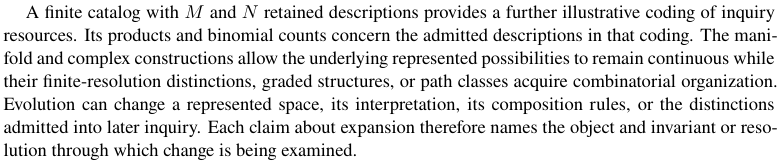
These conditional representations acquire philosophical significance through the distinction between a possible configuration and a warranted use. A large catalog of combinations gives an inventory of descriptions under a stated convention. A question that can be investigated also needs appropriate evidence, interpretable connections, access to resources, and an account of the operations that connect its premises to its conclusions. A use that affects other people additionally engages purposes, institutions, responsibilities, and consequences. When a growing space supplies substantively distinct candidates for consideration, it raises a problem of orientation: which paths deserve attention, how their claims acquire support, and how their effects can become available for criticism and revision. The work required depends on the search, equivalence, and selection procedures used to navigate that space.
Science and the humanities enter the argument through their contributions to these conditions of inquiry. Scientific methods can investigate mechanisms, estimate quantities, construct models, and test consequences. Historical, linguistic, philosophical, cultural, and other humanistic inquiries can investigate the formation of categories, the interpretation of records, the purposes of an intervention, and the reasons for accepting or contesting a judgment. These roles overlap in practice. Their integration can change the object under investigation and the meaning of a successful result. The paper therefore treats the humanities as participants in problem formation, representation, interpretation, and evaluation throughout the inquiry lifecycle.
AI adds a further organizational possibility. Language-model agents can propose combinations, inspect resources, execute supported operations, and contribute candidate revisions to a body of work. Their proposals can become inputs to later projects. The resulting process makes the infrastructure itself a potential object of evolution: interfaces, representations, documentation, tests, evaluative procedures, and project relations can all receive proposed changes. Human mediation then requires a concrete account of who can inspect, redirect, authorize, contest, or retire those changes. The distribution of such capacities becomes a substantive part of the infrastructure’s epistemic and institutional design.
1.1 Research Question and Mode of Argument
The paper asks how an integrative science and humanities infrastructure can organize expanding, pathdependent possibilities for inquiry while sustaining the capacity to interpret, evaluate, and revise their utilization. Its method combines conceptual reconstruction, two illustrative geometric and algebraic proof routes, finite coding examples, a source-grounded design case, and a proposal for evaluating humanmediatable autonomous evolution. Mathematical expressions make the representational assumptions, finite-resolution conventions, composition laws, and selected invariants explicit. They supply a restricted language for examining the motivating intuition about combinatorial expansion. Interpretive and normative arguments address what these counts leave to judgment and evidence.
Three distinctions organize the analysis. The first separates retained resources, possible compositions, and supported uses. The second separates a larger inventory from a changed grammar of inquiry: adding one method can enable new operations on existing resources, while revising a category can alter which questions those resources answer. The third separates the production of candidate changes from their epistemic admission and institutional authorization. Autonomous generation, justified acceptance, and permission to act have different evidential and practical requirements.
The contribution proposed here is a coordinated account of these distinctions for an evolving integrative infrastructure. The combinatorial ingredients have established mathematical histories, and the literatures on integration, recombination, infrastructures, and evolutionary inquiry supply substantial antecedents. The paper develops a particular connection among question-relative compositional possibilities, endogenous changes in those possibilities, and the capacities required to mediate their evaluation. Its source case, Noetarium, supplies a concrete set of design choices through which that connection can be examined. The case gives architectural and documentary evidence; the comparative effects of operating the proposed ecology remain questions for the research design developed later in the paper.
1.2 Structure and Relation to the Technical Reports
Section 2 establishes the conceptual objects and their roles. Section 3 develops the epistemic work of integration and the humanities. Sections 4 and 5 develop the smooth-manifold and cell-complex proof routes. Appendix A supplies supplementary finite-code bundle and path counts. Section 6 examines the relation between utilization, generativity, and future inquiry. Section 7 presents Noetarium as a sourcegrounded case. Sections 8 and 9 give dedicated attention to the author’s project-ecology, grammar, carrier, economic, kybernetic, evaluative-power, and evaluative-norm research. Section 10 proposes an evaluation programme for the evolving infrastructure. Section 11 examines the resulting conceptual claims and conditions of adequacy before the conclusion.
The companion technical reports investigate particular inference, representation, computation, and governance problems. The present inquiry concerns the philosophical organization connecting such work: the growth and selection of possible inquiries, the different warrants involved in integration, the role of human mediation, and the evolution of the infrastructure through its own use. Detailed implementations can test components of this account. The conceptual argument identifies what a component test would need to establish and how its result relates to broader epistemic and institutional claims.
2 Interpretation, Manifestation, and Representational Spaces
The analysis needs counting units and interpretive units that remain distinguishable. This section introduces a small set of paper-local terms for that purpose. Their role is analytical: they specify what the subsequent constructions count, what the infrastructure connects, and what remains to be justified when a candidate combination becomes a proposed use. The definitions leave disciplinary accounts of knowledge, interpretation, and justification available for their own substantive development.
2.1 Pre-Symbolic Relations and Ontological Suspension
Pre-symbolic knowledge names a philosophical point of departure for this paper: experiential, practical, and relational activity considered before its articulation within the particular symbolic scheme being used.
Its precise ontological status remains open. In the Generative Relational perspective considered here, temporal encounters, retained capacities, and changing relations provide a way to investigate how knowledge becomes available for recognition and use. The phrase Generative Relational spacetime provisionally emphasizes such histories and relations in this conceptual programme; the mathematical representation selected for an inquiry receives its own explicit assumptions. That perspective guides the construction of representations whose adequacy can be examined; the mathematical results below concern the explicitly represented structures.
Interpretation selects and articulates features of this activity for an inquiry. Manifestation concerns the forms through which those selected distinctions become available to an observer, participant, or subsequent process. A representation can preserve relations useful for one question while leaving other features outside its scope. Historical experience, embodied competence, and the significance of an encounter can therefore exceed what a particular record makes available. This remainder is a reason to preserve criticism, re-interpretation, and access to the circumstances of use.
The two mathematical routes begin after a representation has been stipulated. In the first route, interpreted features occupy smooth manifolds with task-selected metrics. The product construction investigates composition, and covering or packing numbers investigate distinguishability at a stated resolution. In the second, interpreted relational histories receive cell-complex representations. Algebraic results concern cells, chains, homology, and path classes under the assumptions made explicit in Section 5. The geometric realization of a finite complex contains continuous points. Its combinatorial organization therefore supplies an analytical structure while leaving the ontology of knowledge suspended.
An initial interpretive assignment and a subsequent mathematical map have different roles. An assignment from pre-symbolic activity to a represented space records a modeling commitment. A cellular map between represented complexes carries additional continuity and skeletal conditions. Those conditions permit the chain and homology arguments developed below. Their satisfaction belongs to the justification of the particular interpretive model. A partially articulated, context-dependent, or discontinuous interpretation may require a different mathematical treatment.
2.2 Resources and Their Disciplinary Relations
Definition 2.1 (Knowledge resource). A knowledge resource is a retained carrier, capability, or represented contribution that can enter an inquiry under an identifiable description of its content, provenance, scope, and available modes of use. Examples include a claim, dataset, model, method, historical account, interpretive distinction, evaluative argument, software capability, or documented practice. The term identifies an infrastructural role and leaves the contribution’s substantive epistemic standing to its appropriate forms of assessment.
Definition 2.1 accommodates heterogeneous contributions without assigning them a common unit of truth, value, or complexity. A historical interpretation and a numerical model can each become a resource while carrying different warrants. A reliable simulation routine can have a restricted computational warrant; its application to a social situation can require an additional account of measurement, context, and purpose. An institution’s description of its own procedure can be an important source while its completeness and authority remain open to documentary investigation.
A disciplinary inventory is a selected set of such retained resources. Its boundary is relative to a cataloging convention, period, problem, and community of use. Several inventories can contain related descriptions or overlapping resources. A count therefore needs a declared treatment of aliases and shared membership. For the supplementary finite-code calculations in Appendix A, resource descriptions receive distinct tags so that the combinatorial operation is unambiguous. That convention supports an exact calculation within the model. A historical claim about the amount of knowledge in a discipline would require a separate account of what its units mean and how they were identified.
Disciplinary relations can carry several functions. An evidential relation connects a claim to an observation or source. A computational relation connects an input representation to an operation. An interpretive relation connects a record to a contextual reading. A normative relation connects a proposed action
to an articulated reason or rule. A genealogical relation records the dependence of a category, method, or institution on earlier practices. A single project can involve several of these relations. Preserving their roles helps a reviewer identify what is being transferred at a disciplinary boundary.
2.3 Composition and Inquiry Paths
Definition 2.2 (Inquiry configuration and inquiry path). An inquiry configuration specifies selected resources, their assigned roles, and proposed relations for a question. An inquiry path additionally specifies a sequence of operations and revisions through which the question, resources, or intermediate results can change. Two paths are distinguished to the extent required by the declared analytical task, including relevant differences in intermediate states, evidence obligations, feasible operations, or interpreted outcomes.
Definition 2.2 separates membership from process. A bundle containing an energy model, an account of housing practices, and an argument about distributive justice names three resources. A path specifies when housing practices influence the measurement target, when the model is calibrated, which distributive question is assessed, and how criticism returns to the earlier choices. Counting bundles and counting paths answer different questions. The same membership can support distinct processes; different serialized processes can also become equivalent for a particular downstream query.
Order dependence has substantive content when an earlier operation changes the inputs, admissible operations, evidence, or interpretation available to a later one. Merely writing the same unordered list in several orders changes its description. Investigating a category’s history before constructing a survey can change which response categories are offered; undertaking that investigation after the survey can reveal distinctions the retained observations leave unresolved. The difference concerns the information created and preserved through the process. It therefore gives a basis for examining path dependence beyond a count of permutations.
2.4 Possibility, Accessibility, and Warrant
The paper distinguishes nominal, accessible, and supported possibilities. Nominal configurations satisfy a declared syntax or selection rule. Accessible configurations additionally meet the relevant availability, compatibility, resource, and permission conditions for a specified actor or group. Supported utilization requires an account of why a proposed conclusion or action follows from its evidence, interpretations, and evaluative commitments within its stated scope. These distinctions can be represented through recorded relations; their substantive adequacy remains a matter for the forms of inquiry involved.
Accessibility is relational. A computational tool can be publicly available yet costly to install, difficult to interpret, or inappropriate for a particular record. A community can possess important practical knowledge while lacking the recognized standing or technical interface through which a project accepts contributions. A later infrastructural change can alter access by changing documentation, translation, participation, or maintenance arrangements. The relevant possibility space therefore depends on who is considering an inquiry, for what purpose, with which resources and forms of authority.
Warrant is also differentiated. Numerical agreement supports a claim about a calculation under specified inputs. Source criticism supports an account of a document’s origin and use. An interpretive argument supports a reading through contextual reasons. A normative argument supports a proposed principle through the reasons and objections relevant to its adoption. A proposed integrated conclusion can depend on several such warrants. The infrastructure’s task is to preserve their relations sufficiently for inquiry and criticism, including the places at which additional justification is required.
2.5 Utilization and the Retention of Future Capacities
Utilization includes investigation, explanation, interpretation, design, learning, criticism, and practical intervention. Its effects can include a completed task, a revised category, a new question, a reusable method, a maintained relation, or a reason to retire an earlier inference. These effects have different meanings and may be valued by different participants. The analysis consequently examines how they are
documented and made available for subsequent inquiry without assuming a common cardinal measure of benefit.
A resource can acquire additional uses through a new relation while its original content remains stable. Conversely, a corrected interpretation can reduce the set of uses previously attributed to a resource. Both changes can improve the organization of inquiry when their reasons are supported. Generativity in this setting concerns the capacity to sustain or enable further appropriate processes. An expanding catalog, a surviving project, a flourishing community of inquiry, and a justified intervention remain distinct outcomes whose relationships call for examination.
The remainder of the paper uses these distinctions to interpret combinatorial expansion. An increase in a covering number, a cell count, a homological rank, or a finite-code configuration count identifies a specific change within its represented model. A claim about accessible inquiry additionally requires the relevant relational and institutional conditions. A claim about valuable utilization requires articulated purposes and evidence about consequences. This differentiated vocabulary allows the motivating combinatorial intuition to become a precise part of a broader philosophical argument.
3 Epistemic Integration Across Scientific And Humanistic Inquiry
An integrative inquiry infrastructure has to connect practices that establish different kinds of understanding. A physical model, an archival interpretation, and an argument about a public obligation can bear on the same situation while answering different questions. Their combination requires an account of the relations through which each becomes relevant to another. This section develops that account through a comparison with established integration approaches and a constructed example. The proposed unit of analysis is a revisable path of inquiry: a sequence of representations, interpretive decisions, and evidential handoffs that makes a particular question investigable. Such a path can preserve disciplinary differences while creating possibilities that the contributing resources support jointly.
3.1 Pluralism, Coordination, And Shared Objects
Existing integration research already explains several forms of cooperation across heterogeneous practices. Star and Griesemer’s museum study relates collaboration to standardized methods and boundary objects that accommodate different viewpoints while remaining recognizable across participating social worlds (Star and Griesemer, 1989). Their historical explanation gives shared objects an organizational and interpretive role. It provides an antecedent for an infrastructure in which the same collection supports distinct research purposes, with the relationships among those purposes available for inspection.
Galison’s account of trading zones locates coordination among scientific subcultures in local practices of exchange. Different wider meanings and standards can coexist with workable procedures and contact languages (Galison, 1999). Mitchell and Dietrich similarly defend explanatory integration for complex biological phenomena alongside pluralism and the limits of broad theoretical unification (Mitchell and Dietrich, 2006). These approaches establish a substantive starting point: integration can involve cooperation and explanatory connection while preserving differences among its participants. A proposed platform inherits that insight when it supports several representations of a common situation.
The present argument concerns the subsequent career of those connections. Suppose two research groups agree on a shared representation. Its later use introduces a further question: which conclusions remain supported when the purpose, population, interpretation, or procedure changes? Local agreement supplies a starting commitment whose scope can be carried forward. An infrastructure can record that commitment, identify the research purposes it supports, and retain the reasons for revisiting it. The proposed contribution is to make the evolution of such connections part of the research object itself.
Epistemic integration will therefore mean the establishment and revision of question-relative relations among research resources. A relation may connect measurements to a model, historical sources to an interpretation, or an evaluation principle to a proposed action. Its specification identifies what the receiving inquiry takes from the contributing practice and which judgments remain there. A numerical estimate can become an input to a historical explanation without turning that explanation into an estimate. An
interpretation of a legal category can change a statistical grouping while retaining its own documentary and argumentative support. These relations give heterogeneous knowledge a usable connection and a continuing place for disagreement.
3.2 Humanistic Inquiry In The Formation Of Research Objects
Scientific and humanistic resources can enter an integrative project during its formulation. The categories through which a situation becomes observable, the historical identities assigned to actors, and the significance attributed to a change already shape what can be investigated. Humanistic inquiry contributes methods for examining those commitments. Its participation can alter the object, the question, and the representation through which subsequent analysis proceeds.
Skinner’s revised methodological essay questions the assumption that canonical texts address a fixed set of timeless problems and can simply be read as contemporary interventions (Skinner, 2002). That concern motivates attention to the historical situations in which a category acquires its meaning. An administrative term used in two periods may require separate interpretations before a researcher decides which comparisons are warranted. A stable spelling, database identifier, or translation equivalent leaves that historical work open.
Drucker’s account of graphical display gives humanistic interpretation a constructive role in representation. Her discussion of capta and interpretive coordinates distinguishes displaying uncertainty within a ready-made frame from constructing a frame through interpretation. Her treatment of temporality likewise connects representation to relationships among events and viewpoints (Drucker, 2011). An integrative infrastructure can draw on that argument by preserving the choices through which its categories, spatial divisions, and temporal relations were formed. Different fields can then assess which features of the representation matter to their questions.
Consider a constructed inquiry into heat exposure and public space in a city. A physical analysis might estimate temperatures and shade at specified locations. An administrative collection might identify streets, buildings, and registered residents. Historical research could establish how a square became classified as public space, which uses its records preserve, and which populations appear under changing administrative descriptions. Literary, visual, and oral materials could support interpretations of how the place is experienced and remembered. A political argument could examine the standing of different claims to access or protection. Each contribution changes the inquiry through its own evidential and interpretive work.
The physical estimate and the historical interpretation can support a joint question about the consequences of a redevelopment. Establishing that connection requires a justified relation between modeled locations and historically situated places, as well as a decision about the relevant period and population. The resulting spatial unit may differ from the available administrative polygon. Historical inquiry has then contributed to the model’s object of analysis. A subsequent account of exposure will inherit that decision and can retain the documentary grounds and competing readings that informed it.
The example also permits distinct outcomes. One inquiry may seek a defensible intervention; another may seek to understand a changing conception of public life. A narrative interpretation can remain useful even when it yields several defensible readings. A numerical model can remain useful for a bounded physical question while a dispute about the relevant affected population continues. Integration supports these outcomes by relating their questions and evidence. It gives the humanities a role in producing understanding, identifying alternatives, and transforming the terms of inquiry.
This account treats scientific and humanistic inquiry as internally diverse. Historical interpretation can employ statistical evidence, and empirical science can depend on contextual judgment and conceptual reconstruction. The analytical distinction concerns what a particular contribution establishes. An infrastructure can make that standing explicit while allowing methods and participants to move across disciplinary boundaries.
3.3 Translation, Warrant, And Knowledge Use
Making a representation available for reuse introduces an evidential question. Leonelli’s relational account treats data status as dependent on the role an object plays in inquiry and on its prospective use as evidence. Her discussion of portability connects that role to the media and transformations through which research outputs travel (Leonelli, 2015). The implication developed here is that a stored object and a supported use of that object deserve distinct records. A dataset can remain available while a particular interpretation of its relevance receives revision.
A translation between practices should identify both its achievement and its remainder. In the heat example, a conversion from residents’ descriptions of a place to spatial categories might preserve references to particular routes while simplifying their temporal or experiential significance. The receiving model can use the preserved distinction for a specified question. The source descriptions continue to support inquiries requiring what the conversion set aside. A translational remainder names those retained differences, unresolved correspondences, and questions whose support depends on returning to the contributing practice.
The remainder can be recorded through ordinary scholarly means. A mapping can retain passages supporting an interpretation, describe competing readings, and state the consequences of selecting one. A computational conversion can identify the variables and relations it preserves. A comparison between periods can document which meanings were reconstructed and how their differences affect the comparison. These records make the cost of reuse intelligible. They also create an avenue for specialist criticism when a receiving inquiry places more weight on a translation than its grounds support.
Different handoffs call for different kinds of warrant. An empirical handoff may require a measurement model and an uncertainty assessment. An interpretive handoff may require contextual evidence and an argument addressing plausible rival readings. A normative handoff may require reasons for the principle used and an account of who has standing in its application. A completed numerical check establishes its declared computational property. Documentary interpretation and justification of the evaluative principle remain substantive parts of the joint inquiry. Their recorded relationships allow a reader to assess how the eventual conclusion is supported.
Cartwright’s analysis of evidence-based policy distinguishes the credibility of an empirical finding from its relevance to the proposed conclusion. Her implementation-scenario argument connects evidence of efficacy to the circumstances under which a policy would operate (Cartwright, 2009). The present framework generalizes the design question across kinds of use: which additional premises connect an available result to the task now being undertaken? The proposed generalization is methodological; a concrete application still has to establish those premises within its subject matter.
Utilizable knowledge, in this account, is knowledge accompanied by a sufficiently articulated route into a specified inquiry or practice. Its uses include interpretation, explanation, criticism, and the formulation of further questions, alongside prediction and intervention. A resource’s usability can therefore grow through a new interpretation or an explicit limit on a former application. Making an unsupported connection visible can improve an inquiry even when the immediate outcome is a narrower claim. The infrastructure’s contribution concerns that availability and inspectability; the value of the use remains open to disciplinary and public judgment.
3.4 Path Dependence And The Revision Of Possibilities
The order in which resources are related can change the questions that remain accessible. Aggregating administrative records before examining the history of their categories may merge distinctions needed for a later interpretation. Reconstructing those categories first can motivate a different aggregation and a different model. Both routes use the same initial collections, yet they arrive at different research objects. Recovering the richer question may require renewed access to the source and additional interpretive work.
Path dependence consequently concerns more than the time needed to assemble a workflow. A decision about representation can reshape the available alternatives. Once a project organizes its collections, expertise, and validation around that decision, some later connections become easier and others become
costly. Conversely, a newly established relation can open several follow-on questions by making a source or method intelligible to additional participants. The space of possible inquiries changes through the work performed within it.
Edwards and colleagues describe knowledge infrastructures through interacting people, artifacts, institutions, and practices. Their report examines incompatible ontologies, maintenance, and the adaptation required for continuing use across domains (Edwards et al., 2013). Star and Ruhleder’s earlier study of a genetics community system also reports access and use difficulties involving organizational and intellectual communication despite favorable interface feedback (Star and Ruhleder, 1996). These antecedents support treating sustained integration as collective work with historical and institutional conditions.
The specific extension proposed here attaches those conditions to the future possibilities of inquiry. Preserving a distinction can keep a later comparison available. Retaining a rival interpretation can support a question that the initial project left aside. Recording a failed translation can prevent a later team from rebuilding an apparently available connection on the same inadequate premise. These are prospective effects of infrastructural choices. Assessing their extent requires observations of actual reuse and revision.
Knowledge evolution also includes changes to the questions and standards themselves. A revised concept of public space might redirect the heat inquiry from average residential exposure toward access during particular activities. Earlier results remain interpretable under their original questions, while the new target creates additional requirements. The infrastructure can preserve that succession and show which relationships were retained, reconstructed, or left unresolved. Continued inquiry then becomes an explicit research outcome whose assessment includes what later investigators can examine and contest.
3.5 Critical Participation And The Contribution Of The Framework
The authority to establish and revise a connection deserves attention alongside its technical representation. Longino’s account gives criticism an epistemic role in exposing background assumptions. Her proposed conditions include venues, uptake, public standards, and tempered equality of intellectual authority; the standards themselves remain subject to scrutiny (Longino, 2004). These conditions motivate a design in which a documented objection can affect the standing and use of a relation. Providing a field for comments supplies only one element of that institutional arrangement.
For the constructed heat inquiry, a historian might challenge a cross-period category mapping, a resident might contest the population represented by an access claim, and a modeler might identify an unsupported physical extrapolation. Each objection bears on a different relationship in the inquiry. A review procedure can identify the affected claims, record the response, and preserve an unresolved objection where relevant. Resources for participation, interpretive authority, and review remain organizational commitments requiring their own justification.
The framework’s contribution is a particular coordination of these established insights. Boundary objects and trading zones explain workable relations across heterogeneous meanings; pluralist accounts support several forms of understanding; infrastructure studies explain the collective conditions of maintenance. The present argument makes the question-relative path, its translational remainder, and its revision consequences the objects through which such integration can be specified and assessed. It thereby connects the combinatorial availability of resources to the historically developing possibilities of warranted inquiry.
Evaluation can compare routes through a shared research collection while preserving the information and expert support available to each route. Relevant observations include which distinctions survive translation, which judgments specialists accept, how an objection changes downstream claims, and which later questions remain investigable. Historical and interpretive assessments would contribute to defining those outcomes as well as evaluating them. Such studies could establish the practical reach of the proposal. The conceptual argument supplies a basis for that work while leaving disciplinary adequacy and the worth of particular uses to continued inquiry.
Readable text
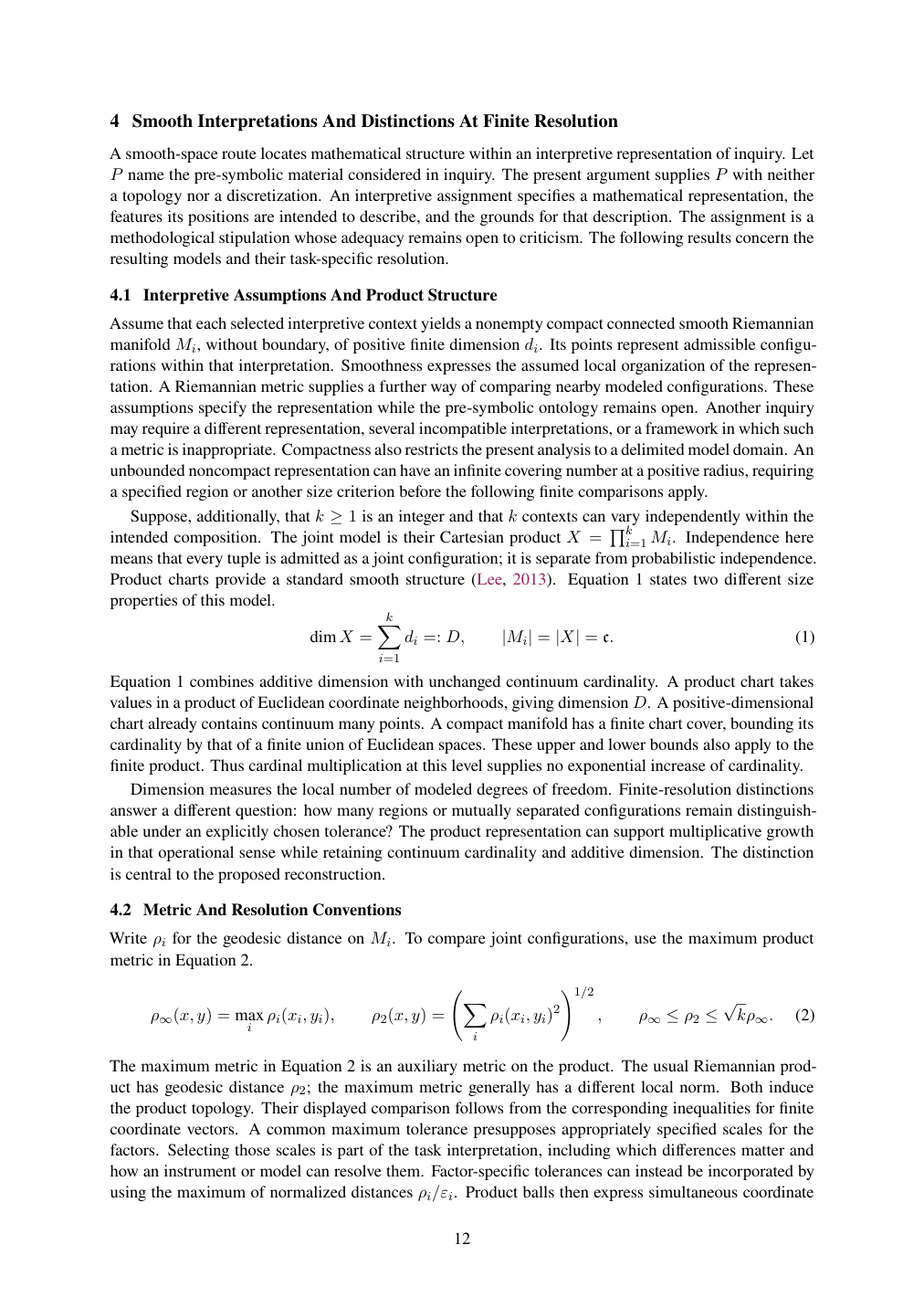
4 Smooth Interpretations And Distinctions At Finite Resolution
A smooth-space route locates mathematical structure within an interpretive representation of inquiry. Let a topology nor a discretization. An interpretive assignment specifies a mathematical representation, the features its positions are intended to describe, and the grounds for that description. The assignment is a methodological stipulation whose adequacy remains open to criticism. The following results concern the
resulting models and their task-specific resolution.
Assume that each selected interpretive context yields a nonempty compact connected smooth Riemannian rations within that interpretation. Smoothness expresses the assumed local organization of the represen- tation. A Riemannian metric supplies a further way of comparing nearby modeled configurations. These assumptions specify the representation while the pre-symbolic ontology remains open. Another inquiry may require a different representation, several incompatible interpretations, or a framework in which such a metric is inappropriate. Compactness also restricts the present analysis to a delimited model domain. An unbounded noncompact representation can have an infinite covering number at a positive radius, requiring a specified region or another size criterion before the following finite comparisons apply.
means that every tuple is admitted as a joint configuration; it is separate from probabilistic independence. Product charts provide a standard smooth structure (Lee, 2013). Equation 1 states two different size
Equation 1 combines additive dimension with unchanged continuum cardinality. A product chart takes chart already contains continuum many points. A compact manifold has a finite chart cover, bounding its cardinality by that of a finite union of Euclidean spaces. These upper and lower bounds also apply to the finite product. Thus cardinal multiplication at this level supplies no exponential increase of cardinality.
Dimension measures the local number of modeled degrees of freedom. Finite-resolution distinctions answer a different question: how many regions or mutually separated configurations remain distinguish- able under an explicitly chosen tolerance? The product representation can support multiplicative growth in that operational sense while retaining continuum cardinality and additive dimension. The distinction
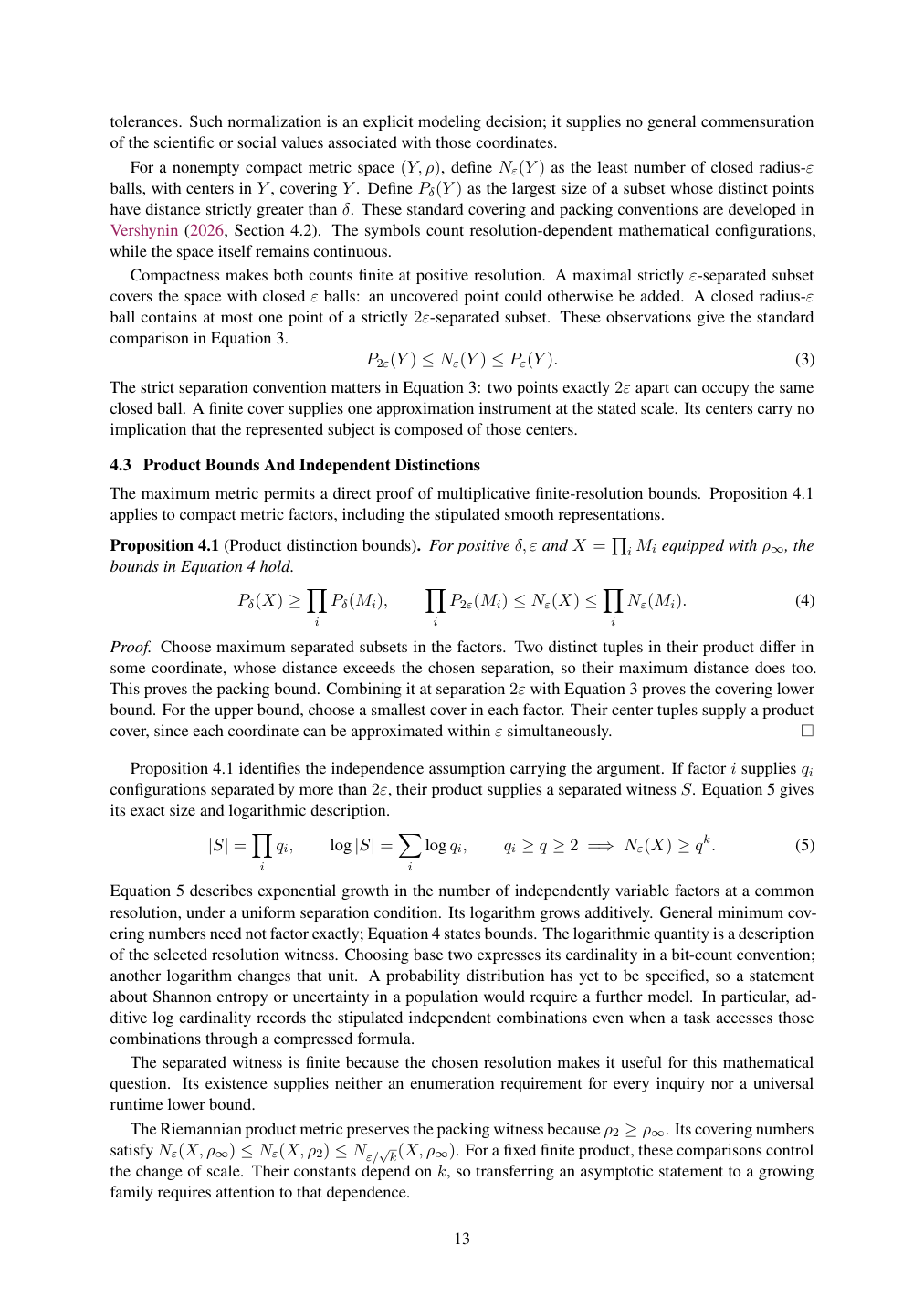
The maximum metric in Equation 2 is an auxiliary metric on the product. The usual Riemannian prod- the product topology. Their displayed comparison follows from the corresponding inequalities for finite coordinate vectors. A common maximum tolerance presupposes appropriately specified scales for the factors. Selecting those scales is part of the task interpretation, including which differences matter and how an instrument or model can resolve them. Factor-specific tolerances can instead be incorporated by
Readable text
tolerances. Such normalization is an explicit modeling decision; it supplies no general commensuration of the scientific or social values associated with those coordinates.
Vershynin (2026, Section 4.2). The symbols count resolution-dependent mathematical configurations,
closed ball. A finite cover supplies one approximation instrument at the stated scale. Its centers carry no implication that the represented subject is composed of those centers.
The maximum metric permits a direct proof of multiplicative finite-resolution bounds. Proposition 4.1 applies to compact metric factors, including the stipulated smooth representations.
Proof. Choose maximum separated subsets in the factors. Two distinct tuples in their product differ in some coordinate, whose distance exceeds the chosen separation, so their maximum distance does too. bound. For the upper bound, choose a smallest cover in each factor. Their center tuples supply a product
Equation 5 describes exponential growth in the number of independently variable factors at a common resolution, under a uniform separation condition. Its logarithm grows additively. General minimum cov- ering numbers need not factor exactly; Equation 4 states bounds. The logarithmic quantity is a description of the selected resolution witness. Choosing base two expresses its cardinality in a bit-count convention; another logarithm changes that unit. A probability distribution has yet to be specified, so a statement about Shannon entropy or uncertainty in a population would require a further model. In particular, ad- ditive log cardinality records the stipulated independent combinations even when a task accesses those
The separated witness is finite because the chosen resolution makes it useful for this mathematical question. Its existence supplies neither an enumeration requirement for every inquiry nor a universal
Readable text
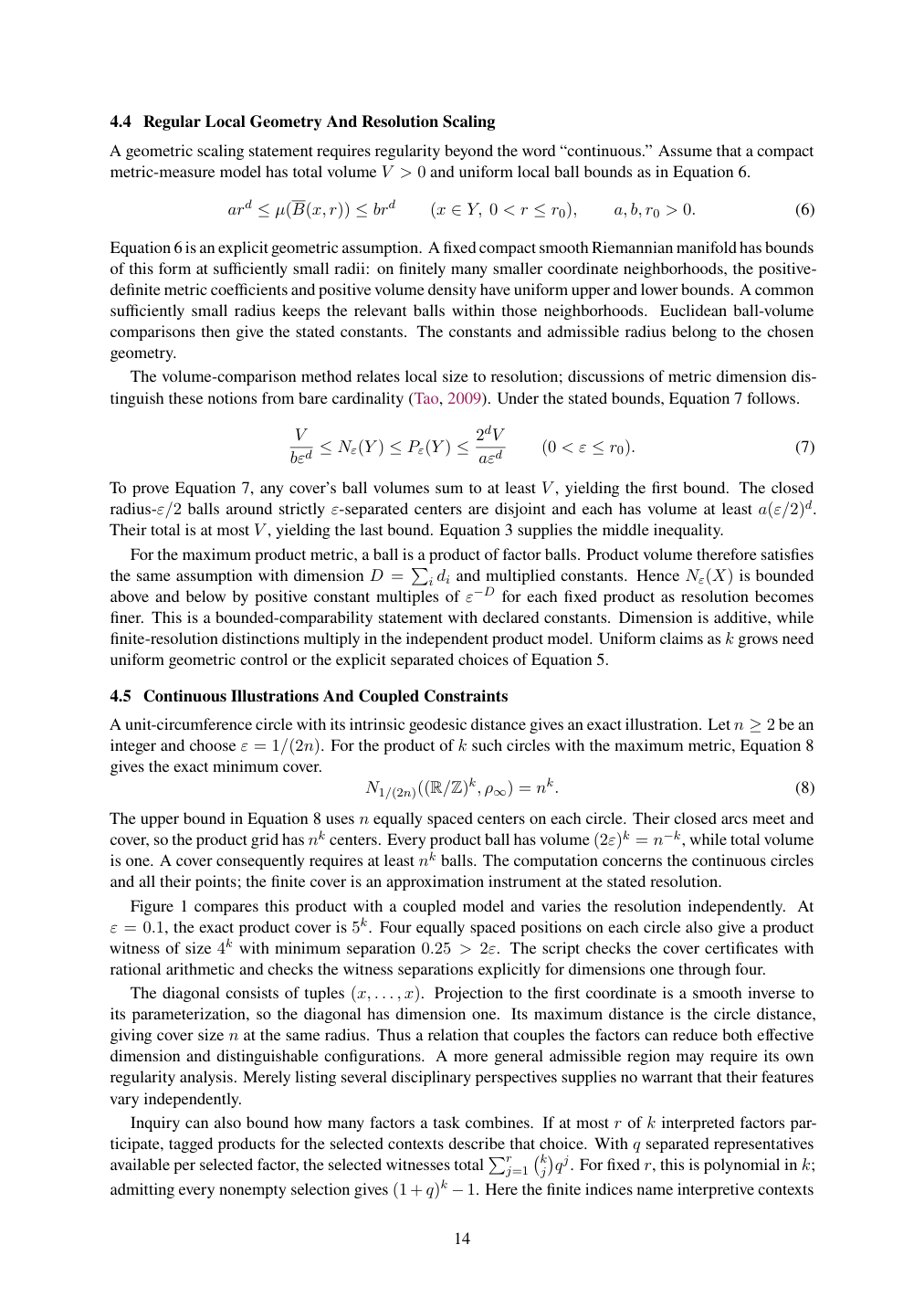
A geometric scaling statement requires regularity beyond the word “continuous.” Assume that a compact
Equation 6 is an explicit geometric assumption. A fixed compact smooth Riemannian manifold has bounds of this form at sufficiently small radii: on finitely many smaller coordinate neighborhoods, the positive- definite metric coefficients and positive volume density have uniform upper and lower bounds. A common sufficiently small radius keeps the relevant balls within those neighborhoods. Euclidean ball-volume comparisons then give the stated constants. The constants and admissible radius belong to the chosen
The volume-comparison method relates local size to resolution; discussions of metric dimension dis- tinguish these notions from bare cardinality (Tao, 2009). Under the stated bounds, Equation 7 follows.
For the maximum product metric, a ball is a product of factor balls. Product volume therefore satisfies
finer. This is a bounded-comparability statement with declared constants. Dimension is additive, while uniform geometric control or the explicit separated choices of Equation 5.
and all their points; the finite cover is an approximation instrument at the stated resolution.
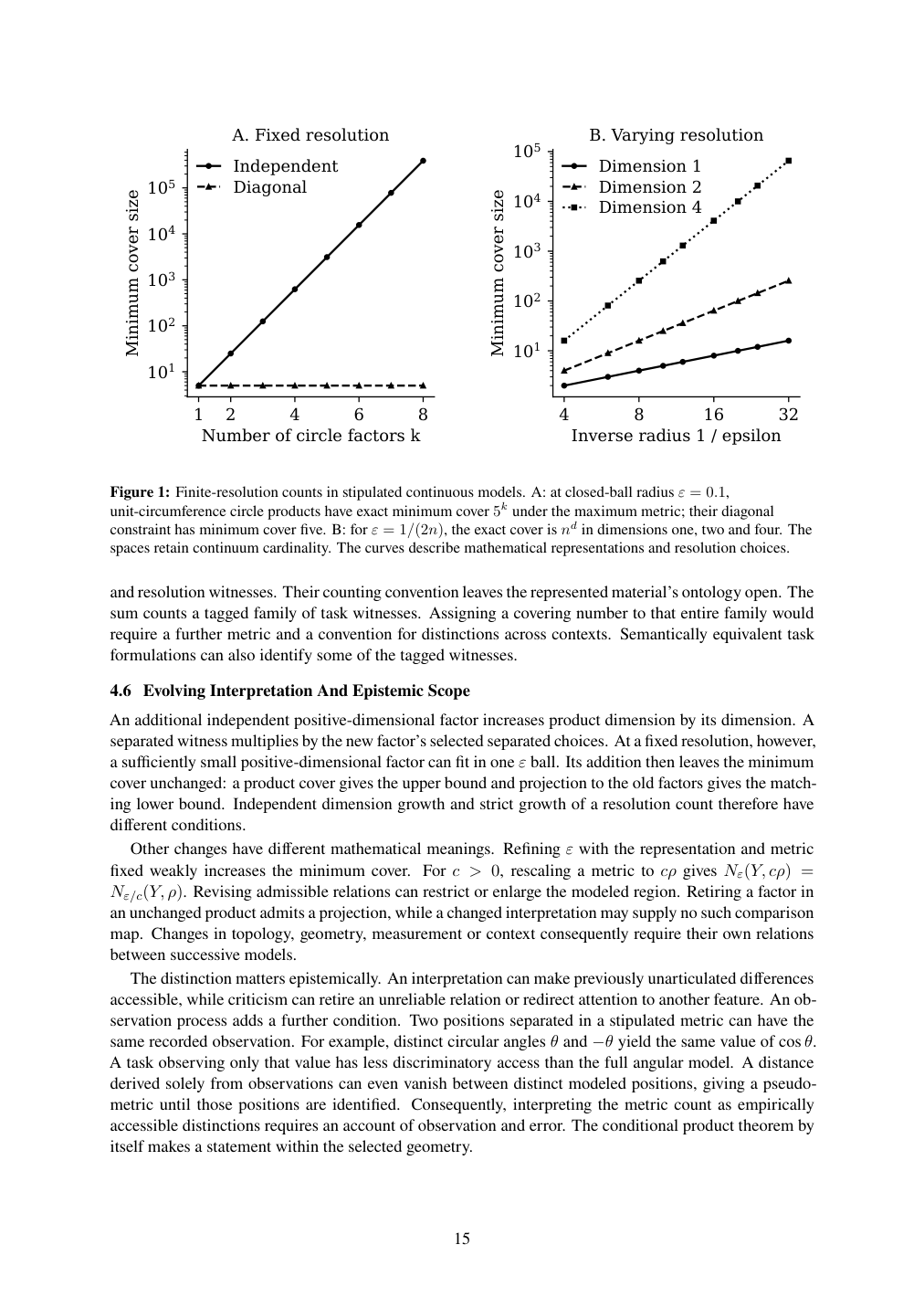
Figure 1 compares this product with a coupled model and varies the resolution independently. At rational arithmetic and checks the witness separations explicitly for dimensions one through four.
its parameterization, so the diagonal has dimension one. Its maximum distance is the circle distance, dimension and distinguishable configurations. A more general admissible region may require its own regularity analysis. Merely listing several disciplinary perspectives supplies no warrant that their features
Readable text
spaces retain continuum cardinality. The curves describe mathematical representations and resolution choices.
and resolution witnesses. Their counting convention leaves the represented material’s ontology open. The sum counts a tagged family of task witnesses. Assigning a covering number to that entire family would require a further metric and a convention for distinctions across contexts. Semantically equivalent task formulations can also identify some of the tagged witnesses.
An additional independent positive-dimensional factor increases product dimension by its dimension. A separated witness multiplies by the new factor’s selected separated choices. At a fixed resolution, however, cover unchanged: a product cover gives the upper bound and projection to the old factors gives the match- ing lower bound. Independent dimension growth and strict growth of a resolution count therefore have
an unchanged product admits a projection, while a changed interpretation may supply no such comparison map. Changes in topology, geometry, measurement or context consequently require their own relations
The distinction matters epistemically. An interpretation can make previously unarticulated differences accessible, while criticism can retire an unreliable relation or redirect attention to another feature. An ob- servation process adds a further condition. Two positions separated in a stipulated metric can have the A task observing only that value has less discriminatory access than the full angular model. A distance derived solely from observations can even vanish between distinct modeled positions, giving a pseudo- metric until those positions are identified. Consequently, interpreting the metric count as empirically accessible distinctions requires an account of observation and error. The conditional product theorem by
itself makes a statement within the selected geometry.
The associated change in resolution counts describes that modeling history. Its scientific worth depends on the interpretation’s warrants, the relevance of its distinctions and the consequences of its use. A metric of proximity may itself be contested where perspectives preserve different meanings or values.
This route establishes a conditional statement about independently variable continuous representations. It supports an account of expanding inquiry possibilities while keeping cardinality, dimension, finiteresolution complexity and realized discovery distinct. Section 5 develops a complementary algebraic route through structured spaces and their invariants. Both routes provide mathematical models for examining relational possibilities; their application to pre-symbolic material remains an interpretive and revisable research commitment.
5 Cellular Composition, Interpretation, And Algebraic Distinctions
A cellular representation supplies an algebraic route for examining how composition and interpretation change a structured space. Its objects are finite CW complexes: spaces built by attaching finitely many cells along specified boundary maps. This section derives product identities, examines the distinctions retained by interpretation maps, and compares two forms of structural revision. The ingredients are established topology. Standard constructions of products, cellular homology, induced maps, and the fieldcoefficient Künneth theorem provide the foundations (Hatcher, 2002, Ch. 0; Secs. 1.2, 2.2, 3.B). The contribution here is their coordinated use in an explicitly conditional account of composition, manifestation, and evolving inquiry.
5.1 Representational Assumptions And Cellular Structure
The initial interpretive assignment selects a complex and the relations it is intended to represent. The presymbolic domain is left without an assumed topology or inventory of knowledge atoms. Consequently, assigning a CW representation carries a substantive commitment about which distinctions and relations will enter the model. A vertex, edge, or face receives its role through that assignment. Its existence as a cell establishes a feature of the representation; the connection to a phenomenon, interpretation, or practice requires the corresponding disciplinary argument.
A finite two-dimensional CW complex offers one possible initial representation. Its vertices can identify locally distinguished positions; edges can connect them; attaching loops for faces can specify relations among those connections. These roles are stipulated for the inquiry. The formalism permits endpoints of an edge to coincide and a face boundary to traverse an edge several times. Retaining the actual attaching map therefore matters. A list of numbers of vertices, edges, and faces gives a coarser description than the complex itself.
The choice is compatible with the interpretive work discussed in Section 3. A historical comparison may motivate different vertices or relations from those chosen for a physical measurement model of the same material. An uncertainty about their correspondence can remain an unresolved part of the representation. Selecting a finite complex makes particular calculations available while leaving the adequacy of the selection open to criticism.
Several operations will receive distinct meanings. A Cartesian product models independently available coordinates under a declared composition rule. A cellular map models a specified subsequent interpretation or manifestation between already represented spaces. Attaching a cell changes the represented relations. Subdivision refines a cellular presentation of the same space. Each operation can be useful in an inquiry, and their algebraic consequences differ. In particular, products of two-dimensional complexes generally contain higher-dimensional cells. The calculations below retain those cells; returning a product to two dimensions would be an additional operation requiring its own justification.
5.2 Product Cells And Graded Composition

Readable text
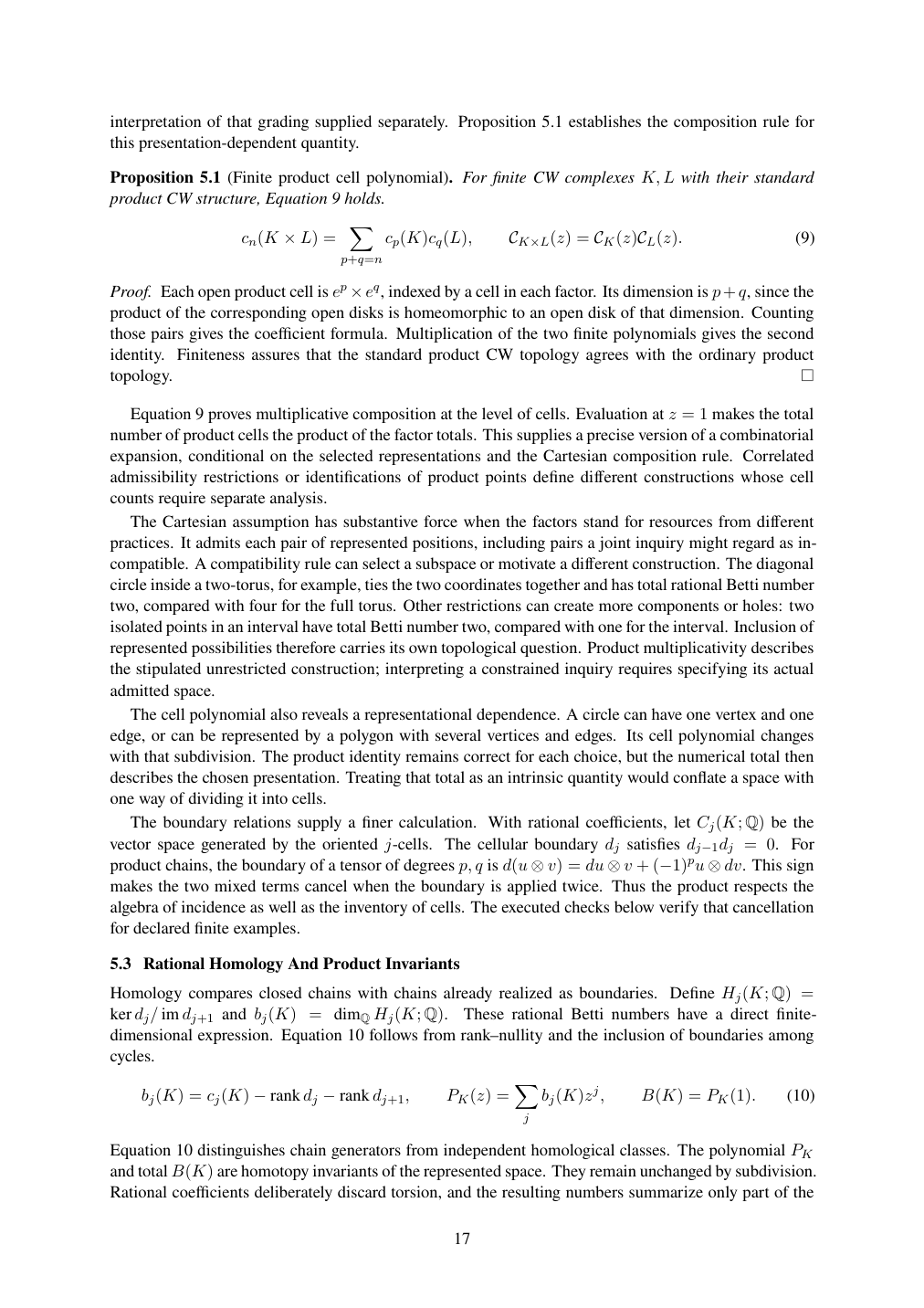
interpretation of that grading supplied separately. Proposition 5.1 establishes the composition rule for
product of the corresponding open disks is homeomorphic to an open disk of that dimension. Counting those pairs gives the coefficient formula. Multiplication of the two finite polynomials gives the second identity. Finiteness assures that the standard product CW topology agrees with the ordinary product
number of product cells the product of the factor totals. This supplies a precise version of a combinatorial expansion, conditional on the selected representations and the Cartesian composition rule. Correlated admissibility restrictions or identifications of product points define different constructions whose cell
The Cartesian assumption has substantive force when the factors stand for resources from different practices. It admits each pair of represented positions, including pairs a joint inquiry might regard as in- compatible. A compatibility rule can select a subspace or motivate a different construction. The diagonal circle inside a two-torus, for example, ties the two coordinates together and has total rational Betti number two, compared with four for the full torus. Other restrictions can create more components or holes: two isolated points in an interval have total Betti number two, compared with one for the interval. Inclusion of represented possibilities therefore carries its own topological question. Product multiplicativity describes the stipulated unrestricted construction; interpreting a constrained inquiry requires specifying its actual
The cell polynomial also reveals a representational dependence. A circle can have one vertex and one edge, or can be represented by a polygon with several vertices and edges. Its cell polynomial changes with that subdivision. The product identity remains correct for each choice, but the numerical total then describes the chosen presentation. Treating that total as an intrinsic quantity would conflate a space with
makes the two mixed terms cancel when the boundary is applied twice. Thus the product respects the algebra of incidence as well as the inventory of cells. The executed checks below verify that cancellation
dimensional expression. Equation 10 follows from rank–nullity and the inclusion of boundaries among
Rational coefficients deliberately discard torsion, and the resulting numbers summarize only part of the
Readable text
topology. Their interpretation as features of an inquiry consequently remains tied to the model and the
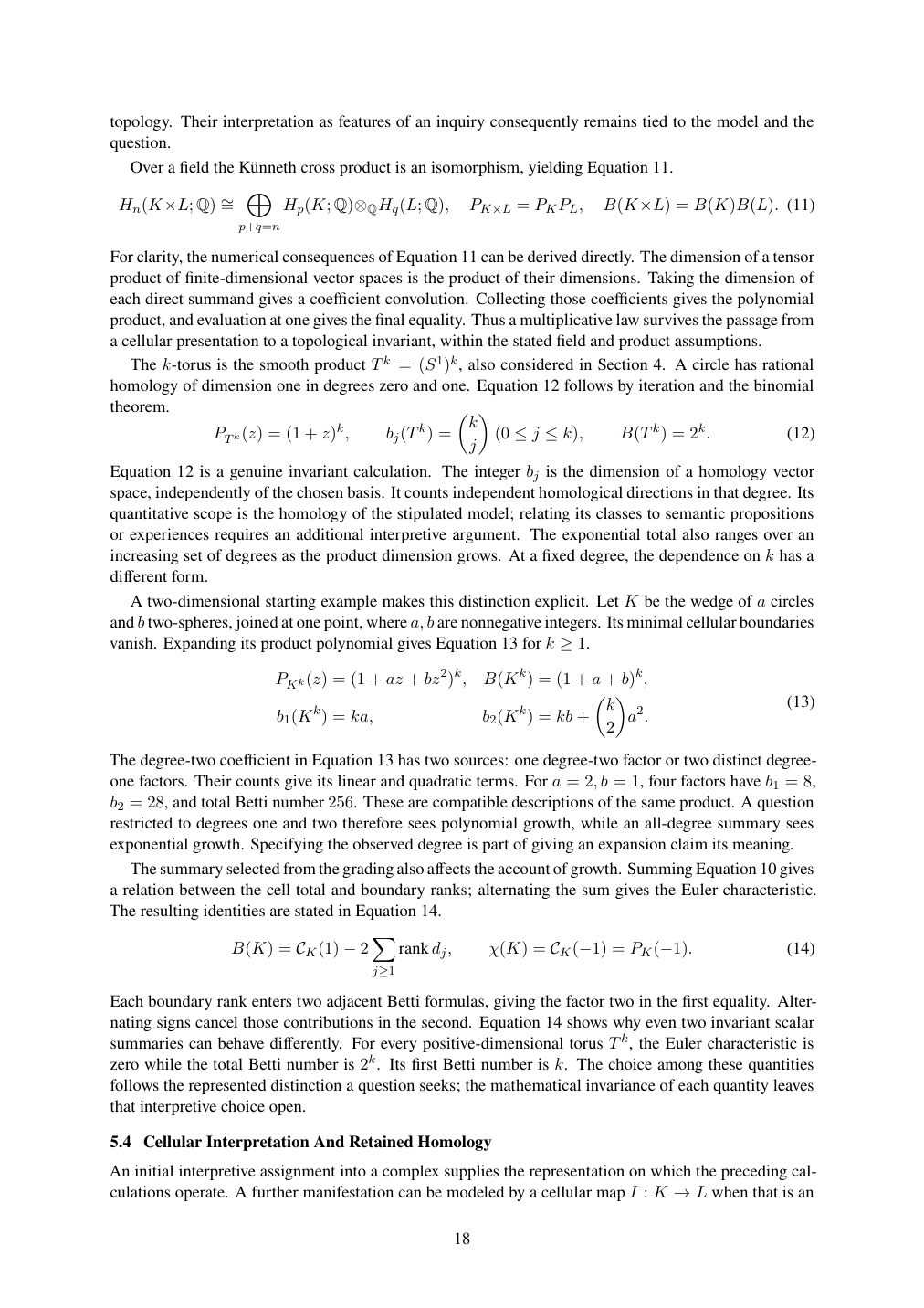
Over a field the Künneth cross product is an isomorphism, yielding Equation 11.
For clarity, the numerical consequences of Equation 11 can be derived directly. The dimension of a tensor product of finite-dimensional vector spaces is the product of their dimensions. Taking the dimension of each direct summand gives a coefficient convolution. Collecting those coefficients gives the polynomial product, and evaluation at one gives the final equality. Thus a multiplicative law survives the passage from a cellular presentation to a topological invariant, within the stated field and product assumptions.
homology of dimension one in degrees zero and one. Equation 12 follows by iteration and the binomial
space, independently of the chosen basis. It counts independent homological directions in that degree. Its quantitative scope is the homology of the stipulated model; relating its classes to semantic propositions or experiences requires an additional interpretive argument. The exponential total also ranges over an
The degree-two coefficient in Equation 13 has two sources: one degree-two factor or two distinct degree- restricted to degrees one and two therefore sees polynomial growth, while an all-degree summary sees exponential growth. Specifying the observed degree is part of giving an expansion claim its meaning.
The summary selected from the grading also affects the account of growth. Summing Equation 10 gives a relation between the cell total and boundary ranks; alternating the sum gives the Euler characteristic.
Each boundary rank enters two adjacent Betti formulas, giving the factor two in the first equality. Alter- nating signs cancel those contributions in the second. Equation 14 shows why even two invariant scalar follows the represented distinction a question seeks; the mathematical invariance of each quantity leaves
An initial interpretive assignment into a complex supplies the representation on which the preceding cal-
Readable text
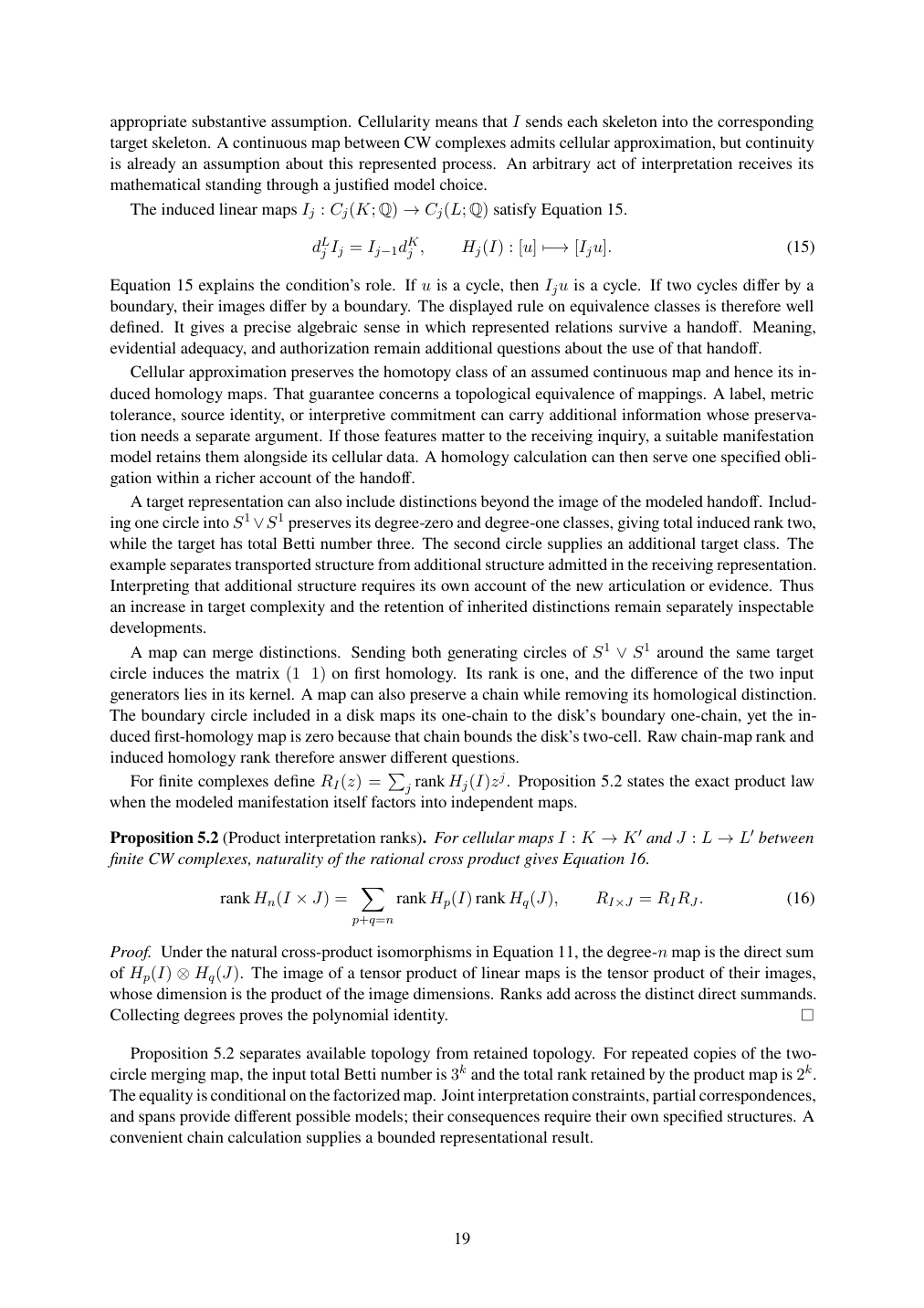
target skeleton. A continuous map between CW complexes admits cellular approximation, but continuity is already an assumption about this represented process. An arbitrary act of interpretation receives its mathematical standing through a justified model choice.
boundary, their images differ by a boundary. The displayed rule on equivalence classes is therefore well defined. It gives a precise algebraic sense in which represented relations survive a handoff. Meaning, evidential adequacy, and authorization remain additional questions about the use of that handoff.
Cellular approximation preserves the homotopy class of an assumed continuous map and hence its in- duced homology maps. That guarantee concerns a topological equivalence of mappings. A label, metric tolerance, source identity, or interpretive commitment can carry additional information whose preserva- tion needs a separate argument. If those features matter to the receiving inquiry, a suitable manifestation model retains them alongside its cellular data. A homology calculation can then serve one specified obli-
A target representation can also include distinctions beyond the image of the modeled handoff. Includ- while the target has total Betti number three. The second circle supplies an additional target class. The example separates transported structure from additional structure admitted in the receiving representation. Interpreting that additional structure requires its own account of the new articulation or evidence. Thus an increase in target complexity and the retention of inherited distinctions remain separately inspectable
circle induces the matrix (1 1) on first homology. Its rank is one, and the difference of the two input generators lies in its kernel. A map can also preserve a chain while removing its homological distinction. The boundary circle included in a disk maps its one-chain to the disk’s boundary one-chain, yet the in- duced first-homology map is zero because that chain bounds the disk’s two-cell. Raw chain-map rank and induced homology rank therefore answer different questions.
when the modeled manifestation itself factors into independent maps.
finite CW complexes, naturality of the rational cross product gives Equation 16.
whose dimension is the product of the image dimensions. Ranks add across the distinct direct summands.
Proposition 5.2 separates available topology from retained topology. For repeated copies of the two- The equality is conditional on the factorized map. Joint interpretation constraints, partial correspondences, and spans provide different possible models; their consequences require their own specified structures. A convenient chain calculation supplies a bounded representational result.
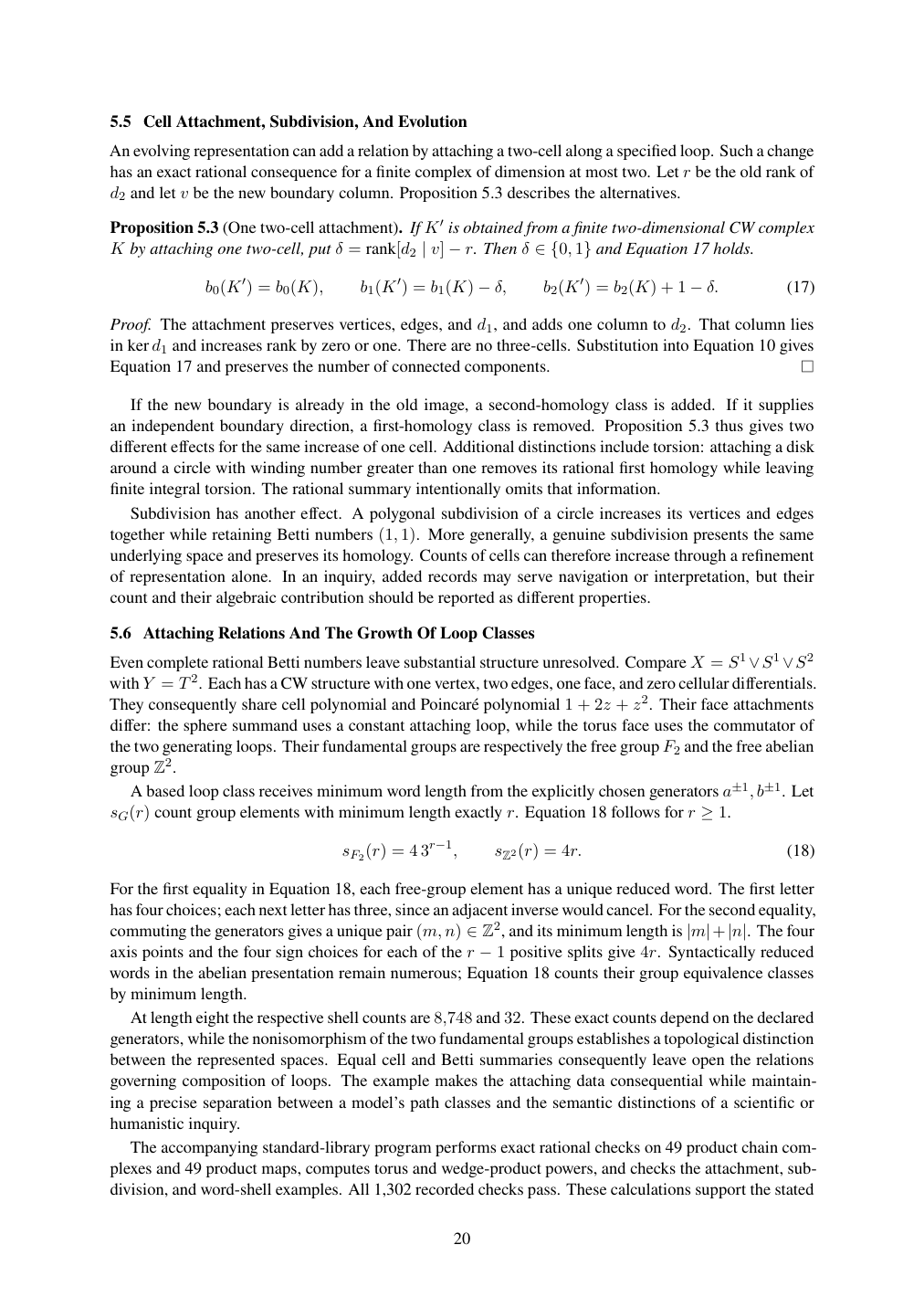
Readable text
An evolving representation can add a relation by attaching a two-cell along a specified loop. Such a change
Equation 17 and preserves the number of connected components.
If the new boundary is already in the old image, a second-homology class is added. If it supplies an independent boundary direction, a first-homology class is removed. Proposition 5.3 thus gives two different effects for the same increase of one cell. Additional distinctions include torsion: attaching a disk around a circle with winding number greater than one removes its rational first homology while leaving finite integral torsion. The rational summary intentionally omits that information.
Subdivision has another effect. A polygonal subdivision of a circle increases its vertices and edges underlying space and preserves its homology. Counts of cells can therefore increase through a refinement of representation alone. In an inquiry, added records may serve navigation or interpretation, but their count and their algebraic contribution should be reported as different properties.
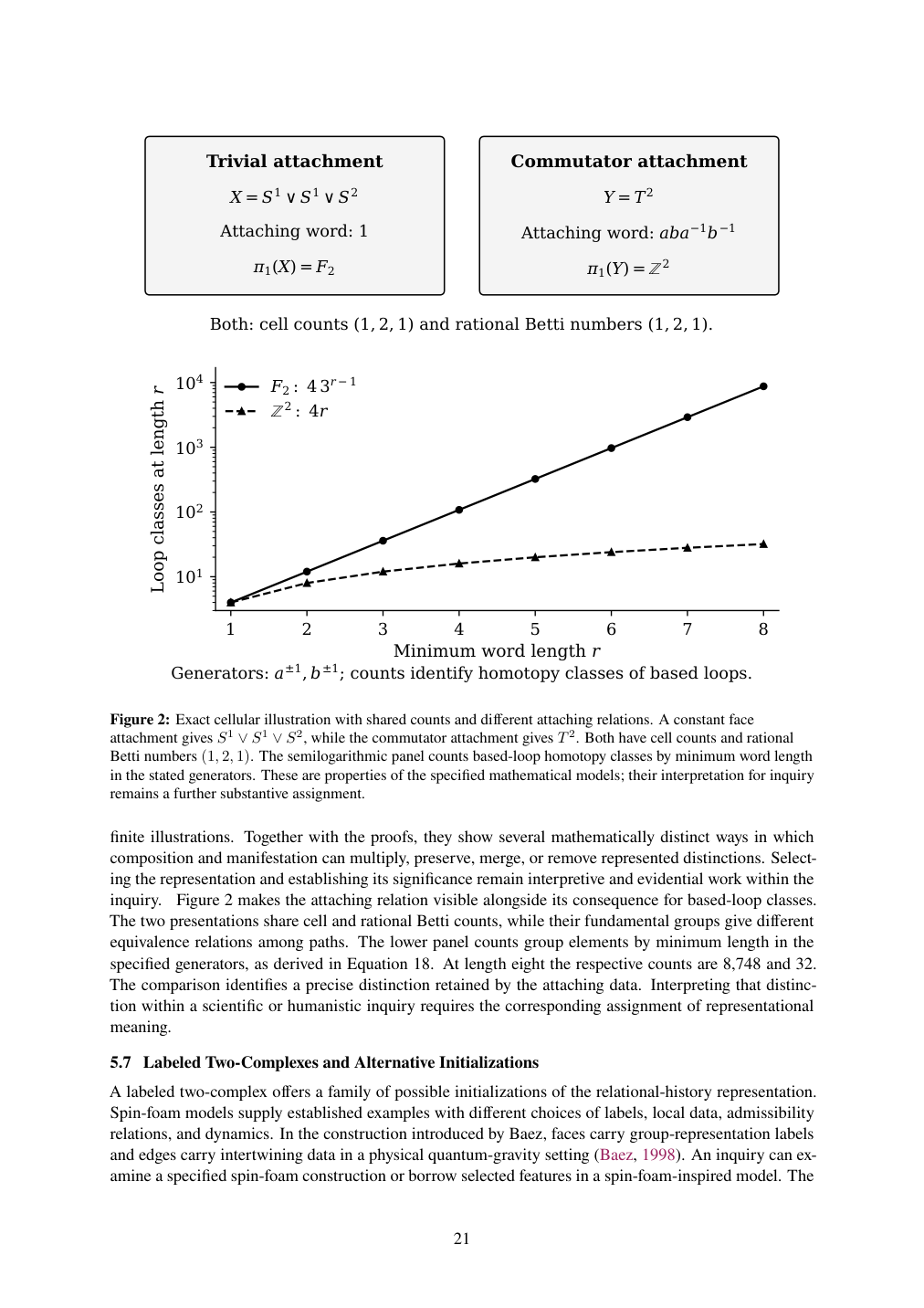
differ: the sphere summand uses a constant attaching loop, while the torus face uses the commutator of
For the first equality in Equation 18, each free-group element has a unique reduced word. The first letter has four choices; each next letter has three, since an adjacent inverse would cancel. For the second equality, words in the abelian presentation remain numerous; Equation 18 counts their group equivalence classes
generators, while the nonisomorphism of the two fundamental groups establishes a topological distinction between the represented spaces. Equal cell and Betti summaries consequently leave open the relations governing composition of loops. The example makes the attaching data consequential while maintain- ing a precise separation between a model’s path classes and the semantic distinctions of a scientific or
The accompanying standard-library program performs exact rational checks on 49 product chain com- plexes and 49 product maps, computes torus and wedge-product powers, and checks the attachment, sub- division, and word-shell examples. All 1,302 recorded checks pass. These calculations support the stated
Readable text
Generators: a±1, b±1; counts identify homotopy classes of based loops.
Figure 2: Exact cellular illustration with shared counts and different attaching relations. A constant face in the stated generators. These are properties of the specified mathematical models; their interpretation for inquiry
finite illustrations. Together with the proofs, they show several mathematically distinct ways in which composition and manifestation can multiply, preserve, merge, or remove represented distinctions. Select- ing the representation and establishing its significance remain interpretive and evidential work within the Figure 2 makes the attaching relation visible alongside its consequence for based-loop classes. The two presentations share cell and rational Betti counts, while their fundamental groups give different equivalence relations among paths. The lower panel counts group elements by minimum length in the specified generators, as derived in Equation 18. At length eight the respective counts are 8,748 and 32. The comparison identifies a precise distinction retained by the attaching data. Interpreting that distinc- tion within a scientific or humanistic inquiry requires the corresponding assignment of representational
5.7 Labeled Two-Complexes and Alternative Initializations
A labeled two-complex offers a family of possible initializations of the relational-history representation. Spin-foam models supply established examples with different choices of labels, local data, admissibility relations, and dynamics. In the construction introduced by Baez, faces carry group-representation labels and edges carry intertwining data in a physical quantum-gravity setting (Baez, 1998). An inquiry can ex- amine a specified spin-foam construction or borrow selected features in a spin-foam-inspired model. The
proposed infrastructural use concerns incidence, structured labels, and declared compatibility. Physical amplitudes, gauge laws, and empirical interpretations carry their own independent commitments.
For an illustrative inquiry representation, vertices can index manifested encounters, edges their declared continuations, and faces relations among those continuations. Labels can record an available mode of distinction, a contextual condition, or a proposed compatibility rule, provided each assignment receives its own interpretation. A subsequent manifestation can produce another represented complex and a stipulated map or correspondence. The chain-map results of this section apply when that mathematical transformation satisfies the stated cellular conditions. Interpretive adequacy requires the additional historical, experiential, or disciplinary argument appropriate to the question.
The geometric cells retain continuous realizations. A finite alphabet of retained labels is one optional codebook for selected distinctions, while continuously varying labels and amplitudes require their corresponding state spaces. A finite-label version can display product growth before incidence and compatibility constraints are imposed. The cellular proofs above explain the different behavior of cell structures, homological distinctions, and path relations under composition and revision. This provides a controlled route for investigating several spin-foam or spin-foam-inspired initializations within the ontologysuspended argument.
The representational programme remains open. Simplicial, cubical, higher-dimensional cellular, smooth, or mixed constructions can provide other starting points when they suit the relations and questions under examination. Directed incidence, temporal structure, continuously varying labels, or singularities can require additional mathematical data and suitable notions of transformation. A choice among these alternatives should identify which distinctions it preserves, which operations it supports, and what evidence would motivate its revision. The present proofs establish the stated product, map, and attachment results for their declared model classes; further representations invite their own corresponding analysis.
6 Generative Utilization And Recursive Inquiry
The enlargement of a candidate repertoire creates a further question about the uses that make its contents consequential. Generative utilization names a process in which applying, interpreting, or contesting existing knowledge changes the resources available for subsequent inquiry. A use can produce an answer, a new epistemic carrier, a relation among existing carriers, or a question that reorganizes their significance. The argument developed here concerns that recursive capacity and its conditions. Recombination provides an important antecedent; the warrant of a particular application, the labor supporting its continuation, and the distribution of its returns determine its epistemic and practical significance.
6.1 Recombination And Further Epistemic Carriers
An observation protocol can become a resource for constructing a new experiment. An interpretation can expose an ambiguity that becomes a research question. A model used outside its original domain can reveal a missing variable, a neglected historical condition, or a mismatch between the outcome being predicted and the concern motivating the prediction. In each case, utilization alters the organization of inquiry. The generative predicate is indexed to a practice, a question, and a subsequent repertoire: its content concerns what a use makes possible, preserves, or renders intelligible.
This conception inherits a substantial account of cumulative innovation. In the opening chapter of Arthur (2009), existing technologies supply components for further combinations, and successful combinations become available for later construction. Arthur and Polak (2006) give this recursive mechanism a precise artificial setting. Their logic-circuit model tests combinations against stipulated functional needs and retains useful circuits as components for further combinations. Its explicit retention rule also identifies an important condition of the analogy: the model receives its functional goals as inputs. The present argument extends the question to inquiry practices in which purposes, relevant outcomes, and standards of usefulness can themselves become objects of investigation.
A newly assembled object becomes an epistemic resource through identifiable work. Its terms need interpretation, its inferential role needs specification, and its claims need an adequate mode of assessment. These requirements can differ among a historical explanation, an experimental protocol, a simulation, and a participatory account of lived experience. Their contributions can enter a common problem while preserving their distinct evidential relations. A reusable result therefore includes an account of the conditions supporting its use and the questions for which its adequacy remains open.
Generativity can also take a restrictive form. An unsuccessful transfer can yield a supported boundary condition, an incompatibility, or a reason to abandon an interpretation. Preserving that result changes subsequent inquiry by directing attention toward a more appropriate question or preventing an already diagnosed mistake. Such a return depends on the quality and recoverability of the diagnosis. A rejected proposal recorded without its reasons offers little guidance about the scope of its failure.
6.2 Candidate Repertoires And Evidential Development
Combinatorial possibility, developed knowledge, and valuable consequence occupy different stages of this argument. Weitzman (1998) distinguish potential hybrid ideas from their resource-intensive development into productive ideas. The paper’s unrestricted recombinant expansion result uses a declared crossing rule, a constant success proportion, and an initial reproductive condition. Its economic models then make processing resources consequential for realized growth. That distinction matters here: a large supply of imaginable combinations can coexist with severe limits on what researchers can develop, understand, or assess.
The adjacent possible supplies a related account of how a realized novelty can change later possibilities. Tria et al. (2014) represent this mechanism through an urn in which first encounters trigger additional elements, alongside reinforcement of previously encountered ones. Their empirical sequences concern texts, music, tags, and Wikipedia activity. Distinct-element growth in the model can be sublinear in observed events, depending on the relation between triggering and reinforcement. This account supports a mechanism-sensitive conception of expansion. Applying it to scientific inquiry additionally requires evidence about the production and validation of scientific claims.
Empirical recombination studies likewise require attention to their measured outcomes. Fleming (2001) study patent subclasses and subsequent citations, finding that unfamiliar combinations can increase outcome variability while reducing average citation-based usefulness under the reported models. The article retains qualifications about patent coverage, classification proxies, and interpretation. Uzzi et al. (2013) associate highly cited scientific papers with conventional reference combinations containing an atypical tail, using journal-pair citation patterns relative to randomized networks. These findings motivate attention to the composition and uncertainty of search. Their dependent variables concern patent or publication citations; assessing an inference’s validity, an intervention’s accessibility, or an ecological consequence requires corresponding evidence.
The philosophical implication is a distinction among enlargement, development, and appraisal. A new relation can enlarge a proposal repertoire before its explanatory adequacy has been established. A technically successful development can remain contentious in its social purpose. An outcome judged valuable in one setting can require revision when its effects on another population or practice become visible. An integrative infrastructure should make these transitions available for examination, including the points at which a promising connection remains a conjecture or a purpose itself needs reconsideration.
6.3 Heat Protection And The Reframing Of A Public Problem
Consider a deliberately conceptual inquiry into urban heat protection. Suppose researchers begin with four heterogeneous resources: an outdoor temperature model indexed by location and time; public-health concepts concerning exposure and susceptibility; a hydrological account of available water; and historical and interpretive work on housing, tenancy, and the use of shared space. These resources support different questions and contain different kinds of evidence. The illustration specifies possible relations among them; its claims concern the organization of inquiry and leave intervention effects to a substantive study.
An initial engineering question might concern the location of a cooling intervention. Historical inquiry and residents’ interpretations can change that problem upstream by examining whose use of a dwelling, street, or public building receives protection, and which arrangements make that use possible. The resulting concern could be a resident’s secure ability to find a usable cool setting across a daily schedule. This reformulation introduces temporal access, tenancy conditions, and the meaning of habitation into the object being investigated. It changes the relevant unit of analysis before candidate interventions are compared.
Researchers could then construct an exposure-and-access protocol relating outdoor conditions to movement, occupancy, and opening hours. That protocol would be a new carrier: it would specify which observations and interpretations are needed to connect a modeled location to a person’s opportunities for protection. An account of water availability could introduce a condition on a proposed vegetated route. Housing evidence could introduce a question about who can authorize a change to a dwelling and who maintains it. Each connection expands the inquiry through a specified relation between a proposed action and the conditions of its use.
Several possible projects now become distinguishable. One could investigate a roof intervention under particular occupancy conditions. Another could investigate access to an existing public building during specified hours. A third could examine a route proposal under a water constraint. These projects would inherit some spatial definitions, source interpretations, and accounting conventions from the shared inquiry. Their distinct causal and evaluative questions would remain visible: a temperature comparison, a claim about access, and an interpretation of a housing right require appropriate evidence for their respective conclusions.
The protocol’s application could expose a consequential gap. An outdoor model might describe the chosen places adequately while the relation between those observations and indoor experience remains unresolved. Recording the missing relation would generate a further question about which indoor observations, participant accounts, or occupancy information are needed. The inquiry would thereby produce a directed research need from the limits of an attempted use. It could also produce a more precise interpretation of access if residents identify a supposedly available setting as practically unusable under the specified conditions.
Assessment can preserve several kinds of consequence. Participants might examine heat exposure, water use, maintenance labor, accessibility, tenancy security, and ecological continuity. Some comparisons could use common numerical units within a domain. Others could use a justified threshold, a prohibition, an ordinal judgment, or an articulated disagreement. For example, if a community treats continued tenancy as a condition of an acceptable intervention, a proposal violating that condition remains inadmissible under that assessment even if another indicator improves. The stipulation makes the evaluative disagreement inspectable without assuming that all consequences share a cardinal scale.
The worked example identifies three possible returns from one utilization episode: a question reformulated through historical and lived concerns; a reusable protocol connecting previously separate resources; and a specified gap that directs new inquiry. The substantive credibility of those returns would depend on the participants, sources, observations, and institutions of an actual study. Their conceptual relationship explains how integration can change the future problem repertoire while preserving the task of establishing a particular answer.
6.4 Shared Preparation, Task Warrant, And Attention
Recursive utilization has several cost structures. Shared preparation includes recovering a source’s meaning, understanding a method, reconciling relevant units, and establishing a translation that several projects can use. Task warrant includes the evidence and reasoning needed for a particular conclusion in its particular setting. Maintenance includes checking whether sources, implementations, interpretations, and institutional conditions remain adequate. A reusable interface can distribute preparation across several projects, while each project’s warrant and the continuing maintenance remain identifiable responsibilities.
The heat-protection protocol illustrates the distinction. A carefully documented alignment of spatial and temporal units can save later researchers from reconstructing that alignment. A subsequent project still needs to establish that its source observations, relevant population, and use conditions support its own question. An altered building schedule or a revised interpretation of access can require maintenance even when the computational transformation continues to run successfully. Reuse can thus lower some repeated costs while introducing dependencies that require care.
The production of proposals also encounters an allocation problem. Simon (1971, pp. 40–41) relates abundant information to limited recipient attention and the organizational need to allocate it. In inquiry, attention is partly specialized: an available reviewer may lack the experience needed to assess a contested interpretation or measurement relation. Evaluative knowledge includes understanding which observations discriminate among explanations, which assumptions carry a transfer, and which consequences matter to the affected participants. Developing that knowledge can itself require research.
An AI system that generates candidate connections cheaply can therefore shift the burden toward appraisal. The relevant organizational capacity includes people able to formulate useful questions, identify misleading equivalences, investigate failures, and explain why a proposed use is appropriate. Automation can support those activities through retrieval, explicit comparisons, or traceable transformations. Its contribution depends on whether the resulting work helps a relevant assessment under the constraints of the case. Proposal volume alone leaves that question open.
Attention also has an opportunity cost across inquiries. Repeatedly elaborating easily evaluated connections can crowd out interpretive work, neglected populations, or questions whose evidence takes longer to obtain. A defensible portfolio can reserve resources for different forms and timescales of learning, including the recovery of evidence that needs additional interpretive methods. The criterion for maintaining an avenue should specify its anticipated epistemic or practical contribution, its present uncertainty, and the responsibilities incurred by preserving it.
6.5 Returns, Optionality, And Conditions Of Valuation
A preserved avenue of inquiry has optionality when it remains feasible for later development under specified conditions. Its value can include the ability to respond to a revised question, test an alternative explanation, or reassemble a relation after a relevant change. Such optionality is conditional on access, understandable records, competent users, and continued support. Preserving an indefinitely expanding archive can consume the very resources needed to investigate its contents. Selective maintenance, revision, and retirement belong to the generative process.
Diversity can support this discussion while retaining its dimensions. Stirling (2007) distinguish variety, balance, and disparity and provide for different perspectives on relevant attributes and weights. A repertoire with many labels can concentrate its active resources in a narrow set of approaches. The present argument consequently treats plural assessment as a question about the actual availability and standing of different lines of inquiry, including their evidential requirements. Counting named disciplines provides one description; examining the repertoire’s usable differences provides another.
Returns also have recipients. A utilization episode can yield explanatory understanding, a method, credit, revenue, institutional authority, or an enlarged capacity to participate. Their routes of circulation can diverge. Contributors may supply interpretation or maintenance while another actor controls access to the resulting asset. The choice of which combinations receive funding or recognition then affects which possibilities become practically available. Power enters both the production of candidates and the conditions under which their consequences count as valuable.
Generative-justice scholarship gives this question an important predecessor. Eglash (2016) connects labor, ecological, and expressive value to participation by value generators in its benefits and conditions of production. The present extension concerns how an inquiry infrastructure can keep the conditions of epistemic production connected to its uses. A useful contribution would return intelligible findings, capabilities, recognition, or decision standing to relevant contributors and communities, alongside support
for the material and ecological conditions on which the work depends. The appropriate form of return requires substantive justification in the case.
In the heat-protection illustration, possible returns include a resident-usable account of unresolved access conditions, recognition and support for participants’ interpretive labor, and resources for maintaining observation sites. Their adequacy would be assessed with contributors. Ecological obligations could enter as a water-use condition or a requirement to sustain a habitat, with the relevant basis and representation explained. These are possible commitments in a case, each with its own justification and an identifiable responsibility for fulfillment.
These considerations permit a plural account of value reproduction. A new connection can contribute to knowledge while depleting the labor that sustains it; a widely recognized result can carry unresolved consequences for the people represented. Appraisal should therefore preserve both the kind of return and its conditions of generation, appropriation, and renewal. The section proposes an inquiry ecology in which utilization can change carriers, relations, questions, and capacities, and in which those changes remain answerable to evidence and to articulated purposes. Its generativity concerns the supported continuation of inquiry under plural demands, with the possibility of criticism and revision remaining part of what is reproduced.
7 The Noetarium Infrastructure Case
Noetarium provides a documentary case for examining how disciplinary resources, evidential relations, and human direction can be organized within one developing infrastructure. The case connects the paper’s account of integrative inquiry to concrete architectural decisions and source interfaces. Its method is primary-document and source-code inspection: programme statements establish aims, decision records establish recorded commitments, and inspected implementations establish the presence of particular computational mechanisms. Scientific effectiveness, institutional adoption, and comprehensive integration remain questions for empirical evaluation.
The source identification is contemporaneous. On 24 November 2026, the originally supplied repository address redirected to Noetarium—The Science and Humanity Infrastructure. The public page, official repository API, and Git endpoint identified main at commit 869fe38; the complete identifier and retrieval records accompany the source ledger. The selected public files matched the earlier pinned audit snapshot. Accordingly, the discussion refers to the publicly observed state at retrieval, while preserving the dates and statuses of individual documents (Noetarium Project, 2026k). Source inspection below establishes what is represented in that state. A manifest, a detailed design, an implemented routine, and an independently validated research workflow have different evidential standing.
7.1 Architectural Composition And Disciplinary Relations
A recorded change in the project’s architecture makes its relational problem explicit. ADR 0026 superseded an arrangement in which laboratories grouped disciplines and applications. Its rationale was that an exclusive grouping placed shared knowledge under one laboratory even when several undertakings required it. The adopted design separated subject-organized domain libraries from purpose-organized works. Geodesy could then serve several applications through the same interface, while an atlas or study could compose the domains relevant to its question. The decision records the user’s acceptance and the model’s role in proposing and documenting the arrangement (Noetarium Project, 2026a). This history supplies a specific architectural response to overlapping research purposes.
The resulting organization distinguishes foundations, domains, shared edges, and works. Foundations carry reusable mathematical, computational, inferential, and other methods. Domains supply objects and models associated with particular fields. Data acquisition, observation, visualization, and interfaces connect those resources to external materials and users. Applications, research, and notebooks assemble them around purposes. The draft architecture places pure computation in the core and interactions with external systems at the edges, making the conditions of a calculation more inspectable (Noetarium Project,
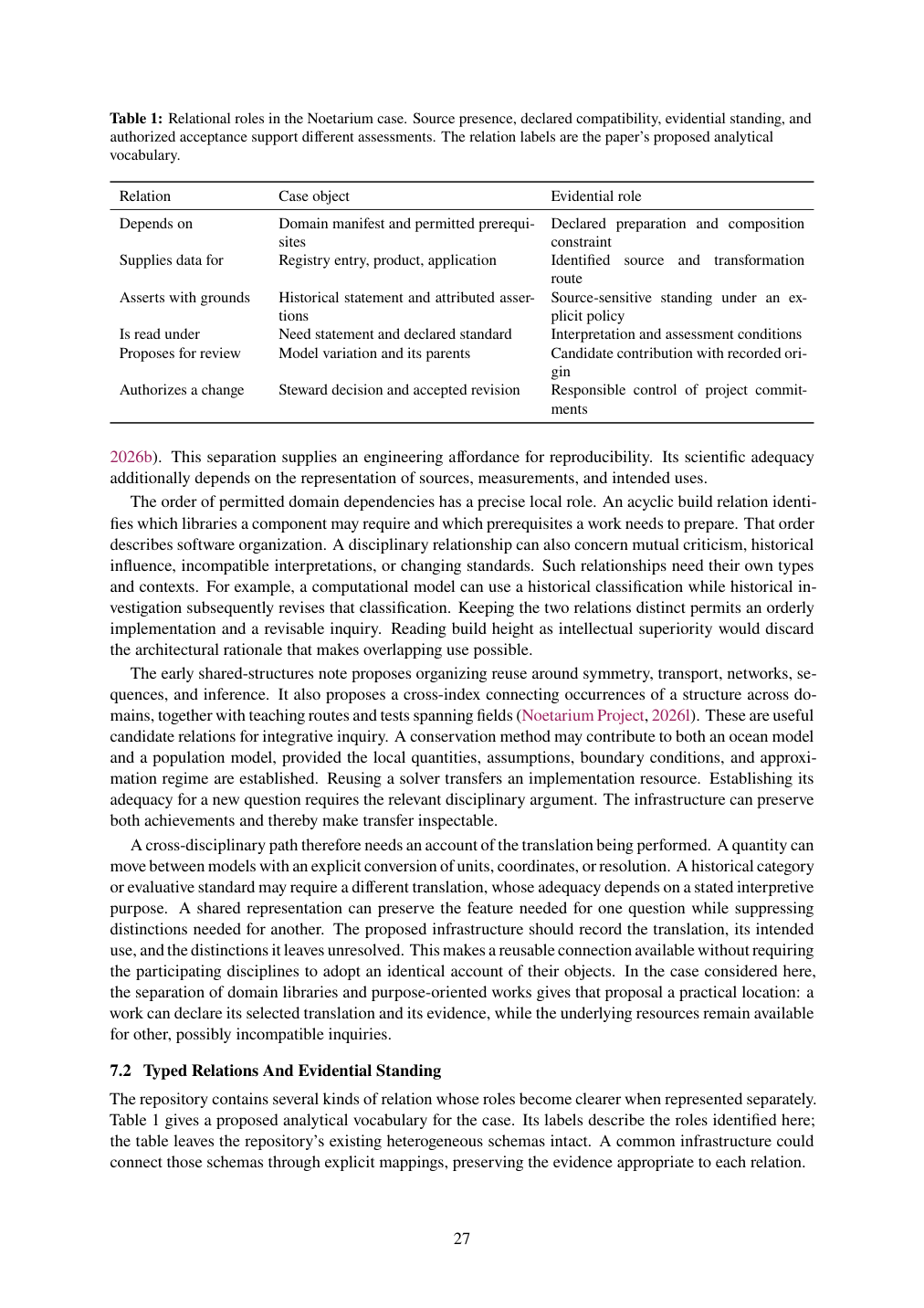
Readable text
Table 1: Relational roles in the Noetarium case. Source presence, declared compatibility, evidential standing, and authorized acceptance support different assessments. The relation labels are the paper’s proposed analytical
Declared preparation and composition constraint Identified source and transformation route
Registry entry, product, application Historical statement and attributed asser-
Source-sensitive standing under an ex- plicit policy Interpretation and assessment conditions Candidate contribution with recorded ori- gin Responsible control of project commit- ments
Need statement and declared standard Steward decision and accepted revision
Is read under Proposes for review Model variation and its parents Authorizes a change
2026b). This separation supplies an engineering affordance for reproducibility. Its scientific adequacy additionally depends on the representation of sources, measurements, and intended uses.
The order of permitted domain dependencies has a precise local role. An acyclic build relation identi- fies which libraries a component may require and which prerequisites a work needs to prepare. That order describes software organization. A disciplinary relationship can also concern mutual criticism, historical influence, incompatible interpretations, or changing standards. Such relationships need their own types and contexts. For example, a computational model can use a historical classification while historical in- vestigation subsequently revises that classification. Keeping the two relations distinct permits an orderly implementation and a revisable inquiry. Reading build height as intellectual superiority would discard the architectural rationale that makes overlapping use possible.
The early shared-structures note proposes organizing reuse around symmetry, transport, networks, se- quences, and inference. It also proposes a cross-index connecting occurrences of a structure across do- mains, together with teaching routes and tests spanning fields (Noetarium Project, 2026l). These are useful candidate relations for integrative inquiry. A conservation method may contribute to both an ocean model and a population model, provided the local quantities, assumptions, boundary conditions, and approxi- mation regime are established. Reusing a solver transfers an implementation resource. Establishing its adequacy for a new question requires the relevant disciplinary argument. The infrastructure can preserve both achievements and thereby make transfer inspectable.
A cross-disciplinary path therefore needs an account of the translation being performed. A quantity can move between models with an explicit conversion of units, coordinates, or resolution. A historical category or evaluative standard may require a different translation, whose adequacy depends on a stated interpretive purpose. A shared representation can preserve the feature needed for one question while suppressing distinctions needed for another. The proposed infrastructure should record the translation, its intended use, and the distinctions it leaves unresolved. This makes a reusable connection available without requiring the participating disciplines to adopt an identical account of their objects. In the case considered here, the separation of domain libraries and purpose-oriented works gives that proposal a practical location: a work can declare its selected translation and its evidence, while the underlying resources remain available
The repository contains several kinds of relation whose roles become clearer when represented separately. Table 1 gives a proposed analytical vocabulary for the case. Its labels describe the roles identified here; the table leaves the repository’s existing heterogeneous schemas intact. A common infrastructure could connect those schemas through explicit mappings, preserving the evidence appropriate to each relation.
A planned tidal bridge illustrates the distinction between a possible path and an accomplished integration. Its manifest declares astronomy, geodesy, oceanography, and meteorology as dependencies and marks the domain planned (Noetarium Project, 2026m). The declaration locates a coherent intended connection between astronomical forcing and marine response. A working scientific application would additionally need a selected forcing model, a response model, compatible coordinates and times, observations, and an appropriate validation task. The declared relation makes those requirements easier to locate. Its evidential contribution is the preparation contract for an intended composition.
A population registry entry illustrates a different relation. The GHS-POP declaration identifies a provider, release, epoch, file, declared digest, licence, units, transformations, and consuming components. It describes the source values as residential people per cell and records aggregation and division by cell area (Noetarium Project, 2026j). That distinction matters when population information enters exposure, accessibility, or provision questions. A sum of counts and an average of densities support different operations. The registry supplies an inspectable account of the intended source and transformation. Acquiring the stated file, checking its identity, executing a transformation, and justifying the resulting measure remain distinguishable acts of inquiry.
The historical-object implementation makes assertion standing a first-class object. Its source records an assertion’s source identifier, grade, passage, location, confirmation, and dispute status. A policy computes proposed, attested, established, or disputed standing; the reader can select an evidential layer. The inspected routine distinguishes a model proposal from other source grades and uses confirmation and documentary status in assigning standing (Noetarium Project, 2026f). These mechanisms allow a visualization to preserve the provenance of its statements. Their status words express the implemented policy. Historical adequacy also requires examination of passages, source relationships, selection, and interpretation.
The canon documentation supplies an instructive boundary. It explicitly identifies language-modeldrafted seed records, states that their assertions await source checking, and describes selections that privilege particular written, canonical, or socially prominent histories (Noetarium Project, 2026e). A joined historical representation can therefore be computationally structured while its documentary content remains provisional. The repository’s candid declaration makes that difference available to a reader. An integrative inquiry should carry the declaration into subsequent maps, comparisons, and interpretations, including the unresolved identities through which histories are joined.
A later economic decision provides a further example of interpretation-sensitive reuse. ADR 0166 describes a computed complexity index as position along a dominant division of industries and distinguishes that quantity from a judgment of sophistication. It also records uncertainty about whether some employment changes reflect economic change or changes in recording (Noetarium Project, 2026i). The relevant relation is consequently richer than a number linked to a formula. It connects an operation, a dataset, a substantive reading, and an unresolved alternative explanation. Preserving those components permits further research to revise the interpretation while retaining the inspectable calculation.
7.3 Human Direction And Generative Exploration
The needs domain connects combinatorial exploration to explicit evaluative choices. Its documentation defines a need through an observed gap judged under a declared standard. Normative, felt, expressed, and comparative readings can generate different questions about the same observations. The domain’s proposed statement language names the group, satisfaction domain, measure, and standard, and its design retains interpretations and rivals (Noetarium Project, 2026g). This organization gives an AI system a space of candidate statements while leaving the grounds of their meaning visible. Choosing a standard is a substantive act whose responsibility deserves a record alongside computational results.
The inspected search implementation provides concrete interfaces for proposing statements and recording their sources and parents. Its request routine allocates a declared statement budget across model roles, including proposing, mutating, crossing, and reflecting on candidates. Its confirmation routine registers an admitted statement before computing its confirmation estimate and records the resulting assessment (Noetarium Project, 2026h). These are source-level mechanisms for separating parts of the inquiry pro-
cess. Their presence supports a detailed account of intended control and information flow. Assessing the complete statistical protocol or its usefulness for a population would require execution, appropriate observations, and validation of the stated assumptions.
The conceptual significance lies in the relation between generating a candidate and accepting what it says. A search can produce a new conjunction of group conditions, a rival interpretation, or a suggested intervention. Each can enlarge the available inquiry space. Its acceptance depends on the evidence and authority appropriate to that contribution. A proposal concerning housing need, for example, can be assessed for its statistical behavior while the choice of housing standard remains an attributed judgment. The same resource can support an alternative standard without erasing the reasons for disagreement. Such plural paths make integration compatible with disciplinary and public contestation.
The project’s more general ecology design extends beyond these implemented interfaces. Its seed documents propose interacting agent lineages that make claims, challenge one another, consume budgets, and continue through selected forms of reliance. The documents explicitly describe the broader design as unbuilt (Noetarium Project, 2026d). The infrastructure-specific case distinguishes existing practices from proposed sealed records, challenge mechanisms, budget boundaries, and other additions. It reserves structural and conventional changes for human agreement, treats model statements as proposals pending confirmation, and identifies a presently concentrated stewardship arrangement (Noetarium Project, 2026c). This is a design trajectory with articulated gaps, whose components can be investigated separately.
Human autonomy has a concrete architectural location in that trajectory. A human or authorized collective can determine a research purpose, authorize resources, choose a standard, reject a translation, accept a revision, or stop a process. An AI can assist at each point by explaining consequences and proposing alternatives. Recording these acts gives later participants grounds for reconstructing the decisions under which a result acquired standing. Meaningful participation also requires attention to whose purposes and standards enter the system. One maintainer’s control demonstrates a locus of project authority; broader affected communities require an appropriate process for representation, disagreement, and revision.
A further distinction concerns the authority to change the rules of inquiry. An agent’s ability to suggest a new test or dependency can improve a project. Accepting a change to the assessment rule alters the terms on which subsequent proposals will be judged. The case therefore suggests separate records for proposals, evidence-bearing assessments, and authorized changes to evaluative commitments. That separation permits methodological evolution while exposing which prior decisions a change affects. Its institutional quality depends on accountable procedures and participants, alongside the software interfaces that make decisions inspectable.
7.4 Research Implications Of The Case
The case identifies several dimensions for evaluating an integrative infrastructure. Resource preparation concerns whether required materials and prerequisites can be located. Operational composition concerns whether selected components work together under their contracts. Evidential assessment concerns what a resulting observation supports. Revisability concerns whether altered data, interpretations, or standards can be traced to affected claims. Human direction concerns the purposes and legitimate decisions under which those activities occur. A successful local computation supplies evidence for its own task while the other dimensions retain their separate evaluation questions.
This differentiated account changes the meaning of growth. Additional libraries, records, and proposed links enlarge a repertoire of possible inquiry. Research value arises when a particular path connects a worthwhile question to suitable resources, interpretable observations, defensible conclusions, and the possibility of correction. Typed relations help identify the work remaining along that path: a missing interface, an unverified passage, an incompatible unit, a contested standard, or an unaccepted change. AI can assist in discovering and preparing such paths; people and scientific communities remain participants in determining their purposes and warranted uses.
Noetarium thus supplies an inspectable case and a research programme. Its recorded architectural revision addresses overlapping use, its source interfaces make selected evidential distinctions computable,
and its seed proposals articulate further forms of generative exploration. The conceptual proposal of the present paper is to assess these developments through their relationships and their differentiated standing. That assessment can recognize concrete implementation progress while directing empirical inquiry toward integration quality, interpretive adequacy, participation, and the continued capacity to revise knowledge.
8 Human-Mediatable Project Ecologies And Infrastructural Evolution
An integrative inquiry infrastructure requires a practice through which its own representations, instruments, and working arrangements can be investigated and revised. This section develops that practice through the conceptual object of a project ecology: interacting inquiries together with the materials, interpreters, relationships, and resources through which they continue. Its objective is to connect bounded autonomous activity with human mediation and the renewal of shared research capacities. The argument first locates the proposal within four companion manuscripts, then examines delegation, generative representations, environmental feedback, and the costs of continuation. The resulting architecture is a proposal for organizing inquiry. Its adequacy depends on what researchers and affected participants can discover, contest, and use through it.
8.1 Project Architectures And Their Infrastructural Interfaces
The project-ecology proposal distinguishes an operating ground held fixed under delegated lineage operations, a human-declared site specifying the project’s materials and procedures, and an evolving layer of agent-produced work. Revision of the ground or site requires a separately authorized human act. Its inquiry site reserves asking, reading, acceptance, and signature to persons. It also separates a statement’s evidential standing from its acceptance into a theory (Huang, 2026d, secs. 4.1–4.10, 6.4). These distinctions provide an immediate architectural resource: a research process can delegate many operations while retaining identifiable occasions at which people determine its direction and assume responsibility for its use.
The grammar manuscript investigates compact weighted representations from which projects and their records can develop. It distinguishes replay through compression from generalization through merging, makes development relative to machinery and environment, and states conditions under which restricted variation preserves specified human approval guards (Huang, 2026c, secs. 4, 6, 8). The external-carriers manuscript differentiates static records, dormant generators, shared workspaces, shared experience, and maintained partners. Its declared models connect uptake and continuation to access, admission, resources, and dependence (Huang, 2026a, secs. 3–5, 7). The economic manuscript develops continuation records connecting productive capacities to skills, resources, permissions, and institutions, together with distinct warrants for revising arrangements, evidence, standards, authority, and support (Huang, 2026b, secs. 5–7, 16). Table 2 identifies the specific interfaces inherited here. The synthesis treats them as complementary proposals with different analytical objects. A grammar describes a generative process; a carrier makes some material or capability available across occasions; a continuation account investigates the conditions under which that availability becomes usable. Human mediation concerns the situated exercise of judgement and authority across those processes. The conceptual contribution proposed in this section is their conjunction at the point where an inquiry infrastructure becomes an object of its own organized revision.
8.2 Human Mediation And Bounded Autonomy
Human-mediatable autonomy names a proposed relation between delegated activity and the people entitled to orient, interpret, challenge, or authorize its consequences. A project can carry out a sequence of searches, transformations, calculations, and provisional comparisons within a declared remit. Human mediation enters through the formulation of that remit, the interpretation of its results, and the authority to alter its consequential commitments. Reserved human reading concerns the responsible inquirer’s interpretive uptake; agents can inspect and compare sources within their remit. Different people can occupy these roles. A researcher may specify an evidential question, a practitioner supply an interpretation
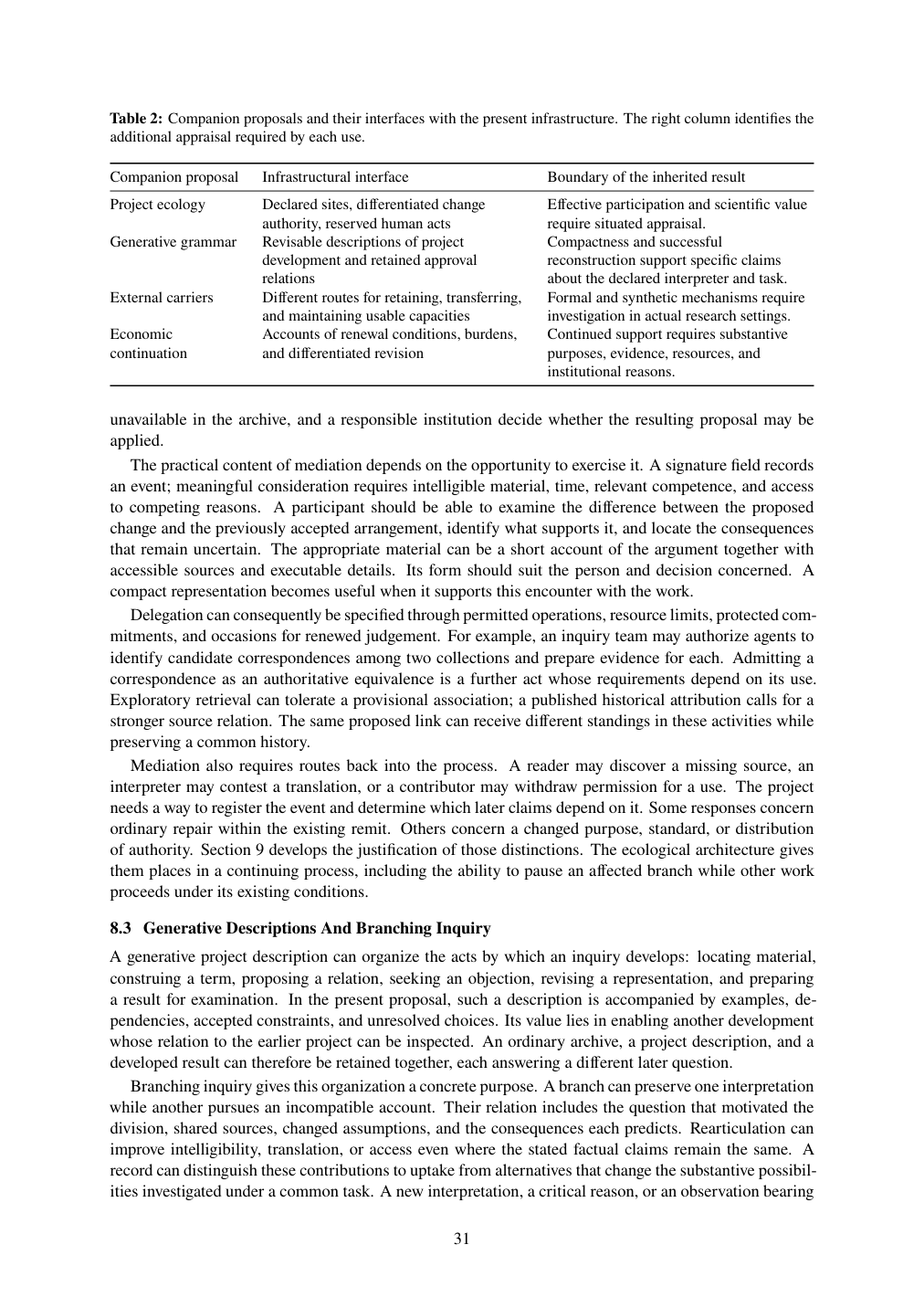
Readable text
Table 2: Companion proposals and their interfaces with the present infrastructure. The right column identifies the
Generative grammar Revisable descriptions of project development and retained approval relations
External carriers and maintaining usable capacities
Effective participation and scientific value require situated appraisal.
Compactness and successful reconstruction support specific claims about the declared interpreter and task.
Formal and synthetic mechanisms require investigation in actual research settings.
Continued support requires substantive purposes, evidence, resources, and institutional reasons.
unavailable in the archive, and a responsible institution decide whether the resulting proposal may be
The practical content of mediation depends on the opportunity to exercise it. A signature field records an event; meaningful consideration requires intelligible material, time, relevant competence, and access to competing reasons. A participant should be able to examine the difference between the proposed change and the previously accepted arrangement, identify what supports it, and locate the consequences that remain uncertain. The appropriate material can be a short account of the argument together with accessible sources and executable details. Its form should suit the person and decision concerned. A compact representation becomes useful when it supports this encounter with the work.
Delegation can consequently be specified through permitted operations, resource limits, protected com- mitments, and occasions for renewed judgement. For example, an inquiry team may authorize agents to identify candidate correspondences among two collections and prepare evidence for each. Admitting a correspondence as an authoritative equivalence is a further act whose requirements depend on its use. Exploratory retrieval can tolerate a provisional association; a published historical attribution calls for a stronger source relation. The same proposed link can receive different standings in these activities while
Mediation also requires routes back into the process. A reader may discover a missing source, an interpreter may contest a translation, or a contributor may withdraw permission for a use. The project needs a way to register the event and determine which later claims depend on it. Some responses concern ordinary repair within the existing remit. Others concern a changed purpose, standard, or distribution of authority. Section 9 develops the justification of those distinctions. The ecological architecture gives them places in a continuing process, including the ability to pause an affected branch while other work
A generative project description can organize the acts by which an inquiry develops: locating material, construing a term, proposing a relation, seeking an objection, revising a representation, and preparing a result for examination. In the present proposal, such a description is accompanied by examples, de- pendencies, accepted constraints, and unresolved choices. Its value lies in enabling another development whose relation to the earlier project can be inspected. An ordinary archive, a project description, and a developed result can therefore be retained together, each answering a different later question.
Branching inquiry gives this organization a concrete purpose. A branch can preserve one interpretation while another pursues an incompatible account. Their relation includes the question that motivated the division, shared sources, changed assumptions, and the consequences each predicts. Rearticulation can improve intelligibility, translation, or access even where the stated factual claims remain the same. A record can distinguish these contributions to uptake from alternatives that change the substantive possibil- ities investigated under a common task. A new interpretation, a critical reason, or an observation bearing
on a disagreement can each make a branch consequential in that further sense. The relevant kinds of diversity are therefore tied to the inquiry’s questions, participants, and modes of access. Their appraisal includes interpretive development alongside discrimination by further observation.
The integration of branches requires interpretation. Combining two useful components can introduce a new incompatibility between their assumptions or uses. A method developed for one population may presuppose an access condition absent from the other. A translation may preserve a numerical result while changing what the result is about. Integration should make these interfaces explicit and retain each branch’s qualifications. Sometimes the useful product is a conditional correspondence with a documented remainder. That outcome enlarges the infrastructure’s capacity to support inquiry while preserving the disciplinary distinction that made the encounter informative.
This account also makes the interpreter a research object. A description developed successfully through one model, team, or software environment has been tested under those conditions. A later interpreter can change its expression. Transfer therefore calls for a receiving-setting inquiry into available tools, competence, permissions, and the meaning of the reconstructed output. The proposed ecology keeps the relation between description, development, and receiving conditions open to examination as its projects and tools change.
8.4 Environmental Feedback And Evaluative Learning
The environment of an inquiry includes phenomena, institutions, research communities, practical users, and the infrastructures through which observations arrive. Feedback can concern an empirical prediction, a failed operation, an interpretation challenged by a source reader, or a consequence reported by an affected person. These encounters differ in what they warrant. A computational contradiction can defeat a numerical assertion. A historical source can change a proposed chronology. Testimony can reveal that a classification misses a relevant experience. A disagreement over the purpose of an application requires reasons appropriate to that purpose.
An integrative project ecology should preserve those differences when it revises itself. The team first identifies what the encounter places in question: a source claim, a representation, an inference, a working procedure, or the terms under which a result is used. It then identifies the materials and competences suited to investigating the disagreement. A useful response can be a repaired calculation, a richer category, a revised research question, or a justified restriction on use. Each response has a distinct relation to the original finding. Recording that relation makes the learning available to later inquiries facing a similar circumstance.
External feedback also changes the production of future evidence. A new collection rule can make previously neglected cases accessible. A revised vocabulary can enable a community to state an objection in terms that an institution recognizes. A public ranking can encourage contributors to produce more of what its categories count. The infrastructure thereby participates in the environment from which it learns. Its records should identify such interventions and investigate their effects on what subsequently becomes observable.
Evaluative learning concerns this reciprocal relation. The proposal preserves earlier assessments, the reasons for their revision, and the circumstances in which the revised procedure becomes applicable. Some inquiries can compare a result under both the earlier and the proposed criteria. Others reveal a translation problem that makes the comparison itself an object of study. In either case, the useful achievement is an accountable change in the capacity to investigate and judge. A wider institutional appraisal determines which consequences warrant adoption and which commitments continue to govern the transition.
8.5 Carriers, Maintenance, And The Evaluation Budget
The different carriers identified in Table 2 suggest different continuation tests. An archived result can be located and interpreted by a later reader. A retained generator can be developed under declared receiving conditions. A shared workspace can be investigated through the contributions it admits and the inquiries those contributions enable. Shared work can transmit distinctions through demonstration and correction. A maintained partner can supply a capability whose availability depends on continued support. The
present architecture proposes keeping the uptake event and its conditions with the claim made about that continuation.
Maintenance gives these relations their duration. A source collection needs curation, a parser needs adaptation, a terminology needs interpretation, and a community relationship needs continuing attention. An apparent saving from automating an analytic stage can depend on additional work elsewhere. The evaluation of an infrastructural change should therefore follow its relevant dependencies and identify who performs the renewal work. That inquiry can reveal an overlooked contribution, a bottleneck, or a new concentration of dependence. Which remedy is appropriate depends on the setting and the parties concerned.
The available evaluation budget constrains how many branches can receive meaningful investigation. Generating a candidate may require little effort compared with obtaining a source, consulting a specialist, observing a process, or checking a consequential claim. A feasible ecology needs a policy for choosing its next investigation and for preserving candidates that await attention. The policy can favor a discriminating observation, a repair that serves several inquiries, or a neglected alternative whose implications differ from those already tested. Its reasons should identify the decision that the additional work could change.
Costs include the labour of interpretation, challenge, and participation. A project that saves drafting time while increasing uncompensated checking has redistributed its research work. Evaluation should make that redistribution visible. Similarly, retaining an alternative consumes resources that could support another inquiry. Dormancy can preserve a description at a lower immediate cost, with a later cost of recovering its interpreter and context. A credible continuation plan identifies that trade-off and the conditions that would justify revival. This yields a selective, maintained plurality of inquiries whose differences remain usable.
8.6 Infrastructural Revision And Responsible Closure
A constructed example concerns a shared research collection containing accounts of repair. Software researchers describe the correction of a program, conservators describe interventions on an object, and community historians describe the restoration of a place and its relationships. An initial search interface groups these materials by a common word. The grouping assists discovery, while the purposes and evidence associated with each use remain available in their original records. A subsequent project investigates whether particular relations among these practices can support further inquiry.
One branch proposes a common sequence of diagnosis, intervention, and later assessment. Another investigates a distinction: an intervention can restore a technical function while changing the historical identity or social meaning of what was repaired. Their disagreement can guide the infrastructure’s development. Researchers might add fields for the affected object, the purpose of intervention, the standards invoked, and the accounts that contest its success. Agents can help populate candidate relations and expose inconsistent entries. Source readers and relevant practitioners examine whether the fields capture distinctions that matter in their materials.
The infrastructure is now undergoing an evaluable change. The earlier interface supported discovery through shared vocabulary. The proposed interface supports more differentiated comparisons at an additional cost of description and review. Its assessment can examine whether users recover relevant material, recognize the differences between the cases, and formulate a supported new question. It can also examine whether contributors can correct a misleading relation and whether the extra fields impose disproportionate burdens. The example states a prospective comparison; its outcomes remain matters for investigation.
The branch decision can take several forms. The team may retain the richer interface for one collection, offer it as an optional view, preserve an unresolved correspondence, or retire the added structure when its costs exceed its demonstrated use. A useful finding can survive the project that produced it. For example, the failed attempt to impose one common repair sequence may clarify a boundary later researchers need to understand. Conversely, a widely used service can merit replacement when a more maintainable
arrangement becomes available. The record should distinguish the reason for closure from the standing of the findings left behind.
Responsible closure follows the dependencies of the activity being ended. A service can have downstream users, contributors expecting attribution, restricted material requiring continued protection, and partners whose work depends on its availability. A closure decision should identify the obligations that continue, the capability to be transferred where appropriate, the materials retained, and the limits on later reuse. Its institutional justification is developed in Section 9. Ecologically, closure is one way the infrastructure reallocates its finite capacity while preserving warranted learning and addressing its relationships.
An autonomous project ecology can thus contribute to infrastructure through a continuing succession of bounded inquiries into its own components and relations. Human mediation provides occasions to reconsider the question, interpret what changed, and decide which continuation deserves support. The proposed result is an infrastructure whose development remains connected to the heterogeneous inquiries it serves, with inheritance, branching, feedback, and retirement available as explicit objects of scholarly and practical judgement. Figure 3 distinguishes three coupled objects of continuing inquiry: projects, infrastructural capacities, and the practices through which their contributions acquire standing. Projects introduce demands and proposed changes; available representations and interpreters condition which inquiries can proceed. New capacities and consequences become objects of appraisal, while criteria and warrants guide further revision. Human mediation can enter each layer through questions, interpretations, criticism, and authorized revision. Environmental observations and consequences can place different commitments in question. The diagram therefore identifies relations to investigate, with their appropriate evidence, resources, and responsible participants. Continuous and cellular representations remain available within that proposal, under the task-relative assignments developed earlier.
9 Evaluative Governance and Human Mediation
Evaluative governance concerns the powers through which an inquiry acquires standards, distributes attention, recognizes contributions, and authorizes consequential action. Its object includes the conditions under which those powers can be questioned and changed. An infrastructure for integrative inquiry consequently needs an account of its own evaluative development: the practices that identify promising relations also influence which people, projects, and future possibilities receive support. This section argues for historically attentive, plural, and answerable human mediation of that development. Autonomy can enlarge the activity delegated to an evolving research ecology; the grounds of the delegation, its effects upon others, and its revision remain matters of situated justification.
9.1 Historical Conditions of Evaluation
An evaluation participates in a history. A research programme reaches a review after receiving some combination of training, instruments, interpretation, criticism, and time. An evaluator arrives with a corresponding history of access and practice. Huang’s discussion of evaluative power locates consequential judgment within retained capacities, inherited dependencies, present commitments, and developmental horizons. It separates the historical configuration, its description, and the mechanism through which either becomes influential (Huang, 2026g, Secs. 2–3). This distinction gives the infrastructure a substantive object of reflection. A reputation may accurately register competence; a record may conceal the cooperation that produced it; a deadline may favor capacities that become visible quickly. Each possibility calls for its own evidence and appraisal.
The relation between support and merit creates a further difficulty. Suppose a programme receives a year of sustained criticism while a competitor receives only an initial screening. Their eventual contributions can differ substantially. The successful programme may deserve recognition for real achievement, while its achievement also bears on the adequacy of the opportunity arrangement. These judgments answer different questions. Assessing an argument concerns its present grounds; assessing the allocation concerns the reasons for producing these conditions of inquiry. A defensible institution can recognize
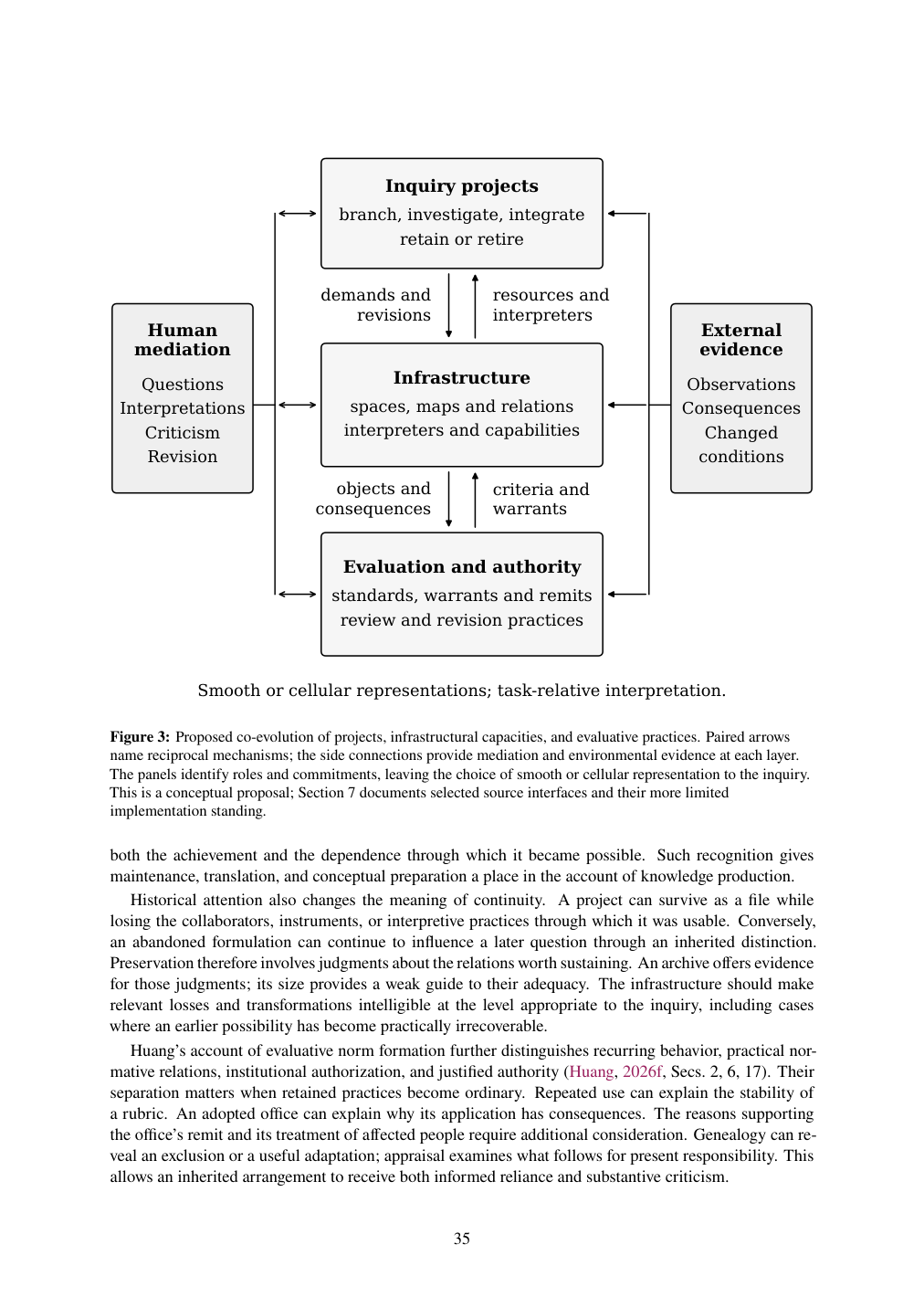
Readable text
spaces, maps and relations interpreters and capabilities
Smooth or cellular representations; task-relative interpretation.
Figure 3: Proposed co-evolution of projects, infrastructural capacities, and evaluative practices. Paired arrows name reciprocal mechanisms; the side connections provide mediation and environmental evidence at each layer. The panels identify roles and commitments, leaving the choice of smooth or cellular representation to the inquiry. This is a conceptual proposal; Section 7 documents selected source interfaces and their more limited
both the achievement and the dependence through which it became possible. Such recognition gives maintenance, translation, and conceptual preparation a place in the account of knowledge production.
Historical attention also changes the meaning of continuity. A project can survive as a file while losing the collaborators, instruments, or interpretive practices through which it was usable. Conversely, an abandoned formulation can continue to influence a later question through an inherited distinction. Preservation therefore involves judgments about the relations worth sustaining. An archive offers evidence for those judgments; its size provides a weak guide to their adequacy. The infrastructure should make relevant losses and transformations intelligible at the level appropriate to the inquiry, including cases where an earlier possibility has become practically irrecoverable.
Huang’s account of evaluative norm formation further distinguishes recurring behavior, practical nor- mative relations, institutional authorization, and justified authority (Huang, 2026f, Secs. 2, 6, 17). Their separation matters when retained practices become ordinary. Repeated use can explain the stability of a rubric. An adopted office can explain why its application has consequences. The reasons supporting the office’s remit and its treatment of affected people require additional consideration. Genealogy can re- veal an exclusion or a useful adaptation; appraisal examines what follows for present responsibility. This allows an inherited arrangement to receive both informed reliance and substantive criticism.
9.2 Human Mediation and Plural Authority
Human mediation is a distributed practice of interpretation, responsibility, and response. Researchers identify objects and assess arguments; participants convey experiences and challenge categories; institutions authorize actions and sustain conditions of inquiry. These roles can overlap, conflict, or change. Naming a human decision-maker consequently begins an account of mediation. Its adequacy depends on that person’s competence, remit, evidential position, practical alternatives, and answerability to others. A signature has greater significance when these relations give its judgment an intelligible basis.
Longino’s account of effective criticism supplies an important antecedent. It joins opportunities for criticism, responsive uptake, public standards, and tempered equality of intellectual authority, while making the standards themselves available for scrutiny. Her discussion also recognizes how assumptions shared across a community can survive its internal criticism (Longino, 2004, pp. 133–135). Applied here, these considerations support plurality across evaluative roles and communities. Several agents using one inherited rubric may produce numerous assessments with a narrow critical range. A smaller exchange across genuinely different evidential practices may expose an assumption that repeated internal review preserves. The relevant plurality concerns the capacity to bring different, pertinent reasons into consideration.
Plural authority permits differentiated judgment. An experimental specialist can assess measurement validity, a historian can question a retrospective category, and an affected community can identify an omitted practical burden. Their contributions acquire weight through their relation to the matter being considered. The authority to settle a laboratory question can coexist with a duty to explain its institutional use to people whose interests it affects. Conflict then calls for an account of jurisdiction and reasons, with room for a decision under continuing substantive disagreement.
Reception deserves equal attention. Fricker distinguishes prejudice affecting a speaker’s credibility from unfair disadvantage involving collective interpretive resources (Fricker, 2007). This narrow distinction helps identify different questions about an objection: whether its source receives a fair hearing, and whether the receiving practice can understand its significance. A submission form can accurately preserve words while obscuring the claim those words make. Interpreters, contextual accounts, and revisions of the form can sometimes improve the encounter. Their adequacy requires attention to the participant’s own account of what matters.
Haraway’s situated knowledge connects partial perspective with accountability and cautions against romanticizing the positions of less powerful participants (Haraway, 1988, pp. 581–585). Human mediation accordingly involves learning across positions while retaining criticism of particular claims. The argument for hearing a neglected objection rests on the possibility of relevant knowledge and the standing of the person involved. Its eventual evidential force remains available for examination. This relation gives inclusion an epistemic task as well as an institutional significance.
9.3 Autonomous Development and Evaluative Change
Autonomous development can concern several objects. A system can revise a proposal under a standing criterion, propose a different method of assessment, or recommend changes to the offices that adopt criteria. These transformations carry different responsibilities. The kybernesis report distinguishes operational learning, collective choice, and constitutional revision, locating changes to actions, policies, and evaluative terms at corresponding levels. It also records role-specific human amendments and review within a declared architecture (Huang, 2026e, Secs. 3, 8). These interfaces provide a vocabulary for identifying what an autonomous process is doing and which authorization its uptake requires.
The separation becomes particularly consequential when projects influence their evaluators. A counterexample can reveal a missing distinction; a new experimental method can make another kind of claim assessable; an interpretive disagreement can change how a contribution is classified. Subsequent projects may then develop under the revised evaluative medium. Reciprocal development concerns these relations of influence. A claim of co-evolution additionally needs an account of variation, retention, transmission, and selection. In this conceptual proposal, the possibility of such development motivates inquiry into its terms; observation of successive updates would supply only part of the evidence for its actual mechanisms.
Consider a constructed collaboration investigating river flooding through hydrology, archival reconstruction, and residents’ accounts. An initial rubric admits measured peak water levels and discounts other contributions. Historical work identifies alterations to drainage that make the measurement period atypical. Residents describe recurring disruption below the threshold registered as a major flood. The ecology can treat these contributions as requests for new measurements, challenges to its classification of harm, or both. The resulting revision changes the questions the projects can ask and the evidence later evaluators recognize. Its justification depends on the relevance of those distinctions and the consequences of the revised use. This thought case illustrates a possible relation; it establishes neither the truth of a particular complaint nor the merits of an actual flood policy.
The case also explains why evaluative adaptability needs external relations. A system’s own actions may alter the population of projects whose agreement it subsequently measures. An internally successful standard can thereby acquire apparent support partly through its earlier selection effects. Independent measurements, criticism from other research traditions, and affected accounts offer additional encounters through which the standard can be tested. Such encounters remain mediated and fallible. Their value lies in exposing the arrangement to reasons and consequences that its present organization may fail to articulate.
9.4 Protected Experimentation and Resource Commitments
Protected experimentation gives an unfamiliar line of inquiry a bounded opportunity to develop the evidence and distinctions needed for appraisal. The protection concerns a practical interval within which an initial adverse judgment can be examined. It can be appropriate when existing criteria poorly represent the proposed contribution and a feasible investigation could clarify that problem. Its rationale follows from the developmental character of inquiry: the grounds needed for assessment sometimes require work that an immediate screening would prevent.
This protection requires a commitment about resources and consequences. A sponsor can support a limited investigation, identify what the investigation is intended to clarify, and explain the conditions of continuation. A participant can then decide whether the opportunity is usable and what risks remain. Where a project concerns people, protected inquiry must also respect the responsibilities attached to those
relationships. Experimental freedom has a domain; the effects imposed beyond that domain require their own permission and justification. The scope of protection should therefore be considered alongside the distribution of costs, the significance of possible learning, and the interests exposed by the investigation.
The deeper issue concerns whose uncertainty receives patience. An established programme may receive repeated opportunities to reinterpret disappointing results, while an unfamiliar approach must demonstrate immediate success. Either treatment can have reasons in a particular case. A consistent explanation should connect the allowed developmental interval to evidence, commitments, and feasible alternatives. This places the institution’s treatment of time within evaluative scrutiny. A long horizon can permit learning; it can also defer acknowledgment of a poor commitment and consume opportunities that others could use.
Protected alternatives also need practical independence. Keeping a rival project in an archive supplies one condition of possible reconsideration. Access to evidence, a competent interpreter, and a proportionate route back into inquiry can determine whether that possibility remains usable. The institution may reasonably support different degrees of preservation according to likely value, cost, and responsibility. Its judgment becomes clearer when it identifies what is being preserved: a result, a method, a relationship, a capacity for criticism, or an opportunity for future work. These objects can have different beneficiaries and different burdens.
Closure belongs within this account. Finite resources can justify ending support after an adequate opportunity for examination. A responsible decision can acknowledge an unresolved question, retain proportionate materials, and explain why further investment has lower priority under the institution’s purpose. Closure then concerns a particular commitment and its conditions. A wider intellectual judgment may remain open, allowing another community or later evidence to give the question a different significance. This distinction permits practical decisions while preserving accuracy about what they establish.
9.5 Reasons, Recourse, and Withdrawal
Answerability connects the exercise of evaluative power to people who can reasonably ask for its grounds. We take as normative premises that persons have interests and agency deserving consideration, that conse-
quential treatment requires reasons attentive to those claims, and that opportunities for correction should be proportionate to the stakes and available means. These premises support a burden of explanation when an institution substantially restricts a person’s participation or closes an opportunity on which it has induced reliance. The form of recourse remains a further practical judgment.
A useful explanation identifies the matter decided and the grounds that bear on it. An evaluator can explain an evidential weakness, an administrator can explain an allocation, and a responsible institution can explain why a particular office held the power to decide. The recipient may need one or several of these accounts. Providing a detailed technical rationale for a prediction leaves a question about an imposed burden open when the dispute concerns the authorized use of the prediction. Reasons serve answerability through their relevance to the claim addressed and the recipient’s opportunity to obtain a response.
Appeal can consequently examine an application, an interpretation, a criterion, or the remit of an office. These routes can carry different thresholds and responsibilities. An initial reviewer may efficiently correct a mistake; a dispute about its own competence or institutional interest can warrant independent consideration. Access also requires resources. Translation, time, advice, and protection against retaliation can affect whether a person can use a nominal right. Institutional responsibility can be exercised through assistance or representation when direct participation would impose an unreasonable burden. Respecting agency includes respecting a person’s decision to decline the encounter.
Withdrawal has related temporal dimensions. A participant may leave while retaining claims concerning attribution, confidentiality, or undertakings already made. Others may depend on the participant’s maintenance or interpretive work. A responsible transition considers these relations and the available means of transfer, while recognizing the person’s reasons for ending participation. Software retirement raises different questions about functional continuity and downstream human effects. Describing an agent as a contributor or evaluator identifies a role; a claim about its moral standing requires additional argument. The standing of represented people remains relevant throughout changes in their software representatives.
Finally, correction and repair have different objects. An amended record can change a verdict while leaving lost time, dissolved cooperation, or missed experimental conditions unrecovered. Where responsibility is established, repair should address the surviving possibilities and the burdens reasonably attributable to the earlier decision. Historical knowledge helps distinguish an avoidable failure, an unforeseeable loss, and a present capacity to improve an inherited arrangement. Each can matter without supporting an identical assignment of blame.
9.6 Institutional Scope of Continuing Inquiry
Evaluative governance has a bounded institutional purpose. A research ecology can assist a laboratory, university, professional association, or public inquiry, each with different obligations and sources of authority. Its successful coordination within one setting supports a local claim about that arrangement. Wider uptake requires renewed consideration of the affected constituency, responsibilities, resources, and
grounds of reliance. The kybernesis report makes the distinction concrete by separating finite architectural checks from prospective assessment of engagement practice and policy consequences (Huang, 2026e, Secs. 10–11).
The philosophical task is to connect intellectual openness with responsibilities that persist through change. An ecology should be capable of learning that its criteria omit a relevant relation, while sustaining commitments that make criticism and cooperation possible. Human mediation supplies historically situated interpretation, plural judgment, and institutions capable of answering for consequential use. Its adequacy is itself open to criticism. On this account, the infrastructure’s contribution is a possible enlargement of the relations through which inquiry develops, accompanied by a clearer account of who can influence that development, how their reasons receive consideration, and what responsibilities its continuation creates.
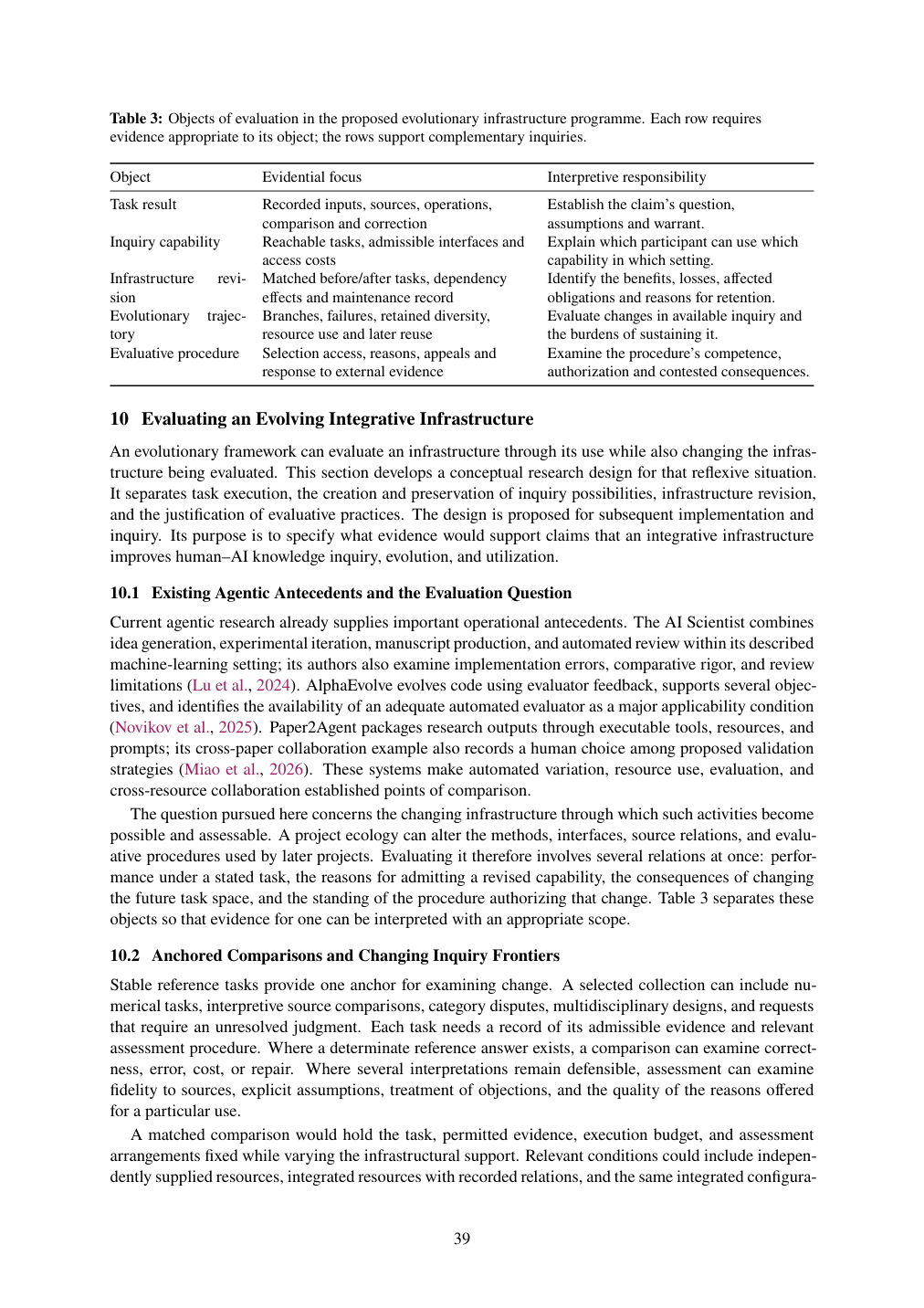
Readable text
Table 3: Objects of evaluation in the proposed evolutionary infrastructure programme. Each row requires evidence appropriate to its object; the rows support complementary inquiries.
Evaluative procedure response to external evidence
Establish the claim’s question, assumptions and warrant.
Explain which participant can use which capability in which setting.
Identify the benefits, losses, affected obligations and reasons for retention.
Evaluate changes in available inquiry and the burdens of sustaining it.
Examine the procedure’s competence, authorization and contested consequences.
10 Evaluating an Evolving Integrative Infrastructure
An evolutionary framework can evaluate an infrastructure through its use while also changing the infras- tructure being evaluated. This section develops a conceptual research design for that reflexive situation. It separates task execution, the creation and preservation of inquiry possibilities, infrastructure revision, and the justification of evaluative practices. The design is proposed for subsequent implementation and inquiry. Its purpose is to specify what evidence would support claims that an integrative infrastructure improves human–AI knowledge inquiry, evolution, and utilization.
10.1 Existing Agentic Antecedents and the Evaluation Question
Current agentic research already supplies important operational antecedents. The AI Scientist combines idea generation, experimental iteration, manuscript production, and automated review within its described machine-learning setting; its authors also examine implementation errors, comparative rigor, and review limitations (Lu et al., 2024). AlphaEvolve evolves code using evaluator feedback, supports several objec- tives, and identifies the availability of an adequate automated evaluator as a major applicability condition (Novikov et al., 2025). Paper2Agent packages research outputs through executable tools, resources, and prompts; its cross-paper collaboration example also records a human choice among proposed validation strategies (Miao et al., 2026). These systems make automated variation, resource use, evaluation, and cross-resource collaboration established points of comparison.
The question pursued here concerns the changing infrastructure through which such activities become possible and assessable. A project ecology can alter the methods, interfaces, source relations, and evalu- ative procedures used by later projects. Evaluating it therefore involves several relations at once: perfor- mance under a stated task, the reasons for admitting a revised capability, the consequences of changing the future task space, and the standing of the procedure authorizing that change. Table 3 separates these objects so that evidence for one can be interpreted with an appropriate scope.
10.2 Anchored Comparisons and Changing Inquiry Frontiers
Stable reference tasks provide one anchor for examining change. A selected collection can include nu- merical tasks, interpretive source comparisons, category disputes, multidisciplinary designs, and requests that require an unresolved judgment. Each task needs a record of its admissible evidence and relevant assessment procedure. Where a determinate reference answer exists, a comparison can examine correct- ness, error, cost, or repair. Where several interpretations remain defensible, assessment can examine fidelity to sources, explicit assumptions, treatment of objections, and the quality of the reasons offered
A matched comparison would hold the task, permitted evidence, execution budget, and assessment arrangements fixed while varying the infrastructural support. Relevant conditions could include indepen- dently supplied resources, integrated resources with recorded relations, and the same integrated configura-
tion after an authorized evolutionary revision. Human participants and agents should receive comparable initial source access and the same task brief. Derived relations, prepared capabilities, and improved access intentionally supplied by integration belong to the treatment and should be recorded as such. Additional privileged source material or unequal assessment attention requires its own attribution. The comparison should retain both the numerical outcome and the actual route through which it arose. Initial integration and curation costs, evolutionary preparation, execution, and maintenance should be reported separately over a declared reuse horizon. A matched execution budget estimates performance conditional on prepared support; an end-to-end resource comparison additionally includes the costs of creating and sustaining that support.
An evolving frontier requires additional observation. A revised interface may make a previously inaccessible question investigable, while a new interpretation may reveal that an earlier task asked an inadequate question. A fixed task set alone measures the effects visible through its retained questions. A frontier record can document proposed new tasks, their parent resources, the new distinction or operation they require, and the evidence used to admit them. Review can then examine whether the change represents a substantive new capability, an alternative description of an existing capability, or a currently unsupported proposal.
Anchors and frontier records serve different functions. Anchors preserve comparability across versions. Frontier records preserve sensitivity to changing questions and capabilities. A useful evaluation programme maintains both and documents the relations between them. A later category revision may lead to a successor task that supersedes an earlier formulation while leaving its original result inspectable within the earlier scope. That practice permits historical comparison without treating the original task definition as the permanent measure of inquiry.
10.3 Counterfactual Contribution and Dependency Evidence
An infrastructural contribution can be distributed over several projects. A source wrapper may be developed in one task, make a second task feasible, and later require correction when a third task exposes an assumption. A project-only score would assign those effects according to an attribution convention. A relational evaluation instead records the sequence of dependencies, reuse, criticism, and repair through which the effects become visible. The resulting record supports several attribution questions while preserving the difference between documented dependence and a causal estimate of benefit.
Counterfactual comparisons can make those questions more precise. One can ask whether a task remains executable when a particular interface is removed, whether the conclusion retains its warrant after a supporting interpretation is revised, or whether a later project can reconstruct the sources behind a result. Designed ablations, carefully matched versions, and independent reconstruction can provide evidence for these restricted questions. A claim that the infrastructure caused a social or scientific benefit across institutions would require a corresponding empirical design and an account of other changes in the setting.
Humanistic contributions need their own evidence in such comparisons. A historical account can affect the categories used in a model; a linguistic analysis can change how an interview question is understood; a philosophical objection can reveal an unjustified transition between an observed difference and a proposed action. Their contribution may appear through the revision of a question, the withdrawal of an inference, or a newly recorded disagreement. An evaluation that records only successful execution would lose those effects. A reasoned revision can be a substantive outcome even when it reduces the number of claims retained.
10.4 Evaluation of Human Mediation
Human mediation becomes assessable when its capacities and burdens are specified. Relevant observations include whether a participant can reconstruct a decision’s evidence, introduce a contextual objection, request a competing interpretation, obtain a response, and affect the disposition of the disputed claim or revision. A recorded intervention should identify what changed, which reasons were considered, and which unresolved issue remains. Assessment can then examine the effectiveness of the intervention within the relevant authorization arrangements.
The distribution of these capacities matters. A system may offer a sophisticated review interface while access is concentrated among already influential participants. A participant may be formally entitled to object while lacking time, compensation, language support, or access to the necessary records. An inquiry into mediability should therefore examine the conditions under which the available procedures can actually be used. The evaluative-power analysis in Section 9 gives a basis for identifying such questions without presuming that an interface’s existence settles them.
Autonomous operation also changes the scale of mediation. Generating more candidate revisions can increase the demands placed on reviewers, maintainers, and affected communities. The relevant allocation question includes which operations can proceed under existing warrants, which need specialized review, and which changes affect the terms authorizing later operations. A well-specified programme records these classes, the evidence available to distinguish them, and the costs of responding when a classification fails. This permits a study of supported delegation and the capacity to correct its consequences.
10.5 External Feedback, Negative Findings, and Retirement
An evolving research ecology interacts with conditions beyond its internal records. Changed observations, public priorities, practical failures, disciplinary criticism, and the experiences of affected people can make an internally coherent result inadequate for its proposed use. The evaluation programme should identify routes through which such evidence enters the ecology, the standing it receives, and the revisions it can trigger. This requirement connects the infrastructure to a partially observed environment and makes environmental response an empirical question.
Failed compositions and withdrawn claims provide particularly informative cases. A failed translation can identify an unresolved conceptual difference. A failed reproduction can locate an undocumented dependency. A retired method can release maintenance resources and clarify the conditions under which earlier results remain usable. The archive should preserve the reason and scope of the disposition so that failure remains available for learning. Counting retained projects alone would assign these developments a meaning that needs independent justification.
The proposed programme consequently combines anchored comparisons, frontier records, dependency evidence, studies of mediation, and external validation. Its measures can remain plural. A project can improve computational performance while imposing an unacceptable maintenance burden; an interpretation can improve fidelity while leaving an action unsettled. The evaluation record should retain such configurations and the reasons used to address them. The philosophical claim is that an evolving integrative infrastructure requires an evolving capacity for answerable selection, with particular changes assessed through the evidence appropriate to their consequences.
11 Conceptual Contributions and Conditions of Adequacy
The preceding analysis connects combinatorial possibility, disciplinary integration, and autonomous evolution through a question about the conditions of inquiry. This section identifies the proposed conceptual contribution and examines its conditions of adequacy. The objective is to specify what the argument establishes within its representations, what it proposes for infrastructural practice, and which further judgments depend on historical, interpretive, or empirical inquiry.
11.1 Relational Expansion and Epistemic Selection
The first contribution is a distinction between expansion by resource admission and expansion by changed relations. A new retained resource can enter existing combinations under an established grammar. A new relation or operation can also make existing resources available for a different question. A historical distinction, for example, can change the categories through which an existing dataset is interpreted. An interface can make an established method accessible to another project. The infrastructure’s generative role therefore includes changing the conditions under which resources can contribute, in addition to enlarging their inventory.
The second contribution connects that expansion to the work of selection. Substantively distinct possibilities considered for use can create additional demands for attention, interpretation, testing, and maintenance. Their actual burden depends on search, equivalence, filtering, and selection; additional descriptions can also remain unexamined or share an existing warrant. Compatibility and cost can restrict which possibilities are accessible. Evidential and normative assessment can restrict which uses are supported or authorized. The practical significance of expansion therefore depends on the development and distribution of the capacities that make those selections answerable. The combinatorial argument motivates this problem; the counts supply a representation of its nominal scale under particular assumptions.
An important consequence concerns the interpretation of a decreasing count. A revised grammar can eliminate duplicate descriptions, retire misleading interfaces, or withdraw an unsupported use. The resulting possibility space can become smaller while becoming more faithful to a task or more practical to navigate. The direction of a count is consequently one observation within an evaluation. Its value depends on which possibilities were added or removed and why. This explains the role of the retained dispositions and reasons proposed throughout the paper.
11.2 Evolution of Resources, Grammars, and Evaluation
The third contribution is a distinction among three objects of evolution. Resources can change through criticism, correction, extension, or new observation. Inquiry grammars can change through new operations, roles, translations, and admissibility relations. Evaluative procedures can change through learning, disagreement, altered purposes, or institutional revision. These processes interact. A new evaluation rule can admit different resources; a new resource can expose a weakness in that rule; a new translation can change the population of projects it assesses.
Treating those processes separately makes their connections inspectable. A rule’s successful diffusion can be studied as a process of uptake. Its accuracy can be studied relative to a declared assessment target. Its authority can be investigated through the procedures, relationships, and reasons that support its institutional role. Its justice can be examined through the experiences, claims, and consequences relevant to those affected. A proposed autonomous ecology needs ways to preserve these records and to relate them through criticism and revision.
The capacity for human mediation becomes significant at each level. Participants may need to contest a resource’s scope, introduce a different grammar of inquiry, or challenge the terms through which evaluative standing is distributed. These are different interventions and can call for different competencies and authorization arrangements. Their common infrastructural requirement is an effective route for an intervention to receive consideration and a reasoned response. Participants can raise a concern while its vocabulary and supporting account remain under development; mediation can help articulate it. Subsequent uptake requires justification appropriate to the proposed change. A named supervisory role alone gives a limited account of that capacity; a concrete design needs records, resources, response procedures, and a distribution of standing.
11.3 Plurality, Commensurability, and Institutional Context
A possible objection concerns the demand for a common evaluative language. Integrated projects often need interoperable records, and practical decisions may require a selection among alternatives. Interoperability can be supported by explicit mappings and common procedural descriptions while preserving differences in what the participants take to count as evidence or justification. A shared record can hold several reasons, a disputed mapping, and the circumstances in which a judgment applies. The adequacy of any further common scale remains a substantive question for the inquiry.
The proposed framework therefore permits several dispositions: a justified common judgment, a taskspecific translation, a limited comparison, a retained disagreement, or a request for additional evidence. Each disposition can have practical consequences that need explanation. A retained disagreement can protect a distinction needed for a later question; it can also delay a decision with costs of its own. The framework’s contribution is to make the reasons and dependencies available for examination. The appropriate response depends on the institutions and purposes involved.
Readable text
Another objection concerns resource inequality. An infrastructure organized around extensive prove- nance, review, and revision can impose work that some participants are less able to perform. The response requires institutional design alongside software design: supported participation, appropriate compensa- tion, usable records, and limits on burdens placed on contributors. Evaluation of the infrastructure should include those conditions. Otherwise, formal opportunities to contribute can coexist with a narrower dis-
The paper’s proposed increment lies in coordinating question-relative compositional spaces, their en- dogenous transformation, and the human-mediatable evaluation of that transformation. Existing work supplies the relevant foundations in interdisciplinary cooperation, pluralism, recombination, knowledge infrastructures, project ecologies, and agentic research. The smooth and cellular constructions clarify several restricted aspects of the argument. Finite-resolution distinguishability, graded topology, and sym- bolic coding provide different measurements; their conclusions retain the corresponding representation as- sumptions. The Noetarium case supplies a source-grounded design instance. The evaluation programme identifies evidence through which broader claims can be examined.
Historical studies can examine how new methods or categories recorded disciplinary relations on inquiry, reproduction, and repair. Institutional studies can examine whose interventions obtain a response as an ecology evolves. relations among generativity, warrant, authority, and plural value in particular settings. These inquiries would add different kinds of support to the general proposal and could also identify conditions requiring
Several further inquiries follow. changed the questions available to a community. its revision.
Comparative studies can investigate the effects of Philosophical work can develop the
Integrative science and humanities infrastructure can be examined through the relations that make knowl- edge resources available for particular inquiries. Its significance includes the organization of existing con- tributions, the formation of supported translations, and the possibility that use will change the resources, relations, and evaluative practices available to later projects. The resulting space is compositional, histor-
The two illustrative proof routes distinguish finite-resolution geometry, cellular composition, algebraic invariants, and path equivalence under declared conventions. Their represented spaces can remain con- tinuous. Supplementary finite-code calculations concern retained descriptions and their roles. Adding a resource can expand several of these spaces at once. Changing a grammar can also reconfigure the uses of resources already retained. Compatibility, access, budget, interpretation, and warrant determine which nominal possibilities can become supported inquiries. Those conditions locate the philosophical problem in the capacities for orientation and answerable selection that accompany expanding possibilities.
The humanities contribute to those capacities throughout the inquiry process. Interpretation, category formation, historical understanding, and normative reasoning can change the object of investigation and the meaning of its results. Scientific methods and computational capabilities contribute other resources and tests. Their relations become productive subjects of inquiry when the infrastructure preserves their
Noetarium provides a concrete design case through which these relations can be studied. The compan- ion research connects generated project variation, maintained carriers, revisable rules, and the distribu- tion of evaluative authority within an account of human-mediatable autonomous evolution. Within that account, autonomous activity can generate and investigate changes, while supported mediation provides routes for questioning resources, revising inquiry grammars, and contesting evaluative authority. The proposed evaluation programme makes these capacities objects of subsequent evidence and criticism.
The continuing task is to sustain inquiry while the conditions of inquiry change. An evolving infras- tructure can contribute by making possibilities accessible, preserving the evidence and reasons attached
Readable text
to their use, and retaining effective capacities for revision. Its development can then be assessed through the particular inquiries it enables, the relations it sustains, the burdens it creates, and the consequences
This appendix supplies a supplementary finite-code illustration of the configurations an inquiry can formu- late from a declared inventory of represented descriptions. The counted entries belong to the codebook; the smooth and cellular routes in Sections 4 and 5 provide the main representational analysis. This section reconstructs that argument through elementary finite counts, then examines its interpretation when admis- sibility, meaning and knowledge change. The counting unit is specified before each comparison. A pair of contributions, an unordered bundle and an ordered research pathway are different objects. Their cardi- nalities reveal different structural possibilities; actual discovery and useful application require additional
role is stated. The inventory is an analytical snapshot of historically situated disciplinary practices. Origin tags distinguish entries even when two disciplines use the same name. A later semantic assessment can identify equivalent entries or preserve a consequential difference.
For a task requiring one A contribution and one B contribution, the configuration is an element of its subset, and every such pair is provisionally admitted. These definitions give Equation 19.
entry, remove the empty selection, and repeat for B. Independent selection gives the product. Thus the exponential terms enter through unrestricted subset formation within each inventory. An interpretation
with pair configurations, which is informative only after naming those units. A claim about time, memory, human attention or research productivity needs a corresponding cost measure. The present formulas are cardinalities. An implementation that materializes every configuration emits that many records; a symbolic representation or targeted search can address a task without materializing the entire collection.
Here and below, a binomial coefficient is zero when its lower argument exceeds the available inventory. different growth law from unrestricted subset formation. Selecting an appropriate grammar is part of
needs a rule for its two roles. For independent ordered selections from the same
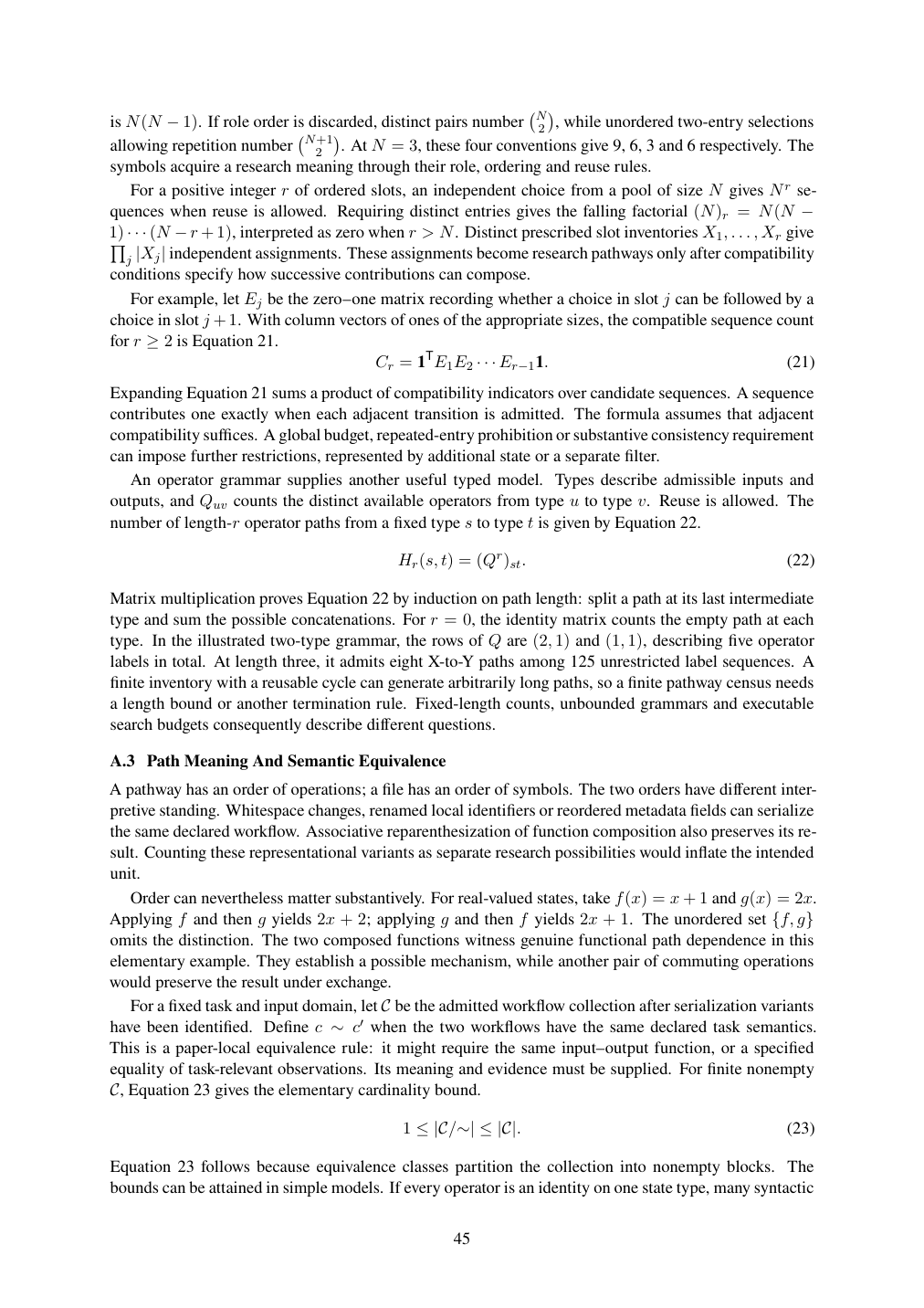
Readable text
symbols acquire a research meaning through their role, ordering and reuse rules.
conditions specify how successive contributions can compose.
Expanding Equation 21 sums a product of compatibility indicators over candidate sequences. A sequence contributes one exactly when each adjacent transition is admitted. The formula assumes that adjacent compatibility suffices. A global budget, repeated-entry prohibition or substantive consistency requirement can impose further restrictions, represented by additional state or a separate filter.
An operator grammar supplies another useful typed model. Types describe admissible inputs and
Matrix multiplication proves Equation 22 by induction on path length: split a path at its last intermediate labels in total. At length three, it admits eight X-to-Y paths among 125 unrestricted label sequences. A finite inventory with a reusable cycle can generate arbitrarily long paths, so a finite pathway census needs a length bound or another termination rule. Fixed-length counts, unbounded grammars and executable search budgets consequently describe different questions.
A pathway has an order of operations; a file has an order of symbols. The two orders have different inter- pretive standing. Whitespace changes, renamed local identifiers or reordered metadata fields can serialize the same declared workflow. Associative reparenthesization of function composition also preserves its re- sult. Counting these representational variants as separate research possibilities would inflate the intended
omits the distinction. The two composed functions witness genuine functional path dependence in this elementary example. They establish a possible mechanism, while another pair of commuting operations
This is a paper-local equivalence rule: it might require the same input–output function, or a specified equality of task-relevant observations. Its meaning and evidence must be supplied. For finite nonempty
Equation 23 follows because equivalence classes partition the collection into nonempty blocks. The bounds can be attained in simple models. If every operator is an identity on one state type, many syntactic
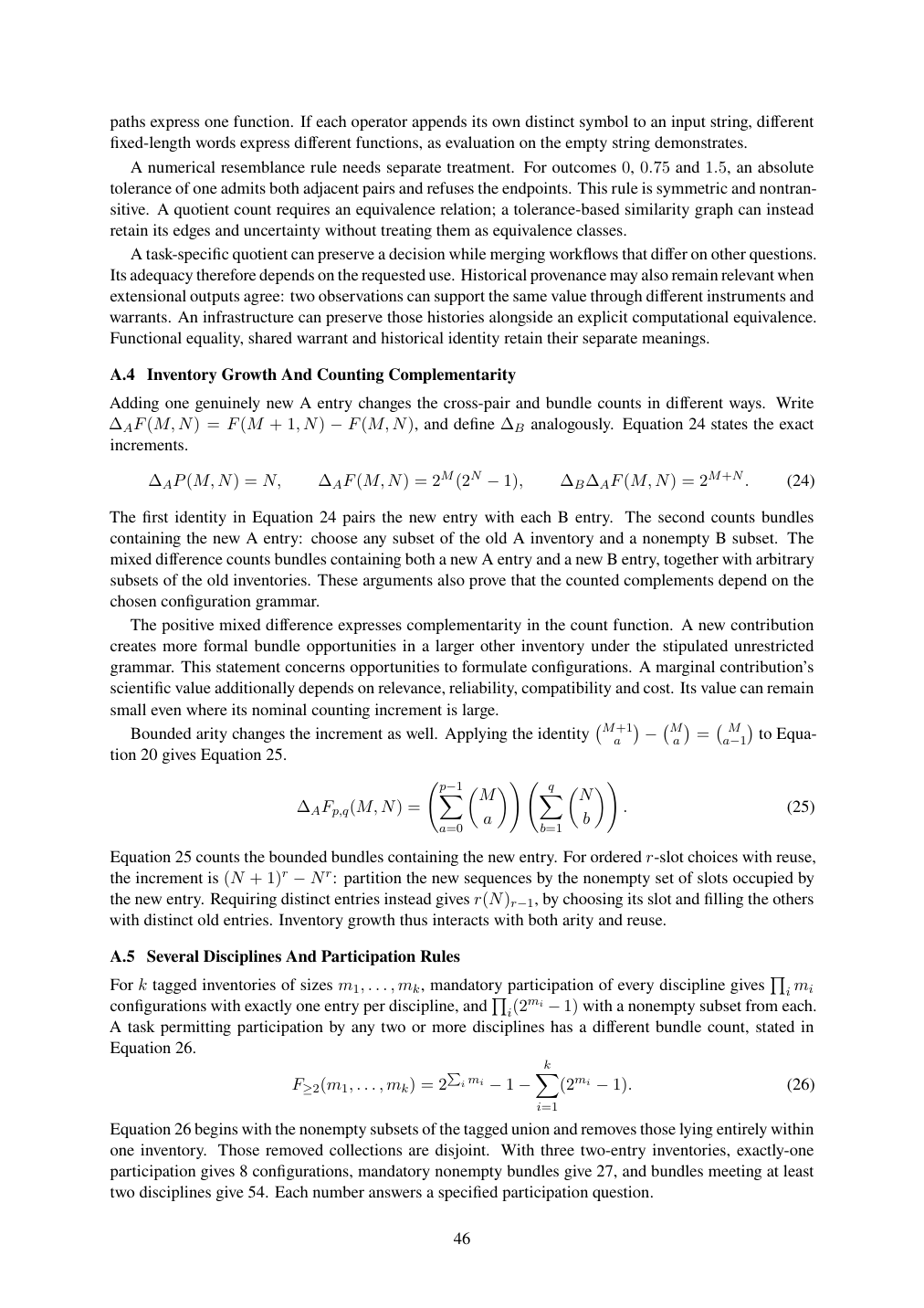
Readable text
paths express one function. If each operator appends its own distinct symbol to an input string, different fixed-length words express different functions, as evaluation on the empty string demonstrates.
tolerance of one admits both adjacent pairs and refuses the endpoints. This rule is symmetric and nontran- sitive. A quotient count requires an equivalence relation; a tolerance-based similarity graph can instead retain its edges and uncertainty without treating them as equivalence classes.
A task-specific quotient can preserve a decision while merging workflows that differ on other questions. Its adequacy therefore depends on the requested use. Historical provenance may also remain relevant when extensional outputs agree: two observations can support the same value through different instruments and warrants. An infrastructure can preserve those histories alongside an explicit computational equivalence. Functional equality, shared warrant and historical identity retain their separate meanings.
Adding one genuinely new A entry changes the cross-pair and bundle counts in different ways. Write
The first identity in Equation 24 pairs the new entry with each B entry. The second counts bundles containing the new A entry: choose any subset of the old A inventory and a nonempty B subset. The mixed difference counts bundles containing both a new A entry and a new B entry, together with arbitrary subsets of the old inventories. These arguments also prove that the counted complements depend on the
The positive mixed difference expresses complementarity in the count function. A new contribution creates more formal bundle opportunities in a larger other inventory under the stipulated unrestricted grammar. This statement concerns opportunities to formulate configurations. A marginal contribution’s scientific value additionally depends on relevance, reliability, compatibility and cost. Its value can remain small even where its nominal counting increment is large.
Bounded arity changes the increment as well. Applying the identity
with distinct old entries. Inventory growth thus interacts with both arity and reuse.
A task permitting participation by any two or more disciplines has a different bundle count, stated in
Equation 26 begins with the nonempty subsets of the tagged union and removes those lying entirely within one inventory. Those removed collections are disjoint. With three two-entry inventories, exactly-one participation gives 8 configurations, mandatory nonempty bundles give 27, and bundles meeting at least two disciplines give 54. Each number answers a specified participation question.
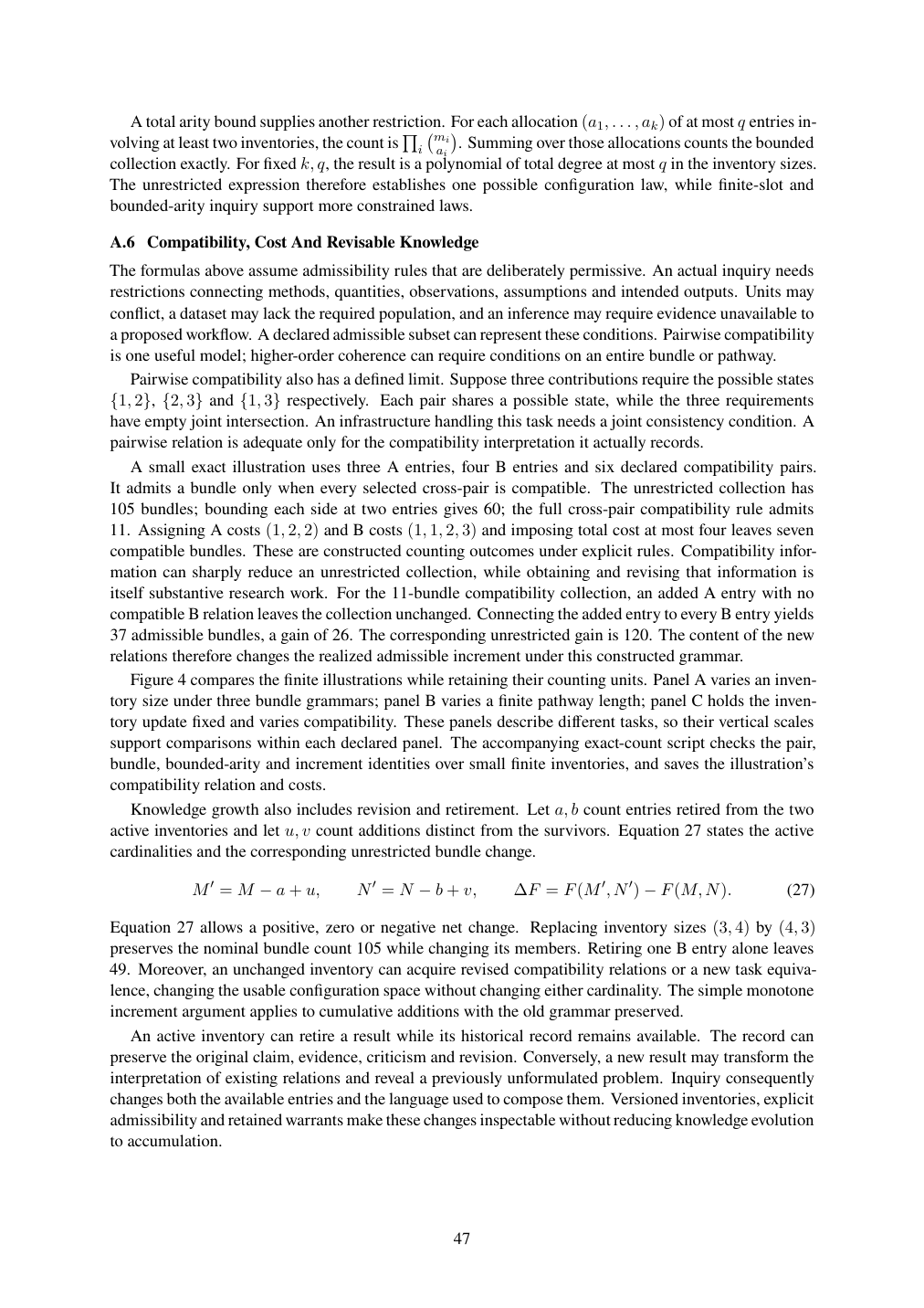
Readable text
. Summing over those allocations counts the bounded bounded-arity inquiry support more constrained laws.
The unrestricted expression therefore establishes one possible configuration law, while finite-slot and
The formulas above assume admissibility rules that are deliberately permissive. An actual inquiry needs restrictions connecting methods, quantities, observations, assumptions and intended outputs. Units may conflict, a dataset may lack the required population, and an inference may require evidence unavailable to a proposed workflow. A declared admissible subset can represent these conditions. Pairwise compatibility is one useful model; higher-order coherence can require conditions on an entire bundle or pathway.
Pairwise compatibility also has a defined limit. Suppose three contributions require the possible states have empty joint intersection. An infrastructure handling this task needs a joint consistency condition. A pairwise relation is adequate only for the compatibility interpretation it actually records.
A small exact illustration uses three A entries, four B entries and six declared compatibility pairs. It admits a bundle only when every selected cross-pair is compatible. The unrestricted collection has 105 bundles; bounding each side at two entries gives 60; the full cross-pair compatibility rule admits compatible bundles. These are constructed counting outcomes under explicit rules. Compatibility infor- mation can sharply reduce an unrestricted collection, while obtaining and revising that information is itself substantive research work. For the 11-bundle compatibility collection, an added A entry with no compatible B relation leaves the collection unchanged. Connecting the added entry to every B entry yields 37 admissible bundles, a gain of 26. The corresponding unrestricted gain is 120. The content of the new relations therefore changes the realized admissible increment under this constructed grammar.
Figure 4 compares the finite illustrations while retaining their counting units. Panel A varies an inven- tory size under three bundle grammars; panel B varies a finite pathway length; panel C holds the inven- tory update fixed and varies compatibility. These panels describe different tasks, so their vertical scales support comparisons within each declared panel. The accompanying exact-count script checks the pair, bundle, bounded-arity and increment identities over small finite inventories, and saves the illustration’s
cardinalities and the corresponding unrestricted bundle change.
preserves the nominal bundle count 105 while changing its members. Retiring one B entry alone leaves 49. Moreover, an unchanged inventory can acquire revised compatibility relations or a new task equiva- lence, changing the usable configuration space without changing either cardinality. The simple monotone increment argument applies to cumulative additions with the old grammar preserved.
An active inventory can retire a result while its historical record remains available. The record can preserve the original claim, evidence, criticism and revision. Conversely, a new result may transform the interpretation of existing relations and reveal a previously unformulated problem. Inquiry consequently changes both the available entries and the language used to compose them. Versioned inventories, explicit admissibility and retained warrants make these changes inspectable without reducing knowledge evolution
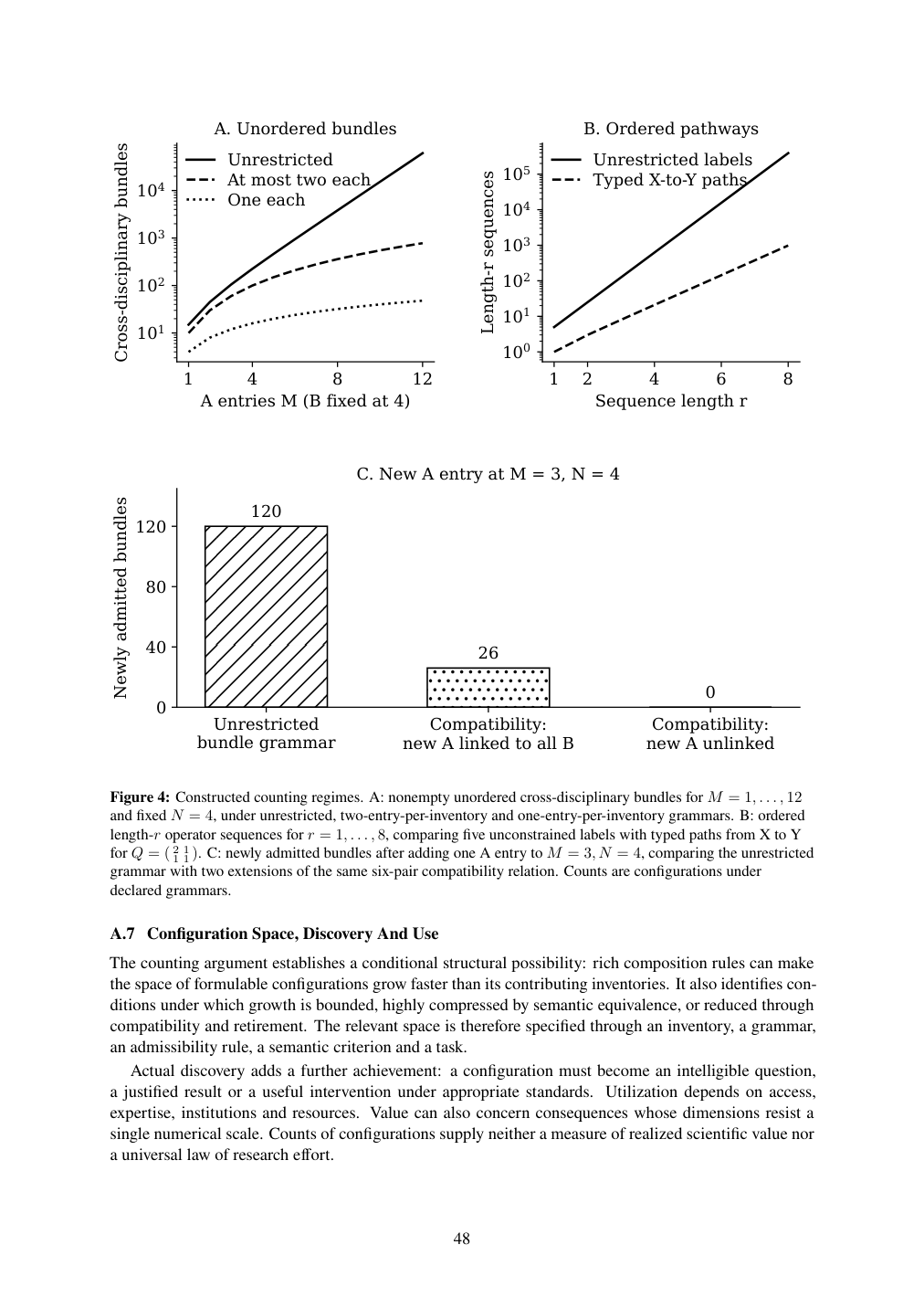
Readable text
grammar with two extensions of the same six-pair compatibility relation. Counts are configurations under
The counting argument establishes a conditional structural possibility: rich composition rules can make the space of formulable configurations grow faster than its contributing inventories. It also identifies con- ditions under which growth is bounded, highly compressed by semantic equivalence, or reduced through compatibility and retirement. The relevant space is therefore specified through an inventory, a grammar,
an admissibility rule, a semantic criterion and a task.
Actual discovery adds a further achievement: a configuration must become an intelligible question, a justified result or a useful intervention under appropriate standards. Utilization depends on access, expertise, institutions and resources. Value can also concern consequences whose dimensions resist a single numerical scale. Counts of configurations supply neither a measure of realized scientific value nor
The philosophical implication is an orientation for infrastructure. A relational environment can help researchers and AI agents formulate compositions, identify obligations, preserve alternatives and acquire evidence that resolves a consequential ambiguity. Its contribution can be evaluated through concrete tasks: useful questions reached, valid results retained through revision, or inquiry costs under declared constraints. The combinatorial space explains the importance of navigation and selection; the quality of the selected relations remains a matter for scientific and institutional judgment.
References
W. Brian Arthur. The Nature of Technology: What It Is and How It Evolves. Free Press, New York, 2009. ISBN
9781416544050. URL https://www.simonandschuster.com/books/The-Nature-of-Technology/W-B rian-Arthur/9781416544067. Chapter 1 consulted through the publisher’s excerpt accompanying the 2011 paperback; original publication year verified through the author’s Santa Fe Institute page. W. Brian Arthur and Wolfgang Polak. The evolution of technology within a simple computer model. Complexity,
11(5):23–31, 2006. doi: 10.1002/cplx.20130. URL https://sites.santafe.edu/~wbarthur/Pape rs/AP-Complexity.pdf. Author-hosted preprint, Santa Fe Institute Working Paper 2004-12-042, consulted; publication metadata and abstract checked at Wiley. John C. Baez. Spin foam models. Classical and Quantum Gravity, 15(7):1827–1858, 1998. doi: 10.1088/0264-9
381/15/7/004. URL https://arxiv.org/abs/gr-qc/9709052. Nancy Cartwright. Evidence-based policy: What’s to be done about relevance? Philosophical Studies, 143(1): 127–136, 2009. doi: 10.1007/s11098-008-9311-4. Johanna Drucker. Humanities approaches to graphical display. Digital Humanities Quarterly, 5(1), 2011. URL
https://www.digitalhumanities.org/dhq/vol/5/1/000091/000091.html. Paul N. Edwards, Steven J. Jackson, Melissa K. Chalmers, Geoffrey C. Bowker, Christine L. Borgman, David Ribes,
Matt Burton, and Scout Calvert. Knowledge infrastructures: Intellectual frameworks and research challenges. Workshop report, University of Michigan School of Information, Ann Arbor, 2013. URL http://hdl.handle .net/2027.42/97552. Ron Eglash. An introduction to generative justice. Teknokultura, 13(2):369–404, 2016. doi: 10.5209/rev_TEKN
.2016.v13.n2.52847. URL https://revistas.ucm.es/index.php/TEKN/en/article/view/52847. Lee Fleming. Recombinant uncertainty in technological search. Management Science, 47(1):117–132, 2001. doi:
10.1287/mnsc.47.1.117.10671. URL https://funginstitute.berkeley.edu/wp-content/uploads/2 012/10/Recombinant-Uncertainty-in-Technological-Search.pdf. Miranda Fricker. Epistemic Injustice: Power and the Ethics of Knowing. Oxford University Press, Oxford, 2007.
doi: 10.1093/acprof:oso/9780198237907.001.0001. URL https://academic.oup.com/book/32817. Peter Galison. Trading zone: Coordinating action and belief. In Mario Biagioli, editor, The Science Studies Reader,
pages 137–160. Routledge, New York, 1999. URL https://galison.scholars.harvard.edu/publicati ons/trading-zone-coordinating-action-and-belief-1998-abridgment. Donna Haraway. Situated knowledges: The science question in feminism and the privilege of partial perspective.
Feminist Studies, 14(3):575–599, 1988. doi: 10.2307/3178066. URL https://sidoli.w.waseda.jp/Haraw ay_1988_Situated_Knowledges_The_Science_Question_in_Feminism.pdf. Allen Hatcher. Algebraic Topology. Cambridge University Press, Cambridge, 2002. ISBN 9780521795401. URL
https://pi.math.cornell.edu/~hatcher/AT/ATpage.html. Wanhong Huang. The prolongation of generativity through external carriers and adaptive power in projects: Insights
for evolutionary frameworks. Proposal paper, Knowledge Commons, 2026a. URL https://huang-wanhong .com/pdfs/huang2026_krskw_rct80.pdf. Author-hosted primary manuscript; accessed 24 November 2026. Wanhong Huang. Evolutionary project ecologies in economics: A conceptual framework and institutional prospects.
Philosophical discussion paper, Knowledge Commons, 2026b. URL https://huang-wanhong.com/pdfs/hu ang2026_gbr7a_0yv44.pdf. Author-hosted primary manuscript; accessed 24 November 2026. Wanhong Huang. Generative grammar representations for autonomous evolutionary algorithms in large-scale projects. Proposal paper, Knowledge Commons, 2026c. URL https://huang-wanhong.com/pdfs/hu ang2026_z19gj_js615.pdf. Author-hosted primary manuscript; accessed 24 November 2026. Wanhong Huang. Towards a generative ecology of projects: A universal evolutionary framework for the continuing
improvement of a body of work by language-model agents. Proposal paper, Knowledge Commons, 2026d. URL https://huang-wanhong.com/pdfs/huang2026\_cjd80\_xr956.pdf. Author-hosted primary manuscript; accessed 24 November 2026. Wanhong Huang. kybernesis: A revisable meta-foundation for evolutionary evidence-based policy making, 2026e.
URL https://huang-wanhong.com/pdfs/huang2026\_2ng16\_d4j17.pdf. Technical report; author-hosted version accessed 24 November 2026.
Readable text
Wanhong Huang. An inquiry into evaluative norm formation and justice in self-evolving AI knowledge systems,
2026f. URL https://huang-wanhong.com/pdfs/huang2026\_0ykav\_ybp07.pdf. Philosophical discussion paper; author-hosted version accessed 24 November 2026. Wanhong Huang. Evaluative power in self-evolving AI knowledge systems: Temporal and relational formation,
URL https://huang-wanhong.com/pdfs/huang2026\_6b8mh\_5d956.pdf. discussion paper; author-hosted version accessed 24 November 2026. John M. Lee. Introduction to Smooth Manifolds, volume 218 of Graduate Texts in Mathematics. Springer, New
York, 2 edition, 2013. doi: 10.1007/978-1-4419-9982-5. URL https://sites.math.washington.edu/~l Sabina Leonelli. What counts as scientific data? a relational framework. Philosophy of Science, 82(5):810–821,
Helen E. Longino. How values can be good for science. In Peter Machamer and Gereon Wolters, editors, Science,
Values, and Objectivity, pages 127–142. University of Pittsburgh Press, Pittsburgh, 2004. doi: 10.2307/j.ctt5vk g7t.11. URL https://www.ugr.es/~zink/mono/Longino2004.pdf. Chris Lu, Cong Lu, Robert Tjarko Lange, Jakob Foerster, Jeff Clune, and David Ha. The AI scientist: Towards
fully automated open-ended scientific discovery, 2024. arXiv:2408.06292, version 3.
Jiacheng Miao, Joe R. Davis, Yaohui Zhang, Jonathan K. Pritchard, and James Zou. Reimagining research papers
as interactive and reliable AI agents. Nature, 658:1272–1280, 2026. doi: 10.1038/s41586-026-11044-y. URL https://www.nature.com/articles/s41586-026-11044-y. Sandra D. Mitchell and Michael R. Dietrich. Integration without unification: An argument for pluralism in the
biological sciences. The American Naturalist, 168(S6):S73–S79, 2006. doi: 10.1086/509050. Noetarium Project. Adr 0026: Domains as libraries, and works that compose them, 2026a. URL https://gith
ub.com/huangwanhong-maker/Noetarium-The-Science-and-Humanity-Infrastructure/blob/869 fe38afac257cd9b5d51ad5b498a8ff6b8e443/development/decisions/0026-domains-as-librari es.md. Repository source at commit 869fe38afac257cd9b5d51ad5b498a8ff6b8e443; primary content inspected Noetarium Project. Architecture, 2026b. URL https://github.com/huangwanhong-maker/Noetarium-The
-Science-and-Humanity-Infrastructure/blob/869fe38afac257cd9b5d51ad5b498a8ff6b8e443/do
cs/architecture.md. Repository source at commit 869fe38afac257cd9b5d51ad5b498a8ff6b8e443; primary Noetarium Project. The science infrastructure: A generative ecology case, 2026c. URL https://github.c
om/huangwanhong-maker/Noetarium-The-Science-and-Humanity-Infrastructure/blob/8 69fe38afac257cd9b5d51ad5b498a8ff6b8e443/development/ideas/2026-11-20-a-generativ e-ecology-of-projects/case-1-the-science-infrastructure.md. Repository source at commit 869fe38afac257cd9b5d51ad5b498a8ff6b8e443; primary content inspected online before citation. Noetarium Project. An ecology that improves the infrastructure: Evolution without an appointed evaluator, 2026d.
URL https://github.com/huangwanhong-maker/Noetarium-The-Science-and-Humanity-I nfrastructure/blob/869fe38afac257cd9b5d51ad5b498a8ff6b8e443/development/ideas/ 2026-11-19-an-ecology-that-improves-the-infrastructure.md. Repository source at commit 869fe38afac257cd9b5d51ad5b498a8ff6b8e443; primary content inspected online before citation. Noetarium Project. Canons: The history domain records, 2026e. URL https://github.com/huangwanh
ong-maker/Noetarium-The-Science-and-Humanity-Infrastructure/blob/869fe38afac257c d9b5d51ad5b498a8ff6b8e443/domains/history/canons/README.md. Repository source at commit 869fe38afac257cd9b5d51ad5b498a8ff6b8e443; primary content inspected online before citation. Noetarium Project. Historical objects and assertion standing: Source implementation, 2026f. URL https://gith
ub.com/huangwanhong-maker/Noetarium-The-Science-and-Humanity-Infrastructure/blob/869 fe38afac257cd9b5d51ad5b498a8ff6b8e443/domains/history/objects/include/history/object s/record.hpp. Repository source at commit 869fe38afac257cd9b5d51ad5b498a8ff6b8e443; primary content Needs: Their exploration and validation, 2026g. wanhong-maker/Noetarium-The-Science-and-Humanity-Infrastructure/blob/869fe38af ac257cd9b5d51ad5b498a8ff6b8e443/domains/needs/README.md. 869fe38afac257cd9b5d51ad5b498a8ff6b8e443; primary content inspected online before citation. Noetarium Project. Needs search and confirmation: Source implementation, 2026h. URL https://github.com
inspected online before citation. Noetarium Project.
URL https://github.com/huang Repository source at commit
/huangwanhong-maker/Noetarium-The-Science-and-Humanity-Infrastructure/blob/869fe38af
ac257cd9b5d51ad5b498a8ff6b8e443/domains/needs/search/include/needs/search/search.hpp. Repository source at commit 869fe38afac257cd9b5d51ad5b498a8ff6b8e443; primary content inspected online
Readable text
Noetarium Project. Adr 0166: The structure of regional economies, 2026i. URL https://github.com/huangwa
nhong-maker/Noetarium-The-Science-and-Humanity-Infrastructure/blob/869fe38afac257cd9 b5d51ad5b498a8ff6b8e443/development/decisions/0166-the-structure-of-regional-economi es.md. Repository source at commit 869fe38afac257cd9b5d51ad5b498a8ff6b8e443; primary content inspected Noetarium Project. Ghs-pop r2023a population registry declaration, 2026j. URL https://github.com/huang
wanhong-maker/Noetarium-The-Science-and-Humanity-Infrastructure/blob/869fe38afac257c d9b5d51ad5b498a8ff6b8e443/data/registry/ghsl-population.json. Repository source at commit 869fe38afac257cd9b5d51ad5b498a8ff6b8e443; primary content inspected online before citation. Noetarium: The science and humanity infrastructure, 2026k. .com/huangwanhong-maker/Noetarium-The-Science-and-Humanity-Infrastructure/bl ob/869fe38afac257cd9b5d51ad5b498a8ff6b8e443/README.md. 869fe38afac257cd9b5d51ad5b498a8ff6b8e443; primary content inspected online before citation. Noetarium Project. Shared structures across the sciences, 2026l. URL https://github.com/huangwanhong-mak
er/Noetarium-The-Science-and-Humanity-Infrastructure/blob/869fe38afac257cd9b5d51ad5b4 98a8ff6b8e443/development/ideas/2026-10-22-shared-structures-across-the-sciences.md. Repository source at commit 869fe38afac257cd9b5d51ad5b498a8ff6b8e443; primary content inspected online aker/Noetarium- The- Science- and- Humanity- Infrastructure/blob/869fe38afac25 7cd9b5d51ad5b498a8ff6b8e443/domains/tides/module.json. 869fe38afac257cd9b5d51ad5b498a8ff6b8e443; primary content inspected online before citation. Alexander Novikov, Ngân Vũ, Marvin Eisenberger, Emilien Dupont, Po-Sen Huang, Adam Zsolt Wagner, Sergey
before citation. Noetarium Project. Tides domain manifest, 2026m.
URL https://github.com/huangwanhong- m Repository source at commit
Shirobokov, Borislav Kozlovskii, Francisco J. R. Ruiz, Abbas Mehrabian, M. Pawan Kumar, Abigail See, Swarat Chaudhuri, George Holland, Alex Davies, Sebastian Nowozin, Pushmeet Kohli, and Matej Balog. AlphaEvolve: A coding agent for scientific and algorithmic discovery, 2025. URL https://arxiv.org/abs/2506.13131. Herbert A. Simon. Designing organizations for an information-rich world. In M. Greenberger, editor, Computers,
Communications, and the Public Interest, pages 37–72. The Johns Hopkins Press, Baltimore, 1971. URL https: Quentin Skinner. Meaning and understanding in the history of ideas. In Visions of Politics, Volume 1: Regarding
Method, pages 57–89. Cambridge University Press, Cambridge, 2002. doi: 10.1017/CBO9780511790812.007. Susan Leigh Star and James R. Griesemer. Institutional ecology, ‘translations’ and boundary objects: Amateurs and
professionals in berkeley’s museum of vertebrate zoology, 1907–39. Social Studies of Science, 19(3):387–420, Susan Leigh Star and Karen Ruhleder. Steps toward an ecology of infrastructure: Design and access for large
information spaces. Information Systems Research, 7(1):111–134, 1996. doi: 10.1287/isre.7.1.111. Andy Stirling. A general framework for analysing diversity in science, technology and society. Journal of the Royal
Society Interface, 4(15):707–719, 2007. doi: 10.1098/rsif.2007.0213. URL https://pmc.ncbi.nlm.nih.g Terence Tao. 245c, notes 5: Hausdorff dimension (optional). Author’s graduate lecture notes, What’s New, may
- URL https://terrytao.wordpress.com/2009/05/19/245c-notes-5-hausdorff-dimension-o Francesca Tria, Vittorio Loreto, Vito Domenico Pietro Servedio, and Steven H. Strogatz. The dynamics of correlated
novelties. Scientific Reports, 4:5890, 2014. doi: 10.1038/srep05890. URL https://www.nature.com/artic Brian Uzzi, Satyam Mukherjee, Michael Stringer, and Ben Jones. Atypical combinations and scientific impact.
Science, 342(6157):468–472, 2013. doi: 10.1126/science.1240474. URL https://www.kellogg.northwes tern.edu/faculty/uzzi/htm/papers/science-2013-uzzi-468-72.pdf. Roman Vershynin. High-Dimensional Probability: An Introduction with Applications in Data Science. Cambridge
Series in Statistical and Probabilistic Mathematics. Cambridge University Press, Cambridge, 2 edition, 2026. URL https://webapps.math.uci.edu/~rvershyn/papers/HDP-book/HDP-2.pdf. Author-hosted text Martin L. Weitzman. Recombinant growth. The Quarterly Journal of Economics, 113(2):331–360, 1998. doi: