Cycle-Space Exact Inference For Partially Observed Relational Histories
Full text from the PDF
Cycle-Space Exact Inference For Partially Observed Relational
Histories
Wanhong HUANG
Abstract
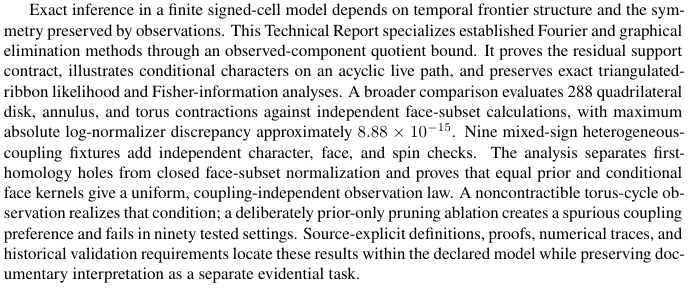
Keywords: relational histories; exact inference; gauge symmetry; cycle space; partial observation
Technical Report Note
This technical report shares an evolving inquiry and invites dialogue, criticism, revision, and independent development. Its definitions, distinctions, and constructions remain open to refinement. Circulation across scholarly and practical communities is part of the purpose of releasing the manuscript.
The author treats the viewpoints, concepts, and lines of reasoning presented here as contributions to a shared field of inquiry. Similar or related ideas may have appeared in other intellectual, cultural, and disciplinary traditions. The manuscript identifies known antecedents and distinguishes inherited positions, interpretive proposals, and arguments developed here. Historical priority remains open to further investigation.
The constructions and arguments are presented with their stated assumptions and evidential scope. Readers are encouraged to question, test, revise, extend, reinterpret, or independently develop the ideas presented here. Where appropriate, acknowledgment of this paper as one point of encounter in the development of a related idea is appreciated. Such acknowledgment records an intellectual route; the ideas remain available for criticism, revision, and independent development.
Definitions introduced by the paper are local analytical stipulations unless attributed to another source. Their use identifies the scope of the present argument; terminological and historical priority remain subjects for independent investigation. Generative Relational theory is treated as an open research programme whose proposals receive critical examination alongside independent literature.
Responsible Use and Rights Reservation
This section records a request for responsible scholarly conduct and identifies the scope of retained rights. Legal permissions are governed by the licence on the following page.
The author encourages good-faith discussion, criticism, independent inquiry, and responsible use of the material. Separately from the licence’s terms, the author asks users to consider foreseeable harms when adapting the arguments, representations, or examples of this paper, particularly in scientific inquiry, institutional decisions, and computational knowledge infrastructures. The ethical request leaves the licence’s permissions and legally authorised uses unchanged.
The author retains the rights preserved under CC BY-NC 4.0 and may pursue remedies to which the author is legally entitled for breach of the licence or violation of independently applicable rights. Reuse remains independent from authorial endorsement. Third-party rights require authorisation from their respective holders where applicable. Copyright exceptions and limitations, including applicable forms of fair use or fair dealing, remain available.
Notices
This page consolidates the manuscript’s research status, licence, development disclosure, researchprogramme relation, and suggested citation.
Status. This technical report is prepared for the author’s substantive review and subsequent scholarly discussion. Conditional support and face-kernel results concern a declared binary closed-cell family. Homogeneous and heterogeneous topology calculations provide independent exact-representation checks. Historical application requires source-grounded coding and model comparison. Internal checks assess the stated arguments and examples; independent scholarly assessment can further test their interpretation and adequacy. The source ledgers record the access level and claim scope of consulted works.
Licence. Except where otherwise indicated, copyright 2026 Wanhong Huang. This work is made available under the Creative Commons Attribution-NonCommercial 4.0 International License (CC BY-NC 4.0). Subject to its terms, the licence permits sharing and adaptation for noncommercial purposes with appropriate attribution, a link to the licence, and an indication of changes. Attribution should preserve the licensor’s independence from the reuse. Reuse is governed solely by the licence; the responsible-use request on the preceding page remains separate from its terms. The licence deed and legal code are available at https://creativecommons.org/licenses/by-nc/4.0/. The licence governs in case of conflict with this summary. Third-party material remains subject to its respective rights.
Statement on the use of language models. Preparation involved OpenAI’s ChatGPT and Codex. Language models supported exploratory dialogue, source discovery and checking, argumentative criticism, manuscript revision, LATEX typesetting, and the development of supporting code and figures. Verification used the sources and access levels recorded in the accompanying ledgers. The author initiated the research questions and directed the research programme; interpretation, acceptance of the arguments, and publication decisions remain subject to the author’s review. Authorship credit and responsibility for the released manuscript remain with the human author.
Code and data availability. Supporting scripts, generated outputs, source records, and editable manuscript files accompany this report. The computational illustrations are reproducible from the provided scripts. The source package contains the editable manuscript, source ledgers, supporting scripts and outputs, and a reading guide. Numerical illustrations, where present, use the assumptions stated in their captions and text.
Related research programme. This report belongs to the Noetarium technical report series. Companion reports study inference, computation, evaluation, governance, and cross-disciplinary knowledge formation. The reports develop distinct technical questions within an open Generative Relational research programme.
Suggested citation. Huang, Wanhong. “Cycle-Space Exact Inference For Partially Observed Relational Histories.” Technical report, 2026.
1 Introduction
Relational histories contain more than successive snapshots. A tie can persist across occasions, an observation can fix its sign at one moment, and a triadic constraint can couple signs that otherwise remain uncertain. Exact inference in such a model depends on the structure of those couplings and on which variables must remain live as the computation passes through time. A long record can consequently be tractable when its active frontier remains small, while a shorter densely coupled record can be demanding.
Noetarium represents signed histories through a cell complex and a finite gauge-inspired model. Its history implementation maps rungs to binary link variables, lenses to persistence interactions, and triangles to balance interactions. An ordered contraction computes normalizers, posterior quantities, and parameter derivatives. The present report examines the change in symmetry and active character space induced by conditioning on observed signs.
The main insight is that a prior cycle-space bound requires an observation-aware qualification. Before signs are fixed, vertex gauge symmetry permits only cycle characters. After observations are imposed, the surviving symmetry is determined by the connected components of the observed-edge graph. Characters can then correspond to paths whose endpoints are joined through observed relations. A frontier that is acyclic as an ordinary graph can therefore carry a nonconstant posterior character. An observed triangle supplies the smallest example.

A broader comparison evaluates 288 quadrilateral disk, annulus, and torus contractions and nine heterogeneous-coupling fixtures against independent face and spin representations. It separates firsthomology holes from closed face-subset normalization. A noncontractible torus-cycle observation has an exactly flat coupling likelihood, while prior-only pruning introduces a spurious parameter preference. These cases connect a support-assumption error to a specific inferential consequence.
The contribution is a scoped interpretation and computational study of known gauge and elimination principles in a relational-history setting. Historical adequacy requires a separately curated corpus, sourcechecked observations, an interpretable sign codebook, and comparisons with substantive alternatives.
2 Related Work In Graphical And Signed-Relation Inference
The comparative object in this section is exact computation for a finite signed-relation model, together with the evidential requirements of applying that model to historical material. Several mature literatures already provide its mathematical ingredients. A focused synthesis identifies their respective roles and locates the present report’s narrower observation-aware frontier analysis. The comparison preserves the distinction between a useful formal representation, an efficient inference method, and an empirically adequate account of a historical process.
Wilson’s lattice formulation provides a foundational gauge-theoretic antecedent (Wilson, 1974). Closed products of edge variables are invariant under local vertex transformations, giving a structured family of interactions. The finite binary model in the report adopts that algebraic pattern. The physical source supplies a mathematical lineage and a worked scientific context for local symmetry. Historical interpretation requires an independent argument about the coded relations, the meaning of their signs, and whether a local sign transformation preserves the quantities of interest. A shared equation form establishes a formal connection at that stated level; empirical adequacy remains specific to the domain and codebook.
Signed social relations have their own substantive history. Cartwright et al. (1956) develops structural balance through signed-graph reasoning. Balance can motivate attention to products around cycles, but
several distinctions matter. A positive or negative edge can represent alliance, hostility, agreement, dependency, or another coded relation. Changing a vertex’s sign convention is a representational operation only when the codebook permits it. A historical actor’s change of allegiance is an event with its own evidence. The present gauge action is an imposed invariance of the declared statistical model. Its relation to observed social categories needs explicit interpretation and should remain open to comparison with models that privilege particular edge signs directly.
Exponential-family graphical models provide the statistical framework. Wainwright et al. (2008) develops the relation among local sufficient statistics, partition functions, marginalization, and variational inference. The report’s cell products are selected sufficient statistics, and their normalizer determines the likelihood of partial observations. The score identity follows the established exponential-family calculus. The report’s specific computational question concerns which Fourier characters can survive when a subset of edges is observed and a temporal frontier is eliminated. That question specializes established likelihood and graphical inference to the selected statistics.
Bucket elimination supplies a direct algorithmic antecedent. Dechter (1999) organizes exact reasoning by eliminating variables and emphasizes the importance of induced width. Factor-graph and sum-product accounts likewise provide generic languages for factorization and marginalization (Kschischang et al., 2001; Loeliger, 2004). The sparse character dictionary is one representation for those operations in a binary parity model. Multiplication uses symmetric difference of character supports, and summation removes terms odd in an eliminated unobserved variable. These operations instantiate established elimination principles. The report’s useful specialization is to track observation-aware character support and connect its dimension to the quotient graph induced by observed components.
Normal factor graphs provide an especially close algebraic comparator. Forney et al. (2011) discusses partition functions and invariant transformations connecting Fourier representations and graphical computation. Forney (2018) develops connections among graph codes, elementary topology, and Ising-type models. Those antecedents make the relationship between parity constraints, incidence ranks, and transformed representations explicit. A character-based implementation can therefore inherit both mathematical tools and caution about complexity: a change of basis can expose sparsity for one family and leave a large support for another. The proposed frontier statistic should be evaluated as a representation-dependent bound within that established framework.
Dynamic network models offer a substantive alternative. Hanneke et al. (2010) studies temporal extensions of exponential random graph models. Caimo et al. (2026) develops separable models for dynamic signed networks, distinguishing interaction and sign-related structure through a Bayesian modeling approach. These sources show that temporal signed-network inference already has substantial statistical development. The report’s exact closed-cell model occupies a particular finite family with an algebraically favorable representation. A comparison with dynamic network models should therefore examine assumptions and predictive adequacy, alongside computational tractability. Exact inference can be valuable for a declared family while a different family better represents the observed process.
Observation distinguishes the current formal problem from a prior-only symmetry calculation. Fixing edge signs reduces the gauge transformations that preserve the observed event. The residual action is constant on observed components, so selected live-edge paths can become invariant after those components are contracted. The triangle example and quotient-rank proof identify the resulting character bound. This is a scoped specialization of incidence-rank reasoning with an important implementation consequence: the ordinary cycle rank of the live unobserved graph can undercount surviving conditional characters. The report makes that dependence explicit and tests the associated computation under several observation patterns and factor orders.
Historical sources introduce a further boundary. A relational history is assembled through interpretations of documents, actor identities, periods, and relation categories. Those interpretations require independent historical review alongside exact model evaluation. The inspected repository’s historical canons include unchecked language-model-assisted material, which cannot serve as empirical support without independent source review. The present study uses invented ribbons and declared signs. That choice
makes its algebra and execution reproducible while leaving documentary validation as a distinct research stage. The literature synthesis thereby locates an affirmative contribution: a precise observation-aware inference object and benchmark that can support subsequent, separately grounded historical research.
3 Historical Measurement And Model Scope
A finite relational history begins with a measurement design. This section specifies the objects that a historical application would need to establish before the exact inference algorithm can carry substantive meaning. The design concerns actor identity, relation type, temporal aggregation, missingness, and the interpretation of local cells. Its objective is to preserve the connection between documentary evidence and formal variables while retaining alternative codings where the historical record supports several readings.
An edge variable requires a defined pair of entities, relation meaning, and period. Entities may be persons, institutions, roles, texts, or other historically situated objects, but a single graph should state which kind it represents. Relations may record alliance, conflict, endorsement, exchange, or another defined event or standing. The binary sign vocabulary then needs an operational codebook. A negative sign can mean active opposition in one study and an absence of support in another; those meanings induce different observation and missingness assumptions. A source-linked variable record should identify the exact proposition being coded and the evidence supporting its sign.
Temporal aggregation changes the object. A relation that fluctuates within a decade can receive a different aggregate sign from one observed at a specific event. Repeated institutional identities can conceal changes in membership or competence. A two-row ribbon can represent a deliberately simplified temporal arrangement, but its rows and columns need declared meanings before an application interprets its cells. The current constructed ribbon treats them as indexed vertices and local interaction structure. A historical study would have to specify whether columns represent periods, whether edges connect contemporaneous or successive entities, and how documentary events are mapped onto that geometry.
Closed cells encode selected interactions among signs. A triangle product might summarize a balancelike relation among three actors, a temporal consistency relation, or another interpretive hypothesis. A shared coupling parameter asserts a common statistical tendency across the selected cells. Those choices are model assumptions. Their adequacy can be assessed through source-informed reasoning, comparison with alternative cell selections, and predictive checks on held-out observations. The formal algorithm accepts a cell list whose substantive selection belongs to the historical research design. Retaining the interpretive ground for each cell type makes that boundary visible.
Observation status has at least three layers. A relation can have a well-supported sign, conflicting support, or an insufficient record. It can also lie outside the study’s declared boundary. The current conditional normalizer treats observed signs as fixed and sums over unobserved signs. A disputed sign could be handled by alternative observation assignments or by an explicit measurement-error model. An edge outside the potential universe is absent from the statistical object altogether. Those treatments differ, so a source codebook should explain how it assigns them. A sparse archive can otherwise appear as a sparse historical network when it actually records only a narrow subset of relations.
The local sign symmetry deserves direct substantive review. In the formal model, multiplying incident edges by a vertex sign preserves every closed-cell product. This means the prior weight depends on gaugeinvariant combinations of edge signs. A historical coding may assign an absolute meaning to a particular edge sign, making a gauge-transformed configuration substantively different even if the model assigns it the same weight. Such a family can still be used as a statistical model, but its invariance becomes a testable restriction on the distribution. Additional edge or field terms can relax it and alter the Fourier support bound. Their inclusion should follow the historical question and evidence.
Source provenance supports reproducible interpretation. A variable record can link the coded sign to document identifiers, passages, dates, extraction decisions, reviewer assessments, and uncertainty annotations. Identity resolution should retain alternatives when two names may refer to different entities. Temporal coding should record the basis for interval boundaries. Relation coding should preserve disagreements among qualified readers. A completed statistical input can then be accompanied by an inter-
Readable text
pretation dossier explaining how it was produced. Reproduction of the partition function and reproduction of the coding process remain different achievements, both relevant to a mature historical application.
A useful sensitivity design can vary plausible codings within that dossier. Several observation as- signments can represent competing source readings. Alternative temporal windows can test aggregation. Alternative relation definitions can test the effect of combining distinct kinds of ties. Alternative cell sets can test local interaction hypotheses. Each variation changes a named model component. The infer- ence engine can compute the corresponding likelihoods and summaries exactly for tractable cases, while historical assessment determines which comparisons are meaningful. This division supports methodolog- ical pluralism: close reading establishes interpretive alternatives, and formal computation examines their
The resulting research scope is affirmative and bounded. Exact conditional inference can identify what the selected model implies about partially observed signs and parameters. It can expose weak iden- tification, computational sensitivity, and disagreements among coded variants. A historically persuasive account additionally needs adequate sources, contextual interpretation, and comparison with alternative explanations. Maintaining the relations among those forms of evidence lets the infrastructure support discovery without collapsing them into one kind of proof. The constructed experiments provide a precise
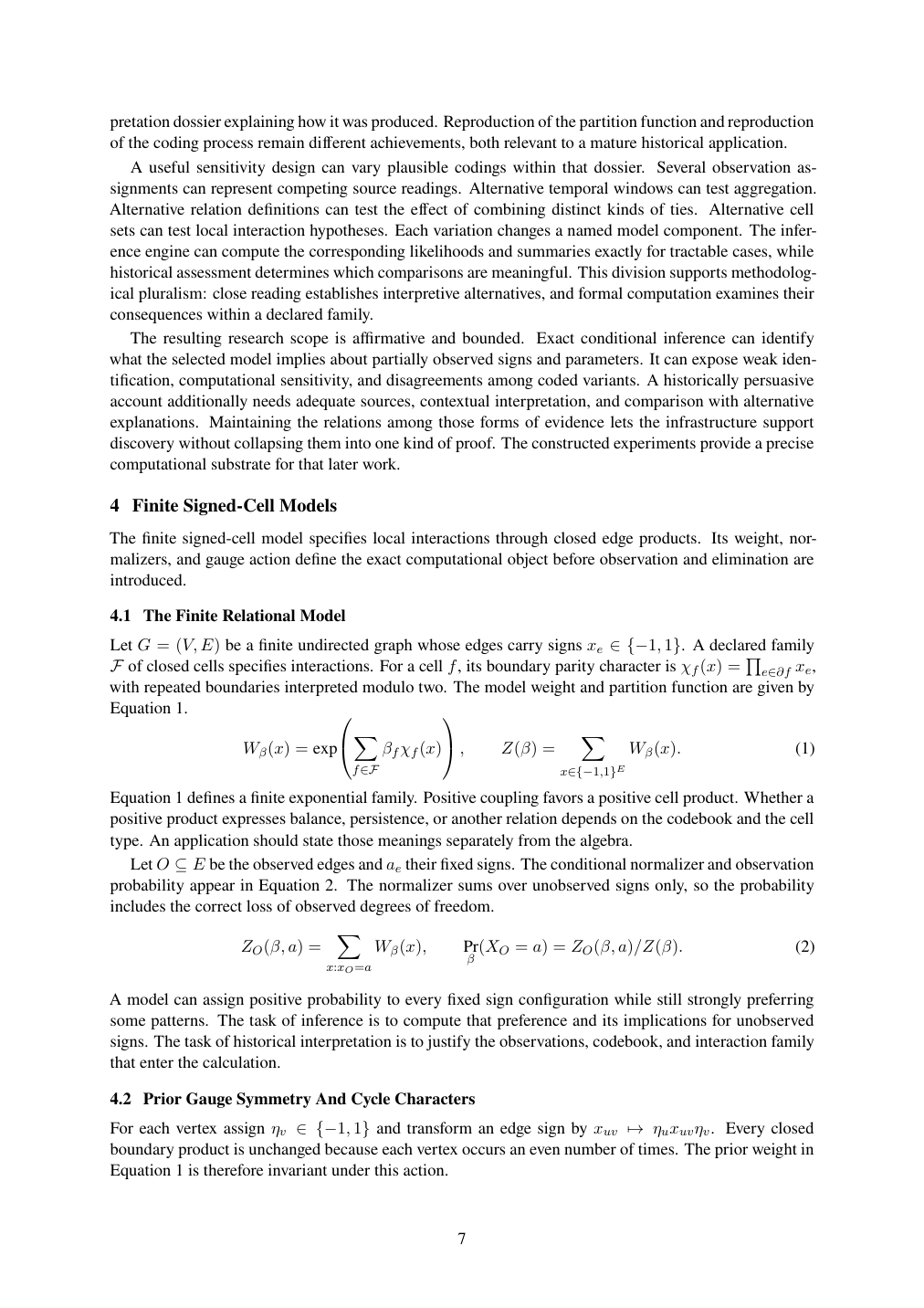
The finite signed-cell model specifies local interactions through closed edge products. Its weight, nor- malizers, and gauge action define the exact computational object before observation and elimination are
with repeated boundaries interpreted modulo two. The model weight and partition function are given by
Equation 1 defines a finite exponential family. Positive coupling favors a positive cell product. Whether a positive product expresses balance, persistence, or another relation depends on the codebook and the cell type. An application should state those meanings separately from the algebra.
probability appear in Equation 2. The normalizer sums over unobserved signs only, so the probability includes the correct loss of observed degrees of freedom.
A model can assign positive probability to every fixed sign configuration while still strongly preferring some patterns. The task of inference is to compute that preference and its implications for unobserved signs. The task of historical interpretation is to justify the observations, codebook, and interaction family
boundary product is unchanged because each vertex occurs an even number of times. The prior weight in
Readable text
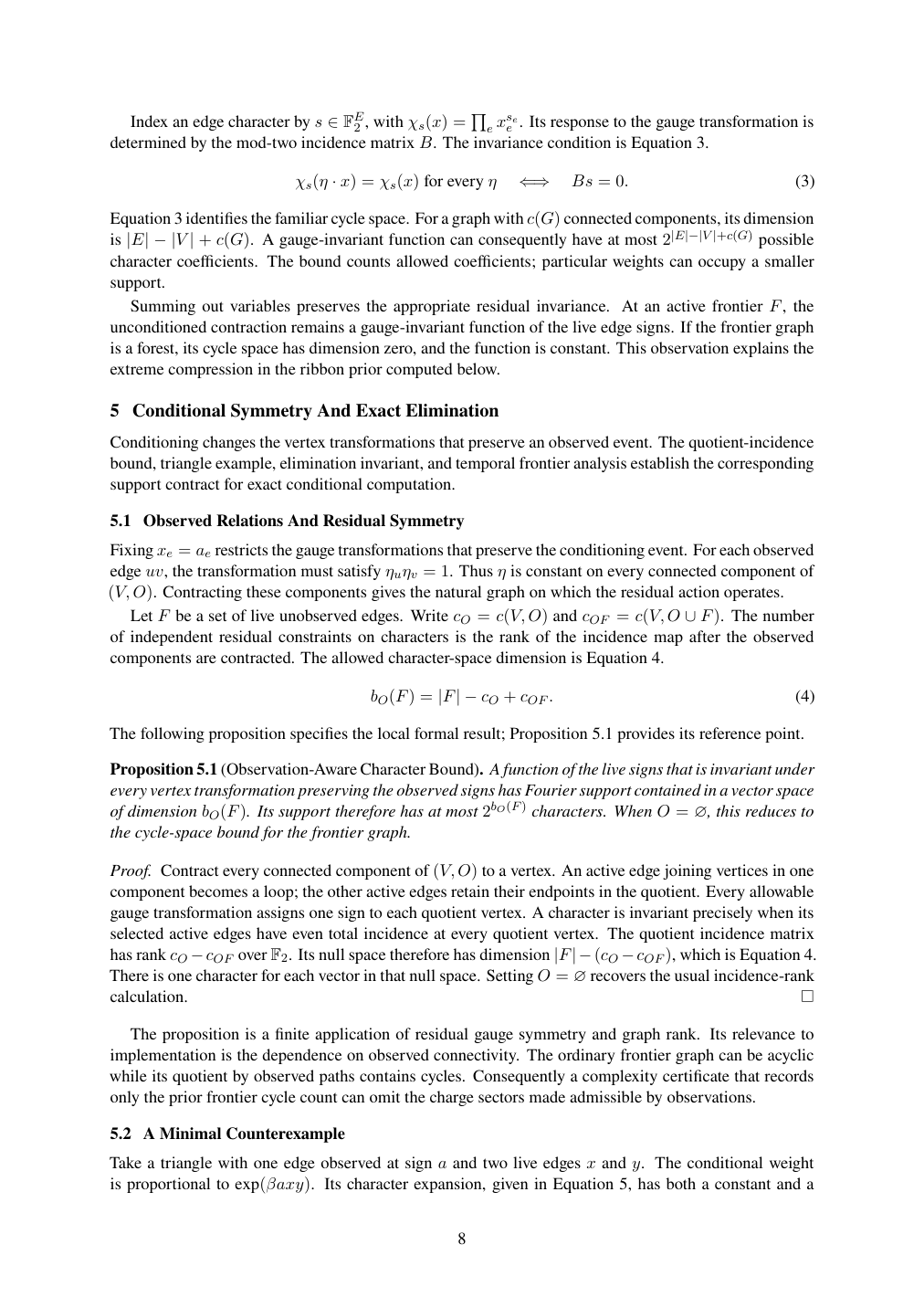
character coefficients. The bound counts allowed coefficients; particular weights can occupy a smaller
unconditioned contraction remains a gauge-invariant function of the live edge signs. If the frontier graph is a forest, its cycle space has dimension zero, and the function is constant. This observation explains the extreme compression in the ribbon prior computed below.
Conditioning changes the vertex transformations that preserve an observed event. The quotient-incidence bound, triangle example, elimination invariant, and temporal frontier analysis establish the corresponding
support contract for exact conditional computation.
of independent residual constraints on characters is the rank of the incidence map after the observed components are contracted. The allowed character-space dimension is Equation 4.
The following proposition specifies the local formal result; Proposition 5.1 provides its reference point.
Proposition 5.1 (Observation-Aware Character Bound). A function of the live signs that is invariant under every vertex transformation preserving the observed signs has Fourier support contained in a vector space
component becomes a loop; the other active edges retain their endpoints in the quotient. Every allowable gauge transformation assigns one sign to each quotient vertex. A character is invariant precisely when its selected active edges have even total incidence at every quotient vertex. The quotient incidence matrix
The proposition is a finite application of residual gauge symmetry and graph rank. Its relevance to implementation is the dependence on observed connectivity. The ordinary frontier graph can be acyclic while its quotient by observed paths contains cycles. Consequently a complexity certificate that records only the prior frontier cycle count can omit the charge sectors made admissible by observations.
Readable text
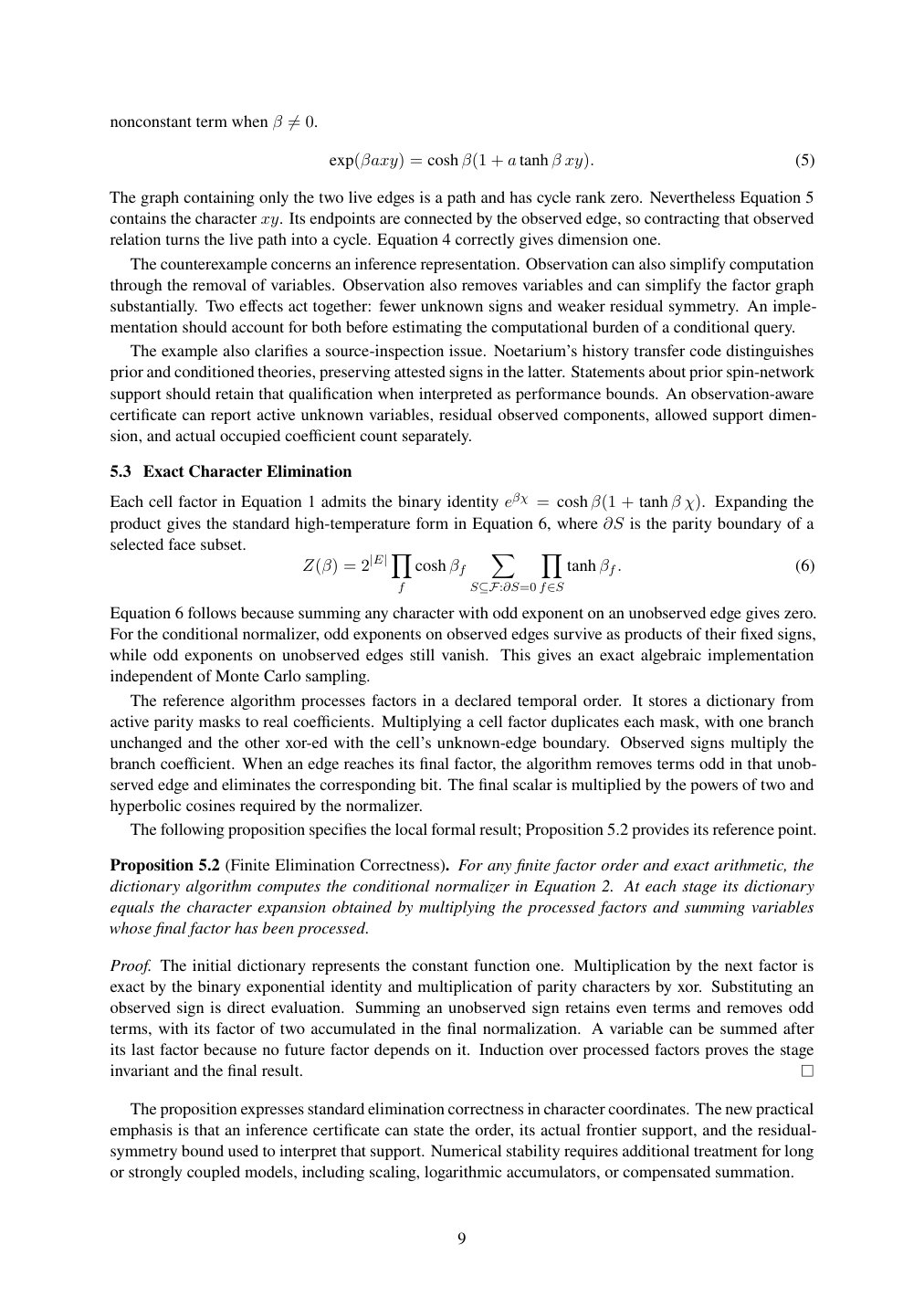
The graph containing only the two live edges is a path and has cycle rank zero. Nevertheless Equation 5 relation turns the live path into a cycle. Equation 4 correctly gives dimension one.
The counterexample concerns an inference representation. Observation can also simplify computation through the removal of variables. Observation also removes variables and can simplify the factor graph substantially. Two effects act together: fewer unknown signs and weaker residual symmetry. An imple- mentation should account for both before estimating the computational burden of a conditional query.
The example also clarifies a source-inspection issue. Noetarium’s history transfer code distinguishes prior and conditioned theories, preserving attested signs in the latter. Statements about prior spin-network support should retain that qualification when interpreted as performance bounds. An observation-aware certificate can report active unknown variables, residual observed components, allowed support dimen-
sion, and actual occupied coefficient count separately.
Equation 6 follows because summing any character with odd exponent on an unobserved edge gives zero. For the conditional normalizer, odd exponents on observed edges survive as products of their fixed signs, while odd exponents on unobserved edges still vanish. This gives an exact algebraic implementation
The reference algorithm processes factors in a declared temporal order. It stores a dictionary from active parity masks to real coefficients. Multiplying a cell factor duplicates each mask, with one branch unchanged and the other xor-ed with the cell’s unknown-edge boundary. Observed signs multiply the branch coefficient. When an edge reaches its final factor, the algorithm removes terms odd in that unob- served edge and eliminates the corresponding bit. The final scalar is multiplied by the powers of two and
The following proposition specifies the local formal result; Proposition 5.2 provides its reference point.
Proposition 5.2 (Finite Elimination Correctness). For any finite factor order and exact arithmetic, the dictionary algorithm computes the conditional normalizer in Equation 2. At each stage its dictionary equals the character expansion obtained by multiplying the processed factors and summing variables
Proof. The initial dictionary represents the constant function one. Multiplication by the next factor is exact by the binary exponential identity and multiplication of parity characters by xor. Substituting an observed sign is direct evaluation. Summing an unobserved sign retains even terms and removes odd terms, with its factor of two accumulated in the final normalization. A variable can be summed after its last factor because no future factor depends on it. Induction over processed factors proves the stage
The proposition expresses standard elimination correctness in character coordinates. The new practical emphasis is that an inference certificate can state the order, its actual frontier support, and the residual- symmetry bound used to interpret that support. Numerical stability requires additional treatment for long or strongly coupled models, including scaling, logarithmic accumulators, or compensated summation.
5.4 Temporal Frontier Geometry And Complexity
The temporal frontier is the set of unobserved variables retained between processed and future factors. This section connects its geometry to the observation-aware character bound and clarifies what that bound predicts. The analysis separates the number of spin assignments, the number of symmetry-allowed characters, and the actual nonzero dictionary support. These quantities can differ substantially. Their separation supplies both a correctness check and a useful measurement design for exact inference experiments.
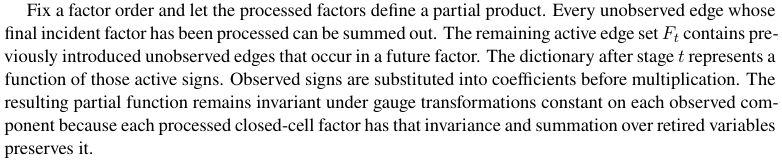


Equation 7 is a symmetry-allowed support bound. It can be loose when cell structure prevents some allowed characters from appearing or when coefficients cancel. Its value concerns the representation’s available character space, while actual support size concerns the particular factor product and parameter setting. The distinction becomes important near zero coupling, where many coefficients vanish exactly even though the geometric bound remains unchanged.
The stage-invariance claim is formalized in Proposition 5.3. Its assumptions specify the local closedcell interactions, exact substitution of fixed observations, and full summation of retired unobserved variables.

Proof. Every closed-cell product is invariant under the full vertex action. Restricting to transformations preserving the observed signs leaves each substituted factor invariant. Products preserve invariance. Summation over a retired unobserved sign commutes with the action because sign multiplication permutes its two possible values. The resulting function is therefore invariant on the remaining variables. In its unique binary character expansion, a character with odd quotient incidence changes sign under some residual transformation and has zero coefficient by averaging over that transformation. The surviving masks belong to the quotient-incidence kernel, whose dimension gives the displayed bound.
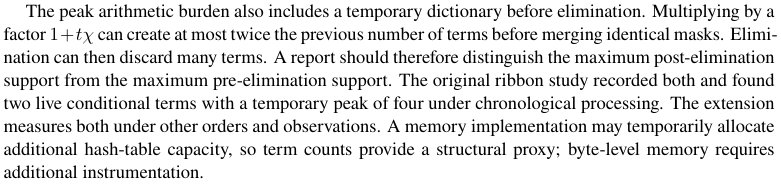
Factor order changes the frontier. A chronological order respects the ribbon’s local geometry, while a permuted order can retain several separated interfaces simultaneously. The same final partition function can then require a larger intermediate support. This dependence is an instance of the established elimination-width phenomenon (Dechter, 1999). The character representation adds a symmetry-sensitive refinement: even a frontier with many edge variables can carry few allowed characters when quotient
incidence imposes many parity constraints. A useful complexity record should therefore include active variable count, quotient character dimension, actual support, and temporary peak at each stage.
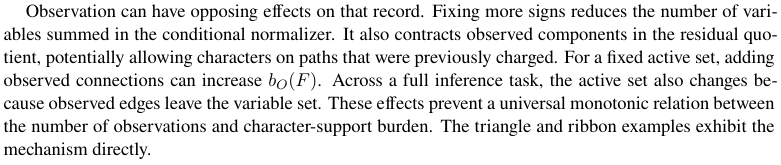
Complexity remains representation- and family-dependent. The number of possible masks can grow exponentially with the maximal quotient character dimension. Sparse dictionary operations can also be costly when masks are long or coefficients require high precision. A chronological ribbon is a favorable structural family, and a constructed permuted order demonstrates a controlled deterioration within it. General exact inference remains subject to the established complexity of graphical elimination. The report’s contribution is to identify an observation-aware statistic and a checkable stage invariant that help explain that behavior in the selected binary model.
A production implementation can use those records diagnostically. Before contraction, it can estimate frontier geometry for candidate orders. During contraction, it can verify that observed support stays within the predicted kernel and record deviations caused by numerical thresholding. After contraction, it can compare the normalizer with independent identities on small or special families. The resulting trace supports both debugging and scientific interpretation: a larger computation can be attributed to observation geometry, factor order, or richer interactions, with each cause linked to a specific model change.
6 Ribbon Likelihood And Parameter Identification
The triangulated ribbon supplies an analytically tractable observation family. Its construction, boundary identity, likelihood derivatives, and information calculation distinguish exact computational evaluation from the information retained by the selected observations.
6.1 Constructed Triangulated Ribbons

Factors are processed cell by cell. The prior dictionary has one live character after every elimination step. The conditioned dictionary has two until the final face. This is the triangle mechanism repeated along the strip: observed boundary paths allow a live charged character even when the ordinary live-edge frontier is acyclic. The favorable width results from this particular ribbon order and geometry.

6.2 A Closed Form For The Ribbon Observation Probability

Readable text
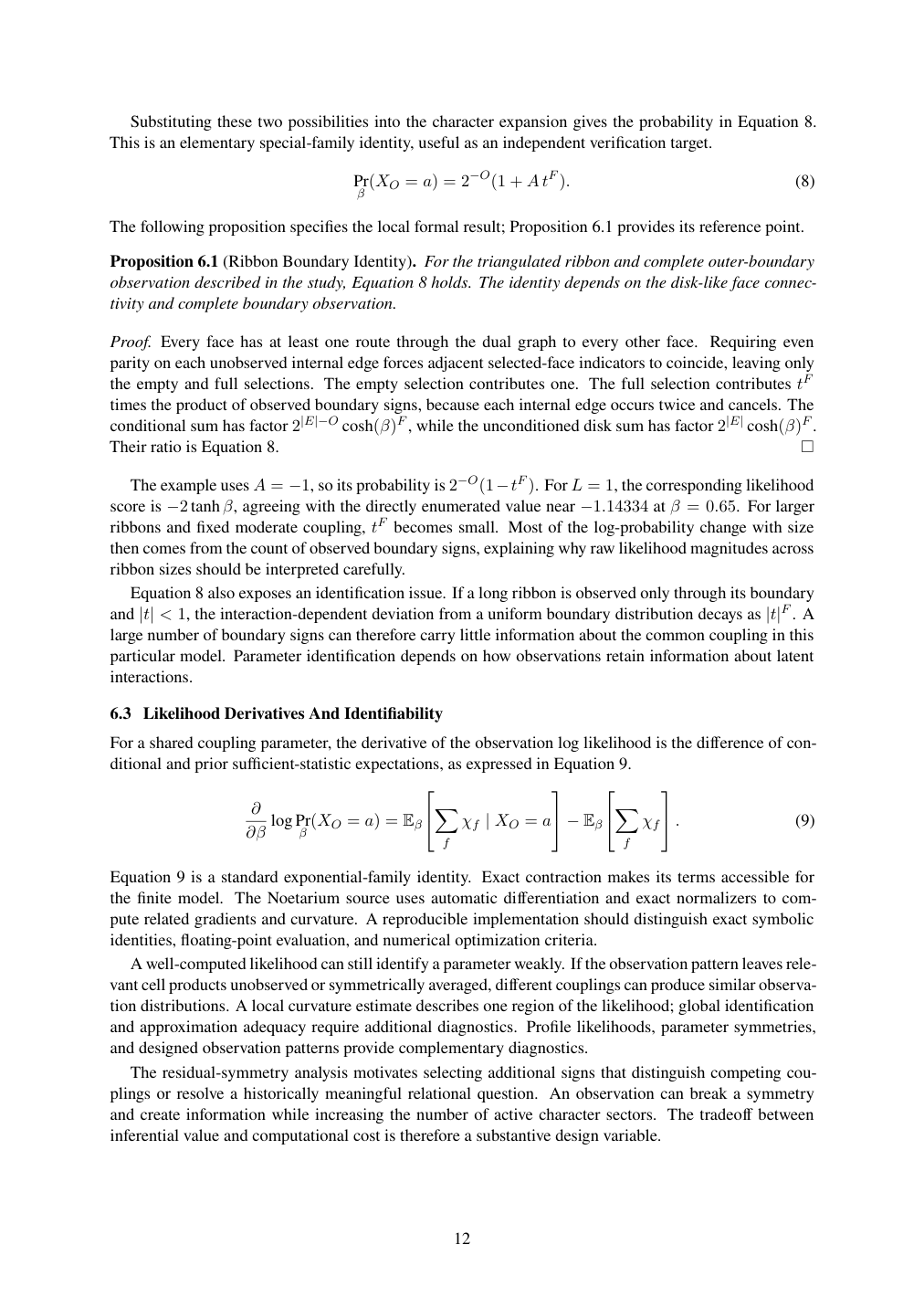
Substituting these two possibilities into the character expansion gives the probability in Equation 8. This is an elementary special-family identity, useful as an independent verification target.
The following proposition specifies the local formal result; Proposition 6.1 provides its reference point.
Proposition 6.1 (Ribbon Boundary Identity). For the triangulated ribbon and complete outer-boundary observation described in the study, Equation 8 holds. The identity depends on the disk-like face connec-
Proof. Every face has at least one route through the dual graph to every other face. Requiring even parity on each unobserved internal edge forces adjacent selected-face indicators to coincide, leaving only
times the product of observed boundary signs, because each internal edge occurs twice and cancels. The
then comes from the count of observed boundary signs, explaining why raw likelihood magnitudes across
Equation 8 also exposes an identification issue. If a long ribbon is observed only through its boundary large number of boundary signs can therefore carry little information about the common coupling in this particular model. Parameter identification depends on how observations retain information about latent
For a shared coupling parameter, the derivative of the observation log likelihood is the difference of con- ditional and prior sufficient-statistic expectations, as expressed in Equation 9.
Equation 9 is a standard exponential-family identity. Exact contraction makes its terms accessible for the finite model. The Noetarium source uses automatic differentiation and exact normalizers to com- pute related gradients and curvature. A reproducible implementation should distinguish exact symbolic identities, floating-point evaluation, and numerical optimization criteria.
A well-computed likelihood can still identify a parameter weakly. If the observation pattern leaves rele- vant cell products unobserved or symmetrically averaged, different couplings can produce similar observa- tion distributions. A local curvature estimate describes one region of the likelihood; global identification and approximation adequacy require additional diagnostics. Profile likelihoods, parameter symmetries, and designed observation patterns provide complementary diagnostics.
The residual-symmetry analysis motivates selecting additional signs that distinguish competing cou- plings or resolve a historically meaningful relational question. An observation can break a symmetry and create information while increasing the number of active character sectors. The tradeoff between inferential value and computational cost is therefore a substantive design variable.
Readable text
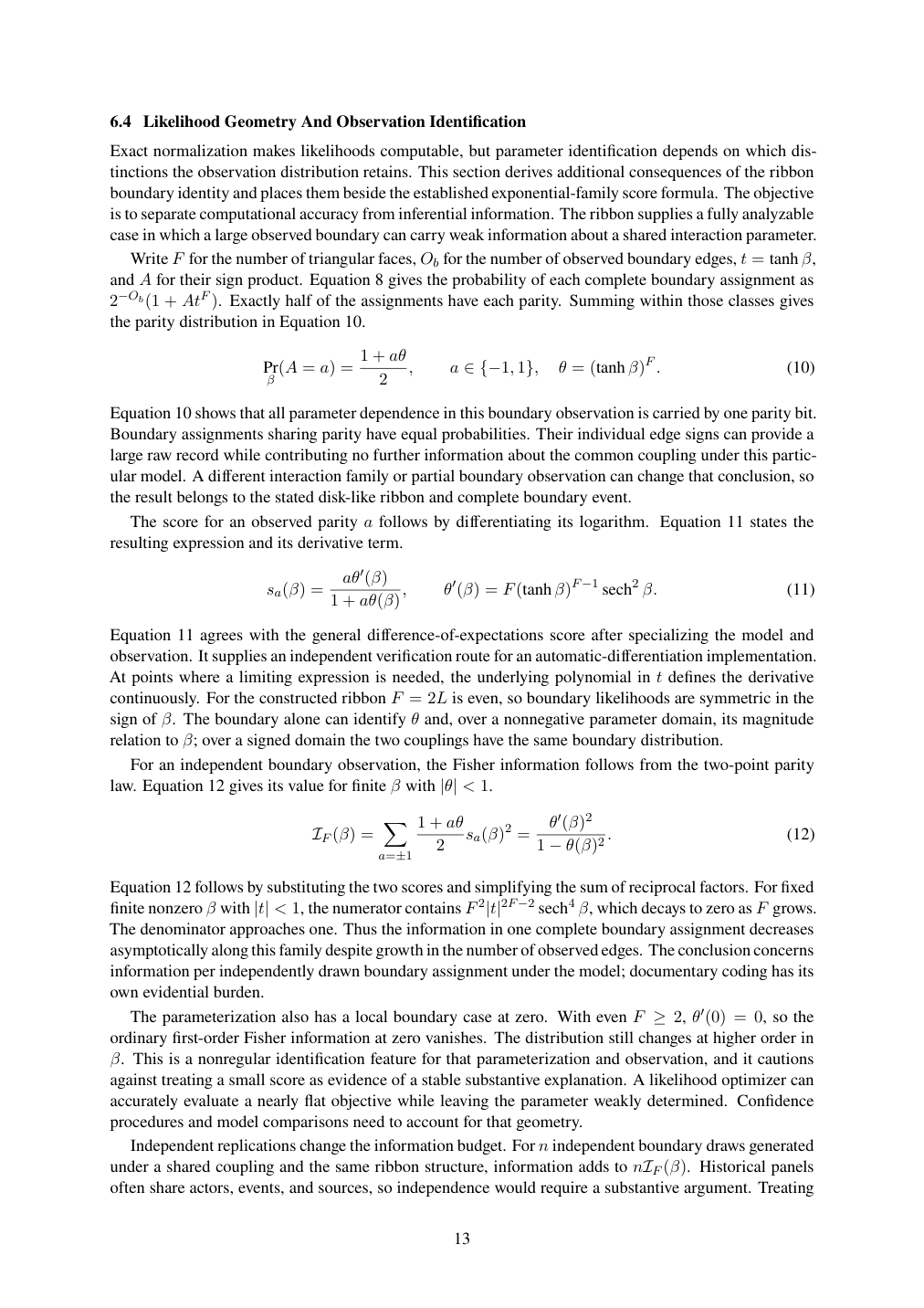
6.4 Likelihood Geometry And Observation Identification
Exact normalization makes likelihoods computable, but parameter identification depends on which dis- tinctions the observation distribution retains. This section derives additional consequences of the ribbon boundary identity and places them beside the established exponential-family score formula. The objective is to separate computational accuracy from inferential information. The ribbon supplies a fully analyzable case in which a large observed boundary can carry weak information about a shared interaction parameter.
Equation 10 shows that all parameter dependence in this boundary observation is carried by one parity bit. Boundary assignments sharing parity have equal probabilities. Their individual edge signs can provide a large raw record while contributing no further information about the common coupling under this partic- ular model. A different interaction family or partial boundary observation can change that conclusion, so the result belongs to the stated disk-like ribbon and complete boundary event.
Equation 11 agrees with the general difference-of-expectations score after specializing the model and observation. It supplies an independent verification route for an automatic-differentiation implementation.
For an independent boundary observation, the Fisher information follows from the two-point parity
Equation 12 follows by substituting the two scores and simplifying the sum of reciprocal factors. For fixed The denominator approaches one. Thus the information in one complete boundary assignment decreases asymptotically along this family despite growth in the number of observed edges. The conclusion concerns information per independently drawn boundary assignment under the model; documentary coding has its
ordinary first-order Fisher information at zero vanishes. The distribution still changes at higher order in against treating a small score as evidence of a stable substantive explanation. A likelihood optimizer can accurately evaluate a nearly flat objective while leaving the parameter weakly determined. Confidence procedures and model comparisons need to account for that geometry.
often share actors, events, and sources, so independence would require a substantive argument. Treating
Readable text
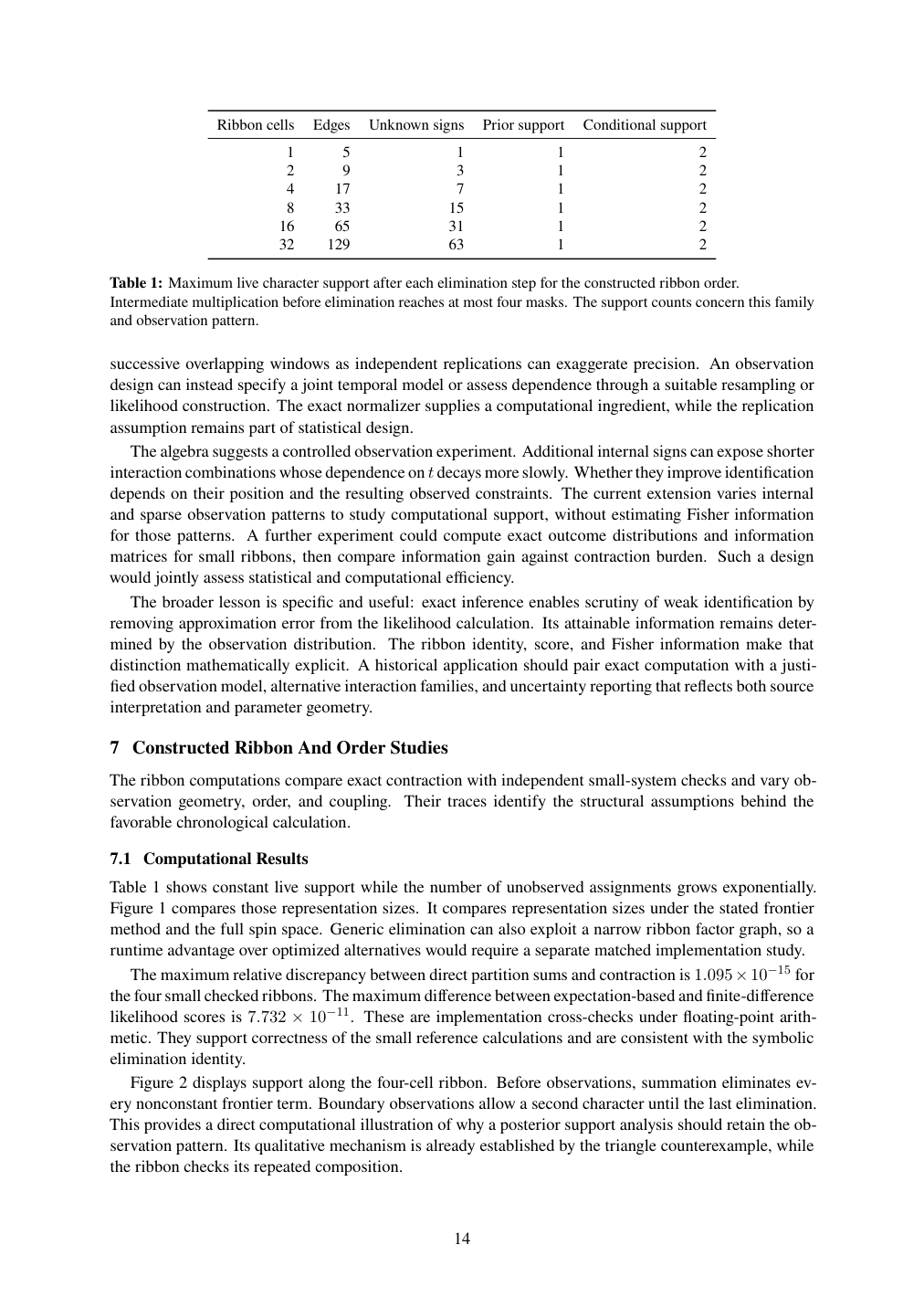
Table 1: Maximum live character support after each elimination step for the constructed ribbon order. Intermediate multiplication before elimination reaches at most four masks. The support counts concern this family
successive overlapping windows as independent replications can exaggerate precision. An observation design can instead specify a joint temporal model or assess dependence through a suitable resampling or likelihood construction. The exact normalizer supplies a computational ingredient, while the replication
The algebra suggests a controlled observation experiment. Additional internal signs can expose shorter depends on their position and the resulting observed constraints. The current extension varies internal and sparse observation patterns to study computational support, without estimating Fisher information for those patterns. A further experiment could compute exact outcome distributions and information matrices for small ribbons, then compare information gain against contraction burden. Such a design would jointly assess statistical and computational efficiency.
The broader lesson is specific and useful: exact inference enables scrutiny of weak identification by removing approximation error from the likelihood calculation. Its attainable information remains deter- mined by the observation distribution. The ribbon identity, score, and Fisher information make that distinction mathematically explicit. A historical application should pair exact computation with a justi- fied observation model, alternative interaction families, and uncertainty reporting that reflects both source
The ribbon computations compare exact contraction with independent small-system checks and vary ob- servation geometry, order, and coupling. Their traces identify the structural assumptions behind the
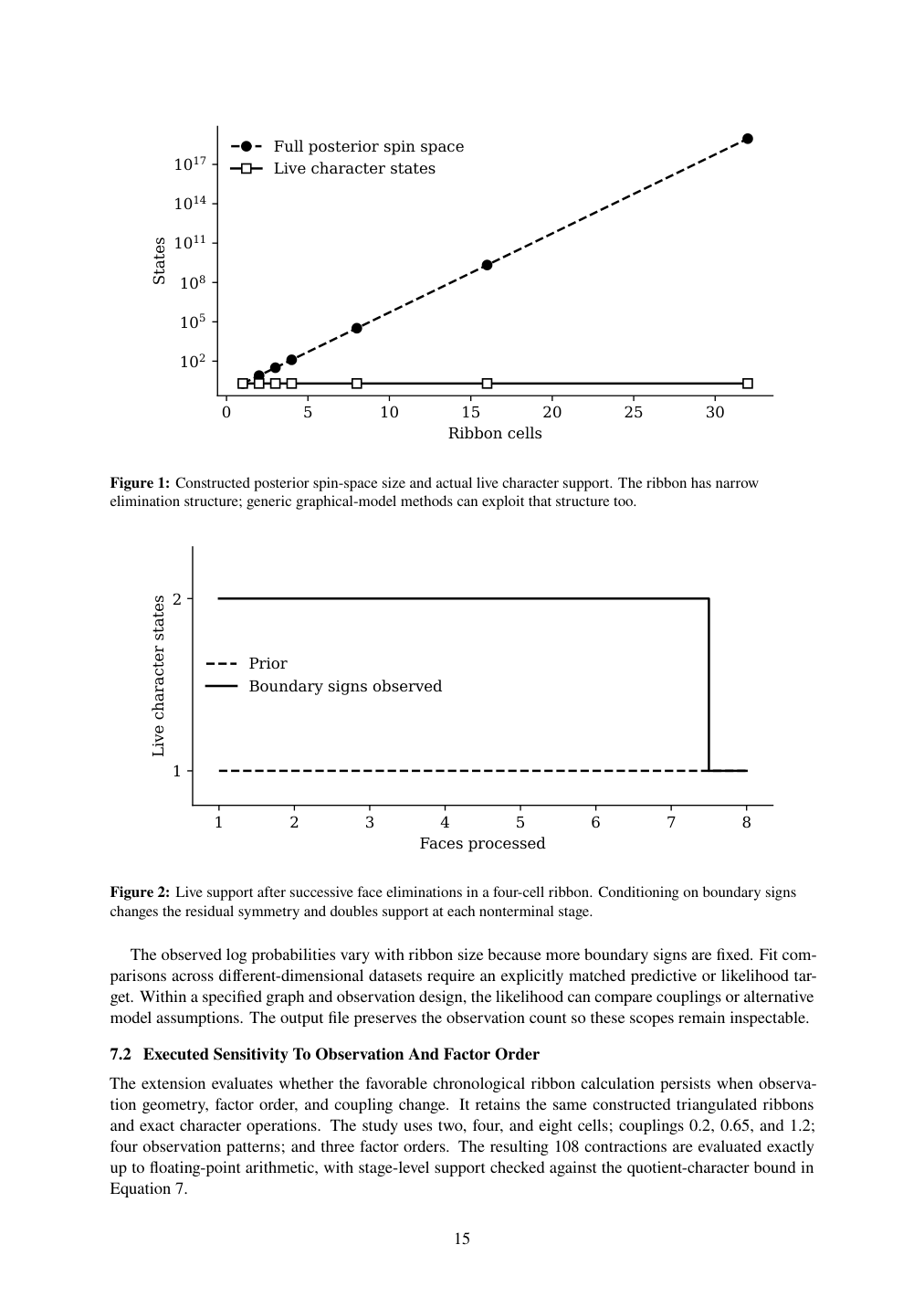
Table 1 shows constant live support while the number of unobserved assignments grows exponentially. Figure 1 compares those representation sizes. It compares representation sizes under the stated frontier method and the full spin space. Generic elimination can also exploit a narrow ribbon factor graph, so a runtime advantage over optimized alternatives would require a separate matched implementation study.
the four small checked ribbons. The maximum difference between expectation-based and finite-difference metic. They support correctness of the small reference calculations and are consistent with the symbolic
Figure 2 displays support along the four-cell ribbon. Before observations, summation eliminates ev- ery nonconstant frontier term. Boundary observations allow a second character until the last elimination. This provides a direct computational illustration of why a posterior support analysis should retain the ob- servation pattern. Its qualitative mechanism is already established by the triangle counterexample, while
Readable text
Figure 1: Constructed posterior spin-space size and actual live character support. The ribbon has narrow elimination structure; generic graphical-model methods can exploit that structure too.
Figure 2: Live support after successive face eliminations in a four-cell ribbon. Conditioning on boundary signs changes the residual symmetry and doubles support at each nonterminal stage.
The observed log probabilities vary with ribbon size because more boundary signs are fixed. Fit com- parisons across different-dimensional datasets require an explicitly matched predictive or likelihood tar- get. Within a specified graph and observation design, the likelihood can compare couplings or alternative model assumptions. The output file preserves the observation count so these scopes remain inspectable.
7.2 Executed Sensitivity To Observation And Factor Order
The extension evaluates whether the favorable chronological ribbon calculation persists when observa- tion geometry, factor order, and coupling change. It retains the same constructed triangulated ribbons and exact character operations. The study uses two, four, and eight cells; couplings 0.2, 0.65, and 1.2; four observation patterns; and three factor orders. The resulting 108 contractions are evaluated exactly up to floating-point arithmetic, with stage-level support checked against the quotient-character bound in
Readable text
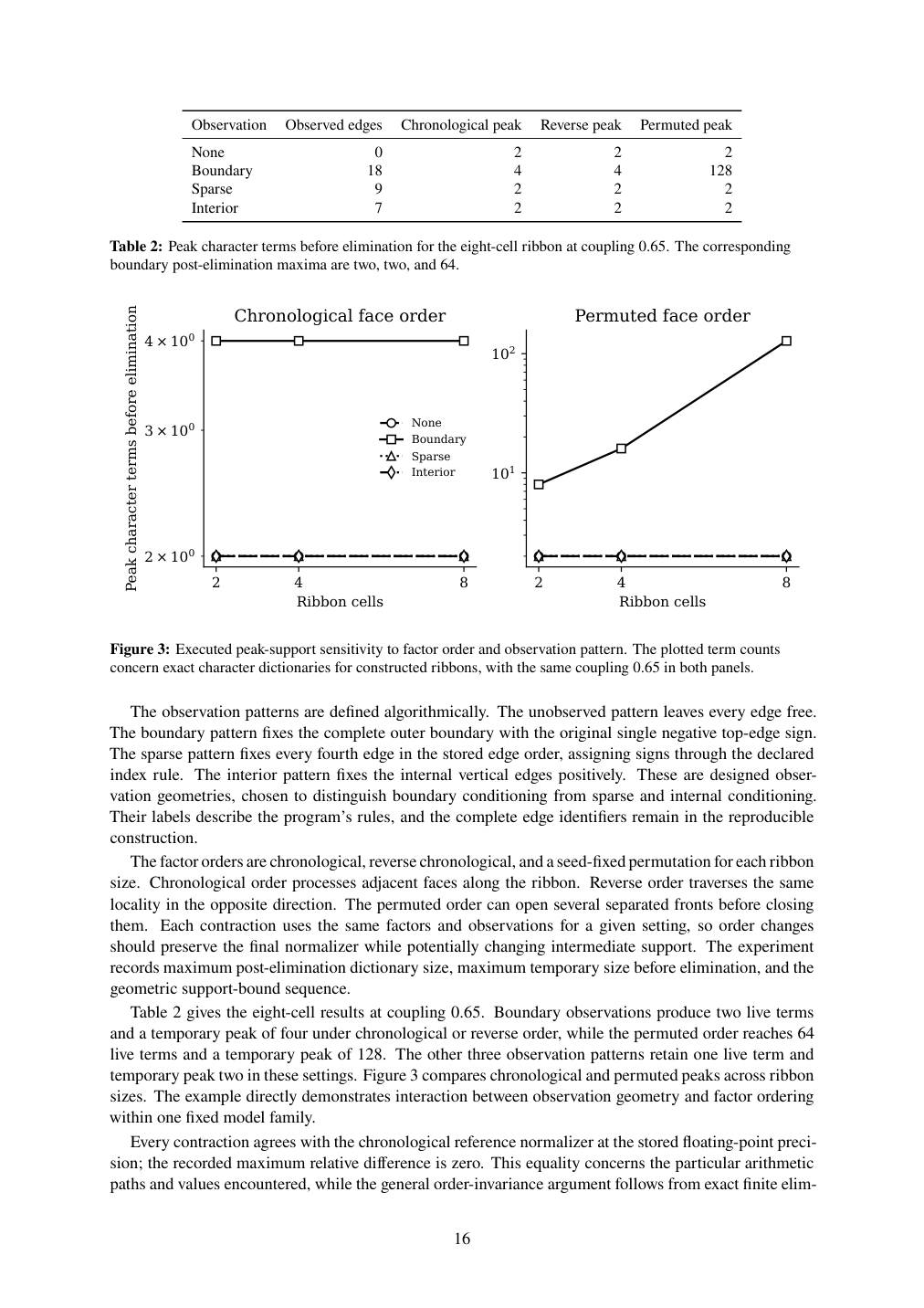
Table 2: Peak character terms before elimination for the eight-cell ribbon at coupling 0.65. The corresponding
Figure 3: Executed peak-support sensitivity to factor order and observation pattern. The plotted term counts concern exact character dictionaries for constructed ribbons, with the same coupling 0.65 in both panels.
The observation patterns are defined algorithmically. The unobserved pattern leaves every edge free. The boundary pattern fixes the complete outer boundary with the original single negative top-edge sign. The sparse pattern fixes every fourth edge in the stored edge order, assigning signs through the declared index rule. The interior pattern fixes the internal vertical edges positively. These are designed obser- vation geometries, chosen to distinguish boundary conditioning from sparse and internal conditioning. Their labels describe the program’s rules, and the complete edge identifiers remain in the reproducible
The factor orders are chronological, reverse chronological, and a seed-fixed permutation for each ribbon size. Chronological order processes adjacent faces along the ribbon. Reverse order traverses the same locality in the opposite direction. The permuted order can open several separated fronts before closing them. Each contraction uses the same factors and observations for a given setting, so order changes should preserve the final normalizer while potentially changing intermediate support. The experiment records maximum post-elimination dictionary size, maximum temporary size before elimination, and the
Table 2 gives the eight-cell results at coupling 0.65. Boundary observations produce two live terms and a temporary peak of four under chronological or reverse order, while the permuted order reaches 64 live terms and a temporary peak of 128. The other three observation patterns retain one live term and temporary peak two in these settings. Figure 3 compares chronological and permuted peaks across ribbon sizes. The example directly demonstrates interaction between observation geometry and factor ordering
Every contraction agrees with the chronological reference normalizer at the stored floating-point preci- sion; the recorded maximum relative difference is zero. This equality concerns the particular arithmetic paths and values encountered, while the general order-invariance argument follows from exact finite elim-
ination. The original brute-force checks on the smallest ribbons remain a separate validation route. Together they compare algebraic representations, elimination orders, a special-family closed form, and direct spin enumeration. Their agreement provides stronger computational evidence than repeating only one implementation path.
The quotient-character bound holds at every recorded post-elimination stage. Under the complete boundary observation, the boundary connects all vertices into one observed component. Active unobserved edges then become loops in the quotient, so the allowed dimension equals their count. A permuted factor order can retain several such independent active masks. Under chronological processing, the same geometry leaves a much smaller frontier. This explains why observation count alone fails to predict support: eighteen fixed signs reduce the spin space while permitting conditional characters across the observed component.
Coupling variation changes coefficient values and partition functions, while support sizes remain unchanged across the three tested positive couplings in this family. Each coupling is nonzero, and the selected structures retain the same algebraically present masks. A zero-coupling ablation would collapse nonconstant coefficients and requires careful treatment of exact-zero dictionary entries. Stronger couplings can also create numerical cancellation in signed coefficient sums. The current values provide a modest sensitivity grid; domain-wide numerical stability requires a precision study. A precision study should compare floating-point and higher-precision arithmetic near difficult observation events.
The sparse and interior patterns illustrate the distinction between a support bound and occupied support. Observation can make additional characters symmetry-allowed while the processed cell structure still removes them through parity constraints. The program records both the bound sequence and actual dictionary sizes, enabling such cases to be inspected directly. An expanded benchmark could vary cell attachments, holes, long-range interactions, and observed-component structure to test when the bound is tight. The present ribbon remains structurally favorable, so its constants should be interpreted as properties of that family.
The extension is an independently written Python study, separate from execution of the repository’s C++ transfer code. It adds a meaningful stress test to the original scaling illustration: a poor order produces a 32-fold increase in temporary terms for the eight-cell boundary task, despite an unchanged final normalizer. The finding supports recording observation-aware frontier geometry when exact inference performance is reported. It also supplies a discriminating regression example for a future implementation that chooses factor orders automatically.
8 Topology Comparators And Conditional Observability
The topology comparison examines exact inference beyond the favorable triangulated ribbon. It separates first-homology holes, closed face-subset contributions, and observed-component conditioning through independent finite calculations. The new construction uses quadrilateral disks, annuli, and tori, evaluated by character elimination, direct face-subset expansion, and selected spin enumerations. Its purpose is to identify the assumptions behind tractability and parameter information with greater precision.
8.1 Fourier Antecedents And The Comparison Contract
Normal-factor-graph Fourier duality already transforms local factors while preserving the partition function up to explicit scale, as the primary proof in Forney et al. (2011) establishes. The information-set and graph-code constructions in Forney (2018) likewise provide established incidence-kernel and topological foundations. The present algorithms instantiate those ideas for a specified binary closed-cell model. The additional object examined here is the observation-dependent support trace and the consequences of using a prior-only support restriction during conditional inference.

Readable text
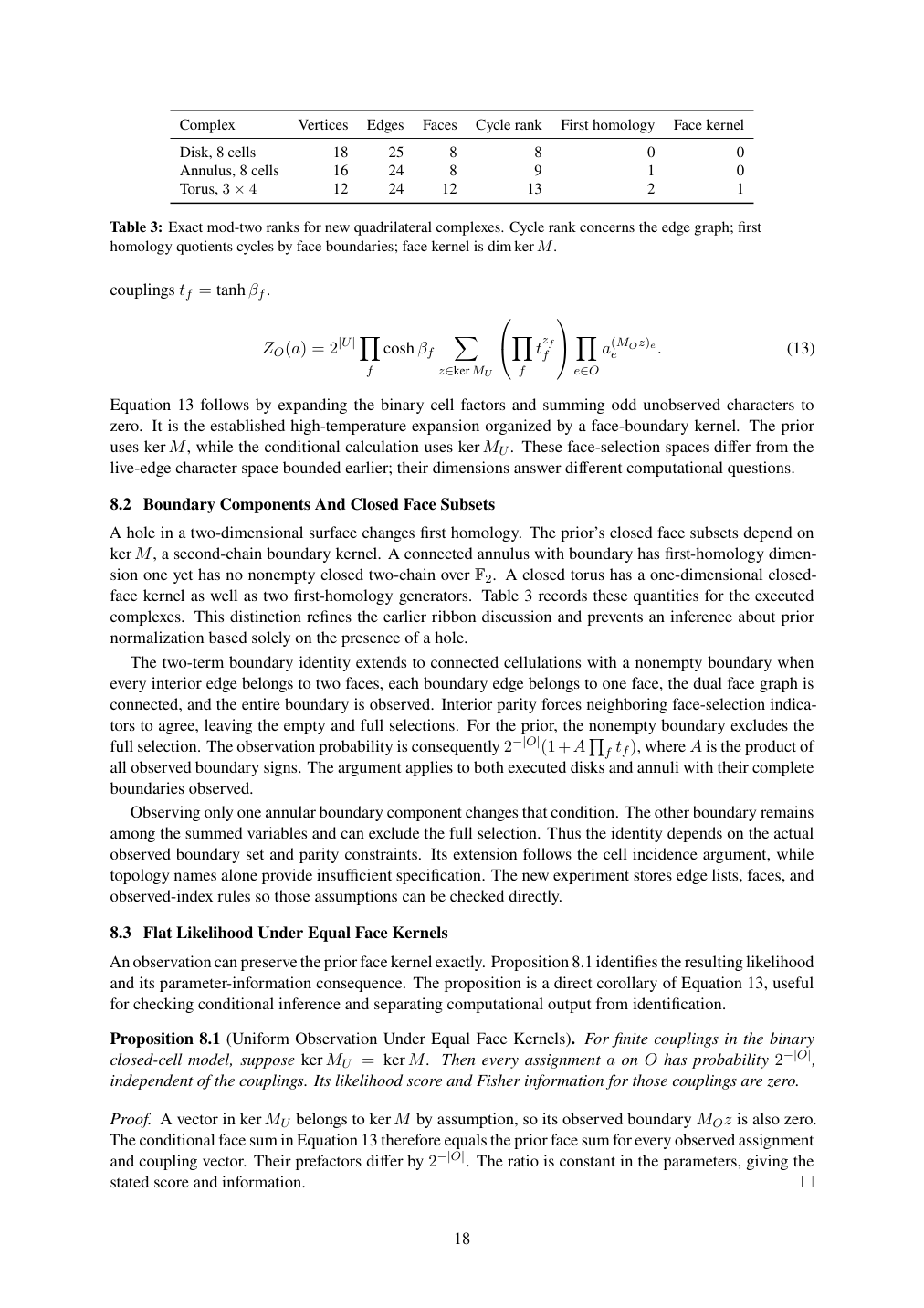
Table 3: Exact mod-two ranks for new quadrilateral complexes. Cycle rank concerns the edge graph; first
Equation 13 follows by expanding the binary cell factors and summing odd unobserved characters to zero. It is the established high-temperature expansion organized by a face-boundary kernel. The prior live-edge character space bounded earlier; their dimensions answer different computational questions.
A hole in a two-dimensional surface changes first homology. The prior’s closed face subsets depend on face kernel as well as two first-homology generators. Table 3 records these quantities for the executed complexes. This distinction refines the earlier ribbon discussion and prevents an inference about prior
The two-term boundary identity extends to connected cellulations with a nonempty boundary when every interior edge belongs to two faces, each boundary edge belongs to one face, the dual face graph is connected, and the entire boundary is observed. Interior parity forces neighboring face-selection indica- tors to agree, leaving the empty and full selections. For the prior, the nonempty boundary excludes the
all observed boundary signs. The argument applies to both executed disks and annuli with their complete
Observing only one annular boundary component changes that condition. The other boundary remains among the summed variables and can exclude the full selection. Thus the identity depends on the actual observed boundary set and parity constraints. Its extension follows the cell incidence argument, while topology names alone provide insufficient specification. The new experiment stores edge lists, faces, and observed-index rules so those assumptions can be checked directly.
An observation can preserve the prior face kernel exactly. Proposition 8.1 identifies the resulting likelihood and its parameter-information consequence. The proposition is a direct corollary of Equation 13, useful for checking conditional inference and separating computational output from identification.
Proposition 8.1 (Uniform Observation Under Equal Face Kernels). For finite couplings in the binary independent of the couplings. Its likelihood score and Fisher information for those couplings are zero.
The conditional face sum in Equation 13 therefore equals the prior face sum for every observed assignment
On the executed tori, observing one complete noncontractible row cycle leaves the face kernel unchanged. The matrix calculation verifies the condition: both kernels contain only the empty and full face selections. The observation likelihood is therefore flat even though its signs form a genuine edge cycle. This is a stronger distinction than weak local curvature. The coupling information matrix for these observations is zero under this interaction family. The earlier even-face ribbon sign ambiguity and asymptotic information decay retain their stated scope for the triangulated boundary family.
8.4 Executed Representation And Topology Comparison





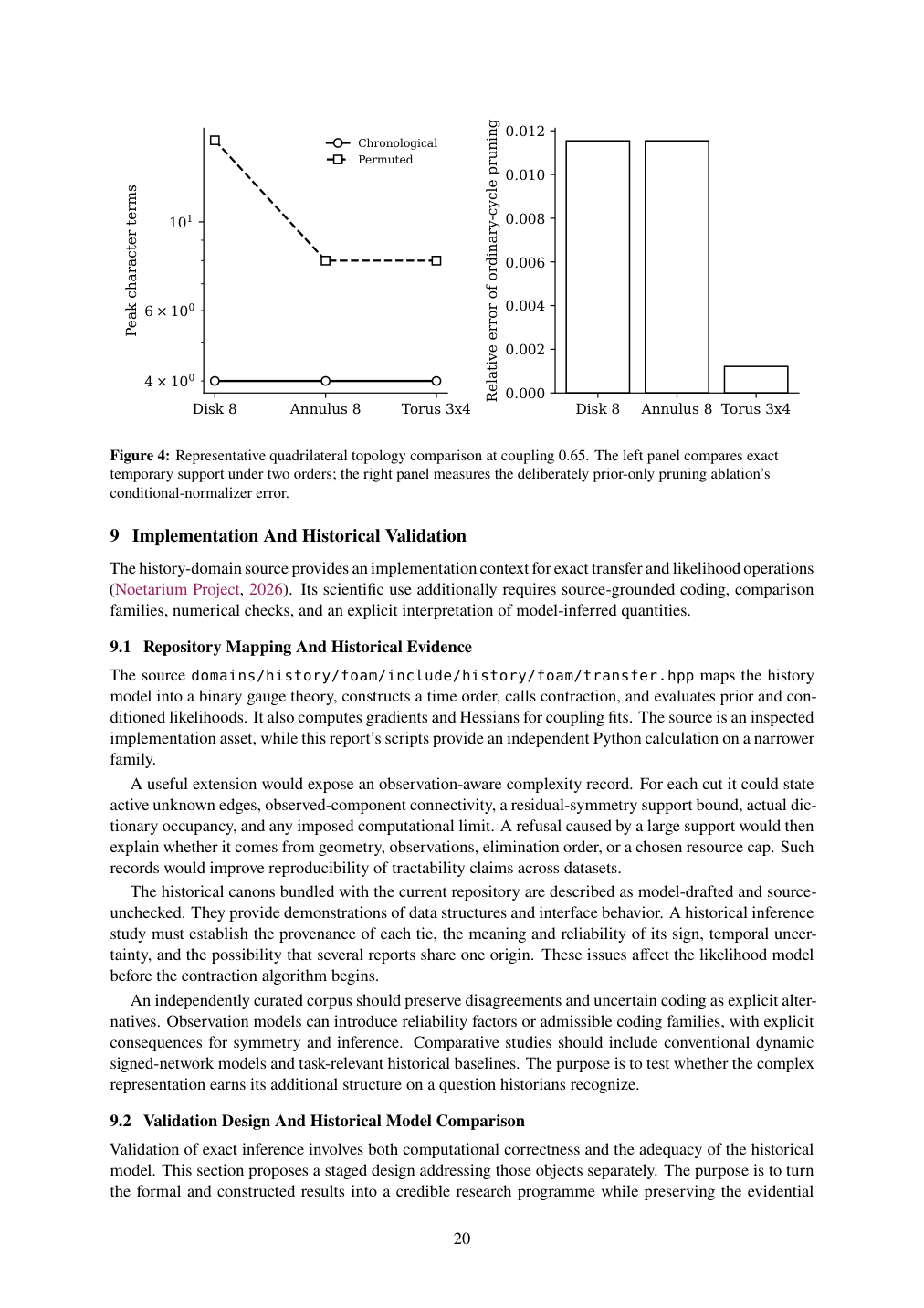
Figure 4 reports intermediate support and pruning error for representative new complexes. The quadrilateral families differ from the original triangulated ribbons, so their absolute support counts describe their own incidence structures. Chronological and permuted orders preserve exact normalizers while changing peak support. Complete observations, sparse observations, and cycle observations can behave differently even at the same coupling because they change both summed variables and residual constraints.
The publication contribution is thus a precise conditional diagnostic and its tested consequences within a finite model. Fourier elimination and topological code methods supply the established foundation. The observed-component bound, face-kernel comparison, and source-explicit traces make the conditioning contract inspectable. Historical application additionally requires a defensible relation codebook, documentary sources, and substantive alternatives. Exact finite calculations can support that inquiry by distinguishing a model’s limited information from artifacts introduced by an inference representation.
Readable text
Figure 4: Representative quadrilateral topology comparison at coupling 0.65. The left panel compares exact temporary support under two orders; the right panel measures the deliberately prior-only pruning ablation’s
The history-domain source provides an implementation context for exact transfer and likelihood operations (Noetarium Project, 2026). Its scientific use additionally requires source-grounded coding, comparison families, numerical checks, and an explicit interpretation of model-inferred quantities.
The source domains/history/foam/include/history/foam/transfer.hpp maps the history model into a binary gauge theory, constructs a time order, calls contraction, and evaluates prior and con- ditioned likelihoods. It also computes gradients and Hessians for coupling fits. The source is an inspected implementation asset, while this report’s scripts provide an independent Python calculation on a narrower
A useful extension would expose an observation-aware complexity record. For each cut it could state active unknown edges, observed-component connectivity, a residual-symmetry support bound, actual dic- tionary occupancy, and any imposed computational limit. A refusal caused by a large support would then explain whether it comes from geometry, observations, elimination order, or a chosen resource cap. Such records would improve reproducibility of tractability claims across datasets.
The historical canons bundled with the current repository are described as model-drafted and source- unchecked. They provide demonstrations of data structures and interface behavior. A historical inference study must establish the provenance of each tie, the meaning and reliability of its sign, temporal uncer- tainty, and the possibility that several reports share one origin. These issues affect the likelihood model
An independently curated corpus should preserve disagreements and uncertain coding as explicit alter- natives. Observation models can introduce reliability factors or admissible coding families, with explicit consequences for symmetry and inference. Comparative studies should include conventional dynamic signed-network models and task-relevant historical baselines. The purpose is to test whether the complex representation earns its additional structure on a question historians recognize.
Validation of exact inference involves both computational correctness and the adequacy of the historical model. This section proposes a staged design addressing those objects separately. The purpose is to turn the formal and constructed results into a credible research programme while preserving the evidential
role of historical interpretation. Exact computation can remove approximation error for a selected family; historical adequacy depends on the sources, coding, and comparison classes through which that family acquires meaning.
Computational validation can begin with exhaustive small complexes. For each complex, direct spin enumeration can evaluate prior and conditional normalizers, marginal probabilities, and sufficient-statistic moments. Character elimination can compute the same objects under several factor orders. Automatic derivatives can be checked against exact moment identities and finite differences at well-conditioned parameter values. Special families such as the ribbon provide closed-form targets for larger systems. The existing scripts implement several of these comparisons, and the extension adds order and support-bound checks. A production integration should reproduce them against the actual C++ code and its numerical types.
A systematic stress-test family should vary topology, interaction range, observation geometry, and coupling. Adding a hole changes homological structure. Adding long-range cells changes factor overlap and frontier width. Clustering observed edges changes residual components. Varying signs and coupling can expose cancellation or small event probabilities. Each variation should be tied to a formal expectation or an identified failure mechanism. Runtime alone is insufficient: traces should include active variables, quotient dimension, occupied support, temporary peak, arithmetic precision, and normalizer agreement. These measurements make a scaling claim interpretable across representations and implementation choices.
Historical validation should begin with a small, well-documented case whose source boundary can be defended. Qualified researchers can identify actors, periods, relation types, and relevant documents before statistical coding. Independent coding can preserve competing interpretations of signs and uncertain identities. A source dossier should record reasons for disagreements and the scope of each assertion. The resulting model variants can then be compared through exact inference where feasible. This procedure gives interpretive uncertainty a visible relation to computational outcomes, while retaining close reading as evidence in its own right.
Model comparison needs substantive alternatives. A closed-cell parity family can be compared with a model containing edge-specific effects, a temporal signed-network model, or an explicitly specified independent-edge baseline. The alternatives should reflect plausible mechanisms and use comparable observation boundaries. Predictive checks can examine held-out edge signs or selected relational summaries, subject to a defensible missingness model. Information criteria or predictive scores can supplement source-based judgment but require suitable treatment of dependence and parameter identification. The dynamic signed-network literature provides relevant comparison families (Caimo et al., 2026; Hanneke et al., 2010); equivalence to the present model would require a separate derivation.
Weak identification deserves planned evaluation. The ribbon boundary identity shows that a large observation vector can reduce to one parameter-relevant parity. A study can therefore compare parameter recovery under boundary-only, internal, and mixed observations using simulated draws from a known model. Exact likelihoods would make the simulation’s inferential mechanism transparent. Such a simulation would establish performance under the chosen data-generating family. An application to historical material would still need an argument about whether that family and its observation process represent the record adequately. The two forms of evidence can inform each other without becoming interchangeable.
Ethical issues arise through actor representation and source visibility. A binary relation can flatten heterogeneous motives or contested identities. Missing records can reflect archival destruction, unequal power, or selective preservation. Publishing inferred signs may attribute relations to actors whose documentary traces are weak. A research output should distinguish observed, disputed, and model-inferred quantities, retaining source grounds and alternative codings. Sensitive contemporary or personal material may require access restrictions and participant-centered review. The categories imposed by an analysis require ethical assessment across historical distances.
Language-model-assisted source material requires explicit review. The repository’s unchecked historical canons can suggest leads or organizational structures, while empirical claims need independent
Layer Content and standing
Established ingredients Gauge-invariant closed products, binary Fourier characters, incidence-rank cycle spaces, graphical elimination, and exponential-family derivatives. Specific formal analysis Observed-component support bound, stage invariant, conditional path counterexample, and equal-face-kernel observation criterion. Special-family results Ribbon boundary probability, parity reduction, score, and information decay under the declared model. Executed evidence Ribbon checks and order sensitivity; 288 topology contractions and nine heterogeneous-coupling fixtures. Proposed validation Original C++ comparisons, broader topological stress tests, source-grounded historical coding, and substantive model comparison.
Table 4: Contribution layers for observation-aware exact inference in the finite signed-cell model.
primary-source verification and contextual interpretation. A validation dossier should identify which passages were verified, by whom, against which sources, and with what remaining uncertainty. The present technical report makes its computational claims through invented complexes and declared variables, avoiding dependence on those unchecked narratives. A future historical paper can build on the inference method after supplying its own documentary foundation.
The final research package should connect code, model definitions, source dossiers, coding variants, computational traces, and substantive interpretations. A reviewer could then reproduce a normalizer, challenge a sign assignment, compare an alternative interaction family, or examine an identification limitation. That structure gives cross-disciplinary collaboration a precise object. Historical inquiry supplies grounded distinctions; mathematics supplies conditional consequences; computation supplies exact evaluation; statistical design supplies inferential calibration; ethical review examines the representation and use of the resulting claims.
10 Contribution Assessment And Research Boundaries
The report’s contribution is an observation-aware analysis of exact character inference for a specified finite signed-relation family. It combines established gauge, graph-code, exponential-family, and elimination ingredients with a quotient-frontier bound, a minimal conditional counterexample, and reproducible ribbon computations. Table 4 identifies the different evidential layers. The classification gives readers a direct way to assess which results are established mathematically, which are demonstrated computationally, and which remain proposed historical research.
The observation-aware bound addresses a concrete correctness issue. A prior gauge calculation can restrict characters to the ordinary cycle space. Conditioning on observed signs changes the residual action. A live path whose endpoints are connected through observed edges can become invariant, so using only the cycle rank of the unobserved frontier can discard a valid conditional term. The triangle gives the smallest transparent illustration, and the quotient-incidence proof supplies the general finite correction. The contribution concerns the explicit conditional parameterization and its use in an inspectable inference trace. The underlying rank and Fourier mechanisms have substantial established antecedents.
The executed sensitivity study adds a computational insight. The chronological boundary ribbon retains two live terms, while a seeded permutation on the eight-cell version retains 64 and creates a temporary peak of 128. The normalizer remains unchanged. Observation geometry and factor order jointly determine the intermediate representation. A favorable scaling plot should consequently state its order and observed structure. The new example supplies a reproducible case in which those choices matter, helping distinguish an exact algorithm’s correctness from the structural conditions behind its efficiency.
The likelihood analysis adds a statistical insight within the special family. Complete boundary data depend on the shared coupling through one parity parameter, and the corresponding Fisher information can decay as the ribbon grows. Exact calculation makes that limitation visible. A larger observed record can carry weak information when the model maps its parameter dependence into a rapidly attenuated
invariant. This result motivates joint design of observation placement and inference computation. The formal conclusion remains tied to the disk-like ribbon and common coupling, leaving other topologies, heterogeneous interactions, and source processes for separate analysis.
The repository connection is precise. The inspected history domain contains finite complexes, transfer operations, and likelihood-related infrastructure. The report’s Python studies independently illustrate a character-elimination design and its scope. They provide regression targets and proposed interfaces for later integration. A production implementation would need a stable complex representation, explicit observation substitution, factor-order control, derivative checks, and diagnostic traces. Comparing that implementation against the reference scripts would establish code-level agreement. Historical validation would add a different evidential layer through independently reviewed source coding.
Several extensions have clear research roles. Higher-dimensional cells can alter the parity spaces and their topological interpretation. Nonclosed interactions or external fields can reduce symmetry and enlarge support. Uncertain observations can be represented through measurement factors, changing both likelihood and residual invariance. Heterogeneous couplings can create an information matrix with additional identifiable and weakly identified directions. Automatic order selection can trade frontier width against sparse character support. Each extension changes a declared model component, so its contribution should be assessed through revised proofs, measured traces, and an adequate substantive rationale.
The historical scope remains open to plural inquiry. A formal relation model can help organize questions about consistency, persistence, or interaction, while documentary and interpretive work establishes what the signs and cells mean. A successful translation preserves useful relations between those activities and identifies the distinctions it leaves unresolved. The report’s finite results concern the declared representation and its conditional consequences. They offer exact consequences of a declared representation and a reproducible method for inspecting those consequences under partial observation.
The infrastructural significance lies in maintaining the relations among source interpretation, model construction, mathematical guarantees, computation, and evidential claims. A revised sign coding can alter a likelihood; a new observation can alter residual symmetry; a changed factor order can alter memory burden; a different interaction family can alter historical interpretation. Preserving those dependencies creates a cumulative space for discovery and correction. The present report contributes a bounded technical object within that space, with enough formal and computational detail for subsequent researchers to test, revise, and connect it to independently grounded historical work.
11 Conclusion
Exact inference on relational histories can exploit temporal factorization and symmetry, but the relevant symmetry depends on what has been observed. The report proves a finite bound using observed-edge components, gives a triangle counterexample to an unqualified prior-frontier interpretation, and checks the mechanism through exact ribbon calculations. Direct enumeration agrees with the character recurrence on the small instances, while the constructed long ribbons retain constant live support.
These results provide a technical foundation for observation-aware tractability records in Noetarium. Their substantive extension requires independently curated histories and comparison with established statistical models. The central contribution is an inspectable connection between observed relational structure, residual symmetry, and the computational space needed to reconstruct what remains uncertain.
References
Caimo, Alberto; Gollini, Isabella. (2026). Separable Models for Dynamic Signed Networks. Journal of the Royal
Statistical Society Series A, qnag053. https://doi.org/10.1093/jrsssa/qnag053. Dechter, Rina. (1999). Bucket Elimination: A Unifying Framework for Reasoning. Artificial Intelligence 113, 41–85.
https://doi.org/10.1016/S0004-3702(99)00059-4. Wainwright, Martin J.; Jordan, Michael I.. (2008). Graphical Models, Exponential Families, and Variational Infer-
ence. Foundations and Trends in Machine Learning 1, 1–305. https://doi.org/10.1561/2200000001.
Wilson, Kenneth G.. (1974). Confinement of Quarks. Physical Review D 10, 2445–2459. https://doi.org/10
.1103/PhysRevD.10.2445. Cartwright, Dorwin; Harary, Frank. (1956). Structural Balance: A Generalization of Heider’s Theory. Psychologi-
cal Review 63, 277–293. https://doi.org/10.1037/h0046049. Kschischang, Frank R.; Frey, Brendan J.; Loeliger, Hans-Andrea. (2001). Factor Graphs and the Sum-Product Al-
gorithm. IEEE Transactions on Information Theory 47, 498–519. https://doi.org/10.1109/18.910572. Forney, G. David; Vontobel, Pascal O.. (2011). Partition Functions of Normal Factor Graphs. Information Theory
and Applications Workshop. https://arxiv.org/abs/1102.0316. Forney, G. David. (2018). Codes on Graphs: Models for Elementary Algebraic Topology and Statistical Physics.
IEEE Transactions on Information Theory 64, 7465–7487. https://doi.org/10.1109/TIT.2018.2866577. Loeliger, Hans-Andrea. (2004). An Introduction to Factor Graphs. IEEE Signal Processing Magazine 21, 28–41.
https://doi.org/10.1109/MSP.2004.1267047. Hanneke, Steve; Fu, Wenjie; Xing, Eric P.. (2010). Discrete Temporal Models of Social Networks. Electronic Jour-
nal of Statistics 4, 585–605. https://doi.org/10.1214/09-EJS548. Noetarium Project. (2026). Noetarium: The Science and Humanity Infrastructure. Repository commit 869fe38afac257cd9b5d51ad5b498a8ff6b8e443. https://github.com/huangwanhong-maker/Noetari um-The-Science-and-Humanity-Infrastructure.