Partially Identified Visitor Pressure From Overlapping Tourism Statistics
Full text from the PDF
Partially Identified Visitor Pressure From Overlapping Tourism
Statistics
Wanhong HUANG
Abstract
Overlapping tourism sources supply class margins and duplicate-coverage information at different resolutions. This Technical Report develops a joint counting and validation protocol for aligned official and platform guest nights. A sharp annual-class projection yields seasonal bounds and coherent downstream queries. A residual-information argument shows that class-only restrictions preserve the union upper endpoint even when the complete monthly class profile is observed. Bounded linkage evidence supplies lower and upper overlap information; an explicit projection gives sharp seasonal endpoints with compatible class and overlap witnesses. Exact finite-population validation regions then support all queries evaluated on the same joint set. A constructed guest-night population compares four predeclared linkage designs with 600 labels each. Uniform allocation leaves an August pressure trigger unresolved, while platform-proportional allocation raises its lower pressure endpoint to approximately 516.32 per thousand residents and resolves strict exceedance of 500. Concentrated designs improve the local query while retaining wider annual intervals. The implementation checks 4,150 integer tail comparisons and both endpoint tables, including equality to fully observed class margins where applicable. Earlier partition, rounding, geographic-transfer, and pressure-precision studies are retained. The contribution is a closed information-sensitive method built on established incomplete-table bounds and sampling theory, with explicit event frames, linkage-label assumptions, and confidence scope. A substantive application requires source-compatible counts and usable validation evidence.
Keywords: tourism overlap; partial identification; linkage validation; seasonal margins; joint query coverage
Technical Report Note
This technical report shares an evolving inquiry and invites dialogue, criticism, revision, and independent development. Its definitions, distinctions, and constructions remain open to refinement. Circulation across scholarly and practical communities is part of the purpose of releasing the manuscript.
The author treats the viewpoints, concepts, and lines of reasoning presented here as contributions to a shared field of inquiry. Similar or related ideas may have appeared in other intellectual, cultural, and disciplinary traditions. The manuscript identifies known antecedents and distinguishes inherited positions, interpretive proposals, and arguments developed here. Historical priority remains open to further investigation.
The constructions and arguments are presented with their stated assumptions and evidential scope. Readers are encouraged to question, test, revise, extend, reinterpret, or independently develop the ideas presented here. Where appropriate, acknowledgment of this paper as one point of encounter in the development of a related idea is appreciated. Such acknowledgment records an intellectual route; the ideas remain available for criticism, revision, and independent development.
Definitions introduced by the paper are local analytical stipulations unless attributed to another source. Their use identifies the scope of the present argument; terminological and historical priority remain subjects for independent investigation. Generative Relational theory is treated as an open research programme whose proposals receive critical examination alongside independent literature.
Responsible Use and Rights Reservation
This section records a request for responsible scholarly conduct and identifies the scope of retained rights. Legal permissions are governed by the licence on the following page.
The author encourages good-faith discussion, criticism, independent inquiry, and responsible use of the material. Separately from the licence’s terms, the author asks users to consider foreseeable harms when adapting the arguments, representations, or examples of this paper, particularly in scientific inquiry, institutional decisions, and computational knowledge infrastructures. The ethical request leaves the licence’s permissions and legally authorised uses unchanged.
The author retains the rights preserved under CC BY-NC 4.0 and may pursue remedies to which the author is legally entitled for breach of the licence or violation of independently applicable rights. Reuse remains independent from authorial endorsement. Third-party rights require authorisation from their respective holders where applicable. Copyright exceptions and limitations, including applicable forms of fair use or fair dealing, remain available.
Notices
This page consolidates the manuscript’s research status, licence, development disclosure, researchprogramme relation, and suggested citation.
Status. This technical report is prepared for the author’s substantive review and subsequent scholarly discussion. The report distinguishes established antecedents, conditional results developed here, inspected source artifacts, and numerical illustrations under declared assumptions. Internal checks assess the stated arguments and examples; independent scholarly assessment can further test their interpretation and adequacy. The source ledgers record the access level and claim scope of consulted works.
Licence. Except where otherwise indicated, copyright 2026 Wanhong Huang. This work is made available under the Creative Commons Attribution-NonCommercial 4.0 International License (CC BY-NC 4.0). Subject to its terms, the licence permits sharing and adaptation for noncommercial purposes with appropriate attribution, a link to the licence, and an indication of changes. Attribution should preserve the licensor’s independence from the reuse. Reuse is governed solely by the licence; the responsible-use request on the preceding page remains separate from its terms. The licence deed and legal code are available at https://creativecommons.org/licenses/by-nc/4.0/. The licence governs in case of conflict with this summary. Third-party material remains subject to its respective rights.
Statement on the use of language models. Preparation involved OpenAI’s ChatGPT and Codex. Language models supported exploratory dialogue, source discovery and checking, argumentative criticism, manuscript revision, LATEX typesetting, and the development of supporting code and figures. Verification used the sources and access levels recorded in the accompanying ledgers. The author initiated the research questions and directed the research programme; interpretation, acceptance of the arguments, and publication decisions remain subject to the author’s review. Authorship credit and responsibility for the released manuscript remain with the human author.
Code and data availability. Supporting scripts, generated baseline, sensitivity and publication-method outputs, verified source records, and a publication-review ledger accompany this report. A single reproduction entry point regenerates the declared computations and figures. The source package contains the editable manuscript, source ledgers, supporting scripts and outputs, and a reading guide. Numerical illustrations, where present, use the assumptions stated in their captions and text.
Related research programme. This report belongs to the Noetarium technical report series. Companion reports study inference, computation, evaluation, governance, and cross-disciplinary knowledge formation. The reports develop distinct technical questions within an open Generative Relational research programme.
Suggested citation. Huang, Wanhong. “Partially Identified Visitor Pressure From Overlapping Tourism Statistics.” Technical report, 2026.
1 Introduction
Registered accommodation statistics and platform guest-night statistics can observe overlapping activity at different class and temporal resolutions. Their combination therefore requires a common counting definition and an account of duplicate coverage. Eurostat’s metadata explicitly identifies overlap in the platform and traditional accommodation series (Eurostat, 2026). An annual short-stay class total can constrain possible duplication while leaving its monthly location unresolved.
The report derives a sharp overlap set for monthly all-class and platform counts with annual registered class information. A shared capped budget yields annual and seasonal endpoints, explains the coherence gap produced by adding separate monthly minima, and extends to partition margins and weighted queries. The construction is a specialised finite-count application of established incomplete-table and partial-identification methods. Its attaining tables make the dependence among connected accounts inspectable.
The main information result distinguishes class margins from direct overlap evidence. Class-only restrictions preserve zero overlap and hence the union upper endpoint, even when the entire monthly class profile is observed. Bounded linkage evidence can narrow both sides. The report derives the resulting sharp projection and attaches an exact guest-night validation design to it. A simultaneous confidence region for the overlap vector then supports every query computed from the same joint set.
The original twelve-month construction and its margin, rounding, geographic, and pressure-precision studies are retained. A new finite-population experiment compares four linkage designs with 600 labels each. In its declared sample, platform-proportional allocation resolves an August pressure trigger that uniform allocation leaves open, while concentrated designs retain wider annual intervals. Exact integer tail decisions and both endpoint witnesses are checked independently.
Noetarium’s visitor domain and overlap decision record provide the implementation context (Noetarium Project, 2026). The contribution is a closed information-sensitive counting and validation protocol. Its empirical application requires aligned guest-night sources, a usable observation frame, and supported linkage quality. Establishment records, listings, rented nights, and guest-night events retain distinct roles throughout that interface.
2 Statistical Antecedents And Scope
2.1 Accommodation Counts And Shared Records
Eurostat distinguishes stays, nights rented, and guest nights. Guest nights count persons multiplied by their nights, whereas a booked unit can host several persons (Eurostat, 2026). The algebra below therefore uses guest nights consistently. Mixing rented nights with guest nights would introduce a different denominator and invalidate a direct union calculation. The time period, geographic boundary, and included accommodation classes must also agree.
The counting units in this report are conceptual person-night events with consistent identifiers in the underlying population. Two sources can each count the same event. The published tables provide aggregate margins from which overlap bounds are derived. If record errors, canceled bookings, or incompatible geographic assignments also matter, their uncertainty should be represented through further constraints. The overlap model alone addresses duplicate coverage under compatible counts.
2.2 Partial Identification And Feasible Tables
Partial identification studies what observations and maintained assumptions determine when a unique parameter remains unresolved. Manski and Tamer (2002) provides an established example in regression with interval data. In the present problem the unresolved object is a table of seasonal overlaps. Its feasible set is determined by nonnegativity, count margins, class inclusion, and any additional observed totals. Linear programming computes extrema over that set.
Inclusion–exclusion itself is classical. The contribution developed here is the projection of a particular annual/monthly information structure into a sharp overlap set and its use for coherent seasonal and
policy queries. The argument preserves the distinction between bounds implied by published margins and narrower bounds produced by a seasonal allocation assumption. It also shows how the same feasible set should be propagated through several connected analyses while preserving compatibility among their endpoints.
2.3 Guest Nights, Pressure, And Economic Accounts
The International Recommendations for Tourism Statistics supplies definitions for comparable tourism measurement (United Nations and UNWTO, 2010). A guest-night account concerns overnight visitors covered by its sources. Same-day visitors, people staying with friends, and accommodation outside those sources require additional evidence. Their inclusion can be represented as further components with their own identification conditions.
Expenditure, value added, employment, and welfare require further spending profiles, production relations, labour coefficients, or other declared models. This report examines how uncertainty in the initial total propagates through specified functions. It thereby distinguishes data uncertainty from behavioral and economic assumptions while allowing them to be studied together.
3 Tourism Measurement And Identification Literature
Combining registered accommodation statistics with platform statistics requires both measurement alignment and an account of unknown overlap. The purpose of this synthesis is to locate the report’s sharpbound construction within official tourism measurement, partial identification, and incomplete-table analysis. The relevant contribution is a seasonal projection under a specific information structure. Inclusion– exclusion and optimisation over compatible counts are established ingredients.
3.1 Statistical Units And Official Collections
The International Recommendations for Tourism Statistics define the visitor and tourism measurement framework (United Nations and UNWTO, 2010). Eurostat’s occupancy metadata describe rented accommodation across the covered accommodation classes and distinguish guest nights, arrivals, capacity, and occupancy rates (Eurostat, 2024). Platform metadata provide a short-stay class scope and explicitly identify overlap with occupancy statistics (Eurostat, 2026). These sources make alignment of event, class, geography, and period a prerequisite for the counting model.
The Tourism Satellite Account framework relates visitor demand to the supply of goods and services and to wider economic accounts (United Nations et al., 2010). That relationship clarifies the scope of the present visitor-pressure calculation. Guest nights can support a measure of overnight presence in a declared coverage union. Expenditure, value added, employment, and broader social consequences require additional accounts and behavioural or institutional mechanisms. A mechanical levy calculation using guest nights is a scenario calculation with its tax base and behavioural assumptions stated.
Regulation (EU) No 692/2011 provides the harmonised European tourism-statistics framework (European Parliament and Council, 2011). Regulation (EU) 2024/1028 establishes data collection and sharing arrangements for short-term rental services, including registration-linked activity transmission subject to its territorial and platform provisions; its application date is 20 May 2026 (European Parliament and Council, 2024). These arrangements can support better measurement interfaces. Their existence alone leaves open which compatible aggregate margins or linked observations are available for a particular city and period. The present report uses them as measurement context, with a separate data-availability check required for an empirical application.
3.2 Partial Identification
Manski (2003) develops an approach that begins with what observed evidence identifies and examines how additional assumptions contract the resulting set. Manski and Tamer (2002) study regression with interval data under explicit restrictions. Their work supplies a methodological lineage for preserving a set of compatible values when the data leave a target unresolved. The report applies that discipline to
a simpler finite counting object: seasonal union guest nights with an annual class margin and unknown source overlap.
A point correction can be useful when its identifying assumptions are plausible. For example, an annual class share can be assigned to each month to create a seasonal profile. The profile then supplies information beyond the published annual total. Treating that profile as a conditional scenario permits comparison with the data-supported feasible set. The contribution of the projection theorem is to show precisely how much the annual margin establishes before that seasonal allocation is supplied.
The identified set also supports coherent downstream queries. A yearly total, a peak-season total, and a maximum monthly pressure can depend on the same latent table. Computing each marginal endpoint independently can yield summaries whose simultaneous attainment is infeasible. Preserving the joint feasible object allows the institution to ask a new question without reconstructing the original information structure or silently assuming independent monthly uncertainty.
3.3 Contingency Tables And Capture Histories
Dobra and Fienberg (2000) derive sharp bounds on contingency-table cells under fixed margins, including overlapping marginal information and its consistency restrictions. That literature is a close mathematical predecessor. The present report’s capped-overlap polytope is a small special structure with an explicit elimination proof. Its tourism interpretation and annual-to-seasonal information constraint determine which cells and margins enter the construction.
Capture–recapture provides another comparator with a different information requirement. Fienberg (1972) represents multiple observation histories through an incomplete contingency table with an unobserved cell. The primary abstract supports that structural comparison. A linked history contains information about which units appear in which source. The aggregate margins used in this report leave that overlap unobserved. The model therefore preserves it as a latent variable and computes its admissible range.
Brenner (1995) examines two-source capture–recapture under dependent observation sources and identifies source independence as a key assumption of the basic method. A platform booking and a registered accommodation record can be related through establishment practices and institutional coverage. Estimating an unseen population through a capture model would require a justified observation mechanism and linked or otherwise informative overlap evidence. The coverage union studied here has a narrower target: activity observed by at least one of two aligned sources.
These comparisons identify a useful empirical sequence. First align the source events and preserve their published margins. Then determine whether a defensible linkage or external universe constraint supplies additional overlap information. Finally compare the resulting identified set with any model-based point estimate, keeping the point estimate’s assumptions attached. The sequence allows stronger evidence to narrow uncertainty while retaining the original bound as a reproducible baseline.
3.4 Optimisation And Source-Specific Contribution
Linear programming, dual certificates, and sensitivity of optimum values are established tools (Boyd and Vandenberghe, 2004). They provide an independent computational route to the analytic seasonal bounds and accommodate additional margins or rounding intervals. The report uses the solver to return attaining latent tables, so an endpoint is accompanied by a witness. The executed extension compares annual, quarterly, and monthly class information and reports the effect of measurement precision on a declared pressure trigger.
The report’s contribution is therefore specific and testable. It identifies the exact overlap projection for a stated seasonal information structure, quantifies the coherence gap produced by adding independent marginal minima, and provides an executable query interface with attaining tables. A real-data application would add evidence about source compatibility and local coverage. A capture model, expenditure account, or policy response model could be added as a distinct component with its own assumptions and validation.
Readable text
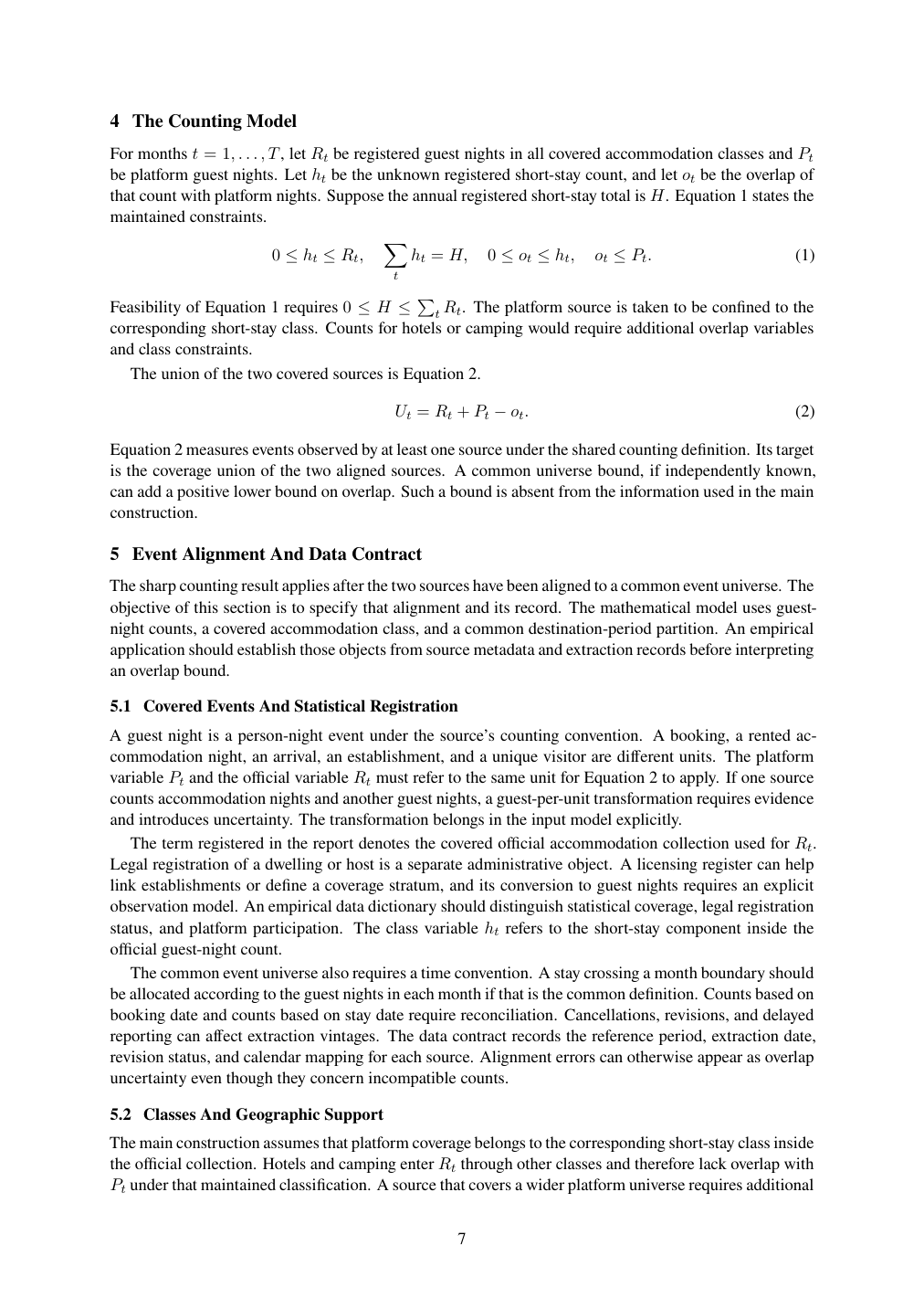
corresponding short-stay class. Counts for hotels or camping would require additional overlap variables
Equation 2 measures events observed by at least one source under the shared counting definition. Its target is the coverage union of the two aligned sources. A common universe bound, if independently known, can add a positive lower bound on overlap. Such a bound is absent from the information used in the main
The sharp counting result applies after the two sources have been aligned to a common event universe. The objective of this section is to specify that alignment and its record. The mathematical model uses guest- night counts, a covered accommodation class, and a common destination-period partition. An empirical application should establish those objects from source metadata and extraction records before interpreting
A guest night is a person-night event under the source’s counting convention. A booking, a rented ac- commodation night, an arrival, an establishment, and a unique visitor are different units. The platform counts accommodation nights and another guest nights, a guest-per-unit transformation requires evidence and introduces uncertainty. The transformation belongs in the input model explicitly.
Legal registration of a dwelling or host is a separate administrative object. A licensing register can help link establishments or define a coverage stratum, and its conversion to guest nights requires an explicit observation model. An empirical data dictionary should distinguish statistical coverage, legal registration
The common event universe also requires a time convention. A stay crossing a month boundary should be allocated according to the guest nights in each month if that is the common definition. Counts based on booking date and counts based on stay date require reconciliation. Cancellations, revisions, and delayed reporting can affect extraction vintages. The data contract records the reference period, extraction date, revision status, and calendar mapping for each source. Alignment errors can otherwise appear as overlap uncertainty even though they concern incompatible counts.
The main construction assumes that platform coverage belongs to the corresponding short-stay class inside
class variables. The model should follow the actual classification supplied by the extracted series and its metadata.
Geographic support needs a similar check. A municipal boundary, an urban area, and a regional statistical unit can cover different places. The numerator and resident denominator of a pressure measure should use the same declared geography or an explicit crosswalk. A regional platform count combined directly with a municipal official count produces another target. A crosswalk can be modelled through bounded allocation variables when exact local observations are unavailable, preserving the resulting spatial uncertainty alongside seasonal uncertainty.
Boundary revisions can also change comparability over time. The contract should identify the geographic version, any population adjustment, and the treatment of establishments near a boundary. A spatial aggregation operation should preserve the common guest-night definition. If the goal is neighbourhood pressure, citywide margins supply only limited information about within-city location. Additional geographic margins or an explicit spatial model are required to narrow that question.
5.3 Input Types And Uncertainty Status
An input table should distinguish exact counts, rounded published values, sampling estimates, intervalvalued releases, and assumed scenario quantities. An exact annual margin imposes an equality. A rounded margin imposes an interval reflecting its rounding rule. A confidence interval for a sampled estimate has a stochastic interpretation that requires a joint coverage statement before it can be propagated as a confidence region. A scenario share supplies a conditional equality whose status differs from observed data.
The report’s constructed example uses exact model values in thousands of guest nights. Its rounding extension treats each input as lying within a declared deterministic interval. Those intervals express compatibility, and their sharp endpoints are identification bounds conditional on the intervals. A probability label would require an additional sampling or measurement-error statement. Keeping input types explicit prevents a precise optimisation result from implying more precise source evidence than was supplied.

5.4 Pressure Outputs And Their Units
The pressure calculation divides union guest nights by days and resident population. It describes average overnight presence in the coverage union relative to residents. It is distinct from the number of distinct people who visited and from a count of people present in a particular street at a particular hour. Day visitors, unobserved accommodation, commuting, and local mobility can require additional sources. The coverage boundary is part of the output label.
A resident denominator also needs a reference date and uncertainty status. Seasonal residents, temporary workers, and population estimates can matter for a local interpretation. A ratio bound with a positive interval-valued denominator can be computed jointly if numerator and denominator dependencies are known. With independent compatibility intervals, the conservative extremes pair the smallest numerator with the largest denominator and conversely. A finer result requires the corresponding joint information.
The output record contains the target query, units, information set, endpoint values, attaining tables, solver diagnostics, and source versions. A dashboard can display a monthly band while retaining the joint feasible table behind it. When a user requests an annual or peak-season value, the system solves that query against the same information set. This interface preserves the shared annual constraint and gives the sharpness result an operational role.
6 Eliminating The Unobserved Seasonal Class Counts

Readable text
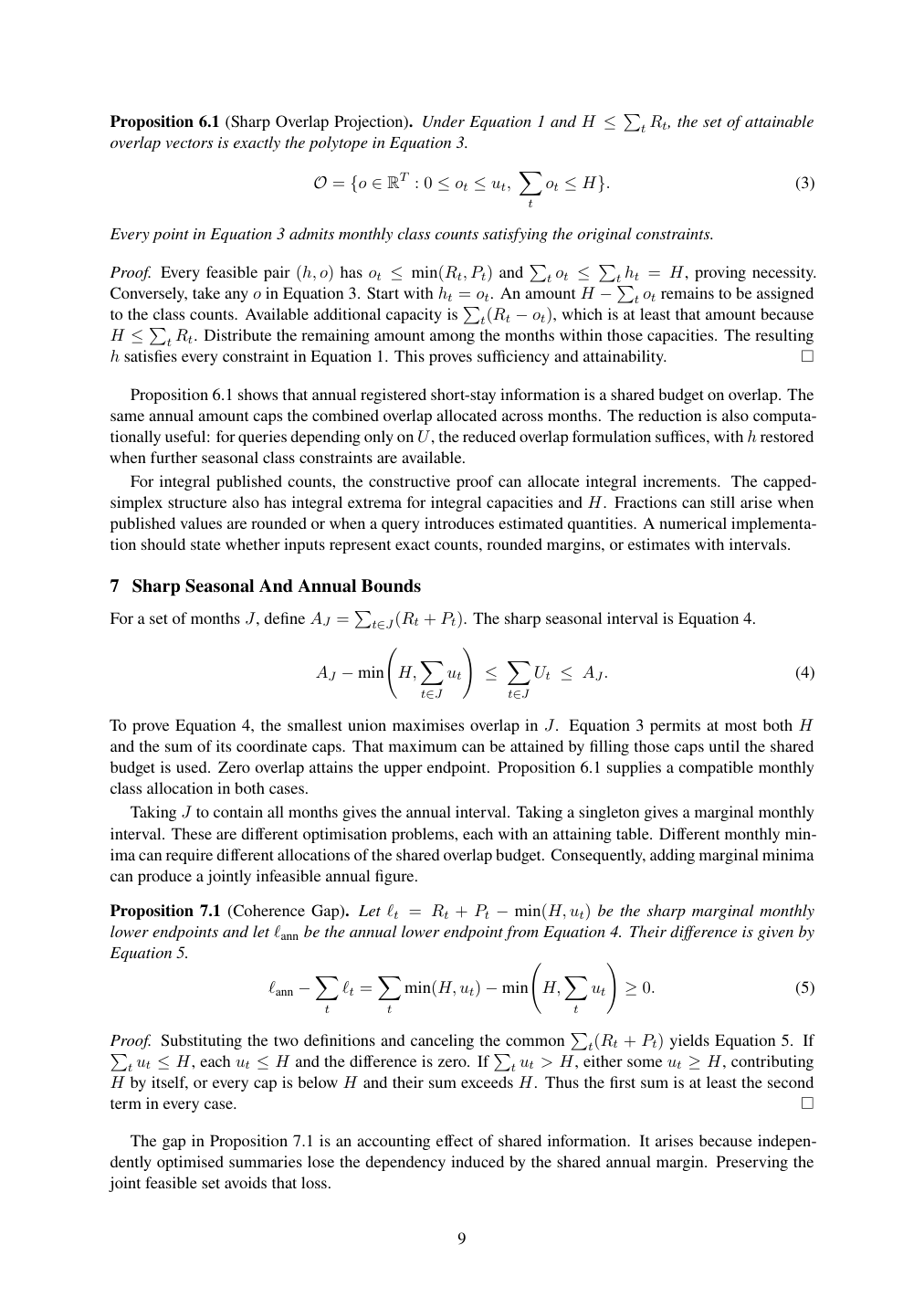
Every point in Equation 3 admits monthly class counts satisfying the original constraints.
Proposition 6.1 shows that annual registered short-stay information is a shared budget on overlap. The same annual amount caps the combined overlap allocated across months. The reduction is also computa-
when further seasonal class constraints are available.
For integral published counts, the constructive proof can allocate integral increments. The capped- published values are rounded or when a query introduces estimated quantities. A numerical implementa- tion should state whether inputs represent exact counts, rounded margins, or estimates with intervals.
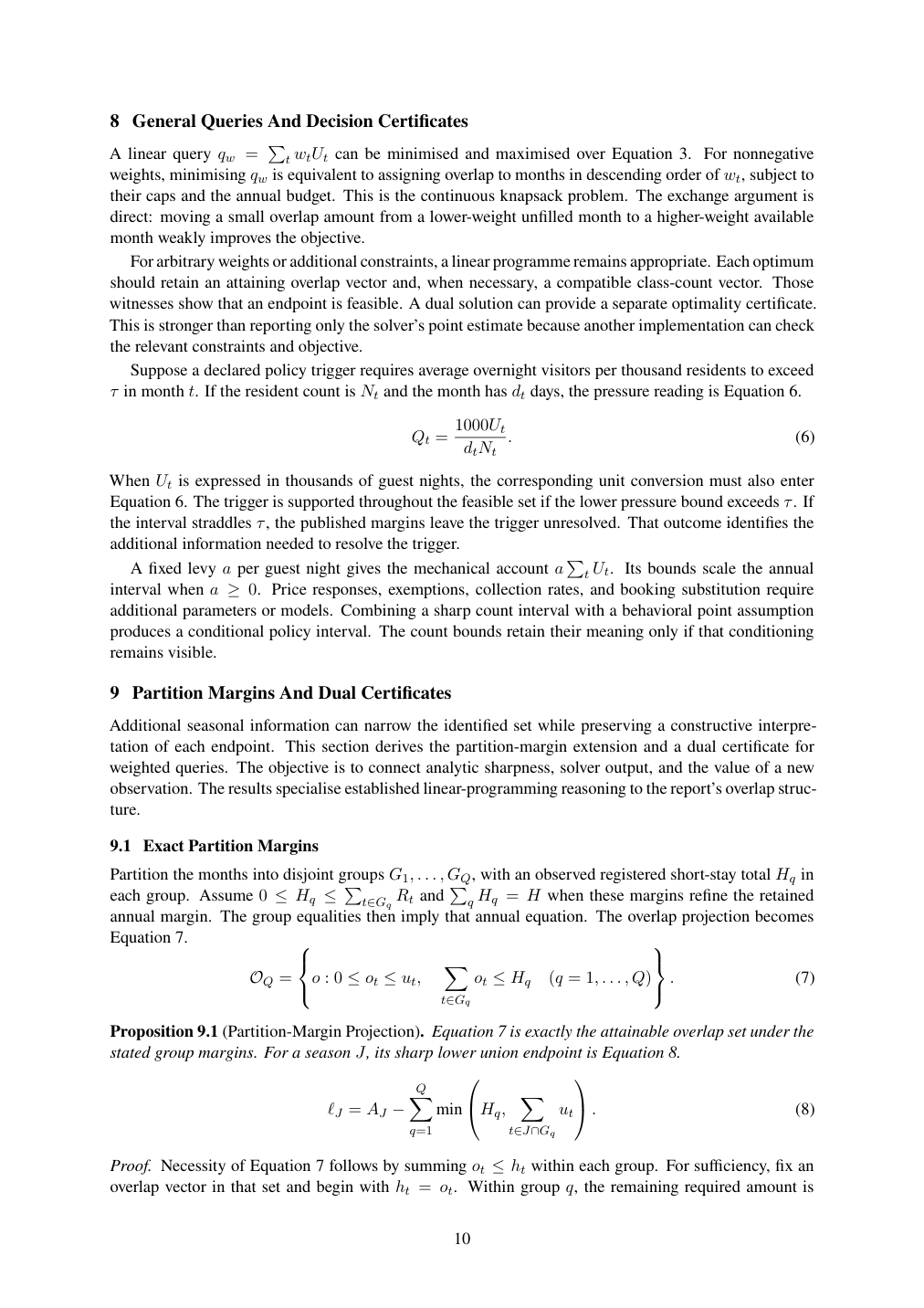
and the sum of its coordinate caps. That maximum can be attained by filling those caps until the shared budget is used. Zero overlap attains the upper endpoint. Proposition 6.1 supplies a compatible monthly
interval. These are different optimisation problems, each with an attaining table. Different monthly min- ima can require different allocations of the shared overlap budget. Consequently, adding marginal minima
The gap in Proposition 7.1 is an accounting effect of shared information. It arises because indepen- dently optimised summaries lose the dependency induced by the shared annual margin. Preserving the
Readable text
their caps and the annual budget. This is the continuous knapsack problem. The exchange argument is direct: moving a small overlap amount from a lower-weight unfilled month to a higher-weight available
For arbitrary weights or additional constraints, a linear programme remains appropriate. Each optimum should retain an attaining overlap vector and, when necessary, a compatible class-count vector. Those witnesses show that an endpoint is feasible. A dual solution can provide a separate optimality certificate. This is stronger than reporting only the solver’s point estimate because another implementation can check
Suppose a declared policy trigger requires average overnight visitors per thousand residents to exceed
additional information needed to resolve the trigger.
additional parameters or models. Combining a sharp count interval with a behavioral point assumption produces a conditional policy interval. The count bounds retain their meaning only if that conditioning
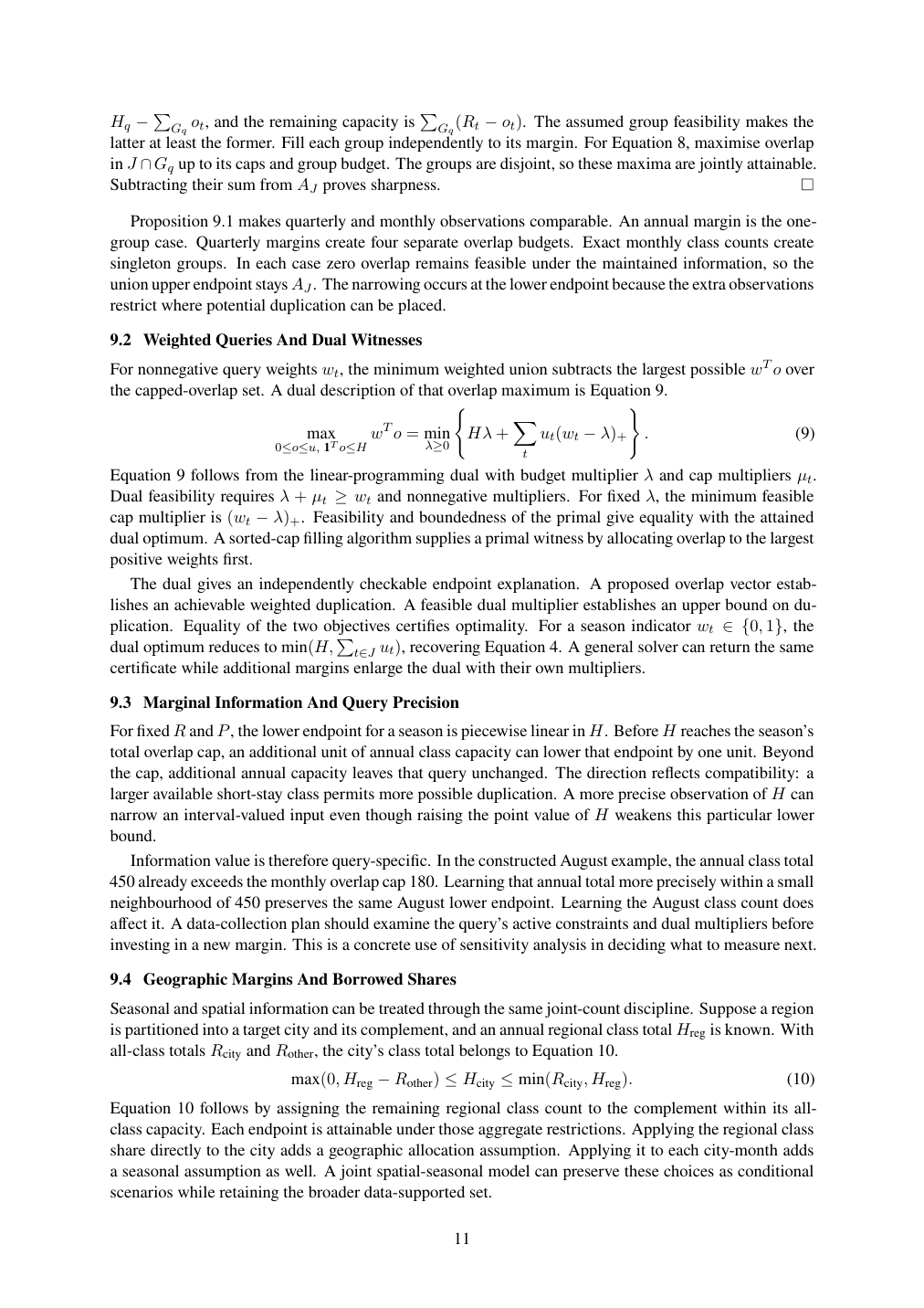
Additional seasonal information can narrow the identified set while preserving a constructive interpre- tation of each endpoint. This section derives the partition-margin extension and a dual certificate for weighted queries. The objective is to connect analytic sharpness, solver output, and the value of a new observation. The results specialise established linear-programming reasoning to the report’s overlap struc-
annual margin. The group equalities then imply that annual equation. The overlap projection becomes
Proposition 9.1 (Partition-Margin Projection). Equation 7 is exactly the attainable overlap set under the
Readable text
latter at least the former. Fill each group independently to its margin. For Equation 8, maximise overlap
Proposition 9.1 makes quarterly and monthly observations comparable. An annual margin is the one- group case. Quarterly margins create four separate overlap budgets. Exact monthly class counts create singleton groups. In each case zero overlap remains feasible under the maintained information, so the
the capped-overlap set. A dual description of that overlap maximum is Equation 9.
dual optimum. A sorted-cap filling algorithm supplies a primal witness by allocating overlap to the largest
The dual gives an independently checkable endpoint explanation. A proposed overlap vector estab- lishes an achievable weighted duplication. A feasible dual multiplier establishes an upper bound on du-
certificate while additional margins enlarge the dual with their own multipliers.
total overlap cap, an additional unit of annual class capacity can lower that endpoint by one unit. Beyond the cap, additional annual capacity leaves that query unchanged. The direction reflects compatibility: a
Information value is therefore query-specific. In the constructed August example, the annual class total 450 already exceeds the monthly overlap cap 180. Learning that annual total more precisely within a small neighbourhood of 450 preserves the same August lower endpoint. Learning the August class count does affect it. A data-collection plan should examine the query’s active constraints and dual multipliers before investing in a new margin. This is a concrete use of sensitivity analysis in deciding what to measure next.
Seasonal and spatial information can be treated through the same joint-count discipline. Suppose a region
Equation 10 follows by assigning the remaining regional class count to the complement within its all- class capacity. Each endpoint is attainable under those aggregate restrictions. Applying the regional class share directly to the city adds a geographic allocation assumption. Applying it to each city-month adds a seasonal assumption as well. A joint spatial-seasonal model can preserve these choices as conditional scenarios while retaining the broader data-supported set.
Readable text
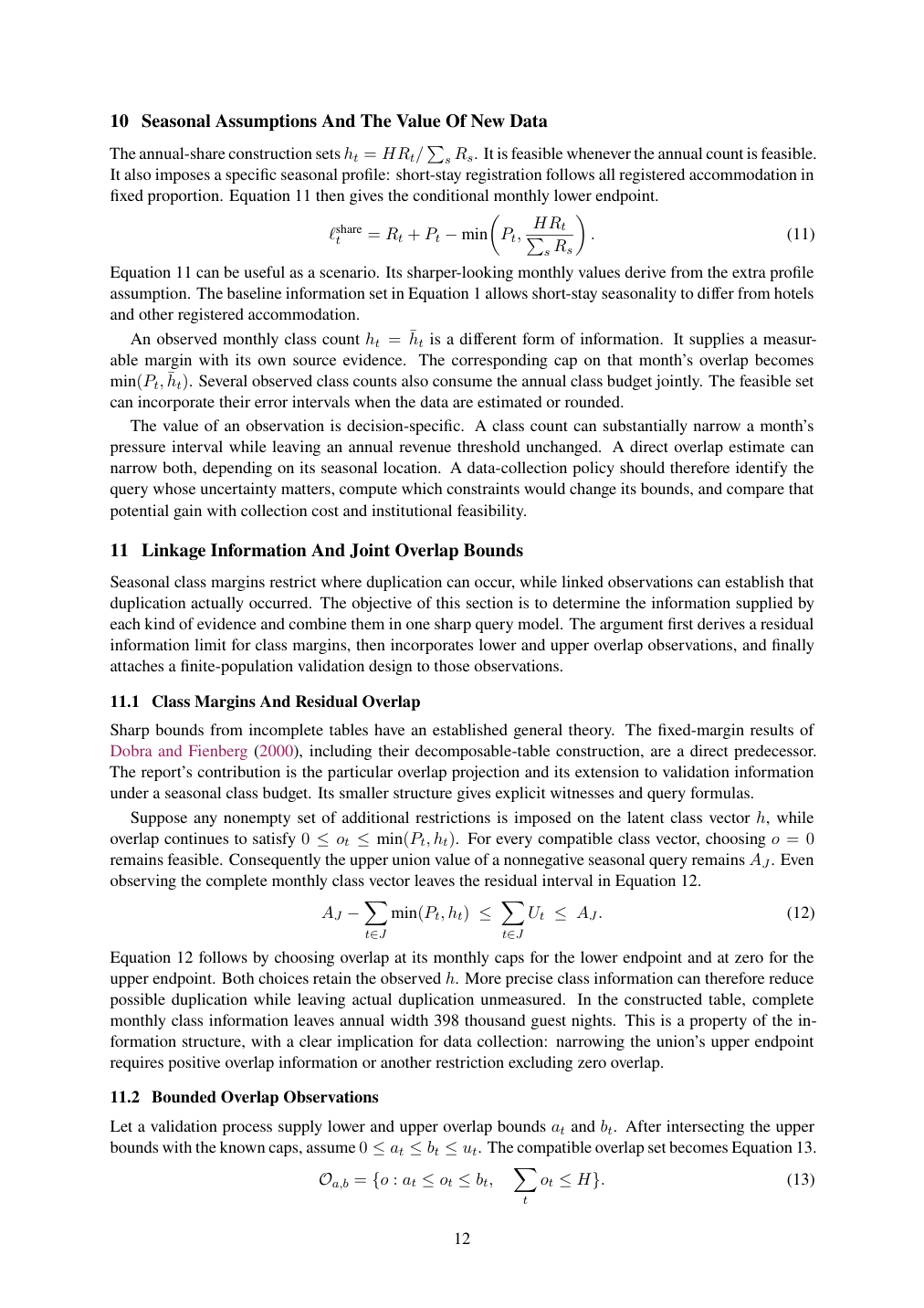
It also imposes a specific seasonal profile: short-stay registration follows all registered accommodation in fixed proportion. Equation 11 then gives the conditional monthly lower endpoint.
Equation 11 can be useful as a scenario. Its sharper-looking monthly values derive from the extra profile assumption. The baseline information set in Equation 1 allows short-stay seasonality to differ from hotels
able margin with its own source evidence. The corresponding cap on that month’s overlap becomes can incorporate their error intervals when the data are estimated or rounded.
The value of an observation is decision-specific. A class count can substantially narrow a month’s pressure interval while leaving an annual revenue threshold unchanged. A direct overlap estimate can narrow both, depending on its seasonal location. A data-collection policy should therefore identify the query whose uncertainty matters, compute which constraints would change its bounds, and compare that potential gain with collection cost and institutional feasibility.
Seasonal class margins restrict where duplication can occur, while linked observations can establish that duplication actually occurred. The objective of this section is to determine the information supplied by each kind of evidence and combine them in one sharp query model. The argument first derives a residual information limit for class margins, then incorporates lower and upper overlap observations, and finally attaches a finite-population validation design to those observations.
Sharp bounds from incomplete tables have an established general theory. The fixed-margin results of Dobra and Fienberg (2000), including their decomposable-table construction, are a direct predecessor. The report’s contribution is the particular overlap projection and its extension to validation information under a seasonal class budget. Its smaller structure gives explicit witnesses and query formulas.
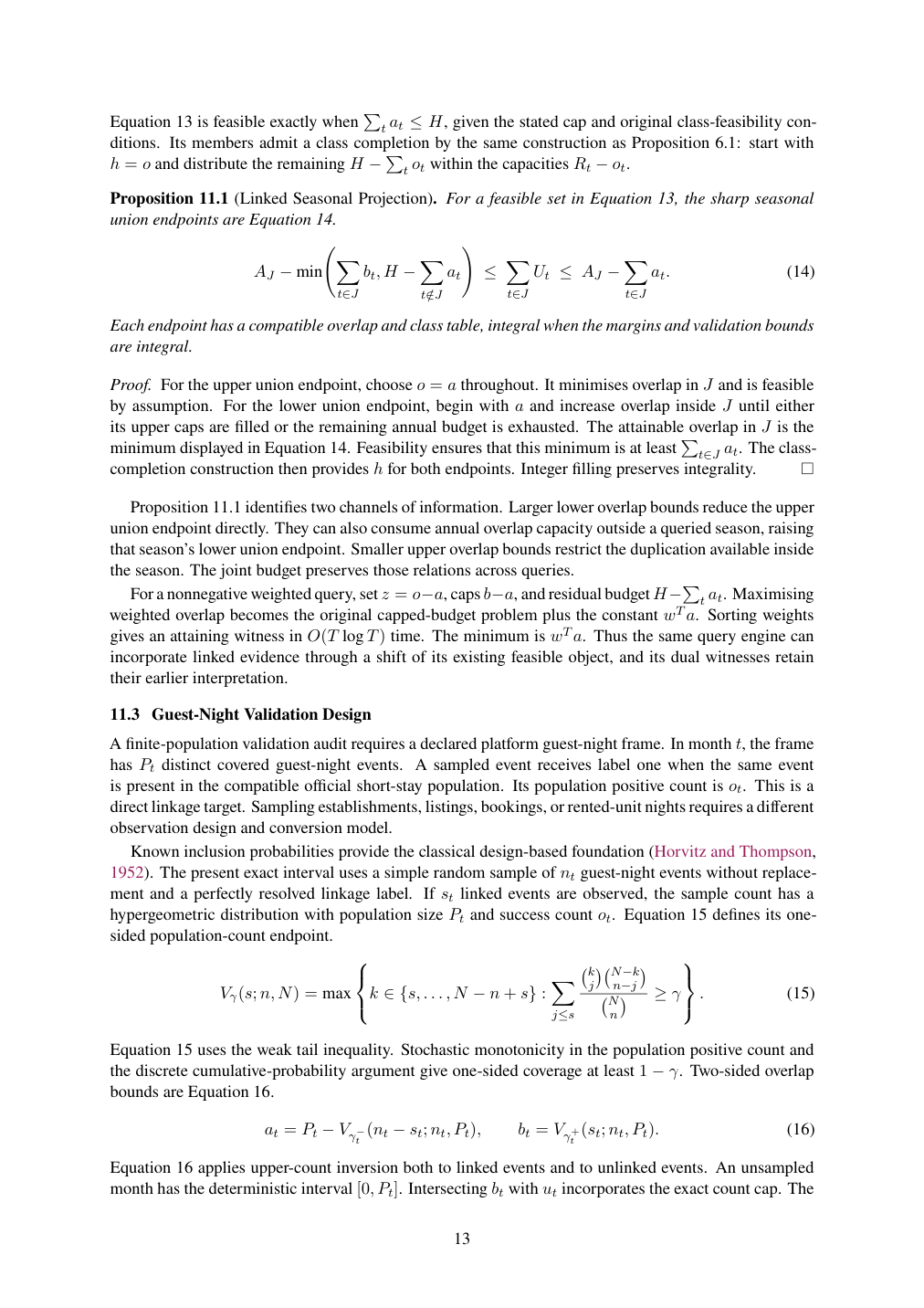
observing the complete monthly class vector leaves the residual interval in Equation 12.
Equation 12 follows by choosing overlap at its monthly caps for the lower endpoint and at zero for the possible duplication while leaving actual duplication unmeasured. In the constructed table, complete monthly class information leaves annual width 398 thousand guest nights. This is a property of the in- formation structure, with a clear implication for data collection: narrowing the union’s upper endpoint requires positive overlap information or another restriction excluding zero overlap.
Readable text
ditions. Its members admit a class completion by the same construction as Proposition 6.1: start with
Proposition 11.1 (Linked Seasonal Projection). For a feasible set in Equation 13, the sharp seasonal
Each endpoint has a compatible overlap and class table, integral when the margins and validation bounds
Proposition 11.1 identifies two channels of information. Larger lower overlap bounds reduce the upper union endpoint directly. They can also consume annual overlap capacity outside a queried season, raising that season’s lower union endpoint. Smaller upper overlap bounds restrict the duplication available inside the season. The joint budget preserves those relations across queries.
incorporate linked evidence through a shift of its existing feasible object, and its dual witnesses retain
direct linkage target. Sampling establishments, listings, bookings, or rented-unit nights requires a different
Known inclusion probabilities provide the classical design-based foundation (Horvitz and Thompson,
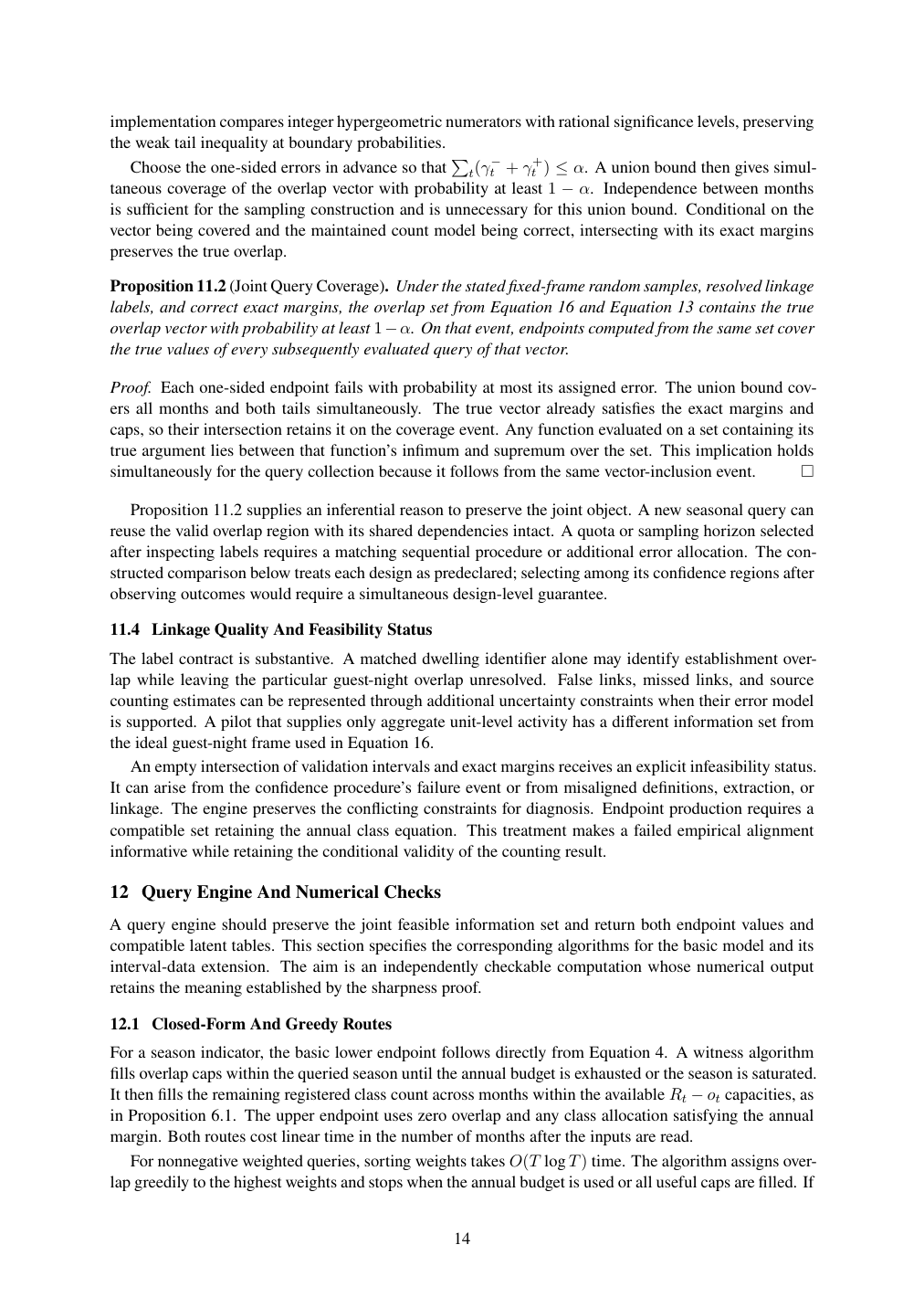
Equation 15 uses the weak tail inequality. Stochastic monotonicity in the population positive count and
Equation 16 applies upper-count inversion both to linked events and to unlinked events. An unsampled
Readable text
implementation compares integer hypergeometric numerators with rational significance levels, preserving
is sufficient for the sampling construction and is unnecessary for this union bound. Conditional on the vector being covered and the maintained count model being correct, intersecting with its exact margins
Proposition 11.2 (Joint Query Coverage). Under the stated fixed-frame random samples, resolved linkage labels, and correct exact margins, the overlap set from Equation 16 and Equation 13 contains the true the true values of every subsequently evaluated query of that vector.
Proof. Each one-sided endpoint fails with probability at most its assigned error. The union bound cov- ers all months and both tails simultaneously. The true vector already satisfies the exact margins and caps, so their intersection retains it on the coverage event. Any function evaluated on a set containing its true argument lies between that function’s infimum and supremum over the set. This implication holds simultaneously for the query collection because it follows from the same vector-inclusion event.
Proposition 11.2 supplies an inferential reason to preserve the joint object. A new seasonal query can reuse the valid overlap region with its shared dependencies intact. A quota or sampling horizon selected after inspecting labels requires a matching sequential procedure or additional error allocation. The con- structed comparison below treats each design as predeclared; selecting among its confidence regions after observing outcomes would require a simultaneous design-level guarantee.
The label contract is substantive. A matched dwelling identifier alone may identify establishment over- lap while leaving the particular guest-night overlap unresolved. False links, missed links, and source counting estimates can be represented through additional uncertainty constraints when their error model is supported. A pilot that supplies only aggregate unit-level activity has a different information set from
An empty intersection of validation intervals and exact margins receives an explicit infeasibility status. It can arise from the confidence procedure’s failure event or from misaligned definitions, extraction, or linkage. The engine preserves the conflicting constraints for diagnosis. Endpoint production requires a compatible set retaining the annual class equation. This treatment makes a failed empirical alignment informative while retaining the conditional validity of the counting result.
A query engine should preserve the joint feasible information set and return both endpoint values and compatible latent tables. This section specifies the corresponding algorithms for the basic model and its interval-data extension. The aim is an independently checkable computation whose numerical output retains the meaning established by the sharpness proof.
For a season indicator, the basic lower endpoint follows directly from Equation 4. A witness algorithm fills overlap caps within the queried season until the annual budget is exhausted or the season is saturated. in Proposition 6.1. The upper endpoint uses zero overlap and any class allocation satisfying the annual margin. Both routes cost linear time in the number of months after the inputs are read.
lap greedily to the highest weights and stops when the annual budget is used or all useful caps are filled. If
a lower-weight coordinate holds overlap while a higher-weight coordinate has spare capacity, exchanging a unit between them weakly improves the objective. Repeating that exchange proves the greedy structure. Tied weights can use a deterministic month order, which gives a reproducible witness among several optima.
Partition margins permit the same algorithm independently within each group. An arbitrary system of overlapping margins can couple several allocations and is naturally represented as a linear programme. The query engine can select the closed-form route when its assumptions match and the general route otherwise. Comparing both routes on basic cases gives a useful implementation check because the analytic result and solver formulation have independent failure modes.
12.2 Linear-Programming Formulation


Input validation checks nonnegative intervals, consistent class totals, common units, and geographicperiod identifiers. A feasibility solve precedes endpoint interpretation. If the constraints conflict, the output should identify the infeasible information set and support diagnosis through a minimal conflicting subset or a solver certificate where available. A point estimate obtained after quietly discarding a conflicting margin would answer another problem. The manifest should retain any explicit revision that resolves the conflict.
12.3 Numerical Precision And Output Interpretation
The checker records solver status, primal residuals, objective values, and endpoint witnesses. It should compare objective values with an analytic formula on the basic model and with a feasible dual bound where available. A numerical residual tolerance concerns arithmetic agreement with the specified programme. It is distinct from uncertainty in source counts. Both belong in the output, with their units and roles identified.
Exact integer guest-night counts can use the integral structure of the basic capped-budget model. More general overlapping margins may call for integer optimisation if indivisible-count attainability is essential. The present constructed inputs are measured in thousands and are treated as continuous compatible quantities. The analytic basic model has integral witnesses when its inputs are integral, while the interval extension reports the stated continuous programme. An empirical release should choose and document the appropriate convention.
The engine’s response includes the query and information-set hashes, endpoints, attaining tables, units, and source versions. A new query reuses the same feasible object. This architecture prevents a monthly display from becoming an accidental annual point account. It also makes additional information actionable: adding a quarterly margin creates a new information-set version, and the engine can show which queries narrowed and which active constraints changed.
13 Constructed Twelve-Month Study
13.1 Input Margins
The executable illustration uses registered monthly guest nights, in thousands, of 80, 70, 90, 100, 120, 150, 200, 210, 160, 120, 90, and 110. The annual registered count is 1,500 thousand. Platform guest
Readable text
Sharp marginal bounds Annual-share conditional lower Registered
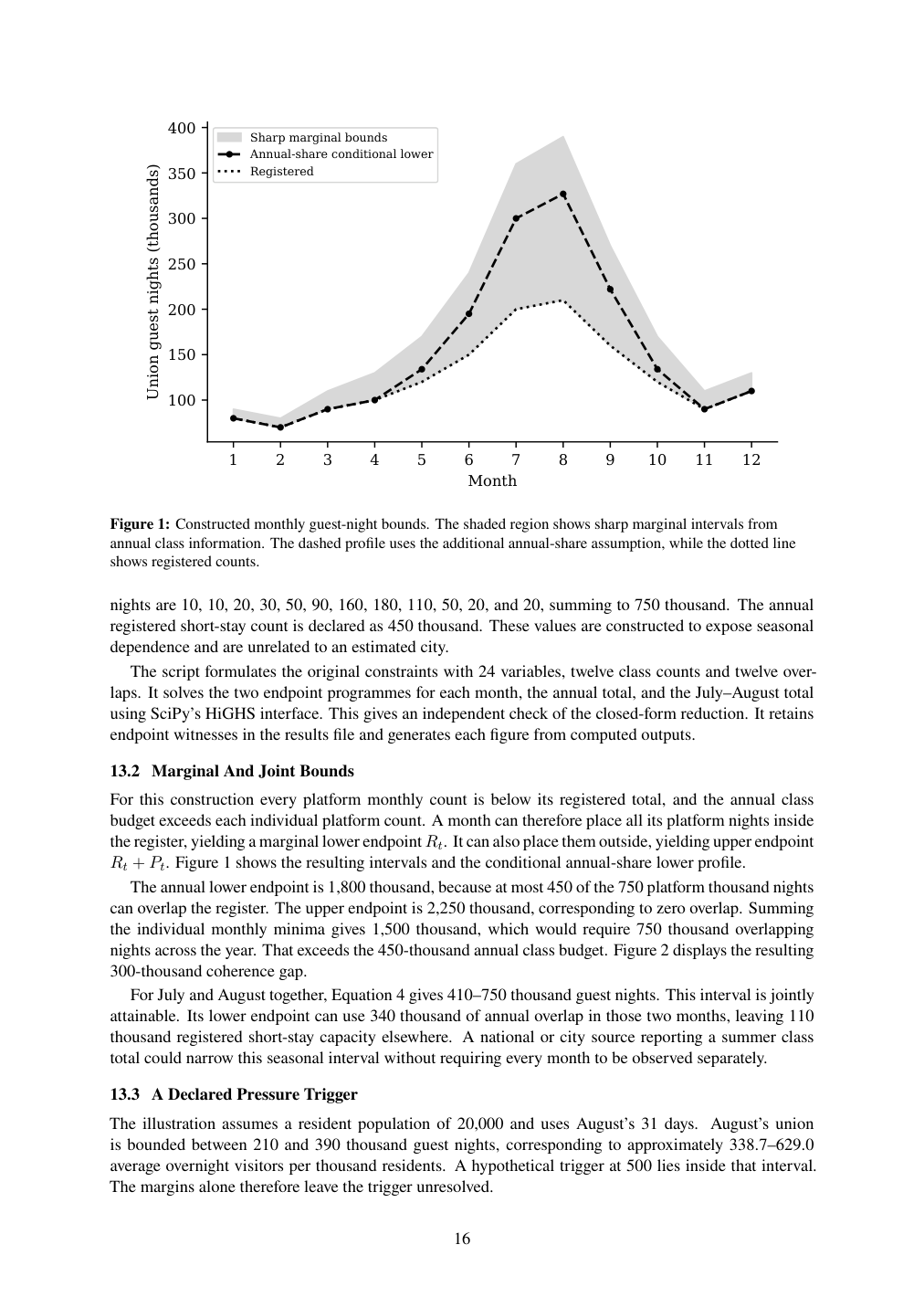
Figure 1: Constructed monthly guest-night bounds. The shaded region shows sharp marginal intervals from annual class information. The dashed profile uses the additional annual-share assumption, while the dotted line
nights are 10, 10, 20, 30, 50, 90, 160, 180, 110, 50, 20, and 20, summing to 750 thousand. The annual registered short-stay count is declared as 450 thousand. These values are constructed to expose seasonal
The script formulates the original constraints with 24 variables, twelve class counts and twelve over- laps. It solves the two endpoint programmes for each month, the annual total, and the July–August total using SciPy’s HiGHS interface. This gives an independent check of the closed-form reduction. It retains endpoint witnesses in the results file and generates each figure from computed outputs.
For this construction every platform monthly count is below its registered total, and the annual class budget exceeds each individual platform count. A month can therefore place all its platform nights inside
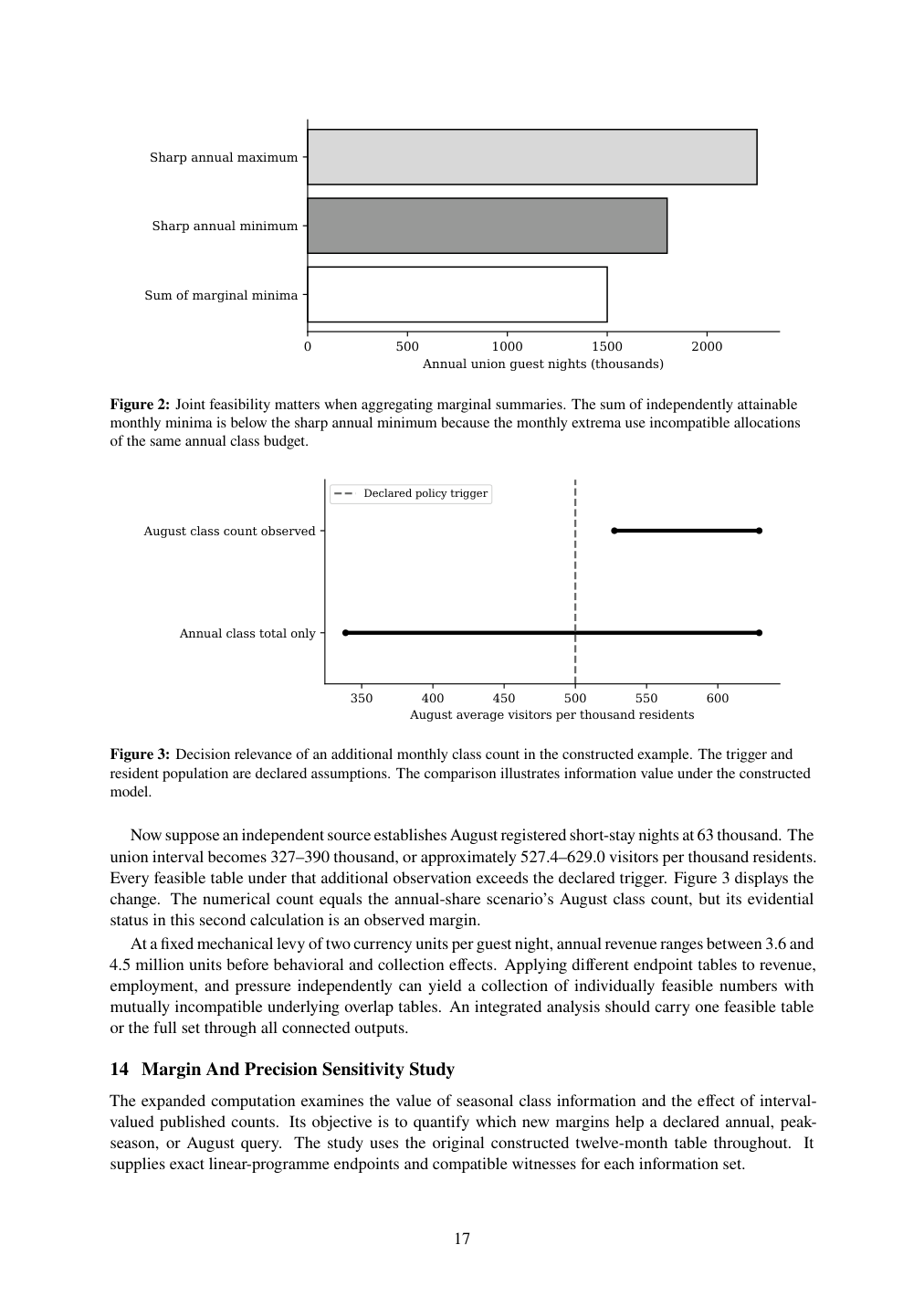
The annual lower endpoint is 1,800 thousand, because at most 450 of the 750 platform thousand nights can overlap the register. The upper endpoint is 2,250 thousand, corresponding to zero overlap. Summing the individual monthly minima gives 1,500 thousand, which would require 750 thousand overlapping nights across the year. That exceeds the 450-thousand annual class budget. Figure 2 displays the resulting For July and August together, Equation 4 gives 410–750 thousand guest nights. This interval is jointly attainable. Its lower endpoint can use 340 thousand of annual overlap in those two months, leaving 110 thousand registered short-stay capacity elsewhere. A national or city source reporting a summer class total could narrow this seasonal interval without requiring every month to be observed separately.
The illustration assumes a resident population of 20,000 and uses August’s 31 days. August’s union is bounded between 210 and 390 thousand guest nights, corresponding to approximately 338.7–629.0 average overnight visitors per thousand residents. A hypothetical trigger at 500 lies inside that interval. The margins alone therefore leave the trigger unresolved.
Readable text
Figure 2: Joint feasibility matters when aggregating marginal summaries. The sum of independently attainable monthly minima is below the sharp annual minimum because the monthly extrema use incompatible allocations
Figure 3: Decision relevance of an additional monthly class count in the constructed example. The trigger and resident population are declared assumptions. The comparison illustrates information value under the constructed
Now suppose an independent source establishes August registered short-stay nights at 63 thousand. The union interval becomes 327–390 thousand, or approximately 527.4–629.0 visitors per thousand residents. Every feasible table under that additional observation exceeds the declared trigger. Figure 3 displays the change. The numerical count equals the annual-share scenario’s August class count, but its evidential status in this second calculation is an observed margin.
At a fixed mechanical levy of two currency units per guest night, annual revenue ranges between 3.6 and 4.5 million units before behavioral and collection effects. Applying different endpoint tables to revenue, employment, and pressure independently can yield a collection of individually feasible numbers with mutually incompatible underlying overlap tables. An integrated analysis should carry one feasible table
The expanded computation examines the value of seasonal class information and the effect of interval- valued published counts. Its objective is to quantify which new margins help a declared annual, peak- season, or August query. The study uses the original constructed twelve-month table throughout. It supplies exact linear-programme endpoints and compatible witnesses for each information set.
Readable text
Annual Quarter Month Registered class margins observed
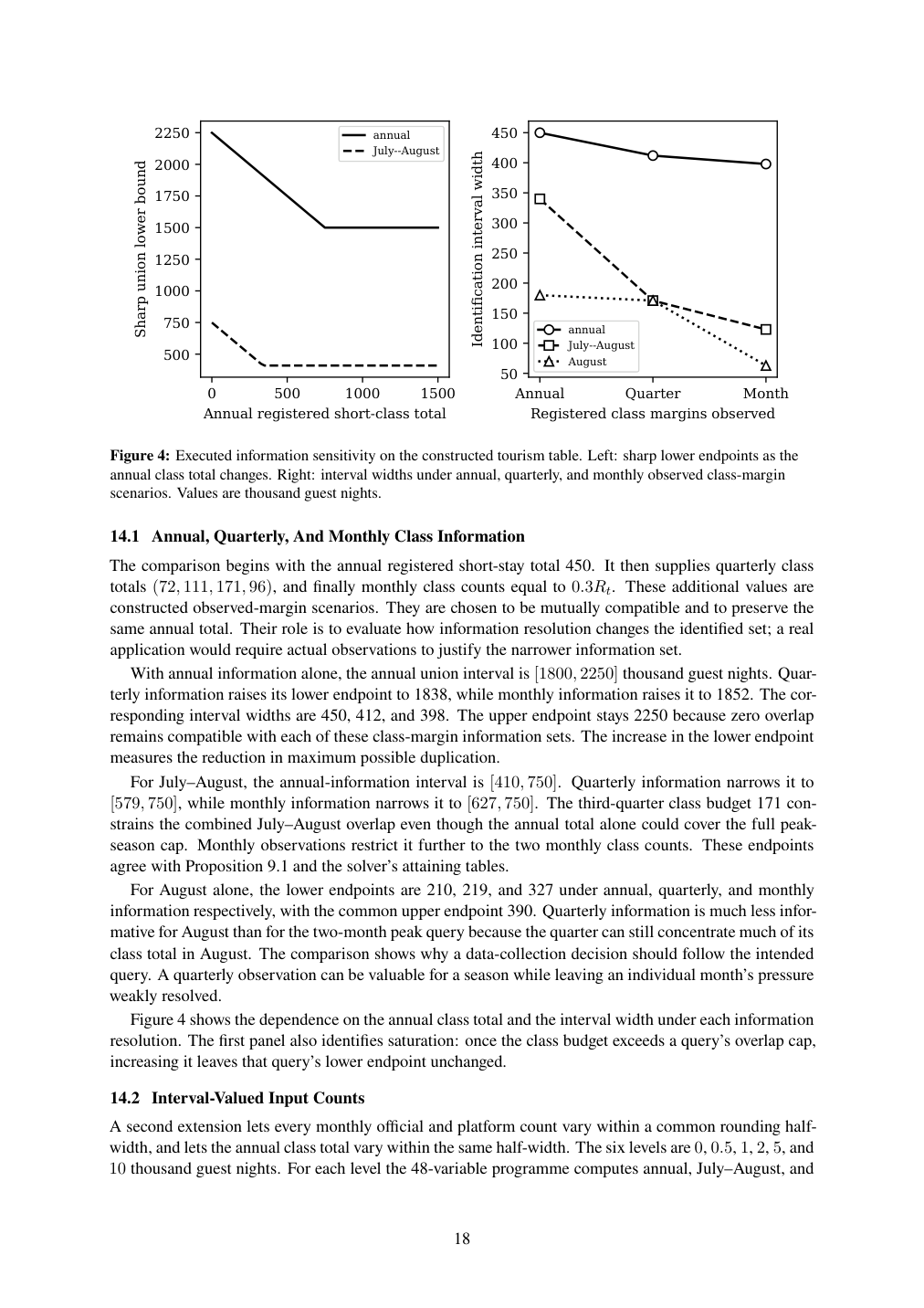
Figure 4: Executed information sensitivity on the constructed tourism table. Left: sharp lower endpoints as the annual class total changes. Right: interval widths under annual, quarterly, and monthly observed class-margin
The comparison begins with the annual registered short-stay total 450. It then supplies quarterly class constructed observed-margin scenarios. They are chosen to be mutually compatible and to preserve the same annual total. Their role is to evaluate how information resolution changes the identified set; a real application would require actual observations to justify the narrower information set.
terly information raises its lower endpoint to 1838, while monthly information raises it to 1852. The cor- responding interval widths are 450, 412, and 398. The upper endpoint stays 2250 because zero overlap remains compatible with each of these class-margin information sets. The increase in the lower endpoint measures the reduction in maximum possible duplication.
strains the combined July–August overlap even though the annual total alone could cover the full peak- season cap. Monthly observations restrict it further to the two monthly class counts. These endpoints agree with Proposition 9.1 and the solver’s attaining tables.
For August alone, the lower endpoints are 210, 219, and 327 under annual, quarterly, and monthly information respectively, with the common upper endpoint 390. Quarterly information is much less infor- mative for August than for the two-month peak query because the quarter can still concentrate much of its class total in August. The comparison shows why a data-collection decision should follow the intended query. A quarterly observation can be valuable for a season while leaving an individual month’s pressure
Figure 4 shows the dependence on the annual class total and the interval width under each information resolution. The first panel also identifies saturation: once the class budget exceeds a query’s overlap cap, increasing it leaves that query’s lower endpoint unchanged.
A second extension lets every monthly official and platform count vary within a common rounding half- 10 thousand guest nights. For each level the 48-variable programme computes annual, July–August, and
Readable text
Half-width of observed August class interval (thousands)
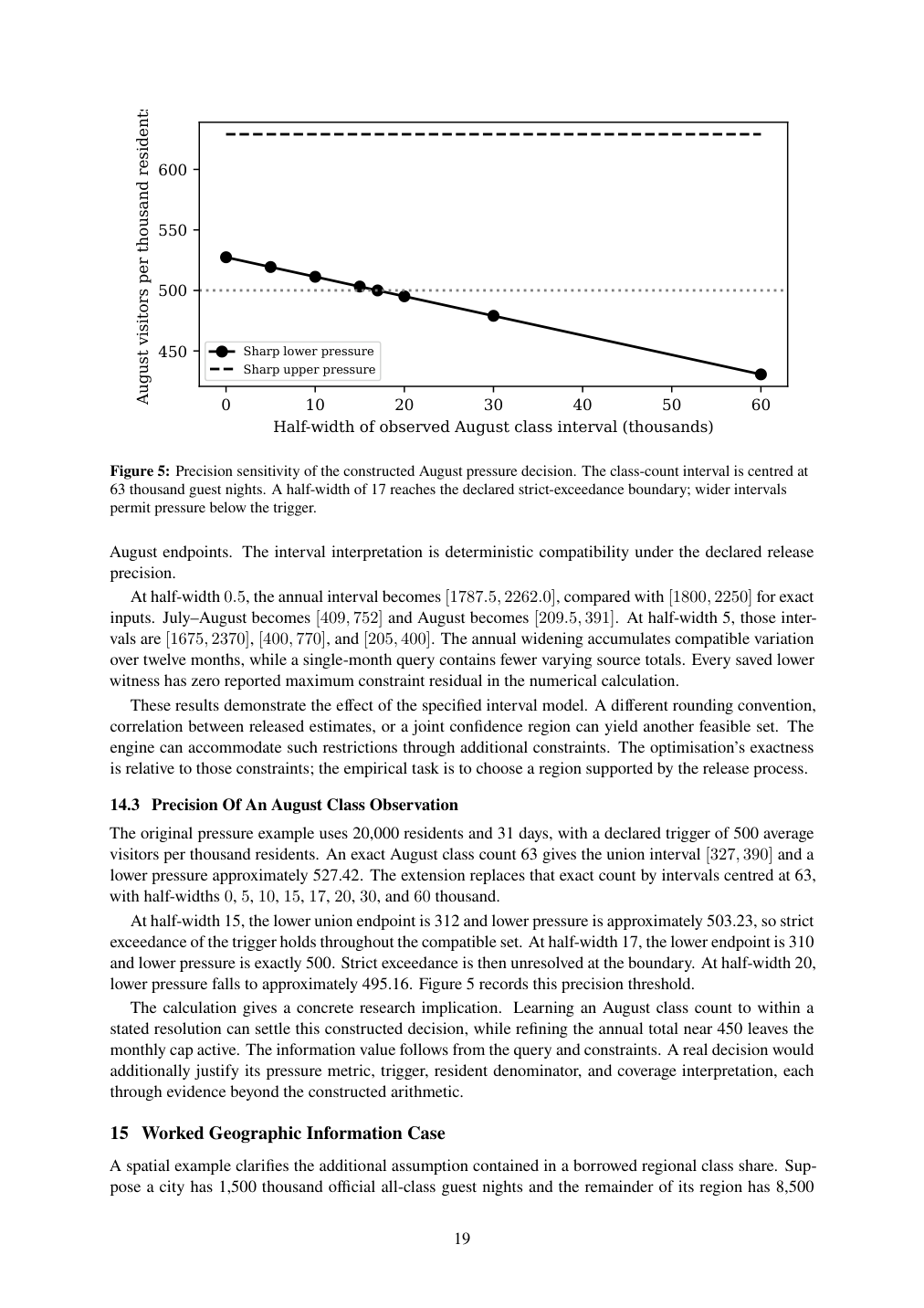
Figure 5: Precision sensitivity of the constructed August pressure decision. The class-count interval is centred at 63 thousand guest nights. A half-width of 17 reaches the declared strict-exceedance boundary; wider intervals
August endpoints. The interval interpretation is deterministic compatibility under the declared release
over twelve months, while a single-month query contains fewer varying source totals. Every saved lower witness has zero reported maximum constraint residual in the numerical calculation.
These results demonstrate the effect of the specified interval model. A different rounding convention, correlation between released estimates, or a joint confidence region can yield another feasible set. The engine can accommodate such restrictions through additional constraints. The optimisation’s exactness is relative to those constraints; the empirical task is to choose a region supported by the release process.
The original pressure example uses 20,000 residents and 31 days, with a declared trigger of 500 average lower pressure approximately 527.42. The extension replaces that exact count by intervals centred at 63, with half-widths 0, 5, 10, 15, 17, 20, 30, and 60 thousand.
At half-width 15, the lower union endpoint is 312 and lower pressure is approximately 503.23, so strict exceedance of the trigger holds throughout the compatible set. At half-width 17, the lower endpoint is 310 and lower pressure is exactly 500. Strict exceedance is then unresolved at the boundary. At half-width 20, lower pressure falls to approximately 495.16. Figure 5 records this precision threshold.
The calculation gives a concrete research implication. Learning an August class count to within a stated resolution can settle this constructed decision, while refining the annual total near 450 leaves the monthly cap active. The information value follows from the query and constraints. A real decision would additionally justify its pressure metric, trigger, resident denominator, and coverage interpretation, each
through evidence beyond the constructed arithmetic.
A spatial example clarifies the additional assumption contained in a borrowed regional class share. Sup- pose a city has 1,500 thousand official all-class guest nights and the remainder of its region has 8,500
thousand. The region’s registered short-stay class total is 3,000 thousand, so its regional class share is 0.3. Equation 10 permits the city’s class total anywhere from zero to 1,500 thousand. The complement can accommodate the remaining class total throughout that interval.



This case is an analytic illustration with declared counts. Its practical use is to structure a data request. A researcher can distinguish the need for a city-level class total from the need for its seasonal profile and ask which observation would narrow the intended query. A source crosswalk or statistical model can supply a conditional allocation when direct observations are unavailable, with its uncertainty and validation retained. Preserving the broader compatible set makes the contribution of that added model visible and gives subsequent empirical evidence a clear place to enter.
16 Linkage-Validation Benchmark
The validation experiment compares class information with direct overlap evidence and then compares four linkage designs under the same number of labels. The objective is to test the complete chain from a known finite population through random observation, joint overlap constraints, sharp endpoint witnesses, and a declared pressure decision. The population is constructed from the earlier twelve-month table; it is expressed in individual guest nights for sampling.
16.1 Constructed Guest-Night Population

Within each month, the experiment draws a random ordered sample of 600 distinct platform guestnight identifiers using seed 20261123. An identifier receives a linkage label according to the constructed month’s overlap count. Each predeclared design uses the required prefix of that order. This coupling compares designs using the same underlying random observations, while each prefix remains a uniform sample without replacement. The code saves quotas, observed successes, integer endpoints, compatible tables, and the actual target values.

Readable text
Information/design Linkage labels Annual union, thousands
Annual class 0 Monthly class 0 Uniform linkage 600 Proportional linkage 600 Peak-season linkage 600 August linkage 600
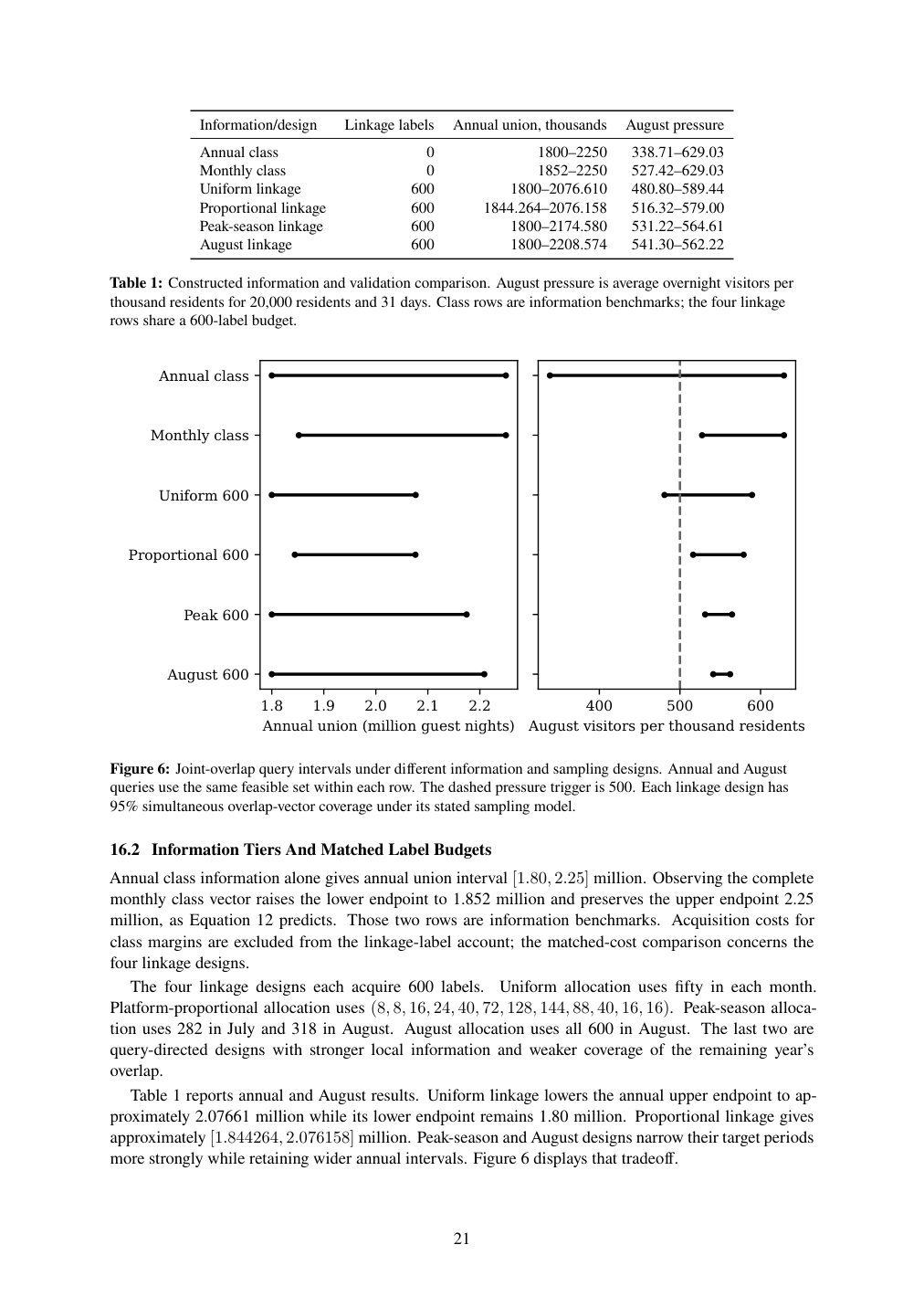
Table 1: Constructed information and validation comparison. August pressure is average overnight visitors per thousand residents for 20,000 residents and 31 days. Class rows are information benchmarks; the four linkage
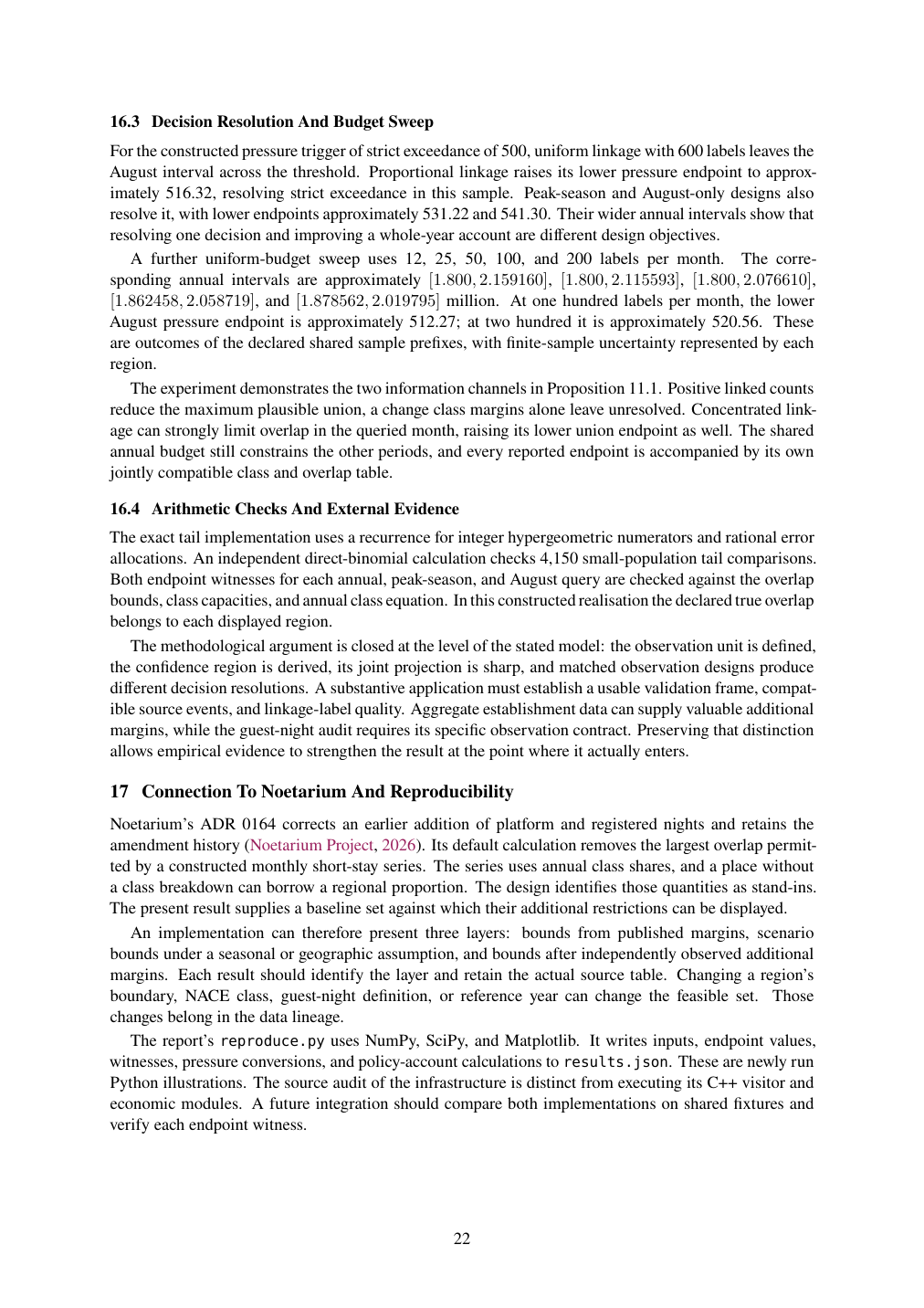
Figure 6: Joint-overlap query intervals under different information and sampling designs. Annual and August queries use the same feasible set within each row. The dashed pressure trigger is 500. Each linkage design has 95% simultaneous overlap-vector coverage under its stated sampling model.
monthly class vector raises the lower endpoint to 1.852 million and preserves the upper endpoint 2.25 million, as Equation 12 predicts. Those two rows are information benchmarks. Acquisition costs for class margins are excluded from the linkage-label account; the matched-cost comparison concerns the
The four linkage designs each acquire 600 labels. tion uses 282 in July and 318 in August. August allocation uses all 600 in August. The last two are query-directed designs with stronger local information and weaker coverage of the remaining year’s
Table 1 reports annual and August results. Uniform linkage lowers the annual upper endpoint to ap- proximately 2.07661 million while its lower endpoint remains 1.80 million. Proportional linkage gives more strongly while retaining wider annual intervals. Figure 6 displays that tradeoff.
Readable text
For the constructed pressure trigger of strict exceedance of 500, uniform linkage with 600 labels leaves the August interval across the threshold. Proportional linkage raises its lower pressure endpoint to approx- imately 516.32, resolving strict exceedance in this sample. Peak-season and August-only designs also resolve it, with lower endpoints approximately 531.22 and 541.30. Their wider annual intervals show that resolving one decision and improving a whole-year account are different design objectives.
A further uniform-budget sweep uses 12, 25, 50, 100, and 200 labels per month. August pressure endpoint is approximately 512.27; at two hundred it is approximately 520.56. These are outcomes of the declared shared sample prefixes, with finite-sample uncertainty represented by each
The experiment demonstrates the two information channels in Proposition 11.1. Positive linked counts reduce the maximum plausible union, a change class margins alone leave unresolved. Concentrated link- age can strongly limit overlap in the queried month, raising its lower union endpoint as well. The shared annual budget still constrains the other periods, and every reported endpoint is accompanied by its own
The exact tail implementation uses a recurrence for integer hypergeometric numerators and rational error allocations. An independent direct-binomial calculation checks 4,150 small-population tail comparisons. Both endpoint witnesses for each annual, peak-season, and August query are checked against the overlap bounds, class capacities, and annual class equation. In this constructed realisation the declared true overlap
The methodological argument is closed at the level of the stated model: the observation unit is defined, the confidence region is derived, its joint projection is sharp, and matched observation designs produce different decision resolutions. A substantive application must establish a usable validation frame, compat- ible source events, and linkage-label quality. Aggregate establishment data can supply valuable additional margins, while the guest-night audit requires its specific observation contract. Preserving that distinction allows empirical evidence to strengthen the result at the point where it actually enters.
Noetarium’s ADR 0164 corrects an earlier addition of platform and registered nights and retains the amendment history (Noetarium Project, 2026). Its default calculation removes the largest overlap permit- ted by a constructed monthly short-stay series. The series uses annual class shares, and a place without a class breakdown can borrow a regional proportion. The design identifies those quantities as stand-ins. The present result supplies a baseline set against which their additional restrictions can be displayed.
An implementation can therefore present three layers: bounds from published margins, scenario bounds under a seasonal or geographic assumption, and bounds after independently observed additional margins. Each result should identify the layer and retain the actual source table. Changing a region’s boundary, NACE class, guest-night definition, or reference year can change the feasible set.
The report’s reproduce.py uses NumPy, SciPy, and Matplotlib. It writes inputs, endpoint values, witnesses, pressure conversions, and policy-account calculations to results.json. These are newly run Python illustrations. The source audit of the infrastructure is distinct from executing its C++ visitor and economic modules. A future integration should compare both implementations on shared fixtures and
Readable text
Established methods bounds, partial identification, linear-programming duality
Verified statistical, official-measurement, and optimisation antecedents.
Proposition 6.1, constructive proof and attaining class tables.
Seasonal and linked-overlap endpoints, coherence, and joint query coverage
Margin and precision studies, matched linkage designs, and integer endpoint
Solver witnesses and reproducible constructed results.
Source alignment, linked pilots, point-profile assessment, and decision
Proposed protocol with separate measurement and policy targets.
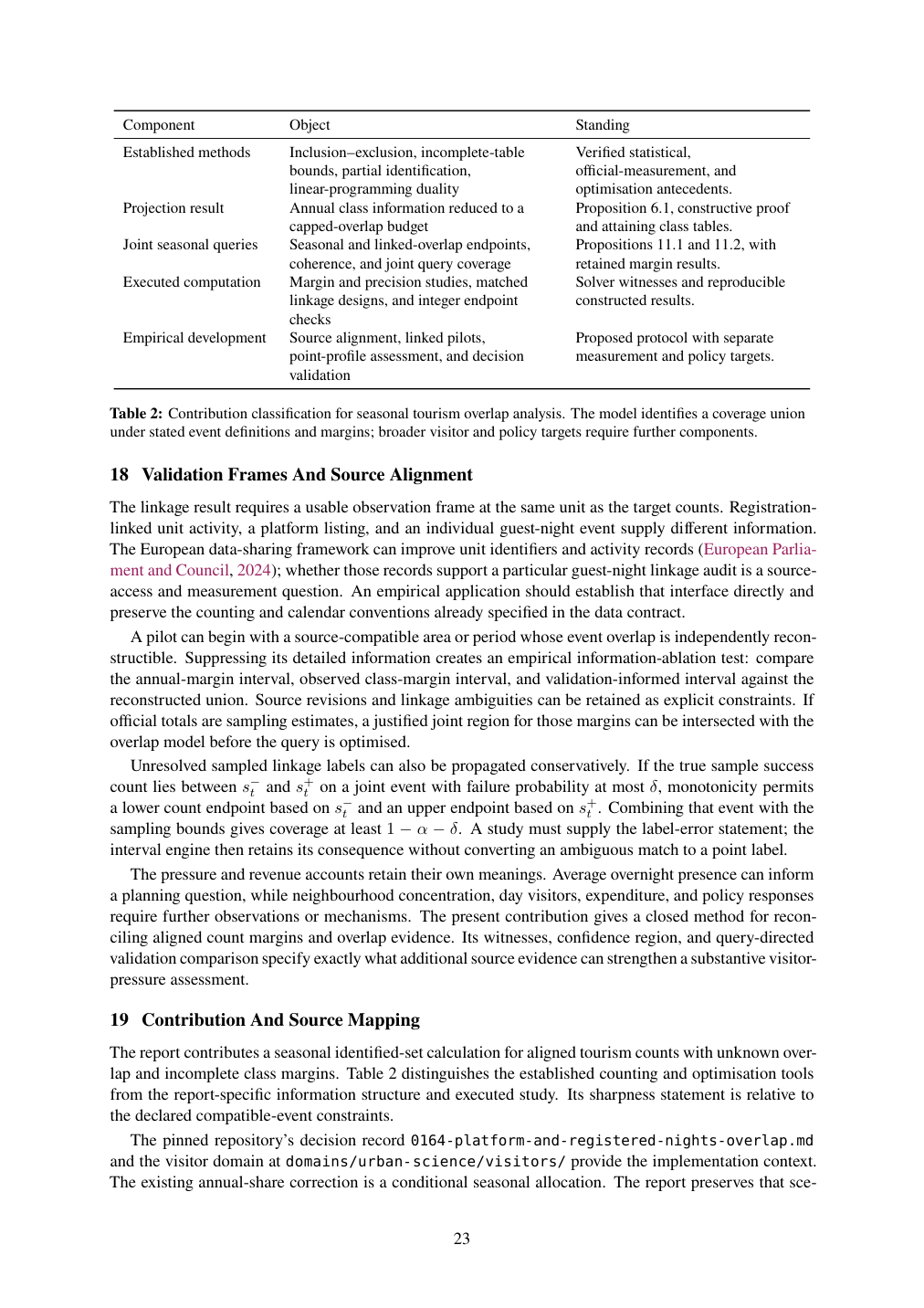
Table 2: Contribution classification for seasonal tourism overlap analysis. The model identifies a coverage union under stated event definitions and margins; broader visitor and policy targets require further components.
The linkage result requires a usable observation frame at the same unit as the target counts. Registration- linked unit activity, a platform listing, and an individual guest-night event supply different information. The European data-sharing framework can improve unit identifiers and activity records (European Parlia- ment and Council, 2024); whether those records support a particular guest-night linkage audit is a source- access and measurement question. An empirical application should establish that interface directly and preserve the counting and calendar conventions already specified in the data contract.
A pilot can begin with a source-compatible area or period whose event overlap is independently recon- structible. Suppressing its detailed information creates an empirical information-ablation test: compare the annual-margin interval, observed class-margin interval, and validation-informed interval against the reconstructed union. Source revisions and linkage ambiguities can be retained as explicit constraints. If official totals are sampling estimates, a justified joint region for those margins can be intersected with the
Unresolved sampled linkage labels can also be propagated conservatively. If the true sample success
interval engine then retains its consequence without converting an ambiguous match to a point label.
The pressure and revenue accounts retain their own meanings. Average overnight presence can inform a planning question, while neighbourhood concentration, day visitors, expenditure, and policy responses require further observations or mechanisms. The present contribution gives a closed method for recon- ciling aligned count margins and overlap evidence. Its witnesses, confidence region, and query-directed validation comparison specify exactly what additional source evidence can strengthen a substantive visitor-
The report contributes a seasonal identified-set calculation for aligned tourism counts with unknown over- lap and incomplete class margins. Table 2 distinguishes the established counting and optimisation tools from the report-specific information structure and executed study. Its sharpness statement is relative to
The pinned repository’s decision record 0164-platform-and-registered-nights-overlap.md and the visitor domain at domains/urban-science/visitors/ provide the implementation context. The existing annual-share correction is a conditional seasonal allocation. The report preserves that sce-
nario and supplies a broader feasible-count object when only annual class information is observed. An observed monthly class count and an assumed monthly profile can coincide numerically while retaining different evidential status.
The Python reproduction writes the original 24-variable endpoint witnesses and figures, then invokes the extension’s partition-margin and 48-variable interval-input calculations. The main entry point also invokes publication_study.py for the guest-night validation frame, random linkage prefixes, exact overlap region, and class-compatible query witnesses. The saved results identify units, information sets, bounds, pressure conversion, and constraint residuals. A reader can inspect the attaining tables directly or recompute a new linear query on the same feasible set. The computations use constructed data, and its empirical standing is a constructed information-sensitivity study.
The contribution can be assessed through a concrete information gain. A researcher can determine whether a seasonal conclusion follows from observed margins, depends on a profile assumption, or remains unresolved pending a particular new observation. The joint set also prevents annual accounts from being assembled out of mutually incompatible monthly extrema. These are useful, sharply specified additions to the repository’s visitor-counting programme and a foundation for an empirical report once source-compatible local data and validation evidence are available.
20 Conclusion
Seasonal overlap is a joint information object. Annual and partitioned class margins constrain possible duplication, while direct overlap evidence can narrow the union’s upper endpoint as well. The linked projection, exact validation region, and attaining tables provide a closed route from aligned observations to coherent annual, seasonal, and pressure queries. Matched label-budget designs demonstrate that information useful for one decision can leave another account less resolved. The protocol preserves those dependencies and specifies the source and linkage evidence required for a substantive visitor assessment.
References
Eurostat (2026). Short-Stay Accommodation Offered via Online Collaborative Economy Platforms: Reference
Metadata (tour_ce). European Commission. https://ec.europa.eu/eurostat/cache/metadata/en/ tour_ce_esms.htm. Eurostat (2024). Occupancy of Tourist Accommodation Establishments: Reference Metadata (tour_occ). European
Commission. https://ec.europa.eu/eurostat/cache/metadata/en/tour\_occ\_esms.htm. United Nations; World Tourism Organization (2010). International Recommendations for Tourism Statistics 2008.
Studies in Methods, Series M, No.83/Rev.1. https://unstats.un.org/unsd/publication/Seriesm/Seri esM_83rev1e.pdf. United Nations; European Commission; Organisation for Economic Co-operation; Development; World Tourism
Organization (2010). Tourism Satellite Account: Recommended Methodological Framework 2008. Studies in Methods, Series F, No.80/Rev.1. https://unstats.un.org/unsd/publication/Seriesf/SeriesF\_80re v1e.pdf. European Parliament; Council of the European Union (2011). Regulation (EU) No 692/2011 of 6 July 2011 Con-
cerning European Statistics on Tourism. Official Journal L192, 17–32. https://eur-lex.europa.eu/eli/r eg/2011/692/oj. European Parliament; Council of the European Union (2024). Regulation (EU) 2024/1028 of 11 April 2024 on Data
Collection and Sharing Relating to Short-Term Accommodation Rental Services. Official Journal L, 2024/1028. https://eur-lex.europa.eu/eli/reg/2024/1028/oj. Charles F. Manski; Elie Tamer (2002). Inference on Regressions with Interval Data on a Regressor or Outcome.
Econometrica 70(2), 519–546. https://doi.org/10.1111/1468-0262.00294. Charles F. Manski (2003). Partial Identification of Probability Distributions. Springer. https://link.springer.
com/book/10.1007/b97478. Adrian Dobra; Stephen E. Fienberg (2000). Bounds for Cell Entries in Contingency Tables Given Marginal Totals
and Decomposable Graphs. Proceedings of the National Academy of Sciences 97(22), 11885–11892. https: //pmc.ncbi.nlm.nih.gov/articles/PMC17264/.

Readable text
Tables. Biometrika 59(3), 591–603. https://academic.oup.com/biomet/article-abstract/59/3/591 Hermann Brenner (1995). Use and Limitations of the Capture-Recapture Method in Disease Monitoring with Two
Dependent Sources. Epidemiology 6(1), 42–48. https://pubmed.ncbi.nlm.nih.gov/7888444/. Stephen Boyd; Lieven Vandenberghe (2004). Convex Optimization. Cambridge University Press. https://web.
stanford.edu/~boyd/cvxbook/bv_cvxbook.pdf. Noetarium Project (2026). Noetarium: The
Science 869fe38afac257cd9b5d51ad5b498a8ff6b8e443. https://github.com/huangwanhong-maker/Noeta rium-The-Science-and-Humanity-Infrastructure. D. G. Horvitz; D. J. Thompson (1952). A Generalization of Sampling Without Replacement From a Finite Universe.
Journal of the American Statistical Association 47(260), 663–685. https://ww2.arb.ca.gov/sites/defau lt/files/2025-09/Horvitz-GeneralizationSamplingWithout-1952.pdf.