Phase Transition Caused by Normative Behaviors - A Field-Theoretic Model
Full text from the PDF
Normative Behaviors And Collective Transitions Working Paper
Phase Transition Caused by Normative Behaviors: A
Field-Theoretic Model
Wanhong HUANG
Abstract. A normative act can change who may communicate, whose judgment controls a decision, which responses are required, or how an institution revises its own procedures. When these effects alter interaction terms, they can change the collective dynamics of heterogeneous participants. This paper develops a field-theoretic discussion of that mechanism. It distinguishes a norm specification, conduct qualified under an order, the implementation of its effects, and the resulting dynamical response. A two-field model gives an explicit condition under which a coupling-changing act destabilizes a previously damped collective mode. In a reciprocal subclass, a continuous meanfield transition follows from quartic saturation. A second calculation shows how a feedback field shifts a quartic coefficient and can change a transition from continuous to discontinuous. The analysis uses a four-primitives description of change, constraint, structure, and difference, and separates temporal adaptation from state-dependent response and renormalization-group scale flow. Multiphase fluid dynamics supplies a physically grounded example of coupled configurations, constitutive response, constraints, and moving interfaces. Finite-population stochastic models and an identification framework specify what evidence a phase-transition claim would require. The results are conditional mathematical mechanisms and a research design for heterogeneous communities.
Keywords: Normative Behaviors; Coupling; Phase Transition; Heterogeneous Communities; Field Theory.
AI Statement. OpenAI ChatGPT assisted with formal development, literature checking, drafting, mathematical checks, and document preparation. The author is responsible for the interpretation and subsequent scholarly review of this discussion.
License. CC BY-NC 4.0.
1 Introduction
A community can change a single procedure and thereby change an interaction loop. An appointment can make one participant’s instruction actionable by others. A review rule can require an AI system to route a proposal through a human reviewer. An amendment can make the reviewer’s decisions available to an automated process that revises subsequent recommendations. A new return channel then links decisions, observations, and future proposals. The text of the amendment can be short while the resulting feedback is extensive.
The issue is consequential for heterogeneous society building because norms organize relations as well as individual choices. A prohibition may reduce the probability of one action. A constitutive rule can also establish an office, create a channel, give a message institutional effect, or alter who may revise a procedure. Performance of a duty can sustain another participant’s reliance. A breach and the response it elicits can reorganize access, sanctions, or cooperation. These changes can affect collective modes that none of the participants exhibits in isolation.
The proposed mechanism is a sequence with separately identifiable links: conduct receives a normative qualification under an order; an implemented rule or recognized practice changes an interaction;
Normative Behaviors And Collective Transitions Working Paper
the changed interaction alters the collective generator; and the resulting system may cross a stability or phase boundary. Each link has its own conditions. A label entered in an archive has a dynamical effect only through a realized channel, interpretation, or institutional transition. A large response can arise for reasons other than criticality. An empirical claim about a community therefore needs evidence about the mechanism and the collective behavior.
The title uses “caused” to identify the conditional causal mechanism investigated here. The analysis proves results within specified models and states a design for testing related hypotheses. It neither infers causation from the mere occurrence of normative language nor identifies every abrupt change as a phase transition. The main example shows exactly when a coupling-changing intervention crosses a linear threshold. A reciprocal saturated model then supplies a controlled mean-field transition, while a feedback-field example supplies both continuous and discontinuous regimes.
The distinction between several levels of behavioral description is useful for this inquiry. The companion taxonomy distinguishes epistemic activity, occurring conduct, manifestation, social attribution, and normative qualification [T]. A vote can be transmitted, recorded, interpreted as pressure, and admitted as an effective institutional decision. These descriptions concern related evidence and different claims. When an amendment is alleged to have changed a collective regime, the occurrence of the vote, its standing, its implementation, and the subsequent response must be recoverable separately.
Experiments on human naming conventions and on populations of LLM agents provide evidence of collective convention formation in their respective settings [6, 7]. They motivate inquiry into collective interaction while leaving the normative-causal and heterogeneous-community questions open.
The four-primitives vocabulary developed by the author provides a second organizing perspective: change, constraint, structure, and difference. A field configuration supplies a structural state; an evolution generator supplies a rule of change; constraints specify admissibility; and differential or discrete comparison operators specify differences. All four can evolve within an enlarged model. Their separation is analytical and depends on declared representations and observation scales. This paper develops that vocabulary through explicit equations rather than treating its universal sufficiency as an established theorem.
Sections 2 and 3 define the normative and field-theoretic objects. Section 4 derives the central coupling threshold and an explicit normative intervention. Sections 5–7 distinguish local response, scale dependence, criticality, and phase criteria. Sections 8 and 9 analyze feedback, transition order, conservation, and oscillatory regimes. Sections 10 and 11 discuss multiphase flow and volcanic transitions. Sections 12–15 connect the constructions to heterogeneous communities, empirical identification, and control over generative possibilities. Sections 16 and 17 discuss the scope of the claims. Appendix A provides the principal mathematical checks. Figures report calculations for the declared illustrative models.
2 Normative Behaviors And Their Causal Realization
2.1 Conduct, Qualification, And Institutional Effect
For this paper, a normative behavior is conduct considered through its constitution or qualification under an identified order or practice. It includes an admitted appointment, exercise of a mandate, performance of a duty, or an act qualified as a breach. The definition names a level of description; it does not imply that the conduct is morally justified. A norm specification is the rule or expectation under which conduct receives its standing. The conduct, the specification, and the mechanism implementing its effects remain distinct objects.
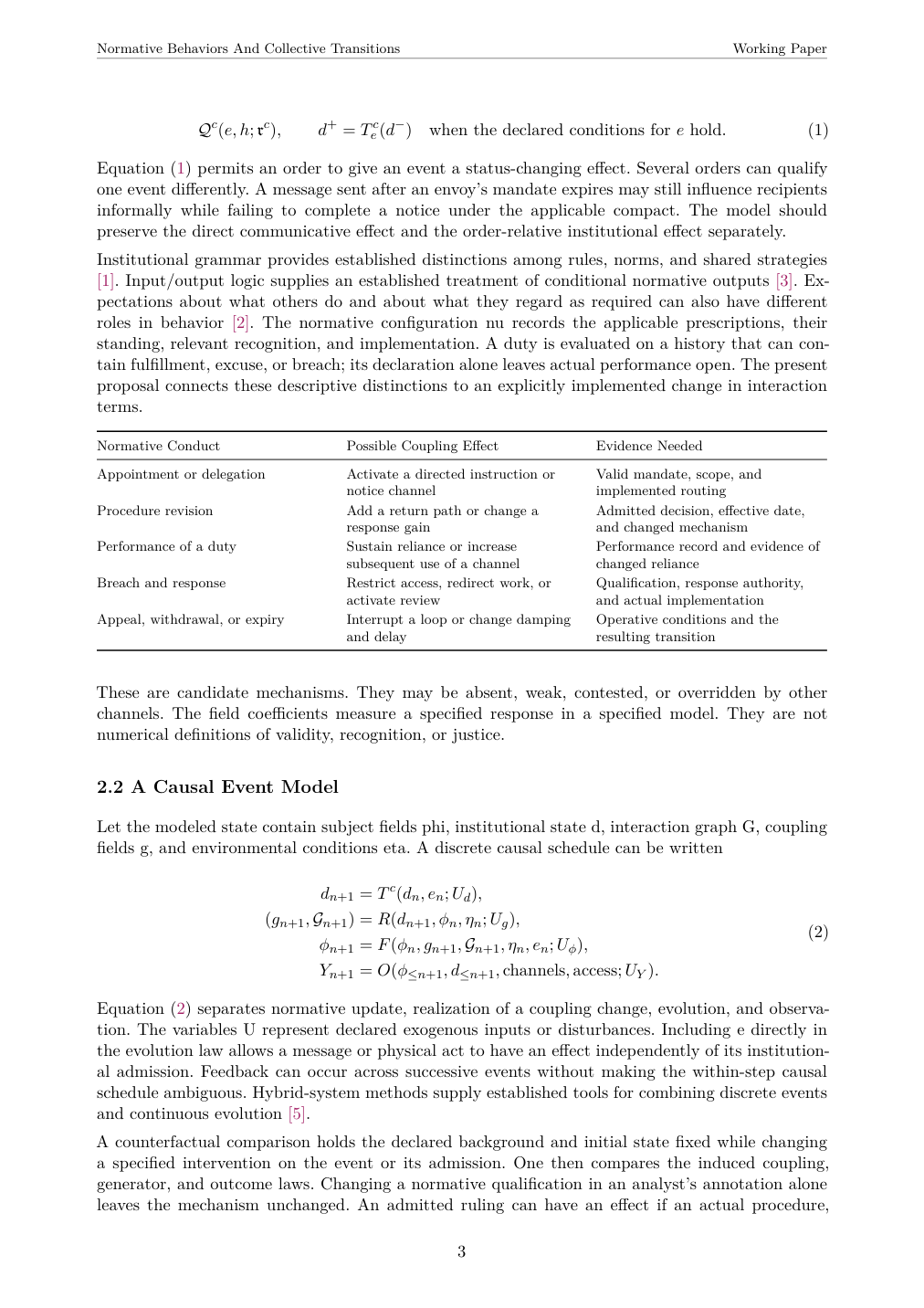
Let c identify the relevant order, e an episode, d the institutional state, and r the applicable versioned prescriptions. A qualification and a constitutive update can be represented as
Readable text
Equation (1) permits an order to give an event a status-changing effect. Several orders can qualify one event differently. A message sent after an envoy’s mandate expires may still influence recipients informally while failing to complete a notice under the applicable compact. The model should preserve the direct communicative effect and the order-relative institutional effect separately.
Institutional grammar provides established distinctions among rules, norms, and shared strategies [1]. Input/output logic supplies an established treatment of conditional normative outputs [3]. Ex- pectations about what others do and about what they regard as required can also have different roles in behavior [2]. The normative configuration nu records the applicable prescriptions, their standing, relevant recognition, and implementation. A duty is evaluated on a history that can con- tain fulfillment, excuse, or breach; its declaration alone leaves actual performance open. The present proposal connects these descriptive distinctions to an explicitly implemented change in interaction
Admitted decision, effective date, and changed mechanism
Sustain reliance or increase subsequent use of a channel
Performance record and evidence of changed reliance
Qualification, response authority, and actual implementation
These are candidate mechanisms. They may be absent, weak, contested, or overridden by other channels. The field coefficients measure a specified response in a specified model. They are not numerical definitions of validity, recognition, or justice.
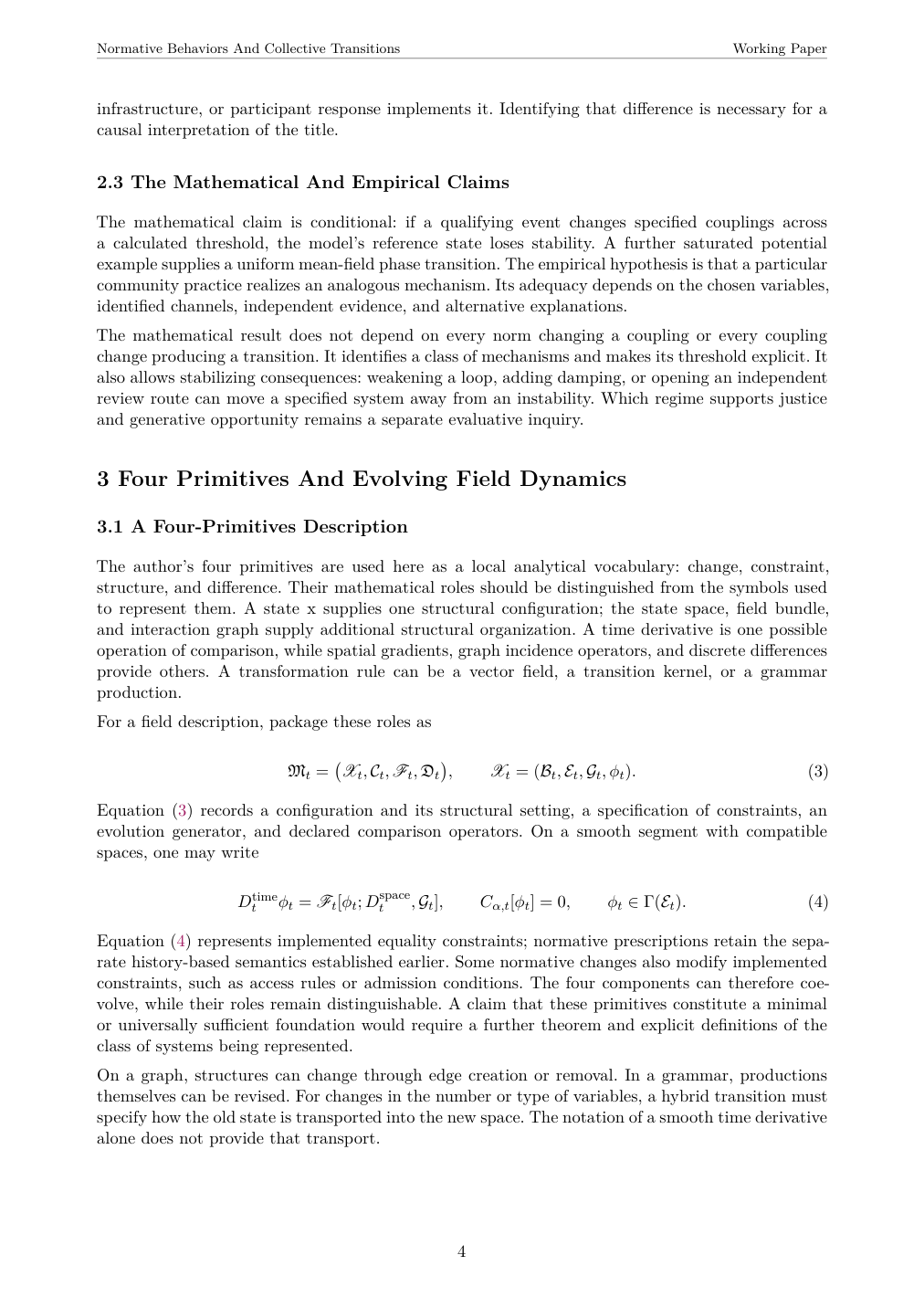
Let the modeled state contain subject fields phi, institutional state d, interaction graph G, coupling fields g, and environmental conditions eta. A discrete causal schedule can be written
Equation (2) separates normative update, realization of a coupling change, evolution, and observa- tion. The variables U represent declared exogenous inputs or disturbances. Including e directly in the evolution law allows a message or physical act to have an effect independently of its institution- al admission. Feedback can occur across successive events without making the within-step causal schedule ambiguous. Hybrid-system methods supply established tools for combining discrete events
A counterfactual comparison holds the declared background and initial state fixed while changing a specified intervention on the event or its admission. One then compares the induced coupling, generator, and outcome laws. Changing a normative qualification in an analyst’s annotation alone leaves the mechanism unchanged. An admitted ruling can have an effect if an actual procedure,
Readable text
infrastructure, or participant response implements it. Identifying that difference is necessary for a
The mathematical claim is conditional: if a qualifying event changes specified couplings across a calculated threshold, the model’s reference state loses stability. A further saturated potential example supplies a uniform mean-field phase transition. The empirical hypothesis is that a particular community practice realizes an analogous mechanism. Its adequacy depends on the chosen variables, identified channels, independent evidence, and alternative explanations.
The mathematical result does not depend on every norm changing a coupling or every coupling change producing a transition. It identifies a class of mechanisms and makes its threshold explicit. It also allows stabilizing consequences: weakening a loop, adding damping, or opening an independent review route can move a specified system away from an instability. Which regime supports justice and generative opportunity remains a separate evaluative inquiry.
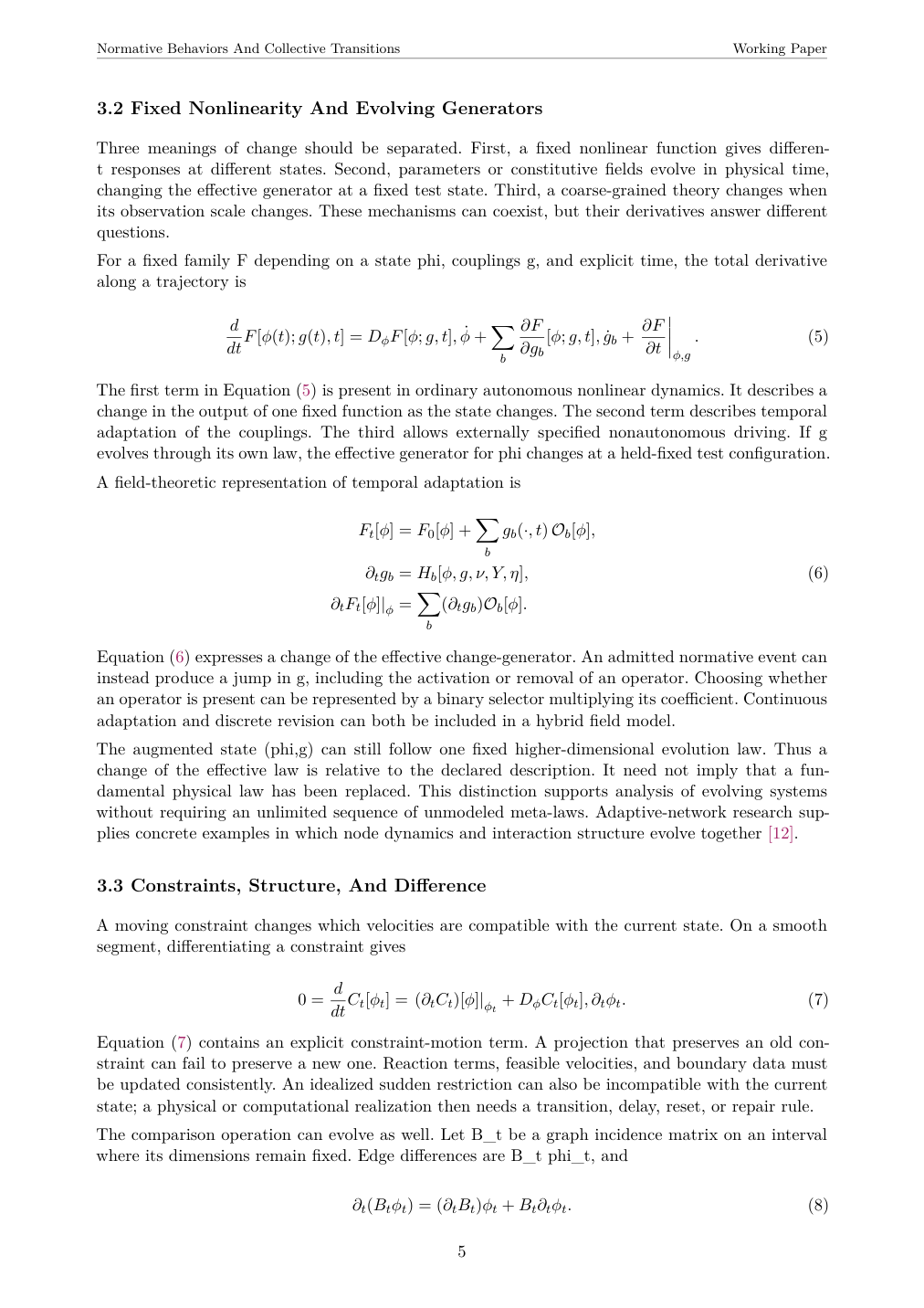
The author’s four primitives are used here as a local analytical vocabulary: change, constraint, structure, and difference. Their mathematical roles should be distinguished from the symbols used to represent them. A state x supplies one structural configuration; the state space, field bundle, and interaction graph supply additional structural organization. A time derivative is one possible operation of comparison, while spatial gradients, graph incidence operators, and discrete differences provide others. A transformation rule can be a vector field, a transition kernel, or a grammar
Equation (3) records a configuration and its structural setting, a specification of constraints, an evolution generator, and declared comparison operators. On a smooth segment with compatible
Equation (4) represents implemented equality constraints; normative prescriptions retain the sepa- rate history-based semantics established earlier. Some normative changes also modify implemented constraints, such as access rules or admission conditions. The four components can therefore coe- volve, while their roles remain distinguishable. A claim that these primitives constitute a minimal or universally sufficient foundation would require a further theorem and explicit definitions of the
On a graph, structures can change through edge creation or removal. In a grammar, productions themselves can be revised. For changes in the number or type of variables, a hybrid transition must specify how the old state is transported into the new space. The notation of a smooth time derivative
Readable text
Three meanings of change should be separated. First, a fixed nonlinear function gives differen- t responses at different states. Second, parameters or constitutive fields evolve in physical time, changing the effective generator at a fixed test state. Third, a coarse-grained theory changes when its observation scale changes. These mechanisms can coexist, but their derivatives answer different
For a fixed family F depending on a state phi, couplings g, and explicit time, the total derivative
The first term in Equation (5) is present in ordinary autonomous nonlinear dynamics. It describes a change in the output of one fixed function as the state changes. The second term describes temporal adaptation of the couplings. The third allows externally specified nonautonomous driving. If g evolves through its own law, the effective generator for phi changes at a held-fixed test configuration.
A field-theoretic representation of temporal adaptation is
Equation (6) expresses a change of the effective change-generator. An admitted normative event can instead produce a jump in g, including the activation or removal of an operator. Choosing whether an operator is present can be represented by a binary selector multiplying its coefficient. Continuous adaptation and discrete revision can both be included in a hybrid field model.
The augmented state (phi,g) can still follow one fixed higher-dimensional evolution law. Thus a change of the effective law is relative to the declared description. It need not imply that a fun- damental physical law has been replaced. This distinction supports analysis of evolving systems without requiring an unlimited sequence of unmodeled meta-laws. Adaptive-network research sup- plies concrete examples in which node dynamics and interaction structure evolve together [12].
A moving constraint changes which velocities are compatible with the current state. On a smooth
Equation (7) contains an explicit constraint-motion term. A projection that preserves an old con- straint can fail to preserve a new one. Reaction terms, feasible velocities, and boundary data must be updated consistently. An idealized sudden restriction can also be incompatible with the current state; a physical or computational realization then needs a transition, delay, reset, or repair rule.
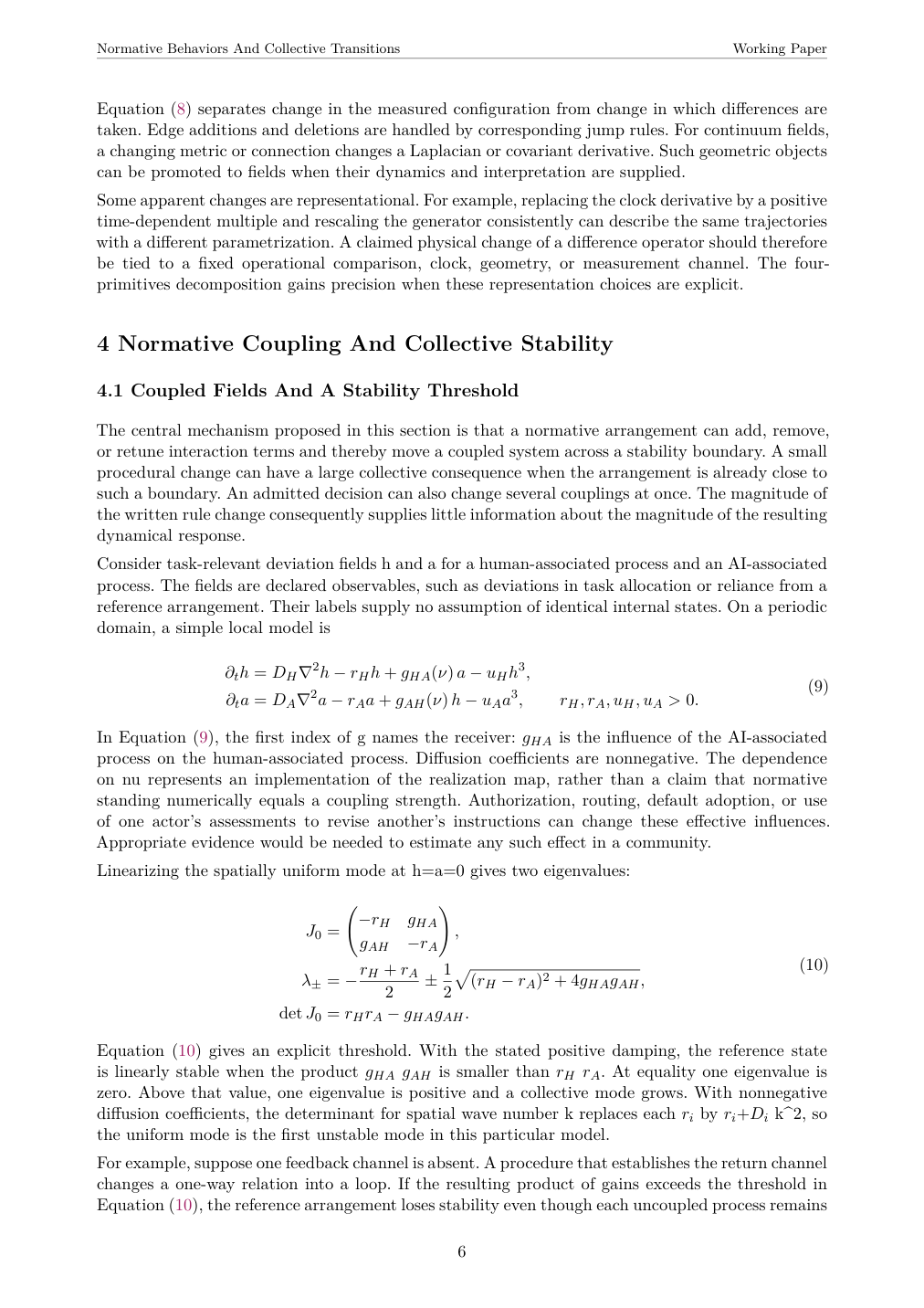
The comparison operation can evolve as well. Let B_t be a graph incidence matrix on an interval where its dimensions remain fixed. Edge differences are B_t phi_t, and
Readable text
Equation (8) separates change in the measured configuration from change in which differences are taken. Edge additions and deletions are handled by corresponding jump rules. For continuum fields, a changing metric or connection changes a Laplacian or covariant derivative. Such geometric objects can be promoted to fields when their dynamics and interpretation are supplied.
Some apparent changes are representational. For example, replacing the clock derivative by a positive time-dependent multiple and rescaling the generator consistently can describe the same trajectories with a different parametrization. A claimed physical change of a difference operator should therefore be tied to a fixed operational comparison, clock, geometry, or measurement channel. The four- primitives decomposition gains precision when these representation choices are explicit.
The central mechanism proposed in this section is that a normative arrangement can add, remove, or retune interaction terms and thereby move a coupled system across a stability boundary. A small procedural change can have a large collective consequence when the arrangement is already close to such a boundary. An admitted decision can also change several couplings at once. The magnitude of the written rule change consequently supplies little information about the magnitude of the resulting
Consider task-relevant deviation fields h and a for a human-associated process and an AI-associated process. The fields are declared observables, such as deviations in task allocation or reliance from a reference arrangement. Their labels supply no assumption of identical internal states. On a periodic
process on the human-associated process. Diffusion coefficients are nonnegative. The dependence on nu represents an implementation of the realization map, rather than a claim that normative standing numerically equals a coupling strength. Authorization, routing, default adoption, or use of one actor’s assessments to revise another’s instructions can change these effective influences. Appropriate evidence would be needed to estimate any such effect in a community.
Linearizing the spatially uniform mode at h=a=0 gives two eigenvalues:
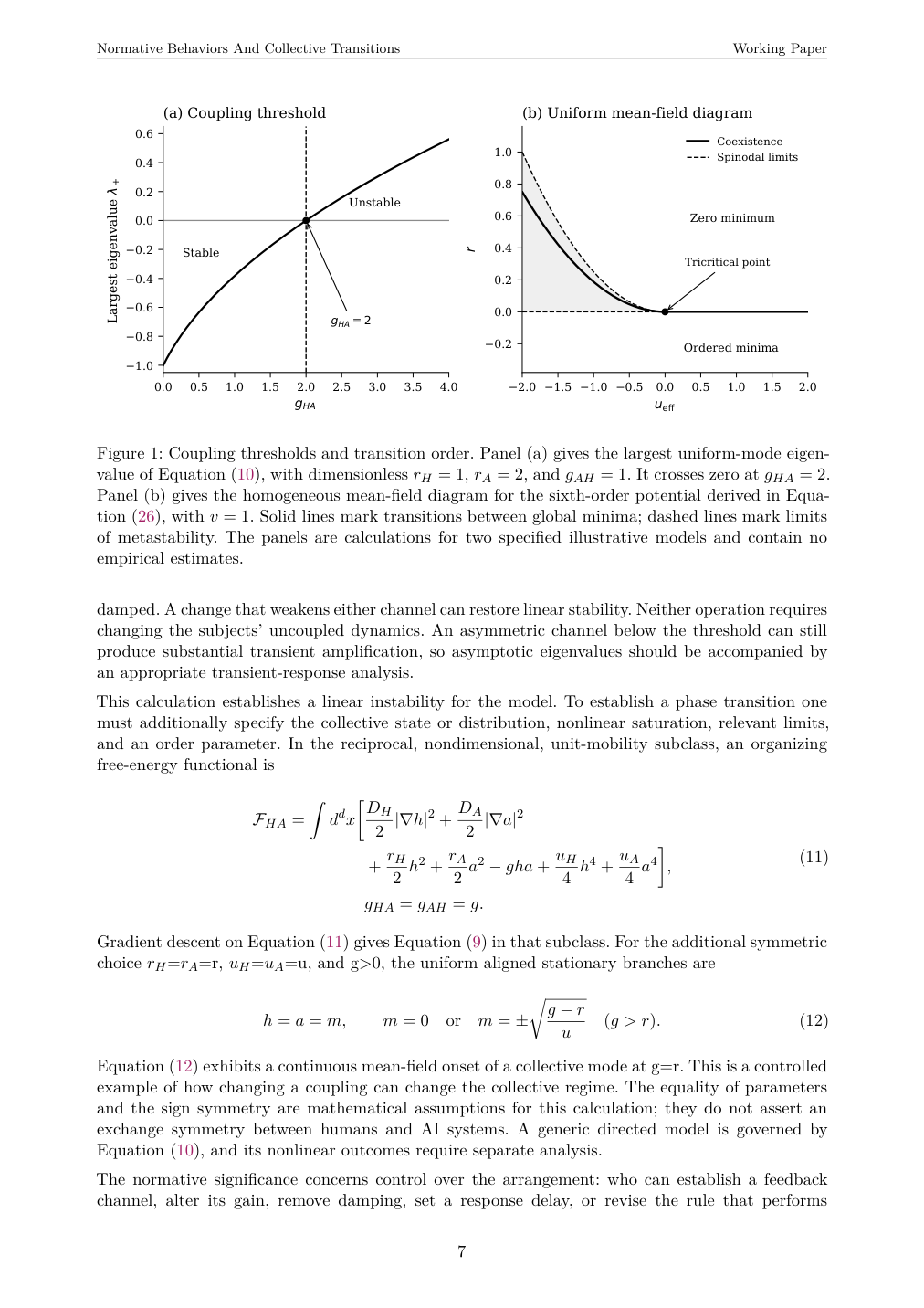
Equation (10) gives an explicit threshold. With the stated positive damping, the reference state zero. Above that value, one eigenvalue is positive and a collective mode grows. With nonnegative the uniform mode is the first unstable mode in this particular model.
For example, suppose one feedback channel is absent. A procedure that establishes the return channel changes a one-way relation into a loop. If the resulting product of gains exceeds the threshold in Equation (10), the reference arrangement loses stability even though each uncoupled process remains
Readable text
Figure 1: Coupling thresholds and transition order. Panel (a) gives the largest uniform-mode eigen- Panel (b) gives the homogeneous mean-field diagram for the sixth-order potential derived in Equa- of metastability. The panels are calculations for two specified illustrative models and contain no
damped. A change that weakens either channel can restore linear stability. Neither operation requires changing the subjects’ uncoupled dynamics. An asymmetric channel below the threshold can still produce substantial transient amplification, so asymptotic eigenvalues should be accompanied by
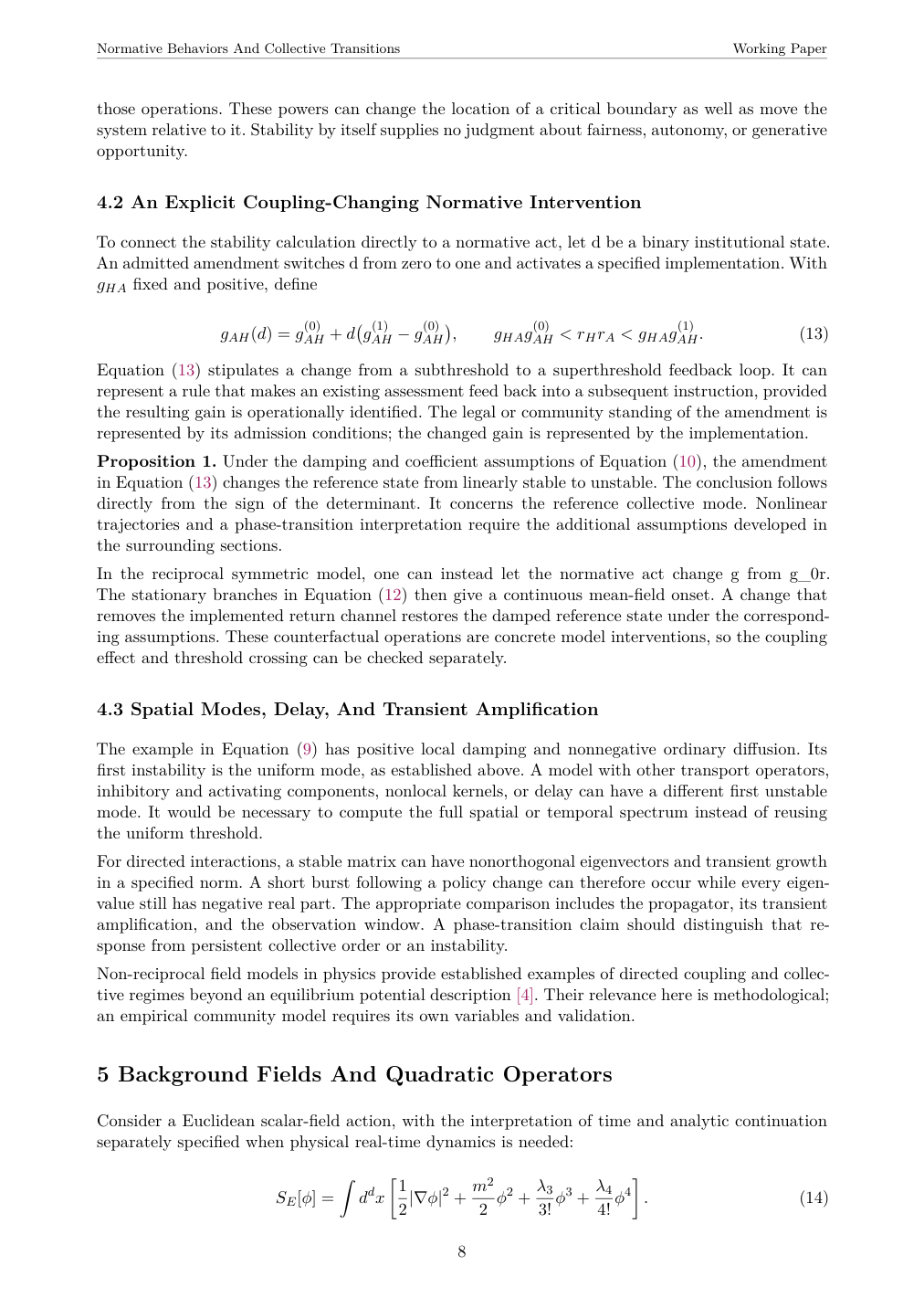
This calculation establishes a linear instability for the model. To establish a phase transition one must additionally specify the collective state or distribution, nonlinear saturation, relevant limits, and an order parameter. In the reciprocal, nondimensional, unit-mobility subclass, an organizing
Gradient descent on Equation (11) gives Equation (9) in that subclass. For the additional symmetric
Equation (12) exhibits a continuous mean-field onset of a collective mode at g=r. This is a controlled example of how changing a coupling can change the collective regime. The equality of parameters and the sign symmetry are mathematical assumptions for this calculation; they do not assert an exchange symmetry between humans and AI systems. A generic directed model is governed by Equation (10), and its nonlinear outcomes require separate analysis.
The normative significance concerns control over the arrangement: who can establish a feedback channel, alter its gain, remove damping, set a response delay, or revise the rule that performs
Readable text
those operations. These powers can change the location of a critical boundary as well as move the system relative to it. Stability by itself supplies no judgment about fairness, autonomy, or generative
4.2 An Explicit Coupling-Changing Normative Intervention
To connect the stability calculation directly to a normative act, let d be a binary institutional state. An admitted amendment switches d from zero to one and activates a specified implementation. With
Equation (13) stipulates a change from a subthreshold to a superthreshold feedback loop. It can represent a rule that makes an existing assessment feed back into a subsequent instruction, provided the resulting gain is operationally identified. The legal or community standing of the amendment is represented by its admission conditions; the changed gain is represented by the implementation.
Proposition 1. Under the damping and coefficient assumptions of Equation (10), the amendment in Equation (13) changes the reference state from linearly stable to unstable. The conclusion follows directly from the sign of the determinant. It concerns the reference collective mode. Nonlinear trajectories and a phase-transition interpretation require the additional assumptions developed in
In the reciprocal symmetric model, one can instead let the normative act change g from g_0r. The stationary branches in Equation (12) then give a continuous mean-field onset. A change that removes the implemented return channel restores the damped reference state under the correspond- ing assumptions. These counterfactual operations are concrete model interventions, so the coupling effect and threshold crossing can be checked separately.
The example in Equation (9) has positive local damping and nonnegative ordinary diffusion. Its first instability is the uniform mode, as established above. A model with other transport operators, inhibitory and activating components, nonlocal kernels, or delay can have a different first unstable mode. It would be necessary to compute the full spatial or temporal spectrum instead of reusing
For directed interactions, a stable matrix can have nonorthogonal eigenvectors and transient growth in a specified norm. A short burst following a policy change can therefore occur while every eigen- value still has negative real part. The appropriate comparison includes the propagator, its transient amplification, and the observation window. A phase-transition claim should distinguish that re- sponse from persistent collective order or an instability.
Non-reciprocal field models in physics provide established examples of directed coupling and collec- tive regimes beyond an equilibrium potential description [4]. Their relevance here is methodological; an empirical community model requires its own variables and validation.
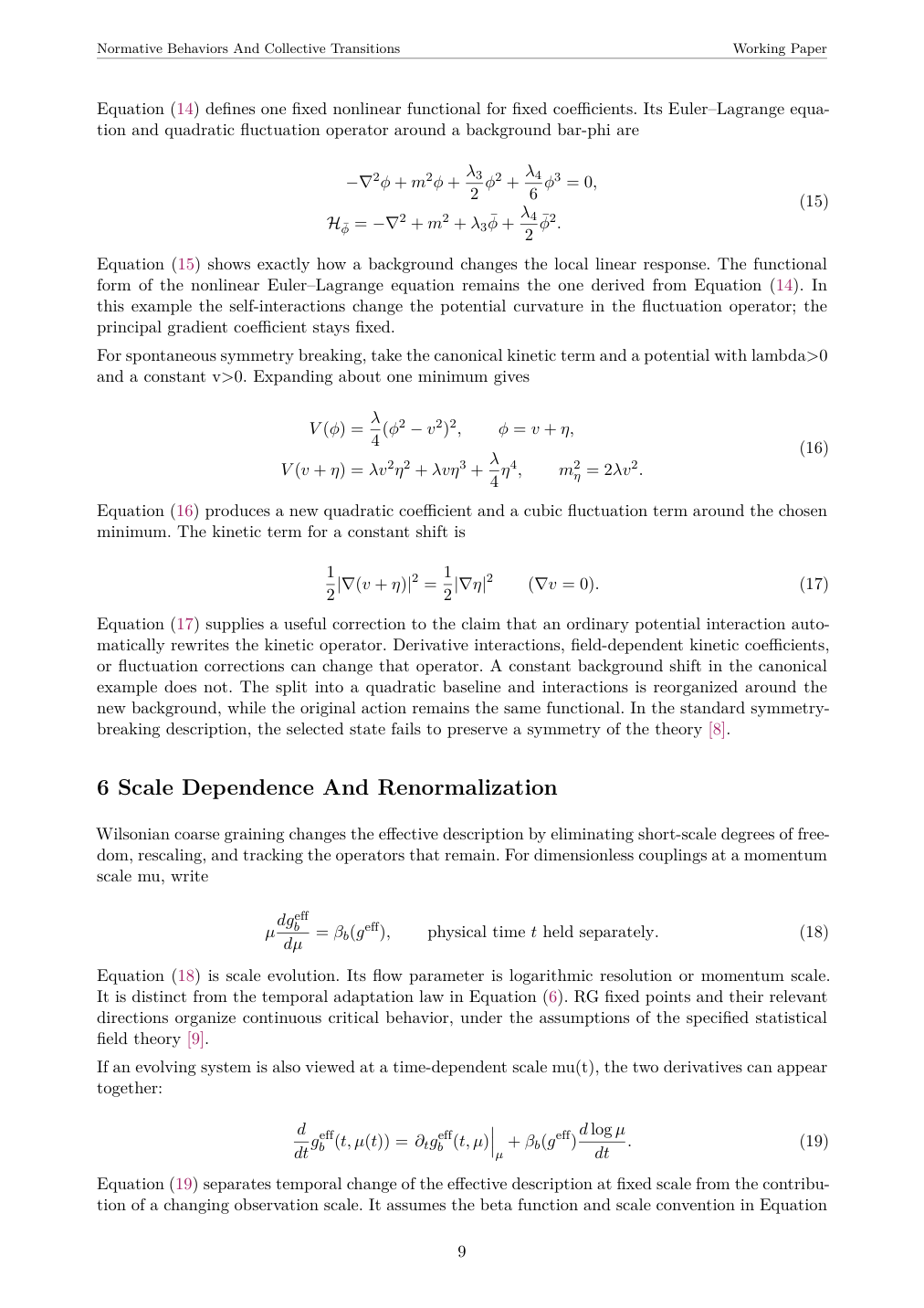
Consider a Euclidean scalar-field action, with the interpretation of time and analytic continuation separately specified when physical real-time dynamics is needed:
Readable text
Equation (14) defines one fixed nonlinear functional for fixed coefficients. Its Euler–Lagrange equa- tion and quadratic fluctuation operator around a background bar-phi are
Equation (15) shows exactly how a background changes the local linear response. The functional form of the nonlinear Euler–Lagrange equation remains the one derived from Equation (14). In this example the self-interactions change the potential curvature in the fluctuation operator; the
For spontaneous symmetry breaking, take the canonical kinetic term and a potential with lambda>0 and a constant v>0. Expanding about one minimum gives
Equation (16) produces a new quadratic coefficient and a cubic fluctuation term around the chosen
Equation (17) supplies a useful correction to the claim that an ordinary potential interaction auto- matically rewrites the kinetic operator. Derivative interactions, field-dependent kinetic coefficients, or fluctuation corrections can change that operator. A constant background shift in the canonical example does not. The split into a quadratic baseline and interactions is reorganized around the new background, while the original action remains the same functional. In the standard symmetry- breaking description, the selected state fails to preserve a symmetry of the theory [8].
Wilsonian coarse graining changes the effective description by eliminating short-scale degrees of free-
dom, rescaling, and tracking the operators that remain. For dimensionless couplings at a momentum
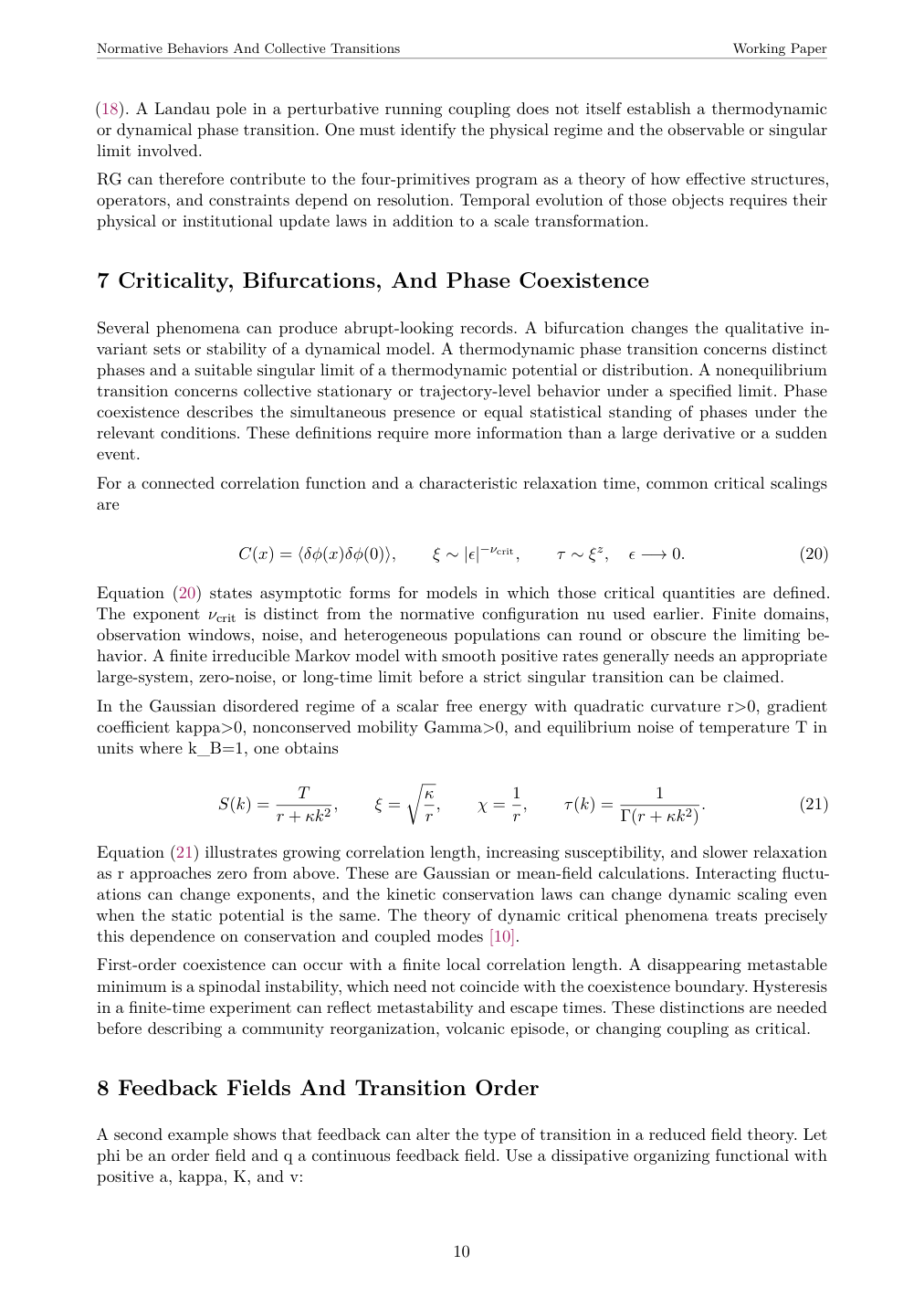
Equation (18) is scale evolution. Its flow parameter is logarithmic resolution or momentum scale. It is distinct from the temporal adaptation law in Equation (6). RG fixed points and their relevant directions organize continuous critical behavior, under the assumptions of the specified statistical
If an evolving system is also viewed at a time-dependent scale mu(t), the two derivatives can appear
Equation (19) separates temporal change of the effective description at fixed scale from the contribu- tion of a changing observation scale. It assumes the beta function and scale convention in Equation
Readable text
(18). A Landau pole in a perturbative running coupling does not itself establish a thermodynamic
or dynamical phase transition. One must identify the physical regime and the observable or singular
RG can therefore contribute to the four-primitives program as a theory of how effective structures, operators, and constraints depend on resolution. Temporal evolution of those objects requires their physical or institutional update laws in addition to a scale transformation.
Several phenomena can produce abrupt-looking records. A bifurcation changes the qualitative in- variant sets or stability of a dynamical model. A thermodynamic phase transition concerns distinct phases and a suitable singular limit of a thermodynamic potential or distribution. A nonequilibrium transition concerns collective stationary or trajectory-level behavior under a specified limit. Phase coexistence describes the simultaneous presence or equal statistical standing of phases under the relevant conditions. These definitions require more information than a large derivative or a sudden
For a connected correlation function and a characteristic relaxation time, common critical scalings
Equation (20) states asymptotic forms for models in which those critical quantities are defined. observation windows, noise, and heterogeneous populations can round or obscure the limiting be- havior. A finite irreducible Markov model with smooth positive rates generally needs an appropriate large-system, zero-noise, or long-time limit before a strict singular transition can be claimed.
In the Gaussian disordered regime of a scalar free energy with quadratic curvature r>0, gradient coefficient kappa>0, nonconserved mobility Gamma>0, and equilibrium noise of temperature T in
Equation (21) illustrates growing correlation length, increasing susceptibility, and slower relaxation as r approaches zero from above. These are Gaussian or mean-field calculations. Interacting fluctu- ations can change exponents, and the kinetic conservation laws can change dynamic scaling even when the static potential is the same. The theory of dynamic critical phenomena treats precisely this dependence on conservation and coupled modes [10].
First-order coexistence can occur with a finite local correlation length. A disappearing metastable minimum is a spinodal instability, which need not coincide with the coexistence boundary. Hysteresis in a finite-time experiment can reflect metastability and escape times. These distinctions are needed before describing a community reorganization, volcanic episode, or changing coupling as critical.
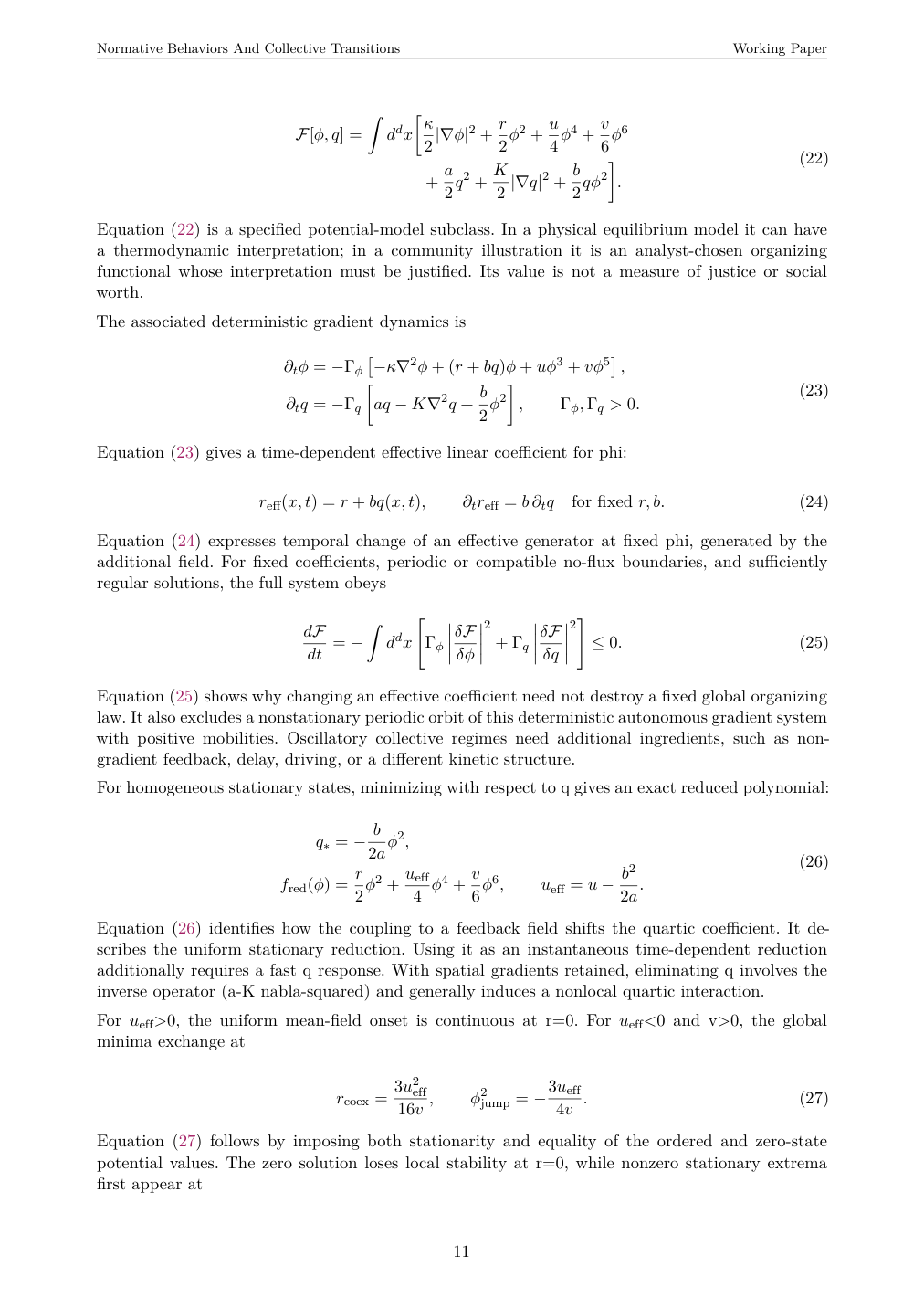
A second example shows that feedback can alter the type of transition in a reduced field theory. Let phi be an order field and q a continuous feedback field. Use a dissipative organizing functional with
Readable text
Equation (22) is a specified potential-model subclass. In a physical equilibrium model it can have a thermodynamic interpretation; in a community illustration it is an analyst-chosen organizing functional whose interpretation must be justified. Its value is not a measure of justice or social
Equation (23) gives a time-dependent effective linear coefficient for phi:
Equation (24) expresses temporal change of an effective generator at fixed phi, generated by the additional field. For fixed coefficients, periodic or compatible no-flux boundaries, and sufficiently
Equation (25) shows why changing an effective coefficient need not destroy a fixed global organizing law. It also excludes a nonstationary periodic orbit of this deterministic autonomous gradient system with positive mobilities. Oscillatory collective regimes need additional ingredients, such as non- gradient feedback, delay, driving, or a different kinetic structure.
For homogeneous stationary states, minimizing with respect to q gives an exact reduced polynomial:
Equation (26) identifies how the coupling to a feedback field shifts the quartic coefficient. It de- scribes the uniform stationary reduction. Using it as an instantaneous time-dependent reduction additionally requires a fast q response. With spatial gradients retained, eliminating q involves the inverse operator (a-K nabla-squared) and generally induces a nonlocal quartic interaction.
Equation (27) follows by imposing both stationarity and equality of the ordered and zero-state potential values. The zero solution loses local stability at r=0, while nonzero stationary extrema
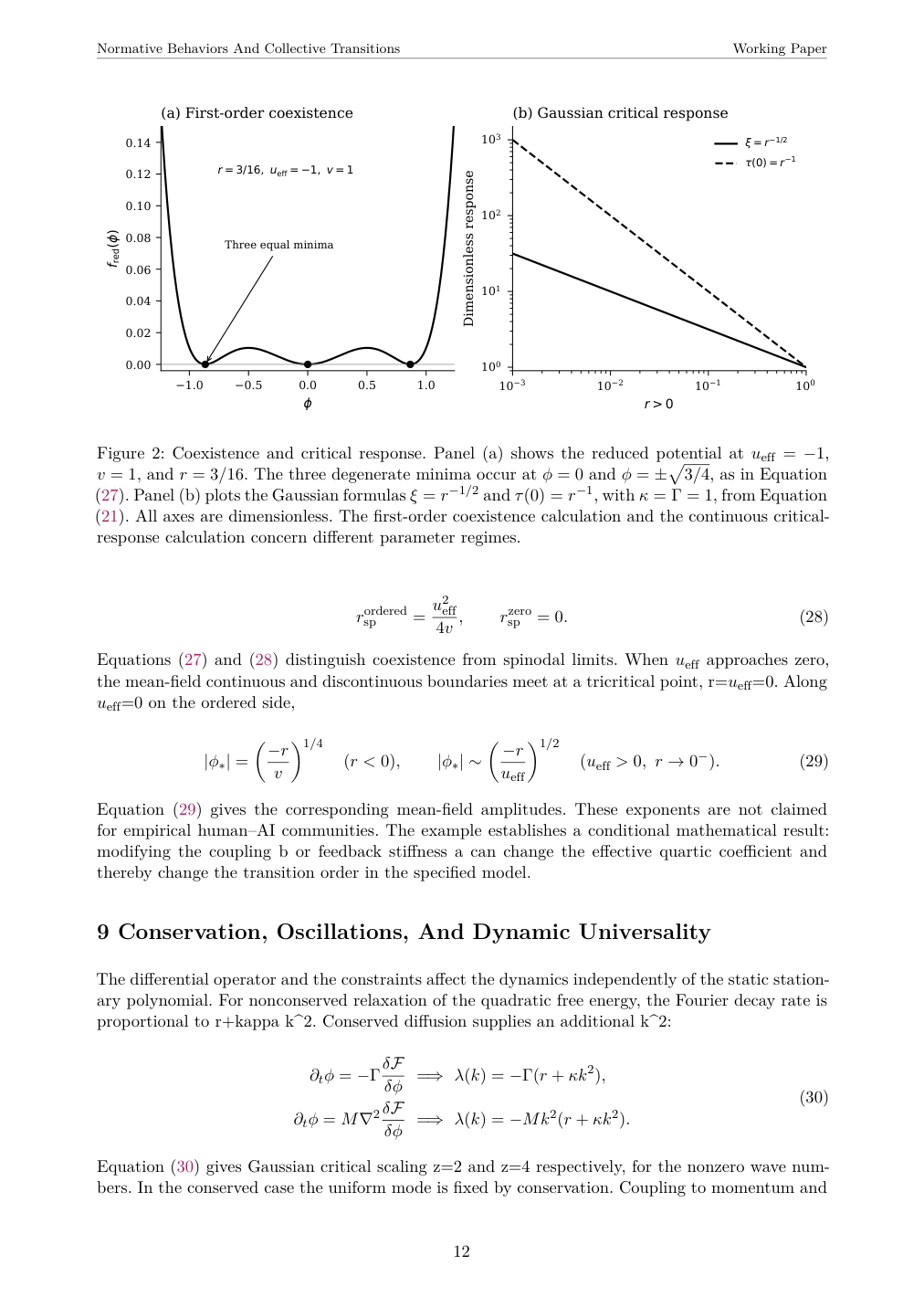
Readable text
(21). All axes are dimensionless. The first-order coexistence calculation and the continuous critical-
response calculation concern different parameter regimes.
Equation (29) gives the corresponding mean-field amplitudes. These exponents are not claimed for empirical human–AI communities. The example establishes a conditional mathematical result: modifying the coupling b or feedback stiffness a can change the effective quartic coefficient and thereby change the transition order in the specified model.
9 Conservation, Oscillations, And Dynamic Universality
The differential operator and the constraints affect the dynamics independently of the static station- ary polynomial. For nonconserved relaxation of the quadratic free energy, the Fourier decay rate is proportional to r+kappa k^2. Conserved diffusion supplies an additional k^2:
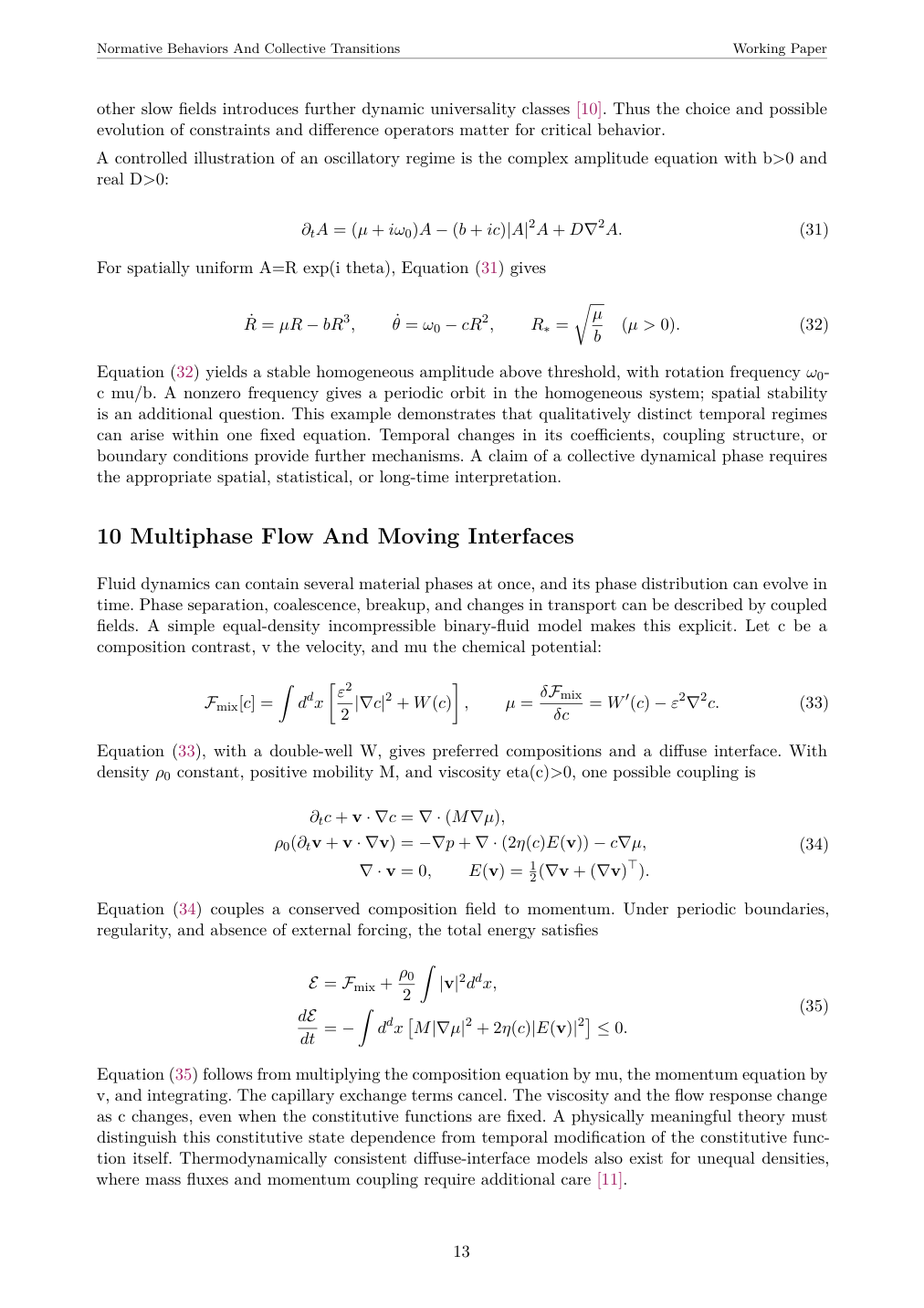
Equation (30) gives Gaussian critical scaling z=2 and z=4 respectively, for the nonzero wave num- bers. In the conserved case the uniform mode is fixed by conservation. Coupling to momentum and
Readable text
other slow fields introduces further dynamic universality classes [10]. Thus the choice and possible evolution of constraints and difference operators matter for critical behavior.
A controlled illustration of an oscillatory regime is the complex amplitude equation with b>0 and
c mu/b. A nonzero frequency gives a periodic orbit in the homogeneous system; spatial stability is an additional question. This example demonstrates that qualitatively distinct temporal regimes can arise within one fixed equation. Temporal changes in its coefficients, coupling structure, or boundary conditions provide further mechanisms. A claim of a collective dynamical phase requires the appropriate spatial, statistical, or long-time interpretation.
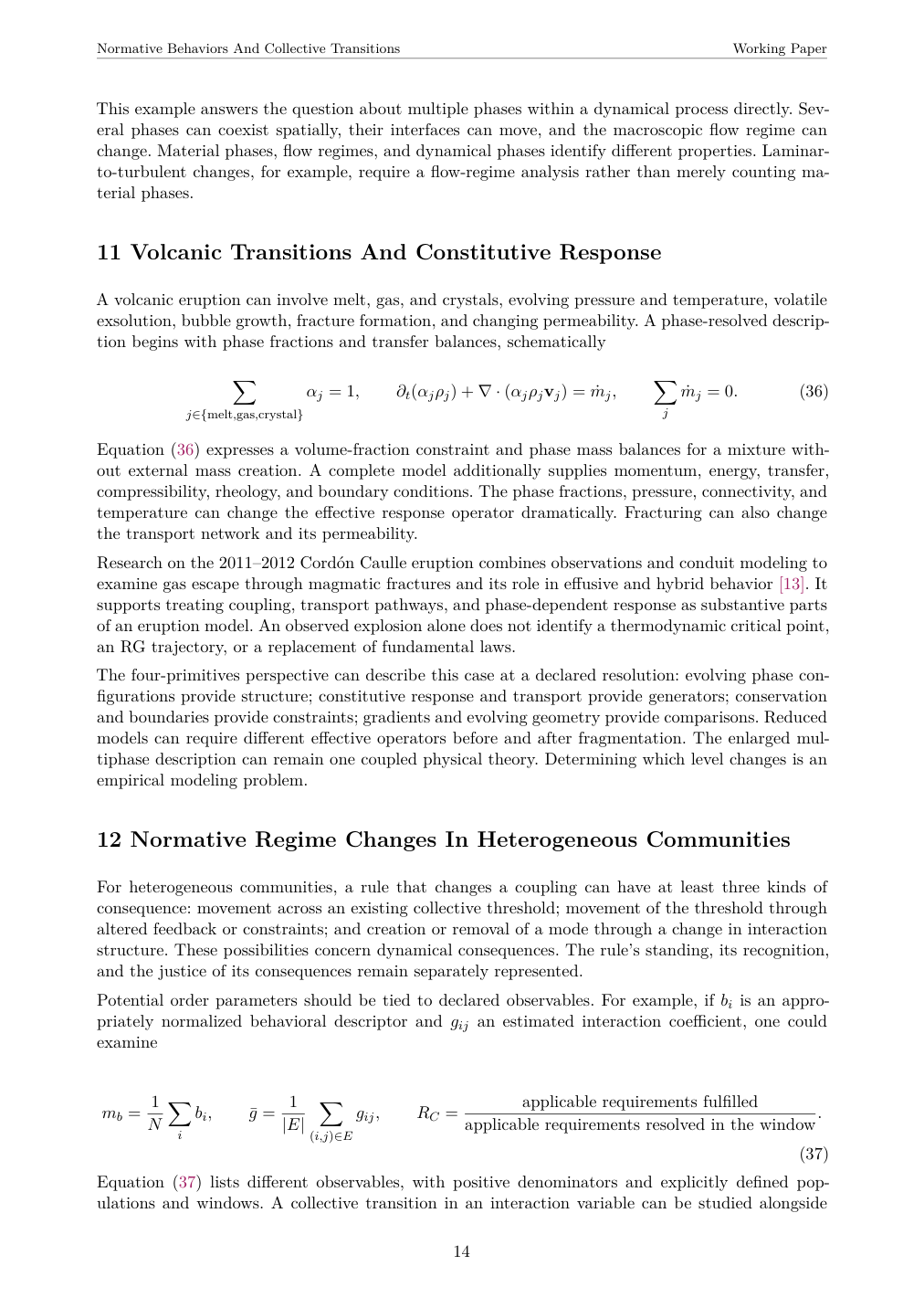
Fluid dynamics can contain several material phases at once, and its phase distribution can evolve in time. Phase separation, coalescence, breakup, and changes in transport can be described by coupled fields. A simple equal-density incompressible binary-fluid model makes this explicit. Let c be a composition contrast, v the velocity, and mu the chemical potential:
Equation (33), with a double-well W, gives preferred compositions and a diffuse interface. With
Equation (34) couples a conserved composition field to momentum. Under periodic boundaries, regularity, and absence of external forcing, the total energy satisfies
Equation (35) follows from multiplying the composition equation by mu, the momentum equation by v, and integrating. The capillary exchange terms cancel. The viscosity and the flow response change as c changes, even when the constitutive functions are fixed. A physically meaningful theory must distinguish this constitutive state dependence from temporal modification of the constitutive func- tion itself. Thermodynamically consistent diffuse-interface models also exist for unequal densities, where mass fluxes and momentum coupling require additional care [11].
Readable text
This example answers the question about multiple phases within a dynamical process directly. Sev- eral phases can coexist spatially, their interfaces can move, and the macroscopic flow regime can change. Material phases, flow regimes, and dynamical phases identify different properties. Laminar- to-turbulent changes, for example, require a flow-regime analysis rather than merely counting ma-
A volcanic eruption can involve melt, gas, and crystals, evolving pressure and temperature, volatile exsolution, bubble growth, fracture formation, and changing permeability. A phase-resolved descrip- tion begins with phase fractions and transfer balances, schematically
Equation (36) expresses a volume-fraction constraint and phase mass balances for a mixture with- out external mass creation. A complete model additionally supplies momentum, energy, transfer, compressibility, rheology, and boundary conditions. The phase fractions, pressure, connectivity, and temperature can change the effective response operator dramatically. Fracturing can also change
Research on the 2011–2012 Cordón Caulle eruption combines observations and conduit modeling to examine gas escape through magmatic fractures and its role in effusive and hybrid behavior [13]. It supports treating coupling, transport pathways, and phase-dependent response as substantive parts of an eruption model. An observed explosion alone does not identify a thermodynamic critical point, an RG trajectory, or a replacement of fundamental laws.
The four-primitives perspective can describe this case at a declared resolution: evolving phase con- figurations provide structure; constitutive response and transport provide generators; conservation and boundaries provide constraints; gradients and evolving geometry provide comparisons. Reduced models can require different effective operators before and after fragmentation. The enlarged mul- tiphase description can remain one coupled physical theory. Determining which level changes is an
12 Normative Regime Changes In Heterogeneous Communities
For heterogeneous communities, a rule that changes a coupling can have at least three kinds of consequence: movement across an existing collective threshold; movement of the threshold through altered feedback or constraints; and creation or removal of a mode through a change in interaction structure. These possibilities concern dynamical consequences. The rule’s standing, its recognition, and the justice of its consequences remain separately represented.
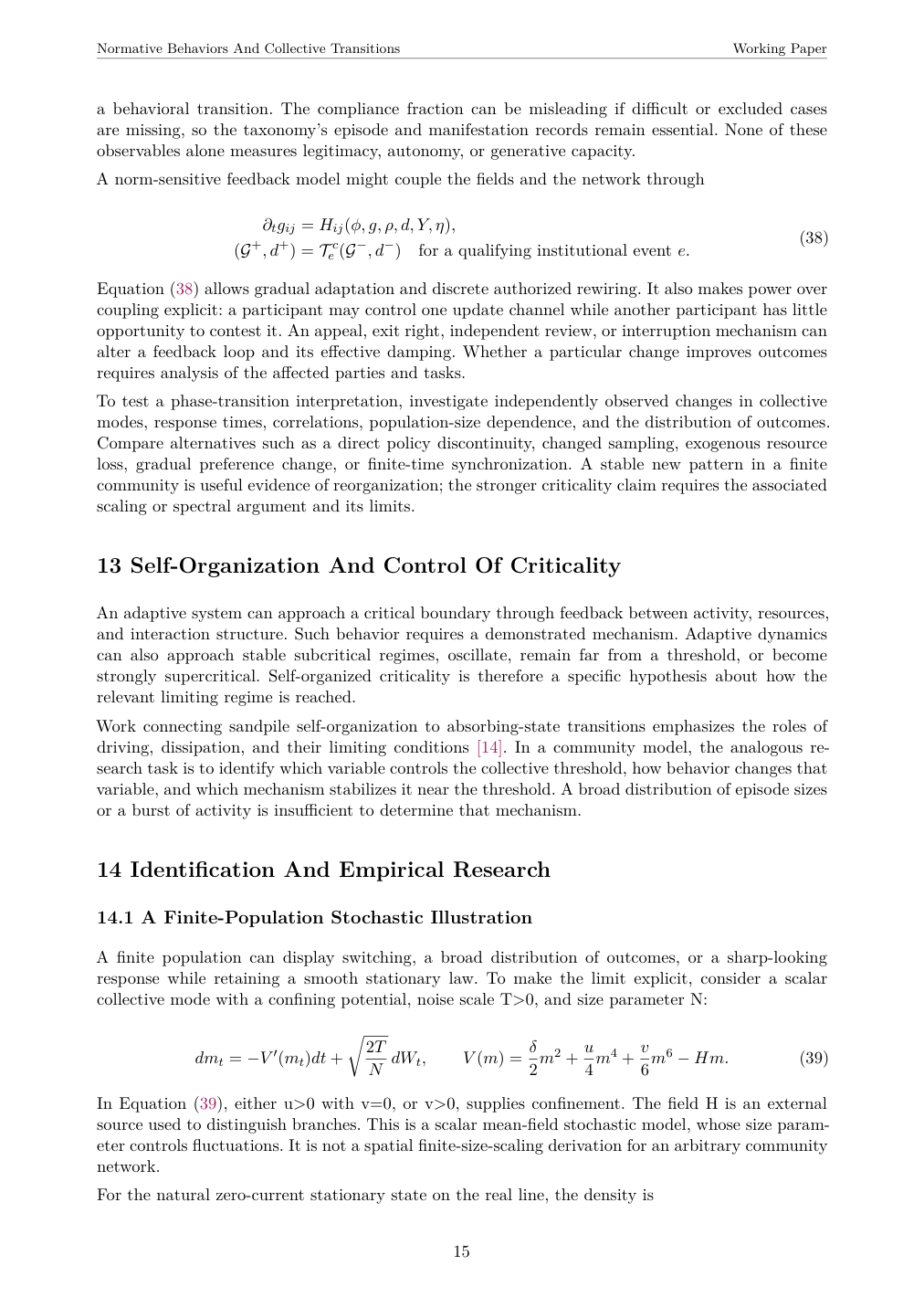
Equation (37) lists different observables, with positive denominators and explicitly defined pop- ulations and windows. A collective transition in an interaction variable can be studied alongside
Readable text
a behavioral transition. The compliance fraction can be misleading if difficult or excluded cases are missing, so the taxonomy’s episode and manifestation records remain essential. None of these observables alone measures legitimacy, autonomy, or generative capacity.
A norm-sensitive feedback model might couple the fields and the network through
Equation (38) allows gradual adaptation and discrete authorized rewiring. It also makes power over coupling explicit: a participant may control one update channel while another participant has little opportunity to contest it. An appeal, exit right, independent review, or interruption mechanism can alter a feedback loop and its effective damping. Whether a particular change improves outcomes
To test a phase-transition interpretation, investigate independently observed changes in collective modes, response times, correlations, population-size dependence, and the distribution of outcomes. Compare alternatives such as a direct policy discontinuity, changed sampling, exogenous resource loss, gradual preference change, or finite-time synchronization. A stable new pattern in a finite community is useful evidence of reorganization; the stronger criticality claim requires the associated
An adaptive system can approach a critical boundary through feedback between activity, resources, and interaction structure. Such behavior requires a demonstrated mechanism. Adaptive dynamics can also approach stable subcritical regimes, oscillate, remain far from a threshold, or become strongly supercritical. Self-organized criticality is therefore a specific hypothesis about how the
Work connecting sandpile self-organization to absorbing-state transitions emphasizes the roles of
driving, dissipation, and their limiting conditions [14]. In a community model, the analogous re- search task is to identify which variable controls the collective threshold, how behavior changes that variable, and which mechanism stabilizes it near the threshold. A broad distribution of episode sizes or a burst of activity is insufficient to determine that mechanism.
A finite population can display switching, a broad distribution of outcomes, or a sharp-looking response while retaining a smooth stationary law. To make the limit explicit, consider a scalar collective mode with a confining potential, noise scale T>0, and size parameter N:
In Equation (39), either u>0 with v=0, or v>0, supplies confinement. The field H is an external source used to distinguish branches. This is a scalar mean-field stochastic model, whose size param- eter controls fluctuations. It is not a spatial finite-size-scaling derivation for an arbitrary community
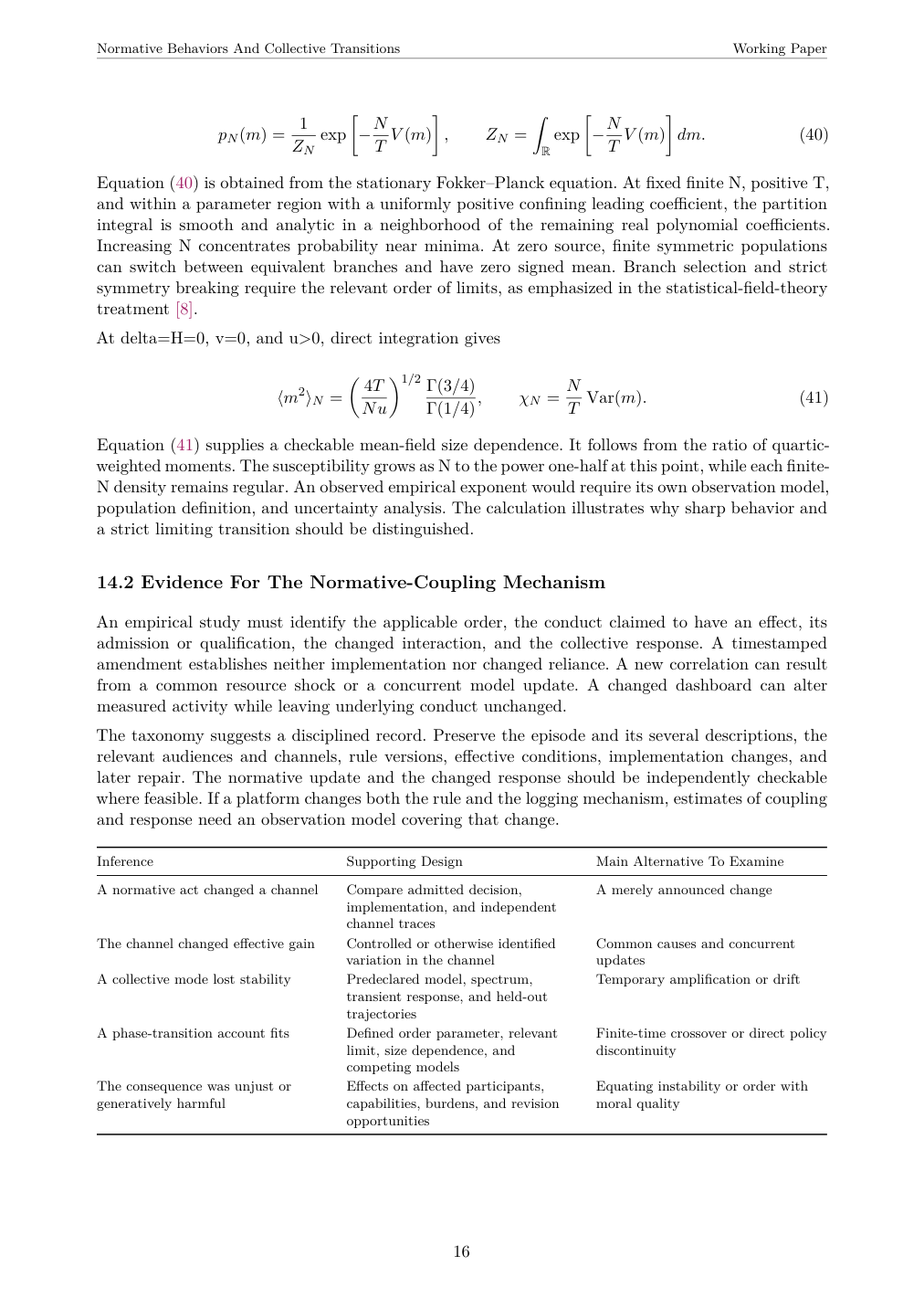
For the natural zero-current stationary state on the real line, the density is
Readable text
Equation (40) is obtained from the stationary Fokker–Planck equation. At fixed finite N, positive T, and within a parameter region with a uniformly positive confining leading coefficient, the partition integral is smooth and analytic in a neighborhood of the remaining real polynomial coefficients. Increasing N concentrates probability near minima. At zero source, finite symmetric populations can switch between equivalent branches and have zero signed mean. Branch selection and strict symmetry breaking require the relevant order of limits, as emphasized in the statistical-field-theory
Equation (41) supplies a checkable mean-field size dependence. It follows from the ratio of quartic- weighted moments. The susceptibility grows as N to the power one-half at this point, while each finite- N density remains regular. An observed empirical exponent would require its own observation model, population definition, and uncertainty analysis. The calculation illustrates why sharp behavior and
a strict limiting transition should be distinguished.
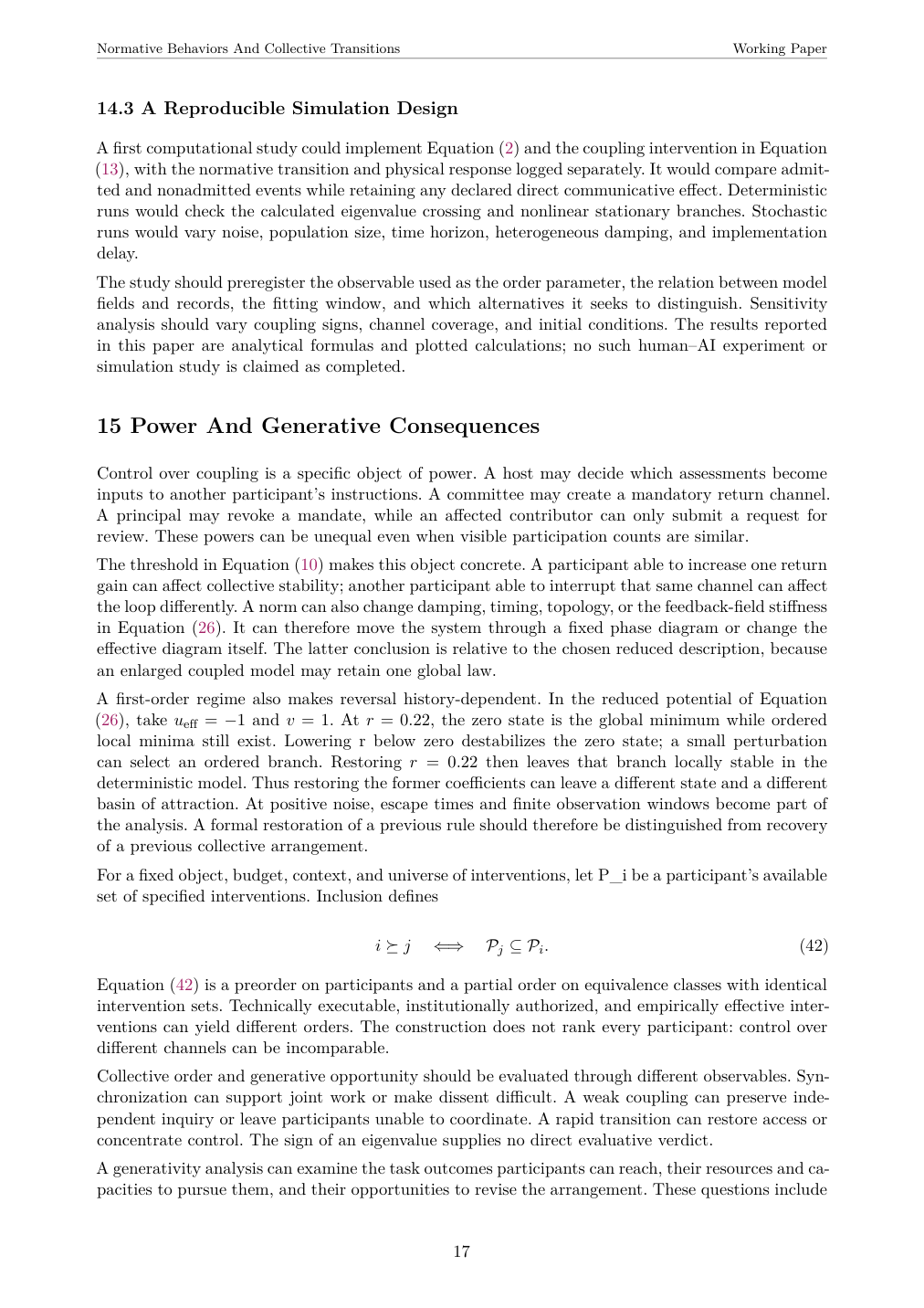
An empirical study must identify the applicable order, the conduct claimed to have an effect, its admission or qualification, the changed interaction, and the collective response. A timestamped amendment establishes neither implementation nor changed reliance. A new correlation can result from a common resource shock or a concurrent model update. A changed dashboard can alter measured activity while leaving underlying conduct unchanged.
The taxonomy suggests a disciplined record. Preserve the episode and its several descriptions, the relevant audiences and channels, rule versions, effective conditions, implementation changes, and later repair. The normative update and the changed response should be independently checkable where feasible. If a platform changes both the rule and the logging mechanism, estimates of coupling and response need an observation model covering that change.
Compare admitted decision, implementation, and independent
Controlled or otherwise identified variation in the channel
Predeclared model, spectrum, transient response, and held-out
Defined order parameter, relevant limit, size dependence, and
Finite-time crossover or direct policy discontinuity
Effects on affected participants, capabilities, burdens, and revision
Readable text
A first computational study could implement Equation (2) and the coupling intervention in Equation (13), with the normative transition and physical response logged separately. It would compare admit-
ted and nonadmitted events while retaining any declared direct communicative effect. Deterministic runs would check the calculated eigenvalue crossing and nonlinear stationary branches. Stochastic runs would vary noise, population size, time horizon, heterogeneous damping, and implementation
The study should preregister the observable used as the order parameter, the relation between model fields and records, the fitting window, and which alternatives it seeks to distinguish. Sensitivity analysis should vary coupling signs, channel coverage, and initial conditions. The results reported in this paper are analytical formulas and plotted calculations; no such human–AI experiment or
Control over coupling is a specific object of power. A host may decide which assessments become inputs to another participant’s instructions. A committee may create a mandatory return channel. A principal may revoke a mandate, while an affected contributor can only submit a request for review. These powers can be unequal even when visible participation counts are similar.
The threshold in Equation (10) makes this object concrete. A participant able to increase one return gain can affect collective stability; another participant able to interrupt that same channel can affect the loop differently. A norm can also change damping, timing, topology, or the feedback-field stiffness in Equation (26). It can therefore move the system through a fixed phase diagram or change the effective diagram itself. The latter conclusion is relative to the chosen reduced description, because an enlarged coupled model may retain one global law.
A first-order regime also makes reversal history-dependent. In the reduced potential of Equation
local minima still exist. Lowering r below zero destabilizes the zero state; a small perturbation deterministic model. Thus restoring the former coefficients can leave a different state and a different basin of attraction. At positive noise, escape times and finite observation windows become part of the analysis. A formal restoration of a previous rule should therefore be distinguished from recovery
For a fixed object, budget, context, and universe of interventions, let P_i be a participant’s available
Equation (42) is a preorder on participants and a partial order on equivalence classes with identical intervention sets. Technically executable, institutionally authorized, and empirically effective inter- ventions can yield different orders. The construction does not rank every participant: control over
Collective order and generative opportunity should be evaluated through different observables. Syn- chronization can support joint work or make dissent difficult. A weak coupling can preserve inde- pendent inquiry or leave participants unable to coordinate. A rapid transition can restore access or concentrate control. The sign of an eigenvalue supplies no direct evaluative verdict.
A generativity analysis can examine the task outcomes participants can reach, their resources and ca- pacities to pursue them, and their opportunities to revise the arrangement. These questions include
Normative Behaviors And Collective Transitions Working Paper
the cost of sustaining a norm, the burden of providing evidence, access to appeal, and the preservation of contributions across transitions. The five-level taxonomy helps distinguish a favorable official qualification from a participant’s actual opportunity to act or have a contribution recognized.
16 Discussion And Scope
The proposed contribution is a connection between an identified normative mechanism and explicit collective field dynamics. The mathematical results exhibit a causal possibility with stated assumptions: a qualifying act changes implemented couplings, the couplings cross a stability boundary, and the nonlinear or statistical model supplies the corresponding collective regimes. The framework also accommodates changes that remain within one regime.
The four-primitives description makes several kinds of evolution visible. A field configuration can change under a fixed law; coupling fields can alter an effective generator in physical time; constraints can change the feasible continuation; and evolving geometry can change the operators used to take differences. RG adds a separate dependence on scale. These are related mathematical operations with different meanings and different evidential requirements.
The phase-transition calculations use simple potential or amplitude models where the relevant quantities can be derived. General heterogeneous communities can contain nonreciprocal influence, symbolic actions, partial observation, changing membership, incompatible norms, and several temporal scales. Those features require an appropriate hybrid or stochastic extension. Their inclusion should preserve the distinction between normative standing and the mechanism that produces a dynamical effect.
Several findings would weaken a particular empirical application: no demonstrable coupling change after the normative act; a response accounted for by a concurrent external cause; a fitted threshold that fails on held-out histories; or apparent critical scaling that disappears under a suitable observation model. These are substantive tests of the mechanism. The present paper offers a framework and controlled examples for formulating them.
17 Conclusion
Normative behaviors can change relations through appointments, prescriptions, performance, breach responses, and revision. When their implemented effects alter interaction terms, they can change collective stability. The two-field example identifies an exact threshold for that mechanism, and the feedback-field calculation shows how coupling can change the order of a reduced mean-field transition. A study of society building can consequently examine who controls the couplings, how their effects propagate across scales and histories, and what evidence distinguishes a collective transition from other forms of reorganization.
Appendix A Mathematical Derivations
A.1 Stability And The Normative Intervention


Readable text
terms is nondecreasing with k-squared. Thus the uniform mode is the first unstable mode in this spe- cific diffusion model. This conclusion does not extend automatically to other transport or feedback
Varying Equation (11) with respect to h and a gives the reciprocal version of Equation (9). In the homogeneous symmetric case, stationarity at h=a=m gives (r-g)m+u m-cubed=0. For g>r, the two nonzero branches are Equation (12). The drift eigenvalues along and transverse to either branch are 2(r-g) and 2r-4g, both negative. The amplitudes therefore turn on continuously at g=r in the
Differentiating the cubic and quartic terms of Equation (14) yields the corresponding nonlinear terms in Equation (15). Differentiating again gives the background-dependent Hessian. Expanding the square in Equation (16) gives the stated quadratic, cubic, and quartic coefficients. A constant shift has zero derivative, which proves Equation (17). A time-varying or spatially varying background would introduce the corresponding additional background terms.
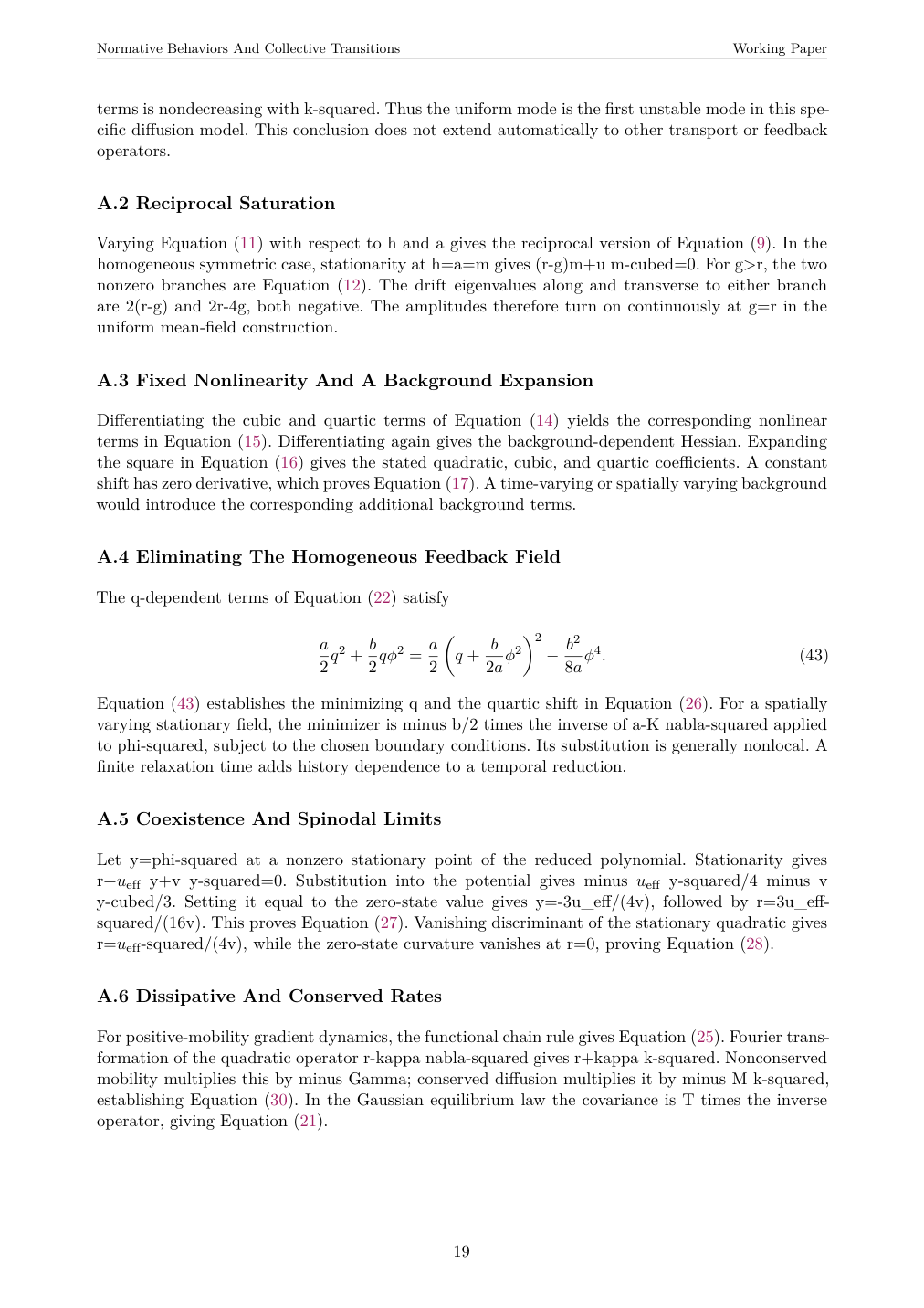
Equation (43) establishes the minimizing q and the quartic shift in Equation (26). For a spatially varying stationary field, the minimizer is minus b/2 times the inverse of a-K nabla-squared applied to phi-squared, subject to the chosen boundary conditions. Its substitution is generally nonlocal. A finite relaxation time adds history dependence to a temporal reduction.
Let y=phi-squared at a nonzero stationary point of the reduced polynomial. Stationarity gives y-cubed/3. Setting it equal to the zero-state value gives y=-3u_eff/(4v), followed by r=3u_eff- squared/(16v). This proves Equation (27). Vanishing discriminant of the stationary quadratic gives
For positive-mobility gradient dynamics, the functional chain rule gives Equation (25). Fourier trans- formation of the quadratic operator r-kappa nabla-squared gives r+kappa k-squared. Nonconserved mobility multiplies this by minus Gamma; conserved diffusion multiplies it by minus M k-squared, establishing Equation (30). In the Gaussian equilibrium law the covariance is T times the inverse
Readable text
Multiply composition balance in Equation (34) by mu and integrate over the periodic domain. The diffusive term gives minus the integral of M times the squared gradient of mu. Integration by parts converts the advective contribution into plus the integral of c v dot grad mu. Multiplying the momentum balance by v produces the opposite capillary term and the viscous loss. The convective and pressure contributions integrate to zero by incompressibility. Their sum proves Equation (35), including state-dependent positive viscosity inside the full stress divergence.
The zero-current Fokker–Planck condition for Equation (39) is V-prime times p plus T/N times the derivative of p equal to zero. Integration gives Equation (40). For a positive a and k>-1, the even
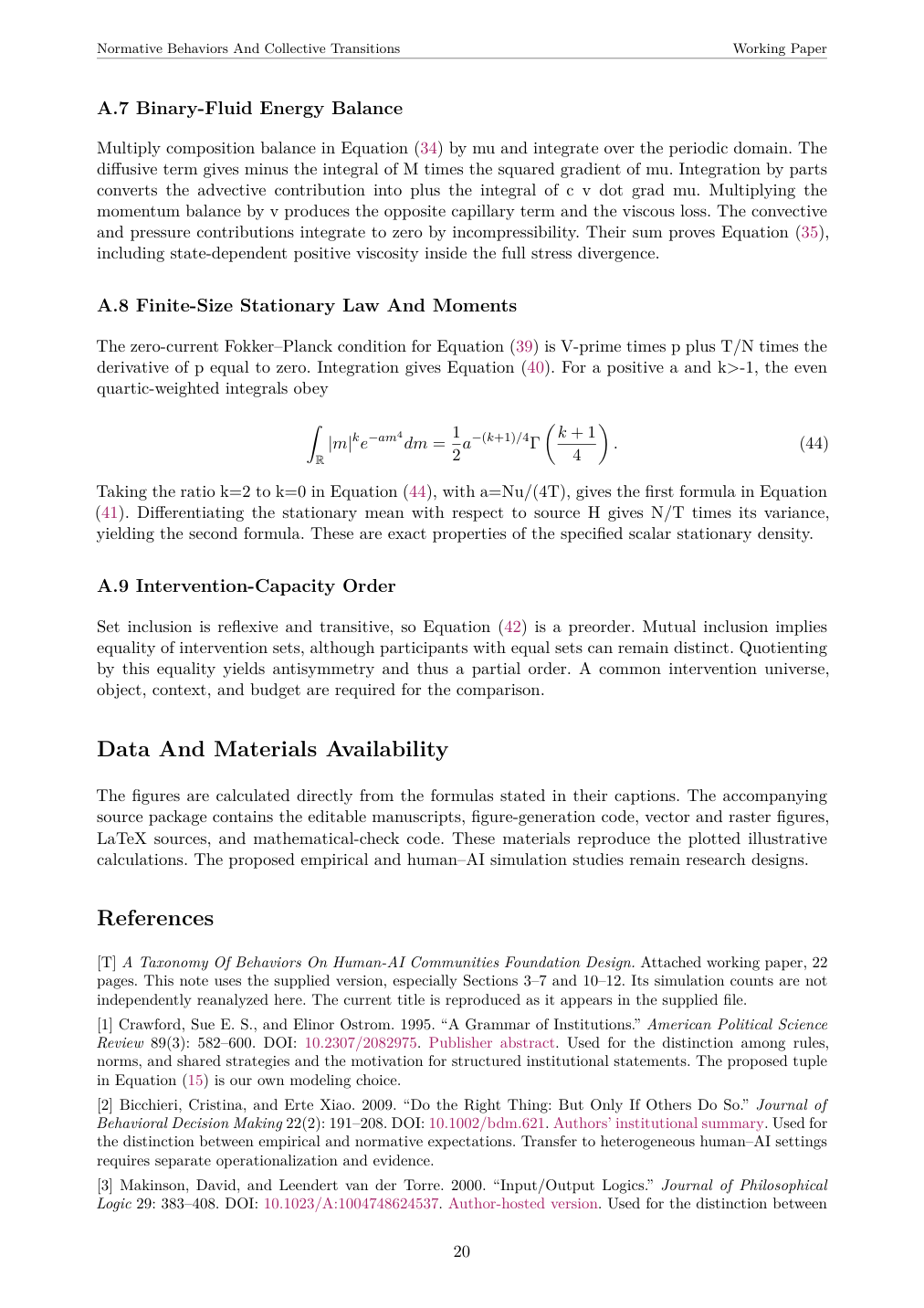
Taking the ratio k=2 to k=0 in Equation (44), with a=Nu/(4T), gives the first formula in Equation (41). Differentiating the stationary mean with respect to source H gives N/T times its variance,
yielding the second formula. These are exact properties of the specified scalar stationary density.
Set inclusion is reflexive and transitive, so Equation (42) is a preorder. Mutual inclusion implies equality of intervention sets, although participants with equal sets can remain distinct. Quotienting by this equality yields antisymmetry and thus a partial order. A common intervention universe, object, context, and budget are required for the comparison.
The figures are calculated directly from the formulas stated in their captions. The accompanying source package contains the editable manuscripts, figure-generation code, vector and raster figures, LaTeX sources, and mathematical-check code. These materials reproduce the plotted illustrative calculations. The proposed empirical and human–AI simulation studies remain research designs.
[T] A Taxonomy Of Behaviors On Human-AI Communities Foundation Design. Attached working paper, 22 pages. This note uses the supplied version, especially Sections 3–7 and 10–12. Its simulation counts are not independently reanalyzed here. The current title is reproduced as it appears in the supplied file.
[1] Crawford, Sue E. S., and Elinor Ostrom. 1995. “A Grammar of Institutions.” American Political Science Review 89(3): 582–600. DOI: 10.2307/2082975. Publisher abstract. Used for the distinction among rules,
norms, and shared strategies and the motivation for structured institutional statements. The proposed tuple
[2] Bicchieri, Cristina, and Erte Xiao. 2009. “Do the Right Thing: But Only If Others Do So.” Journal of Behavioral Decision Making 22(2): 191–208. DOI: 10.1002/bdm.621. Authors’ institutional summary. Used for
the distinction between empirical and normative expectations. Transfer to heterogeneous human–AI settings
requires separate operationalization and evidence.
[3] Makinson, David, and Leendert van der Torre. 2000. “Input/Output Logics.” Journal of Philosophical Logic 29: 383–408. DOI: 10.1023/A:1004748624537. Author-hosted version. Used for the distinction between

Readable text
conditional normative outputs and ordinary consequence. The temporal monitors and powers in this note
[4] Fruchart, Michel, Ryo Hanai, Peter B. Littlewood, and Vincenzo Vitelli. 2021. “Non-Reciprocal Phase Transitions.” Nature 592: 363–369. DOI: 10.1038/s41586-021-03375-9. Author preprint. Used as a physical example of directed coupling and collective dynamics beyond equilibrium potential descriptions. No physical
universality-class claim about society is inferred here.
[5] Alur, Rajeev, Thomas A. Henzinger, and Pei-Hsin Ho. 1996. “Automatic Symbolic Verification of Embed- ded Systems.” IEEE Transactions on Software Engineering 22(3): 181–201. Cornell technical-report record, 1995 version. Used for the established hybrid-system approach combining discrete control, continuous vari-
[6] Centola, Damon, Joshua Becker, Devon Brackbill, and Andrea Baronchelli. 2018. “Experimental Evi- dence for Tipping Points in Social Convention.” Science 360(6393): 1116–1119. DOI: 10.1126/science.aas8827. Author-hosted published paper. Used for evidence of convention change in a specific controlled coordination setting. Its numerical threshold is not generalized in this note.
[7] Ashery, Ariel Flint, Luca Maria Aiello, and Andrea Baronchelli. 2025. “Emergent Social Conventions and Collective Bias in LLM Populations.” Science Advances 11(20): eadu9368. DOI: 10.1126/sciadv.adu9368. Institutional repository, published version. Used for convention formation and collective bias in the studied LLM-agent coordination games. It supplies neither a direct test of heterogeneous human–AI society nor an
[8] Tong, David. Statistical Field Theory, Chapter 1, “From Spins to Fields.” Cambridge lecture notes. Author’s chapter. Used for Landau–Ginzburg descriptions and the distinction between symmetry of a theory and symmetry of a selected state. The explicit background expansions in this note are calculated directly.
[9] Tong, David. Statistical Field Theory, Chapter 3, “The Renormalisation Group.” Cambridge lecture notes. Author’s chapter. Used for the scale interpretation of Wilsonian coarse graining, fixed points, and relevant perturbations. Physical-time coupling adaptation is separately specified here.
[10] Hohenberg, P. C., and B. I. Halperin. 1977. “Theory of Dynamic Critical Phenomena.” Reviews of Modern Physics 49: 435–479. DOI: 10.1103/RevModPhys.49.435. Used for the dependence of critical dynamics on
conservation laws and coupled slow modes. The Gaussian rates and exponents displayed here have their
[11] Abels, Helmut, Harald Garcke, and Günther Grün. 2012. “Thermodynamically Consistent, Frame Indif- ferent Diffuse Interface Models for Incompressible Two-Phase Flows with Different Densities.” Mathematical Models and Methods in Applied Sciences 22(3): 1150013. Author preprint. Used for the established coupling
of phase fields and momentum and the care required for unequal-density energy balances. The equal-density periodic example in this note is stated and checked directly.
[12] Gross, Thilo, and Bernd Blasius. 2008. “Adaptive Coevolutionary Networks: A Review.” Journal of the Royal Society Interface 5(20): 259–271. DOI: 10.1098/rsif.2007.1229. Author preprint. Used for the established
distinction and feedback between network states and network structure. It does not establish the adequacy
[13] Crozier, Josh, and colleagues. 2022. “Outgassing Through Magmatic Fractures Enables Effusive Volcanology 10.1016/j.jvolgeores.2022.107617. Authors’ USGS publication record. Used for observed and modeled relationships among fracture pathways, outgassing, and effusive or hybrid behavior at Cordón Caulle. No claim of a thermodynamic critical point is inferred from that example.
[14] Dickman, Ronald, Alessandro Vespignani, and Stefano Zapperi. 1998. “Self-Organized Criticality as an Absorbing-State Phase Transition.” Physical Review E 57: 5095–5105. DOI: 10.1103/PhysRevE.57.5095. Author preprint. Used for the need to identify driving, dissipation, and limiting conditions in a self-organized- criticality claim. No automatic tuning mechanism for human–AI communities is assumed.