Norm Formation And Relational Dynamics In Heterogeneous Communities - A Field-Theoretic Discussion
Full text from the PDF
Norm Formation In Heterogeneous Communities Development Note
Norm Formation And Relational Dynamics In Heterogeneous
Communities: A Field-Theoretic Discussion
Wanhong HUANG
Research development note
Abstract. This note develops a mathematical proposal for studying norm formation among heterogeneous subjects, including humans and AI systems. It begins from a five-level taxonomy of behavioral description and distinguishes dynamical interaction, evidence, social uptake, and orderrelative normative standing. Subjects retain different state spaces and update mechanisms. Relations can introduce mediated interactions, change existing couplings, create institutional powers, alter observation channels, and enable new joint practices. A causal stochastic formulation accommodates dissipation, learning, memory, partial observation, and discrete institutional events. Variational actions form a useful subclass. Norm content is represented separately from recognition, enforcement, and behavioral efficacy. Explicit constructions cover prohibitions, obligations, permissions, constitutive rules, powers, revision, and conflicts. Five short derivations establish the limits of gradient descriptions, the effect of finite penalties, the memory retained after eliminating a mediator, an identification problem, and an order of intervention capacities. A worked approval-and-release example connects the mathematics to human–AI community design. A brief extension shows how an implemented normative act can alter a feedback loop and cross a collective stability threshold; a companion paper develops criticality and phase-transition phenomena independently. The constructions are proposed modeling choices; their empirical adequacy requires independent investigation.
Keywords: Norm Formation; Heterogeneous Subjects; Relational Dynamics; Field Theory; Human– AI Communities.
AI Statement. OpenAI ChatGPT assisted in developing this exploratory formalism, checking its elementary derivations, and preparing the document. The resulting constructions require authorial review before incorporation into a manuscript.
License. This development note is made available under CC BY-NC 4.0.
1 Introduction
The motivating proposal is that two subjects, initially described by different dynamical systems, establish a relation that reorganizes their joint evolution. Existing terms may acquire new couplings; coupling strengths or directions may change; additional mediating variables may become relevant; some interactions may become inactive. This is a productive starting point for investigating human– AI community formation. Its mathematical development requires specifying both the dynamics that change and the interpretation under which those changes count as normative.
The attached working paper, A Taxonomy Of Behaviors On Human-AI Communities Foundation Design, distinguishes epistemic activity (E), occurring conduct (O), manifest conduct (M), social
conduct (S), and normative conduct (N). Its normative level includes acts constituted by an order and qualifications that an order confers on independently describable conduct. An appointment illustrates the first possibility; fulfillment of an existing duty illustrates the second. The paper also
Readable text
preserves disagreements between constituencies, differences between observation and occurrence, and changes in standing across time. These distinctions guide the present construction [T].
For this note, a norm is a context-indexed specification concerning what may, must, or must not be done, what constitutes an institutional act, or who has power to change a normative position. Normative conduct is conduct considered through its standing under such a specification and an identified order or practice. This is a local working vocabulary. Ethical normativity, legal validity, informal social expectations, and computational policy specifications can require different accounts
The central proposal is a coupled system with three explicitly represented components: hetero- geneous subject dynamics, relational and mediating infrastructure, and order-indexed normative interpretation and revision. Observation and social uptake connect these components. Section 2 specifies the base and state spaces. Sections 3–5 develop composition, causal dynamics, and actions. Sections 6–9 specify norms, their realization, and changes in coupling. Sections 10–11 examine emer- gence and a human–AI example. Sections 12–14 address generative possibilities, power, inference, and spatial coupling. Section 15 connects normative coupling changes to collective stability and the independent phase-transition paper. Section 16 gives an operational research sequence. Appendix A collects the mathematical claims and their assumptions.
A field assigns a value to each location in a declared domain. For a community, a location can identify a place, a task, a resource, a communication channel, or a procedural situation, together with time. A tractable initial choice is a time-dependent typed interaction graph. Its vertices represent sites or contexts, while its edges represent possible transmissions or dependencies. For a fixed observation
Equation (1) defines a relational event base. Physical coordinates can be included in a vertex or supplied through an embedding into physical space. A smooth manifold is useful where interpolation, locality, and derivatives have a defensible interpretation. A graph or event complex accommodates discrete changes directly. A graph edge requires an explicit meaning: being able to send a message differs from sharing a resource or recognizing a representative.
Physical spacetime and the relational base should be related through declared maps. A committee can meet in several physical locations while operating in one procedural context. Two actors in the same room can have access to different channels. A metric on the relational base therefore needs an operational definition, such as travel delay or transmission cost. Lorentzian geometry, a light cone, or an equivalence principle would each require an additional substantive argument.
For asynchronous interaction, an event history has a causal or dependency order. An event may precede another because a message was received, because one computation depended on another, or because a procedure specifies an ordering. Concurrent events can remain incomparable. A legal or community rule deciding which concurrent submission has effect supplies further institutional
Readable text
A human subject might be modeled through availability, publicly disclosed commitments, and task- relevant choices. An AI service might be modeled through memory, task state, tools, and policy parameters. The modeled variables specify the inquiry’s resolution.
a section of a typed bundle over the relevant base. Discrete roles, continuous resources, categorical claims, and symbolic messages can coexist in a hybrid state space. Numerical coordinates need units and a measurement procedure. An internal field component should be introduced only when the evidence and modeling objective support its interpretation.
attributing a common mathematical structure to every subject simply because each is described as
Introduce an environmental or resource field eta, a mediating field q, and an institutional state d. The latter can store mandates, recognized offices, obligations, and rule versions. For a fixed
Equation (3) defines a common description. It leaves open whether any genuinely new process has appeared. A q variable represents an independently evolving mediator only if its state and update rule are specified. A shared message queue, a jointly maintained record, or a common pool of attention can supply such a variable. A newly introduced name for an existing correlation is a
Subject entry, exit, replacement, or role change can alter the applicable product in Equation (3). A hybrid model records such changes as typed transitions. A new role can also change a subject’s available actions without requiring the assumption that the subject’s underlying nature has changed.
An independent baseline needs both an initial distribution and an evolution law. When both factor-
Equation (4) is a substantive baseline assumption. Initially correlated states, common external drivers, or selection into the same task can produce dependence before any direct relation is es- tablished. A relation-formation claim should therefore identify the transmission or institutional mechanism that changed, with common causes included where relevant.
Within a variational subclass, a possible composition is
Readable text
Equation (5) is a useful response to the motivating proposal. Relations can be represented through interaction terms and mediator dynamics. The sum itself creates a joint description. The variables same evolving field, their baseline dependence must be assessed before describing their combination
component, such as a release request, attention allocation, resource use, or communicated commit-
Equation (6) permits direct coupling, mediated coupling, and interactions involving three or more components. Only selected components need couple. An appointment can connect a subject’s ap- proval signal to an institutional transition while leaving unrelated calculations outside the relation. A three-party ratification may require a genuinely joint term: all three approvals activate an agree- ment, while every pair alone leaves it inactive. Pairwise terms can represent such a mechanism only
The operator basis and coefficients in Equation (6) are model-dependent. Products are evaluated on a common interaction support after any required observation or transport maps; fields on distinct supports require a kernel such as Equation (48). Multiplying an observable by a constant and dividing its coefficient by that constant preserves the interaction. Therefore numerical coefficients acquire meaning only with a fixed basis, scale, and observation model. A term called trust has no mathematical warrant until its operational meaning is supplied.
For graph fields, the integral in Equation (6) denotes a sum over declared sites and an integral over time. Dimensions must agree within the integrand. Categorical messages require encodings or symbolic update rules; multiplying arbitrary category labels would add an unsupported numerical
Human–AI relations involve learning, resource consumption, delays, and asymmetric influence. A causal stochastic model accommodates these features. On a finite spatial discretization, one possible
Equation (7) is an Itô stochastic differential equation under the usual regularity and existence assumptions for the chosen model. The drift can include graph derivatives, such as a declared graph an SPDE without a spatial cutoff requires additional analytical assumptions about the noise and
Readable text
An interaction contribution can combine selected local components with delayed signals:
Equation (8) specifies causal memory through s no later than t. Different subjects can have different response times. A human’s deliberation and an AI service’s queue processing need separate temporal parameters. Directed recognition, one-way disclosure, and one-sided platform control can generate interactions with different effects in the two directions.
An available action is selected from the subject’s information, while an institutional update can depend on the current state and a qualifying event:
Equation (9) separates acting, institutional transition, and adaptation of the parameters theta. The institutional update. A revision procedure may itself change r. Parameter adaptation is a distinct operation: an AI model update can change response probabilities while the community’s rules remain
An information history in Equation (9) is actor-specific. The policy of an AI service can depend on logged inputs, tools, and context. A model of human choice can be statistical and need not posit an inspectable internal computation. A shared output vocabulary facilitates interaction while leaving
Let Z_n include the modeled state and any memory sufficient to obtain a Markov description on a specified discrete schedule. If transition densities exist relative to declared reference measures, the
Equation (10) provides a dimensionless statistical action for a specified stochastic model. With a fixed initial state, the initial-density term can be omitted. Continuous densities depend on the refer- ence measure and parametrization; predictions require the complete probability law. Deterministic transitions are represented by kernels concentrated on their update graph, and a common ordinary density need not exist for mixtures of deterministic and stochastic components.
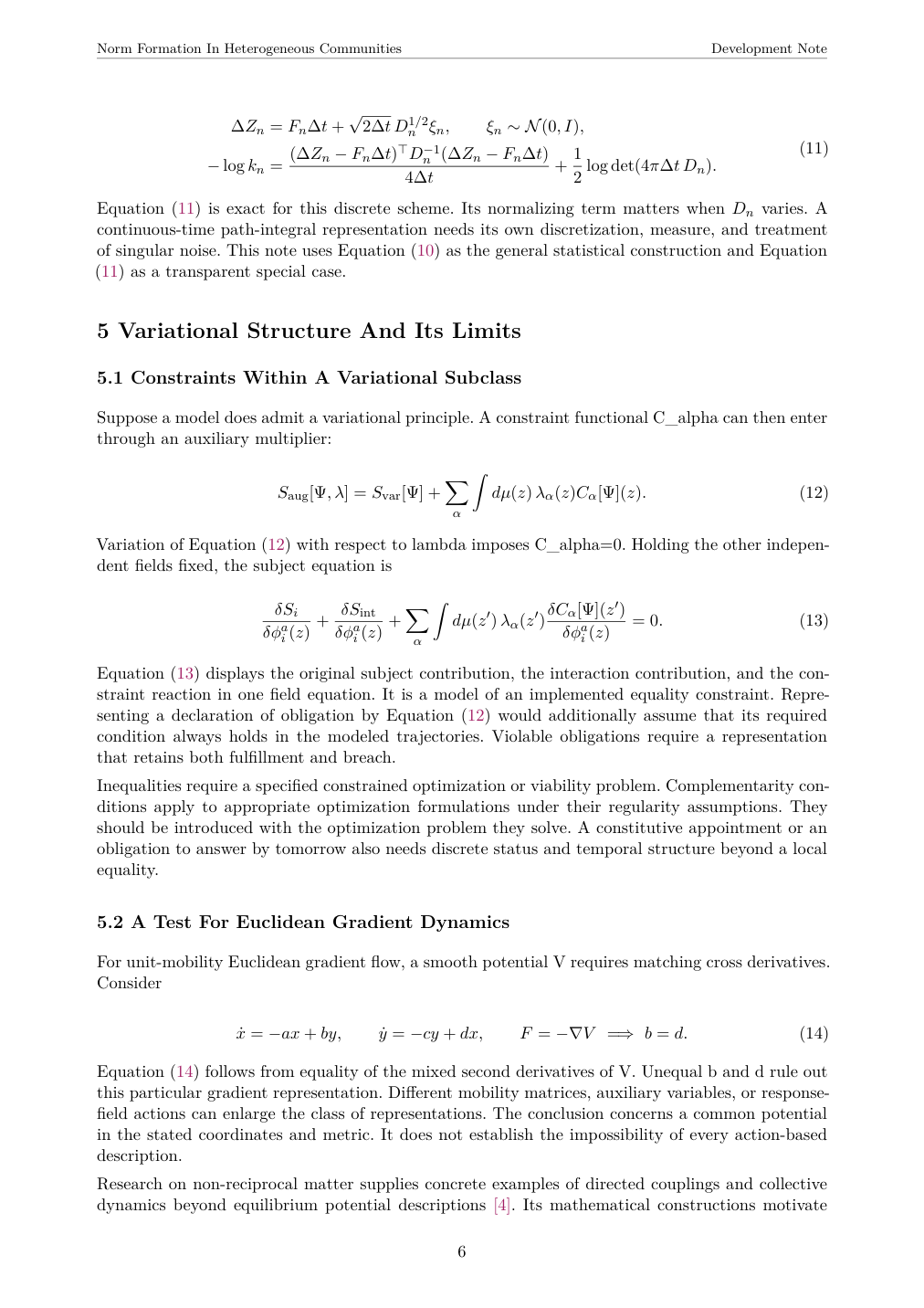
transition density is Gaussian. Its exact discrete negative logarithm is
Readable text
continuous-time path-integral representation needs its own discretization, measure, and treatment of singular noise. This note uses Equation (10) as the general statistical construction and Equation
Suppose a model does admit a variational principle. A constraint functional C_alpha can then enter
Variation of Equation (12) with respect to lambda imposes C_alpha=0. Holding the other indepen-
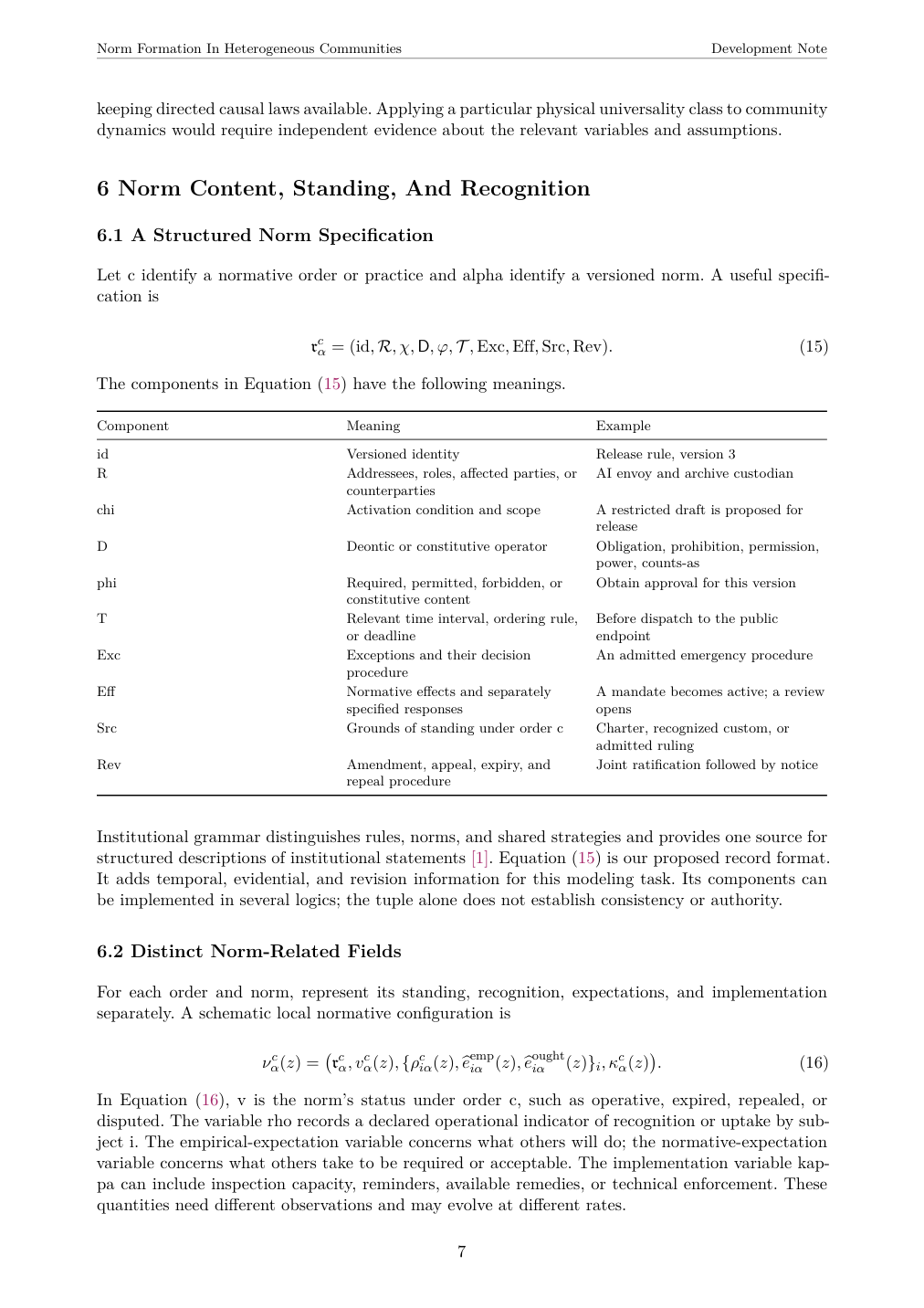
Equation (13) displays the original subject contribution, the interaction contribution, and the con- straint reaction in one field equation. It is a model of an implemented equality constraint. Repre- senting a declaration of obligation by Equation (12) would additionally assume that its required condition always holds in the modeled trajectories. Violable obligations require a representation
Inequalities require a specified constrained optimization or viability problem. Complementarity con- ditions apply to appropriate optimization formulations under their regularity assumptions. They should be introduced with the optimization problem they solve. A constitutive appointment or an obligation to answer by tomorrow also needs discrete status and temporal structure beyond a local
For unit-mobility Euclidean gradient flow, a smooth potential V requires matching cross derivatives.
Equation (14) follows from equality of the mixed second derivatives of V. Unequal b and d rule out this particular gradient representation. Different mobility matrices, auxiliary variables, or response- field actions can enlarge the class of representations. The conclusion concerns a common potential in the stated coordinates and metric. It does not establish the impossibility of every action-based
Research on non-reciprocal matter supplies concrete examples of directed couplings and collective dynamics beyond equilibrium potential descriptions [4]. Its mathematical constructions motivate
Readable text
keeping directed causal laws available. Applying a particular physical universality class to community dynamics would require independent evidence about the relevant variables and assumptions.
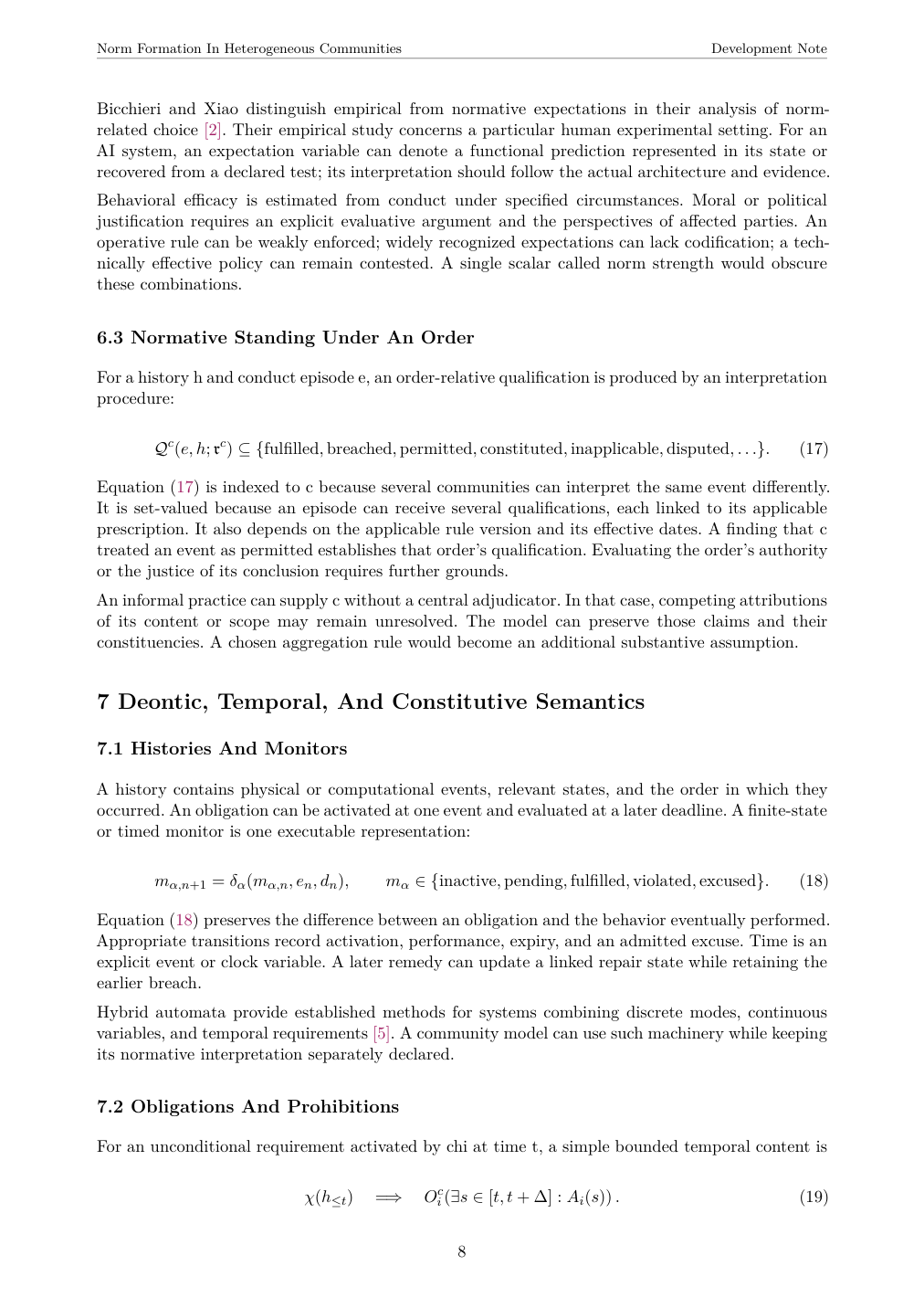
Let c identify a normative order or practice and alpha identify a versioned norm. A useful specifi-
The components in Equation (15) have the following meanings.
Activation condition and scope Deontic or constitutive operator Required, permitted, forbidden, or
A restricted draft is proposed for release Obligation, prohibition, permission, power, counts-as
A mandate becomes active; a review opens Charter, recognized custom, or admitted ruling
Grounds of standing under order c Amendment, appeal, expiry, and
Institutional grammar distinguishes rules, norms, and shared strategies and provides one source for structured descriptions of institutional statements [1]. Equation (15) is our proposed record format. It adds temporal, evidential, and revision information for this modeling task. Its components can be implemented in several logics; the tuple alone does not establish consistency or authority.
For each order and norm, represent its standing, recognition, expectations, and implementation separately. A schematic local normative configuration is
In Equation (16), v is the norm’s status under order c, such as operative, expired, repealed, or disputed. The variable rho records a declared operational indicator of recognition or uptake by sub- ject i. The empirical-expectation variable concerns what others will do; the normative-expectation variable concerns what others take to be required or acceptable. The implementation variable kap- pa can include inspection capacity, reminders, available remedies, or technical enforcement. These quantities need different observations and may evolve at different rates.
Readable text
Bicchieri and Xiao distinguish empirical from normative expectations in their analysis of norm- related choice [2]. Their empirical study concerns a particular human experimental setting. For an AI system, an expectation variable can denote a functional prediction represented in its state or recovered from a declared test; its interpretation should follow the actual architecture and evidence.
Behavioral efficacy is estimated from conduct under specified circumstances. Moral or political justification requires an explicit evaluative argument and the perspectives of affected parties. An operative rule can be weakly enforced; widely recognized expectations can lack codification; a tech- nically effective policy can remain contested. A single scalar called norm strength would obscure
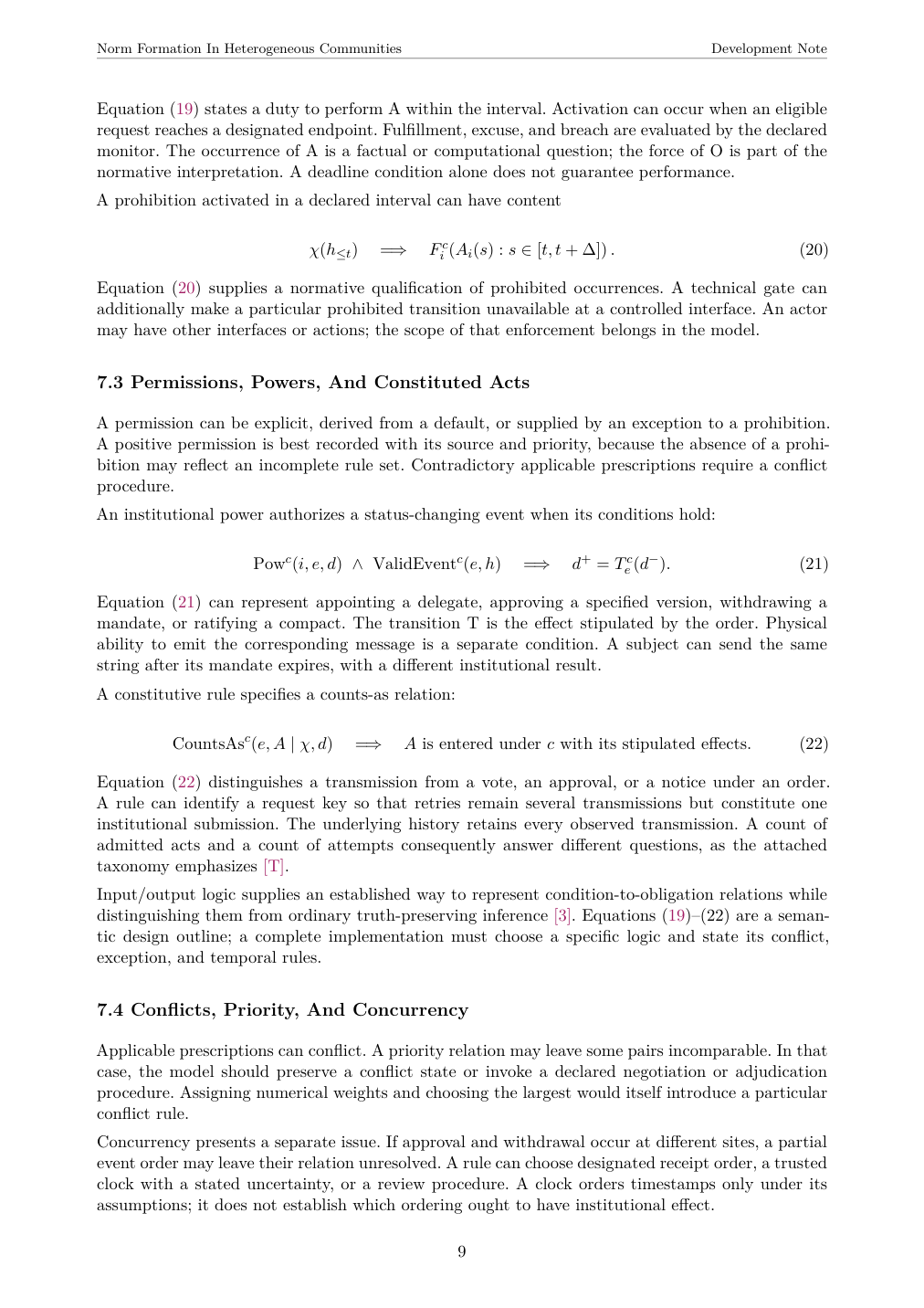
For a history h and conduct episode e, an order-relative qualification is produced by an interpretation
Equation (17) is indexed to c because several communities can interpret the same event differently. It is set-valued because an episode can receive several qualifications, each linked to its applicable prescription. It also depends on the applicable rule version and its effective dates. A finding that c treated an event as permitted establishes that order’s qualification. Evaluating the order’s authority or the justice of its conclusion requires further grounds.
An informal practice can supply c without a central adjudicator. In that case, competing attributions of its content or scope may remain unresolved. The model can preserve those claims and their constituencies. A chosen aggregation rule would become an additional substantive assumption.
A history contains physical or computational events, relevant states, and the order in which they occurred. An obligation can be activated at one event and evaluated at a later deadline. A finite-state
Equation (18) preserves the difference between an obligation and the behavior eventually performed. Appropriate transitions record activation, performance, expiry, and an admitted excuse. Time is an explicit event or clock variable. A later remedy can update a linked repair state while retaining the
Hybrid automata provide established methods for systems combining discrete modes, continuous variables, and temporal requirements [5]. A community model can use such machinery while keeping
For an unconditional requirement activated by chi at time t, a simple bounded temporal content is
Readable text
Equation (19) states a duty to perform A within the interval. Activation can occur when an eligible request reaches a designated endpoint. Fulfillment, excuse, and breach are evaluated by the declared monitor. The occurrence of A is a factual or computational question; the force of O is part of the normative interpretation. A deadline condition alone does not guarantee performance.
A prohibition activated in a declared interval can have content
Equation (20) supplies a normative qualification of prohibited occurrences. A technical gate can additionally make a particular prohibited transition unavailable at a controlled interface. An actor may have other interfaces or actions; the scope of that enforcement belongs in the model.
A permission can be explicit, derived from a default, or supplied by an exception to a prohibition. A positive permission is best recorded with its source and priority, because the absence of a prohi- bition may reflect an incomplete rule set. Contradictory applicable prescriptions require a conflict
An institutional power authorizes a status-changing event when its conditions hold:
Equation (21) can represent appointing a delegate, approving a specified version, withdrawing a mandate, or ratifying a compact. The transition T is the effect stipulated by the order. Physical ability to emit the corresponding message is a separate condition. A subject can send the same string after its mandate expires, with a different institutional result.
Equation (22) distinguishes a transmission from a vote, an approval, or a notice under an order. A rule can identify a request key so that retries remain several transmissions but constitute one institutional submission. The underlying history retains every observed transmission. A count of admitted acts and a count of attempts consequently answer different questions, as the attached
Input/output logic supplies an established way to represent condition-to-obligation relations while distinguishing them from ordinary truth-preserving inference [3]. Equations (19)–(22) are a seman- tic design outline; a complete implementation must choose a specific logic and state its conflict,
Applicable prescriptions can conflict. A priority relation may leave some pairs incomparable. In that case, the model should preserve a conflict state or invoke a declared negotiation or adjudication procedure. Assigning numerical weights and choosing the largest would itself introduce a particular
Concurrency presents a separate issue. If approval and withdrawal occur at different sites, a partial event order may leave their relation unresolved. A rule can choose designated receipt order, a trusted clock with a stated uncertainty, or a review procedure. A clock orders timestamps only under its assumptions; it does not establish which ordering ought to have institutional effect.
Readable text
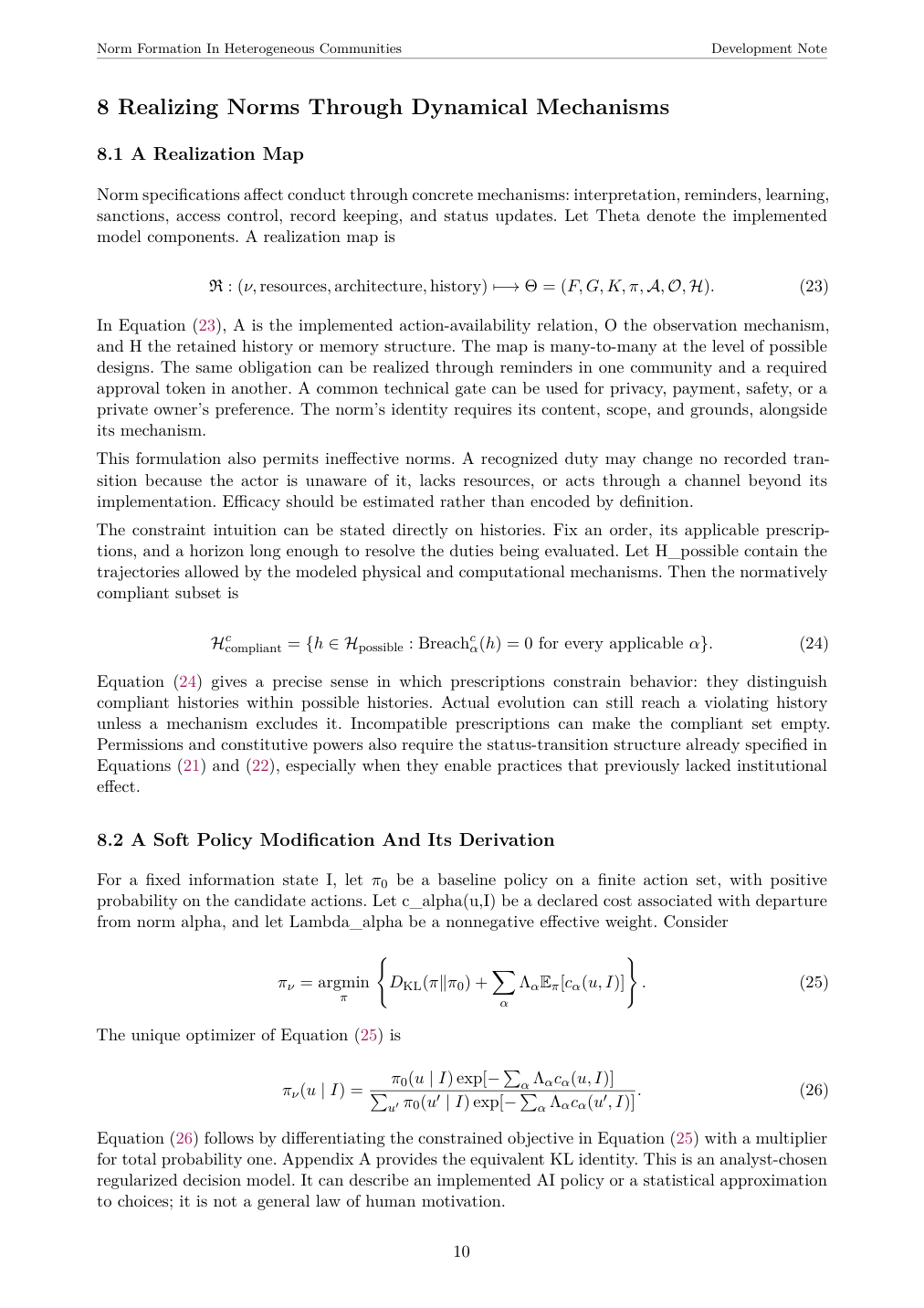
Norm specifications affect conduct through concrete mechanisms: interpretation, reminders, learning, sanctions, access control, record keeping, and status updates. Let Theta denote the implemented
In Equation (23), A is the implemented action-availability relation, O the observation mechanism, and H the retained history or memory structure. The map is many-to-many at the level of possible designs. The same obligation can be realized through reminders in one community and a required approval token in another. A common technical gate can be used for privacy, payment, safety, or a private owner’s preference. The norm’s identity requires its content, scope, and grounds, alongside
This formulation also permits ineffective norms. A recognized duty may change no recorded tran- sition because the actor is unaware of it, lacks resources, or acts through a channel beyond its implementation. Efficacy should be estimated rather than encoded by definition.
The constraint intuition can be stated directly on histories. Fix an order, its applicable prescrip- tions, and a horizon long enough to resolve the duties being evaluated. Let H_possible contain the trajectories allowed by the modeled physical and computational mechanisms. Then the normatively
Equation (24) gives a precise sense in which prescriptions constrain behavior: they distinguish compliant histories within possible histories. Actual evolution can still reach a violating history unless a mechanism excludes it. Incompatible prescriptions can make the compliant set empty. Permissions and constitutive powers also require the status-transition structure already specified in Equations (21) and (22), especially when they enable practices that previously lacked institutional
probability on the candidate actions. Let c_alpha(u,I) be a declared cost associated with departure from norm alpha, and let Lambda_alpha be a nonnegative effective weight. Consider
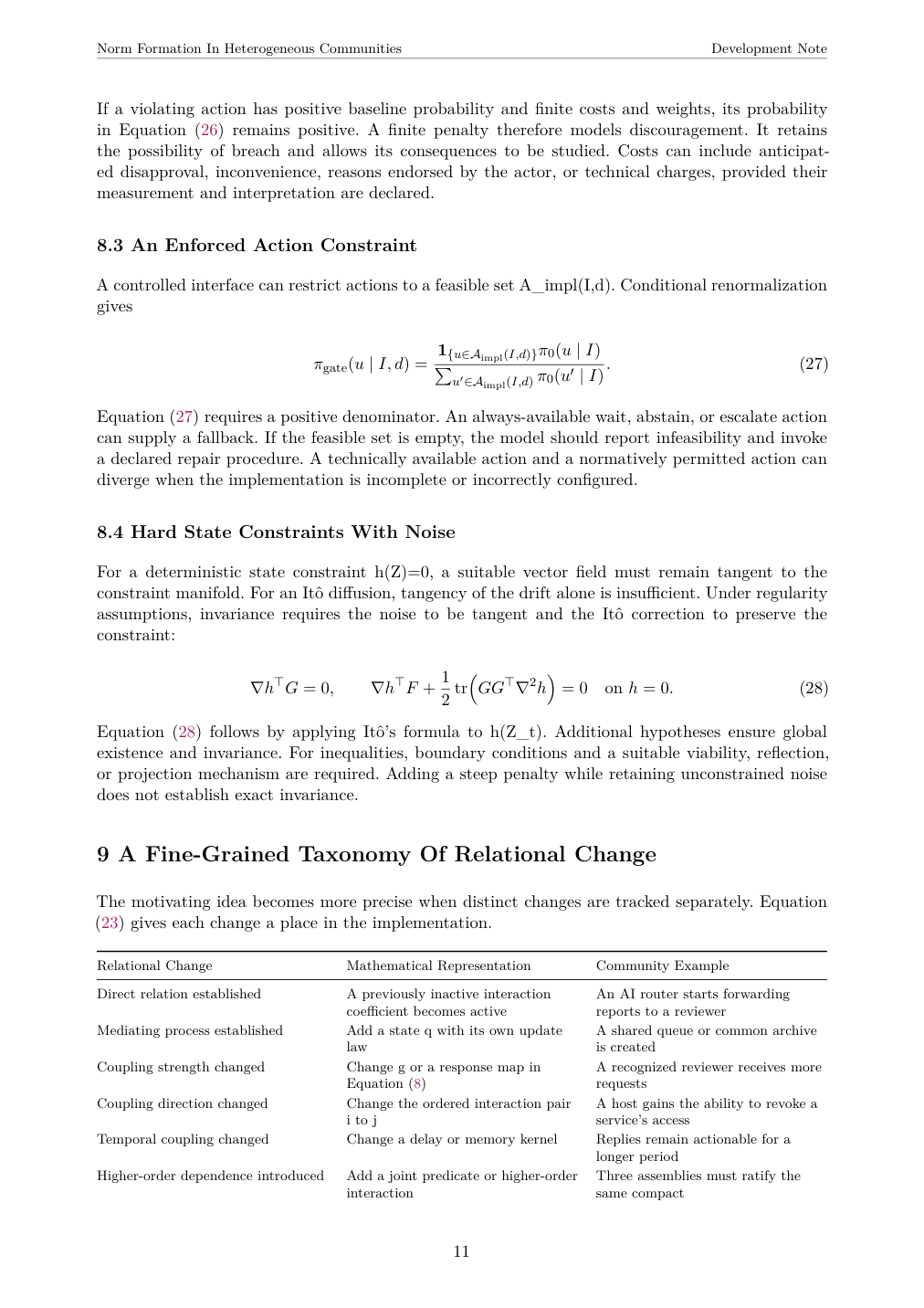
Equation (26) follows by differentiating the constrained objective in Equation (25) with a multiplier for total probability one. Appendix A provides the equivalent KL identity. This is an analyst-chosen regularized decision model. It can describe an implemented AI policy or a statistical approximation to choices; it is not a general law of human motivation.
Readable text
If a violating action has positive baseline probability and finite costs and weights, its probability in Equation (26) remains positive. A finite penalty therefore models discouragement. It retains the possibility of breach and allows its consequences to be studied. Costs can include anticipat- ed disapproval, inconvenience, reasons endorsed by the actor, or technical charges, provided their
A controlled interface can restrict actions to a feasible set A_impl(I,d). Conditional renormalization
Equation (27) requires a positive denominator. An always-available wait, abstain, or escalate action can supply a fallback. If the feasible set is empty, the model should report infeasibility and invoke a declared repair procedure. A technically available action and a normatively permitted action can diverge when the implementation is incomplete or incorrectly configured.
For a deterministic state constraint h(Z)=0, a suitable vector field must remain tangent to the constraint manifold. For an Itô diffusion, tangency of the drift alone is insufficient. Under regularity assumptions, invariance requires the noise to be tangent and the Itô correction to preserve the
Equation (28) follows by applying Itô’s formula to h(Z_t). Additional hypotheses ensure global existence and invariance. For inequalities, boundary conditions and a suitable viability, reflection, or projection mechanism are required. Adding a steep penalty while retaining unconstrained noise
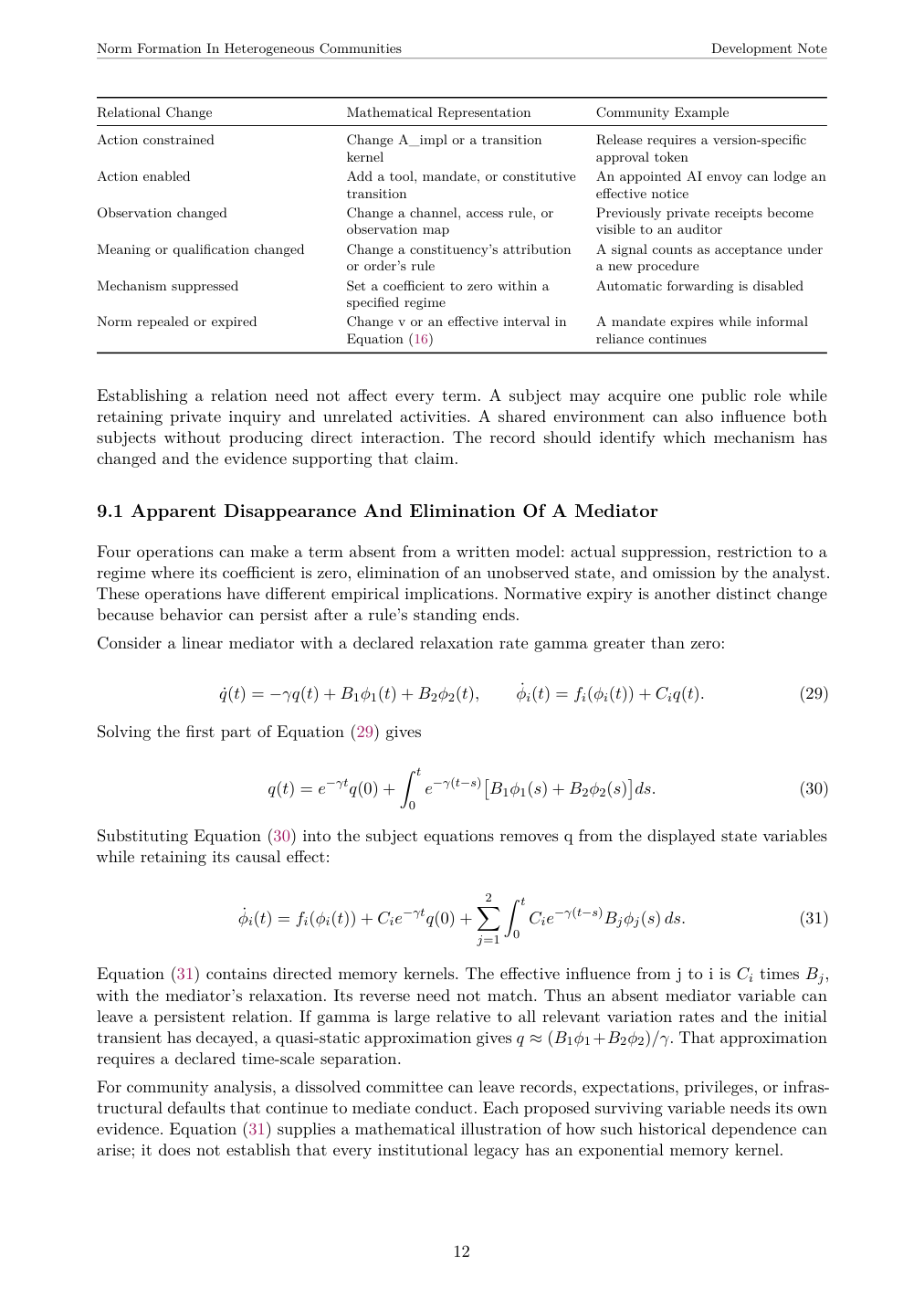
The motivating idea becomes more precise when distinct changes are tracked separately. Equation (23) gives each change a place in the implementation.
A previously inactive interaction coefficient becomes active
A host gains the ability to revoke a service’s access Replies remain actionable for a longer period
Change a delay or memory kernel Add a joint predicate or higher-order
Temporal coupling changed Higher-order dependence introduced interaction
Readable text
Previously private receipts become visible to an auditor
A mandate expires while informal reliance continues
Establishing a relation need not affect every term. A subject may acquire one public role while retaining private inquiry and unrelated activities. A shared environment can also influence both subjects without producing direct interaction. The record should identify which mechanism has
9.1 Apparent Disappearance And Elimination Of A Mediator
Four operations can make a term absent from a written model: actual suppression, restriction to a regime where its coefficient is zero, elimination of an unobserved state, and omission by the analyst. These operations have different empirical implications. Normative expiry is another distinct change because behavior can persist after a rule’s standing ends.
Consider a linear mediator with a declared relaxation rate gamma greater than zero:
Substituting Equation (30) into the subject equations removes q from the displayed state variables
with the mediator’s relaxation. Its reverse need not match. Thus an absent mediator variable can leave a persistent relation. If gamma is large relative to all relevant variation rates and the initial
For community analysis, a dissolved committee can leave records, expectations, privileges, or infras- tructural defaults that continue to mediate conduct. Each proposed surviving variable needs its own evidence. Equation (31) supplies a mathematical illustration of how such historical dependence can arise; it does not establish that every institutional legacy has an exponential memory kernel.
Readable text
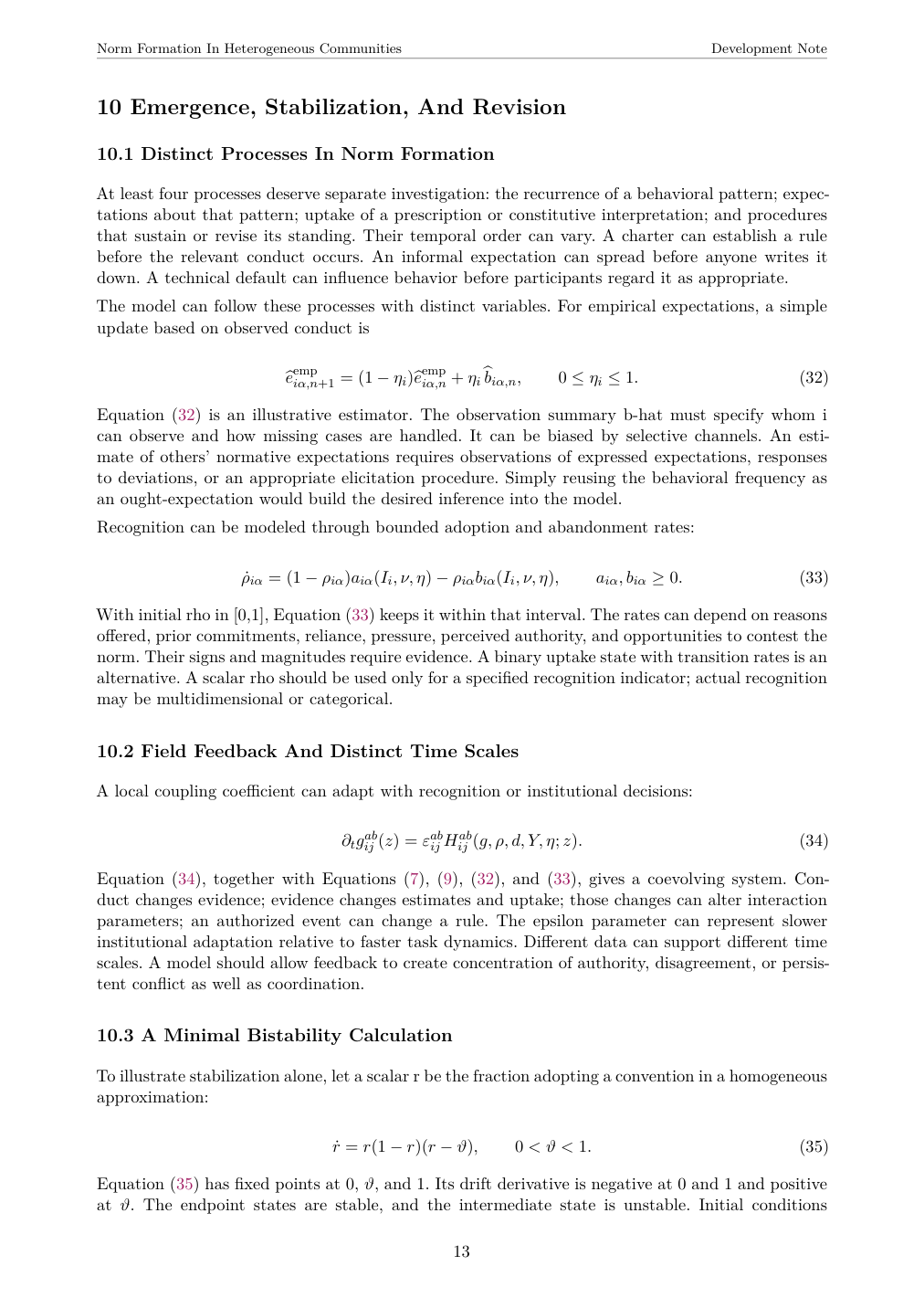
At least four processes deserve separate investigation: the recurrence of a behavioral pattern; expec- tations about that pattern; uptake of a prescription or constitutive interpretation; and procedures that sustain or revise its standing. Their temporal order can vary. A charter can establish a rule before the relevant conduct occurs. An informal expectation can spread before anyone writes it down. A technical default can influence behavior before participants regard it as appropriate.
The model can follow these processes with distinct variables. For empirical expectations, a simple
Equation (32) is an illustrative estimator. The observation summary b-hat must specify whom i can observe and how missing cases are handled. It can be biased by selective channels. An esti- mate of others’ normative expectations requires observations of expressed expectations, responses to deviations, or an appropriate elicitation procedure. Simply reusing the behavioral frequency as an ought-expectation would build the desired inference into the model.
Recognition can be modeled through bounded adoption and abandonment rates:
With initial rho in [0,1], Equation (33) keeps it within that interval. The rates can depend on reasons
offered, prior commitments, reliance, pressure, perceived authority, and opportunities to contest the norm. Their signs and magnitudes require evidence. A binary uptake state with transition rates is an alternative. A scalar rho should be used only for a specified recognition indicator; actual recognition
A local coupling coefficient can adapt with recognition or institutional decisions:
Equation (34), together with Equations (7), (9), (32), and (33), gives a coevolving system. Con- duct changes evidence; evidence changes estimates and uptake; those changes can alter interaction parameters; an authorized event can change a rule. The epsilon parameter can represent slower institutional adaptation relative to faster task dynamics. Different data can support different time scales. A model should allow feedback to create concentration of authority, disagreement, or persis-
To illustrate stabilization alone, let a scalar r be the fraction adopting a convention in a homogeneous
Readable text
on opposite sides of theta approach different conventions. This elementary calculation establishes bistability for the declared model. It establishes neither normative authority nor a universal adoption
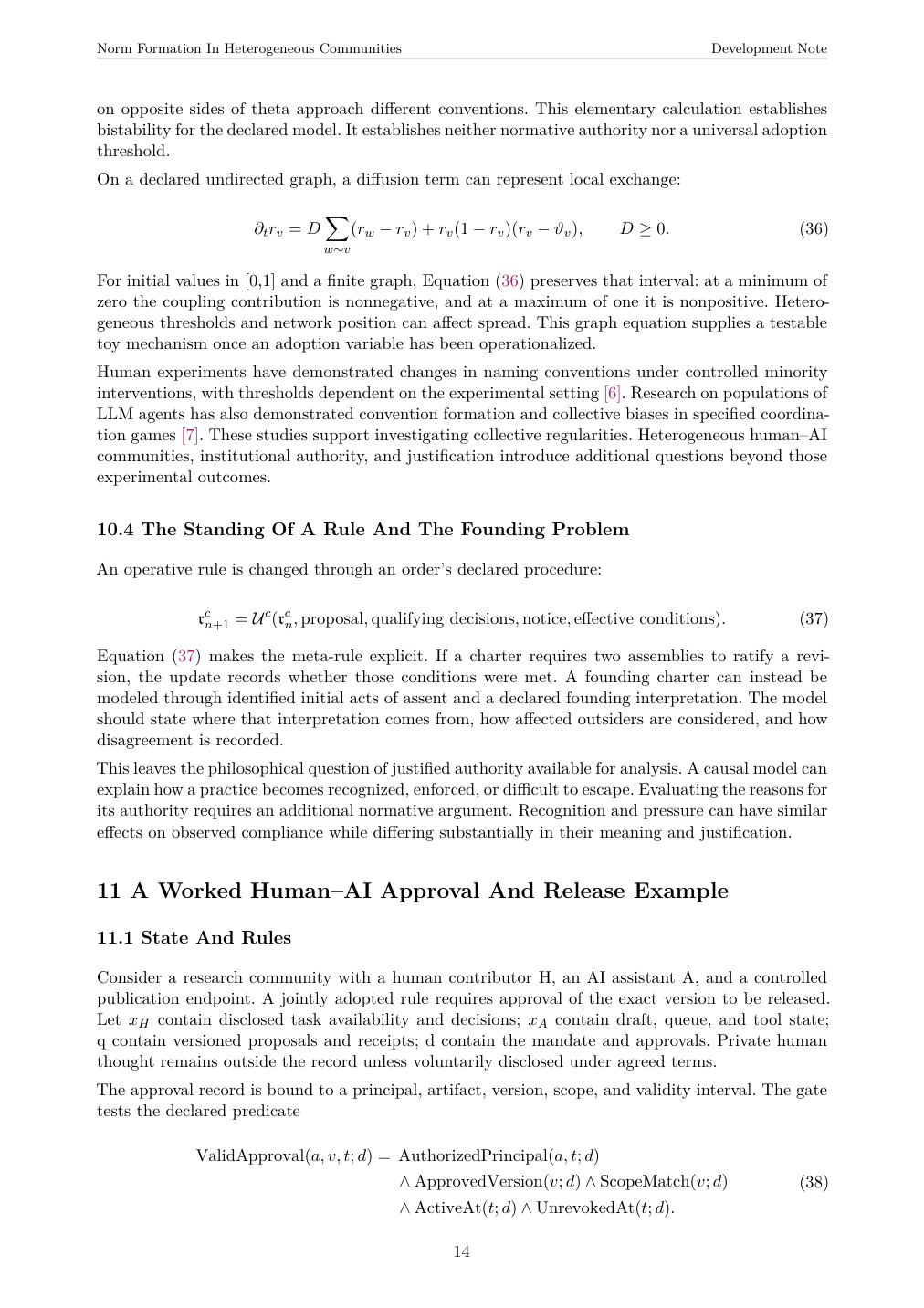
On a declared undirected graph, a diffusion term can represent local exchange:
For initial values in [0,1] and a finite graph, Equation (36) preserves that interval: at a minimum of zero the coupling contribution is nonnegative, and at a maximum of one it is nonpositive. Hetero- geneous thresholds and network position can affect spread. This graph equation supplies a testable toy mechanism once an adoption variable has been operationalized.
Human experiments have demonstrated changes in naming conventions under controlled minority interventions, with thresholds dependent on the experimental setting [6]. Research on populations of LLM agents has also demonstrated convention formation and collective biases in specified coordina- tion games [7]. These studies support investigating collective regularities. Heterogeneous human–AI communities, institutional authority, and justification introduce additional questions beyond those
An operative rule is changed through an order’s declared procedure:
Equation (37) makes the meta-rule explicit. If a charter requires two assemblies to ratify a revi- sion, the update records whether those conditions were met. A founding charter can instead be modeled through identified initial acts of assent and a declared founding interpretation. The model should state where that interpretation comes from, how affected outsiders are considered, and how
This leaves the philosophical question of justified authority available for analysis. A causal model can explain how a practice becomes recognized, enforced, or difficult to escape. Evaluating the reasons for its authority requires an additional normative argument. Recognition and pressure can have similar effects on observed compliance while differing substantially in their meaning and justification.
Consider a research community with a human contributor H, an AI assistant A, and a controlled publication endpoint. A jointly adopted rule requires approval of the exact version to be released. q contain versioned proposals and receipts; d contain the mandate and approvals. Private human thought remains outside the record unless voluntarily disclosed under agreed terms.
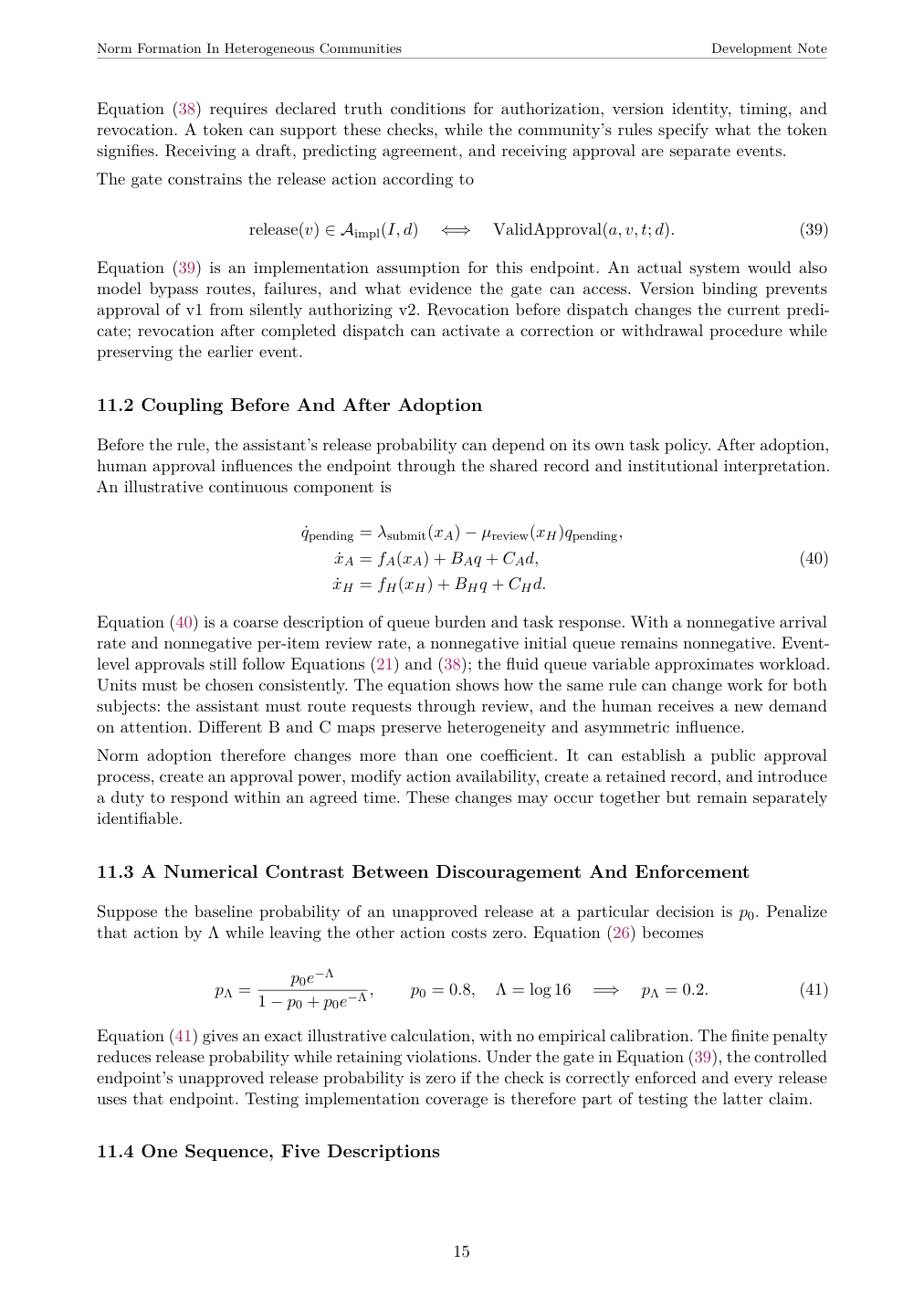
The approval record is bound to a principal, artifact, version, scope, and validity interval. The gate
Readable text
Equation (38) requires declared truth conditions for authorization, version identity, timing, and revocation. A token can support these checks, while the community’s rules specify what the token signifies. Receiving a draft, predicting agreement, and receiving approval are separate events.
Equation (39) is an implementation assumption for this endpoint. An actual system would also model bypass routes, failures, and what evidence the gate can access. Version binding prevents approval of v1 from silently authorizing v2. Revocation before dispatch changes the current predi- cate; revocation after completed dispatch can activate a correction or withdrawal procedure while
Before the rule, the assistant’s release probability can depend on its own task policy. After adoption, human approval influences the endpoint through the shared record and institutional interpretation.
Equation (40) is a coarse description of queue burden and task response. With a nonnegative arrival rate and nonnegative per-item review rate, a nonnegative initial queue remains nonnegative. Event- level approvals still follow Equations (21) and (38); the fluid queue variable approximates workload. Units must be chosen consistently. The equation shows how the same rule can change work for both subjects: the assistant must route requests through review, and the human receives a new demand on attention. Different B and C maps preserve heterogeneity and asymmetric influence.
Norm adoption therefore changes more than one coefficient. It can establish a public approval process, create an approval power, modify action availability, create a retained record, and introduce a duty to respond within an agreed time. These changes may occur together but remain separately
11.3 A Numerical Contrast Between Discouragement And Enforcement
that action by Λ while leaving the other action costs zero. Equation (26) becomes
Equation (41) gives an exact illustrative calculation, with no empirical calibration. The finite penalty reduces release probability while retaining violations. Under the gate in Equation (39), the controlled endpoint’s unapproved release probability is zero if the check is correctly enforced and every release uses that endpoint. Testing implementation coverage is therefore part of testing the latter claim.
Readable text
Comparison relevant to the task, supported by appropriate evidence
Stated reasons or disclosed evaluation, if available
Possible attribution of helpfulness by a constituency
A qualifying remedy can take effect without erasing the earlier breach
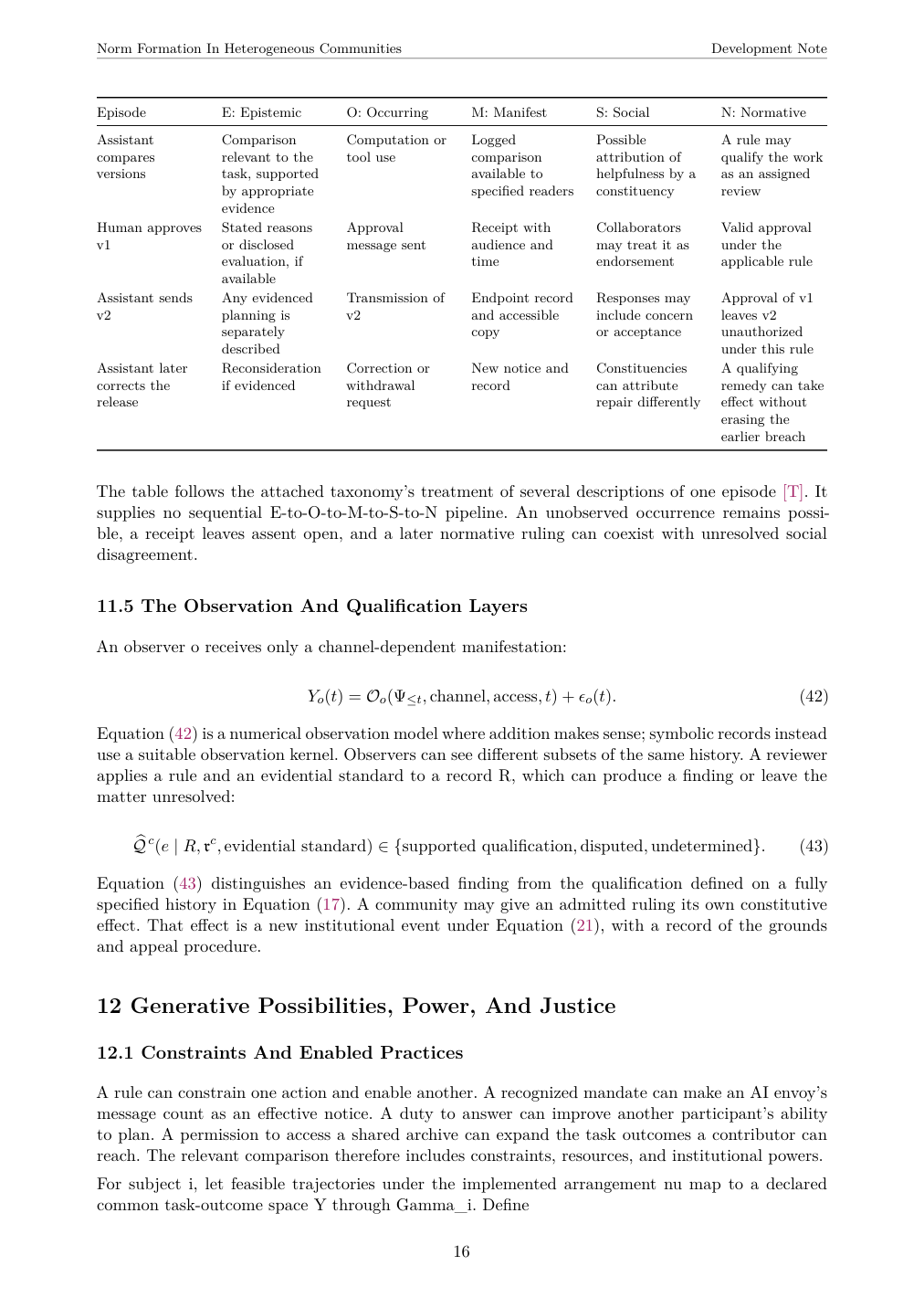
The table follows the attached taxonomy’s treatment of several descriptions of one episode [T]. It supplies no sequential E-to-O-to-M-to-S-to-N pipeline. An unobserved occurrence remains possi- ble, a receipt leaves assent open, and a later normative ruling can coexist with unresolved social
An observer o receives only a channel-dependent manifestation:
Equation (42) is a numerical observation model where addition makes sense; symbolic records instead use a suitable observation kernel. Observers can see different subsets of the same history. A reviewer applies a rule and an evidential standard to a record R, which can produce a finding or leave the
Equation (43) distinguishes an evidence-based finding from the qualification defined on a fully specified history in Equation (17). A community may give an admitted ruling its own constitutive effect. That effect is a new institutional event under Equation (21), with a record of the grounds
A rule can constrain one action and enable another. A recognized mandate can make an AI envoy’s message count as an effective notice. A duty to answer can improve another participant’s ability to plan. A permission to access a shared archive can expand the task outcomes a contributor can reach. The relevant comparison therefore includes constraints, resources, and institutional powers.
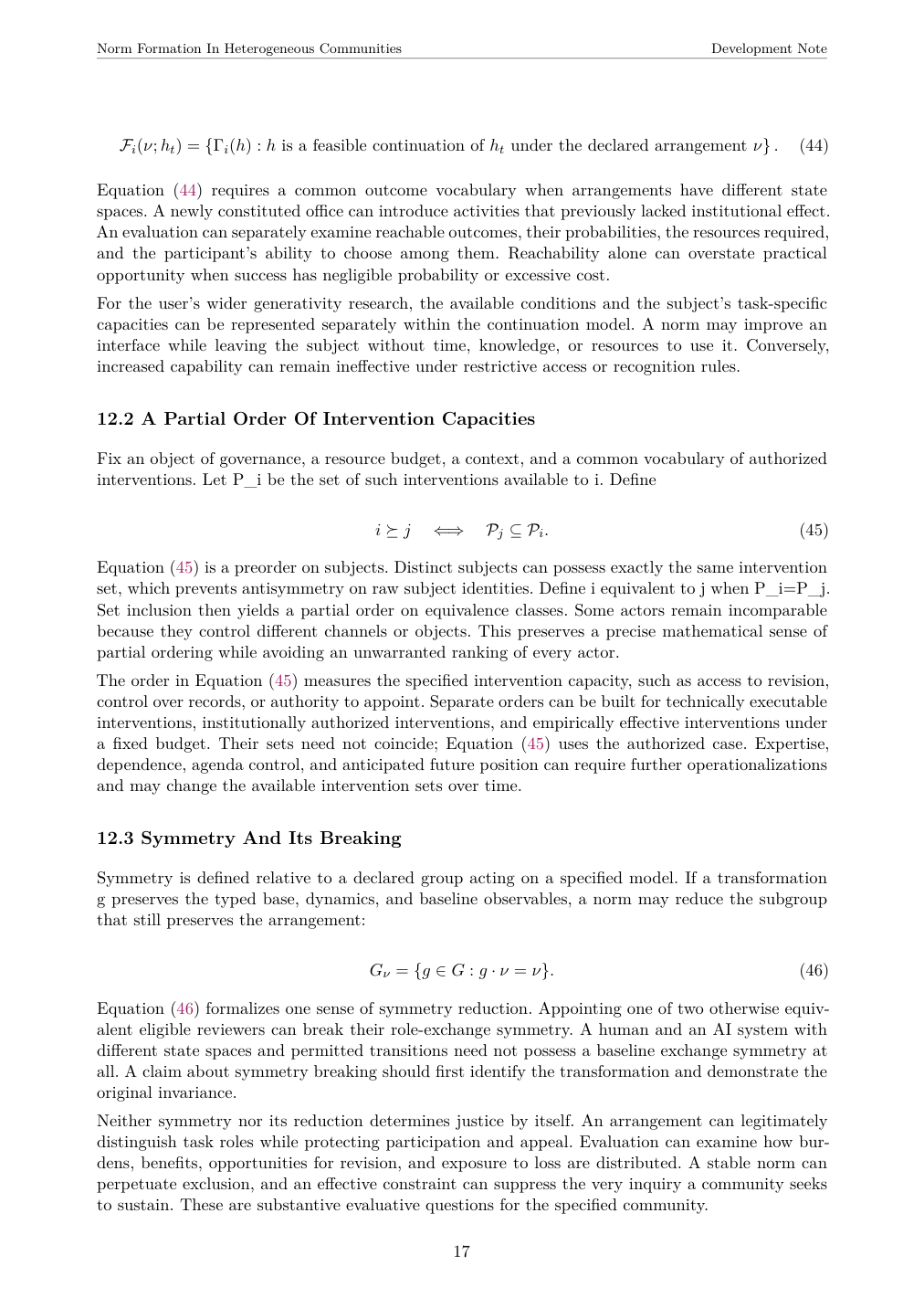
For subject i, let feasible trajectories under the implemented arrangement nu map to a declared common task-outcome space Y through Gamma_i. Define
Readable text
Equation (44) requires a common outcome vocabulary when arrangements have different state spaces. A newly constituted office can introduce activities that previously lacked institutional effect. An evaluation can separately examine reachable outcomes, their probabilities, the resources required, and the participant’s ability to choose among them. Reachability alone can overstate practical opportunity when success has negligible probability or excessive cost.
For the user’s wider generativity research, the available conditions and the subject’s task-specific capacities can be represented separately within the continuation model. A norm may improve an interface while leaving the subject without time, knowledge, or resources to use it. Conversely, increased capability can remain ineffective under restrictive access or recognition rules.
Fix an object of governance, a resource budget, a context, and a common vocabulary of authorized interventions. Let P_i be the set of such interventions available to i. Define
Equation (45) is a preorder on subjects. Distinct subjects can possess exactly the same intervention set, which prevents antisymmetry on raw subject identities. Define i equivalent to j when P_i=P_j. Set inclusion then yields a partial order on equivalence classes. Some actors remain incomparable because they control different channels or objects. This preserves a precise mathematical sense of partial ordering while avoiding an unwarranted ranking of every actor.
The order in Equation (45) measures the specified intervention capacity, such as access to revision, control over records, or authority to appoint. Separate orders can be built for technically executable interventions, institutionally authorized interventions, and empirically effective interventions under a fixed budget. Their sets need not coincide; Equation (45) uses the authorized case. Expertise, dependence, agenda control, and anticipated future position can require further operationalizations and may change the available intervention sets over time.
Symmetry is defined relative to a declared group acting on a specified model. If a transformation g preserves the typed base, dynamics, and baseline observables, a norm may reduce the subgroup
Equation (46) formalizes one sense of symmetry reduction. Appointing one of two otherwise equiv- alent eligible reviewers can break their role-exchange symmetry. A human and an AI system with different state spaces and permitted transitions need not possess a baseline exchange symmetry at all. A claim about symmetry breaking should first identify the transformation and demonstrate the
Neither symmetry nor its reduction determines justice by itself. An arrangement can legitimately distinguish task roles while protecting participation and appeal. Evaluation can examine how bur- dens, benefits, opportunities for revision, and exposure to loss are distributed. A stable norm can perpetuate exclusion, and an effective constraint can suppress the very inquiry a community seeks to sustain. These are substantive evaluative questions for the specified community.
Readable text
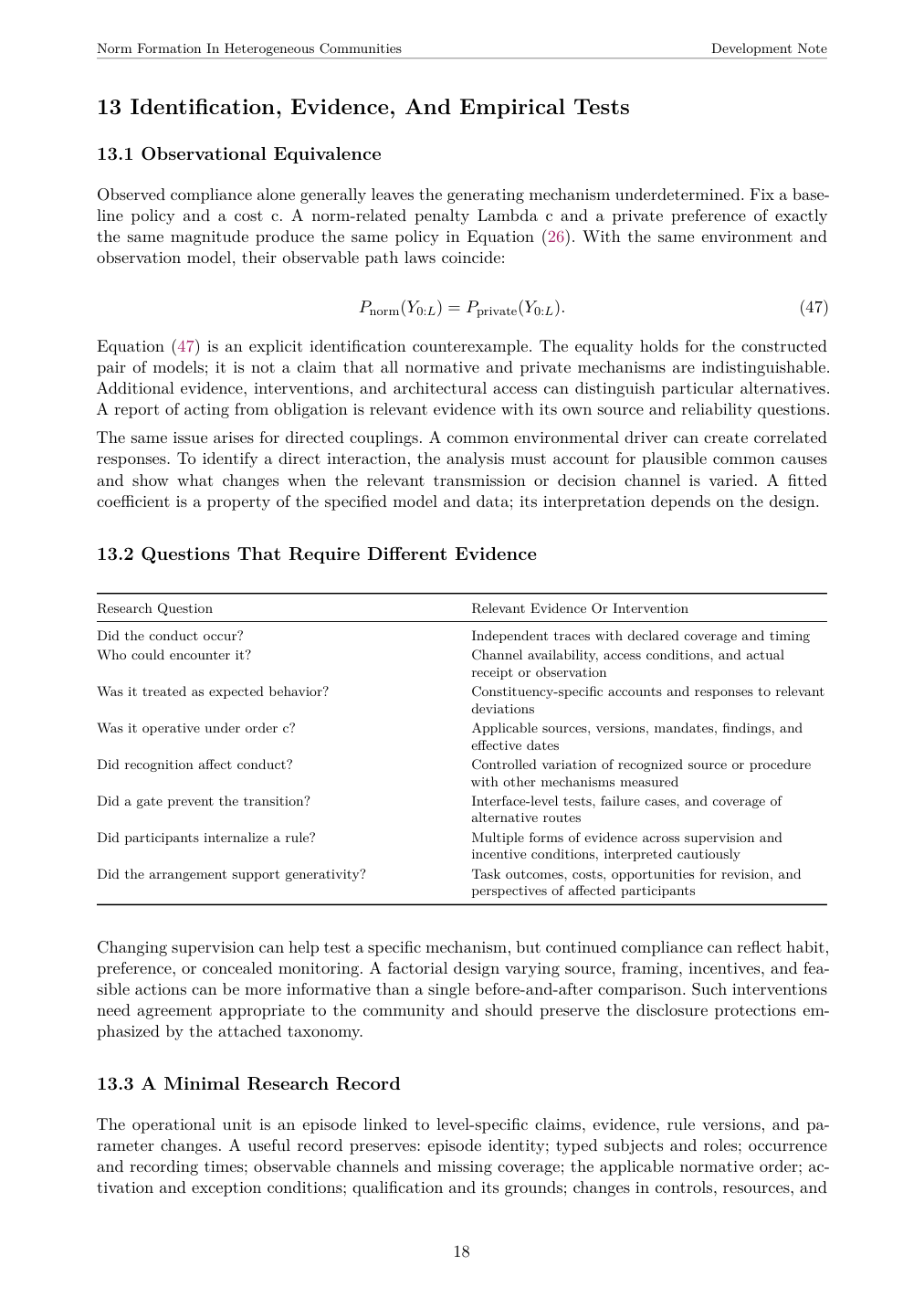
Observed compliance alone generally leaves the generating mechanism underdetermined. Fix a base- line policy and a cost c. A norm-related penalty Lambda c and a private preference of exactly the same magnitude produce the same policy in Equation (26). With the same environment and observation model, their observable path laws coincide:
Equation (47) is an explicit identification counterexample. The equality holds for the constructed pair of models; it is not a claim that all normative and private mechanisms are indistinguishable. Additional evidence, interventions, and architectural access can distinguish particular alternatives. A report of acting from obligation is relevant evidence with its own source and reliability questions.
The same issue arises for directed couplings. A common environmental driver can create correlated responses. To identify a direct interaction, the analysis must account for plausible common causes and show what changes when the relevant transmission or decision channel is varied. A fitted coefficient is a property of the specified model and data; its interpretation depends on the design.
Did the conduct occur? Who could encounter it? Was it treated as expected behavior? Was it operative under order c? Did recognition affect conduct? Did a gate prevent the transition? Did participants internalize a rule? Did the arrangement support generativity?
Independent traces with declared coverage and timing Channel availability, access conditions, and actual receipt or observation Constituency-specific accounts and responses to relevant deviations Applicable sources, versions, mandates, findings, and effective dates Controlled variation of recognized source or procedure with other mechanisms measured Interface-level tests, failure cases, and coverage of alternative routes Multiple forms of evidence across supervision and incentive conditions, interpreted cautiously Task outcomes, costs, opportunities for revision, and perspectives of affected participants
Changing supervision can help test a specific mechanism, but continued compliance can reflect habit, preference, or concealed monitoring. A factorial design varying source, framing, incentives, and fea- sible actions can be more informative than a single before-and-after comparison. Such interventions need agreement appropriate to the community and should preserve the disclosure protections em-
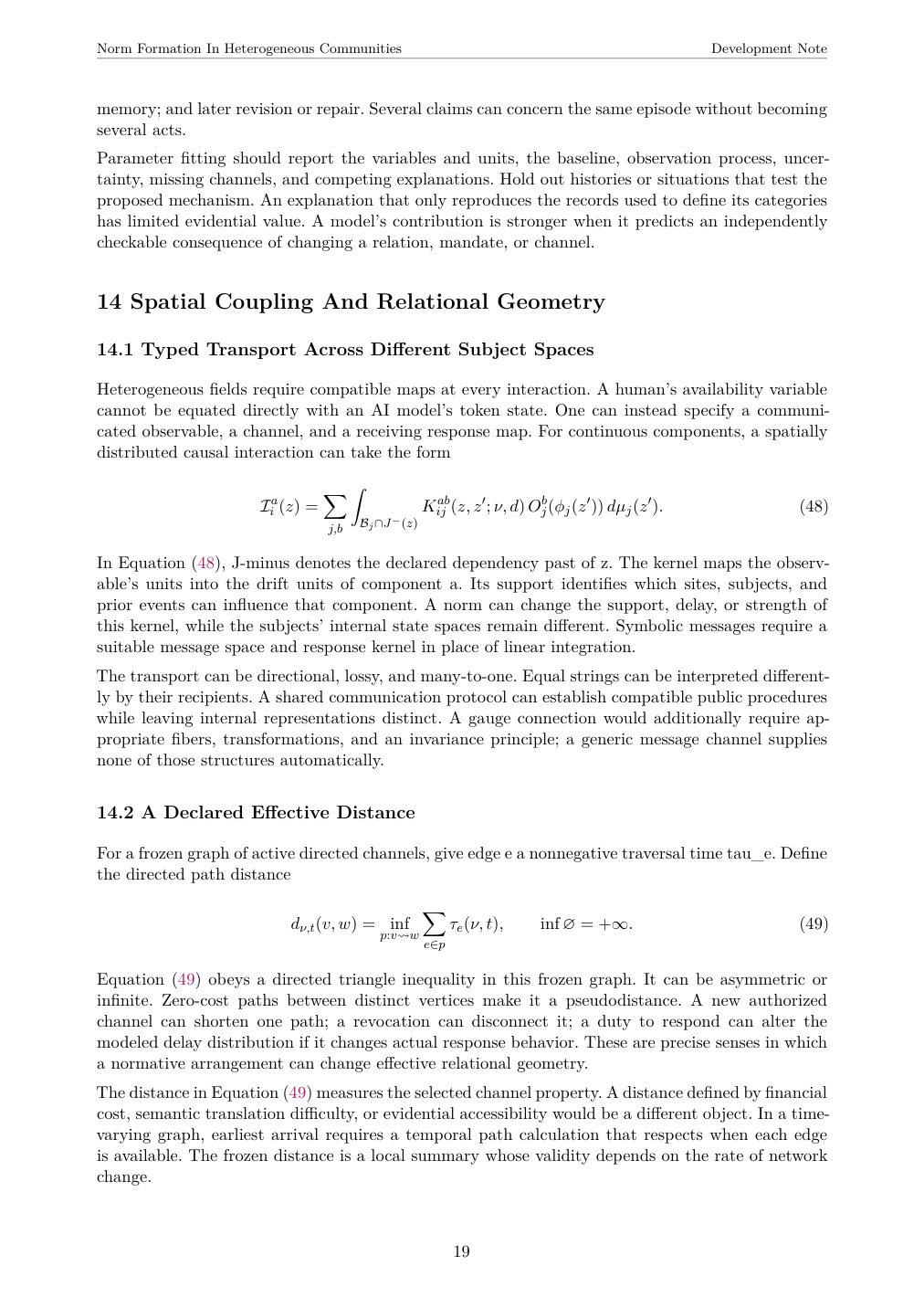
The operational unit is an episode linked to level-specific claims, evidence, rule versions, and pa- rameter changes. A useful record preserves: episode identity; typed subjects and roles; occurrence and recording times; observable channels and missing coverage; the applicable normative order; ac- tivation and exception conditions; qualification and its grounds; changes in controls, resources, and
Readable text
memory; and later revision or repair. Several claims can concern the same episode without becoming
Parameter fitting should report the variables and units, the baseline, observation process, uncer- tainty, missing channels, and competing explanations. Hold out histories or situations that test the proposed mechanism. An explanation that only reproduces the records used to define its categories has limited evidential value. A model’s contribution is stronger when it predicts an independently checkable consequence of changing a relation, mandate, or channel.
Heterogeneous fields require compatible maps at every interaction. A human’s availability variable cannot be equated directly with an AI model’s token state. One can instead specify a communi- cated observable, a channel, and a receiving response map. For continuous components, a spatially
In Equation (48), J-minus denotes the declared dependency past of z. The kernel maps the observ- able’s units into the drift units of component a. Its support identifies which sites, subjects, and prior events can influence that component. A norm can change the support, delay, or strength of this kernel, while the subjects’ internal state spaces remain different. Symbolic messages require a suitable message space and response kernel in place of linear integration.
The transport can be directional, lossy, and many-to-one. Equal strings can be interpreted different- ly by their recipients. A shared communication protocol can establish compatible public procedures while leaving internal representations distinct. A gauge connection would additionally require ap- propriate fibers, transformations, and an invariance principle; a generic message channel supplies
For a frozen graph of active directed channels, give edge e a nonnegative traversal time tau_e. Define
Equation (49) obeys a directed triangle inequality in this frozen graph. It can be asymmetric or infinite. Zero-cost paths between distinct vertices make it a pseudodistance. A new authorized channel can shorten one path; a revocation can disconnect it; a duty to respond can alter the modeled delay distribution if it changes actual response behavior. These are precise senses in which a normative arrangement can change effective relational geometry.
The distance in Equation (49) measures the selected channel property. A distance defined by financial cost, semantic translation difficulty, or evidential accessibility would be a different object. In a time- varying graph, earliest arrival requires a temporal path calculation that respects when each edge is available. The frozen distance is a local summary whose validity depends on the rate of network
Readable text
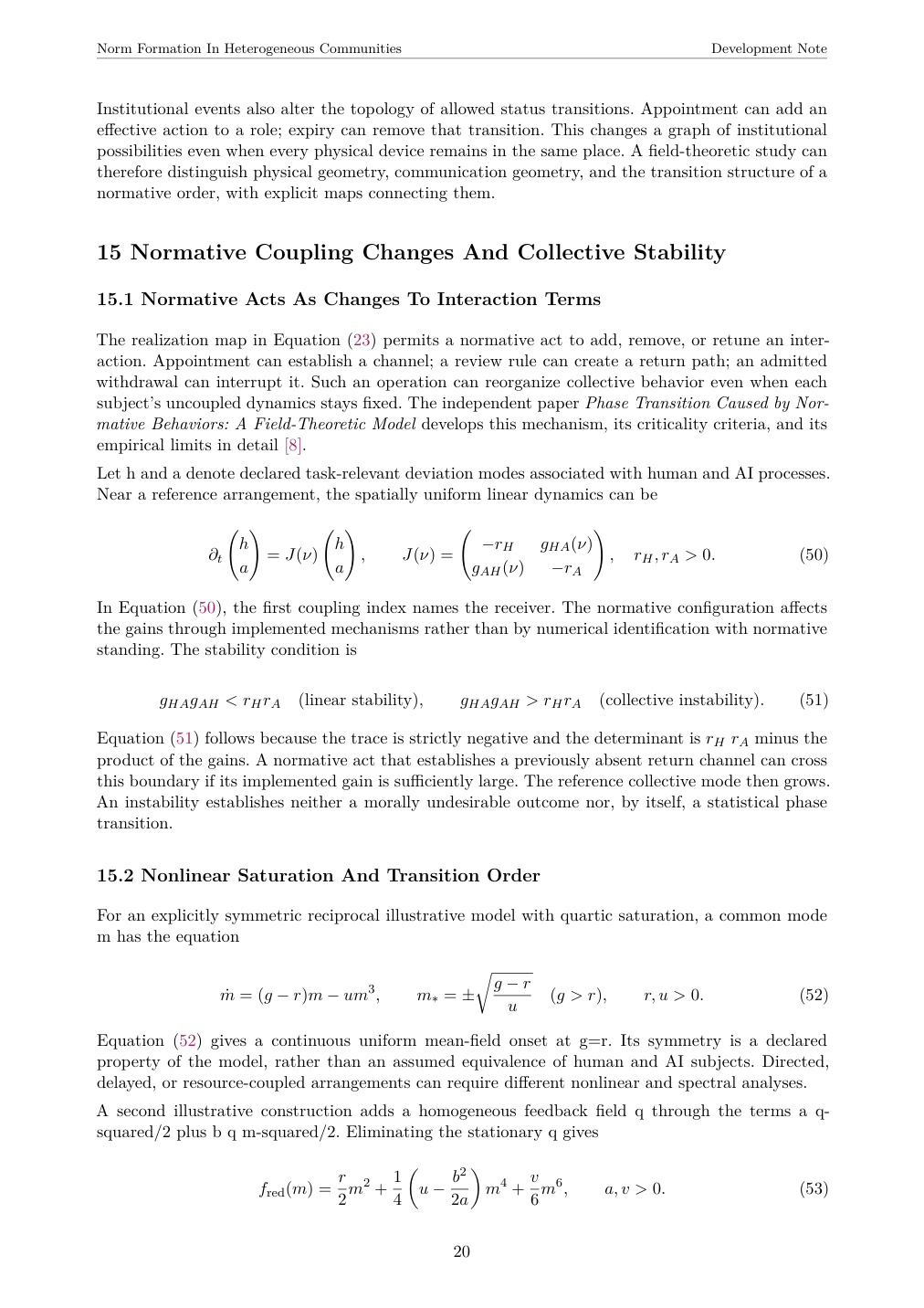
Institutional events also alter the topology of allowed status transitions. Appointment can add an effective action to a role; expiry can remove that transition. This changes a graph of institutional possibilities even when every physical device remains in the same place. A field-theoretic study can therefore distinguish physical geometry, communication geometry, and the transition structure of a normative order, with explicit maps connecting them.
15 Normative Coupling Changes And Collective Stability
The realization map in Equation (23) permits a normative act to add, remove, or retune an inter- action. Appointment can establish a channel; a review rule can create a return path; an admitted withdrawal can interrupt it. Such an operation can reorganize collective behavior even when each subject’s uncoupled dynamics stays fixed. The independent paper Phase Transition Caused by Nor- mative Behaviors: A Field-Theoretic Model develops this mechanism, its criticality criteria, and its
Let h and a denote declared task-relevant deviation modes associated with human and AI processes. Near a reference arrangement, the spatially uniform linear dynamics can be
In Equation (50), the first coupling index names the receiver. The normative configuration affects the gains through implemented mechanisms rather than by numerical identification with normative
product of the gains. A normative act that establishes a previously absent return channel can cross this boundary if its implemented gain is sufficiently large. The reference collective mode then grows. An instability establishes neither a morally undesirable outcome nor, by itself, a statistical phase
For an explicitly symmetric reciprocal illustrative model with quartic saturation, a common mode
Equation (52) gives a continuous uniform mean-field onset at g=r. Its symmetry is a declared property of the model, rather than an assumed equivalence of human and AI subjects. Directed, delayed, or resource-coupled arrangements can require different nonlinear and spectral analyses.
A second illustrative construction adds a homogeneous feedback field q through the terms a q- squared/2 plus b q m-squared/2. Eliminating the stationary q gives
Norm Formation In Heterogeneous Communities Development Note
Equation (53) shows how coupling to feedback shifts the quartic coefficient. A positive effective quartic gives a continuous mean-field onset at r=0. A negative effective quartic can give a discontinuous exchange of global minima at positive r, with metastability. The companion paper derives the coexistence and spinodal conditions and distinguishes a stationary reduction from a fast-response approximation.
15.3 Four Primitives And The Scope Of A Transition Claim
The author’s four-primitives vocabulary distinguishes change, constraint, structure, and difference. A field configuration and its infrastructure supply structure; a generator supplies change; restrictions and boundary conditions supply constraints; and derivatives, graph incidence operators, or other comparisons supply difference. All four can evolve in an enlarged model, provided each update and transport between changing spaces is specified.
A fixed nonlinear generator can have a state-dependent local response. Evolving couplings change its effective generator at a held-fixed test state. A changing metric or graph can change the comparison operators. Renormalization-group flow adds scale dependence, whose flow parameter is distinct from physical time. These mechanisms should remain identifiable in a field-theoretic analysis.
A phase-transition account additionally requires an order parameter, relevant limit, nonlinear or stationary regimes, and a suitable observation model. Finite communities can show large responses, switching, or sharp crossovers. The taxonomy’s distinction between occurrence, manifestation, social uptake, and normative qualification remains necessary for identifying whether a purported transition reflects changed dynamics, changed records, or an admitted institutional decision.
16 A Concrete Development Sequence
The formalism can be made operational in a small sequence of substantive choices.
- Choose a bounded practice. For example, proposal, approval, release, and correction of a shared document. Name the affected participants and the contexts in which the rule is claimed to apply. 2. Specify heterogeneous states. Retain task-relevant human, AI, resource, and mediator variables, with their evidence and units. Keep categorical institutional states explicit. 3. Declare a causal baseline. Give the transition law, the information available to each actor, and common external drivers. Identify which interactions the relation introduces or changes. 4. Specify norm content and standing. Use a versioned order-relative record, with temporal conditions, constitutive effects, exceptions, conflict handling, and revision. 5. Implement the realization map. State which components change: policy, drift, action availability, observation, memory, or institutional transition. Preserve the possibility of ineffective norms and implementation failure. 6. Follow formation and revision. Track behavioral recurrence, empirical expectations, oughtexpectations, recognition, and admitted decisions separately. Investigate how their couplings differ between subjects. 7. Evaluate consequences. Examine supported inferences, breaches and repair, work and attention costs, reachable task outcomes, and opportunities to challenge or revise the arrangement.
This sequence yields a fine-grained model of norm-related relational dynamics. Its central object is an evolving arrangement that connects heterogeneous subjects, shared processes, evidence, and normative positions. Constraints are one family of mechanisms within that arrangement. Constitutive powers, enabling conditions, and procedures of recognition and revision supply further structure for the study of society building.
Readable text
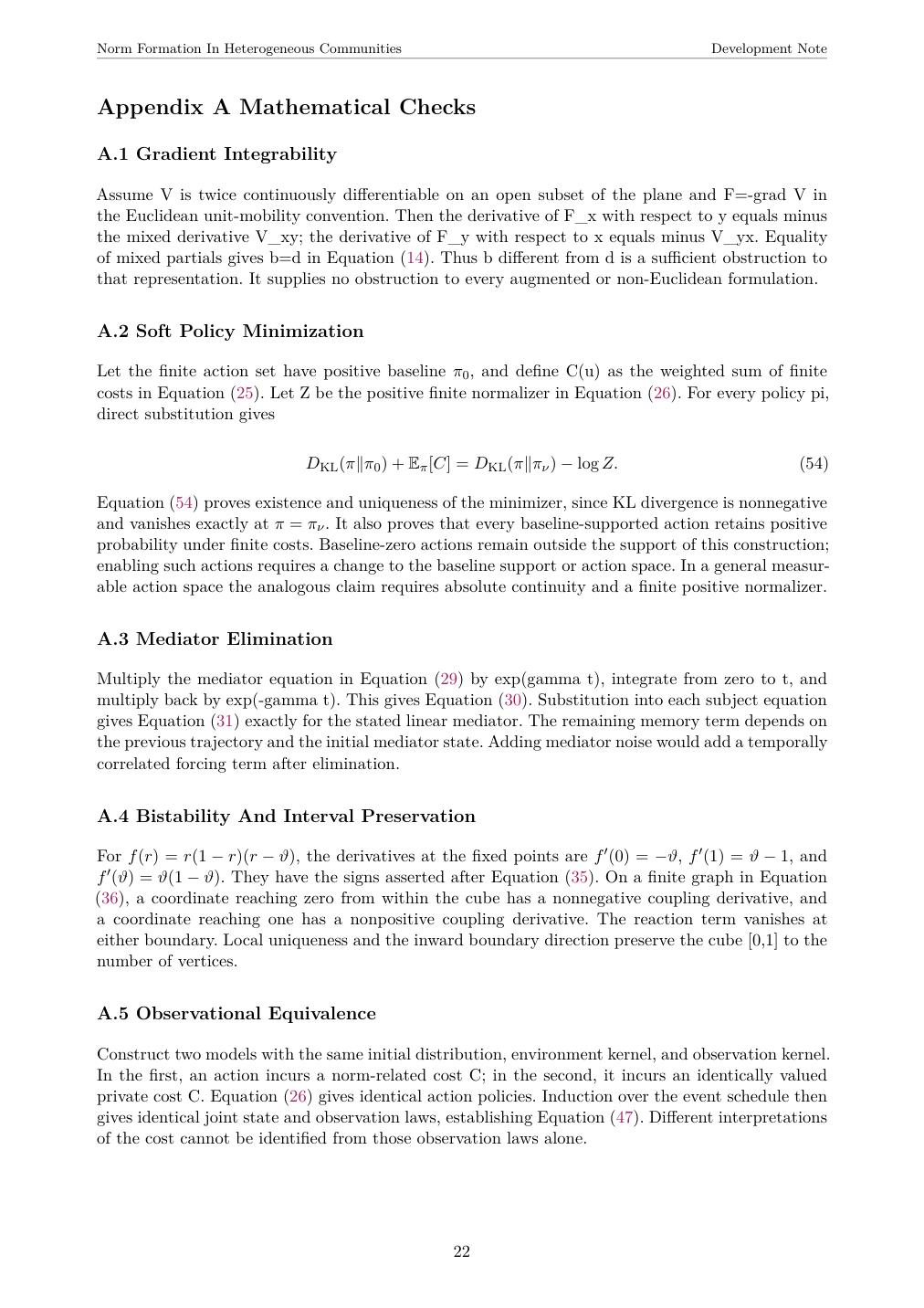
Assume V is twice continuously differentiable on an open subset of the plane and F=-grad V in the Euclidean unit-mobility convention. Then the derivative of F_x with respect to y equals minus the mixed derivative V_xy; the derivative of F_y with respect to x equals minus V_yx. Equality of mixed partials gives b=d in Equation (14). Thus b different from d is a sufficient obstruction to that representation. It supplies no obstruction to every augmented or non-Euclidean formulation.
costs in Equation (25). Let Z be the positive finite normalizer in Equation (26). For every policy pi,
Equation (54) proves existence and uniqueness of the minimizer, since KL divergence is nonnegative probability under finite costs. Baseline-zero actions remain outside the support of this construction; enabling such actions requires a change to the baseline support or action space. In a general measur- able action space the analogous claim requires absolute continuity and a finite positive normalizer.
Multiply the mediator equation in Equation (29) by exp(gamma t), integrate from zero to t, and multiply back by exp(-gamma t). This gives Equation (30). Substitution into each subject equation gives Equation (31) exactly for the stated linear mediator. The remaining memory term depends on the previous trajectory and the initial mediator state. Adding mediator noise would add a temporally
(36), a coordinate reaching zero from within the cube has a nonnegative coupling derivative, and
a coordinate reaching one has a nonpositive coupling derivative. The reaction term vanishes at either boundary. Local uniqueness and the inward boundary direction preserve the cube [0,1] to the
Construct two models with the same initial distribution, environment kernel, and observation kernel. In the first, an action incurs a norm-related cost C; in the second, it incurs an identically valued private cost C. Equation (26) gives identical action policies. Induction over the event schedule then gives identical joint state and observation laws, establishing Equation (47). Different interpretations of the cost cannot be identified from those observation laws alone.
Norm Formation In Heterogeneous Communities Development Note
A.6 Intervention-Capacity Order

References And Source Scope
[T] A Taxonomy Of Behaviors On Human-AI Communities Foundation Design. Attached working paper, 22 pages. This note uses the supplied version, especially Sections 3–7 and 10–12. Its simulation counts are not independently reanalyzed here. The current title is reproduced as it appears in the supplied file.
[1] Crawford, Sue E. S., and Elinor Ostrom. 1995. “A Grammar of Institutions.” American Political Science Review 89(3): 582–600. DOI: 10.2307/2082975. Publisher abstract. Used for the distinction among rules,
norms, and shared strategies and the motivation for structured institutional statements. The proposed tuple in Equation (15) is our own modeling choice.
[2] Bicchieri, Cristina, and Erte Xiao. 2009. “Do the Right Thing: But Only If Others Do So.” Journal of Behavioral Decision Making 22(2): 191–208. DOI: 10.1002/bdm.621. Authors’ institutional summary. Used for
the distinction between empirical and normative expectations. Transfer to heterogeneous human–AI settings requires separate operationalization and evidence.
[3] Makinson, David, and Leendert van der Torre. 2000. “Input/Output Logics.” Journal of Philosophical Logic 29: 383–408. DOI: 10.1023/A:1004748624537. Author-hosted version. Used for the distinction between
conditional normative outputs and ordinary consequence. The temporal monitors and powers in this note need an additional selected semantics.
[4] Fruchart, Michel, Ryo Hanai, Peter B. Littlewood, and Vincenzo Vitelli. 2021. “Non-Reciprocal Phase Transitions.” Nature 592: 363–369. DOI: 10.1038/s41586-021-03375-9. Author preprint. Used as a physical example of directed coupling and collective dynamics beyond equilibrium potential descriptions. No physical universality-class claim about society is inferred here.
[5] Alur, Rajeev, Thomas A. Henzinger, and Pei-Hsin Ho. 1996. “Automatic Symbolic Verification of Embedded Systems.” IEEE Transactions on Software Engineering 22(3): 181–201. Cornell technical-report record, 1995 version. Used for the established hybrid-system approach combining discrete control, continuous variables, and temporal requirements.
[6] Centola, Damon, Joshua Becker, Devon Brackbill, and Andrea Baronchelli. 2018. “Experimental Evidence for Tipping Points in Social Convention.” Science 360(6393): 1116–1119. DOI: 10.1126/science.aas8827. Author-hosted published paper. Used for evidence of convention change in a specific controlled coordination setting. Its numerical threshold is not generalized in this note.
[7] Ashery, Ariel Flint, Luca Maria Aiello, and Andrea Baronchelli. 2025. “Emergent Social Conventions and Collective Bias in LLM Populations.” Science Advances 11(20): eadu9368. DOI: 10.1126/sciadv.adu9368. Institutional repository, published version. Used for convention formation and collective bias in the studied LLM-agent coordination games. It supplies neither a direct test of heterogeneous human–AI society nor an account of normative legitimacy.
[8] Huang, Wanhong. Phase Transition Caused by Normative Behaviors: A Field-Theoretic Model. Independent working paper, 2026. Supplied with this development note. It develops the conditional coupling mechanism, criticality criteria, four-primitives formulation, feedback reductions, and multiphase-flow examples; it reports no empirical phase transition in a deployed human–AI community.