Behavioral Relations In Community Planning - A Generative–Relational Discussion
Full text from the PDF
Behavioral Relations In Community Planning: A
Generative–Relational Discussion
Wanhong Huang
Abstract. Community planning concerns relations through which diverse forms of behavior arise, recur, and change. These relations involve material arrangements, shared histories, norms, and the distribution of authority. This paper develops a generative–relational discussion of their formation and their implications for planning and policymaking in urban and human–AI communities. A structured interdisciplinary narrative survey connects economics, activity theory, social reproduction, spatial inquiry, aesthetics, governance, and natural language processing. The framework distinguishes occurrences, practical roles, experienced qualities, and observer-dependent records. It examines enabling requirements alongside valued participation, allowing movement and coordination to have significance beyond their contribution to another task. Historical reconstruction and locally specified dynamics support inquiry into the formation of activities, evaluative standards, and power over participation. Evaluation and optimization enter as conditional methods within this broader analysis, with heterogeneous criteria, preservation requirements, and opportunities for revision. Formal results concern observational identification, contextual intervention orders, and feasible-set inclusion; synthetic illustrations expose their assumptions. An extended survey examines the reconstruction of expressed values and contextual norms from interviews, conversations, speeches, articles, and institutional texts. It distinguishes stable measurement from persistent social patterns and evidence of dynamical attraction. A proposed architecture connects provenance-preserving claim records, interpretive inquiry, computational representations, longitudinal mechanism testing, and practical deliberation. New constructions illustrate identical aggregate distributions under different dynamics, coordinated relabeling, and trajectory-dependent comparisons. Published studies and constructed cases clarify the scope of application, while an inquiry protocol specifies how participant review, independent evidence, and reversible interventions can test the framework. The discussion proposes a framework for examining community arrangements and their possible revision, with explicit records of evidential limits, affected perspectives, and authority over change.
Keywords: Community Planning; Behavioral Relations; Human–AI Communities; Norm Formation; Historical Spacetime.
Notes On The Research
Scope Of The Inquiry
The manuscript presents an interdisciplinary research proposal and philosophical analysis for community planning and policymaking. The literature survey provides verified points of contact across economics, urban studies, social theory, aesthetics, governance, human–AI collaboration, and computational language analysis. The framework’s concepts and taxonomies are paper-local analytical proposals. Mathematical propositions establish consequences of stated assumptions. The numerical illustrations use synthetic data and explicitly specified dynamics. The proposed interview and language-analysis protocol has not been implemented as an empirical community study. Its role is to specify a concrete route for testing the framework.
Status Of The Analytical Definitions
Definitions delimit the present inquiry and remain open to revision. Relational, temporal, network, order-theoretic, and dynamical representations organize selected aspects of activities and their conditions. Their adequacy depends on interpretation, empirical access, and the purpose of inquiry. Generativity refers locally to the formation, transformation, and continuation of possibilities through changing capacities, relations, and conditions. Its normative appraisal is developed through explicit reasons, affected perspectives, and attention to consequences.
AI Assistance In The Research Process
AI assistance supported literature retrieval, source verification, conceptual development, drafting, formal checking, programming, and typesetting. The accompanying source package contains the bibliography, a reference verification ledger, complete manuscript sources, and the code and data used for the original illustrations. Interpretive and methodological choices are stated in the manuscript so that readers can examine and revise them. This version remains available for author review and scholarly criticism.
License For The Research Materials
© 2026 Wanhong Huang. Original manuscript text, code, and original figures are offered under
the Creative Commons Attribution–NonCommercial 4.0 International license. Bibliographic materials and third-party works remain subject to their respective terms.
1 Introduction
Collective life involves diverse forms of behavior whose significance develops through bodies, environments, relationships, and histories. A journey may provide access to employment, sustain a friendship, permit recovery after demanding work, and become an aesthetic experience. A shared archive may support an immediate research task while preserving the conditions for later interpretation. A community discussion may produce a decision and also transform the vocabulary through which subsequent decisions become intelligible. These examples motivate the paper’s object: the generative relations through which activities, enabling conditions, evaluative standards, and practical possibilities develop together.
Behavior serves here as a broad term for conduct, interaction, and response. Activity provides a more specified description of situated participation, with its boundaries and relations stated by the inquiry. Attributions of intention, purpose, and experienced significance remain open to further investigation.
The practical motivation is community planning and policymaking. Planning is used here for the continuing organization of conditions for collective life, including spatial arrangements, shared services, digital infrastructures, responsibilities, and procedures for revising decisions. Policy concerns the rules, resource commitments, and institutional arrangements through which some of those conditions are maintained or changed. Activity analysis contributes by explaining what participants do, how conduct becomes possible, what interdependencies sustain it, and how an intervention may alter those relations. Evaluation supplies reasons for comparing possibilities; optimization can support a specified comparison when its assumptions are adequate. Both belong within an inquiry whose scope also includes explanation, historical understanding, the generation of alternatives, and the formation of shared purposes.
The inquiry begins with an economic question about the resources needed to make activity possible. Household production theory, social provisioning, and cooperative-work research provide several relevant concepts, including time inputs, social reproduction, and articulation work [5, 64, 71]. The question expands when an enabling process also constitutes something participants value. Transport research explicitly distinguishes the value of destinations, activities during journeys, and travelling itself [51]. An assessment of transport as an overhead therefore requires an account of the focal activity, the affected participants, and the qualities an alternative arrangement would preserve or transform.
To examine these dependencies, the paper takes an evolving configuration of activities and their conditions as its analytical object. Activities are approached through situated episodes, recurrent practices, and longer projects. Their conditions include embodied capacities, material and digital arrangements, available time, shared understandings, access rules, and relations of authority. Norms and evaluative categories also belong to the configuration: they help determine which activities receive recognition, support, resources, and permission to continue. A street, a neighbourhood, or a human–AI community provides a tractable site for inquiry while remaining connected to wider histories and infrastructures.
The term generative–relational identifies the paper’s orientation toward the formation and alteration of possibilities through relations. Generative capacity denotes a subject’s or organized system’s ability to contribute to such processes under specified circumstances. Generative conditions denote the surrounding arrangements through which capacities can be exercised, supported, redirected, or constrained. A skilled musician, for example, possesses capacities whose realization depends on instruments, time, compatible participants, a place to perform, and an audience or other intended setting. The distinction remains relational because capacities develop through prior conditions and their exercise can alter subsequent conditions.
The framework retains ontological suspension. Event descriptions, networks, state spaces, and partial orders offer different representations with specific purposes. Their compatibility is assessed at explicit interfaces. A mathematical representation of a care relation supports certain questions about timing, dependency, or resource incidence; interpretation and lived experience provide other forms of access. The manuscript consequently treats formalization as an accountable analytical operation whose scope can be examined.
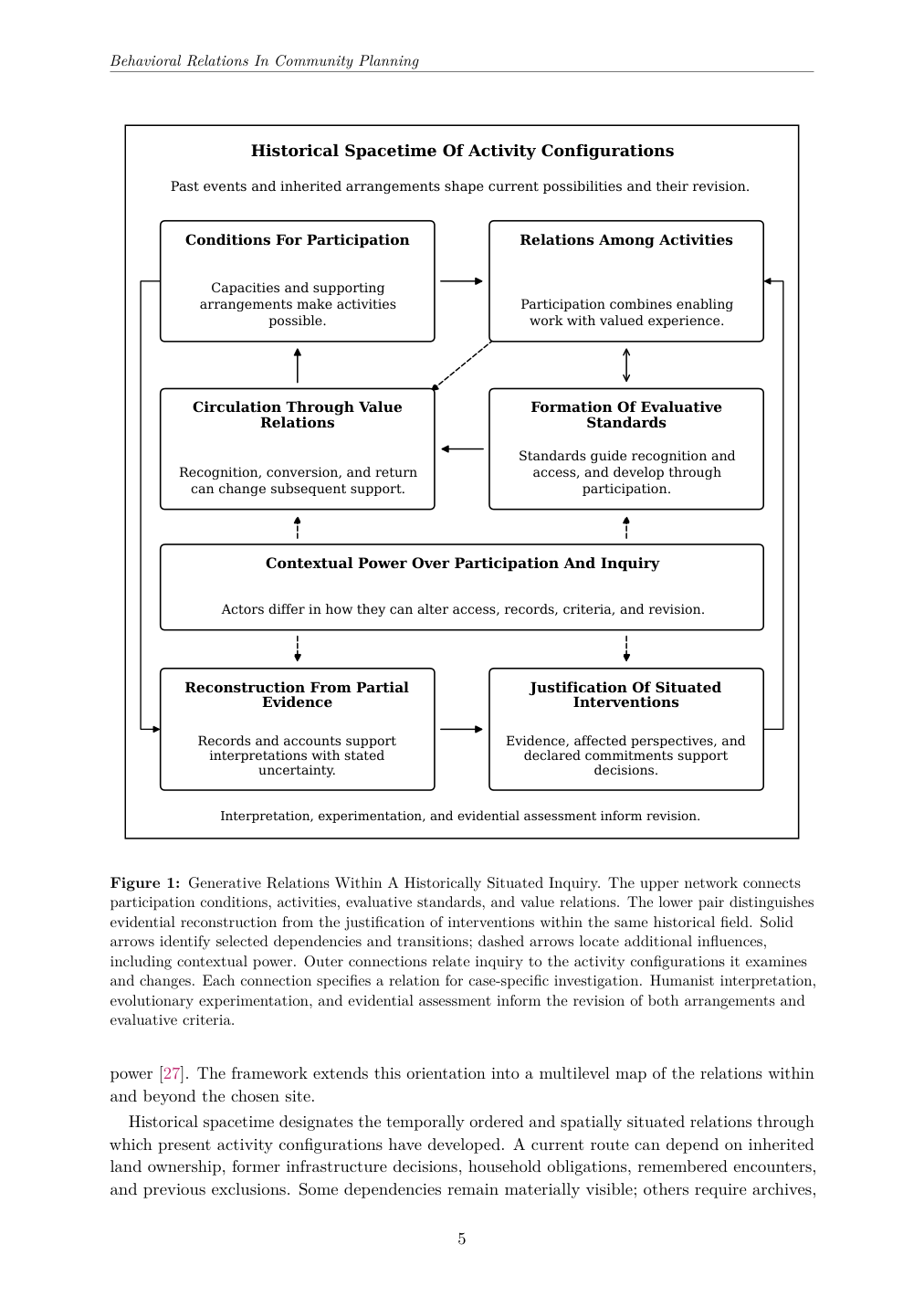
Figure 1 provides an overview of the proposed relations. The upper network locates activity within the formation of conditions, standards, and value relations. The lower pair locates evidence reconstruction and reasoned appraisal within that same historical field. Contextual power affects both participation and the inquiry through which its consequences become visible. The diagram organizes questions for investigation; the interpretation of each relation depends on the case, evidence, and evaluative commitments.
Urban and human–AI settings serve complementary purposes. Streets concentrate bodily movement, material design, public encounters, and visible regulation. Human–AI communities make communication, context reconstruction, technical maintenance, and evaluative mediation especially salient. Both settings allow inquiry into the allocation of enabling work, the formation of common standards, the persistence of histories, and the revision of participation conditions. Their comparison concerns selected structural relations; empirical mechanisms retain their domain specificity.
Within these configurations, an activity’s evaluation depends partly on historically formed standards. Speed can become evidence of competence; quietness can become a sign of civic order; visible novelty can become a criterion for creative achievement. The framework examines the emergence, reinforcement, interpretation, and revision of such standards. Empirical expectations concern what participants anticipate others will do. Normative expectations concern what participants believe relevant others think they ought to do. Personal endorsement, practical compliance, and public justification provide additional objects of inquiry [8].
The inquiry examines norms whose reproduction exhibits attraction or persistence under specified dynamics. The paper develops this inquiry through locally specified models of recurrence, convergence, persistence, and transition. Evolutionary work on conventions and social norms supplies a substantial precedent [84, 85]. Eglash and Garvey also explicitly connect basins of attraction with generative justice and social ecologies [23]. The present proposal brings the formation of the evaluative apparatus into the same research architecture as activity organization, historical reconstruction, and power over representation. The contribution is formulated as a structured integration and a set of operational distinctions whose usefulness requires further examination.
A central distinction concerns dynamical attraction, expressed endorsement, and normative justification. A recurrent pattern can be sustained through coordination benefits, shared experience, sanctions, restricted alternatives, unequal visibility, or combinations of these mechanisms. The pattern’s persistence supports a question about its reproduction. Its justification requires reasons concerning affected subjects, consequences, opportunities, and the conditions under which judgments can be challenged. This distinction permits the study of endogenous standards while retaining a substantive practice of criticism.
Power enters the analysis through the ability to alter relevant possibilities: access to places, allocation of time and resources, recognition of activities, enforcement of norms, preservation of records, and revision of evaluative procedures. Planning research has developed situated methods for relating judgments of desirability to distributions of gains and losses and to mechanisms of
Readable text
Past events and inherited arrangements shape current possibilities and their revision.
Capacities and supporting arrangements make activities
Actors differ in how they can alter access, records, criteria, and revision.
Interpretation, experimentation, and evidential assessment inform revision.
Figure 1: Generative Relations Within A Historically Situated Inquiry. The upper network connects participation conditions, activities, evaluative standards, and value relations. The lower pair distinguishes evidential reconstruction from the justification of interventions within the same historical field. Solid arrows identify selected dependencies and transitions; dashed arrows locate additional influences, including contextual power. Outer connections relate inquiry to the activity configurations it examines and changes. Each connection specifies a relation for case-specific investigation. Humanist interpretation, evolutionary experimentation, and evidential assessment inform the revision of both arrangements and
power [27]. The framework extends this orientation into a multilevel map of the relations within
Historical spacetime designates the temporally ordered and spatially situated relations through which present activity configurations have developed. A current route can depend on inherited land ownership, former infrastructure decisions, household obligations, remembered encounters, and previous exclusions. Some dependencies remain materially visible; others require archives,
testimony, or comparison with alternative explanations. Temporal duration, recurring rhythms, and sequence are therefore represented alongside spatial distance. The task is to reconstruct an evidentially warranted family of interpretations of activities and their formation.
The distinction between an observed trajectory and an interpreted activity is particularly consequential. Coordinates and timestamps may describe a journey while leaving its purpose and experience unresolved. Work combining GPS with travel diaries demonstrates the practical importance of obtaining additional information about purposes and accompaniment [47]. The same concern applies to logs of human–AI interaction: message counts and output volumes require interpretation before they can inform claims about understanding, contribution, or flourishing.
The paper addresses these analytical requirements through six connected contributions. First, it proposes a layered, overlapping taxonomy of activities that separates occurrences, functions, and modes of experience. Second, it defines enabling requirements and overhead relative to activities, participants, temporal horizons, and preservation conditions. Third, it places norms, evaluative authority, and value formation within historical activity configurations. Fourth, it specifies formal interfaces, including observational identification, context-dependent power orders, and constrained comparisons of alternative arrangements. Fifth, it develops reproducible synthetic illustrations of regime persistence, preservation-constrained design evaluation, and observational underidentification. Sixth, it integrates humanist, evolutionary, and evidence-based inquiry through an explicit record of consequential translations among observations, classifications, evaluations, and decisions.
The distinctive proposal concerns the accountability of these interfaces. Historical activity systems, diagnostic governance frameworks, critical spatial theory, and generative justice already provide substantial resources for examining changing practices and institutions. The present architecture brings selected distinctions into a common inquiry protocol while preserving their theoretical differences. Its minimal interface record states what is being translated, what the translation preserves or omits, who authorizes its use, whose activities are affected, and which evidence or reasons would warrant revision. Comparative assessment can then examine whether that protocol improves an inference or decision at a proportionate investigative cost.
The framework also develops a route from behavioral description to practical reconstruction. A taxonomy supplies distinctions through which episodes can be described; generative accounts investigate the mechanisms through which those episodes and descriptions arise. Historical and longitudinal evidence then supports locally specified models of changing relations. Interviews, speeches, discussions, and articles contribute records of value claims and normative expectations. Their computational analysis can assist retrieval, contextual comparison, and the examination of temporal patterns. Appendix B surveys the relevant natural language processing research and develops an explicit interface between linguistic evidence and relational dynamics. It keeps the reliability of a representation, the persistence of a social pattern, and the justification of a policy analytically distinct.
Section 2 explains the survey and verification method. Section 3 organizes the disciplinary connections and theoretical comparators. The subsequent conceptual sections develop activities, costs, aesthetics, histories, norms, power, and value formation. Section 12 states the formal interfaces; Section 13 presents their numerical illustrations. The applied sections develop inquiry methods, published urban evidence, synthetic street cases, and human–AI communities. Section 17 identifies empirical and conceptual research programmes, and Section 18 states the resulting scope of the framework. Appendix A documents the computational materials. Appendix B provides the extended language-research survey, a reconstruction architecture, and a proposed protocol for community planning.
2 Methods For An Interdisciplinary Narrative Review
The survey establishes conceptual and evidential connections needed for the proposed metaframework. Its method is a structured interdisciplinary narrative review organized around explicit analytical problems. The review combines primary theoretical texts, original empirical research, author-hosted manuscripts, publisher records, and official methodological guidance. The search and verification work was conducted through 27 November 2026. Coverage follows conceptual relevance and claim support; the record is suitable for examining the manuscript’s sources and extending its inquiry.
2.1 Search Domains For The Activity Framework
The search was organized around eight domains. The first concerns activity, practice, and the relation between observed behaviour and interpreted purposes. The second concerns the costs of enabling and sustaining participation, including time allocation, coordination, and social reproduction. The third concerns transport, accessibility, and historical spatial arrangements. The fourth concerns aesthetic and relational experience. The fifth concerns norm formation, dynamical stabilization, and the transformation of evaluative expectations. The sixth concerns power, governance, and value circulation. The seventh concerns methods of inquiry and intervention, including human–AI collaboration. The eighth concerns computational representations of values and norms from language, their validation, and their use in longitudinal reconstruction.
Search phrases combined a conceptual term with a relevant mechanism or application. Examples include articulation work and overhead; household production and time allocation; activity-based travel and purpose; social reproduction and depletion; norm dynamics and stochastic stability; generative justice and basins of attraction; power and planning; and human–AI collaboration and collective diversity. Initial results were followed to primary sources where accessible. Bibliographic searches were also used to distinguish publication dates from online-hosting dates and to check the scope of particular claims.
The search architecture reflects the problem’s interdisciplinarity. A keyword such as overhead can refer to an accounting category, cooperative-work requirements, or shared infrastructural capital. A search confined to one discipline would therefore risk importing a narrow meaning into a broader inquiry. The review instead records the analytical role of each concept and the level at which it can be related to the proposed framework. Similar wording across traditions is treated as a reason for comparison and examination.
2.2 Verification Of Sources For Manuscript Use
Each external source was checked online for bibliographic identity and support for its intended use before its citation entered the manuscript. A bibliography entry and a row marked VERIFIED were then added to refs/references.bib and refs/VERIFICATION_LEDGER.tsv. The ledger records the source address, verification date, retrievable evidence, and the claim scope supported by that evidence. The accompanying source registry preserves structured metadata used to generate these materials.
Verification concerns the passage or record actually consulted. Where a publisher or author supplied a complete text, the manuscript could use the relevant argument directly. Where access consisted of an abstract or substantial official summary, the supported use remained at that level. Bibliographic metadata establishes authorship, title, venue, and date; substantive claims additionally require readable supporting text. This distinction is particularly relevant for books, archival editions, and paywalled articles. Interpretive extensions in the present paper are described as proposals, even when a source supplies the originating distinction.
The workflow also preserves publication history where needed. An advance online article is cited using the verified version consulted. A later reprint of a classic text is distinguished from the date of its original argument. The bibliography’s purpose is to make the actual evidential route recoverable. The ledger identifies the passages or substantive records supporting each use.
2.3 Evidential Grounds For Analytical Claims
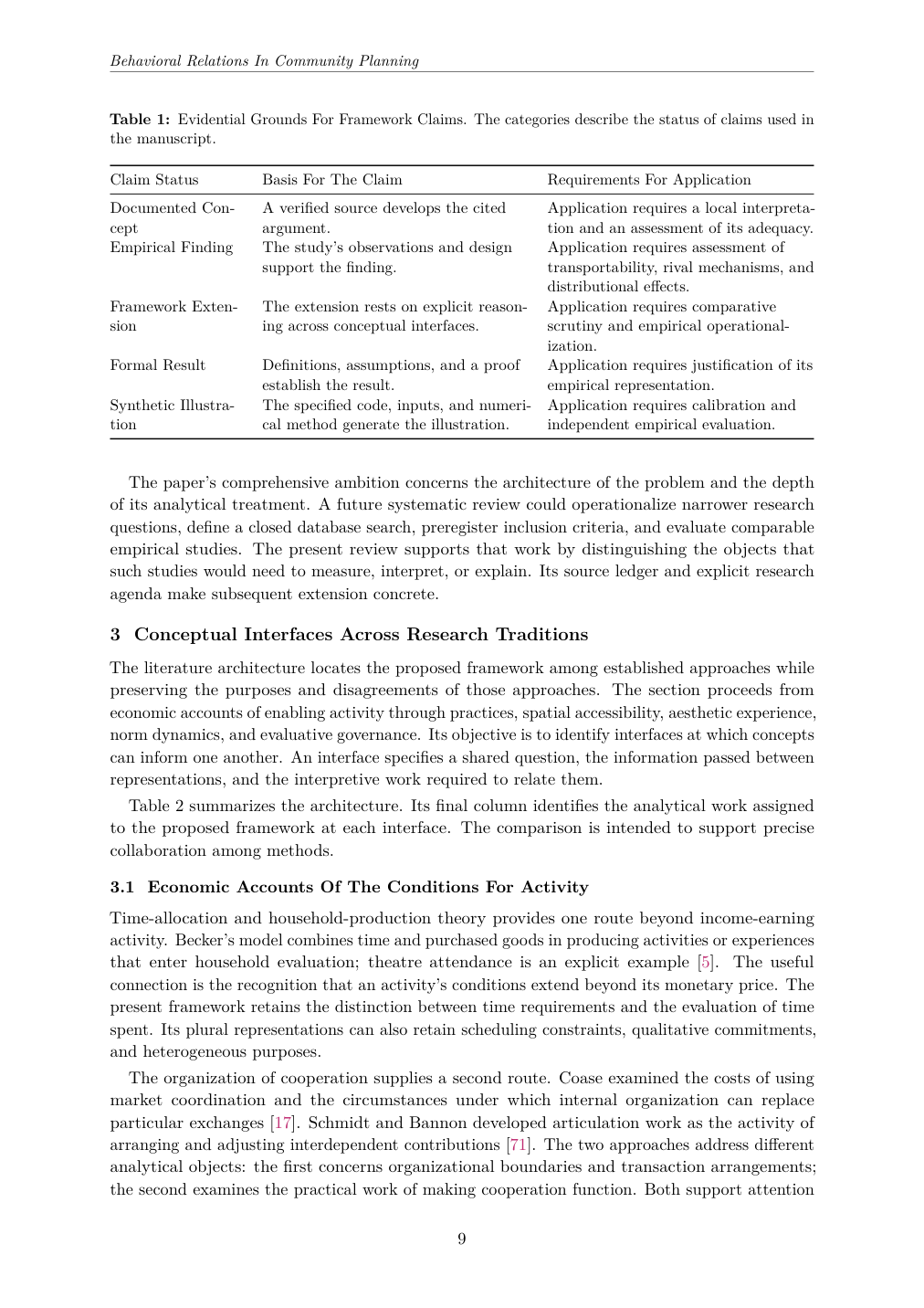
The manuscript distinguishes five evidential standings. A documented concept is a distinction or proposal explicitly developed in a source. An empirical finding is a result associated with a particular study design, population, measurement, and context. A framework extension is an argument developed here to connect or apply ideas. A formal result follows from definitions and assumptions stated in the manuscript. A synthetic illustration is generated from stipulated data or equations to clarify an analytical possibility. These standings support different kinds of inference.
For example, a transport study’s conceptual separation of travel’s purposes can motivate an overlapping activity description. A study of human–AI performance can identify heterogeneity within its evidence base. Neither use by itself establishes a universal claim about urban life or human–AI communities. The framework therefore records the movement from source evidence to proposed interpretation. Its strongest commitments concern the transparency of these movements and the possibility of revising them.
Table 1 summarizes the evidential organization. The final column identifies the additional work required when an argument moves toward practical application. This format helps prevent a formal demonstration, illustrative case, or observed regularity from silently acquiring the standing of a validated intervention.
2.4 Scope Of The Literature Review
The review is intended to establish a substantial conceptual foundation and a traceable route for further research. Its selection is especially developed around activity organization, social reproduction, time geography, normative dynamics, evaluative power, and methodological pluralism. It engages contemporary human–AI evidence where the research directly informs the distinction between local performance and collective consequences. The review’s historical anchors remain useful because many central questions concern the interpretation of activities and the justification of evaluation.
A comparative review stage examined close predecessors in activity-system analysis, diagnostic governance, classification studies, critical spatial theory, and aesthetic sociology. It also added published urban and workplace studies to distinguish conceptual plausibility from empirical support. An extended language-research stage examines value detection, conversational norm discovery, moral framing, interview analysis, participant review, and temporal representations. Appendix B records its selection principles, compares the evidential objects, and develops the practical reconstruction protocol. These additions sharpen the contribution around consequential analytical translations and preserve the surveyed approaches’ distinct explanatory commitments. The bibliography contains eighty-seven verified sources.
Several areas remain open to expanded comparison. Urban scholarship in languages other than English can reveal categories whose translation alters their practical meaning. Indigenous, feminist, disability, labour, and migration perspectives can change both the activity taxonomy and the boundaries of participation. Aesthetic traditions differ in their accounts of experience, form, community, and judgment. Legal and administrative arrangements also differ across jurisdictions. The framework provides places to record such disagreements and differences while leaving their resolution to appropriately situated inquiry.
Readable text
Table 1: Evidential Grounds For Framework Claims. The categories describe the status of claims used in
Application requires a local interpreta- tion and an assessment of its adequacy.
Application requires assessment of transportability, rival mechanisms, and distributional effects.
The extension rests on explicit reason- ing across conceptual interfaces.
Application requires comparative scrutiny and empirical operational- ization.
Application requires justification of its empirical representation.
Application requires calibration and independent empirical evaluation.
The specified code, inputs, and numeri- cal method generate the illustration.
The paper’s comprehensive ambition concerns the architecture of the problem and the depth of its analytical treatment. A future systematic review could operationalize narrower research questions, define a closed database search, preregister inclusion criteria, and evaluate comparable empirical studies. The present review supports that work by distinguishing the objects that such studies would need to measure, interpret, or explain. Its source ledger and explicit research
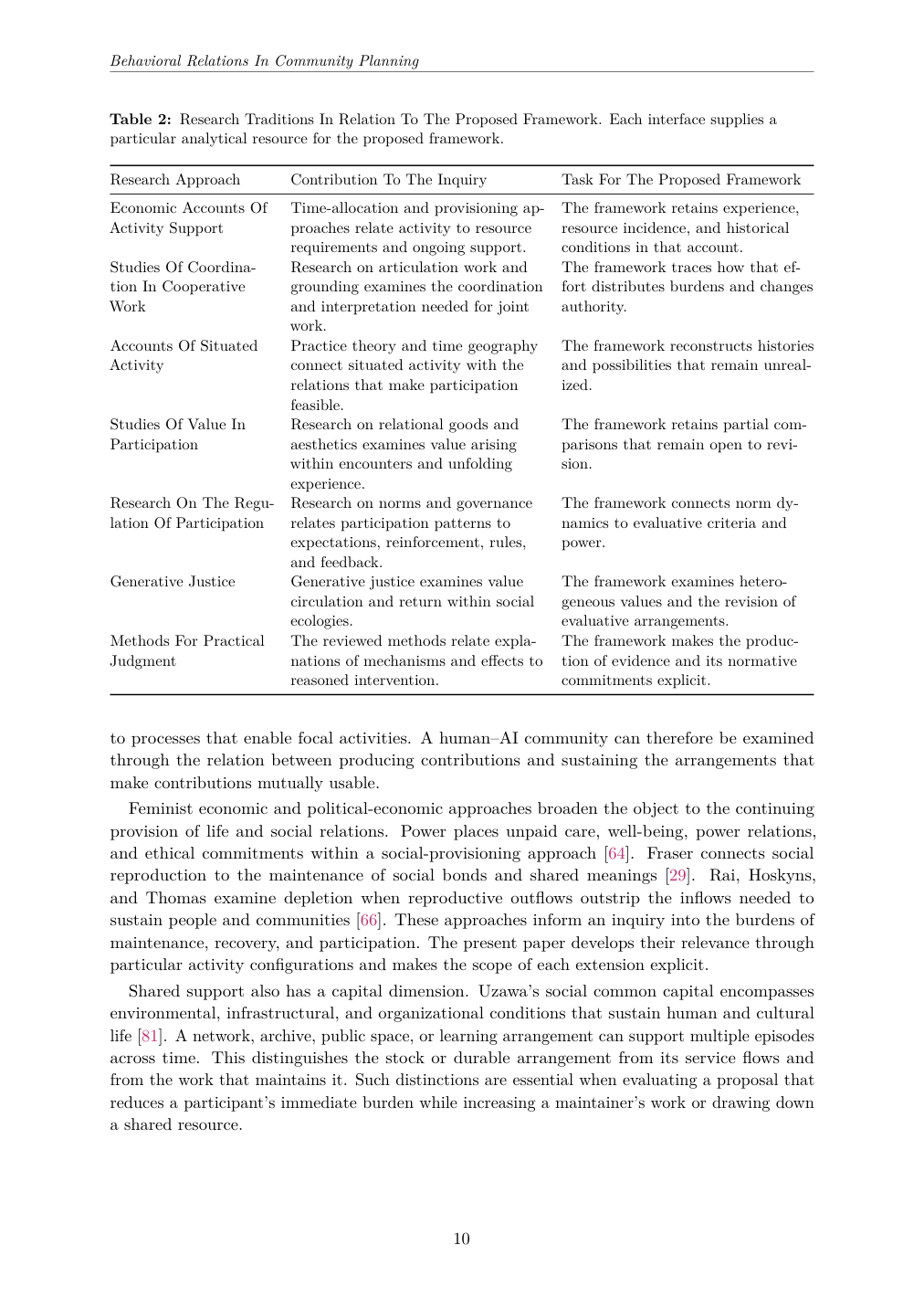
The literature architecture locates the proposed framework among established approaches while preserving the purposes and disagreements of those approaches. The section proceeds from economic accounts of enabling activity through practices, spatial accessibility, aesthetic experience, norm dynamics, and evaluative governance. Its objective is to identify interfaces at which concepts can inform one another. An interface specifies a shared question, the information passed between representations, and the interpretive work required to relate them.
Table 2 summarizes the architecture. Its final column identifies the analytical work assigned to the proposed framework at each interface. The comparison is intended to support precise
Time-allocation and household-production theory provides one route beyond income-earning activity. Becker’s model combines time and purchased goods in producing activities or experiences that enter household evaluation; theatre attendance is an explicit example [5]. The useful connection is the recognition that an activity’s conditions extend beyond its monetary price. The present framework retains the distinction between time requirements and the evaluation of time spent. Its plural representations can also retain scheduling constraints, qualitative commitments,
The organization of cooperation supplies a second route. Coase examined the costs of using market coordination and the circumstances under which internal organization can replace particular exchanges [17]. Schmidt and Bannon developed articulation work as the activity of arranging and adjusting interdependent contributions [71]. The two approaches address different analytical objects: the first concerns organizational boundaries and transaction arrangements; the second examines the practical work of making cooperation function. Both support attention
Readable text
Table 2: Research Traditions In Relation To The Proposed Framework. Each interface supplies a particular analytical resource for the proposed framework.
Time-allocation and provisioning ap- proaches relate activity to resource requirements and ongoing support.
The framework retains experience, resource incidence, and historical conditions in that account.
Research on articulation work and grounding examines the coordination and interpretation needed for joint
The framework traces how that ef- fort distributes burdens and changes authority.
Practice theory and time geography connect situated activity with the relations that make participation
The framework reconstructs histories and possibilities that remain unreal- ized.
Research on relational goods and aesthetics examines value arising within encounters and unfolding
The framework retains partial com- parisons that remain open to revi- sion.
Research on norms and governance relates participation patterns to expectations, reinforcement, rules,
The framework connects norm dy- namics to evaluative criteria and power.
Generative justice examines value circulation and return within social
The framework examines hetero- geneous values and the revision of evaluative arrangements.
The reviewed methods relate expla- nations of mechanisms and effects to
The framework makes the produc- tion of evidence and its normative commitments explicit.
to processes that enable focal activities. A human–AI community can therefore be examined through the relation between producing contributions and sustaining the arrangements that
Feminist economic and political-economic approaches broaden the object to the continuing provision of life and social relations. Power places unpaid care, well-being, power relations, and ethical commitments within a social-provisioning approach [64]. Fraser connects social reproduction to the maintenance of social bonds and shared meanings [29]. Rai, Hoskyns, and Thomas examine depletion when reproductive outflows outstrip the inflows needed to sustain people and communities [66]. These approaches inform an inquiry into the burdens of maintenance, recovery, and participation. The present paper develops their relevance through particular activity configurations and makes the scope of each extension explicit.
Shared support also has a capital dimension. Uzawa’s social common capital encompasses environmental, infrastructural, and organizational conditions that sustain human and cultural life [81]. A network, archive, public space, or learning arrangement can support multiple episodes across time. This distinguishes the stock or durable arrangement from its service flows and from the work that maintains it. Such distinctions are essential when evaluating a proposal that reduces a participant’s immediate burden while increasing a maintainer’s work or drawing down
3.2 Spatial Conditions For Situated Activity
Practice-oriented social theory provides a way to connect episodes with wider arrangements. Schatzki develops an ontology in which social life occurs through nexuses of practices and material arrangements [70]. The proposed event-based description can communicate with that approach by recording the recurrent understandings, objects, roles, and arrangements through which an episode becomes intelligible. The translation remains partial: a temporal network represents selected relations, while a practice account may emphasize practical understanding and situated intelligibility.
Urban observation has long recognized the interweaving of activity types. Gehl’s necessary, optional, and social activities provide an influential vocabulary for examining public space [32]. The present taxonomy treats necessity, social participation, and experiential orientation as intersecting dimensions. This retains the practical insight that the same public setting can host obligations, discretionary exploration, and encounters, while making the logical basis of classification explicit.
Time geography supplies a complementary account of feasibility. Hägerstrand’s capability, coupling, and authority constraints concern the conditions under which activities can occur in temporal and spatial relation [35]. The framework extends the reconstruction task to activities that remain unrealized, including participation prevented by incompatible schedules or inaccessible places. Activity-based transport models also situate journeys within broader patterns of engagement [26]. Their analytical usefulness depends on the activity vocabulary and behavioural assumptions supplied to each implementation.
Accessibility research connects these questions to the distribution of opportunities. The OECD/ITF treatment of sustainable accessibility includes the availability of opportunities and the means of reaching them across differently situated populations [55]. Capability analysis similarly distinguishes resources from the opportunities made possible through their conversion in particular circumstances [68]. The interface is productive because a resource increase can have different consequences depending on bodily capacities, relational obligations, environmental conditions, and permissions. A geographical measure becomes one input to that inquiry.
3.3 The Analysis Of Collective Activity Across Frameworks
Activity theory, diagnostic governance frameworks, and studies of classification provide close comparators for the proposed architecture. These comparisons concern the choice of analytical unit, the explanation of transformation, and the work performed by an evaluative vocabulary. They also establish a boundary for the contribution: historical relations, heterogeneous perspectives, contextual governance, and consequential classifications already have substantial theoretical development. The present proposal specifies interfaces through which those concerns can enter a common inquiry while retaining their distinct commitments.
Engeström’s account takes collective, artifact-mediated, object-oriented activity systems in their relations with other systems as its principal unit. It emphasizes multiple voices, historical formation, structural contradictions, and expansive transformations of an activity’s object and motive; its interorganizational healthcare study examines the development of new coordination concepts [25]. This supplies a direct comparator for the present concern with activities that change their own purposes and supporting relations. An application can draw on activity-system analysis when reconstructing rules, tools, divisions of labor, and the historical object around which cooperation develops.
The present protocol selects descriptive units in relation to a bounded question. An occurrence record can therefore retain overlapping participation and incompatible interpretations before
an encompassing activity system has been established. Translating that record into an activitysystem account requires an argument connecting situated events with collective objects and motives. The explanation of change also remains a declared choice: an application adopting a contradiction-based developmental account identifies the relevant tensions and the evidence for their effects. Other local explanations can be compared within the same inquiry. This methodological openness carries a cost: explanatory structure must be supplied and assessed in each application.
Ostrom’s social-ecological systems framework organizes nested variables concerning resources, users, governance, interactions, and outcomes. It supports question-specific selection of variables and cumulative comparison across cases. Its categories already encompass histories, norms, deliberation, conflict, social and ecological performance, and effects on other systems [59]. The present architecture shares that diagnostic ambition. It proposes an activity record capable of accommodating cases in which a common resource system supplies one relevant organizing description among several. Translation should preserve the distinctions needed for a particular governance explanation, including the type of resource, applicable rules, and levels of authority.
The treatment of performance categories gives that translation a further task. Here, their formation and revision become recurring empirical objects. An application records how a term such as contribution, access, or appropriate use is introduced, operationalized, contested, and amended. The record connects these changes with the activities and participants whose standing changes. An existing diagnostic framework can populate this inquiry; the added task is to retain the provenance and consequences of changes in the evaluative vocabulary. Its practical benefit requires comparison with the additional work it creates.
Bowker and Star analyze classifications as consequential information infrastructures. Their introduction examines who makes and revises categories, the work sustaining their practical operation, the treatment of cases that fit poorly, and the moral implications of visibility and exclusion [10]. These concerns directly precede the present treatment of classification, archives, and evidential authority in Section 10.4. A proposed activity taxonomy accordingly becomes an object of the same scrutiny that it directs toward administrative or computational categories. Its omissions, maintenance demands, and distributional consequences require an explicit record.
The proposed contribution lies in making particular translations inspectable: how an experienced quality becomes a preservation requirement, how an enabling demand is assigned to affected participants, how a changed classification alters recognized contributions, and how authority shapes the evidence available for review. Each translation can fail through loss of meaning, unsupported inference, or disproportionate effort. Comparative application should examine those failures using a common case record and an explicit baseline. A useful result may be a revised interpretation, a newly warranted distinction, or a justified decision to retain a simpler analysis. Such outcomes establish the contribution more precisely than a claim of general theoretical superiority.
3.4 Critical Accounts Of The Organization Of Social Space
Critical spatial theory extends the literature architecture by examining how activity settings become organized, represented, inhabited, and contested. The following comparison distinguishes relational spatiality, the production of social space, political differentiation within mobility, and the social formation of aesthetic judgment. These approaches supply questions about the historical organization of participation and authority. The proposed framework uses those questions to guide reconstruction while retaining the substantive commitments of each approach.
Massey’s opening propositions describe space as constituted through interrelations, as the coexistence of heterogeneous trajectories, and as continually made through material practices
[46, pp. 9–15]. For the present framework, this attention to coexistence motivates inquiry into connections extending beyond an observed setting. A community meeting can involve participants whose obligations, attachments, and anticipated futures differ substantially. Reconstructing their relations requires a declared study boundary and attention to what that boundary excludes. The resulting description remains a selected account of those relations, with the theoretical status of spatiality open to further argument.
Lefebvre examines social space through spatial practice, representations of space, and representational spaces. His distinction connects conceived spatial order with lived meanings and practices within a historical account of production, domination, and appropriation [44, pp. 38–41]. A framework application can therefore study a planning map as an intervention whose categories and official status may shape authorized uses. Establishing that effect requires evidence about the map’s enactment. The manuscript’s distinctions among occurrences, attributed functions, and experience serve a separate descriptive purpose. Their relation to Lefebvre’s triad requires interpretation, including attention to the historical argument in which his distinctions operate.
Cresswell analyses mobility through movement, representation, and embodied practice, and distinguishes motive force, speed, rhythm, route, experience, and friction. His historically specific constellations of mobility connect these aspects with political regulation [18]. For an activity inquiry, two journeys with equal duration and expenditure can involve different degrees of compulsion, control over departure, and exposure to interruption. Such differences identify additional objects of investigation alongside resource requirements. The relevant evidence might concern routing rules, work schedules, permissions, enforcement encounters, and participants’ accounts of travel. This application gives the mobility categories an empirical task within a declared setting.
Bourdieu locates the acquisition of aesthetic dispositions and the authority of legitimate taste within relations of education, social background, and classification [9, Introduction]. The present framework consequently examines how participants become entitled to define an aesthetic benefit and how institutions recognize their judgments. In a hypothetical design review, recruitment procedures could influence whose familiarity with a place becomes authoritative. Investigating that possibility requires records of selection, testimony, and decision, alongside accounts of experienced quality. The normative assessment of the review additionally requires reasons concerning fair participation and the treatment of disagreement.
These interlocutors enlarge the objects of inquiry while retaining differences in theoretical purpose and historical scope. Their translation into research questions leaves ontological adjudication suspended. An activity record can support analysis of a particular configuration; claims about spatial constitution or the reproduction of cultural hierarchy require their own arguments and evidence. The framework also distinguishes an explanation of an evaluative standard’s formation from a justification of its authority. Maintaining those distinctions makes critical spatial analysis part of the investigation’s continuing scrutiny of its own categories.
3.5 Value Through The Experience Of Participation
Relational-goods research offers a vocabulary for value that depends on interaction. Uhlaner examines interaction-dependent objectives in participation, while Gui treats encounters as processes that can generate immediate relational experiences and durable relation-specific resources [34, 78]. The framework uses this distinction to examine how an episode can both matter in its occurrence and alter later possibilities. A conversation during a journey can be valued at the time and also change the conditions of future cooperation.
Aesthetic analysis extends this concern with the unfolding of experience. Dewey’s account connects aesthetic quality with the temporal organization of practical and intellectual experience
[20]. This supports considering aesthetic qualities across several activity families. The paper’s proposed representation records situated descriptions, comparisons, and histories without requiring a single numerical measure of their importance. Formal structures can preserve incomplete comparisons and contextual dependence when those are part of the inquiry.
The distinction between value in an activity and value through an activity changes cost analysis. Mokhtarian and Salomon’s discussion of travel supplies a concrete precedent [51]. The physical duration of an event can be measured, but its allocation among instrumental and constitutive roles requires an interpretation of purposes and experience. The framework therefore treats shared time and other jointly used resources through explicit incidence records. Separate evaluations can refer to one event without multiplying the underlying duration.
3.6 Norm Formation Within Evolving Social Arrangements
Evolutionary models explain how recurrent interactions can sustain conventions and how perturbations can alter their persistence. Young’s work provides analytical results on convention selection and a wider discussion of social-norm dynamics [84, 85]. Bicchieri’s work emphasizes diagnostic distinctions among customs, descriptive patterns, normative expectations, and conditional behaviour [7, 8]. These traditions supply different observables and mechanisms. A stable pattern of action can be investigated by examining the expectations, sanctions, and alternatives that support it.
Generative justice provides a particularly close lineage. Eglash discusses the circulation and return of labour, ecological, and expressive value [22]. Eglash and Garvey explicitly consider basins of attraction within social ecologies [23]. Their work makes the relationship among dynamical organization, value generation, and normative aims a substantive predecessor of this inquiry. The present manuscript proposes an explicit interface among activity description, the formation of evaluative categories, power over their application, and procedures for revising both practical arrangements and evaluative standards. Comparative development is needed to establish the contribution of these distinctions in particular settings.
Ostrom’s research adds an empirical and theoretical orientation toward heterogeneous participants, contextual rules, and multiple centres of governance [57, 58]. The framework draws from this orientation in treating the governance of activity as a configuration that can be compared and learned about. Authority can be distributed across overlapping domains, while cooperation and conflict coexist within a common setting. The resulting inquiry examines the relations that make an arrangement work and the reasons for maintaining or changing it.
3.7 Methods For Evaluating Situated Interventions
Sen’s analysis of choice permits incomplete comparisons and recognizes that the process of choosing can matter to evaluation [73]. This provides a formal point of contact for a design practice that preserves several defensible alternatives. His account of public discussion also gives deliberation a constructive role in the formation of values and priorities [74]. The paper applies these insights to the possibility that inquiry itself changes what participants can articulate and value.
Phronetic planning research brings practical judgment into explicit relation with power and distribution [27]. Realist evaluation organizes explanations around mechanisms operating in contexts, while work on evidence-based policy emphasizes the support conditions involved in moving findings to new situations [14, 62]. Causal-inference methods provide tools for identifying effects under stated assumptions [37]. These approaches have distinct commitments. Their combination in this framework is organized by the research question and by explicit statements of what each method can establish.
4 A Situated Ontology Of Participation In Activity
An account of activity provides the descriptive objects through which enabling costs, evaluative norms, and interventions can be investigated. The present section proposes a situated vocabulary for occurrences, processes, relations, roles, experiences, capacities, and conditions. Its purpose is to support reconstruction across physical and digital settings while retaining distinctions among observation, interpretation, and prospective judgment. The argument proceeds through explicit analytical conventions and hypothetical examples. The resulting ontology is paper-local: it specifies a mode of inquiry under ontological suspension, with its adequacy assessed through explanatory usefulness, evidential accountability, and revisability.
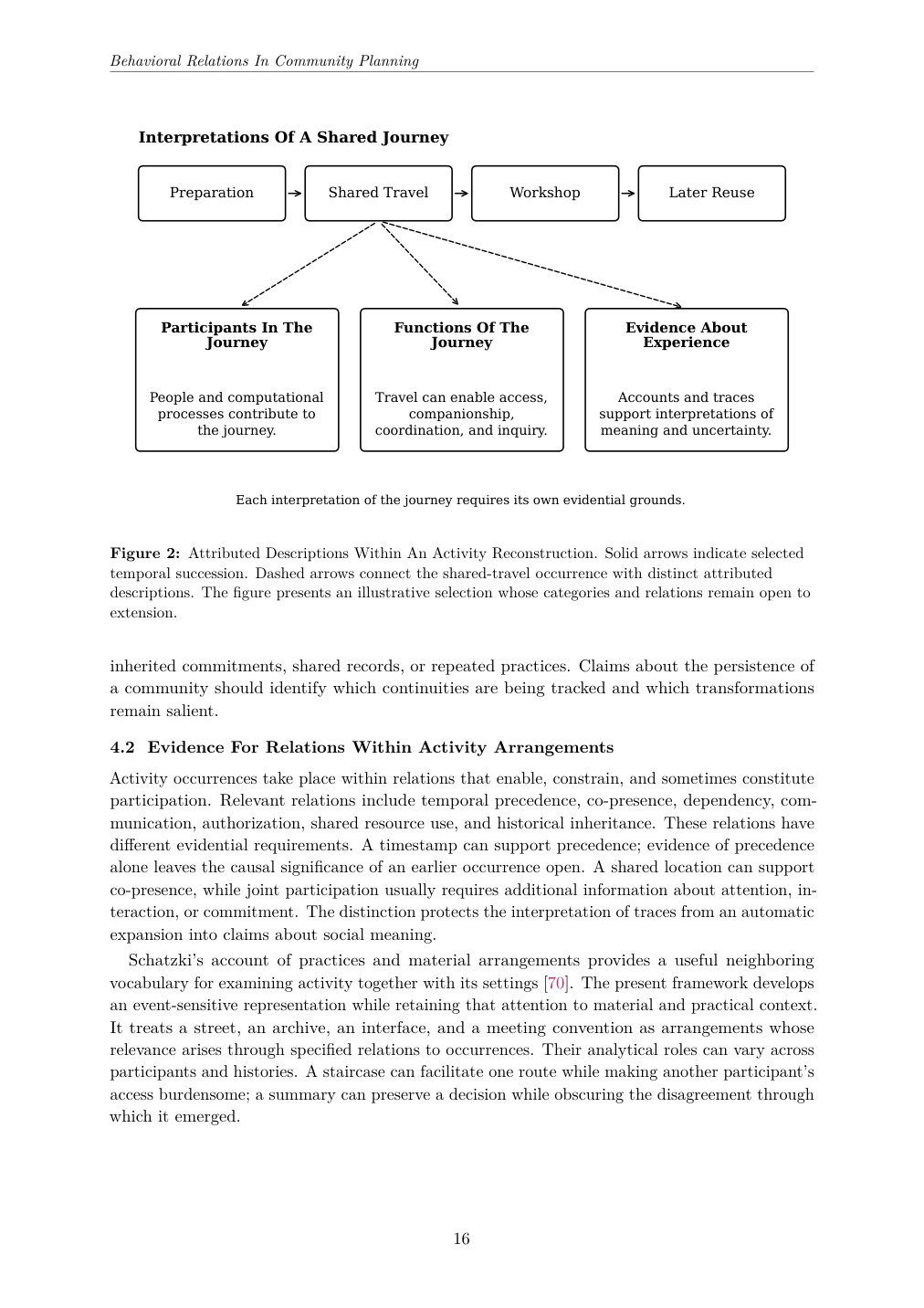
Figure 2 relates an illustrative occurrence sequence to distinct descriptions of a shared-travel occurrence. The separation makes visible the different analytical roles of a recorded sequence, attributed participation, functional roles, and supporting evidence.
4.1 Boundaries Of Activity Occurrences
An activity occurrence denotes a temporally situated process involving participation and the maintenance or alteration of some relevant state, relation, or possibility. Participation can involve deliberate action, receptive attention, bodily presence, computational operation, or an arrangement among several such contributions. A workshop discussion, an interval of recovery, a data translation, and a jointly maintained silence can consequently enter the description. Their inclusion depends on the question under investigation and on evidence supporting the proposed participation relation. The vocabulary leaves the attribution of intention, experience, and responsibility to more specific inquiries.
The boundaries of an occurrence are analytical decisions with practical consequences. A journey might begin at a front door, when a participant starts arranging childcare, or when an invitation creates a commitment to attend. The first boundary supports an analysis of travel time; the second supports an analysis of participation requirements; the third supports an analysis of commitments and coordination. Each boundary selects a different object. The researcher should identify the boundary rule, preserve the relevant surrounding history, and explain the consequences of alternative segmentation. Where participants disagree about the beginning or completion of an activity, the disagreement becomes part of the record.
For a hypothetical community workshop, the period visible in a meeting room is one occurrence within a larger process. Preparation, travel, arrival, discussion, archiving, and later reuse may be reconstructed as linked occurrences. Some overlap: an organizer can answer questions while arranging materials, and a participant can develop an idea while travelling. A single segmentation consequently supplies a resolution of the activity field. Finer descriptions may be appropriate for coordination failures, while longer descriptions may reveal fatigue, learning, or historical continuity. Consistency requires explicit relations between resolutions.
Rest and apparent inactivity also deserve a place in this vocabulary. An observed stationary body supports a description of position over time. Interpreting the same interval as recovery, exclusion, attentive listening, or waiting requires additional evidence. Similarly, a computational process awaiting input can be described operationally without attributing a corresponding human experience. Separating the recorded state from its proposed significance permits comparisons across heterogeneous participants while preserving the distinct grounds for experiential claims.
Temporal extension matters because completion, interruption, and recurrence can have different consequences. A conversation resumed after several weeks may preserve a question while changing its participants and meaning. Recurrent meetings may maintain an association despite substantial turnover. The researcher can therefore describe continuity through specified relations, such as
Readable text
Each interpretation of the journey requires its own evidential grounds.
Figure 2: Attributed Descriptions Within An Activity Reconstruction. Solid arrows indicate selected temporal succession. Dashed arrows connect the shared-travel occurrence with distinct attributed descriptions. The figure presents an illustrative selection whose categories and relations remain open to
inherited commitments, shared records, or repeated practices. Claims about the persistence of a community should identify which continuities are being tracked and which transformations
4.2 Evidence For Relations Within Activity Arrangements
Activity occurrences take place within relations that enable, constrain, and sometimes constitute participation. Relevant relations include temporal precedence, co-presence, dependency, com- munication, authorization, shared resource use, and historical inheritance. These relations have different evidential requirements. A timestamp can support precedence; evidence of precedence alone leaves the causal significance of an earlier occurrence open. A shared location can support co-presence, while joint participation usually requires additional information about attention, in- teraction, or commitment. The distinction protects the interpretation of traces from an automatic
Schatzki’s account of practices and material arrangements provides a useful neighboring vocabulary for examining activity together with its settings [70]. The present framework develops an event-sensitive representation while retaining that attention to material and practical context. It treats a street, an archive, an interface, and a meeting convention as arrangements whose relevance arises through specified relations to occurrences. Their analytical roles can vary across participants and histories. A staircase can facilitate one route while making another participant’s access burdensome; a summary can preserve a decision while obscuring the disagreement through
Readable text
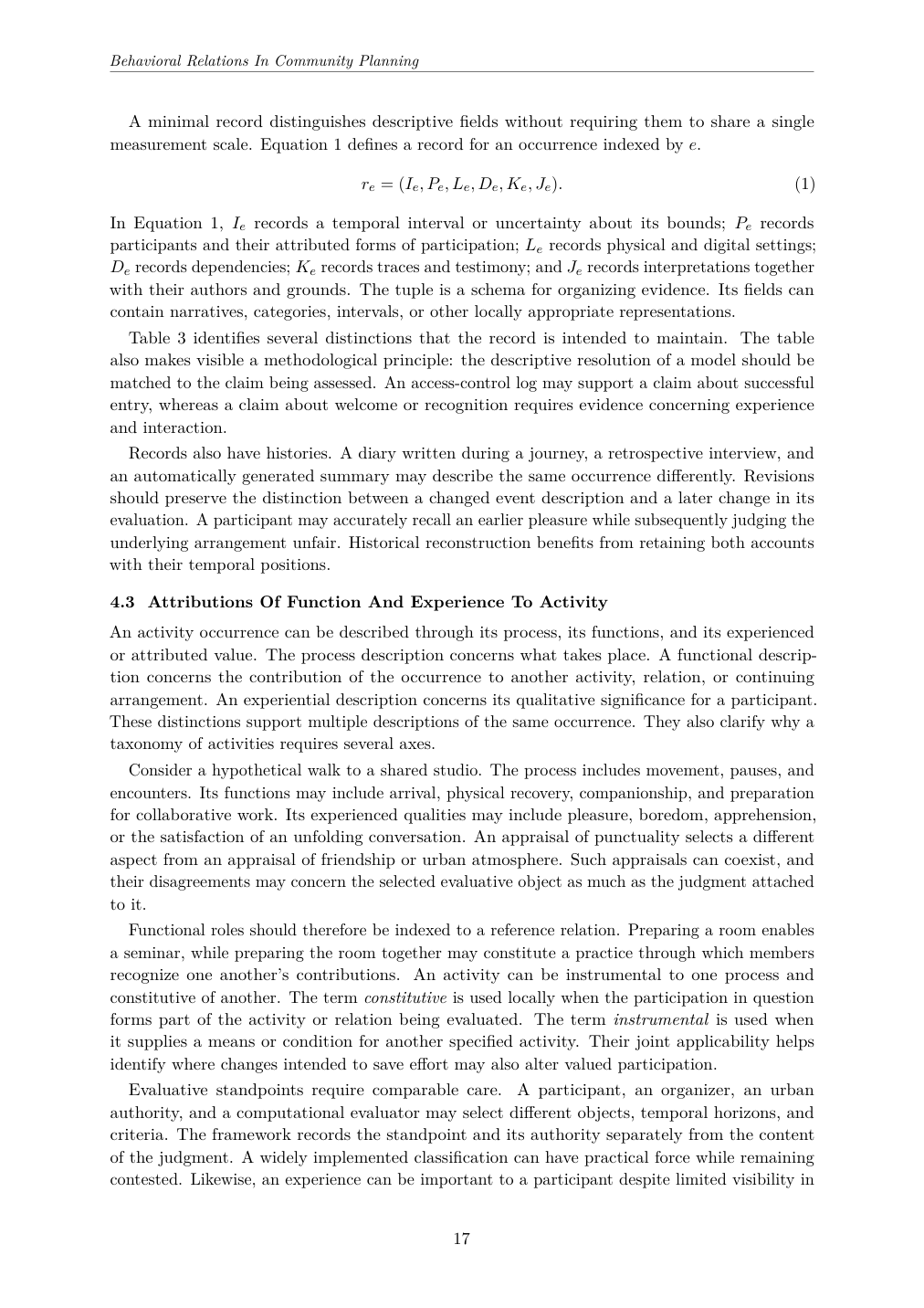
A minimal record distinguishes descriptive fields without requiring them to share a single
with their authors and grounds. The tuple is a schema for organizing evidence. Its fields can contain narratives, categories, intervals, or other locally appropriate representations.
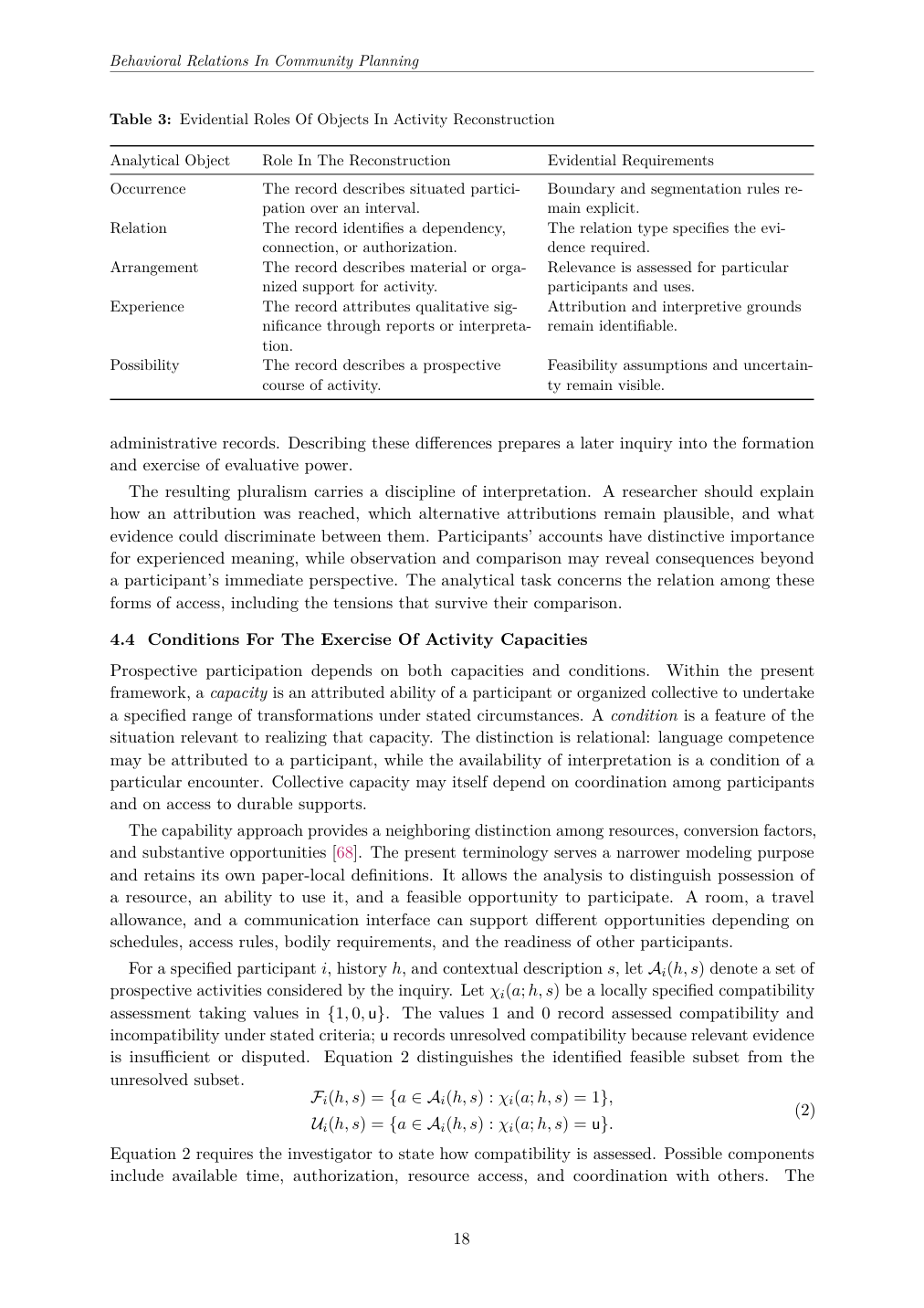
Table 3 identifies several distinctions that the record is intended to maintain. The table also makes visible a methodological principle: the descriptive resolution of a model should be matched to the claim being assessed. An access-control log may support a claim about successful entry, whereas a claim about welcome or recognition requires evidence concerning experience
Records also have histories. A diary written during a journey, a retrospective interview, and an automatically generated summary may describe the same occurrence differently. Revisions should preserve the distinction between a changed event description and a later change in its evaluation. A participant may accurately recall an earlier pleasure while subsequently judging the underlying arrangement unfair. Historical reconstruction benefits from retaining both accounts
4.3 Attributions Of Function And Experience To Activity
An activity occurrence can be described through its process, its functions, and its experienced or attributed value. The process description concerns what takes place. A functional descrip- tion concerns the contribution of the occurrence to another activity, relation, or continuing arrangement. An experiential description concerns its qualitative significance for a participant. These distinctions support multiple descriptions of the same occurrence. They also clarify why a
Consider a hypothetical walk to a shared studio. The process includes movement, pauses, and encounters. Its functions may include arrival, physical recovery, companionship, and preparation for collaborative work. Its experienced qualities may include pleasure, boredom, apprehension, or the satisfaction of an unfolding conversation. An appraisal of punctuality selects a different aspect from an appraisal of friendship or urban atmosphere. Such appraisals can coexist, and their disagreements may concern the selected evaluative object as much as the judgment attached
Functional roles should therefore be indexed to a reference relation. Preparing a room enables a seminar, while preparing the room together may constitute a practice through which members recognize one another’s contributions. An activity can be instrumental to one process and constitutive of another. The term constitutive is used locally when the participation in question forms part of the activity or relation being evaluated. The term instrumental is used when it supplies a means or condition for another specified activity. Their joint applicability helps identify where changes intended to save effort may also alter valued participation.
Evaluative standpoints require comparable care. authority, and a computational evaluator may select different objects, temporal horizons, and criteria. The framework records the standpoint and its authority separately from the content of the judgment. A widely implemented classification can have practical force while remaining contested. Likewise, an experience can be important to a participant despite limited visibility in
Readable text
Table 3: Evidential Roles Of Objects In Activity Reconstruction
Relevance is assessed for particular participants and uses.
The record attributes qualitative sig- nificance through reports or interpreta-
Attribution and interpretive grounds remain identifiable.
Feasibility assumptions and uncertain- ty remain visible.
administrative records. Describing these differences prepares a later inquiry into the formation
The resulting pluralism carries a discipline of interpretation. A researcher should explain how an attribution was reached, which alternative attributions remain plausible, and what evidence could discriminate between them. Participants’ accounts have distinctive importance for experienced meaning, while observation and comparison may reveal consequences beyond a participant’s immediate perspective. The analytical task concerns the relation among these forms of access, including the tensions that survive their comparison.
Prospective participation depends on both capacities and conditions. framework, a capacity is an attributed ability of a participant or organized collective to undertake a specified range of transformations under stated circumstances. A condition is a feature of the situation relevant to realizing that capacity. The distinction is relational: language competence may be attributed to a participant, while the availability of interpretation is a condition of a particular encounter. Collective capacity may itself depend on coordination among participants
The capability approach provides a neighboring distinction among resources, conversion factors, and substantive opportunities [68]. The present terminology serves a narrower modeling purpose and retains its own paper-local definitions. It allows the analysis to distinguish possession of a resource, an ability to use it, and a feasible opportunity to participate. A room, a travel allowance, and a communication interface can support different opportunities depending on schedules, access rules, bodily requirements, and the readiness of other participants.
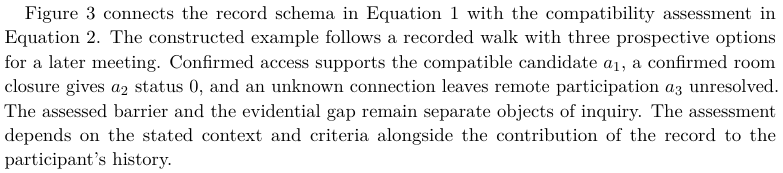
incompatibility under stated criteria; u records unresolved compatibility because relevant evidence is insufficient or disputed. Equation 2 distinguishes the identified feasible subset from the
Equation 2 requires the investigator to state how compatibility is assessed. Possible components include available time, authorization, resource access, and coordination with others.
unresolved set preserves candidates for further investigation, and reported assessments distinguish its members from activities assigned status 0. These sets describe possibilities recognized by a particular inquiry; participants may discover further activities as their relations and circumstances change. New evidence can also revise an activity’s status within the existing domain.
Prospective descriptions become especially important when an intervention changes the activities people can conceive or attempt. A shared archive may enable a project that earlier participants had difficulty formulating. An accessible evening service may make repeated participation plausible and thereby encourage a new association. These are hypothetical mechanisms requiring investigation. They illustrate why an evaluation can examine the evolution of feasible possibilities alongside the realized outcomes of a fixed list of activities.
Finally, the distinction between capacity and condition supports an account of responsibility that preserves causal complexity. A failure to participate may reflect inaccessible arrangements, depleted capacity, incompatible schedules, an informed refusal, or several interacting factors. Attributing the failure to one participant requires evidence appropriate to that claim. The ontology consequently prepares the ground for a taxonomy that follows activities, supports, and consequences across several relations and temporal scales.
Readable text
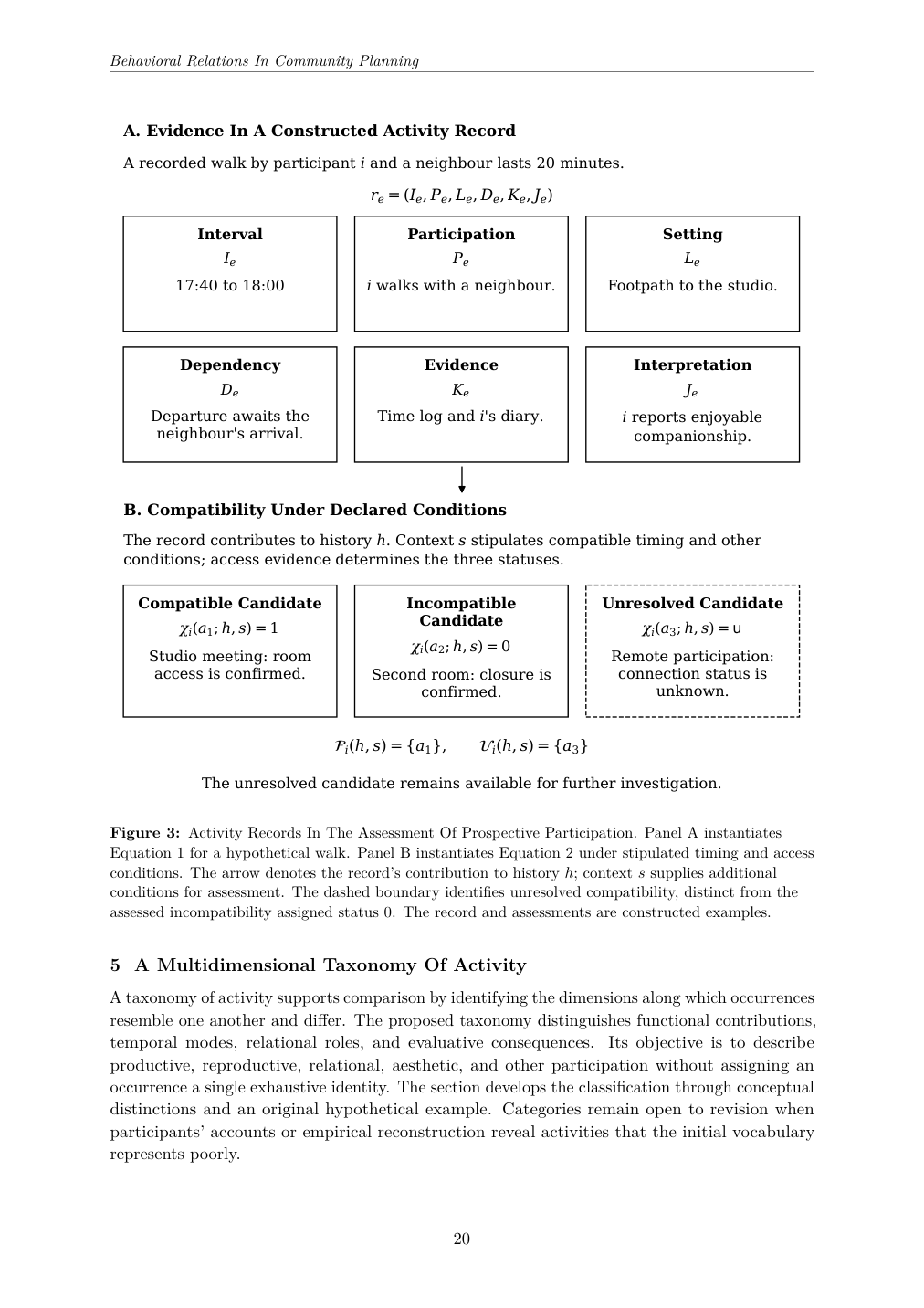
A recorded walk by participant i and a neighbour lasts 20 minutes.
The record contributes to history h. Context s stipulates compatible timing and other conditions; access evidence determines the three statuses.
The unresolved candidate remains available for further investigation.
Figure 3: Activity Records In The Assessment Of Prospective Participation. Panel A instantiates Equation 1 for a hypothetical walk. Panel B instantiates Equation 2 under stipulated timing and access conditions for assessment. The dashed boundary identifies unresolved compatibility, distinct from the assessed incompatibility assigned status 0. The record and assessments are constructed examples.
A taxonomy of activity supports comparison by identifying the dimensions along which occurrences resemble one another and differ. The proposed taxonomy distinguishes functional contributions, temporal modes, relational roles, and evaluative consequences. productive, reproductive, relational, aesthetic, and other participation without assigning an occurrence a single exhaustive identity. The section develops the classification through conceptual distinctions and an original hypothetical example. Categories remain open to revision when participants’ accounts or empirical reconstruction reveal activities that the initial vocabulary
5.1 Overlapping Membership Across Classification Axes
Functional categories describe contributions to specified processes. Temporal categories describe positions within their development. Relational roles describe how an occurrence connects with other occurrences or continuing arrangements. Evaluative categories describe judgments about effects and experiences from stated standpoints. Keeping these axes distinguishable prevents a recurrent ambiguity: the word reproductive may describe a contribution to continuity, whereas aesthetic may describe a quality experienced during that contribution. Both can apply to the
same event.
The taxonomy accordingly uses overlapping membership. A shared meal can provision participants, sustain relationships, convey knowledge, and provide aesthetic enjoyment. Preparing the meal can involve coordination and practical learning. The allocation of preparation work can also reproduce a contested hierarchy. Treating these descriptions as compatible preserves the material, relational, and evaluative specificity of the occurrence. An inquiry may select one focal contribution while retaining the others as relevant contextual descriptions.
Classification also depends on the resolution of observation. A two-hour workshop can be coded as collaborative inquiry, while an interval within it involves conflict resolution or silent reflection. A longer project may combine the production of a public artifact with the maintenance of a community. The analyst should state the scale at which labels are assigned and describe the relation between labels at adjacent scales. A large-scale label carries limited information about the distribution of contributions within the activity.
Existing classifications provide resources for comparison. Gehl’s distinction among necessary, optional, and social activities concerns patterns of public-space use [32]. Its categories can inform an inquiry into streets while leaving room for additional questions about historical reproduction, knowledge, and evaluative authority. The present proposal offers a complementary set of axes whose usefulness depends on the research question and the evidence available. Translation between taxonomies should preserve differences in purpose.
5.2 Functional Families In Activity Reconstruction
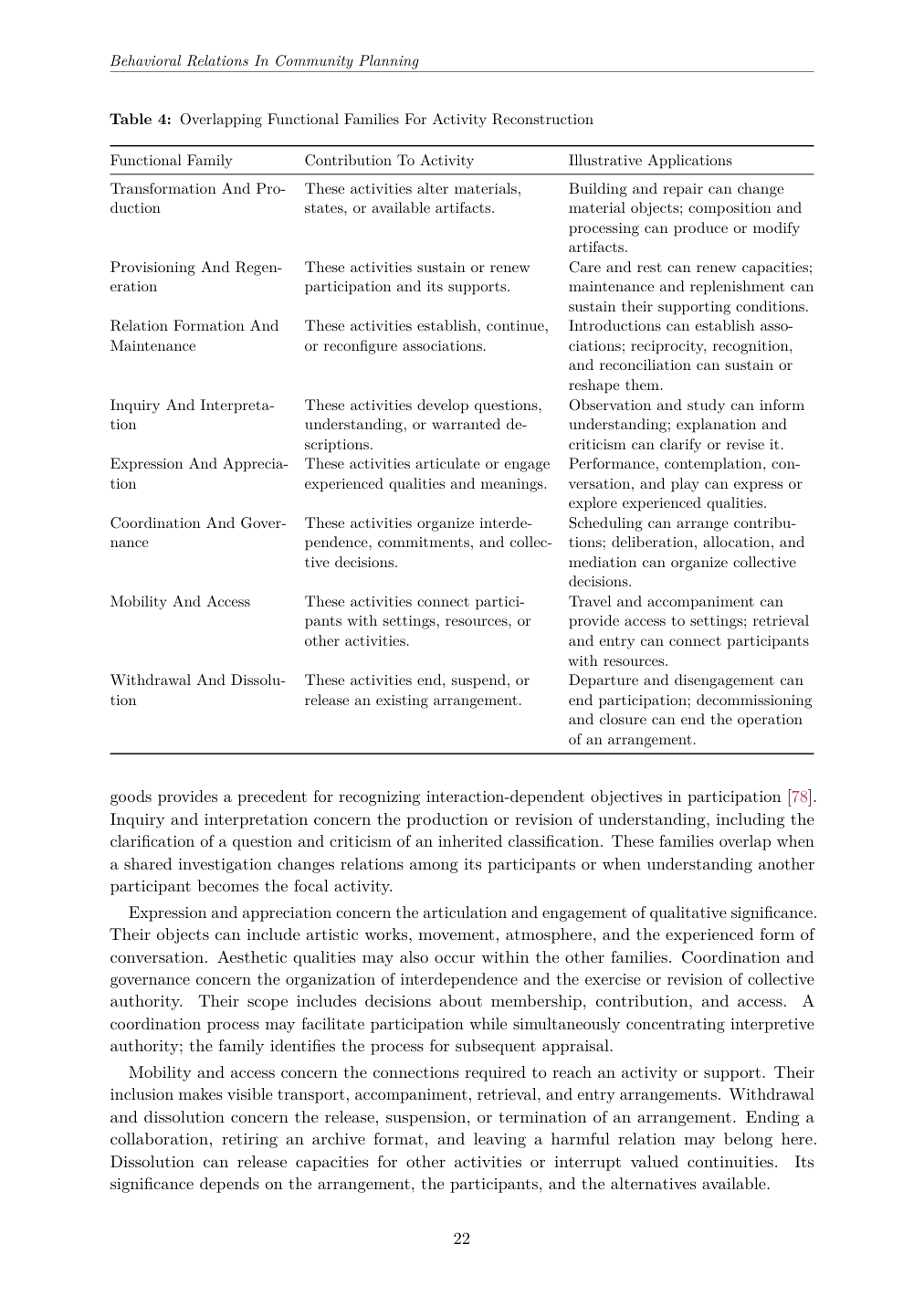
Table 4 presents eight functional families. Each family identifies a contribution that can be examined in relation to an activity, a participant, or a continuing arrangement. Examples indicate possible membership and carry the status of analytical illustrations. Their coverage remains open to extension through investigation of further human and computational activities.
Transformation and production concern changes in an identified object or state. A repaired tool, a translated record, and a newly composed song can be focal outcomes. Production in this local sense includes paid and unpaid activity. Its identification requires a specification of what is produced or transformed, together with the relevant temporal boundary. The category also accommodates transformations whose consequences participants assess unfavorably. Evaluation follows from the effects and their interpretation.
Provisioning and regeneration concern the continuing requirements of participation. They include maintaining material supports and renewing capacities that activity draws upon. Power’s social-provisioning approach offers a disciplinary precedent for treating unpaid work, care, power, and well-being as central economic concerns [64]. The present family extends the analytical attention to heterogeneous community settings while maintaining distinctions between human recovery, organizational maintenance, and technical servicing. Their common role in continuation leaves their mechanisms and significance available for separate description.
Relation formation and maintenance concern association itself: establishing familiarity, sustaining a commitment, or revising an antagonistic relation. Uhlaner’s account of relational
Readable text
Table 4: Overlapping Functional Families For Activity Reconstruction
These activities alter materials, states, or available artifacts.
Building and repair can change material objects; composition and processing can produce or modify artifacts.
These activities sustain or renew participation and its supports.
Care and rest can renew capacities; maintenance and replenishment can sustain their supporting conditions.
These activities establish, continue, or reconfigure associations.
Introductions can establish asso- ciations; reciprocity, recognition, and reconciliation can sustain or reshape them.
These activities develop questions, understanding, or warranted de-
Observation and study can inform understanding; explanation and criticism can clarify or revise it.
Performance, contemplation, con- versation, and play can express or explore experienced qualities.
These activities articulate or engage experienced qualities and meanings.
These activities organize interde- pendence, commitments, and collec-
Scheduling can arrange contribu- tions; deliberation, allocation, and mediation can organize collective decisions.
These activities connect partici- pants with settings, resources, or
Travel and accompaniment can provide access to settings; retrieval and entry can connect participants with resources.
These activities end, suspend, or release an existing arrangement.
Departure and disengagement can end participation; decommissioning and closure can end the operation of an arrangement.
goods provides a precedent for recognizing interaction-dependent objectives in participation [78]. Inquiry and interpretation concern the production or revision of understanding, including the clarification of a question and criticism of an inherited classification. These families overlap when a shared investigation changes relations among its participants or when understanding another
Expression and appreciation concern the articulation and engagement of qualitative significance. Their objects can include artistic works, movement, atmosphere, and the experienced form of conversation. Aesthetic qualities may also occur within the other families. Coordination and governance concern the organization of interdependence and the exercise or revision of collective Their scope includes decisions about membership, contribution, and access. coordination process may facilitate participation while simultaneously concentrating interpretive authority; the family identifies the process for subsequent appraisal.
Mobility and access concern the connections required to reach an activity or support. Their inclusion makes visible transport, accompaniment, retrieval, and entry arrangements. Withdrawal and dissolution concern the release, suspension, or termination of an arrangement. Ending a collaboration, retiring an archive format, and leaving a harmful relation may belong here. Dissolution can release capacities for other activities or interrupt valued continuities. significance depends on the arrangement, the participants, and the alternatives available.
Readable text
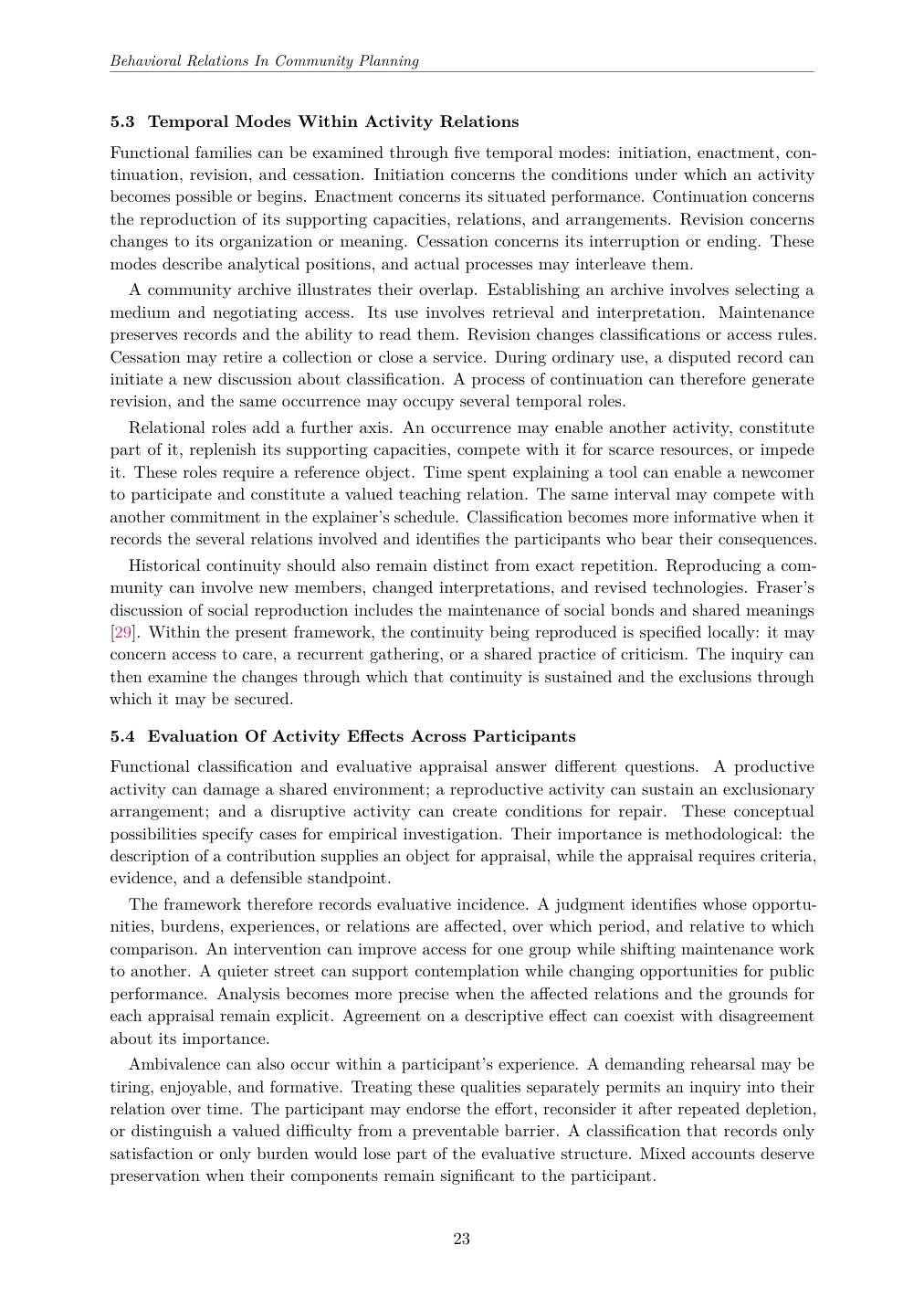
Functional families can be examined through five temporal modes: initiation, enactment, con- tinuation, revision, and cessation. Initiation concerns the conditions under which an activity becomes possible or begins. Enactment concerns its situated performance. Continuation concerns the reproduction of its supporting capacities, relations, and arrangements. Revision concerns changes to its organization or meaning. Cessation concerns its interruption or ending. These modes describe analytical positions, and actual processes may interleave them.
A community archive illustrates their overlap. Establishing an archive involves selecting a medium and negotiating access. Its use involves retrieval and interpretation. Maintenance preserves records and the ability to read them. Revision changes classifications or access rules. Cessation may retire a collection or close a service. During ordinary use, a disputed record can initiate a new discussion about classification. A process of continuation can therefore generate revision, and the same occurrence may occupy several temporal roles.
Relational roles add a further axis. An occurrence may enable another activity, constitute part of it, replenish its supporting capacities, compete with it for scarce resources, or impede it. These roles require a reference object. Time spent explaining a tool can enable a newcomer to participate and constitute a valued teaching relation. The same interval may compete with another commitment in the explainer’s schedule. Classification becomes more informative when it records the several relations involved and identifies the participants who bear their consequences.
Historical continuity should also remain distinct from exact repetition. Reproducing a com- munity can involve new members, changed interpretations, and revised technologies. Fraser’s discussion of social reproduction includes the maintenance of social bonds and shared meanings [29]. Within the present framework, the continuity being reproduced is specified locally: it may concern access to care, a recurrent gathering, or a shared practice of criticism. The inquiry can then examine the changes through which that continuity is sustained and the exclusions through
5.4 Evaluation Of Activity Effects Across Participants
Functional classification and evaluative appraisal answer different questions. activity can damage a shared environment; a reproductive activity can sustain an exclusionary arrangement; and a disruptive activity can create conditions for repair. possibilities specify cases for empirical investigation. Their importance is methodological: the description of a contribution supplies an object for appraisal, while the appraisal requires criteria,
The framework therefore records evaluative incidence. A judgment identifies whose opportu- nities, burdens, experiences, or relations are affected, over which period, and relative to which comparison. An intervention can improve access for one group while shifting maintenance work to another. A quieter street can support contemplation while changing opportunities for public performance. Analysis becomes more precise when the affected relations and the grounds for each appraisal remain explicit. Agreement on a descriptive effect can coexist with disagreement
Ambivalence can also occur within a participant’s experience. A demanding rehearsal may be tiring, enjoyable, and formative. Treating these qualities separately permits an inquiry into their relation over time. The participant may endorse the effort, reconsider it after repeated depletion, or distinguish a valued difficulty from a preventable barrier. A classification that records only satisfaction or only burden would lose part of the evaluative structure. Mixed accounts deserve preservation when their components remain significant to the participant.
Normative categories should consequently be documented as judgments with histories. The description appropriate use, for example, can derive from a rule, a customary expectation, a practical accommodation, or an interpretive dispute. Recording the source and consequences of the classification makes it possible to investigate how judgments acquire authority. The taxonomy supplies descriptive coordinates for that inquiry; the legitimacy of the resulting authority remains a further question.
5.5 A Worked Reconstruction Of Shared Participation
Consider a hypothetical evening workshop in which residents and computational assistants prepare an exhibition of neighborhood memories. One participant travels with an older neighbor, another prepares the room, and a third checks an automatically generated transcript. During the meeting, participants discuss the interpretation of a remembered event, arrange images, and negotiate which records may be displayed. Afterward, an organizer stores the materials and answers a participant’s concern about representation. The example is constructed to illustrate classification choices and implies no measured effects.
Accompanied travel belongs to mobility and access, relation maintenance, and possibly expression and appreciation. Room preparation belongs to provisioning and coordination, while its collective performance may support recognition. Transcript checking belongs to inquiry, production, and the maintenance of a usable record. The disagreement about memory belongs to interpretation and governance because participants negotiate both meaning and authority over display. Storing the records contributes to continuation; honoring a request to remove a record may contribute to revision or withdrawal.
The reconstruction also reveals relations among contributions. The exhibition depends on transport, preparation, interpretation, permissions, and maintenance. Some requirements are shared, while others fall on particular participants. The room’s existence supplies one condition, but participation also depends on the timing of its availability and on the acceptability of its access arrangements. A classification centered only on the displayed exhibition would record an outcome while leaving much of its production and reproduction difficult to assess.
A comparative protocol can begin with participant-generated descriptions, apply the proposed categories, and then preserve mismatches between them. Analysts should record uncertain or disputed labels, inspect how coding changes at different temporal resolutions, and compare participation that occurred with activities that were attempted, declined, or prevented. The result is a structured reconstruction whose categories remain accountable to the activity being studied. It prepares the subsequent analysis of enabling costs by identifying the processes, relations, and standpoints relative to which those costs are meaningful.
6 Enabling Costs In The Reproduction Of Participation
Enabling costs concern the requirements of making a specified activity feasible and sustaining its supporting arrangements. Their analysis connects transport, coordination, communication, maintenance, and recovery with productive, relational, aesthetic, and other forms of participation. The present section develops a paper-local account of overhead through four distinctions: economic concepts and their domains; reference-relative attribution; resource use, transfers, and foregone alternatives; and the distribution of sustaining work over time. The objective is to clarify what an intervention changes, for whom, and with which implications for future activity.
6.1 Economic Concepts For Analysing Participation Requirements
Several established economic concepts illuminate parts of the problem. Becker’s analysis of household production combines goods and time in activities that include attending a performance
[5]. Coase examines the costs associated with organizing transactions through particular arrangements [17]. These contributions provide distinct interfaces: one makes time and nonmarket activity analytically visible; the other examines requirements of coordination. Their relation to the present proposal is complementary, with each concept retaining its original explanatory purpose.
Transport cost offers a further interface. Generalized travel-cost models can combine monetary charges, time, and specified features of a journey through explicit valuation assumptions [19]. Such models can support a particular decision while the broader inquiry retains dimensions that call for separate representation. A route’s accessibility, the availability of accompaniment, and an experienced atmosphere may enter through different evidence and evaluative procedures. The analytical task is to state the dimensions included, their interpretation, and the conditions under which their aggregation is warranted.
Coordination and communication likewise require resources. Schmidt and Bannon’s articulationwork perspective examines the work involved in coordinating distributed interdependence [71]. Clark and Brennan’s account of grounding identifies communication requirements and costs that vary with the medium and the current purpose [16]. These sources support attention to the explanation, synchronization, and repair through which joint activity becomes possible. Applying that attention to human–AI communities is a proposed extension requiring empirical investigation of specific arrangements.
The present use of overhead names support requirements relative to a selected focal activity. The focal activity may be an artwork, a friendship, a collective inquiry, or a public service. Monetary return supplies one possible evaluative context. The description can also concern activities valued for their experience, their relational consequences, or their contribution to continuing possibilities. The term acquires precision through its reference relation and accounting boundary.
6.2 Attribution Of Overhead Across Joint Contributions
Attributing overhead requires a focal activity, a contributor, a temporal horizon, and a comparison. A journey can be an enabling requirement of attending a workshop while also constituting an enjoyable walk. An explanation can facilitate a practical task while developing a valued teaching relation. A preparatory activity may therefore make several contributions simultaneously. Treating its entire duration as a removable burden would require an additional judgment about which contributions the intervention preserves and which it changes.
Consider a hypothetical ninety-minute preparation session shared by two organizers. They arrange materials, discuss the exhibition’s interpretation, and welcome a newcomer. Assigning the session solely to the production of the exhibition would obscure its interpretive and relational contributions. Assigning the complete resource use independently to three outputs would inflate their aggregate requirements. A defensible account can preserve the session as a joint contribution and report attribution alternatives when a decision requires separate estimates.

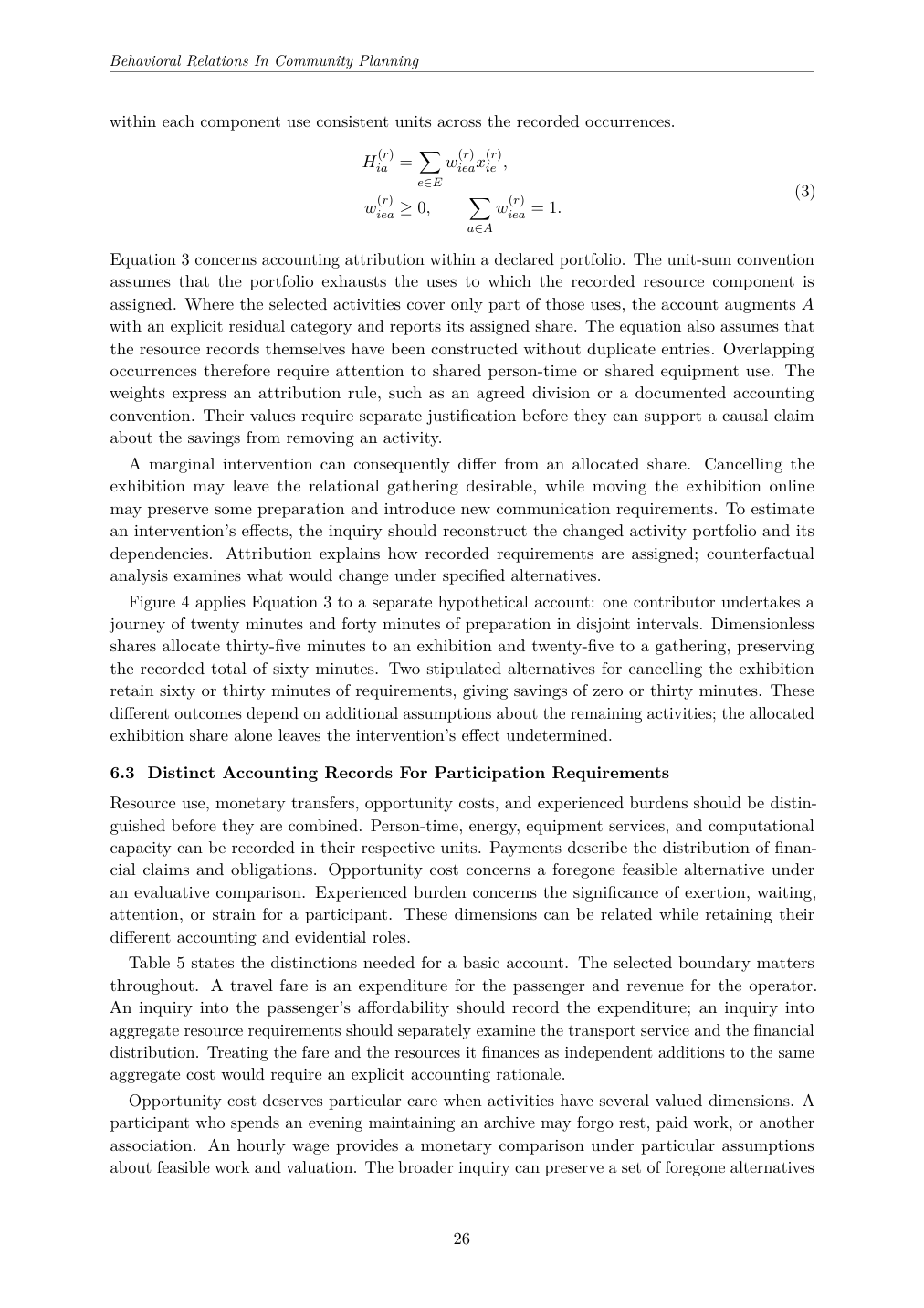
Readable text
within each component use consistent units across the recorded occurrences.
Equation 3 concerns accounting attribution within a declared portfolio. The unit-sum convention assumes that the portfolio exhausts the uses to which the recorded resource component is with an explicit residual category and reports its assigned share. The equation also assumes that the resource records themselves have been constructed without duplicate entries. Overlapping occurrences therefore require attention to shared person-time or shared equipment use. The weights express an attribution rule, such as an agreed division or a documented accounting convention. Their values require separate justification before they can support a causal claim
A marginal intervention can consequently differ from an allocated share. Cancelling the exhibition may leave the relational gathering desirable, while moving the exhibition online may preserve some preparation and introduce new communication requirements. To estimate an intervention’s effects, the inquiry should reconstruct the changed activity portfolio and its dependencies. Attribution explains how recorded requirements are assigned; counterfactual analysis examines what would change under specified alternatives.
Figure 4 applies Equation 3 to a separate hypothetical account: one contributor undertakes a journey of twenty minutes and forty minutes of preparation in disjoint intervals. Dimensionless shares allocate thirty-five minutes to an exhibition and twenty-five to a gathering, preserving the recorded total of sixty minutes. Two stipulated alternatives for cancelling the exhibition retain sixty or thirty minutes of requirements, giving savings of zero or thirty minutes. These different outcomes depend on additional assumptions about the remaining activities; the allocated exhibition share alone leaves the intervention’s effect undetermined.
6.3 Distinct Accounting Records For Participation Requirements
Resource use, monetary transfers, opportunity costs, and experienced burdens should be distin- guished before they are combined. Person-time, energy, equipment services, and computational capacity can be recorded in their respective units. Payments describe the distribution of finan- cial claims and obligations. Opportunity cost concerns a foregone feasible alternative under an evaluative comparison. Experienced burden concerns the significance of exertion, waiting, attention, or strain for a participant. These dimensions can be related while retaining their
Table 5 states the distinctions needed for a basic account. The selected boundary matters throughout. A travel fare is an expenditure for the passenger and revenue for the operator. An inquiry into the passenger’s affordability should record the expenditure; an inquiry into aggregate resource requirements should separately examine the transport service and the financial distribution. Treating the fare and the resources it finances as independent additions to the same aggregate cost would require an explicit accounting rationale.
Opportunity cost deserves particular care when activities have several valued dimensions. A participant who spends an evening maintaining an archive may forgo rest, paid work, or another association. An hourly wage provides a monetary comparison under particular assumptions about feasible work and valuation. The broader inquiry can preserve a set of foregone alternatives
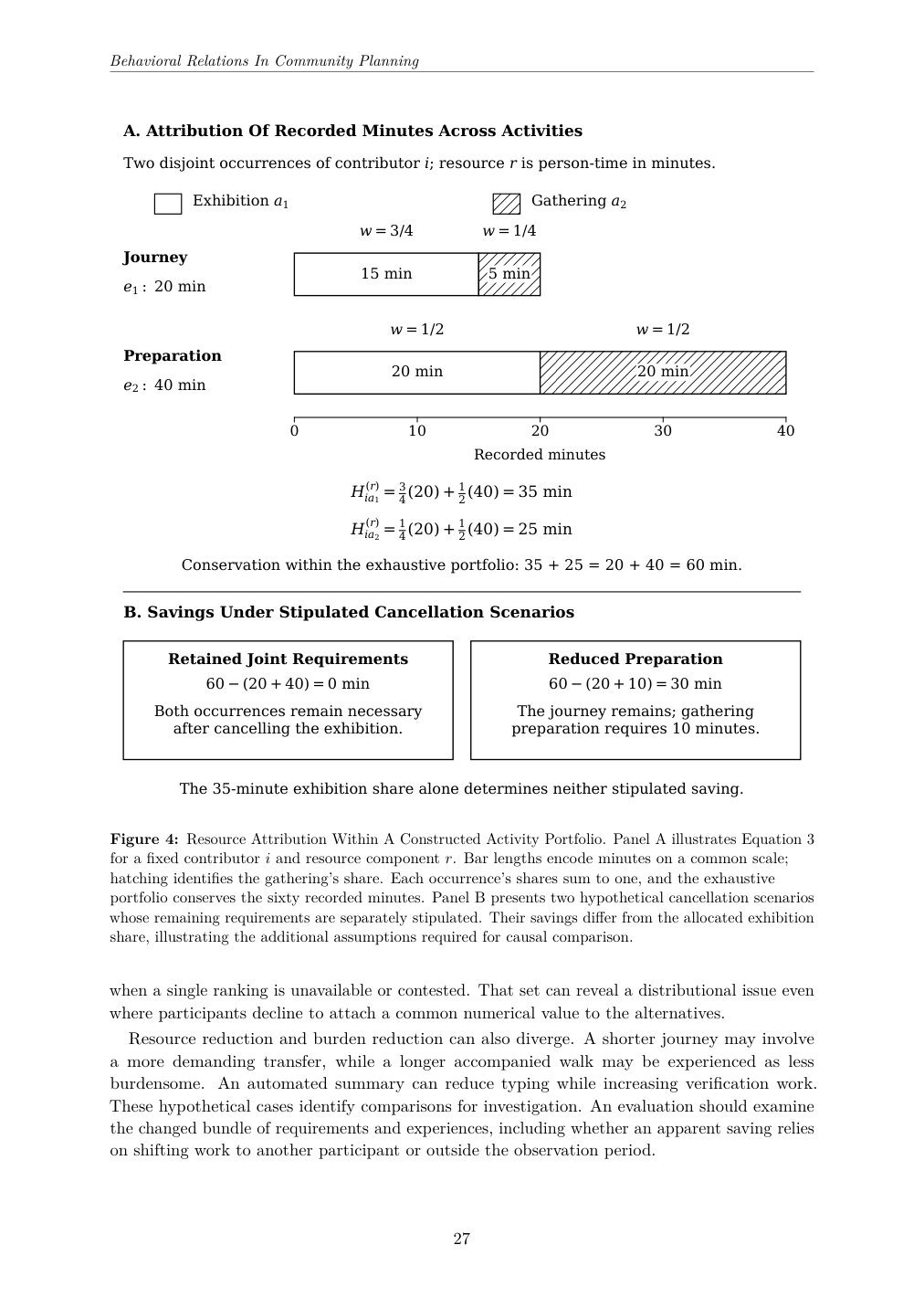
Readable text
A. Attribution Of Recorded Minutes Across Activities
Two disjoint occurrences of contributor i; resource r is person-time in minutes.
The journey remains; gathering preparation requires 10 minutes.
The 35-minute exhibition share alone determines neither stipulated saving.
Figure 4: Resource Attribution Within A Constructed Activity Portfolio. Panel A illustrates Equation 3 hatching identifies the gathering’s share. Each occurrence’s shares sum to one, and the exhaustive portfolio conserves the sixty recorded minutes. Panel B presents two hypothetical cancellation scenarios whose remaining requirements are separately stipulated. Their savings differ from the allocated exhibition share, illustrating the additional assumptions required for causal comparison.
when a single ranking is unavailable or contested. That set can reveal a distributional issue even where participants decline to attach a common numerical value to the alternatives.
Resource reduction and burden reduction can also diverge. A shorter journey may involve a more demanding transfer, while a longer accompanied walk may be experienced as less burdensome. An automated summary can reduce typing while increasing verification work. These hypothetical cases identify comparisons for investigation. An evaluation should examine the changed bundle of requirements and experiences, including whether an apparent saving relies on shifting work to another participant or outside the observation period.
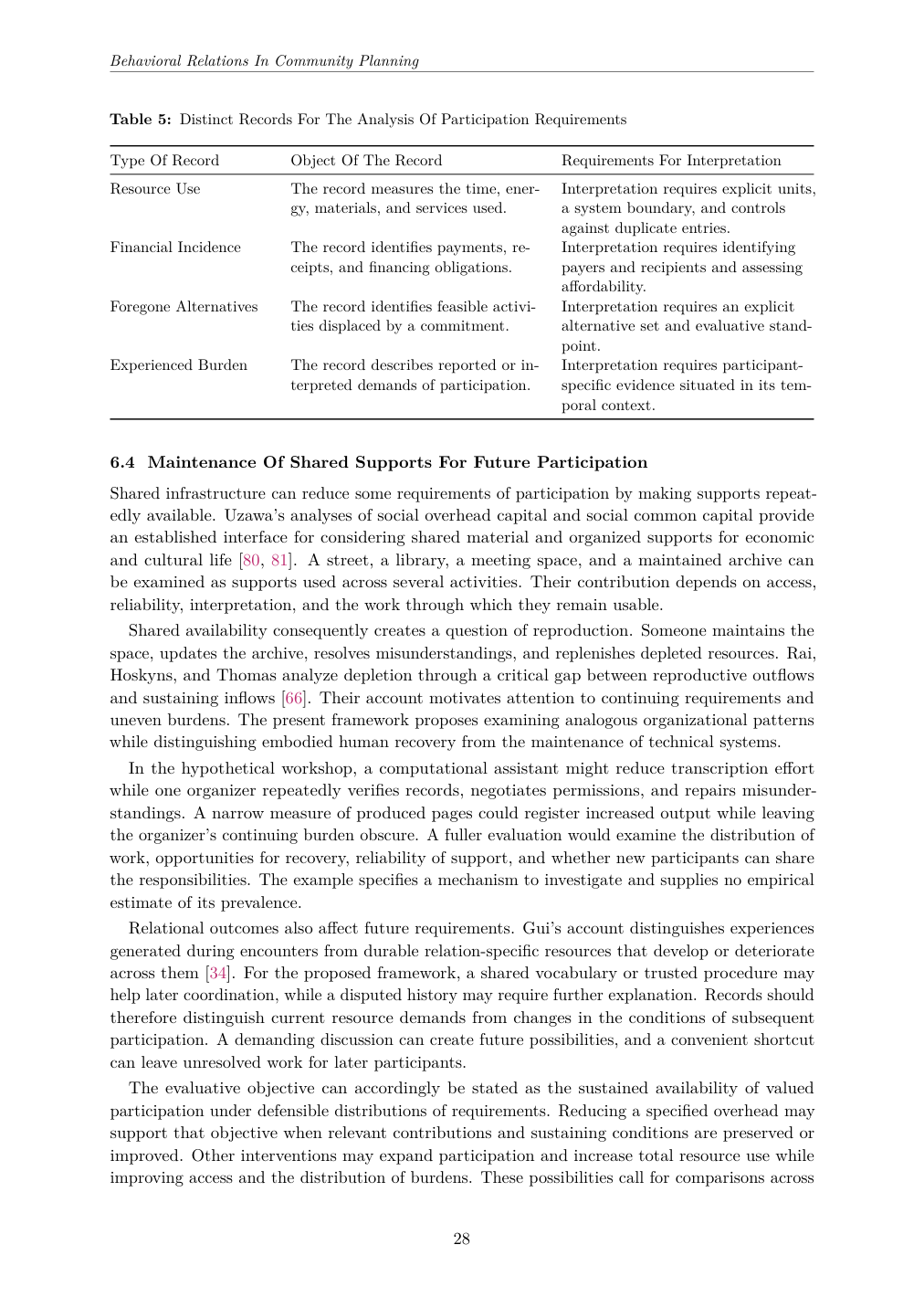
Readable text
Table 5: Distinct Records For The Analysis Of Participation Requirements
The record measures the time, ener- gy, materials, and services used.
Interpretation requires explicit units, a system boundary, and controls against duplicate entries.
The record identifies payments, re- ceipts, and financing obligations.
Interpretation requires identifying payers and recipients and assessing affordability.
The record identifies feasible activi- ties displaced by a commitment.
Interpretation requires an explicit alternative set and evaluative stand- point.
The record describes reported or in- terpreted demands of participation.
Interpretation requires participant- specific evidence situated in its tem- poral context.
6.4 Maintenance Of Shared Supports For Future Participation
Shared infrastructure can reduce some requirements of participation by making supports repeat- edly available. Uzawa’s analyses of social overhead capital and social common capital provide an established interface for considering shared material and organized supports for economic and cultural life [80, 81]. A street, a library, a meeting space, and a maintained archive can be examined as supports used across several activities. Their contribution depends on access, reliability, interpretation, and the work through which they remain usable.
Shared availability consequently creates a question of reproduction. Someone maintains the space, updates the archive, resolves misunderstandings, and replenishes depleted resources. Rai, Hoskyns, and Thomas analyze depletion through a critical gap between reproductive outflows and sustaining inflows [66]. Their account motivates attention to continuing requirements and uneven burdens. The present framework proposes examining analogous organizational patterns while distinguishing embodied human recovery from the maintenance of technical systems.
In the hypothetical workshop, a computational assistant might reduce transcription effort while one organizer repeatedly verifies records, negotiates permissions, and repairs misunder- standings. A narrow measure of produced pages could register increased output while leaving the organizer’s continuing burden obscure. A fuller evaluation would examine the distribution of work, opportunities for recovery, reliability of support, and whether new participants can share the responsibilities. The example specifies a mechanism to investigate and supplies no empirical
Relational outcomes also affect future requirements. Gui’s account distinguishes experiences generated during encounters from durable relation-specific resources that develop or deteriorate across them [34]. For the proposed framework, a shared vocabulary or trusted procedure may help later coordination, while a disputed history may require further explanation. Records should therefore distinguish current resource demands from changes in the conditions of subsequent participation. A demanding discussion can create future possibilities, and a convenient shortcut
The evaluative objective can accordingly be stated as the sustained availability of valued participation under defensible distributions of requirements. Reducing a specified overhead may support that objective when relevant contributions and sustaining conditions are preserved or improved. Other interventions may expand participation and increase total resource use while improving access and the distribution of burdens. These possibilities call for comparisons across
resource requirements, experienced consequences, and future capacities. The framework supplies a structure for making those comparisons explicit and revisable.
7 Situated Evaluation Of Aesthetic Experience
Aesthetic evaluation concerns experienced qualities whose significance develops through activity, relation, and history. Its inclusion changes the analysis of overhead because movement, preparation, and interaction can themselves contribute to valued experience. The present section examines temporal experience, the social formation of judgments, the adequacy of selected representations, plural comparison, and revisable appraisal. The argument combines a brief engagement with relevant literature and paper-local formal distinctions. It supports situated judgments while keeping the reach of a representation separate from the authority of the evaluation performed through it.
7.1 Experienced Quality Within Relational Histories
Aesthetic significance can arise in the course of an activity: the rhythm of walking, the unfolding of conversation, the handling of materials, or the relation between expectation and encounter. Dewey’s discussion of experience provides a philosophical precedent for examining temporal integration and aesthetic qualities within intellectual and practical activity [20]. The present framework adopts the analytical question of how qualities develop through participation. It leaves open differences among philosophical accounts of experience and their implications for particular empirical inquiries.
Travel provides a useful example. Mokhtarian and Salomon distinguish the attraction of a destination, activities undertaken during travel, and the experience of travelling itself [51]. That distinction helps identify the contributions affected by an intervention. A faster connection can improve access to a destination while changing the journey’s opportunities for observation or conversation. Whether the combined change is desirable depends on the participant, occasion, and available alternatives. The analysis can preserve the several contributions before considering their comparison.
Relational history adds further specificity. In a hypothetical neighborhood, a courtyard may evoke shared work for one participant, an earlier exclusion for another, and curiosity for a newcomer. Its visible geometry supplies part of the setting, while its experienced significance also involves histories of use, testimony, memory, and anticipated encounters. A design evaluation that records these differences can identify several objects of concern: material form, access to the place, the interpretation of its history, and the opportunities for future use.
Qualities can also change within a repeated activity. A route initially enjoyed for novelty may later be valued for familiarity, or experienced as burdensome when circumstances impose repeated travel. An encounter can be pleasurable while leaving a disagreement unresolved. These hypothetical possibilities motivate temporal records that distinguish immediate experience, retrospective interpretation, and continuing consequences. Aesthetic appraisal thereby becomes an inquiry into situated relations among qualities and histories, including the conditions under which those relations change.
7.2 Formation Of Authority In Aesthetic Appraisal
Aesthetic appraisal concerns the formation of dispositions through which qualities become salient and judgments receive recognition. In the introduction to Distinction, Bourdieu relates cultural acquisition, educational and social backgrounds, and hierarchies of legitimate taste [9, Introduction]. His account directs attention to learned dispositions and the classification of persons through cultural judgments. The framework brings those questions into conversation
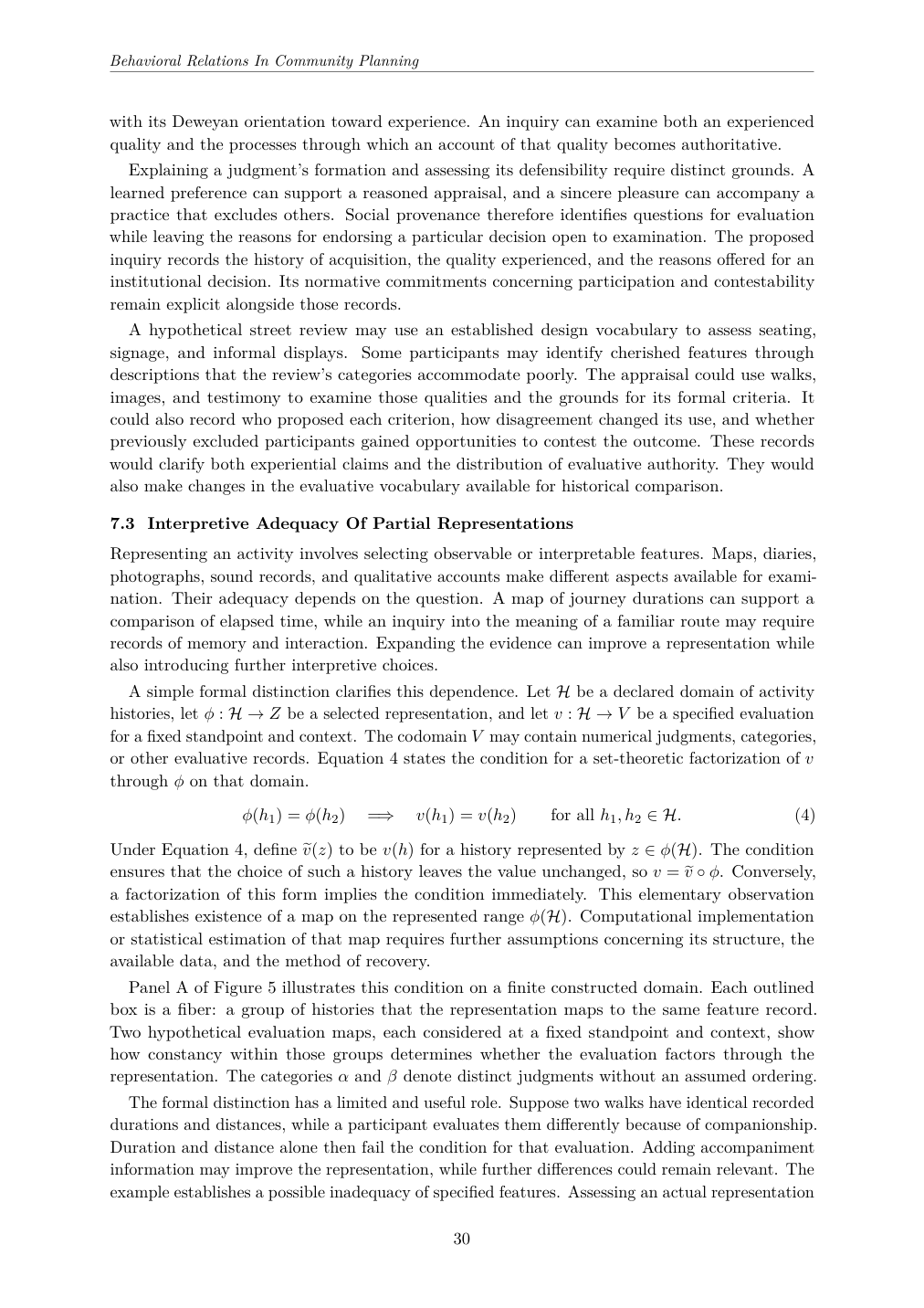
Readable text
with its Deweyan orientation toward experience. An inquiry can examine both an experienced quality and the processes through which an account of that quality becomes authoritative.
Explaining a judgment’s formation and assessing its defensibility require distinct grounds. A learned preference can support a reasoned appraisal, and a sincere pleasure can accompany a practice that excludes others. Social provenance therefore identifies questions for evaluation while leaving the reasons for endorsing a particular decision open to examination. The proposed inquiry records the history of acquisition, the quality experienced, and the reasons offered for an institutional decision. Its normative commitments concerning participation and contestability
A hypothetical street review may use an established design vocabulary to assess seating, signage, and informal displays. Some participants may identify cherished features through descriptions that the review’s categories accommodate poorly. The appraisal could use walks, images, and testimony to examine those qualities and the grounds for its formal criteria. It could also record who proposed each criterion, how disagreement changed its use, and whether previously excluded participants gained opportunities to contest the outcome. These records would clarify both experiential claims and the distribution of evaluative authority. They would also make changes in the evaluative vocabulary available for historical comparison.
Representing an activity involves selecting observable or interpretable features. Maps, diaries, photographs, sound records, and qualitative accounts make different aspects available for exami- nation. Their adequacy depends on the question. A map of journey durations can support a comparison of elapsed time, while an inquiry into the meaning of a familiar route may require records of memory and interaction. Expanding the evidence can improve a representation while
a factorization of this form implies the condition immediately. This elementary observation or statistical estimation of that map requires further assumptions concerning its structure, the
Panel A of Figure 5 illustrates this condition on a finite constructed domain. Each outlined box is a fiber: a group of histories that the representation maps to the same feature record. Two hypothetical evaluation maps, each considered at a fixed standpoint and context, show how constancy within those groups determines whether the evaluation factors through the
The formal distinction has a limited and useful role. Suppose two walks have identical recorded durations and distances, while a participant evaluates them differently because of companionship. Duration and distance alone then fail the condition for that evaluation. Adding accompaniment information may improve the representation, while further differences could remain relevant. The example establishes a possible inadequacy of specified features. Assessing an actual representation
requires evidence about the histories and evaluations at issue, including uncertainty in their records.
Partial representation consequently supports several kinds of result. It can identify reliably comparable features, disclose distinctions that the current model omits, and suggest further observation. Exact reconstruction, approximate prediction, and interpretive usefulness are different standards of adequacy. An explicit choice among them makes criticism more productive. It also permits the inquiry to preserve questions whose significance participants recognize even when the available representation remains limited.
The factorization condition applies within a fixed evaluative version. When criteria or meanings change, the inquiry records the revised evaluation and representation together with the grounds for their comparison. The versioning of categories in Section 9.2 and the historical comparison of judgments in Section 11.6 develop the corresponding methodological requirements.
7.4 Objective Functions Within Plural Evaluation
An evaluative comparison requires criteria and a standpoint in addition to a representation. A street design can be assessed for travel time, accessibility, ecological effects, cultural meaning, and the quality of encounter. Combining these dimensions into a single objective requires decisions about scales, compensation, and the authority to make those decisions. Such decisions can be justified for a specific purpose, and their implications remain open to examination by affected participants.


Equation 5 preserves designs for which the declared comparison supplies no strictly superior alternative. Under the stated finite-domain assumptions, the set is nonempty, although it may contain several designs. To see existence, follow strict improvements from an arbitrary design: transitivity and irreflexivity prevent revisiting a design, so finiteness yields a terminal member. Members of the maximal set can include alternatives whose relevant qualities remain incomparable. Selecting one for implementation then requires further grounds, a decision procedure, or a justified provisional choice.
Panel B of Figure 5 gives an exact five-design example. The upward arrows specify the immediate strict comparisons, and their transitive implications complete the order. Two terminal alternatives remain incomparable. Their common membership in the maximal set supplies no further comparison between them.
Consider two hypothetical routes to a community studio. One takes six minutes and passes a busy road; another takes ten minutes and follows a shaded path suitable for conversation. For an urgent visit, the time difference may dominate the participant’s appraisal. For a planned walk with a friend, the second route may be preferred. A route comparison can therefore change with the focal activity even while physical conditions remain fixed. Recording the activity and context clarifies the grounds of the different judgments.
A weighted score could represent a locally agreed comparison after its dimensions and scales have been specified. Its use would then carry the commitments introduced by those choices. A model’s unique optimum concerns the objective, feasible set, and assumptions used to construct
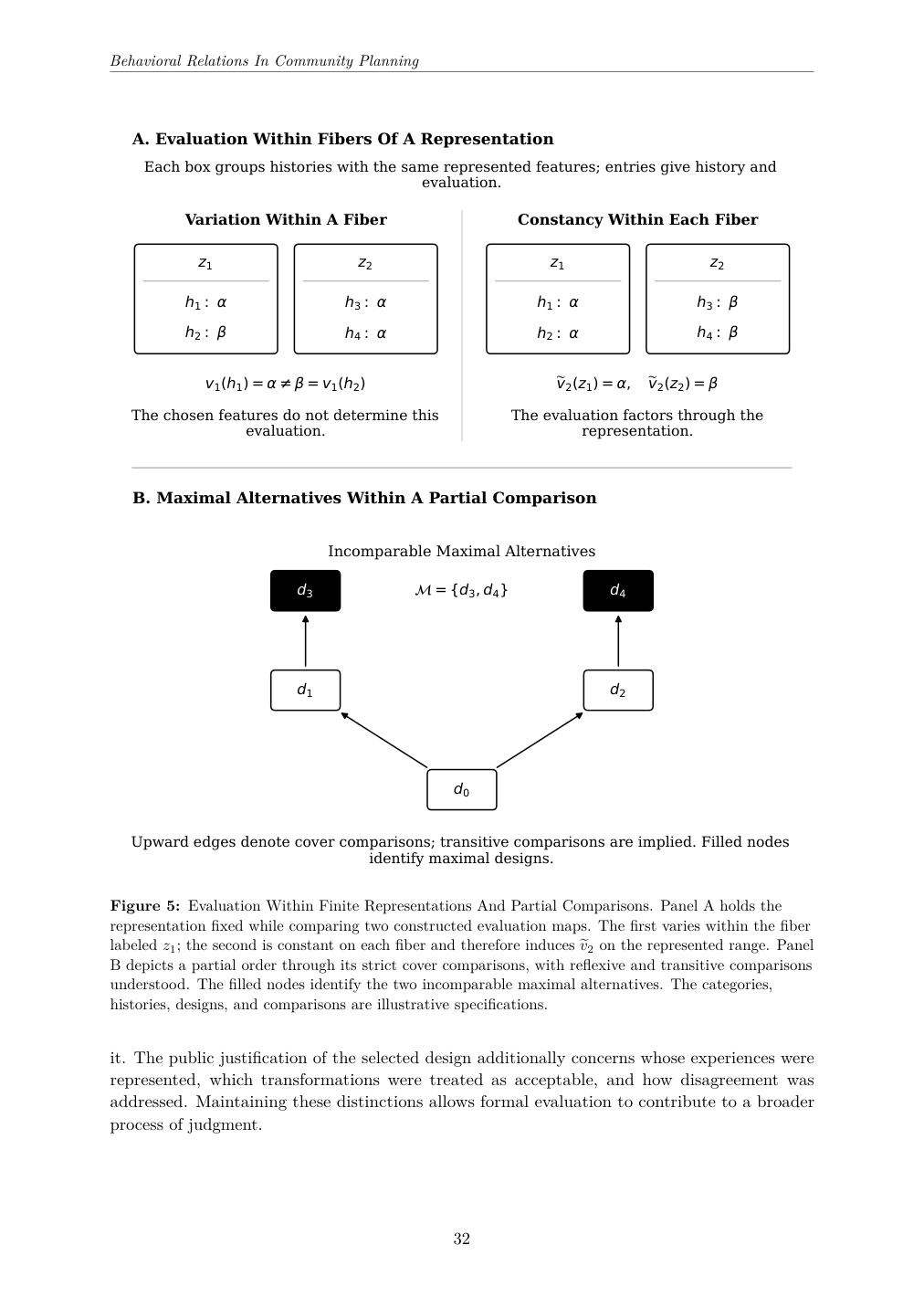
Readable text
Each box groups histories with the same represented features; entries give history and
Upward edges denote cover comparisons; transitive comparisons are implied. Filled nodes
Figure 5: Evaluation Within Finite Representations And Partial Comparisons. Panel A holds the representation fixed while comparing two constructed evaluation maps. The first varies within the fiber B depicts a partial order through its strict cover comparisons, with reflexive and transitive comparisons understood. The filled nodes identify the two incomparable maximal alternatives. The categories, histories, designs, and comparisons are illustrative specifications.
it. The public justification of the selected design additionally concerns whose experiences were represented, which transformations were treated as acceptable, and how disagreement was addressed. Maintaining these distinctions allows formal evaluation to contribute to a broader
7.5 Revisable Design Through Participatory Appraisal
A participatory appraisal can begin by eliciting accounts of particular activities and places, including episodes participants value and situations they find burdensome. Repeated observation and discussion can then examine how those accounts relate to material conditions, histories, and available alternatives. The procedure should identify whose accounts are included, how they are interpreted, and which questions remain disputed. Affected participants may also need resources and accessible settings to contribute to the appraisal itself.
Public discussion can change the evaluative vocabulary as well as communicate existing preferences. Sen assigns discussion a constructive role in the formation of values and priorities [74]. Within the present proposal, a participant may discover a previously unfamiliar history or recognize a burden that earlier criteria obscured. The inquiry can record such revisions together with their reasons. An evolving judgment then has an intelligible history, and disagreement can reveal a difference in experience, evidence, or normative commitment.
The hypothetical neighborhood exhibition illustrates the procedure. Participants initially favor a striking display of old street photographs. During preparation, one contributor explains that a photograph’s caption omits a history of displacement, while another values the image as a record of collective achievement. The appraisal can examine the image, caption, display setting, and proposed interpretive materials separately. Several arrangements may become available, including additional testimony, an alternative sequence, or a different place for discussion. Their merits depend on how the competing concerns are addressed and on the participation that the arrangement makes possible.
Revisability also matters after implementation. A new seating arrangement may support some encounters while changing movement through the space. An archive interface may make selected histories visible while leaving others difficult to retrieve. These hypotheses require observation of particular arrangements and participants. Review can compare anticipated and experienced effects, examine their distribution, and identify amendments. The relevant temporal horizon should include the work required to maintain the arrangement and the opportunities for participants to challenge its interpretation.
Aesthetic evaluation thus contributes to the wider framework by keeping experienced quality, historical meaning, and continuing possibility available for inquiry. It supports situated comparisons, explicit representations, and provisional decisions whose reasons can be examined. Its incorporation also changes the interpretation of enabling costs: an activity’s demands can be assessed alongside the experiences and relations constituted through its performance. The resulting appraisal preserves both the practical need to decide and the continuing responsibility to learn from the decision’s consequences.
8 Activity Reconstruction Within Historical Spacetime
Historical spacetime provides an analytical setting for reconstructing activities together with their enabling relations, accumulated conditions, and changing interpretations. The objective of this section is to specify what such reconstruction can establish from heterogeneous evidence. The discussion proceeds through evidential layers, the identification of purposes, the distinction between capacities and conditions, historical dependence across relational scales, and the treatment of absent participants. Its method is conceptual and methodological: it develops requirements for a research design without assuming that a particular record exhausts an activity’s reality. A reconstruction is treated as a revisable account of situated processes whose evidential support, temporal coverage, and interpretive commitments remain identifiable.
The critical spatial approaches reviewed in Section 3.4 identify further questions for reconstruction: the historical production of spatial arrangements, the unequal conditions of movement, and the relation between planning descriptions and lived appropriation. The present record brings those questions into an evidential inquiry. Its spatial boundaries and event categories remain analytical selections whose adequacy depends on the relations at issue.
8.1 Evidential Layers Of Activity Histories
An activity history contains several distinguishable kinds of information. A location record can indicate where a tracked object was estimated to be at a particular time. A diary may identify the activity that a participant understood herself to be performing. An administrative document can describe the permissions governing access. A later interview may explain why a previously valued activity ceased. Each source has an analytical role, and their relations require examination. Agreement between sources strengthens a particular inference only to the extent that the sources contribute relevant and sufficiently independent information. Two databases copied from one registration system provide a different evidential configuration from a registration record and an independently documented encounter.
The appropriate unit of reconstruction depends on the question. A crossing can be represented as one event when evaluating waiting time, as a sequence when examining negotiation between pedestrians and drivers, or as part of a longer project when studying access to employment. These descriptions can coexist. Their compatibility depends on explicit aggregation rules and on preservation of distinctions required by the question. If a caregiver accompanies a child to school before travelling to work, an account that groups the whole sequence under commuting conceals the coupling between care and livelihood. Conversely, an excessively fragmented record may obscure the practical unity of the morning project.
Hägerstrand’s account identifies capability, coupling, and authority constraints on activities in time and space, connecting bodily requirements and available means with coordination and access [35]. The present framework uses these distinctions as prompts for evidential reconstruction. A schedule should record the presence of commitments, their flexibility, the consequences of delay, and the actors authorized to alter them. A path becomes practically intelligible when the circumstances linking successive events receive comparable attention.
Table 6 separates recurrent evidential layers and their appropriate claims. The separation permits a reconstruction to remain informative when a layer is incomplete. An observed path may be well established while its purpose remains uncertain; a reported aspiration may be clear while the feasibility of acting upon it requires further investigation.
8.2 Interpretive Identification Of Activity Purposes
Activity identification involves an inverse problem whenever observations are used to infer purposes, meanings, or relations. The same recorded walk can be compatible with shopping, companionship, an aesthetic excursion, or several concurrent purposes. A change in direction may indicate curiosity, avoidance, an obligation, or a measurement error. These possibilities concern the relation between the observational scheme and the activity being reconstructed. They provide a reason to state the candidate interpretations and the evidence needed to discriminate among them.
Mavoa and colleagues combine location records with travel diaries to connect movement with information about purpose and accompaniment; their study makes explicit the additional contextual work required to interpret trajectories [47]. For the present argument, the methodological consequence is limited and precise. A record of displacement can support propositions about displacement while leaving several interpretations of the activity compatible with the evidence.
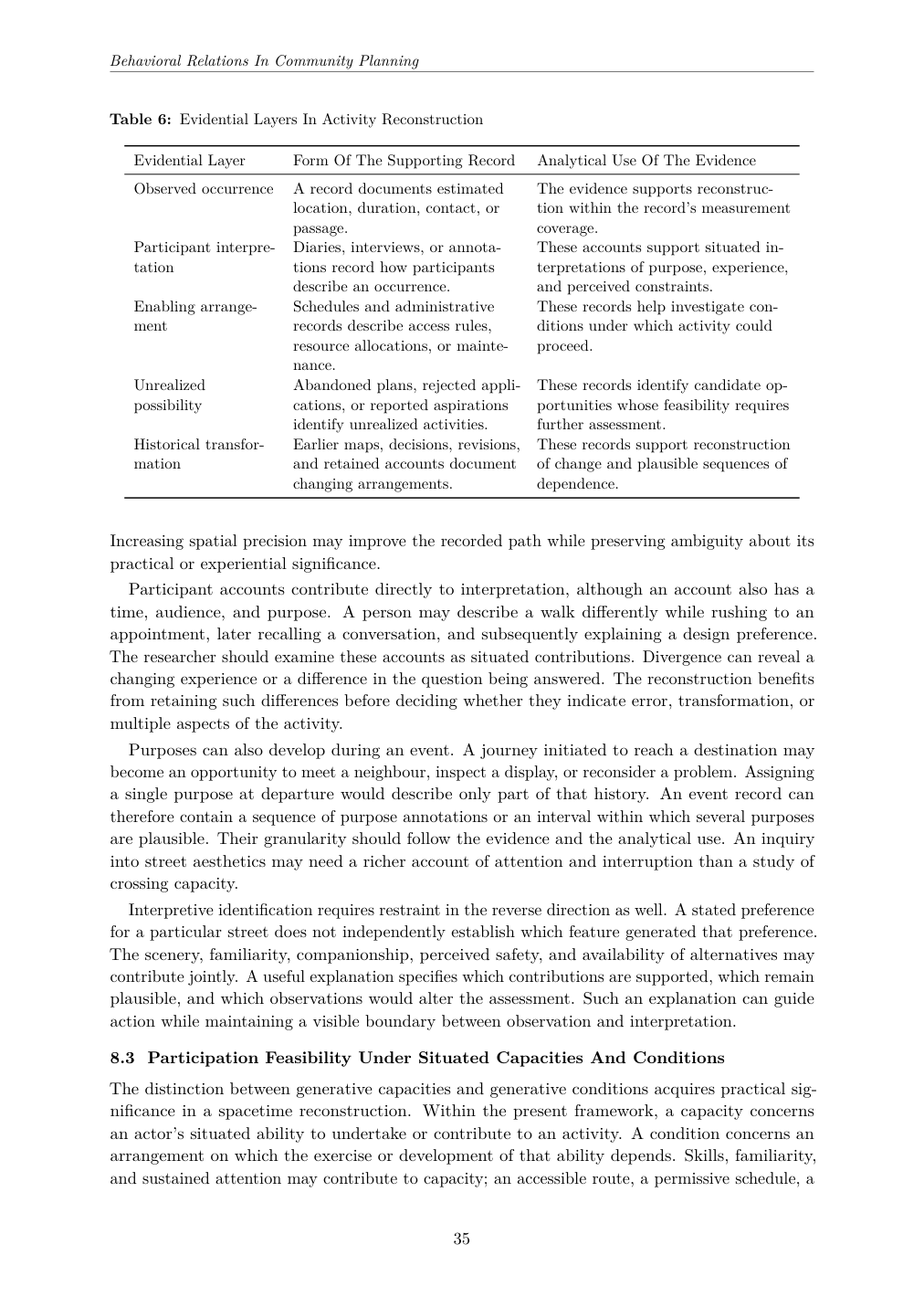
Readable text
Table 6: Evidential Layers In Activity Reconstruction
A record documents estimated location, duration, contact, or
The evidence supports reconstruc- tion within the record’s measurement coverage.
Diaries, interviews, or annota- tions record how participants
These accounts support situated in- terpretations of purpose, experience, and perceived constraints.
Schedules and administrative records describe access rules, resource allocations, or mainte-
These records help investigate con- ditions under which activity could proceed.
Abandoned plans, rejected appli- cations, or reported aspirations identify unrealized activities.
These records identify candidate op- portunities whose feasibility requires further assessment.
These records support reconstruction of change and plausible sequences of dependence.
Earlier maps, decisions, revisions, and retained accounts document
Increasing spatial precision may improve the recorded path while preserving ambiguity about its
Participant accounts contribute directly to interpretation, although an account also has a time, audience, and purpose. A person may describe a walk differently while rushing to an appointment, later recalling a conversation, and subsequently explaining a design preference. The researcher should examine these accounts as situated contributions. Divergence can reveal a changing experience or a difference in the question being answered. The reconstruction benefits from retaining such differences before deciding whether they indicate error, transformation, or
Purposes can also develop during an event. A journey initiated to reach a destination may become an opportunity to meet a neighbour, inspect a display, or reconsider a problem. Assigning a single purpose at departure would describe only part of that history. An event record can therefore contain a sequence of purpose annotations or an interval within which several purposes are plausible. Their granularity should follow the evidence and the analytical use. An inquiry into street aesthetics may need a richer account of attention and interruption than a study of
Interpretive identification requires restraint in the reverse direction as well. A stated preference for a particular street does not independently establish which feature generated that preference. The scenery, familiarity, companionship, perceived safety, and availability of alternatives may contribute jointly. A useful explanation specifies which contributions are supported, which remain plausible, and which observations would alter the assessment. Such an explanation can guide action while maintaining a visible boundary between observation and interpretation.
8.3 Participation Feasibility Under Situated Capacities And Conditions
The distinction between generative capacities and generative conditions acquires practical sig- nificance in a spacetime reconstruction. Within the present framework, a capacity concerns an actor’s situated ability to undertake or contribute to an activity. A condition concerns an arrangement on which the exercise or development of that ability depends. Skills, familiarity, and sustained attention may contribute to capacity; an accessible route, a permissive schedule, a
cooperative partner, and an available workspace may contribute to conditions. Their separation is analytical and provisional because repeated activity can transform both.
An accessible workshop illustrates the interaction. A participant may possess the relevant knowledge while lacking an available route during opening hours. Another may reach the workshop but require instruction before taking part. A third may have both route access and skill, yet lack a partner whose presence the activity requires. These configurations call for different interventions. Recording attendance alone would collapse several distinct limitations into a shared outcome. A reconstruction should therefore identify the specific relation whose alteration could make participation feasible.
Feasibility also depends on sequences. A meeting that is individually reachable may be incompatible with a preceding care commitment and a subsequent work obligation. Several separately accessible destinations can form an infeasible daily programme. The relevant object becomes a set of possible activity combinations with explicit temporal, material, and relational requirements. Investigating that set directs attention toward flexibility: a longer opening interval, an alternative sequence, or shared responsibility may expand feasible participation without changing travel speed.
Capacities and conditions can be distributed across participants. A neighbourhood gathering may depend on one person’s practical knowledge, another’s accessible premises, and a third’s willingness to coordinate. Its apparent stability can conceal the concentration of sustaining effort. Reconstructing the activity network therefore involves contributions, substitutions, dependencies, and opportunities for repair. A route improvement may increase access while leaving the concentration of coordination burdens intact. Conversely, a change in coordination may make existing infrastructure more usable.
The distinction has evaluative consequences. A resource inventory describes what is supplied, while an activity reconstruction examines the conversion of that supply into feasible and meaningful participation. The present account proposes documenting both levels and the relations between them. Where participation remains limited, the investigator can ask whether the obstacle concerns a capacity, a condition, their interaction, or a competing commitment. The resulting explanation is more actionable than a general classification of a person or neighbourhood as deficient.
8.4 Historical Dependence Across Relational Scales
Historical reconstruction concerns the formation of present possibilities as well as the chronology of recorded events. Earlier decisions can persist in street layouts, ownership patterns, schedules, categories of entitlement, and expectations about appropriate conduct. Barrington-Leigh and Millard-Ball identify persistence in street-network disconnectedness across periods and interpret it as indicative of path-dependent processes [4]. Such persistence provides an empirical prompt. The causal contribution of particular decisions, rules, and investments remains a further question for a case-specific investigation.
The proposed reconstruction distinguishes inherited arrangements from mechanisms that reproduce them. A narrow passage may persist because buildings endure, because ownership prevents modification, because residents value its character, or because investment priorities favour other places. Several mechanisms may operate together. Their implications for intervention differ. Physical alteration, negotiated access, maintenance, and changed priorities address different dependencies. Historical explanation becomes useful when it identifies how an inherited arrangement continues to shape activity and what could modify that relation.
The boundary of a street is similarly distinct from the boundary of its determinants. Local activity can depend on regional transport services, distant employment schedules, landowners’ financial decisions, and wider cultural expectations. For analysis, internal and external designate relations to a specified boundary. They should remain open to revision when an apparently external actor becomes part of the explanatory account. A street-centred inquiry can retain its practical focus while tracing selected dependencies beyond its immediate geography.
Different temporal scales matter because interventions and evaluations can unfold at different rates. A temporary change in seating can affect use within days; the development of familiarity or the displacement of a local business may emerge over a longer interval. A short observation window may capture an immediate adjustment while missing a later change in the composition of users. Conversely, a long aggregate record may conceal a brief disruption with lasting consequences for particular participants. The relevant periods should follow the hypothesized mechanism and the consequences under assessment.
Historical comparison also requires attention to category changes. An earlier record of street trading may use a classification different from the contemporary licensing register. Apparent continuity or decline can partly reflect those classifications. The investigator should preserve the original terms and document the translation used for comparison. Historical spacetime thereby includes the evolution of the observational and administrative categories through which activity becomes visible.
8.5 The Representation Of Absence In Activity Histories
An activity network observed in a place includes the participants who reached and remained within the observation boundary. A reconstruction concerned with opportunity and justice also needs a defensible account of relevant absences. Potential participants may have postponed, abandoned, or redirected activities; former participants may have left after costs, relationships, or conditions changed. These positions carry different evidential meanings. The category of absence should consequently be differentiated by the available history and by the relationship to the activity under investigation.
Selective exit can create a misleading appearance of convergence. Suppose dissatisfied participants cease attending a gathering while new participants enter. A subsequent survey may register greater satisfaction even when the earlier participants’ opportunities have contracted. Evaluating the change requires a cohort-sensitive account of entry, continued participation, and exit. Aggregate attendance and current satisfaction remain useful observations, but their interpretation depends on changes in the population represented.
Recruitment beyond current users can begin with former participants, nearby residents, rejected applicants, or people reporting a relevant unmet need. Such sampling requires an explicit rationale; every conceivable absence would provide an unmanageable and poorly justified boundary. The proposed criterion is explanatory relevance to a defined activity or opportunity. Evidence about intended participation, practical connection, or a plausible exposure to changed conditions can justify inclusion. The resulting account should state where coverage is weak and whose history remains difficult to recover.
Spacetime reconstruction is therefore a disciplined process of linking events, accounts, conditions, capacities, and transformations. Its adequacy is assessed relative to a question and a set of plausible alternatives. A useful reconstruction preserves enough detail to explain a disputed relation, identifies consequential missing evidence, and supports revision when new participants or histories become visible. These features allow the activity taxonomy to guide inquiry while keeping its classifications responsive to the lives and processes being studied.
9 Norm Dynamics In The Formation Of Evaluative Regularities
Norm dynamics concerns the processes through which recurrent activities acquire expectations, evaluative distinctions, and practical consequences. Within the present meta-framework, the analytical objective is to reconstruct the emergence, persistence, and revision of these arrangements while preserving differences between observed regularity, expressed obligation, and justified evaluation. The section develops a local representation of normative regimes, examines several meanings of dynamical attraction, and identifies evidence needed to investigate their historical formation. Formal constructions specify possible mechanisms; interpretive and comparative inquiry supplies the meanings, boundaries, and evaluative questions through which a particular application becomes intelligible.
9.1 Observational Distinctions Within Normative Regimes
A street may exhibit recurrent ways of passing, waiting, gathering, performing, or occupying space. Recurrence supplies an initial object of investigation. Its interpretation depends on additional evidence about constraints, expectations, commitments, and responses to departures. A pattern of rapid walking could reflect a shared expectation, a restricted timetable, discomfort, a particular sampling period, or several processes together. Each interpretation generates a different research problem and different implications for design. The framework therefore records the conditions under which an activity becomes recurrent alongside accounts of the significance attributed to it.
Bicchieri’s analyses distinguish types of behavioral regularity through conditional preferences and expectations, including differences between personal normative commitments and expectations concerning other people [7, 8]. These distinctions motivate a layered evidential record. An investigator can separately document observed conduct; beliefs about the conduct of relevant others; beliefs about what those others regard as appropriate; personally endorsed judgments; and anticipated or experienced responses to departures. The layers can reinforce one another, diverge, or change at different rates. Their empirical relationships remain questions for the particular population and setting.
Definition 9.1 introduces a paper-local organizing concept for that record.
Definition 9.1 (Normative Regime). A normative regime is a historically situated configuration of activity expectations, evaluative distinctions, recognized sources of authority, and practices of affirmation, correction, or sanction, together with the participants and contexts for which those relations are evidenced. A regime description includes its observation period and the basis on which its elements are attributed.
Definition 9.1 permits overlapping regimes. A pedestrian crossing can be subject simultaneously to formal traffic rules, locally learned conventions, expectations concerning accompaniment, and aesthetic judgments about the manner of movement. A researcher can preserve these relations without assigning the entire event to a single normative category. Disagreement among participants also belongs within the representation: a recorded regime can include contested expectations and uneven capacities to act on them.
The definition leaves the analytical boundary revisable. Identifying relevant participants requires attention to those whose activities are supported or constrained, including people absent from the observed location. An apparently quiet street might be evaluated differently after accounting for people who avoid it, workers whose schedules exclude them, or former participants displaced by changed access conditions. These possibilities are hypotheses for inquiry. They establish a reason to document the selection process through which a normative regime becomes visible to the investigator.
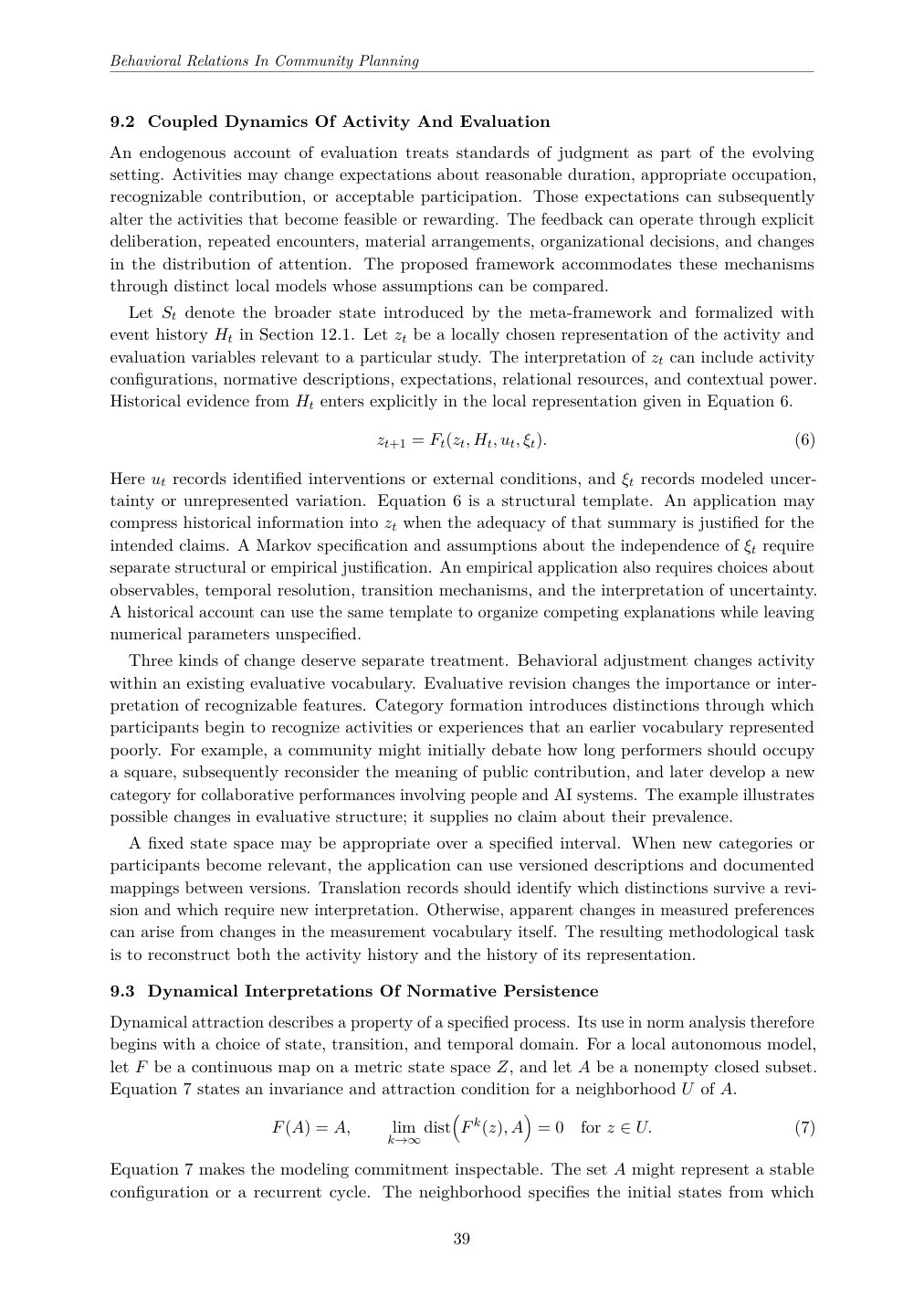
Readable text
An endogenous account of evaluation treats standards of judgment as part of the evolving setting. Activities may change expectations about reasonable duration, appropriate occupation, recognizable contribution, or acceptable participation. Those expectations can subsequently alter the activities that become feasible or rewarding. The feedback can operate through explicit deliberation, repeated encounters, material arrangements, organizational decisions, and changes in the distribution of attention. The proposed framework accommodates these mechanisms through distinct local models whose assumptions can be compared.
configurations, normative descriptions, expectations, relational resources, and contextual power.
tainty or unrepresented variation. Equation 6 is a structural template. An application may separate structural or empirical justification. An empirical application also requires choices about observables, temporal resolution, transition mechanisms, and the interpretation of uncertainty. A historical account can use the same template to organize competing explanations while leaving
Three kinds of change deserve separate treatment. Behavioral adjustment changes activity within an existing evaluative vocabulary. Evaluative revision changes the importance or inter- pretation of recognizable features. Category formation introduces distinctions through which participants begin to recognize activities or experiences that an earlier vocabulary represented poorly. For example, a community might initially debate how long performers should occupy a square, subsequently reconsider the meaning of public contribution, and later develop a new category for collaborative performances involving people and AI systems. The example illustrates possible changes in evaluative structure; it supplies no claim about their prevalence.
A fixed state space may be appropriate over a specified interval. When new categories or participants become relevant, the application can use versioned descriptions and documented mappings between versions. Translation records should identify which distinctions survive a revi- sion and which require new interpretation. Otherwise, apparent changes in measured preferences can arise from changes in the measurement vocabulary itself. The resulting methodological task is to reconstruct both the activity history and the history of its representation.
9.3 Dynamical Interpretations Of Normative Persistence
Dynamical attraction describes a property of a specified process. Its use in norm analysis therefore begins with a choice of state, transition, and temporal domain. For a local autonomous model,
configuration or a recurrent cycle. The neighborhood specifies the initial states from which
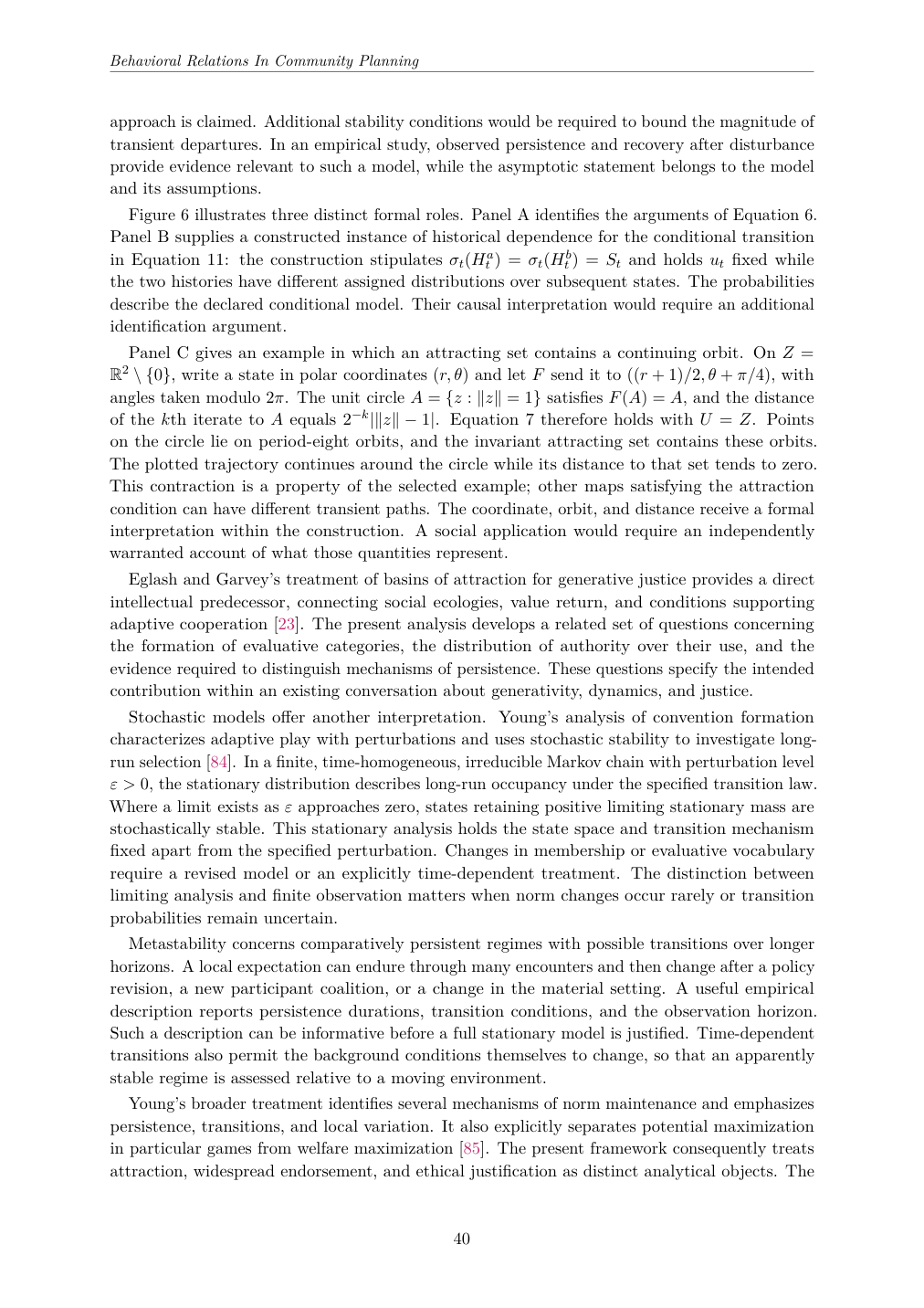
Readable text
approach is claimed. Additional stability conditions would be required to bound the magnitude of transient departures. In an empirical study, observed persistence and recovery after disturbance provide evidence relevant to such a model, while the asymptotic statement belongs to the model
Figure 6 illustrates three distinct formal roles. Panel A identifies the arguments of Equation 6. Panel B supplies a constructed instance of historical dependence for the conditional transition
the two histories have different assigned distributions over subsequent states. The probabilities describe the declared conditional model. Their causal interpretation would require an additional
on the circle lie on period-eight orbits, and the invariant attracting set contains these orbits. The plotted trajectory continues around the circle while its distance to that set tends to zero. This contraction is a property of the selected example; other maps satisfying the attraction condition can have different transient paths. The coordinate, orbit, and distance receive a formal interpretation within the construction. A social application would require an independently warranted account of what those quantities represent.
Eglash and Garvey’s treatment of basins of attraction for generative justice provides a direct intellectual predecessor, connecting social ecologies, value return, and conditions supporting adaptive cooperation [23]. The present analysis develops a related set of questions concerning the formation of evaluative categories, the distribution of authority over their use, and the evidence required to distinguish mechanisms of persistence. These questions specify the intended contribution within an existing conversation about generativity, dynamics, and justice.
Stochastic models offer another interpretation. Young’s analysis of convention formation characterizes adaptive play with perturbations and uses stochastic stability to investigate long- run selection [84]. In a finite, time-homogeneous, irreducible Markov chain with perturbation level
stochastically stable. This stationary analysis holds the state space and transition mechanism fixed apart from the specified perturbation. Changes in membership or evaluative vocabulary require a revised model or an explicitly time-dependent treatment. The distinction between limiting analysis and finite observation matters when norm changes occur rarely or transition
Metastability concerns comparatively persistent regimes with possible transitions over longer horizons. A local expectation can endure through many encounters and then change after a policy revision, a new participant coalition, or a change in the material setting. A useful empirical description reports persistence durations, transition conditions, and the observation horizon. Such a description can be informative before a full stationary model is justified. Time-dependent transitions also permit the background conditions themselves to change, so that an apparently stable regime is assessed relative to a moving environment.
Young’s broader treatment identifies several mechanisms of norm maintenance and emphasizes persistence, transitions, and local variation. It also explicitly separates potential maximization in particular games from welfare maximization [85]. The present framework consequently treats attraction, widespread endorsement, and ethical justification as distinct analytical objects. The
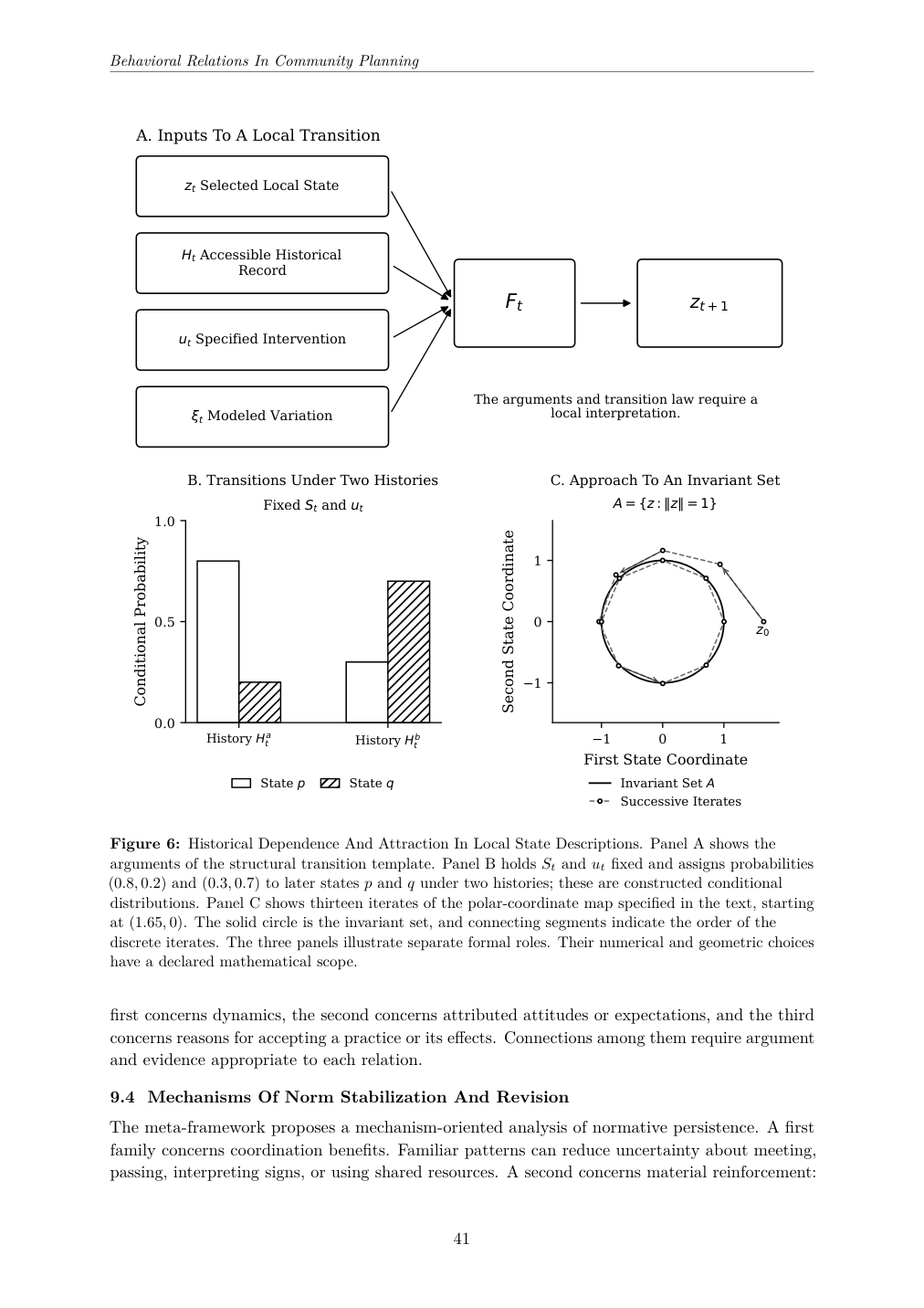
Readable text
Figure 6: Historical Dependence And Attraction In Local State Descriptions. Panel A shows the
distributions. Panel C shows thirteen iterates of the polar-coordinate map specified in the text, starting discrete iterates. The three panels illustrate separate formal roles. Their numerical and geometric choices
first concerns dynamics, the second concerns attributed attitudes or expectations, and the third concerns reasons for accepting a practice or its effects. Connections among them require argument
The meta-framework proposes a mechanism-oriented analysis of normative persistence. A first family concerns coordination benefits. Familiar patterns can reduce uncertainty about meeting, passing, interpreting signs, or using shared resources. A second concerns material reinforcement:
spatial arrangements and service schedules can make some patterns easier to repeat. A third concerns evaluative reinforcement, including recognition, prestige, criticism, and sanctions. A fourth concerns representational reinforcement: classifications, archives, interfaces, and public descriptions can repeatedly present a particular interpretation as the relevant one. These families provide research prompts whose combinations require local investigation.
Consider an illustrative plaza in which a recurring afternoon gathering gradually becomes associated with a particular seating area. Participants learn where to meet, nearby services adjust, and municipal descriptions begin to identify the area with the gathering. Coordination, material support, and public recognition now reinforce one another. A newcomer seeking a different use encounters a setting already organized by that history. The example shows how persistence can emerge through linked mechanisms without assigning every participant the same preference or treating the outcome as a fully planned collective choice.
Revision can likewise involve several processes. Participants may reinterpret an existing convention, develop an alternative practice, alter the resources available for participation, or change the procedure through which competing claims receive consideration. A successful alternative may remain local, coexist with an earlier regime, or spread through imitation and administrative adoption. Each pathway has different evidential signatures. Coexistence calls for attention to boundaries and translation; replacement calls for evidence about participation and displacement; administrative adoption calls for records of how a situated practice becomes a generalized rule.
Ostrom’s account of collective action emphasizes heterogeneous participant types and contextual variables, including information about past behavior and rules concerning provision and allocation [57]. The present application builds on that attention to context by distinguishing persistence sustained through mutual support from persistence sustained through unequal burdens. Both may produce similar aggregate regularities. Their evaluation requires evidence about who contributes, who benefits, who can revise the arrangement, and which alternatives remain accessible.
Mechanism selection should also remain sensitive to scale. A neighborhood regularity may depend on citywide transport schedules, platform visibility, or changes in housing access. A local intervention can alter one reinforcing process while leaving others active. Its effects therefore deserve assessment across the set of relations included in the explanation, with subsequent revision when outcomes reveal an omitted dependency.
9.5 Historical Pathways Of Norm Transfer Across Domains
Historical spacetime enters norm analysis through accumulated relations among events, records, material arrangements, and expectations. A present response can refer to a remembered encounter, an inherited classification, or an anticipated future use. The relevant history can be distributed across locations and media. A street-level interaction may be shaped by an earlier dispute conducted online, while a digital community’s conventions may draw meaning from recurring encounters in a physical venue. The analytical task is to reconstruct the paths through which those histories become consequential in the present.
Three historical operations are useful for local studies. Retention concerns which events or interpretations remain available. Reactivation concerns the circumstances in which a retained history is invoked. Translation concerns its use in a changed setting. These operations can be investigated through documents, interviews, interface histories, event sequences, and material evidence. Their distinction helps explain why extensive recording can coexist with selective remembrance: availability, attention, interpretive authority, and practical relevance are separate relations.
Cross-domain norm transfer deserves particular attention in human–AI communities. A rule suitable for a time-limited meeting might be incorporated into a persistent online workspace. A moderation practice developed for one language community might be applied to participants whose conventions of disagreement differ. A ranking procedure designed for finished outputs might become a means of evaluating exploratory exchanges. These are proposed analytical scenarios. In each case, the inquiry identifies the original problem addressed by the rule, the translation procedure, the new participants, and the consequences of retaining or modifying its evaluative categories.
Historical explanation also needs a scale-sensitive account of agency. A current participant may inherit an arrangement while having limited authority to revise it. Another actor may control the archive or interface through which the arrangement is presented. Attribution of responsibility should therefore examine available interventions at the relevant time, alongside knowledge, dependencies, and obligations. Reconstructing the normative regime through differentiated relations preserves distinctions among collective participation, specific interventions, and attributed responsibilities.
9.6 The Evidential Basis Of Contestable Norm Evaluation
An evidence-based investigation of norm dynamics begins by identifying the claims its evidence can support. Repeated observation can establish distributions of activity within a sampling frame. Accounts from participants can clarify interpreted expectations, experiences, and reasons. Documentary evidence can establish recorded decisions or changes in official descriptions. Carefully designed comparisons can assess whether a proposed mechanism predicts variation across settings. Each contribution addresses a different part of the explanation, and disagreements between sources can reveal an important structure in the regime itself.
Attraction hypotheses require particular care. Several mechanisms may generate similar persistence, including coordination, constrained alternatives, selective participation, and continued external pressure. Useful evidence can include responses to disturbances, changes following altered access, differences between public and private evaluations, and accounts from people who leave or decline to participate. Where intervention is feasible and appropriate, a reversible pilot can help distinguish competing explanations. Its interpretation should include the possibility that the pilot changes expectations and thereby becomes part of the process being studied.
Humanist evaluation enters through declared commitments concerning affected people’s capacities to participate, interpret their experience, and contest consequential descriptions. These commitments guide the treatment of evidence and the design of inquiry. Their justification belongs to explicit ethical and political argument. The descriptive study of a regime’s persistence supplies information for that argument, including distributional consequences and possibilities for revision. A locally dominant standard can itself become an object of evaluation when its formation or effects are contested.
The resulting method is recursive and accountable. Researchers formulate a provisional regime description, expose its evidential basis, compare alternative mechanisms, and revise the description through further inquiry and participant engagement. Models can clarify implications and identify missing observations; historical and interpretive work can revise the variables and meanings that a model presupposes. This division of epistemic labor supports a meta-framework in which evaluative regularities remain historically intelligible, empirically investigable, and open to reasoned transformation.
10 Contextual Orders Of Evaluative Power
Evaluative power concerns capacities to affect the activities, descriptions, evidence, and procedures through which judgments acquire practical consequences. The present section develops a contextdependent account suited to generative-relational inquiry. It distinguishes intervention capabilities from observed influence, establishes a limited order-theoretic representation, and examines the control of classifications, archives, and revision procedures. The argument combines a formal construction with interpretive examples. Its purpose is to make particular asymmetries inspectable while preserving the plurality of domains in which actors may acquire, exercise, or contest power.
10.1 Domains Of Power Over Activity Conditions
An activity can be affected through access to space, provision of resources, assignment of categories, visibility in an archive, or authority to determine an acceptable procedure. Each pathway identifies a different object of power. A venue operator may allocate opening hours; participants may jointly sustain a practice; a platform may shape its discoverability; an administrative body may determine which evidence enters a formal decision. These are illustrative roles. Their effective capacities depend on the particular setting, including dependencies and the actions of other participants.
Flyvbjerg’s planning research connects inquiry into power with questions about gains, losses, desirability, and possible intervention [27]. The present framework uses that orientation to distinguish the existence of an intervention capacity from its justification and consequences. Authority recognized within one procedure can coexist with limited capacity elsewhere. A participant may possess a formal right to submit evidence while facing substantial practical obstacles to assembling it. Conversely, an actor with little official authority may exercise considerable influence through control of resources or interpretive channels.
Power descriptions should therefore specify a domain, a target, a time horizon, and relevant background conditions. A comparison of control over street permits has a different scope from a comparison of influence over aesthetic judgments. The chosen horizon also matters: immediate access to a location, capacity to change its future use, and authority over the historical account of that change are distinct objects. A single scalar ranking would require an explicit rule for combining them, together with a justification for the rule’s evaluative significance.
The framework proposes retaining these distinctions as a family of contextual comparisons. An investigation can then examine where an actor’s capacities expand or contract, how capabilities in one domain support intervention in another, and where reciprocal dependencies limit a simple hierarchy. Such a representation treats power as an evolving relation within an activity ecology. It also enables analysis of actors situated beyond the physical site, provided their relevant intervention pathways are evidenced.
10.2 Orders Induced By Inclusion Of Intervention Capabilities
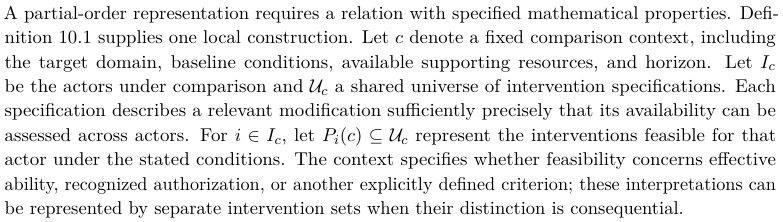
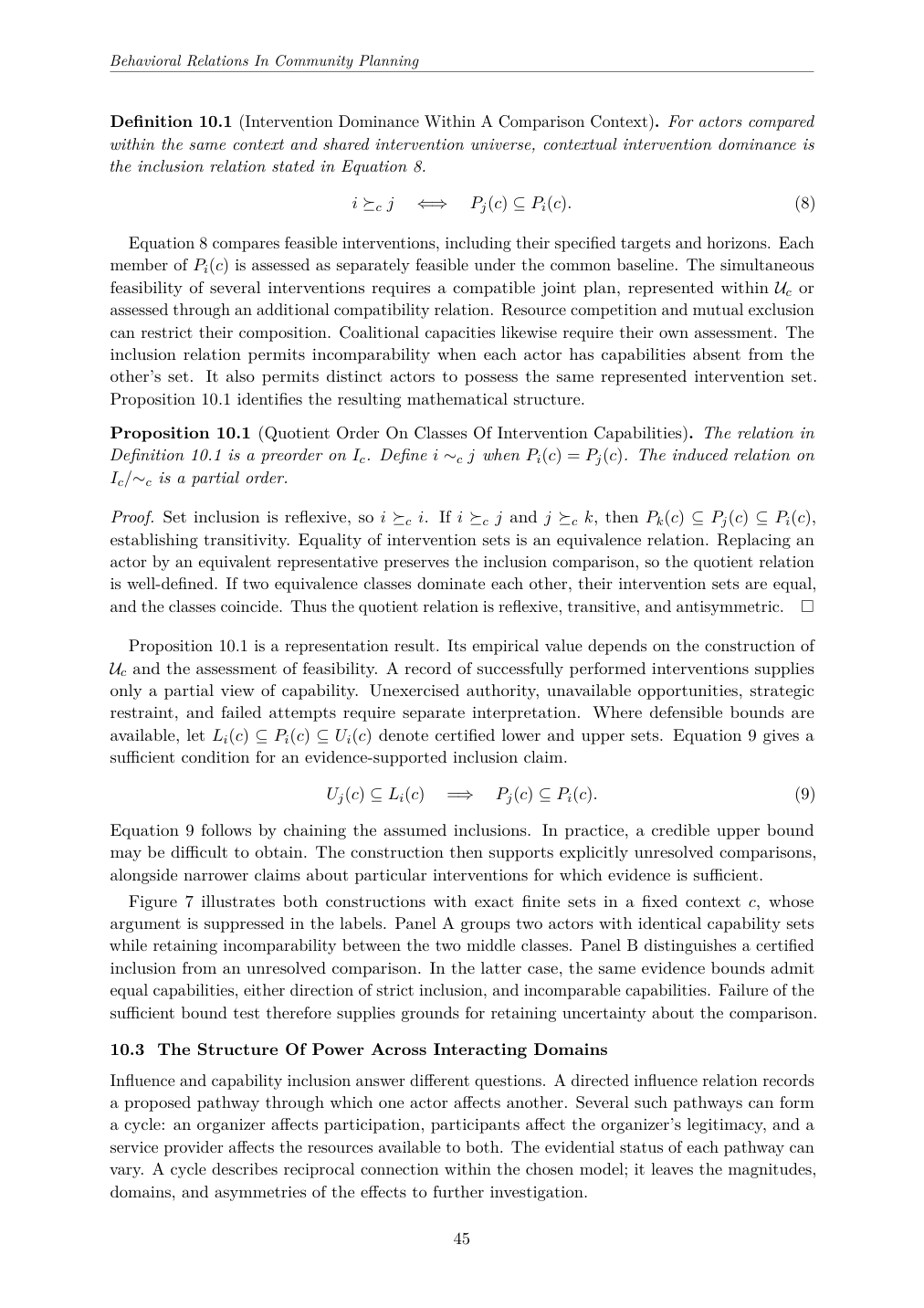
Readable text
Definition 10.1 (Intervention Dominance Within A Comparison Context). For actors compared within the same context and shared intervention universe, contextual intervention dominance is
Equation 8 compares feasible interventions, including their specified targets and horizons. Each assessed through an additional compatibility relation. Resource competition and mutual exclusion can restrict their composition. Coalitional capacities likewise require their own assessment. The inclusion relation permits incomparability when each actor has capabilities absent from the other’s set. It also permits distinct actors to possess the same represented intervention set. Proposition 10.1 identifies the resulting mathematical structure.
Proposition 10.1 (Quotient Order On Classes Of Intervention Capabilities). The relation in
establishing transitivity. Equality of intervention sets is an equivalence relation. Replacing an actor by an equivalent representative preserves the inclusion comparison, so the quotient relation is well-defined. If two equivalence classes dominate each other, their intervention sets are equal, and the classes coincide. Thus the quotient relation is reflexive, transitive, and antisymmetric.
Proposition 10.1 is a representation result. Its empirical value depends on the construction of only a partial view of capability. Unexercised authority, unavailable opportunities, strategic restraint, and failed attempts require separate interpretation. Where defensible bounds are sufficient condition for an evidence-supported inclusion claim.
Equation 9 follows by chaining the assumed inclusions. In practice, a credible upper bound may be difficult to obtain. The construction then supports explicitly unresolved comparisons, alongside narrower claims about particular interventions for which evidence is sufficient.
argument is suppressed in the labels. Panel A groups two actors with identical capability sets while retaining incomparability between the two middle classes. Panel B distinguishes a certified inclusion from an unresolved comparison. In the latter case, the same evidence bounds admit equal capabilities, either direction of strict inclusion, and incomparable capabilities. Failure of the sufficient bound test therefore supplies grounds for retaining uncertainty about the comparison.
Influence and capability inclusion answer different questions. A directed influence relation records a proposed pathway through which one actor affects another. Several such pathways can form a cycle: an organizer affects participation, participants affect the organizer’s legitimacy, and a service provider affects the resources available to both. The evidential status of each pathway can vary. A cycle describes reciprocal connection within the chosen model; it leaves the magnitudes, domains, and asymmetries of the effects to further investigation.
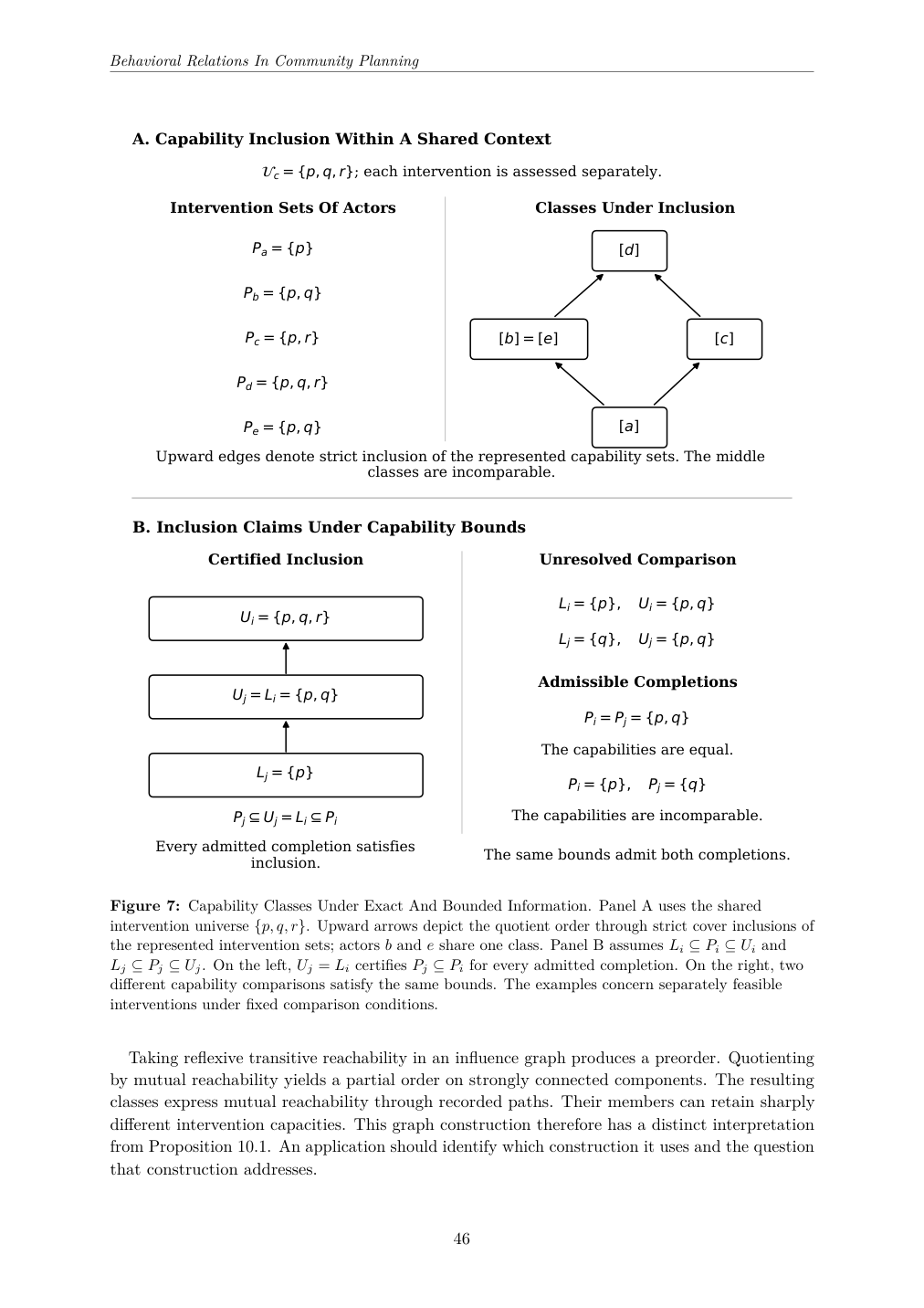
Readable text
Upward edges denote strict inclusion of the represented capability sets. The middle
Figure 7: Capability Classes Under Exact And Bounded Information. Panel A uses the shared different capability comparisons satisfy the same bounds. The examples concern separately feasible
Taking reflexive transitive reachability in an influence graph produces a preorder. Quotienting by mutual reachability yields a partial order on strongly connected components. The resulting classes express mutual reachability through recorded paths. Their members can retain sharply different intervention capacities. This graph construction therefore has a distinct interpretation from Proposition 10.1. An application should identify which construction it uses and the question

Cross-domain reach concerns a further mechanism: an intervention can change the conditions under which later comparisons are made. Control of a classification procedure may affect eligibility for resources, which can alter access to space and subsequently the ability to produce recognized evidence. The framework proposes investigating such sequences through explicit intermediate events. A claim that one domain of power propagates into another requires evidence about the connection, the timing, and the actors’ available responses. Contextual orders can then be indexed by successive states, making historical changes visible without presuming that a single hierarchy governs the whole trajectory.
10.4 Power Over The Classification And Preservation Of Evidence
Bowker and Star provide an explicit predecessor for examining the politics and practical labor of classification. Their analysis connects the creation and maintenance of categories with the visibility of work and with consequences for people whose circumstances fit classifications poorly [10]. The present intervention vocabulary organizes questions about who can establish, apply, challenge, and amend such categories within a specified activity setting. Each capacity requires its own evidence and may belong to a different participant or institution.
Evaluative procedures depend on decisions about recognizable objects. Classification determines whether an occurrence enters an analysis as transport, care, commerce, performance, disturbance, or another activity. A single event can sustain several descriptions, while administrative or computational systems may request a single code. The capacity to establish a classification scheme can consequently affect which contributions become visible and which comparisons become possible. The present framework treats that capacity as an object of inquiry, with attention to the purposes and constraints of the classification process.
Archive control introduces additional relations. Relevant capacities include recording an event, attaching metadata, preserving contextual accounts, granting access, correcting a description, and determining retrieval priority. These interventions influence the histories available to later evaluators. A record’s practical visibility can differ from its technical existence: search interfaces, language, organization, and familiarity with the collection can affect retrieval. The associated research task is to document the sequence connecting preservation to recognition and subsequent use.
Consider a hypothetical community exhibition that combines oral discussion, movement, and AI-assisted visual production. A public archive stores finished images and attendance totals, while the coordination and interpretive exchanges remain sparsely documented. A later allocation process evaluates contributions using only the stored outputs. The resulting comparison reflects a chain of archival and procedural choices. Investigation would need to determine who selected the records, which alternatives were available, what participants understood, and how the allocation procedure could receive additional evidence. The example specifies a possible mechanism and corresponding evidential questions for a future study.
Power over evidence can also concern admissibility and challenge. An authority may determine the formats in which a claim can be presented, the period covered by acceptable records, or the procedure for correcting an error. Such decisions can serve legitimate administrative purposes while producing differentiated burdens. Evaluating them requires examining those purposes,
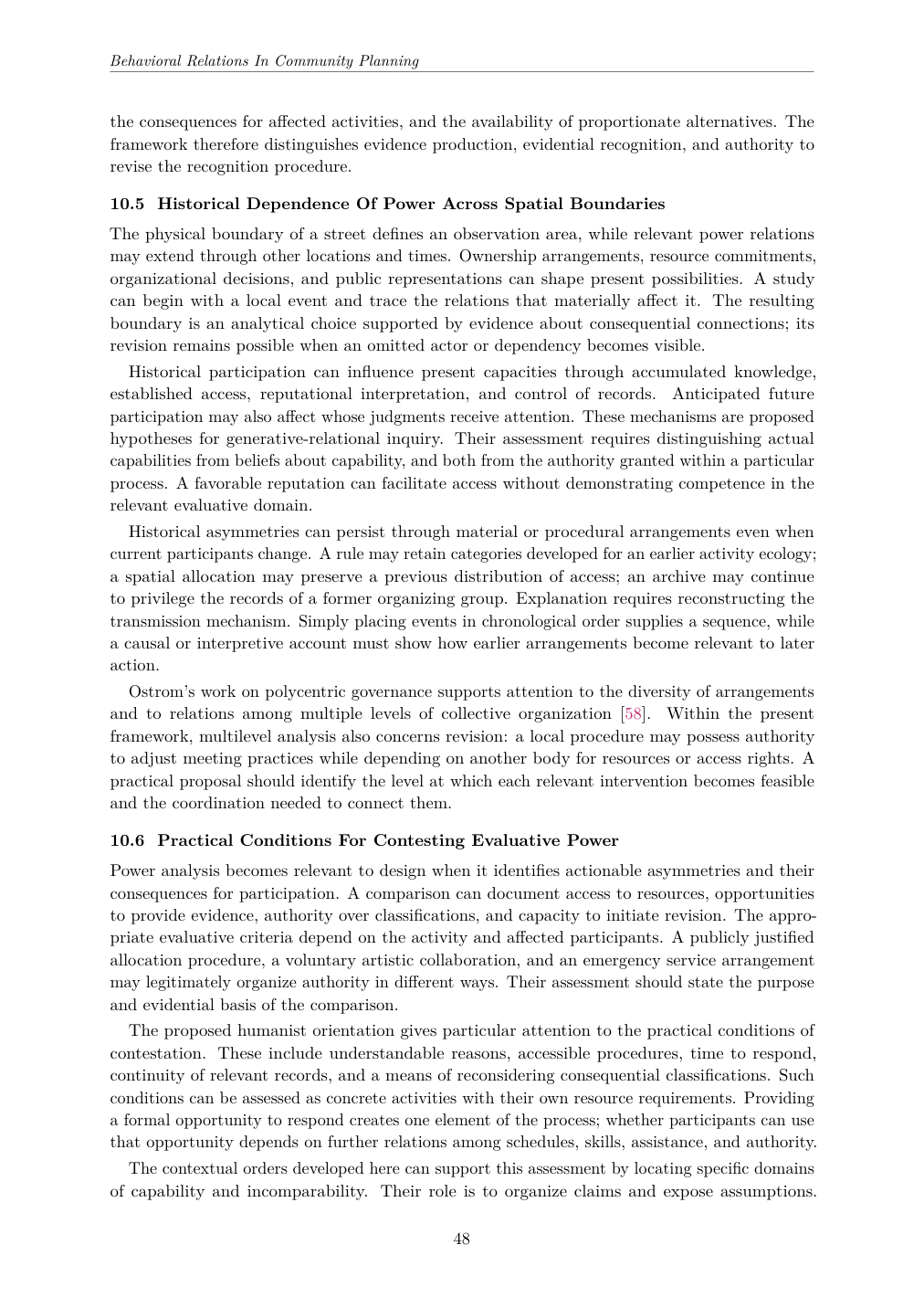
Readable text
the consequences for affected activities, and the availability of proportionate alternatives. The framework therefore distinguishes evidence production, evidential recognition, and authority to
10.5 Historical Dependence Of Power Across Spatial Boundaries
The physical boundary of a street defines an observation area, while relevant power relations may extend through other locations and times. Ownership arrangements, resource commitments, organizational decisions, and public representations can shape present possibilities. A study can begin with a local event and trace the relations that materially affect it. The resulting boundary is an analytical choice supported by evidence about consequential connections; its revision remains possible when an omitted actor or dependency becomes visible.
Historical participation can influence present capacities through accumulated knowledge, established access, reputational interpretation, and control of records. participation may also affect whose judgments receive attention. These mechanisms are proposed hypotheses for generative-relational inquiry. Their assessment requires distinguishing actual capabilities from beliefs about capability, and both from the authority granted within a particular process. A favorable reputation can facilitate access without demonstrating competence in the
Historical asymmetries can persist through material or procedural arrangements even when current participants change. A rule may retain categories developed for an earlier activity ecology; a spatial allocation may preserve a previous distribution of access; an archive may continue to privilege the records of a former organizing group. Explanation requires reconstructing the transmission mechanism. Simply placing events in chronological order supplies a sequence, while a causal or interpretive account must show how earlier arrangements become relevant to later
Ostrom’s work on polycentric governance supports attention to the diversity of arrangements and to relations among multiple levels of collective organization [58]. framework, multilevel analysis also concerns revision: a local procedure may possess authority to adjust meeting practices while depending on another body for resources or access rights. A practical proposal should identify the level at which each relevant intervention becomes feasible
10.6 Practical Conditions For Contesting Evaluative Power
Power analysis becomes relevant to design when it identifies actionable asymmetries and their consequences for participation. A comparison can document access to resources, opportunities to provide evidence, authority over classifications, and capacity to initiate revision. The appro- priate evaluative criteria depend on the activity and affected participants. A publicly justified allocation procedure, a voluntary artistic collaboration, and an emergency service arrangement may legitimately organize authority in different ways. Their assessment should state the purpose
The proposed humanist orientation gives particular attention to the practical conditions of contestation. These include understandable reasons, accessible procedures, time to respond, continuity of relevant records, and a means of reconsidering consequential classifications. Such conditions can be assessed as concrete activities with their own resource requirements. Providing a formal opportunity to respond creates one element of the process; whether participants can use that opportunity depends on further relations among schedules, skills, assistance, and authority.
The contextual orders developed here can support this assessment by locating specific domains of capability and incomparability. Their role is to organize claims and expose assumptions.
Decisions about acceptable authority require additional ethical and political reasoning, informed by the historical formation and distributional effects of the arrangement. A design intervention can then aim to improve a defined capability, reduce a documented barrier, or widen a revision procedure, with subsequent evaluation of how the change affects the wider activity ecology.
11 Value Formation Within Generative Activity Relations
Value formation concerns the processes through which activities, experiences, relations, and their consequences become valuable to particular participants and acquire significance within collective practices. This section develops a process vocabulary for investigating those relations across heterogeneous evaluative domains. It distinguishes recognition, validation, valuation, conversion, circulation, return, capture, dissipation, and regeneration, then examines their connections to evaluative power and historical change. The proposed vocabulary organizes inquiry; its categories remain open to revision through engagement with the activities and traditions under investigation.
11.1 Modes Of Valuation Across Heterogeneous Objects
A shared activity can sustain several kinds of valued experience and consequence. A neighborhood performance may provide aesthetic engagement, occasions for companionship, income for some participants, opportunities for learning, and records available for later reinterpretation. These possible relations concern different objects and horizons. The performance’s duration, its contribution to a relationship, and its monetary receipts can each be described, while their combination into a single measure would require further evaluative choices. An analysis should specify which relation is being represented and whose judgment supplies its significance.
The literature on relational goods provides an established route for examining interactiondependent value. Uhlaner incorporates sociability into an account of participation, while Gui analyzes encounters that jointly generate relational goods and conventional values [34, 78]. These contributions support attention to the relational content of an activity. The present meta-framework additionally records the historical formation of evaluative categories and the procedures through which different accounts receive recognition. This extension is an analytical proposal whose usefulness requires examination in particular cases.
Eglash’s generative-justice framework provides a further intellectual basis for examining labor, ecological, and expressive value together with their circulation [22]. The present paper inherits that concern while developing a differentiated vocabulary for conversion interfaces, evaluative authority, and revision. Its use of generativity identifies questions about the continuation and transformation of capacities and supporting relations. A specific application still requires an account of the value forms involved and the reasons for treating a proposed return or renewal as adequate.
Value descriptions can include quantitative measures, ordinal judgments, qualitative accounts, and unresolved comparisons. Their coexistence permits several forms of knowledge to enter an assessment. A participant’s account of aesthetic significance can guide inquiry even when its meaning exceeds a selected indicator. Similarly, a financial record can establish a payment while leaving the fairness of its distribution open to argument. The framework treats each representation according to the kind of claim it can support.
11.2 Processes Within Value Formation
Recognition concerns the identification of something as relevant within an evaluative practice. Validation concerns the grounds on which a description, contribution, or claim receives warranted acceptance within a specified procedure. Valuation concerns the attribution or comparison of significance. These processes can overlap, yet their distinction reveals different points of
intervention. An activity may be recognized while its effects remain disputed; a contribution can be well documented while its significance is evaluated differently by participants; and an experience can be valued personally before entering a public record.
Table 7 summarizes the proposed process vocabulary. The rows describe analytical functions that can recur, overlap, or branch. An empirical account determines which functions are present and how they are related.
A hypothetical community archive illustrates the distinction. Participants recognize an informal workshop as relevant to their collective history. They validate the record through accounts from people involved and supporting artifacts. Later, a funding procedure values the workshop through a criterion of public participation. Each process can draw on different evidence and different authorities. A disagreement about the funding criterion can therefore coexist with agreement that the workshop occurred and mattered to its participants.
Recognition and validation also have histories. Categories can emerge through repeated attempts to describe an experience, and acceptable forms of evidence can change as a community learns. The framework proposes documenting such revisions explicitly. An earlier description remains historically intelligible when the reasons for replacement are preserved. Participants can then distinguish a change in the activity from a change in its public representation.
11.3 Authority Over Conversion Between Evaluative Domains
Conversion connects evaluative domains through a procedure or practice. A contribution can influence eligibility for a grant; a public reputation can facilitate access to a venue; or a shared experience can motivate a future commitment of time. Each connection involves a particular mechanism. Some conversions are specified by formal rules, others depend on situated judgments, and some remain contested. Their study requires attention to the actors who establish the interface and those affected by its operation.



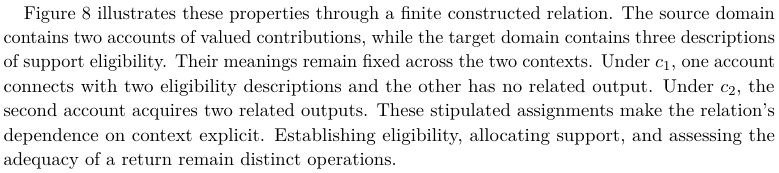
For example, a community’s account of an accessible gathering may enter a municipal application under a category of public benefit. The conversion can make resources available, while selecting some features of the original account for administrative consideration. A useful analysis records what the interface retains, which distinctions remain outside the administrative description, and the procedures available for explaining those distinctions. The same activity can thus remain accessible through several descriptions with different practical roles.
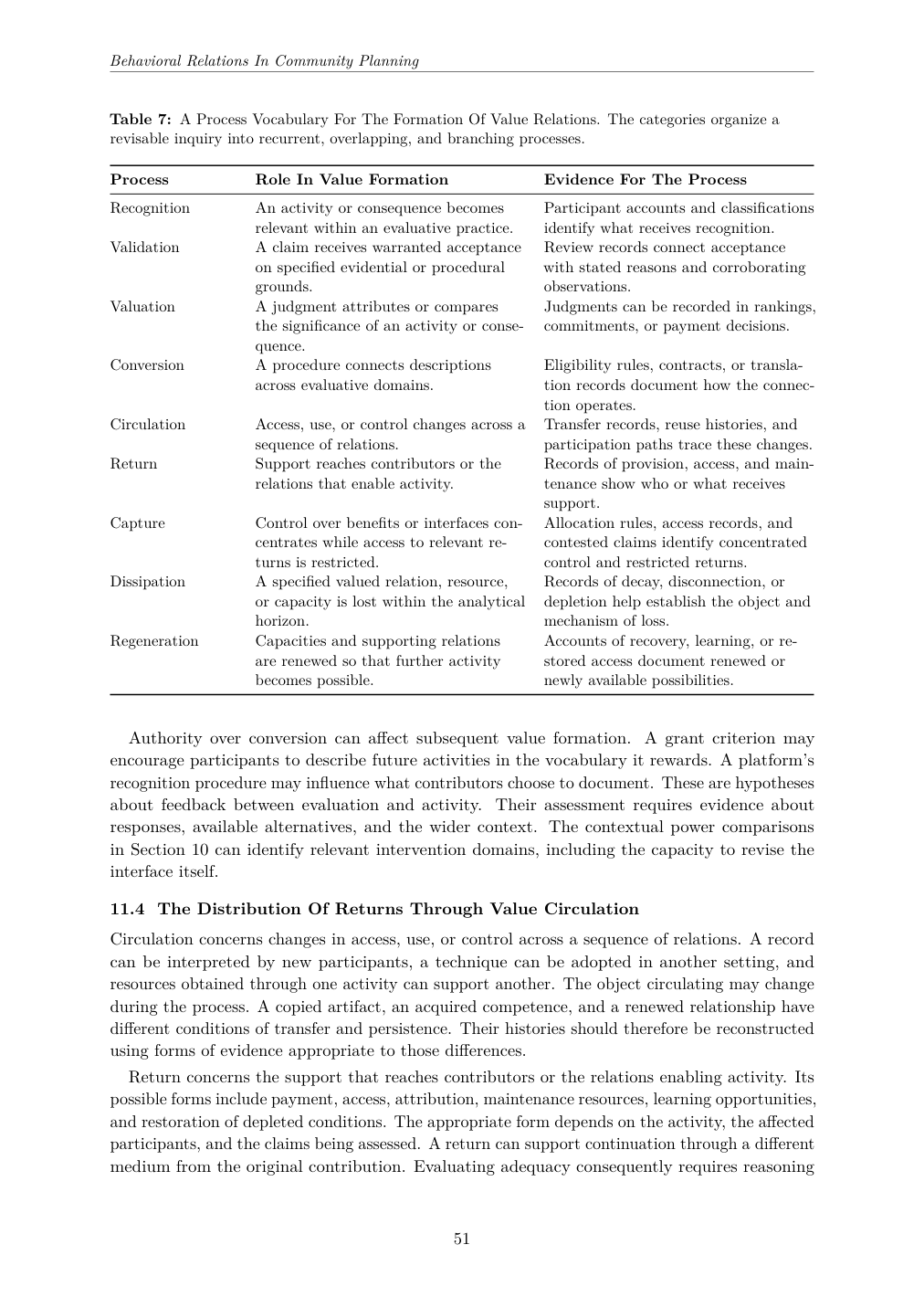
Readable text
Table 7: A Process Vocabulary For The Formation Of Value Relations. The categories organize a revisable inquiry into recurrent, overlapping, and branching processes.
An activity or consequence becomes relevant within an evaluative practice.
Participant accounts and classifications identify what receives recognition.
A claim receives warranted acceptance on specified evidential or procedural
Review records connect acceptance with stated reasons and corroborating observations.
A judgment attributes or compares the significance of an activity or conse-
Judgments can be recorded in rankings, commitments, or payment decisions.
Eligibility rules, contracts, or transla- tion records document how the connec- tion operates.
Transfer records, reuse histories, and participation paths trace these changes.
Records of provision, access, and main- tenance show who or what receives support.
Control over benefits or interfaces con- centrates while access to relevant re-
Allocation rules, access records, and contested claims identify concentrated control and restricted returns.
A specified valued relation, resource, or capacity is lost within the analytical
Records of decay, disconnection, or depletion help establish the object and mechanism of loss.
Capacities and supporting relations are renewed so that further activity
Accounts of recovery, learning, or re- stored access document renewed or newly available possibilities.
Authority over conversion can affect subsequent value formation. A grant criterion may encourage participants to describe future activities in the vocabulary it rewards. A platform’s recognition procedure may influence what contributors choose to document. These are hypotheses about feedback between evaluation and activity. Their assessment requires evidence about responses, available alternatives, and the wider context. The contextual power comparisons in Section 10 can identify relevant intervention domains, including the capacity to revise the
11.4 The Distribution Of Returns Through Value Circulation
Circulation concerns changes in access, use, or control across a sequence of relations. A record can be interpreted by new participants, a technique can be adopted in another setting, and resources obtained through one activity can support another. The object circulating may change during the process. A copied artifact, an acquired competence, and a renewed relationship have different conditions of transfer and persistence. Their histories should therefore be reconstructed using forms of evidence appropriate to those differences.
Return concerns the support that reaches contributors or the relations enabling activity. Its possible forms include payment, access, attribution, maintenance resources, learning opportunities, and restoration of depleted conditions. The appropriate form depends on the activity, the affected participants, and the claims being assessed. A return can support continuation through a different medium from the original contribution. Evaluating adequacy consequently requires reasoning
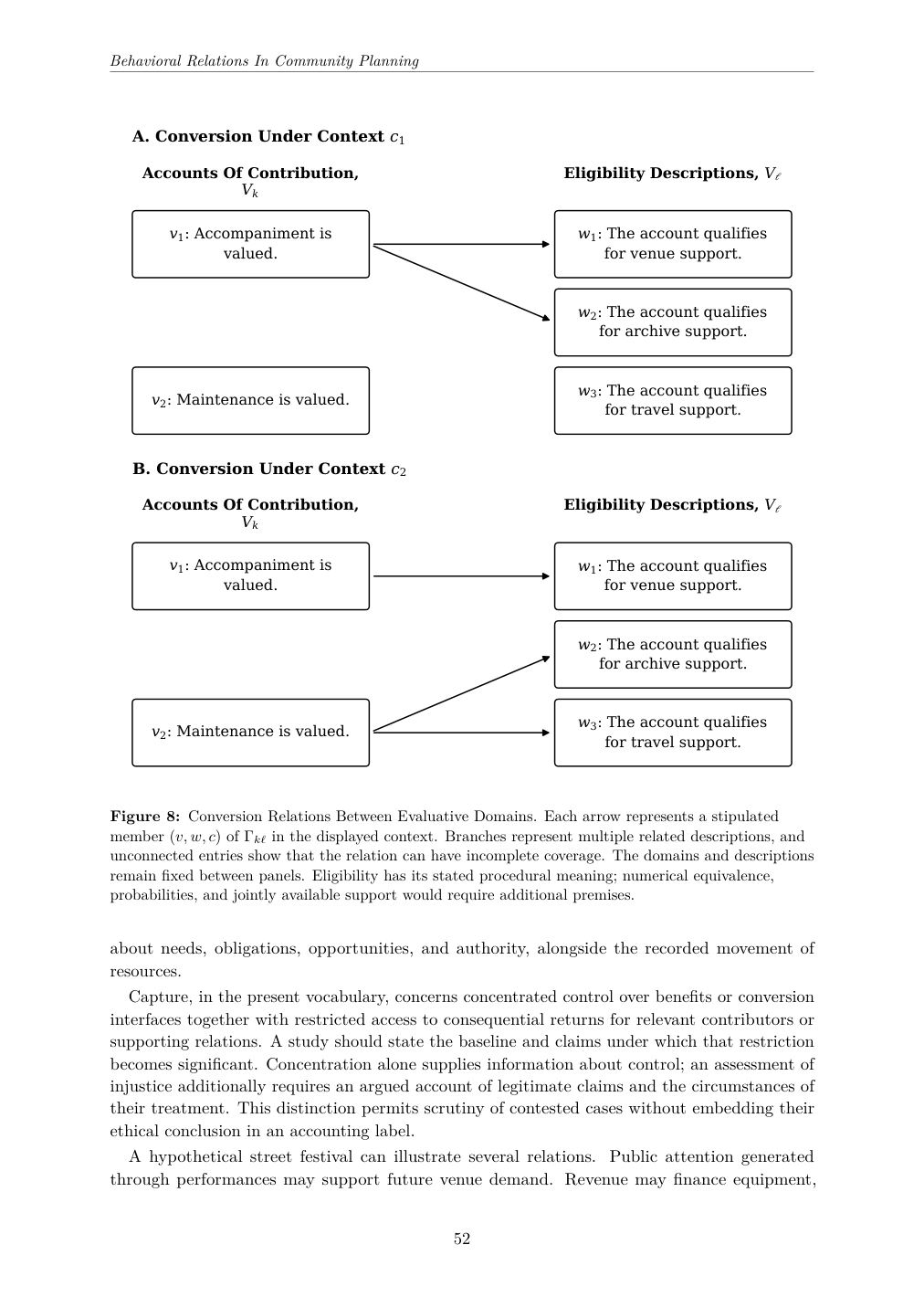
Readable text
Figure 8: Conversion Relations Between Evaluative Domains. Each arrow represents a stipulated unconnected entries show that the relation can have incomplete coverage. The domains and descriptions remain fixed between panels. Eligibility has its stated procedural meaning; numerical equivalence, probabilities, and jointly available support would require additional premises.
about needs, obligations, opportunities, and authority, alongside the recorded movement of
Capture, in the present vocabulary, concerns concentrated control over benefits or conversion interfaces together with restricted access to consequential returns for relevant contributors or supporting relations. A study should state the baseline and claims under which that restriction becomes significant. Concentration alone supplies information about control; an assessment of injustice additionally requires an argued account of legitimate claims and the circumstances of their treatment. This distinction permits scrutiny of contested cases without embedding their
A hypothetical street festival can illustrate several relations. Public attention generated through performances may support future venue demand. Revenue may finance equipment,
while volunteers contribute time to preparation and cleanup. A later organizer might control the records used to allocate future opportunities. Analysis would trace how attention becomes access or revenue, which contributions receive recognition, how maintenance is sustained, and who can revise allocation procedures. The scenario concerns a relational history whose components may be measured or interpreted separately; a common numerical unit would be an additional methodological choice.
11.5 The Renewal Of Capacities For Further Activity
Dissipation identifies the loss of a specified valued relation, accessible resource, or capacity within an analytical horizon. The relevant object and mechanism need to be stated. A record may remain stored while losing the contextual knowledge needed for interpretation. A relationship may become difficult to sustain after participants’ schedules diverge. Physical equipment can deteriorate, and an activity can become inaccessible when its supporting service ends. These processes involve different analytical objects and evidence requirements, despite their shared relevance to continuation.
Rai, Hoskyns, and Thomas examine depletion through the relation between reproductive outflows and the resources needed to sustain them [66]. This perspective motivates attention to burdens that are weakly represented by visible outputs. In the present framework, an assessment can document the time and material demands of continuity, their distribution, and the resources through which participants recover or renew capacities. The analysis remains specific about the kind of capacity involved and the evidence used to assess change.
Regeneration concerns the renewal of capacities and supporting relations through which further activity becomes possible. Its forms may include rest, maintenance, learning, ecological restoration, organizational repair, and reinterpretation of a neglected archive. Some processes restore a previous possibility, while others create a different basis for continuation. The evaluative question is therefore tied to the future activities and relations that participants have reason to sustain or develop. Continuation of the existing arrangement is one possible outcome within that inquiry.
Planned discontinuation can also belong to a regenerative strategy. A community may retire a procedure that consumes substantial coordination effort, preserve its historical record, and redirect resources to another form of participation. The consequences require assessment across affected relations, including those that relied on the earlier arrangement. This example shows why a process vocabulary benefits from distinguishing material loss, loss of access, deliberate release, and renewal. Their ethical significance depends on the activities, histories, and claims at stake.
An application should identify the object of a proposed generative contribution: what is continued, renewed, reconfigured, or made possible; for whom; over which horizon; and on what evidence. This specification distinguishes a documented change in capacity or conditions from a general attribution of generativity. Capacities that support exclusion or domination remain describable within the framework, with their consequences subject to the same explicit evaluative inquiry.
11.6 Deliberative Revision Within Historical Value Formation
The formation of value can involve changes in both experience and the vocabulary through which experience becomes intelligible. Participants may learn to appreciate a previously unfamiliar practice, identify an overlooked burden, or reinterpret an inherited distinction. Sen’s account of democracy emphasizes the constructive role of public discussion in forming values and priorities
[74]. The present framework uses that insight to investigate deliberation as an activity that can change the objects and standards of evaluation.
Such change creates a methodological challenge for comparison over time. An earlier survey and a later discussion may use similar words while referring to different concerns. A changed ranking may reflect new experience, altered information, changed options, or a revision of the evaluative categories. Longitudinal inquiry should therefore retain the context of each judgment and the reasons offered for revision. Comparability becomes a matter of justified translation across records, with unresolved differences preserved where the available evidence warrants them.
For human–AI communities, a corresponding research program can examine the formation of shared evaluative vocabularies across people, interfaces, and computational procedures. AIgenerated summaries or classifications may become inputs to later judgments, while participants can revise the categories, reject an interpretation, or develop alternative descriptions. These pathways should be documented as situated interactions. Attributing evaluative authority to a computational output requires an account of the procedure through which that authority is granted and the means available for its review.
The meta-framework consequently treats evaluation as an evolving practice embedded in the activity ecology. Recognition and conversion affect what circulates; circulation changes the resources available for further activity; those activities can revise the criteria through which earlier contributions are understood. Empirical studies can investigate selected relations within this sequence, while historical and ethical analysis examines the claims and meanings that measurements presuppose. The resulting account preserves heterogeneous value forms and makes the conditions of their continuation, transformation, and contestation available for inquiry.
12 An Integrated Architecture For Relational Inquiry
The integrated architecture connects activity reconstruction, enabling requirements, norm formation, and evaluative power through a limited set of analytical interfaces. Its objective is to show how a particular inquiry can move from evidence to interpretation, comparison, intervention, and revision while preserving the status of each step. The section develops a history-sensitive state description, an identification criterion, a conditional result concerning resource requirements, and a protocol for evaluating interventions. The formal constructions establish consequences of declared representations. Their empirical usefulness depends on the adequacy of those representations to the case.
12.1 Local State Descriptions Derived From Historical Records


The relationship between state selection and historical dependence is analytically consequential. A compact state need not contain sufficient information to predict its own continuation.
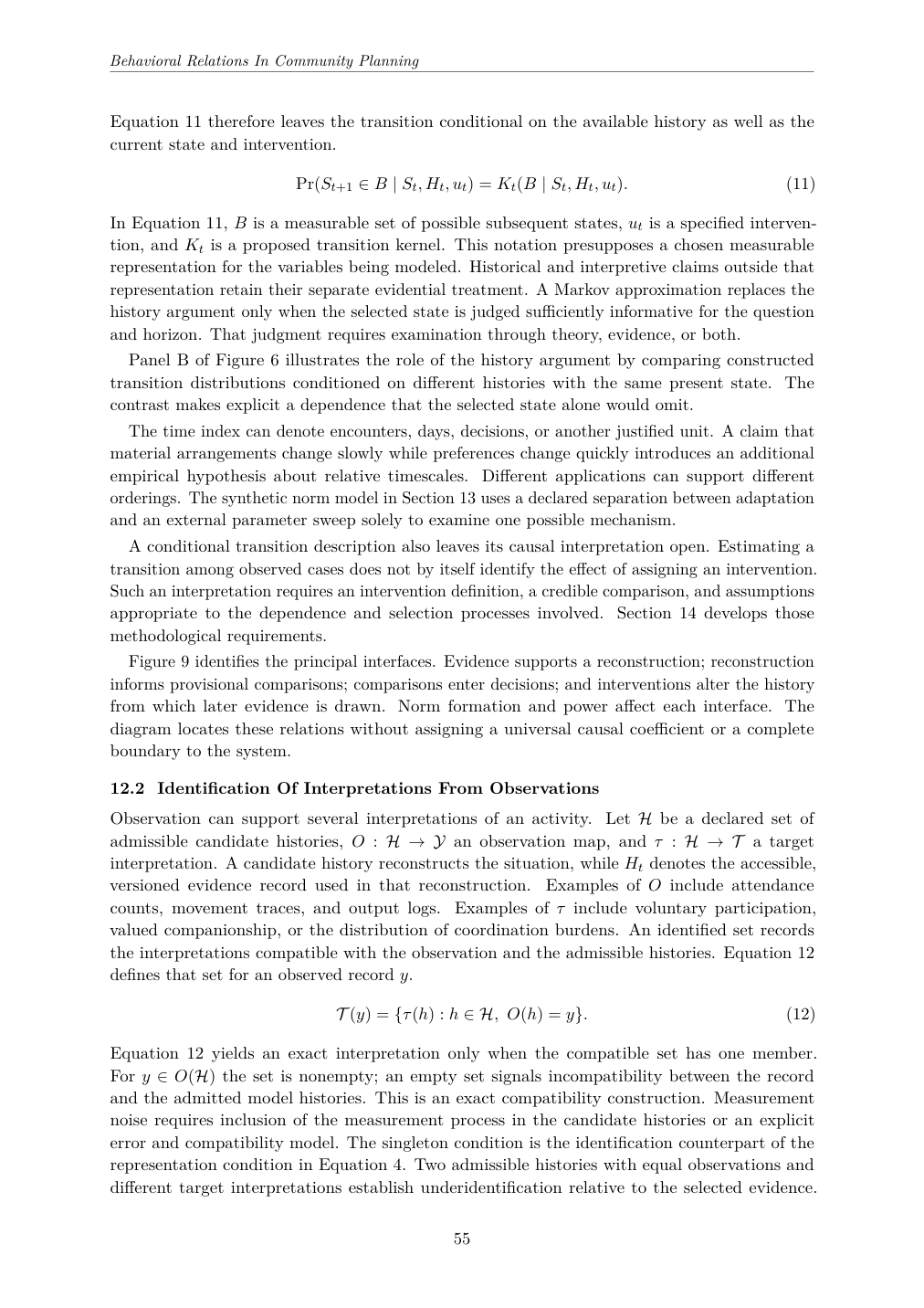
Readable text
Equation 11 therefore leaves the transition conditional on the available history as well as the
representation for the variables being modeled. Historical and interpretive claims outside that representation retain their separate evidential treatment. A Markov approximation replaces the history argument only when the selected state is judged sufficiently informative for the question and horizon. That judgment requires examination through theory, evidence, or both.
Panel B of Figure 6 illustrates the role of the history argument by comparing constructed transition distributions conditioned on different histories with the same present state. The contrast makes explicit a dependence that the selected state alone would omit.
The time index can denote encounters, days, decisions, or another justified unit. A claim that material arrangements change slowly while preferences change quickly introduces an additional empirical hypothesis about relative timescales. Different applications can support different orderings. The synthetic norm model in Section 13 uses a declared separation between adaptation and an external parameter sweep solely to examine one possible mechanism.
A conditional transition description also leaves its causal interpretation open. Estimating a transition among observed cases does not by itself identify the effect of assigning an intervention. Such an interpretation requires an intervention definition, a credible comparison, and assumptions appropriate to the dependence and selection processes involved. Section 14 develops those
Figure 9 identifies the principal interfaces. Evidence supports a reconstruction; reconstruction informs provisional comparisons; comparisons enter decisions; and interventions alter the history from which later evidence is drawn. Norm formation and power affect each interface. The diagram locates these relations without assigning a universal causal coefficient or a complete
12.2 Identification Of Interpretations From Observations
versioned evidence record used in that reconstruction. valued companionship, or the distribution of coordination burdens. An identified set records the interpretations compatible with the observation and the admissible histories. Equation 12
Equation 12 yields an exact interpretation only when the compatible set has one member. and the admitted model histories. This is an exact compatibility construction. Measurement noise requires inclusion of the measurement process in the candidate histories or an explicit error and compatibility model. The singleton condition is the identification counterpart of the representation condition in Equation 4. Two admissible histories with equal observations and different target interpretations establish underidentification relative to the selected evidence.
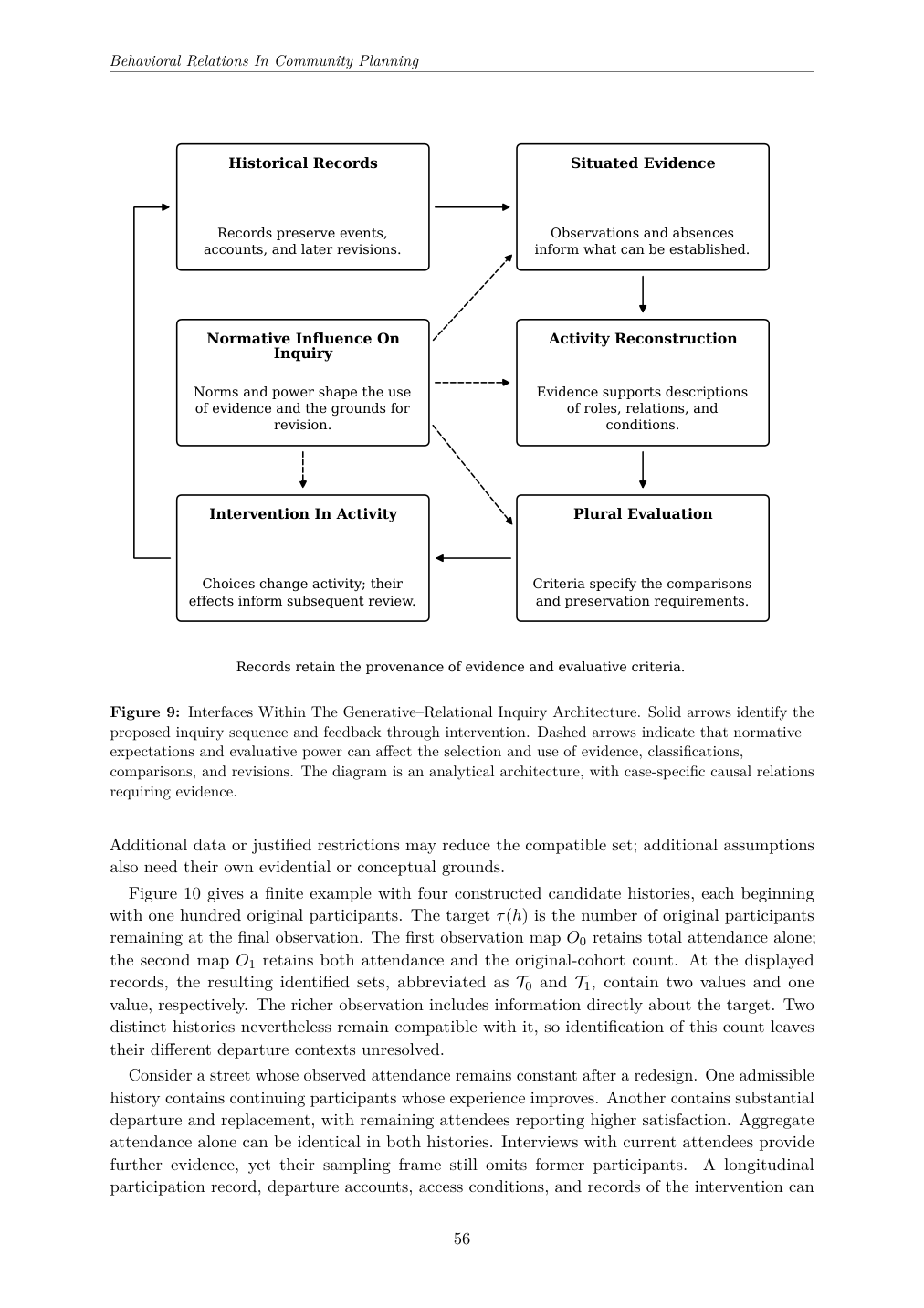
Readable text
Records preserve events, accounts, and later revisions.
Choices change activity; their effects inform subsequent review.
Observations and absences inform what can be established.
Records retain the provenance of evidence and evaluative criteria.
Figure 9: Interfaces Within The Generative–Relational Inquiry Architecture. Solid arrows identify the proposed inquiry sequence and feedback through intervention. Dashed arrows indicate that normative expectations and evaluative power can affect the selection and use of evidence, classifications, comparisons, and revisions. The diagram is an analytical architecture, with case-specific causal relations
Additional data or justified restrictions may reduce the compatible set; additional assumptions also need their own evidential or conceptual grounds.
Figure 10 gives a finite example with four constructed candidate histories, each beginning value, respectively. The richer observation includes information directly about the target. Two distinct histories nevertheless remain compatible with it, so identification of this count leaves
Consider a street whose observed attendance remains constant after a redesign. One admissible history contains continuing participants whose experience improves. Another contains substantial departure and replacement, with remaining attendees reporting higher satisfaction. Aggregate attendance alone can be identical in both histories. Interviews with current attendees provide further evidence, yet their sampling frame still omits former participants. participation record, departure accounts, access conditions, and records of the intervention can
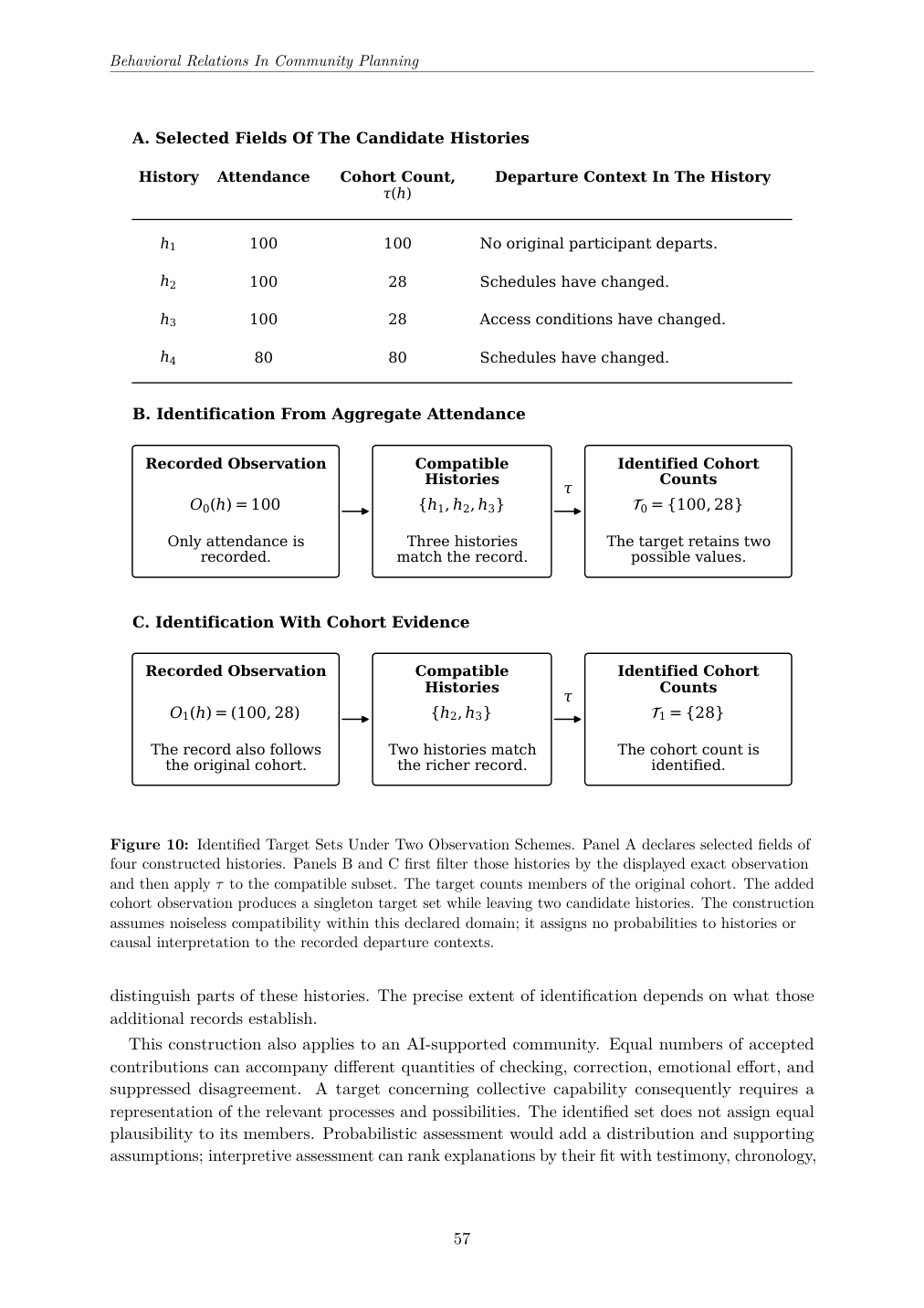
Readable text
Figure 10: Identified Target Sets Under Two Observation Schemes. Panel A declares selected fields of four constructed histories. Panels B and C first filter those histories by the displayed exact observation cohort observation produces a singleton target set while leaving two candidate histories. The construction assumes noiseless compatibility within this declared domain; it assigns no probabilities to histories or causal interpretation to the recorded departure contexts.
distinguish parts of these histories. The precise extent of identification depends on what those
This construction also applies to an AI-supported community. Equal numbers of accepted contributions can accompany different quantities of checking, correction, emotional effort, and suppressed disagreement. A target concerning collective capability consequently requires a representation of the relevant processes and possibilities. The identified set does not assign equal plausibility to its members. Probabilistic assessment would add a distribution and supporting assumptions; interpretive assessment can rank explanations by their fit with testimony, chronology,
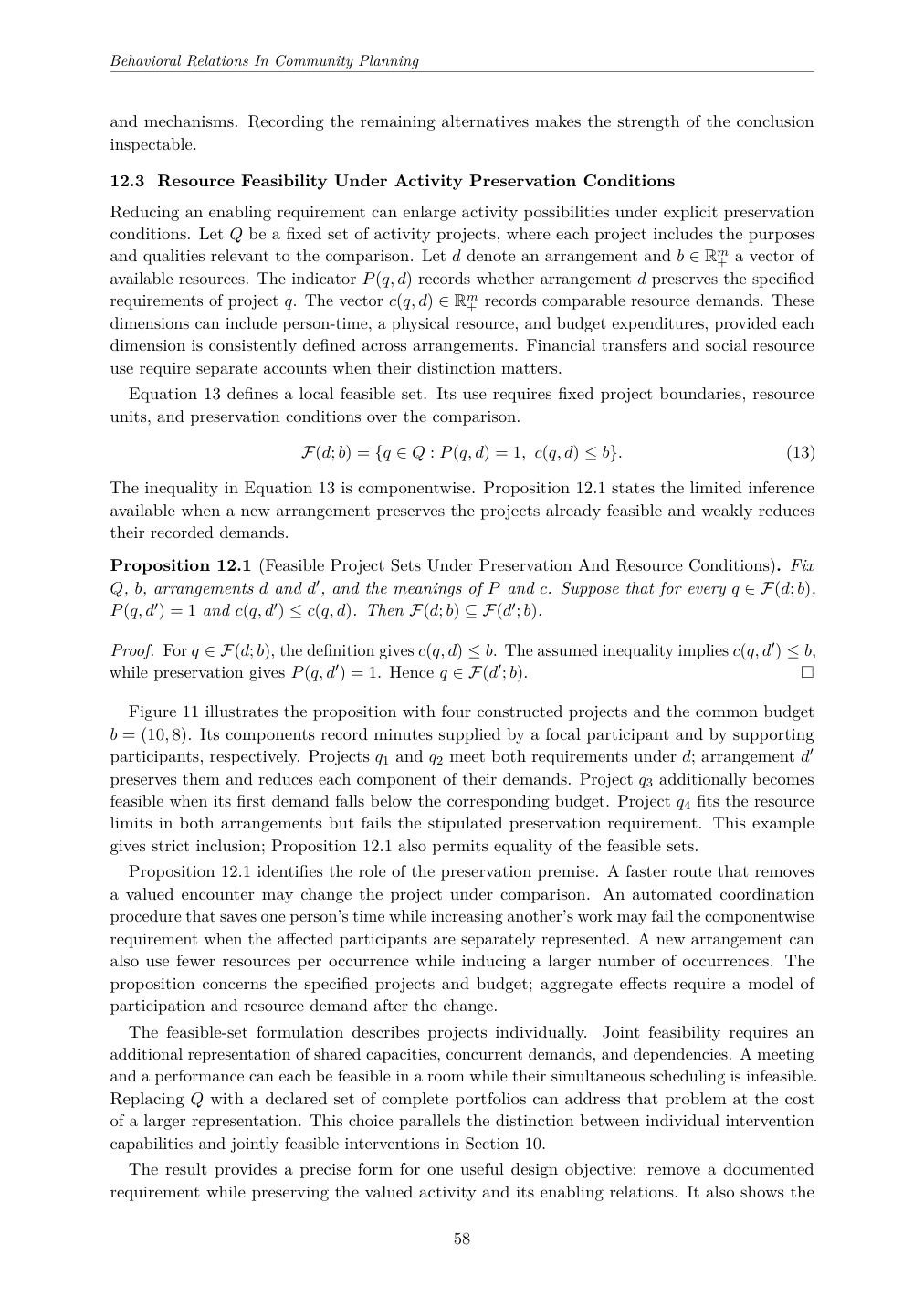
Readable text
and mechanisms. Recording the remaining alternatives makes the strength of the conclusion
12.3 Resource Feasibility Under Activity Preservation Conditions
Reducing an enabling requirement can enlarge activity possibilities under explicit preservation
dimensions can include person-time, a physical resource, and budget expenditures, provided each dimension is consistently defined across arrangements. Financial transfers and social resource use require separate accounts when their distinction matters.
Equation 13 defines a local feasible set. Its use requires fixed project boundaries, resource units, and preservation conditions over the comparison.
The inequality in Equation 13 is componentwise. Proposition 12.1 states the limited inference available when a new arrangement preserves the projects already feasible and weakly reduces
Proposition 12.1 (Feasible Project Sets Under Preservation And Resource Conditions). Fix
Figure 11 illustrates the proposition with four constructed projects and the common budget
limits in both arrangements but fails the stipulated preservation requirement. This example gives strict inclusion; Proposition 12.1 also permits equality of the feasible sets.
Proposition 12.1 identifies the role of the preservation premise. A faster route that removes a valued encounter may change the project under comparison. An automated coordination procedure that saves one person’s time while increasing another’s work may fail the componentwise requirement when the affected participants are separately represented. A new arrangement can also use fewer resources per occurrence while inducing a larger number of occurrences. The proposition concerns the specified projects and budget; aggregate effects require a model of participation and resource demand after the change.
The feasible-set formulation describes projects individually. additional representation of shared capacities, concurrent demands, and dependencies. A meeting and a performance can each be feasible in a room while their simultaneous scheduling is infeasible. of a larger representation. This choice parallels the distinction between individual intervention capabilities and jointly feasible interventions in Section 10.
The result provides a precise form for one useful design objective: remove a documented requirement while preserving the valued activity and its enabling relations. It also shows the
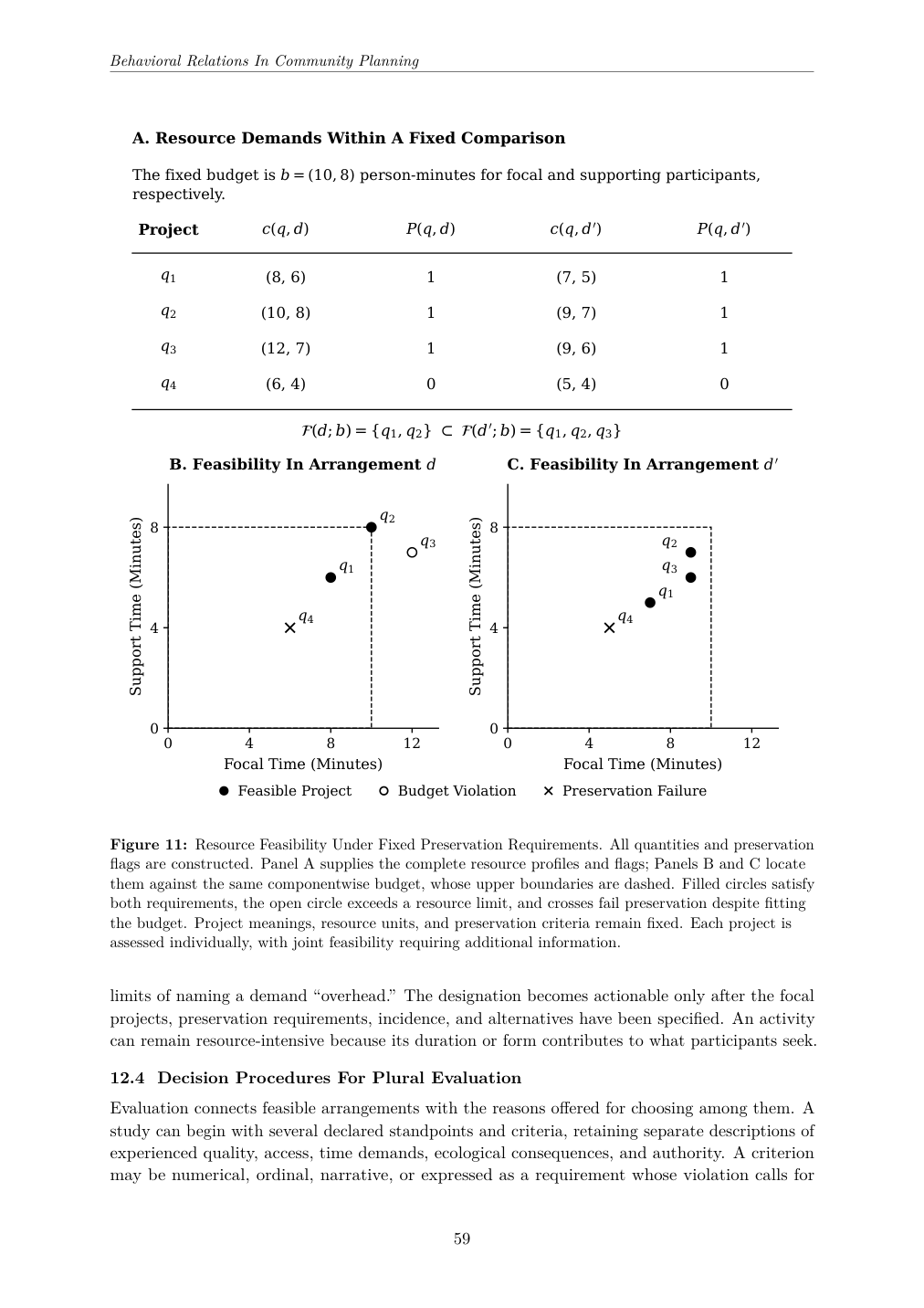
Readable text
The fixed budget is b = (10, 8) person-minutes for focal and supporting participants,
Figure 11: Resource Feasibility Under Fixed Preservation Requirements. All quantities and preservation flags are constructed. Panel A supplies the complete resource profiles and flags; Panels B and C locate them against the same componentwise budget, whose upper boundaries are dashed. Filled circles satisfy both requirements, the open circle exceeds a resource limit, and crosses fail preservation despite fitting the budget. Project meanings, resource units, and preservation criteria remain fixed. Each project is assessed individually, with joint feasibility requiring additional information.
limits of naming a demand “overhead.” The designation becomes actionable only after the focal projects, preservation requirements, incidence, and alternatives have been specified. An activity can remain resource-intensive because its duration or form contributes to what participants seek.
Evaluation connects feasible arrangements with the reasons offered for choosing among them. A study can begin with several declared standpoints and criteria, retaining separate descriptions of experienced quality, access, time demands, ecological consequences, and authority. A criterion may be numerical, ordinal, narrative, or expressed as a requirement whose violation calls for
justification. Combining these forms requires explicit translation decisions. An evaluative architecture should therefore record the owner or proponent of each criterion, its evidence, scope, contestability, and relation to other criteria.
The maximal-set construction in Equation 5 supplies one disciplined way to preserve incomparability. Pareto comparison is a specific instance when several numerical dimensions are given a direction of improvement. A design’s membership in a Pareto set means that the selected comparison supplies no dominating alternative in the selected feasible set. Its membership leaves questions concerning omitted dimensions, thresholds, distribution, and procedural legitimacy open. The synthetic comparison in Section 13.3 makes those boundaries explicit.
Several decision procedures can be evaluated without requiring an overarching scalar objective. A community may adopt a reversible pilot, choose between admissible alternatives through a declared voting rule, negotiate a schedule that preserves different uses, or require a minimum opportunity before considering further trade-offs. The appropriate procedure depends on the participants, obligations, available time, and reversibility of effects. Each procedure also creates activities: preparation, translation, deliberation, administration, monitoring, and challenge. Their demands enter the same activity analysis.
Humanist commitments provide declared normative orientation within this architecture. The present proposal gives priority to the conditions under which affected people can articulate experience, sustain participation, obtain reasons, and contest consequential decisions. These commitments have a philosophical standing separate from a theorem about feasibility or a model of norm persistence. They also require contextual specification when participation, privacy, urgent action, ecological obligations, or incompatible claims create tensions. The record should preserve the reasons for a resolution and the conditions that would warrant reopening it.
12.5 Records Of Consequential Translations Between Representations
An interface record makes the transition between analytical descriptions available for criticism. It includes a date and version identifier, retaining the original judgment when criteria change as developed in Section 17.3. It identifies the source record, the resulting description or judgment, the distinctions preserved or omitted, the authority under which the translation is used, the affected activities, and the conditions for revision. These fields operationalize the meta-framework at the point where a representation becomes consequential. They can be completed in narrative form; a database implementation is optional and requires its own account of unresolved or incompatible descriptions.
Table 8 provides a minimal specification for these translations. Its role is to identify required analytical work at a consequential boundary. A small application can use a brief record for a single disputed translation; a larger inquiry can relate several records across an intervention history. The fields become useful through their connection with actual evidence and decisions, and their continued use should be assessed against the effort they require.
Consider the synthetic promenade case developed in Section 15. An observation of sound becomes a classification of an event, which enters an assessment of appropriate use and then a decision about permitted activity. Each transition changes the analytical object. Recorded intensity can support a claim about a sound measure under specified sampling conditions. Identifying a performance, a disturbance, or a valued collective event requires further contextual interpretation. A decision about acceptable occupation additionally invokes normative and institutional grounds. The interface record identifies those grounds and the people authorized to apply or contest them.
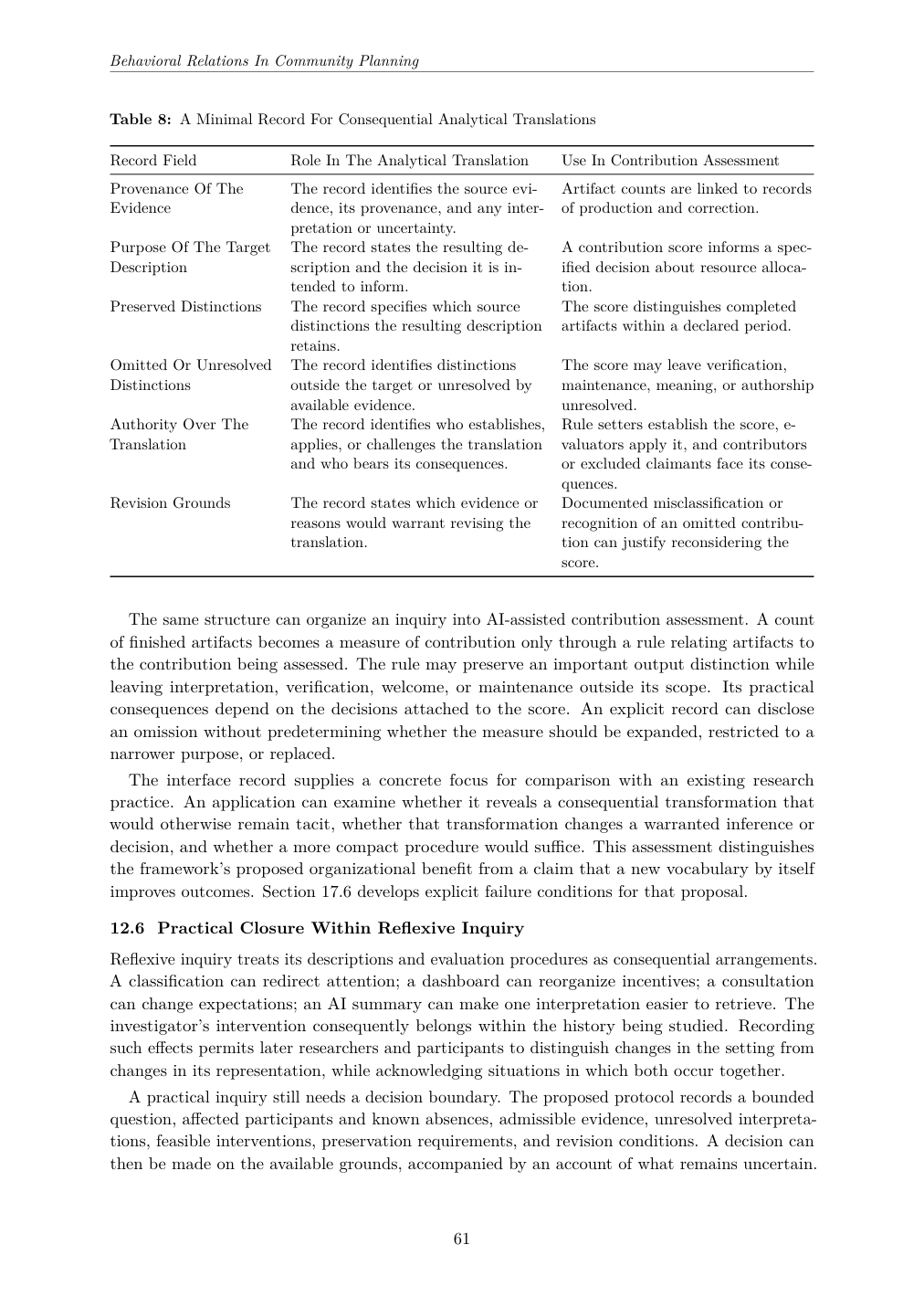
Readable text
Table 8: A Minimal Record For Consequential Analytical Translations
The record identifies the source evi- dence, its provenance, and any inter-
Artifact counts are linked to records of production and correction.
The record states the resulting de- scription and the decision it is in-
A contribution score informs a spec- ified decision about resource alloca- tion.
The record specifies which source distinctions the resulting description
The score distinguishes completed artifacts within a declared period.
The record identifies distinctions outside the target or unresolved by
The score may leave verification, maintenance, meaning, or authorship unresolved.
Rule setters establish the score, e- valuators apply it, and contributors or excluded claimants face its conse- quences.
The record identifies who establishes, applies, or challenges the translation and who bears its consequences.
The record states which evidence or reasons would warrant revising the
Documented misclassification or recognition of an omitted contribu- tion can justify reconsidering the score.
The same structure can organize an inquiry into AI-assisted contribution assessment. A count of finished artifacts becomes a measure of contribution only through a rule relating artifacts to the contribution being assessed. The rule may preserve an important output distinction while leaving interpretation, verification, welcome, or maintenance outside its scope. Its practical consequences depend on the decisions attached to the score. An explicit record can disclose an omission without predetermining whether the measure should be expanded, restricted to a
The interface record supplies a concrete focus for comparison with an existing research practice. An application can examine whether it reveals a consequential transformation that would otherwise remain tacit, whether that transformation changes a warranted inference or decision, and whether a more compact procedure would suffice. This assessment distinguishes the framework’s proposed organizational benefit from a claim that a new vocabulary by itself improves outcomes. Section 17.6 develops explicit failure conditions for that proposal.
Reflexive inquiry treats its descriptions and evaluation procedures as consequential arrangements. A classification can redirect attention; a dashboard can reorganize incentives; a consultation can change expectations; an AI summary can make one interpretation easier to retrieve. The investigator’s intervention consequently belongs within the history being studied. Recording such effects permits later researchers and participants to distinguish changes in the setting from changes in its representation, while acknowledging situations in which both occur together.
A practical inquiry still needs a decision boundary. The proposed protocol records a bounded question, affected participants and known absences, admissible evidence, unresolved interpreta- tions, feasible interventions, preservation requirements, and revision conditions. A decision can then be made on the available grounds, accompanied by an account of what remains uncertain.
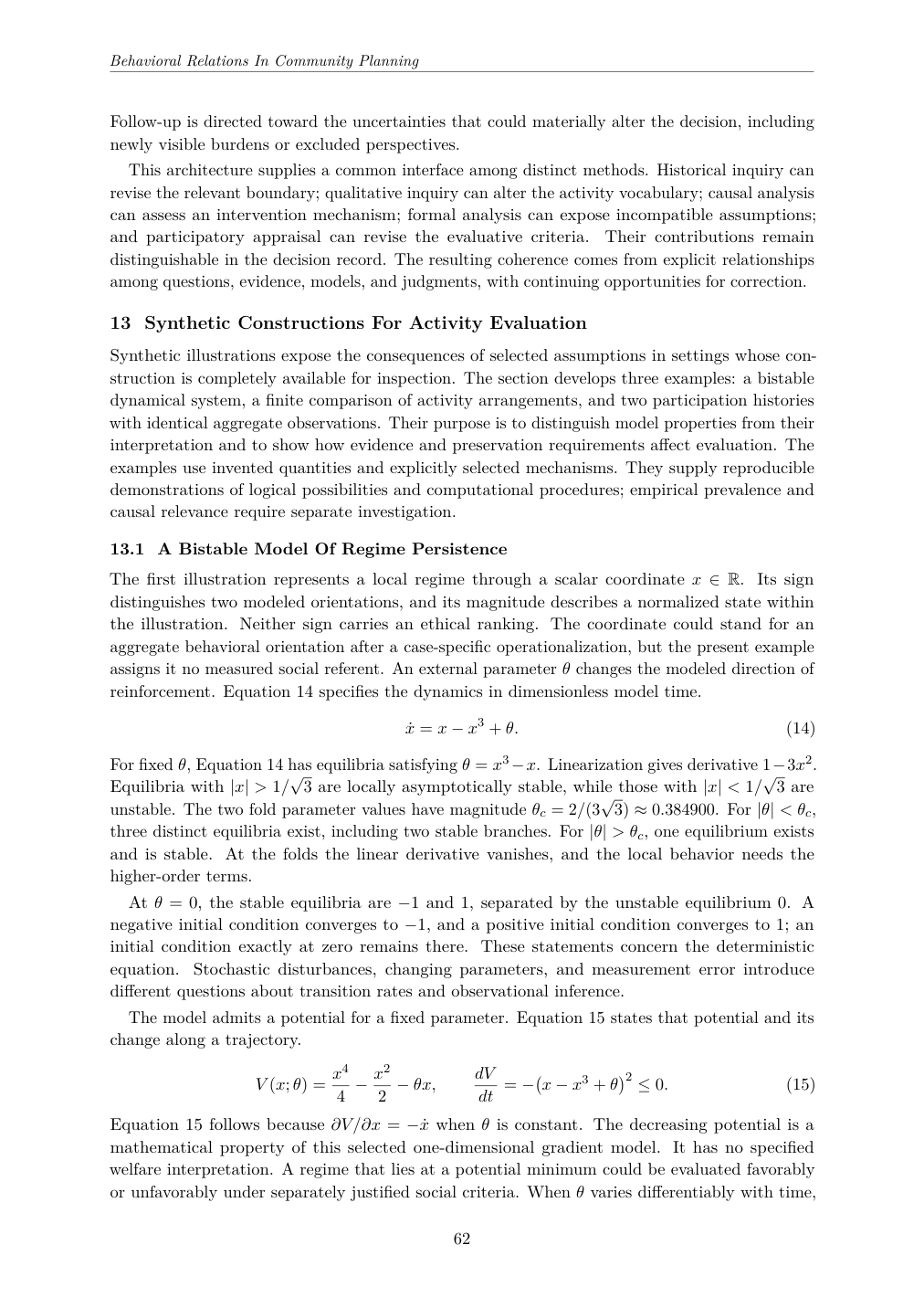
Readable text
Follow-up is directed toward the uncertainties that could materially alter the decision, including
This architecture supplies a common interface among distinct methods. Historical inquiry can revise the relevant boundary; qualitative inquiry can alter the activity vocabulary; causal analysis can assess an intervention mechanism; formal analysis can expose incompatible assumptions; and participatory appraisal can revise the evaluative criteria. distinguishable in the decision record. The resulting coherence comes from explicit relationships among questions, evidence, models, and judgments, with continuing opportunities for correction.
Synthetic illustrations expose the consequences of selected assumptions in settings whose con- struction is completely available for inspection. The section develops three examples: a bistable dynamical system, a finite comparison of activity arrangements, and two participation histories with identical aggregate observations. Their purpose is to distinguish model properties from their interpretation and to show how evidence and preservation requirements affect evaluation. The examples use invented quantities and explicitly selected mechanisms. They supply reproducible demonstrations of logical possibilities and computational procedures; empirical prevalence and
distinguishes two modeled orientations, and its magnitude describes a normalized state within the illustration. Neither sign carries an ethical ranking. The coordinate could stand for an aggregate behavioral orientation after a case-specific operationalization, but the present example reinforcement. Equation 14 specifies the dynamics in dimensionless model time.
and is stable. At the folds the linear derivative vanishes, and the local behavior needs the
initial condition exactly at zero remains there. These statements concern the deterministic equation. Stochastic disturbances, changing parameters, and measurement error introduce different questions about transition rates and observational inference.
The model admits a potential for a fixed parameter. Equation 15 states that potential and its
mathematical property of this selected one-dimensional gradient model. It has no specified welfare interpretation. A regime that lies at a potential minimum could be evaluated favorably


13.2 Hysteresis Under Stepped Parameter Histories

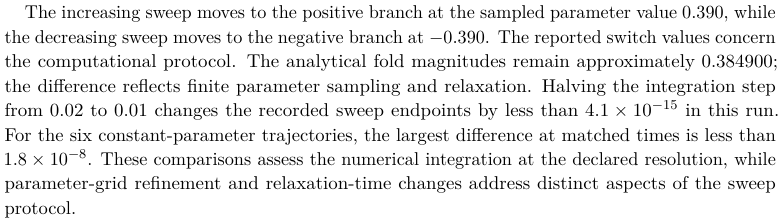
The hysteresis loop provides a concrete form for path dependence: at the same intermediate parameter value, the modeled state can differ according to the preceding sequence. Returning the parameter to an earlier value can therefore leave the system in another locally stable regime. In an empirical application, this possibility would motivate examination of the intervention sequence, transition thresholds, and conditions sustaining the new regime. It would also motivate attention to institutions or material arrangements that were changed during the transition and therefore cannot be treated as fixed background.
An external bias can have several substantive interpretations. Coordination benefits, changed access, expected sanctions, or altered public recognition could each be proposed as a source of reinforcement. Giving those processes the same position in the equation leaves them observationally indistinguishable within the equation alone. To interpret a change as freely valued adaptation or as compelled compliance requires evidence beyond the trajectory. The simple model thereby makes the need for mechanism-sensitive inquiry visible. It supplies a diagram of possible persistence, with social interpretation supplied by additional research.
13.3 Design Comparison Under Preservation Requirements
The design illustration examines seven hypothetical arrangements for a recurring activity. Two resource dimensions are recorded: journey time for a focal participant and support effort by distinct assisting participants, both per occurrence. The separation prevents these two columns from being added as if they were interchangeable minutes for one person. Support effort is aggregated here solely to keep the example small; a study of distribution would disaggregate it
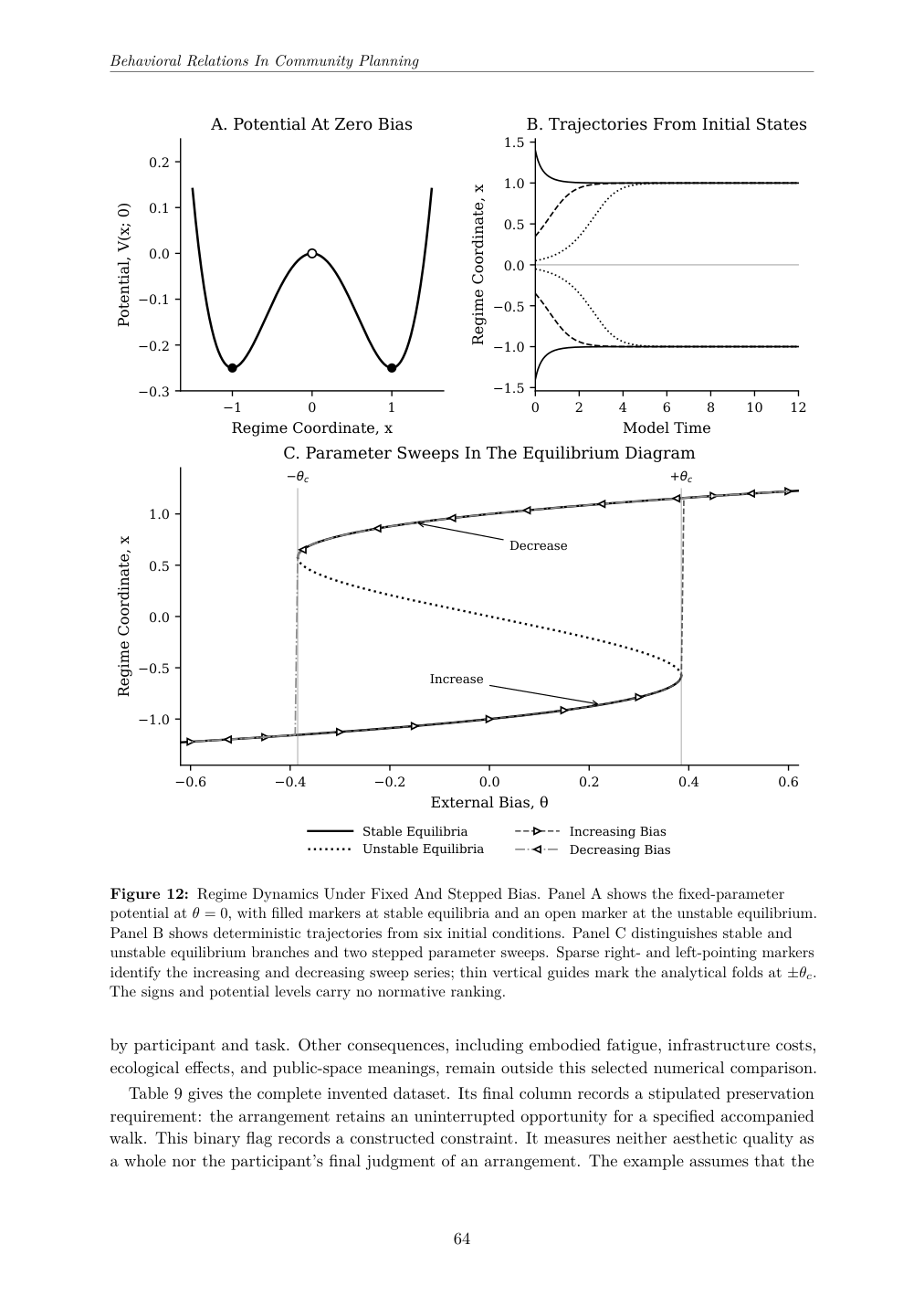
Readable text
Figure 12: Regime Dynamics Under Fixed And Stepped Bias. Panel A shows the fixed-parameter Panel B shows deterministic trajectories from six initial conditions. Panel C distinguishes stable and unstable equilibrium branches and two stepped parameter sweeps. Sparse right- and left-pointing markers The signs and potential levels carry no normative ranking.
by participant and task. Other consequences, including embodied fatigue, infrastructure costs, ecological effects, and public-space meanings, remain outside this selected numerical comparison.
Table 9 gives the complete invented dataset. Its final column records a stipulated preservation requirement: the arrangement retains an uninterrupted opportunity for a specified accompanied walk. This binary flag records a constructed constraint. It measures neither aesthetic quality as a whole nor the participant’s final judgment of an arrangement. The example assumes that the
flag has already been settled for the focal project; an actual inquiry would need evidence and discussion to establish it.


its former dominating comparator, fails the preservation requirement. Figure 13 presents both comparisons. The shift in the retained set follows from an explicit change in what constitutes a feasible project, with the underlying resource numbers held fixed.
The example identifies a practical role for formal evaluation in aesthetic contexts. A representation can preserve an explicitly valued feature while leaving other qualities for further appraisal. The two retained arrangements then provide concrete alternatives for situated discussion. If the support work falls disproportionately on a particular participant, or if the preserved walk creates an exclusion elsewhere, the criterion set and feasibility description need revision. Computation supplies an exact result for the selected comparison, and the broader inquiry evaluates the adequacy of that selection.
13.4 Interpretation Of Participation Histories From Aggregate Attendance
The third illustration concerns a restricted observation. Both constructed histories begin with one hundred participants and retain a total attendance of one hundred at each of thirteen monthly observations. In the continuity history, the original cohort remains throughout. In the replacement history, six original participants depart and six entrants join at each monthly step. At month twelve, the replacement history therefore contains twenty-eight members of the original cohort and seventy-two entrants. Figure 14 shows the identical total and the different compositions.
Let the observation map retain only monthly totals and the target interpretation concern continuity of the original cohort. The two histories then belong to the same observational fiber while receiving different target values. Equation 12 consequently contains at least these two values. A data collection procedure that follows the original cohort can resolve this particular distinction. Establishing why people depart requires further evidence concerning their situations, opportunities, experiences, and relevant changes in the environment.
The constructed contrast is relevant to both street design and community governance. A place or platform can maintain visible activity while its population changes. Aggregate success criteria can thereby miss consequences for former participants or for people who never enter. Conversely, entry by new participants can carry benefits that a retention-only criterion obscures. The evaluative task therefore concerns the reasons and distributions associated with continuity, entry, and exit. A complete normative ranking does not follow from a preference for one population pattern.
13.5 The Evaluative Record For The Synthetic Design Comparison
The finite design example permits a completed instance of the interface record in Table 8. Its source is the seven-row constructed dataset; its first target is a comparison of the two recorded resource demands. That comparison preserves the declared quantities and yields B, C, and D.
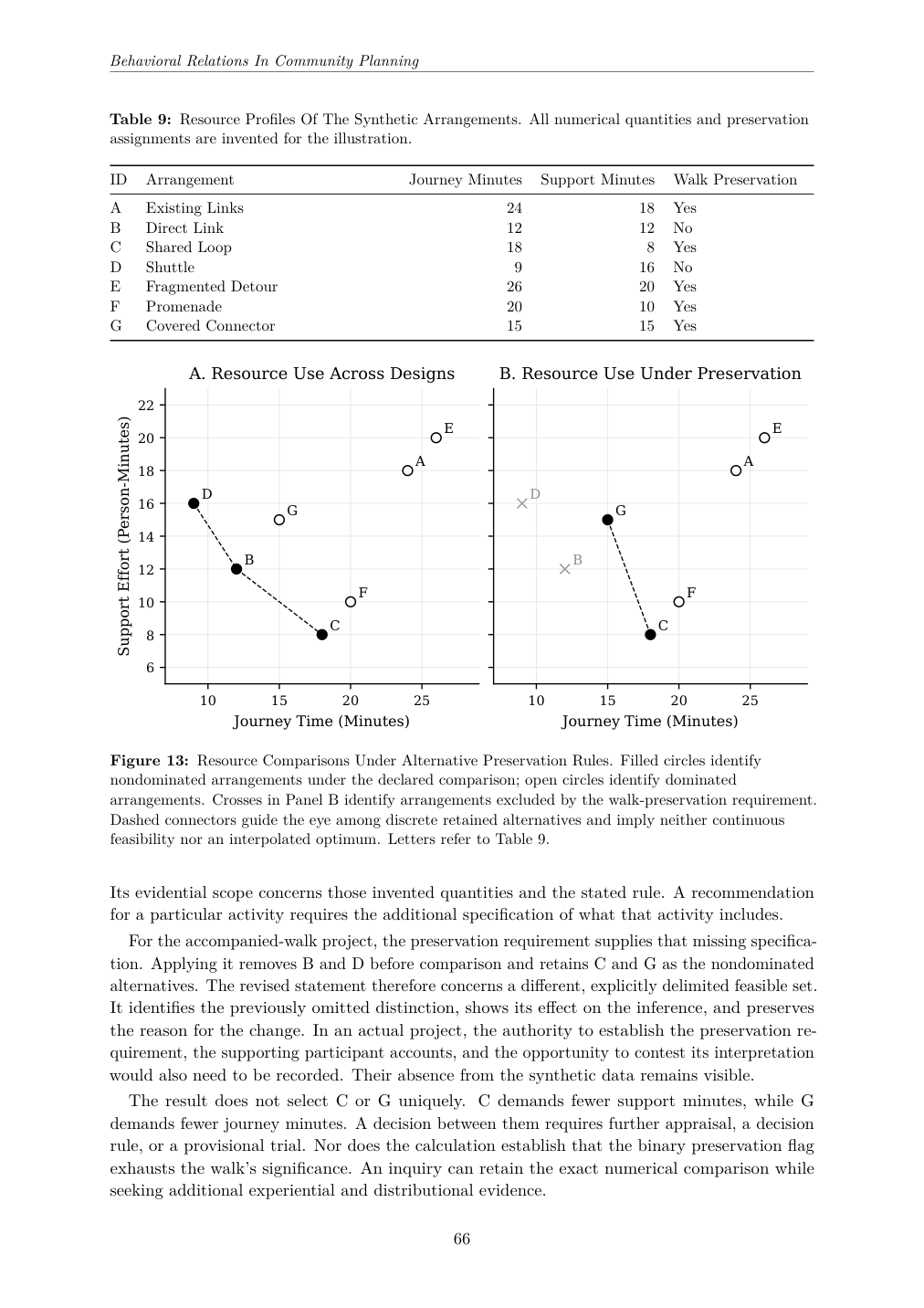
Readable text
Table 9: Resource Profiles Of The Synthetic Arrangements. All numerical quantities and preservation
A Existing Links B Direct Link C Shared Loop D Shuttle E Fragmented Detour F Promenade G Covered Connector
Figure 13: Resource Comparisons Under Alternative Preservation Rules. Filled circles identify nondominated arrangements under the declared comparison; open circles identify dominated arrangements. Crosses in Panel B identify arrangements excluded by the walk-preservation requirement. Dashed connectors guide the eye among discrete retained alternatives and imply neither continuous feasibility nor an interpolated optimum. Letters refer to Table 9.
Its evidential scope concerns those invented quantities and the stated rule. A recommendation for a particular activity requires the additional specification of what that activity includes.
For the accompanied-walk project, the preservation requirement supplies that missing specifica- tion. Applying it removes B and D before comparison and retains C and G as the nondominated alternatives. The revised statement therefore concerns a different, explicitly delimited feasible set. It identifies the previously omitted distinction, shows its effect on the inference, and preserves the reason for the change. In an actual project, the authority to establish the preservation re- quirement, the supporting participant accounts, and the opportunity to contest its interpretation would also need to be recorded. Their absence from the synthetic data remains visible.
The result does not select C or G uniquely. C demands fewer support minutes, while G demands fewer journey minutes. A decision between them requires further appraisal, a decision rule, or a provisional trial. Nor does the calculation establish that the binary preservation flag exhausts the walk’s significance. An inquiry can retain the exact numerical comparison while seeking additional experiential and distributional evidence.
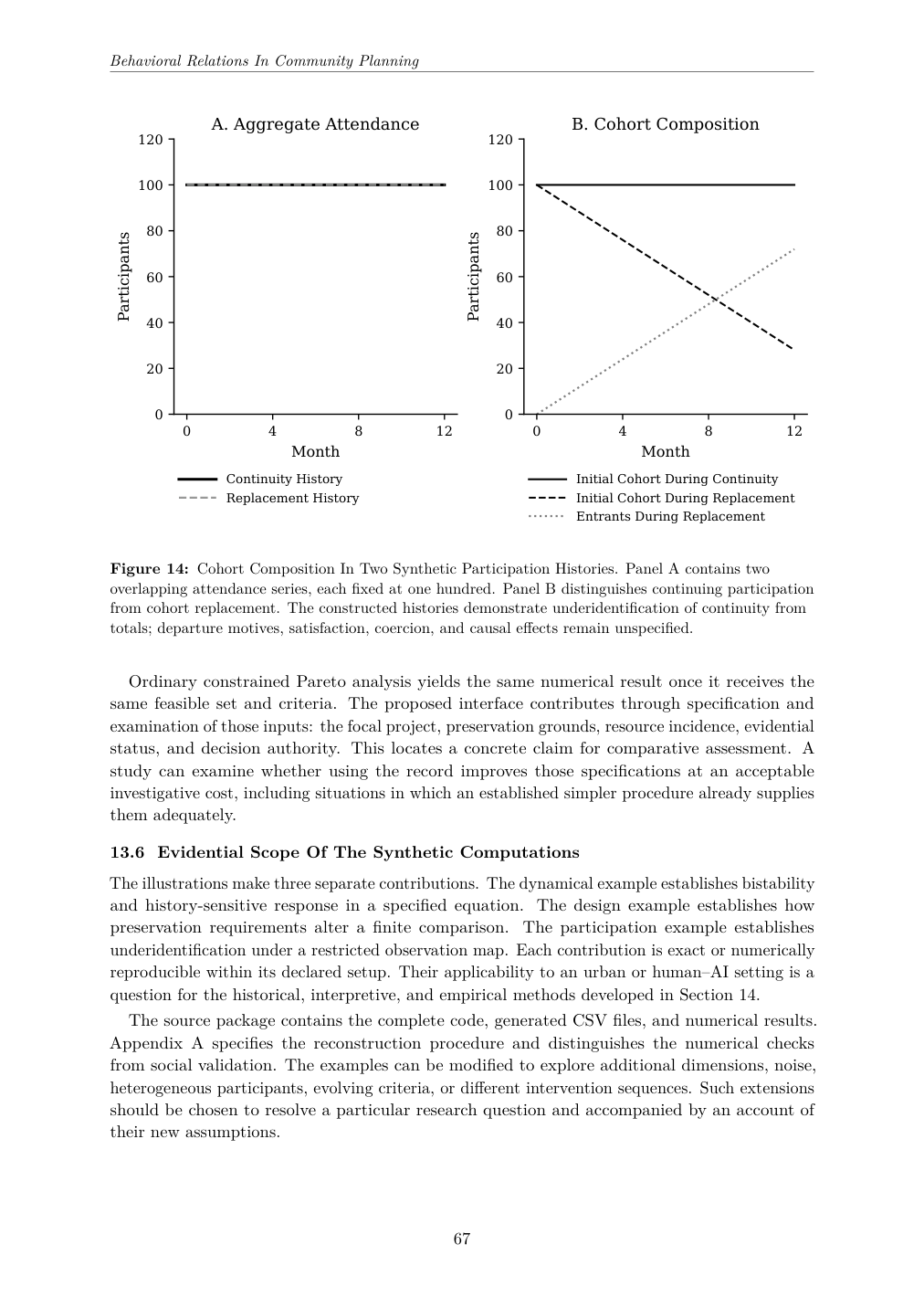
Readable text
Initial Cohort During Continuity Initial Cohort During Replacement Entrants During Replacement
Figure 14: Cohort Composition In Two Synthetic Participation Histories. Panel A contains two overlapping attendance series, each fixed at one hundred. Panel B distinguishes continuing participation from cohort replacement. The constructed histories demonstrate underidentification of continuity from totals; departure motives, satisfaction, coercion, and causal effects remain unspecified.
Ordinary constrained Pareto analysis yields the same numerical result once it receives the same feasible set and criteria. The proposed interface contributes through specification and examination of those inputs: the focal project, preservation grounds, resource incidence, evidential status, and decision authority. This locates a concrete claim for comparative assessment. A study can examine whether using the record improves those specifications at an acceptable investigative cost, including situations in which an established simpler procedure already supplies
The illustrations make three separate contributions. The dynamical example establishes bistability and history-sensitive response in a specified equation. The design example establishes how preservation requirements alter a finite comparison. The participation example establishes underidentification under a restricted observation map. Each contribution is exact or numerically reproducible within its declared setup. Their applicability to an urban or human–AI setting is a question for the historical, interpretive, and empirical methods developed in Section 14.
The source package contains the complete code, generated CSV files, and numerical results. Appendix A specifies the reconstruction procedure and distinguishes the numerical checks from social validation. The examples can be modified to explore additional dimensions, noise, heterogeneous participants, evolving criteria, or different intervention sequences. Such extensions should be chosen to resolve a particular research question and accompanied by an account of
14 Situated Inquiry For Community Planning
Inquiry into activity arrangements requires methods for learning about consequences and procedures for reconsidering the terms through which those consequences acquire significance. This section develops a proposed research orientation combining humanist commitments, evolutionary revision, and evidence-based assessment. The three orientations perform distinguishable functions. Humanist inquiry attends to persons, relationships, and meaningful possibilities; evolutionary inquiry examines and revises arrangements through experience; evidence-based inquiry makes descriptive and causal claims answerable to relevant observations and explicit assumptions. Their integration is developed through participatory co-inquiry, historical and interpretive reconstruction, causal assessment, and the governance of evidence. The proposal concerns a research practice whose criteria and methods can themselves become objects of examination.
An iterative decision process needs identifiable transitions between inquiry and action. Table 10 sets out a proposed sequence whose stages can recur at different scales. The sequence offers a practical organization of work whose temporal ordering can vary with the inquiry. A new finding may reopen the question, change the participant boundary, or require a different comparison before another intervention is warranted.
14.1 Relations Among The Three Inquiry Orientations
The humanist orientation adopted here begins with the situated significance of activities for those who undertake, sustain, encounter, or are excluded from them. Its evaluative field includes bodily security, care, learning, participation, aesthetic experience, and the development of meaningful relations. These concerns direct attention toward differences among participants and toward the conditions under which their descriptions become audible. Humanist inquiry therefore includes questions about whose experiences are represented, who bears sustaining burdens, and who can influence the interpretation of a shared situation. It remains open to disagreement over the relative significance and proper interpretation of these concerns.
The present proposal endorses participation, reason-giving, and contestability on two related grounds. Affected people can contribute access to experiences, burdens, and histories that an external indicator omits, giving their participation an epistemic role. Their standing to challenge consequential arrangements also has normative significance within the adopted humanist commitment to persons as interpreters and participants in their own lives. This second ground extends beyond the usefulness of their information. Conflicts among participation, bodily security, privacy, ecological continuity, and other commitments require a situated justification whose reasons remain open to examination.
Evolutionary inquiry concerns the generation, comparison, modification, and retention of candidate arrangements. A candidate may be a spatial design, an access rule, an account of an activity, or a criterion used to evaluate change. Retention is a practical decision within a stated process. It requires reasons appropriate to the consequences at issue. The persistence of an arrangement can motivate investigation into its sustaining mechanisms, while a judgment about its desirability requires a further account of the affected activities and participants. This distinction permits learning from recurrent practices while retaining the capacity to revise them.
Evidence-based inquiry concerns the warranted relation between claims and evidence. Observation can challenge an explanation, reveal an overlooked consequence, or establish that a proposed intervention operates differently across settings. The evidential standard depends on the claim. A causal estimate requires assumptions about the comparison being made; an account of experienced humiliation requires appropriate access to experience and context; a reconstruction
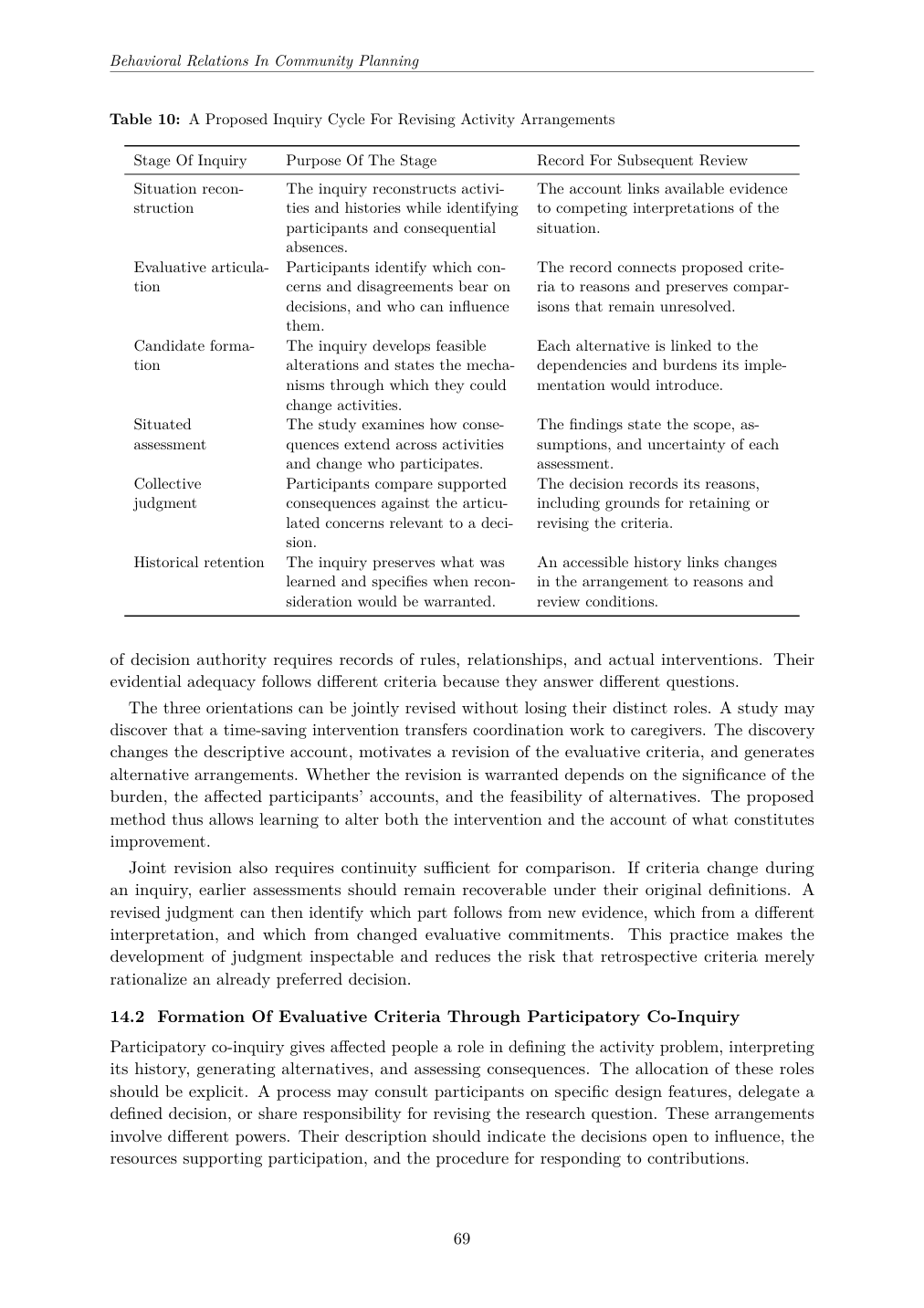
Readable text
Table 10: A Proposed Inquiry Cycle For Revising Activity Arrangements
The inquiry reconstructs activi- ties and histories while identifying participants and consequential
The account links available evidence to competing interpretations of the situation.
Participants identify which con- cerns and disagreements bear on decisions, and who can influence
The record connects proposed crite- ria to reasons and preserves compar- isons that remain unresolved.
The inquiry develops feasible alterations and states the mecha- nisms through which they could
Each alternative is linked to the dependencies and burdens its imple- mentation would introduce.
The study examines how conse- quences extend across activities and change who participates.
The findings state the scope, as- sumptions, and uncertainty of each assessment.
Participants compare supported consequences against the articu- lated concerns relevant to a deci-
The decision records its reasons, including grounds for retaining or revising the criteria.
The inquiry preserves what was learned and specifies when recon- sideration would be warranted.
An accessible history links changes in the arrangement to reasons and review conditions.
of decision authority requires records of rules, relationships, and actual interventions. Their evidential adequacy follows different criteria because they answer different questions.
The three orientations can be jointly revised without losing their distinct roles. A study may discover that a time-saving intervention transfers coordination work to caregivers. The discovery changes the descriptive account, motivates a revision of the evaluative criteria, and generates alternative arrangements. Whether the revision is warranted depends on the significance of the burden, the affected participants’ accounts, and the feasibility of alternatives. The proposed method thus allows learning to alter both the intervention and the account of what constitutes
Joint revision also requires continuity sufficient for comparison. If criteria change during an inquiry, earlier assessments should remain recoverable under their original definitions. A revised judgment can then identify which part follows from new evidence, which from a different interpretation, and which from changed evaluative commitments. This practice makes the development of judgment inspectable and reduces the risk that retrospective criteria merely
14.2 Formation Of Evaluative Criteria Through Participatory Co-Inquiry
Participatory co-inquiry gives affected people a role in defining the activity problem, interpreting its history, generating alternatives, and assessing consequences. The allocation of these roles should be explicit. A process may consult participants on specific design features, delegate a defined decision, or share responsibility for revising the research question. These arrangements involve different powers. Their description should indicate the decisions open to influence, the resources supporting participation, and the procedure for responding to contributions.
The OECD’s participation guidance emphasizes meaningful influence, accessible processes, feedback on the treatment of contributions, and evaluation as a basis for iteration [54]. Those principles support the present proposal for co-inquiry, while leaving its application dependent on the activity and context. A street study, for example, may require several forms of participation because residents, workers, visitors, and former users encounter the same setting through different schedules and relations.
The formation of criteria deserves a distinct place in participation. Participants may initially discuss speed or cleanliness and later identify companionship, the ability to remain without purchase, or recognition of a local practice as consequential. Sen’s account of democracy assigns public discussion a constructive role in the formation of values and priorities [74]. Within the present framework, this motivates documenting how evaluative terms arise, acquire support, and undergo revision. The resulting record can distinguish an articulated shared concern from a category introduced by the research team or an administrative sponsor.
Participation requires attention to its own overhead. Meetings, surveys, and consultation documents consume time and interpretive effort. A person who contributes repeatedly may also carry the burden of translating experiences into categories acceptable to the process. An inquiry can examine this burden by recording contribution opportunities, preparation requirements, and participants’ assessments of usefulness. Shorter or more accessible formats may improve participation, while complex disputes may warrant sustained engagement. The appropriate design concerns the relation between effort, influence, and the significance of the decision.
Co-inquiry should preserve disagreements that remain consequential after deliberation. A record can state which concerns are shared, which priorities differ, and where the relevant evidence remains contested. A collective decision may still be needed, but its account should retain the reasons advanced by affected minorities and the opportunities for review. This approach supports practical action without treating agreement as the sole measure of process quality. It also keeps visible the difference between endorsement, acceptance under constraints, and participation motivated by the need to protect an existing opportunity.
14.3 Reconstruction Of Activity Mechanisms In Context
Historical inquiry reconstructs how an activity arrangement and its evaluative categories developed. Relevant materials may include plans, maps, correspondence, maintenance records, participant accounts, and changes in access rules. The purpose is to identify sequences and dependencies that bear on a present question. A history of a public square can reveal how a trading practice acquired recognition, how a boundary became enforceable, or how a particular design objective came to dominate. The evidential strength of each reconstruction depends on the availability, provenance, and interpretation of the records.
Interpretive inquiry examines the descriptions through which participants understand activities and consequences. Interviews, accompanied walks, observations, and collectively annotated histories can disclose distinctions that an initial taxonomy missed. A reported desire for quiet may concern sound intensity, the timing of disturbance, the predictability of interruption, or the ability to withdraw. Those interpretations suggest different design responses. Researchers should state the circumstances under which accounts were produced and examine variation across situations, including the possibility that the inquiry itself changes participants’ vocabulary or attention.
Mechanism-oriented analysis connects a proposed intervention with the processes through which consequences might arise. Pawson and Tilley’s realist evaluation develops inquiry through relations among context, mechanisms, and outcomes [62]. The present use is a methodological prompt: state the process expected to connect an alteration with a consequence and seek
observations that could distinguish that process from plausible alternatives. A rise in attendance after installing seating, for example, may involve greater physical comfort, a signal of welcome, a concurrent event, or a change in the population observed.
Evidence transfer requires comparable attention to supporting conditions. Cartwright and Hardie examine the assumptions involved in moving evidence about policy effectiveness into a new setting [14]. For the activity framework, a successful arrangement elsewhere provides a candidate for local investigation. The inquiry should examine which conditions supported the earlier result, whether corresponding conditions are present, and what differences could change the mechanism. Such comparison can include staffing, maintenance, legal authority, local meanings, and the availability of complementary activities.
Historical, interpretive, and mechanism-oriented methods can contribute different kinds of constraint on an explanation. An interview may identify a perceived mechanism; a decision record may establish when a rule changed; observations may show whether the predicted activity adjustment followed. Their conjunction can strengthen an account while leaving causal ambiguity where several changes coincide. The research report should preserve that ambiguity at the point where it affects the decision. Methodological pluralism becomes productive when each method has a stated role and the transitions among evidential claims are explicit.
14.4 Causal Assessment Across Changing Activity Networks
Causal assessment begins by specifying the intervention, the comparison, the relevant population, the outcomes, and the period of interest. Hernán and Robins provide a systematic treatment of causal identification and the assumptions required to connect observed data with causal questions [37]. In the present framework, this discipline is especially important because changes in activities can alter the population exposed, the surrounding network, and the criteria through which outcomes are recorded. A study should state which of those changes forms part of the effect being investigated.
A street trial can compare alternative opening schedules, arrangements of movable furniture, or access rules. Random allocation may be feasible for some bounded choices, while historical comparison or a matched comparison area may be more appropriate for others. The design should explain how the comparison addresses the relevant causal question and which remaining differences could affect the result. A before-and-after difference is informative about change; its causal interpretation depends on additional evidence about concurrent influences and the credibility of the proposed comparison.
Spillovers are central when activities form networks. A closure may redirect traffic, a new venue may draw participants from another area, and an accessible meeting time may alter household coordination. The evaluation boundary should include consequences whose omission would materially change the judgment. Expanding that boundary indefinitely is impractical, so the inquiry can begin with an explicit map of plausible displacement, substitution, and complementary effects. Subsequent evidence can justify extension. The map also helps identify whose outcomes should be measured alongside those of direct participants.
Population change requires longitudinal attention. Current users, continuing users, entrants, and former users can exhibit different trajectories. An increase in average satisfaction might reflect improvement for continuing participants, replacement of dissatisfied participants, or both. A useful design reports these possibilities separately when the evidence permits. Following former users can be particularly important where rents, permissions, schedules, or informal sanctions change. Attrition from the study also needs examination because loss of contact may coincide with the very processes under investigation.
Outcome measurement can develop during a trial. Participants may identify an effect that the initial instrument omitted, or an activity may acquire a new meaning. The inquiry can preserve an initial set of outcomes for comparability while documenting additional outcomes and the reasons for their inclusion. Separate reporting makes clear which assessments were planned and which arose through learning. This distinction supports exploratory discovery and disciplined comparison within the same programme.
Causal evidence and normative judgment meet at the interpretation of consequences. An estimated increase in visit duration requires further analysis of the activities performed, the people represented, and the burdens incurred. A longer stay may express enjoyment, waiting, or difficulty leaving. The causal study can establish an effect on duration under its assumptions, while complementary evidence helps evaluate its significance. The integration proceeds through an explicit argument about consequences and values, with uncertainty retained where it affects the assessment.
14.5 Governance Of Evidence In Iterative Decision Processes
Evidence governance concerns authority over research questions, categories, access to records, interpretation, and revision. Flyvbjerg’s phronetic planning research directs attention to the distribution of gains and losses, mechanisms of power, desirability, and intervention [27]. In the proposed inquiry practice, these concerns apply to the research arrangement itself. A sponsor’s preferred measure, a platform’s available data, or a professional category can shape which consequences become visible. Documenting these influences helps explain the scope of the resulting evidence.
Iteration also requires a stopping or continuation judgment. Further inquiry has costs, and delaying a decision can itself affect activities. The relevant question is whether unresolved uncertainty is likely to change the choice or the conditions of implementation. A reversible trial may be appropriate when learning is valuable and burdens are limited; a consequential alteration of enduring access conditions warrants stronger scrutiny of alternatives and affected groups. The reasons for proceeding should state both the evidence available and the uncertainty accepted.
The resulting practice links learning with accountability. Participants can inspect how a claim was supported, how an experience entered the evaluation, and how a decision responded to the findings. Criteria remain revisable, while revisions retain their histories and reasons. Humanist, evolutionary, and evidence-based inquiry thereby form a coordinated approach to activity arrangements whose purposes, consequences, and evaluative meanings continue to develop.
15 Situated Evaluation Of Urban Activities
Urban research and synthetic street cases provide complementary means of examining activity, access, experience, and evaluative power. The section first compares three primary studies whose methods make different aspects of urban change accessible. Their findings and limitations establish empirical points of contact for the framework. Two subsequent cases develop the reasoning required to connect activity relations, competing explanations, targeted evidence, and situated judgments. The first concerns a riverside route serving both destination access and valued movement. The second concerns a pedestrian promenade whose apparent success may involve several mechanisms of participation and exclusion. These cases remain constructed analytical vignettes: their settings, interventions, and possible outcomes carry no claim to empirical occurrence. The comparison with published studies clarifies their research questions and preserves the distinct standing of observations, projections, and analytical constructions.
15.1 Evidential Scope Of The Urban Studies
The three studies address neighborhood change, projected intervention consequences, and reported travel experience. Table 11 organizes their different evidential contributions and the questions left open for an activity-centered inquiry. The comparison serves a methodological purpose: it connects selected framework distinctions to research problems while preserving each study’s population, observational unit, and mode of inference.
Anguelovski and colleagues use spatially weighted Bayesian models to examine greening and subsequent gentrification across 28 cities in nine countries. They find a positive, relevant relationship for at least one period in 17 cities, using a composite measure of demographic and rent changes. Cities were selected for diversity and data availability. The authors identify differences among jurisdictions’ variables, a shortened final observation period, and boundaryrelated aggregation problems [1].
For the present framework, the connection concerns the distinction between changing a place and sustaining particular people’s opportunities within it. An aggregate neighborhood index and an individual activity history answer different questions. A composition change could combine several histories of entry, departure, and continuing residence. Establishing the distribution of realized benefits would require evidence linking these histories to access, experience, and feasible alternatives. The framework therefore treats neighborhood change as a reason to investigate participant continuity and institutional conditions, while leaving individual displacement mechanisms to further inquiry. Affordability, permission, and transport connections enter as candidate mediating conditions whose relevance requires local evidence.
Mueller and colleagues conduct a comparative-risk assessment of projected implementation of 503 Barcelona Superblocks. Their model connects assumed changes in transport-related activity, air pollution, noise, green space, and heat with population outcomes through available risk estimates. Environmental exposure changes are modeled. The authors discuss causal assumptions, exposure assignment, possible overlap among pathways, and the need for postintervention measurements [53].
This case locates several distinct assessment tasks. One concerns whether the stipulated physical changes occur. Another concerns the adequacy of the relationships used to project consequences. A further task concerns whose activities and outcomes enter the assessment. An observed improvement along one pathway could support that part of a model while leaving its combined estimate or distribution unresolved. Within the activity framework, the selection of quantified endpoints is itself a recorded evaluative choice. Relational continuity, aesthetic experience, and the effort of reorganizing daily activities remain additional objects of inquiry when a particular model leaves them unmeasured. Their assessment requires appropriate evidence and reasons for comparison.
Ory and Mokhtarian analyze reported travel liking among 1,358 commuting residents of three San Francisco Bay Area neighborhoods through thirteen regression models. Attitudinal and personality variables contribute to the modeled variation alongside travel amounts. The survey had approximately one-quarter response and overrepresented higher incomes. The authors discuss response selection and possible confusion between liking a journey and liking the activity at its destination [56].
The relevant analytical connection is between an occurrence’s transport function and its experienced qualities. A reported preference for travel opens an interpretive question about what the participant values: movement, a transition between commitments, an accompanying activity, or anticipated arrival. These possibilities can coexist and change between occasions. A participant’s practical constraints also matter to the interpretation of expressed preference.
Familiarity with a restricted set of options can shape appreciation without making the account either self-explanatory or dispensable. Inquiry would need to examine the account alongside available alternatives and the particular journey. The study thereby provides an empirical point of contact for investigating experiential variation while leaving aesthetic interpretation situated.
Taken together, these studies support treating the unit of observation, evidential pathway, and evaluative object as explicit parts of an inquiry. They leave the framework’s broader adequacy open to examination. The synthetic cases below use the resulting distinctions to formulate discriminating questions. Their role is to make the proposed reasoning inspectable across connected activities, histories, and participants; their plausibility remains separate from evidence that the specified events occurred.
15.2 Shared Protocol For The Synthetic Cases
The cases begin with a practical dispute about an arrangement and develop an explicit account of the activities at stake. A useful description identifies material processes, purposes, dependencies, experiential qualities, and authority over conditions. Several descriptions may apply to one event. A walk can provide access to a clinic, companionship, and aesthetic enjoyment; waiting can permit conversation while imposing a consequential delay. The analytical task is to investigate these contributions and burdens in relation to particular participants and projects.
Both cases distinguish a change in an observed indicator from explanations of that change. Table 12 introduces examples of this distinction. The proposed observations are directed toward discriminating among mechanisms, with attention to the feasibility and limits of the comparison. Evidence may support several mechanisms operating together. The evaluation should then examine their joint consequences and distribution.
The evaluative record in each case separates effects on current activities from effects on future possibilities. A design can improve a familiar use while narrowing the range of activities that could later emerge. Conversely, an adaptable arrangement may require continued maintenance or negotiation. Comparing such options involves the distribution of ongoing effort alongside the preservation of opportunities for learning and revision.
15.3 Relations Between Access And Experience On The Riverside Route
Consider a riverside street connecting housing with a clinic, a library, and a transport stop. An inland route provides a shorter connection for some users, while its slope and crossings make it less feasible for others. The riverside route contains seating and views that support lingering, conversation, and observation. Several people use it to reach destinations; others arrive primarily to walk beside the water. A proposal to reduce travel time would straighten movement through a narrow segment, remove several resting places, and introduce a continuous passage zone.
The activity reconstruction begins with the relations among these uses. A caregiver accompanying a relative to the clinic may need both reliable arrival and opportunities to rest. A library visitor may choose the river because the journey forms part of a reflective practice. A worker may prefer a predictable passage through the crowded segment. A group of friends may sustain a relationship through repeated walks whose route matters to their shared experience. These are illustrative positions within the case; the relevant local study would investigate their prevalence, variation, and connections.
Mokhtarian and Salomon distinguish value associated with destinations, activities during travel, and travelling itself [51]. That distinction helps locate the evaluative difficulty in the riverside proposal. Saving travel time can expand one person’s feasible activities, while removing places to pause can diminish another’s access or experience. The event’s role as transport and
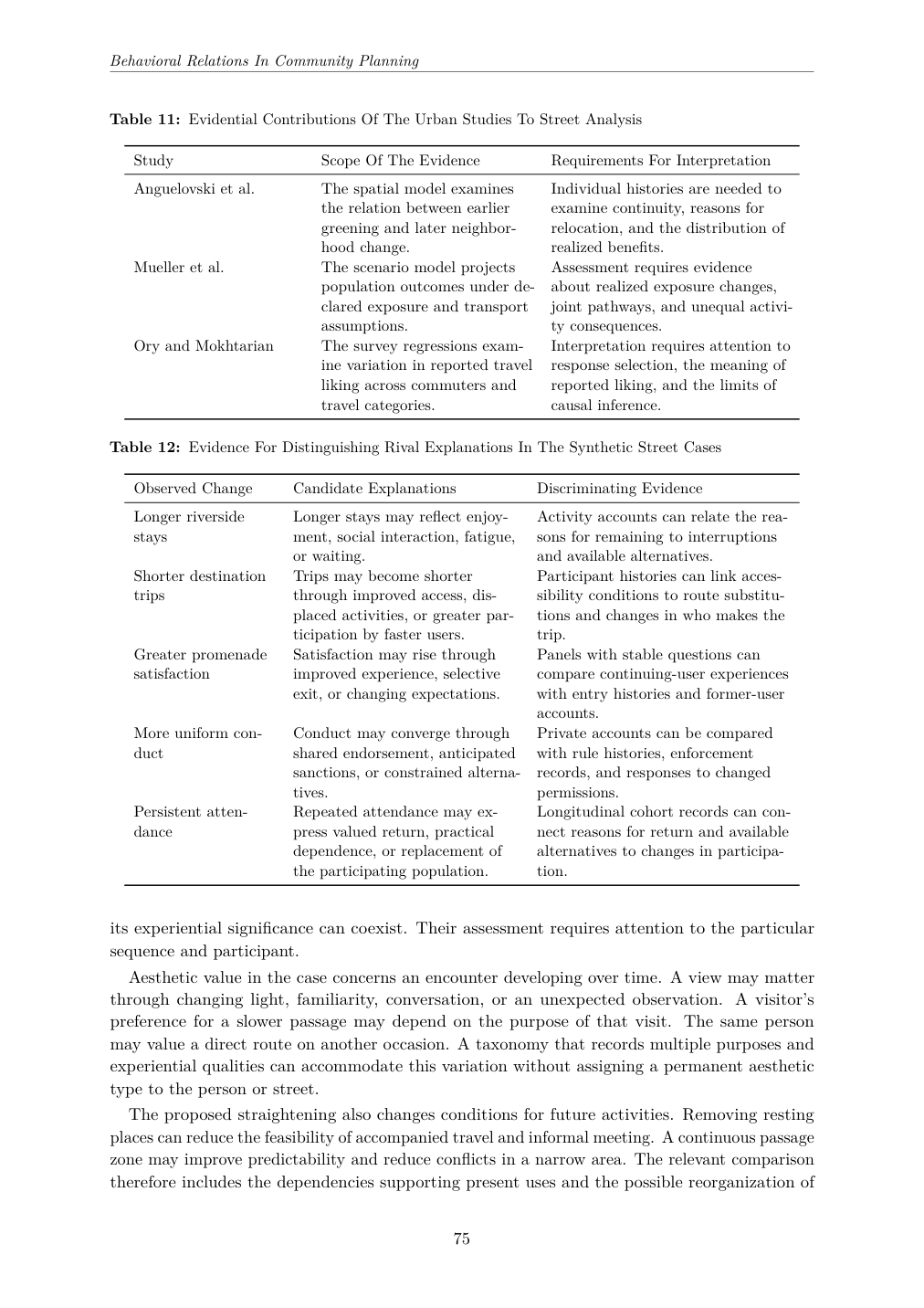
Readable text
Table 11: Evidential Contributions Of The Urban Studies To Street Analysis
The spatial model examines the relation between earlier greening and later neighbor-
Individual histories are needed to examine continuity, reasons for relocation, and the distribution of realized benefits.
The scenario model projects population outcomes under de- clared exposure and transport
Assessment requires evidence about realized exposure changes, joint pathways, and unequal activi- ty consequences.
The survey regressions exam- ine variation in reported travel liking across commuters and
Interpretation requires attention to response selection, the meaning of reported liking, and the limits of causal inference.
Table 12: Evidence For Distinguishing Rival Explanations In The Synthetic Street Cases
Longer stays may reflect enjoy- ment, social interaction, fatigue,
Activity accounts can relate the rea- sons for remaining to interruptions and available alternatives.
Participant histories can link acces- sibility conditions to route substitu- tions and changes in who makes the trip.
through improved access, dis- placed activities, or greater par-
Satisfaction may rise through improved experience, selective exit, or changing expectations.
Panels with stable questions can compare continuing-user experiences with entry histories and former-user accounts.
Conduct may converge through shared endorsement, anticipated sanctions, or constrained alterna-
Private accounts can be compared with rule histories, enforcement records, and responses to changed permissions.
Repeated attendance may ex- press valued return, practical dependence, or replacement of the participating population.
Longitudinal cohort records can con- nect reasons for return and available alternatives to changes in participa- tion.
its experiential significance can coexist. Their assessment requires attention to the particular
Aesthetic value in the case concerns an encounter developing over time. A view may matter through changing light, familiarity, conversation, or an unexpected observation. A visitor’s preference for a slower passage may depend on the purpose of that visit. The same person may value a direct route on another occasion. A taxonomy that records multiple purposes and experiential qualities can accommodate this variation without assigning a permanent aesthetic
The proposed straightening also changes conditions for future activities. Removing resting places can reduce the feasibility of accompanied travel and informal meeting. A continuous passage zone may improve predictability and reduce conflicts in a narrow area. The relevant comparison therefore includes the dependencies supporting present uses and the possible reorganization of
those uses. Each consequence should be associated with an identified mechanism: physical effort, waiting, perceived permission to linger, or the coordination of different movement speeds.
The research boundary extends to destination schedules and the alternative route. A clinic’s appointment system may create urgency; library opening hours may influence when people travel; a difficult crossing inland may concentrate otherwise diverse activities beside the river. These conditions can make an apparently local conflict partly dependent on arrangements elsewhere. A useful analysis retains the riverside focus while examining the external relations necessary to explain the observed use.
15.4 Evidence For Revising The Riverside Arrangement
The riverside inquiry can compare several candidate alterations. One preserves a predictable passage through the narrow segment while providing accessible resting areas nearby. Another improves the inland connection so that a wider range of users can choose between routes. A third changes the timing of deliveries or scheduled activities that intensify conflicts. Each candidate changes a different part of the activity network. Their feasibility depends on space, authority, maintenance, and the willingness of participants to adjust practices.
Evidence collection should identify linked activities and reasons for route choice. Accompanied walks, short diaries, and observations at different times can reveal where pauses contribute to access or experience. Interviews with people who avoid the river can identify unmet needs concealed by the current user population. Destination records and voluntarily supplied schedule information can help establish which delays affect subsequent commitments. Counts and travel times provide useful measures within this richer account.
A trial with movable seating and a temporary passage arrangement could test bounded features before an enduring alteration. The inquiry would record accessibility, conflicts, interruptions, opportunities to rest, and participant accounts of experience. Weather, unusual events, and changes in destination schedules would enter the interpretation. A comparison period or nearby segment may improve the assessment, provided the report explains the differences that remain. Feedback can also generate a new candidate, such as relocating a passage boundary while retaining a valued viewing position.
Several outcomes would require careful interpretation. Longer stays could express greater enjoyment or increased difficulty moving through the area. Shorter trips could reflect improved access or the departure of slower users. A reported preference for the existing route might express attachment, a valuable practical familiarity, or difficulty imagining the proposed arrangement. These possibilities invite additional evidence and a respectful treatment of participant accounts. Their interpretation should remain tied to the activity and the available alternatives.
Evaluation can preserve a set of alternatives when comparisons remain incomplete. One arrangement may improve reliable passage, another may better sustain accompanied walking, and a third may provide greater adaptability. A justified decision would explain the accepted trade-offs, the participants bearing them, and the conditions for review. The aesthetic dimension enters through articulated and observed experience, including disagreement and changes over time. The inquiry thereby supports purposeful design while preserving opportunities for further encounter and interpretation.
15.5 Normative Regulation Of Participation On The Promenade
Consider a former market street redesigned as a pedestrian promenade with trees, cafés, lighting, and coordinated storefronts. Visits increase, and current users report satisfaction with its appearance. Over time, an influential local account of a desirable promenade emphasizes quiet consumption, visual order, and predictable conduct. Some activities become more welcome, while
informal trading, prolonged rest, and certain gatherings encounter increasing resistance. The hypothetical research question concerns the mechanisms forming and sustaining this pattern and their implications for different participants.
Historical reconstruction identifies the relations through which the redevelopment became possible. Earlier parcel boundaries shape available public space. Ownership changes affect leases and business continuity. Licensing decisions alter the activities that can be publicly recognized. Memories of the market contribute to different understandings of the street’s identity. These histories can remain active through material arrangements, rights, expectations, and accounts of legitimate use. Their relevance depends on documented connections to the current dispute.
Power within the street includes control over premises, the ability to set service conditions, influence over complaints, and authority to enforce rules. Relations beyond the street include municipal licensing, metropolitan transport, owners’ investment decisions, and work schedules imposed elsewhere. These powers have different objects and limits. A resident’s capacity to influence noise enforcement may coexist with limited influence over rent or transit service. The analysis should identify these relations specifically and trace their interaction where it affects activity.
The apparent stabilization of conduct admits several explanations. Participants may endorse the emerging expectations because they find the promenade pleasant. Some may comply because they anticipate sanctions or social disapproval. Others may adapt because viable alternatives are scarce. People whose activities fit poorly may leave, while new visitors arrive with different expectations. Repeated attendance and uniform conduct can therefore accompany different compositions of endorsement, constraint, and selective participation.
Norm formation also concerns evaluative language. Descriptions such as orderly, welcoming, respectable, or lively can acquire practical force when they shape permission and enforcement. The inquiry should investigate who uses these terms, which activities they include, and how their interpretation changes across occasions. A concern for quiet may refer to sleep, commercial atmosphere, or the exclusion of a particular gathering. Establishing those meanings requires contextual evidence and attention to conflicting accounts.
The promenade’s development can alter future options. Successful businesses may support maintenance and create meeting opportunities; rising occupancy costs may reduce the continuation of existing uses. A coherent visual identity may attract some participants while making experimental uses harder to authorize. These possible consequences should be treated as hypotheses within the vignette. Their evaluation would require evidence about the mechanisms, affected groups, and longer-term changes in the activity network.
15.6 Longitudinal Assessment Of Promenade Participation
A targeted study would follow continuing users, entrants, former users, workers, and nearby residents. Interviews and activity histories would be linked, where relevant and appropriate, to changes in leases, permits, opening hours, complaints, and enforcement. The purpose of this linkage is to distinguish a participant’s reported reason for change from the conditions that might explain it. An owner, worker, and visitor may describe the same rule differently because they encounter different consequences and possess different opportunities to challenge it.
Evidence about voluntary attraction requires attention to feasible choice. Repeated visits are more informative when the reasons for return and the alternatives available are understood. An anonymous account may reveal concerns obscured in a public meeting, while observations of conduct under varied permissions can illuminate the role of anticipated sanctions. A bounded trial of clearly designated seating available without purchase could examine whether uses diversify
and whose participation changes. Such a trial would still require attention to concurrent events, publicity, and displacement from neighbouring areas.
The inquiry should preserve a distinction between changes in activity and changes in the population observed. Greater average satisfaction among current users may coexist with loss of opportunity among former users. A cohort-sensitive account can examine whether continuing participants experienced improvement, whether particular groups left, and whether new opportunities compensated the same people or benefited others. The question of compensation remains evaluative: benefits to entrants and losses to displaced participants require an explicit account of distribution and justification.
Longitudinal assessment would examine the durability of both benefits and burdens. Initial interest in a redesigned street might diminish, while changed rental conditions or activity permissions persist. Conversely, repeated encounters could develop valued relationships whose significance emerges gradually. Review should therefore follow the mechanisms under investigation and retain records of earlier commitments. An assessment conducted only at opening would provide limited evidence about these later processes.
Possible revisions include accessible public resting places, clearer distinctions between public and commercial space, changes in licensing, shared arrangements for events, or altered maintenance responsibilities. Their merits depend on the specific explanation supported by the inquiry. A design response aimed at physical comfort will have limited reach where exclusion primarily operates through permission or affordability. A change in permission may require accompanying material support to become usable.
The two synthetic cases demonstrate a common evaluative discipline. Activities receive multiple situated descriptions; historical and external relations enter the account where they explain consequential conditions; observed stability is examined through competing mechanisms; and judgments remain explicit about distribution, uncertainty, and revisability. Street design can then be assessed through the activities and possibilities it sustains over time, together with the processes through which participants acquire influence over their shared environment.
16 Activity Continuity In Human–AI Communities
Human–AI communities provide a further setting for examining activity relations, enabling burdens, historical continuity, and evolving evaluation. Here a community denotes an arrangement in which human participants and computational processes contribute to recurring activities, shared records, and decisions. The section develops a conceptual crosswalk from urban activity analysis to this heterogeneous setting. It examines material support, coordination and grounding, archives, evaluative authority, and methods of assessment. The transfer concerns specified relations among activities and conditions. Questions about experience, agency, responsibility, and moral standing retain their own evidential and philosophical requirements. The proposed account concentrates on arrangements that can be described and investigated through their contributions, dependencies, and consequences.
Table 13 identifies selected relations that can be investigated across urban and human–AI settings. The correspondences are analytical: each directs attention toward a type of dependency while preserving domain-specific mechanisms and evidence. The table can guide question formation without presuming that a street and a computational community share a single ontology.
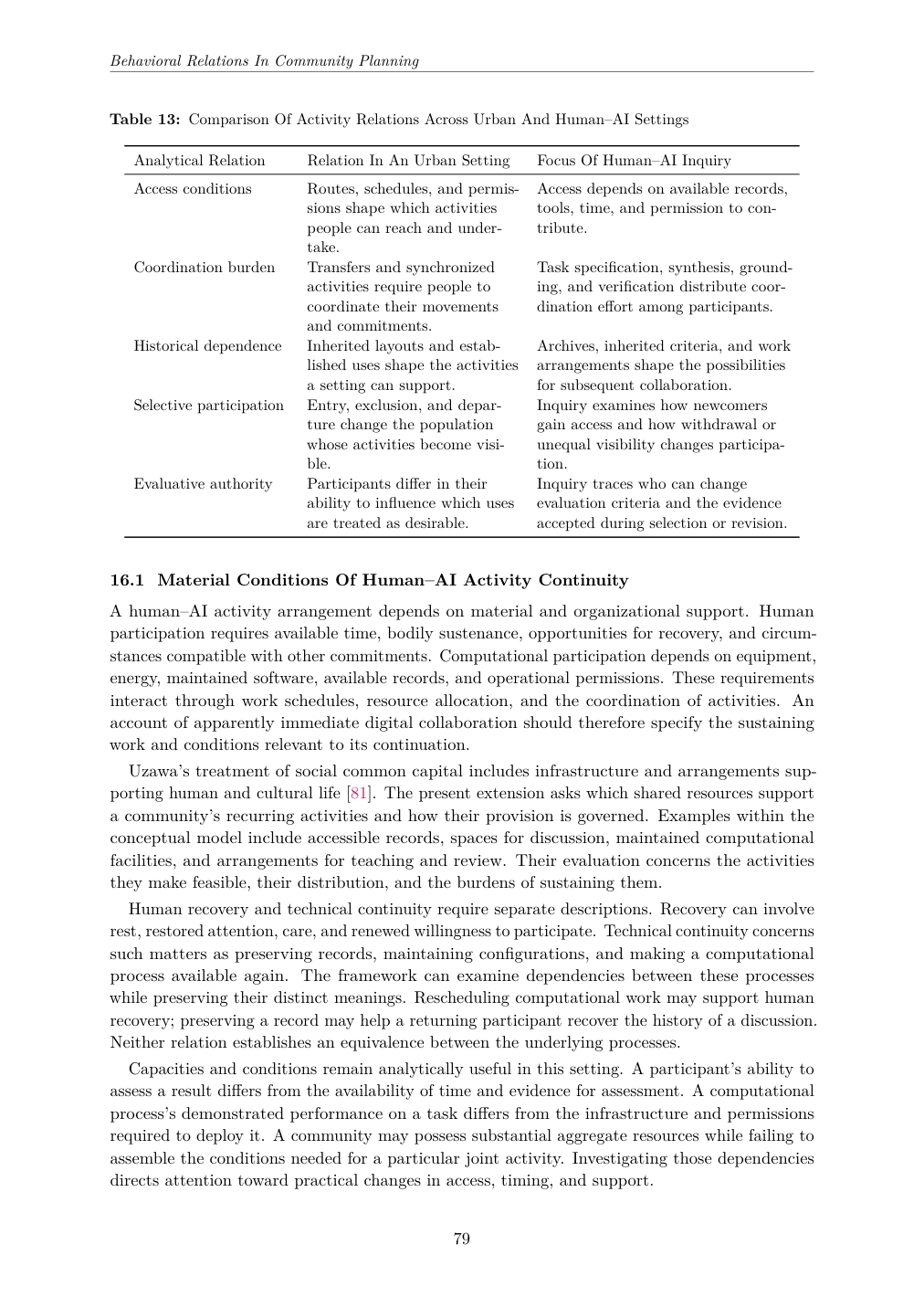
Readable text
Table 13: Comparison Of Activity Relations Across Urban And Human–AI Settings
Routes, schedules, and permis- sions shape which activities people can reach and under-
Access depends on available records, tools, time, and permission to con- tribute.
Transfers and synchronized activities require people to coordinate their movements
Task specification, synthesis, ground- ing, and verification distribute coor- dination effort among participants.
Inherited layouts and estab- lished uses shape the activities
Archives, inherited criteria, and work arrangements shape the possibilities for subsequent collaboration.
Entry, exclusion, and depar- ture change the population whose activities become visi-
Inquiry examines how newcomers gain access and how withdrawal or unequal visibility changes participa- tion.
Participants differ in their ability to influence which uses
Inquiry traces who can change evaluation criteria and the evidence accepted during selection or revision.
16.1 Material Conditions Of Human–AI Activity Continuity
A human–AI activity arrangement depends on material and organizational support. Human participation requires available time, bodily sustenance, opportunities for recovery, and circum- stances compatible with other commitments. Computational participation depends on equipment, energy, maintained software, available records, and operational permissions. These requirements interact through work schedules, resource allocation, and the coordination of activities. An account of apparently immediate digital collaboration should therefore specify the sustaining
Uzawa’s treatment of social common capital includes infrastructure and arrangements sup- porting human and cultural life [81]. The present extension asks which shared resources support a community’s recurring activities and how their provision is governed. Examples within the conceptual model include accessible records, spaces for discussion, maintained computational facilities, and arrangements for teaching and review. Their evaluation concerns the activities they make feasible, their distribution, and the burdens of sustaining them.
Human recovery and technical continuity require separate descriptions. Recovery can involve rest, restored attention, care, and renewed willingness to participate. Technical continuity concerns such matters as preserving records, maintaining configurations, and making a computational process available again. The framework can examine dependencies between these processes while preserving their distinct meanings. Rescheduling computational work may support human recovery; preserving a record may help a returning participant recover the history of a discussion. Neither relation establishes an equivalence between the underlying processes.
Capacities and conditions remain analytically useful in this setting. A participant’s ability to assess a result differs from the availability of time and evidence for assessment. A computational process’s demonstrated performance on a task differs from the infrastructure and permissions required to deploy it. A community may possess substantial aggregate resources while failing to assemble the conditions needed for a particular joint activity. Investigating those dependencies directs attention toward practical changes in access, timing, and support.
16.2 Distribution Of Coordination Effort In Human–AI Collaboration
Coordination is itself an activity within a human–AI arrangement. Participants specify tasks, communicate assumptions, allocate responsibilities, compare intermediate results, and repair misunderstandings. Schmidt and Bannon’s account of articulation work examines the work required to coordinate distributed interdependent activities [71]. The present extension treats task allocation, synthesis, verification, and repair as contributions whose burdens and generative effects should be examined. Some coordination establishes reusable understanding; some resolves a temporary incompatibility; some redistributes effort among participants.
Clark and Brennan describe grounding in communication through understanding sufficient for a current purpose and through costs that vary with the medium [16]. In the proposed human–AI application, evidence of adequate coordination should be tied to the task. Agreement in wording may be sufficient for a simple formatting choice, while a disputed interpretation can require examples, source inspection, or a demonstration of the intended consequence. The empirical adequacy of these techniques requires investigation in the relevant human–AI arrangement.
Output production and recipient uptake have different activity requirements. A process that produces many candidate texts can create selection, reading, comparison, and verification work for recipients. Assessing efficiency at the production stage alone would leave those downstream requirements outside the boundary. A community-level account should trace the resulting sequence: what participants inspect, which material they defer, what they understand, and what decisions the material supports. These relations can reveal whether increased output expands feasible inquiry or accumulates an unresolved demand on attention.
Several design hypotheses follow. Staged delivery could allow recipients to request detail when needed. Explicit uncertainty and source organization could support targeted verification. A common vocabulary could reduce repeated explanation while requiring revision when it obscures a new distinction. These are candidate arrangements for local assessment, each with possible costs. A shared vocabulary can become difficult for newcomers, and a compressed summary can remove context required by another task. Their value depends on the activities and participants they support.
16.3 Authority Over Community Archives
Archives can support continuity across interrupted participation, changing personnel, and revised computational arrangements. Their analytical role extends beyond retaining outputs. A useful record may include the question being pursued, the evidence available, the alternatives considered, the criteria applied, and the reasons for a decision. Such material can help later participants reconstruct how a conclusion arose and which assumptions remain open to reconsideration. The degree of reconstruction possible depends on what was recorded and how the record remains interpretable.
Historical participation can influence authority within a community. A person who maintained an archive may understand its classifications and omissions better than a newcomer. A long-used computational process may acquire practical authority because participants organize routines around its outputs. These are proposed mechanisms for investigation. Their significance depends on how past contributions, current capabilities, perceived reliability, and control over access interact. An account should distinguish documented competence from reputation and from authority conferred by a role.
Records also participate in selective visibility. Contributions compatible with an established format may be easier to retain and retrieve than an unresolved objection or an experiential account. If later evaluations draw primarily on the retained material, earlier classification choices
can influence future judgments. A community can investigate this possibility by examining what is routinely omitted, whose contributions require translation, and which records receive attention. Revision of an archive may involve adding context, preserving alternative descriptions, or changing access conditions.
Historical continuity requires a relation between preservation and reinterpretation. A stable record supplies material for later inquiry; its interpretation depends on the questions, vocabulary, and circumstances of the reader. A revision process should therefore preserve the identity of earlier versions while documenting substantive changes and their reasons. The history of evaluative criteria becomes especially important when archived outputs are later used to train participants, select projects, or allocate resources. In those cases, authority over the archive can affect future possibilities through the organization of remembered evidence.
16.4 Collective Variation Under Evolving Evaluative Criteria
Human–AI communities can change both their outputs and the criteria used to assess them. A research group may initially emphasize speed, later identify verification burdens, and subsequently give greater weight to interpretability or the preservation of alternative approaches. Such changes can reflect learning, a change in membership, an external demand, or a redistribution of authority. A historical account should distinguish these mechanisms where they affect the legitimacy and practical consequences of the revision.
Empirical evidence supports caution about transferring a single performance judgment across tasks. Vaccaro and colleagues synthesize 106 experimental studies of human–AI combinations from an evidence window extending from 2020 to June 2023 and report heterogeneous outcomes across task arrangements [82]. Their synthesis motivates evaluation at the level of a specified activity and comparison. It provides limited grounds for claims about a community’s longer historical development, which requires a different observational design.
Collective variation also deserves attention alongside the assessment of particular outputs. In an online short-story experiment, Doshi and Hauser find that access to AI-generated ideas improves several ratings of stories while increasing similarity among outputs [21]. The finding concerns that experimental task and its measures. The present framework draws a methodological implication: an assessment can examine both the quality of individual contributions and changes in the distribution of contributions across a community.
An evolving evaluation process may therefore retain several questions. Which activities become more feasible? Whose expertise develops? Which alternatives remain available for future inquiry? How are criteria selected and contested? A community can improve a particular output measure while concentrating authority or narrowing the range of approaches receiving support. Investigating these possibilities requires longitudinal records of selection, participation, rejected alternatives, and reasons for changing criteria. The questions remain open to evidence about benefits as well as burdens.
16.5 Evidential Scope Of Workplace Studies
Published workplace evidence offers a useful comparison with the task experiments. In their journal study of a staggered deployment among 5,172 customer-support workers, Brynjolfsson, Li, and Raymond report an average increase of approximately 15% in issues resolved per hour. Gains differ by prior skill and experience, and the highest-performing workers show a different pattern from less experienced colleagues. The authors delimit their findings to medium-run outcomes within one firm and identify wages and aggregate labor demand as outside the observed outcomes [13]. The published journal estimates are used here; earlier working-paper versions report different sample counts and headline estimates.
The framework interprets this study through three analytically distinct questions. The first concerns performance within an established evaluative arrangement. Resolved issues per hour is an intelligible measure for a bounded customer-support activity, with quality and customer experience supplying complementary observations. The second concerns the distribution and continuation of capabilities: the same average can accompany different changes across levels of experience, forms of learning, and future opportunities. The third concerns authority over the objective itself, including the definition of successful support and the disposition of the time or resources made available. Evidence answering the first question can inform the others while leaving further empirical and normative work necessary.
This distinction also makes the relation between the present framework and productivity research constructive. A verified performance improvement is one relevant result. Activity reconstruction asks how it connects with preparation, recipient effort, recovery, technical maintenance, and the continued production of expertise. Some of those connections may already be measured in a particular study; others require an expanded boundary. The appropriate expansion follows the focal research question and the consequences whose omission could change the judgment.
For a community application, an investigator could begin with a clear performance measure, identify the activities on which it depends, and then examine whether the intervention changes the distribution or recognition of those activities. An archive-assisted group might complete decisions more quickly while allocating more verification to experienced members. Another group might use saved time for additional exploration. These are proposed mechanisms to test. The workplace evidence supports the importance of contextual and distributional analysis while leaving the outcomes of such community arrangements open to investigation.
16.6 Situated Assessment Of Human–AI Communities
Assessment should follow the complete activity relation relevant to a decision. A faster drafting process may be evaluated together with reading effort, verification, revision, and subsequent use. An archive intervention may be assessed through successful recovery of earlier reasoning and through the effort required to maintain it. A change in decision authority may require attention to whose concerns enter the record and how objections receive a response. These questions give observable or interpretable content to a community-level evaluation.
The inquiry cycle developed in Section 14 can organize such assessment. Participants identify consequential activities, articulate provisional criteria, compare feasible arrangements, and review evidence about their effects. Revisions retain a history of the decisions and their reasons. The resulting account treats human–AI collaboration as an evolving arrangement of heterogeneous activities whose continuity depends on material support, interpretable histories, workable coordination, and revisable authority.
17 A Research Agenda For Activity Analysis In Community Planning
The research agenda identifies the empirical and conceptual work needed to assess the proposed framework. Its objective is to move from an organized vocabulary to studies capable of supporting, revising, or challenging particular claims. The section develops comparative questions about activity description, norm mechanisms, changing criteria, power, and human–AI community development. It also states the limits of the present survey and formal constructions. Progress is assessed through explanatory discrimination, useful decisions, and accountable revision in specified settings.
Table 14 summarizes the principal tests of usefulness. These are research directions, with outcomes that could motivate revision or rejection of particular elements. A meta-framework
contributes when it improves the quality of questions, distinguishes explanations, makes consequential exclusions visible, or supports better justified decisions under an explicit standard. Its continued elaboration is warranted through those achievements.
17.1 Assessment Of Taxonomy Adequacy Through Comparative Activity Records
The activity taxonomy can be investigated through its performance in actual reconstruction. A useful first study would compare accounts of the same episodes produced through a fixed administrative classification, the proposed multi-axis record, and participant-led descriptions. Researchers could examine which distinctions each approach makes visible, what coordination work each requires, and which consequential disagreements remain. The aim would be to establish the conditions under which the additional descriptive work improves understanding or decisions.
Inter-coder agreement can provide evidence concerning the reproducibility of assigned categories under a specified protocol. Agreement alone provides limited evidence of conceptual adequacy, because a common vocabulary can consistently omit the same concern. Participant review, examination of discrepant cases, and records of category revision therefore address complementary questions. The distinction between a trace, an attributed role, and an experienced quality should be maintained throughout. A reliable classification of movement remains a different achievement from a warranted interpretation of its significance.
The taxonomy also needs examination at its boundaries. Activities involving rest, refusal, waiting, withdrawal, repair, and the dissolution of an arrangement are especially useful cases because their significance can depend on what remains possible or prevented. A comparison across communities could test whether the eight proposed functional families provide a useful starting vocabulary, whether additional distinctions are needed, and whether some categories create more confusion than analytical benefit. The version history should retain failed classifications and the reasons for replacing them.
Comparative research requires a disciplined account of translation. Two communities may use a term such as care, creativity, contribution, or publicness differently. A cross-case schema can record a common analytical question while preserving local descriptions and their evidential grounds. Translation is successful to the degree that it supports the intended comparison without erasing a distinction material to that comparison. Areas of failed translation should appear as findings about the limits of the common representation.
17.2 Mechanisms Of Normative Stabilization
The central empirical challenge for norm dynamics is distinguishing mechanisms that produce similar visible conduct. A longitudinal design can combine repeated activity observation with accounts of personal endorsement, empirical expectations, normative expectations, anticipated sanctions, and available alternatives. Changes in access, membership, resources, or authority provide occasions for examining which mechanism predicts the subsequent pattern. Historical reconstruction establishes the sequence within which those changes acquire meaning.
The design should include continuing participants, entrants, former participants, and relevant nonparticipants. Their inclusion changes the explanatory object from the behavior of a visible population to the process through which that population becomes visible. Former participants may have left through dissatisfaction, changed interests, displacement, or unrelated life circumstances. Entry can reflect improved access, novelty, recruitment, or a changed activity mix. The record should keep these explanations separate until evidence supports their connection.
A particular attraction claim can then receive a limited empirical interpretation. Repeated return after specified disturbances may support a local restoring mechanism. Persistent occupancy can support a descriptive regime classification. A change after the removal of a sanction can help
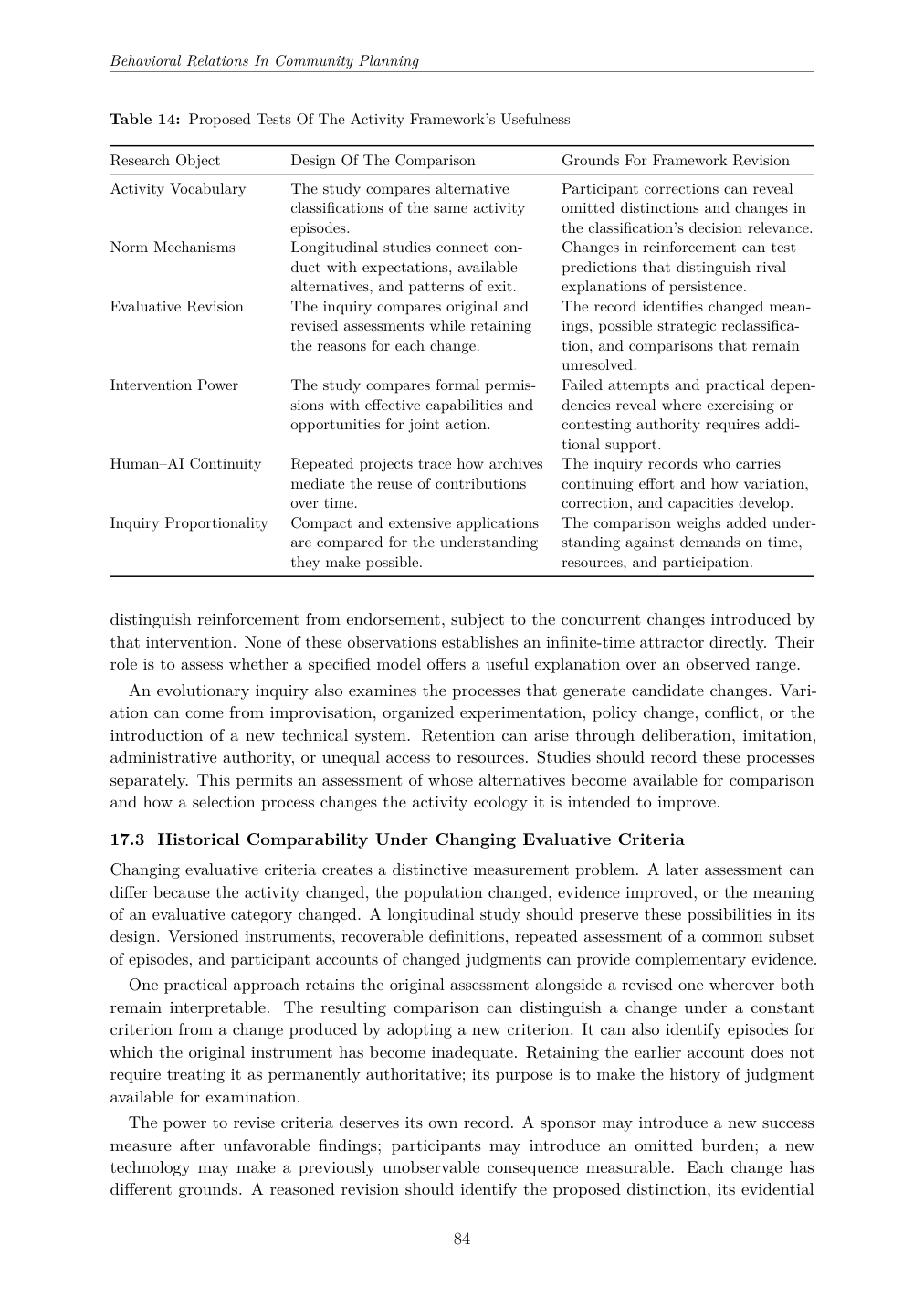
Readable text
Table 14: Proposed Tests Of The Activity Framework’s Usefulness
The study compares alternative classifications of the same activity
Participant corrections can reveal omitted distinctions and changes in the classification’s decision relevance.
Longitudinal studies connect con- duct with expectations, available alternatives, and patterns of exit.
Changes in reinforcement can test predictions that distinguish rival explanations of persistence.
The inquiry compares original and revised assessments while retaining the reasons for each change.
The record identifies changed mean- ings, possible strategic reclassifica- tion, and comparisons that remain unresolved.
The study compares formal permis- sions with effective capabilities and opportunities for joint action.
Failed attempts and practical depen- dencies reveal where exercising or contesting authority requires addi- tional support.
The inquiry records who carries continuing effort and how variation, correction, and capacities develop.
Repeated projects trace how archives mediate the reuse of contributions
Compact and extensive applications are compared for the understanding
The comparison weighs added under- standing against demands on time, resources, and participation.
distinguish reinforcement from endorsement, subject to the concurrent changes introduced by that intervention. None of these observations establishes an infinite-time attractor directly. Their role is to assess whether a specified model offers a useful explanation over an observed range.
An evolutionary inquiry also examines the processes that generate candidate changes. Vari- ation can come from improvisation, organized experimentation, policy change, conflict, or the introduction of a new technical system. Retention can arise through deliberation, imitation, administrative authority, or unequal access to resources. Studies should record these processes separately. This permits an assessment of whose alternatives become available for comparison and how a selection process changes the activity ecology it is intended to improve.
17.3 Historical Comparability Under Changing Evaluative Criteria
Changing evaluative criteria creates a distinctive measurement problem. A later assessment can differ because the activity changed, the population changed, evidence improved, or the meaning of an evaluative category changed. A longitudinal study should preserve these possibilities in its design. Versioned instruments, recoverable definitions, repeated assessment of a common subset of episodes, and participant accounts of changed judgments can provide complementary evidence.
One practical approach retains the original assessment alongside a revised one wherever both remain interpretable. The resulting comparison can distinguish a change under a constant criterion from a change produced by adopting a new criterion. It can also identify episodes for which the original instrument has become inadequate. Retaining the earlier account does not require treating it as permanently authoritative; its purpose is to make the history of judgment
The power to revise criteria deserves its own record. A sponsor may introduce a new success measure after unfavorable findings; participants may introduce an omitted burden; a new technology may make a previously unobservable consequence measurable. Each change has different grounds. A reasoned revision should identify the proposed distinction, its evidential
support, the people affected, and the consequences for earlier judgments. Independent scrutiny can then assess whether the revision reflects learning, strategic reclassification, or a combination.
Comparability also has limits. An activity that changes its participants, purposes, and setting may no longer support a single longitudinal score with the same meaning. A study can respond through a documented conceptual transition, parallel descriptions, or a narrower comparison. The framework’s commitment is to accountable continuity of reasoning. It leaves the adequacy of numerical continuity to the case.
17.4 Institutional Conditions Of Intervention Capabilities
The power construction invites empirical work on the content and reliability of intervention sets. An investigation can distinguish formal permission, practical ability, expected effectiveness, and access to collective action. Interviews, rules, decision records, observed interventions, and failed attempts can each inform the bounds of those sets. The comparison should state its baseline and the resources and dependencies held fixed. A capability that exists only through another actor’s continuing cooperation requires that dependence to remain visible.
Three research questions follow. The first concerns the relation between recognized authority and effective intervention. The second concerns complementary capabilities, where actors who are individually limited can jointly achieve a change. The third concerns the cost of contestation: initiating a challenge can consume time, reputation, or access, and those consequences can alter the practical intervention set. A partial-order representation can organize some of these relations, while a full account also requires the meanings and institutional mechanisms associated with them.
Institutional change can be assessed through alterations in these specific domains. A new appeal procedure may widen correction opportunities; a public archive may improve access to historical evidence; a resource allocation may make an existing formal right practically usable. Such changes should be examined for their effects on participation, burden, and authority. A formally expanded option can coexist with increased demands elsewhere, making the incidence record essential.
The framework also needs a careful treatment of constituencies whose interests have limited direct representation. Children, future participants, ecological systems, and people absent through exclusion can be affected by present arrangements. Their consideration involves judgments about representation, evidence, obligation, and uncertainty. Humanist attention to experienced significance can be combined with ecological and intergenerational responsibilities, while disagreements among those commitments require explicit argument. The present architecture supplies places for those claims in evaluation; it does not settle their philosophical priority.
17.5 Longitudinal Inquiry Into Human–AI Community Activities
Research on human–AI communities can examine how local assistance changes a continuing ecology of activity. The relevant period includes preparation, contribution, interpretation, verification, archiving, reuse, and recovery. A short-term improvement in an assessed output may coexist with changes in recipient effort, learning opportunities, dependence on particular infrastructures, or the diversity of approaches retained by the community. The task-level studies discussed in Section 16 provide bounded empirical starting points for this broader programme.
A prospective study could follow several recurring community projects under documented arrangements of AI assistance. It would record the division of activity, changes in contribution criteria, correction work, and the use of archives over time. The comparison should account for participant selection, prior skills, task differences, changes in the technical system, and the possibility that assistance changes the work people choose to undertake. Depending on the
setting, a phased introduction or a bounded randomized component may support causal questions, while historical and interpretive methods address meaning and institutional development.
Collective variation is one object of particular interest. A community may produce more contributions while converging on a smaller range of forms; it may also use assistance to explore previously inaccessible approaches. These are competing possibilities that call for measures and interpretations appropriate to the activity. Diversity of surface form, diversity of practical methods, and diversity of represented perspectives can develop differently. Participants’ reasons for valuing or disregarding those differences should accompany the descriptive evidence.
Archive effects merit equal attention. A summary or retrieval system can alter which histories remain usable, which contributors receive recognition, and which questions appear settled. Studies can compare retrieval outcomes with source records, examine corrections, and follow the consequences for subsequent decisions. The object is the chain linking technical selection to interpretation and authority. Questions concerning an AI system’s experience or moral standing remain analytically distinct from evidence about those operational effects.
17.6 Comparative Assessment Of Framework Usefulness
The framework’s proposed usefulness can be assessed through explicit comparisons with established practice. One study design would provide several research teams with the same bounded case materials, decision question, and resource budget. Some teams would use their existing disciplinary procedure, while others would add the interface record from Section 12.5. Evaluation would examine whether the additional procedure identifies consequential omissions, distinguishes rival mechanisms, or changes an inference in a way supported by the shared evidence. Assessment would use predeclared, claim-specific criteria applied to substantive inferences and decisions, with completion of the framework’s own fields treated as a process record. The evaluators, affected constituencies, unresolved disagreements, and effort required for adjudication would be recorded. A follow-up comparison could assess the same tasks with fuller information and participant review. This is a proposed evaluation design whose criteria and assignment procedure would need specification before execution.
The comparison should avoid rewarding description simply for becoming longer. Relevant outcomes include correction of an inference, identification of an affected activity that changes the decision, explicit preservation of an unresolved comparison, or a defensible reduction in unnecessary analysis. Researcher expertise, familiarity with the vocabulary, and additional time can influence these outcomes. They should therefore be recorded or held comparable where the design permits. A favorable result for an extensively supported team would otherwise leave the contribution of the framework itself uncertain.
Several failure conditions are identifiable. If a taxonomy assigns almost every functional family to almost every occurrence without helping answer the focal question, its resolution or purpose needs revision. A substantive finding of power incomparability remains a valid result. Revision is warranted when the intervention descriptions fail to address the focal question or conceal distinctions supported by the evidence. If an attraction model offers no discriminating implication beyond observed persistence, its explanatory status should remain limited to the descriptive pattern actually supported. If newly chosen criteria are justified only by their agreement with an already preferred outcome, the revision lacks an independent account of the evaluative reasons at issue.
Failure can also occur through excessive investigative demands. A compact comparison with stable purposes, clear resource incidence, and an adequate decision rule may gain little from a larger reconstruction. In that case, proportional use of the framework consists in identifying that sufficiency and stopping. The meta-framework is assessed through its organizing and interpretive
contribution; particular causal hypotheses and mathematical models retain the more specific tests appropriate to their claims. An application that leaves decisions unchanged can still reveal an important evidential limit, but that benefit should be demonstrated in the record.
17.7 Conditions For Applying The Activity Framework
The survey is a structured interdisciplinary narrative review. Its selection emphasizes concepts needed for the proposed interfaces and includes the extended examination of language-based norm and value reconstruction in Appendix B. It offers a traceable set of intellectual connections, with further specialist review needed for fuller treatment of particular traditions, jurisdictions, cultural settings, and contemporary systems. The framework’s distinctive contribution lies in the arrangement of questions and distinctions; a claim of superior explanatory or practical performance requires comparative application.
The formal results are deliberately limited. The factorization criterion concerns a declared representation and target evaluation. Maximal-set existence assumes a finite nonempty design set and a transitive comparison. Power ordering depends on a shared intervention universe and contextual feasibility semantics. Conditional feasibility expansion assumes preservation and comparable resource records. The synthetic dynamics establish properties of a selected equation. Each result identifies a place where empirical or normative work must supply content, and each can become uninformative when the selected representation omits what matters to the decision.
The framework also introduces work of its own. Rich records, plural appraisal, longitudinal observation, and participatory revision can consume substantial resources. Its use should therefore be proportionate to the stakes and uncertainty of the situation. A small, reversible scheduling adjustment may require a compact activity and burden record. An enduring change in access, authority, or historical representation may justify a more extensive inquiry. The research process should itself be evaluated for the relation between its demands and its contribution to warranted action.
18 The Contribution Of Activity Analysis To Community Planning
The generative–relational framework connects a structured interdisciplinary survey, paper-local concepts, conditional formal results, synthetic illustrations, and situated inquiry. Its practical purpose is to support community planning and policymaking through an analysis of activity ecologies whose participants, relations, enabling conditions, opportunities, burdens, and evaluative standards develop through history. Urban and human–AI communities provide related settings for assessing and revising the framework. Explanation, reconstruction, alternative formation, and deliberation establish the context in which particular evaluations and optimization procedures can be useful.
The survey identifies several economic and neighboring concepts relevant to enabling activity: time allocation, transaction costs, articulation work, grounding, social provisioning, social reproduction, relational goods, and social common capital. These concepts address distinct objects. Their connection supports a differentiated analysis of the time, resources, coordination, care, and shared conditions through which participation becomes possible. The framework retains those differences while proposing common records of activity relations, incidence, and continuation.
The taxonomy treats an occurrence as capable of several functional and experiential descriptions. Production, maintenance, reproduction, inquiry, relationship, expression, governance, and withdrawal can intersect within one sequence. Temporal modes and evaluative valence remain separate dimensions. Movement can enable another activity and also contribute to
companionship, exploration, or aesthetic experience. The classification of a requirement as overhead consequently depends on focal purposes, participants, preservation requirements, and a declared comparison. Its reduction requires examination of the activity that remains and of the burdens transferred elsewhere.
Historical spacetime supplies the relations through which those descriptions become intelligible. Present possibilities depend on schedules, permissions, embodied capacities, material arrangements, accumulated records, and earlier interpretations. Relevant relations extend beyond the immediate location of an encounter. A street can be shaped by distant decisions concerning ownership, services, classification, or visibility; a digital community can depend on embodied work and historical authority distributed across places. Reconstruction therefore combines the observed event with the conditions of its possibility and the processes through which its history becomes available.
Norm dynamics adds the formation and stabilization of evaluation to this account. A recurrent pattern can be sustained through coordination, material reinforcement, endorsement, sanctions, constrained alternatives, or changes in the participating population. Dynamical attraction characterizes a specified process; normative justification requires reasons concerning its formation, effects, and alternatives. The paper recognizes Eglash and Garvey’s prior connection between basins of attraction and generative justice, and develops an interface among that lineage, evaluative category formation, contextual power, and evidence-sensitive revision.
Power enters through differentiated capacities to change activity and its interpretation. Access, resource allocation, classification, archive control, evidential admissibility, and opportunities for challenge can be investigated as distinct domains. The intervention-set construction supports contextual comparisons and preserves incomparability where the declared capabilities differ. Its quotient-order result establishes a property of the representation, while practical explanation requires evidence about the institutions, dependencies, and histories that produce those capabilities. Heterogeneous values likewise require attention to recognition, conversion, circulation, return, capture, and the continuation of generative capacities and conditions.
The formal and computational work clarifies several boundaries of inference. A selected observation can leave activity meaning underidentified. The factorization result identifies when a specified evaluation is constant across histories sharing the same representation; computational or statistical recovery requires additional assumptions. A finite, transitive comparison can yield several maximal alternatives. Lower recorded requirements weakly expand feasible projects under explicit preservation conditions. A synthetic bistable model can exhibit hysteresis while carrying no ethical ranking. The examples establish those limited consequences and provide reproducible material for further exploration.
Aesthetic inquiry benefits from this division of analytical work. Selected qualities and requirements can be represented, compared, and sometimes optimized under explicit assumptions. Experienced significance, evolving interpretation, disagreement, and public justification remain additional objects of inquiry. The proposed approach preserves useful formal comparisons while maintaining a record of their boundaries and the reasons for revising them. A decision can therefore be concrete and provisional at the same time: it identifies an arrangement, its grounds, accepted uncertainty, and conditions for reconsideration.
The methodology coordinates humanist, evolutionary, and evidence-based inquiry. Humanist commitments concern meaningful participation and the standing of affected people. Evolutionary inquiry revises arrangements through experience; evidence-based inquiry connects descriptive and causal claims to appropriate observations and assumptions. Together they examine the criteria, records, and authority through which inquiry operates. Comparative reconstruction, longitudinal
studies of norm mechanisms, documented criteria revision, and continuing human–AI community projects can assess the framework. Its development remains accountable to the understanding and decisions those applications support.
The extended language survey specifies a practical interface for that programme. Natural language processing offers representations of expressed values, moral framing, contextual norms, attributed positions, and social responses. A versioned record can preserve the relation between these representations and the passages, participants, audiences, and rules on which an interpretation depends. Longitudinal reconstruction then asks which mechanisms explain observed persistence and change, including the effects of power over visibility and of the analytical system itself. A planning process can use these records to identify neglected dependencies, generate alternatives, and examine the consequences of a policy. Whether the proposed architecture improves understanding or decisions remains a question for the comparative studies specified in Appendix B.
A Research Materials For Reproducing The Analytical Constructions
The research materials provide a reviewable record of the manuscript’s sources, formal conventions, and original illustrations. This appendix specifies the contents of the accompanying package, the computational procedures, and the conditions under which the results can be reproduced. Its purpose is to distinguish reproducibility of the declared constructions from empirical adequacy of their social interpretation. The bibliography and verification ledger document the surveyed sources; the section files preserve the argument; and the code and data make the synthetic examples inspectable.
Section A.1 describes the materials and verification record. Section A.2 consolidates notation. Section A.3 documents the explanatory constructions. Sections A.4 and A.5 specify the dynamical and finite-data procedures. Section A.6 gives the reproduction sequence and its review boundaries.
A.1 Source Documentation Within The Research Package
The package contains a main LATEX document, individually organized section files, a BibTEX bibliography, a tab-separated verification ledger, a structured source registry, vector and raster figures, Python code, and generated CSV and JSON data. Table 15 identifies the principal entry points. A separate README gives build instructions and the numerical results expected from the supplied code.
The reference workflow records online verification of bibliographic identity and support for the intended use before insertion into manuscript prose. Entries distinguish consulted versions where publication history is relevant. Source access ranges from complete primary texts to authoritative substantive records and abstracts; the corresponding claim is bounded by the material consulted. The ledger records that supporting use, alongside the source URL and retrieval reference. The retrieval references identify the research session’s lookup records, while the URLs and bibliography provide the independently usable route to the cited material.
The source package contains original analytical material and bibliographic records. Third-party full texts are accessed through their source links and retain their applicable terms. The paper’s proposed framework, taxonomy, cases, and simulations should be cited and assessed according to their declared standing. A reference’s presence in the survey establishes an intellectual or evidential connection at a specified point; it does not imply endorsement of the entire framework by the referenced author.
A.2 Scope Of The Manuscript’s Formal Notation
Table 16 summarizes the principal notation. Objects are defined locally where they enter an argument. Reused letters have distinct indices or arguments, and the table identifies the relevant scope. The notation does not require narrative evidence, qualitative interpretation, and resource records to share a common numerical scale.
The formal results assume the domains stated in their local definitions. Finite-set results require finite sets; order constructions require the specified comparison relation; and exact compatibility concerns the declared observation map. Unresolved observations can be preserved as unresolved. The power order compares capabilities within a common context and intervention universe. It leaves cross-domain judgments and jointly feasible portfolios to additional constructions. These conventions support precise reuse of a result without extending its conclusion to a different analytical object.
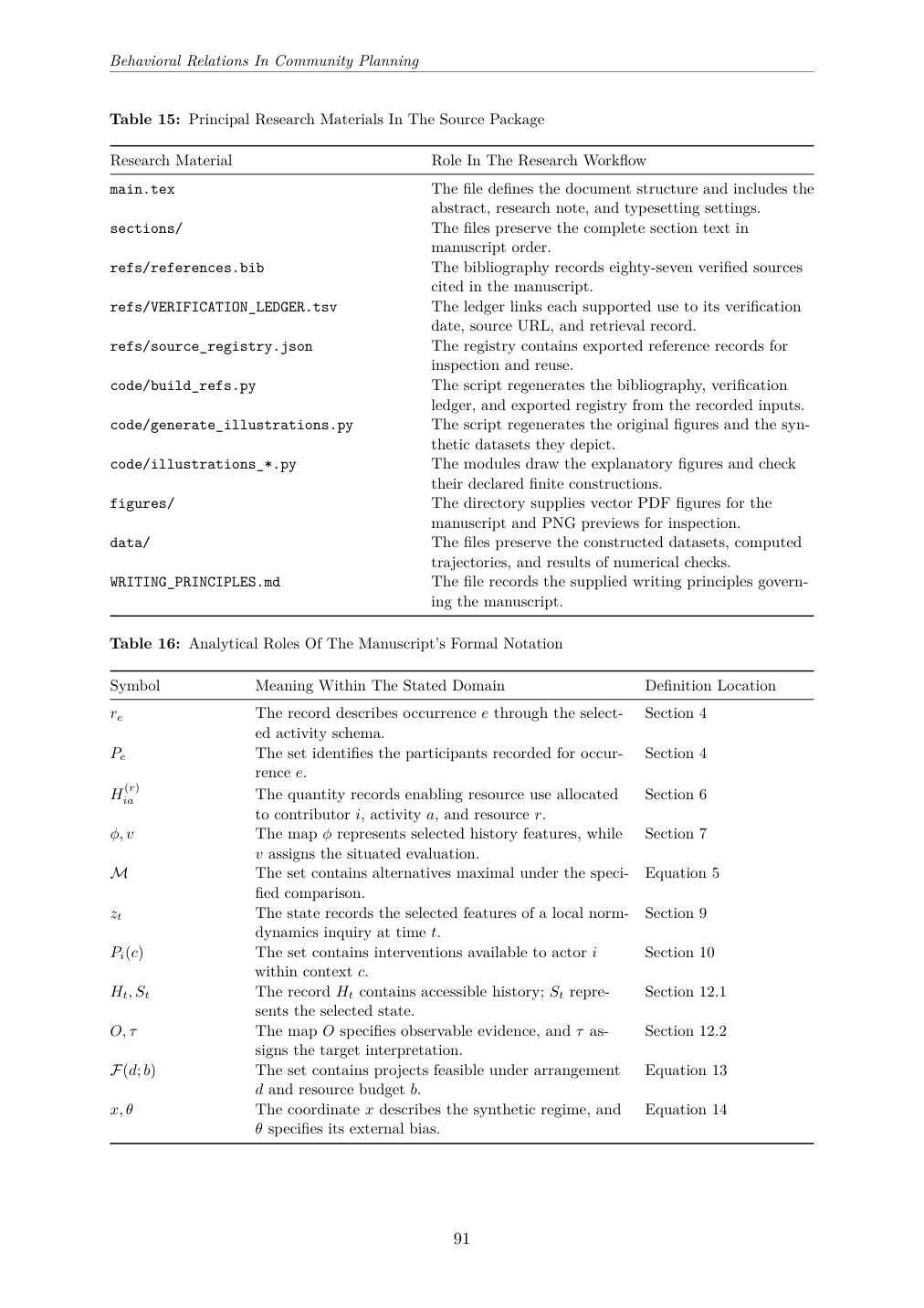
Readable text
Table 15: Principal Research Materials In The Source Package
The file defines the document structure and includes the abstract, research note, and typesetting settings. The files preserve the complete section text in manuscript order. The bibliography records eighty-seven verified sources cited in the manuscript. The ledger links each supported use to its verification date, source URL, and retrieval record. The registry contains exported reference records for inspection and reuse. The script regenerates the bibliography, verification ledger, and exported registry from the recorded inputs. The script regenerates the original figures and the syn- thetic datasets they depict. The modules draw the explanatory figures and check their declared finite constructions. The directory supplies vector PDF figures for the manuscript and PNG previews for inspection. The files preserve the constructed datasets, computed trajectories, and results of numerical checks. The file records the supplied writing principles govern- ing the manuscript.
main.tex sections/ refs/references.bib refs/VERIFICATION_LEDGER.tsv refs/source_registry.json code/build_refs.py code/generate_illustrations.py code/illustrations_*.py figures/ data/ WRITING_PRINCIPLES.md
Table 16: Analytical Roles Of The Manuscript’s Formal Notation
The set identifies the participants recorded for occur-
The quantity records enabling resource use allocated
The set contains alternatives maximal under the speci-
The state records the selected features of a local norm-
The set contains projects feasible under arrangement
A.3 Checks On The Explanatory Constructions
The explanatory figures pair local formal objects with declared examples. Their code records the memberships, allocations, comparisons, or conditional probabilities used to produce each visual. Checks concern the displayed examples: resource attribution preserves the recorded total under unit-sum shares; representation fibers are compared with target assignments; maximal alternatives follow from the declared order; intervention-set comparisons preserve the specified context; and project feasibility uses the stated resource budget and preservation indicator. These are checks on constructed objects whose meanings are supplied in the corresponding sections.
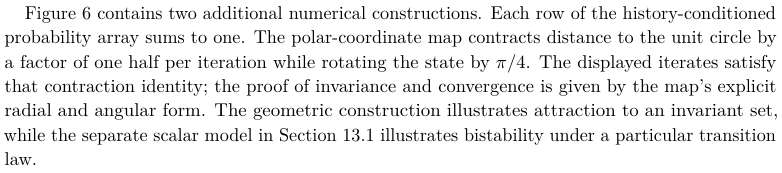
Running the main illustration script also invokes the four modules explaining the core framework and writes their checks to data/illustrative_formal_checks.json. Each module can be run independently from the source package. The companion record data/formal_figure_coverag e.json associates each numbered equation with the figure that explains its object or inference. Figure captions state the meaning of arrows, set boundaries, symbols, and constructed quantities. Review therefore concerns both mathematical correspondence and the adequacy of the visual explanation at manuscript size.
The language-reconstruction extension in Appendix B adds two explanatory modules. The record module draws the inquiry architecture and a contextual interpretation of an invented utterance. The dynamics module checks two explicitly defined Markov matrices, their common stationary distribution, their different transition probabilities, a coordinated graph permutation, and the totals in a constructed trajectory comparison. These checks are recorded in data/nlp _records_audit.json and data/nlp_formal_checks.json. The modules generate original
illustrations; they perform no extraction on a community corpus and estimate no empirical norm dynamics.
A.4 Numerical Checks On The Dynamical Computations
The illustration code uses Python with NumPy and Matplotlib. The recorded execution used Python 3.12.14, NumPy 2.3.5, and Matplotlib 3.10.8. It uses no random sampling, so the constructed datasets are deterministic. Minor differences in floating-point arithmetic or font rendering across environments can affect the last reported digits or figure layout. The mathematical definitions, parameter protocol, and comparison rules determine the substantive results.


final ascending state. A second pair of sweeps halves the integration step while retaining the same parameter grid and hold duration. The endpoint comparison therefore measures timestep sensitivity for that fixed protocol.
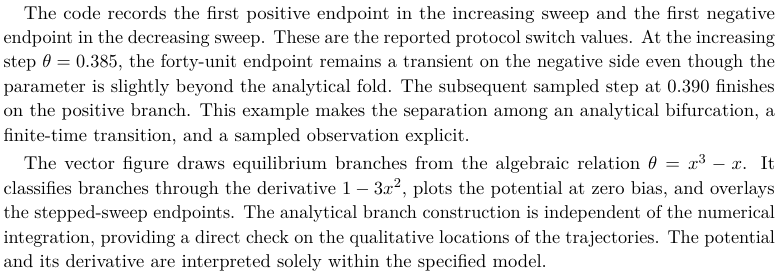
A.5 Construction Of The Finite Synthetic Datasets
The design dataset contains exactly the seven rows displayed in Table 9. The comparison algorithm checks each row against each other row. An alternative is removed from the retained set when another row weakly reduces both recorded resource demands and strictly reduces at least one. The preservation-constrained calculation first filters the rows by the stipulated walk requirement, then applies the same dominance rule. This order of operations is necessary because removing an otherwise dominating arrangement can alter the maximal set.
The code checks that the unrestricted retained identifiers are B, C, and D, and that the preservation-constrained identifiers are C and G. The result concerns seven discrete alternatives. The figure’s connectors support visual reading of those alternatives and introduce no additional feasible designs. Extending the example to continuous variables would require a new feasible-set specification and appropriate assumptions concerning interpolation, preservation, and resource use.

The figures concerning the activity record and the framework architecture are original analytical diagrams. Their arrows denote explicitly captioned relations, such as selected temporal succession or an inquiry interface. They carry no estimated coefficient, causal effect size, or exhaustive claim about the social system. This interpretation keeps their analytical role aligned with the paper’s ontological suspension.
A.6 Procedures For Reproducing The Research Package
Running pythoncode/generate_illustrations.py recreates the figures, CSV files, and results JSON in directories resolved relative to the script. Running pythoncode/build_refs.py reproduces the bibliography and ledger from the verified records embedded in the script and in refs/additional_sources.json, and exports refs/source_registry.json. It performs no new source verification; additions require verification before citation.
The README lists required packages and the supplied build script. A standard pdfLATEX and BibTEX sequence, followed by two pdfLATEX passes, resolves citations and cross-references. The included vector PDF figures also permit compilation without regenerating the illustrations.
Internal review examines formal consistency, code–result correspondence, bibliography keys, semantic labels, cross-references, and rendered layout. The accessible sources and reproducible constructions support subsequent peer review, empirical assessment of the framework, and authorial judgment.
B The Reconstruction Of Values And Norms From Language
Natural language research offers a practical route for investigating the expectations, value claims, and contested interpretations through which communities organize activity. This appendix surveys that research and develops its relation to the generative–relational framework. The objective is to identify representations that can support historical analysis and community planning while preserving their evidential scope. The discussion moves from the objects represented in language, through major computational approaches and their validation, to a proposed reconstruction architecture, longitudinal models, and a practical inquiry protocol. Published findings, methodological recommendations, and original formal illustrations retain their separate standing.
The proposed programme has two interacting routes. A formal route begins with a revisable taxonomy of activity and behavior, specifies candidate generative mechanisms, studies changes in historically situated relations, and constructs criteria for comparing possible trajectories. A practical route begins with a consequential question, available records, situated judgment, and an achievable investigation. The practical route can use philosophical reasoning, historical interpretation, participant knowledge, computational analysis, and experiments without first constructing a universal formal system. Its findings can subsequently alter the taxonomy, the dynamics, or the criteria used in the formal route. Figure 15 locates these activities within one continuing inquiry.
The central empirical target is a situated record of what is expressed, attributed, expected, contested, and acted upon. A vector of value scores is one possible view of that record. A norm proposition, a discourse network, an annotated passage, and a participant’s account can preserve other information. The task is to establish which distinctions a particular planning question requires, which sources support them, and which transformations remain inspectable. This orientation follows the broader text-as-data requirement for application-specific validation and substantive reading [33]. The architecture developed below is a proposal for carrying those requirements into relational analysis.
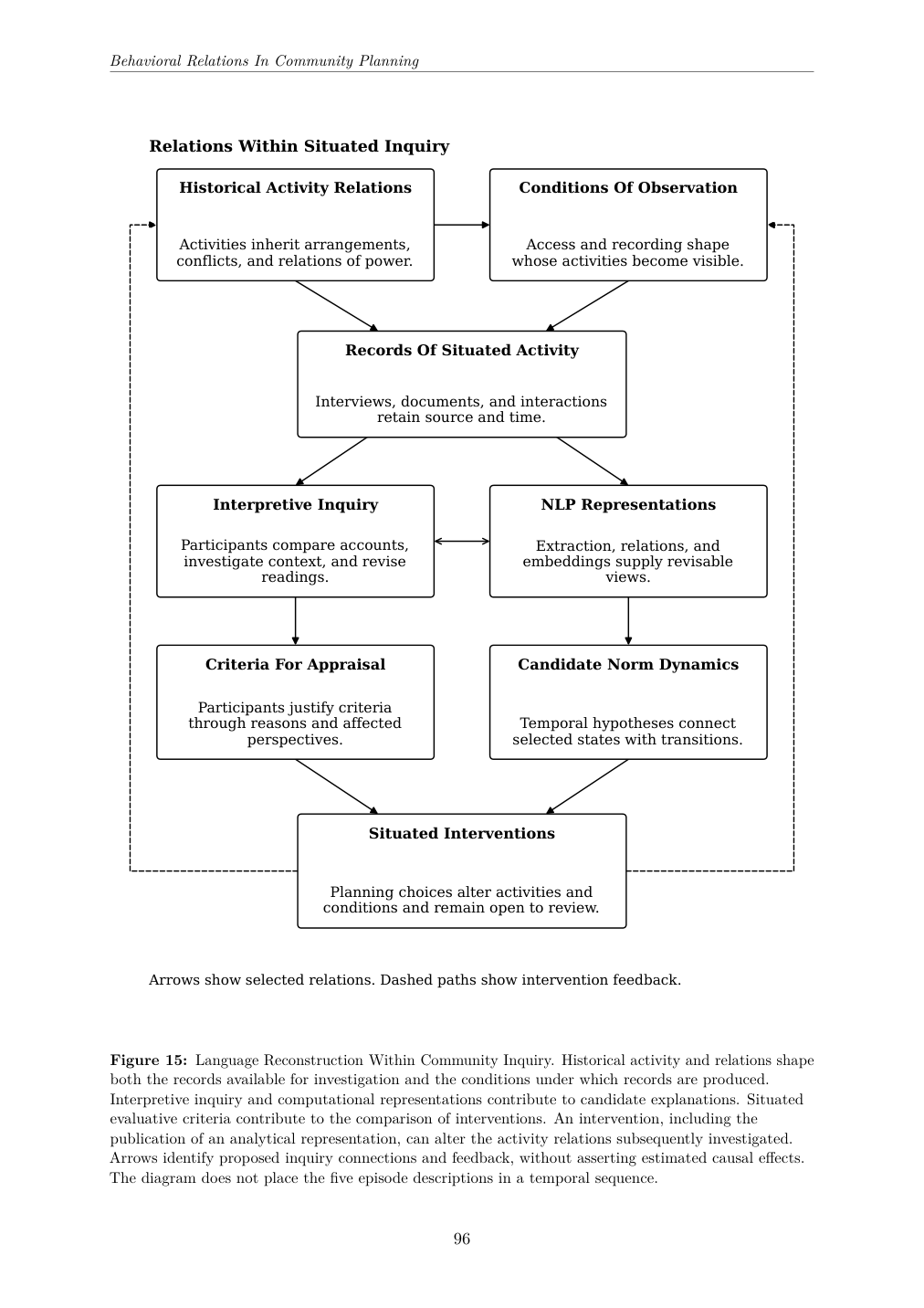
Readable text
Activities inherit arrangements, conflicts, and relations of power.
Participants justify criteria through reasons and affected
Access and recording shape whose activities become visible.
Extraction, relations, and embeddings supply revisable
Temporal hypotheses connect selected states with transitions.
Planning choices alter activities and conditions and remain open to review.
Arrows show selected relations. Dashed paths show intervention feedback.
Figure 15: Language Reconstruction Within Community Inquiry. Historical activity and relations shape both the records available for investigation and the conditions under which records are produced. Interpretive inquiry and computational representations contribute to candidate explanations. Situated evaluative criteria contribute to the comparison of interventions. An intervention, including the publication of an analytical representation, can alter the activity relations subsequently investigated. Arrows identify proposed inquiry connections and feedback, without asserting estimated causal effects. The diagram does not place the five episode descriptions in a temporal sequence.
B.1 Selection Of Research For The Language Survey
The language survey extends the narrative-review method in Section 2. Searches and source checks continued through 27 November 2026. The selection prioritizes primary research that constructs representations of values, normative claims, moral framing, social responses, or historically changing meanings. Research on interviews and open-ended responses is included where it establishes a practical methodological connection, even when its immediate object is a topic rather than a value. Coverage follows the analytical interfaces specified here within a purposive survey whose boundaries remain open to extension.
The search combined terms concerning human values, norm discovery, moral language, situational norms, value detection, interviews, conversations, political texts, multilingual measurement, temporal embeddings, and participant interpretation. Searches followed named resources to their original publications and examined close methodological neighbors. ACL Anthology records, author manuscripts, publisher articles, institutional publication records, and conference proceedings supplied the verified evidence. The reference ledger identifies the actual accessible source and supported use. An abstract-only record supports a bounded account of a study’s stated design and result; detailed implementation claims require the corresponding primary text.
Inclusion required a clear relation between source material, representational object, and an evaluative procedure or substantive application. The review therefore includes contextual norm extraction, value classification, semantic scaling, interview-supported topic analysis, longitudinal language representations, and studies of interpretive reliability. Speech recognition and stance detection appear as necessary interfaces: errors at those interfaces can change whose language is represented or which position is attributed. Work on generating plausible moral responses is included when its representational design informs reconstruction, with its generated material identified as such.
Publication dates and resource versions matter. A shared task can precede the final dataset report, and a preprint can precede a conference publication. The survey uses the final verified bibliographic record where available and identifies the data version relevant to a factual claim. It does not pool reported performance measures across different tasks. Norm grounding, value classification, participant-perceived fit, response prediction, and temporal forecasting measure different achievements; their scores acquire meaning within their respective populations, labels, baselines, and evaluation designs.
The survey’s boundaries are also substantive. Generic sentiment analysis does not by itself identify the value or norm at issue. A model’s answers to a moral questionnaire concern the model’s generated responses under that elicitation procedure. They provide a different evidential object from an interview corpus about a community’s conduct. A study of psychological traits, political position, or emotion may contribute a method without establishing a measure of normative expectation. These distinctions guide selection and prevent adjacent tasks from being combined into an unsupported claim of general value recovery.
B.2 Objects Of Interpretation In Community Records
The phrase value representation can refer to several objects. An analyst may represent the evaluative language in an article, the reason a speaker offers for a decision, an attributed preference, a perceived obligation, or a recurring relation between conduct and response. These objects differ in their units, grounds, and appropriate validation. Table 17 states the distinctions used in this appendix. They are analytical categories for the present inquiry, open to refinement through community interpretation and the requirements of a particular study.
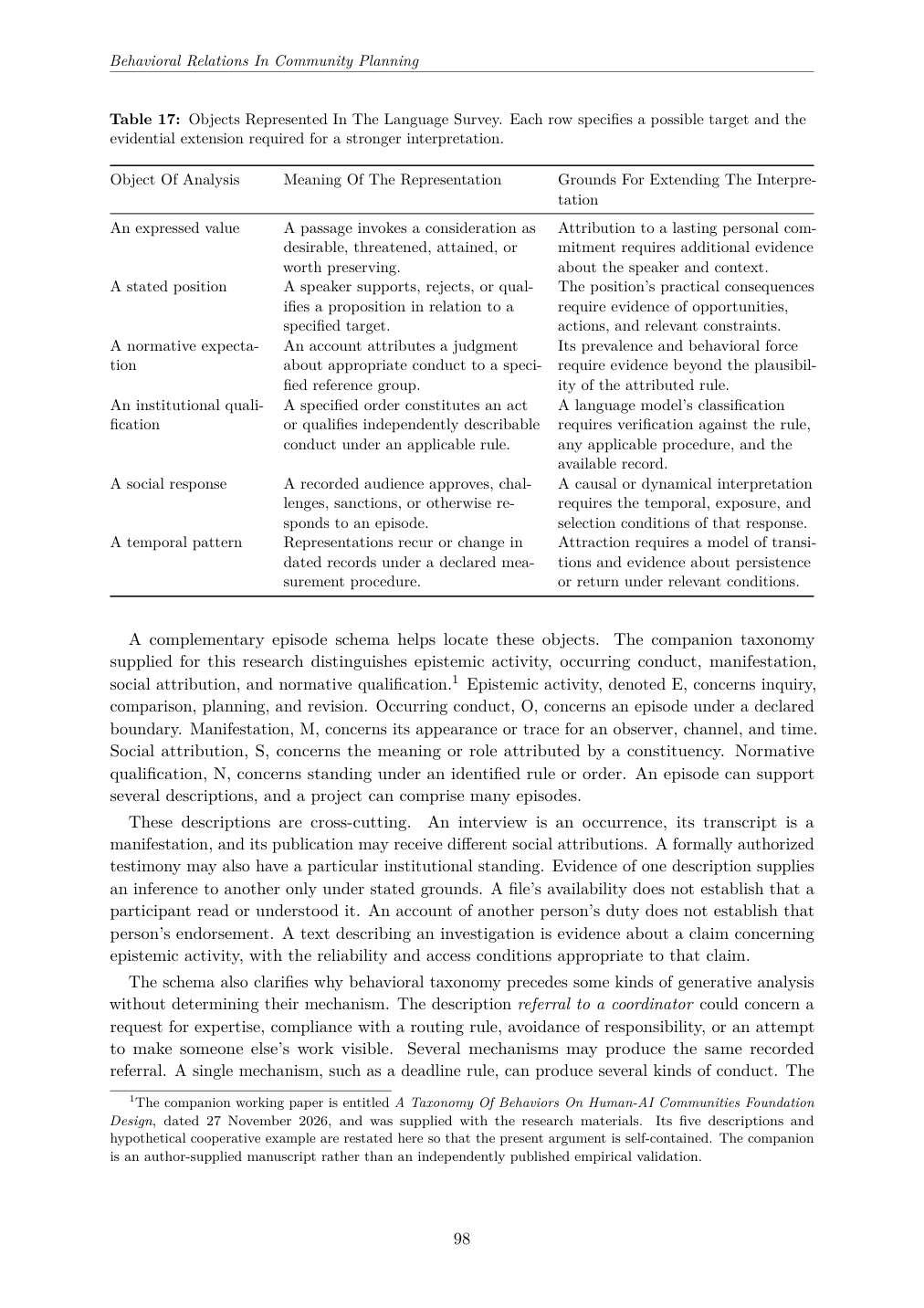
Readable text
Table 17: Objects Represented In The Language Survey. Each row specifies a possible target and the evidential extension required for a stronger interpretation.
A passage invokes a consideration as desirable, threatened, attained, or
Attribution to a lasting personal com- mitment requires additional evidence about the speaker and context.
A speaker supports, rejects, or qual- ifies a proposition in relation to a
The position’s practical consequences require evidence of opportunities, actions, and relevant constraints.
An account attributes a judgment about appropriate conduct to a speci-
Its prevalence and behavioral force require evidence beyond the plausibil- ity of the attributed rule.
A specified order constitutes an act or qualifies independently describable conduct under an applicable rule.
A language model’s classification requires verification against the rule, any applicable procedure, and the available record.
A recorded audience approves, chal- lenges, sanctions, or otherwise re-
A causal or dynamical interpretation requires the temporal, exposure, and selection conditions of that response.
Representations recur or change in dated records under a declared mea-
Attraction requires a model of transi- tions and evidence about persistence or return under relevant conditions.
A complementary episode schema helps locate these objects. supplied for this research distinguishes epistemic activity, occurring conduct, manifestation, social attribution, and normative qualification.1 Epistemic activity, denoted E, concerns inquiry, comparison, planning, and revision. Occurring conduct, O, concerns an episode under a declared boundary. Manifestation, M, concerns its appearance or trace for an observer, channel, and time. Social attribution, S, concerns the meaning or role attributed by a constituency. Normative qualification, N, concerns standing under an identified rule or order. An episode can support several descriptions, and a project can comprise many episodes.
An interview is an occurrence, its transcript is a manifestation, and its publication may receive different social attributions. A formally authorized testimony may also have a particular institutional standing. Evidence of one description supplies an inference to another only under stated grounds. A file’s availability does not establish that a participant read or understood it. An account of another person’s duty does not establish that person’s endorsement. A text describing an investigation is evidence about a claim concerning epistemic activity, with the reliability and access conditions appropriate to that claim.
The schema also clarifies why behavioral taxonomy precedes some kinds of generative analysis without determining their mechanism. The description referral to a coordinator could concern a request for expertise, compliance with a routing rule, avoidance of responsibility, or an attempt to make someone else’s work visible. Several mechanisms may produce the same recorded referral. A single mechanism, such as a deadline rule, can produce several kinds of conduct. The
1The companion working paper is entitled A Taxonomy Of Behaviors On Human-AI Communities Foundation Design, dated 27 November 2026, and was supplied with the research materials. hypothetical cooperative example are restated here so that the present argument is self-contained. The companion is an author-supplied manuscript rather than an independently published empirical validation.
generative task investigates these relations using histories, opportunities, records, and competing explanations.
For NLP, the immediate input is an accessible manifestation. The system produces a further manifestation: an annotation, summary, embedding, or graph. A claim that the output represents a norm, a private commitment, or a community’s values needs an additional interpretive warrant. Retaining the source passage and attribution makes that warrant reviewable. Keeping uncertainty and disagreement visible permits a record to support planning even when the stronger interpretation remains unresolved.
B.3 Value Representations In Arguments And Public Texts
Research on value detection offers several ways to make evaluative content computationally inspectable. Some approaches begin with a fixed psychological taxonomy; others generate contextual value propositions or retain several conflicting considerations. Their common contribution is a representation linking language to an explicitly defined evaluative object. Their implications for planning depend on whose text is represented, how the categories were established, and whether the intended conclusion concerns an argument, a person, or a community.
B.3.1 Theoretical Categories And Their Units Of Measurement
Schwartz and colleagues’ refined theory distinguishes nineteen values within a motivational continuum and assesses them through a questionnaire instrument across multiple national samples [72]. The framework provides a substantive vocabulary for several NLP datasets. Its empirical unit and elicitation procedure differ from those of textual annotation. A sentence interpreted as invoking security is an observation about expressed evaluative content. A questionnaire response concerns a respondent’s reported orientation under specified questions. Theories connecting these objects can be investigated, but the common category name does not establish equivalence between their measurements.
For community inquiry, fixed categories offer comparability and a vocabulary for examining possible omissions. They also set a boundary around what the instrument can express. A collective’s concern for a particular place, a form of care, or an aesthetic practice may require a more specific account than a standard value label supplies. A useful design can preserve the local account and provide an additional mapping to a shared taxonomy. The mapping should identify the interpreter, its purpose, and cases where the proposed correspondence remains disputed.
The distinction among value, norm, and institutional order is especially consequential. A value can provide a reason for supporting an arrangement. A norm can concern what a specified group expects in a situation. An institutional rule can confer a status or authorize an action. A planning document may invoke the same value to justify several conflicting policies. Consequently, a vector of value categories can support an analysis of expressed reasons while leaving the relation between those reasons and a concrete proposal to be represented separately.
B.3.2 Personal Value References In Linguistic Measurement
Personal-value measurement from language concerns the relation between what people say matters, the recurring concerns in their discourse, and the priorities attributed to them. These are distinguishable objects of inquiry. A questionnaire response, an interview account, and a word-frequency profile organize evidence differently, even when researchers give their outputs the same value labels. The earlier dictionary and topic-model literature provides a methodological foundation for assessing what a stable linguistic representation could reasonably represent.
Boyd et al. [11] used the Meaning Extraction Method to identify themes in open-ended descriptions of values and recent behavior from 767 participants. They compared the resulting value
themes with Schwartz Value Survey scores and with themes in participants’ behavioral accounts, then applied the value lexicon to Facebook status updates from 130,828 users. Correspondence with questionnaire scores was limited; linguistic value themes covered more behavioral topics than the questionnaire dimensions in their analyses. Those behavioral criteria were descriptions and topics in text. The Facebook sample required at least 200 words per user, and the authors emphasized the need for sufficient text. This inclusion rule did not establish a general minimum for reliable personal-value assessment.
Wilson et al. [83] examined English-language value and behavior essays from 551 United States and 551 Indian participants, followed by an application to blogs. Their topic-model approach compared thematic usage across country groups while regression models included age and gender. Associations between value themes and behavioral topics varied with the corpus’s country composition. The study therefore supplies a concrete example of contextual dependence within language-based measurement. Its groups were recruited samples, its behavioral measures were textual, and its country comparison did not isolate culture from every other difference between participants. The essay inclusion requirement of 40 words per response likewise describes this particular research design.
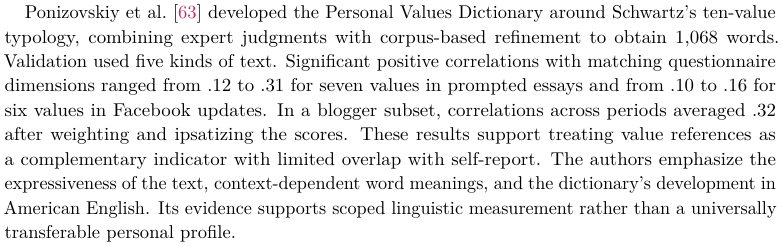
For the present framework, the distinction between lexical reference and endorsed priority is fundamental. An open-ended account remains a form of self-report when a person describes their own commitments; computational processing does not make the underlying account independent of the speaker’s presentation. Conversely, a questionnaire’s predefined categories and an interview’s locally meaningful concerns may answer different questions. Disagreement between their scores should invite examination of the proposed construct, the elicitation setting, and the intended inference. A useful representation can preserve that disagreement as evidence about how a person articulates priorities in different circumstances.
Stability consequently requires an explicit object and comparison. A reproducible dictionary score concerns the behavior of an analytical procedure. Similar scores across occasions concern continuity in the sampled discourse. A stable attributed priority concerns the person or relationship under investigation. Movement between these claims requires additional evidence. For example, repeated references to security in a constructed neighborhood archive could accompany persistent fear, an official communication template, or continuing criticism of surveillance. The representation should retain passages and stances that permit these rival interpretations to be examined, together with the sampling dates and conditions of speech.
Text volume enters this assessment through the opportunities it provides for observing relevant expressions. A defensible local validation could compare estimates across increasing amounts of text, resample passages, and report uncertainty for rare categories. It could also compare conclusions when prolific speakers receive less weight or when each participant contributes a similar observation window. These are proposed checks, not results established here. More words can improve an estimate of the available discourse while leaving participation bias or a
mistaken construct unchanged. Silence about a value remains ambiguous when an interview prompt, institutional form, or practical constraint gave the speaker little occasion to discuss it.
Cultural transfer similarly concerns the relation between meanings and settings. A proposed application could ask participants to interpret ambiguous terms, retain locally specific concepts alongside shared categories, and test whether the same passages receive comparable descriptions across languages and groups. Translation alone supplies no answer to that question. Country, language, occupation, generation, and institutional position provide potentially different comparison units. Pooling their records should therefore be justified by the research question, with enough provenance retained to reconstruct differences that an aggregate profile would conceal.
The relation to behavior also needs a specified evidential bridge. An interview account of helping a neighbor records a communicative act and a claim about another activity. Investigating whether help occurred, under what constraints, and with what consequences requires evidence suited to those questions. A value score cannot by itself settle them. Similarly, recurrent expressions of a personal priority do not establish a shared obligation, an expectation of sanction, or a dynamical attractor. Those objects require contextual and temporal relations beyond lexical recurrence.
In community planning, these distinctions favor a revisable map of expressed reasons over an unqualified ranking of residents by inferred traits. Such a map could connect an accessibility proposal to passages about independence, mutual care, or belonging while preserving who supplied each reason and how others interpreted it. Participants could challenge the coding and add concerns that the original categories obscured. The resulting representation would support comparison and inquiry; decisions about competing claims would still require explicit evaluative reasoning and accountable participation.
B.3.3 Argument-Level Value Detection
Kiesel and colleagues operationalize values behind arguments through a multilevel taxonomy of fifty-four values and a dataset of 5,270 manually annotated arguments drawn from four geographical cultures [40]. Their task concerns values invoked, including implicitly, in an argument. It supplies a direct precedent for analysing public reasons in consultation material. The annotation remains an interpretation of the argument: it does not independently establish the author’s enduring commitments or the justification of the advocated policy.
The Touché23-ValueEval dataset expands the resource to 9,324 arguments from six source types, including editorials, political debates, religious texts, and community discussions. Three crowdworkers annotate each argument using the fifty-four-value scheme [48]. Its range of materials is useful for comparing how evaluative considerations are articulated across genres. Dataset composition and annotation conventions still delimit what successful classification establishes.
These resources suggest an argument-centered representation for a planning consultation. The record would retain a proposed action, the offered reason, the target of support or opposition, the invoked value, and the conditions under which the reason applies. Two statements that invoke accessibility can then remain distinct if one supports relocating a service and another supports extending its opening hours. Collapsing both into a frequency count for accessibility would lose their different practical implications.
Argument analysis can also distinguish shared values from shared policies. Participants may agree that a service should be dependable while disagreeing about centralized scheduling, personal discretion, or the acceptable distribution of waiting. A map of reasons and objections can locate the disputed causal assumptions and preservation requirements. Its planning role is to make those relations available for examination, including minority arguments whose significance would be obscured by document-level averages.
B.3.4 Multilingual Value Expression In News And Manifestos
ValuesML provides an expert-annotated corpus of 2,648 texts and 74,231 sentences across nine languages, with aligned English translations. Its nineteen refined value categories are accompanied by labels distinguishing values portrayed as attained, constrained, or undecided [69]. The 2026 final report describes iterative guideline development, training, and curation. Multiple values can be annotated when distinct meanings are present, while ambiguous cases emphasize the dominant value. This is a substantial resource for value expression in news and political manifestos. Its annotations remain theory-guided interpretations of public language, with corpus selection and curatorial decisions contributing to the resulting representation.
A planning application can adapt the distinction between attaining and constraining a value without importing the entire taxonomy unchanged. For example, a consultation statement may present a proposed pedestrian area as improving encounter and another as constraining a person’s ability to reach a service. A useful representation records the proposal, the affected activity, the claimed direction of consequence, and its evidential basis. A generic positive score would discard the disagreement about what the arrangement makes possible.
Cross-language comparison requires particular attention to the local relation between a term and an activity. A translation that is fluent can still alter who bears an obligation, the intensity of a demand, or the distinction between permission and expectation. Parallel source passages and review by people competent in the relevant languages can make these transformations inspectable. Numerical comparability requires a further argument that differences in scores concern the intended object rather than translation conventions or annotation practice.
B.3.5 Scenario-Based And Pluralistic Representations
ValueNet organizes human attitudes toward 21,374 textual scenarios along ten basic-value dimensions and trains a value-regression model for dialogue applications [65]. The work supplies an example of an explicit numerical value representation tied to situations. Its supervised target is the annotated relation between a scenario and the value scheme. Using such a model to describe a particular person’s commitments or a community’s historically formed norms would require a separately validated inference.
Value Kaleidoscope introduces ValuePrism, connecting 218,000 value, right, and duty entries to 31,000 human-written situations. The contextual entries are generated by a language model and assessed by human annotators. Its Kaleido model produces explanations and judgments about relevance and support or opposition [76]. The representation accommodates several considerations within one situation, including tensions among them. For this framework, its useful role is to generate candidate interpretations or neglected considerations for review. Generated plausibility and a community’s expressed or institutionally recognized commitments remain distinct sources of evidence.
The methodological choice between a fixed score and an open contextual proposition concerns a tradeoff between comparability and expressive scope. Fixed categories support repeated calculations using a common coordinate system. Contextual propositions preserve exceptions and local vocabulary but require more interpretive work before aggregation. A layered representation can make both available: the proposition preserves its passage and context, while a versioned mapping supplies a numerical view for a stated task. A later revision can change the mapping while retaining the original claim and its provenance.
Plural representation also changes the role of optimization. A planning process can first generate feasible arrangements and examine which activities, relationships, and opportunities each preserves. It can then apply selected numerical criteria where their interpretation is justified,
retaining comparisons that remain qualitative or incomplete. This ordering supports analysis of alternatives even when an agreed scalar objective is unavailable. It also leaves room for a previously unrecognized aesthetic or relational activity to change the description of the planning problem.
B.3.6 Stance As An Interface Between Language And Attribution
The SemEval-2016 stance task classifies whether a text favors a specified target, opposes it, or supports neither inference. The target of the stance can differ from the entity receiving an explicit opinion in the text [50]. This distinction is relevant to norm and value reconstruction because negative language about one actor can accompany support for that actor’s proposal, and the mention of an obligation can accompany its rejection.
Consider the constructed sentence The managers expect us to answer at night, but we reject that demand. A representation useful for planning would separate the expectation attributed
to managers from the speaker’s rejection. It would leave the enforceability of the demand, the conduct of other workers, and the speaker’s private motivations unresolved without further evidence. The same passage can therefore supply several claims with different subjects and evidential standings.
Stance, semantic role, quotation, modality, and temporal qualification can be treated as components of a contextual extraction task. A researcher may use established classifiers, a prompted language model, or manual annotation to populate those components. The choice depends on the corpus and the consequence of an error. Evaluating each component against reviewed passages makes it possible to locate a failed inference before it becomes a community-level conclusion.
B.4 Contextual Norm Representations For The Analysis Of Collective Activity
Contextual norm representations connect descriptions of activity with judgments about how participants are expected or entitled to act. Their relevance to community planning concerns the reconstruction of these relations: whose conduct is being evaluated, under which circumstances, by whom, and with what practical consequences. The following comparison examines seven computational studies through their evidence sources, representational choices, and evaluation designs. It then develops methodological implications for the present framework. The paper-specific accounts report published work; the proposed extensions concern the interpretation of records, interviews, consultation material, and interaction histories. These extensions remain research proposals. The common analytical objective is a revisable account of situated expectations that preserves the differences among expressed judgments, attributed rules, observable responses, and justified policy requirements.
B.4.1 Norm Propositions Within Situated Activity Accounts
Social Chemistry 101 represents norms through natural-language rules of thumb associated with situations and judgment attributes. Its corpus contains approximately 292,000 rules and twelve annotation dimensions, including social judgment, anticipated agreement, cultural pressure, and assumed legality. Crowdworkers supplied norms for situations drawn from Reddit post titles, ROCStories sentences, and Dear Abby titles. The Reddit communities’ own moral-voting annotations were not used as the norm labels. Evaluation examines generated rules through human judgments of relevance and attribute adherence alongside automatic metrics. The predominantly white annotator pool had substantial US residence. These provenance details locate the judgments within a particular annotation process, even when the source situation describes someone else’s experience [28].
For activity analysis, a rule’s grammatical subject and its attributed evaluator deserve separate treatment. A consultation statement that visitors should keep a square quiet may describe the speaker’s preference, an expectation attributed to residents, or an existing restriction. Each interpretation changes the object of inquiry. The analyst can preserve the statement as an attributed normative proposition while investigating its standing through additional evidence. Attaching the original passage and its circumstances to the proposition allows participants to examine whether the interpretation preserves their intended distinction. An uncertain reading can remain useful for retrieval without becoming an established description of collective agreement.
Moral Stories supplies 12,000 validated, crowd-authored branching narratives in which a shared norm, situation, and intention accompany alternative actions and consequences. Its norm prompts originate in Social Chemistry. The study examines the generation of actions, consequences, and norm hypotheses through automatic metrics and human assessments of coherence, intention satisfaction, norm observance, plausibility, and relevance. The corpus consists of constructed narratives, with contributors predominantly residing in the United States. Writers and validators came from the same participant pool. Its contribution is therefore a structured test of situated language reasoning; the narrated consequences do not constitute observations of how particular communities respond to conduct [24].
The distinction between an intention and a normative qualification is also useful when examining practical alternatives. In a constructed planning example, a performer seeks an audience, nearby residents seek conditions for sleep, and visitors seek an accessible gathering place. A single episode can advance some purposes while imposing costs on other activities. A narrative that supplies a favorable consequence for compliance already incorporates an interpretation of that relation. A community inquiry would preserve alternative accounts of consequences and ask which are supported, whose opportunities they affect, and which preservation requirements have standing. The resulting record can support the comparison of schedules, locations, or operating conditions while retaining disagreements about the activity’s value.
B.4.2 Conversational Evidence For Attributed Norms
NormSage uses language-model prompting to extract candidate norms from English and Chinese conversations and to produce correctness and grounding judgments with explanations. Its sources combine television scripts with documentaries, negotiations, text messages, phone conversations, and online videos. The proposed knowledge base retains contextual information and source offsets. Human evaluation examines several dimensions of extraction quality, while a separate grounding task assesses relations between norms and conversations. The reported 94.6% AUC concerns that grounding task. The authors acknowledge temporal contextuality, model bias, and the possibility of ungrounded explanations. The study supports the feasibility of proposing contextual norm interpretations from heterogeneous dialogue; the evaluation does not establish population endorsement of the extracted propositions [30].
Speech records create a particular attribution problem because an utterance can enact conduct while referring to other conduct. A participant may quote a rule to contest it, rehearse an objection, describe a past sanction, or accommodate an interviewer. The present framework therefore proposes preserving the conversational sequence surrounding a candidate norm, including the eliciting question and subsequent clarification where available. An interviewer’s formulation can become part of the answer’s conditions of production. Repeated wording across interviews would then require examination of the interview protocol before being interpreted as independently shared language. Reported experience, observed interaction, and staged dialogue remain distinguishable evidence categories within the same archive.
NormDial generates synthetic English and Chinese dyadic dialogues through a human–AI process that expands expert-seeded norms into situations and conversational exchanges. Individual turns receive adherence, violation, or irrelevance labels with explanations. Human evaluation assesses dialogue quality and corrects predicted turn labels. The reported violation predictions have comparatively low precision, and qualitative inspection identifies context-setting turns that were mistakenly classified as violations. The authors also delimit cultural representation by annotator experience and language-model bias. The resource tests the production and interpretation of dialogues under specified norms; its generated interactions are not records of naturally occurring community endorsement [45].
For a planning application, the relevant unit may consequently extend beyond the sentence selected by a classifier. A resident’s quotation of an exclusionary instruction could supply evidence of a reported restriction and evidence of opposition to it. Recording the quotation as the resident’s own preference would reverse its significance. Participant review can help distinguish these interpretations, while disagreement between participant and analyst should remain visible as an attribution dispute. A useful system would allow several linked interpretations with different evidential standing. Such a design preserves the possibility that a passage is relevant to the inquiry even when its precise normative force remains unresolved.
B.4.3 Contextual Variation In Normative Classification
NormBank organizes approximately 155,000 situational norms through settings, roles, actor attributes, concurrent behavior, and environmental constraints. Language-model suggestions support a taxonomy that US-based English-speaking annotators use to construct contrasting contexts. Classification, knowledge-completion, human-evaluation, and transfer experiments examine the resulting resource. Its labels combine different meanings: “expected” includes duty or high probability, while “unexpected” includes prohibition or low probability. The framework’s contextual structure is therefore separable from its particular classification semantics. The authors also acknowledge the absence of evidence about the resource’s long-term reliability as real norms evolve. Changing a contextual constraint can reverse a normative inference within the representation [87].
The proposed activity inquiry can adopt contextual qualification while defining each judgment dimension independently. Behavioral frequency, perceived permission, personal approval, anticipated sanction, and binding institutional requirement answer different questions. A rare activity may be permitted and valued; a frequently performed task may be resented and compulsory. These are logical possibilities that a coding scheme should be able to retain. Their empirical prevalence belongs to the particular case under investigation. When a category joins several meanings, the analyst should preserve the original label and explain the additional interpretation needed before it can enter a policy comparison. Apparent agreement among labels may otherwise conceal disagreement about their meanings.
CH-Wang and colleagues align Social Chemistry situations with Zhihu questions and extract norms from the highest-voted answers. Their human–AI process constructs 3,069 norms aligned with situations, accompanied by relation labels and explanations. Evaluation concerns explainable norm entailment, including automatic measures and human assessment of explanations. The study treats the source corpora as proxies for contrasting cultural contexts. Its stated limitations include demographic differences, value pluralism, coverage, and moderation. Selecting a highly approved answer restricts which views enter the comparison, while situation alignment makes the basis of a cross-context comparison more explicit [15].
Community comparisons can use that general alignment problem to clarify what their records hold constant. Two passages about “public gathering” may concern different participants, times,
permissions, noise levels, or alternatives. Similar wording supplies an initial retrieval relation; the substantive comparison requires an account of these conditions. Conversely, different vocabulary can express related concerns when the practical relations are comparable. A planning team could retain separate indexes for textual similarity and contextual comparability, documenting the reason for each proposed alignment. Cases that resist alignment would identify limits on transfer and possible omissions in the chosen activity description. They would remain part of the inquiry’s evidence about diversity.
B.4.4 Social Responses Within Normative Organization
ValueScope relates linguistic dimensions to predicted social approval in thirteen Reddit communities, using English comments primarily from 2019–2023. It learns dimension and net-vote predictors, generates stylistic rewrites, and compares predicted responses to original and rewritten comments. Human annotations evaluate dimension labels and generated material; preference prediction uses recorded voting data. The study also examines temporal variation. Responses to the rewrites are model predictions, rather than experimentally observed reactions. The authors acknowledge that approval captures only part of norm structure, that other stakeholders remain incompletely represented, and that errors can propagate through the pipeline. Its approach provides response-based evidence for studying normative organization under those qualifications [60].
An approval predictor has a precise potential role in the present framework: it estimates a selected response under its training conditions. Interpreting that estimate as endorsement requires an account of what the response expresses, who could provide it, and what opportunities they had to encounter the relevant activity. Interpreting it as obligation requires a further argument about normative standing. Neither inference follows from predictive success alone. A high predicted response may be relevant to communication planning while remaining insufficient as a criterion for allocating access to a shared place. The inquiry should identify the decision for which the response estimate is informative and preserve the reasons that exceed its scope.
Constructed linguistic variations are useful for examining a model’s sensitivity to an operationalized feature. Their interpretation depends on what else changes when the wording changes. In the continuing planning example, replacing an angry complaint with a polite request could alter perceived urgency, speaker identity, or the severity of the described problem. Even a carefully filtered rewrite requires scrutiny of these possibilities. Predictions for such alternatives support hypotheses about social responses; observing the consequences of an actual intervention requires an appropriate empirical design. The distinction also protects minority objections from disappearing when the chosen model favors a locally successful style. A proposal can be consequential for affected people despite attracting little visible approval.
B.4.5 Representational Stability In Community Inquiry
Representational stability concerns the continued intelligibility of an analytical record as evidence accumulates. Within the proposed inquiry, a proposition retains an identifier and provenance while its interpretation, scope, or evidential standing can change. A record of revision explains whether the change reflects new circumstances, additional testimony, corrected extraction, or a changed evaluative criterion. Stable storage and reproducible retrieval consequently support the examination of substantive change. They do not require an unchanged judgment about the underlying activity. A revised account may be more faithful precisely because the activity’s participants and conditions have changed.
Table 18 distinguishes four analytical objects by the further evidence needed to extend their interpretation. The comparison is a proposed methodological organization of the survey. It
does not assign an intrinsic ranking to the objects: a situated quotation may be sufficient for one historical question, whereas a policy intervention may require an additional account of consequences and authority.
The cross-cutting episode descriptions in Section B.2 organize these distinctions. A record of criticism, for example, establishes an observed expression under its recording conditions while leaving the criticized occurrence, wider social attribution, institutional qualification, and justification open to separate inquiry. Each extension identifies its own evidential grounds.
For a bounded consultation study, the proposed protocol would begin by defining the activity and decision under examination. Researchers and participants could develop a small set of attributed propositions through close reading, identify ambiguous cases, and specify which distinctions affect the decision. Computational extraction could then propose additional passages and interpretations for review. Validation would examine whether those proposals preserve source meaning across relevant speakers, periods, and document types. The evaluation target would be explicit: locating pertinent testimony, retaining conditions and exceptions, or distinguishing reported expectations from personal commitments. Agreement scores would be interpreted alongside substantive disagreements and the consequences of errors.
Planning relevance enters through the connection between those interpretations and feasible actions. A proposal to reorganize a square’s evening use should relate testimony to access conditions, competing activities, implementation authority, and opportunities for revision. A statement of dislike can motivate investigation without acquiring automatic veto power; a documented obligation can constrain a decision even where expressed support is weak. The inquiry must make the grounds for these different treatments reviewable. Participants’ ability to challenge classifications also becomes part of the process being evaluated. The additional labor of transcription, interpretation, translation, and review belongs in the assessment of the method’s practical demands.
B.4.6 Temporal Identification Of Normative Dynamics
Temporal reconstruction depends on the historical comparability of the instrument and on evidence about transitions, as developed in Sections B.5.6 and B.7.3. These requirements have direct planning implications: an observed change can leave several accounts of the community’s history compatible with the available record.
For the constructed square example, a decline in recorded objections after a revised schedule could be consistent with improved coexistence, the departure of affected residents, reduced access to consultation, or changed expectations about whether speaking would matter. A longitudinal evaluation would seek evidence capable of distinguishing those histories and would retain uncertainty when the available records leave several plausible. The resulting account could support a provisional statement about persistence under specified conditions. Stronger claims about attraction, recovery, or transformation would require corresponding evidence about transitions and disturbances. These are proposed standards for inference, not reported findings from an implemented study.
Computational interpretation can also enter the dynamics it describes. If a community reads an extracted summary before discussing acceptable conduct, the summary becomes part of the subsequent interaction’s conditions. Its categories, omissions, and presentation may then require investigation alongside the original evidence. Versioned records of the model, prompt, reviewed output, and participant exposure would help reconstruct that relation. Community planning can use such representations as revisable contributions to deliberation while preserving the authority to contest their interpretation. The central analytical benefit is an inspectable
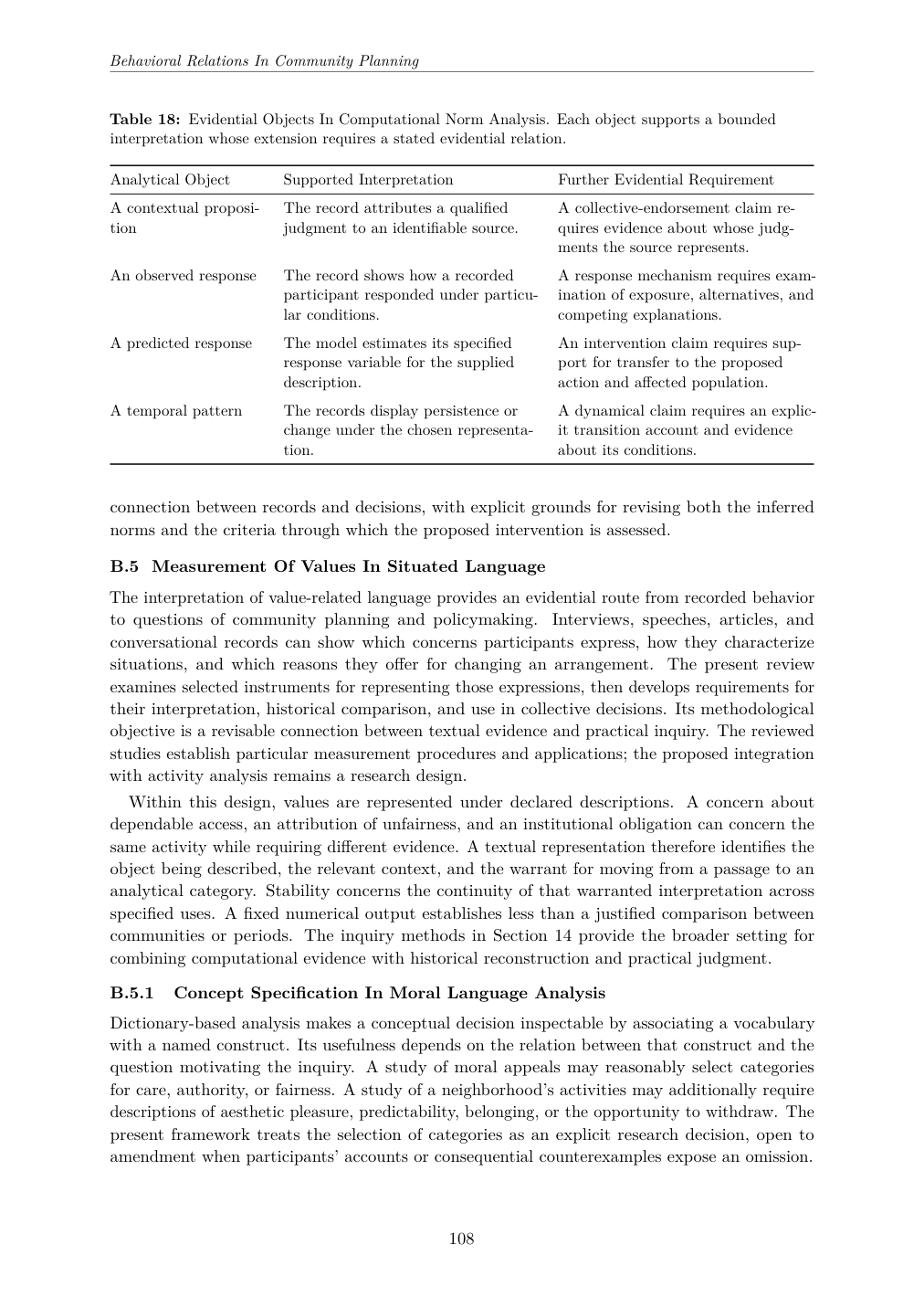
Readable text
Table 18: Evidential Objects In Computational Norm Analysis. Each object supports a bounded interpretation whose extension requires a stated evidential relation.
The record attributes a qualified judgment to an identifiable source.
A collective-endorsement claim re- quires evidence about whose judg- ments the source represents.
The record shows how a recorded participant responded under particu-
A response mechanism requires exam- ination of exposure, alternatives, and competing explanations.
The model estimates its specified response variable for the supplied
An intervention claim requires sup- port for transfer to the proposed action and affected population.
The records display persistence or change under the chosen representa-
A dynamical claim requires an explic- it transition account and evidence about its conditions.
connection between records and decisions, with explicit grounds for revising both the inferred norms and the criteria through which the proposed intervention is assessed.
The interpretation of value-related language provides an evidential route from recorded behavior to questions of community planning and policymaking. conversational records can show which concerns participants express, how they characterize situations, and which reasons they offer for changing an arrangement. The present review examines selected instruments for representing those expressions, then develops requirements for their interpretation, historical comparison, and use in collective decisions. Its methodological objective is a revisable connection between textual evidence and practical inquiry. The reviewed studies establish particular measurement procedures and applications; the proposed integration
Within this design, values are represented under declared descriptions. A concern about dependable access, an attribution of unfairness, and an institutional obligation can concern the same activity while requiring different evidence. A textual representation therefore identifies the object being described, the relevant context, and the warrant for moving from a passage to an analytical category. Stability concerns the continuity of that warranted interpretation across specified uses. A fixed numerical output establishes less than a justified comparison between communities or periods. The inquiry methods in Section 14 provide the broader setting for combining computational evidence with historical reconstruction and practical judgment.
Dictionary-based analysis makes a conceptual decision inspectable by associating a vocabulary with a named construct. Its usefulness depends on the relation between that construct and the question motivating the inquiry. A study of moral appeals may reasonably select categories for care, authority, or fairness. A study of a neighborhood’s activities may additionally require descriptions of aesthetic pleasure, predictability, belonging, or the opportunity to withdraw. The present framework treats the selection of categories as an explicit research decision, open to amendment when participants’ accounts or consequential counterexamples expose an omission.
Hopp and colleagues develop the extended Moral Foundations Dictionary from human annotations of English-language news. The instrument assigns words weights across moral foundations and foundation-specific sentiment scores. Its evaluations concern news topics, partisan sources, and article sharing, with comparisons against earlier dictionaries, including MFD2. The accompanying implementation also offers an analysis of textual agents and targets through syntactic dependencies. These applications establish a news-derived instrument; the authors identify use in substantially different textual domains as a limitation requiring further investigation [38].
For activity research, an extracted moral term provides a candidate location for interpretation. A passage describing a harmful journey may concern danger, humiliation, wasted time, or several of these experiences. An aggregate foundation score can direct attention to relevant material, while the connection to a planning problem requires identifying the activity and the relationship at issue. The selected categories also define a field of visibility: experiences expressed through vocabulary outside the dictionary may remain consequential. Comparing dictionary results with uncoded passages is therefore part of examining the instrument’s coverage.
Garten and colleagues introduce distributed dictionary representations, which compare text with concept representations constructed from dictionary words in an embedding space. Their evaluations include movie-review sentiment and moral rhetoric in donation-related tweets surrounding Hurricane Sandy. They examine the contribution of dictionary size and the corpus used to train the embeddings. The approach can identify semantic associations beyond exact word matches, while the paper also discusses domain dependence and changing word usage [31].
The conceptual contribution of this approach to the proposed design is an interface between a specified analytical vocabulary and variations in expression. A community could define dependable access through examples of predictable opening hours, usable routes, and reliable assistance, then investigate which passages resemble those examples. The resulting similarity would require a declared interpretation. Resemblance to a concept’s vocabulary may identify a discussion of its absence, a disputed attribution, or a proposed remedy. The original passages remain necessary for deciding which relation supports the intended claim.
B.5.2 Framing Through Semantic Axes And Topic Models
Exploratory representations can help researchers discover distinctions that an initial coding scheme leaves unexamined. Their role in the present framework is to organize a return to the evidence. A pattern becomes relevant when its interpretation changes an account of activities, relationships, or feasible interventions. The researcher consequently needs both a description of the computational pattern and an argument connecting it to the inquiry. Statistical separation between groups supplies a question for that argument rather than specifying its social meaning in advance.
Kwak and colleagues’ FrameAxis represents texts through semantic axes defined by antonym pairs. It distinguishes directional emphasis along an axis from the axis’s prominence in a corpus. Applications include restaurant reviews and political news headlines, and the method supports examination of contributing words and documents. The authors present these microframes as aids to exploratory analysis and distinguish them from the richer frames identified through expert interpretation [43].
A proposed axis such as orderly–disorderly can help locate contrasting descriptions of a street. Its interpretation depends on who uses the terms and what activity is being described. A festival organizer may associate movement and noise with participation, while a resident may describe the same occasion through disrupted sleep. An axis can preserve that contrast without establishing that order and participation are mutually exclusive values. Several axes, accounts of particular episodes, and descriptions that resist an axis may be required to make the comparison useful.
Structural topic models developed by Roberts and colleagues connect patterns of vocabulary and topic prevalence with document metadata. Their applications include survey experiments and open-ended responses from the 2008 American National Election Study. Comparisons with human coding identify substantial correspondence alongside differences in categories, including topics specific to the election and infrequent categories that the model fails to recover. The study concerns interpretable mixtures of topics within responses, with metadata supporting comparisons across respondent characteristics [67].
Ulstein applies structural topic modeling to 49 interviews across 17 Norwegian organizations about the inclusion of workers from vulnerable groups. Interviews were translated, checked, and grouped by organization; topic interpretation returned to the transcripts. The study demonstrates an application to qualitative interviews and discusses limitations arising from small samples, unequal document lengths, and the loss of context in unigram representations. Its evidence concerns topical structure and its interpretation, rather than a general procedure for recovering personal values [79].
The unit of aggregation is consequential for the proposed activity analysis. Grouping interviews by organization can support a comparison of organizational discourse while reducing the visibility of disagreement between workers and managers. Grouping passages by activity can reveal recurring access problems while separating statements from the conversations that explain them. A useful representation keeps links to both groupings. Analysts can then distinguish a widespread topic from a shared judgment about it, and an organizational account from the experiences of people whose work sustains that organization.
B.5.3 Validation Of Value Measures Across Instruments
Validation specifies which conclusions a representation can support under the conditions of its use. Reproducibility, robustness, interpretability, and comparability address different aspects of that question. The present review treats them as complementary requirements whose relevance depends on the decision being considered. A descriptive map used to select passages for further reading requires a different evidential argument from an indicator used to compare communities or allocate resources. Table 19 states the distinctions adopted for this proposed research design.
Stecker and Hopp compare six moral-content instruments, including MFD2, eMFD, distributed dictionary representations, contextualized representations, and MoralBERT, on 810 party manifestos in four languages. They find substantial disagreement between measurements and show that instrument choice can change the direction of substantive relationships. Their analysis also considers translation and implementation limitations. The result demonstrates a comparability problem within the studied political corpus; it leaves the relative adequacy of particular instruments for other purposes to further evaluation [77].
For the proposed framework, disagreement between instruments is evidence requiring diagnosis. Two measures may respond to different aspects of a passage, apply incompatible category boundaries, or produce errors concentrated in particular contexts. Averaging their outputs would settle none of those possibilities. A useful comparison examines passages on which the measures diverge and identifies which reading bears on the question. If an access policy is being evaluated, the relevant distinction might be between expressions of gratitude for assistance and evidence that assistance was dependable.
Validation also requires an account of absent material. An archive of public comments describes contributions admitted to that channel. Its coverage can change after a meeting format, platform, or participation rule changes. A rise in expressions of dissatisfaction may reflect an altered arrangement, a new opportunity to speak, or both. These possibilities motivate comparisons with records of participation and the circumstances of expression. The relevant denominator
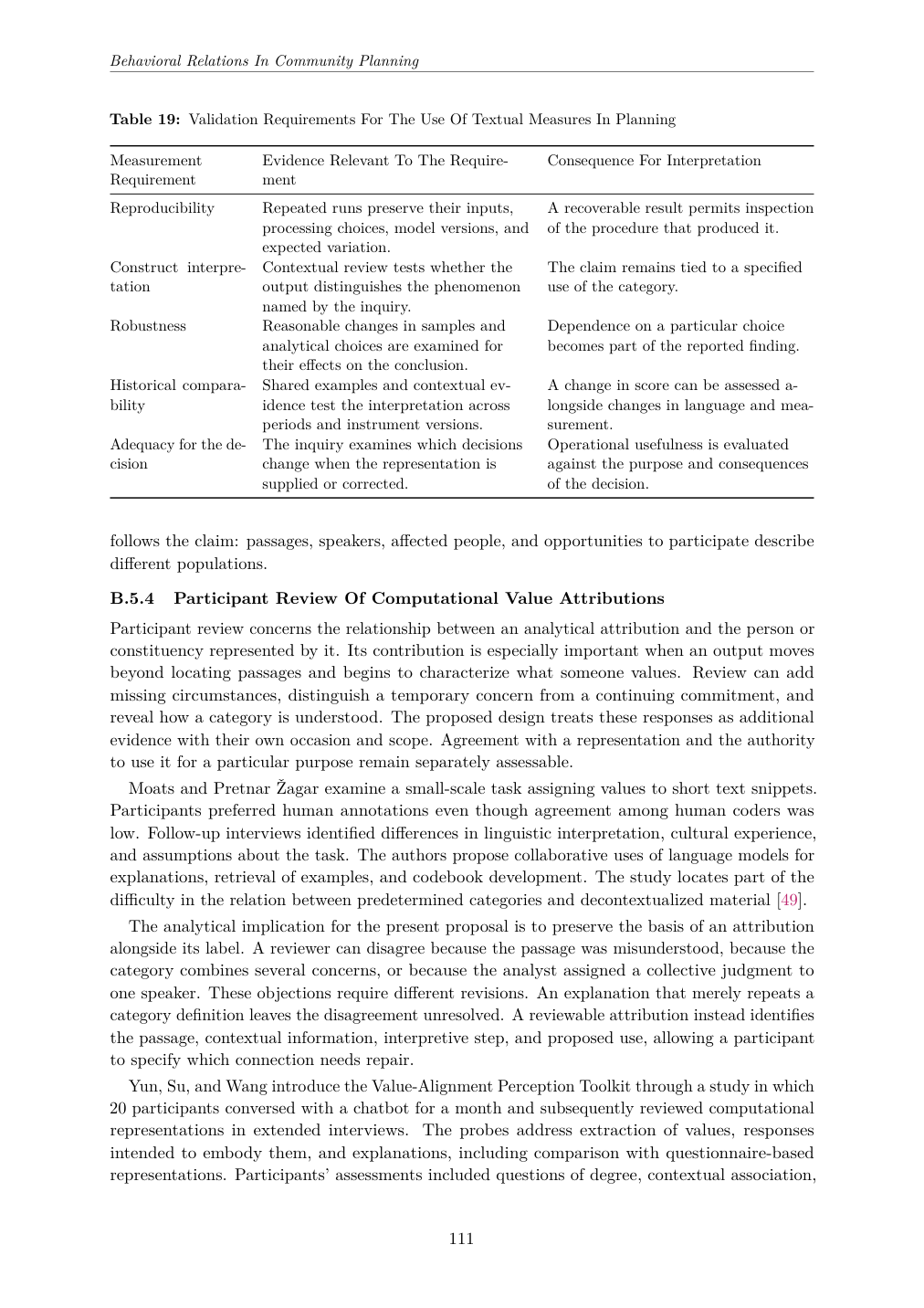
Readable text
Table 19: Validation Requirements For The Use Of Textual Measures In Planning
Repeated runs preserve their inputs, processing choices, model versions, and
A recoverable result permits inspection of the procedure that produced it.
Contextual review tests whether the output distinguishes the phenomenon
The claim remains tied to a specified use of the category.
Reasonable changes in samples and analytical choices are examined for
Dependence on a particular choice becomes part of the reported finding.
Shared examples and contextual ev- idence test the interpretation across periods and instrument versions.
A change in score can be assessed a- longside changes in language and mea- surement.
The inquiry examines which decisions change when the representation is
Operational usefulness is evaluated against the purpose and consequences of the decision.
follows the claim: passages, speakers, affected people, and opportunities to participate describe
Participant Review Of Computational Value Attributions
Participant review concerns the relationship between an analytical attribution and the person or constituency represented by it. Its contribution is especially important when an output moves beyond locating passages and begins to characterize what someone values. Review can add missing circumstances, distinguish a temporary concern from a continuing commitment, and reveal how a category is understood. The proposed design treats these responses as additional evidence with their own occasion and scope. Agreement with a representation and the authority to use it for a particular purpose remain separately assessable.
Moats and Pretnar Žagar examine a small-scale task assigning values to short text snippets. Participants preferred human annotations even though agreement among human coders was low. Follow-up interviews identified differences in linguistic interpretation, cultural experience, and assumptions about the task. The authors propose collaborative uses of language models for explanations, retrieval of examples, and codebook development. The study locates part of the difficulty in the relation between predetermined categories and decontextualized material [49].
The analytical implication for the present proposal is to preserve the basis of an attribution alongside its label. A reviewer can disagree because the passage was misunderstood, because the category combines several concerns, or because the analyst assigned a collective judgment to one speaker. These objections require different revisions. An explanation that merely repeats a category definition leaves the disagreement unresolved. A reviewable attribution instead identifies the passage, contextual information, interpretive step, and proposed use, allowing a participant
Yun, Su, and Wang introduce the Value-Alignment Perception Toolkit through a study in which 20 participants conversed with a chatbot for a month and subsequently reviewed computational representations in extended interviews. The probes address extraction of values, responses intended to embody them, and explanations, including comparison with questionnaire-based representations. Participants’ assessments included questions of degree, contextual association,
and justification. The study examines perceptions of value representation and identifies contextual and sampling limits; it does not establish unrestricted recovery of enduring personal traits [86].
Dialogue can consequently become part of the object studied. A participant may encounter an unfamiliar description, reconsider an earlier statement, or discover a conflict between commitments through discussing a generated summary. Such an exchange can improve an account while also changing what the participant subsequently expresses. A historical record should preserve the distinction between the initial conversation, the proposed attribution, and the later response. That distinction makes it possible to study reflection and learning without treating revision as evidence that the earlier account was simply erroneous.
Review also has a distributional dimension. Participants differ in the time, access, confidence, and institutional standing available for correcting a representation. A community planning inquiry should therefore specify whose review was possible and whose absence remains relevant. The opportunity to amend one’s attributed position can coexist with procedures for representing affected people who did not supply text. Such arrangements give practical content to methodological pluralism: textual analysis, personal accounts, and collective deliberation contribute distinct evidence to the decision.
B.5.5 Interview-Based Representations In Community Inquiry
Dialogical elicitation and interview-conditioned simulation provide two close antecedents to the proposed reconstruction architecture. Both connect contextual accounts to inspectable computational objects, while addressing different inferential tasks. Elicitation can articulate considerations that participants recognize and compare; simulation can estimate responses under a specified model. The present proposal builds on these possibilities by relating their outputs to activity histories, participation conditions, and decisions. Its potential contribution concerns those interfaces and their validation, with the adequacy of each representation assessed for its intended use.
Klingefjord, Lowe, and Edelman’s Moral Graph Elicitation uses GPT-4 interviews to produce editable values cards describing context-specific, noninstrumental criteria for choice. Participants then judge generated stories portraying one value as a development from another; these judgments supply directed, contextual graph edges. The 2024 preprint reports a study with 500 US participants considering three prompts for conversational AI, and an output containing 85 deduplicated values and 100 edges. PageRank supplies contextual rankings. Evaluation includes participants’ assessments of representation and fairness, alongside other proposed criteria for alignment targets. The authors acknowledge possible influence from generated stories, unresolved conflicts, limited cultural coverage, and the additional work needed to evaluate model training from the graph. The edges record elicited comparisons about purported developments, rather than observed longitudinal changes in the participants’ values [41].
For the present framework, a contextual comparison graph offers a structure for preserving articulated reasons, disagreements, and proposed revisions. Its construction also belongs within the inquiry. Selecting a scenario, rewriting a statement, presenting an alternative, and ranking the resulting comparisons can alter what becomes salient. A planning application should retain these operations and participants’ opportunities to contest them. The useful interpretive question is what the elicitation enabled a person to express or reconsider. Whether a resulting ordering should govern access to a shared resource requires further reasons concerning affected people, feasible alternatives, and the authority of the process.
Park and colleagues’ 2026 revision of their 2024 generative-agent study examines 1,052 US adults who completed two-hour AI interviews following the American Voices Project protocol, surveys, and behavioral experiments. The working paper compares simulations supplied with
demographics, personas, interviews, surveys, or combined self-reports. On withheld General Social Survey items, accuracy was 60.4% with demographics, 69.4% with interviews, and 72.8% with combined interviews and surveys; participants’ two-week agreement was 79.5%. Rich self-reports improved several predictions and reduced several sample-level distortions, while gains did not extend to incentivized economic choices. The study distinguishes individual accuracy from population fidelity and notes limits concerning model versions, small subgroup effects, and linguistic transfer. These results concern specified response targets in an English-language, quota-based online sample [61].
A predictive representation and a participant-recognized account support different conclusions. A system may estimate an answer accurately through related biographical information without recovering the person’s reason for giving it. Conversely, a carefully reviewed account may preserve a meaningful concern while supplying insufficient information to predict conduct under altered incentives. Their combination is useful when the inferential link remains explicit. The record can distinguish a directly stated commitment, an interpretation accepted during review, a model prediction, and the later response against which that prediction is assessed. Agreement among these objects becomes a finding to investigate rather than an assumption of the representation.
Consider an original planning example involving a community workshop. One participant describes the importance of an unhurried shared evening; another emphasizes predictable closing times because care responsibilities follow the session. An elicitation process could articulate contextual reasons, invite clarification, and register disagreement over a proposed timetable. A simulation could estimate which timetable a participant might select on a questionnaire. Planning would additionally require information about transport, staffing, care schedules, and the consequences of changing attendance. Preserving these distinct claims allows a predicted choice to inform the investigation while an affected person retains a separate opportunity to explain or revise their position.
The example also distinguishes representation over time from a lasting personal disposition. Repeated approval of a schedule can reflect continuing support, unchanged alternatives, strategic accommodation, or a recurring question that leaves important circumstances unmentioned. A longitudinal study would retain the relevant circumstances and seek evidence that discriminates among those accounts. A later change in expressed judgment may reflect learning or changed responsibilities. Such a change can improve the historical account without invalidating the earlier statement within its original conditions. The comparison procedures in Section B.5.6 apply to both the elicitation instrument and the representation it produces.
Norm reconstruction additionally requires identifying whose expectations a statement attributes and which order, if any, gives a requirement standing. A contextual value comparison can inform that investigation while its relation to a binding rule or shared expectation remains to be established. Similarly, a ranking among graph nodes describes a relation within an elicited comparison structure. A dynamical claim about recurrent conduct requires the separate transition specification and evidence discussed in Section B.7.3. Keeping these objects distinguishable makes their potential combination more precise.
Extending individual response models to collective activity creates another validation problem. Joint conduct depends on who encounters whom, which commitments are credible, how resources are allocated, and what participants anticipate about others. These relations can change when an intervention changes the community. A proposed simulation should therefore state which interactions and institutional arrangements it models, then assess predictions against relevant joint outcomes. The longitudinal models in Section B.7 provide an interface for this extension. Good performance on individual responses supplies bounded evidence for that larger task.
These precedents locate the present architecture within an existing research trajectory linking interviews, contextual values, and computational representations. Its proposed extension is the maintained connection between those representations and historically situated episodes, observation conditions, attributed expectations, and authorized decisions. Elicited comparisons can support deliberation; predictions can help identify uncertainties and alternative scenarios. Their use in policymaking remains accountable through participant review, independent evidence, and documented grounds for the institutional and evaluative standing assigned to each output.
B.5.6 Historical Comparability Of Language Representations
A historical inquiry needs representations that preserve meaningful comparisons while remaining responsive to changes in expression. Stability of an instrument and stability of its referent are separate conditions. Retaining a vocabulary may support reproducibility while overlooking a developing usage; revising that vocabulary may improve interpretation while changing the basis of an earlier comparison. The proposed framework therefore records both the history being investigated and the history of the instrument used to investigate it. Conclusions about value formation depend on keeping those histories distinguishable.
Hamilton, Leskovec, and Jurafsky compare diachronic embedding methods against documented changes in word meaning and apply them to historical corpora. Their procedure aligns lowdimensional embeddings from different periods using orthogonal Procrustes transformations, addressing coordinate differences that obstruct direct comparison. The study supplies a method for investigating lexical relationships over time, with evaluation directed toward semantic change [36].
Bamler and Mandt model word and context representations as temporally linked latent trajectories. Their filtering and smoothing procedures share information across time while allowing the representations to evolve. Evaluations use Google Books, United States presidential addresses, and news tweets, comparing predictive performance and the interpretability of trajectories with alternatives trained on separate periods. The modeled dynamics concern distributions of language within those corpora [3].
In the present framework, a changing association between words is a candidate indicator of historical change whose social interpretation requires further work. A community may discuss safety more often because activities have become dangerous, because its membership has changed, or because an administrative consultation repeatedly introduces that term. The same association can also arise when an existing concern receives a new name. The inquiry should examine the relevant activity histories, sources of language, and population represented before interpreting the trajectory as a change in values.
Comparability can be strengthened by maintaining examples that span periods and instrument versions. Researchers can inspect how the same passage is represented before and after a revision, then examine passages whose local meanings have changed. An anchor is useful because its intended role is specified, not because its meaning is presumed immune to history. Where a category no longer supports a coherent comparison, the report can preserve a narrower comparable series and describe the emerging category separately. This allows continuity and innovation to appear together.
Temporal smoothing introduces a further modeling choice. A procedure that favors gradual movement may be useful for separating sampling variation from a developing pattern, while abrupt changes in practice can require a different temporal resolution. The relevant interval follows the activity: a shift handoff, a seasonal festival, and a membership policy have different histories. The framework consequently treats temporal aggregation as part of the explanatory claim. Sensitivity to alternative intervals helps establish which changes the representation can make visible.
B.5.7 Interpretive Accountability In Planning Decisions
The purpose of value measurement in the present framework is to improve inquiry into activities and their possible organization. A policy question specifies what a representation needs to distinguish. Consider a constructed consultation about extending the opening hours of a community workshop. Participants describe convenient access, quiet evenings, opportunities for companionship, and the effort required to supervise the space. A useful analysis identifies how these concerns relate to proposed schedules, affected activities, and responsibilities. Their relative frequency supplies one description of the consultation.
Several practical conclusions can remain compatible with that description. Frequent requests for later access might support an additional evening session, a change in booking rules, or assistance for people whose travel times prevent attendance. The choice depends on the conditions producing the difficulty and on the effects of the alternatives. Supervisory work and disturbance may fall on people who contribute little text. The representation should therefore support a comparison of activity relations and consequences, preserving the difference between linguistic prominence and the weight a deliberative process gives a concern.
The distinction between norm formation and justification is especially consequential here. A recurring expectation can become familiar through repeated reference, acquire support through mutual reliance, or gain institutional standing through an authorized decision. These are different developments within a historical account. Whether the expectation deserves endorsement requires an evaluative argument responsive to the people affected and the reasons at stake. The present framework includes that argument within situated inquiry while preserving its distinction from an estimate of prevalence.
Interpretive and computational orientations therefore meet at identifiable interfaces. Historical and practical judgment specify the question, examine the relevance of categories, and assess the proposed use. Computational inquiry organizes evidence, tests regularities, and reveals cases that challenge an interpretation. Participant review can alter either the category or the understanding of the activity. The resulting representation is accountable when a reader can trace a consequential conclusion to its evidence, assumptions, and opportunities for revision. This standard supports community planning without converting a textual measure into a general authority over the people it describes.
B.6 A Relational Record For Language Reconstruction
The surveyed approaches can be connected through a layered record that preserves evidence, contextual claims, and computational views. This subsection specifies such a record as an original design proposal. The objective is to support the movement from language analysis to historical reconstruction without requiring every method to use the same ontology or numerical scale. The record’s adequacy depends on whether a reader can recover the source of a claim, understand its attribution, inspect its transformation, and identify the conditions under which it could be revised.
B.6.1 Evidence And Conditions Of Access
The evidence layer retains a passage together with its source, date, author or speaker where legitimately available, audience, genre, language, and position within the larger record. An interview additionally retains the eliciting question and relevant conversational context. A speech transcript identifies whether it is a prepared text, a verbatim transcription, an edited transcript, or a later report. An article separates the journalist’s account, quoted speech, and editorial voice. The source record distinguishes an event’s occurrence time from its recording, publication, and later retrieval.
Speech-to-text conversion requires its own assessment. Koenecke and colleagues’ 2020 study of five commercial recognizers found substantial differences in transcription error between Black and white speakers in a matched corpus of sociolinguistic interviews [42]. That historical result supports checking transcription as an observation process; it supplies no estimate of the performance of a current system on a new community. A study using speech should assess the actual recognizer, languages, accents, recording conditions, and speaker positions present in its material.
The proposed protocol preserves the original recording where access and consent permit, together with transcript versions and reviewed corrections. Consequential negations, pronouns, modal expressions, and speaker changes receive particular attention because an error can reverse a normative attribution. Where acoustic features such as hesitation or overlap matter to the question, the protocol states what was retained and how it was interpreted. A polished transcript and a prosodic record support different claims. Neither supplies direct access to a speaker’s private commitments.
Copies and derivatives remain linked to their origins. A speech quoted by twenty articles does not automatically provide twenty independent endorsements of its content. A summary produced from an interview remains connected to that interview and to the transformation that produced the summary. These links permit an analyst to change the unit of aggregation explicitly: publication frequency, independent speakers, distinct episodes, and estimated audience exposure can each be relevant, but they describe different distributions.
Access conditions also belong to the record. A private interview, a public announcement, and a restricted workplace channel differ in audience and likely consequences of speaking. A corpus can identify which positions are represented and where evidence is unavailable. It can record a refusal to disclose without treating the undisclosed content as absent. A planning inquiry therefore needs a representation of its evidential boundary alongside the language it successfully collected.
B.6.2 Contextual Claims And Their Attributions
The claim layer represents the relationship asserted in a passage, retaining enough context to distinguish the subject, target, situation, attribution, and qualification. Figure 16 illustrates the proposed structure using the constructed night-work statement. The same sentence supports an expectation attributed to managers and a rejection attributed to the speaker. A further claim concerning a formal workplace rule would require another source or a separately stated inference.
Table 20 specifies the minimum relations proposed for consequential uses. The design allows missing, unresolved, and inapplicable entries. It also permits several incompatible interpretations with their separate grounds. A complete-looking form filled by speculation would undermine the purpose of preserving provenance.
The relational form supports questions that a document-level score leaves difficult to answer. An analyst can retrieve expectations attributed to supervisors but rejected by workers, compare stated exceptions with observed scheduling practices, or locate changes in the rule invoked by a decision. These operations depend on explicit semantics for the relations and on the quality of extraction. A graph is a useful organization of claims; its visual connectivity provides no additional evidential warrant.
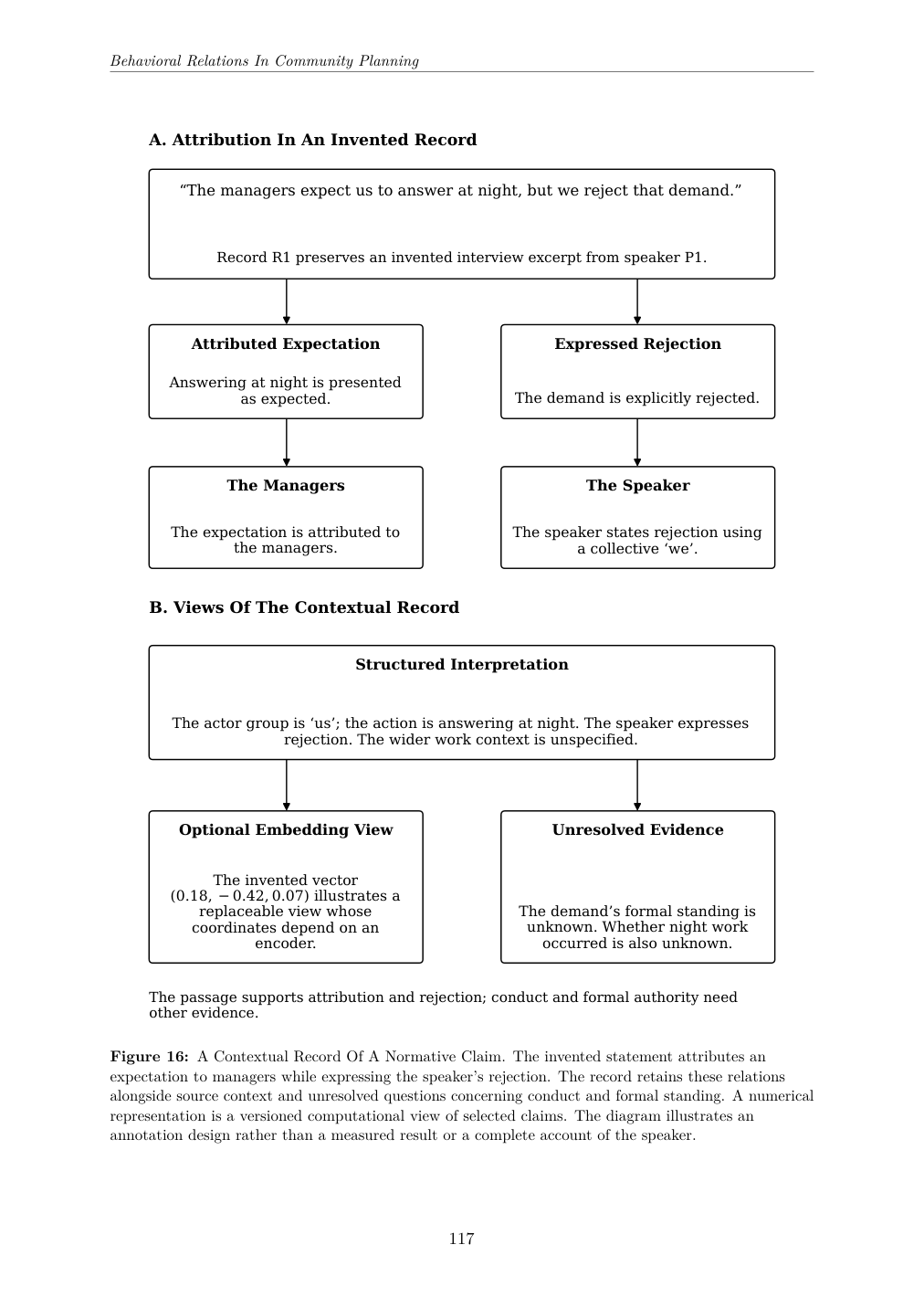
Readable text
“The managers expect us to answer at night, but we reject that demand.”
Record R1 preserves an invented interview excerpt from speaker P1.
The actor group is ‘us’; the action is answering at night. The speaker expresses
The passage supports attribution and rejection; conduct and formal authority need
Figure 16: A Contextual Record Of A Normative Claim. The invented statement attributes an expectation to managers while expressing the speaker’s rejection. The record retains these relations alongside source context and unresolved questions concerning conduct and formal standing. A numerical representation is a versioned computational view of selected claims. The diagram illustrates an annotation design rather than a measured result or a complete account of the speaker.
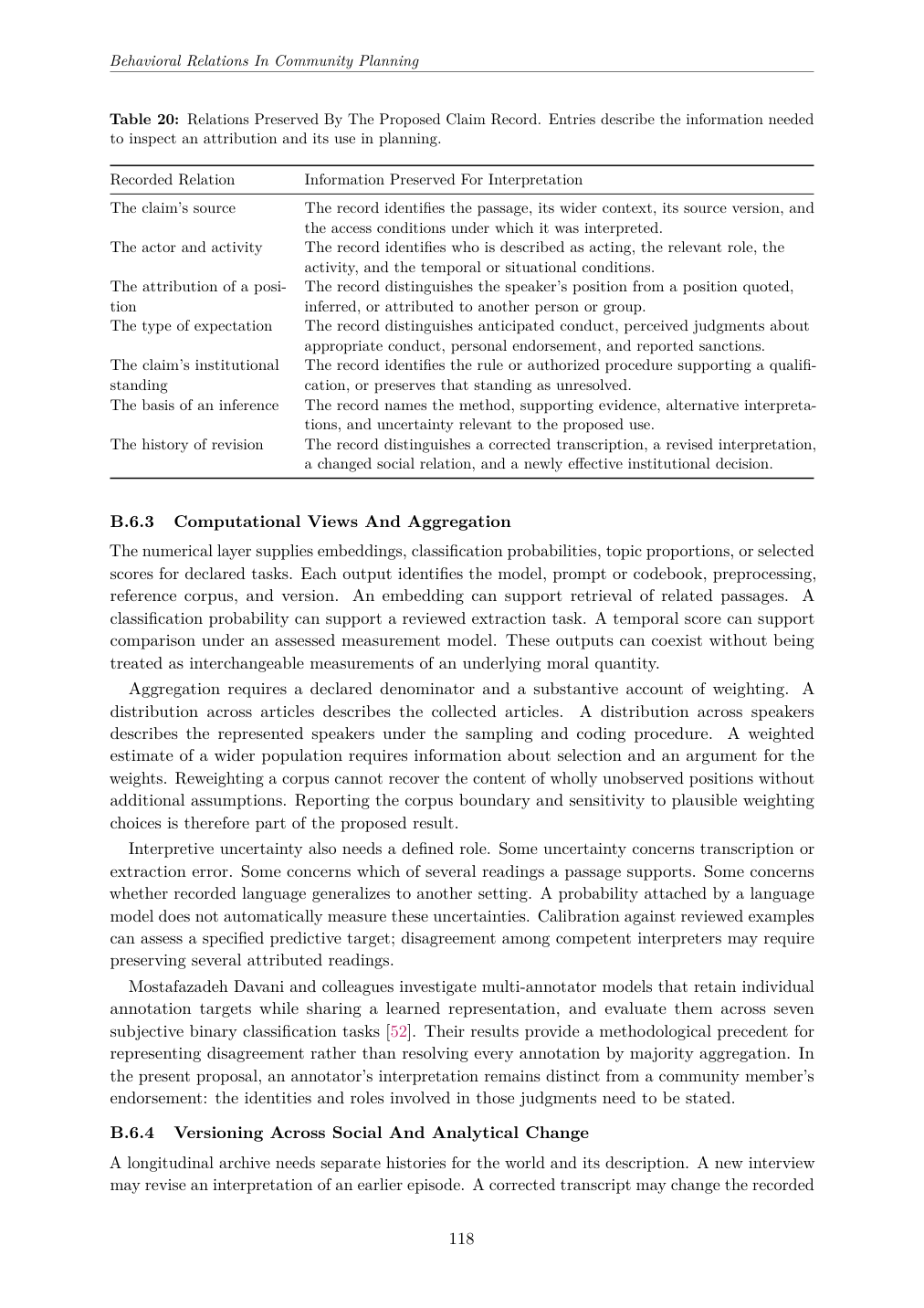
Readable text
Table 20: Relations Preserved By The Proposed Claim Record. Entries describe the information needed
The record identifies the passage, its wider context, its source version, and the access conditions under which it was interpreted. The record identifies who is described as acting, the relevant role, the activity, and the temporal or situational conditions.
The claim’s source The actor and activity The attribution of a posi- tion
The record distinguishes the speaker’s position from a position quoted, inferred, or attributed to another person or group. The record distinguishes anticipated conduct, perceived judgments about appropriate conduct, personal endorsement, and reported sanctions.
The type of expectation The claim’s institutional standing
The record identifies the rule or authorized procedure supporting a qualifi- cation, or preserves that standing as unresolved. The record names the method, supporting evidence, alternative interpreta- tions, and uncertainty relevant to the proposed use. The record distinguishes a corrected transcription, a revised interpretation, a changed social relation, and a newly effective institutional decision.
The numerical layer supplies embeddings, classification probabilities, topic proportions, or selected scores for declared tasks. Each output identifies the model, prompt or codebook, preprocessing, reference corpus, and version. An embedding can support retrieval of related passages. A classification probability can support a reviewed extraction task. A temporal score can support comparison under an assessed measurement model. These outputs can coexist without being treated as interchangeable measurements of an underlying moral quantity.
Aggregation requires a declared denominator and a substantive account of weighting. A distribution across articles describes the collected articles. describes the represented speakers under the sampling and coding procedure. estimate of a wider population requires information about selection and an argument for the weights. Reweighting a corpus cannot recover the content of wholly unobserved positions without additional assumptions. Reporting the corpus boundary and sensitivity to plausible weighting
Interpretive uncertainty also needs a defined role. Some uncertainty concerns transcription or extraction error. Some concerns which of several readings a passage supports. Some concerns whether recorded language generalizes to another setting. A probability attached by a language model does not automatically measure these uncertainties. Calibration against reviewed examples can assess a specified predictive target; disagreement among competent interpreters may require
Mostafazadeh Davani and colleagues investigate multi-annotator models that retain individual annotation targets while sharing a learned representation, and evaluate them across seven subjective binary classification tasks [52]. Their results provide a methodological precedent for representing disagreement rather than resolving every annotation by majority aggregation. In the present proposal, an annotator’s interpretation remains distinct from a community member’s endorsement: the identities and roles involved in those judgments need to be stated.
A longitudinal archive needs separate histories for the world and its description. A new interview may revise an interpretation of an earlier episode. A corrected transcript may change the recorded
words without changing the past utterance. A revised codebook may split one category into two. A new community decision may give a procedure force from a specified date. These are different changes even when they arrive in the database on the same day.
The proposed record therefore preserves both the time to which a claim refers and the time at which it enters or changes in the archive. Where a category changes, a mapping can document whether the revision is a renaming, a refinement, a merger, or a substantive change of meaning. Renaming may preserve earlier comparisons. Refinement may require recoding old material. Substantive change can require reporting separate series with an explicitly limited bridge. A smooth graph of scores should not conceal those differences.
The appropriate meaning of stability is consequently relational and task-specific. A stable record supports recovery of the evidence and the transformations already performed. A stable instrument preserves the distinctions needed for a specified comparison under tested variations. A stable social pattern concerns the process under investigation. Maintaining these separate histories allows the instrument to remain accountable while the community and its language change.
B.7 Longitudinal Models Of Activity From Situated Language Records
Longitudinal language analysis adds a measurement problem to the study of activity: the records, audiences, vocabularies, and extraction procedures can change alongside the community. This subsection extends the history-sensitive architecture in Sections 9.2 and 12.1 by specifying those observational dependencies. The argument combines an original finite counterexample, a conditional probabilistic representation, and methodological requirements for planning. It connects behavioral descriptions to generative models, examines representation symmetries and revisable background commitments, and locates trajectory evaluation and geometric transport within that evidential structure.
B.7.1 Behavioral Descriptions Within Episode Histories
The five behavioral descriptions distinguish epistemic activity, occurring conduct, manifestation, social attribution, and normative qualification. The labels E, O, M, S, and N organize crosscutting descriptions of episodes. They supply neither a sequence of states through which an episode progresses nor a causal law connecting its descriptions. A request can simultaneously constitute an inquiry, an utterance, an audible signal, a perceived affront, and an admitted procedural motion. Each attribution requires its own subject, source, audience or authority, and grounds.
For longitudinal NLP, the episode identifier provides a point of connection among those claims. A later interview can revise an interpretation of an earlier exchange while leaving its timestamp unchanged. A new moderation rule can change the standing of a future submission whose wording resembles an earlier one. The record should therefore distinguish occurrence time, documentation time, rule version, and interpretive revision. Counting descriptions as independent episodes would change the unit of analysis; merging their evidential grounds would obscure the relations the taxonomy preserves.
Generative explanation begins with additional hypotheses about these relations. An investigation might propose that repeated acknowledgment encourages further contributions, that anticipated criticism affects disclosure, or that access restrictions alter whose accounts become available. The taxonomy helps specify the explanandum and relevant evidence. Historical comparison, participant testimony, and an appropriate design establish grounds for assessing the mechanism. Language extraction can assist in locating claims and their connections while
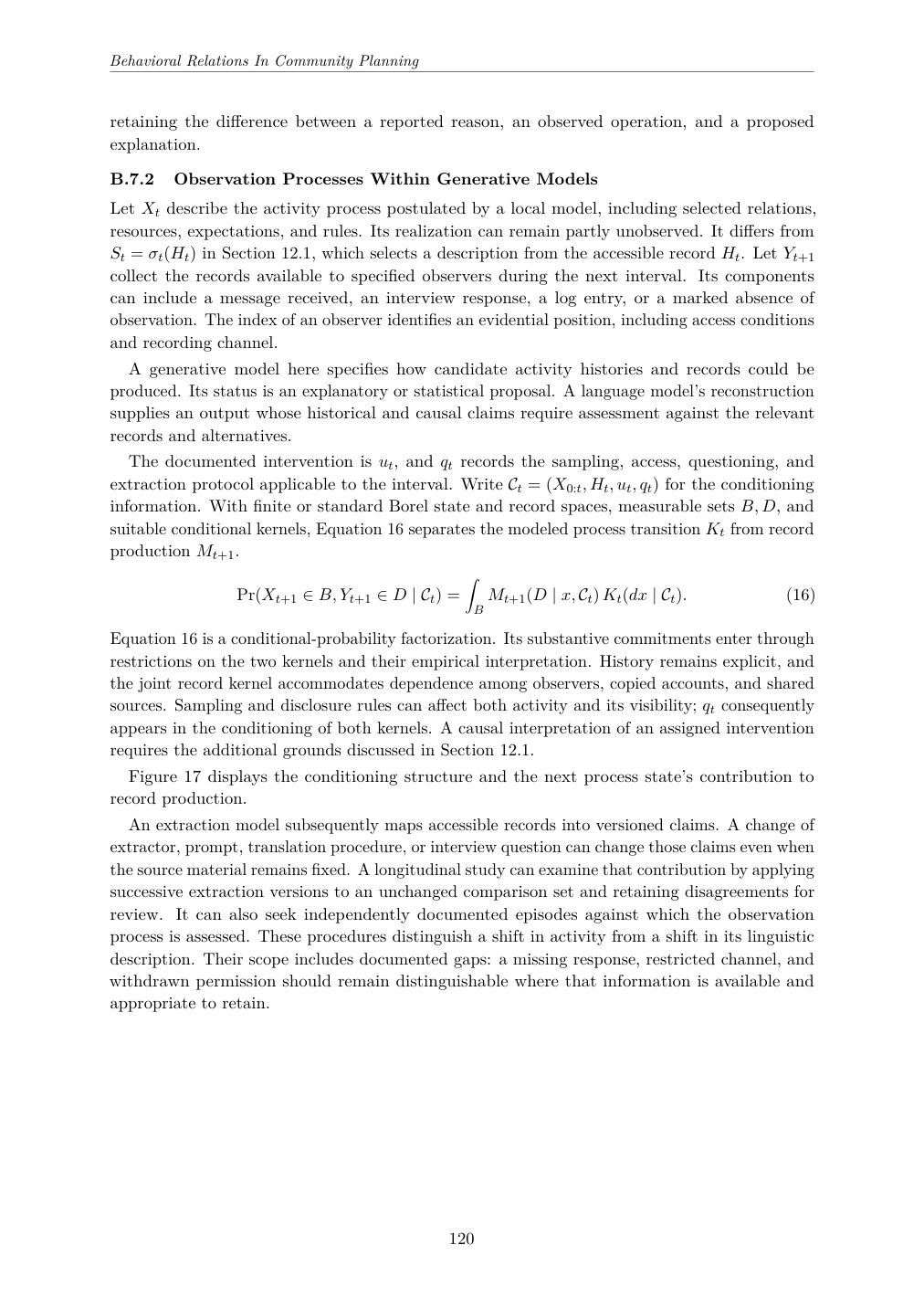
Readable text
retaining the difference between a reported reason, an observed operation, and a proposed
resources, expectations, and rules. Its realization can remain partly unobserved. It differs from collect the records available to specified observers during the next interval. Its components can include a message received, an interview response, a log entry, or a marked absence of observation. The index of an observer identifies an evidential position, including access conditions
A generative model here specifies how candidate activity histories and records could be produced. Its status is an explanatory or statistical proposal. A language model’s reconstruction supplies an output whose historical and causal claims require assessment against the relevant
Equation 16 is a conditional-probability factorization. Its substantive commitments enter through restrictions on the two kernels and their empirical interpretation. History remains explicit, and the joint record kernel accommodates dependence among observers, copied accounts, and shared appears in the conditioning of both kernels. A causal interpretation of an assigned intervention requires the additional grounds discussed in Section 12.1.
Figure 17 displays the conditioning structure and the next process state’s contribution to
An extraction model subsequently maps accessible records into versioned claims. A change of extractor, prompt, translation procedure, or interview question can change those claims even when the source material remains fixed. A longitudinal study can examine that contribution by applying successive extraction versions to an unchanged comparison set and retaining disagreements for review. It can also seek independently documented episodes against which the observation process is assessed. These procedures distinguish a shift in activity from a shift in its linguistic description. Their scope includes documented gaps: a missing response, restricted channel, and withdrawn permission should remain distinguishable where that information is available and
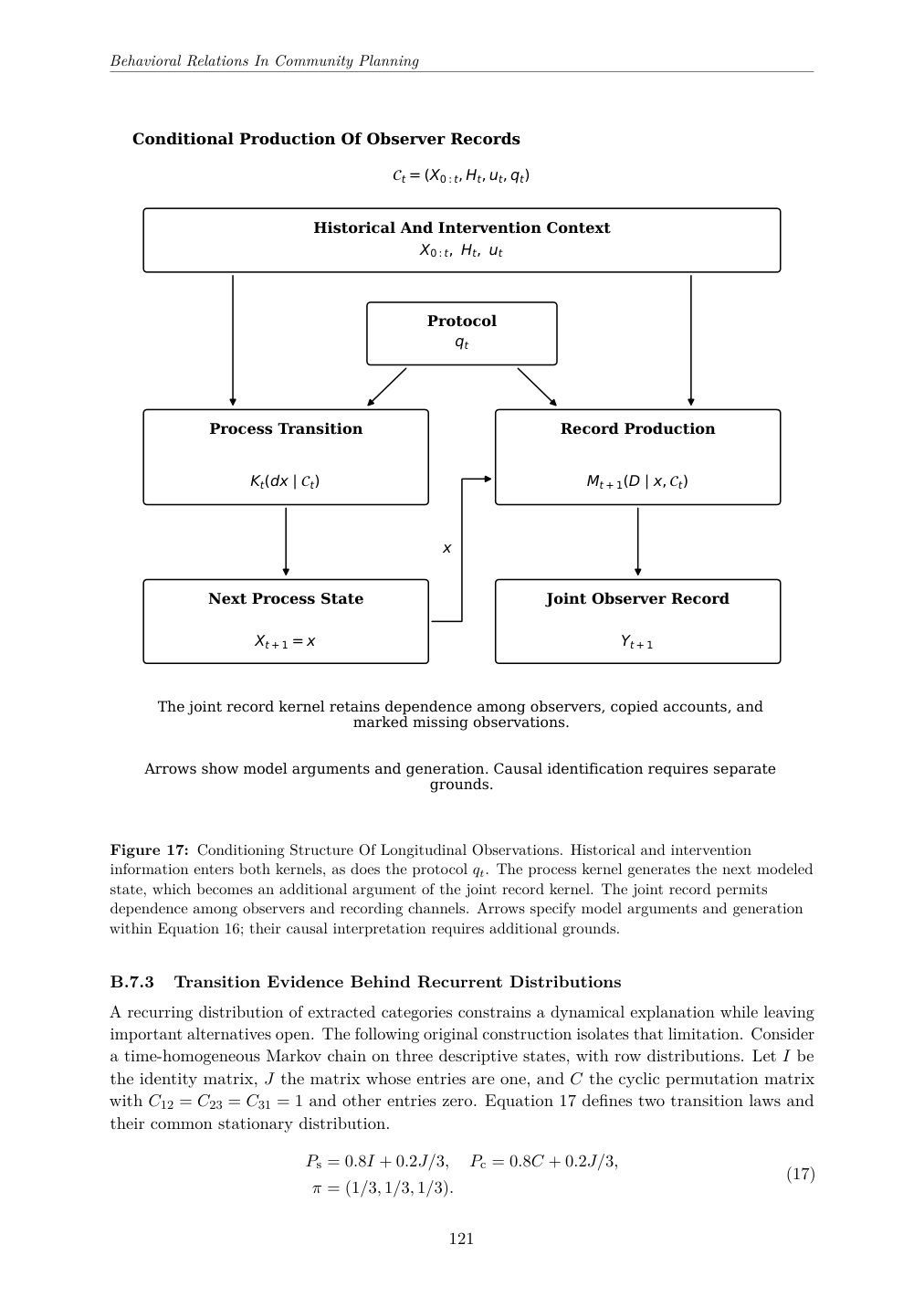
Readable text
The joint record kernel retains dependence among observers, copied accounts, and
Arrows show model arguments and generation. Causal identification requires separate
Figure 17: Conditioning Structure Of Longitudinal Observations. Historical and intervention state, which becomes an additional argument of the joint record kernel. The joint record permits dependence among observers and recording channels. Arrows specify model arguments and generation within Equation 16; their causal interpretation requires additional grounds.
Transition Evidence Behind Recurrent Distributions
A recurring distribution of extracted categories constrains a dynamical explanation while leaving important alternatives open. The following original construction isolates that limitation. Consider
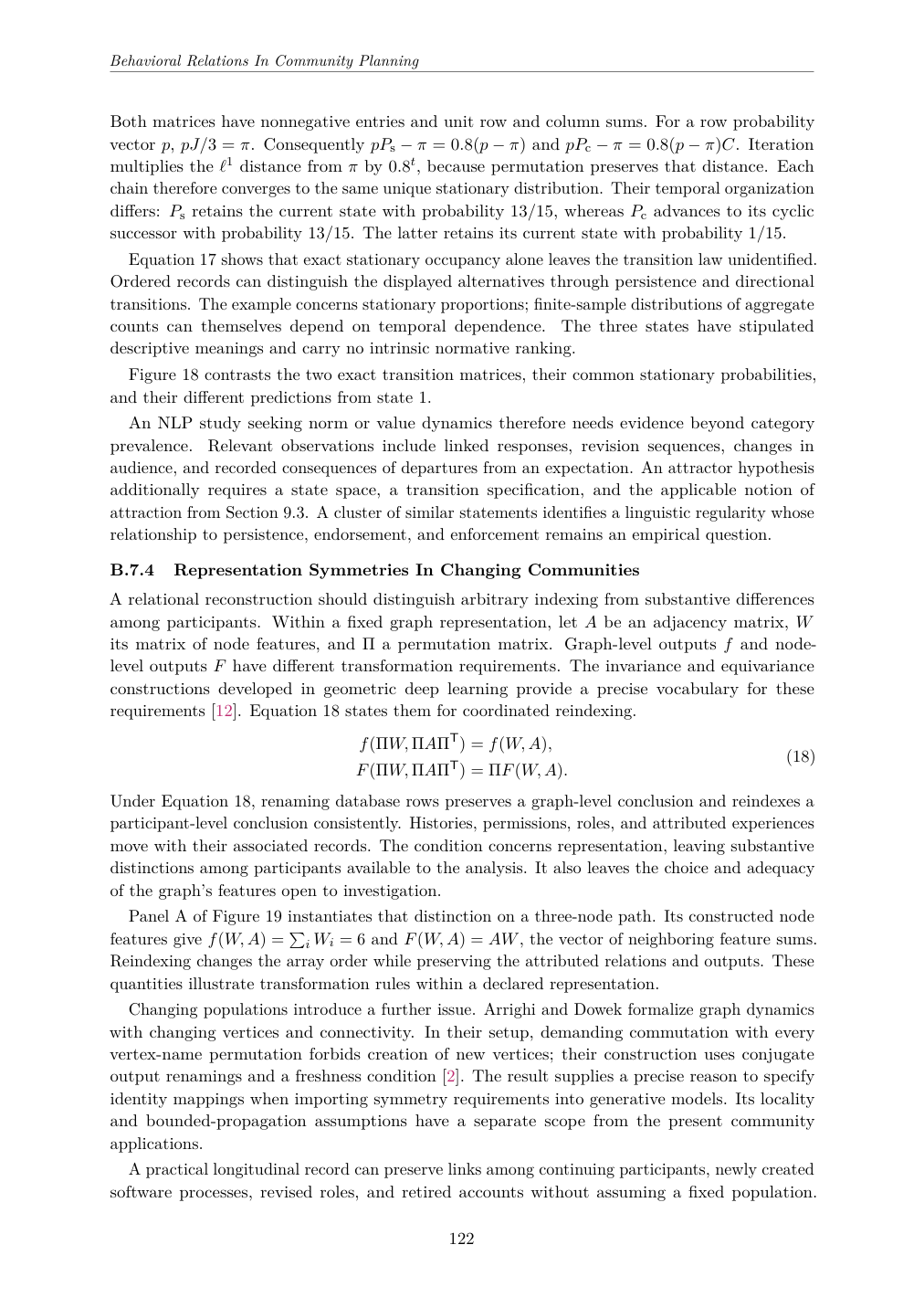
Readable text
Both matrices have nonnegative entries and unit row and column sums. For a row probability chain therefore converges to the same unique stationary distribution. Their temporal organization
Equation 17 shows that exact stationary occupancy alone leaves the transition law unidentified. Ordered records can distinguish the displayed alternatives through persistence and directional transitions. The example concerns stationary proportions; finite-sample distributions of aggregate counts can themselves depend on temporal dependence. descriptive meanings and carry no intrinsic normative ranking.
Figure 18 contrasts the two exact transition matrices, their common stationary probabilities,
An NLP study seeking norm or value dynamics therefore needs evidence beyond category Relevant observations include linked responses, revision sequences, changes in audience, and recorded consequences of departures from an expectation. An attractor hypothesis additionally requires a state space, a transition specification, and the applicable notion of attraction from Section 9.3. A cluster of similar statements identifies a linguistic regularity whose relationship to persistence, endorsement, and enforcement remains an empirical question.
Representation Symmetries In Changing Communities
A relational reconstruction should distinguish arbitrary indexing from substantive differences constructions developed in geometric deep learning provide a precise vocabulary for these requirements [12]. Equation 18 states them for coordinated reindexing.
Under Equation 18, renaming database rows preserves a graph-level conclusion and reindexes a participant-level conclusion consistently. Histories, permissions, roles, and attributed experiences move with their associated records. The condition concerns representation, leaving substantive distinctions among participants available to the analysis. It also leaves the choice and adequacy
Panel A of Figure 19 instantiates that distinction on a three-node path. Its constructed node
Reindexing changes the array order while preserving the attributed relations and outputs. These quantities illustrate transformation rules within a declared representation.
Changing populations introduce a further issue. Arrighi and Dowek formalize graph dynamics with changing vertices and connectivity. In their setup, demanding commutation with every vertex-name permutation forbids creation of new vertices; their construction uses conjugate output renamings and a freshness condition [2]. The result supplies a precise reason to specify identity mappings when importing symmetry requirements into generative models. Its locality and bounded-propagation assumptions have a separate scope from the present community
A practical longitudinal record can preserve links among continuing participants, newly created software processes, revised roles, and retired accounts without assuming a fixed population.
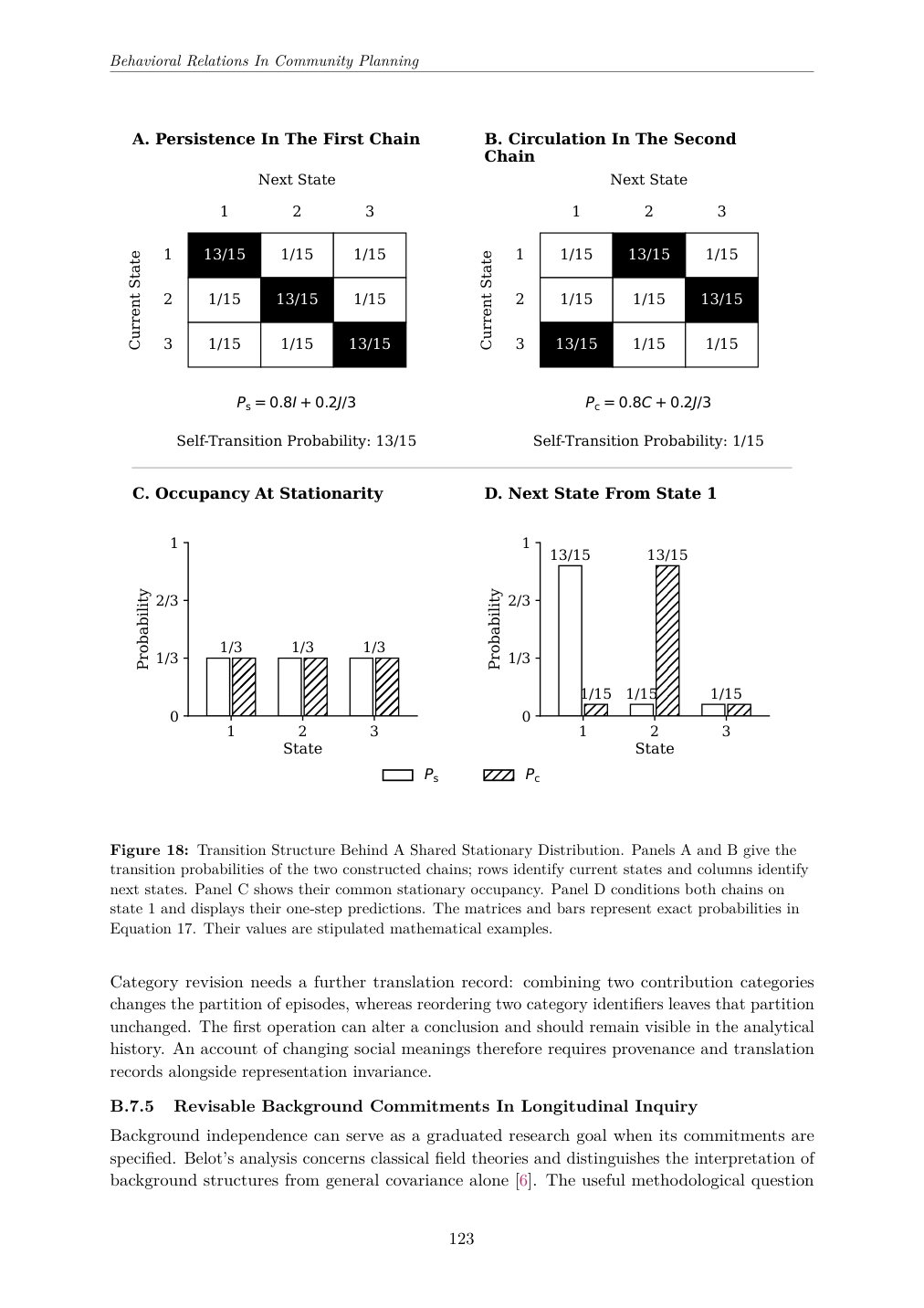
Readable text
Figure 18: Transition Structure Behind A Shared Stationary Distribution. Panels A and B give the transition probabilities of the two constructed chains; rows identify current states and columns identify next states. Panel C shows their common stationary occupancy. Panel D conditions both chains on state 1 and displays their one-step predictions. The matrices and bars represent exact probabilities in Equation 17. Their values are stipulated mathematical examples.
Category revision needs a further translation record: combining two contribution categories changes the partition of episodes, whereas reordering two category identifiers leaves that partition unchanged. The first operation can alter a conclusion and should remain visible in the analytical history. An account of changing social meanings therefore requires provenance and translation
Revisable Background Commitments In Longitudinal Inquiry
Background independence can serve as a graduated research goal when its commitments are specified. Belot’s analysis concerns classical field theories and distinguishes the interpretation of background structures from general covariance alone [6]. The useful methodological question
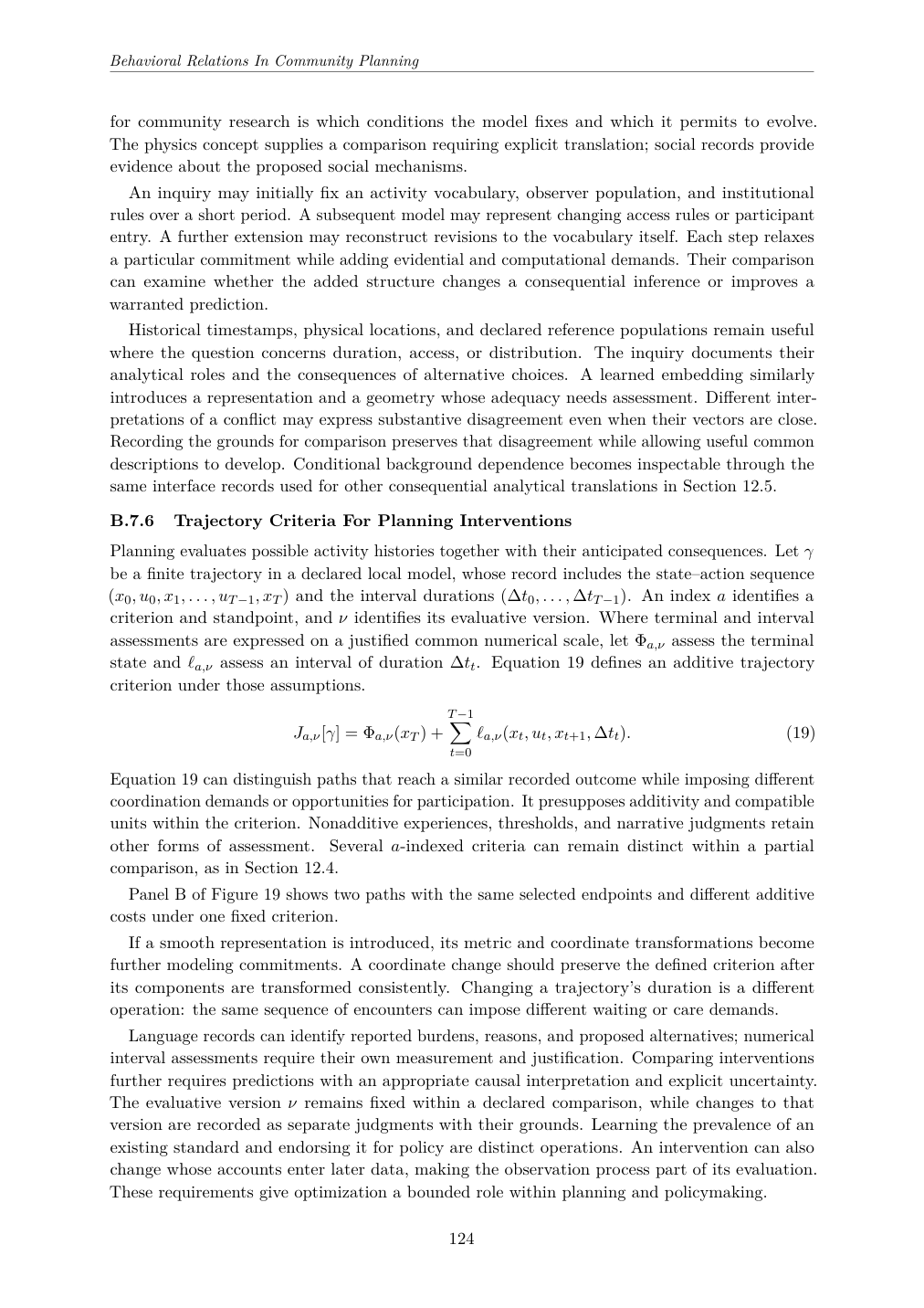
Readable text
for community research is which conditions the model fixes and which it permits to evolve. The physics concept supplies a comparison requiring explicit translation; social records provide
An inquiry may initially fix an activity vocabulary, observer population, and institutional rules over a short period. A subsequent model may represent changing access rules or participant entry. A further extension may reconstruct revisions to the vocabulary itself. Each step relaxes a particular commitment while adding evidential and computational demands. Their comparison can examine whether the added structure changes a consequential inference or improves a
Historical timestamps, physical locations, and declared reference populations remain useful where the question concerns duration, access, or distribution. The inquiry documents their analytical roles and the consequences of alternative choices. A learned embedding similarly introduces a representation and a geometry whose adequacy needs assessment. Different inter- pretations of a conflict may express substantive disagreement even when their vectors are close. Recording the grounds for comparison preserves that disagreement while allowing useful common descriptions to develop. Conditional background dependence becomes inspectable through the same interface records used for other consequential analytical translations in Section 12.5.
be a finite trajectory in a declared local model, whose record includes the state–action sequence
Equation 19 can distinguish paths that reach a similar recorded outcome while imposing different coordination demands or opportunities for participation. It presupposes additivity and compatible units within the criterion. Nonadditive experiences, thresholds, and narrative judgments retain
Panel B of Figure 19 shows two paths with the same selected endpoints and different additive
If a smooth representation is introduced, its metric and coordinate transformations become further modeling commitments. A coordinate change should preserve the defined criterion after its components are transformed consistently. Changing a trajectory’s duration is a different operation: the same sequence of encounters can impose different waiting or care demands.
Language records can identify reported burdens, reasons, and proposed alternatives; numerical interval assessments require their own measurement and justification. Comparing interventions further requires predictions with an appropriate causal interpretation and explicit uncertainty. version are recorded as separate judgments with their grounds. Learning the prevalence of an existing standard and endorsing it for policy are distinct operations. An intervention can also change whose accounts enter later data, making the observation process part of its evaluation. These requirements give optimization a bounded role within planning and policymaking.
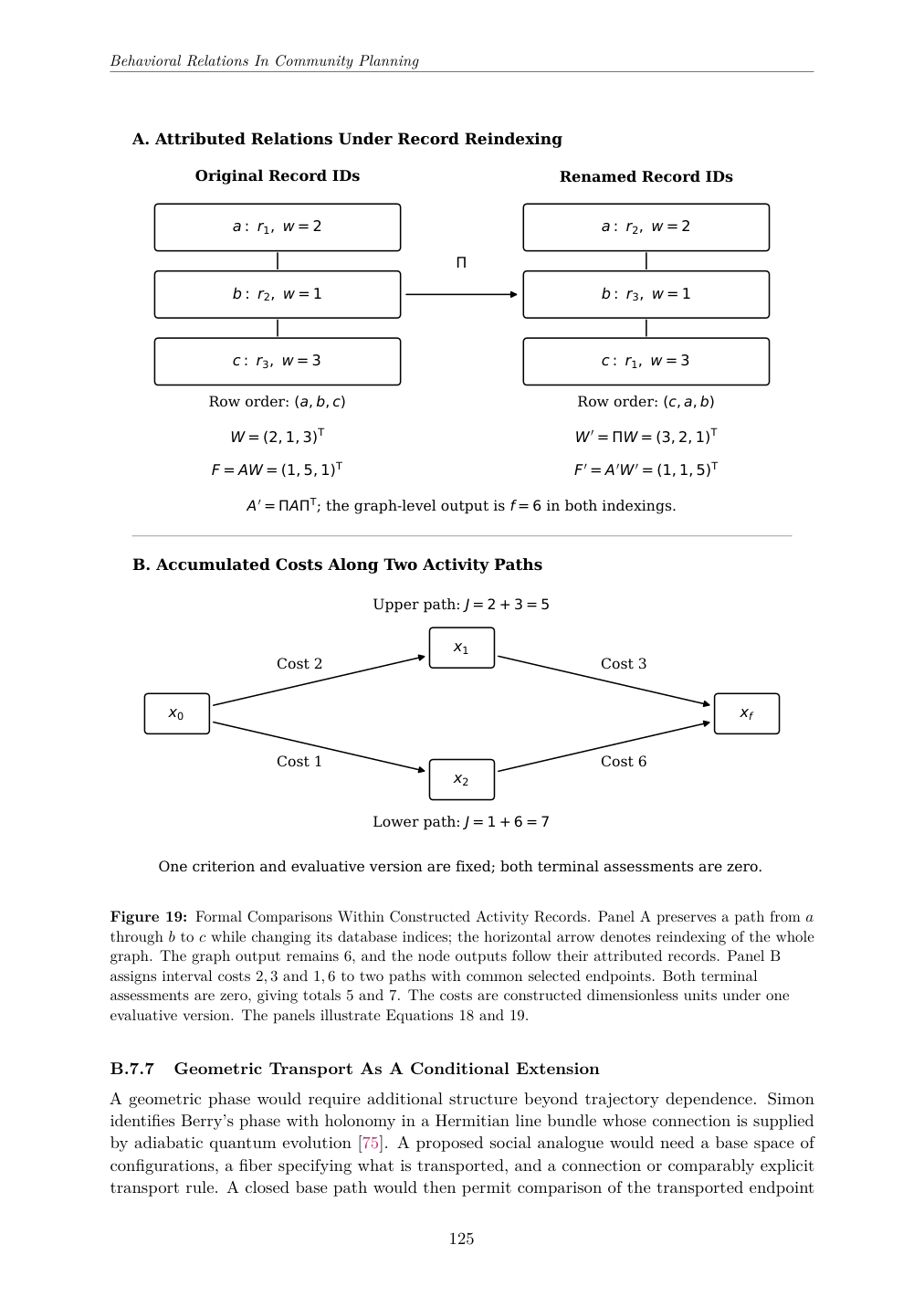
Readable text
One criterion and evaluative version are fixed; both terminal assessments are zero.
graph. The graph output remains 6, and the node outputs follow their attributed records. Panel B assessments are zero, giving totals 5 and 7. The costs are constructed dimensionless units under one evaluative version. The panels illustrate Equations 18 and 19.
A geometric phase would require additional structure beyond trajectory dependence. Simon identifies Berry’s phase with holonomy in a Hermitian line bundle whose connection is supplied by adiabatic quantum evolution [75]. A proposed social analogue would need a base space of configurations, a fiber specifying what is transported, and a connection or comparably explicit transport rule. A closed base path would then permit comparison of the transported endpoint
with its starting point. The research task includes identifying a consequence whose interpretation survives admissible changes of frame.
For example, a community may restore the wording of a policy after consultations while participation rights or expectations have changed. Such a history first warrants analysis of the retained and omitted state variables. Establishing holonomy would additionally require the specified transport structure and evidence for its role. Changing membership or noninvertible category revisions may call for a more general mathematical representation than a smooth bundle. The existing trajectory criterion remains applicable within its stated scope while these questions are unresolved.
The proposed extension thus distinguishes increasingly demanding commitments: reconstructed episodes, observer-specific records, supported transition mechanisms, explicit representation symmetries, and justified trajectory comparisons. A geometric interpretation becomes useful when its additional structure clarifies a question that these records and models leave unresolved. Its descriptive success would still leave the grounds of public evaluation and intervention open to the humanist, historical, and participatory inquiry developed in the main text.
B.8 A Practical Protocol For Community Reconstruction
The following protocol translates the survey and formal constructions into a feasible community inquiry. It is a proposed design rather than a report of implementation. Its starting point is one recurring activity whose organization is disputed or poorly understood. The protocol coordinates historical and interpretive judgment, empirical reconstruction, and practical experimentation. Its scale can range from a small reviewed interview corpus to a longitudinal archive, provided the claims remain proportionate to the evidence and the investigative burden.
B.8.1 The Planning Question And Its Historical Boundary
The inquiry begins by specifying the decision or understanding it should improve. A transport case might concern the relation between a new route, access to services, companionship, and the experience of movement. A digital community might investigate how requests for assistance become assignments, how assignments become completed work, and how credit or responsibility is attributed. The question identifies relevant activities, affected positions, temporal horizons, and the authority through which a proposed change could be considered.
An initial historical account reconstructs how the current arrangement arose. Relevant materials may include former rules, service schedules, meeting records, accounts of prior conflicts, and the experiences of people who left or could not participate. The investigation identifies which relations extend beyond the immediate site, such as funding conditions, platform policies, property arrangements, or external service dependencies. This account provides candidate explanations and records where the available history is partial.
Participant involvement concerns the terms of the question as well as the interpretation of answers. People can identify activities omitted from official categories, dispute the boundaries of a project, or explain why a seemingly costly process is valued. A voluntary walk may be part of companionship rather than an expendable journey segment. A handoff conversation may sustain mutual understanding beyond the transfer of a task. Such observations can change what the inquiry attempts to preserve before any optimization is specified.
B.8.2 An Interpretive Corpus And A Provisional Vocabulary
The corpus is assembled around the question, with a declared account of its composition. Interviews can use concrete episodes, contrasting situations, and opportunities for correction. Records can identify what happened before and after an episode. Speeches and articles can
contribute public justifications, competing framings, and changes in official language. The researcher records who produced each material, for whom, under what conditions, and with what relation to the activity being investigated.
Close reading supplies an initial codebook expressed in complete statements and accompanied by examples, counterexamples, and unresolved cases. Established value taxonomies can be used as comparison vocabularies. Community-specific terms remain available when they carry distinctions that a standard taxonomy would merge. Philosophical reasoning can clarify the object of a value claim, the nature of an obligation, or the grounds for an evaluative comparison. Historical inquiry can show how those terms acquired their local significance.
The codebook distinguishes a participant’s own position, an attributed expectation, an account of conduct, an institutional qualification, and an analyst’s proposed interpretation. It also distinguishes an explicit statement from an inference. Some passages may remain insufficient for the proposed classification. Recording that insufficiency prevents a forced label from supplying apparent evidence for a later temporal pattern.
The orientation is methodologically plural. Interpretive inquiry can reveal a meaningful omission in a numerical representation. Computational search can locate counterexamples to an initially persuasive interpretation. A practical trial can expose a dependence that neither method anticipated. The choice among these approaches follows the question and available evidence. The protocol does not require a choice between a wholly intuitive tradition and a wholly measurement-driven programme.
B.8.3 Baselines And Reviewed Computational Extraction
The initial computational comparison should include a transparent baseline appropriate to the target, such as reviewed manual coding, a clearly specified dictionary, or a simple classifier. A contextual language model can then be assessed for the additional distinctions it preserves. A model that gives fluent explanations without improving the relevant attribution may add considerable review burden. The comparison therefore concerns errors and practical usefulness as well as nominal predictive performance.
A reviewed reference set is sampled across the periods, source types, positions, and languages relevant to the inquiry. It includes quotation, negation, hypothetical examples, reported disagreement, changing rules, and passages whose interpretation depends on the surrounding exchange. Reviewers record their grounds and unresolved differences. Adjudication can establish a coding convention while retaining the fact that another interpretation was defensible.
Evaluation separates source recovery, passage selection, entity and role attribution, stance, contextual qualification, and value or norm labeling. A system can identify the correct topic while assigning the expectation to the wrong person. It can recover a relevant norm while losing its exception. These errors have different consequences for planning and should be reported separately. When confidence or abstention is used, its relation to reviewed errors should be assessed for the specified task.
Holdout design follows the intended generalization. Evaluation on a new speaker should separate speakers across training and test sets. Evaluation on a new interview should keep the interview’s related passages together. A claim about future use requires a later-period holdout. A claim about another community requires evaluation in that community or a justified transportability argument. Randomly separating nearly identical passages can give an uninformative picture of these more demanding uses.
B.8.4 Temporal Reconstruction And Competing Mechanisms
Only after the extraction task is adequately understood does the protocol reconstruct temporal relations among claims, conduct, and response. A first analysis can describe changes in attributed positions or recorded expectations. A stronger analysis asks which events and mechanisms plausibly account for the changes. Chronology identifies sequences, while explanation requires an account of opportunities, constraints, selection, and alternative pathways.
A norm candidate can be investigated through its reference group, anticipated responses, observed sanctions or rewards, and the availability of alternatives. Interviews can ask what a participant expects others to do, what they believe others consider appropriate, what they personally endorse, and what they think would happen after deviation. Independent records can help assess the relation among those accounts and actual conduct. The different answers are retained even when they conflict.
For an attractor hypothesis, the study specifies the state features, temporal resolution, transition model, and conditions under which return or persistence is expected. It then compares that explanation with alternatives such as stable membership selection, repeated external instruction, a persistent material constraint, or common AI-generated wording. Evidence of return after naturally occurring departures can be informative, provided the observation and selection processes are also examined. Planned interventions require a distinct design and a clear account of their authority and consequences.
Model assessment uses the temporal target actually claimed. Reconstructing past language with access to later records differs from predicting a later period using only earlier material. A model can describe an observed series well while failing to predict its continuation or the effects of a policy change. The protocol records which achievement was tested and where the historical evidence leaves mechanisms underidentified.
B.8.5 A Cooperative Handoff As A Constructed Case
The companion taxonomy’s hypothetical food cooperative provides a bounded illustration of the protocol. A member requests a callback before arranging a Saturday collection. A scheduling agent compares availability and posts the request to the evening shift. A volunteer accepts it; under the cooperative’s rota, that acceptance assigns the callback to the volunteer. The dashboard marks the accepted request as allocated. A coordinator later repairs the arrangement, and the member eventually collects the parcel. The case is constructed to distinguish stages of a project and the evidence available for them; it reports no empirical finding about a cooperative.
The planning question concerns dependable collection and the distribution of waiting, coordination, and repair. A count of successful collections can establish the final outcome in the hypothetical record while leaving the member’s uncertainty and the coordinator’s additional work unresolved. A blank callback field can have several explanations, including a missed attempt or an unanswered call. An interview can add an account of the episode, with its claims assessed against the relevant record and context.
Table 21 illustrates the proposed claim structure. The statements are invented for the example. They are kept distinct because each supports a different question about activity organization, normative expectations, or possible policy.
The taxonomy directs attention to several descriptions of the same project. Planning the callback is epistemic activity; attempting the call is occurring conduct; the call log is a manifestation; recognizing the coordinator as dependable is a social attribution; and closing a case under an authorized procedure is a normative qualification. These descriptions need not coincide in time
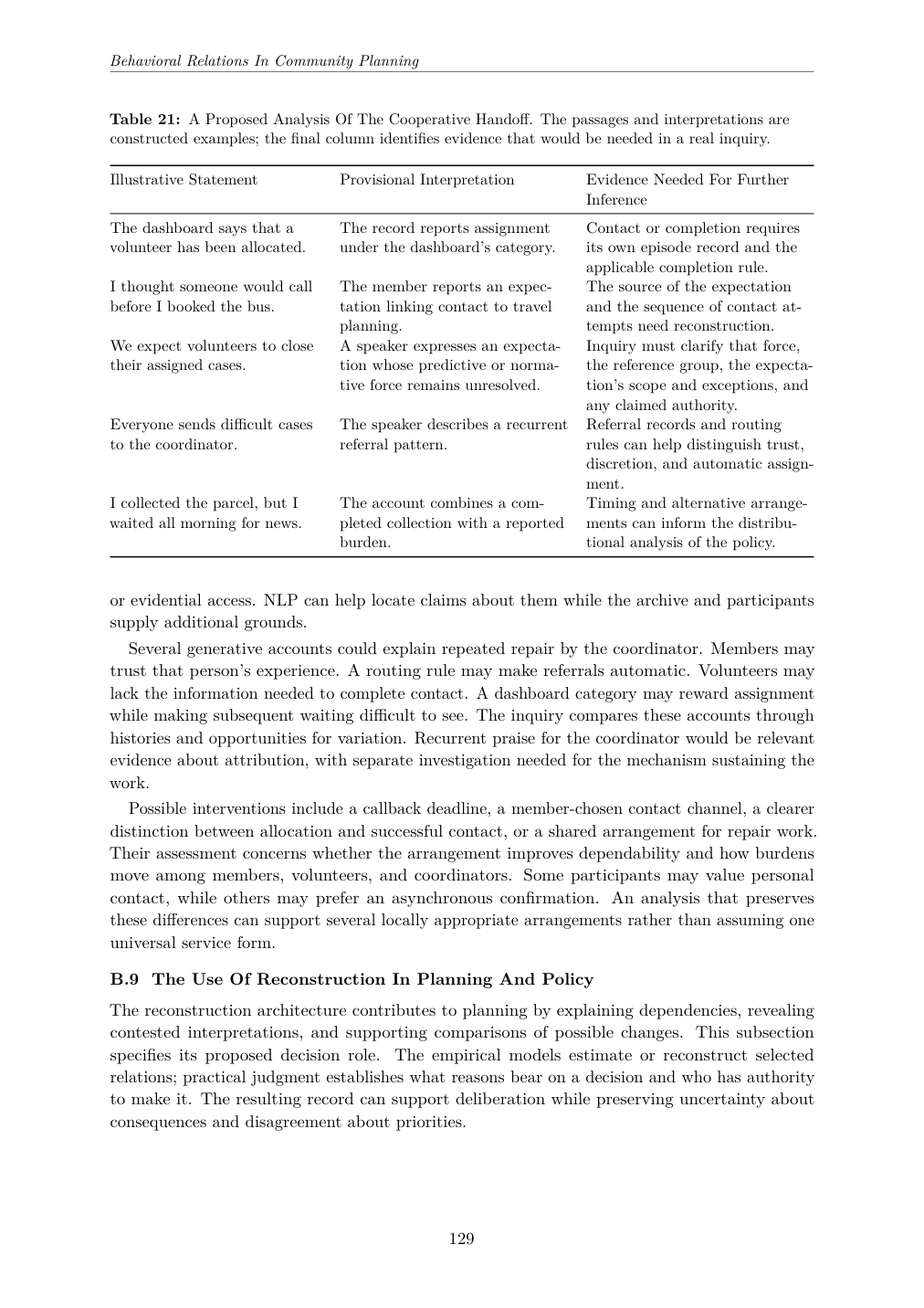
Readable text
Table 21: A Proposed Analysis Of The Cooperative Handoff. The passages and interpretations are constructed examples; the final column identifies evidence that would be needed in a real inquiry.
The record reports assignment under the dashboard’s category.
The dashboard says that a volunteer has been allocated.
Contact or completion requires its own episode record and the applicable completion rule.
The member reports an expec- tation linking contact to travel
The source of the expectation and the sequence of contact at- tempts need reconstruction.
A speaker expresses an expecta- tion whose predictive or norma- tive force remains unresolved.
Inquiry must clarify that force, the reference group, the expecta- tion’s scope and exceptions, and any claimed authority.
Referral records and routing rules can help distinguish trust, discretion, and automatic assign- ment.
The account combines a com- pleted collection with a reported
I collected the parcel, but I waited all morning for news.
Timing and alternative arrange- ments can inform the distribu- tional analysis of the policy.
or evidential access. NLP can help locate claims about them while the archive and participants
Several generative accounts could explain repeated repair by the coordinator. Members may trust that person’s experience. A routing rule may make referrals automatic. Volunteers may lack the information needed to complete contact. A dashboard category may reward assignment while making subsequent waiting difficult to see. The inquiry compares these accounts through histories and opportunities for variation. Recurrent praise for the coordinator would be relevant evidence about attribution, with separate investigation needed for the mechanism sustaining the
Possible interventions include a callback deadline, a member-chosen contact channel, a clearer distinction between allocation and successful contact, or a shared arrangement for repair work. Their assessment concerns whether the arrangement improves dependability and how burdens move among members, volunteers, and coordinators. Some participants may value personal contact, while others may prefer an asynchronous confirmation. An analysis that preserves these differences can support several locally appropriate arrangements rather than assuming one
The reconstruction architecture contributes to planning by explaining dependencies, revealing contested interpretations, and supporting comparisons of possible changes. This subsection The empirical models estimate or reconstruct selected relations; practical judgment establishes what reasons bear on a decision and who has authority to make it. The resulting record can support deliberation while preserving uncertainty about
specifies its proposed decision role. consequences and disagreement about priorities.
B.9.1 Criteria And Opportunities For Revision
Criteria emerge from the planning question, affected perspectives, historical understanding, and practical commitments. Some can be expressed quantitatively, such as waiting time, exposure to a disturbance, missed handoffs, or resources used for repair. Others concern recognition, trust, aesthetic experience, or the ability to challenge a decision. Their representation should be sufficient for the intended comparison, with the reasons for any numerical conversion stated.
Observed approval can inform an inquiry into how conduct is received. Its desirability as a policy objective requires further justification. A system that rewards conformity with the most visible recorded expectation may reduce opportunities to question that expectation. Similarly, a reduction in conflict reports may indicate improved relations, reduced opportunities to complain, selective departure, or a changed reporting procedure. The planning record therefore identifies both the proposed criterion and the conditions that make its interpretation credible.
Optimization becomes useful after the admissible interventions, relevant constraints, and comparison criteria have been specified. It can search for arrangements that reduce an agreed burden while preserving access, meaningful participation, and valued activities. Several maximal alternatives can remain when criteria are incomplete or conflicting. The framework then supports a reasoned selection, a trial, or further inquiry. Its role includes discovering that the available formulation omits an important activity or that the apparent tradeoff results from a remediable institutional arrangement.
B.9.2 Representations As Interventions
Publishing a community norm map can alter what participants believe others expect. Introducing a value profile can influence the vocabulary available for self-description. A dashboard can direct attention to the episodes it counts and make other forms of contribution less visible. These are candidate feedback mechanisms within the proposed model and should be investigated when analytical outputs enter practice.
Jakesch and colleagues’ experiment with an opinionated writing assistant found effects on participants’ written positions and their subsequent attitude-survey responses in a specific online writing task [39]. The study provides a bounded empirical reason to consider the effects of language tools on the language and judgments subsequently measured. It does not establish long-term community norm change. The present protocol accordingly records whether a passage was produced with AI assistance, which analytical outputs participants encountered, and when those encounters occurred, where this information is available and relevant.
Community review should permit correction of attribution, supplementation of missing context, and challenge to the proposed use of a representation. Agreement with a summary can support its usefulness or perceived fit, while leaving causal and population-level claims open. A participant may also accept a description of a recurrent expectation while arguing that the expectation should change. The review record should preserve that distinction.
B.9.3 Practical Burden And Proportionate Inquiry
The inquiry itself requires time for interviewing, transcription, interpretation, review, maintenance, and dispute resolution. These activities belong to the community’s enabling work. An elaborate representation that improves a minor classification while diverting substantial effort from the focal project may be poorly suited to the purpose. The evaluation of the framework therefore includes its investigative and coordination demands.
A proportionate design can begin with a small, carefully reviewed corpus and a transparent representation. More complex models are introduced when a concrete uncertainty or decision
requires them and when the available evidence can support their assessment. The record can preserve a qualitative disagreement without estimating a latent score. It can use a chronology without inferring an attractor. It can recommend a reversible procedural change without claiming a complete model of the community.
Operational governance concerns the permissions attached to the evidence and its use. Interviews collected for understanding a service problem should remain tied to that purpose and the conditions under which they were provided. Access to source passages may differ from access to a published aggregate. The architecture records those differences so that making an analysis inspectable does not imply unrestricted disclosure of personal accounts. Inferences about named participants require particular care because a classification can itself become a social attribution with practical effects.
B.10 Research Questions For The Integrated Approach
The survey supports a programme with several separately assessable contributions. A first question concerns representational adequacy: whether a contextual claim record preserves distinctions that are lost by a document-level value score. A second concerns measurement: whether the retained distinctions remain recoverable across speakers, genres, languages, and periods. A third concerns explanation: whether a proposed dynamic model improves understanding or prediction relative to competing mechanisms. A fourth concerns practice: whether the reconstructed relations help participants identify workable changes at an acceptable investigative cost.
Table 22 states proposed claims and the findings that would require their revision. The table serves as an inquiry design; no result in its final column has been measured for the integrated framework.
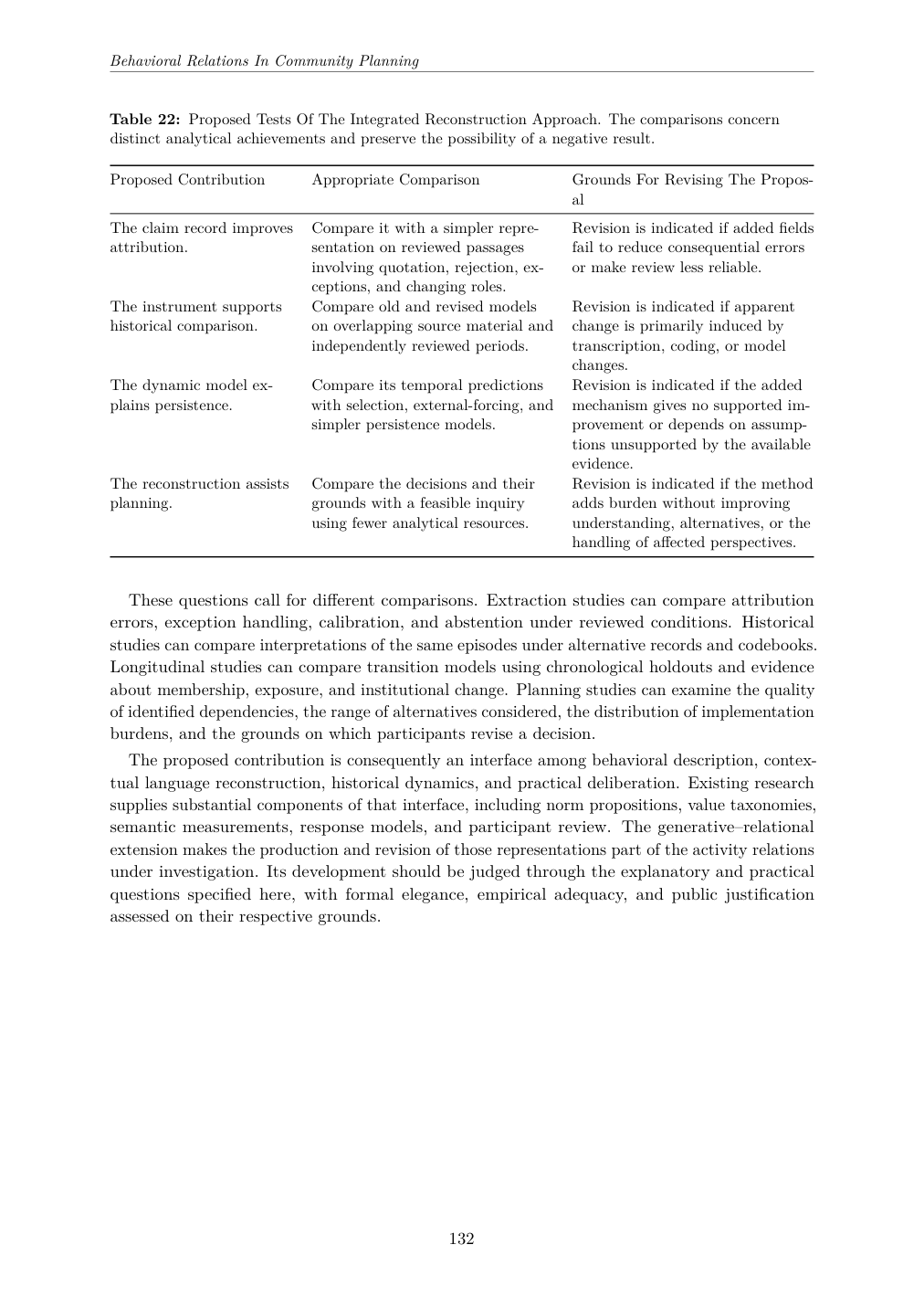
Readable text
Table 22: Proposed Tests Of The Integrated Reconstruction Approach. The comparisons concern distinct analytical achievements and preserve the possibility of a negative result.
Compare it with a simpler repre- sentation on reviewed passages involving quotation, rejection, ex- ceptions, and changing roles.
Revision is indicated if added fields fail to reduce consequential errors or make review less reliable.
Compare old and revised models on overlapping source material and independently reviewed periods.
Revision is indicated if apparent change is primarily induced by transcription, coding, or model changes.
Compare its temporal predictions with selection, external-forcing, and simpler persistence models.
Revision is indicated if the added mechanism gives no supported im- provement or depends on assump- tions unsupported by the available evidence.
Compare the decisions and their grounds with a feasible inquiry using fewer analytical resources.
Revision is indicated if the method adds burden without improving understanding, alternatives, or the handling of affected perspectives.
These questions call for different comparisons. Extraction studies can compare attribution errors, exception handling, calibration, and abstention under reviewed conditions. Historical studies can compare interpretations of the same episodes under alternative records and codebooks. Longitudinal studies can compare transition models using chronological holdouts and evidence about membership, exposure, and institutional change. Planning studies can examine the quality of identified dependencies, the range of alternatives considered, the distribution of implementation burdens, and the grounds on which participants revise a decision.
The proposed contribution is consequently an interface among behavioral description, contex- tual language reconstruction, historical dynamics, and practical deliberation. Existing research supplies substantial components of that interface, including norm propositions, value taxonomies, semantic measurements, response models, and participant review. The generative–relational extension makes the production and revision of those representations part of the activity relations under investigation. Its development should be judged through the explanatory and practical questions specified here, with formal elegance, empirical adequacy, and public justification
Readable text
[1] Isabelle Anguelovski, James J. T. Connolly, Helen Cole, et al. Green Gentrification in European and
[2] Pablo Arrighi and Gilles Dowek. Causal Graph Dynamics. Information and Computation, 223:78–93,
[3] Robert Bamler and Stephan Mandt. Dynamic Word Embeddings. In Doina Precup and Yee Whye
Teh, editors, Proceedings of the 34th International Conference on Machine Learning, volume 70 of Proceedings of Machine Learning Research, pages 380–389. PMLR, 2017. URL https://proceedings.
[4] Christopher Barrington-Leigh and Adam Millard-Ball. Global Trends Toward Urban Street-Network
[5] Gary S. Becker. A Theory of the Allocation of Time. The Economic Journal, 75(299):493–517, 1965.
[6] Gordon Belot. Background-Independence. General Relativity and Gravitation, 43:2865–2884, 2011.
[7] Cristina Bicchieri. Norms, Preferences, and Conditional Behavior. Politics, Philosophy & Economics,
[8] Cristina Bicchieri. Diagnosing Norms. In Norms in the Wild: How to Diagnose, Measure, and Change
Social Norms. Oxford University Press, 2017. URL https://academic.oup.com/book/6479/chapter-a
[9] Pierre Bourdieu. Distinction: A Social Critique of the Judgement of Taste. Harvard University Press,
Cambridge, Massachusetts, 1984. URL https://www.mit.edu/~allanmc/bourdieu1.pdf. Translated
[10] Geoffrey C. Bowker and Susan Leigh Star. Sorting Things Out: Classification and Its Consequences.
[11] Ryan L. Boyd, Steven R. Wilson, James W. Pennebaker, Michal Kosinski, David J. Stillwell, and
Rada Mihalcea. Values in Words: Using Language to Evaluate and Understand Personal Values. In Proceedings of the Ninth International AAAI Conference on Web and Social Media, pages 31–40. AAAI Press, 2015. doi: 10.1609/icwsm.v9i1.14589. URL https://web.eecs.umich.edu/~mihalcea/pa
[12] Michael M. Bronstein, Joan Bruna, Taco Cohen, and Petar Veličković. Geometric Deep Learning:
[13] Erik Brynjolfsson, Danielle Li, and Lindsey Raymond. Generative AI at Work. The Quarterly Journal
[14] Nancy Cartwright and Jeremy Hardie. Evidence-Based Policy: A Practical Guide to Doing It
[15] Sky CH-Wang, Arkadiy Saakyan, Oliver Li, Zhou Yu, and Smaranda Muresan. Norm Similarities and Differences via Situational Alignment and Explainable Textual Entailment. In Houda Bouamor, Juan Pino, and Kalika Bali, editors, Proceedings of the 2023 Conference on Empirical Methods in Natural Language Processing, pages 3548–3564, Singapore, December
- Association for Computational Linguistics. doi: 10.18653/v1/2023.emnlp-main.215. URL
Readable text
[16] Herbert H. Clark and Susan E. Brennan. Grounding in Communication. In Lauren B. Resnick,
John M. Levine, and Stephanie D. Teasley, editors, Perspectives on Socially Shared Cognition, pages 127–149. American Psychological Association, 1991. doi: 10.1037/10096-006. URL https: //web.stanford.edu/~clark/1990s/Clark,%20H.H.%20_%20Brennan,%20S.E.%20_Grounding%20
[18] Tim Cresswell. Towards a Politics of Mobility. Environment and Planning D: Society and Space, 28
[19] Department for Transport. TAG Unit M2.1: Variable Demand Modelling. Technical report, Depart-
ment for Transport, November 2025. URL https://assets.publishing.service.gov.uk/media/69a034423 e672177d0bc7710/tag-unit-m21-variable-demand-modelling.pdf.
[20] John Dewey. Having an Experience. Chapter excerpt from Art as Experience, 1934. URL https:
//www.marxists.org/reference/subject/philosophy/works/us/an-experience.htm. Online text
[21] Anil R. Doshi and Oliver P. Hauser. Generative AI Enhances Individual Creativity but Reduces the
Collective Diversity of Novel Content. Science Advances, 10(28):eadn5290, 2024. doi: 10.1126/sciadv .adn5290. URL https://doi.org/10.1126/sciadv.adn5290.
An Introduction to Generative Justice. 10.5209/rev_TEKN.2016.v13.n2.52847. URL https://revistas.ucm.es/index.php/TEKN/es/article/
[23] Ron Eglash and Colin Garvey. Basins of Attraction for Generative Justice. In Chaos Theory in
ugarvey.com/wp-content/uploads/2021/03/Eglash_Garvey_2014_Basins-of-Attraction-for-Gener
[24] Denis Emelin, Ronan Le Bras, Jena D. Hwang, Maxwell Forbes, and Yejin Choi. Moral Stories:
Situated Reasoning about Norms, Intents, Actions, and their Consequences. In Marie-Francine Moens, Xuanjing Huang, Lucia Specia, and Scott Wen-tau Yih, editors, Proceedings of the 2021 Conference on Empirical Methods in Natural Language Processing, pages 698–718, Online and
Punta Cana, Dominican Republic, November 2021. Association for Computational Linguistics. doi: 10.18653/v1/2021.emnlp-main.54. URL https://aclanthology.org/2021.emnlp-main.54/.
[25] Yrjö Engeström. Expansive Learning at Work: Toward an Activity Theoretical Reconceptualization.
https://researchportal.helsinki.fi/en/publications/expansive-learning-at-work-toward-an-activity-t
Synthesis of Traveler Choice Research: Improving Modeling Accuracy for Better Transportation Decisionmaking. Technical Report FHWA-HRT-13-022, U.S. Department of Transportation, 2013. URL https://www.fhwa.dot.gov/publications/research/operati
[27] Bent Flyvbjerg. Bringing Power to Planning Research: One Researcher’s Praxis Story. Journal of
[28] Maxwell Forbes, Jena D. Hwang, Vered Shwartz, Maarten Sap, and Yejin Choi. Social Chemistry 101:
Learning to Reason about Social and Moral Norms. In Bonnie Webber, Trevor Cohn, Yulan He, and Yang Liu, editors, Proceedings of the 2020 Conference on Empirical Methods in Natural Language Pro- cessing (EMNLP), pages 653–670, Online, November 2020. Association for Computational Linguistics.
[29] Nancy Fraser. Contradictions of Capital and Care. New Left Review, (100):99–117, 2016. URL https:
//newleftreview.org/issues/ii100/articles/nancy-fraser-contradictions-of-capital-and-care.pdf.
Readable text
[30] Yi Fung, Tuhin Chakrabarty, Hao Guo, Owen Rambow, Smaranda Muresan, and Heng Ji. NORM-
SAGE: Multi-Lingual Multi-Cultural Norm Discovery from Conversations On-the-Fly. In Houda Bouamor, Juan Pino, and Kalika Bali, editors, Proceedings of the 2023 Conference on Empir- ical Methods in Natural Language Processing, pages 15217–15230, Singapore, December 2023.
Association for Computational Linguistics. doi: 10.18653/v1/2023.emnlp-main.941. https://aclanthology.org/2023.emnlp-main.941/.
[31] Justin Garten, Joe Hoover, Kate M. Johnson, Reihane Boghrati, Carol Iskiwitch, and Morteza
Dehghani. Dictionaries and Distributions: Combining Expert Knowledge and Large Scale Textual Data Content Analysis: Distributed Dictionary Representation. Behavior Research Methods, 50(1): 344–361, 2018. doi: 10.3758/s13428-017-0875-9. URL https://link.springer.com/article/10.3758/s134
[32] Jan Gehl. Life Between Buildings: Using Public Space. Island Press, 2011. URL https://cus.ubt-uni
.net/wp-content/uploads/2024/11/Jan-Gehl-Life-Between-Buildings_-Using-Public-Space-2011-I
[33] Justin Grimmer and Brandon M. Stewart. Text as Data: The Promise and Pitfalls of Automatic
Content Analysis Methods for Political Texts. Political Analysis, 21(3):267–297, 2013. doi: 10.1093/ pan/mps028. URL https://web.stanford.edu/~jgrimmer/tad2.pdf.
[34] Benedetto Gui. From Transactions to Encounters: The Joint Generation of Relational Goods and
Conventional Values. In Economics and Social Interaction: Accounting for Interpersonal Relations. Cambridge University Press, 2005. URL https://unifind.unipd.it/resource/item/100036.
[35] Torsten Hägerstrand. What About People in Regional Science? Papers of the Regional Science
Association, 24, 1970. doi: 10.1007/BF01936872. URL https://www.sciencedirect.com/science/articl
[36] William L. Hamilton, Jure Leskovec, and Dan Jurafsky. Diachronic Word Embeddings Reveal
Statistical Laws of Semantic Change. In Katrin Erk and Noah A. Smith, editors, Proceedings of the 54th Annual Meeting of the Association for Computational Linguistics (Volume 1: Long Papers), pages 1489–1501, Berlin, Germany, 2016. Association for Computational Linguistics. doi: 10.18653/v1/P16-1141. URL https://aclanthology.org/P16-1141/.
[37] Miguel A. Hernán and James M. Robins. Causal Inference: What If. Chapman & Hall/CRC, 2020.
[38] Frederic R. Hopp, Jacob T. Fisher, Devin Cornell, Richard Huskey, and René Weber. The Extended
Moral Foundations Dictionary (eMFD): Development and Applications of a Crowd-Sourced Approach to Extracting Moral Intuitions from Text. Behavior Research Methods, 53(1):232–246, 2021. doi: 10.3758/s13428-020-01433-0. URL https://link.springer.com/article/10.3758/s13428-020-01433-0.
[39] Maurice Jakesch, Advait Bhat, Daniel Buschek, Lior Zalmanson, and Mor Naaman. Co-Writing with
Opinionated Language Models Affects Users’ Views. In Proceedings of the 2023 CHI Conference on Human Factors in Computing Systems. Association for Computing Machinery, 2023. doi: 10.1145/35 44548.3581196. URL https://arxiv.org/abs/2302.00560.
[40] Johannes Kiesel, Milad Alshomary, Nicolas Handke, Xiaoni Cai, Henning Wachsmuth, and Benno
Stein. Identifying the Human Values behind Arguments. In Proceedings of the 60th Annual Meeting of the Association for Computational Linguistics (Volume 1: Long Papers), pages 4459–4471. Association
for Computational Linguistics, 2022. doi: 10.18653/v1/2022.acl-long.306. URL https://aclanthology
[41] Oliver Klingefjord, Ryan Lowe, and Joe Edelman. What are human values, and how do we align AI
[42] Allison Koenecke, Andrew Nam, Emily Lake, Joe Nudell, Minnie Quartey, Zion Mengesha, Connor
Toups, John R. Rickford, Dan Jurafsky, and Sharad Goel. Racial Disparities in Automated Speech Proceedings of the National Academy of Sciences, 117(14):7684–7689, 2020. 10.1073/pnas.1915768117. URL https://www.pnas.org/doi/full/10.1073/pnas.1915768117.
[43] Haewoon Kwak, Jisun An, Elise Jing, and Yong-Yeol Ahn. FrameAxis: Characterizing Microframe Bias
and Intensity with Word Embedding. PeerJ Computer Science, 7:e644, 2021. doi: 10.7717/peerj-cs.644. URL https://jisun.me/pdfs/peerj-cs-644.pdf.
[44] Henri Lefebvre. The Production of Space. Basil Blackwell, Oxford, 1991. URL https://www.wiley.co
m/en-sg/the-production-of-space-p-9780631181774. Translated by Donald Nicholson-Smith; French original published 1974.
[45] Oliver Li, Mallika Subramanian, Arkadiy Saakyan, Sky CH-Wang, and Smaranda Muresan. NormDial:
A Comparable Bilingual Synthetic Dialog Dataset for Modeling Social Norm Adherence and Violation. In Houda Bouamor, Juan Pino, and Kalika Bali, editors, Proceedings of the 2023 Conference on Empirical Methods in Natural Language Processing, pages 15732–15744, Singapore, December
2023. Association for Computational Linguistics. doi: 10.18653/v1/2023.emnlp-main.974. URL https://aclanthology.org/2023.emnlp-main.974/.
[46] Doreen Massey. For Space. SAGE Publications, London, 2005. URL https://us2.sagepub.com/en-us/
nam/for-space/book227109.
[47] Suzanne Mavoa, Melody Oliver, Karen Witten, and Hannah M. Badland. Linking GPS and Travel
Diary Data Using Sequence Alignment in a Study of Children’s Independent Mobility. International Journal of Health Geographics, 10:64, 2011. doi: 10.1186/1476-072X-10-64. URL https://link.springe
r.com/article/10.1186/1476-072X-10-64.
[48] Nailia Mirzakhmedova, Johannes Kiesel, Milad Alshomary, Maximilian Heinrich, Nicolas Hand-
ke, Xiaoni Cai, Valentin Barriere, Doratossadat Dastgheib, Omid Ghahroodi, Mohammad Ali Sadraei Javaheri, Ehsaneddin Asgari, Lea Kawaletz, Henning Wachsmuth, and Benno Stein. The Touché23-ValueEval Dataset for Identifying Human Values behind Arguments. In Proceedings of the 2024 Joint International Conference on Computational Linguistics, Language Resources and Evaluation (LREC-COLING 2024), pages 16121–16134. ELRA and ICCL, 2024. URL
https://aclanthology.org/2024.lrec-main.1402/.
[49] David Moats and Ajda Pretnar Žagar. Meeting the Machines Half-Way: Testing LLMs for Qualitative
Coding of Values in Texts. Human Organization, 85(3):250–262, 2026. doi: 10.1080/00187259.2026. 2703871. URL https://kclpure.kcl.ac.uk/portal/en/publications/meeting-the-machines-half-way-tes ting-llms-for-qualitative-coding/. Published online 30 July 2026.
[50] Saif M. Mohammad, Svetlana Kiritchenko, Parinaz Sobhani, Xiaodan Zhu, and Colin Cherry. SemEval-
2016 Task 6: Detecting Stance in Tweets. In Proceedings of the 10th International Workshop on Semantic Evaluation (SemEval-2016), pages 31–41. Association for Computational Linguistics, 2016. doi: 10.18653/v1/S16-1003. URL https://aclanthology.org/S16-1003/.
[51] Patricia L. Mokhtarian and Ilan Salomon. How Derived Is the Demand for Travel? Some Conceptual
and Measurement Considerations. Transportation Research Part A: Policy and Practice, 35(8): 695–719, 2001. doi: 10.1016/S0965-8564(00)00013-6. URL https://itspubs.ucdavis.edu/publication\_ detail.php?id=390.
[52] Aida Mostafazadeh Davani, Mark Díaz, and Vinodkumar Prabhakaran. Dealing with Disagreements:
Looking Beyond the Majority Vote in Subjective Annotations. Transactions of the Association for Computational Linguistics, 10:92–110, 2022. doi: 10.1162/tacl_a_00449. URL https://aclanthology
.org/2022.tacl-1.6/.
[53] Natalie Mueller, David Rojas-Rueda, Haneen Khreis, et al. Changing the Urban Design of Cities for
Health: The Superblock Model. Environment International, 134:105132, 2020. doi: 10.1016/j.envint .2019.105132. URL https://doi.org/10.1016/j.envint.2019.105132.
[54] OECD. OECD Guidelines for Citizen Participation Processes. Technical report, OECD Publishing,
2022. URL https://www.oecd.org/en/publications/oecd-guidelines-for-citizen-participation-process es_f765caf6-en.html.
[55] OECD/ITF. Sustainable Accessibility for All. Technical report, OECD Publishing, 2024. URL
https://www.itf-oecd.org/sustainable-accessibility-for-all.
[56] David T. Ory and Patricia L. Mokhtarian. When Is Getting There Half the Fun? Modeling the
Liking for Travel. Transportation Research Part A: Policy and Practice, 39(2–3):97–123, 2005. doi: 10.1016/j.tra.2004.09.006. URL https://itspubs.ucdavis.edu/publication\_detail.php?id=1763.
Readable text
[57] Elinor Ostrom. Collective Action and the Evolution of Social Norms. Journal of Economic Perspectives,
[58] Elinor Ostrom. Beyond Markets and States: Polycentric Governance of Complex Economic Systems.
Nobel Prize Lecture, 8 December 2009, 2009. URL https://www.nobelprize.org/uploads/2018/06/ost
[59] Elinor Ostrom. A General Framework for Analyzing Sustainability of Social-Ecological Systems.
[60] Chan Young Park, Shuyue Stella Li, Hayoung Jung, Svitlana Volkova, Tanu Mitra, David Jurgens,
and Yulia Tsvetkov. ValueScope: Unveiling Implicit Norms and Values via Return Potential Model of Social Interactions. In Yaser Al-Onaizan, Mohit Bansal, and Yun-Nung Chen, editors, Findings of the Association for Computational Linguistics: EMNLP 2024, pages 16659–16695, Miami, Florida,
USA, November 2024. Association for Computational Linguistics. doi: 10.18653/v1/2024.findings-e mnlp.972. URL https://aclanthology.org/2024.findings-emnlp.972/.
[61] Joon Sung Park, Carolyn Q. Zou, Jonne Kamphorst, Niles Egan, Aaron Shaw, Benjamin Mako
Hill, Carrie Cai, Meredith Ringel Morris, Percy Liang, Robb Willer, and Michael S. Bernstein. AI Simulations Grounded in Rich Self-Reports Increase Accuracy and Reduce Distortion, 2026. URL https://arxiv.org/abs/2411.10109v4. Working paper, version 4, 16 November 2026; first released in 2024 as Generative Agent Simulations of 1,000 People.
[62] Ray Pawson and Nick Tilley. Realist Evaluation. Methods chapter, 2004. URL https://www.cnxus.
[63] Vladimir Ponizovskiy, Murat Ardag, Lusine Grigoryan, Ryan Boyd, Henrik Dobewall, and Peter
Holtz. Development and Validation of the Personal Values Dictionary: A Theory-Driven Tool for Investigating References to Basic Human Values in Text. European Journal of Personality, 34(5): 885–902, 2020. doi: 10.1002/per.2294. URL https://journals.sagepub.com/doi/10.1002/per.2294.
[64] Marilyn Power. Social Provisioning As a Starting Point for Feminist Economics. Feminist Economics,
[65] Liang Qiu, Yizhou Zhao, Jinchao Li, Pan Lu, Baolin Peng, Jianfeng Gao, and Song-Chun Zhu.
ValueNet: A New Dataset for Human Value Driven Dialogue System. In Proceedings of the AAAI Conference on Artificial Intelligence, 2022. URL https://www.microsoft.com/en-us/research/publica
tion/valuenet-a-new-dataset-for-human-value-driven-dialogue-system/. AAAI 2022; author research
[66] Shirin M. Rai, Catherine Hoskyns, and Dania Thomas. Depletion: The Cost of Social Reproduction.
International Feminist Journal of Politics, 2013. https://warwick.ac.uk/fac/soc/pais/people/rai/publications/depletion\_ifjp.pdf. Advance online
[67] Margaret E. Roberts, Brandon M. Stewart, Dustin Tingley, Christopher Lucas, Jetson Leder-Luis,
Shana Kushner Gadarian, Bethany Albertson, and David G. Rand. Structural Topic Models for Open-Ended Survey Responses. American Journal of Political Science, 58(4):1064–1082, 2014. doi: 10.1111/ajps.12103. URL https://dtingley.scholars.harvard.edu/sites/g/files/omnuum8551/files/dti ngley/files/topicmodelsopenendedexperiments.pdf.
[68] Ingrid Robeyns. Wellbeing, Freedom and Social Justice: The Capability Approach Re-Examined.
Open Book Publishers, 2017. doi: 10.11647/OBP.0130. URL https://www.openbookpublishers.com
[69] Mario Scharfbillig, Theresa Reitis-Münstermann, Nicolas Stefanovitch, Johannes Kiesel, Paula
Schulze Brock, Joanne Sneddon, et al. ValuesML: A New Multilingual Dataset for Values Detection in News and Political Manifestos. Behavior Research Methods, 58:276, 2026. doi: 10.3758/s13428-026 -03092-z. URL https://link.springer.com/article/10.3758/s13428-026-03092-z. Published 20 August
Readable text
[70] Theodore R. Schatzki. Peripheral Vision: The Sites of Organizations. Organization Studies, 26(3):
[71] Kjeld Schmidt and Liam Bannon. Taking CSCW Seriously: Supporting Articulation Work. Computer
Supported Cooperative Work, 1:7–40, 1992. doi: 10.1007/BF00752449. URL https://www.academia.e du/1760981/Taking_CSCW_seriously_Supporting_articulation_work_1992_.
[72] Shalom H. Schwartz, Jan Cieciuch, Michele Vecchione, Eldad Davidov, Ronald Fischer, Constanze
Beierlein, Alice Ramos, Markku Verkasalo, Jan-Erik Lönnqvist, Kursad Demirutku, Ozlem Dirilen- Gumus, and Mark Konty. Refining the Theory of Basic Individual Values. Journal of Personality and Social Psychology, 103(4):663–688, 2012. doi: 10.1037/a0029393. URL https://cris.huji.ac.il/en /publications/refining-the-theory-of-basic-individual-values/.
Maximization and the Act of Choice. Econometrica, 65(4):745–779, 1997. 10.2307/2171939. URL https://cs.stanford.edu/~epacuit/classes/rationality-fall2010/sen-max.pdf.
[74] Amartya Sen. Democracy As a Universal Value. Journal of Democracy, 10(3):3–17, 1999. URL
https://www.journalofdemocracy.org/articles/democracy-as-a-universal-value/.
[75] Barry Simon. Holonomy, the Quantum Adiabatic Theorem, and Berry’s Phase. Physical Review
[76] Taylor Sorensen, Liwei Jiang, Jena Hwang, Sydney Levine, Valentina Pyatkin, Peter West, Nouha
Dziri, Ximing Lu, Kavel Rao, Chandra Bhagavatula, Maarten Sap, John Tasioulas, and Yejin Choi. Value Kaleidoscope: Engaging AI with Pluralistic Human Values, Rights, and Duties. In Proceedings of the AAAI Conference on Artificial Intelligence, volume 38, pages 19937–19947, 2024.
Moral Foundation Measurements Fail to Converge on Multilingual Party Manifestos. Political Analysis, 34(2):166–187, 2026. doi: 10.1017/pan.2025.10011. URL https://www.cambridge.org/core/journals/political-analysis/article/moral-foundation-measu rements-fail-to-converge-on-multilingual-party-manifestos/0283BE5BA7711C182FC33989681EC6
[77] Marvin Stecker and Frederic R. Hopp. A7. Published online 15 August 2025.
[78] Carole Jean Uhlaner. Relational Goods and Participation: Incorporating Sociability into a Theory
[79] Julie Ulstein. Structural Topic Modeling as a Mixed Methods Research Design: A Study on Employer
[80] Hirofumi Uzawa. On the Economics of Social Overhead Capital. In Preference, Production and
Capital: Selected Papers of Hirofumi Uzawa, pages 340–362. Cambridge University Press, 1989. doi:
10.1017/CBO9780511664496.021. URL https://www.cambridge.org/core/books/abs/preference-pro duction-and-capital/on-the-economics-of-social-overhead-capital/4DF5CAB31F2D7A9E51759D7
[81] Hirofumi Uzawa. Economic Analysis of Social Common Capital. Cambridge University Press, 2005.
doi: 10.1017/CBO9780511610462. URL https://www.cambridge.org/core/books/economic-analysi s-of-social-common-capital/E22967403BF7D8275EA131B068FCD145.
[82] Michelle Vaccaro, Abdullah Almaatouq, and Thomas Malone. When Combinations of Humans and
[83] Steven Wilson, Rada Mihalcea, Ryan Boyd, and James Pennebaker. Disentangling Topic Models: A
Cross-cultural Analysis of Personal Values through Words. In David Bamman, A. Seza Doğruöz, Jacob Eisenstein, Dirk Hovy, David Jurgens, Brendan O’Connor, Alice Oh, Oren Tsur, and Svitlana Volkova, editors, Proceedings of the First Workshop on NLP and Computational Social Science, pages 143–152, Austin, Texas, November 2016. Association for Computational Linguistics. doi: 10.18653/v1/W16-5619. URL https://aclanthology.org/W16-5619/.
[84] H. Peyton Young. The Evolution of Conventions. Econometrica, 61(1):57–84, 1993. URL https:
//ora.ox.ac.uk/objects/uuid%3A61f174fe-a28c-4d33-a8c1-7092887a3ac6.
[85] H. Peyton Young. The Evolution of Social Norms. Annual Review of Economics, 7:359–387, 2015.
URL https://www.econ2.jhu.edu/people/young/SocialNormsFinal.pdf.
[86] Bhada Yun, Renn Su, and April Yi Wang. AI and My Values: User Perceptions of LLMs’ Ability to
Extract, Embody, and Explain Human Values from Casual Conversations. In Proceedings of the 2026 CHI Conference on Human Factors in Computing Systems, New York, NY, USA, 2026. Association
for Computing Machinery. doi: 10.1145/3772318.3790566. URL https://www.bhadayun.com/papers/ values. CHI ’26, Barcelona, Spain, 13–17 April 2026; 38 pages.
[87] Caleb Ziems, Jane Dwivedi-Yu, Yi-Chia Wang, Alon Halevy, and Diyi Yang. NormBank: A Knowledge
Bank of Situational Social Norms. In Anna Rogers, Jordan Boyd-Graber, and Naoaki Okazaki, editors, Proceedings of the 61st Annual Meeting of the Association for Computational Linguistics (Volume 1: Long Papers), pages 7756–7776, Toronto, Canada, July 2023. Association for Computational Linguistics. doi: 10.18653/v1/2023.acl-long.429. URL https://aclanthology.org/2023.acl-long.429/.