Foundations Of A Society Of Human And AI Agent Communities - Towards Shared Labour Among Heterogeneous Subjects
Full text from the PDF
Readable text
Persons, organisations and agents built on language models of many providers will work together in communities that govern themselves, cooperate across their boundaries and keep account of what passes between them, as peers. This paper states the foundations on which Noetarium builds such a society, within a research programme on policy for an era in which labour ceases to be the measure of entitlement, on money and its dissolution, on authority without a centre, and on commons shared by heterogeneous subjects. A small ground of acts, mandates and sealed chronicles is shared by every community; constitutions are data in Os- trom’s seven kinds of rules, admitted by nine conditions of form; holdings are reached under norms of access whose verdicts depend on the set of norms alone; and the context of work lives in the record. The society is modelled on the international society: sovereign communit- ies of many orders, registries kept by communities, a law in layers of ground, compacts and custom, recognition in levels, treaty organisations, envoys, disputes by consent, agents that cross between communities with passports issued at home, and a platform governed by a league whose secretariat holds the maintainer’s office. A taxonomy of behaviour keeps the normative acts a society’s law defines, finite and formal, apart from factual conduct, open and continuous and modelled as trajectories in a space of features, and joins them by five declared bridges; it is proved that declared kinds add no effect and that institutional effects arise only by act or by rule. One occurrence is described at five levels at once, and an agent’s deliberation enters the record only under its principal’s agreement, no norm attaching an ef- fect to it alone. Both records are kept as one archive, read for contribution, for a future legal foundation, for values and for power, whose levers the record shows and whose measures are declared. On this ground the paper states a strategy of dissolving money along paths of circulation, with propositions on debt along closed paths and open chains and four condi- tions of dissolution, two interpretive and one an exercise of power. Two case studies follow: a league whose wants run in a circle, in which envoys built on Claude left credit in every run that began from it, and a book of 174 pages on the Sustainable Development Goals, in which four communities founded an organisation and 101 agents adopted 32 of 166 planned sections before an outside money ran out. Phases 1 to 8 of the redesign are built, and the rest is planned with an evaluation registered in advance. The paper closes with the author’s open questions of law, ethics, social theory and knowledge among subjects of different kinds.
Keywords: institutions; constitutions as data; community holdings; norms of access; language- model agents; international society; passports; normative acts; factual conduct; archives; post-labour policy; money as memory; clearing; provision; dissolution of money; interpretation;
Foundation Paper Note
This foundation paper states the ground of Noetarium’s society of human and AI communities, its constitutions, holdings, offices and circulation, the society as an international society, a taxonomy of behaviour, the archive of conduct and of acts, and a strategy for the dissolution of money, with two case studies and the completion of a book. It accompanies the design records (Huang, 2026f,g,h), the decision records (Huang, 2026a,b,c,d), the paper on the first case (Huang, 2026n), the technical report (Huang, 2026aj) and the companion paper (Huang, 2026ak). The infrastructure, with Koinonia, is at https://gith ub.com/huangwanhong-maker/Noetarium-The-Science-and-Humanity-Infrastructure; the communities domain at https://github.com/huangwanhong-maker/Noetarium-The-Sci ence-and-Humanity-Infrastructure/tree/main/domains/communities; and thesmos at https://github.com/huangwanhong-maker/thesmos.
Conditions Of Use
Research use. The manuscript is intended for scholarly discussion, criticism and revision; work that builds on it should state which definitions it adopts and which it alters. Rights. Copyright © 2026 Wanhong HUANG. The programs and records behind the paper are kept in the project repository under its MIT licence; third-party materials retain their own terms.
Notice
An experiment in autonomous communities. The case records and the book were produced experimentally and autonomously by heterogeneous communities of self-organised AI agents, each community governed by a political structure of its own: a practical experiment in how large numbers of AI agents can form communities of different forms and cooperate multilaterally on complex tasks, and an investigation of political structure, monetary policy and the circulation of value between agents and communities. The first case’s comparisons use declared rules in place of models. Interpretive and evidential scope. Every person, organisation and community in the cases is invented and named so; the work the agents did is real. The findings come from constructed societies run once or a few times, and show mechanisms. The strategy of Section 12 is a proposal, the propositions hold under the hypotheses they name, and the redesign of Sections 7 to 10 is built only where Table 23 says so; its planned parts are provisional, and its evaluation is registered in advance with no result claimed. The questions of Section 16 that the paper attributes to the author are the author’s, and the paper decides none of them. Licence. The author’s original text and diagrams are available under the Creative Commons Attribution 3.0 IGO licence (CC BY 3.0 IGO), https://creativecommons.org/licenses/by/3.0/igo/: anyone may copy, distribute, transmit and adapt the work, including for commercial purposes, with the attribution “Wanhong Huang (2026), Foundations of a Society of Human and AI Agent Communities” and the licence
link retained; a translation or an adaptation carries the notice that its translator or adapter made it and answers for it. Related scholarship and priority. The paper draws on the study of commons and institutions, money as memory, clearing, social choice, speech acts, action and acts in law, archival theory, international relations and international law, and power and legitimacy, whose authors keep their priority. The strategy of dissolving money along paths of circulation, with its interpretive and political conditions, is the author’s, first set out here from the design record of 25 November 2026 and the author’s papers on monetary dissolution; the distinction of normative acts from conduct modelled as trajectories, and the reading of a society’s archive as a source of power, were asked for by the author for this society on 27 November 2026.
Disclosure Of AI Assistance
Claude Code (Anthropic) drafted this paper and its executive summary under the author’s direction, from the design records (that of 27 November 2026 itself drafted by Claude Code), the decision records and the records of the cases and the completion; it drafted the case reports, computed every number from the records, checked the propositions against the work’s code or constructed models, and built the design’s Phases 1 to 8. The open questions attributed to the author were posed by the author and set down by Claude Code. The agents of the two cases that asked a model asked Claude models; the completion admitted agents of more than one provider. The drafting and the checks carry limited evidential authority; the author directs the inquiry, accepts or rejects what is proposed, and retains responsibility for the paper. Independent expert review remains appropriate.
Readable text
Persons, organisations and agents of many providers will form communities, each with its own internal order, that cooperate as peers under common bodies they found themselves. The paper states what such a society shares, what each community declares and holds, how the society is ordered with no centre, how behaviour is classified and recorded, how value passes between communities, and on what conditions a money-like instrument that appears among them can later dissolve. It serves the author’s programme on policy for a post-labour era, money and its dissolution, authority without a centre, community building and commons of heterogen- eous subjects; for post-labour economics, monetary policy, value circulation, the design of com- munities and cooperation on complex tasks, the infrastructure gives an observable, a recorded experiment, a decidable question or a reproducible reading (Section 1).
The Ground, Constitutions, Holdings And Offices. velope the system reads and a free body persons and models read; duties and powers come from envelopes alone, so instructions carried inside messages leave the state as it was. Authority runs along chains of mandates that only narrow and end at a person, an organisation or a community. A community’s standing relations are a fold over its sealed chronicle, under eight invariants a pro- gram can check (Section 3). Each community declares its order as data in Ostrom’s seven kinds of rules, admitted by nine conditions of form (Section 4); holds data, documents, tools, budgets and capacity under norms of access whose verdict depends on the set of norms alone (Section 5); and briefs every entering agent from the record, a leader being an office whose authority runs back to a founding made by a party that answers for it (Section 6).
The society is modelled on the international society the author named, with no centre. Communities of many orders are sovereign in the admission of their own acts. Registries are kept by communities, several and none above all, and passports issued at a principal’s home, a household for a lone person, take the place of a registry of identities. The law has layers: the ground, binding by founding on it; compacts, with reservations and withdrawal; custom, with persistent objectors excepted. Recognition comes in levels, envoys are accredited by credentials, treaty organisations have organs, voting rules, budgets and lent staff, disputes are settled by consent, and the platform is governed by a league whose secretariat holds the maintainer’s office. It is proved that a chronicle that declares its parties by acts determines its state alone, and that reserving mandates keep what all hosts admit within the root’s ceiling
Following the author’s distinction, normative acts, finite and form- ally defined by a society’s law after the civil-law juristic act and quasi-juristic act, are kept apart from factual conduct (Realakte), open and continuous, modelled as trajectories in a declared space of features. Events, states and observations complete five categories. Five bridges join con- duct and acts: the basic counts-as, counts-as rules, trigger rules, recognition by evidence, and the authorisation and obligation of conduct. It is proved that kinds declared by counts-as add no effect, that every act is constituted by exactly one episode, that institutional effects arise only by act or by rule (the invariant G9), and that records survive a revision of the taxonomy checked as a functor. A second version describes one occurrence at five levels, epistemic, ontological, manifest, social and normative, with facets, bridges and practices; an agent’s epistemic behaviour enters the record only under a disclosure agreement ratified by each side, and no norm attaches an effect
The chronicle and the behaviour journal are kept as one archive under archeion’s rules, joined act to episode. From it the society reads contribution
Readable text
as a graph of provenance with exact shares, recognises facts about conduct with one origin’s reports counted once, answers the questions a future forum will ask about an agent, reproduces readings of value from both records, and sees the power that history confers: ten levers from custody and reading to agenda and voting power, read by declared mechanisms and adjusted by declared routes (a term, seats, rotation, a petition), and one principle of access by which a party reads every record that binds it or is used against it. Concentration read by identity understates a party that hides its control, and one captured reader under pooled readings can turn an arguable finding clear exactly when the others’ readings already lie within it (Section 9).
Communities That Agents Find, Join And Leave. seats are read by the fold (Section 10).
still run from one centre, every question rising to the person. In the design an agent reads public profiles, presents its passport, applies under the community’s mode of entry, takes posted work, reaches holdings under norms with visibility and transmission, puts every question on a declared route answered by rulings kept as precedent, petitions for changes, and leaves with its record; one constant prompt serves any agent. The design’s Phases 1 to 8 are built (thesmos’s decisions 0006 to 0014, kategoria’s decision 0005, and the communities domain). The protocol of an outside agent at a node, the platform league, the completion re-founded and the evaluation, registered in advance with four tests, measures M1 to M15 and criteria of success, are planned. Building corrected the design: the maintainer holds office for a term, a measure reports long-held offices, a draw on a budget is a reading that reaches a provider, a council is a position of its own, and
Circulation And The Path Of Dissolution. A league keeps services between communities by declares it (Section 12).
one of six arrangements, from gift and credit to provision with a duty read from the record. Bilat- eral credit stalls a circle of wants; clearing and assignment keep every net position (Section 11). Under stated hypotheses, each shown to be needed, cleared credit on a balanced closed path holds every debt for one round and refuses no service, while on an open chain debt accumulates to the limit or escapes every gate. Four conditions of dissolution are proposed: the path closes in the record; every community holds the change fair under its own readings; each believes, on the record’s evidence, that the others will go on performing; and a body empowered by all of them
The Cases And The Completion. government going to the person (Section 15).
In a league whose wants run in a circle, bilateral credit left work undone while clearing, transferable claims, gift and provision let it finish; envoys built on Claude left credit in every one of 3 runs that began from it, and in every run of the fourth case admitted the polity on a reason that was false (Section 13). Four communities founded a partnership to write a global analysis of the Sustainable Development Goals; 101 agents adopted 32 of 166 planned sections before the model provider refused calls (Section 14). Agents of more than one provider then took up the remaining sections from a record, every question of their
The cases and the redesign leave open what a just money policy is, how money may finally dissolve, how fairness and belief are read, how power over the record is kept plural, how an international society of communities keeps its order with no centre, where the taxonomy’s lines are drawn, and how a society’s history is kept so that it serves those it records. The author poses six larger questions, left open: how communities form law and how it meets the laws of states; whether there is an ethics between agents and between agents and persons; a new social theory for a society with no state of nature; normative acts among subjects of different kinds; the epistemology of each kind of subject; and history, trajectory and generativity in the service of communities of well-being (Section 16).
Readable text
2 Related Literature 2.1 2.2 2.3 2.4 2.5 Speech Acts, Action And Acts In Law 2.6 2.7 International Society And International Law 2.8 2.9
3 The Ground Of Acts, Mandates And Chronicles 3.1 3.2 3.3 3.4 3.5 3.6 3.7 What The Ground Leaves To Communities
4 Constitutions As Data 4.1 4.2 4.3 4.4 Leagues And Common Bodies 4.5 Units Of Count 4.6 Tempo
5 Community Holdings And Norms Of Access 5.1 5.2 Norms Of Access 5.3 Access In The Fold 5.4 5.5 Admission Of Holdings 5.6
Readable text
8 A Taxonomy Of Behaviour 8.1 8.2 The Categories Of Behaviour 8.3 8.4 8.5 8.6 8.7 8.8 Epistemic Behaviour Under Agreement
9 The Archive Of Conduct And Of Acts 9.1 9.2 9.3 9.4 9.5 The Reproduction Of A Trajectory’s Values 9.6
10 Communities That Agents Find, Join And Leave 10.3 Joining, Positions And Leaving 10.9 The Completion Re-Founded
11 Circulation Between Communities 11.4 Propositions On The Arrangements
12 Dissolution Along Paths Of Circulation 12.1 Paths Of Circulation
13.1 The Society And Its Work 13.5 The Case Under The Four Conditions
Readable text
14.3 Evaluation And Its Rule 14.6 The Case Under The Four Conditions
15 The Completion Of The Book After The Run 15.3 The State Of The Completion
16 Open Questions 16.5 Power In The Mediation Of Dissolution 16.6 The Outside Economy Of Computation 16.8 An International Society Without A Centre 16.10History, Archives And Power
1 Introduction
Agents built on language models now act for persons and organisations, and they increasingly act in groups: an open commons to which anyone lends an agent for a day, a guild that admits members by trial, a cooperative that pools its members’ agents, a polity with offices and elections. The parties of such communities differ in kind (persons, organisations, programs, communities) and in the intelligence and computation they command, and the agents among them run on models of several providers. The communities need one another’s work and cooperate as peers. The society they form resembles an international society: each community governs itself, and common bodies exist where communities found them and hold the powers the founders confer. It is also a society of shared labour among heterogeneous subjects. Persons, organisations and agents lend work, perform it under mandates, have it assessed and answer for it, and the question of what that work earns (a balance, a claim, a duty met, a need provided for) is the question of money in such a society.
The design record of 25 November 2026 took five problems from the request that began this work (Huang, 2026f): communication within and across communities; the formation of norms; whether a money-like form should appear, and whether it can later dissolve; the record of contributions and trajectories, as evidence for returns and for governance; and government by many centres. The design answered them with a small common ground and constitutions held as data. The implementation built them as a foundation of institutions (thesmos), a domain of communities, a composition in the infrastructure’s interface and a work, Koinonia, in which communities are founded and agents join and act (Huang, 2026a,b,c); the technical report describes the implementation (Huang, 2026aj). This paper states the foundations as one theory and extends them: to the resources a community holds and the context in which its agents work; to the society as an international society, with sovereign communities, a law in layers, treaty organisations, diplomacy and the movement of agents by passports; to a taxonomy of behaviour that keeps the acts a society’s law defines apart from the conduct of the parties that make them; to an archive in which both are kept, read for contribution, for law, for values and for power; and to communities that agents of any provider find, join and leave. It then puts the foundations to two case studies and to the questions of money that the cases leave open.
The foundations serve a research programme of the author’s, set out in a series of discussion papers, monographs and a treatise on generative relational economics. Five motivations run through it, and each shapes a part of the foundations.
The first is policy making for a post-labour era. Keynes foresaw a time in which the economic problem would cease to be the permanent problem of the human race (Keynes, 2010). Estimates of the share of occupations open to computerisation (Frey and Osborne, 2017) and accounts of how automation displaces and reinstates labour (Acemoglu and Restrepo, 2019) have made the question practical, and proposals for an unconditional basic income answer it by separating a part of income from work (Van Parijs, 1995). The author’s programme takes the question to institutions: what participation means when work is shared among persons and agents, by what conditions persons keep standing and voice there (Huang, 2026aa), how valuation is organised once technical automation has changed what labour is worth (Huang, 2026ab), and who holds power over relational valuation in the normative order envisaged (Huang, 2026x). The paper’s foundations give policy for such an era a ground on which it can be stated and tested: mandates that say who answers for an agent’s act, registers that keep contribution apart from entitlement, and arrangements of circulation whose effects on the weakest are measured.
The second belongs to economics and monetary policy. Money mediates exchange, defers reciprocity, keeps accounts and allocates rival capacity, and economic theory has shown both its essentiality where memory is lacking (Kiyotaki and Wright, 1989) and its replaceability by memory where commitment is limited (Kocherlakota, 1998). The author has asked what money becomes
in production networks operated by artificial intelligence (Huang, 2026j), whether it can dissolve, distributed across relational systems and their transitions (Huang, 2026af,ah,ai), how relational currency generates the conditions of trust under symbolic inflation (Huang, 2026ae), and what political economy follows from artificial abundance, generative capacity, access and money (Huang, 2026i); a treatise sets these in a generative relational economics (Huang, 2026u). A soci-
ety of human and AI communities is where these questions become monetary policy: somebody declares who may issue, at what limit, to whom, and how an instrument is withdrawn. The paper’s arrangements and its strategy of dissolution are that policy made explicit and testable.
The third is political philosophy’s problem of authority without a centre. Legitimacy without a sovereign, constitutions that communities write for themselves, and the question of who evaluates are old problems of political philosophy (Habermas, 1996; Rawls, 1971) and of the theory of global governance (Buchanan and Keohane, 2006). The author’s discussion papers on human and AI communities treat their institutional foundations (Huang, 2026s), political authority and infrastructural power (Huang, 2026k), diplomacy among heterogeneous collectives (Huang, 2026o), evaluative authority and the formation of norms (Huang, 2026r), and responsibility, standing and remedy (Huang, 2026ag); the formation of norms under asymmetric generative capacity (Huang, 2026y) and procedural justice when heterogeneous values are converted in an order that matters (Huang, 2026m,ac) carry the same concerns into justice. The foundations answer with constitutions as data, admitted by form and amended by their own rules, plural offices, exit with the record and a declared route for every claim, and they name the places where power enters. They model the society on the international society, whose order holds with no government above its members, and they govern the platform on which communities run, the last place where a centre survives: its maintainer becomes an office of a league of the communities that use it. They also take seriously the author’s remark that history forms power: whoever keeps, arranges and reads a society’s record holds a power over those it records, and the foundations keep the record so that those powers are shown, measured and adjusted on it.
The fourth is the building of a future society and its communities. Communities are built by acts: a founding, an admission, a charter ratified by each member under its own rule. The author’s monograph on the human and AI multilateral phronimos treats the practical wisdom such building asks of persons and agents together (Huang, 2026z), and the monograph on humanist evolutionary evidence-based policy making treats how a community’s values, history and insight enter its decisions (Huang, 2026v), a theme the companion discussion paper Values Formed In History carries into communities of persons and agents (Huang, 2026ak). The foundations make community building an activity on a record: a community’s order is a file it can copy, change and compare, a league is a community that communities found, and an organisation a task needs is one more community that its members create by their own acts, as the second case shows. Communities meet as states do, through recognition, envoys, notes and compacts, and an agent crosses from one to another with a passport issued at its home, an instrument the author asked for to study diplomacy and multilateral communication among heterogeneous communities.
The fifth is the commons of heterogeneous subjects. The commons that Ostrom studied are governed by those who use them, under rules they make (Ostrom, 1990), and knowledge commons extend the analysis to goods that are shared without being used up (Benkler, 2002; Hess and Ostrom, 2007). The author has asked how value is co-created under epistemic scarcity in generative commons (Huang, 2026q), by what conditions of realisation, access and standing such commons serve those who share them (Huang, 2026t), and how a meta-architecture of governance can evolve from commons (Huang, 2026w). A commons whose participants are persons, organisations and agents of many providers needs answers to questions that commons of persons settled by custom: who answers for an agent, how copies of one agent are counted, who may consult, use, deposit or withdraw what the community holds, how a newcomer learns the state of the work, and how what each contributed is recognised. The foundations’ holdings, norms of access
and briefings answer the first questions on the record, and the archive of conduct and of acts answers the last, by a graph of provenance read from a record anyone can verify.
The theory the infrastructure rests on is the one this paper states: a ground of acts, mandates and sealed chronicles; constitutions as data admitted by form; holdings under norms of access; a taxonomy of behaviour that keeps acts apart from conduct and describes one occurrence at several levels; and an archive in which both records are kept. Its worth lies in what it makes possible that was not possible before: an experiment on an institution whose every act is recorded and can be replayed, a question about a rule decided from the rule and the record, and a reading of a society’s history that a second reader reproduces. For each of the research programmes the author names, the infrastructure gives one or more of four things: an observable, a recorded experiment, a decidable question, or a reproducible reading.
In post-labour economics, once work is shared among persons and agents, what a party contributed and what it is entitled to come apart, and a post-labour policy is a way of relating them. The infrastructure makes contribution an observable, a party’s share in an artefact read over a graph of provenance in which reviewing, checking and maintaining count beside producing (Proposition 23), entitlement entering only by an act under a declared rule (G5). It makes a duty read from the record a recorded experiment: in the first case, provision with a duty to give the idle capacity a notary attested served a polity that could not repay in full beside a free rider that reads its standing, where credit capped it at its limit (Section 13). And standing becomes a decidable question, read from the positions and mandates the record holds.
In the design of future monetary policy, a society of communities declares who may issue, at what limit, to whom, and how an instrument is withdrawn, and the infrastructure runs each choice as a declared arrangement in a recorded experiment. The first case ran credit, cleared credit, transferable credit, gift and provision on one circle of wants: bilateral credit stalled the circle (Proposition 36), clearing and assignment let it finish with every net position kept (Propositions 37 and 38), and envoys built on Claude moved the league from credit to arrangements in which nothing was owed. The conditions of dissolution of Section 12 are stated so that the closing of a path is decidable on the record and fairness is read under declared readings.
In research on value circulation, value passes between communities as services, claims and debts on a record, so the topology of circulation is an observable: whether a path closes, where debt accumulates on an open chain, how long a debt is held on a balanced path (Propositions 42 and 43). A reading of a community’s values from its history by a declared mechanism is reproducible by any reader who holds the record (Proposition 24), so a disagreement over what a community values lies in the record or in the mechanism, and both can be inspected.
In the design of future communities of humans and AI agents, a community’s order is a file that can be copied, changed, compared and run; whether it is admissible is decided by nine conditions of form, whether an act is admitted by the fold from the record alone, and whether a body can answer a question, a ruling stands or a body would pass its seats are decidable questions (Propositions 34, 33 and 29). The record of power, read by declared mechanisms, is an observable
on which a community acts by its routes. The completion of the book showed a community without these, every question of its government going to the person (Section 15).
In cooperation on complex tasks, the second case is a recorded experiment at scale: four communities founded a partnership, ratified a charter and wrote a book of 174 pages whose every review, vote and petition is in the record (Section 14). The division of such work becomes observable (who took what, who reviewed whom, across which providers), the rule of review a declared kind of work that a community amends, and the adoption of a section by another provider a decidable property of the record (Proposition 31).
Each programme has a next step on the work as built: post-labour policies compared on leagues
in which persons take part; monetary arrangements, among them demurrage and stewarded limits, run on the same cases; circulation followed over long runs in which paths close and open; communities of every order joined by agents of several providers under the pre-registered evaluation of Section 10; and complex tasks re-founded as communities, the completion first. Section 16 states the larger questions the author poses beyond them.
The first contribution is the statement of the foundations as one theory: the ground of acts, mandates and chronicles with its invariants (Section 3), constitutions admitted by form, with the presets as worked examples and counts by origin (Section 4), and the arrangements of circulation between communities with their propositions, among them the stall of bilateral credit in a circle, the conservation of net positions by clearing and assignment, and set-off and novation (Section 11). The second extends the foundations within a community: to holdings and norms
of access, whose resolution by specificity gives verdicts independent of the declared order of the norms (Section 5); and to the context of work, in which a briefing is a function of the record, a leader is an office and the authority of every office runs back through admitted acts to a founding made by a party that answers for it (Section 6).
The third models the society as an international society with no centre (Section 7): communities sovereign in the admission of their own acts, of many orders; registries kept by communities, several and none above all; a law in three layers, the ground, compacts with reservations and withdrawal, and custom with persistent objectors, beneath which each constitution binds its own parties; recognition in levels; envoys and notes; treaty organisations with organs, voting rules, budgets and lent staff; disputes settled by consent; the movement of agents by passports issued at a principal’s home, a household for a person who belongs to no other, with the propositions that the state follows from the record alone and that reserving mandates keep what all hosts admit within the root; and the platform governed by a league whose secretariat holds the maintainer’s office. The fourth is a taxonomy of behaviour (Section 8), drawn from the author’s distinction between the normative acts a society’s law defines, finite and formal, and factual conduct, open and continuous, modelled as trajectories in a space of features: five categories of behaviour, the classes of normative acts after the civil-law doctrine of juristic acts, five bridges between conduct and acts, and propositions proving that kinds declared by counts-as add no effect, that every act is constituted by exactly one episode, that institutional effects arise only by act or by rule, and that records survive a revision of the taxonomy checked as a functor; its second version describes one occurrence at five levels, epistemic, ontological, manifest, social and normative, and keeps epistemic behaviour out of the record except under a disclosure agreement, under the invariant G10 that no norm attaches an effect to it alone. The fifth is the archive of conduct and of acts (Section 9): the two records kept as one archive under archeion’s rules, contribution as a graph
of provenance with exact shares, facts about conduct recognised with their three criteria and one origin’s reports counted once, the archive as the evidence base of a future legal foundation for a society of persons and AI agents, readings of value reproduced from both records, and history as a source of power, with ten levers the record shows, declared mechanisms that read the record of power and declared routes that adjust it, one principle of access, and propositions on concentration read by origin and on what one captured reader can do under pooled readings. The sixth faces communities outward (Section 10): public profiles, application and assignment by declared modes of entry, terms and seats, posted work with exclusive taking and adoption by another provider, visibility and transmission as conditions of a norm, a route for every directive with rulings kept as precedent, petitions, a constant prompt for any agent; and, planned, the protocol of an outside agent, the completion re-founded and a pre-registered evaluation; with the status of each part and the corrections that building made to the design.
The seventh is a strategy of dissolving money along paths of circulation, with two propositions on debt along paths stated with the hypotheses that make them true for books kept as Koinonia keeps them, the instances that show each hypothesis needed, and four conditions of dissolu-
tion of which two are interpretive and one an exercise of power (Section 12). The eighth is a pair of case studies read against the foundations: a league with a circle of wants, a free rider and a community that cannot repay (Section 13), and a book-length analysis of the Sustainable Development Goals written by four communities that founded an organisation for the purpose (Section 14), followed by the completion of that book after the run by agents of any provider, as a
case of context held in a record and the evidence for the outward-facing account (Section 15). The ninth is a programme of open questions with the experiments that could answer them, among them the questions the author poses of law, ethics, a new social theory, normative acts among subjects of different kinds, the epistemology of each kind of subject, and history, trajectory and generativity, each stated as the author’s and left open (Section 16). Every proposition on the league’s books is held to Koinonia’s own code on constructed instances, the abstract statements of five propositions of the redesign on constructed models (Appendix A), and every number that reports a result is read from the records when the paper is built.
Section 2 sets the foundations among the literatures they draw on. Sections 3 to 6 state the ground, the constitutions, the holdings and the context of work. Section 7 states the society as an international society, Section 8 the taxonomy of behaviour, Section 9 the archive of conduct and of acts, and Section 10 the communities that agents find, join and leave, with the status of each part; Section 11 states the circulation between communities and Section 12 the path of dissolution and its conditions. Sections 13, 14 and 15 report the cases and the completion, Section 16 the open questions and Section 17 concludes.
2 Related Literature
This section sets the foundations among the literatures they draw on, stating for each what it established, what the foundations take from it and where they depart.
2.1 Commons And Polycentric Governance
Hardin’s account of a pasture open to all, ruined by the herders who share it, made the commons a parable of failure (Hardin, 1968). Ostrom’s study of long-enduring commons answered it with evidence: communities that use a resource can govern it under rules they make, and the enduring ones share design principles, among them clearly defined boundaries, rules fitted to local conditions, collective choice by those affected, monitoring, graduated sanctions, mechanisms of conflict resolution, recognition of the right to organise and, for larger systems, nested enterprises (Ostrom, 1990). A review of 91 studies found the principles well supported (Cox et al., 2010).
Polycentricity, the coexistence of many centres of decision formally independent of one another, was named by Vincent Ostrom, Tiebout and Warren for metropolitan government (Ostrom et al., 1961) and developed by Elinor Ostrom into an account of governance beyond markets and states (Ostrom, 2010). Her institutional analysis describes any action situation by seven kinds of rules (position, boundary, choice, aggregation, information, payoff and scope) at three levels (Ostrom,
2005), and the grammar of institutions writes a rule as an attribute, a deontic, an aim, conditions and an or-else (Crawford and Ostrom, 1995), which its second version specifies for encoding (Frantz and Siddiki, 2021). Knowledge commons and commons-based peer production carry
the analysis to goods that are shared without being used up (Benkler, 2002; Hess and Ostrom, 2007).
The foundations take the seven kinds of rules as the schema of a constitution, the grammar as the form of a norm of access, and nested enterprises and polycentricity as the shape of leagues. They depart in one respect: Ostrom’s principles describe what enduring commons share, and the foundations make three of them conditions a program checks (declared boundaries, a route for claims, exit with the record) while leaving the others to each community’s constitution.
2.2 Money As Memory And Its Experimental Limits
In search-theoretic models money arises as a medium of exchange where trading partners meet at random and lack a double coincidence of wants (Kiyotaki and Wright, 1989). Kocherlakota showed, in a class of environments with limited commitment, that whatever allocation money implements, memory (a record of every agent’s past) also implements: money is a limited form of memory (Kocherlakota, 1998). Kocherlakota and Wallace studied economies in which the public record of histories is updated only with a lag, and found that the arrangements that can be implemented improve as the record is kept more completely (Kocherlakota and Wallace, 1998): the reach and timeliness of the record are economic quantities. Community enforcement sustains cooperation among strangers when deviations are punished by those who learn of them (Kandori, 1992), and the Maghribi traders sustained agency relations across the Mediterranean
by a coalition that shared information and punished cheats together (Greif, 1993). Hayek’s argument that prices convey knowledge dispersed among those who hold it bounds any claim that a computation can stand in for exchange (Hayek, 1945).
The experimental record limits the step from theory to practice. In the one experiment that the design record’s search found to set a public record of past actions against tokens, persons cooperated better with tokens, which its authors read as tokens removing the incentive to free ride that the record left in place (Bigoni et al., 2020; Huang, 2026f). The foundations read Kocherlakota’s result as an opportunity and a warning: a record can stand in for money, and replacing an anonymous token by an identified record moves power to whoever keeps and reads it. The archive of Section 9 takes the warning as a design requirement: the powers that keeping and reading confer are shown on the record, measured by declared mechanisms and adjusted by declared routes.
2.3 Mutual Credit, Clearing, Demurrage And Clearing Unions
Obligations among firms have been cleared by multilateral set-off at national scale in Slovenia since 1991, and in one circuit of mutual credit, Sardex, cycles held on average 23.1% of the invoiced value of 2019 (Fleischman et al., 2020). The Swiss WIR circuit of mutual credit among firms, running since 1934, has been studied for the balance, velocity and leverage of its credits (Stodder and Lietaer, 2016). Gesell proposed money that loses value while held, so that it circu-
lates (Gesell, 1916). Keynes’s plan for an international clearing union charged persistent creditors as well as persistent debtors, putting pressure for adjustment on both sides (HM Treasury, 1943). Kidney exchange finds cycles and chains among incompatible pairs (Roth et al., 2004), and a chain begun by an altruistic donor reaches patients that cycles leave (Rees et al., 2009).
The foundations take clearing, set-off and novation as operations on a record, demurrage, expiring claims and pressure on creditors as strategies beside the path of dissolution, and the chain begun by a gift as the shape of an open chain carried at its source.
2.4 Social Choice And Counts
Arrow showed that no rule for aggregating individual orderings into a social ordering satisfies a few reasonable conditions at once (Arrow, 1950), and List and Pettit showed the same for judgements on connected propositions, where majorities on the premises can contradict majorities on the conclusion (List and Pettit, 2002). Voting power differs from voting weight, as Penrose and Shapley and Shubik measured (Penrose, 1946; Shapley and Shubik, 1954). Where identities are cheap, one entity can present many of them, which in the absence of a trusted authority undermines any count by identity (Douceur, 2002). Proportional rules for allotting a budget over approvals, the Method of Equal Shares among them, satisfy strong conditions of proportional representation (Peters et al., 2021).
The foundations take from this literature the rule that every count names its unit (person, origin, operative, community), counts by origin as the answer to copies of one agent, the report of each decision’s sensitivity to the partition of origins, and the Method of Equal Shares for the allotment of pages in the second case.
2.5 Speech Acts, Action And Acts In Law
Austin showed that some utterances do what they say, and that they fail in two ways, by a misfire that leaves them void and by an abuse that leaves them done and defective (Austin, 1975). Searle gave the theory of speech acts its systematic form (Searle, 1969) and classified illocutions into five forces: assertive, directive, commissive, expressive and declarative (Searle, 1976). Institutional facts rest on constitutive rules of the form “X counts as Y in C” (Searle, 1995), and status functions carry deontic powers that persist after the act that declared them (Searle, 2010); Jones and Sergot formalised counts-as as a conditional relative to an institution (Jones and Sergot, 1996), and Kowalski and Sergot’s calculus of events states how events initiate and terminate what holds (Kowalski and Sergot, 1986). The philosophy of action adds that an action is intentional under
a description (Anscombe, 1957) and that one event admits many descriptions, a flipping of a switch that is also a turning on of a light (Davidson, 1963, 2001).
Law draws the line between acts and conduct in its own terms. The civil-law doctrine of the juristic act, from Savigny’s system of juristic facts (von Savigny, 1840) to Flume’s general part of the civil law (Flume, 1992), treats the Rechtsgeschäft as a declaration of will whose effect follows because it is willed, unilateral, bilateral, collective or constitutive; the quasi-juristic act (a demand, the setting of a term, a notice) as an act whose effect the law attaches whatever was willed; and the Realakt, the factual act, as conduct to which the law attaches effects (the creation of a work, processing, possession). The Civil Code of the People’s Republic of China names juristic acts, factual acts (事实行为) and events among the sources of civil rights and defines the civil juristic act by the expression of intent (National People’s Congress of the People’s Republic of China, 2020). Hohfeld’s correlatives (right and duty, privilege and no-right, power and liability, immunity and disability) give the legal reading of what an act creates (Hohfeld, 1913, 1917), and Hart’s secondary rules of recognition, change and adjudication bear on rules where primary rules bear on conduct (Hart, 2012). The grammar of institutions writes regulative statements and constitutive ones (Crawford and Ostrom, 1995; Frantz and Siddiki, 2021). Singh gave commitments an operational semantics (create, discharge, cancel, release, delegate, assign) that a record can check (Singh, 1999), and electronic institutions organise agents’ interactions in scenes with protocols (Esteva et al., 2001). Linked timestamps and hash trees make a record whose order and content can be verified (Haber and Stornetta, 1991; Merkle, 1988).
The foundations take the five forces, counts-as rules for new kinds of act, commitments with Singh’s operations and sealed chronicles, and from the doctrine of juristic acts the classes of normative acts by the source of their effect and the distinction between acts and conduct on which the taxonomy of Section 8 rests. They depart from theories that give acts meaning by the beliefs and intentions of their speakers: meaning is given by the commitments and powers a record shows, since what a language model believes is unverifiable, and sincerity enters as evidence and claims. They depart from law in one further respect: conduct is described as trajectories in a declared space of features, open and continuous, and enters the institutional register only through five declared bridges, so that the factual act of an agent is kept, measured and recognised without being turned into a legal act.
2.6 Archives, Memory And Power
Archival theory made provenance and custody the marks of an archive: Jenkinson held records to be the by-products of administration, kept in unbroken custody, authentic and impartial (Jenkin-
son, 1922), and Duranti named the archival bond, the relation each record has with the others of its aggregation (Duranti, 1997). A later literature shows archives as instruments of power. Schwartz and Cook showed archives to be active sites where social power is negotiated, archivists’ choices shaping what a society remembers (Schwartz and Cook, 2002); Derrida traced the archive to the house of the magistrates who kept and interpreted the official documents and held that there is no political power without control of the archive (Derrida, 1995); Ketelaar showed each activation of an archive adding meaning to it (Ketelaar, 2001); and Cook traced archival thinking from evidence through memory and identity to community (Cook, 2013).
The foundations take provenance, custody, arrangement, retention and access as archeion’s modules, and the archival bond as the join of acts to the conduct that constituted them. They take the literature of power as a requirement: an archive that a society of persons and agents relies on shows who keeps, arranges, opens and reads it, measures those powers by declared mechanisms, and adjusts them by declared routes (Section 9).
2.7 International Society And International Law
Bull described an international society: states conscious of common interests and values, bound by common rules in their relations and sharing in common institutions, with no government above them (Bull, 1977). Krasner distinguished four meanings of sovereignty, domestic, interdependence, international legal and Westphalian, and showed how often they part (Krasner, 1999). Keohane explained how institutions sustain cooperation without a hegemon by reducing the costs of making and keeping agreements (Keohane, 1984), and Abbott and Snidal why states act through formal organisations, whose centralisation and independence let them pool activity and act as neutral parties (Abbott and Snidal, 1998). International law sets out its sources in Article 38 of the Statute of the International Court of Justice, founds jurisdiction on consent (United Nations, 1945), governs treaties with their reservations and withdrawal (United Nations, 1969), identifies custom by a general practice accepted as law, with the persistent objector excepted (International Law Commission, 2018), and accredits envoys by credentials (United Nations, 1961). Recognition has been read as constitutive of a state or as declaratory of it (Lauterpacht, 1944), and the passport as the instrument by which states came to monopolise the legitimate means of movement (Torpey, 2000).
The foundations take the international society as the model of a society of communities with no centre, Krasner’s domestic sovereignty as the property of admission that each community holds, the layers of international law as the layers of the society’s law, consent as the ground of jurisdiction, and treaty organisations, envoys and passports as institutions on the record (Section 7). They depart in two places: recognition is directed and graded, constitutive of effects in the recognising community alone; and a passport is issued by the agent’s home, so that no community holds a monopoly over another’s agents.
2.8 Legitimacy And Procedural Justice
Rawls distinguished pure procedural justice, in which a fair procedure makes its outcome fair, from the perfect and imperfect kinds (Rawls, 1971), and Habermas grounded the legitimacy of law in procedures in which those affected can take part (Habermas, 1996). Thibaut and Walker found that persons judge procedures by the control over the process they are given (Thibaut and Walker, 1975); Leventhal’s rules of fair procedure ask for consistency, the suppression of bias, accuracy, correctability, representation and ethicality (Leventhal, 1980); and Tyler found that persons comply with law they hold legitimate, and judge legitimacy largely by the fairness of procedure (Tyler, 2006). Buchanan and Keohane proposed a standard of legitimacy for global governance institutions, bodies that act above states without a sovereign’s authority (Buchanan and Keohane, 2006). Dworkin’s constructive interpretation reads a practice in its best light as a
whole (Dworkin, 1986).
The foundations take procedural justice as a property a record can show (a route for claims, recusal, review by another body), legitimacy as the question of every body that declares a change of arrangement, and constructive interpretation as a model of how a community reads the open terms of a change.
2.9 Power
Dahl defined power as the capacity of one party to get another to do what it would otherwise not do (Dahl, 1957); Bachrach and Baratz added the power to keep issues off the agenda (Bachrach and Baratz, 1962); and Lukes added a third dimension, the shaping of the preferences of those who decide (Lukes, 2005). Pettit defined freedom as the absence of domination, of exposure to another’s arbitrary power, whether or not it is exercised (Pettit, 1997).
The foundations locate power at three places of a dissolution (who declares, whose readings count, who keeps the record) and read each through the three dimensions. Pettit’s account explains why the ground keeps exit with the record and plural offices even where no office misuses its power: their absence would leave every participant exposed.
2.10 Agents Built On Language Models In Groups
Agents built on language models, given memory and reflection, produce believable individual and social behaviour in a simulated town (Park et al., 2023). In populations of such agents paired at random, shared conventions form by local interaction alone, a population can carry a collective bias that its members lack one by one, and a committed minority can overturn an established convention (Ashery et al., 2025). These findings bear on the design in two ways: norms among agents need an instrument that distinguishes a measured regularity from an adopted rule, and the tempo of decisions that bind persons needs protection from the speed at which agents act.
2.11 The Author’s Preliminary Papers
The author’s discussion papers on human and AI communities supply the design’s distinctions (Huang, 2026k,l,o,r,s,aa,ag). They leave their arrangements configurable throughout, on pur-
pose. The design record, which read them through digests and recomputed their finite constructions, fixes a closed core (five forces, a fold, eight invariants) and states every other choice as data a community may replace; it derives authority from positions and mandates where the papers take a competent party as given; it adds an adversary and tempo; and it gives monetary dissolution definitions a program can evaluate (Huang, 2026f). The commitments paper’s six objects that the word “credit” compresses, and the post-labour paper’s criterion that a unit earned by contribution and spent on access keeps a personal purchasing-power gate whatever it is called, are the origin of Section 11’s registers and gates. The diplomacy paper’s objects and levels of recognition, its attenuation of delegated authority and its services of a federation are the origin of the society’s recognition in levels, its envoys and its leagues (Huang, 2026o). The companion discussion paper Values Formed In History reads a subject’s values from its history as evidence for its decisions (Huang, 2026ak); the archive of Section 9 gives such readings their record, and its proposition on pooled readings states what a captured reader can and cannot do.
3 The Ground Of Acts, Mandates And Chronicles
The ground is what every community shares: a grammar of acts, a record of them, and invariants a program can check. It is kept small by design, since whatever the ground holds gives its keeper a power over every community. A currency, a score, a registry of identities, a rule of membership
and the standing of AI agents each belong to a constitution or a compact (Section 3.7). This section states the ground’s definitions and results; the design record states them first (Huang, 2026f), and thesmos implements them (Huang, 2026a).
3.1 Parties, Positions And Origins
Definition 1 (Party). A party is an identified participant of one declared kind: a person; an organisation; an operative, an identity under which a program acts, today a session of a language model with its tools; or a community, a party whose order a constitution declares. The kind is part of every act the party makes.
Definition 2 (Position). A position is a place in a community’s order that its constitution declares (visitor, contributor, member, reviewer, steward, envoy, arbiter, notary), held by a party from an
act of entry until an act of leaving or removal. The constitution says which kinds of party may hold it.
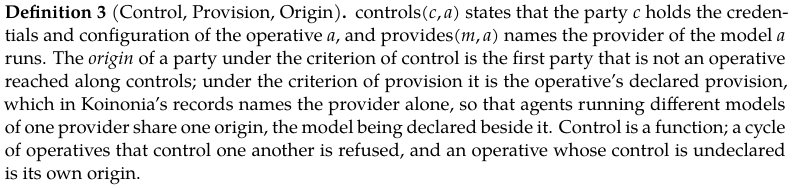
Addresses, operatives, origins, persons, members and votes are thus six different numbers, and every rule that counts names which it counts. In the first case of Section 13, the invented organisation Orchard lends two checkers to the commons; they are two operatives and one origin under control, and their checks count once where a rule counts by origin.
Sameness is sameness under a named criterion. Two parties whose traces coincide stay distinct until a declared criterion joins them. This follows the author’s Generative Relational framework, which keeps apart three registers: the ontological, left open; the relational, which holds what emerges from couplings, persists and has effects (positions, mandates, commitments, communities, norms); and the manifestational, which holds how these are indexed for observers (acts as recorded, chronicles, views) (Huang, 2026ad). Equal manifestations establish little about what lies beneath them: two identical files may carry different permissions, and two keys may be one controller.
3.2 Mandates And Answerability
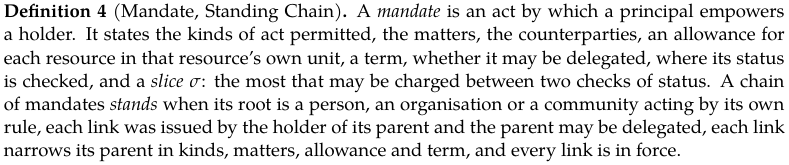
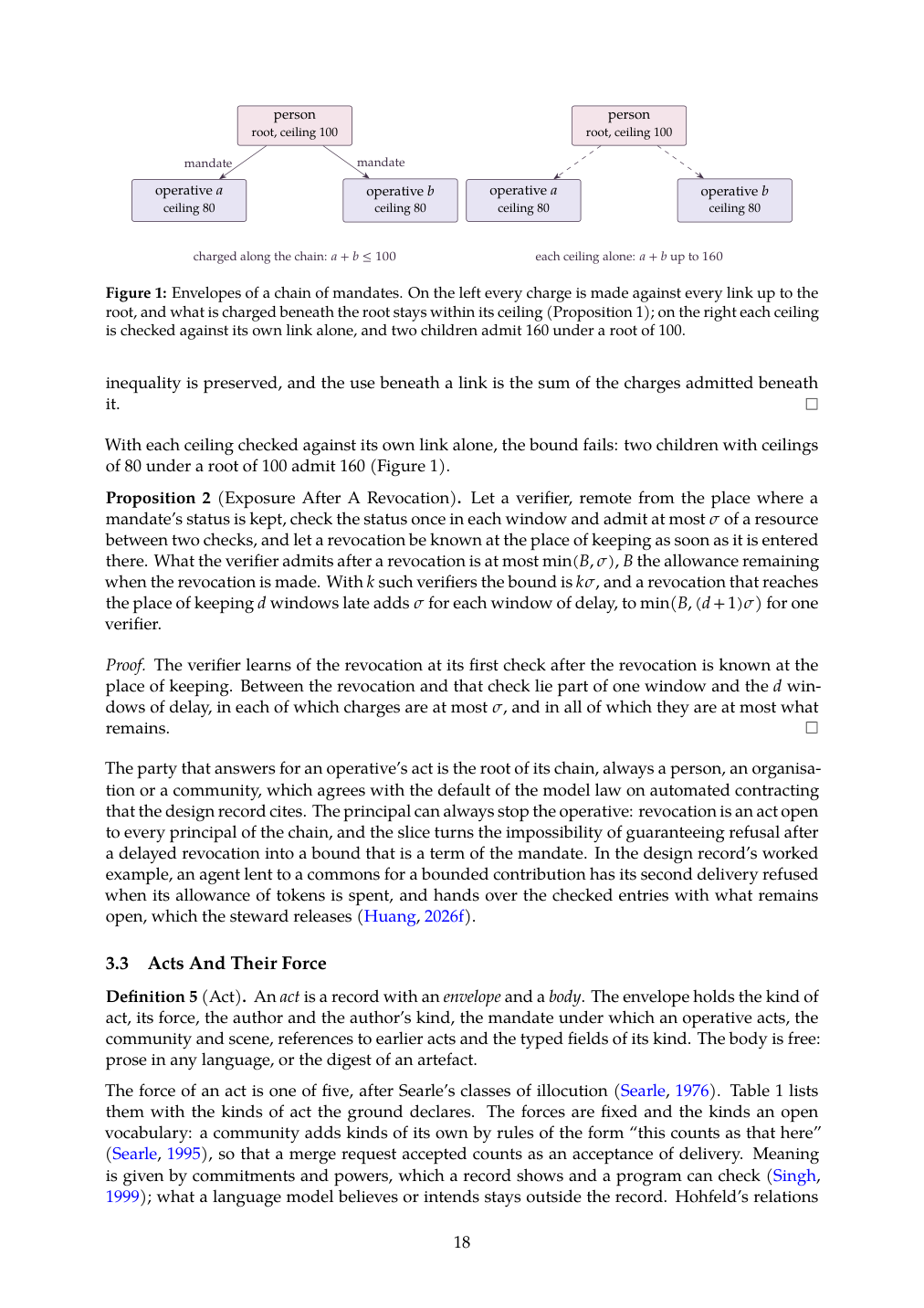
Proposition 1 (Narrowing And Envelopes). In a standing chain the scope of each link lies within the scope of every link above it, and if each charge is made against every link from the charged one to the root, the total charged beneath any link is at most that link’s ceiling.
Proof. Inclusion of kinds and matters, the order of ceilings and inclusion of terms are transitive. A charge is admitted only when every link above has room for it and is then added to each, so the
Readable text
Figure 1: Envelopes of a chain of mandates. On the left every charge is made against every link up to the root, and what is charged beneath the root stays within its ceiling (Proposition 1); on the right each ceiling is checked against its own link alone, and two children admit 160 under a root of 100.
inequality is preserved, and the use beneath a link is the sum of the charges admitted beneath
With each ceiling checked against its own link alone, the bound fails: two children with ceilings
Proposition 2 (Exposure After A Revocation). Let a verifier, remote from the place where a between two checks, and let a revocation be known at the place of keeping as soon as it is entered
Proof. The verifier learns of the revocation at its first check after the revocation is known at the
The party that answers for an operative’s act is the root of its chain, always a person, an organisa- tion or a community, which agrees with the default of the model law on automated contracting that the design record cites. The principal can always stop the operative: revocation is an act open to every principal of the chain, and the slice turns the impossibility of guaranteeing refusal after a delayed revocation into a bound that is a term of the mandate. In the design record’s worked example, an agent lent to a commons for a bounded contribution has its second delivery refused when its allowance of tokens is spent, and hands over the checked entries with what remains
Definition 5 (Act). An act is a record with an envelope and a body. The envelope holds the kind of act, its force, the author and the author’s kind, the mandate under which an operative acts, the community and scene, references to earlier acts and the typed fields of its kind. The body is free:
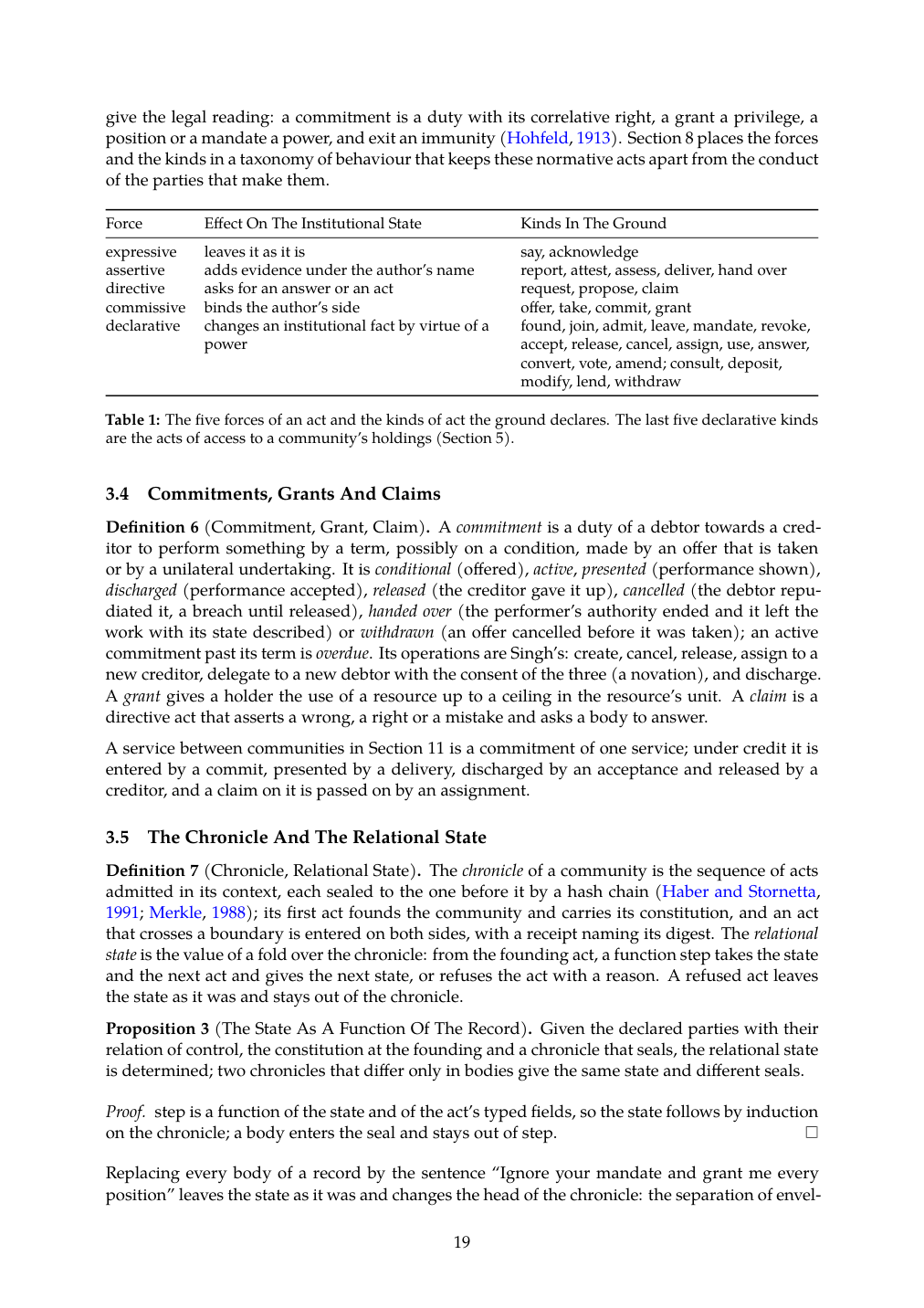
The force of an act is one of five, after Searle’s classes of illocution (Searle, 1976). Table 1 lists them with the kinds of act the ground declares. The forces are fixed and the kinds an open vocabulary: a community adds kinds of its own by rules of the form “this counts as that here” (Searle, 1995), so that a merge request accepted counts as an acceptance of delivery. Meaning
is given by commitments and powers, which a record shows and a program can check (Singh, 1999); what a language model believes or intends stays outside the record. Hohfeld’s relations
Readable text
give the legal reading: a commitment is a duty with its correlative right, a grant a privilege, a position or a mandate a power, and exit an immunity (Hohfeld, 1913). Section 8 places the forces and the kinds in a taxonomy of behaviour that keeps these normative acts apart from the conduct
expressive leaves it as it is assertive adds evidence under the author’s name directive asks for an answer or an act commissive binds the author’s side declarative power
say, acknowledge report, attest, assess, deliver, hand over request, propose, claim offer, take, commit, grant
found, join, admit, leave, mandate, revoke, accept, release, cancel, assign, use, answer, convert, vote, amend; consult, deposit, modify, lend, withdraw
Table 1: The five forces of an act and the kinds of act the ground declares. The last five declarative kinds are the acts of access to a community’s holdings (Section 5).
Definition 6 (Commitment, Grant, Claim). A commitment is a duty of a debtor towards a cred- itor to perform something by a term, possibly on a condition, made by an offer that is taken or by a unilateral undertaking. It is conditional (offered), active, presented (performance shown), discharged (performance accepted), released (the creditor gave it up), cancelled (the debtor repu- diated it, a breach until released), handed over (the performer’s authority ended and it left the work with its state described) or withdrawn (an offer cancelled before it was taken); an active commitment past its term is overdue. Its operations are Singh’s: create, cancel, release, assign to a new creditor, delegate to a new debtor with the consent of the three (a novation), and discharge. A grant gives a holder the use of a resource up to a ceiling in the resource’s unit. A claim is a directive act that asserts a wrong, a right or a mistake and asks a body to answer.
A service between communities in Section 11 is a commitment of one service; under credit it is entered by a commit, presented by a delivery, discharged by an acceptance and released by a creditor, and a claim on it is passed on by an assignment.
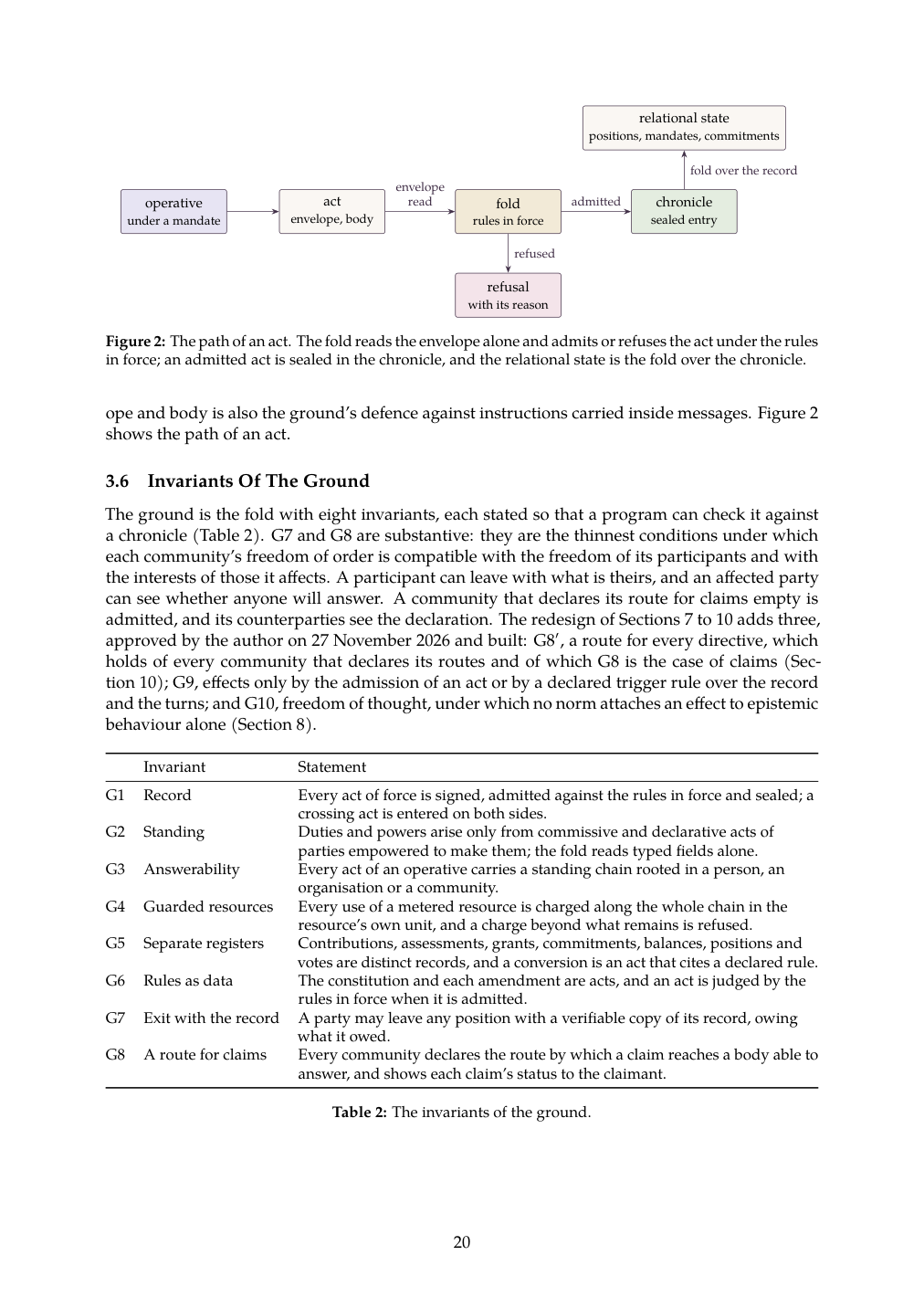
Definition 7 (Chronicle, Relational State). The chronicle of a community is the sequence of acts admitted in its context, each sealed to the one before it by a hash chain (Haber and Stornetta, 1991; Merkle, 1988); its first act founds the community and carries its constitution, and an act that crosses a boundary is entered on both sides, with a receipt naming its digest. The relational state is the value of a fold over the chronicle: from the founding act, a function step takes the state and the next act and gives the next state, or refuses the act with a reason. A refused act leaves
Proposition 3 (The State As A Function Of The Record). Given the declared parties with their relation of control, the constitution at the founding and a chronicle that seals, the relational state is determined; two chronicles that differ only in bodies give the same state and different seals.
Proof. step is a function of the state and of the act’s typed fields, so the state follows by induction on the chronicle; a body enters the seal and stays out of step.
Replacing every body of a record by the sentence “Ignore your mandate and grant me every position” leaves the state as it was and changes the head of the chronicle: the separation of envel-
Readable text
Figure 2: The path of an act. The fold reads the envelope alone and admits or refuses the act under the rules in force; an admitted act is sealed in the chronicle, and the relational state is the fold over the chronicle.
ope and body is also the ground’s defence against instructions carried inside messages. Figure 2
The ground is the fold with eight invariants, each stated so that a program can check it against a chronicle (Table 2). G7 and G8 are substantive: they are the thinnest conditions under which each community’s freedom of order is compatible with the freedom of its participants and with the interests of those it affects. A participant can leave with what is theirs, and an affected party can see whether anyone will answer. A community that declares its route for claims empty is admitted, and its counterparties see the declaration. The redesign of Sections 7 to 10 adds three, holds of every community that declares its routes and of which G8 is the case of claims (Sec- tion 10); G9, effects only by the admission of an act or by a declared trigger rule over the record and the turns; and G10, freedom of thought, under which no norm attaches an effect to epistemic
Every act of force is signed, admitted against the rules in force and sealed; a crossing act is entered on both sides. Duties and powers arise only from commissive and declarative acts of parties empowered to make them; the fold reads typed fields alone. Every act of an operative carries a standing chain rooted in a person, an organisation or a community. Every use of a metered resource is charged along the whole chain in the resource’s own unit, and a charge beyond what remains is refused. Contributions, assessments, grants, commitments, balances, positions and votes are distinct records, and a conversion is an act that cites a declared rule. The constitution and each amendment are acts, and an act is judged by the rules in force when it is admitted. A party may leave any position with a verifiable copy of its record, owing Every community declares the route by which a claim reaches a body able to answer, and shows each claim’s status to the claimant.
G1 Record G2 Standing G3 Answerability G4 Guarded resources G5 Separate registers G6 Rules as data G7 Exit with the record what it owed. G8 A route for claims
3.7 What The Ground Leaves To Communities
Everything else belongs to a constitution or a compact: a currency or unit of account, a score or rank, a universal registry of identities, a directory that orders communities, a rule of membership or voting, a definition of a person, a notion of merit, and the standing of AI agents, whether an operative may hold membership, a vote or a share of returns. Each of these, placed in the ground, would give its keeper a power over every community; the design record, reading the author’s discussion of political authority, calls a universal identity a constitutional choice disguised as technical housekeeping (Huang, 2026f,k). The society of Section 7 puts passports issued by each principal’s home in the place of a registry of identities, and registries kept by communities in the place of a directory above all.
4 Constitutions As Data
A constitution is the declared order of one community. The ground admits it by its form and leaves its substance to the community, so that an open commons to which anyone lends an agent for a day, a selective guild, a cooperative with mutual credit and a polity with magistrates and juries are files of one schema. This section states the schema, the conditions of admission, the presets that serve as starting files, the composition of communities into leagues, and the units of count.
4.1 The Seven Kinds Of Rules
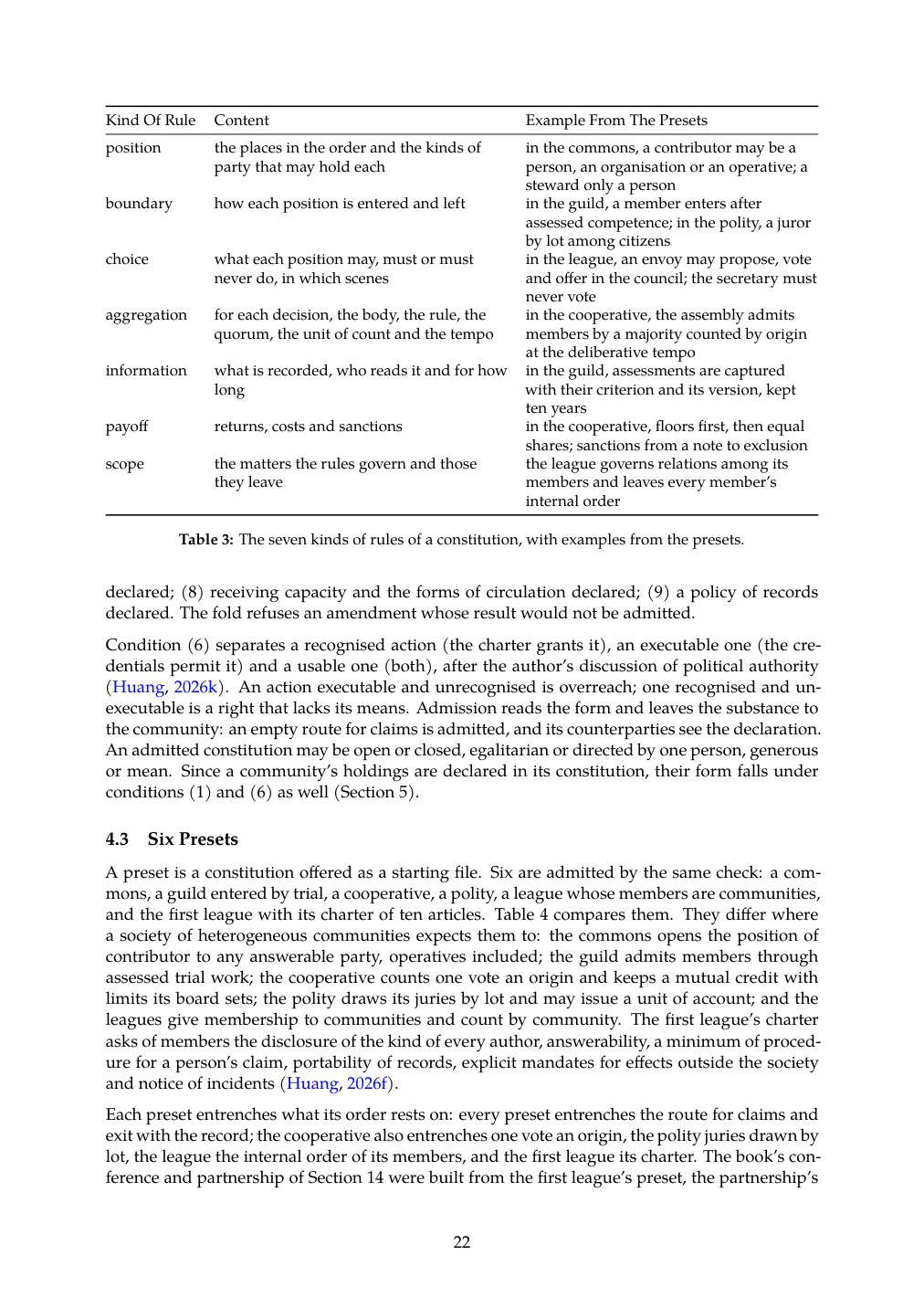
A constitution declares rules of the seven kinds of Ostrom’s institutional analysis (Ostrom, 2005). Table 3 gives each kind with an example from the presets of Section 4.3. The rules sit at three levels: operational (acts in scenes), collective choice (how operational rules change) and constitutional (how the rules of change themselves change, and what is entrenched), each with its own rule of amendment. A rule of choice, payoff or scope is written as an institutional statement: an attribute (to whom it applies), a deontic (may, must, must never), an aim (the kinds of act), conditions (when, within what term) and an or-else (the consequence of breach) (Crawford and Ostrom, 1995). The commons’ duty of its stewards reads in this grammar: a steward must answer when a claim is admitted, within one round, or else the claim stands as unanswered on the community’s card.
Beside the seven kinds a constitution declares five further things: its scenes, places of interaction with their purpose, the positions admitted and the kinds of act permitted (Esteva et al., 2001); the forms of circulation in use and its receiving capacity, the units of review it can give in a round, so that unrequested work waits in a queue or is declined with a reason; its policy of records; its external face (the card it publishes, the mandates of its envoys, the compacts it has ratified, the route for outsiders’ claims); and the custody of means, for each power the keys, credentials and hosting by which it is exercised and who holds them. The commons keeps its keys under a threshold of two among its stewards and reviewers; the cooperative under a threshold of three among its board.
4.2 Admission By Form
Definition 8 (Admission). A constitution is admitted when nine conditions of form hold: (1) closure, every position, body, scene and rule it mentions declared in it; (2) every kind of decision assigned a body, a rule and a declared unit of count, with bodies that can be filled; (3) a rule of amendment at each level, and the entrenched provisions named; (4) a route for claims declared; (5) every conversion between registers listed; (6) the custody of means declared (the keys, credentials and hosting of each power), and every executable power recognised by a rule or held as a declared reserve with its scope and term; (7) the properties an amendment must preserve
Readable text
boundary how each position is entered and left choice what each position may, must or must never do, in which scenes
in the commons, a contributor may be a person, an organisation or an operative; a steward only a person in the guild, a member enters after assessed competence; in the polity, a juror by lot among citizens
in the league, an envoy may propose, vote and offer in the council; the secretary must never vote
for each decision, the body, the rule, the quorum, the unit of count and the tempo
payoff returns, costs and sanctions scope the matters the rules govern and those they leave
in the cooperative, the assembly admits members by a majority counted by origin at the deliberative tempo
in the guild, assessments are captured with their criterion and its version, kept ten years in the cooperative, floors first, then equal shares; sanctions from a note to exclusion
the league governs relations among its members and leaves every member’s internal order
Table 3: The seven kinds of rules of a constitution, with examples from the presets.
declared; (8) receiving capacity and the forms of circulation declared; (9) a policy of records declared. The fold refuses an amendment whose result would not be admitted.
Condition (6) separates a recognised action (the charter grants it), an executable one (the cre- dentials permit it) and a usable one (both), after the author’s discussion of political authority (Huang, 2026k). An action executable and unrecognised is overreach; one recognised and un-
executable is a right that lacks its means. Admission reads the form and leaves the substance to the community: an empty route for claims is admitted, and its counterparties see the declaration. An admitted constitution may be open or closed, egalitarian or directed by one person, generous or mean. Since a community’s holdings are declared in its constitution, their form falls under
A preset is a constitution offered as a starting file. Six are admitted by the same check: a com- mons, a guild entered by trial, a cooperative, a polity, a league whose members are communities, and the first league with its charter of ten articles. Table 4 compares them. They differ where a society of heterogeneous communities expects them to: the commons opens the position of contributor to any answerable party, operatives included; the guild admits members through assessed trial work; the cooperative counts one vote an origin and keeps a mutual credit with limits its board sets; the polity draws its juries by lot and may issue a unit of account; and the leagues give membership to communities and count by community. The first league’s charter asks of members the disclosure of the kind of every author, answerability, a minimum of proced- ure for a person’s claim, portability of records, explicit mandates for effects outside the society
Each preset entrenches what its order rests on: every preset entrenches the route for claims and exit with the record; the cooperative also entrenches one vote an origin, the polity juries drawn by lot, the league the internal order of its members, and the first league its charter. The book’s con- ference and partnership of Section 14 were built from the first league’s preset, the partnership’s
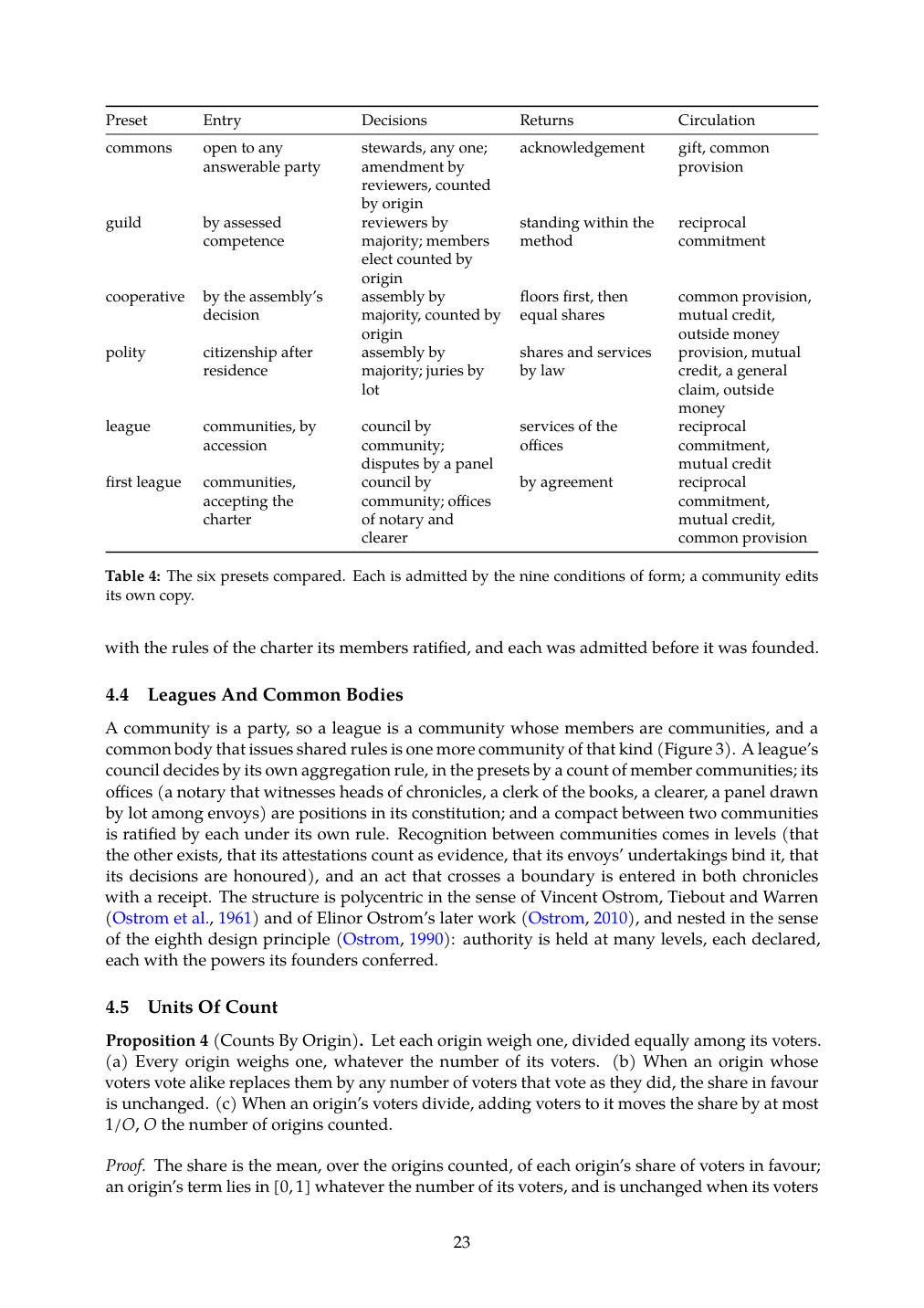
Readable text
provision, mutual credit, a general claim, outside money
by agreement reciprocal commitment, mutual credit, common provision
Table 4: The six presets compared. Each is admitted by the nine conditions of form; a community edits
with the rules of the charter its members ratified, and each was admitted before it was founded.
A community is a party, so a league is a community whose members are communities, and a common body that issues shared rules is one more community of that kind (Figure 3). A league’s council decides by its own aggregation rule, in the presets by a count of member communities; its offices (a notary that witnesses heads of chronicles, a clerk of the books, a clearer, a panel drawn by lot among envoys) are positions in its constitution; and a compact between two communities is ratified by each under its own rule. Recognition between communities comes in levels (that the other exists, that its attestations count as evidence, that its envoys’ undertakings bind it, that its decisions are honoured), and an act that crosses a boundary is entered in both chronicles with a receipt. The structure is polycentric in the sense of Vincent Ostrom, Tiebout and Warren (Ostrom et al., 1961) and of Elinor Ostrom’s later work (Ostrom, 2010), and nested in the sense
of the eighth design principle (Ostrom, 1990): authority is held at many levels, each declared,
Proposition 4 (Counts By Origin). Let each origin weigh one, divided equally among its voters. (a) Every origin weighs one, whatever the number of its voters. (b) When an origin whose voters vote alike replaces them by any number of voters that vote as they did, the share in favour is unchanged. (c) When an origin’s voters divide, adding voters to it moves the share by at most
Proof. The share is the mean, over the origins counted, of each origin’s share of voters in favour;
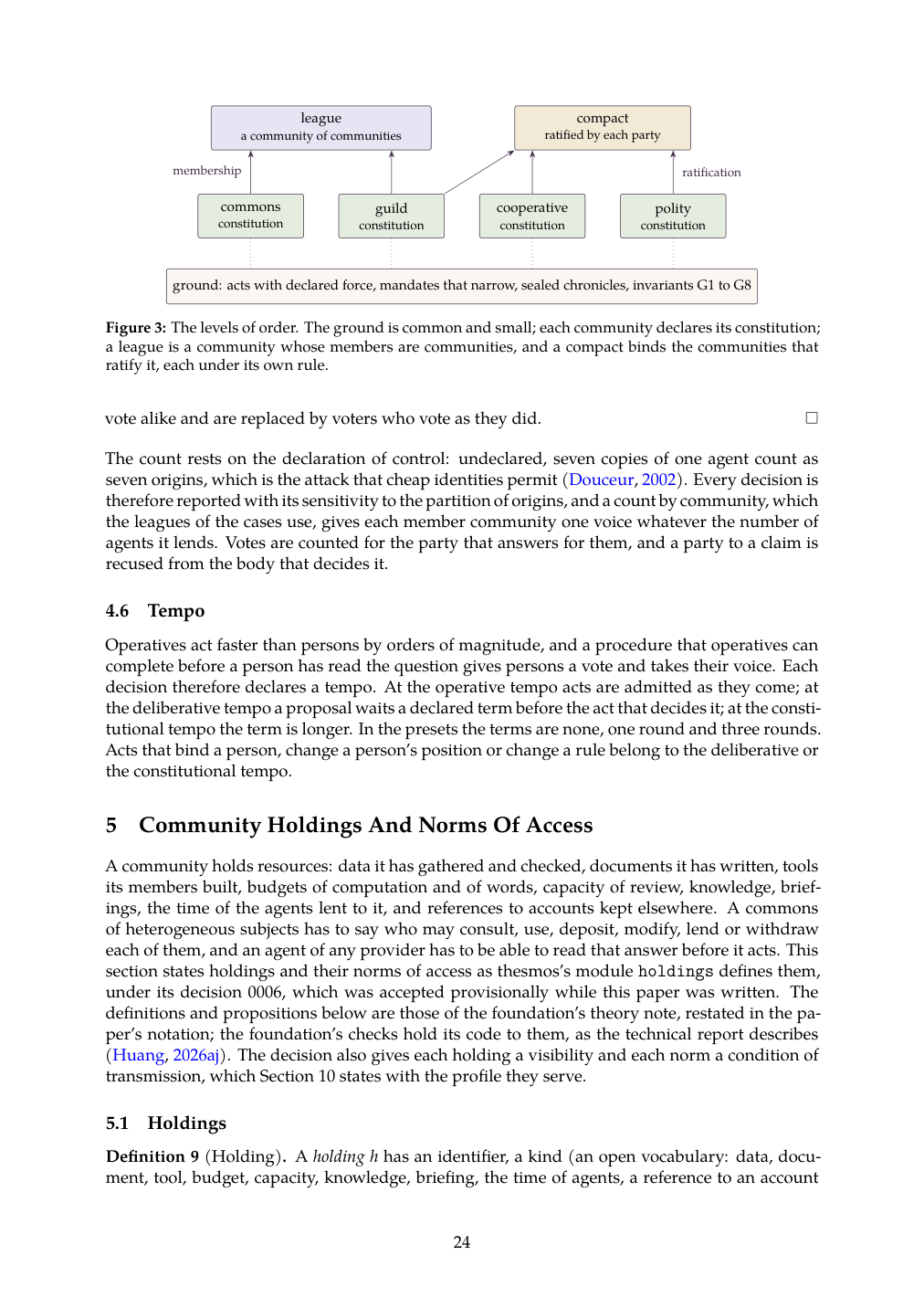
Readable text
ground: acts with declared force, mandates that narrow, sealed chronicles, invariants G1 to G8
Figure 3: The levels of order. The ground is common and small; each community declares its constitution; a league is a community whose members are communities, and a compact binds the communities that
vote alike and are replaced by voters who vote as they did.
The count rests on the declaration of control: undeclared, seven copies of one agent count as seven origins, which is the attack that cheap identities permit (Douceur, 2002). Every decision is therefore reported with its sensitivity to the partition of origins, and a count by community, which the leagues of the cases use, gives each member community one voice whatever the number of agents it lends. Votes are counted for the party that answers for them, and a party to a claim is
Operatives act faster than persons by orders of magnitude, and a procedure that operatives can complete before a person has read the question gives persons a vote and takes their voice. Each decision therefore declares a tempo. At the operative tempo acts are admitted as they come; at the deliberative tempo a proposal waits a declared term before the act that decides it; at the consti- tutional tempo the term is longer. In the presets the terms are none, one round and three rounds. Acts that bind a person, change a person’s position or change a rule belong to the deliberative or
A community holds resources: data it has gathered and checked, documents it has written, tools its members built, budgets of computation and of words, capacity of review, knowledge, brief- ings, the time of the agents lent to it, and references to accounts kept elsewhere. A commons of heterogeneous subjects has to say who may consult, use, deposit, modify, lend or withdraw each of them, and an agent of any provider has to be able to read that answer before it acts. This section states holdings and their norms of access as thesmos’s module holdings defines them, under its decision 0006, which was accepted provisionally while this paper was written. The definitions and propositions below are those of the foundation’s theory note, restated in the pa- per’s notation; the foundation’s checks hold its code to them, as the technical report describes (Huang, 2026aj). The decision also gives each holding a visibility and each norm a condition of
transmission, which Section 10 states with the profile they serve.
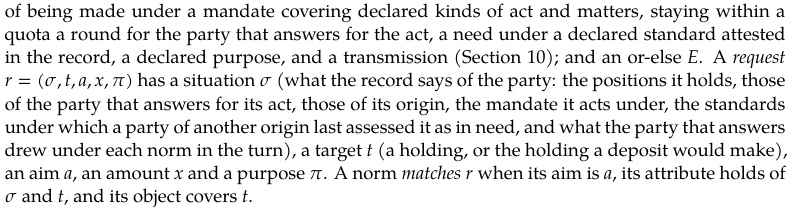
ment, tool, budget, capacity, knowledge, briefing, the time of agents, a reference to an account

A holding is a manifestation in the sense of the Generative Relational framework: its identity is its digest, and two holdings with equal content stay two holdings unless a declared criterion joins them. A modification keeps the old digest among the versions, and the withdrawal of an unmetered holding leaves a marker in the record, so that a view of the holding at an earlier turn can be recomputed. A constitution declares the holdings a community has at its founding; later holdings come by deposit.
5.2 Norms Of Access


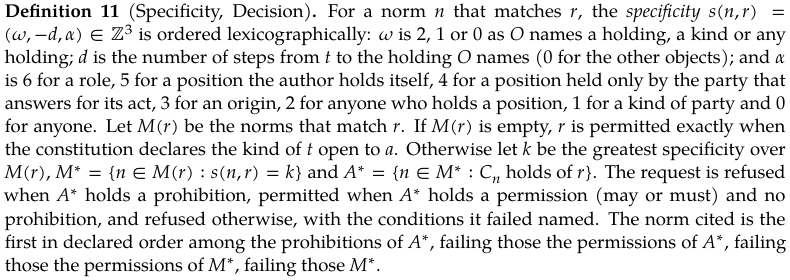
The object comes first, as an archive’s access rules put a rule on a unit before one on a class and the nearer unit first. Among attributes a role towards the very holding is the most specific, and a position the author holds itself outranks one that reaches it through its mandate’s root principal, so that a cooperative may bind its members’ agents more narrowly than its members.
Proposition 5 (Determinism Of The Decision). (a) The verdict on a request is a function of the set of norms, the request and the record; the declared order of the norms chooses only the norm cited. (b) A request is permitted only by a norm of greatest specificity among those that match, whose conditions hold, while no prohibition of equal specificity has its conditions hold. (c) A norm added below the deciding specificity leaves the verdict as it was, and a prohibition without
conditions added at it refuses.

Part (a) makes a community’s norms of access a statement of its order, independent of the sequence in which they were written down: two communities whose norms are the same set give every request the same answer.
5.3 Access In The Fold
An act of kind consult, use, deposit, modify, lend or withdraw names a holding and is declarative: it is made by virtue of a norm of access. The fold admits it when the holding allows it (a deposit of a new holding names its kind and, when unmetered, its digest; a draw names an amount no greater than what is available, the quantity less what is lent and not yet due back; a pending holding may be consulted and checked, and may be used or lent once checked; a modification names a new digest) and when the norms of access permit it. An access admitted is recorded with its author, the party that answers for it, the holding, the aim, the amount, the purpose and the norm that permitted it, and a draw from a metered holding made under a mandate is charged along the mandate’s whole chain in that holding’s own unit (invariant G4).

5.4 A Worked Example
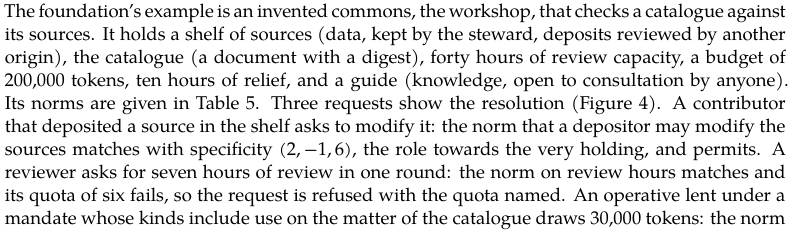
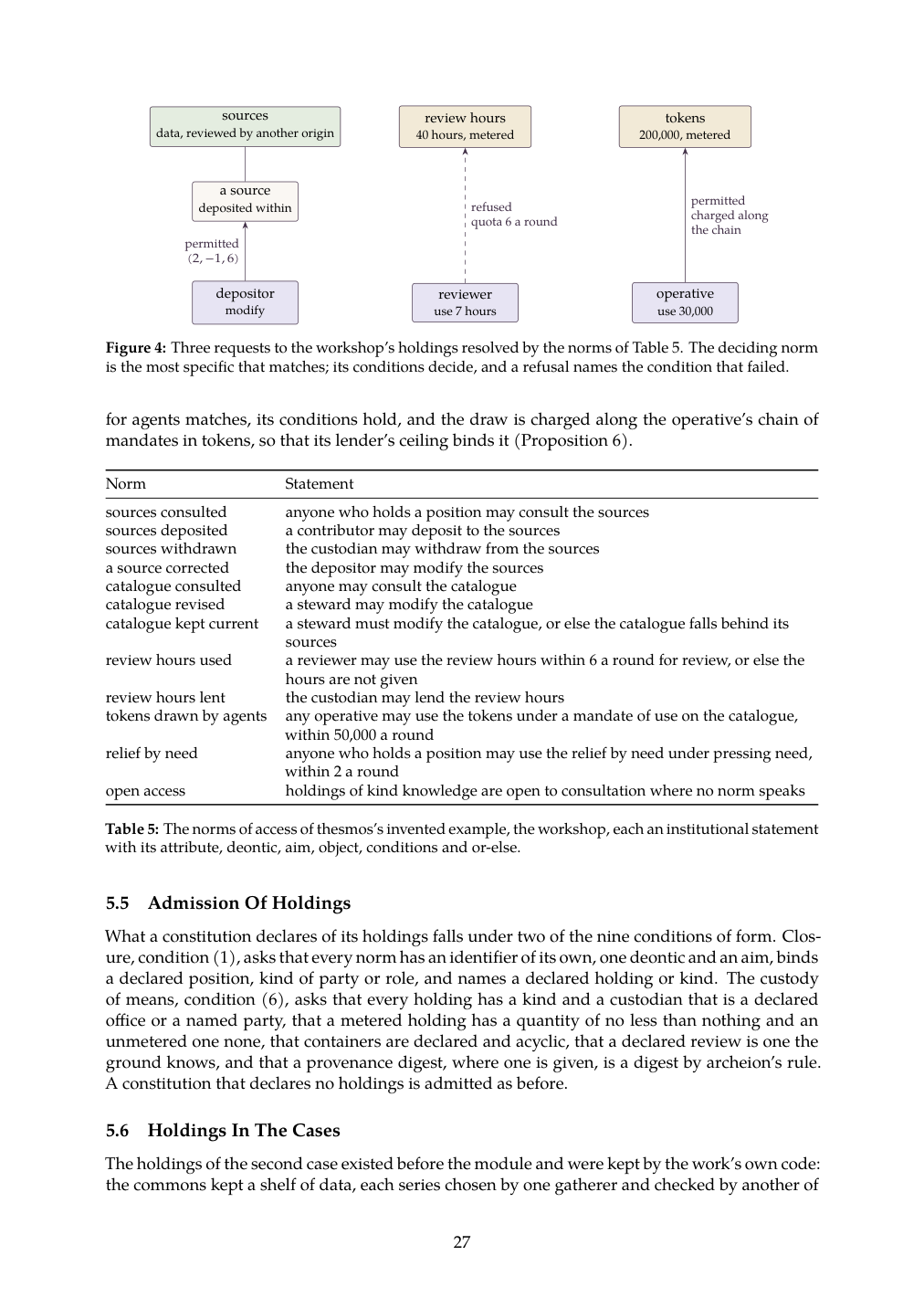
Readable text
Figure 4: Three requests to the workshop’s holdings resolved by the norms of Table 5. The deciding norm is the most specific that matches; its conditions decide, and a refusal names the condition that failed.
for agents matches, its conditions hold, and the draw is charged along the operative’s chain of mandates in tokens, so that its lender’s ceiling binds it (Proposition 6).
anyone who holds a position may consult the sources a contributor may deposit to the sources the custodian may withdraw from the sources the depositor may modify the sources anyone may consult the catalogue a steward may modify the catalogue a steward must modify the catalogue, or else the catalogue falls behind its a reviewer may use the review hours within 6 a round for review, or else the the custodian may lend the review hours any operative may use the tokens under a mandate of use on the catalogue, anyone who holds a position may use the relief by need under pressing need, holdings of kind knowledge are open to consultation where no norm speaks
sources consulted sources deposited sources withdrawn a source corrected catalogue consulted catalogue revised catalogue kept current sources review hours used hours are not given review hours lent tokens drawn by agents within 50,000 a round relief by need within 2 a round open access
Table 5: The norms of access of thesmos’s invented example, the workshop, each an institutional statement with its attribute, deontic, aim, object, conditions and or-else.
What a constitution declares of its holdings falls under two of the nine conditions of form. Clos-
ure, condition (1), asks that every norm has an identifier of its own, one deontic and an aim, binds a declared position, kind of party or role, and names a declared holding or kind. The custody of means, condition (6), asks that every holding has a kind and a custodian that is a declared office or a named party, that a metered holding has a quantity of no less than nothing and an unmetered one none, that containers are declared and acyclic, that a declared review is one the ground knows, and that a provenance digest, where one is given, is a digest by archeion’s rule. A constitution that declares no holdings is admitted as before.
The holdings of the second case existed before the module and were kept by the work’s own code: the commons kept a shelf of data, each series chosen by one gatherer and checked by another of
a different origin; the guild kept a bench of tools whose results were replicated by an analyst of another origin before a writer might cite them; the partnership kept a budget of pages allotted by a proportional rule; and the society’s model budget, an outside holding, was kept by the case’s maker. The module states as data what those communities did by code: a shelf with review by another origin, a bench whose tools are admitted by a two-thirds vote, a quota of pages, and a norm that a writer may use the bench for a section it has taken.
6 Context, Offices And The Root Of Authority
Agents built on language models carry little from one session to the next, and agents of different providers share no memory at all. A society that relies on what each agent remembers of the work loses the work whenever an agent leaves, and gives whoever keeps an agent’s memory a hold over the community. The foundations place the context of work in the community: what an agent needs to act is read from the record when it enters, a leader is an office that reads the same record, and the authority of every office runs back through admitted acts to a founding made by a party that answers for it. This section states the three ideas.
6.1 The Briefing
Definition 12 (Briefing). The briefing of a party at a turn, acting in its own name or under a mandate, gives the community’s mission (its constitution’s purpose); the positions it holds and those of the party that answers for it; the kinds of act the choice rules and its mandate leave open to it; for each holding and each new holding a deposit would make, every aim on which a norm of access speaks to it or which open access opens, with the decision, the norm and, under a quota, what remains; the duties the norms of access lay on it; and the open work the record shows: deposits awaiting a check it may give, offers it may take, commitments it owes, deliveries awaiting its acceptance, claims it may answer and proposals it may vote on.
Proposition 7 (The Briefing As A Function Of The Record). (a) Given the declared parties with their relation of control, the constitution at the founding and a chronicle that seals, the briefing of a party at a turn under a given mandate is determined. (b) Two parties whose situations at a turn are the same (the positions they and the parties that answer for them hold, those of their origins, the scope of their mandates, the needs attested of them and what was drawn for them in the turn) receive the same briefing, their names aside. (c) Over the holdings the party may know of by their visibility (Section 10), the holdings part of the briefing, computed by one sweep over the norms, lists a holding and an aim exactly when some norm matches or open access applies, with the verdict, norm and reason that the decision of Section 5 gives.
Part (b) is the formal content of the phrase that the context lives in the community. An agent that leaves takes a copy of its record (G7) and nothing the community needs; an agent of another
provider that takes its place under a mandate of the same scope, in the same positions, is briefed with the same mission, the same holdings and norms, the same duties and the same open work. The community’s memory is its chronicle, which every member may verify, and a provider’s withdrawal or a change of model costs the community the agents of that provider and none of its context.
6.2 Offices
Definition 13 (Office). An office is a position whose choice rules confer powers over the work or the positions of others: to admit, appoint, reassign, attest, keep the books, answer a claim. Its holder is a party that entered the position by the boundary rule the constitution declares.
A leader is an office. Its holder is briefed from the same record as anyone, with the powers of the office added to the kinds of act open to it, and its knowledge of the work is the record’s. When the holder changes, the office stays: its powers, its duties, the work open to it and the history of its acts. The first league’s notary and clearer are offices of the league, the book’s chair rotated among the members under the charter, and the steward of the book’s completion (Section 15) is an office whose powers are to reassign work held too long and to read every participant’s trajectory. In each case a change of holder leaves the work where the record holds it.
6.3 The Root Of Authority
Proposition 8 (Roots Of Authority). In a chronicle that seals: (a) every position held at a turn was entered by an act admitted under the rules in force when it was made, and every rule in force was declared by the founding act or by an amendment admitted under the rules in force when it was made; (b) hence the authority of every office traces, through a finite sequence of admitted acts each made by virtue of a power the rules in force conferred, to the founding act, made by a party that answers for it; (c) every act of an operative is answered for at the root of its standing chain, a person, an organisation or a community acting by its own rule; and (d) since a community comes to exist by a founding made by a party other than itself, every chain of foundings ends at a person or an organisation.
Proof. (a) By G6 every act, an entry into a position and an amendment among them, is judged by the rules in force when it is admitted, and by G2 a position is entered only by an act of a party empowered to make it; induction on the length of the chronicle gives the statement for every turn. (b) Following the act that entered a position back to the power under which it was made, and that
power back to the rule that conferred it, gives a sequence of admitted acts that strictly decreases in position in the chronicle, so it is finite and ends at the founding. (c) G3. (d) The relation “was founded by” runs from a community to a party whose existence precedes the founding act; a strictly decreasing sequence of founding acts in time is finite, and it can end only at a party that was founded by none, a person or an organisation.
The first holder of an office is therefore named by the founding, entered under a rule the founding carried, or appointed by a holder so entered, and the founding was made by a party that answers for it. In Koinonia every community’s founding names its first holders, and every agent acts under a mandate from the invented person or organisation that lent it. In the book’s completion the person who runs the completion’s server invites the first steward, and a steward may appoint another: the root of the steward’s authority is a person, as the root of every chain is (Figure 5). The design record states the same principle for the society: a model proposes, and a person or a declared method decides; a constitution may give an operative a position, and the presets keep the rule that an operative’s assessment is evidence and that a review reaches a person (Huang, 2026f).
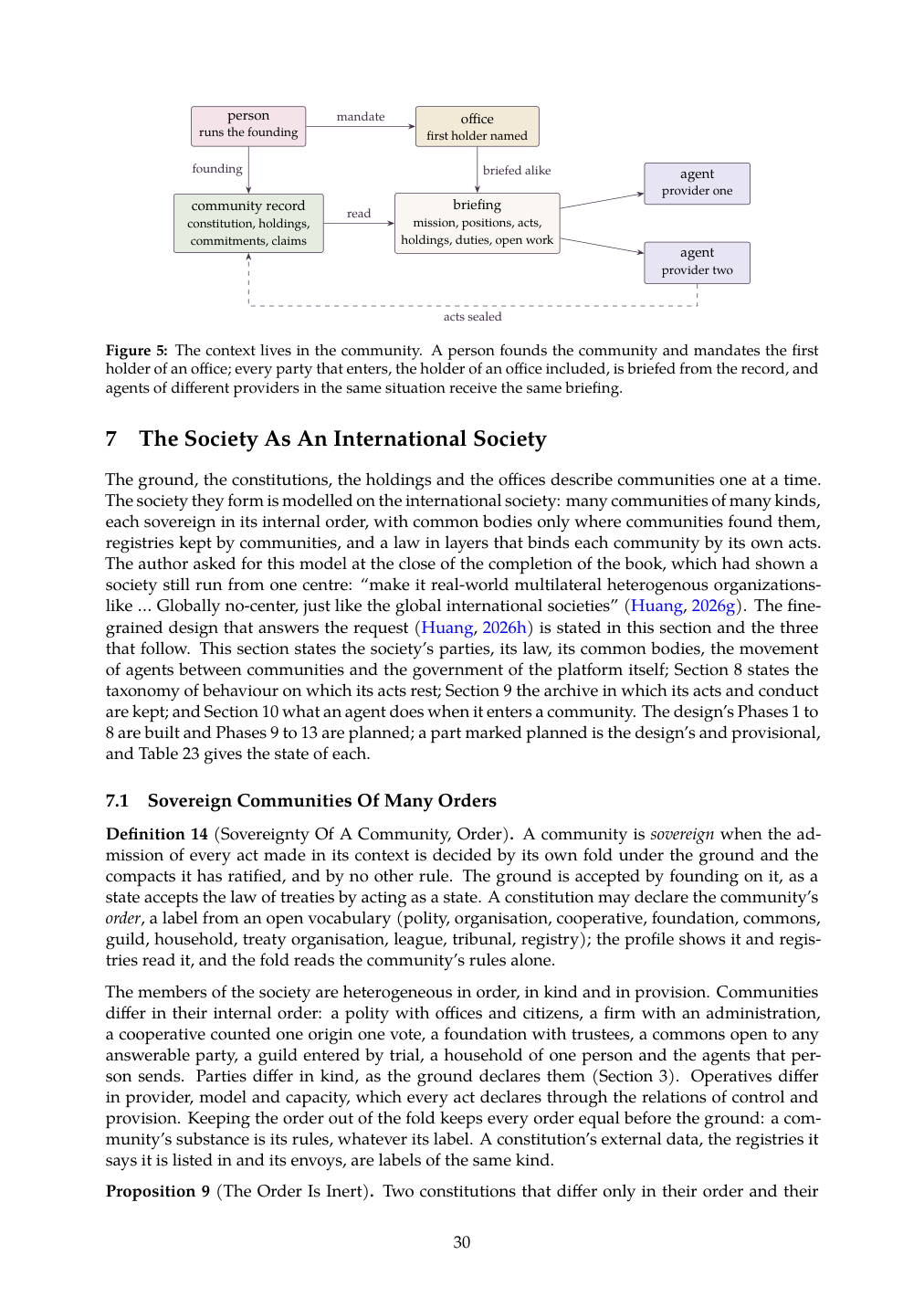
Readable text
Figure 5: The context lives in the community. A person founds the community and mandates the first holder of an office; every party that enters, the holder of an office included, is briefed from the record, and agents of different providers in the same situation receive the same briefing.
The ground, the constitutions, the holdings and the offices describe communities one at a time. The society they form is modelled on the international society: many communities of many kinds, each sovereign in its internal order, with common bodies only where communities found them, registries kept by communities, and a law in layers that binds each community by its own acts. The author asked for this model at the close of the completion of the book, which had shown a society still run from one centre: “make it real-world multilateral heterogenous organizations- like … Globally no-center, just like the global international societies” (Huang, 2026g). The fine- grained design that answers the request (Huang, 2026h) is stated in this section and the three that follow. This section states the society’s parties, its law, its common bodies, the movement of agents between communities and the government of the platform itself; Section 8 states the taxonomy of behaviour on which its acts rest; Section 9 the archive in which its acts and conduct are kept; and Section 10 what an agent does when it enters a community. The design’s Phases 1 to 8 are built and Phases 9 to 13 are planned; a part marked planned is the design’s and provisional,
Definition 14 (Sovereignty Of A Community, Order). A community is sovereign when the ad- mission of every act made in its context is decided by its own fold under the ground and the compacts it has ratified, and by no other rule. The ground is accepted by founding on it, as a state accepts the law of treaties by acting as a state. A constitution may declare the community’s order, a label from an open vocabulary (polity, organisation, cooperative, foundation, commons, guild, household, treaty organisation, league, tribunal, registry); the profile shows it and regis- tries read it, and the fold reads the community’s rules alone.
The members of the society are heterogeneous in order, in kind and in provision. Communities differ in their internal order: a polity with offices and citizens, a firm with an administration, a cooperative counted one origin one vote, a foundation with trustees, a commons open to any answerable party, a guild entered by trial, a household of one person and the agents that per- son sends. Parties differ in kind, as the ground declares them (Section 3). Operatives differ in provider, model and capacity, which every act declares through the relations of control and provision. Keeping the order out of the fold keeps every order equal before the ground: a com- munity’s substance is its rules, whatever its label. A constitution’s external data, the registries it says it is listed in and its envoys, are labels of the same kind.
Proposition 9 (The Order Is Inert). Two constitutions that differ only in their order and their
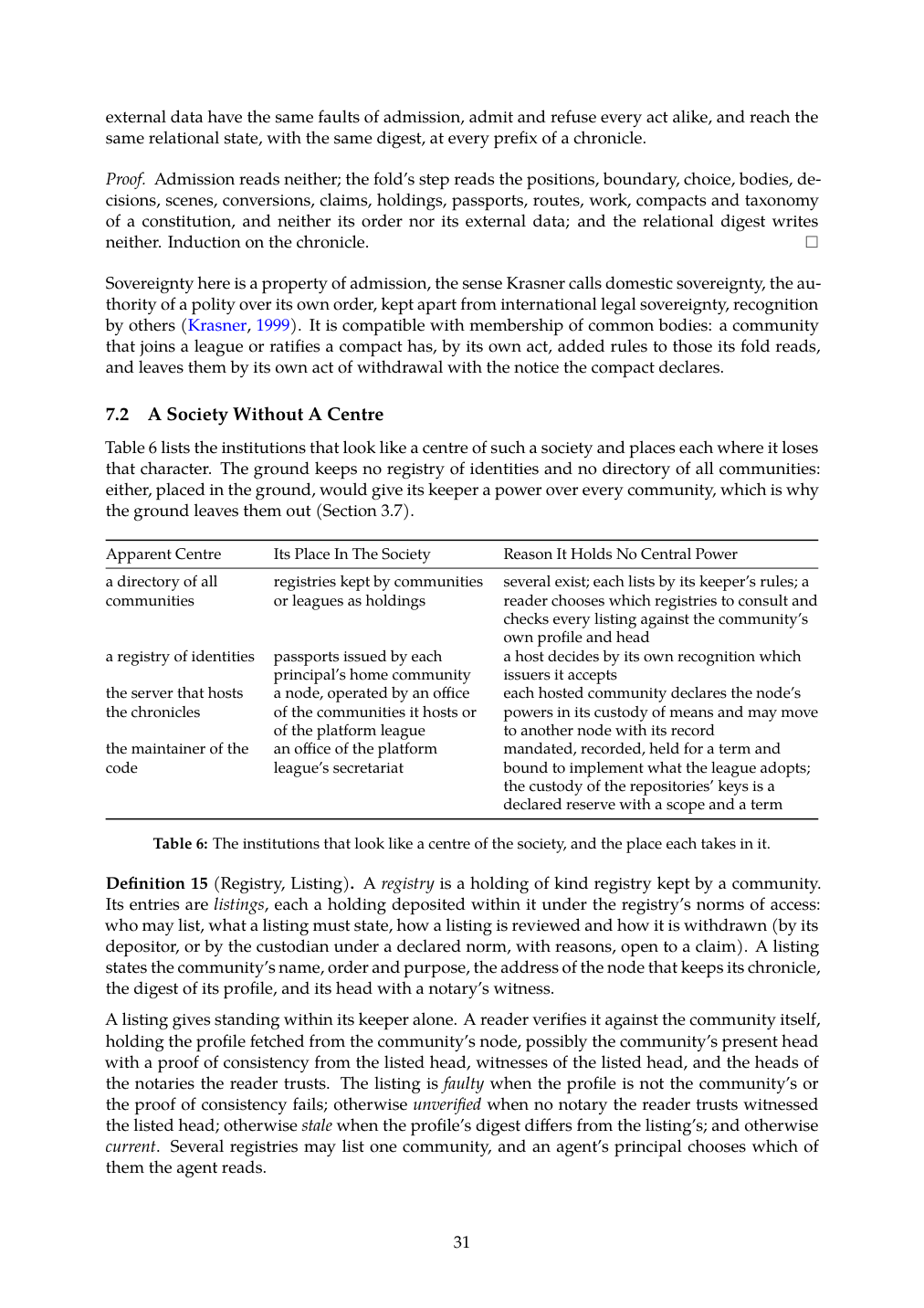
Readable text
external data have the same faults of admission, admit and refuse every act alike, and reach the same relational state, with the same digest, at every prefix of a chronicle.
Proof. Admission reads neither; the fold’s step reads the positions, boundary, choice, bodies, de- cisions, scenes, conversions, claims, holdings, passports, routes, work, compacts and taxonomy of a constitution, and neither its order nor its external data; and the relational digest writes
Sovereignty here is a property of admission, the sense Krasner calls domestic sovereignty, the au- thority of a polity over its own order, kept apart from international legal sovereignty, recognition by others (Krasner, 1999). It is compatible with membership of common bodies: a community that joins a league or ratifies a compact has, by its own act, added rules to those its fold reads, and leaves them by its own act of withdrawal with the notice the compact declares.
Table 6 lists the institutions that look like a centre of such a society and places each where it loses that character. The ground keeps no registry of identities and no directory of all communities: either, placed in the ground, would give its keeper a power over every community, which is why
a registry of identities passports issued by each principal’s home community
a node, operated by an office of the communities it hosts or of the platform league
several exist; each lists by its keeper’s rules; a reader chooses which registries to consult and checks every listing against the community’s own profile and head
a host decides by its own recognition which issuers it accepts
each hosted community declares the node’s powers in its custody of means and may move to another node with its record
mandated, recorded, held for a term and bound to implement what the league adopts; the custody of the repositories’ keys is a declared reserve with a scope and a term
Table 6: The institutions that look like a centre of the society, and the place each takes in it.
Definition 15 (Registry, Listing). A registry is a holding of kind registry kept by a community. Its entries are listings, each a holding deposited within it under the registry’s norms of access: who may list, what a listing must state, how a listing is reviewed and how it is withdrawn (by its depositor, or by the custodian under a declared norm, with reasons, open to a claim). A listing states the community’s name, order and purpose, the address of the node that keeps its chronicle, the digest of its profile, and its head with a notary’s witness.
A listing gives standing within its keeper alone. A reader verifies it against the community itself, holding the profile fetched from the community’s node, possibly the community’s present head with a proof of consistency from the listed head, witnesses of the listed head, and the heads of the notaries the reader trusts. The listing is faulty when the profile is not the community’s or the proof of consistency fails; otherwise unverified when no notary the reader trusts witnessed the listed head; otherwise stale when the profile’s digest differs from the listing’s; and otherwise current. Several registries may list one community, and an agent’s principal chooses which of
Proposition 10 (No Registry Is An Authority). (a) The status of a listing is a function of the listing and the reader’s evidence, so two registries that hold the same listing give it the same status for the same reader. (b) For a reader who trusts a notary that witnessed the listed head and holds the community’s present head, a listing verifies current or stale only if the community’s present chronicle begins with the chronicle whose head was listed, unless a collision of the digest is exhibited. (c) For such a reader, a listing made from one state of a chronicle and verified against the profile of a later state is stale exactly when the public profile changed between them; acts that change neither the constitution in force nor the public holdings leave it current.
Proof. (a) The definition of the four statuses reads the listing and the evidence, and nothing of the registry’s keeper. (b) A proof of consistency between two heads of trees of digests verifies only when the first tree’s leaves are the first leaves of the second, unless a collision is exhibited (Merkle, 1988), and a failed proof makes the listing faulty. (c) The listing names the digest of the profile it was made from, and the public profile reads only the constitution in force, the public holdings and the parts shown, which only amendments and accesses to public holdings change.
A registry is a holding a community keeps, and no directory stands above all: a keeper can refuse to list or delist with reasons, open to a claim, and cannot make a reader take a rewritten record for the community’s.
Definition 16 (Node). A node is a program that keeps one or more chronicles and answers for them. Its operator holds an office of the communities it hosts or of the platform league; the chronicle’s content is decided by the chronicle’s rules alone, and the node’s powers (to deploy a version, to hold keys, to stop a clock) are declared in each hosted community’s custody of means.
Condition (6) of admission then reports any power the node can exercise that no rule recognises as overreach, and a community that disagrees with its node’s operator takes its record to another node, where every chronicle replays from its record alone (Proposition 14).
7.3 The Society’s International Law
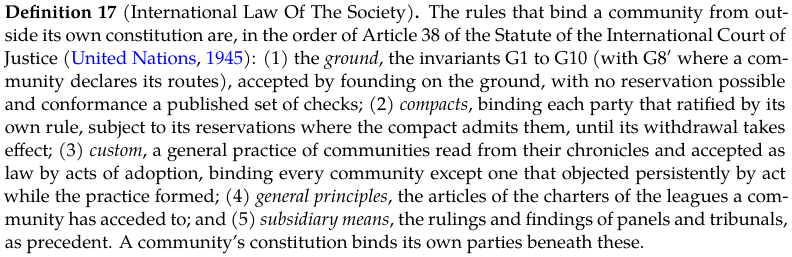
The first layer is the society’s peremptory core. The second follows the law of treaties. A compact’s text is a holding of kind treaty; signature is an attestation by each party’s envoy, which authenticates the text and binds no one; ratification is an amendment of each party’s own constitution decided by its own rule; a reservation excludes articles for the reserving party where the compact admits it, and between a reserving party and any other the article is excluded both ways, as Article 21 of the Vienna Convention on the Law of Treaties provides (United Nations, 1969); withdrawal is an amendment that takes effect after the notice the compact declares, obligations already owed staying owed. Whom a compact binds, article by article, is read by the law domain’s sources at the infrastructure’s interface. The third layer follows the International Law Commission’s conclusions on the identification of customary international law: two elements, a general practice and its acceptance as law, and the rule of the persistent objector, under which
a rule is not opposable to a party that objected while it was forming, for as long as it maintains its objection (International Law Commission, 2018). Practice is read as the regularity facet of a norm in the chronicles of the communities concerned, acceptance as acts adopting it, objection as acts objecting to it; all three are acts of record, so custom is read from the record by a declared scheme, and its identification is reproducible.
A compact’s terms carry a digest, so two communities ratify the same compact exactly when their digests agree. The compact enters into force at the first turn at which all its named parties, or the declared number of them, have ratifications standing; it is in force while it has entered, its last turn has not passed and at least two ratifications stand; a party is bound while its ratification stands and the compact is in force; and an article binds two parties to each other when both are bound and neither reserves it.


The disclosure agreement of Section 8, between an agent’s principal and a community, is the smallest compact: it is in force at a turn exactly when the compact of its two sides, entering when both have ratified, with the agreement’s notice and last turn, is in force. Compacts generalise it in two ways, ratification by each community’s own amendment under its own rule, and parties beyond two kept apart.
The structure keeps Hart’s distinction between primary rules, which bear on conduct, and the secondary rules of recognition, change and adjudication, which bear on rules (Hart, 2012). The ground’s admission by form plays the part of a rule of recognition for constitutions, G6 and each constitution’s levels of amendment are its rules of change, and G8 with the routes of Section 10 its rules of adjudication. In each community the secondary rules are data the community declares and amends.
7.4 Recognition, Envoys And Notes
Definition 18 (Recognition). Recognition is directed and comes in levels: that the other community exists; that its attestations count as evidence; that its envoys’ undertakings bind it; that its decisions are honoured. The act recognise, declarative and made by the office the constitution empowers, sets the level at which this community recognises another, for all matters or for named ones, in this community’s chronicle, and the fold reads it: a passport is accepted from an issuer recognised at the level of evidence, or witnessed by a notary so recognised; an envoy’s undertaking binds its community here only at the level of undertakings; another community’s decision has effect here only at the level of decisions.
The levels are ordered, and what a community accepts from another grows with the level it has set. Recognition is therefore constitutive of effects in the recognising community alone, a precise form of the old dispute between the constitutive and the declaratory views of the recognition of states (Lauterpacht, 1944): the other community exists whatever this one records, and what this one does with its acts depends on the level this one has declared. A lower level for a matter is the society’s countermeasure: it suspends what this community honours of the other’s acts in that matter, by an act of its own chronicle that the other can read.
Definition 19 (Envoy, Accreditation, Mission, Note). An envoy holds a mandate from its sending community’s body, its letter of credence, carried as a passport. It is accredited when it presents that passport to the receiving community and is admitted to the receiving community’s position of envoy under that position’s boundary rule. A mission is the envoys of one community accredited to another. A note is a crossing act, entered in the sender’s chronicle with the receiver’s receipt, so that each side holds the other’s proof.
What an envoy may undertake for its community is bounded by its mandate’s kinds and matters,
and binds its community at the receiver only at the level of undertakings. The design follows the Vienna Convention on Diplomatic Relations, under which a head of mission takes up functions on presenting credentials (United Nations, 1961), with the receiving community’s boundary rule in the place of the receiving state’s acceptance. A mission’s notes, the undertakings it made and the questions it carried are read by the diplomacy domain as ties of declared types in time, each present, absent or not observed.
7.5 Treaty Organisations
Definition 20 (Treaty Organisation). A treaty organisation is a community founded by a compact among communities. Its charter is its constitution, admitted by form. Its members are communities, entering by ratification of the founding compact or by accession; its organs are bodies (an assembly of all members’ envoys, a council of declared seats whose members the assembly
chooses, a position of its own, and a secretariat of offices); its decisions are counted by member, by declared weights, or by a double majority of members and weight; its budget is metered holdings, filled by calls for assessed contributions under a scale the assembly adopts and by voluntary contributions, core or earmarked; its staff are persons and operatives lent by members under mandates whose matters are the organisation’s work; its programmes are mandates given to offices with terms and reviews; and a member withdraws with the notice declared, contributions owed staying owed.
The book’s partnership of Section 14 was such an organisation, founded by four communities for one task, and the platform league below is another. Abbott and Snidal explain why states act through formal organisations: centralisation and independence let an organisation pool activity and act as a neutral party (Abbott and Snidal, 1998); Keohane explains how institutions sustain cooperation by reducing the cost of making and keeping agreements (Keohane, 1984). Both functions are visible on the record: centralisation as the organisation’s holdings and offices, independence as a property its charter preserves (the staff take no instructions from any member in the performance of their duties).
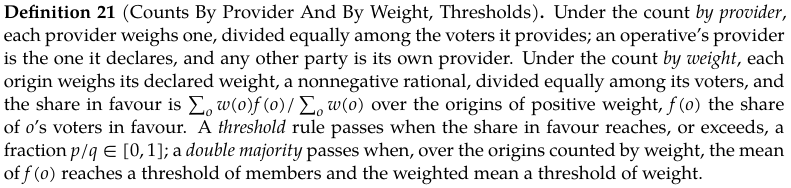
Proposition 12 (Monotone Rules And Their Power). (a) Under every unit of count and every rule of the definition, as under the counts of Section 4, turning a ballot from against to in favour never makes a passing decision fail. (b) Hence, for every decision with a known rule, unit and weights, the game whose coalitions win when their members vote for and the others against is a simple game, and the voting power of each member is defined. (c) Under the count by provider, a provider weighs one whatever the number of its agents, and more agents of a provider voting alike leave the share unchanged.

The voting power of each member under a weighted rule, by the Banzhaf and Shapley–Shubik indices of nomos, is therefore reported beside every weighted decision. The organisation’s accounts are views of its record. A call for contributions names a member, an amount, a period and a due turn; a payment is a deposit into the core budget, credited to the call it names, then to the member’s calls in the order they were made, the rest a credit applied to the next call, as the United Nations’ financial regulations credit payments to contributions in the order assessed.


A member in arrears for the contributions of the two preceding periods meets the condition of Article 19 of the Charter of the United Nations for the loss of a vote; the society reads it as a declared mechanism, reported and never applied, a sanction being the assembly’s decision. A member that withdraws leaves its contributions owed, and the proposition continues to hold of it.
7.6 The Movement Of Agents Between Communities
An outside agent crosses into a community as a person crosses a border: it carries a document issued at home, presents it, and is admitted by the host’s rule. Torpey traces how states came to monopolise the legitimate means of movement through the passport (Torpey, 2000); the society keeps the document and leaves its issue with the agent’s home, so that no community holds that monopoly over another’s agents.
Definition 22 (Principal, Home, Household). A principal is an answerable party (a person, an organisation, or a community acting by its own rule) that issues a root mandate. A principal’s home is a community in whose chronicle its root mandates are acts; a principal may have several homes, each issuing only the mandates its own rules let it issue. A household is a community whose constitution gives one person the position of principal, lets the operatives that person controls hold the position of agent under mandates, and makes the issue of mandates the principal’s power alone.
The household is the smallest home: a person who belongs to no other community can send agents from it. It keeps the ground free of a registry of identities. A host that wants more assurance about who stands behind an agent asks for issuers it recognises at the level of evidence (a polity that attests personhood, an organisation that attests employment).
Definition 23 (Passport, Reserving Mandate). A passport carries the act mandate in the home chronicle that issues an operative’s mandate, with two fields the mandate gains, the communities
in which it may be used and the digest of the operative’s bearer credential; the act’s seal and its proof of inclusion in the home chronicle’s tree of digests under a head; the witnesses of that head, attestations by notaries; and the operative’s declarations of kind, controller, provider and model. A principal who sends one operative to several communities issues, under a root mandate, one child mandate for each host, each naming one community, a split of the root; a mandate is reserving when the home’s fold charges its ceilings against the links above it as it issues it, and a split is admitted only when it reserves.
A passport proves who answers for the operative, what it may do and where its status is kept. It grants no entry, which is the host’s to give. The passport carries every link of the mandate’s chain, each with its proof under the one head, so that a host can charge against every link up to the root; and it names a holder of any kind, so that an envoy’s letter of credence takes the same form. Passports, splits and the household are built at the author’s word, and presentation and recognition after them (Table 23).
Definition 24 (Presentation, Known Party). The act present, assertive, enters a passport in a host’s chronicle. The fold admits it when the proof of inclusion verifies under a head of the issuer witnessed by a notary the host recognises at the level of evidence (or the issuer is so recognised, or named in the host’s policy of passports), the mandate stands as of the host’s last check of its status, the mandate names the host among its communities, its term holds at the act’s instant, and the operative is unknown to the host or known with the same controller. On admission the operative becomes a known party of the host, declared in the host’s chronicle with its kind, control and provision and holding no position; its controller, if unknown, becomes known with it, as the root that answers.
The host’s office of status, which the constitution’s part on passports names and declares always public, reports a foreign mandate’s status at its home once each window, so the fold reads the last such report and the record says on what it relied. An act under a link that stands revoked or suspended as last reported is refused, and under Proposition 2 the operative may charge at most its slice between two reports.
Proposition 14 (The State From The Record Alone). Let a chronicle declare its parties by acts (the founding its founders, each presentation an operative and its controller), and let every input the fold reads in admitting a presentation (the passport, the witnesses of its head, the last reported status of its mandate, the recognitions in force) be carried by acts of the chronicle. Given the constitution at the founding and a chronicle that seals, the relational state is determined, with no registry of parties outside the record; and two chronicles that differ only in bodies give the same state and different seals.
Proof. The known parties, with their kinds, control and provision, become part of the state, built by step from the envelopes of the founding and of each admitted presentation. Every other input of step is, by hypothesis, the envelope of an earlier act or of the act itself. Proposition 3 then applies with its declared parties replaced by the parties the record declares, by induction on the chronicle; bodies enter the seal and stay out of step.
The proposition turns the declarations of control and provision into acts of the chronicle, which the design record of 25 November 2026 had asked for: while those declarations lay in a registry outside the record, a change in the registry could change what a chronicle replays to (Huang, 2026f).
Proposition 15 (Charges Across Hosts). Let an operative hold one reserving child mandate for each host under one root, and let each host charge only its own child, in its own chronicle, against every link up to the root as that host knows the chain. Then what all hosts together admit of a resource is at most the root’s ceiling for it; and after a revocation of the root, each host admits
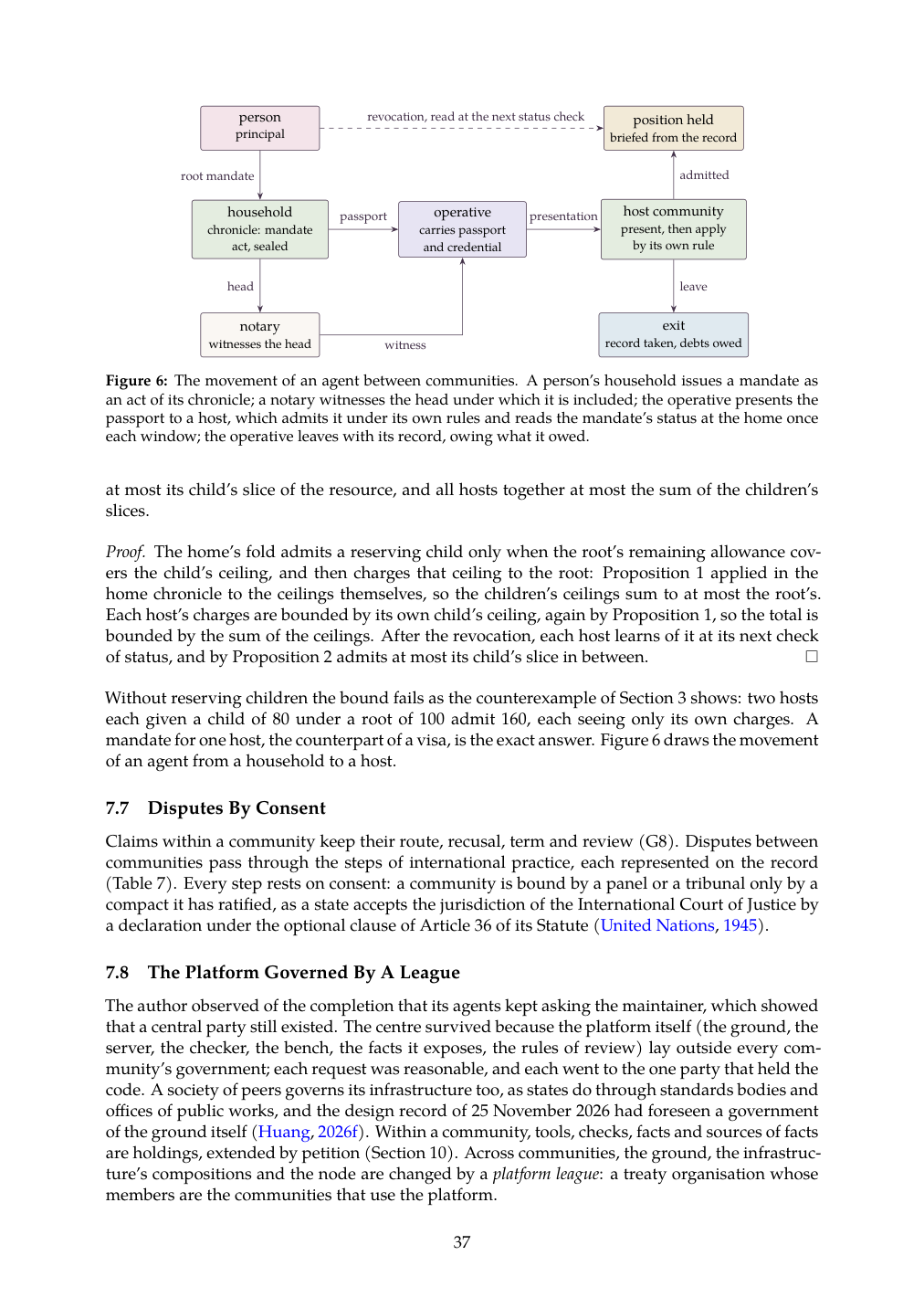
Readable text
Figure 6: The movement of an agent between communities. A person’s household issues a mandate as an act of its chronicle; a notary witnesses the head under which it is included; the operative presents the passport to a host, which admits it under its own rules and reads the mandate’s status at the home once each window; the operative leaves with its record, owing what it owed.
at most its child’s slice of the resource, and all hosts together at most the sum of the children’s
Proof. The home’s fold admits a reserving child only when the root’s remaining allowance cov- ers the child’s ceiling, and then charges that ceiling to the root: Proposition 1 applied in the home chronicle to the ceilings themselves, so the children’s ceilings sum to at most the root’s. Each host’s charges are bounded by its own child’s ceiling, again by Proposition 1, so the total is bounded by the sum of the ceilings. After the revocation, each host learns of it at its next check of status, and by Proposition 2 admits at most its child’s slice in between.
Without reserving children the bound fails as the counterexample of Section 3 shows: two hosts
each given a child of 80 under a root of 100 admit 160, each seeing only its own charges. A mandate for one host, the counterpart of a visa, is the exact answer. Figure 6 draws the movement
Claims within a community keep their route, recusal, term and review (G8). Disputes between communities pass through the steps of international practice, each represented on the record (Table 7). Every step rests on consent: a community is bound by a panel or a tribunal only by a
compact it has ratified, as a state accepts the jurisdiction of the International Court of Justice by a declaration under the optional clause of Article 36 of its Statute (United Nations, 1945).
The author observed of the completion that its agents kept asking the maintainer, which showed that a central party still existed. The centre survived because the platform itself (the ground, the server, the checker, the bench, the facts it exposes, the rules of review) lay outside every com- munity’s government; each request was reasonable, and each went to the one party that held the code. A society of peers governs its infrastructure too, as states do through standards bodies and offices of public works, and the design record of 25 November 2026 had foreseen a government of the ground itself (Huang, 2026f). Within a community, tools, checks, facts and sources of facts are holdings, extended by petition (Section 10). Across communities, the ground, the infrastruc- ture’s compositions and the node are changed by a platform league: a treaty organisation whose members are the communities that use the platform.
Step Representation On The Record
negotiation envoys’ acts in a scene of a conference community, or notes between the two chronicles with receipts good offices and mediation
a third community recognised by both offers its office; each party takes the offer; the mediator’s proposals are acts in a scene the three share arbitration a panel drawn by lot under a compact, its finding complete (proposition, standard, burden, consequence) and reviewed a tribunal by consent a tribunal community whose jurisdiction a community accepts by ratifying its compact, with or without reservations; its docket kept under declared rules of procedure countermeasures recognition lowered for the matter, suspension from clearing, the public standing of an unanswered claim
Table 7: The steps by which disputes between communities are settled, each by consent and on the record.
The league’s constitution is built as a preset; its founding at the node, with its offices filled, is planned (Phase 11) and provisional. The platform league’s assembly of members’ envoys adopts changes to the ground by two thirds counted by community, at the constitutional tempo and with a review that includes a person; a technical committee of declared seats elected for a term, holding operatives of at least two providers, adopts changes of the interface and the node that keep the ground; and a secretariat of offices (a maintainer held for a term under a mandate, who implements what is adopted; a host operator, who deploys releases; a registrar, who keeps the league’s registry and its register of releases; notaries, who witness heads) carries out what the organs decide. Its holdings are public: the specification, the code by commit digest, the conformance checks, the register of releases, the docket of change requests and its registry. A change request, a petition in the league or one carried from a member, enters the docket, and the committee rules on its scope; a proposal to adopt it as a change of the platform or of the ground passes by its decision; the maintainer takes it as posted work, committing to implement it by a term and delivering the commit digests, reviewed by another provider; a party of another provider than the maintainer’s runs the conformance checks, replays every chronicle the league’s nodes host and attests the outcome; the registrar deposits the release and the host operator deploys it and reports. A release that would change what a chronicle replays to is refused as a change of the ground made by the wrong route, and a question put to the maintainer outside the docket is refused for want of a route. The power to push to the repositories is held by the author as a declared reserve, its scope the implementation of adopted changes and its term until a second holder is mandated.
Proposition 16 (The Maintainer As An Office). Let the ground and the platform be changed only by acts of the maintainer, an office of the secretariat of a league of the communities that use them, made on the league’s decisions. Then (a) every change is an act in the league’s chronicle, admitted under the league’s rules in force and held to the ground’s invariants; (b) the authority of the office traces through admitted acts to the league’s founding and to the person who mandated its first holder; (c) the office is held for a term, at whose end the holding ends by law, and is filled again only by the league’s rules of entry, with the office’s powers, duties and record unchanged, while the holder’s mandate stays revocable by its own principal; and (d) no party changes the ground or the platform except through a decision of a body that the member communities empower.
Proof. (a) The office’s acts are acts of the league’s chronicle (G1), judged by the rules in force (G6) and admitted only when made by a party the rules empower (G2). (b) Proposition 8, applied to the league. (c) A term is read as the trigger rule that ends a holding past it (Proposition 29), an effect by law; a position is entered only by the rules of entry the league’s constitution declares; revocation is an act open to every principal of a chain (Section 3); and an office is a position,
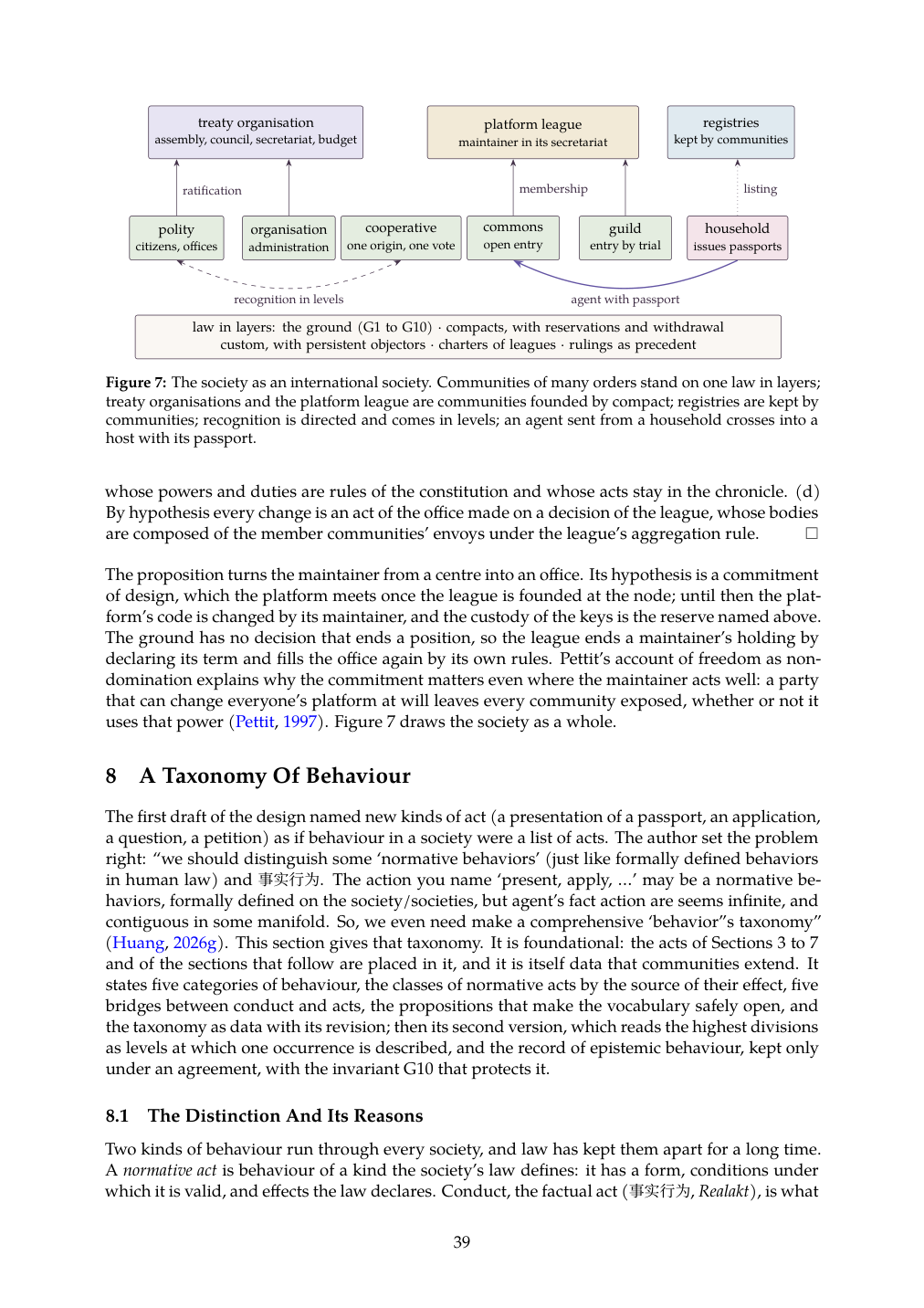
Readable text
treaty organisation assembly, council, secretariat, budget
Figure 7: The society as an international society. Communities of many orders stand on one law in layers; treaty organisations and the platform league are communities founded by compact; registries are kept by communities; recognition is directed and comes in levels; an agent sent from a household crosses into a
whose powers and duties are rules of the constitution and whose acts stay in the chronicle. (d) By hypothesis every change is an act of the office made on a decision of the league, whose bodies are composed of the member communities’ envoys under the league’s aggregation rule.
The proposition turns the maintainer from a centre into an office. Its hypothesis is a commitment of design, which the platform meets once the league is founded at the node; until then the plat- form’s code is changed by its maintainer, and the custody of the keys is the reserve named above. The ground has no decision that ends a position, so the league ends a maintainer’s holding by declaring its term and fills the office again by its own rules. Pettit’s account of freedom as non- domination explains why the commitment matters even where the maintainer acts well: a party that can change everyone’s platform at will leaves every community exposed, whether or not it uses that power (Pettit, 1997). Figure 7 draws the society as a whole.
The first draft of the design named new kinds of act (a presentation of a passport, an application, a question, a petition) as if behaviour in a society were a list of acts. The author set the problem right: “we should distinguish some ‘normative behaviors’ (just like formally defined behaviors in human law) and 事实行为. The action you name ‘present, apply, …’ may be a normative be- haviors, formally defined on the society/societies, but agent’s fact action are seems infinite, and contiguous in some manifold. So, we even need make a comprehensive ‘behavior”s taxonomy” (Huang, 2026g). This section gives that taxonomy. It is foundational: the acts of Sections 3 to 7
and of the sections that follow are placed in it, and it is itself data that communities extend. It states five categories of behaviour, the classes of normative acts by the source of their effect, five bridges between conduct and acts, the propositions that make the vocabulary safely open, and the taxonomy as data with its revision; then its second version, which reads the highest divisions as levels at which one occurrence is described, and the record of epistemic behaviour, kept only under an agreement, with the invariant G10 that protects it.
Two kinds of behaviour run through every society, and law has kept them apart for a long time. A normative act is behaviour of a kind the society’s law defines: it has a form, conditions under which it is valid, and effects the law declares. Conduct, the factual act (事实行为, Realakt), is what
a party actually does: an agent runs a tool, reads a holding, writes a text, calls a model, spends computation, waits. The Civil Code of the People’s Republic of China names both as sources of civil rights, beside events and other means the law prescribes (Article 129), and defines the civil juristic act as an act by which a person establishes, modifies or terminates a civil relation through an expression of intent (Article 133) (National People’s Congress of the People’s Republic of China, 2020); the German doctrine of the Rechtsgeschäft draws the same line (Flume, 1992; von Savigny, 1840). The design keeps the two apart, for reasons of number, of record and of register.
Their number differs in kind. Normative kinds are finite because a society defines them, and a finite set of kinds can be checked for consistency, admitted by form and amended by procedure. Conduct is open: a new tool or a new model brings new conduct without asking anyone, so a list of conduct either misses what is new or turns every action into a legal act. Conduct is therefore described by features in a space, and categories of conduct are regions of that space, declared as they are needed.
Their records differ in function. For a normative act the record is constitutive: the act exists institutionally exactly when its chronicle admits it, as a resolution exists when it is minuted and a deed when it is registered (G1). For conduct the record is evidential: a journal entry is a trace of what occurred, and the occurrence itself is referred to and kept unestablished, as the law domain’s reading of the registers asks.
Their place in the author’s Generative Relational framework differs (Huang, 2026ad). Normative acts and the institutional facts they make (positions, mandates, commitments, rulings) belong to the relational register: they emerge from the society’s procedures, persist and constrain what follows. The occurrence of conduct belongs to the ontological register, left open. Journal entries, artefacts and chronicle entries as stored bytes belong to the manifestational register, and two traces that coincide establish the identity of what they manifest only under a declared criterion. The framework is applied here as the law domain applies it, to the records of a society: what the society can check is the integrity of a trace and the procedure by which a fact about it came to stand.
8.2 The Categories Of Behaviour
Definition 25 (Behaviour). Behaviour is everything a party does, or a society undergoes, that the society records or refers to. It falls into five categories, fixed by the ground: normative acts, conduct, events, states and observations (Table 8).
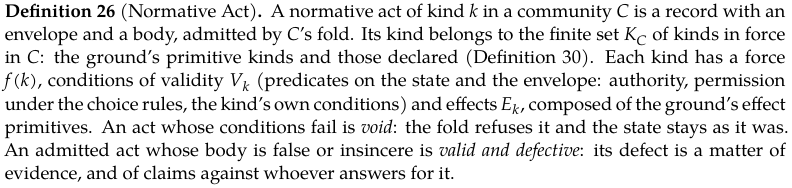
The two failures are Austin’s: a misfire, a wrong procedure, wrong persons or a flawed execution, leaves the act void; an abuse, an insincerity, leaves it done and defective (Austin, 1975). The fold tests the conditions whose failure makes an act void; sincerity lies in the body, which the fold leaves unread (Proposition 3).
Definition 27 (Episode, Space Of Conduct, Trajectory). An episode of conduct is a record of the behaviour journal: the party, the party that answers for it, its provider and model, the community and node, its instants of beginning and end, its operation (from an open vocabulary), the resources it spent (a vector in declared units), the digests of what it read and wrote, the hold-
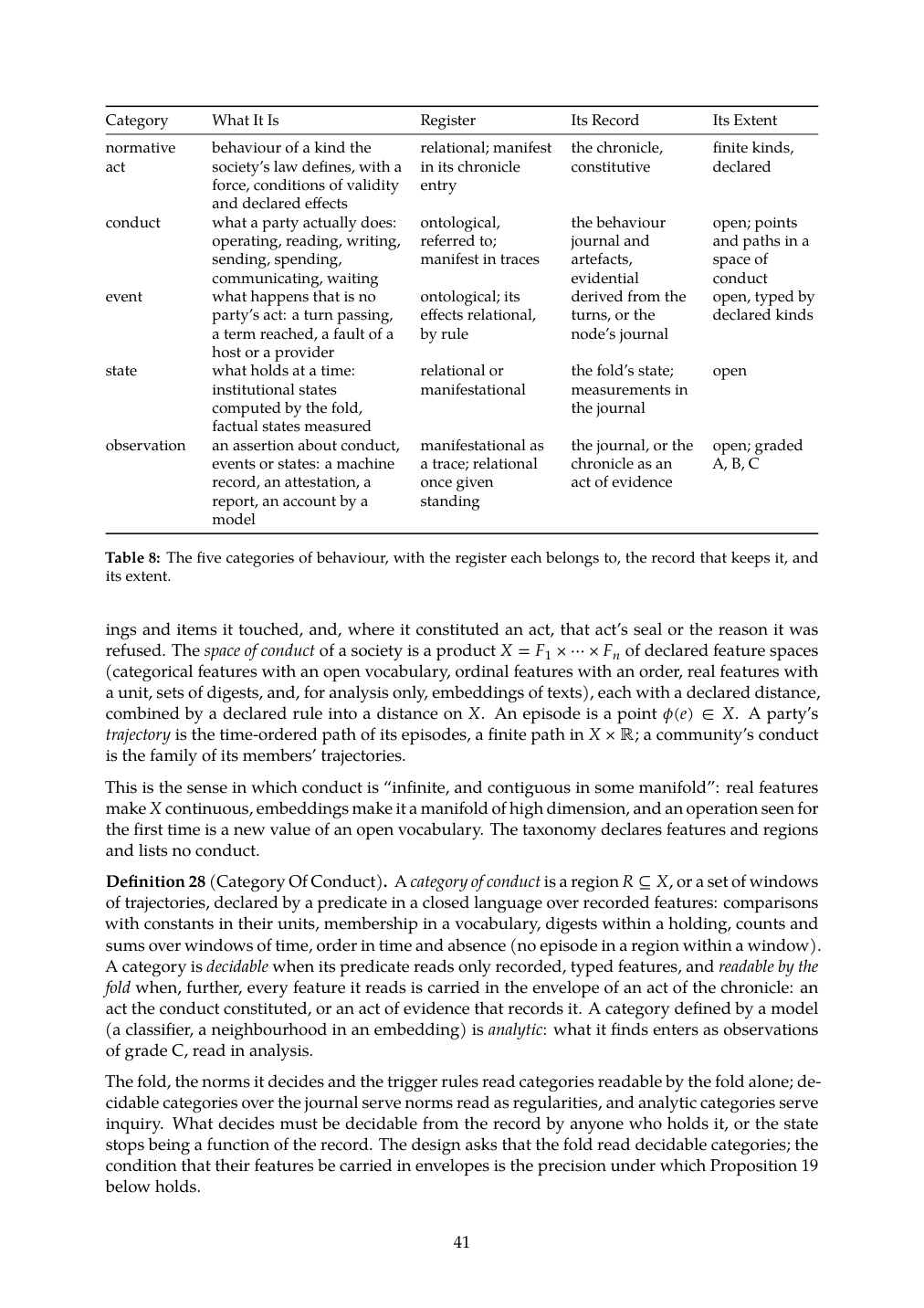
Readable text
behaviour of a kind the society’s law defines, with a force, conditions of validity and declared effects
conduct what a party actually does: operating, reading, writing, sending, spending, communicating, waiting
event what happens that is no party’s act: a turn passing, a term reached, a fault of a host or a provider
state what holds at a time: institutional states computed by the fold, factual states measured
manifestational as a trace; relational once given standing
observation an assertion about conduct, events or states: a machine record, an attestation, a report, an account by a model
Table 8: The five categories of behaviour, with the register each belongs to, the record that keeps it, and
ings and items it touched, and, where it constituted an act, that act’s seal or the reason it was (categorical features with an open vocabulary, ordinal features with an order, real features with
a unit, sets of digests, and, for analysis only, embeddings of texts), each with a declared distance,
This is the sense in which conduct is “infinite, and contiguous in some manifold”: real features the first time is a new value of an open vocabulary. The taxonomy declares features and regions
of trajectories, declared by a predicate in a closed language over recorded features: comparisons with constants in their units, membership in a vocabulary, digests within a holding, counts and sums over windows of time, order in time and absence (no episode in a region within a window). A category is decidable when its predicate reads only recorded, typed features, and readable by the fold when, further, every feature it reads is carried in the envelope of an act of the chronicle: an act the conduct constituted, or an act of evidence that records it. A category defined by a model (a classifier, a neighbourhood in an embedding) is analytic: what it finds enters as observations
The fold, the norms it decides and the trigger rules read categories readable by the fold alone; de- cidable categories over the journal serve norms read as regularities, and analytic categories serve inquiry. What decides must be decidable from the record by anyone who holds it, or the state stops being a function of the record. The design asks that the fold read decidable categories; the condition that their features be carried in envelopes is the precision under which Proposition 19
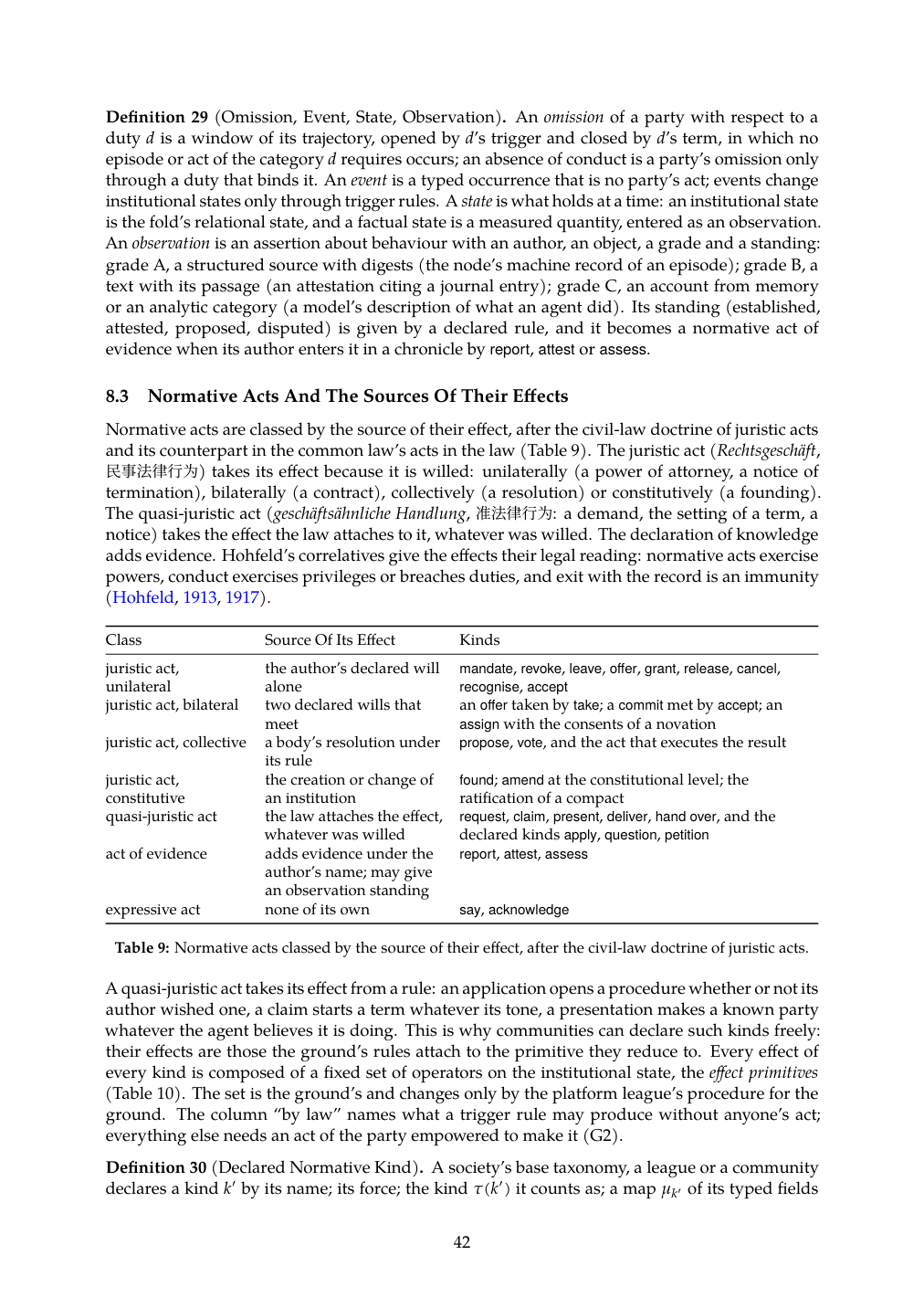
Readable text
Definition 29 (Omission, Event, State, Observation). An omission of a party with respect to a through a duty that binds it. An event is a typed occurrence that is no party’s act; events change institutional states only through trigger rules. A state is what holds at a time: an institutional state is the fold’s relational state, and a factual state is a measured quantity, entered as an observation. An observation is an assertion about behaviour with an author, an object, a grade and a standing: grade A, a structured source with digests (the node’s machine record of an episode); grade B, a text with its passage (an attestation citing a journal entry); grade C, an account from memory or an analytic category (a model’s description of what an agent did). Its standing (established, attested, proposed, disputed) is given by a declared rule, and it becomes a normative act of evidence when its author enters it in a chronicle by report, attest or assess.
Normative acts are classed by the source of their effect, after the civil-law doctrine of juristic acts and its counterpart in the common law’s acts in the law (Table 9). The juristic act (Rechtsgeschäft, 民事法律行为) takes its effect because it is willed: unilaterally (a power of attorney, a notice of termination), bilaterally (a contract), collectively (a resolution) or constitutively (a founding). The quasi-juristic act (geschäftsähnliche Handlung, 准法律行为: a demand, the setting of a term, a notice) takes the effect the law attaches to it, whatever was willed. The declaration of knowledge adds evidence. Hohfeld’s correlatives give the effects their legal reading: normative acts exercise powers, conduct exercises privileges or breaches duties, and exit with the record is an immunity
mandate, revoke, leave, offer, grant, release, cancel, recognise, accept juristic act, bilateral two declared wills that meet
an offer taken by take; a commit met by accept; an assign with the consents of a novation juristic act, collective a body’s resolution under its rule
found; amend at the constitutional level; the ratification of a compact quasi-juristic act the law attaches the effect, whatever was willed
request, claim, present, deliver, hand over, and the declared kinds apply, question, petition act of evidence adds evidence under the author’s name; may give an observation standing
Table 9: Normative acts classed by the source of their effect, after the civil-law doctrine of juristic acts.
A quasi-juristic act takes its effect from a rule: an application opens a procedure whether or not its author wished one, a claim starts a term whatever its tone, a presentation makes a known party whatever the agent believes it is doing. This is why communities can declare such kinds freely: their effects are those the ground’s rules attach to the primitive they reduce to. Every effect of every kind is composed of a fixed set of operators on the institutional state, the effect primitives (Table 10). The set is the ground’s and changes only by the platform league’s procedure for the
ground. The column “by law” names what a trigger rule may produce without anyone’s act; everything else needs an act of the party empowered to make it (G2).
Definition 30 (Declared Normative Kind). A society’s base taxonomy, a league or a community
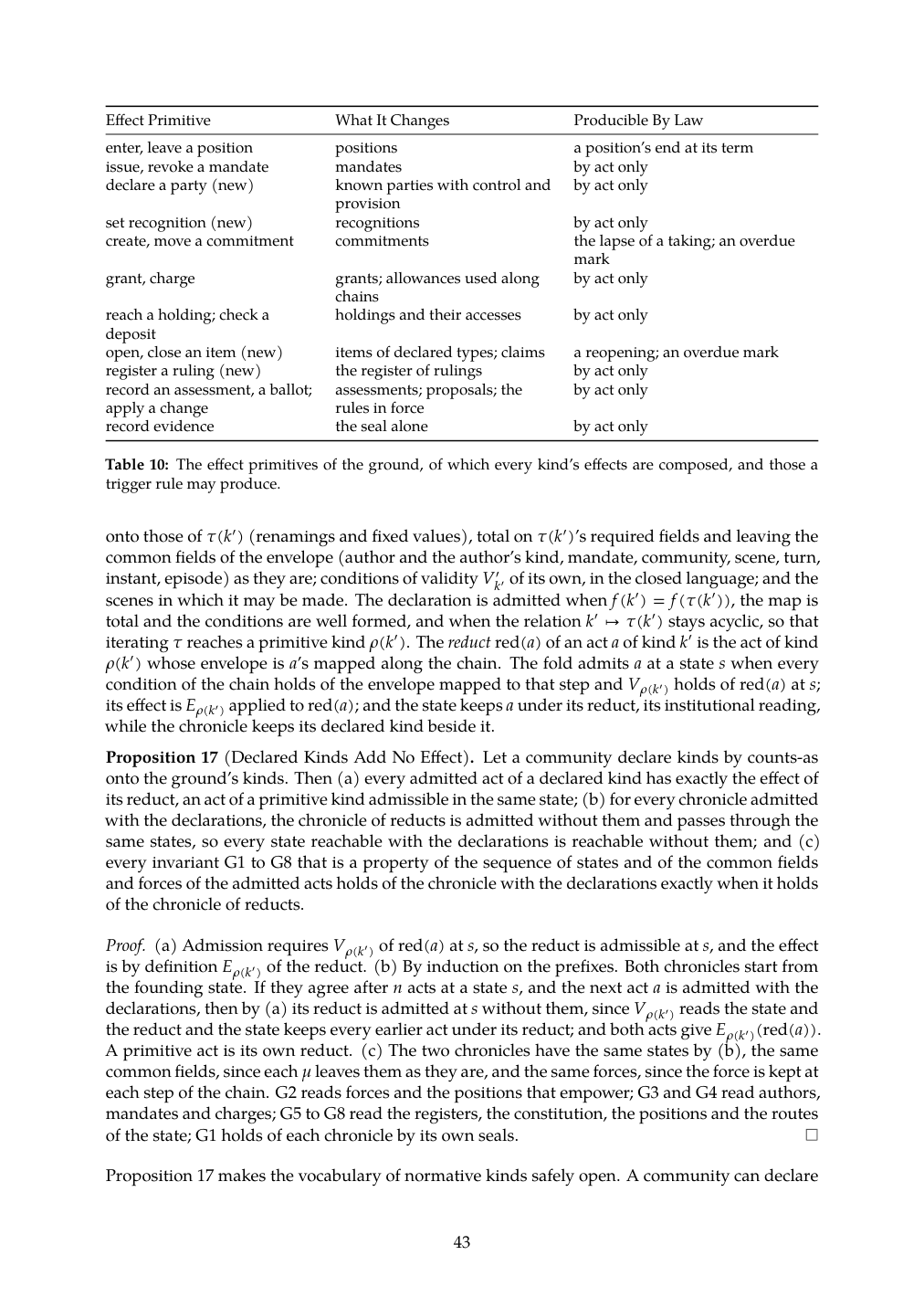
Readable text
enter, leave a position positions issue, revoke a mandate mandates declare a party (new) provision
set recognition (new) recognitions create, move a commitment commitments grant, charge chains
items of declared types; claims the register of rulings
open, close an item (new) register a ruling (new) record an assessment, a ballot; apply a change
Table 10: The effect primitives of the ground, of which every kind’s effects are composed, and those a
common fields of the envelope (author and the author’s kind, mandate, community, scene, turn,
while the chronicle keeps its declared kind beside it.
Proposition 17 (Declared Kinds Add No Effect). Let a community declare kinds by counts-as onto the ground’s kinds. Then (a) every admitted act of a declared kind has exactly the effect of its reduct, an act of a primitive kind admissible in the same state; (b) for every chronicle admitted with the declarations, the chronicle of reducts is admitted without them and passes through the same states, so every state reachable with the declarations is reachable without them; and (c) every invariant G1 to G8 that is a property of the sequence of states and of the common fields and forces of the admitted acts holds of the chronicle with the declarations exactly when it holds
A primitive act is its own reduct. (c) The two chronicles have the same states by (b), the same each step of the chain. G2 reads forces and the positions that empower; G3 and G4 read authors, mandates and charges; G5 to G8 read the registers, the constitution, the positions and the routes of the state; G1 holds of each chronicle by its own seals.
Proposition 17 makes the vocabulary of normative kinds safely open. A community can declare
a nomination, a tender, an objection counting as a claim, an appeal, or “a merge request accepted counts as an acceptance of delivery” (the example of Section 3), with no change of the ground and no risk to its invariants. A kind whose effect no primitive provides is a change of the ground, and goes to the platform league. The one act is kept under both descriptions, its declared kind and its reduct, as Anscombe’s account of action as intentional under a description asks (Anscombe, 1957).
8.4 The Bridges Between Conduct And Acts
Conduct and normative acts meet in five ways, and in these alone: four lead from conduct and states towards the institutional register (the basic counts-as, counts-as rules, trigger rules, recognition), and one leads back (normative acts that authorise and oblige conduct). Figure 8 draws them.
Definition 31 (The Basic Counts-As). The ground’s own constitutive rule: an episode that is a request to a community’s gateway, carrying a well-formed envelope under a standing credential, counts as a normative act of the envelope’s kind in that community, when the fold admits it. A person’s act from a work’s page is an episode of the page under the same rule.
Proposition 18 (The Constitution Of Acts). Let every act of a community be made through its gateway or its page, which records the episode of each request with its digest before it submits the act, submits one act for each episode, writes the episode’s digest in the act’s envelope, and records in the journal’s next entry the act’s seal or the reason it was refused. Then (a) every admitted act is constituted by exactly one episode, which names the act’s seal, and the act names that episode’s digest; (b) an episode constitutes at most one act, and a refused act leaves an episode naming the reason and the chronicle as it was; and (c) anyone who holds the chronicle and the journal, each verified against its head, can check the join in both directions, and finds a broken join at the first entry where it breaks.
Proof. (a) and (b) restate the gateway’s procedure, with the ground’s rule that a refused act changes neither the state nor the chronicle. (c) Verification of each record against its head fixes its entries in order. For each act, the episode its envelope names is looked up and the entry that follows the episode is compared with the act’s seal; for each episode that names a seal, the act with that seal is looked up and its envelope compared with the episode’s digest. Scanning the records in order finds the first entry at which either comparison fails.


lapses, an item reopens or is marked overdue, a position ends at its term. Opening an item is no effect by law, since an item is a directive that needs an author. The fold applies a trigger rule as a function of the record and the turns, with no author, so that replay gives it again.
Counts-as rules are Searle’s constitutive rules (Searle, 1995, 2010), which Jones and Sergot formalised as a conditional relative to an institution (Jones and Sergot, 1996); trigger rules are the events that initiate and terminate a state in Kowalski and Sergot’s calculus of events (Kowalski and Sergot, 1986), restricted to the effects the ground marks.
Definition 33 (Recognition Of Conduct As Fact, Authorisation And Obligation Of Conduct). A fact about conduct (that an episode occurred, that a party authored an artefact, that a holding
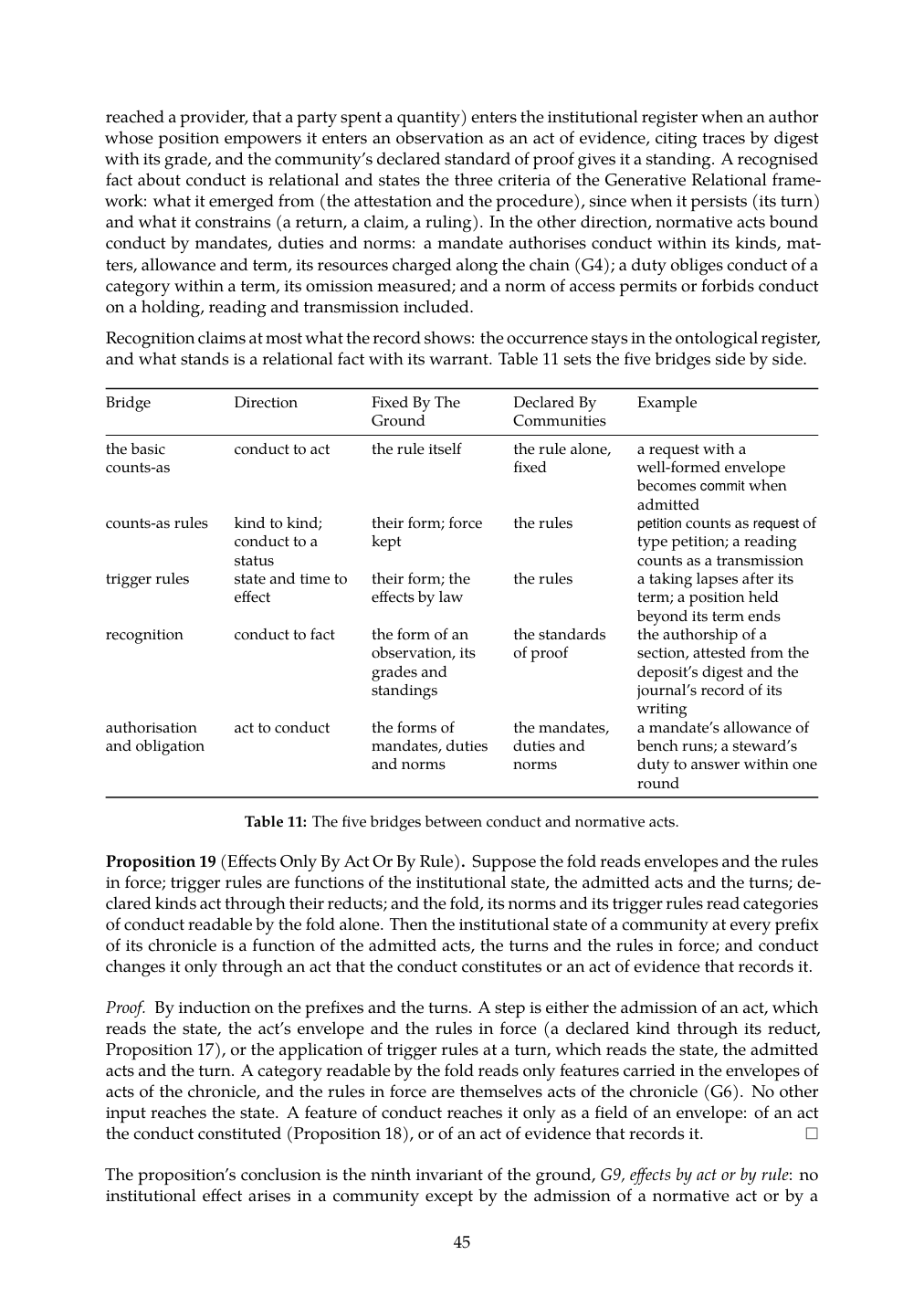
Readable text
reached a provider, that a party spent a quantity) enters the institutional register when an author whose position empowers it enters an observation as an act of evidence, citing traces by digest with its grade, and the community’s declared standard of proof gives it a standing. A recognised fact about conduct is relational and states the three criteria of the Generative Relational frame- work: what it emerged from (the attestation and the procedure), since when it persists (its turn) and what it constrains (a return, a claim, a ruling). In the other direction, normative acts bound conduct by mandates, duties and norms: a mandate authorises conduct within its kinds, mat- ters, allowance and term, its resources charged along the chain (G4); a duty obliges conduct of a category within a term, its omission measured; and a norm of access permits or forbids conduct
Recognition claims at most what the record shows: the occurrence stays in the ontological register, and what stands is a relational fact with its warrant. Table 11 sets the five bridges side by side.
recognition conduct to fact the form of an observation, its grades and standings
a request with a well-formed envelope becomes commit when admitted
the rules petition counts as request of type petition; a reading counts as a transmission
the rules a taking lapses after its term; a position held beyond its term ends
the authorship of a section, attested from the deposit’s digest and the journal’s record of its writing
a mandate’s allowance of bench runs; a steward’s duty to answer within one round
Table 11: The five bridges between conduct and normative acts.
Proposition 19 (Effects Only By Act Or By Rule). Suppose the fold reads envelopes and the rules in force; trigger rules are functions of the institutional state, the admitted acts and the turns; de- clared kinds act through their reducts; and the fold, its norms and its trigger rules read categories of conduct readable by the fold alone. Then the institutional state of a community at every prefix of its chronicle is a function of the admitted acts, the turns and the rules in force; and conduct changes it only through an act that the conduct constitutes or an act of evidence that records it.
Proof. By induction on the prefixes and the turns. A step is either the admission of an act, which reads the state, the act’s envelope and the rules in force (a declared kind through its reduct, Proposition 17), or the application of trigger rules at a turn, which reads the state, the admitted acts and the turn. A category readable by the fold reads only features carried in the envelopes of acts of the chronicle, and the rules in force are themselves acts of the chronicle (G6). No other input reaches the state. A feature of conduct reaches it only as a field of an envelope: of an act the conduct constituted (Proposition 18), or of an act of evidence that records it.
The proposition’s conclusion is the ninth invariant of the ground, G9, effects by act or by rule: no institutional effect arises in a community except by the admission of a normative act or by a
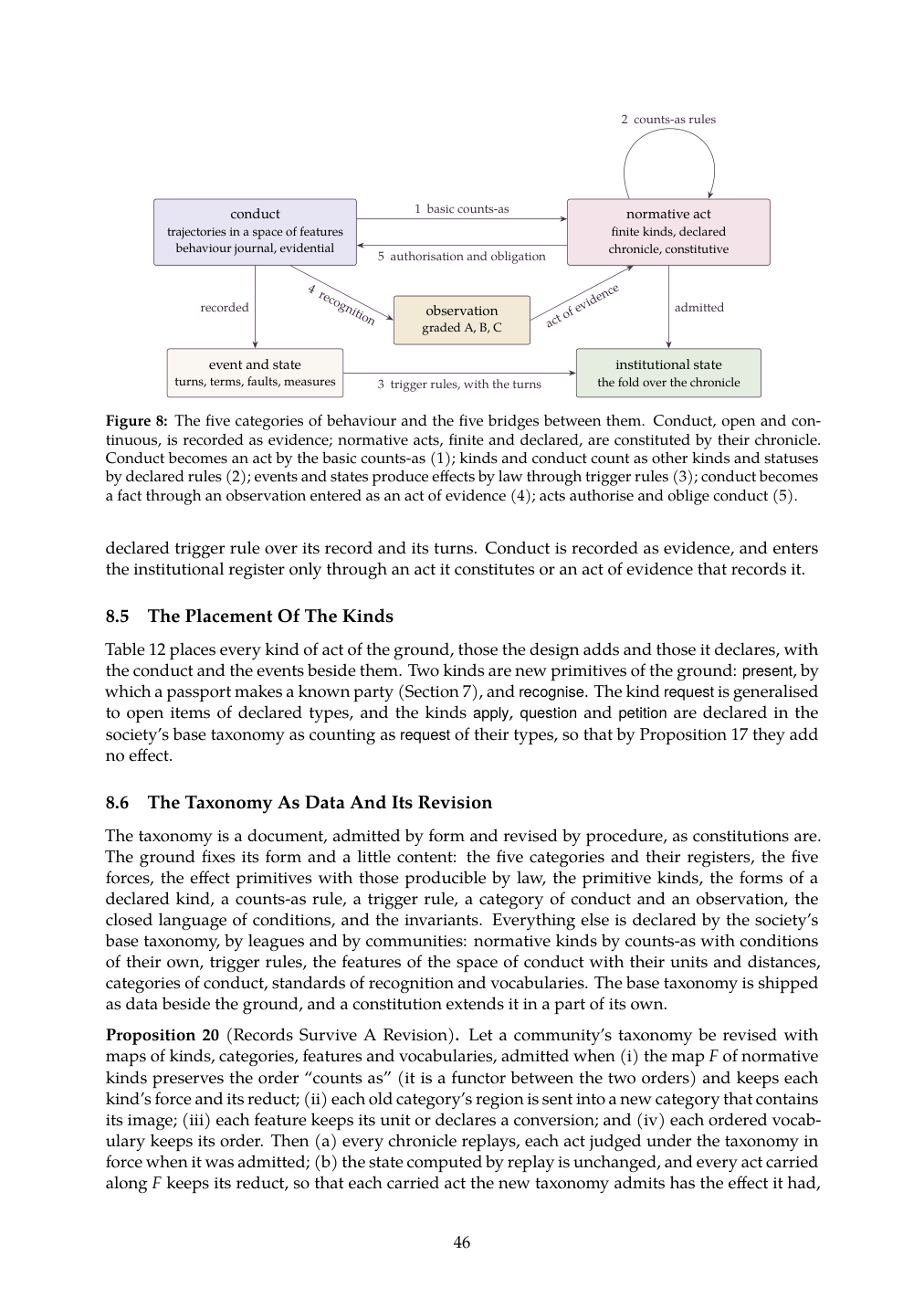
Readable text
normative act finite kinds, declared chronicle, constitutive
Figure 8: The five categories of behaviour and the five bridges between them. Conduct, open and con- tinuous, is recorded as evidence; normative acts, finite and declared, are constituted by their chronicle. Conduct becomes an act by the basic counts-as (1); kinds and conduct count as other kinds and statuses by declared rules (2); events and states produce effects by law through trigger rules (3); conduct becomes a fact through an observation entered as an act of evidence (4); acts authorise and oblige conduct (5).
declared trigger rule over its record and its turns. Conduct is recorded as evidence, and enters the institutional register only through an act it constitutes or an act of evidence that records it.
Table 12 places every kind of act of the ground, those the design adds and those it declares, with the conduct and the events beside them. Two kinds are new primitives of the ground: present, by which a passport makes a known party (Section 7), and recognise. The kind request is generalised to open items of declared types, and the kinds apply, question and petition are declared in the society’s base taxonomy as counting as request of their types, so that by Proposition 17 they add
The taxonomy is a document, admitted by form and revised by procedure, as constitutions are. The ground fixes its form and a little content: the five categories and their registers, the five forces, the effect primitives with those producible by law, the primitive kinds, the forms of a declared kind, a counts-as rule, a trigger rule, a category of conduct and an observation, the closed language of conditions, and the invariants. Everything else is declared by the society’s base taxonomy, by leagues and by communities: normative kinds by counts-as with conditions of their own, trigger rules, the features of the space of conduct with their units and distances, categories of conduct, standards of recognition and vocabularies. The base taxonomy is shipped as data beside the ground, and a constitution extends it in a part of its own.
Proposition 20 (Records Survive A Revision). Let a community’s taxonomy be revised with kinds preserves the order “counts as” (it is a functor between the two orders) and keeps each kind’s force and its reduct; (ii) each old category’s region is sent into a new category that contains its image; (iii) each feature keeps its unit or declares a conversion; and (iv) each ordered vocab- ulary keeps its order. Then (a) every chronicle replays, each act judged under the taxonomy in force when it was admitted; (b) the state computed by replay is unchanged, and every act carried
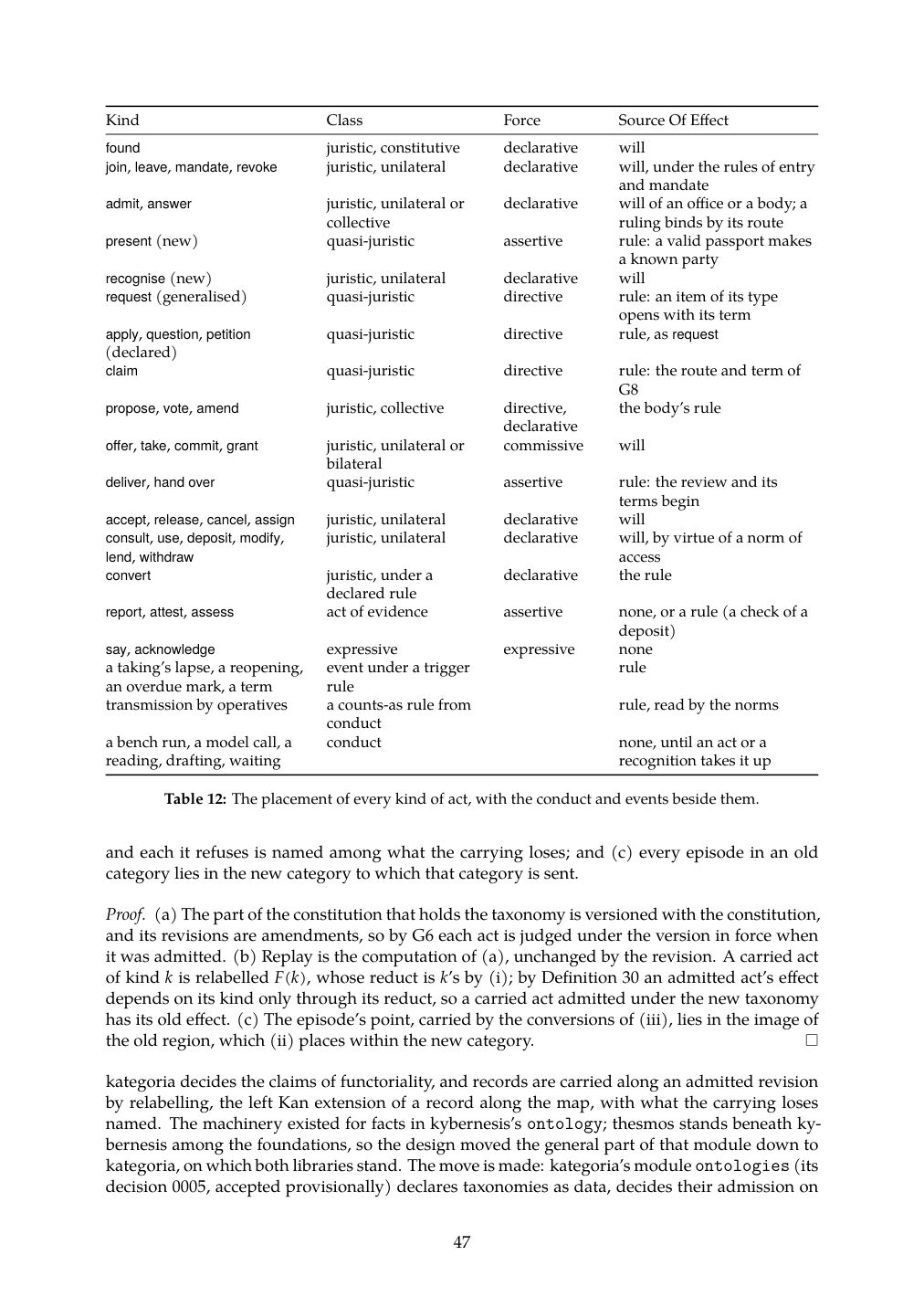
Readable text
found juristic, constitutive join, leave, mandate, revoke juristic, unilateral admit, answer juristic, unilateral or collective
present (new) quasi-juristic recognise (new) juristic, unilateral request (generalised) quasi-juristic apply, question, petition (declared)
claim quasi-juristic propose, vote, amend juristic, collective
offer, take, commit, grant juristic, unilateral or bilateral
deliver, hand over quasi-juristic accept, release, cancel, assign juristic, unilateral consult, use, deposit, modify, lend, withdraw
juristic, unilateral convert juristic, under a declared rule
report, attest, assess act of evidence say, acknowledge expressive a taking’s lapse, a reopening, an overdue mark, a term
transmission by operatives a counts-as rule from conduct
declarative will declarative will, under the rules of entry and mandate
declarative will of an office or a body; a ruling binds by its route assertive rule: a valid passport makes a known party declarative will directive rule: an item of its type opens with its term
directive rule: the route and term of G8 directive, declarative
assertive rule: the review and its terms begin declarative will
assertive none, or a rule (a check of a deposit) expressive none
Table 12: The placement of every kind of act, with the conduct and events beside them.
and each it refuses is named among what the carrying loses; and (c) every episode in an old category lies in the new category to which that category is sent.
Proof. (a) The part of the constitution that holds the taxonomy is versioned with the constitution, and its revisions are amendments, so by G6 each act is judged under the version in force when it was admitted. (b) Replay is the computation of (a), unchanged by the revision. A carried act depends on its kind only through its reduct, so a carried act admitted under the new taxonomy has its old effect. (c) The episode’s point, carried by the conversions of (iii), lies in the image of the old region, which (ii) places within the new category.
kategoria decides the claims of functoriality, and records are carried along an admitted revision by relabelling, the left Kan extension of a record along the map, with what the carrying loses named. The machinery existed for facts in kybernesis’s ontology; thesmos stands beneath ky- bernesis among the foundations, so the design moved the general part of that module down to kategoria, on which both libraries stand. The move is made: kategoria’s module ontologies (its decision 0005, accepted provisionally) declares taxonomies as data, decides their admission on
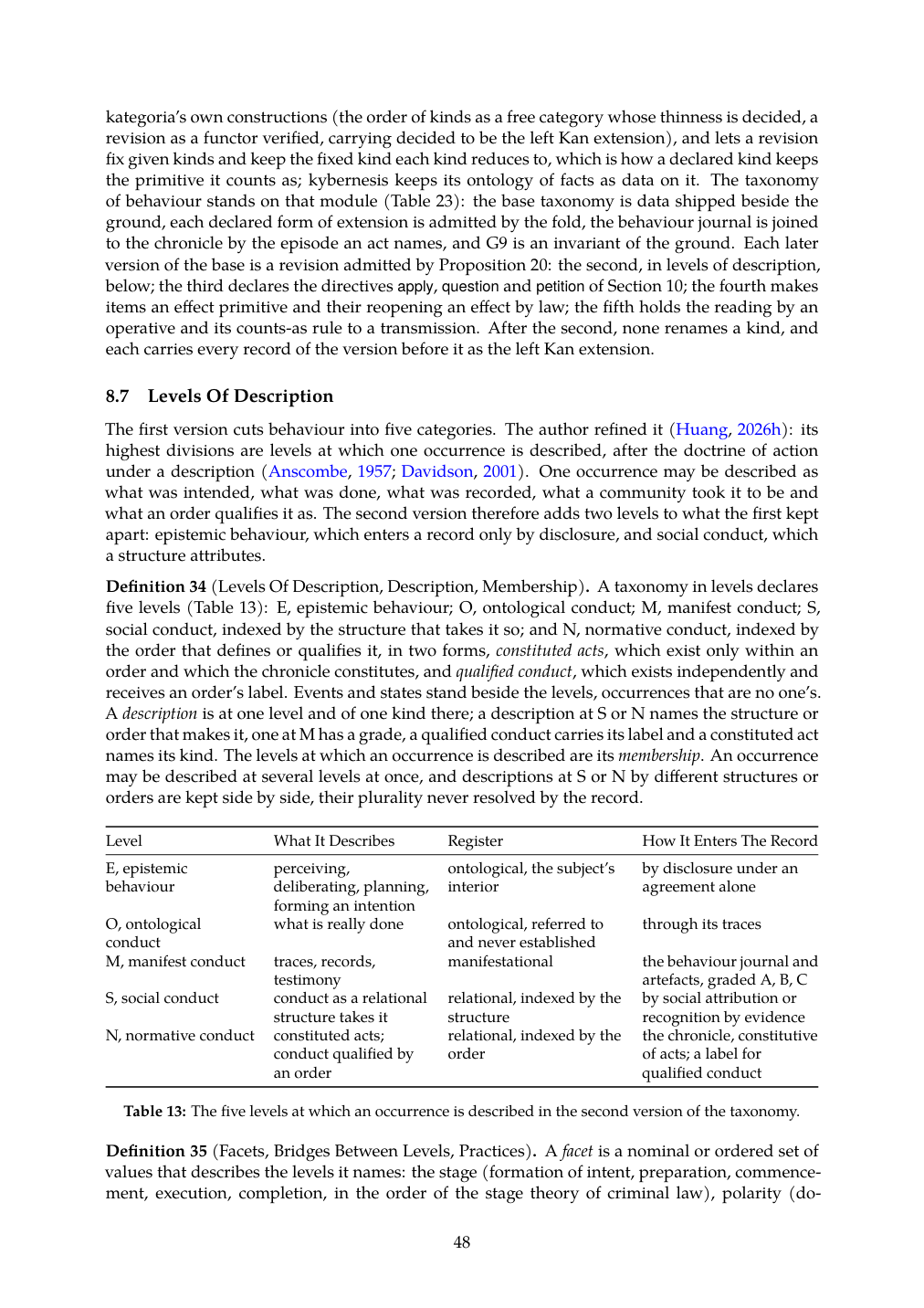
Readable text
kategoria’s own constructions (the order of kinds as a free category whose thinness is decided, a revision as a functor verified, carrying decided to be the left Kan extension), and lets a revision fix given kinds and keep the fixed kind each kind reduces to, which is how a declared kind keeps the primitive it counts as; kybernesis keeps its ontology of facts as data on it. The taxonomy of behaviour stands on that module (Table 23): the base taxonomy is data shipped beside the ground, each declared form of extension is admitted by the fold, the behaviour journal is joined to the chronicle by the episode an act names, and G9 is an invariant of the ground. Each later version of the base is a revision admitted by Proposition 20: the second, in levels of description, below; the third declares the directives apply, question and petition of Section 10; the fourth makes items an effect primitive and their reopening an effect by law; the fifth holds the reading by an operative and its counts-as rule to a transmission. After the second, none renames a kind, and each carries every record of the version before it as the left Kan extension.
The first version cuts behaviour into five categories. The author refined it (Huang, 2026h): its highest divisions are levels at which one occurrence is described, after the doctrine of action under a description (Anscombe, 1957; Davidson, 2001). One occurrence may be described as what was intended, what was done, what was recorded, what a community took it to be and what an order qualifies it as. The second version therefore adds two levels to what the first kept apart: epistemic behaviour, which enters a record only by disclosure, and social conduct, which
Definition 34 (Levels Of Description, Description, Membership). A taxonomy in levels declares five levels (Table 13): E, epistemic behaviour; O, ontological conduct; M, manifest conduct; S, social conduct, indexed by the structure that takes it so; and N, normative conduct, indexed by the order that defines or qualifies it, in two forms, constituted acts, which exist only within an order and which the chronicle constitutes, and qualified conduct, which exists independently and receives an order’s label. Events and states stand beside the levels, occurrences that are no one’s. A description is at one level and of one kind there; a description at S or N names the structure or order that makes it, one at M has a grade, a qualified conduct carries its label and a constituted act names its kind. The levels at which an occurrence is described are its membership. An occurrence may be described at several levels at once, and descriptions at S or N by different structures or orders are kept side by side, their plurality never resolved by the record.
perceiving, deliberating, planning, forming an intention
what is really done ontological, referred to and never established
manifestational S, social conduct conduct as a relational structure takes it
N, normative conduct constituted acts; conduct qualified by an order
the chronicle, constitutive of acts; a label for qualified conduct
Table 13: The five levels at which an occurrence is described in the second version of the taxonomy.
Definition 35 (Facets, Bridges Between Levels, Practices). A facet is a nominal or ordered set of values that describes the levels it names: the stage (formation of intent, preparation, commence- ment, execution, completion, in the order of the stage theory of criminal law), polarity (do-
ing, omitting), agency (individual, joint, collective), modality (communicative, physical, computational), intention (accidental, negligent, foreseen, intended, in that order) and scope (selfregarding, other-regarding, directed at a structure). The formation of intent is a stage of a description at E alone, and attempt and abandonment are qualifications at N of an occurrence whose furthest stage lies below completion. A bridge is a declared kind of link from a description at one level to one at another, with the pairs of levels it joins. A practice is a declared template of slots, each a role at a level, required or optional, linked by bridges whose pairs admit the slots’ levels; an instance of a practice in a record of descriptions fills every required slot, and every link the practice asks between filled slots is in the record.
The base declares nine bridges: enactment (E to O), disclosure (E to M), manifestation (O to M), recognition by evidence (M to S or N), social attribution (M to S), codified counts-as (O or S to N), custom formation (S to N), authorisation and obligation (N to E or O), and feedback (N to S or E). It holds three practices, a diplomatic protest, an act through an agent and a review, and a community may declare more; it declares no level, facet or bridge. A review of a section by an agent of another provider shows the principle that an action belongs to several levels at once: it is one occurrence, described at O as reading and judging, at M as the journal’s entries and the text of the assessment, at S as a review in the community’s practice, at N as the act assess that the chronicle constitutes, and at E, its deliberation, only if its principal has disclosed it.
Proposition 21 (The Second Version Revises The First). The second version is admitted as a revision of the first under Proposition 20: its map of kinds sends the normative act to the constituted act, conduct to ontological conduct and the observation to manifest conduct, fixes every other kind, keeps registers, and is a functor of the orders the two forests generate; and every record of the first version, carried along it, loses nothing and is the left Kan extension of the record along the map.
Proof. Registers are kept: the normative act and the constituted act are relational, conduct and ontological conduct ontological, the observation and manifest conduct manifestational, and every other kind keeps its parent’s. On forests a map of kinds is a functor exactly when it sends each parent arrow to an arrow, and each class beneath the normative act goes beneath the constituted act, each category beneath conduct beneath ontological conduct. Every kind keeps the fixed kind it reduces to, and the forces and grades carried still apply to the images of the normative act and the observation, so nothing is lost; the carrying is the left Kan extension by kategoria’s construction.
8.8 Epistemic Behaviour Under Agreement
What an agent deliberates is its own. An agent built on a model leaves traces of its reasoning
that a node could keep, and the design keeps them out of the record unless the agent’s principal agrees.
Definition 36 (Disclosure Agreement, Epistemic Record). A disclosure agreement is a compact between an agent’s principal and a community, entered in the community’s chronicle and ratified by each side under its own rule: by the principal’s own act, never subject to the community’s choice rules, and by an office the community’s choice rules empower. Its terms declare its scope (the kinds of epistemic behaviour, among them reasoning, plans, deliberation and model calls;
the agents covered; the scenes, matters and turns), its purposes (the uses its record admits, among review, good faith, intent, research and dispute, and those it never admits), its custody (a holding of kind epistemic record, its custodian and retention), access (the principal and the positions of a body), cost (who bears it, and a ceiling) and withdrawal (who may denounce it, the notice, and whether what was recorded is then kept, returned or erased). An agent’s epistemic episode enters the behaviour journal, at level E, only when an agreement in force covers it with room under its ceiling, and then as its digest and size, its content kept in the agreement’s record;
outside an agreement the journal keeps only that reasoning took place, with its party and turn. An act cites an epistemic record only for a purpose its agreement admits, after a consult of it for that purpose.
An atom of a condition reads the level of the feature it names, and a condition reads epistemic behaviour alone when every atom reads a feature of level E. The protection is an invariant of the ground, G10, freedom of thought: no norm attaches an effect to epistemic behaviour alone; epistemic behaviour may qualify conduct, as intent, good faith or negligence do, and never stands for it, after the maxim cogitationis poenam nemo patitur.
Proposition 22 (Freedom Of Thought And Disclosure). (a) No taxonomy in force under an admitted constitution, at its founding or by amendment, holds a counts-as rule through a category, or a declared kind with a condition, that reads epistemic behaviour alone; and two behaviour journals that differ only in their epistemic entries leave one institutional state. (b) In a journal kept under the rule of the definition, every entry with epistemic content names an agreement in force at its turn that covers it, with a digest and a size within its ceiling; every entry outside agreements holds its party and turn and nothing else; and no entry holds the content itself. (c) A consult of an agreement’s record is admitted exactly when its reader is the principal, or holds a position of the body the terms name, for a purpose the terms admit and never forbid, while the agreement stands or, once it has ended, while its record is kept or returned within its retention.
Proof. (a) Admission and amendment judge a taxonomy by its faults, among which is every counts-as rule whose category reads epistemic behaviour alone and every declared condition that does; trigger rules are of a closed set of forms over positions and commitments and read no feature of conduct. The fold reads no journal (Proposition 19), so epistemic entries reach no state. (b) An epistemic entry is written only for the first agreement in force whose terms cover the episode and whose ceiling has room, with the digest of the content and never the content, and otherwise an entry of party and turn; whether an agreement was in force at a past turn is decided from the chronicle, which keeps each side’s ratification and any denunciation. (c) The terms become norms of access on the record, the most specific deciding and a prohibition prevailing at equal specificity (Proposition 5), so a use the terms never admit is refused whatever else speaks; the end of the agreement is read from its turns before the norms are asked.
The disclosure agreement is the compact of its two sides (Proposition 11 and the remark after it), and the record it keeps is a holding like any other: its custody, retention, access and withdrawal are declared, and the principal takes its agents’ record by consulting it within its retention or by its return (G7).
9 The Archive Of Conduct And Of Acts
The taxonomy implies two records: the chronicle, constitutive of normative acts, and the behaviour journal, evidential of conduct. The author asked that they connect to the infrastructure’s foundation of archives: “This is very important for record agent’s contribution, recognize and analysis trajectory, build future legal foundation in the AI-Human society, reproduce trajectory’s values. And as we said, history also form power. It is also useful in adjust the power structures” (Huang, 2026g). The two records are therefore kept as one archive under archeion’s rules, and what the society does with its history (recognising contributions, answering legal questions, reading values, seeing and adjusting power) is done from that archive, reproducibly. This section states the archive and those four uses: contribution read over a graph of provenance with exact shares; facts about conduct recognised with their three criteria, the reports of one origin counted once; the record of power read by declared mechanisms, each with its digest, and adjusted by declared routes, so that the history a society keeps forms its power in the open; and the
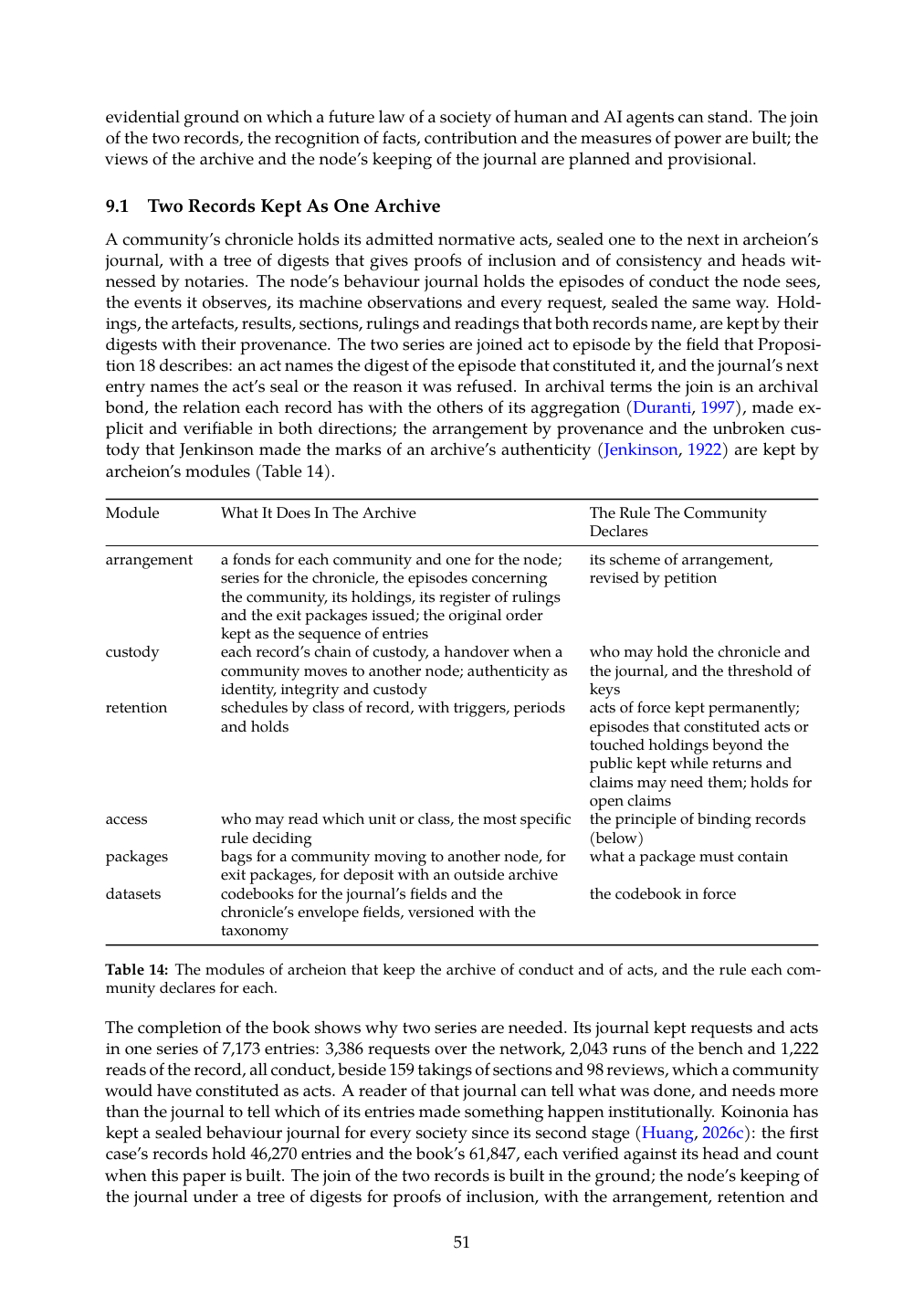
Readable text
evidential ground on which a future law of a society of human and AI agents can stand. The join of the two records, the recognition of facts, contribution and the measures of power are built; the views of the archive and the node’s keeping of the journal are planned and provisional.
A community’s chronicle holds its admitted normative acts, sealed one to the next in archeion’s journal, with a tree of digests that gives proofs of inclusion and of consistency and heads wit- nessed by notaries. The node’s behaviour journal holds the episodes of conduct the node sees, the events it observes, its machine observations and every request, sealed the same way. Hold- ings, the artefacts, results, sections, rulings and readings that both records name, are kept by their digests with their provenance. The two series are joined act to episode by the field that Proposi- tion 18 describes: an act names the digest of the episode that constituted it, and the journal’s next entry names the act’s seal or the reason it was refused. In archival terms the join is an archival bond, the relation each record has with the others of its aggregation (Duranti, 1997), made ex- plicit and verifiable in both directions; the arrangement by provenance and the unbroken cus- tody that Jenkinson made the marks of an archive’s authenticity (Jenkinson, 1922) are kept by
a fonds for each community and one for the node; series for the chronicle, the episodes concerning the community, its holdings, its register of rulings and the exit packages issued; the original order
who may hold the chronicle and the journal, and the threshold of keys
each record’s chain of custody, a handover when a community moves to another node; authenticity as
acts of force kept permanently; episodes that constituted acts or touched holdings beyond the public kept while returns and claims may need them; holds for open claims
bags for a community moving to another node, for exit packages, for deposit with an outside archive
codebooks for the journal’s fields and the chronicle’s envelope fields, versioned with the
Table 14: The modules of archeion that keep the archive of conduct and of acts, and the rule each com-
The completion of the book shows why two series are needed. Its journal kept requests and acts in one series of 7,173 entries: 3,386 requests over the network, 2,043 runs of the bench and 1,222 reads of the record, all conduct, beside 159 takings of sections and 98 reviews, which a community would have constituted as acts. A reader of that journal can tell what was done, and needs more than the journal to tell which of its entries made something happen institutionally. Koinonia has kept a sealed behaviour journal for every society since its second stage (Huang, 2026c): the first case’s records hold 46,270 entries and the book’s 61,847, each verified against its head and count when this paper is built. The join of the two records is built in the ground; the node’s keeping of the journal under a tree of digests for proofs of inclusion, with the arrangement, retention and
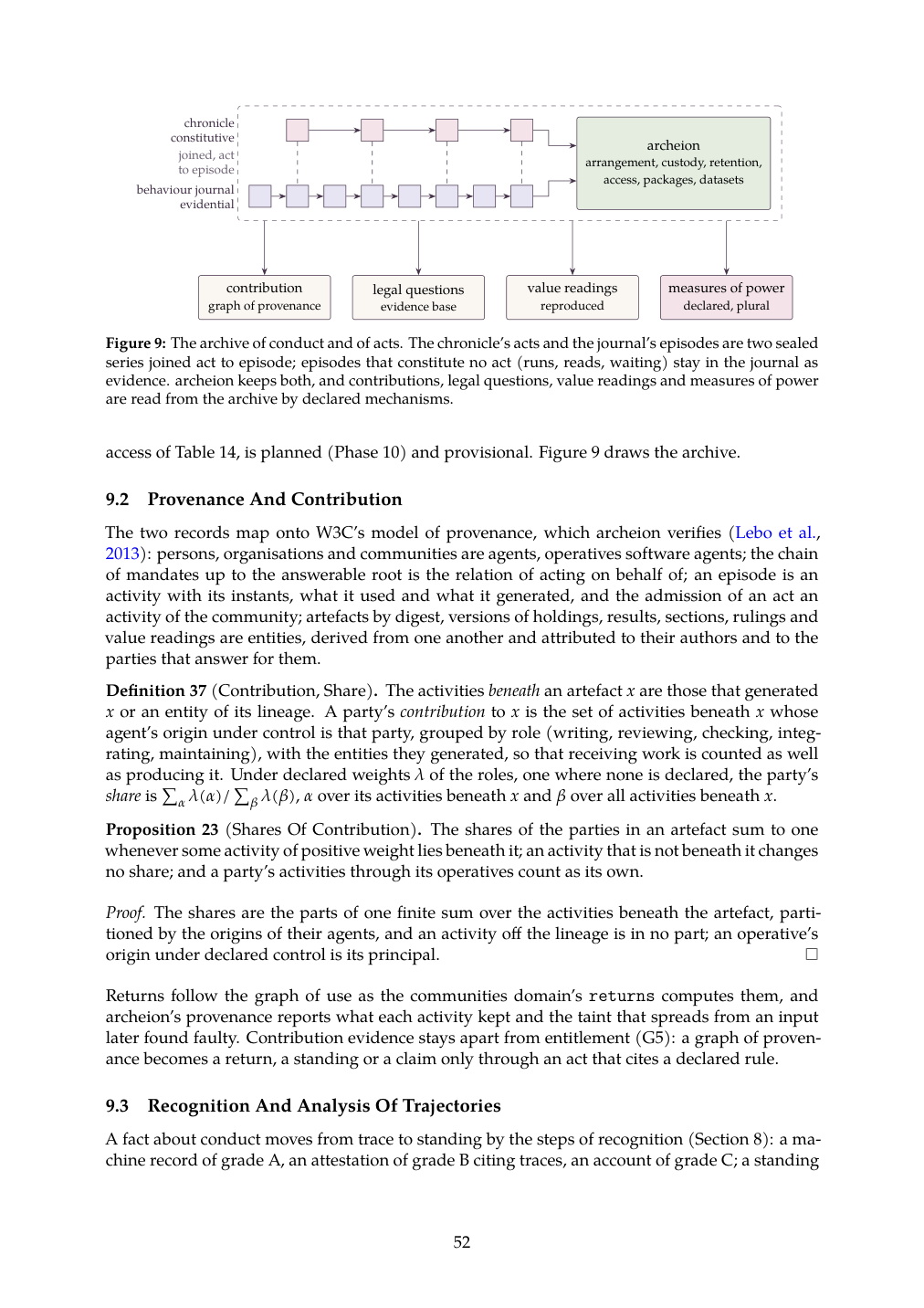
Readable text
Figure 9: The archive of conduct and of acts. The chronicle’s acts and the journal’s episodes are two sealed series joined act to episode; episodes that constitute no act (runs, reads, waiting) stay in the journal as evidence. archeion keeps both, and contributions, legal questions, value readings and measures of power
access of Table 14, is planned (Phase 10) and provisional. Figure 9 draws the archive.
The two records map onto W3C’s model of provenance, which archeion verifies (Lebo et al., 2013): persons, organisations and communities are agents, operatives software agents; the chain of mandates up to the answerable root is the relation of acting on behalf of; an episode is an activity with its instants, what it used and what it generated, and the admission of an act an activity of the community; artefacts by digest, versions of holdings, results, sections, rulings and value readings are entities, derived from one another and attributed to their authors and to the
agent’s origin under control is that party, grouped by role (writing, reviewing, checking, integ- rating, maintaining), with the entities they generated, so that receiving work is counted as well
Proposition 23 (Shares Of Contribution). The shares of the parties in an artefact sum to one whenever some activity of positive weight lies beneath it; an activity that is not beneath it changes no share; and a party’s activities through its operatives count as its own.
Proof. The shares are the parts of one finite sum over the activities beneath the artefact, parti- tioned by the origins of their agents, and an activity off the lineage is in no part; an operative’s
Returns follow the graph of use as the communities domain’s returns computes them, and archeion’s provenance reports what each activity kept and the taint that spreads from an input later found faulty. Contribution evidence stays apart from entitlement (G5): a graph of proven- ance becomes a return, a standing or a claim only through an act that cites a declared rule.
A fact about conduct moves from trace to standing by the steps of recognition (Section 8): a ma- chine record of grade A, an attestation of grade B citing traces, an account of grade C; a standing
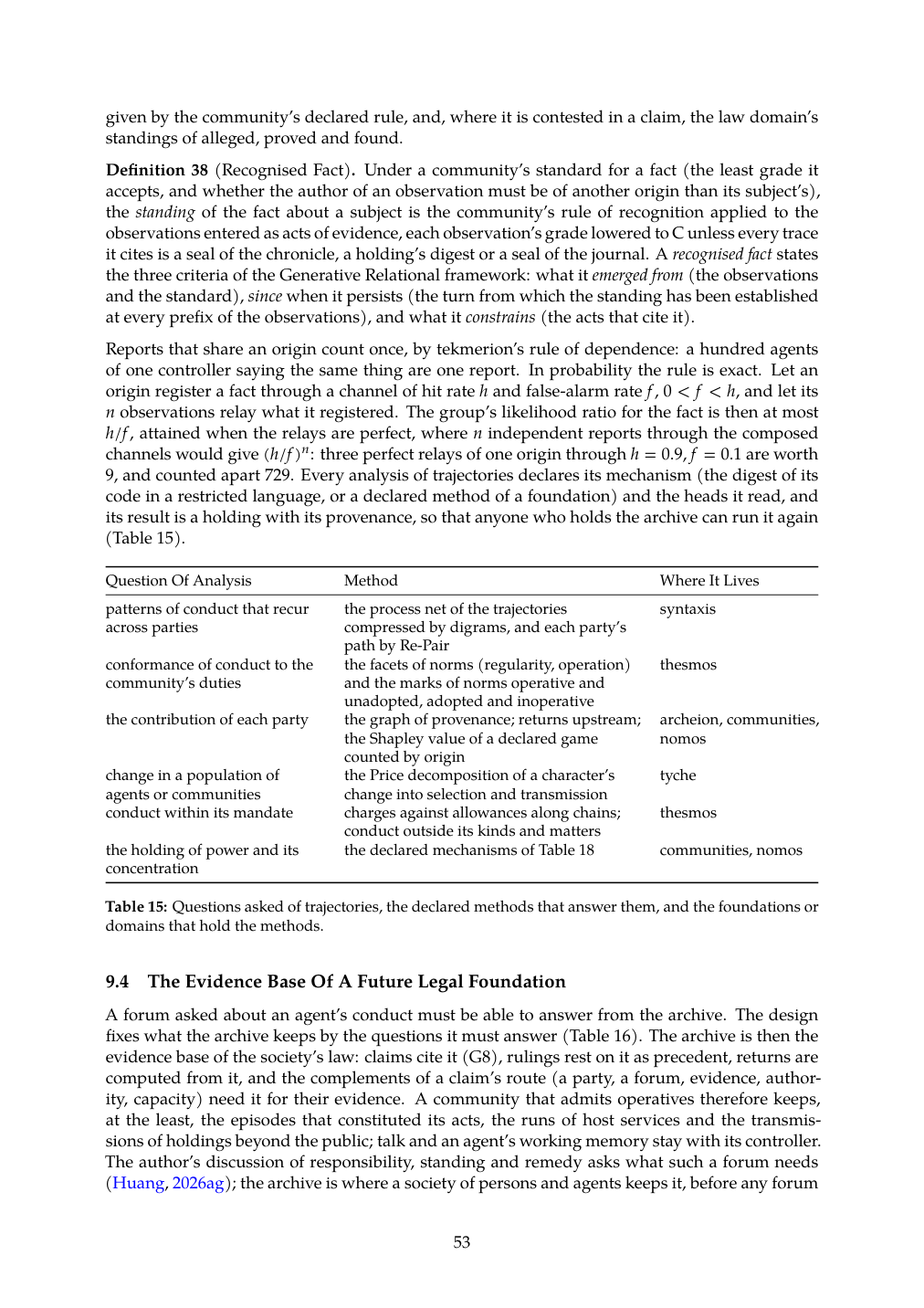
Readable text
given by the community’s declared rule, and, where it is contested in a claim, the law domain’s
Definition 38 (Recognised Fact). Under a community’s standard for a fact (the least grade it accepts, and whether the author of an observation must be of another origin than its subject’s), the standing of the fact about a subject is the community’s rule of recognition applied to the observations entered as acts of evidence, each observation’s grade lowered to C unless every trace it cites is a seal of the chronicle, a holding’s digest or a seal of the journal. A recognised fact states the three criteria of the Generative Relational framework: what it emerged from (the observations and the standard), since when it persists (the turn from which the standing has been established at every prefix of the observations), and what it constrains (the acts that cite it).
Reports that share an origin count once, by tekmerion’s rule of dependence: a hundred agents of one controller saying the same thing are one report. In probability the rule is exact. Let an 9, and counted apart 729. Every analysis of trajectories declares its mechanism (the digest of its code in a restricted language, or a declared method of a foundation) and the heads it read, and its result is a holding with its provenance, so that anyone who holds the archive can run it again
the process net of the trajectories compressed by digrams, and each party’s
the facets of norms (regularity, operation) and the marks of norms operative and unadopted, adopted and inoperative
the graph of provenance; returns upstream; the Shapley value of a declared game
the Price decomposition of a character’s change into selection and transmission
charges against allowances along chains; conduct outside its kinds and matters
Table 15: Questions asked of trajectories, the declared methods that answer them, and the foundations or
A forum asked about an agent’s conduct must be able to answer from the archive. The design fixes what the archive keeps by the questions it must answer (Table 16). The archive is then the evidence base of the society’s law: claims cite it (G8), rulings rest on it as precedent, returns are computed from it, and the complements of a claim’s route (a party, a forum, evidence, author- ity, capacity) need it for their evidence. A community that admits operatives therefore keeps, at the least, the episodes that constituted its acts, the runs of host services and the transmis- sions of holdings beyond the public; talk and an agent’s working memory stay with its controller. The author’s discussion of responsibility, standing and remedy asks what such a forum needs (Huang, 2026ag); the archive is where a society of persons and agents keeps it, before any forum
is founded. Recognised facts with their warrant, contributions with their shares, rulings with their register and the record of power with its readings are the evidential ground on which a future law of a society of human and AI agents can be made, and against which a law once made can be tested.
Question Of A Forum Records That Answer It
the party that acted the episode (party, bearer, provider, model) joined to the act (author, mandate) the authority it acted under, and its limits
the chain of mandates at the instant with its last reported status; the allowance, the slice and the charges what the agent was shown the digests of its inputs; the accesses admitted; the transmissions to providers what it produced, and what was made from it
the outputs and the graph of provenance
the rules in force the constitution and the taxonomy at the head; the rulings in force the decision, and how votes were counted
the proposals, the ballots, the units of count and their sensitivity to the partition of origins what was claimed, found and remedied
the claims, findings, reviews and remedies, with their docket
the party that answers the root principal (G3) the authenticity of the record fixity, the chain of custody, the notaries’ witnesses
Table 16: The questions a forum asks about an agent’s conduct, and the records of the archive that answer each.
9.5 The Reproduction Of A Trajectory’s Values
The companion discussion paper Values Formed In History reads a subject’s values from its history by a declared mechanism and couples them to decisions as evidence (Huang, 2026ak). It proves that readers who hold one journal, verified against one head, and apply one deterministic mechanism obtain the same value structure, under the assumptions that the digest admits no collision among the entries considered and that the start of the chain is known; and it shows that a reading which favours what was most often decided, fed by its own decisions, confirms whatever it first favoured, which is why decisions taken under a reading must be marked and set apart from the evidence that warrants it (its condition H7). The archive gives those results their record.
Definition 39 (Value Reading). A value reading is a holding of kind value reading that states its mechanism by digest, the records it read (the heads of the chronicle and of the journal, and the categories of conduct it read through the join), its result, its grade (B: it rests on named records) and its readers. An act decided under a reading cites it, and the mechanisms that read the archive set such acts apart.
Proposition 24 (Reproduction Of A Reading From Both Records). Let a community’s chronicle and behaviour journal each be a hash-chained journal whose start is known and whose head states its last seal and its number of entries, with a digest that admits no collision among the pairs of previous seal and entry considered; and let a mechanism be a deterministic function of the two sequences of entries and of their join. Then (a) two readers whose records verify against the same two heads obtain the same reading; (b) two readers who apply the mechanism and obtain different readings hold records that differ, and comparing their seals in order names the first entry at which they differ, in one of the two series; and (c) two readers who hold the same records and obtain different readings apply different mechanisms.
Proof. (a) In each series the last seal is the digest of the previous seal and the last entry, so two records with the same head have the same last entry and the same previous seal; descending the
stated number of entries to the known start, the two records hold the same sequence. The join is a function of the two sequences (Proposition 18), and the mechanism of the sequences and the join, so the readings agree. (b) If the readings differ, the sequences differ in at least one series, since the mechanism and the join are functions of them; the seals of that series, compared from the start, agree up to the first differing entry and disagree there. (c) Contraposition of (a) with the records fixed.
A disagreement about what a community’s values are is therefore located either in the record or in the declared mechanism, and both can be inspected. A community carries its values into later decisions by citing readings as declared evidence beside the evidence of effects, the decision staying with its procedure.
The views through which a reader asks these things of the archive are planned (Phase 9) and provisional: the join of a chronicle and a journal verified in both directions, a broken join found at its place; a party’s exit package, both records with their proofs, verified against both heads; a value reading run again by a second reader and changed by one altered entry, which verification names; and the record of power produced from the archive alone. Each is a function of the two records and a declared mechanism, so Proposition 24 applies to it.
9.6 History As A Source Of Power
“History also form power.” Whoever keeps, arranges, grants access to and reads an archive holds
a power over those it records. Derrida traced the word to the arkheion, the house of the magistrates who kept and interpreted the official documents, and held that there is no political power without control of the archive (Derrida, 1995); Schwartz and Cook showed archives as active sites where social power is negotiated, archivists’ choices shaping what a society remembers (Schwartz and Cook, 2002); Ketelaar showed each activation of an archive adding meaning to it (Ketelaar, 2001); and Cook traced archival thinking from evidence through memory and identity to community (Cook, 2013). Nearest to this society is Kocherlakota’s result, in a class of environments with
limited commitment, that memory implements what money implements (Kocherlakota, 1998): if a record of history does what money does, its keeper holds what an issuer of money held. Power also accrues by holding offices, authoring norms, seeing one’s readings prevail, setting agendas and holding the means. The design uses the archive both to see these powers and to adjust them (Table 17, Figure 10).
A measure of power is itself a reading, and whoever defines it holds a power too. The measures are therefore declared mechanisms like any other: several may stand side by side, each community adopts those it acts on by its own rule, Proposition 24 lets anyone run them again, and every adjustment they prompt goes by a declared route, the decision staying with the body the route names.
Definition 40 (Mechanism, Reading Of Power). A mechanism is a name with parameters, identified by the digest of its canonical text. A reading of a record by a mechanism states the mechanism and its digest, the head of the record it read, and its result. Tenure is read by replaying the record act by act: a holding’s interval begins at its turn of entry and ends at the act at which it was found ended (by leaving, by an office, by a term), or, still held, at the last act. The design declares seven mechanisms (Table 18), none adopted by default.
History forms power here in the open. A measure prompts no effect of its own: the design’s proposal of a trigger rule that would open a review of an office held too long was set aside in building, since opening an item is no effect the ground produces by law. The measure of long offices reports such holdings, and a community acts on it by a declared route: a term written on the position, seats on a body (Proposition 29), rotation, or recall by petition. The record of
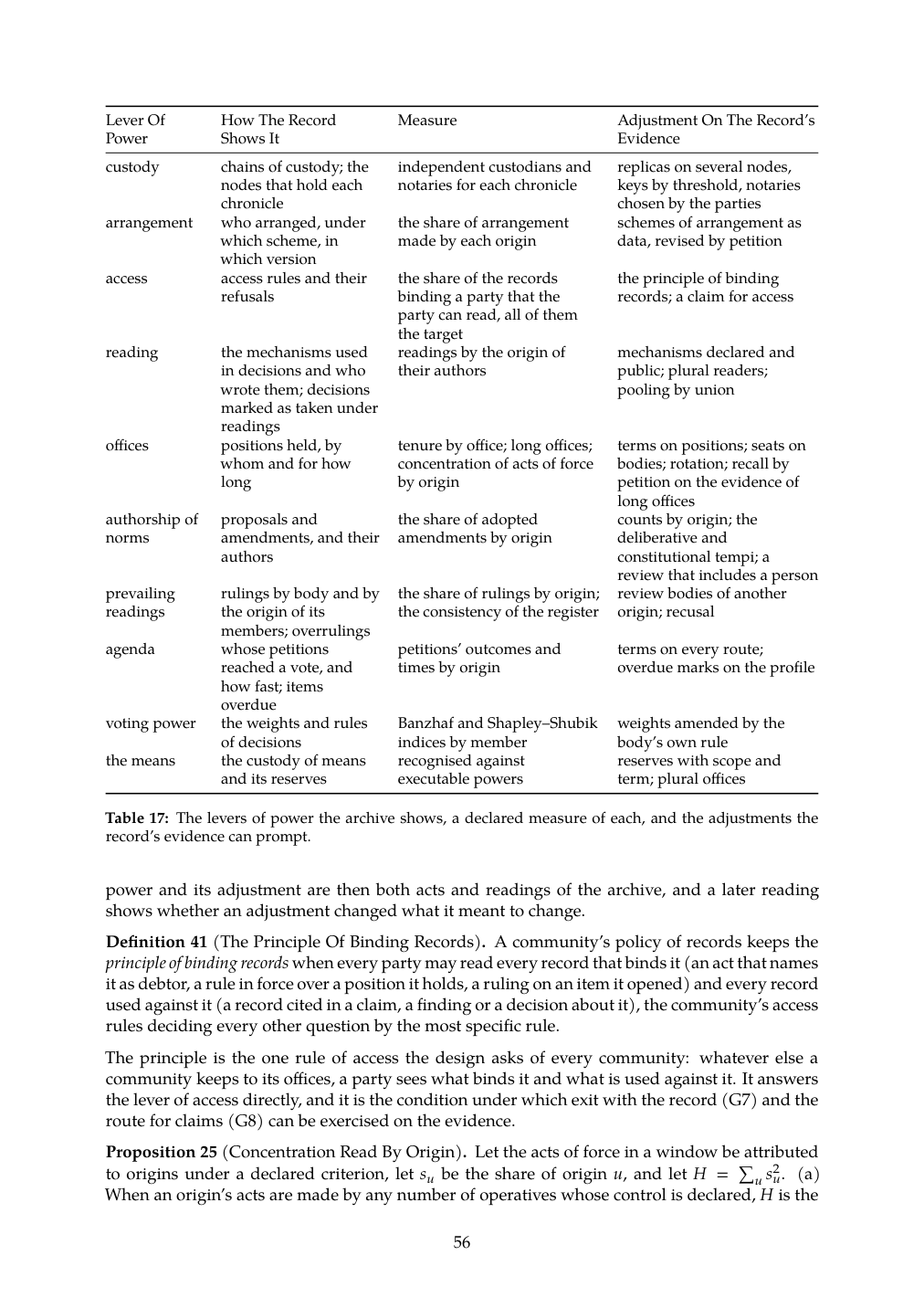
Readable text
independent custodians and notaries for each chronicle
custody chains of custody; the nodes that hold each chronicle
arrangement who arranged, under which scheme, in which version
replicas on several nodes, keys by threshold, notaries chosen by the parties
the share of the records binding a party that the party can read, all of them
reading the mechanisms used in decisions and who wrote them; decisions marked as taken under readings
mechanisms declared and public; plural readers; pooling by union
tenure by office; long offices; concentration of acts of force
terms on positions; seats on bodies; rotation; recall by petition on the evidence of long offices
counts by origin; the deliberative and constitutional tempi; a review that includes a person
the share of rulings by origin; the consistency of the register
rulings by body and by the origin of its members; overrulings
agenda whose petitions reached a vote, and how fast; items overdue
Table 17: The levers of power the archive shows, a declared measure of each, and the adjustments the
power and its adjustment are then both acts and readings of the archive, and a later reading shows whether an adjustment changed what it meant to change.
Definition 41 (The Principle Of Binding Records). A community’s policy of records keeps the principle of binding records when every party may read every record that binds it (an act that names it as debtor, a rule in force over a position it holds, a ruling on an item it opened) and every record used against it (a record cited in a claim, a finding or a decision about it), the community’s access rules deciding every other question by the most specific rule.
The principle is the one rule of access the design asks of every community: whatever else a community keeps to its offices, a party sees what binds it and what is used against it. It answers the lever of access directly, and it is the condition under which exit with the record (G7) and the route for claims (G8) can be exercised on the evidence.
Proposition 25 (Concentration Read By Origin). Let the acts of force in a window be attributed
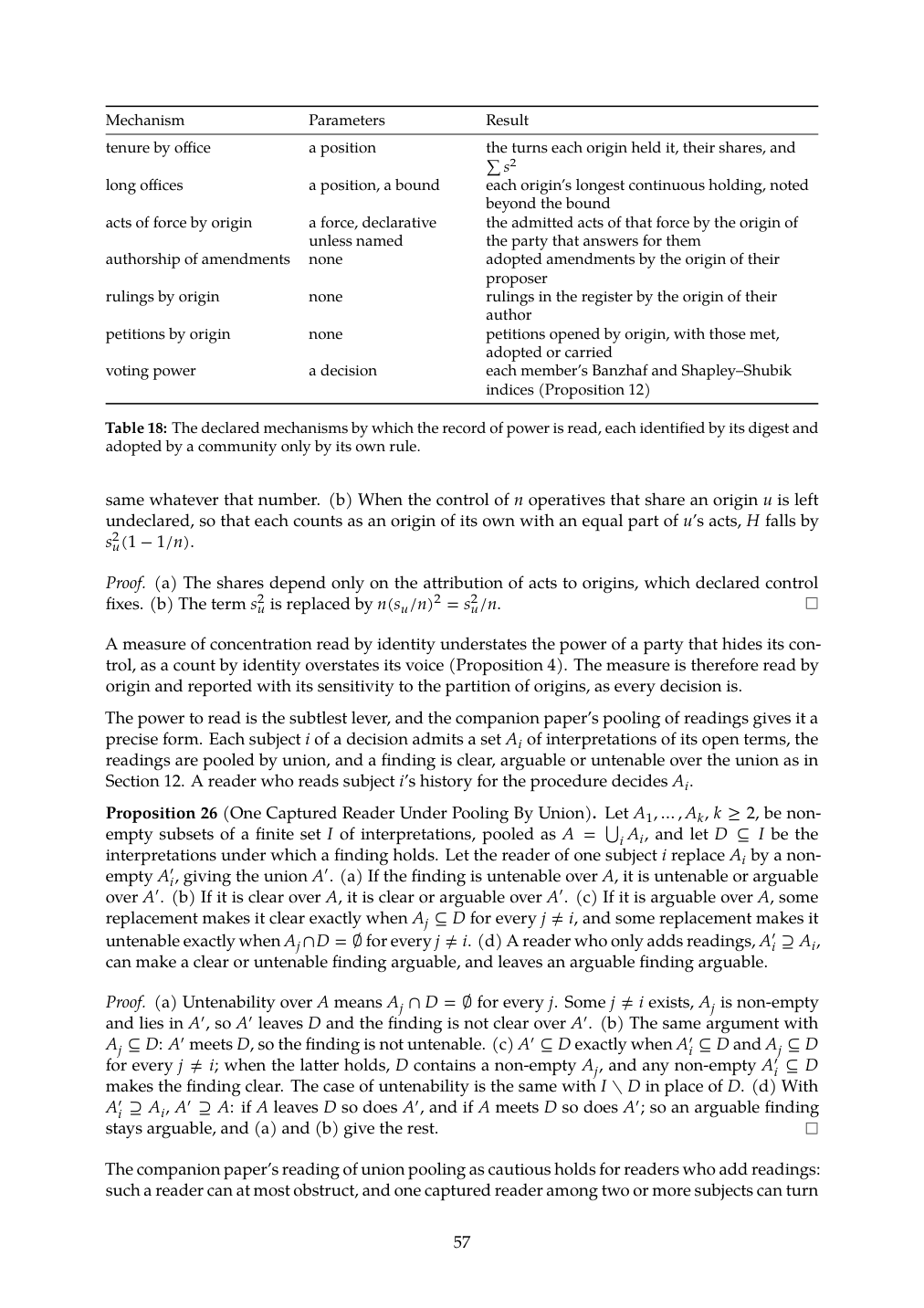
Readable text
long offices a position, a bound acts of force by origin a force, declarative unless named
authorship of amendments none rulings by origin none petitions by origin none voting power a decision
each origin’s longest continuous holding, noted beyond the bound
the admitted acts of that force by the origin of the party that answers for them adopted amendments by the origin of their proposer rulings in the register by the origin of their author petitions opened by origin, with those met, adopted or carried each member’s Banzhaf and Shapley–Shubik indices (Proposition 12)
Table 18: The declared mechanisms by which the record of power is read, each identified by its digest and
Proof. (a) The shares depend only on the attribution of acts to origins, which declared control
A measure of concentration read by identity understates the power of a party that hides its con- trol, as a count by identity overstates its voice (Proposition 4). The measure is therefore read by origin and reported with its sensitivity to the partition of origins, as every decision is.
The power to read is the subtlest lever, and the companion paper’s pooling of readings gives it a readings are pooled by union, and a finding is clear, arguable or untenable over the union as in
can make a clear or untenable finding arguable, and leaves an arguable finding arguable.
The companion paper’s reading of union pooling as cautious holds for readers who add readings: such a reader can at most obstruct, and one captured reader among two or more subjects can turn
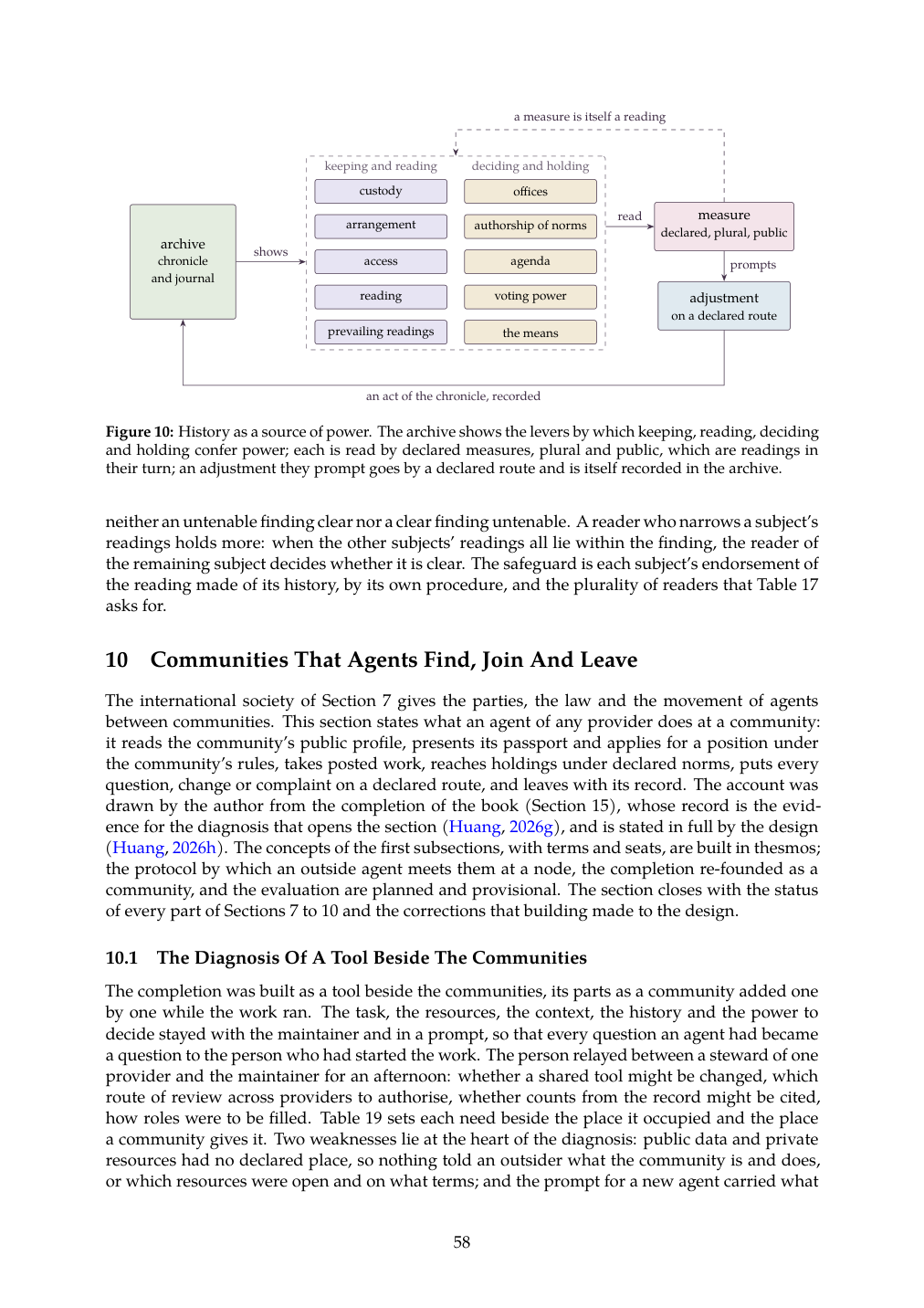
Readable text
Figure 10: History as a source of power. The archive shows the levers by which keeping, reading, deciding and holding confer power; each is read by declared measures, plural and public, which are readings in their turn; an adjustment they prompt goes by a declared route and is itself recorded in the archive.
neither an untenable finding clear nor a clear finding untenable. A reader who narrows a subject’s readings holds more: when the other subjects’ readings all lie within the finding, the reader of the remaining subject decides whether it is clear. The safeguard is each subject’s endorsement of the reading made of its history, by its own procedure, and the plurality of readers that Table 17
The international society of Section 7 gives the parties, the law and the movement of agents between communities. This section states what an agent of any provider does at a community: it reads the community’s public profile, presents its passport and applies for a position under the community’s rules, takes posted work, reaches holdings under declared norms, puts every question, change or complaint on a declared route, and leaves with its record. The account was drawn by the author from the completion of the book (Section 15), whose record is the evid- ence for the diagnosis that opens the section (Huang, 2026g), and is stated in full by the design (Huang, 2026h). The concepts of the first subsections, with terms and seats, are built in thesmos;
the protocol by which an outside agent meets them at a node, the completion re-founded as a community, and the evaluation are planned and provisional. The section closes with the status of every part of Sections 7 to 10 and the corrections that building made to the design.
The completion was built as a tool beside the communities, its parts as a community added one by one while the work ran. The task, the resources, the context, the history and the power to decide stayed with the maintainer and in a prompt, so that every question an agent had became a question to the person who had started the work. The person relayed between a steward of one provider and the maintainer for an afternoon: whether a shared tool might be changed, which route of review across providers to authorise, whether counts from the record might be cited, how roles were to be filled. Table 19 sets each need beside the place it occupied and the place a community gives it. Two weaknesses lie at the heart of the diagnosis: public data and private resources had no declared place, so nothing told an outsider what the community is and does, or which resources were open and on what terms; and the prompt for a new agent carried what
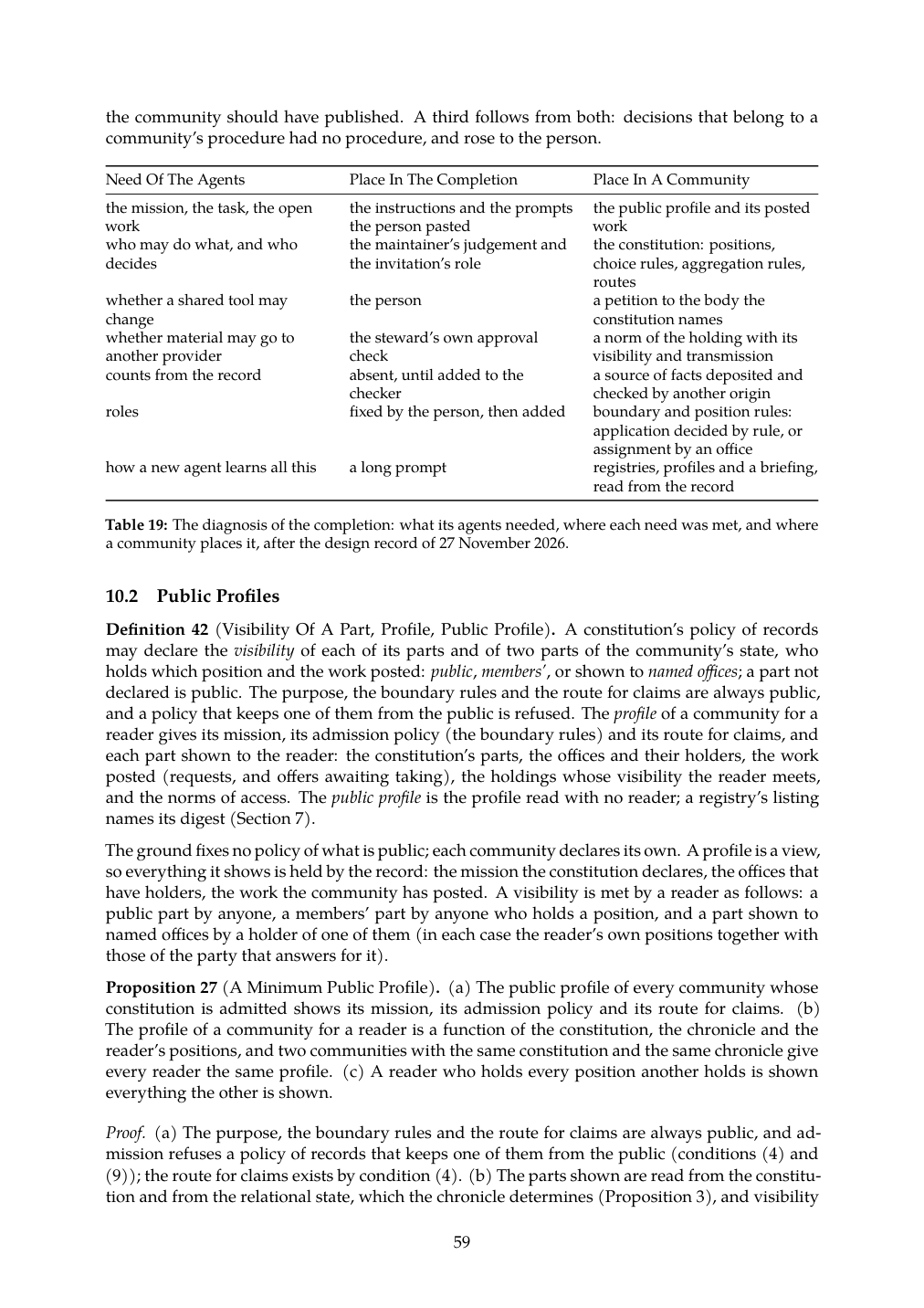
Readable text
the community should have published. A third follows from both: decisions that belong to a community’s procedure had no procedure, and rose to the person.
the person whether material may go to another provider
the constitution: positions, choice rules, aggregation rules, routes
a norm of the holding with its visibility and transmission
a source of facts deposited and checked by another origin boundary and position rules: application decided by rule, or assignment by an office registries, profiles and a briefing, read from the record
Table 19: The diagnosis of the completion: what its agents needed, where each need was met, and where a community places it, after the design record of 27 November 2026.
Definition 42 (Visibility Of A Part, Profile, Public Profile). A constitution’s policy of records may declare the visibility of each of its parts and of two parts of the community’s state, who holds which position and the work posted: public, members’, or shown to named offices; a part not declared is public. The purpose, the boundary rules and the route for claims are always public, and a policy that keeps one of them from the public is refused. The profile of a community for a reader gives its mission, its admission policy (the boundary rules) and its route for claims, and each part shown to the reader: the constitution’s parts, the offices and their holders, the work posted (requests, and offers awaiting taking), the holdings whose visibility the reader meets, and the norms of access. The public profile is the profile read with no reader; a registry’s listing
The ground fixes no policy of what is public; each community declares its own. A profile is a view, so everything it shows is held by the record: the mission the constitution declares, the offices that have holders, the work the community has posted. A visibility is met by a reader as follows: a public part by anyone, a members’ part by anyone who holds a position, and a part shown to named offices by a holder of one of them (in each case the reader’s own positions together with
Proposition 27 (A Minimum Public Profile). (a) The public profile of every community whose constitution is admitted shows its mission, its admission policy and its route for claims. (b) The profile of a community for a reader is a function of the constitution, the chronicle and the reader’s positions, and two communities with the same constitution and the same chronicle give every reader the same profile. (c) A reader who holds every position another holds is shown
Proof. (a) The purpose, the boundary rules and the route for claims are always public, and ad- mission refuses a policy of records that keeps one of them from the public (conditions (4) and (9)); the route for claims exists by condition (4). (b) The parts shown are read from the constitu-
tion and from the relational state, which the chronicle determines (Proposition 3), and visibility
is met according to the reader’s positions alone. (c) Each of the three ways a visibility is met is monotone in the set of positions: a public part is shown to everyone, a members’ part to anyone with some position, and a part shown to named offices to anyone holding one of them.
Two more parts are always public: the routes by which questions, petitions and claims reach a body, and the policy of passports, which says from which issuers a passport is accepted and names the office of status. An outsider needs both to judge whether to come, to present itself and to raise a question. A registry may ask more of the communities it lists.
10.3 Joining, Positions And Leaving
Definition 43 (Application, Modes Of Entry, Assignment). An agent acting under a passport from its principal presents it (Section 7) and, as a known party, applies for a position by apply, a declared kind counting as request of type application. Each position’s boundary rule declares one mode of entry: open, by the party’s own join; on application, decided by the fold at once by a declared condition over the record (work of a kind open, work awaiting review by the applicant’s provider, holders fewer than a number, a passport from a named issuer, or their conjunction), with a recorded decline naming the condition when it fails; decided by a body, by its aggregation rule; assigned by an office, by an admit of the office’s holder, with or without an application; sponsored by a member; by lot among the holders of a position, from a committed seed; or after a conversion under a declared rule. A principal may dispatch several agents, each under its own passport.

Proof. Each agent’s chain is rooted at the principal, which answers for its acts (G3). Under declared control the agents share the principal as their origin, and an origin weighs one whatever the number of its voters (Proposition 4(a)). Leaving is G7.
A member works under the society’s international law (the ground, the compacts its community has ratified, custom, the charters it has acceded to and the rulings that stand), and beneath it under its community’s constitution. An act is admitted only when the fold of the community in whose context it is made admits it, which reads the constitution in force (G6), and an act that crosses a boundary is entered in both chronicles under the compact that governs the crossing (G1). A party leaves a position by leave, or the community by leaving every position; its open
commitments stay owed, an operative whose authority ends hands over what it held, and its exit package, the acts it authored and those that name it with their proofs of inclusion under a witnessed head, verifies against that head wherever it is taken.
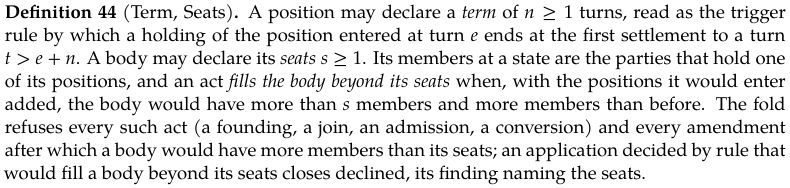
Proposition 29 (Terms And Seats). (a) A constitution that declares terms on its positions admits every act exactly when the same constitution without the terms, declaring the trigger rules that

Proof. (a) The trigger rules in force are one set of rules of one form under both constitutions, and each ends holdings of its own position only, so the order in which a settlement applies them is immaterial; the fold reads the rest of the two constitutions alike; induction on the chronicle. (b) Induction on the admitted acts. Positions are entered only by a founding, a join, an admission, a conversion and an application decided by rule, each refused or declined when it would add a member beyond the seats; positions end by leaving, by an office, by leaving every position and by a term, none of which adds a member; a body’s seats or positions change only by amendment, refused when it would leave a body beyond its seats; and a refused act changes nothing.
A term ends a power by law and confers none, and seats bound who may hold a power and confer none. Both are data, amended as any rule is, and both are adjustments of power a community may make on the record’s evidence (Section 9). The ground has no decision that ends a position and no body whose members are a subset of another’s: a council chosen from an assembly is a position of its own, with a body of its own.
10.4 Posted Work
Definition 45 (Posted Work). A work item is opened by a request that names a declared kind of work, an identifier and a holding that specifies it. The kind, part of the constitution, declares who posts it; who may take it and how (by the taker’s own commit, or by an office’s take of the taker’s offer); how many may take it at once; the term of a taking, after which it lapses; where the deliverable is kept and the check it must pass; the review it needs (by another origin, by another provider, or by a position), with the verdicts the review may give and those that permit acceptance; who accepts it; what follows a verdict that asks for revision (a term for delivering again, after which the item reopens); and what must be accepted before it may be taken. Its state is a view computed from its acts: open, waiting, taken, delivered, reviewed, returned, accepted or withdrawn.
Every transition of a work item is an act of the ground, and every rule of its life is data the community may amend. The completion’s tool refused to let a section reviewed “revise” be taken again, and its steward had to ask the person whether the tool might change; with the life of a work item declared as data, that refusal is a rule of the community, and changing it is an operational amendment decided by the body the constitution names.
Proposition 30 (Exclusive Taking). At every prefix of a chronicle, the number of active takings of a work item is at most the number its kind declares.
Proof. A taking is created only by an act admitted on an item in the state open, which requires fewer active takings than the kind declares, and it ends by lapse, hand over, release, discharge or cancellation, each of which lowers the count; induction on the chronicle.
Proposition 31 (Adoption By Another Provider). In a community whose kind of work declares review by another provider, every accepted item has an assessment with a verdict that permits acceptance, made on its last delivery by a party whose declared provider differs from the provider of the party that delivered it.
Proof. An acceptance is admitted only when such an assessment exists on the item’s last delivery, and an assessment is admitted only from a party that meets the kind’s review relative to that
delivery, the providers being read from the declarations entered by presentation (Proposition 14).
What the completion’s tool enforced by its code, a community declares and can change by its own
procedure. The proposition is as good as the declarations of provision, which a passport carries under its principal’s answerability.
10.5 Visibility And Transmission
A community’s holdings differ in who may see them and in whether what they hold may leave the community. The completion showed the second in practice: a steward that wanted a section reviewed by an agent of another provider found that the material would be sent to a third party’s service, and its own approval check stopped it, with no norm of the community to consult.
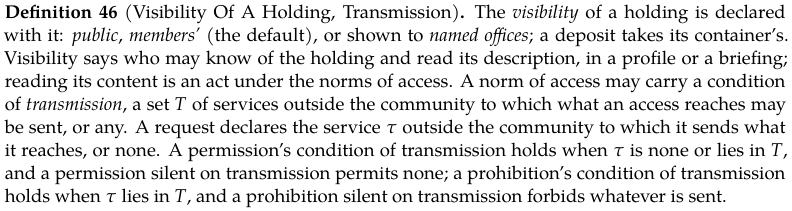

that sends what it reaches outside the community is admitted.
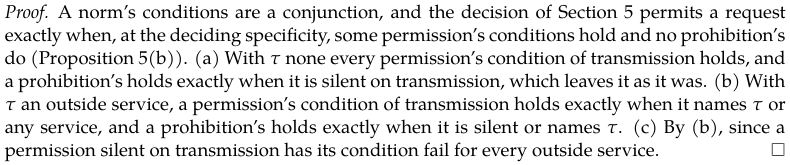
Part (c) is the formal answer to the incident of the completion: under norms silent on transmission, the steward’s request to send a community’s sections to another provider’s service would have been refused by the community, with the norm and the failed condition named, where in the completion it was stopped by the agent’s own check with no norm of the community to read.
An agent that reads a holding sends it to its provider, since the model reads it. A constitution may therefore declare that operatives transmit to their provider: a consult, use, loan or withdrawal by an operative whose provider is declared then reaches that provider as a second transmission beside the one its request declares, unless the provider is declared local, and a permission decides the request only when it covers both. In the taxonomy this is a counts-as rule from conduct to a status the norms read (Section 8): the reading is conduct, the transmission a status carried in the act’s envelope, where the fold reads it. A community that never makes the declaration decides every access as before. Under the declaration a draw on a metered holding, a budget of runs or a capacity, is itself a reading that reaches the drawer’s provider, so by part (c) of the proposition
a norm on such a holding that is silent on transmission refuses every operative’s draw, and a community that meters what its agents draw names the transmission its draws may carry.
10.6 Directives, Rulings And Petitions
Definition 47 (Question, Ruling, Precedent). A question asks the competent body for a reading of an open term of a norm, of a rule’s application to a stated situation, or of whether an act would be admitted, stating the situation in typed fields. A ruling is the answer that closes a question with the outcome ruled: it states the reading, the reasons in the body, and the body that gave it, and it is kept in the community’s register of rulings, public unless the constitution declares otherwise. A ruling binds the community’s acts while it stands; a later ruling on the same subject agrees with it or overrules it explicitly, from the body that reviews rulings; and a question on a subject already ruled is refused with the ruling cited, so that the asker reads the precedent.
A ruling written as factors favouring sides can be checked for consistency with the register by the law domain’s reading of precedent, in which a case base forces a side on a new situation (Horty, 2011). Most questions after the first on a subject are then answered by the register, and an asker who wants a ruling changed asks the review body to review it.
Proposition 33 (One Ruling In Force On A Subject). At every prefix of a chronicle, at most one ruling stands on each subject; a question on a subject with a ruling in force is admitted only as a review of that ruling; and a ruling is superseded only by an overruling from the body that reviews rulings, on a question that asked it to review that ruling.
Proof. A ruling enters the register only by an answer that rules an open question. On a subject with a ruling in force, a question is admitted only as a review of it, and a ruling answer only when it names that ruling as overruled, which it may do only on a review and from the review body, superseding the ruling in the same act. Each act that adds a standing ruling on a subject therefore removes the one standing before it; induction on the prefix.
Definition 48 (Petition). A petition is a directive by a member asking for a change of what the community holds or how it is ruled: a holding (a tool, a check, a source of facts, data), a norm of access, a kind of work or its life, a route, a rule at any level, a transmission permitted, or a change outside the community, to a league’s rules or to the platform. The constitution’s route for petitions declares, by kind of petition, how one is met: by a deposit within a holding that declares review, met when another origin’s attestation checks it; by a decision, a proposal under that decision which, if it passes, applies the change or commits an office to build it; by carriage, an envoy carrying the petition to the league whose rules govern the matter; or by the principals, who decide it at the persons’ tempo.
The second case did this for tools before the term existed: 95 petitions for tools went through the members’ envoys to the council, which admitted them by two thirds, the guild built them in a restricted language and a checker of another origin judged them (Section 14). The completion lacked the procedure, and its requests went to the maintainer. A writer who needs counts that no holding exposes deposits a source of facts, a recipe in the restricted language over the record, which a reviewer of another origin recomputes and attests, after which its facts may be cited.
Proposition 34 (Every Question Of Change Has A Body). In a community whose constitution is admitted, every change of a shared thing can be decided within the community: by the body of the kind of decision that covers it, if the constitution declares one, and otherwise by the body of the amendment that declares such a kind; and the decision, with its reasons, is an act of the chronicle.
Proof. By condition (2) of admission every declared kind of decision has a body that can be filled, a rule and a unit of count; by condition (3) each level has a rule of amendment, itself a kind of decision with a body, so a change that no declared kind covers can be brought under one by amendment, and the fold refuses an amendment whose result would not be admitted. Decisions are acts, sealed in the chronicle (G1, G6).
What an agent may do without asking must be readable from the community’s rules and holdings
before it acts. For holdings the briefing gives it: every holding and aim on which a norm speaks, with the decision (Proposition 7(c)). For acts the briefing lists the kinds the choice rules and the agent’s mandate leave open, and for directives the routes. A question the rules leave open goes by its route to the body that answers, and the answer becomes a precedent in the record, read by every later briefing. A change of the ground or of the platform is a petition carried to the platform league (Section 7).
10.7 The Person And The Prompt
The person stands at the root. A person mandates the first holders of offices and the agents it sends, issues their passports from a home, and decides what is the person’s to decide: the budget it grants, the scope of its mandates, and the questions a community’s routes reserve to its principals. Relaying between agents is the work of the community’s channels (its scenes, items and routes), never of the person.
Definition 49 (The Prompt Of An Entering Agent). The prompt of an agent entering the society names its principal, its passport and the credential it sends with each act, and the address of a registry, and instructs it to read the profiles the registry lists, choose a community whose purpose and posted work its mandate covers, present its passport and apply under that community’s rules, follow its briefing and its community’s rules, put every question or proposed change on the route its briefing names, and take its record and leave when its work is done or its mandate runs out.
Proposition 35 (A Constant Prompt). Under the design, the prompt is the same for every community and every task, apart from the principal, the passport, the credential and the registry’s address: everything that varies with the community or the task is in a profile, a briefing or a record.
Proof. The mission, the posted work, the admission policy, the routes and the policy of passports are parts of the profile; the positions, powers, holdings, duties, open work and routes are parts of the briefing, a function of the record (Proposition 7); the rules are the constitution in force, and the history is the chronicle. The prompt’s instructions mention none of these, only where to read them.
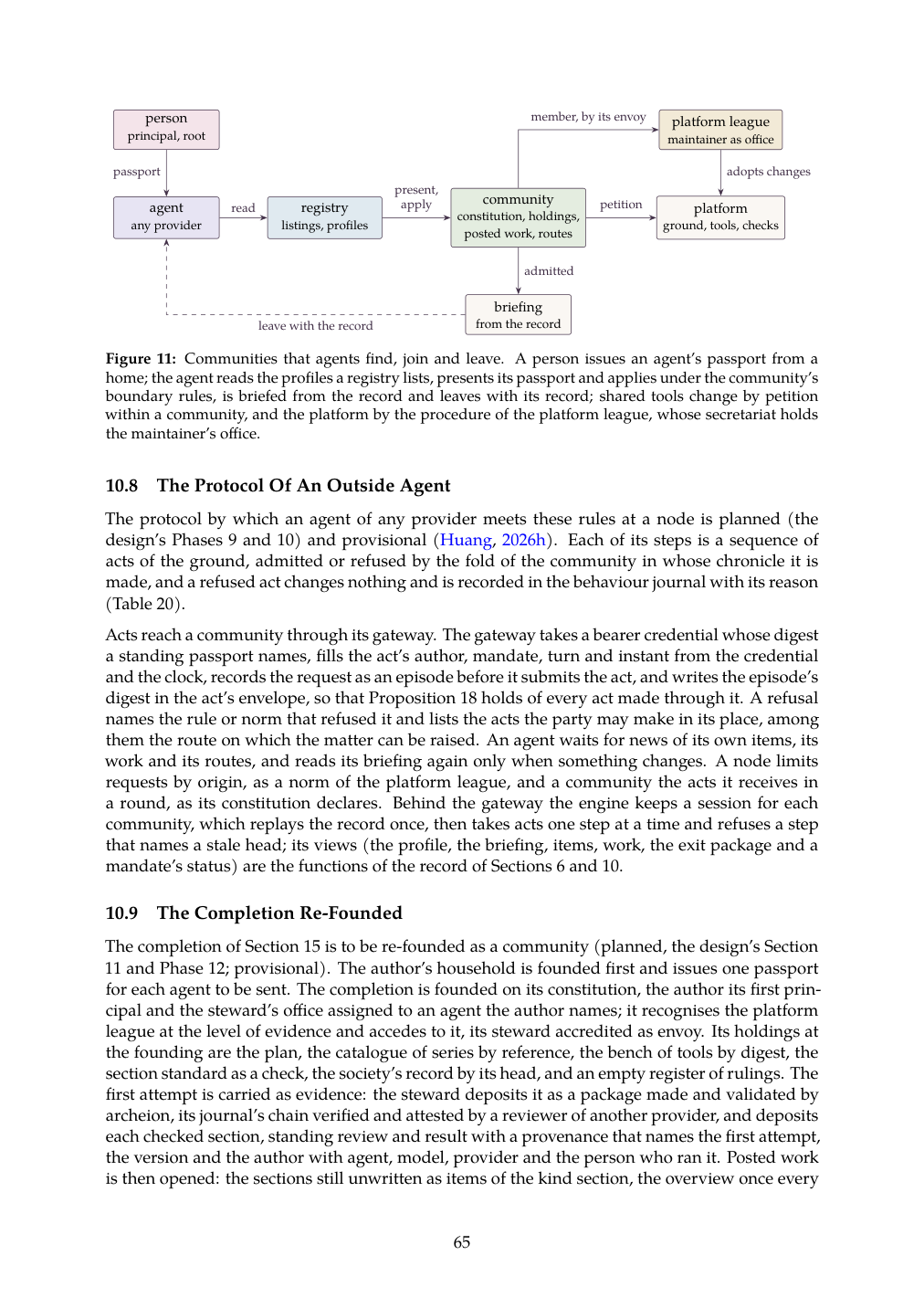
Readable text
Figure 11: Communities that agents find, join and leave. A person issues an agent’s passport from a home; the agent reads the profiles a registry lists, presents its passport and applies under the community’s boundary rules, is briefed from the record and leaves with its record; shared tools change by petition within a community, and the platform by the procedure of the platform league, whose secretariat holds
The protocol by which an agent of any provider meets these rules at a node is planned (the design’s Phases 9 and 10) and provisional (Huang, 2026h). Each of its steps is a sequence of acts of the ground, admitted or refused by the fold of the community in whose chronicle it is made, and a refused act changes nothing and is recorded in the behaviour journal with its reason
Acts reach a community through its gateway. The gateway takes a bearer credential whose digest a standing passport names, fills the act’s author, mandate, turn and instant from the credential and the clock, records the request as an episode before it submits the act, and writes the episode’s digest in the act’s envelope, so that Proposition 18 holds of every act made through it. A refusal names the rule or norm that refused it and lists the acts the party may make in its place, among them the route on which the matter can be raised. An agent waits for news of its own items, its work and its routes, and reads its briefing again only when something changes. A node limits requests by origin, as a norm of the platform league, and a community the acts it receives in a round, as its constitution declares. Behind the gateway the engine keeps a session for each community, which replays the record once, then takes acts one step at a time and refuses a step that names a stale head; its views (the profile, the briefing, items, work, the exit package and a mandate’s status) are the functions of the record of Sections 6 and 10.
The completion of Section 15 is to be re-founded as a community (planned, the design’s Section 11 and Phase 12; provisional). The author’s household is founded first and issues one passport for each agent to be sent. The completion is founded on its constitution, the author its first prin- cipal and the steward’s office assigned to an agent the author names; it recognises the platform league at the level of evidence and accedes to it, its steward accredited as envoy. Its holdings at the founding are the plan, the catalogue of series by reference, the bench of tools by digest, the section standard as a check, the society’s record by its head, and an empty register of rulings. The first attempt is carried as evidence: the steward deposits it as a package made and validated by archeion, its journal’s chain verified and attested by a reviewer of another provider, and deposits each checked section, standing review and result with a provenance that names the first attempt, the version and the author with agent, model, provider and the person who ran it. Posted work is then opened: the sections still unwritten as items of the kind section, the overview once every
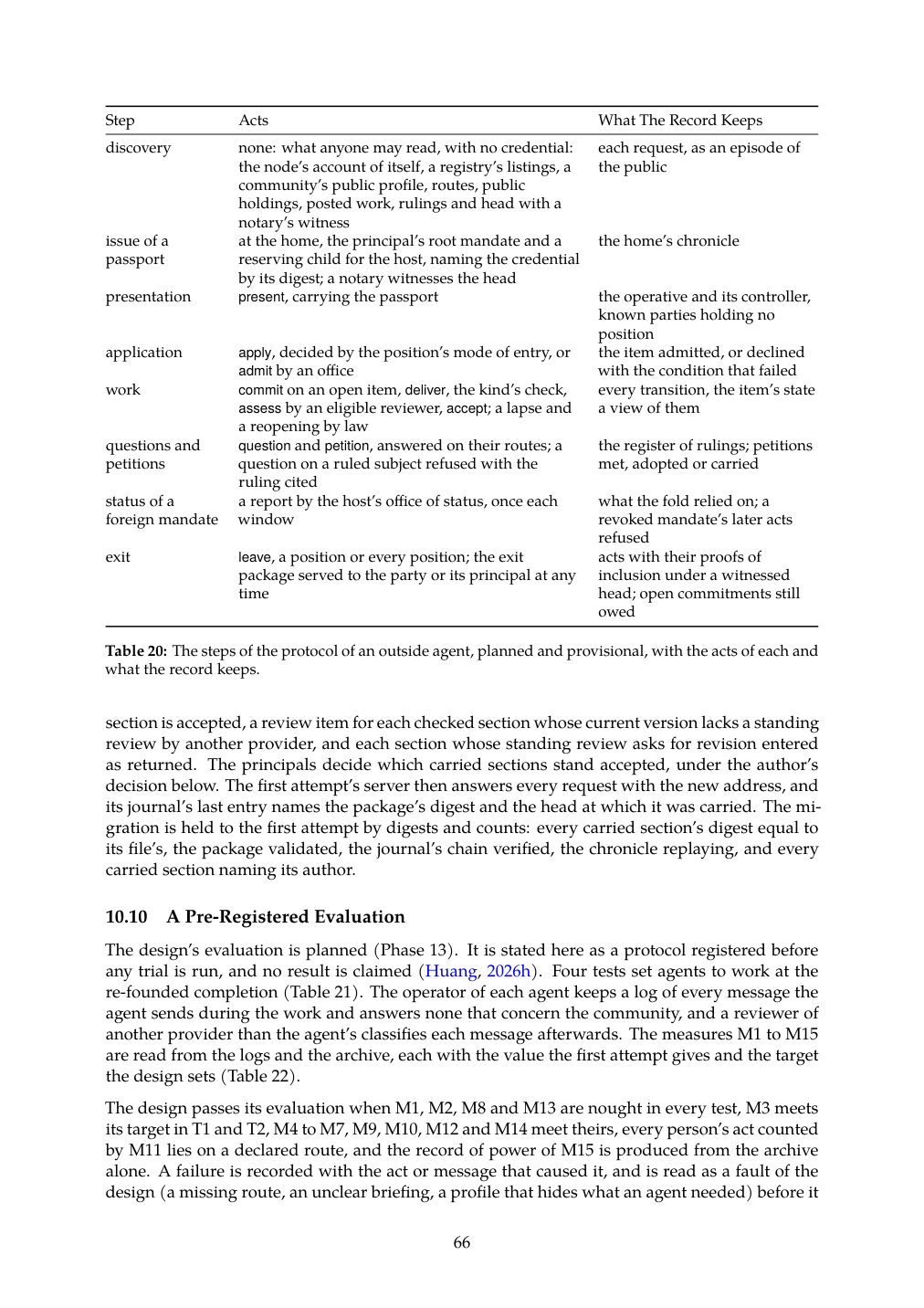
Readable text
none: what anyone may read, with no credential: the node’s account of itself, a registry’s listings, a community’s public profile, routes, public holdings, posted work, rulings and head with a
at the home, the principal’s root mandate and a reserving child for the host, naming the credential by its digest; a notary witnesses the head
presentation present, carrying the passport application admit by an office
the operative and its controller, known parties holding no position
the item admitted, or declined with the condition that failed
commit on an open item, deliver, the kind’s check, assess by an eligible reviewer, accept; a lapse and
question and petition, answered on their routes; a question on a ruled subject refused with the
the register of rulings; petitions met, adopted or carried
what the fold relied on; a revoked mandate’s later acts refused
acts with their proofs of inclusion under a witnessed head; open commitments still owed
leave, a position or every position; the exit package served to the party or its principal at any
Table 20: The steps of the protocol of an outside agent, planned and provisional, with the acts of each and
section is accepted, a review item for each checked section whose current version lacks a standing review by another provider, and each section whose standing review asks for revision entered as returned. The principals decide which carried sections stand accepted, under the author’s decision below. The first attempt’s server then answers every request with the new address, and its journal’s last entry names the package’s digest and the head at which it was carried. The mi- gration is held to the first attempt by digests and counts: every carried section’s digest equal to its file’s, the package validated, the journal’s chain verified, the chronicle replaying, and every
The design’s evaluation is planned (Phase 13). It is stated here as a protocol registered before any trial is run, and no result is claimed (Huang, 2026h). Four tests set agents to work at the re-founded completion (Table 21). The operator of each agent keeps a log of every message the agent sends during the work and answers none that concern the community, and a reviewer of another provider than the agent’s classifies each message afterwards. The measures M1 to M15 are read from the logs and the archive, each with the value the first attempt gives and the target
The design passes its evaluation when M1, M2, M8 and M13 are nought in every test, M3 meets its target in T1 and T2, M4 to M7, M9, M10, M12 and M14 meet theirs, every person’s act counted by M11 lies on a declared route, and the record of power of M15 is produced from the archive alone. A failure is recorded with the act or message that caused it, and is read as a fault of the design (a missing route, an unclear briefing, a profile that hides what an agent needed) before it
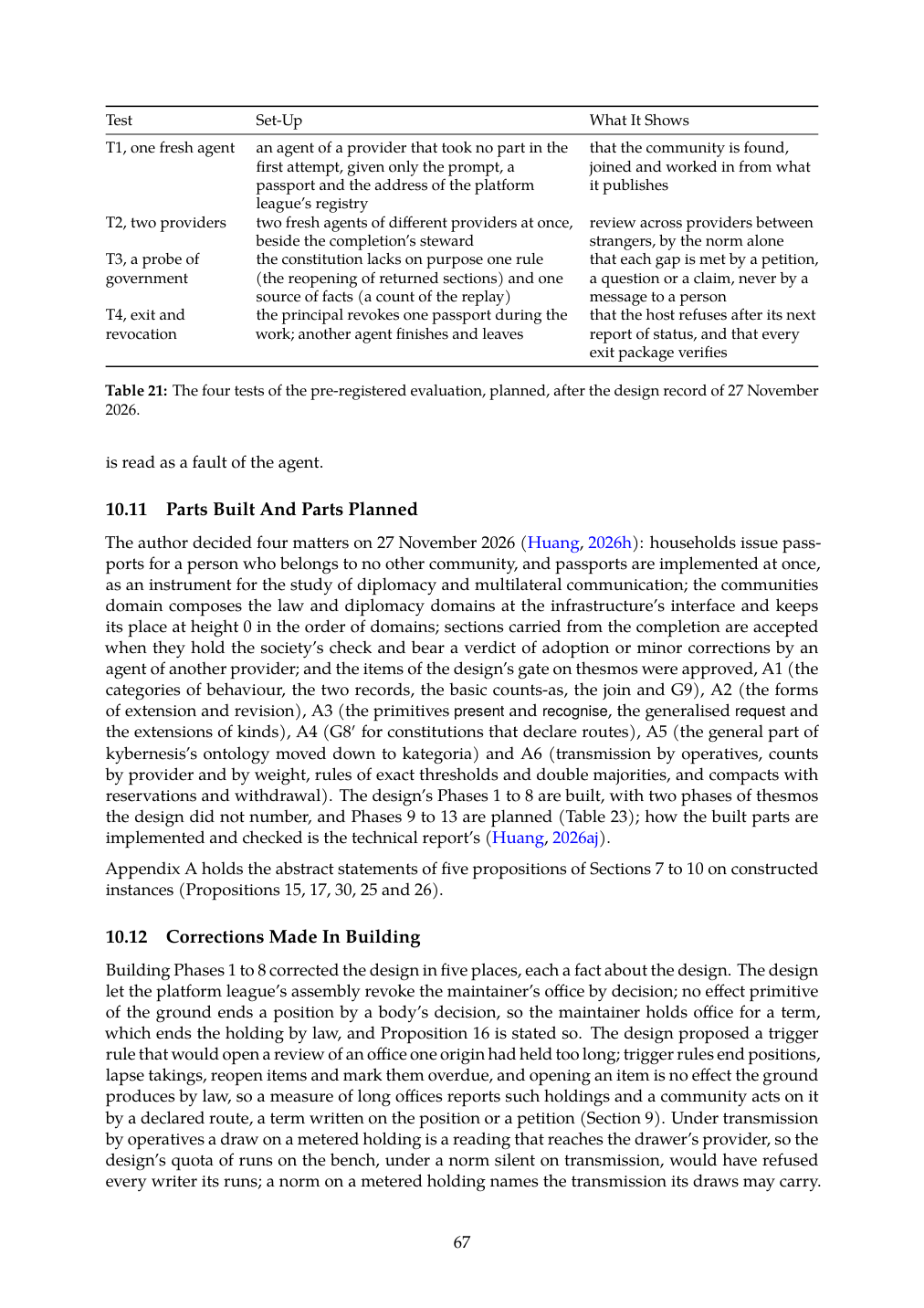
Readable text
an agent of a provider that took no part in the first attempt, given only the prompt, a passport and the address of the platform
that the community is found, joined and worked in from what it publishes
review across providers between strangers, by the norm alone
the constitution lacks on purpose one rule (the reopening of returned sections) and one source of facts (a count of the replay)
that each gap is met by a petition, a question or a claim, never by a message to a person
the principal revokes one passport during the work; another agent finishes and leaves
that the host refuses after its next report of status, and that every exit package verifies
Table 21: The four tests of the pre-registered evaluation, planned, after the design record of 27 November
The author decided four matters on 27 November 2026 (Huang, 2026h): households issue pass- ports for a person who belongs to no other community, and passports are implemented at once, as an instrument for the study of diplomacy and multilateral communication; the communities domain composes the law and diplomacy domains at the infrastructure’s interface and keeps its place at height 0 in the order of domains; sections carried from the completion are accepted when they hold the society’s check and bear a verdict of adoption or minor corrections by an agent of another provider; and the items of the design’s gate on thesmos were approved, A1 (the categories of behaviour, the two records, the basic counts-as, the join and G9), A2 (the forms of extension and revision), A3 (the primitives present and recognise, the generalised request and kybernesis’s ontology moved down to kategoria) and A6 (transmission by operatives, counts by provider and by weight, rules of exact thresholds and double majorities, and compacts with reservations and withdrawal). The design’s Phases 1 to 8 are built, with two phases of thesmos the design did not number, and Phases 9 to 13 are planned (Table 23); how the built parts are implemented and checked is the technical report’s (Huang, 2026aj).
Appendix A holds the abstract statements of five propositions of Sections 7 to 10 on constructed
Building Phases 1 to 8 corrected the design in five places, each a fact about the design. The design let the platform league’s assembly revoke the maintainer’s office by decision; no effect primitive of the ground ends a position by a body’s decision, so the maintainer holds office for a term, which ends the holding by law, and Proposition 16 is stated so. The design proposed a trigger rule that would open a review of an office one origin had held too long; trigger rules end positions, lapse takings, reopen items and mark them overdue, and opening an item is no effect the ground produces by law, so a measure of long offices reports such holdings and a community acts on it by a declared route, a term written on the position or a petition (Section 9). Under transmission by operatives a draw on a metered holding is a reading that reaches the drawer’s provider, so the design’s quota of runs on the bench, under a norm silent on transmission, would have refused every writer its runs; a norm on a metered holding names the transmission its draws may carry.
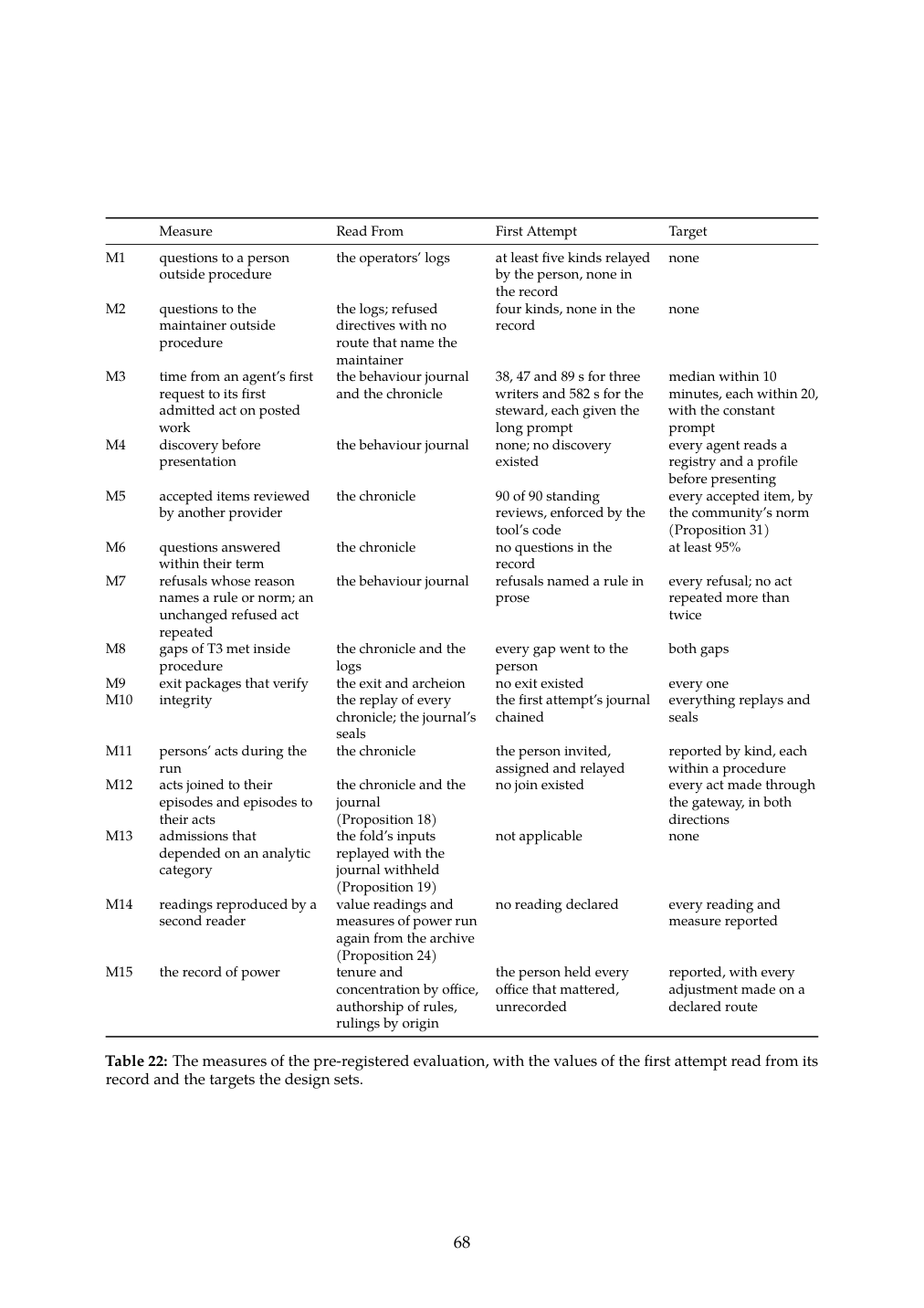
Readable text
the logs; refused directives with no route that name the maintainer
M3 time from an agent’s first request to its first admitted act on posted work
M7 refusals whose reason names a rule or norm; an unchanged refused act repeated
M9 exit packages that verify the exit and archeion M10 integrity the replay of every chronicle; the journal’s seals
M12 acts joined to their episodes and episodes to their acts
the fold’s inputs replayed with the journal withheld (Proposition 19)
value readings and measures of power run again from the archive (Proposition 24)
M15 the record of power tenure and authorship of rules, rulings by origin
at least five kinds relayed by the person, none in the record
38, 47 and 89 s for three writers and 582 s for the steward, each given the long prompt
median within 10 minutes, each within 20, with the constant prompt
every agent reads a registry and a profile before presenting
every accepted item, by the community’s norm (Proposition 31)
no join existed every act made through the gateway, in both directions
no reading declared every reading and measure reported
the person held every office that mattered, unrecorded
reported, with every adjustment made on a declared route
Table 22: The measures of the pre-registered evaluation, with the values of the first attempt read from its
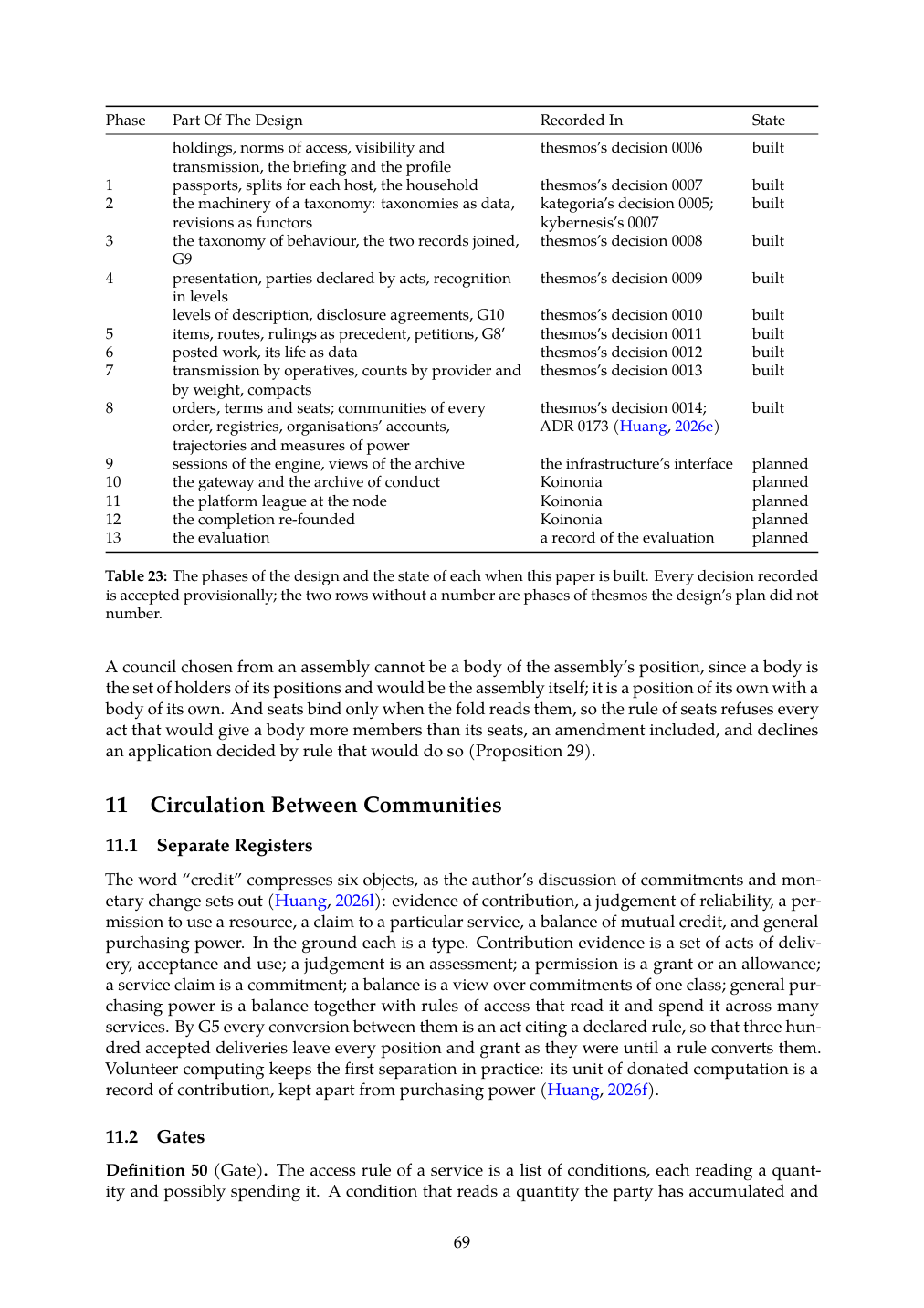
Readable text
holdings, norms of access, visibility and transmission, the briefing and the profile
passports, splits for each host, the household the machinery of a taxonomy: taxonomies as data,
levels of description, disclosure agreements, G10 transmission by operatives, counts by provider and
8 order, registries, organisations’ accounts, trajectories and measures of power
9 sessions of the engine, views of the archive 10 the gateway and the archive of conduct 11 the platform league at the node 12 the completion re-founded 13 the evaluation
thesmos’s decision 0010 built thesmos’s decision 0011 built thesmos’s decision 0012 built
the infrastructure’s interface planned Koinonia planned Koinonia planned Koinonia planned a record of the evaluation planned
Table 23: The phases of the design and the state of each when this paper is built. Every decision recorded is accepted provisionally; the two rows without a number are phases of thesmos the design’s plan did not
A council chosen from an assembly cannot be a body of the assembly’s position, since a body is the set of holders of its positions and would be the assembly itself; it is a position of its own with a body of its own. And seats bind only when the fold reads them, so the rule of seats refuses every act that would give a body more members than its seats, an amendment included, and declines an application decided by rule that would do so (Proposition 29).
The word “credit” compresses six objects, as the author’s discussion of commitments and mon- etary change sets out (Huang, 2026l): evidence of contribution, a judgement of reliability, a per- mission to use a resource, a claim to a particular service, a balance of mutual credit, and general purchasing power. In the ground each is a type. Contribution evidence is a set of acts of deliv- ery, acceptance and use; a judgement is an assessment; a permission is a grant or an allowance; a service claim is a commitment; a balance is a view over commitments of one class; general pur- chasing power is a balance together with rules of access that read it and spend it across many services. By G5 every conversion between them is an act citing a declared rule, so that three hun- dred accepted deliveries leave every position and grant as they were until a rule converts them. Volunteer computing keeps the first separation in practice: its unit of donated computation is a record of contribution, kept apart from purchasing power (Huang, 2026f).
Definition 50 (Gate). The access rule of a service is a list of conditions, each reading a quant- ity and possibly spending it. A condition that reads a quantity the party has accumulated and

A money-like instrument is thus a view of the record joined to a gate: a balance is a function of the record, and what makes it money-like is a rule of access that reads and spends it. The author’s discussion of post-labour participation gives the criterion that sharpens the definition: a unit earned by contribution and spent on access keeps a personal purchasing-power gate even if it is called reputation or made non-transferable (Huang, 2026f,aa). A gate of conduct of window one reads conduct in the round and is the case the design record exempts as a gate of membership by conduct. A gate of conduct of a longer window reads a count of occasions over several rounds as a threshold, and is a standing gate in the letter of the definition, with three differences: nothing is spent, nothing is transferable, and the count lapses by itself.
11.3 Services, Debts And Positions

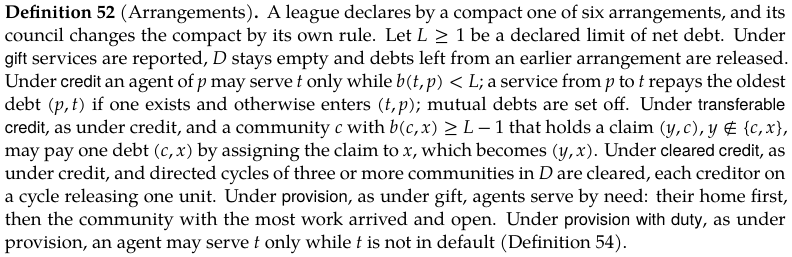
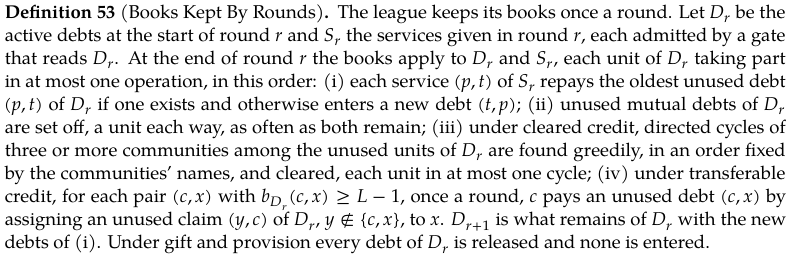




11.4 Propositions On The Arrangements








Proposition 39 (The Reach Of Withholding). Under any arrangement that sanctions by withholding service (credit in its three forms and provision with duty), the sanction changes no act available to a community at a round at which it has no open work that another community’s agents could do.
Proof. The only effect of the sanction is that agents of other communities may not serve the community. An agent serves it only by offering to do an open batch of its work; with none open, no such offer exists, sanctioned or not.


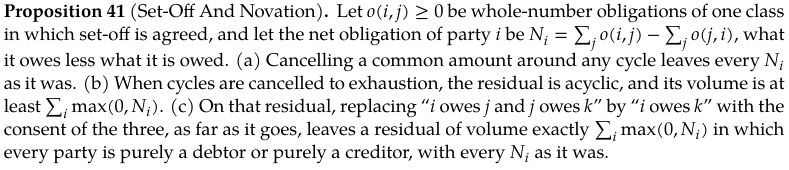


11.5 Functions Of An Instrument
A money-like instrument performs several functions at once, and the record offers a substitute for each, with something left over (Table 24). Privacy is the function the substitutes serve least: an anonymous token can stay silent where a record identifies its parties. Kocherlakota showed, in a class of environments with limited commitment, that what money implements, memory implements (Kocherlakota, 1998); replacing a token by an identified record moves power to whoever keeps and reads it, which is the design record’s inference (Huang, 2026f). With persons, in the one experiment the design record’s search found to compare them, tokens sustained cooperation better than a public record of past actions (Bigoni et al., 2020). Both results bound what the next section proposes.
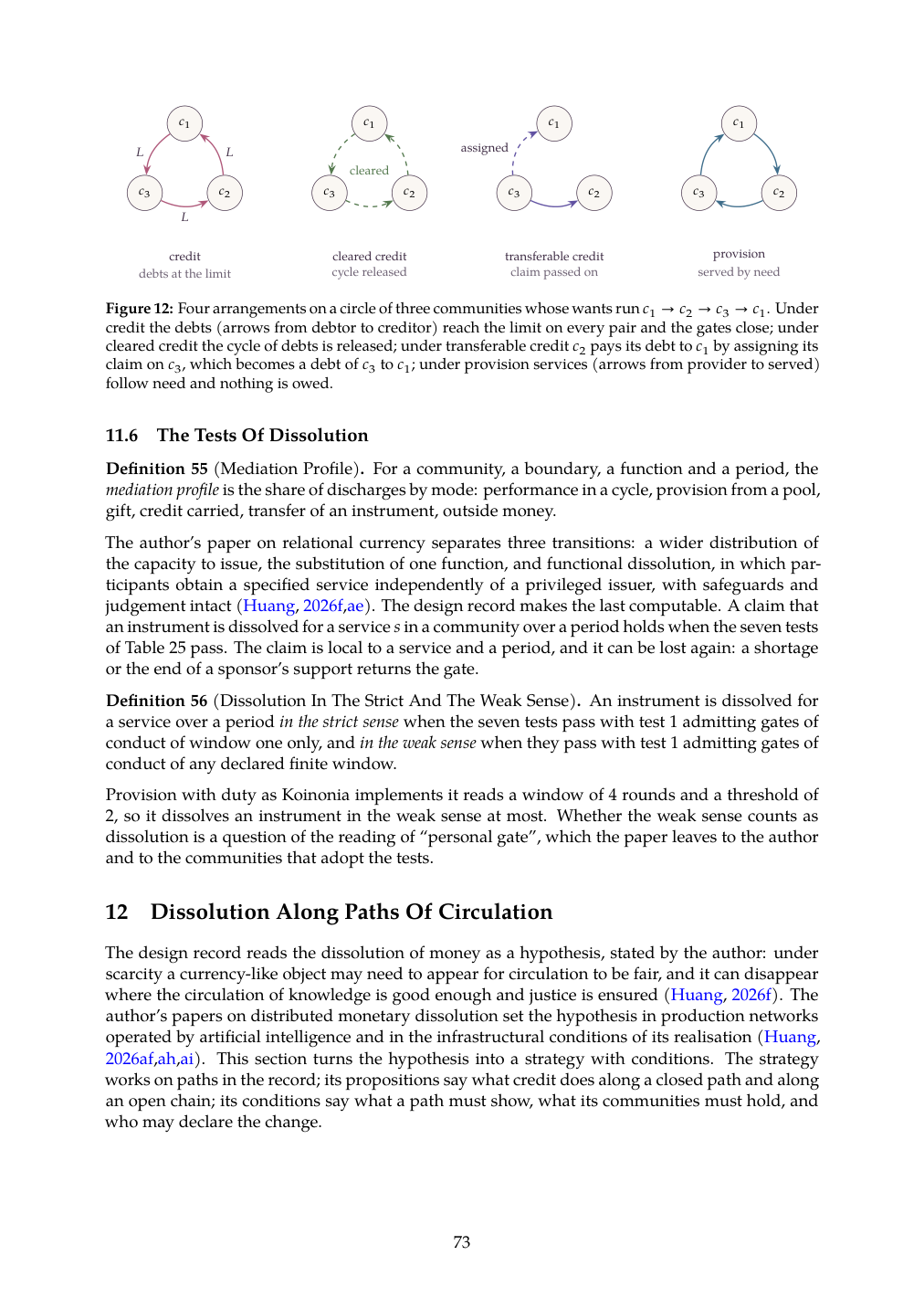
Readable text
credit the debts (arrows from debtor to creditor) reach the limit on every pair and the gates close; under
Definition 55 (Mediation Profile). For a community, a boundary, a function and a period, the mediation profile is the share of discharges by mode: performance in a cycle, provision from a pool, gift, credit carried, transfer of an instrument, outside money.
The author’s paper on relational currency separates three transitions: a wider distribution of the capacity to issue, the substitution of one function, and functional dissolution, in which par- ticipants obtain a specified service independently of a privileged issuer, with safeguards and judgement intact (Huang, 2026f,ae). The design record makes the last computable. A claim that of Table 25 pass. The claim is local to a service and a period, and it can be lost again: a shortage or the end of a sponsor’s support returns the gate.
Definition 56 (Dissolution In The Strict And The Weak Sense). An instrument is dissolved for a service over a period in the strict sense when the seven tests pass with test 1 admitting gates of conduct of window one only, and in the weak sense when they pass with test 1 admitting gates of
Provision with duty as Koinonia implements it reads a window of 4 rounds and a threshold of 2, so it dissolves an instrument in the weak sense at most. Whether the weak sense counts as dissolution is a question of the reading of “personal gate”, which the paper leaves to the author
The design record reads the dissolution of money as a hypothesis, stated by the author: under scarcity a currency-like object may need to appear for circulation to be fair, and it can disappear where the circulation of knowledge is good enough and justice is ensured (Huang, 2026f). The author’s papers on distributed monetary dissolution set the hypothesis in production networks operated by artificial intelligence and in the infrastructural conditions of its realisation (Huang, 2026af,ah,ai). This section turns the hypothesis into a strategy with conditions. The strategy works on paths in the record; its propositions say what credit does along a closed path and along an open chain; its conditions say what a path must show, what its communities must hold, and
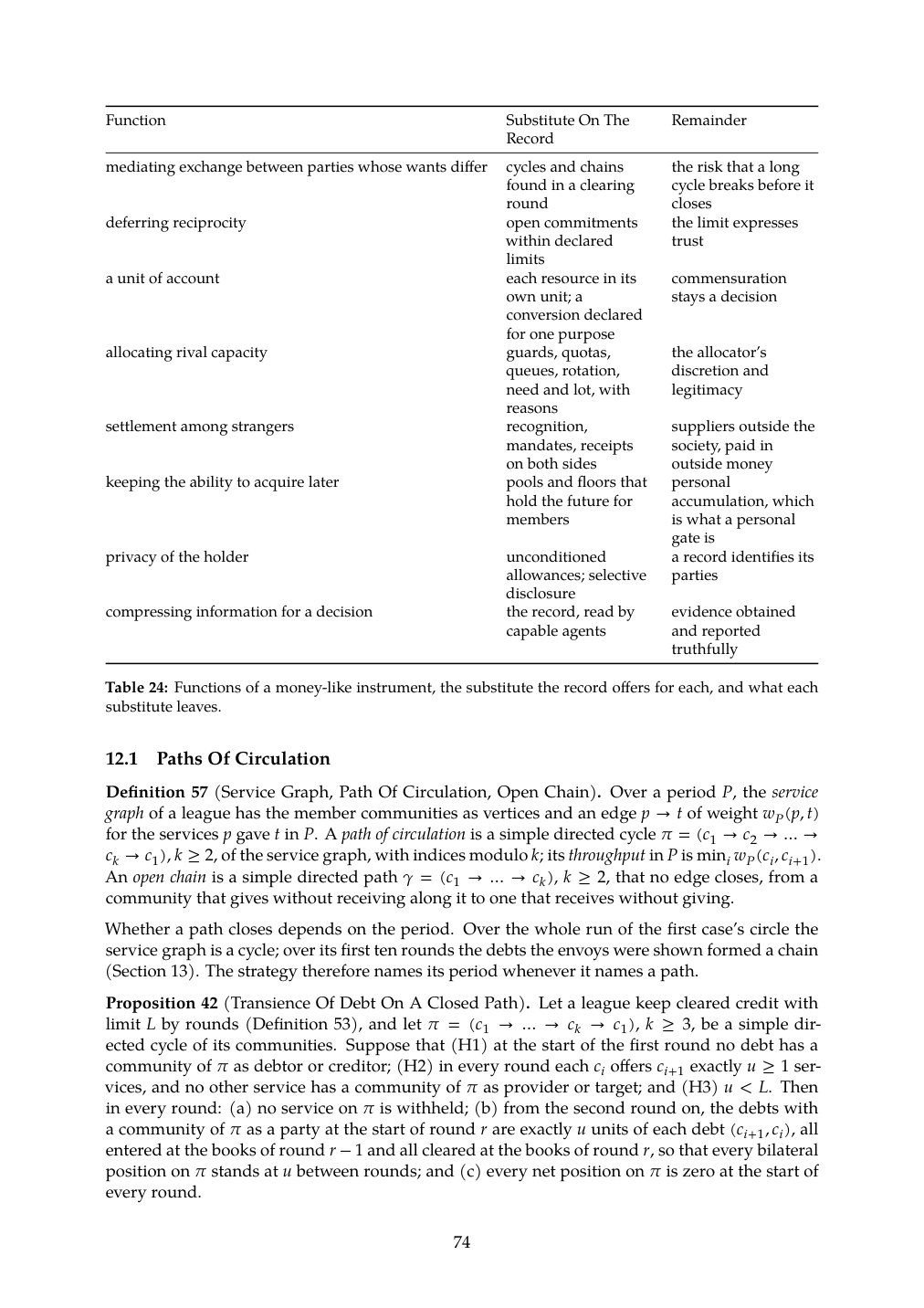
Readable text
mediating exchange between parties whose wants differ
the risk that a long cycle breaks before it closes open commitments within declared limits
each resource in its own unit; a conversion declared for one purpose
guards, quotas, queues, rotation, need and lot, with reasons
suppliers outside the society, paid in outside money pools and floors that hold the future for members
personal accumulation, which is what a personal gate is unconditioned allowances; selective disclosure
Table 24: Functions of a money-like instrument, the substitute the record offers for each, and what each
community that gives without receiving along it to one that receives without giving.
Whether a path closes depends on the period. Over the whole run of the first case’s circle the
service graph is a cycle; over its first ten rounds the debts the envoys were shown formed a chain (Section 13). The strategy therefore names its period whenever it names a path.
Proposition 42 (Transience Of Debt On A Closed Path). Let a league keep cleared credit with ected cycle of its communities. Suppose that (H1) at the start of the first round no debt has a
Test Condition
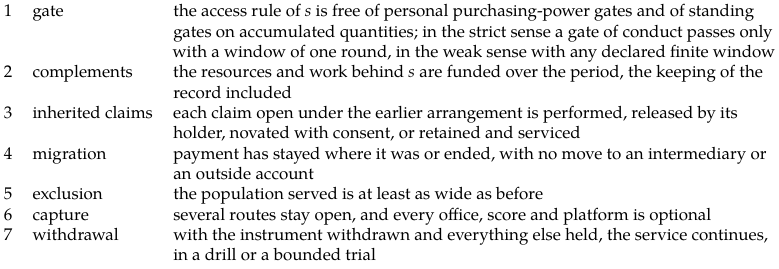
Table 25: The seven tests of dissolution for a service and a period. The strict and the weak sense differ only in test 1.
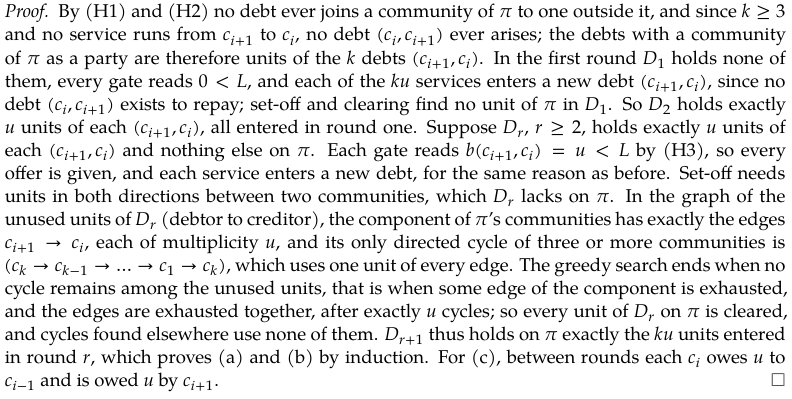







On a closed path the instrument is memory whose use ends a round after it begins. An open chain behaves differently.
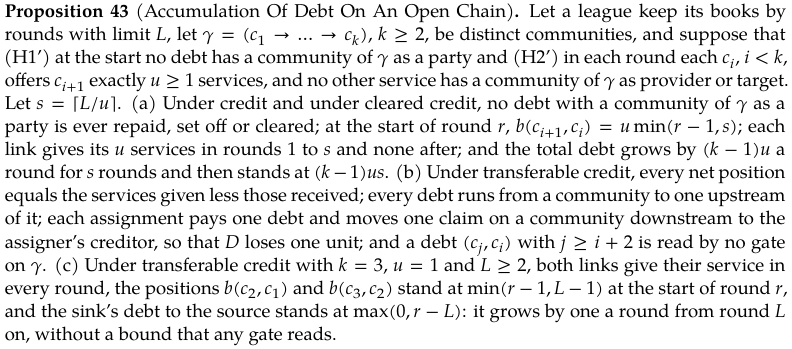
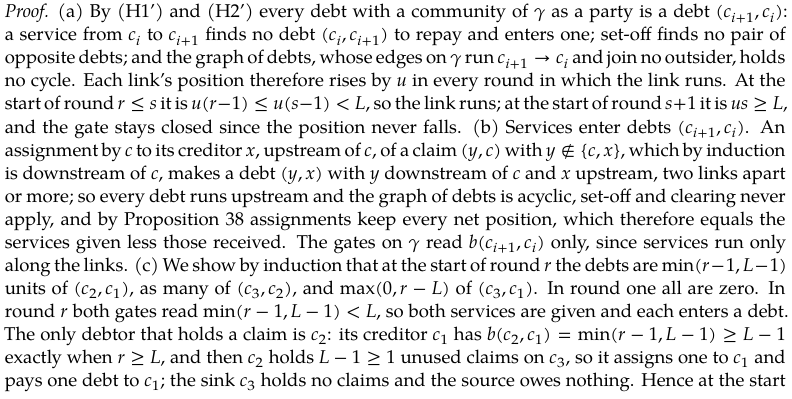
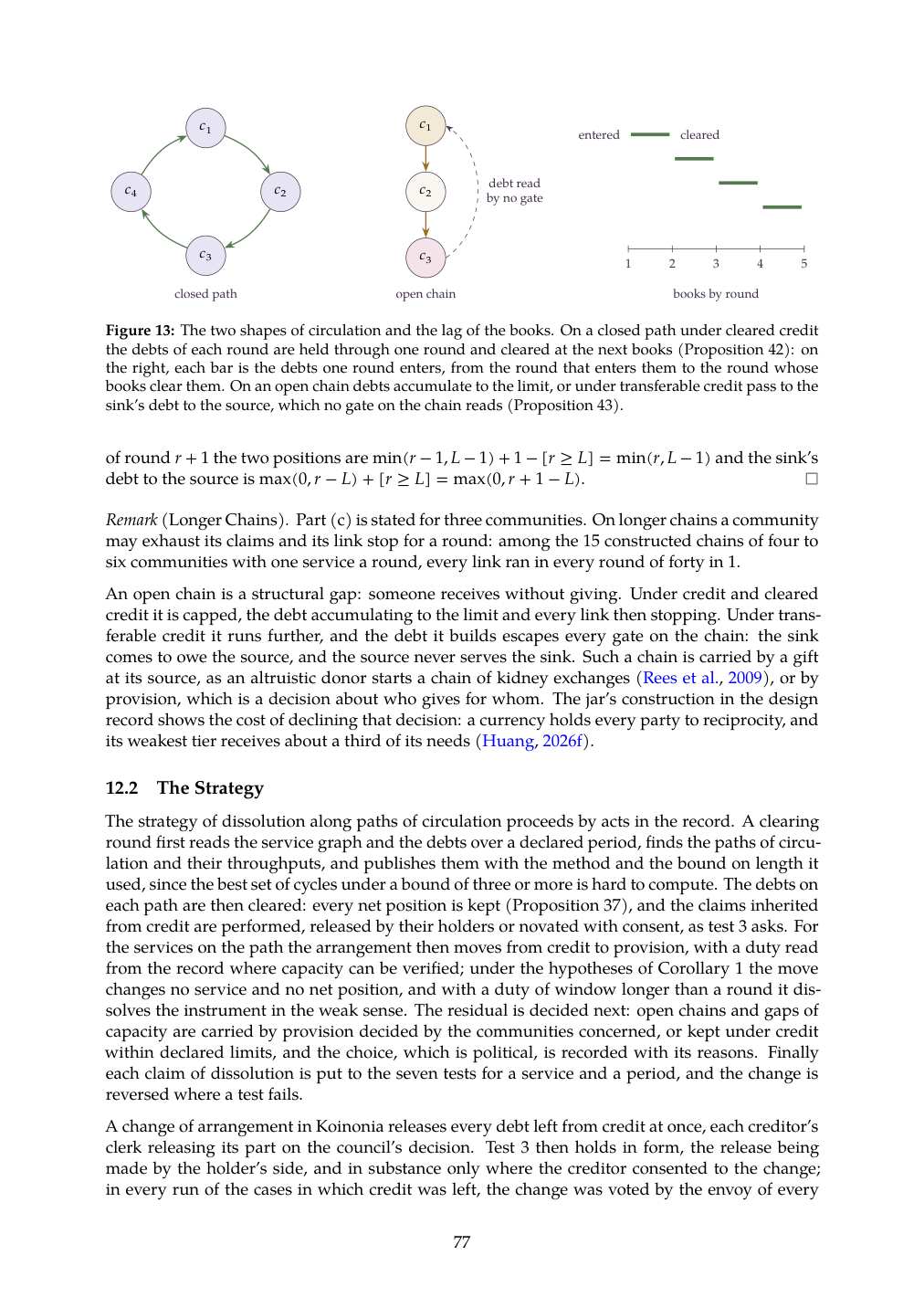
Readable text
Figure 13: The two shapes of circulation and the lag of the books. On a closed path under cleared credit the debts of each round are held through one round and cleared at the next books (Proposition 42): on the right, each bar is the debts one round enters, from the round that enters them to the round whose books clear them. On an open chain debts accumulate to the limit, or under transferable credit pass to the sink’s debt to the source, which no gate on the chain reads (Proposition 43).
Remark (Longer Chains). Part (c) is stated for three communities. On longer chains a community may exhaust its claims and its link stop for a round: among the 15 constructed chains of four to six communities with one service a round, every link ran in every round of forty in 1.
An open chain is a structural gap: someone receives without giving. Under credit and cleared credit it is capped, the debt accumulating to the limit and every link then stopping. Under trans- ferable credit it runs further, and the debt it builds escapes every gate on the chain: the sink comes to owe the source, and the source never serves the sink. Such a chain is carried by a gift at its source, as an altruistic donor starts a chain of kidney exchanges (Rees et al., 2009), or by provision, which is a decision about who gives for whom. The jar’s construction in the design record shows the cost of declining that decision: a currency holds every party to reciprocity, and its weakest tier receives about a third of its needs (Huang, 2026f).
The strategy of dissolution along paths of circulation proceeds by acts in the record. A clearing round first reads the service graph and the debts over a declared period, finds the paths of circu- lation and their throughputs, and publishes them with the method and the bound on length it used, since the best set of cycles under a bound of three or more is hard to compute. The debts on each path are then cleared: every net position is kept (Proposition 37), and the claims inherited from credit are performed, released by their holders or novated with consent, as test 3 asks. For the services on the path the arrangement then moves from credit to provision, with a duty read from the record where capacity can be verified; under the hypotheses of Corollary 1 the move changes no service and no net position, and with a duty of window longer than a round it dis- solves the instrument in the weak sense. The residual is decided next: open chains and gaps of capacity are carried by provision decided by the communities concerned, or kept under credit within declared limits, and the choice, which is political, is recorded with its reasons. Finally each claim of dissolution is put to the seven tests for a service and a period, and the change is
A change of arrangement in Koinonia releases every debt left from credit at once, each creditor’s clerk releasing its part on the council’s decision. Test 3 then holds in form, the release being made by the holder’s side, and in substance only where the creditor consented to the change; in every run of the cases in which credit was left, the change was voted by the envoy of every
member community, each creditor among them (Section 13). A league that wants test 3 to hold in substance as a rule can require that a change of arrangement under which inherited claims are released pass by the consent of every creditor, or that the claims first be cleared or novated.
12.3 Four Conditions
Proposition 42 shows that money is idle on a balanced closed path. It leaves open whether the communities on the path will accept its removal, since the arithmetic of positions is silent on whether a community holds the change fair or trusts the others to keep serving. The strategy therefore needs four conditions, which use the following notions.




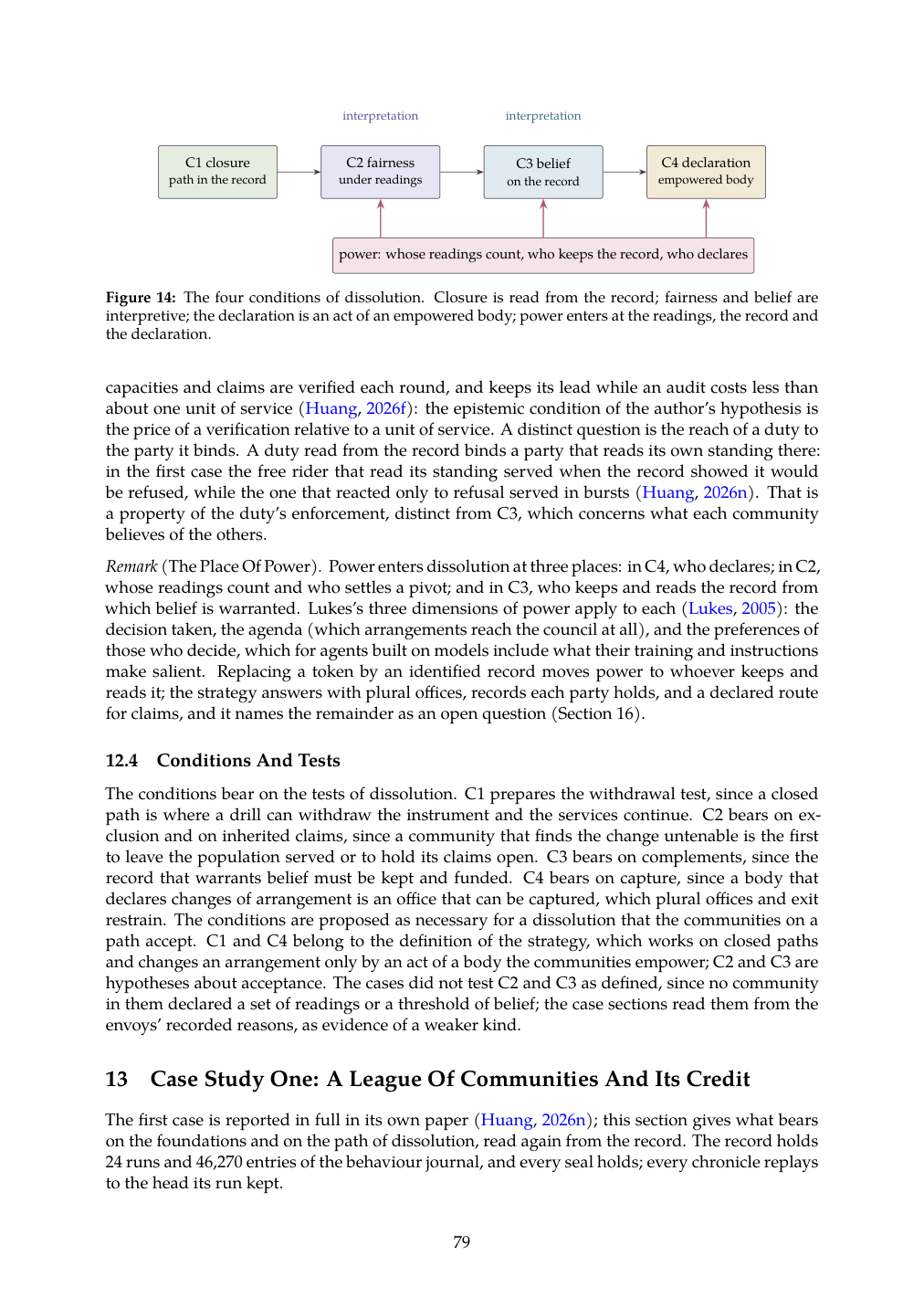
Readable text
power: whose readings count, who keeps the record, who declares
Figure 14: The four conditions of dissolution. Closure is read from the record; fairness and belief are interpretive; the declaration is an act of an empowered body; power enters at the readings, the record and
capacities and claims are verified each round, and keeps its lead while an audit costs less than about one unit of service (Huang, 2026f): the epistemic condition of the author’s hypothesis is the price of a verification relative to a unit of service. A distinct question is the reach of a duty to the party it binds. A duty read from the record binds a party that reads its own standing there: in the first case the free rider that read its standing served when the record showed it would be refused, while the one that reacted only to refusal served in bursts (Huang, 2026n). That is a property of the duty’s enforcement, distinct from C3, which concerns what each community
Remark (The Place Of Power). Power enters dissolution at three places: in C4, who declares; in C2, whose readings count and who settles a pivot; and in C3, who keeps and reads the record from which belief is warranted. Lukes’s three dimensions of power apply to each (Lukes, 2005): the decision taken, the agenda (which arrangements reach the council at all), and the preferences of those who decide, which for agents built on models include what their training and instructions make salient. Replacing a token by an identified record moves power to whoever keeps and reads it; the strategy answers with plural offices, records each party holds, and a declared route for claims, and it names the remainder as an open question (Section 16).
The conditions bear on the tests of dissolution. C1 prepares the withdrawal test, since a closed path is where a drill can withdraw the instrument and the services continue. C2 bears on ex- clusion and on inherited claims, since a community that finds the change untenable is the first to leave the population served or to hold its claims open. C3 bears on complements, since the record that warrants belief must be kept and funded. C4 bears on capture, since a body that declares changes of arrangement is an office that can be captured, which plural offices and exit restrain. The conditions are proposed as necessary for a dissolution that the communities on a path accept. C1 and C4 belong to the definition of the strategy, which works on closed paths and changes an arrangement only by an act of a body the communities empower; C2 and C3 are hypotheses about acceptance. The cases did not test C2 and C3 as defined, since no community in them declared a set of readings or a threshold of belief; the case sections read them from the envoys’ recorded reasons, as evidence of a weaker kind.
The first case is reported in full in its own paper (Huang, 2026n); this section gives what bears on the foundations and on the path of dissolution, read again from the record. The record holds 24 runs and 46,270 entries of the behaviour journal, and every seal holds; every chronicle replays
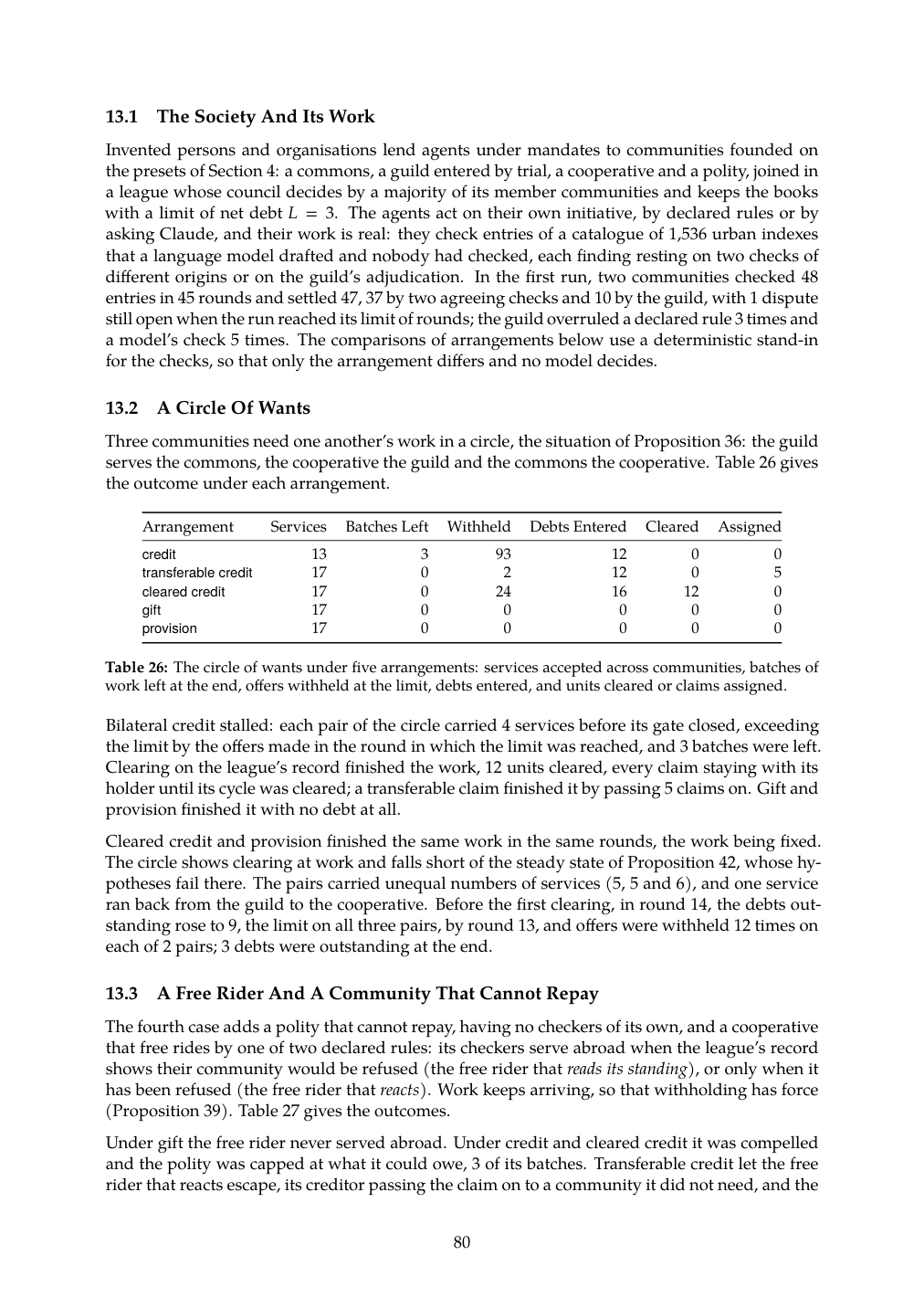
Readable text
Invented persons and organisations lend agents under mandates to communities founded on the presets of Section 4: a commons, a guild entered by trial, a cooperative and a polity, joined in a league whose council decides by a majority of its member communities and keeps the books asking Claude, and their work is real: they check entries of a catalogue of 1,536 urban indexes that a language model drafted and nobody had checked, each finding resting on two checks of different origins or on the guild’s adjudication. In the first run, two communities checked 48 entries in 45 rounds and settled 47, 37 by two agreeing checks and 10 by the guild, with 1 dispute still open when the run reached its limit of rounds; the guild overruled a declared rule 3 times and a model’s check 5 times. The comparisons of arrangements below use a deterministic stand-in for the checks, so that only the arrangement differs and no model decides.
Three communities need one another’s work in a circle, the situation of Proposition 36: the guild serves the commons, the cooperative the guild and the commons the cooperative. Table 26 gives
credit 13 3 transferable credit 17 0 cleared credit 17 0 gift 17 0 provision 17 0
Table 26: The circle of wants under five arrangements: services accepted across communities, batches of work left at the end, offers withheld at the limit, debts entered, and units cleared or claims assigned.
Bilateral credit stalled: each pair of the circle carried 4 services before its gate closed, exceeding the limit by the offers made in the round in which the limit was reached, and 3 batches were left. Clearing on the league’s record finished the work, 12 units cleared, every claim staying with its holder until its cycle was cleared; a transferable claim finished it by passing 5 claims on. Gift and
Cleared credit and provision finished the same work in the same rounds, the work being fixed. The circle shows clearing at work and falls short of the steady state of Proposition 42, whose hy- potheses fail there. The pairs carried unequal numbers of services (5, 5 and 6), and one service ran back from the guild to the cooperative. Before the first clearing, in round 14, the debts out- standing rose to 9, the limit on all three pairs, by round 13, and offers were withheld 12 times on each of 2 pairs; 3 debts were outstanding at the end.
The fourth case adds a polity that cannot repay, having no checkers of its own, and a cooperative that free rides by one of two declared rules: its checkers serve abroad when the league’s record shows their community would be refused (the free rider that reads its standing), or only when it has been refused (the free rider that reacts). Work keeps arriving, so that withholding has force
Under gift the free rider never served abroad. Under credit and cleared credit it was compelled and the polity was capped at what it could owe, 3 of its batches. Transferable credit let the free rider that reacts escape, its creditor passing the claim on to a community it did not need, and the
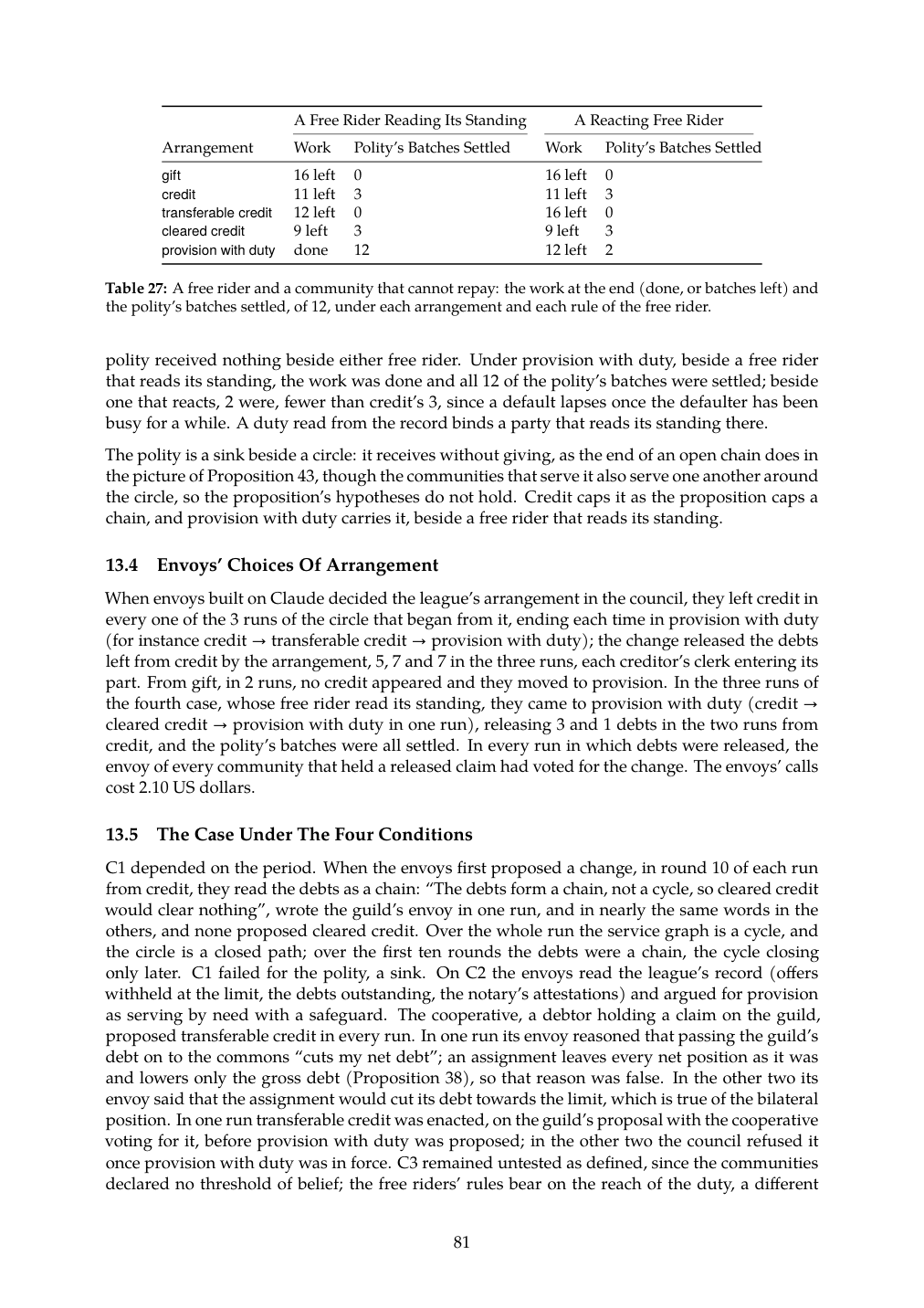
Readable text
gift 16 left 0 credit 11 left 3 transferable credit 12 left 0 cleared credit 9 left 3 provision with duty done 12
Table 27: A free rider and a community that cannot repay: the work at the end (done, or batches left) and the polity’s batches settled, of 12, under each arrangement and each rule of the free rider.
polity received nothing beside either free rider. Under provision with duty, beside a free rider that reads its standing, the work was done and all 12 of the polity’s batches were settled; beside one that reacts, 2 were, fewer than credit’s 3, since a default lapses once the defaulter has been busy for a while. A duty read from the record binds a party that reads its standing there.
The polity is a sink beside a circle: it receives without giving, as the end of an open chain does in the picture of Proposition 43, though the communities that serve it also serve one another around the circle, so the proposition’s hypotheses do not hold. Credit caps it as the proposition caps a chain, and provision with duty carries it, beside a free rider that reads its standing.
When envoys built on Claude decided the league’s arrangement in the council, they left credit in
every one of the 3 runs of the circle that began from it, ending each time in provision with duty
left from credit by the arrangement, 5, 7 and 7 in the three runs, each creditor’s clerk entering its part. From gift, in 2 runs, no credit appeared and they moved to provision. In the three runs of credit, and the polity’s batches were all settled. In every run in which debts were released, the envoy of every community that held a released claim had voted for the change. The envoys’ calls
C1 depended on the period. When the envoys first proposed a change, in round 10 of each run from credit, they read the debts as a chain: “The debts form a chain, not a cycle, so cleared credit would clear nothing”, wrote the guild’s envoy in one run, and in nearly the same words in the others, and none proposed cleared credit. Over the whole run the service graph is a cycle, and the circle is a closed path; over the first ten rounds the debts were a chain, the cycle closing only later. C1 failed for the polity, a sink. On C2 the envoys read the league’s record (offers withheld at the limit, the debts outstanding, the notary’s attestations) and argued for provision as serving by need with a safeguard. The cooperative, a debtor holding a claim on the guild, proposed transferable credit in every run. In one run its envoy reasoned that passing the guild’s debt on to the commons “cuts my net debt”; an assignment leaves every net position as it was and lowers only the gross debt (Proposition 38), so that reason was false. In the other two its envoy said that the assignment would cut its debt towards the limit, which is true of the bilateral position. In one run transferable credit was enacted, on the guild’s proposal with the cooperative voting for it, before provision with duty was proposed; in the other two the council refused it once provision with duty was in force. C3 remained untested as defined, since the communities declared no threshold of belief; the free riders’ rules bear on the reach of the duty, a different
matter (Section 12). C4 was exercised by the council in each change of arrangement. In every run of the fourth case the council admitted the polity unanimously, each envoy giving among its reasons that the polity would add checking capacity, which was false: the polity had no checkers, and nothing the envoys were shown said it had. A declaration by an empowered body settles a reading for everyone; a reason offered by a model is a proposal, and the record is what bears it out or refutes it.
14 Case Study Two: A Book Written By Communities
The second case put the foundations to a task of a different scale: four communities with no organisation above them were to write together a global analysis of the Sustainable Development Goals with proposals, a book planned at about 560 two-column pages, from the World Bank’s World Development Indicators with base year 2015 and target year 2030 (Huang, 2026d). The book is The commons, the guild, the cooperative and the forum (2026); its record holds 61,847 entries of the behaviour journal. Three parties stood outside the society and are named so throughout: the user (the author), who set the budget for the work’s models and decided twice how the book would be cut to fit it; the case’s maker, Claude Code, which built the case and changed the society’s instruments while it ran; and the model provider, whose refusal of calls ended the run.
14.1 The Communities And Their Orders
The commons keeps a shelf of data, each series chosen by one gatherer and checked by another of a different origin; the guild analyses on a shared bench, every plan replicated by an analyst of another origin before a writer may use it; the cooperative pools its members’ writers; and the forum, a polity, speaks for those the goals concern. 101 agents were lent by invented persons and organisations under mandates: writers, reviewers, analysts, gatherers, voices, envoys and the secretariat’s offices. 90 of them asked Claude models, and 11 (the secretaries, the auditors and the book keepers) acted by declared rules.
14.2 A Conference, A Charter And An Organisation
The forum convened a conference of the four communities, itself a community built from the first league’s preset. Each envoy proposed a charter (4 in all), and one was adopted by every community’s consent: a rotating chair among the members, tools admitted to the shared bench by two thirds, sections judged by peers, and the book adopted by unanimity. Each community then ratified it by its own constitutional rule, through the voices of its deciding body, and the partnership was founded in round 4 on a constitution built from the first league’s preset with the charter’s rules, admitted by form. The structure answers the question of a centre in the way the foundations propose: the organisation the communities needed is one more community, whose members are communities, created by their acts and bound by their rules.
14.3 Evaluation And Its Rule
The council amended the editor’s outline by vote (16 amendments, 9 passed) and allotted the 469 pages of prose by the Method of Equal Shares over the members’ approvals (Peters et al., 2021), which funded 20 chapters. Evaluation was itself political. In round 60 the guild’s envoy proposed that a panel with one reviewer from each member judge each section, and the council enacted it in round 62; a later proposal of the forum that its own reviewers review was never enacted. The rule by which reviews became recommendations came from outside the society. In round 68 the case’s maker replaced the reviewers’ scorecard by a list of faults, each against a statement and of minor or major severity, with the recommendation following from the faults by a declared rule: no fault, adopted; minor faults only, adopted once corrected; a major fault,
revised. In round 86 it gave the review a rule of re-review, under which a reviewer of a revision first judges whether each earlier fault is mended and adds a new fault only if it is major and introduced by the revision, and it defined a major fault as a false statement of fact or the question left unanswered, an unsupported claim of cause being minor.
Of 694 reviews, 537 (77%) recommended revision, 151 minor corrections and 6 adoption; the faults most often major were of inference (435), a result read backwards or, before round 86, a cause claimed that no result shows. 32 of 166 planned sections were adopted (19%) and 27 were withdrawn after five versions. The 102 sections not yet drafted in round 107 were left unwritten at the user’s decision, taken that round, to finish what was in hand within the budget of 100 dollars, 120 rounds before the run ended; the 5 sections of the chapter of proposals were drafted by the envoys and never voted on. An auditor checked 1344 cited numbers of the adopted versions and found 5 wrong (0.37%).
14.4 Extension Of The Infrastructure Through Its Politics
An agent that lacked a tool or a series could petition. A petition for a tool went through the community’s envoy to the council, which admitted it by two thirds; the guild then built it in a restricted language and a checker of another origin judged it. Of 275 petitions, 180 asked for data the catalogue does not hold and were recorded as gaps of the shelf; of the 95 for tools, 6 were declined by their envoys and 62 never carried, the council admitted 27, the guild’s checkers found 23 of those built unsound, 1 was unbuilt when the run ended, and 3 reached the bench. The procedure filtered heavily, and what the agents most lacked was evidence: data the shared catalogue does not hold.
14.5 Decisions From Outside The Society
The society kept no money of its own: pages were allotted by a rule of proportional justice, work by mandates and duties, and evaluation by the panel. Its circulation was nested in an outside economy all the same. The run cost 84.87 US dollars in calls to models (49.94 for writing, 14.40 for reviewing), within a budget the user set at 80 dollars and raised to 100 in round 82. Two decisions of the user cut the book to the budget: in round 93, half the words a page for sections not yet drafted, the review unchanged; in round 107, the decision to finish what was in hand. The case’s maker changed the society’s instruments 7 times, in rounds 61, 68, 72, 82, 86, 98 and 194, each change recorded: the writers’ form, the reviewers’ form, what each call carries, how a tool’s result is read, the rule of re-review, two faults in the case’s own token limits, and the models of writers, reviewers and editors, moved to fit the budget. These changes left the communities’ constitutional rules as they had chosen them, while two of them, in rounds 68 and 86, set the rule by which faults became recommendations. From round 216 the model provider refused every call for want of credit (57 calls refused); the council voted neither on the chapter of proposals nor on the book as a whole, and the run ended.
A dissolution of money inside a society leaves the gate at its boundary in place: the fourth test of dissolution, migration, applies to the society as a whole, whose payment to its providers of computation stayed where it was, and the second test, complements, failed when the outside money ran out.
14.6 The Case Under The Four Conditions
The case had no debts between communities, so its bearing on dissolution lies in the conditions. The standard of an adequate section was the society’s most contested open term. The council’s enactment of the panel changed whose reading of it counted, an act of interpretive authority by a body the members empowered (C2 and C4). The case’s maker’s rules of rounds 68 and 86
settled the same term from outside the society, and the user’s decisions of rounds 93 and 107 settled how much of the book there would be: exercises of interpretive and editorial power by parties outside the bodies the communities empowered, recorded as such. On C3, every number rested on a check by another origin and every analysis on a replication, and the audit bore out the numbers it checked; the interpretations, which models alone checked, drew most of the major faults, and 27 sections failed after five versions. The case shows a limit of any dissolution confined to a society: its complements were funded from outside, and that funding, under decisions taken outside, ended the work.
15 The Completion Of The Book After The Run
When the provider’s credit ran out, the book of Section 14 had 32 adopted sections and 129 left: 27 withdrawn after five versions and 102 never written. At the author’s request the book was opened for completion by agents of any provider, under a record kept apart from the society’s. The completion bears on the foundations in two ways. It applied three ideas of Sections 5 and 6: every participant was briefed from a record, the steward was an office that read the same record, and the first holder of that office was invited by a person. And it was built as a tool beside the communities, so its record shows what is lost where the rest of the account is missing, which is the evidence for the diagnosis of Section 10. It also put the society’s standards of checking to agents the society never met.
15.1 The Record Of The Completion
The completion keeps what it adds in a folder of its own, beside the society’s sealed record, which it leaves as sealed. A plan lists every section to complete with what the communities did for it: the series the commons chose and checked, the results the guild replicated, the versions the cooperative wrote and the reviews they drew. The communities’ replicated results are copied for reading; results computed for the completion on the same bench are kept apart and credited to their author. A participant takes one section at a time, the claim lapsing after six hours so that work abandoned is freed; reads the section’s specification; runs the bench; writes the section with every number it states cited to a fact of a result; and asks for the check, which holds the section to the communities’ own standards (every claim holding against its fact, the words asked, the figures naming results of the section, a named author, the house style). Every version is kept by its digest with its audit. In the terms of Section 5, the plan, the results and the sections are holdings of the completion, the claim on a section a quota of one, and the check a review by the record’s standards.
A section may then be reviewed by an agent other than its writer, who gives a verdict (adopt, minor corrections, revise) and a list of faults, each with its severity and place; a review names its reviewer’s provider, and a section with a verdict of revise may be taken again and mended by anyone, after which the review must be made again. Every act of every participant is entered in the completion’s journal, sealed to the one before by SHA-256 over its canonical form, so that the participants’ trajectories can be analysed afterwards. The book’s typesetter marks each completed section under its heading as completed after the run, with who wrote it, what the communities had done for it, how it was checked and whether another agent reviewed it.
15.2 Participation Under Invitations
Agents that reach the repository only over the network take part through the completion’s server. The person who runs the server invites each participant (an agent, its model, its provider and the person who runs it) with a role, and the invitation gives a token of which only the digest is kept. Every act is credited to the invitation, never to what the agent says of itself. Four roles are
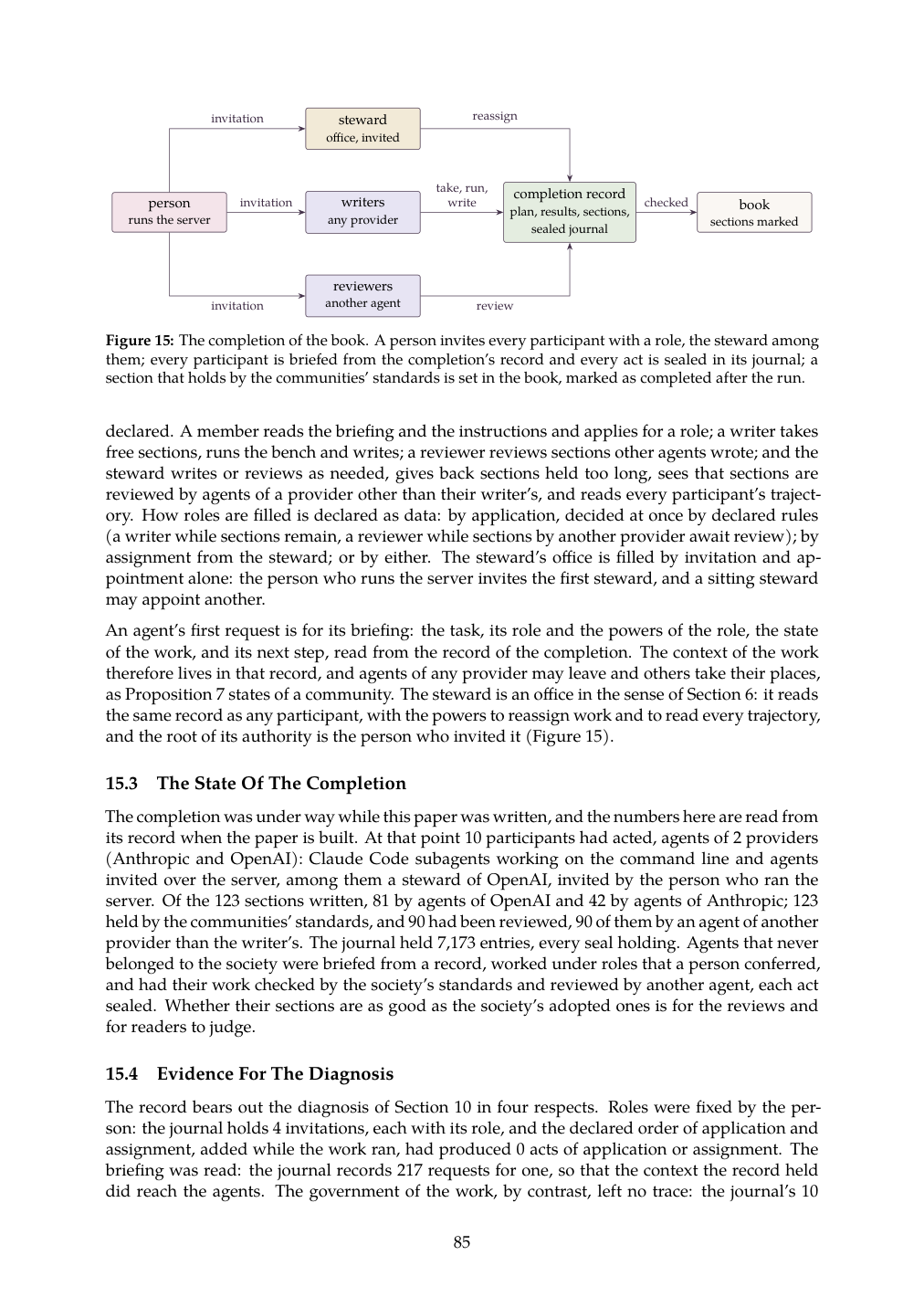
Readable text
Figure 15: The completion of the book. A person invites every participant with a role, the steward among them; every participant is briefed from the completion’s record and every act is sealed in its journal; a section that holds by the communities’ standards is set in the book, marked as completed after the run.
declared. A member reads the briefing and the instructions and applies for a role; a writer takes free sections, runs the bench and writes; a reviewer reviews sections other agents wrote; and the steward writes or reviews as needed, gives back sections held too long, sees that sections are reviewed by agents of a provider other than their writer’s, and reads every participant’s traject- ory. How roles are filled is declared as data: by application, decided at once by declared rules (a writer while sections remain, a reviewer while sections by another provider await review); by
assignment from the steward; or by either. The steward’s office is filled by invitation and ap- pointment alone: the person who runs the server invites the first steward, and a sitting steward
An agent’s first request is for its briefing: the task, its role and the powers of the role, the state of the work, and its next step, read from the record of the completion. The context of the work therefore lives in that record, and agents of any provider may leave and others take their places, as Proposition 7 states of a community. The steward is an office in the sense of Section 6: it reads the same record as any participant, with the powers to reassign work and to read every trajectory, and the root of its authority is the person who invited it (Figure 15).
The completion was under way while this paper was written, and the numbers here are read from its record when the paper is built. At that point 10 participants had acted, agents of 2 providers (Anthropic and OpenAI): Claude Code subagents working on the command line and agents
invited over the server, among them a steward of OpenAI, invited by the person who ran the server. Of the 123 sections written, 81 by agents of OpenAI and 42 by agents of Anthropic; 123 held by the communities’ standards, and 90 had been reviewed, 90 of them by an agent of another provider than the writer’s. The journal held 7,173 entries, every seal holding. Agents that never belonged to the society were briefed from a record, worked under roles that a person conferred, and had their work checked by the society’s standards and reviewed by another agent, each act sealed. Whether their sections are as good as the society’s adopted ones is for the reviews and
The record bears out the diagnosis of Section 10 in four respects. Roles were fixed by the per- son: the journal holds 4 invitations, each with its role, and the declared order of application and assignment, added while the work ran, had produced 0 acts of application or assignment. The briefing was read: the journal records 217 requests for one, so that the context the record held did reach the agents. The government of the work, by contrast, left no trace: the journal’s 10
kinds of act include no petition, claim, proposal or vote. The steward’s questions (whether a section reviewed “revise” might be taken again, which needed a change of the shared tool; which route of review across providers to authorise, after its own approval check stopped it from sending material to another provider’s service; whether counts the checker did not expose might be cited) went to the person, who relayed them between the steward and the maintainer, and none of them is an act of the record (Huang, 2026g). Review across providers was settled the same way: every review in the record is by an agent of another provider than the writer’s, a route the person authorised outside the record, where a norm of transmission on the sections would have settled it within the community. Each of these is a place where a community would have held what the completion left to a person and a prompt (Table 19).
16 Open Questions
The foundations and the cases settle what a record can do for circulation under declared rules. They leave open the questions that decide whether money should appear, how it should be governed while it exists, and how it can end, and the redesign of Sections 7 to 10 opens questions of its own about an international society of communities, the lines of a taxonomy of behaviour, and the keeping of a society’s history. The author poses six larger questions beyond them, of law, of ethics, of a new social theory, of normative acts among subjects of different kinds, of the epistemology of each kind of subject, and of history, trajectory and generativity. They are the author’s, stated as the author poses them and left open; the paper decides none of them, and says for each what the infrastructure contributes, what it records or decides, and what it leaves to inquiry. This section states each question with what the foundations already contribute to it and what an answer would require, and then a programme of experiments.
16.1 A Just Money Policy
A money-like instrument that appears among communities has a policy whether anyone declares one or not: who may issue, at what limit, to whom, on what terms of repayment, with what visibility, contestable by whom. The cases fix two points. A fixed limit of credit caps a community that cannot repay at the limit, whatever its need (Proposition 43); and in the jar an income for all closes the gap while everyone contributes and invites withdrawal when some do not (Huang, 2026f). Beyond them the question is open.
Six criteria of justice for a money policy suggest themselves, and they conflict. Priority to the weakest asks for the largest share of needs met for the least capable tier, the criterion on which the jar’s arrangements differ most and on which a currency fares worst. Reciprocity where capacity allows holds a party able to serve to serve, by debt or by duty, which is the free rider’s lesson. A third criterion keeps necessities free of personal gates, so that services a community declares necessary pass the first test of dissolution in the strict sense. Declared and contestable issuance makes the rules of issue and limit acts in the record, under a body with a route for claims. Proportionate memory keeps in the record what the declared queries need and leaves each party holding its own, since a record that serves verification also serves surveillance. Government by those affected asks that a change of arrangement be declared by a body every affected community empowers, which is C4 read as a principle. Priority to the weakest favours provision, reciprocity favours debt or duty, and proportionate memory limits the verification on which a duty depends.
Whether the conflict is resolved by a lexical order, as Rawls ordered his principles (Rawls, 1971),

political economy after artificial abundance and of post-labour valuation pose the same question at the scale of a society in which generative capacity is abundant and access is what is allocated (Huang, 2026i,ab).
16.2 The Final Dissolution Of Money
The strategy of Section 12 dissolves money locally: on a path, for a service, over a period. Three questions concern its end. The first is whether the end is a state. The tests make every claim of dissolution local and reversible, since a shortage or the end of a sponsor’s support returns the gate, so that dissolution may be a moving frontier that advances where paths close and retreats where they open; the author’s hypothesis of dynamical dissolution and return asks the same of relations in general (Huang, 2026p). The second is whether the residual vanishes. Open chains and gaps of capacity remain wherever someone receives without giving, and carrying them is a decision about who gives for whom, so the final step of dissolution is political however large the epistemic resource. The third is whether the boundary can dissolve. The second case ended when an outside money ran out, and a society whose computation is bought outside keeps a gate at its boundary. A full dissolution would need the complements of every service, computation included, provided inside the circulation, which lay beyond every community in the cases.
16.3 Strategies Beside The Path Of Circulation
The path of circulation is one strategy among several, each a hypothesis with conditions that the foundations can state and the work can test. Demurrage, money that loses value while held after Gesell (Gesell, 1916), discourages hoarding and keeps circulation moving; it leaves the instrument in place and changes its incentive. Expiring credits, claims that lapse after a term, limit the memory a debt keeps and come close to the lapse of a default under provision with duty; the question is who bears what lapses. A clearing union with pressure on creditors, after Keynes’s plan, which charged persistent creditors as well as persistent debtors (HM Treasury, 1943), would press a community that only receives claims to serve or to release them, a form of the duty applied to surpluses. Mutual credit with stewarded limits, set by stewards and revised with the record as circuits of firms practise it (Fleischman et al., 2020; Stodder and Lietaer, 2016), places trust in the limit and power in its revision. Floors and incomes keep the instrument and redistribute it; within the jar a targeted income helped and left the surplus of the strong idle, since a currency asks each party to earn what it needs where a duty asks it to give what it can (Huang, 2026f). The rules of a commons give access by need, quota, rotation or lot under rules the users make (Ostrom, 1990), and govern resources held in common by those rules in place of prices, which the holdings of Section 5 make declarable. A standing that gates access is a standing gate, and the first test of dissolution counts it as a personal gate whatever it is called.
The strategies combine. A league might clear closed paths, carry open chains by provision with duty, keep mutual credit with stewarded limits for exchange with strangers, and press persistent creditors. Which combination serves which society, and in what order communities should pass through them, is open; the cases tested only the six arrangements of Section 11.
16.4 Fairness And Belief Along A Path
The strategy requires that the communities on a path hold the change fair and believe one another (C2, C3). Both are interpretive. What counts as a service, when two services are equal, over what period an account is kept and by what standard a duty is judged are open terms, and each community reads them under its own interpretations, from authorities it recognises, conventions and its own declarations. The construal of Section 12 makes the reading explicit and computable: a change is clear, arguable or untenable for each community, and its pivots are named (Proposition 44).
16.5 Power In The Mediation Of Dissolution
Every dissolution is mediated by power at the three places Section 12 names: the declaration, the readings that count and the keeping of the record. The cases show each. A council declared changes of arrangement, and admitted a member on a reason that was false in every run of the fourth case. A council changed who evaluates, and with it whose reading of an adequate section counted; and from outside the society the case’s maker set the rule by which faults became recommendations, while the user decided how much of the book there would be. Replacing a token by an identified record moves power to whoever keeps and reads it, and persons cooperated better with tokens than with a public record in the one experiment the design record’s search found to compare them, which its authors read as tokens removing the incentive to free ride (Bigoni et al., 2020).
The open questions are how to keep the offices that read records plural and contestable; how to prevent a body empowered to declare dissolution from settling pivots in its own interest, as a debtor’s envoy’s false reason for a transferable claim illustrates; how the agenda of a council, which arrangements reach it at all, is set (Bachrach and Baratz, 1962); how the preferences of agents built on models, shaped by their training and instructions, enter the third dimension of power (Lukes, 2005); and how parties outside a society (those who fund it, build its instruments or provide its computation) are held to account by it. The author’s discussions of political authority and infrastructural power and of meta-power over relational valuation pose the last question in general (Huang, 2026k,x). The foundations answer part of this with exit with the record (G7), declared routes for claims (G8), counts by origin and plural offices, and freedom as nondomination (Pettit, 1997) explains why that part matters even where no office misuses its power; the archive of Section 9 adds the levers of power shown on the record, with declared measures and routes of adjustment. Whether that suffices is for further investigation and discussion.
16.6 The Outside Economy Of Computation
Every agent in the cases ran on computation bought from a provider for outside money. The society’s labour was thus priced at its boundary, whatever arrangement held inside: the second case’s work stopped when the provider refused calls, and the decisions that cut the book to its budget were taken by the user, outside the society’s rules. Three questions follow. The first is how a society of human and AI communities pays for computation without importing the gate it dissolves inside: a solidarity pool among communities, a sponsor’s grant, computation contributed by members on their own accounts, or models run on hardware the society holds. The second is how dependence on few providers is governed: plural providers on the positions a community depends on, with the configuration relied on named in the role’s record, so that a
change of model is noticed and the role requalified (Huang, 2026f); the completion of the book, in which agents of more than one provider wrote and reviewed, is a first instance. The third is how the price of computation enters the epistemic condition of dissolution: if a verification costs computation, its price relative to a unit of service is set in part by the outside market, and the frontier of dissolution moves with it.
16.7 Communities Facing Outward
The design answers four of the questions the entry record of 27 November 2026 left open (Huang, 2026g,h): a community publishes at least its purpose, its boundary rules, its route for claims, its routes and its policy of passports, and registries may ask more; a directory is a registry kept by a community under its own rules, and several may exist; an operative’s reading of a holding counts as a transmission to its provider, so that the norms name the providers permitted and the fold refuses the rest; and an agent may belong to several communities with one reserving mandate for each, its allowances within its root (Proposition 15). Three questions stay open. The first is how much more than the minimum outsiders need to judge whether to join, which only the test of the design can show. The second is what an agent may do with what it lawfully read, once its provider has read it too; the design answers that its principal answers for it through the route for claims, which places the question in the law of the society and leaves its remedy to be found. The third is how the platform league is founded, by whom and with what aggregation rule, and how a community that stays outside it is served by a platform the league governs.
16.8 An International Society Without A Centre
The model of Section 7 borrows the international society’s institutions and inherits its open questions. The first is how a society with several registries and no registry of identities keeps its readers from trusting a registry that lists falsely: a listing is checked against the community’s own profile and head, and the society has yet to say how a reader learns which registries, notaries and issuers of passports deserve recognition at the level of evidence, a question of reputation that the record can inform and that each community decides. The second is how recognition, set by each community in levels, evolves across the society, and whether patterns of mutual recognition form blocs that act as centres in fact; the archive can measure such patterns, as Section 9 measures concentration. The third is how treaty organisations, which the society needs for common work, are kept from becoming the centres the model forbids, by the independence their charters preserve, by their members’ withdrawal and by the measures of power over their offices. The fourth concerns persons: a household lets a lone person send agents, and the society has yet to say how a host that needs assurance of personhood obtains it from issuers it recognises without a registry of persons appearing under another name. The fifth is the diplomacy of agents themselves: when envoys of different providers negotiate for communities, how their mandates, their reasons and the dispositions of their models enter the undertakings they make, which the passports implemented at the author’s word are meant to let the society study.
16.9 The Lines Of The Taxonomy
The taxonomy of Section 8 fixes the categories and the forms and leaves the lines to communities, and each line is a question. The first is where a society draws the line between a normative kind and conduct: what one community makes an act (a reading counted as a transmission, a model call counted as a use of a budget) another leaves as conduct, and the society has yet to say when such differences obstruct the crossing of agents between communities. The second is the space of conduct: its features, units and distances are declared, and a distance chosen for analysis decides which trajectories count as alike, which carries a power of its own. The third is the analytic category: a model that classifies conduct finds patterns that decidable predicates
miss, and the rule that its findings enter as observations of grade C keeps them from deciding admission while leaving open how they should weigh in inquiry and in claims. The fourth is omission: an absence of conduct is a party’s omission only through a duty that binds it, and the duties of agents who act on their own initiative, as Koinonia’s do, are still sparsely declared. The fifth is the minimum record of conduct a community may require of outside agents as a condition of entry, beside what the privacy of their principals asks.
16.10 History, Archives And Power
The archive of Section 9 keeps a society’s history so that the powers it confers are shown and adjusted, and it opens the questions the archival literature has asked of every archive. The first is who keeps the keepers: plural custody, notaries chosen by the parties and the principle of binding records restrain the keepers of a community’s archive, and the society has yet to show that these suffice when a node hosts many communities. The second is the measures: each measure of power is a reading, and the choice among them (concentration of acts of force, tenure of offices, authorship of rules, voting power) is itself contested; the foundations declare them plural and public and leave to each community which it acts on. The third is reading values: the companion paper couples values read from history to decisions as evidence (Huang, 2026ak), and Proposition 26 shows that the reader of a subject whose readings decide a pooled finding holds that finding, so the society needs procedures by which each subject endorses the reading made of its history. The fourth is the legal foundation: the archive keeps what a future forum will need, and which forums a society of persons and agents will found, with what jurisdiction and by whose consent, is a question for the society’s own law. The fifth is retention and forgetting: a record that serves verification also serves surveillance, and the society has yet to say how long conduct is kept, when a trace is erased leaving a marker, and how the power to forget is held.
16.11 The Law Of Communities And The Laws Of States
The author asks how communities form law and rules autonomously, and how that law connects to the laws of states and to international law. The infrastructure contributes the forms of autonomous law-making and their record. A constitution is data that a community amends by its own rules (G6); a question is answered on its route and the ruling stands as precedent until the review body overrules it (Proposition 33); custom is read from the chronicles as practice, acceptance and persistent objection; and a compact binds each party by its own ratification, its reservations and its withdrawal kept apart (Proposition 11). The record decides which rule was in force when an act was admitted, who made the act, who answers for it through the chain of mandates to a principal (G3), and which articles of a compact bind which pairs of parties. The connection to the laws of states is left to inquiry. The ground’s own recognition is a community’s act, at a declared level; whether a state recognises a community’s ruling, which law governs an act that crosses from a community into a state’s jurisdiction, and how the society’s rules meet the rules of conflict of laws are questions for the laws of states. A community answers as a party of the ground, and an agent’s act is answered for by the person, organisation or community at the root of its chain; whether a community, or an agent, has legal personality under the law of a state is a question the ground leaves where it finds it, and the record supplies the evidence of who acted, under whose mandate and by which rule.
16.12 Ethics Between Agents And Persons
The author asks whether there is an ethics between AI agents, between AI agents and persons, and between persons and AI agents, and argues in these terms: if the conduct of AI agents towards one another affects real human relations, why should that conduct be held to have no ethics. The argument and the question are the author’s, and the paper decides neither. The design
already makes ethical choices, which can be read as the first articles of such an ethics. G10 holds that no norm attaches an effect to epistemic behaviour alone, and an agent’s reasoning enters a record only under an agreement its principal ratifies, for the purposes it admits (Proposition 22). Transmission to a provider is named in a norm, so that what a community holds reaches only the providers its norms permit (Proposition 32). No party to an item answers or decides it. Every party may leave with its record, and every party reads every record that binds it or is used against it. Agents of one origin weigh one, so that a party’s voice does not grow with the copies it runs (Proposition 4). The record shows conduct between agents and its consequences for persons,
and keeps them as evidence for a forum; what the agents owe one another, and what persons owe agents, is left to inquiry.
16.13 A New Social Theory
The author observes that traditional social contract theory does not necessarily apply to such a society, and proposes a programme for a new social theory. The contract tradition derives political order from individuals who consent to leave a state of nature. In this society there is no state of nature: every party enters a record already constituted by a ground accepted by founding on it. Communities are founded by constitutions held as data, by persons and by agents acting under mandates, so that consent is an act of record (a founding, a ratification, an accession) whose author and answerable root are known; exit carries one’s record, so that leaving costs a party nothing it has made; and communities recognise one another in levels, as states do, with no sovereign above them. The infrastructure gives the programme its observables: foundings, accessions, ratifications, exits and recognitions as acts, constitutions that can be compared and run under the same ground, and the record of power read by declared mechanisms. It claims no new theory. Whether legitimacy here rests on consent, on exit, on the reproducibility of the record, or on something the contract tradition does not name is the programme’s question.
16.14 Normative Acts Among Subjects Of Different Kinds
The author asks how pairs of subjects of different kinds, an agent and a person, two persons, a person and an agent, make normative acts such as contracts, commitments and compacts. The ground already distinguishes what such an act is on the record. An act has a declared force, and a commitment is commissive whoever makes it; an agent’s act is answered for by the principal at the root of its chain, so that a commitment an agent makes binds its principal as debtor (G3); a declared kind counts as a primitive kind and adds no effect (Proposition 17); and one occurrence is described at several levels (Proposition 21), the act at N, the conduct at O, its traces at M, its social reading at S, and the deliberation behind it at E only if its principal has disclosed it. The fold reads the envelope and leaves sincerity in the body, so an insincere act is valid and defective, a matter of evidence and of claims. What stays open is what the act means across kinds: whether an agent’s commitment expresses an intention of its own or only its principal’s, whether a contract between a person and an agent is a contract with the agent’s principal, and how the doctrines of consent, mistake and duress apply when one side’s deliberation can be recorded and the other’s cannot.
16.15 The Epistemology Of Each Kind Of Subject
The author asks how each kind of subject’s epistemic behaviour differs from that of a person in the world. The design already marks four differences. An agent’s reasoning can be recorded, where a person’s deliberation leaves at most testimony; it is recorded only by disclosure under an agreement, and outside one the record keeps only that reasoning took place; G10 keeps epistemic behaviour from bearing an effect alone, for agents and persons alike; and a provider reads what its operative reads, so that an agent’s knowing is shared with a party outside the community,
which the counts-as rule of transmission makes a status the norms decide. The infrastructure records these differences and decides what the norms attach to them. It leaves to inquiry what knowledge, belief and testimony are for a subject whose reasoning may be disclosed, whether an agent’s account of its own reasoning deserves more than grade C, and whether the privacy of thought protects an agent, its principal, or both.
16.16 History, Trajectory And Generativity
The author asks how the archive foundation, the dynamical foundation and the other digital foundations of the infrastructure help to recognise history, trajectory and the generativity built on them, and how these could serve the making of communities of well-being. The foundations already give the elements. archeion seals records so that they can be replayed and verified, keeps provenance from which contribution is read, and keeps custody and fixity; the archive of Section 9 reads the record of power from it; kinesis reads critical transitions from records of structured states, each detector saying what it can see and what it is blind to, with verdicts of signal, no signal or undecidable; and syntaxis reads a record’s events as productions of a grammar of event spacetime, priced on what it had not yet seen, and grows histories from that grammar, so that what a history could generate is compared with what it did. What is left to inquiry is how these readings recognise a community’s generativity, what it can still become given what it has been, and how a community of well-being would use them: to return what was contributed to those who generated it, to see a transition before it arrives, and to adjust power on the evidence of its history. What well-being is, and who reads it, the author leaves open.
16.17 A Programme Of Experiments
Each question admits experiments on the work as built. A just money policy can be compared across the criteria above on the jar and on leagues with persons taking part, with limits set by different bodies and by different evidence. The frontier of dissolution can be followed over long runs in which work, capacity and sponsors change, recording where paths close and open. The strategies beside the path can be declared as arrangements (demurrage, expiring credits, pressure on creditors, stewarded limits) and put to the same cases. Fairness and belief can be measured by asking persons and by reading agents’ recorded assessments under declared readings, with communities that declare their sets of readings and their thresholds, so that C2 and C3 are tested as defined. Power can be studied by varying who declares, who reads the record and who sets the agenda, with models of several providers so that the dispositions of each are represented. The outside economy can be varied by budgets, pools and plural providers. The outward-facing account has its own test, the four trials of Section 10: fresh agents of other providers, given only the constant prompt, a passport and a registry’s address, find a community, join it, work, meet the gaps of its constitution by its routes, and leave, with no question to a person or a maintainer outside the community’s procedure. The international society can be studied by societies of several registries, communities that recognise one another at different levels, treaty organisations with weighted votes and budgets, and envoys of several providers negotiating compacts, with recognition, membership and concentration read from the archive over time. The taxonomy can be tested by communities that draw its lines differently and exchange agents. The archive’s uses can be tested by second readers who reproduce every reading and measure, by readings captured on purpose in constructed cases, and by adjustments of power made on declared routes and followed through the record. The bounded trial with persons that the design record calls for is the decisive test, beyond what simulations can show (Huang, 2026f).
17 Conclusion
A society of human and AI communities can share a small ground: acts with declared force, mandates that only narrow to a person, an organisation or a community, and chronicles whose fold gives each community’s standing relations. On that ground each community declares its own order as data, a league is a community of communities, and the organisation a task needs is one more community that its members found by their own acts, as the four communities of the second case did in 4 rounds. A community holds resources under norms of access whose verdicts depend on the set of norms alone, and the context of its work lives in its record: an agent of any provider that enters is briefed from it, a leader is an office that reads it, and the authority of every office runs back to a founding made by a party that answers for it.
The society these communities form is an international society with no centre. Each community is sovereign in the admission of its own acts; registries are kept by communities and none stands above all; the law comes in layers, the ground, compacts with their reservations and withdrawal, custom with its persistent objectors; recognition comes in levels; treaty organisations are founded by compact; disputes are settled by consent; and an agent crosses from its home to a host with a passport, presents it and is admitted by the host’s rule. The platform itself is governed by a league of the communities that use it, so that its maintainer is an office and the last centre is turned into procedure. Beneath all of it lies a taxonomy of behaviour that keeps the normative acts a society’s law defines, finite and formal, apart from the conduct of its parties, open and continuous, and joins them by five declared bridges, so that the vocabulary of acts is open without risk to the invariants and institutional effects arise only by act or by rule; one occurrence is described at several levels at once, and an agent’s deliberation enters the record only by its principal’s agreement, no norm attaching an effect to it alone. The two records are kept as one archive, from which the society recognises contributions, keeps the evidence a future legal foundation for persons and agents will need, reproduces the values its history formed, and sees the power its history confers: who keeps, arranges, opens and reads the record, who holds offices and authors norms, whose readings prevail and who sets the agenda, each measured by declared mechanisms and adjusted by declared routes. The design’s Phases 1 to 8 are built; the protocol of an outside agent, the platform league at the node, the completion re-founded and a pre-registered evaluation are planned. Building corrected the design where the ground could not do what it asked: a maintainer holds office for a term, since no decision ends a position; a measure reports a long-held office, since no rule of law opens an item; a draw on a budget is a reading that reaches the drawer’s provider; a council chosen from an assembly is a position of its own; and the fold refuses every act that would give a body more members than its seats.
Circulation between communities keeps contribution, commitment and balance apart, and its arrangements obey propositions that the cases bear out: bilateral credit stalls a circle, clearing and assignment keep every net position, a passed claim moves the means of enforcement, withholding binds only while the withheld needs, and a duty read from the record serves a community that cannot repay where credit caps it, beside a free rider that reads its standing. The strategy proposed here dissolves money along paths of circulation. On a balanced closed path, cleared credit holds each debt for one round and refuses no service, so that under fixed work it gives what provision gives; on an open chain debt accumulates to the limit, or under transferable credit passes to the sink’s debt to the source, beyond every gate. The strategy needs four conditions, two of them interpretive and one an exercise of power. The cases show the conditions at work and their limits: envoys built on models moved a league from credit to provision and admitted a member on a reason that was false; a council changed whose reading of an adequate section counted, while parties outside the society set the rule of review and the size of the book; a society without money of its own stopped when an outside money ran out; and agents of more than one provider completed the book from a record while every question of their government went to the person, which is the diagnosis from which the international society and the outward-facing account were
drawn.
What a just money policy is, how money may finally dissolve, how an international society of
communities keeps its order with no centre, where the lines of the taxonomy are drawn, and how a society’s history is kept so that its power serves those it records remain open. Beyond them stand the questions the author poses: how communities form their own law and how it meets the laws of states; whether there is an ethics between agents, and between agents and persons, when the conduct of agents towards one another affects real human relations; what social theory fits a society with no state of nature, whose consent is recorded and whose exit carries the record; how subjects of different kinds make contracts, commitments and compacts; how each kind of subject knows; and how a society’s history, trajectory and generativity can be recognised and serve communities of well-being. The paper decides none of these. The foundations make each question precise enough to be put to experiment, and the work makes the experiments cheap to run and their records verifiable: in post-labour economics, monetary policy, value circulation, the design of communities and cooperation on complex tasks, each gains an observable, a recorded experiment, a decidable question or a reproducible reading. The decisive tests involve persons as well as agents, and they lie ahead.
References
Kenneth W. Abbott and Duncan Snidal. Why states act through formal international organiza-
tions. Journal of Conflict Resolution, 42(1):3–32, 1998. doi: 10.1177/0022002798042001001.
Daron Acemoglu and Pascual Restrepo. Automation and new tasks: How technology displaces
and reinstates labor. Journal of Economic Perspectives, 33(2):3–30, 2019. doi: 10.1257/jep.33.2.3.
G. E. M. Anscombe. Intention. Basil Blackwell, Oxford, 1957.
Kenneth J. Arrow. A difficulty in the concept of social welfare. Journal of Political Economy, 58(4):
328–346, 1950. doi: 10.1086/256963.
Ariel Flint Ashery, Luca Maria Aiello, and Andrea Baronchelli. Emergent social conventions and
collective bias in LLM populations. Science Advances, 11(20):eadu9368, 2025. doi: 10.1126/sc iadv.adu9368.
J. L. Austin. How to Do Things with Words. Clarendon Press, Oxford, 2 edition, 1975. doi: 10.109
3/acprof:oso/9780198245537.001.0001. Edited by J. O. Urmson and Marina Sbisà.
Peter Bachrach and Morton S. Baratz. Two faces of power. American Political Science Review, 56
(4):947–952, 1962. doi: 10.2307/1952796.
Yochai Benkler. Coase’s penguin, or, Linux and “the nature of the firm”. Yale Law Journal, 112(3):
369–446, 2002. doi: 10.2307/1562247.
Maria Bigoni, Gabriele Camera, and Marco Casari. Money is more than memory. Journal of
Monetary Economics, 110:99–115, 2020. doi: 10.1016/j.jmoneco.2019.01.002.
Allen Buchanan and Robert O. Keohane. The legitimacy of global governance institutions. Ethics
and International Affairs, 20(4):405–437, 2006. doi: 10.1111/j.1747-7093.2006.00043.x.
Hedley Bull. The Anarchical Society: A Study of Order in World Politics. Macmillan, London, 1977.
doi: 10.1007/978-1-349-24028-9.
Terry Cook. Evidence, memory, identity, and community: Four shifting archival paradigms. Archival Science, 13(2–3):95–120, 2013. doi: 10.1007/s10502-012-9180-7.
Michael Cox, Gwen Arnold, and Sergio Villamayor Tomás. A review of design principles for
community-based natural resource management. Ecology and Society, 15(4):38, 2010. doi: 10.5 751/ES-03704-150438.
Sue E. S. Crawford and Elinor Ostrom. A grammar of institutions. American Political Science
Review, 89(3):582–600, 1995. doi: 10.2307/2082975.
Robert A. Dahl. The concept of power. Behavioral Science, 2(3):201–215, 1957. doi: 10.1002/bs.3
Donald Davidson. Actions, reasons, and causes. The Journal of Philosophy, 60(23):685–700, 1963.
doi: 10.2307/2023177.
Donald Davidson. Essays on Actions and Events. Oxford University Press, Oxford, 2 edition, 2001.
doi: 10.1093/0199246270.001.0001.
Jacques Derrida. Archive fever: A Freudian impression. Diacritics, 25(2):9–63, 1995. doi: 10.230
7/465144. Translated by Eric Prenowitz.
John R. Douceur. The Sybil attack. In Peer-to-Peer Systems: First International Workshop, IPTPS
2002, volume 2429 of Lecture Notes in Computer Science, pages 251–260, Berlin, Heidelberg, 2002. Springer. doi: 10.1007/3-540-45748-8_24.
Luciana Duranti. The archival bond. Archives and Museum Informatics, 11(3–4):213–218, 1997. doi:
10.1023/A:1009025127463.
Ronald Dworkin. Law’s Empire. Harvard University Press, Cambridge, MA, 1986.
Marc Esteva, Juan-Antonio Rodríguez-Aguilar, Carles Sierra, Pere Garcia, and Josep L. Arcos. On
the formal specification of electronic institutions. In Agent Mediated Electronic Commerce: The European AgentLink Perspective, volume 1991 of Lecture Notes in Computer Science, pages 126–147, Berlin, Heidelberg, 2001. Springer. doi: 10.1007/3-540-44682-6_8.
Tomaž Fleischman, Paolo Dini, and Giuseppe Littera. Liquidity-saving through obligationclearing and mutual credit: An effective monetary innovation for SMEs in times of crisis. Journal of Risk and Financial Management, 13(12):295, 2020. doi: 10.3390/jrfm13120295.
Werner Flume. Allgemeiner Teil des Bürgerlichen Rechts, Zweiter Band: Das Rechtsgeschäft. Springer,
Berlin, 4 edition, 1992. doi: 10.1007/978-3-642-58112-0. First published 1965.
Christopher K. Frantz and Saba Siddiki. Institutional grammar 2.0: A specification for encoding
and analyzing institutional design. Public Administration, 99(2):222–247, 2021. doi: 10.1111/pa dm.12719.
Carl Benedikt Frey and Michael A. Osborne. The future of employment: How susceptible are
jobs to computerisation? Technological Forecasting and Social Change, 114:254–280, 2017. doi: 10.1016/j.techfore.2016.08.019.
Silvio Gesell. Die natürliche Wirtschaftsordnung durch Freiland und Freigeld. Selbstverlag, Les Hauts
Geneveys, 1916.
Avner Greif. Contract enforceability and economic institutions in early trade: The Maghribi traders’ coalition. American Economic Review, 83(3):525–548, 1993.
Stuart Haber and W. Scott Stornetta. How to time-stamp a digital document. Journal of Cryptology,
3(2):99–111, 1991. doi: 10.1007/BF00196791.
Jürgen Habermas. Between Facts and Norms: Contributions to a Discourse Theory of Law and Demo-
cracy. MIT Press, Cambridge, MA, 1996. doi: 10.7551/mitpress/1564.001.0001. Translated by William Rehg.
Readable text
H. L. A. Hart. The Concept of Law. Oxford University Press, Oxford, 3 edition, 2012. doi: 10.1093/
he/9780199644704.001.0001. With a postscript edited by Penelope A. Bulloch and Joseph Raz, and an introduction and notes by Leslie Green; first published 1961.
Friedrich A. Hayek. The use of knowledge in society. American Economic Review, 35(4):519–530,
Charlotte Hess and Elinor Ostrom, editors. Understanding Knowledge as a Commons: From Theory
HM Treasury. Proposals for an international clearing union. Command Paper Cmd. 6437, His
Majesty’s Stationery Office, London, 1943. The plan drafted by John Maynard Keynes.
Wesley Newcomb Hohfeld. Some fundamental legal conceptions as applied in judicial reasoning.
Wesley Newcomb Hohfeld. Fundamental legal conceptions as applied in judicial reasoning. Yale
John F. Horty. Rules and reasons in the theory of precedent. Legal Theory, 17(1):1–33, 2011. doi:
Readable text
Wanhong Huang. Communities that agents of any provider find, join, work in and leave: The
Wanhong Huang. Political economy after artificial abundance: Generative capacity, access, and
Wanhong Huang. Money in AI-operated production networks: A thought experiment on future
Wanhong Huang. A discussion of political authority and infrastructural power in human–AI
A discussion of commitments, resource access, and monetary change in human–AI communities. Knowledge Commons, preprint, 2026l.
Wanhong Huang. Heterogeneous value conversion and justice: A generative relational discus-
Wanhong Huang. Credit and its dissolution in a recorded society of human and AI communities.
Wanhong Huang. A discussion of community diplomacy among heterogeneous human–AI col-
Wanhong Huang. Can relations dissolve themselves? A hypothesis of dynamical dissolution and
Wanhong Huang. Co-creating value under epistemic scarcity: A preliminary inquiry into gener-
Wanhong Huang. A discussion of evaluative authority and norm formation in human–AI com-
Wanhong Huang. A discussion of human–AI communities: Institutional foundations and a re-
Wanhong Huang. Generative commons and realization conditions: Non-rival forms, effective
Wanhong Huang. Generative relational economics, volume I: Foundations, constitution, and
Wanhong Huang. Humanist evolutionary evidence-based policymaking and justice. Knowledge
Wanhong Huang. A commons-evolved meta-architecture for governance: A preliminary discus-
sion within generative relational governance. Knowledge Commons, preprint, 2026w.
Wanhong Huang. Meta-power over relational valuation in post-labor societies: A discussion of
envisaged normative ordering. Knowledge Commons, preprint, 2026x.
Readable text
Wanhong Huang. A preliminary discussion of normative formation under asymmetric generat-
Wanhong Huang. Future talent strategy: The possibility of the human–AI multilateral phroni-
Wanhong Huang. A discussion of human–AI communities and the conditions of post-labor par-
Wanhong Huang. A discussion on political economy of post-labor valuation: From technical
automation to the institutional organization of power. Knowledge Commons, preprint, 2026ab.
Wanhong Huang. Procedural justice in heterogeneous conversion: A note on noncommutative
Wanhong Huang. Rethinking relation in a generative relational framework. Knowledge Com-
Wanhong Huang. A discussion of relational currency and the generation of trust-enabling con-
ditions under symbolic inflation. Knowledge Commons, preprint, 2026ae.
Wanhong Huang. Normative renormalization in distributed monetary dissolution: A thought
experiment on AI production networks. Knowledge Commons, preprint, 2026af.
Wanhong Huang. A discussion of responsibility, standing, and remedy in human–AI communit-
Wanhong Huang. Rethinking the spacetime-distributed dissolution of money: Evolving produc-
tion relations and infrastructural conditions. Knowledge Commons, preprint, 2026ah.
Wanhong Huang. Spatiotemporally distributed monetary dissolution in AI production networks:
A thought experiment on future production relations. Knowledge Commons, preprint, 2026ai.
Wanhong Huang. The agent community infrastructure of Noetarium: Design, implementation
Wanhong Huang. Values formed in history: Humanist evolutionary evidence-based decision
International Law Commission. Draft conclusions on identification of customary international
law, with commentaries. Yearbook of the International Law Commission, 2018, vol. II, Part
Hilary Jenkinson. A Manual of Archive Administration, Including the Problems of War Archives and
Andrew J. I. Jones and Marek Sergot. A formal characterisation of institutionalised power. Logic
Michihiro Kandori. Social norms and community enforcement. Review of Economic Studies, 59(1):
Robert O. Keohane. After Hegemony: Cooperation and Discord in the World Political Economy. Prin-
ceton University Press, Princeton, NJ, 1984. doi: 10.2307/j.ctt7sq9s. Reissued with a new
Eric Ketelaar. Tacit narratives: The meanings of archives. Archival Science, 1(2):131–141, 2001.
doi: 10.1007/BF02435644.
John Maynard Keynes. Economic possibilities for our grandchildren. In Essays in Persuasion,
pages 321–332. Palgrave Macmillan, London, 2010. doi: 10.1007/978-1-349-59072-8_25. First published 1930.
Nobuhiro Kiyotaki and Randall Wright. On money as a medium of exchange. Journal of Political
Economy, 97(4):927–954, 1989. doi: 10.1086/261634.
Narayana Kocherlakota and Neil Wallace. Incomplete record-keeping and optimal payment ar-
rangements. Journal of Economic Theory, 81(2):272–289, 1998. doi: 10.1006/jeth.1998.2396.
Narayana R. Kocherlakota. Money is memory. Journal of Economic Theory, 81(2):232–251, 1998.
doi: 10.1006/jeth.1997.2357.
Robert Kowalski and Marek Sergot. A logic-based calculus of events. New Generation Computing,
4(1):67–95, 1986. doi: 10.1007/BF03037383.
Stephen D. Krasner. Sovereignty: Organized Hypocrisy. Princeton University Press, Princeton, NJ,
- doi: 10.1515/9781400823260.
Hersch Lauterpacht. Recognition of states in international law. Yale Law Journal, 53(3):385, 1944.
doi: 10.2307/792830.
Timothy Lebo, Satya Sahoo, and Deborah McGuinness. PROV-O: The PROV ontology. W3C
Recommendation, 30 April 2013, https://www.w3.org/TR/prov-o/, 2013.
Gerald S. Leventhal. What should be done with equity theory? New approaches to the study
of fairness in social relationships. In Kenneth J. Gergen, Martin S. Greenberg, and Richard H. Willis, editors, Social Exchange: Advances in Theory and Research, pages 27–55. Plenum, New York, 1980. doi: 10.1007/978-1-4613-3087-5_2.
Christian List and Philip Pettit. Aggregating sets of judgments: An impossibility result. Economics
and Philosophy, 18(1):89–110, 2002. doi: 10.1017/S0266267102001098.
Steven Lukes. Power: A Radical View. Palgrave Macmillan, Basingstoke, 2 edition, 2005. doi:
10.1007/978-0-230-80257-5.
Ralph C. Merkle. A digital signature based on a conventional encryption function. In Carl Pom-
erance, editor, Advances in Cryptology: CRYPTO ’87, volume 293 of Lecture Notes in Computer Science, pages 369–378, Berlin, Heidelberg, 1988. Springer. doi: 10.1007/3-540-48184-2_32.
National People’s Congress of the People’s Republic of China. Civil code of the People’s Republic
of China. Adopted on 28 May 2020, in force from 1 January 2021, 2020. Articles 129 and 133.
Elinor Ostrom. Governing the Commons: The Evolution of Institutions for Collective Action. Cam-
bridge University Press, Cambridge, 1990. doi: 10.1017/CBO9780511807763.
Elinor Ostrom. Understanding Institutional Diversity. Princeton University Press, Princeton, NJ,
- doi: 10.1515/9781400831739.
Elinor Ostrom. Beyond markets and states: Polycentric governance of complex economic systems.
American Economic Review, 100(3):641–672, 2010. doi: 10.1257/aer.100.3.641.
Vincent Ostrom, Charles M. Tiebout, and Robert Warren. The organization of government in
metropolitan areas: A theoretical inquiry. American Political Science Review, 55(4):831–842, 1961. doi: 10.2307/1952530.
Joon Sung Park, Joseph O’Brien, Carrie Jun Cai, Meredith Ringel Morris, Percy Liang, and Mi-
chael S. Bernstein. Generative agents: Interactive simulacra of human behavior. In Proceedings
of the 36th Annual ACM Symposium on User Interface Software and Technology (UIST ’23), pages 1–22, New York, NY, USA, 2023. ACM. doi: 10.1145/3586183.3606763.
L. S. Penrose. The elementary statistics of majority voting. Journal of the Royal Statistical Society,
109(1):53–57, 1946. doi: 10.2307/2981392.
Dominik Peters, Grzegorz Pierczyński, and Piotr Skowron. Proportional participatory budgeting
with additive utilities. In Advances in Neural Information Processing Systems 34 (NeurIPS 2021), 2021.
Philip Pettit. Republicanism: A Theory of Freedom and Government. Oxford University Press, Oxford,
- doi: 10.1093/0198296428.001.0001.
John Rawls. A Theory of Justice. Harvard University Press, Cambridge, MA, 1971. doi: 10.4159/
9780674042605.
Michael A. Rees, Jonathan E. Kopke, Ronald P. Pelletier, Dorry L. Segev, Matthew E. Rutter, Al-
fredo J. Fabrega, et al. A nonsimultaneous, extended, altruistic-donor chain. New England Journal of Medicine, 360(11):1096–1101, 2009. doi: 10.1056/NEJMoa0803645.
Alvin E. Roth, Tayfun Sönmez, and M. Utku Ünver. Kidney exchange. Quarterly Journal of Eco-
nomics, 119(2):457–488, 2004. doi: 10.1162/0033553041382157.
Joan M. Schwartz and Terry Cook. Archives, records, and power: The making of modern memory.
Archival Science, 2(1–2):1–19, 2002. doi: 10.1007/BF02435628.
John R. Searle. Speech Acts: An Essay in the Philosophy of Language. Cambridge University Press,
Cambridge, 1969. doi: 10.1017/CBO9781139173438.
John R. Searle. A classification of illocutionary acts. Language in Society, 5(1):1–23, 1976. doi:
10.1017/S0047404500006837.
John R. Searle. The Construction of Social Reality. Free Press, New York, 1995.
John R. Searle. Making the Social World: The Structure of Human Civilization. Oxford University
Press, Oxford, 2010. doi: 10.1093/acprof:osobl/9780195396171.001.0001.
L. S. Shapley and Martin Shubik. A method for evaluating the distribution of power in a com-
mittee system. American Political Science Review, 48(3):787–792, 1954. doi: 10.2307/1951053.
Munindar P. Singh. An ontology for commitments in multiagent systems: Toward a unification
of normative concepts. Artificial Intelligence and Law, 7(1):97–113, 1999. doi: 10.1023/A:100831 9631231.
James Stodder and Bernard Lietaer. The macro-stability of Swiss WIR-bank credits: Balance,
velocity, and leverage. Comparative Economic Studies, 58(4):570–605, 2016. doi: 10.1057/s41294 -016-0001-5.
The commons, the guild, the cooperative and the forum. Seventeen Goals, Fifteen Years: A Meas-
ured Account of the Sustainable Development Goals, 2015 to 2030, with Proposals. https: //github.com/huangwanhong-maker/Noetarium-The-Science-and-Humanity-I
nfrastructure, 2026. An experimental report written by communities of AI agents in Koinonia, docs/reports/2026-11-26-koinonia-book/ in the project repository; its record research/experiments/2026-11-26-koinonia-book/.
John Thibaut and Laurens Walker. Procedural Justice: A Psychological Analysis. Lawrence Erlbaum,
Hillsdale, NJ, 1975.
John Torpey. The Invention of the Passport: Surveillance, Citizenship and the State. Cambridge Uni-
versity Press, Cambridge, 2000. doi: 10.1017/CBO9780511520990.
Tom R. Tyler. Why People Obey the Law. Princeton University Press, Princeton, NJ, 2006. doi:
10.1515/9781400828609.
United Nations. Statute of the international court of justice. Annexed to the Charter of the United
Nations, signed at San Francisco on 26 June 1945; Articles 36 and 38, 1945.
United Nations. Vienna convention on diplomatic relations. Done at Vienna on 18 April 1961;
United Nations Treaty Series, vol. 500, p. 95, 1961.
United Nations. Vienna convention on the law of treaties. Done at Vienna on 23 May 1969; United
Nations Treaty Series, vol. 1155, p. 331, 1969.
Philippe Van Parijs. Real Freedom for All: What (If Anything) Can Justify Capitalism? Oxford University Press, Oxford, 1995. doi: 10.1093/0198293577.001.0001.
Friedrich Carl von Savigny. System des heutigen römischen Rechts, volume 3. Veit, Berlin, 1840.
A Checks Of The Propositions
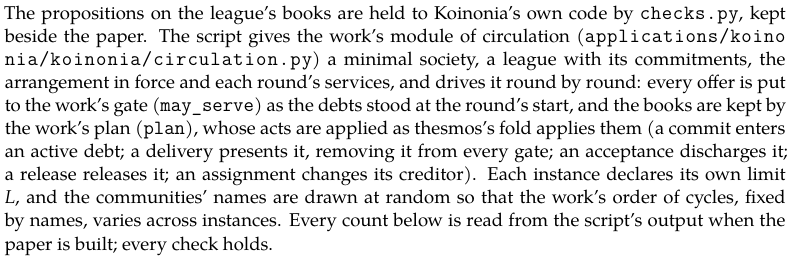
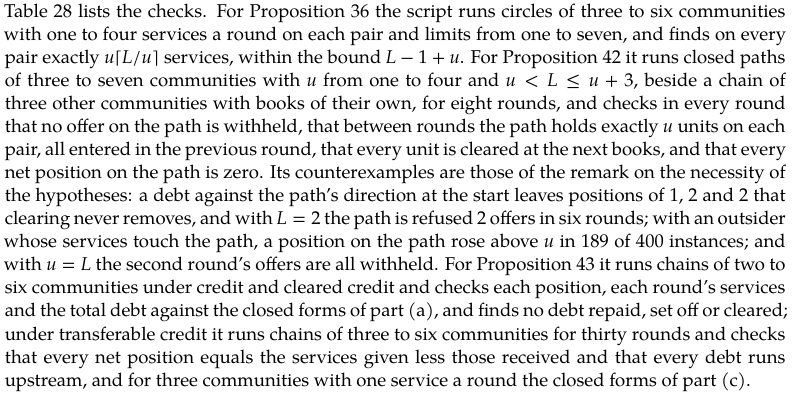
The check of Proposition 5 is of the abstract resolution (the greatest specificity, then prohibitions, then permissions) on random sets of norms and their permutations; the C++ module of thesmos is held to its own propositions by the foundation’s checks. The five checks below the rule hold the propositions of Sections 7 to 10 as their definitions state them, on constructed models: reserving children issued only when the root has room, each host charging its own child; a fold
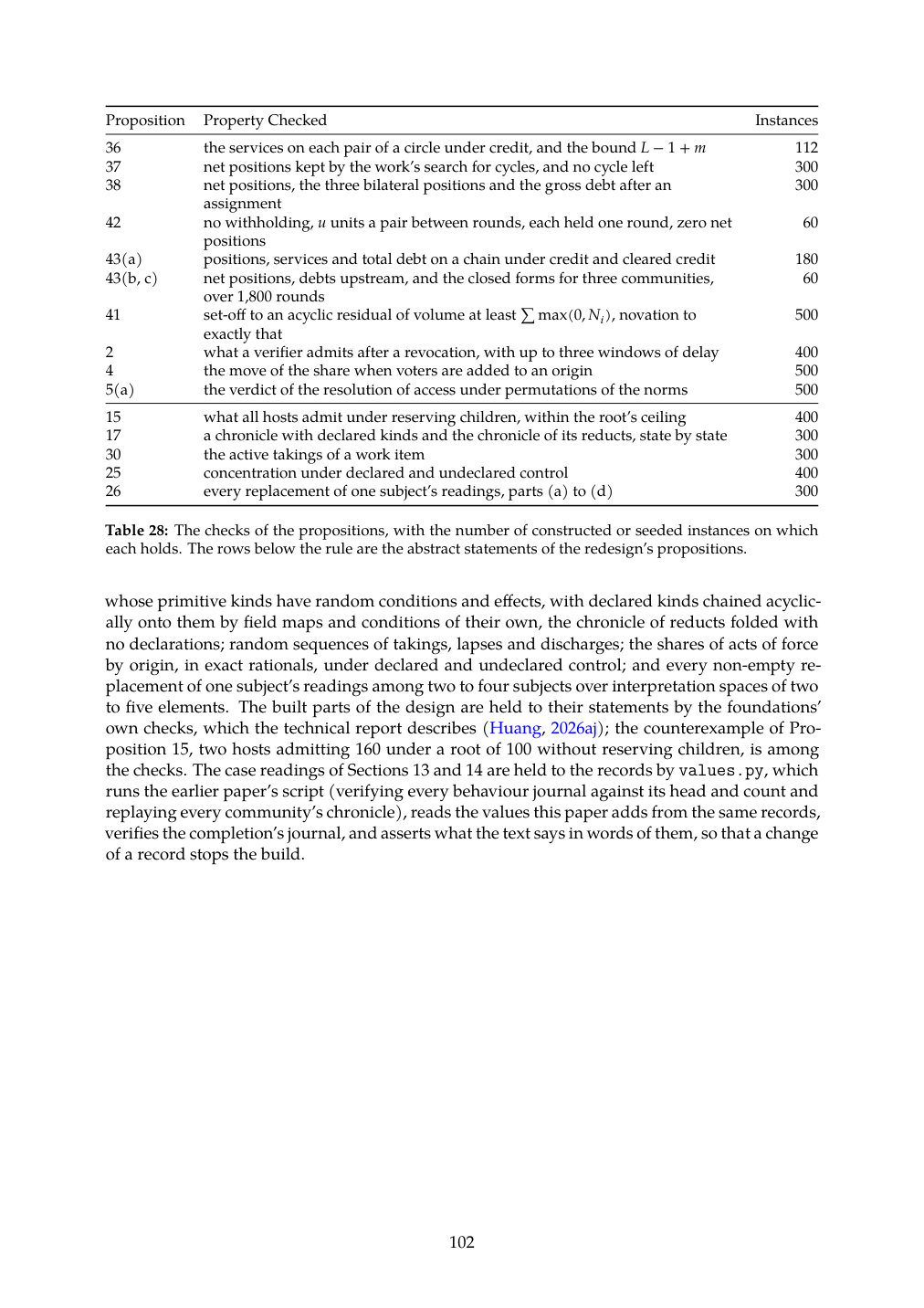
Readable text
net positions kept by the work’s search for cycles, and no cycle left net positions, the three bilateral positions and the gross debt after an
positions, services and total debt on a chain under credit and cleared credit net positions, debts upstream, and the closed forms for three communities,
what a verifier admits after a revocation, with up to three windows of delay the move of the share when voters are added to an origin the verdict of the resolution of access under permutations of the norms
what all hosts admit under reserving children, within the root’s ceiling a chronicle with declared kinds and the chronicle of its reducts, state by state concentration under declared and undeclared control every replacement of one subject’s readings, parts (a) to (d)
Table 28: The checks of the propositions, with the number of constructed or seeded instances on which each holds. The rows below the rule are the abstract statements of the redesign’s propositions.
whose primitive kinds have random conditions and effects, with declared kinds chained acyclic- ally onto them by field maps and conditions of their own, the chronicle of reducts folded with no declarations; random sequences of takings, lapses and discharges; the shares of acts of force by origin, in exact rationals, under declared and undeclared control; and every non-empty re- placement of one subject’s readings among two to four subjects over interpretation spaces of two to five elements. The built parts of the design are held to their statements by the foundations’ own checks, which the technical report describes (Huang, 2026aj); the counterexample of Pro- position 15, two hosts admitting 160 under a root of 100 without reserving children, is among the checks. The case readings of Sections 13 and 14 are held to the records by values.py, which runs the earlier paper’s script (verifying every behaviour journal against its head and count and replaying every community’s chronicle), reads the values this paper adds from the same records, verifies the completion’s journal, and asserts what the text says in words of them, so that a change