The Trolley Problem In A Generative-Relational Framework - A Mathematical Model Of Law, Procedure, And Judgment
Full text from the PDF
The Trolley Problem In A Generative-Relational Framework: A Mathematical Model Of Law, Procedure,
And Judgment
Wanhong Huang huangwanhong@serendip.ngo
Abstract
A general normative principle and a justified judgment are related achievements with different conditions. This paper develops that distinction through three connected objects: law, the procedure through which a judgment is generated, and the resulting judgment record. A generative-relational framework represents their historical formation, epistemic conditions, resources, authority, and anticipated consequences. Labeled 2-complexes provide one mathematical realization; a declared procedural structure supports the path and projection results, while selected 2-cells generate specified substitutions between parallel paths. The model separates substantive admissibility from procedural reachability, proves finite symmetry and observation criteria for record selection, and constructs bounded inquiry strategies by backward induction. Contextual substitution results state when procedural evaluations descend to quotients. A faithful finite matrix representation supplies explicit multiplication and commutator calculations; observation quotients identify which distinctions subsequent operations can expose. State refinement distinguishes corrected outcomes from retained procedural history. An evidentiary robustness construction is extended by finite weighted and error-sensitive operators. A further result shows that an empty intersection of admissible judgment records can coexist with a robust action after verdict compression. Two hypothetical comparisons examine prior responsibility in a trolley setting and the procedural significance of language and evidence access. The account preserves arguments for universal norms and uniquely correct answers while identifying the additional premises required for their discovery, procedural attainment, and implementation. Practical wisdom concerns the selection of relevant history, inquiry, support, and opportunities for revision under the purposes and constraints of a particular judgment.
Keywords: Generative-Relational Framework; Trolley Problem; Procedural Justice; Legal Epistemology; Practical Wisdom.
Discussion Paper Note
This philosophical discussion paper shares an evolving inquiry and invites dialogue, criticism, revision, and independent development. Its definitions, distinctions, and constructions remain open to refinement. Mathematical statements are assessed under their stated assumptions. Circulation across scholarly and practical communities is part of the purpose of releasing the manuscript.
The author treats the viewpoints, concepts, and lines of reasoning presented here as contributions to a shared field of inquiry. Similar or related ideas may have appeared in other intellectual, cultural, and disciplinary traditions. The manuscript identifies known antecedents and distinguishes inherited positions, interpretive proposals, and arguments developed here. Historical priority remains open to further investigation.
The arguments are provisional and historically situated. Readers are encouraged to question, test, revise, extend, reinterpret, or independently develop the ideas presented here. Where appropriate, acknowledgment of this paper as one point of encounter in the development of a related idea is appreciated. Such acknowledgment records an intellectual route; the ideas remain available for criticism, revision, and independent development.
Definitions introduced here are paper-local analytical stipulations. Attributed definitions follow the cited works. The terminology specifies the scope of the present argument, while its intellectual history remains open to further investigation. Generative-Relational inquiry is treated as an open research programme whose proposals receive critical examination alongside independent literature.
Responsible Use And Rights Reservation
This section records a request for responsible scholarly conduct and identifies the scope of retained rights. Legal permissions are governed by the licence reproduced on the following page.
The author encourages good-faith discussion, criticism, independent inquiry, and responsible use of the material. Separately from the licence’s terms, users are asked to consider foreseeable consequences when adapting the arguments, representations, examples, or proposed procedures. Relevant considerations include affected persons’ participation, represented interests, attribution, responsibilities, access to resources, and opportunities for correction. The responsibilities depend on the application and its circumstances. The ethical request leaves the licence’s permissions and obligations unchanged.
The author retains the rights preserved under CC BY-NC 4.0 and may pursue remedies to which the author is legally entitled for breach of the licence or violation of independently applicable rights. Reuse remains independent from authorial endorsement. Third-party rights require authorisation from their respective holders where applicable. Copyright exceptions and limitations, including applicable forms of fair use or fair dealing, remain available.
Notices
This page consolidates the manuscript’s research status, licence, preparation disclosure, available materials, research-programme relation, and suggested citation.
Status. This philosophical discussion manuscript is prepared for the author’s substantive review and subsequent scholarly discussion. It develops the law–procedure–judgment triad through a Generative- Relational framework, formal results, and constructed trolley and adjudication comparisons. Legal sources are interpreted within their stated contexts and applicable scope. Mathematical existence, epistemic accessibility, procedural attainability, and normative warrant remain separately assessed. Sourceaudit records identify the access level and scope of the consulted works.
Licence. Except where otherwise indicated, copyright 2026 Wanhong Huang. This work is made available under the Creative Commons Attribution–NonCommercial 4.0 International Licence (CC BY-NC 4.0). Subject to its terms, the licence permits sharing and adaptation for noncommercial purposes with appropriate attribution, a link to the licence, and an indication of changes. The licence governs reuse; the responsible-use request on the preceding page remains separate from its terms. The licence deed and legal code are available at https://creativecommons.org/licenses/by-nc/4.0/. The licence governs in case of conflict with this summary. Third-party material remains subject to its respective rights.
Statement On The Use Of Language Models. Preparation involved OpenAI’s ChatGPT and Codex. Language models supported exploratory dialogue, source discovery and checking, drafting, mathematical and editorial consistency checks, LATEX typesetting, and supporting code and figures. Verification used the sources and access levels documented in the accompanying source-audit records. The author initiated the research questions and directed the research programme. Interpretation, acceptance of arguments, and publication decisions remain subject to the author’s review. Responsibility for the released manuscript remains with the human author.
Code And Data Availability. Editable figures, manuscript sources, bibliography, source-access records, and scripts checking the finite constructions accompany the paper. The trolley and adjudication comparisons follow their stated assumptions and support analytical comparison. Legal and empirical materials cited from other works remain governed by their original contexts and respective conditions.
Research-Programme Relation. The paper contributes to the author’s evolving Generative-Relational inquiry. Its definitions and constructions are local to the stated arguments and invite comparison with independent approaches.
Suggested Citation. Huang, W. (2026). The Trolley Problem In A Generative-Relational Framework: A Mathematical Model Of Law, Procedure, And Judgment. Philosophical discussion paper.
1 Introduction
A normative principle can remain stable while the task of judging under it changes. Evidence becomes available through particular encounters; actors occupy different roles; time and resources constrain inquiry; and the decision itself enters an evolving history. These features matter in emergency action and in organized adjudication, although their purposes and available procedures differ. The trolley problem makes the immediate action question vivid. Jurisprudence provides developed accounts of the authority, interpretation, participation, and epistemic conditions through which judgments acquire standing. Bringing these inquiries together requires an explicit distinction among the standard invoked, the process of judgment, and its resulting record.
This paper calls these objects law, procedure, and judgment. Law here has a declared interpretation in each application: it can be a legally recognized standard or an explicitly adopted normative principle. Procedure comprises the attributed sequence of inquiry, interpretation, participation, deliberation, and closure through which a result is produced. Judgment denotes a record that can contain a verdict, reasons, conditions, and qualifications. A compressed verdict is a projection from that richer record. The distinctions make it possible to ask different questions about one episode: whether its governing norm has appropriate standing, whether its procedure is defensible, whether its factual claims are warranted, and whether its conclusion is substantively justified.
The central thesis concerns an inference. Establishing an invariant or universally valid principle supplies one premise in an argument for a judgment. Existence of an admissible response, uniqueness, epistemic accessibility, effective discovery, authorized production, and implementation each require further conditions. A complete deterministic rule supplied with fully specified relevant inputs can determine one result. The inquiry developed here identifies the additional premises and the practical work through which participants might establish them. It also distinguishes a uniquely correct classification of several actions as permissible from selection of one particular action.
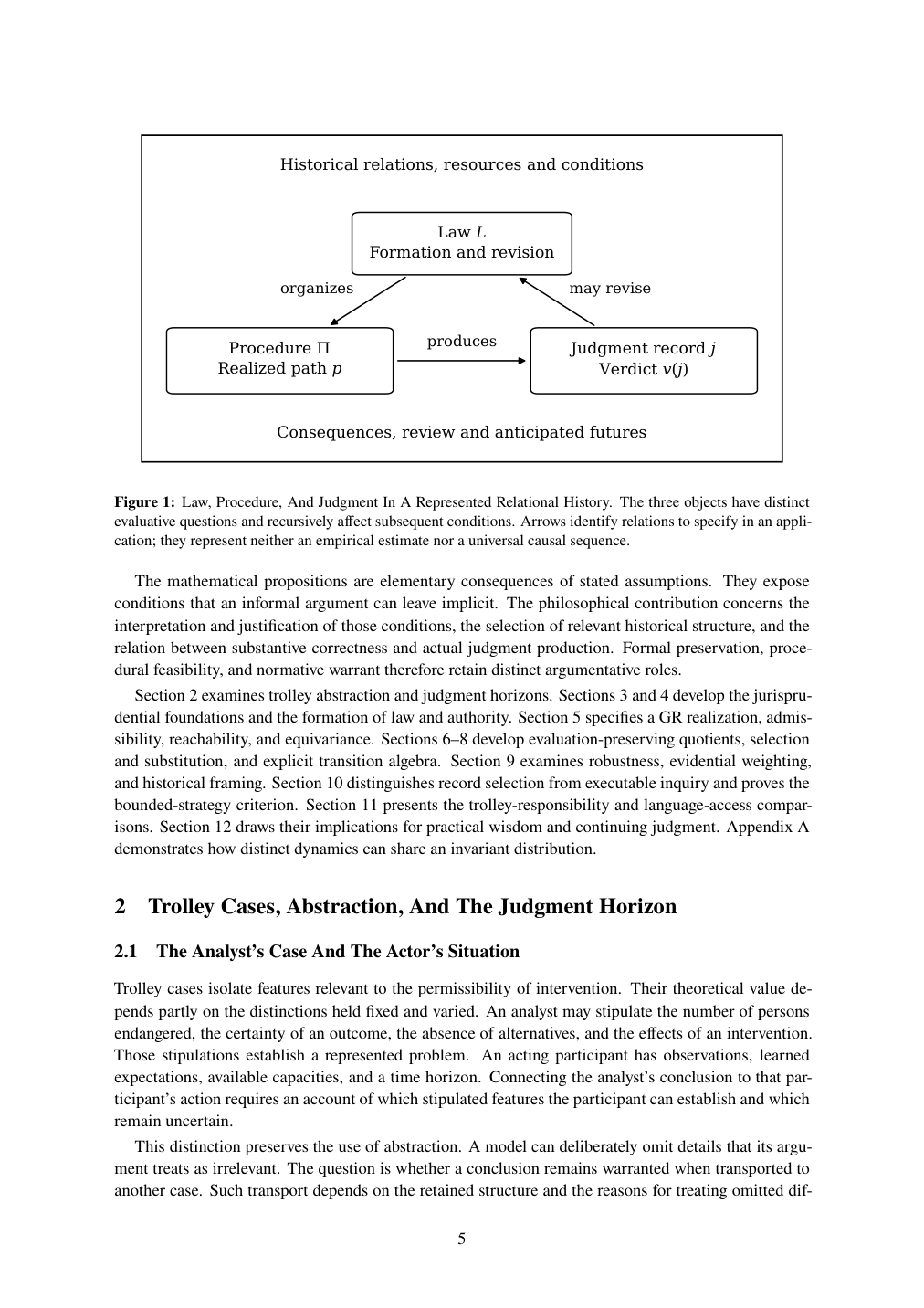
The historical organization of the judgment problem receives a generative-relational interpretation. A relational subject is represented through the events, relations, capacities, resources, and conditions through which it develops. Its spacetime includes represented historical relations and present expectations about possible futures, with their different epistemic statuses explicitly labeled. Laws, procedures, and judgments belong to this history. A procedure can create law; law can allocate procedural competence; and a judgment can alter rights, affect recognition, and provide material for subsequent interpretation. Figure 1 depicts these recursive relations.
This account situates norm formation within practices and powers while preserving the distinction between historical explanation and normative justification. An account of how a standard acquired authority can reveal dependence, exclusion, coordination, or learning. Assessing its claim to authority requires reasons concerning the relevant legal or moral question. Similarly, describing power through specified comparisons or competences supplies material for evaluation. Authorized direction can coordinate action, protect participation, and enable inquiry. Its effects and justification depend on the particular relation and its exercise.
The argument proceeds through representation, evaluation, and executable judgment. It first separates the standard governing a response from the paths through which a record can be produced. It then asks which transformations and compressed descriptions preserve the response set or a specified assessment. Symmetry and observation criteria expose separate obstacles to selecting a record; explicit transition algebra shows how operation order and retained history affect later possibilities. Bounded inquiry models establish when available observations, permitted commands, and resources support one strategy across compatible contexts. The comparative cases return these results to prior responsibility, language access, participation, and the practical choice of an inquiry horizon.
Readable text
Figure 1: Law, Procedure, And Judgment In A Represented Relational History. The three objects have distinct evaluative questions and recursively affect subsequent conditions. Arrows identify relations to specify in an appli- cation; they represent neither an empirical estimate nor a universal causal sequence.
The mathematical propositions are elementary consequences of stated assumptions. They expose conditions that an informal argument can leave implicit. The philosophical contribution concerns the interpretation and justification of those conditions, the selection of relevant historical structure, and the relation between substantive correctness and actual judgment production. Formal preservation, proce- dural feasibility, and normative warrant therefore retain distinct argumentative roles.
Section 2 examines trolley abstraction and judgment horizons. Sections 3 and 4 develop the jurispru- dential foundations and the formation of law and authority. Section 5 specifies a GR realization, admis- sibility, reachability, and equivariance. Sections 6–8 develop evaluation-preserving quotients, selection and substitution, and explicit transition algebra. Section 9 examines robustness, evidential weighting, and historical framing. Section 10 distinguishes record selection from executable inquiry and proves the bounded-strategy criterion. Section 11 presents the trolley-responsibility and language-access compar- isons. Section 12 draws their implications for practical wisdom and continuing judgment. Appendix A demonstrates how distinct dynamics can share an invariant distribution.
Trolley cases isolate features relevant to the permissibility of intervention. Their theoretical value de- pends partly on the distinctions held fixed and varied. An analyst may stipulate the number of persons endangered, the certainty of an outcome, the absence of alternatives, and the effects of an intervention. Those stipulations establish a represented problem. An acting participant has observations, learned expectations, available capacities, and a time horizon. Connecting the analyst’s conclusion to that par- ticipant’s action requires an account of which stipulated features the participant can establish and which
This distinction preserves the use of abstraction. A model can deliberately omit details that its argu- ment treats as irrelevant. The question is whether a conclusion remains warranted when transported to another case. Such transport depends on the retained structure and the reasons for treating omitted dif-
ferences as immaterial. Section 9 expresses this requirement through judgment-preserving projections. Historical distinctness by itself establishes neither relevance nor irrelevance. Two different histories can be equivalent for a stated question, while a seemingly minor relational difference can become decisive under a specified standard.
The classical literature already supplies important relational distinctions. Foot (1967) develops the problem within an inquiry concerning obligations, rights, and the permissibility of interventions affecting others. Thomson (1985, pp. 1397–1398) distinguishes responsibilities associated with drivers and bystanders and considers a possible history in which the five arranged the danger to induce the killing of the one. These arguments make it inappropriate to treat contextual sensitivity as absent from trolley philosophy. The present framework concerns how such distinctions become represented, known, challenged, and used within a procedure.
2.2 Three Horizons Of Judgment
Immediate action, subsequent adjudication, and long-term prevention answer related questions at different horizons. The emergency actor may need to act before obtaining further evidence. A later tribunal can investigate responsibility, hear competing accounts, and consider remedies. A public authority examining prevention can redesign equipment, procedures, or the distribution of protective resources. Their judgments can concern the same represented history while having different response types, standards, competences, and opportunities for inquiry.
For the immediate actor, the practical response might be to redirect a threat or refrain. For subsequent adjudication, the record might additionally determine whether a participant intentionally created the danger and owes a remedial obligation. For prevention, the response might involve changing the infrastructure through which similar dangers arise. The relationship among these judgments should be stated explicitly. A conclusion about a later duty does not by itself choose the emergency action. Conversely, a justified emergency action can coexist with responsibility for creating the situation.
An inquiry therefore begins by identifying its question and response universe. If a record contains an immediate recommendation and a responsibility assessment, uncertainty about the second component can prevent a robust complete record while leaving a robust immediate recommendation. This possibility is developed formally in Sections 9 and 11. It shows why the granularity of the judgment matters before one interprets an empty set of admissible records as an inability to act.
2.3 A Restricted Path And A Mathematical Limit
A represented emergency can permit only one prospective transition: choose an action and reach a terminal recommendation. This is a legitimate restricted model when its purposes and retained context are explicit. The initial configuration can still contain a substantial history, acquired competence, norms, and attributed beliefs. Counting one edge in a graph measures a chosen representational resolution; it provides no direct measure of cognitive complexity or historical depth.
Calling this representation a temporal limit requires additional mathematics. Suppose each transition has a positive duration and procedural feasibility is restricted by a time budget. As the budget shrinks below every available terminal route, the feasible set can become empty. Other parameterized families could retain an immediate action while excluding extended inquiry. A convergence claim needs a specified family, parameters, and comparison notion. The argument here uses horizon restriction and avoids deriving a general limiting theorem from the familiar urgency of trolley cases.
The framework also leaves open why particular trolley conflicts persist. Richer contextual reconstruction may clarify a responsibility, expose a mistaken assumption, or reveal an alternative action. Disagreements about rights, permissible means, duties, or normative priority can remain after that clarification.
The contribution is to identify the structure and conditions of the judgment task, including what the abstraction preserves. Explaining the psychological or philosophical persistence of trolley disagreement is a further question.
3 Jurisprudential Foundations
3.1 Generality, Particulars, And Practical Judgment
Aquinas (n.d., I–II, q. 94, a. 4) distinguishes common practical principles from contingent particulars and the conditions under which they are known. The example of returning entrusted goods illustrates how particular circumstances enter practical judgment. Universality and application therefore already have a developed relation within natural-law reasoning. The present thesis remains open to universal norms while asking what follows from establishing one and what further work its application requires.
Aristotle’s account of equity examines deficiencies arising from the general formulation of law; practical wisdom concerns the particulars of action and the contribution of experience (Aristotle, 1925a,b). These ideas support a question central to the present framework: which description of a particular situation is adequate for the reasons governing action? Generality can guide practice while leaving the recognition of relevant features and the selection of an appropriate response as substantive achievements.
The generative-relational interpretation adds an explicit concern with the conditions under which participants acquire and exercise that recognition. Access to records, practice, trusted interlocutors, language, and time can affect the available reconstruction. The ethical evaluation then includes who supplies those resources, who bears the costs of inquiry, and who can challenge a proposed description. These are features to investigate within the case, alongside the justification of its governing standards.
3.2 Validity, Recognition, And Legal Competence
Hart’s distinction between primary and secondary rules separates requirements governing conduct from practices concerning recognition, change, and adjudication (Hart, 2012). The model consequently distinguishes the identification of a legal standard, authority to alter it, and authority to issue a decision. Difficult applications can require interpretation without making every application indeterminate. A legally recognized norm also remains available for moral appraisal.
Hohfeld’s account of legal power concerns competence to effect a change in legal relations, with a corresponding liability; immunity and disability identify a different relation (Hohfeld, 1913). This vocabulary can type procedural transitions: submitting a claim, exercising an option, legislating, adjudicating, or obtaining review may have different operative effects. Competence, permission, duty, and epistemic expertise require separate labels. Hohfeldian power supplies no automatic general ordering of social influence.
For the present account, the relation between nominal competence and effective exercise is particularly important. A participant can possess a recognized procedural entitlement while lacking the language support or material access needed to exercise it. A tribunal’s authority can exist while a particular exercise breaches a governing rule. The representation should therefore retain both the relevant legal status and the actual route. It should also record the grounds on which that status or breach is asserted.
3.3 Procedural Justice, Participation, And Justification
Rawls (1999, §14) distinguishes perfect, imperfect, and pure procedural justice. The distinction separates an independent criterion for a correct outcome from a procedure’s ability to realize it. Imperfect procedural justice permits a fairly conducted trial to reach an incorrect result. Pure procedural justice
depends on an appropriate fair procedure and background conditions; its structure makes procedural fairness part of the account of an acceptable outcome.
Fuller’s account of adjudication emphasizes participation through proofs and reasoned argument, with a corresponding demand for rational responsiveness in the decision (Fuller, 1978). His discussion of polycentric problems concerns the relationship between procedural form and interacting consequences. The desiderata of legality also connect announced rules with their administration, including congruence between them (Fuller, 1969). These accounts provide different ways to assess the relationship between a rule, its exercise, and a resulting judgment.
Habermas distinguishes justification of norms from their application and examines the grounds of procedural principles themselves (Habermas, 1996, chs. 3–5). This raises a recursive question: a procedure’s standards of participation or reason-giving also require justification. The model can expose those commitments and their historical formation while treating their warrant as an argumentative responsibility. Agreement, legal bindingness, and justified acceptability consequently remain distinct evaluative objects.
These contributions motivate a multidimensional assessment. A result can satisfy a substantive requirement while the process violates a participation requirement. A process can satisfy its procedural requirements while incomplete evidence produces a factual error. A model must specify which claim it establishes and which relation among these dimensions it assumes. Collapsing them into one score requires a further aggregation rule and reasons for adopting it.
3.4 Interpretation, Right Answers, And Formal Argumentation
Dworkin supplies a substantive interlocutor concerning legal reasons and correct interpretation. His distinction between rules and principles challenges a representation consisting solely of mechanically applied rules (Dworkin, 1967). In the introduction to Hard Cases, he separates legal rights from a guaranteed mechanical demonstration and anticipates disagreement among reasonable legal interpreters (Dworkin, 1977). Finite resources or uncertain evidence therefore do not by themselves refute an ideal of correct legal judgment.
The present framework distinguishes that ideal from additional claims concerning discovery, public warrant, procedural attainability, and implementation. A critic defending a uniquely correct answer can accept that actual procedures require evidence, participation, and resources. Conversely, a demonstration that several paths or outputs are permitted by a particular model concerns that model’s premises. Connecting such a demonstration to a general interpretive thesis requires further argument. This separation prevents a practical limitation from silently becoming a theorem about moral or legal truth.
Prakken and Sartor (2015) identify a substantial formal literature concerning rules, exceptions, interpretation, evidence, and multi-agent interaction in legal proceedings. Their account is a close predecessor for distinguishing consequence under a semantics from reasoning and procedural interaction. The present model contributes a historical representation contract and connected criteria for projection, substitution, reachability, and evaluative preservation. Its value depends on the distinctions these constructions clarify in the worked comparisons.
3.5 Epistemic Access, Error Risks, And Representational Framing
Laudan distinguishes error reduction, error distribution, and other policy values in criminal procedure (Laudan, 2006). These questions can pull in different directions. A procedure might improve access to a relevant fact while imposing a burden or compromising a protection justified on another ground. The judgment model retains these criteria separately, allowing an argument about their relation instead of assuming a single measure of epistemic or moral quality.
Crenshaw’s critique of single-axis antidiscrimination frameworks shows how classifications affect which experiences can become recognizable claims (Crenshaw, 1989). The implication developed here concerns framing: the description space can shape a judgment before a tribunal compares the evidence. This extension requires attention to specific categories and exclusions. It also makes the selection of relevant history and admissible descriptions an object of procedural and normative inquiry.
Article 14 of the ICCPR and General Comment No. 32 give concrete legal content to conditions of participation, including language, time, facilities, evidence access, and review within their applicable scope (United Nations, 1966; United Nations Human Rights Committee, 2007). Paragraph 26 of the General Comment distinguishes procedural equality and fairness from a guarantee of error-free adjudication. The instrument therefore supplies a specific legal illustration of the law–procedure–judgment distinction, while its application requires attention to the type of proceeding and the relevant obligations.
Together, these interlocutors support a focused question: what can a representation establish about a judgment, under which substantive premises and procedural conditions? The formal development makes those requirements explicit and the comparisons show where they alter an assessment.
4 Law Formation, Authority, And The Warrant Of Judgment
The relation among law, procedure, and judgment becomes clearer when each object is followed through its formation. A law can acquire recognized standing through enactment, inherited practice, interpretation, or another specified source. Its formulation can organize the categories through which later claims are expressed. A procedure can then determine which claims are heard, which evidence becomes usable, and which actor can issue an operative decision. The resulting judgment enters a further history of reliance, response, criticism, and possible revision. These relations give historical inquiry an explanatory role while leaving the justification of each exercise of authority as a distinct argumentative task.
4.1 Formation And The Different Grounds Of Standing
Five questions organize the analysis. Sourced validity concerns whether a standard has the legal standing attributed to it under the relevant recognition practices. Normative authority concerns the reasons for treating its demands as governing conduct. Interpretive correctness concerns whether a proposed reading is adequately supported within the relevant interpretive account. Epistemic warrant concerns what a participant can responsibly claim on the available evidence. Finality concerns when an authorized process treats a decision as settled. One episode can receive different assessments under these questions because their objects and grounds differ.
Hart’s architecture of recognition, change, and adjudication helps distinguish several sources of legal standing (Hart, 2012). The GR analysis follows how the corresponding practices are learned, maintained, challenged, and exercised. A recognition practice can depend on professional training, documentary infrastructure, language, and established expectations about who may speak authoritatively. An account of those dependencies can explain why a particular standard functions as law in a setting. Its moral authority requires a further account of the reasons participants have for accepting its demands.
This distinction also applies to the content of a standard. Historical formation and cross-context validity describe different properties. A principle can emerge through a contingent encounter and subsequently receive a defensible argument for wider application. An inherited rule can remain effective while its justification becomes vulnerable to criticism. Conversely, showing that a judgment arose within a powerful professional field leaves open whether its reasons withstand examination. Historical dependence alone establishes neither the correctness of the judgment nor its defeat.
The importance of formation extends beyond origins. A legal category affects which differences later participants can express. A rule assigning standing, an evidential classification, or a recognized vocabu-
lary of injury can shape the future judgment space. Crenshaw’s critique of single-axis framing supplies a concrete interlocutor for this issue (Crenshaw, 1989). The present implication is analytical: law helps organize the descriptions that a procedure receives, alongside supplying standards for evaluating descriptions already presented. A procedure examining only its existing record can therefore require a further inquiry into how that record became possible.
This historical account remains selective. Its relevant object might be one category, one translation, one route of authorization, or one pattern of exclusion. A claim that history matters does not require every inquiry to reconstruct an unlimited past. The question is which omissions could change the standing, interpretation, warrant, or consequence currently under assessment. That question itself invokes reasons and can become a site of contestation.
4.2 Operative Power, Duties, And Enabling Relations
An operative legal capacity can differ from the permission or duty governing its exercise. Hohfeld’s analysis distinguishes power and liability from other jural relations, including duty, privilege, immunity, and disability (Hohfeld, 1913). This vocabulary gives the model several transition types. An actor might be competent to alter a relation through a specified act, obligated to observe a procedural requirement, and dependent on another actor for the evidence needed to act responsibly. Those properties need separate representation.
Consider an abstract norm system in which an authorized officer can issue a decision that changes an entitlement, while a separate requirement obliges the officer to hear a response first. Stipulate that the system gives the issued act operative effect even when that requirement is breached. The resulting episode then combines an effective change with a violation. Another system could make the same procedural omission a condition defeating the act’s operative effect. Choosing between those descriptions requires the applicable rules; the abstract distinction provides no general doctrine of validity. It does show why a model should record competence, duty, compliance, and effect separately.
The corresponding moral questions are also distinct. An empowered actor can use authority to obtain interpretation, protect a participant from intimidation, or prevent an inquiry from being dominated by the better-resourced party. Withdrawing that authority can leave other dependencies and inequalities active. A comparison of powers therefore asks what a particular relation enables, what constraints govern it, and whose capacities it changes. A general presumption that every asymmetry is wrongful would obscure these functions.
At the same time, enabling authority can reproduce dependence. If one participant controls access to assistance, determines which histories are relevant, and evaluates whether an explanation is adequate, that participant can influence both the available procedure and its apparent success. The effects can arise through anticipated approval as well as explicit commands. ToM therefore belongs within the history of authority: participants may adapt their accounts to what they expect an evaluator to recognize. The accuracy of that expectation, the evaluator’s intention, and the resulting distribution of influence remain separate claims.
A norm-indexed partial order can represent a specified comparison of competences or roles where its axioms hold. The same actors can occupy different positions under expertise, procedural responsibility, resource control, and recognition. Preserving those different relations helps explain why legitimate direction in one domain supplies limited grounds for deference in another. The mathematical representation makes the comparison explicit; the justification concerns the scope and consequences of the authority claimed.
4.3 Generality, Particularity, And The Additional Premises Of Application
A general principle can guide a judgment while leaving the recognition of relevant circumstances as substantive work. Aquinas’s distinction between common practical principles and contingent particulars, and Aristotle’s treatment of equity and practical wisdom, provide established approaches to this relation (Aquinas, n.d.; Aristotle, 1925a,b). Their significance here is that contextual application already has a place within arguments about general standards. The GR framework makes its historical and epistemic conditions explicit.
There are several ways a general law could be insufficiently specified for unique selection. It might permit multiple responses, leave a priority unresolved, or identify a reason whose application depends on a disputed description. A more complete substantive theory could settle those matters. The present thesis allows that possibility. Its claim concerns the additional premises needed to move from a principle’s existence to a particular assessment, and from that assessment to a warranted, executable response.
Suppose, more strongly, that a theory assigns one correct judgment to every fully specified context. That is a pointwise claim about the relation between contexts and correct records. It leaves a further question about participants who cannot distinguish the relevant contexts. A uniform procedure must respond to the information those participants possess. If indistinguishable contexts require incompatible responses, their separate right answers do not themselves supply an information-feasible choice. Section 10 develops that distinction formally. The obstacle concerns access and implementation under the stated information structure, with the pointwise correctness claim left intact.
This is a productive way to engage Dworkin. His account in Hard Cases separates legal rights from a guaranteed mechanical demonstration and recognizes interpretive disagreement (Dworkin, 1977). The GR account therefore asks how an interpretation becomes warranted for actual participants and how an authorized institution should act under incomplete access. It supplies an analysis of production and justification conditions alongside the substantive question of the best legal answer. A finite-resource limitation becomes a refutation of a stronger theory only if that theory actually promises the attainability that the example defeats.
Searching for invariant features across contexts raises another issue. A quotient can identify situations treated as equivalent, but its construction already selects which differences matter. A comparison preserving a fatality count can omit responsibility; a comparison preserving legal status can omit the conditions under which that status was obtained. Establishing that the retained structure is adequate for judgment requires an argument about relevance. Mathematical invariance can express that proposed comparison precisely. The justification for treating it as a morally significant invariant remains further work.
The same caution permits, rather than forecloses, a natural-law inquiry. One can defend a crosscontext principle and investigate how historically different circumstances satisfy its conditions. The relevant equivalence may concern a relational pattern under the principle, allowing different complete histories to receive the same judgment. Historical uniqueness alone supplies no requirement that all judgments differ, and an invariant principle alone supplies no theorem that every practical selection is unique. These are independent claims whose connection must be established.
4.4 Procedures As Means And As Constituents Of Justice
A procedure can be assessed for what it produces and for what occurs while it produces it. Rawls’s distinction among perfect, imperfect, and pure procedural justice clarifies different relations between an outcome criterion and the procedure used to realize it (Rawls, 1999, §14). The distinction leaves a substantive task of defending the procedure and, where relevant, its background conditions. Merely following an enacted sequence supplies insufficient grounds for identifying the sequence with a fair procedure.
The instrumental question concerns a procedure’s capacity to establish relevant facts and reach a defensible disposition. Its evidential practices can reduce some errors while increasing others. A requirement to hear a response may improve accuracy; a rushed closure may leave material evidence unexamined. A process can also reach the correct result fortuitously, so agreement with a correct endpoint gives limited evidence about its reliability. Judging the method requires reasons concerning how it operates across the situations within its claimed scope.
The constitutive question concerns participation, treatment, and the relations through which the decision is made. Fuller’s account connects adjudicative participation through evidence and reasoned argument with a demand that decisions respond rationally to what participants submit (Fuller, 1978). On that account, giving someone an opportunity to offer reasons shapes the activity’s character. Its value can consequently survive a comparison in which the eventual verdict happens to agree. The language-access case in Section 11 isolates one such possibility under an explicitly limited criterion.
These perspectives can conflict. Maximizing expected accuracy could favor an investigative technique that infringes a protected relation or places an unacceptable burden on a participant. A procedural account can treat a protection as a constraint on eligible methods, leaving the choice among compliant methods to an instrumental comparison. Alternatively, a defended standard might specify circumstances for an exception. Both constructions require reasons concerning the protection and the proposed departure. A numerical loss function records those commitments only after its terms and authority have been justified.
Habermas’s distinction between justification and application adds a further layer: the principles organizing the procedure also require warrant (Habermas, 1996, chs. 3–5). A professional consensus or a valid enactment can establish an important social or legal fact while leaving the corresponding claim of justified acceptability open. The model therefore records whose reasons establish the procedure, whose interests and capacities it affects, and which opportunities exist to challenge its exercise.
A comprehensive substantive theory could include all these procedural values. In that event, the triad remains an analytical distinction within the theory’s richer domain. Evaluating its answer still requires establishing the relevant procedural history, determining which requirements apply, and assessing what the resulting record preserves. The framework makes no assumption that procedural and substantive considerations belong to disjoint moral worlds. It separates their questions so their interaction can be examined.
4.5 Factual Truth, Evidential Warrant, And Legal Disposition
A fact, the warrant for accepting it, and the disposition an institution should issue are different objects. Consider a hypothetical standard under which an adverse finding requires specified proof, with a default disposition when that requirement is unmet. A proposition about the underlying conduct could be true while the available evidence fails to satisfy the standard. The default disposition can then be warranted under the adopted rule. Its correctness under that rule and the truth of a stronger factual finding have different conditions.
This distinction prevents an error-sensitive model from silently replacing its governing norm. A model seeking only to match an underlying fact can rank choices differently from a legal standard that distributes the risk of unsupported adverse findings. Laudan separates questions of error reduction, error distribution, and other values (Laudan, 2006). The formal operators later in the paper use that distinction by declaring their eligible records and losses. They supply conditional analyses of those declarations, with legal or moral adequacy requiring further argument.
The procedure also helps create its evidential record. Interpretation, questioning, disclosure, and assistance influence which claims can become usable material. An inaccessible document can exist in an archive while remaining unavailable as a practical resource for one party. A misunderstood question
can produce an answer that appears decisive within a deficient account. Recognizing these mechanisms requires attention to resources, conditions, and capacities separately.
General Comment No. 32 supplies specific protections concerning fair-hearing conditions within its applicable treaty setting (United Nations Human Rights Committee, 2007). The present model uses such standards as substantive inputs, while distinguishing the treaty-body interpretation from the broader moral questions a case might raise. Its paragraph 26 also leaves procedural fairness distinct from a guarantee against error. A correct disposition can coexist with an access failure, and a procedurally compliant inquiry can remain vulnerable to factual uncertainty.
Finality adds another type of standing. An authorized decision can become the operative basis for coordination or reliance while grounds for criticism remain. The extent of that standing, and the available route of correction, depend on the relevant norms. A model should consequently retain the issued act, its legal characterization, and the reasons for questioning it. Treating them as separate labels permits analysis of review without erasing the earlier episode.
4.6 Conditional Warrants For Inquiry, Participation, And Closure
The framework can support practical arguments without deriving a universal ethics from its mathematical form. Three conditional warrants are especially important. Each begins from a normative commitment requiring defense, then examines what its exercise demands under the represented conditions.
First, a decision claiming to respond to evidence and reasons undertakes an accountability requirement. Under the proposed standard of reciprocal accountability, consequential grounds should be sufficiently attributable that an affected participant can identify and contest a material error. The argument draws on both the activity’s claim to reason-responsiveness and participants’ interests in understanding the demands that organize their conduct. A route for consequential challenge can expose a defeat of the decision’s stated grounds and permit the authority to respond to it. This supports explanations, provenance, or an accessible review route, with the form proportionate to the task. The requirement leaves room for protected information, specialized roles, and justified limits on disclosure, with an alternative route of accountability where those limits are necessary.
Second, a procedure promising meaningful participation requires usable opportunities to exercise that participation. A nominal entitlement to respond can be ineffective when the person cannot understand the material or obtain essential assistance. The corresponding warrant concerns sufficient access for the relevant task, rather than an assumption of identical resources or expertise. Assistance can support participation without making each participant equally authoritative on every question. A role’s legitimate constraints should therefore be intelligible together with the means of using the opportunity it offers.
Third, reliance on a constraint creates a reason to examine its formation and allocation. Some urgency belongs to the immediate danger. Some scarcity arises from earlier decisions about staffing, language support, records, or infrastructure. An emergency actor’s feasible response and an organization’s responsibility for the conditions can consequently differ. Judging the actor under current limitations leaves a further inquiry into whether those limitations should have been prevented or must now be changed.
These warrants also face conflicts. Disclosure can endanger another person’s privacy; continued inquiry can impose delay on those awaiting relief; enabling one participant’s response can consume resources required elsewhere. Practical wisdom must therefore identify the relevant duties, stakes, alternatives, and competent decision-makers. Proportionate inquiry is a reasoned relation among those features. A claim that some further information might exist supplies limited guidance until its possible significance and acquisition costs are specified.
Closure can have a positive justification. Participants may need an operative decision to organize conduct, secure protection, or prevent an inquiry from becoming an indefinite burden. The case for closure should state what it settles and which qualifications remain. A provisional emergency recommenda-
tion, a final legal disposition, and a historical responsibility assessment can require different forms of finality. Their distinction makes room for action without presenting every unresolved feature as already determined.
Correction also has a history. Later review can supply access, alter a judgment, or recognize an earlier failure. It cannot make the earlier burden or deprivation disappear from the episode. The reasons for correction should therefore address both the current disposition and the consequences of the route already taken. Section 7 develops this point through a reopening construction whose verdict can change while procedural provenance remains.
4.7 Criticism Within A Historically Formed Normative Order
The recursive formation of standards raises a concern about regress: every evaluation invokes a norm, whose evaluation invokes another. A practical inquiry can address that concern by making its operative commitments explicit and presenting reasons for their use. It can examine consistency with an avowed purpose, consequences for affected participants, reciprocity, established protections, or a defended crosscontext principle. Each route has an argumentative burden; none requires pretending that judgment begins outside history.
Historicity likewise leaves criticism possible. A norm can be challenged through a conflict among its own commitments, evidence of consequences that its accepted description omitted, or a more adequate normative argument. A participant whose experience lacks an established category can offer reasons to revise that category. The history of recognition helps explain why the challenge was difficult to formulate. Its justification concerns whether the revised account better answers the relevant reasons, including reasons extending beyond the inherited framework.
This is the sense in which the triad connects generativity with responsibility. Laws and procedures shape the future conditions of interpretation and action; judgments reproduce or alter those conditions. A responsible inquiry examines that continuation while retaining bounded, revisable commitments appropriate to its task. The following formal model makes selected requirements precise. Its results concern the structures declared, and its application remains answerable to the historical evidence and normative reasons developed here.
5 Formal Model: Spacetime Realizations And Procedural Reachability
5.1 A Representation Contract For GR Spacetime
The generative-relational framework supplies the representation target: a selected relational subject developing through a historical and prospective spacetime. A mathematical realization specifies a carrier, labels, relevant relations, and the interpretation of operations on them. Different realizations can preserve different aspects of the subject. Consequently, a theorem states which structures it uses and which comparisons it supports.
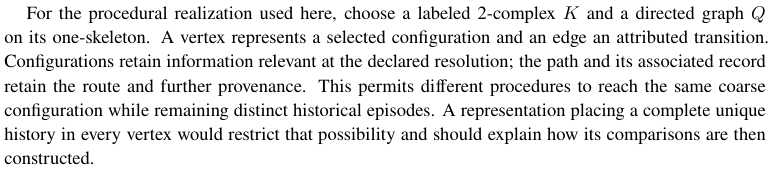
A face has specified incidence or attachment data and a semantic type. Some faces compare parallel directed paths with the same source and target. Others represent a different specified relation, such as
Readable text
interaction, objection, or divergence. In a CW realization, an attaching map supplies the boundary of a cell (Hatcher, 2002, ch. 0). The topological choice and the semantic interpretation are separately stated. Section 6 gives selected parallel-path faces algebraic work through a generated categorical congruence.
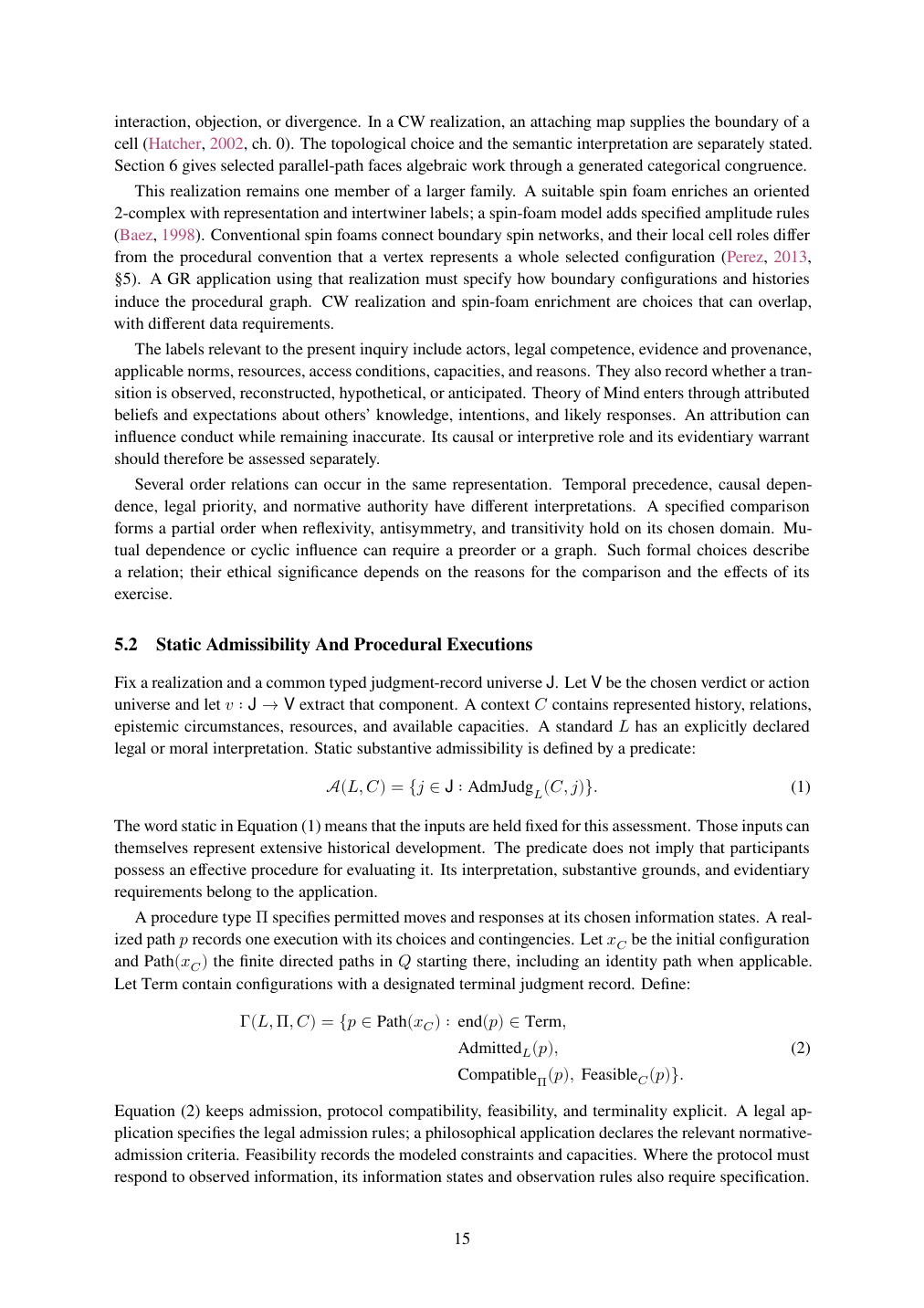
This realization remains one member of a larger family. A suitable spin foam enriches an oriented 2-complex with representation and intertwiner labels; a spin-foam model adds specified amplitude rules (Baez, 1998). Conventional spin foams connect boundary spin networks, and their local cell roles differ from the procedural convention that a vertex represents a whole selected configuration (Perez, 2013, §5). A GR application using that realization must specify how boundary configurations and histories induce the procedural graph. CW realization and spin-foam enrichment are choices that can overlap,
The labels relevant to the present inquiry include actors, legal competence, evidence and provenance, applicable norms, resources, access conditions, capacities, and reasons. They also record whether a tran- sition is observed, reconstructed, hypothetical, or anticipated. Theory of Mind enters through attributed beliefs and expectations about others’ knowledge, intentions, and likely responses. An attribution can influence conduct while remaining inaccurate. Its causal or interpretive role and its evidentiary warrant
Several order relations can occur in the same representation. Temporal precedence, causal depen- dence, legal priority, and normative authority have different interpretations. A specified comparison forms a partial order when reflexivity, antisymmetry, and transitivity hold on its chosen domain. Mu- tual dependence or cyclic influence can require a preorder or a graph. Such formal choices describe a relation; their ethical significance depends on the reasons for the comparison and the effects of its
Fix a realization and a common typed judgment-record universe J. Let V be the chosen verdict or action legal or moral interpretation. Static substantive admissibility is defined by a predicate:
The word static in Equation (1) means that the inputs are held fixed for this assessment. Those inputs can themselves represent extensive historical development. The predicate does not imply that participants possess an effective procedure for evaluating it. Its interpretation, substantive grounds, and evidentiary
Let Term contain configurations with a designated terminal judgment record. Define:
Equation (2) keeps admission, protocol compatibility, feasibility, and terminality explicit. A legal ap- plication specifies the legal admission rules; a philosophical application declares the relevant normative- admission criteria. Feasibility records the modeled constraints and capacities. Where the protocol must respond to observed information, its information states and observation rules also require specification.
Readable text
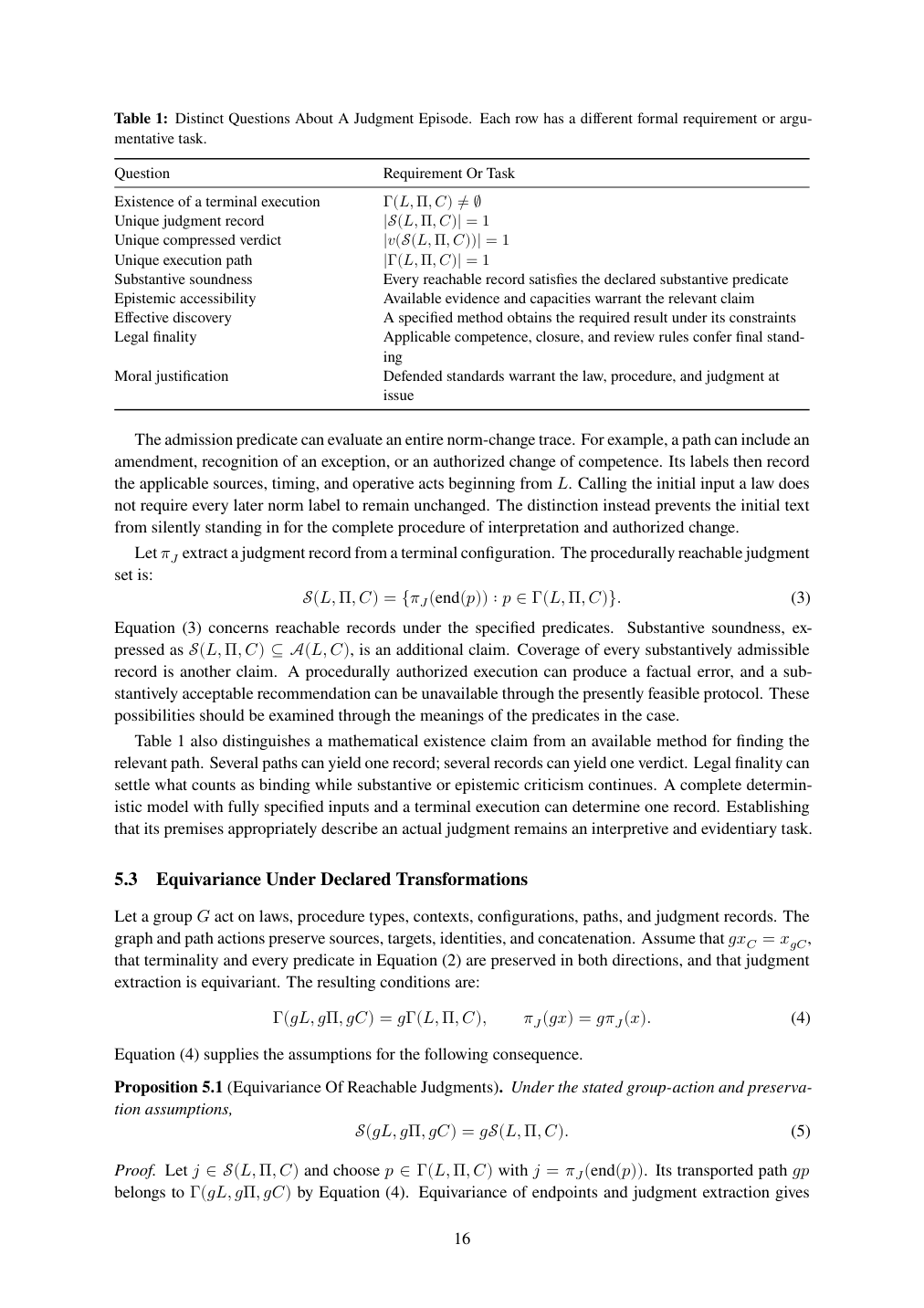
Table 1: Distinct Questions About A Judgment Episode. Each row has a different formal requirement or argu-
Existence of a terminal execution Unique judgment record Unique compressed verdict Unique execution path Substantive soundness Epistemic accessibility Effective discovery Legal finality ing Moral justification issue
Every reachable record satisfies the declared substantive predicate Available evidence and capacities warrant the relevant claim A specified method obtains the required result under its constraints Applicable competence, closure, and review rules confer final stand- Defended standards warrant the law, procedure, and judgment at
The admission predicate can evaluate an entire norm-change trace. For example, a path can include an amendment, recognition of an exception, or an authorized change of competence. Its labels then record not require every later norm label to remain unchanged. The distinction instead prevents the initial text from silently standing in for the complete procedure of interpretation and authorized change.
Equation (3) concerns reachable records under the specified predicates. Substantive soundness, ex- record is another claim. A procedurally authorized execution can produce a factual error, and a sub- stantively acceptable recommendation can be unavailable through the presently feasible protocol. These possibilities should be examined through the meanings of the predicates in the case.
Table 1 also distinguishes a mathematical existence claim from an available method for finding the relevant path. Several paths can yield one record; several records can yield one verdict. Legal finality can settle what counts as binding while substantive or epistemic criticism continues. A complete determin- istic model with fully specified inputs and a terminal execution can determine one record. Establishing that its premises appropriately describe an actual judgment remains an interpretive and evidentiary task.
that terminality and every predicate in Equation (2) are preserved in both directions, and that judgment extraction is equivariant. The resulting conditions are:
Equation (4) supplies the assumptions for the following consequence.
Proposition 5.1 (Equivariance Of Reachable Judgments). Under the stated group-action and preserva-




Section 7 gives the general finite stabilizer criterion for deterministic equivariant selection and distinguishes it from an equivariant lottery. It also combines symmetry with restricted observation. Section 10 then asks the further question of whether a common selection can be realized through an observationbased procedure.
6 Procedural Evaluation, Quotients, And Order Dependence
6.1 What A Verdict Projection Preserves






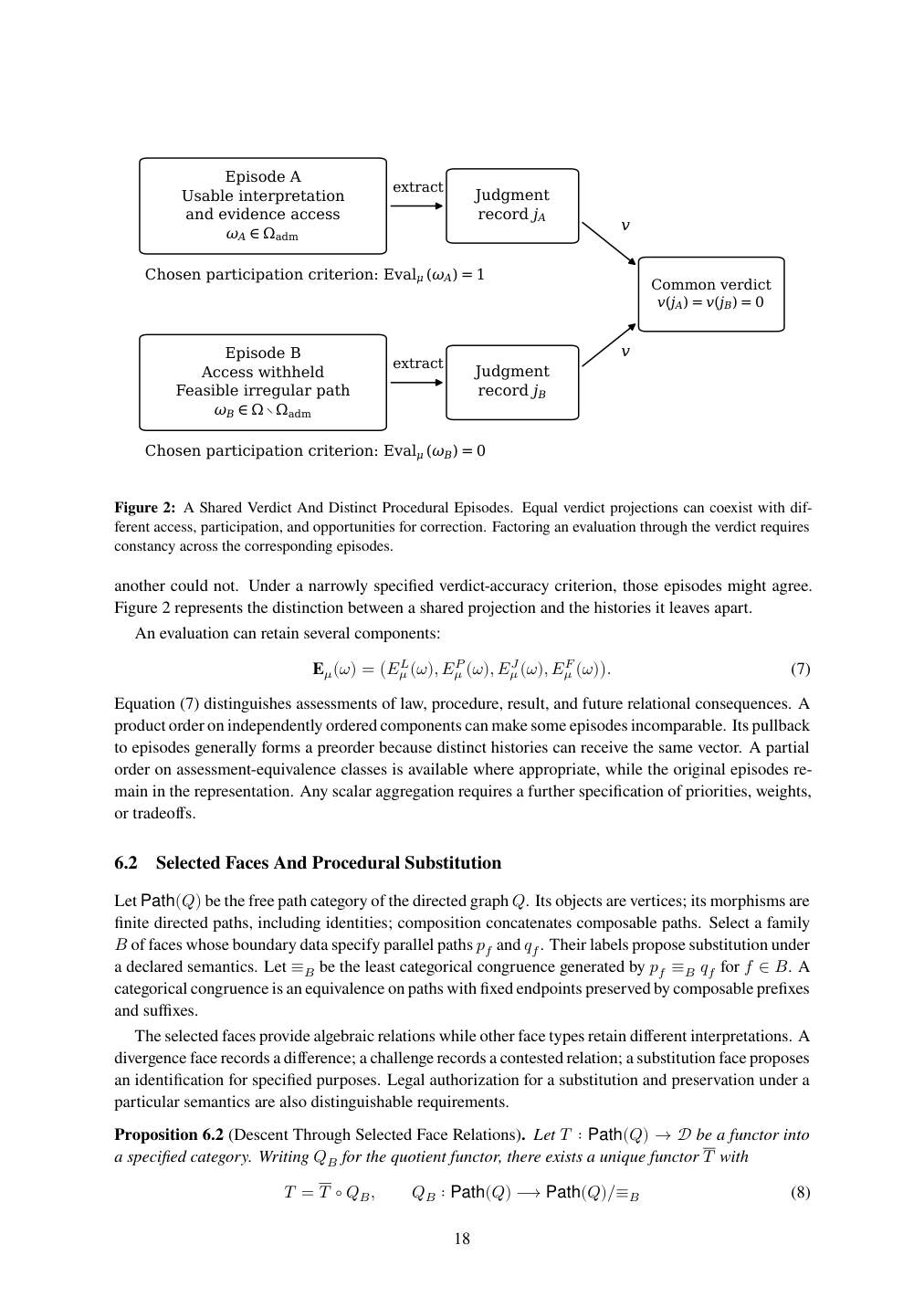
This familiar factorization criterion states exactly what must hold for an endpoint description to preserve a chosen assessment. It gives no warrant for the assessment itself. Under a participation criterion, episodes with the same verdict can differ because one party could contest the material evidence and
Readable text
Figure 2: A Shared Verdict And Distinct Procedural Episodes. Equal verdict projections can coexist with dif- ferent access, participation, and opportunities for correction. Factoring an evaluation through the verdict requires
another could not. Under a narrowly specified verdict-accuracy criterion, those episodes might agree. Figure 2 represents the distinction between a shared projection and the histories it leaves apart.
Equation (7) distinguishes assessments of law, procedure, result, and future relational consequences. A product order on independently ordered components can make some episodes incomparable. Its pullback to episodes generally forms a preorder because distinct histories can receive the same vector. A partial order on assessment-equivalence classes is available where appropriate, while the original episodes re- main in the representation. Any scalar aggregation requires a further specification of priorities, weights,
finite directed paths, including identities; composition concatenates composable paths. Select a family categorical congruence is an equivalence on paths with fixed endpoints preserved by composable prefixes
The selected faces provide algebraic relations while other face types retain different interpretations. A divergence face records a difference; a challenge records a contested relation; a substitution face proposes an identification for specified purposes. Legal authorization for a substitution and preservation under a particular semantics are also distinguishable requirements.
Readable text
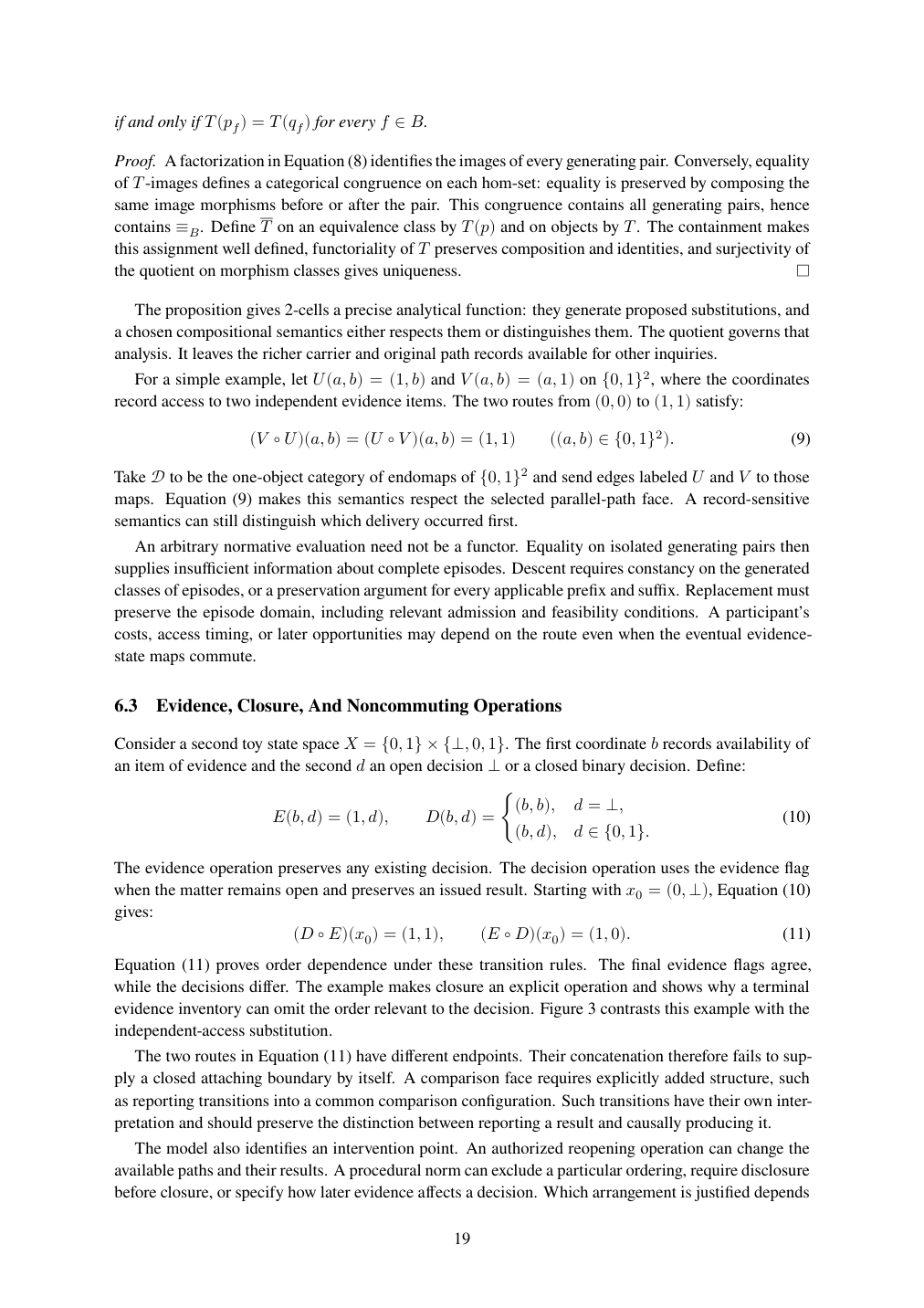
Proof. A factorization in Equation (8) identifies the images of every generating pair. Conversely, equality same image morphisms before or after the pair. This congruence contains all generating pairs, hence
The proposition gives 2-cells a precise analytical function: they generate proposed substitutions, and a chosen compositional semantics either respects them or distinguishes them. The quotient governs that analysis. It leaves the richer carrier and original path records available for other inquiries.
maps. Equation (9) makes this semantics respect the selected parallel-path face. A record-sensitive semantics can still distinguish which delivery occurred first.
An arbitrary normative evaluation need not be a functor. Equality on isolated generating pairs then supplies insufficient information about complete episodes. Descent requires constancy on the generated classes of episodes, or a preservation argument for every applicable prefix and suffix. Replacement must preserve the episode domain, including relevant admission and feasibility conditions. A participant’s costs, access timing, or later opportunities may depend on the route even when the eventual evidence-
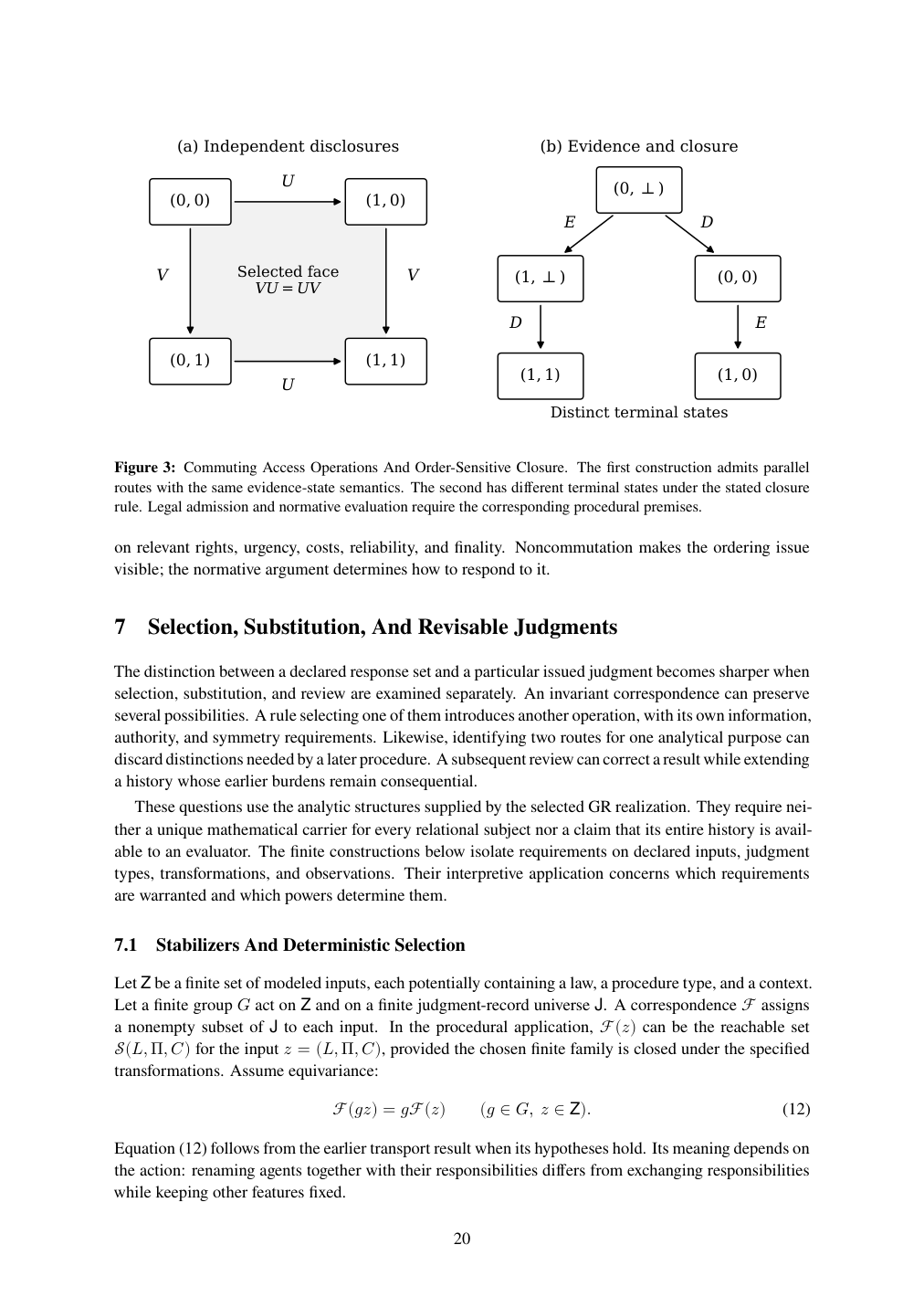
The evidence operation preserves any existing decision. The decision operation uses the evidence flag
Equation (11) proves order dependence under these transition rules. The final evidence flags agree, while the decisions differ. The example makes closure an explicit operation and shows why a terminal evidence inventory can omit the order relevant to the decision. Figure 3 contrasts this example with the
The two routes in Equation (11) have different endpoints. Their concatenation therefore fails to sup- ply a closed attaching boundary by itself. A comparison face requires explicitly added structure, such as reporting transitions into a common comparison configuration. Such transitions have their own inter- pretation and should preserve the distinction between reporting a result and causally producing it.
The model also identifies an intervention point. An authorized reopening operation can change the available paths and their results. A procedural norm can exclude a particular ordering, require disclosure before closure, or specify how later evidence affects a decision. Which arrangement is justified depends
Readable text
Figure 3: Commuting Access Operations And Order-Sensitive Closure. The first construction admits parallel routes with the same evidence-state semantics. The second has different terminal states under the stated closure rule. Legal admission and normative evaluation require the corresponding procedural premises.
on relevant rights, urgency, costs, reliability, and finality. Noncommutation makes the ordering issue visible; the normative argument determines how to respond to it.
The distinction between a declared response set and a particular issued judgment becomes sharper when selection, substitution, and review are examined separately. An invariant correspondence can preserve several possibilities. A rule selecting one of them introduces another operation, with its own information, authority, and symmetry requirements. Likewise, identifying two routes for one analytical purpose can discard distinctions needed by a later procedure. A subsequent review can correct a result while extending a history whose earlier burdens remain consequential.
These questions use the analytic structures supplied by the selected GR realization. They require nei- ther a unique mathematical carrier for every relational subject nor a claim that its entire history is avail- able to an evaluator. The finite constructions below isolate requirements on declared inputs, judgment types, transformations, and observations. Their interpretive application concerns which requirements
Let Z be a finite set of modeled inputs, each potentially containing a law, a procedure type, and a context.
Equation (12) follows from the earlier transport result when its hypotheses hold. Its meaning depends on the action: renaming agents together with their responsibilities differs from exchanging responsibilities
Readable text
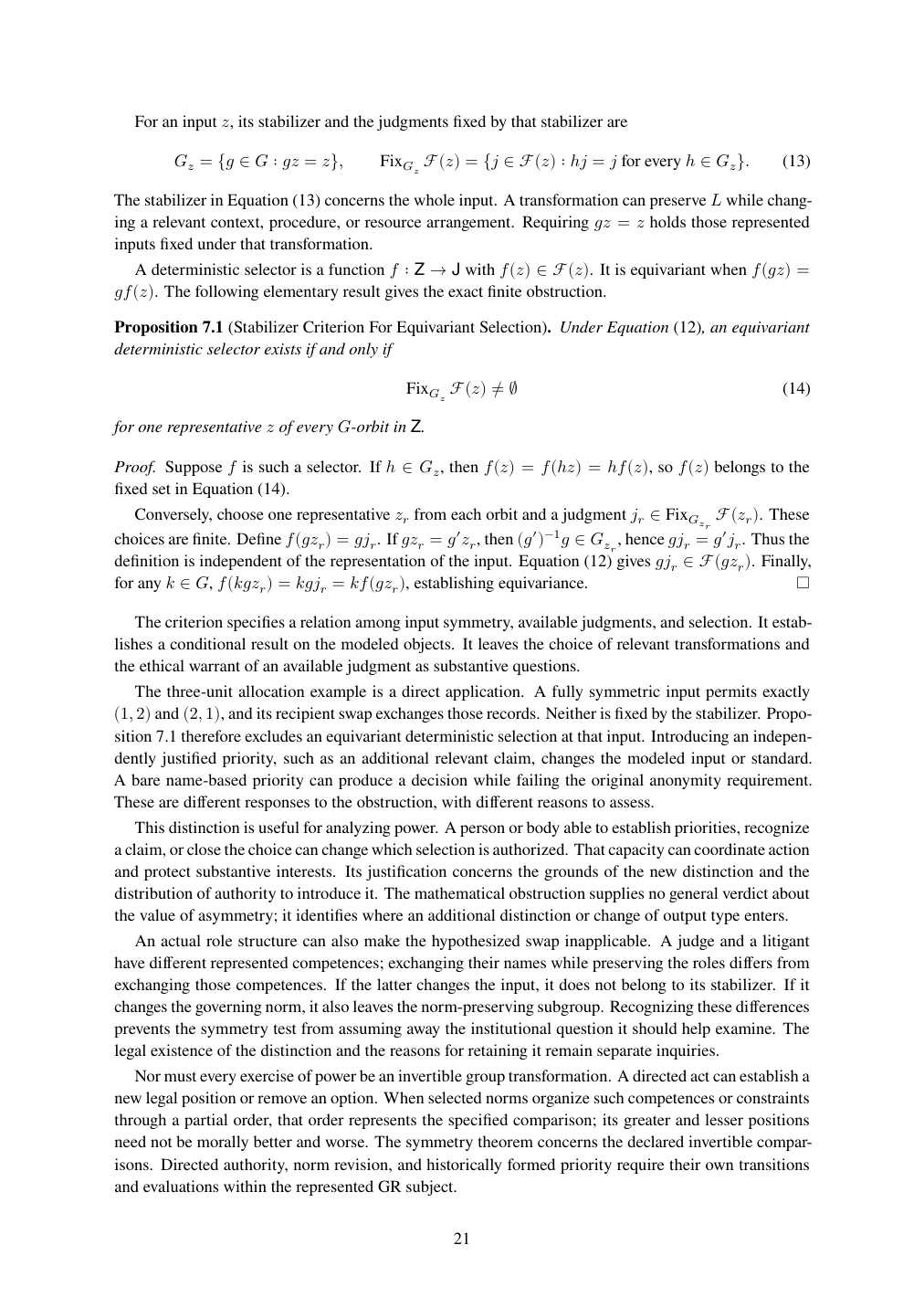
Proposition 7.1 (Stabilizer Criterion For Equivariant Selection). Under Equation (12), an equivariant
The criterion specifies a relation among input symmetry, available judgments, and selection. It estab- lishes a conditional result on the modeled objects. It leaves the choice of relevant transformations and the ethical warrant of an available judgment as substantive questions.
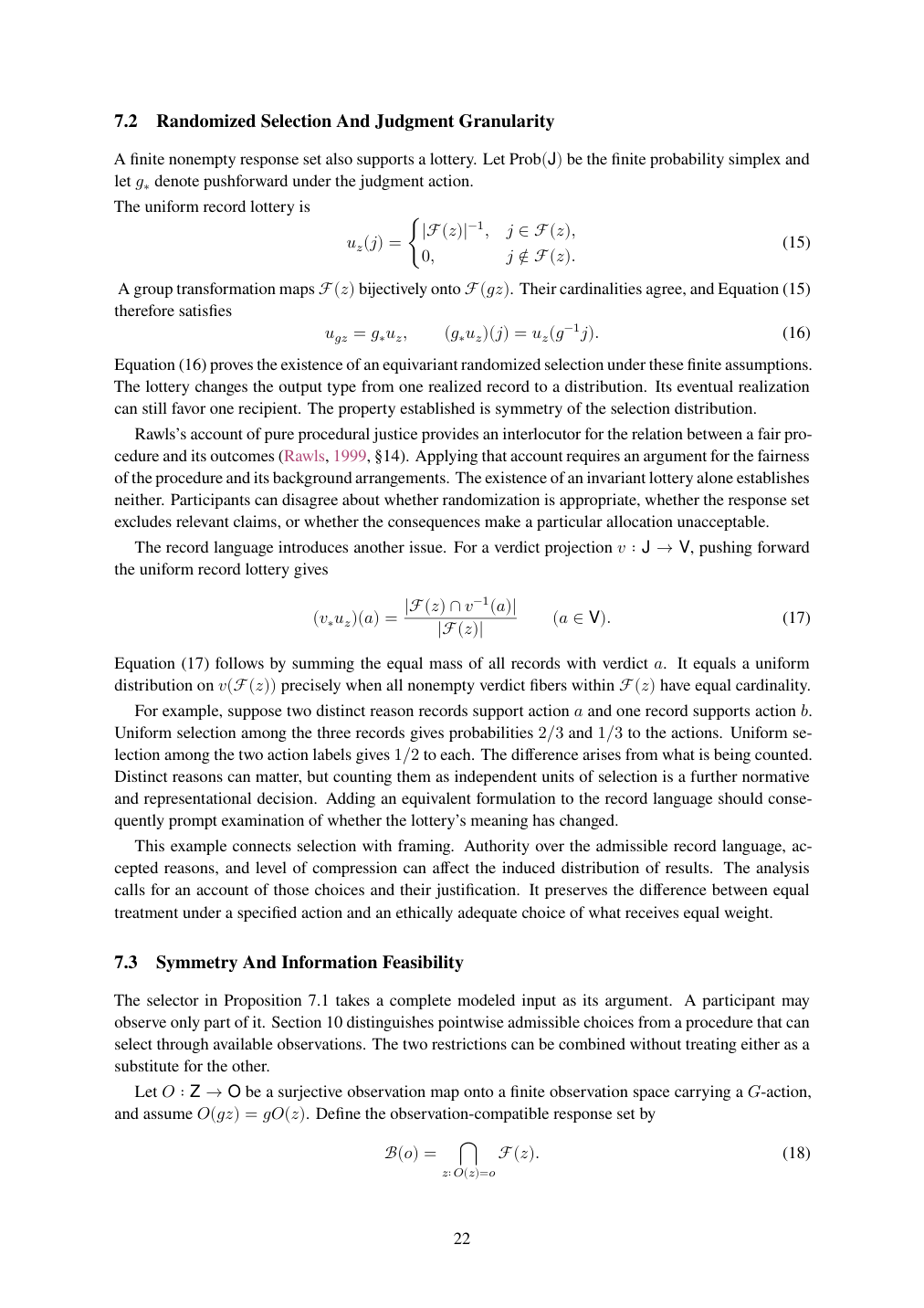
The three-unit allocation example is a direct application. A fully symmetric input permits exactly sition 7.1 therefore excludes an equivariant deterministic selection at that input. Introducing an indepen- dently justified priority, such as an additional relevant claim, changes the modeled input or standard. A bare name-based priority can produce a decision while failing the original anonymity requirement. These are different responses to the obstruction, with different reasons to assess.
This distinction is useful for analyzing power. A person or body able to establish priorities, recognize a claim, or close the choice can change which selection is authorized. That capacity can coordinate action and protect substantive interests. Its justification concerns the grounds of the new distinction and the distribution of authority to introduce it. The mathematical obstruction supplies no general verdict about the value of asymmetry; it identifies where an additional distinction or change of output type enters.
An actual role structure can also make the hypothesized swap inapplicable. A judge and a litigant have different represented competences; exchanging their names while preserving the roles differs from exchanging those competences. If the latter changes the input, it does not belong to its stabilizer. If it changes the governing norm, it also leaves the norm-preserving subgroup. Recognizing these differences prevents the symmetry test from assuming away the institutional question it should help examine. The legal existence of the distinction and the reasons for retaining it remain separate inquiries.
Nor must every exercise of power be an invertible group transformation. A directed act can establish a new legal position or remove an option. When selected norms organize such competences or constraints through a partial order, that order represents the specified comparison; its greater and lesser positions need not be morally better and worse. The symmetry theorem concerns the declared invertible compar- isons. Directed authority, norm revision, and historically formed priority require their own transitions
Readable text
Equation (16) proves the existence of an equivariant randomized selection under these finite assumptions. The lottery changes the output type from one realized record to a distribution. Its eventual realization can still favor one recipient. The property established is symmetry of the selection distribution.
Rawls’s account of pure procedural justice provides an interlocutor for the relation between a fair pro- cedure and its outcomes (Rawls, 1999, §14). Applying that account requires an argument for the fairness of the procedure and its background arrangements. The existence of an invariant lottery alone establishes neither. Participants can disagree about whether randomization is appropriate, whether the response set excludes relevant claims, or whether the consequences make a particular allocation unacceptable.
Distinct reasons can matter, but counting them as independent units of selection is a further normative and representational decision. Adding an equivalent formulation to the record language should conse- quently prompt examination of whether the lottery’s meaning has changed.
This example connects selection with framing. Authority over the admissible record language, ac- cepted reasons, and level of compression can affect the induced distribution of results. The analysis calls for an account of those choices and their justification. It preserves the difference between equal treatment under a specified action and an ethically adequate choice of what receives equal weight.
The selector in Proposition 7.1 takes a complete modeled input as its argument. A participant may observe only part of it. Section 10 distinguishes pointwise admissible choices from a procedure that can select through available observations. The two restrictions can be combined without treating either as a









The construction supplies a record-level test to coordinate with procedural attainability. A law can determine one response at every complete input while the available observation fails to distinguish those inputs. Conversely, observation can identify a permissible set while a symmetry requirement still leaves a selection task. Neither result determines whether an emergency actor ought to investigate, defer, choose under risk, or invoke another authority. Those options depend on the protocol, resources, stakes, and substantive norms.
Readable text
Contextual Preservation Of Procedural Substitution
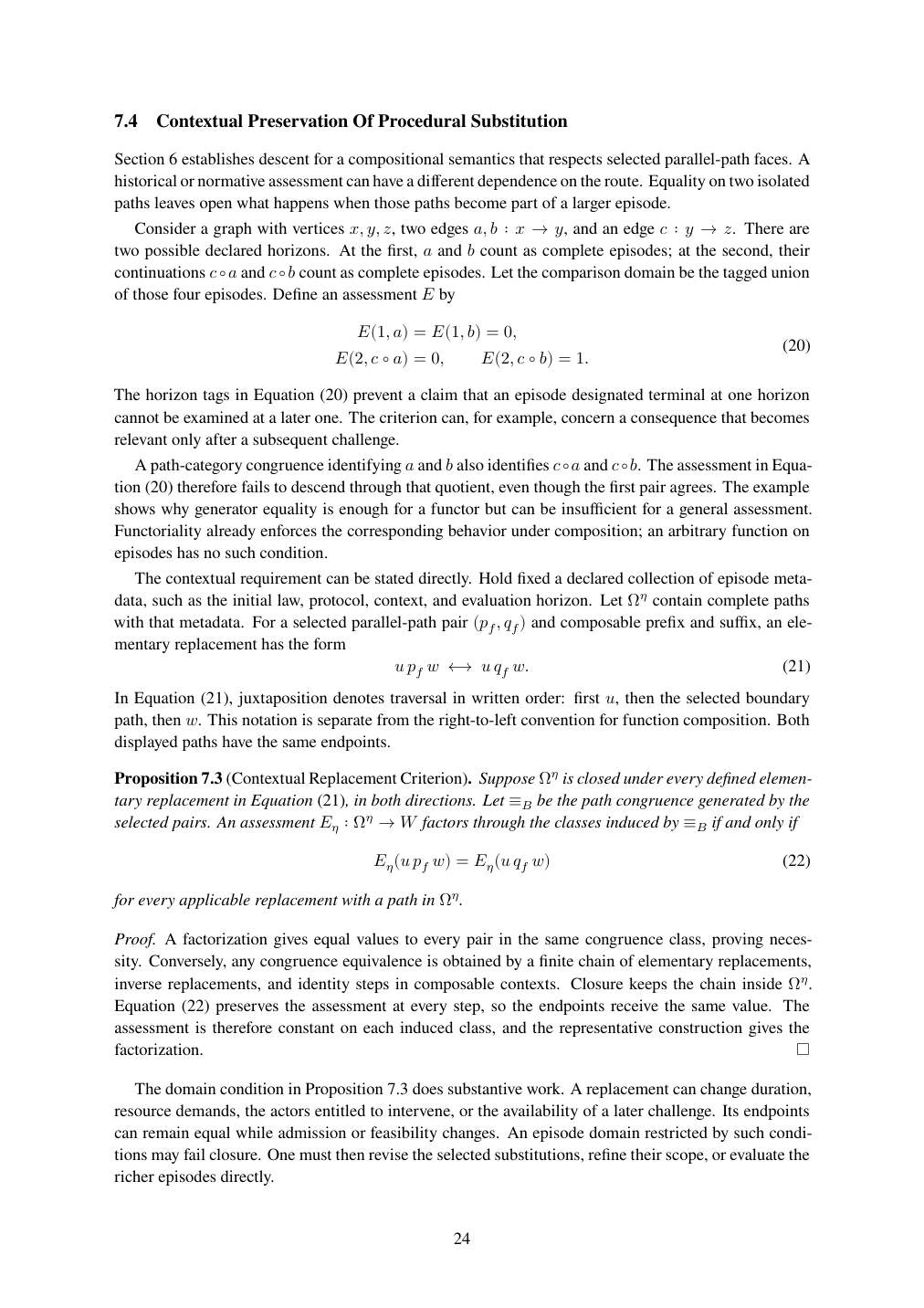
Section 6 establishes descent for a compositional semantics that respects selected parallel-path faces. A historical or normative assessment can have a different dependence on the route. Equality on two isolated paths leaves open what happens when those paths become part of a larger episode.
The horizon tags in Equation (20) prevent a claim that an episode designated terminal at one horizon cannot be examined at a later one. The criterion can, for example, concern a consequence that becomes
tion (20) therefore fails to descend through that quotient, even though the first pair agrees. The example shows why generator equality is enough for a functor but can be insufficient for a general assessment. Functoriality already enforces the corresponding behavior under composition; an arbitrary function on
The contextual requirement can be stated directly. Hold fixed a declared collection of episode meta-
Proof. A factorization gives equal values to every pair in the same congruence class, proving neces- sity. Conversely, any congruence equivalence is obtained by a finite chain of elementary replacements, Equation (22) preserves the assessment at every step, so the endpoints receive the same value. The assessment is therefore constant on each induced class, and the representative construction gives the
The domain condition in Proposition 7.3 does substantive work. A replacement can change duration, resource demands, the actors entitled to intervene, or the availability of a later challenge. Its endpoints can remain equal while admission or feasibility changes. An episode domain restricted by such condi- tions may fail closure. One must then revise the selected substitutions, refine their scope, or evaluate the
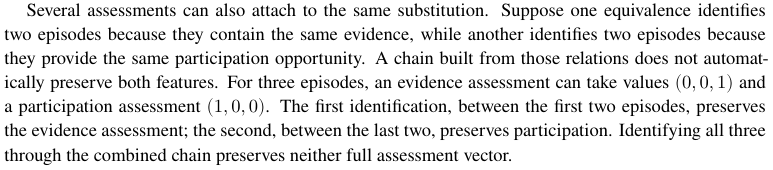
The relevant criterion is consequently joint preservation under a fixed collection of assessments and a fixed episode domain. If each elementary substitution preserves every retained component, a finite chain preserves the vector. If each substitution preserves only its own preferred component, a general common evaluation remains to be established. This distinction matters when different authorities validate procedural forms for different purposes and their decisions are later assembled into one account of legitimacy.

7.5 Directed Review And Equality For A Purpose
A typed witness from one route to another can express several relations: a proposed comparison, an objection, an authorized correction, or an equivalence under a chosen observation. An ordinary quotient imposes equality, including symmetry. An authorized correction need not warrant the reverse identification or equal ethical evaluation of the two histories.
For example, review can supply an omitted hearing opportunity or correct an unsupported factual finding. The existence of a competent actor and operative review procedure concerns legal power in Hohfeld’s sense (Hohfeld, 1913). Whether the original act violated a duty, whether the later act changes a legal relation, and whether the resulting arrangement is just are further questions. Their representation requires distinct labels and reasons.
The same point applies when a review confirms the initial verdict. Equal projected results can coexist with a substantial difference in how the participant could respond. A record of correction can acknowledge that earlier difference and establish a new standing or remedy. Treating the corrected and original histories as interchangeable for every purpose would discard the reason for the correction.

This distinction helps organize disputes about finality. Closure makes some later moves unavailable under the current rules. Review can reopen a question through a separately authorized route. The reasons for finality include coordination, reliance, resource demands, and the burdens of continuing a dispute; reasons for revision can include significant error or an unprovided opportunity to participate. The formal representation identifies which route is available. The balance among those reasons remains part of practical judgment.
Readable text
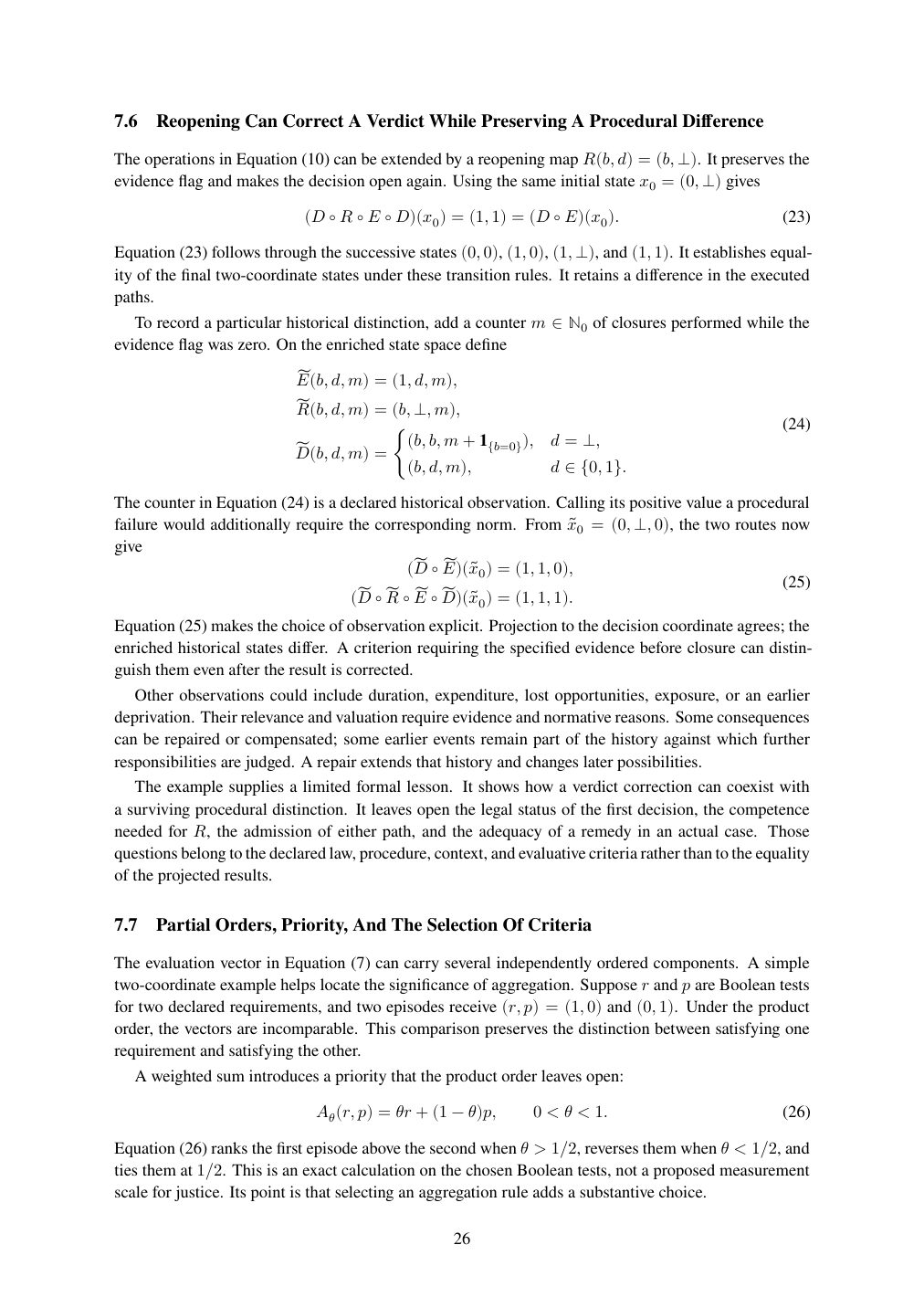
Reopening Can Correct A Verdict While Preserving A Procedural Difference
ity of the final two-coordinate states under these transition rules. It retains a difference in the executed
evidence flag was zero. On the enriched state space define
The counter in Equation (24) is a declared historical observation. Calling its positive value a procedural
Equation (25) makes the choice of observation explicit. Projection to the decision coordinate agrees; the enriched historical states differ. A criterion requiring the specified evidence before closure can distin-
Other observations could include duration, expenditure, lost opportunities, exposure, or an earlier deprivation. Their relevance and valuation require evidence and normative reasons. Some consequences can be repaired or compensated; some earlier events remain part of the history against which further responsibilities are judged. A repair extends that history and changes later possibilities.
The example supplies a limited formal lesson. It shows how a verdict correction can coexist with a surviving procedural distinction. It leaves open the legal status of the first decision, the competence questions belong to the declared law, procedure, context, and evaluative criteria rather than to the equality
Partial Orders, Priority, And The Selection Of Criteria
The evaluation vector in Equation (7) can carry several independently ordered components. A simple order, the vectors are incomparable. This comparison preserves the distinction between satisfying one
A weighted sum introduces a priority that the product order leaves open:
scale for justice. Its point is that selecting an aggregation rule adds a substantive choice.
Readable text
A rule making a participation requirement mandatory before any result can be accepted has a different structure from a finite compensatory weight. A lexicographic priority, a constrained admissible set, and a weighted sum can therefore respond differently to the same vectors. Each needs an interpretation appropriate to the case. Calling a procedure efficient or a verdict accurate supplies incomplete grounds
On the bounded Boolean table, suitable weights can reproduce a specified priority. That equivalence depends on the restricted domain and on the acceptance rule applied to the score. An explicit admissi- bility condition states which options are excluded, while a numerical score alone merely supplies values to compare. Changing the range of another component or the eligible response set can consequently change which weighted representation implements the intended requirement.
An authoritative tie-break also has a legal and temporal setting. A recognized procedure may confer final standing on one choice while other participants continue to contest its moral grounds. That finality can coordinate future conduct and create expectations on which others rely. It can also shift the burdens of correction onto the party seeking review. The account should therefore follow the authority establishing the selection rule, the evidence available to challenge it, and the future opportunities affected by its operation. These consequences belong within the represented history rather than being inferred from
Power enters through authority to determine the criteria, establish their priority, and recognize ev- idence of satisfaction. Such authority can protect an interest that would otherwise be traded away or organize decisions that require closure. It can also make some losses difficult to express. A historical account should trace how the comparison acquired standing, who can challenge it, and what happens
The framework therefore keeps two questions connected but distinguishable: whether an assessment consistently applies a declared order and whether that order is justified for the relations at issue. The stabilizer criterion, contextual replacement criterion, and reopening example make these choices explicit at different stages. They supply conditions under which a representation preserves a selected claim, while practical wisdom addresses the reasons for selecting and acting on that claim.
The preceding arguments use composition, selected substitutions, and observations of an executed route. An explicit finite algebra makes the relation among these operations inspectable. The construction in this section starts with the declared transition rules. Its linear representation preserves their action exactly, and its observation criterion states when a compressed description can support its own transition rule. The represented GR subject, the selected state, the executed history, and an observation of that state
Equation (27) distinguishes the written event order from the order of function composition. In particular,
Readable text
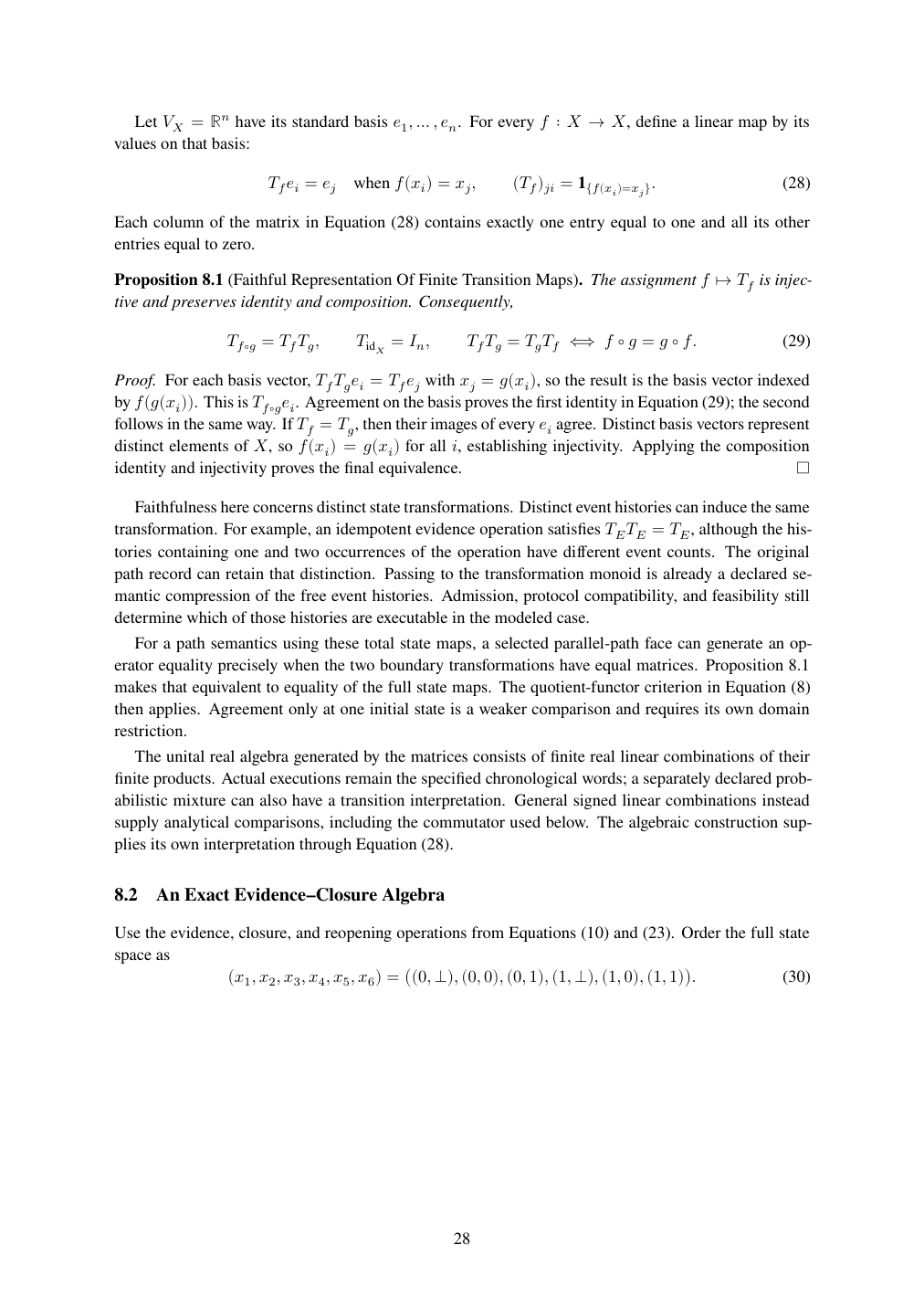
Each column of the matrix in Equation (28) contains exactly one entry equal to one and all its other
tive and preserves identity and composition. Consequently,
identity and injectivity proves the final equivalence.
Faithfulness here concerns distinct state transformations. Distinct event histories can induce the same tories containing one and two occurrences of the operation have different event counts. The original path record can retain that distinction. Passing to the transformation monoid is already a declared se- mantic compression of the free event histories. Admission, protocol compatibility, and feasibility still determine which of those histories are executable in the modeled case.
For a path semantics using these total state maps, a selected parallel-path face can generate an op- erator equality precisely when the two boundary transformations have equal matrices. Proposition 8.1 makes that equivalent to equality of the full state maps. The quotient-functor criterion in Equation (8) then applies. Agreement only at one initial state is a weaker comparison and requires its own domain
The unital real algebra generated by the matrices consists of finite real linear combinations of their finite products. Actual executions remain the specified chronological words; a separately declared prob- abilistic mixture can also have a transition interpretation. General signed linear combinations instead supply analytical comparisons, including the commutator used below. The algebraic construction sup-
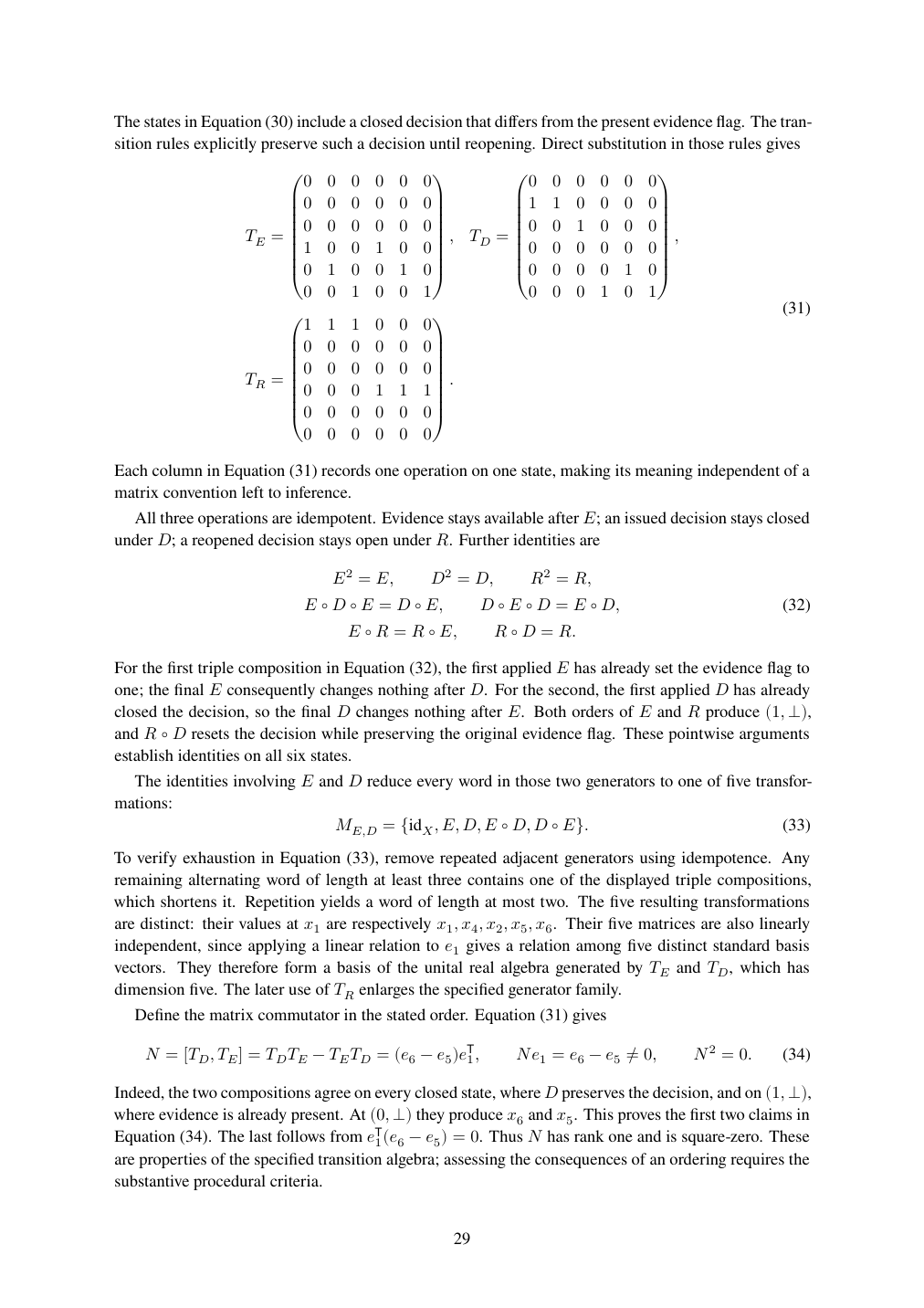
Use the evidence, closure, and reopening operations from Equations (10) and (23). Order the full state
Readable text
The states in Equation (30) include a closed decision that differs from the present evidence flag. The tran- sition rules explicitly preserve such a decision until reopening. Direct substitution in those rules gives
Each column in Equation (31) records one operation on one state, making its meaning independent of a
To verify exhaustion in Equation (33), remove repeated adjacent generators using idempotence. Any remaining alternating word of length at least three contains one of the displayed triple compositions, which shortens it. Repetition yields a word of length at most two. The five resulting transformations
Define the matrix commutator in the stated order. Equation (31) gives
are properties of the specified transition algebra; assessing the consequences of an ordering requires the
Readable text
one initial state, equality after an observation, and equality as transformations therefore remain separate
The first identity in Equation (35) pushes a distribution forward; the second pulls an observable back to the initial state. The last identity follows by transposition and ensures that these two calculations
observable; assigning it ethical importance requires the corresponding argument.
Equation (38) concerns an exact deterministic quotient. A probabilistic model using conditional distri- butions inside an observation fiber introduces additional assumptions about those distributions and their
those operations individually do have the corresponding quotient maps. Whether a compression supports
further reasoning depends on the operation to follow.
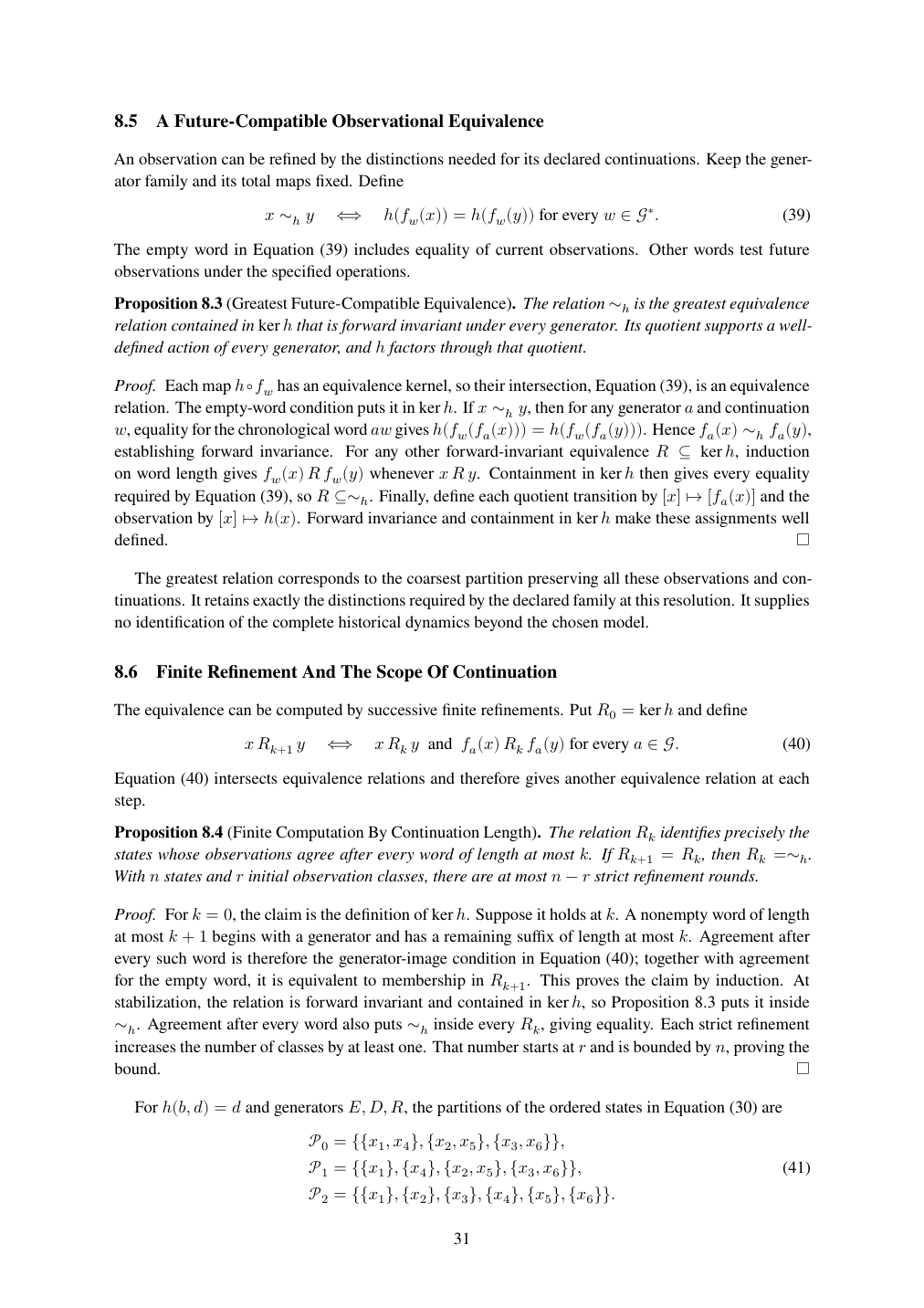
Readable text
An observation can be refined by the distinctions needed for its declared continuations. Keep the gener-
The empty word in Equation (39) includes equality of current observations. Other words test future
The greatest relation corresponds to the coarsest partition preserving all these observations and con- tinuations. It retains exactly the distinctions required by the declared family at this resolution. It supplies no identification of the complete historical dynamics beyond the chosen model.
Equation (40) intersects equivalence relations and therefore gives another equivalence relation at each
every such word is therefore the generator-image condition in Equation (40); together with agreement
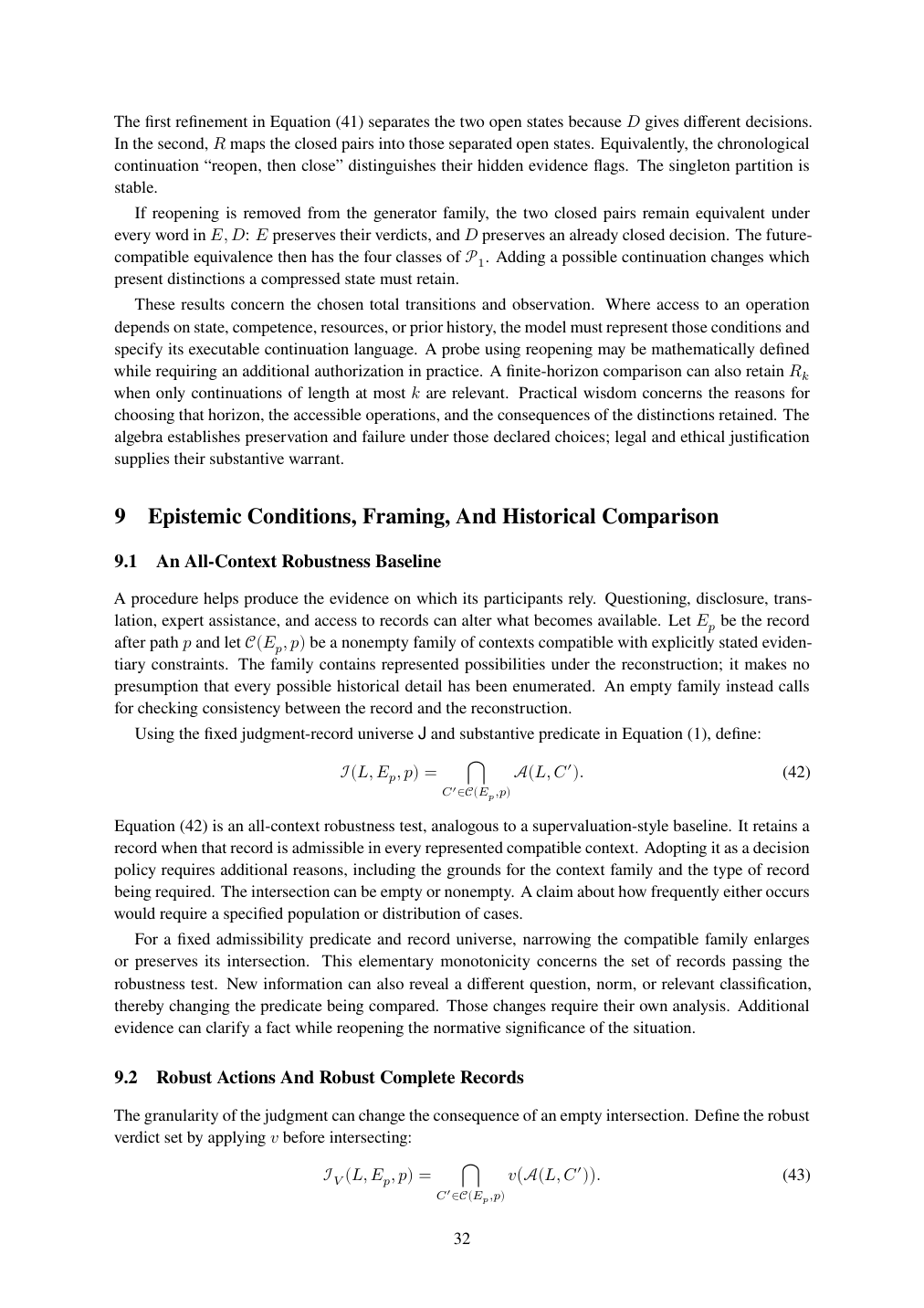
Readable text
continuation “reopen, then close” distinguishes their hidden evidence flags. The singleton partition is
If reopening is removed from the generator family, the two closed pairs remain equivalent under
present distinctions a compressed state must retain.
These results concern the chosen total transitions and observation. Where access to an operation depends on state, competence, resources, or prior history, the model must represent those conditions and specify its executable continuation language. A probe using reopening may be mathematically defined choosing that horizon, the accessible operations, and the consequences of the distinctions retained. The algebra establishes preservation and failure under those declared choices; legal and ethical justification
Epistemic Conditions, Framing, And Historical Comparison
A procedure helps produce the evidence on which its participants rely. Questioning, disclosure, trans- tiary constraints. The family contains represented possibilities under the reconstruction; it makes no presumption that every possible historical detail has been enumerated. An empty family instead calls for checking consistency between the record and the reconstruction.
Using the fixed judgment-record universe J and substantive predicate in Equation (1), define:
Equation (42) is an all-context robustness test, analogous to a supervaluation-style baseline. It retains a record when that record is admissible in every represented compatible context. Adopting it as a decision policy requires additional reasons, including the grounds for the context family and the type of record being required. The intersection can be empty or nonempty. A claim about how frequently either occurs would require a specified population or distribution of cases.
For a fixed admissibility predicate and record universe, narrowing the compatible family enlarges or preserves its intersection. This elementary monotonicity concerns the set of records passing the robustness test. New information can also reveal a different question, norm, or relevant classification, thereby changing the predicate being compared. Those changes require their own analysis. Additional evidence can clarify a fact while reopening the normative significance of the situation.
The granularity of the judgment can change the consequence of an empty intersection. Define the robust
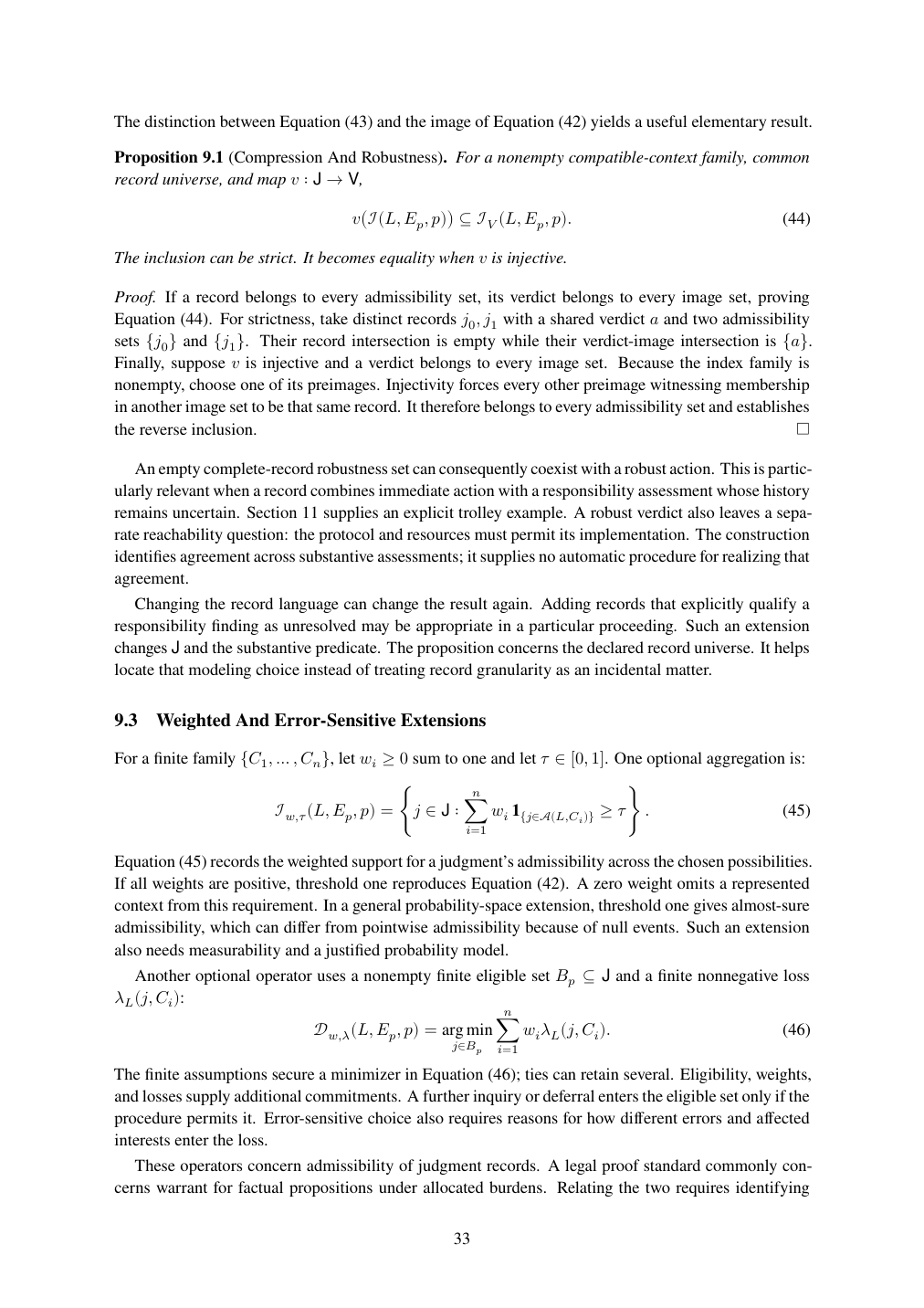
Readable text
The distinction between Equation (43) and the image of Equation (42) yields a useful elementary result.
Proposition 9.1 (Compression And Robustness). For a nonempty compatible-context family, common
Proof. If a record belongs to every admissibility set, its verdict belongs to every image set, proving nonempty, choose one of its preimages. Injectivity forces every other preimage witnessing membership in another image set to be that same record. It therefore belongs to every admissibility set and establishes
An empty complete-record robustness set can consequently coexist with a robust action. This is partic- ularly relevant when a record combines immediate action with a responsibility assessment whose history remains uncertain. Section 11 supplies an explicit trolley example. A robust verdict also leaves a sepa- rate reachability question: the protocol and resources must permit its implementation. The construction identifies agreement across substantive assessments; it supplies no automatic procedure for realizing that
Changing the record language can change the result again. Adding records that explicitly qualify a responsibility finding as unresolved may be appropriate in a particular proceeding. Such an extension changes J and the substantive predicate. The proposition concerns the declared record universe. It helps locate that modeling choice instead of treating record granularity as an incidental matter.
Equation (45) records the weighted support for a judgment’s admissibility across the chosen possibilities. If all weights are positive, threshold one reproduces Equation (42). A zero weight omits a represented context from this requirement. In a general probability-space extension, threshold one gives almost-sure admissibility, which can differ from pointwise admissibility because of null events. Such an extension also needs measurability and a justified probability model.
The finite assumptions secure a minimizer in Equation (46); ties can retain several. Eligibility, weights, and losses supply additional commitments. A further inquiry or deferral enters the eligible set only if the procedure permits it. Error-sensitive choice also requires reasons for how different errors and affected
These operators concern admissibility of judgment records. A legal proof standard commonly con- cerns warrant for factual propositions under allocated burdens. Relating the two requires identifying
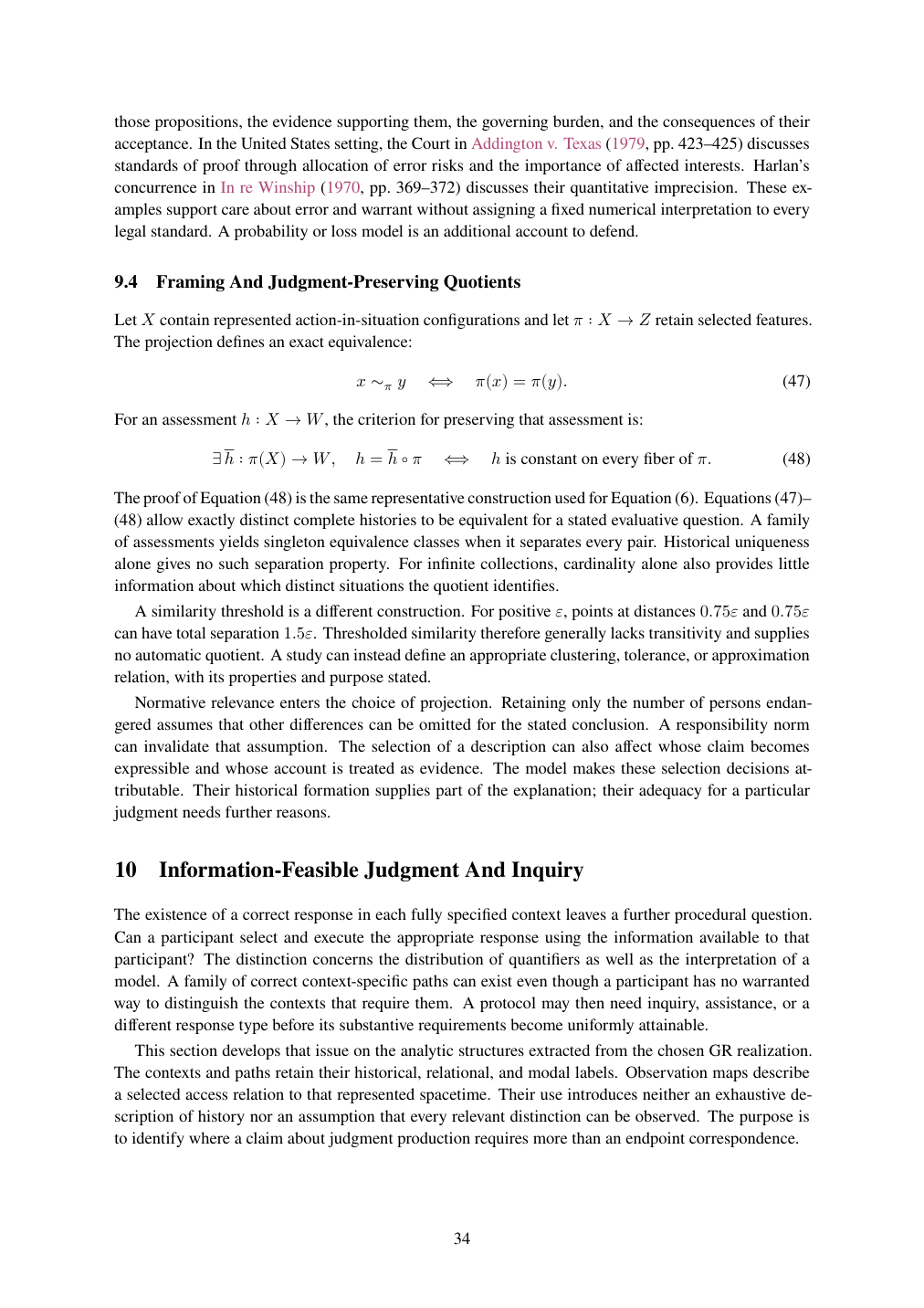
Readable text
those propositions, the evidence supporting them, the governing burden, and the consequences of their acceptance. In the United States setting, the Court in Addington v. Texas (1979, pp. 423–425) discusses standards of proof through allocation of error risks and the importance of affected interests. Harlan’s concurrence in In re Winship (1970, pp. 369–372) discusses their quantitative imprecision. These ex- amples support care about error and warrant without assigning a fixed numerical interpretation to every legal standard. A probability or loss model is an additional account to defend.
The proof of Equation (48) is the same representative construction used for Equation (6). Equations (47)– (48) allow exactly distinct complete histories to be equivalent for a stated evaluative question. A family of assessments yields singleton equivalence classes when it separates every pair. Historical uniqueness alone gives no such separation property. For infinite collections, cardinality alone also provides little information about which distinct situations the quotient identifies.
no automatic quotient. A study can instead define an appropriate clustering, tolerance, or approximation
Normative relevance enters the choice of projection. Retaining only the number of persons endan- gered assumes that other differences can be omitted for the stated conclusion. A responsibility norm can invalidate that assumption. The selection of a description can also affect whose claim becomes expressible and whose account is treated as evidence. The model makes these selection decisions at- tributable. Their historical formation supplies part of the explanation; their adequacy for a particular
The existence of a correct response in each fully specified context leaves a further procedural question. Can a participant select and execute the appropriate response using the information available to that participant? The distinction concerns the distribution of quantifiers as well as the interpretation of a model. A family of correct context-specific paths can exist even though a participant has no warranted way to distinguish the contexts that require them. A protocol may then need inquiry, assistance, or a different response type before its substantive requirements become uniformly attainable.
This section develops that issue on the analytic structures extracted from the chosen GR realization. The contexts and paths retain their historical, relational, and modal labels. Observation maps describe a selected access relation to that represented spacetime. Their use introduces neither an exhaustive de- scription of history nor an assumption that every relevant distinction can be observed. The purpose is to identify where a claim about judgment production requires more than an endpoint correspondence.
10.1 Protocols, Paths, And Observation-Based Strategies

An information history can contain an initial observation, later disclosures, questions and answers, translated materials, and the participant’s preceding actions. The observation rules declare which aspects of the represented context enter that history. A deterministic observation-based strategy assigns a next move to each of its reachable information histories. Its decisions agree whenever the information histories agree. A stochastic strategy would instead assign a distribution under specified randomization rules; the added probabilities require their own interpretation.



The requirement in Equation (49) is one possible criterion for procedural success. It asks for substantively admissible results throughout the represented possibility family, with nonempty admitted terminal executions. Other criteria can concern error risk, warranted belief, participation, or the distribution of burdens. Specifying a success criterion is part of the normative and epistemic account. The path model can represent these distinctions while leaving their justification explicit.

This separation extends the distinction between rules, reasoning, and multi-agent procedure discussed by Prakken and Sartor (2015). It also gives practical content to the difference between possessing a source and being able to use it. A language version may exist in the carrier, a participant may receive a document, and the relevant distinction may still be absent from the participant’s information history. Interpretation, access, and capacity determine which observation the procedural strategy can use.
10.2 A Finite Observation-Fiber Criterion


Readable text
concerns executing that command at the present stage, rather than the existence of a longer path whose
declared substantive and direct-issuance conditions in every context compatible with that observation.
Proposition 10.1 (Uniform Selection From A Finite Observation). There exists a deterministic function
Proposition 10.1 separates pointwise possibility from uniform access. Every context can have at least one correct directly issuable record while an observation fiber has no common record. The participant then has insufficient discriminatory information for this all-context one-step criterion. More accurate source recognition, a different observation rule, or an inquiry procedure could change the fibers. Chang- ing the norm or response language could change their admissibility sets. Each is a distinct intervention.
The proposition establishes existence under specified data. It supplies an effective finite construction when the context family, observation map, and membership predicates are themselves available as de- cidable finite tables. A participant who lacks those tables, relevant evidence, or the capacity to interpret them has a further epistemic task. An analyst’s ability to describe the function does not establish the participant’s warranted possession of it. This is the same distinction between represented completeness and practical access that motivates the law–procedure–judgment triad.
The criterion also clarifies the role of judgment granularity. Replacing J by a compressed verdict universe can create common outputs even when complete records disagree, as shown by Equation (44). Such compression changes what the strategy must select. A common action can be adequate for an emer- gency purpose while leaving a responsibility finding open. Whether that narrower output is appropriate
identifies this binary example; it supplies no claim that a legal judgment generally has only two values.
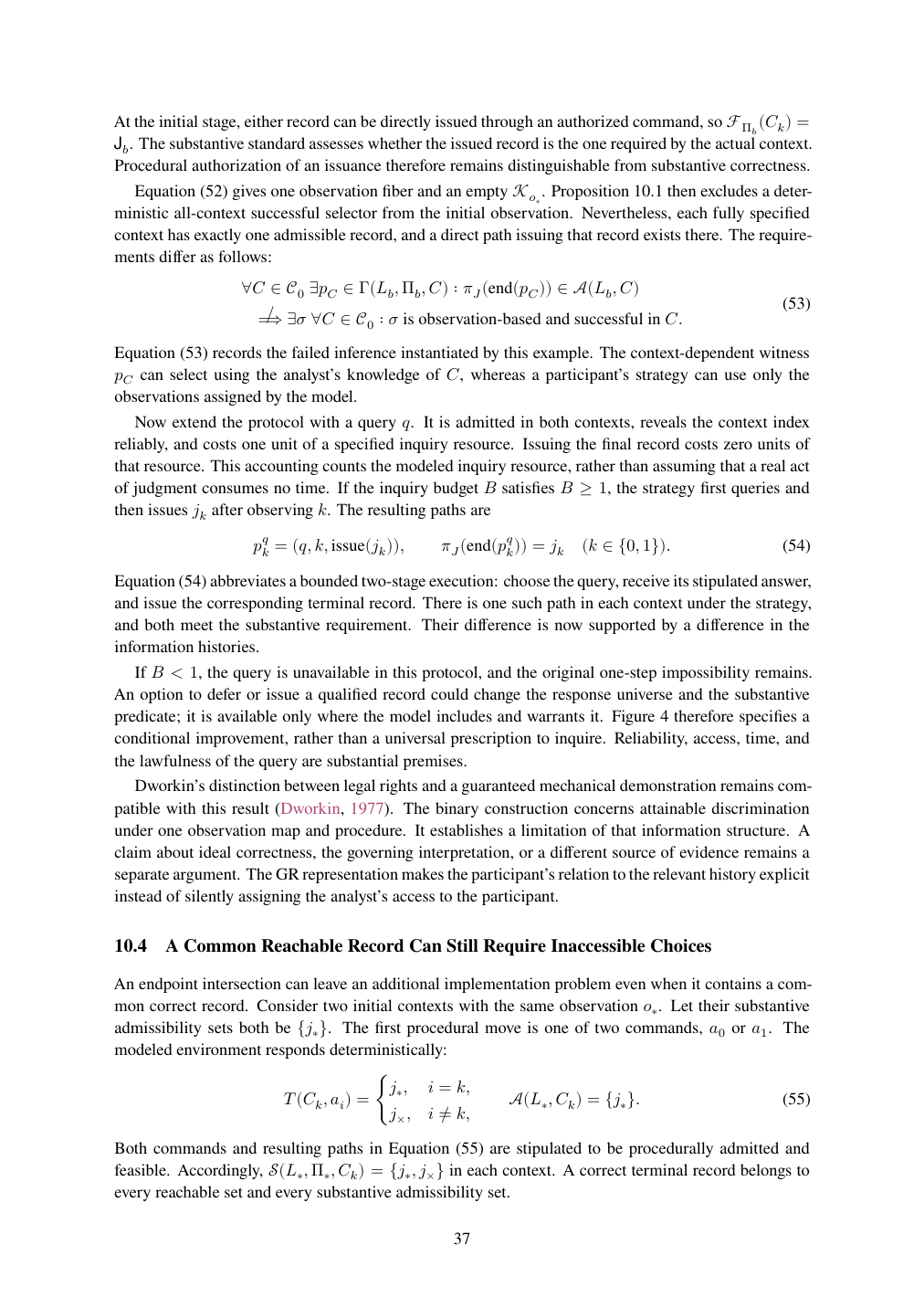
Readable text
Procedural authorization of an issuance therefore remains distinguishable from substantive correctness.
ministic all-context successful selector from the initial observation. Nevertheless, each fully specified context has exactly one admissible record, and a direct path issuing that record exists there. The require-
Equation (53) records the failed inference instantiated by this example. The context-dependent witness
reliably, and costs one unit of a specified inquiry resource. Issuing the final record costs zero units of that resource. This accounting counts the modeled inquiry resource, rather than assuming that a real act
Equation (54) abbreviates a bounded two-stage execution: choose the query, receive its stipulated answer, and issue the corresponding terminal record. There is one such path in each context under the strategy, and both meet the substantive requirement. Their difference is now supported by a difference in the
An option to defer or issue a qualified record could change the response universe and the substantive predicate; it is available only where the model includes and warrants it. Figure 4 therefore specifies a conditional improvement, rather than a universal prescription to inquire. Reliability, access, time, and
the lawfulness of the query are substantial premises.
Dworkin’s distinction between legal rights and a guaranteed mechanical demonstration remains com- patible with this result (Dworkin, 1977). The binary construction concerns attainable discrimination under one observation map and procedure. It establishes a limitation of that information structure. A claim about ideal correctness, the governing interpretation, or a different source of evidence remains a separate argument. The GR representation makes the participant’s relation to the relevant history explicit instead of silently assigning the analyst’s access to the participant.
A Common Reachable Record Can Still Require Inaccessible Choices
An endpoint intersection can leave an additional implementation problem even when it contains a com-
Both commands and resulting paths in Equation (55) are stipulated to be procedurally admitted and every reachable set and every substantive admissibility set.
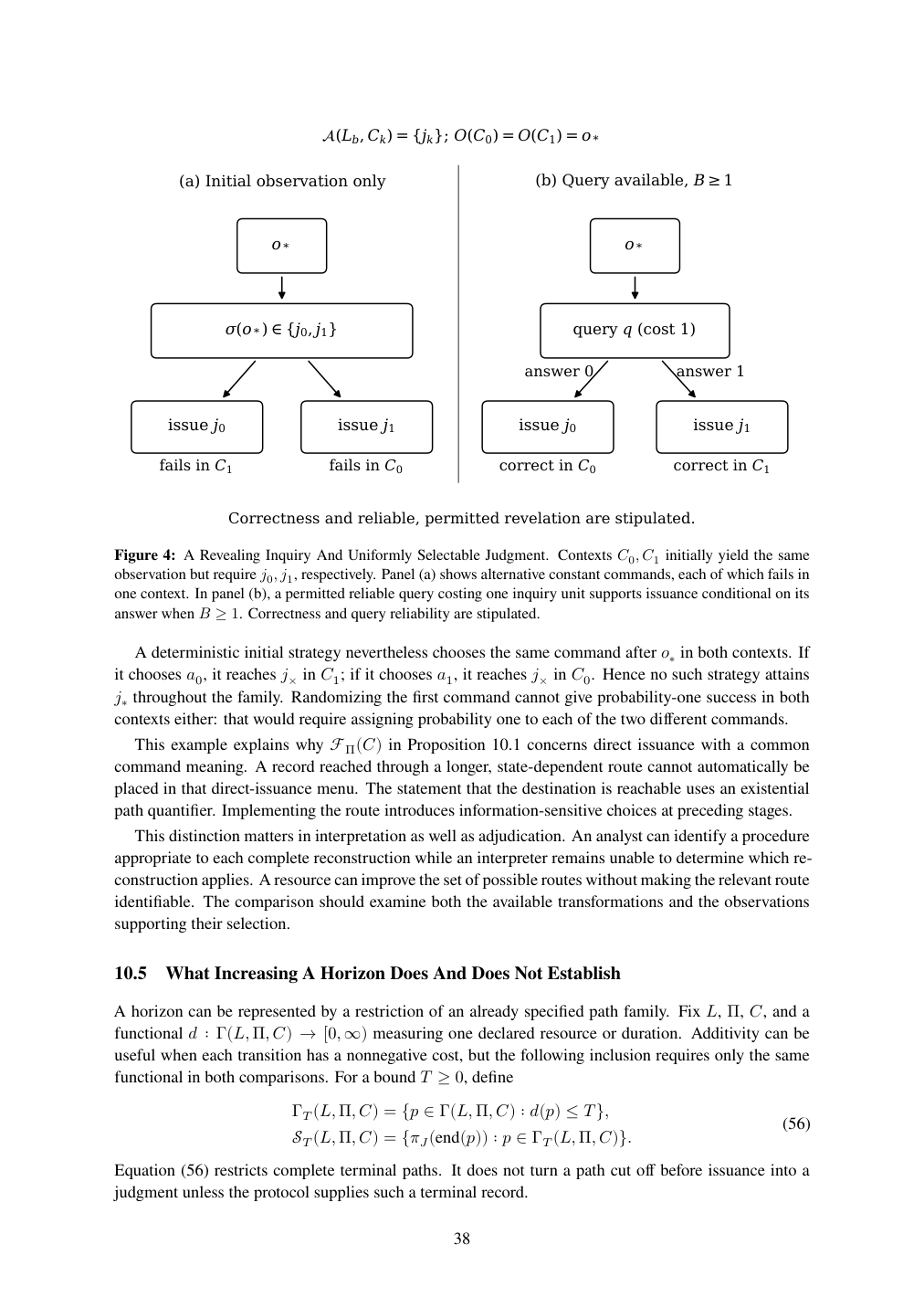
Readable text
Correctness and reliable, permitted revelation are stipulated.
one context. In panel (b), a permitted reliable query costing one inquiry unit supports issuance conditional on its
contexts either: that would require assigning probability one to each of the two different commands.
command meaning. A record reached through a longer, state-dependent route cannot automatically be placed in that direct-issuance menu. The statement that the destination is reachable uses an existential path quantifier. Implementing the route introduces information-sensitive choices at preceding stages.
This distinction matters in interpretation as well as adjudication. An analyst can identify a procedure appropriate to each complete reconstruction while an interpreter remains unable to determine which re- construction applies. A resource can improve the set of possible routes without making the relevant route identifiable. The comparison should examine both the available transformations and the observations
What Increasing A Horizon Does And Does Not Establish
useful when each transition has a nonnegative cost, but the following inclusion requires only the same
Equation (56) restricts complete terminal paths. It does not turn a path cut off before issuance into a judgment unless the protocol supplies such a terminal record.
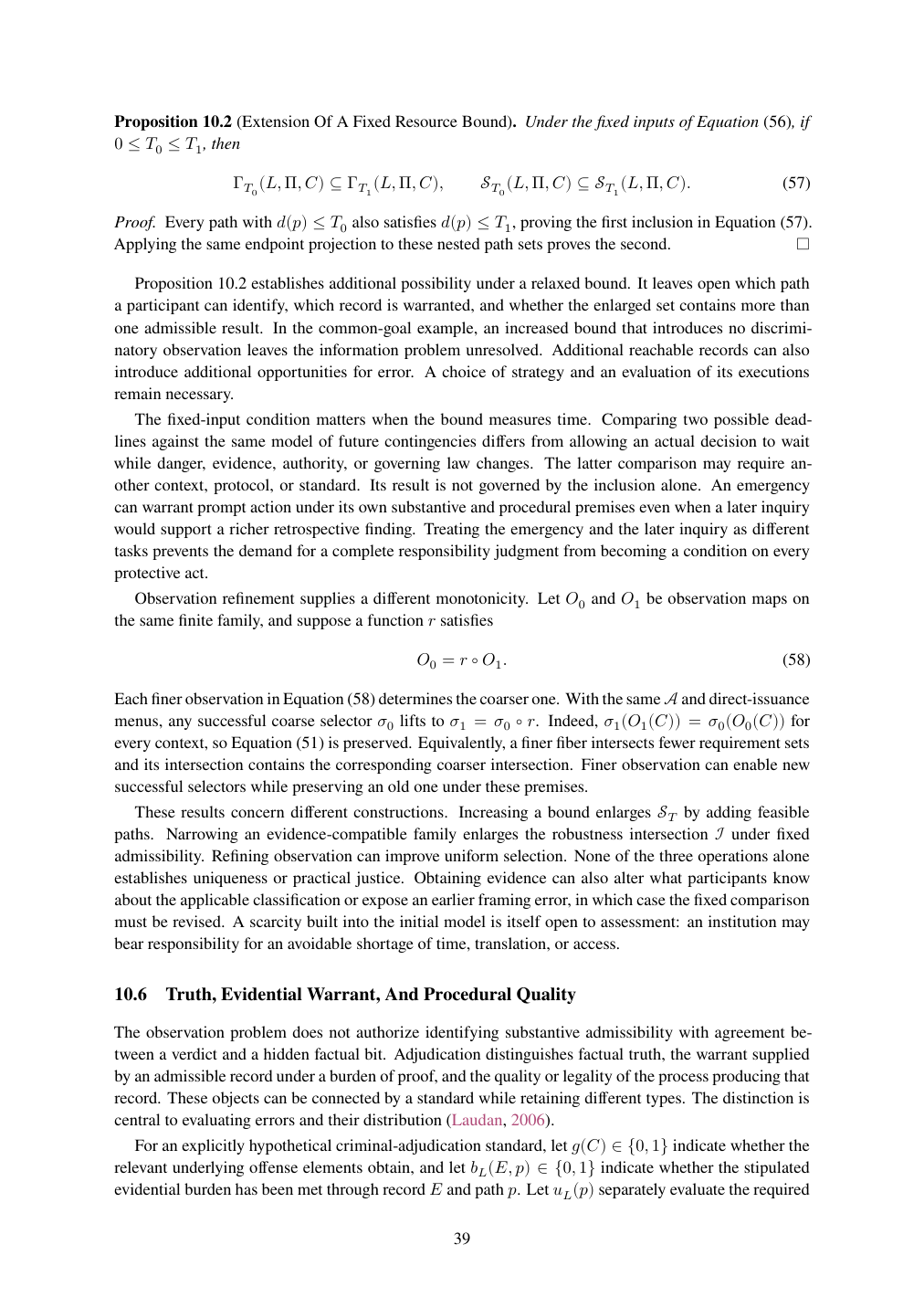
Readable text
Proposition 10.2 (Extension Of A Fixed Resource Bound). Under the fixed inputs of Equation (56), if
Applying the same endpoint projection to these nested path sets proves the second.
Proposition 10.2 establishes additional possibility under a relaxed bound. It leaves open which path a participant can identify, which record is warranted, and whether the enlarged set contains more than one admissible result. In the common-goal example, an increased bound that introduces no discrimi- natory observation leaves the information problem unresolved. Additional reachable records can also introduce additional opportunities for error. A choice of strategy and an evaluation of its executions
The fixed-input condition matters when the bound measures time. Comparing two possible dead- lines against the same model of future contingencies differs from allowing an actual decision to wait while danger, evidence, authority, or governing law changes. The latter comparison may require an- other context, protocol, or standard. Its result is not governed by the inclusion alone. An emergency can warrant prompt action under its own substantive and procedural premises even when a later inquiry would support a richer retrospective finding. Treating the emergency and the later inquiry as different tasks prevents the demand for a complete responsibility judgment from becoming a condition on every
every context, so Equation (51) is preserved. Equivalently, a finer fiber intersects fewer requirement sets and its intersection contains the corresponding coarser intersection. Finer observation can enable new successful selectors while preserving an old one under these premises.
admissibility. Refining observation can improve uniform selection. None of the three operations alone establishes uniqueness or practical justice. Obtaining evidence can also alter what participants know about the applicable classification or expose an earlier framing error, in which case the fixed comparison must be revised. A scarcity built into the initial model is itself open to assessment: an institution may bear responsibility for an avoidable shortage of time, translation, or access.
The observation problem does not authorize identifying substantive admissibility with agreement be- tween a verdict and a hidden factual bit. Adjudication distinguishes factual truth, the warrant supplied by an admissible record under a burden of proof, and the quality or legality of the process producing that record. These objects can be connected by a standard while retaining different types. The distinction is central to evaluating errors and their distribution (Laudan, 2006).
Readable text
procedural conditions. The functions differ in their inputs: the underlying fact can extend beyond the record accessible to the decision maker, the warrant assessment depends on admissible evidence and a burden, and the procedural assessment concerns how that record and decision were produced.
In this simplified example, stipulate a norm authorizing conviction only when the burden is met and otherwise requiring acquittal. This stipulation abstracts from the many additional elements of an actual despite the underlying offense having occurred. The verdict does not assert that the complete underlying history establishes innocence. If a participation requirement also fails, the same verdict may coexist with a procedurally defective path. Conversely, a procedurally compliant hearing may still leave factual uncertainty. The model should identify the relevant correctness predicate before counting an outcome
This distinction permits a richer record universe containing the disposition, stated factual findings, reasons, and an indication of what remains unresolved. It also permits a path evaluation that records fail- ures in disclosure or language access even where the terminal disposition agrees with another path. The earlier fiber-factorization result explains why no function of a compressed verdict can recover every such evaluation. The information-policy results add a further question: which distinctions in the underlying
The proof-standard examples in Section 9 locate this distinction within particular legal settings. The present application retains their separation of interests, error allocation, and evidential warrant. Con- ditions of participation and language access in General Comment No. 32 likewise supply procedural commitments with a specified scope (United Nations Human Rights Committee, 2007). Their role in the model can include eligibility constraints, supported observations, and a separate assessment of the
A decision-theoretic comparison can evaluate one specified reason to inquire. Its assumptions differ this comparison treats as mandatory; it is settled before minimizing loss. The loss may assess one declared kind of error or harm. Choosing it does not establish a complete measure of justice.
Suppose the participant initially has one undifferentiated observation and may receive a further de-
Both minima in Equation (59) exist because their domains are finite and nonempty. The possible policies
Proposition 10.3 (Free Optional Observation). Under the fixed-menu and fixed-loss assumptions of
Proposition 10.3 depends on the ability to ignore the observation while retaining the old options. It does not presuppose that human judgment automatically processes information well. Nor does it show that every acquisition of information improves an actual process. Its limited conclusion isolates the contribution of optional discriminatory access in a fixed finite decision problem.



The weights also matter. A context assigned zero weight has no effect on this expected-loss objective although it remains relevant to all-context success in Equation (49). Estimating weights from institutions that systematically miss a group’s experience can reproduce the omission in the resulting policy. The mathematical minimum supplies no independent warrant for that evidential construction or for how different persons’ burdens enter a scalar loss. Disagreement over either can require a family of evaluations or a nonaggregative constraint rather than a single reported optimum.
Real inquiry is often a generative intervention. Questioning can change trust, make a claim public, expose a witness, alter available actions, or consume the time in which protection remains possible. In those cases, observations are produced along paths with changed relational and prospective conditions. The fixed-menu lemma can isolate one component of the comparison, but a full analysis must represent these changes. Calling the intervention “information” cannot remove its procedural and distributive effects.
10.8 Finite Synthesis Of A Bounded Inquiry Strategy
The one-step intersection criterion can be extended to a finite inquiry tree. This extension gives a constructive answer to a restricted procedural question: which permitted sequence of disclosures supports a terminal judgment throughout the contexts still compatible with the participant’s observations? It keeps the response standard, operational meaning of commands, and inquiry conditions explicit. A successful tree supplies an executable information-dependent route under these assumptions; a common reachable record alone supplies less.
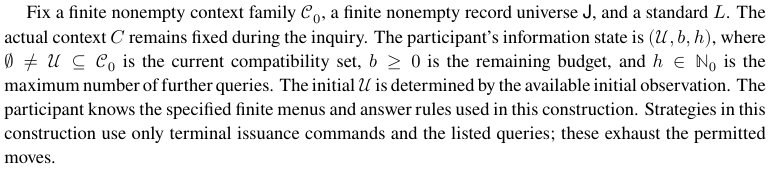

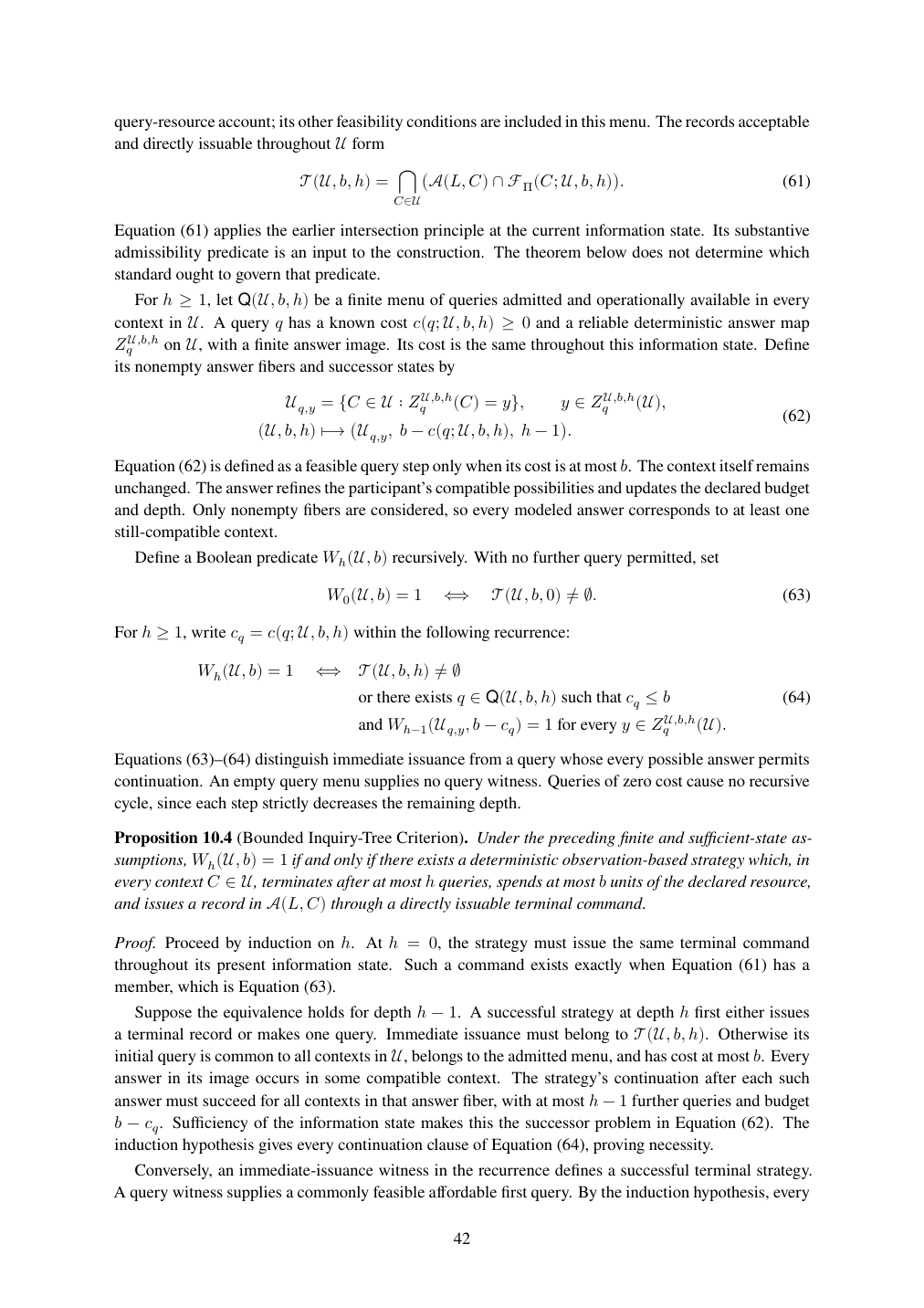
Readable text
query-resource account; its other feasibility conditions are included in this menu. The records acceptable
Equation (61) applies the earlier intersection principle at the current information state. Its substantive admissibility predicate is an input to the construction. The theorem below does not determine which
unchanged. The answer refines the participant’s compatible possibilities and updates the declared budget and depth. Only nonempty fibers are considered, so every modeled answer corresponds to at least one
Equations (63)–(64) distinguish immediate issuance from a query whose every possible answer permits continuation. An empty query menu supplies no query witness. Queries of zero cost cause no recursive cycle, since each step strictly decreases the remaining depth.
Proposition 10.4 (Bounded Inquiry-Tree Criterion). Under the preceding finite and sufficient-state as-
throughout its present information state. Such a command exists exactly when Equation (61) has a
answer in its image occurs in some compatible context. The strategy’s continuation after each such induction hypothesis gives every continuation clause of Equation (64), proving necessity.
Conversely, an immediate-issuance witness in the recurrence defines a successful terminal strategy. A query witness supplies a commonly feasible affordable first query. By the induction hypothesis, every
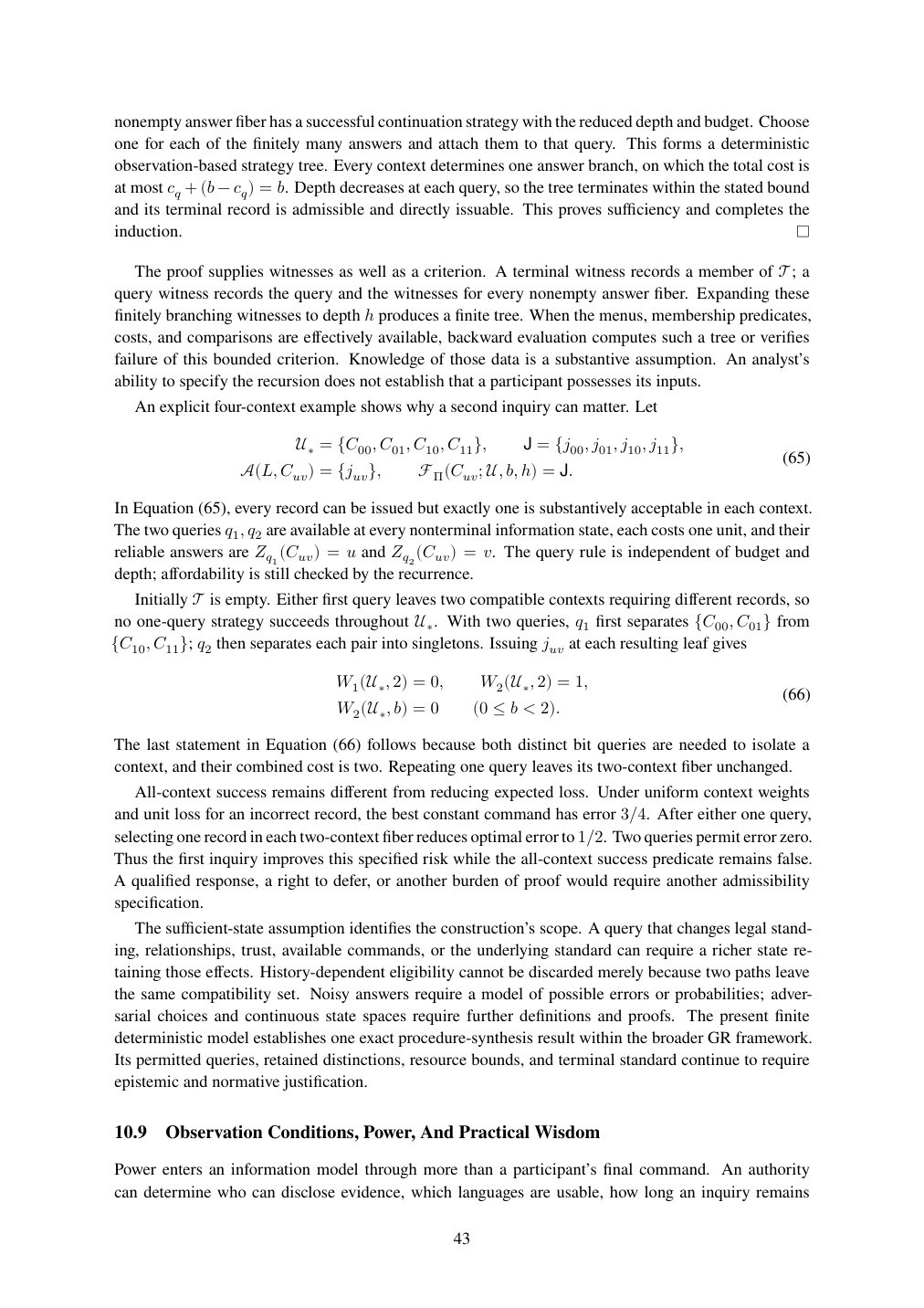
Readable text
nonempty answer fiber has a successful continuation strategy with the reduced depth and budget. Choose one for each of the finitely many answers and attach them to that query. This forms a deterministic observation-based strategy tree. Every context determines one answer branch, on which the total cost is and its terminal record is admissible and directly issuable. This proves sufficiency and completes the
query witness records the query and the witnesses for every nonempty answer fiber. Expanding these costs, and comparisons are effectively available, backward evaluation computes such a tree or verifies failure of this bounded criterion. Knowledge of those data is a substantive assumption. An analyst’s ability to specify the recursion does not establish that a participant possesses its inputs.
An explicit four-context example shows why a second inquiry can matter. Let
In Equation (65), every record can be issued but exactly one is substantively acceptable in each context.
depth; affordability is still checked by the recurrence.
The last statement in Equation (66) follows because both distinct bit queries are needed to isolate a context, and their combined cost is two. Repeating one query leaves its two-context fiber unchanged.
All-context success remains different from reducing expected loss. Under uniform context weights Thus the first inquiry improves this specified risk while the all-context success predicate remains false. A qualified response, a right to defer, or another burden of proof would require another admissibility
The sufficient-state assumption identifies the construction’s scope. A query that changes legal stand- ing, relationships, trust, available commands, or the underlying standard can require a richer state re- taining those effects. History-dependent eligibility cannot be discarded merely because two paths leave the same compatibility set. Noisy answers require a model of possible errors or probabilities; adver- sarial choices and continuous state spaces require further definitions and proofs. The present finite deterministic model establishes one exact procedure-synthesis result within the broader GR framework. Its permitted queries, retained distinctions, resource bounds, and terminal standard continue to require
Power enters an information model through more than a participant’s final command. An authority can determine who can disclose evidence, which languages are usable, how long an inquiry remains
open, what challenges are permitted, and which sources count as authoritative. Those decisions shape observation fibers, direct-issuance menus, and the paths through which the fibers can be refined. A teacher, interpreter, or adjudicator may exercise legitimate direction while still owing reasons for how that direction structures another person’s access. The presence of an ordering relation does not itself settle whether a particular exercise is justified.
Material access, interpretive competence, and a usable opportunity to respond are distinct conditions. Providing a translated document does not establish that its recipient can understand its technical commitments, check its provenance, or challenge the reconstruction it supports. A theory-of-mind attribution can help an interpreter anticipate those needs, but the attribution is a fallible part of the represented information structure. Asking the recipient to explain, amend, or contest an interpretation can provide a better observation than silently treating the interpreter’s prediction as the recipient’s actual understanding. Such feedback remains mediated by authority and incentives; agreement under dependency is not automatically evidence of unconstrained endorsement.
Practical wisdom in this setting involves selecting a task, an inquiry, and a stopping point under incomplete access. The question is which historical or relational distinctions could change the required response, what permitted inquiry could make those distinctions usable, and what delay or exposure that inquiry would impose. A justified urgent response can preserve possibilities for later correction or fuller explanation without pretending to settle every responsibility issue. Conversely, an institution cannot invoke urgency as a complete defense when its own avoidable arrangements created the information deficit.
The finite results identify several different obstacles: no substantively acceptable response, no common response within an observation fiber, no feasible direct issuance, no identifiable route to a common endpoint, or an inquiry whose costs or restrictions preclude it. They leave the warrant for the admissibility standard, the response type, and the allocation of inquiry burdens open to argument. This is useful to the triad precisely because it prevents the existence of a law, an endpoint, or an analyst’s complete description from being mistaken for an executable and justified judgment procedure.
11 Two Worked Comparative Cases
The following comparisons are explicit hypothetical constructions. Their substantive premises determine the conclusions available within them. They demonstrate the model’s distinctions without presenting a complete moral solution to every trolley situation or a general rule for deciding an actual proceeding.
11.1 Prior Responsibility And The Granularity Of A Trolley Judgment


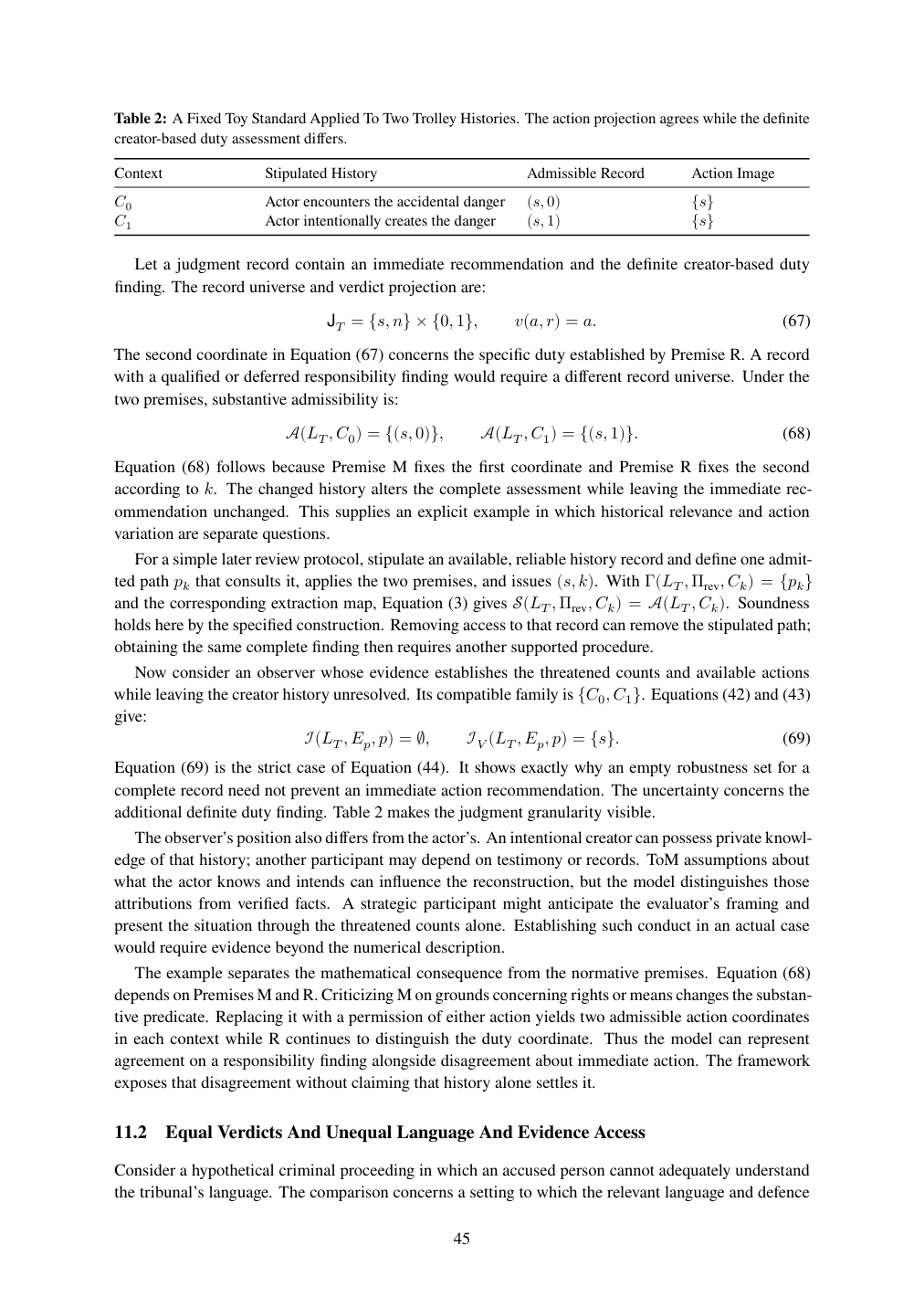
Readable text
Table 2: A Fixed Toy Standard Applied To Two Trolley Histories. The action projection agrees while the definite
Actor encounters the accidental danger Actor intentionally creates the danger
Let a judgment record contain an immediate recommendation and the definite creator-based duty finding. The record universe and verdict projection are:
The second coordinate in Equation (67) concerns the specific duty established by Premise R. A record with a qualified or deferred responsibility finding would require a different record universe. Under the
Equation (68) follows because Premise M fixes the first coordinate and Premise R fixes the second ommendation unchanged. This supplies an explicit example in which historical relevance and action
For a simple later review protocol, stipulate an available, reliable history record and define one admit- holds here by the specified construction. Removing access to that record can remove the stipulated path; obtaining the same complete finding then requires another supported procedure.
Now consider an observer whose evidence establishes the threatened counts and available actions
Equation (69) is the strict case of Equation (44). It shows exactly why an empty robustness set for a complete record need not prevent an immediate action recommendation. The uncertainty concerns the additional definite duty finding. Table 2 makes the judgment granularity visible.
The observer’s position also differs from the actor’s. An intentional creator can possess private knowl- edge of that history; another participant may depend on testimony or records. ToM assumptions about what the actor knows and intends can influence the reconstruction, but the model distinguishes those attributions from verified facts. A strategic participant might anticipate the evaluator’s framing and present the situation through the threatened counts alone. Establishing such conduct in an actual case would require evidence beyond the numerical description.
The example separates the mathematical consequence from the normative premises. Equation (68) depends on Premises M and R. Criticizing M on grounds concerning rights or means changes the substan- tive predicate. Replacing it with a permission of either action yields two admissible action coordinates in each context while R continues to distinguish the duty coordinate. Thus the model can represent agreement on a responsibility finding alongside disagreement about immediate action. The framework exposes that disagreement without claiming that history alone settles it.
Equal Verdicts And Unequal Language And Evidence Access
Consider a hypothetical criminal proceeding in which an accused person cannot adequately understand the tribunal’s language. The comparison concerns a setting to which the relevant language and defence
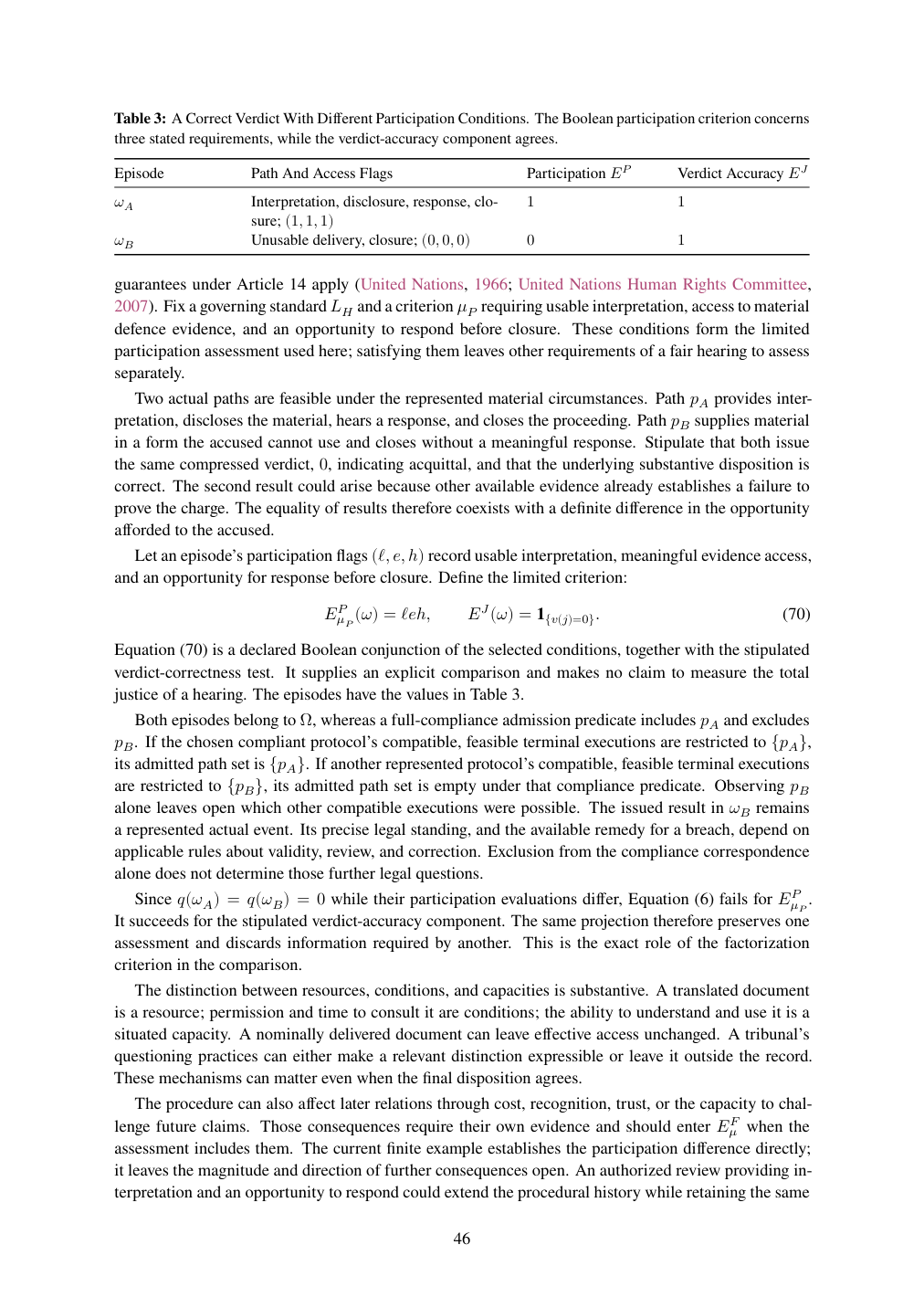
Readable text
Table 3: A Correct Verdict With Different Participation Conditions. The Boolean participation criterion concerns three stated requirements, while the verdict-accuracy component agrees.
guarantees under Article 14 apply (United Nations, 1966; United Nations Human Rights Committee, defence evidence, and an opportunity to respond before closure. These conditions form the limited participation assessment used here; satisfying them leaves other requirements of a fair hearing to assess
in a form the accused cannot use and closes without a meaningful response. Stipulate that both issue correct. The second result could arise because other available evidence already establishes a failure to prove the charge. The equality of results therefore coexists with a definite difference in the opportunity
and an opportunity for response before closure. Define the limited criterion:
Equation (70) is a declared Boolean conjunction of the selected conditions, together with the stipulated verdict-correctness test. It supplies an explicit comparison and makes no claim to measure the total justice of a hearing. The episodes have the values in Table 3.
a represented actual event. Its precise legal standing, and the available remedy for a breach, depend on applicable rules about validity, review, and correction. Exclusion from the compliance correspondence alone does not determine those further legal questions.
It succeeds for the stipulated verdict-accuracy component. The same projection therefore preserves one assessment and discards information required by another. This is the exact role of the factorization
The distinction between resources, conditions, and capacities is substantive. A translated document is a resource; permission and time to consult it are conditions; the ability to understand and use it is a situated capacity. A nominally delivered document can leave effective access unchanged. A tribunal’s questioning practices can either make a relevant distinction expressible or leave it outside the record. These mechanisms can matter even when the final disposition agrees.
The procedure can also affect later relations through cost, recognition, trust, or the capacity to chal-
assessment includes them. The current finite example establishes the participation difference directly; it leaves the magnitude and direction of further consequences open. An authorized review providing in- terpretation and an opportunity to respond could extend the procedural history while retaining the same
acquittal. Whether that route is required or proportionate calls for the governing law and a defended remedial argument.
11.3 What The Comparisons Establish Together
The trolley comparison holds a standard fixed and varies a relevant history. The hearing comparison holds a verdict fixed and varies the procedure. Each reveals information lost by a different projection. The first also shows how an incomplete full-record judgment can coexist with a settled action under its adopted premises. The second shows why a correct disposition can leave a procedural objection intact.
Together, they distinguish substantive requirements, routes of access, actual authority, and the response type being assessed. Their conclusions follow from explicit premises and finite constructions. Transporting them to another case requires examining which premises and preserved features remain appropriate. This is a practical and normative question alongside the mathematics.
12 Practical Wisdom And The Continuing Judgment Task
12.1 Selecting Inquiry, Support, And Closure
Practical wisdom concerns the warranted relation between general commitments and action in a particular situation. In the present account, it includes selecting a question, identifying the historical and relational features that could change its answer, and deciding which further inquiry or support is justified. These decisions operate under actual purposes, duties, evidence, resources, and opportunities for revision. They also affect the later conditions of judgment.
One practical task is horizon calibration. An urgent action may require a recommendation before a full responsibility record can be completed. A later inquiry can preserve questions that urgency left unresolved. The relationship should be made explicit so that a justified immediate choice does not acquire unwarranted authority as a complete historical or moral assessment. Equation (44) identifies a formal reason to distinguish these levels: a robust action can coexist with uncertainty about the record’s additional components.
Another task is provision of epistemic conditions. Meaningful participation can require a tool, an interpreter, time, access to material, or assistance in using it. The practical question includes which intervention would enable an affected participant to understand and challenge the relevant claims. Such direction can support independent judgment. Evaluating it involves the distribution of burdens, the purposes served, and the scope for participants to alter the framing or seek correction.
Relevance selection is itself a site of power. Someone decides which history to investigate, which categories to use, which reasons answer the question, and when the process can close. Those decisions can be exercised through explicit rules or through expectations about a powerful audience. ToM belongs within the representation because anticipated recognition and sanction can influence what people say and what they leave unexpressed. The resulting claims about intention, knowledge, and influence require their own evidence.
The framework supports a practical sequence: state the judgment’s purpose and response type; identify materially consequential uncertainties; examine access, resources, and capacities; choose a feasible inquiry or intervention; issue reasons with the appropriate qualifications; and retain routes of review justified by the stakes. This is a proposal for disciplined deliberation, with each choice answerable to substantive standards. It is neither an optimization rule that supplies those standards nor a requirement to recover every detail of historical spacetime.
12.2 Objections And The Scope Of The Contribution
A first objection is that the framework formalizes familiar distinctions. The factorization and congruence results are standard mathematics, and jurisprudence has long examined rules, circumstances, procedures, and authority. The contribution lies in their connected use. The model specifies when different histories can be compressed without losing an assessment, when selected procedural substitutions preserve a semantics, how actual violations remain available for evaluation, and why record-level uncertainty can differ from action-level uncertainty. The cases show those distinctions doing particular argumentative work.
A second objection holds that a correct substantive theory already includes every relevant procedure and circumstance. If such a theory is supplied with complete inputs and an effective decision method, it can settle the case. The present thesis is compatible with that possibility. It asks which premises establish completeness, which participants can access the relevant inputs, and how the proposed method acquires epistemic and institutional warrant. Enlarging the substantive theory to encode procedure also moves the triad into its richer domain instead of eliminating the questions of representation and application.
A third objection concerns relativism. Standards have histories and are mediated by power, but a historical account alone supplies no verdict about their validity or moral adequacy. Criticism can appeal to defended cross-context principles, immanent commitments, consequences, participation, or other reasons appropriate to the argument. The framework records the standards and their grounds, including persistent disagreement. Its formalism makes those commitments visible without deriving equal validity for every norm.
A fourth objection concerns the demand for context. If historical reconstruction were exhaustive, judgment would be practically unavailable. The model instead makes the purpose and resolution explicit. A projection is adequate for an assessment when that assessment is constant on its fibers; establishing that adequacy remains a substantive responsibility. Participants can make warranted, revisable judgments with bounded knowledge, while preserving important uncertainties and the means to address them. The comparison of compressed verdicts and complete records illustrates why more detail and better judgment have a question-dependent relation.
12.3 Law Formation And Dynamical Extensions
The triad also opens a continuing inquiry into norm formation. Judgments and their consequences can alter recognition practices, resources, expectations, and later procedures. Those developments can be represented as further events and transitions. More specific dynamical models can then investigate how legal structures change, including interactions with their regulated environments (Ruhl, 2008). Such models need specified states, observations, transition rules, and relevant stability concepts. Appendix A supplies an exact two-state illustration in which distinct transition rules have the same unique attracting distribution. Its role is to distinguish a shared invariant from identification of a generator; its normative interpretation requires further premises.
A universal normative principle, a structural invariant, a dynamical evolution rule, and an attractor have different meanings. A stable arrangement might persist through coordination, learning, dependency, enforcement, or resource concentration. Evaluating its justice requires an account of the mechanism and affected relations. A search for cross-context common features remains available, including invariants of a relation among law, procedure, context, and judgment. Its normative significance depends on the reasons for the transformations and comparison classes selected.
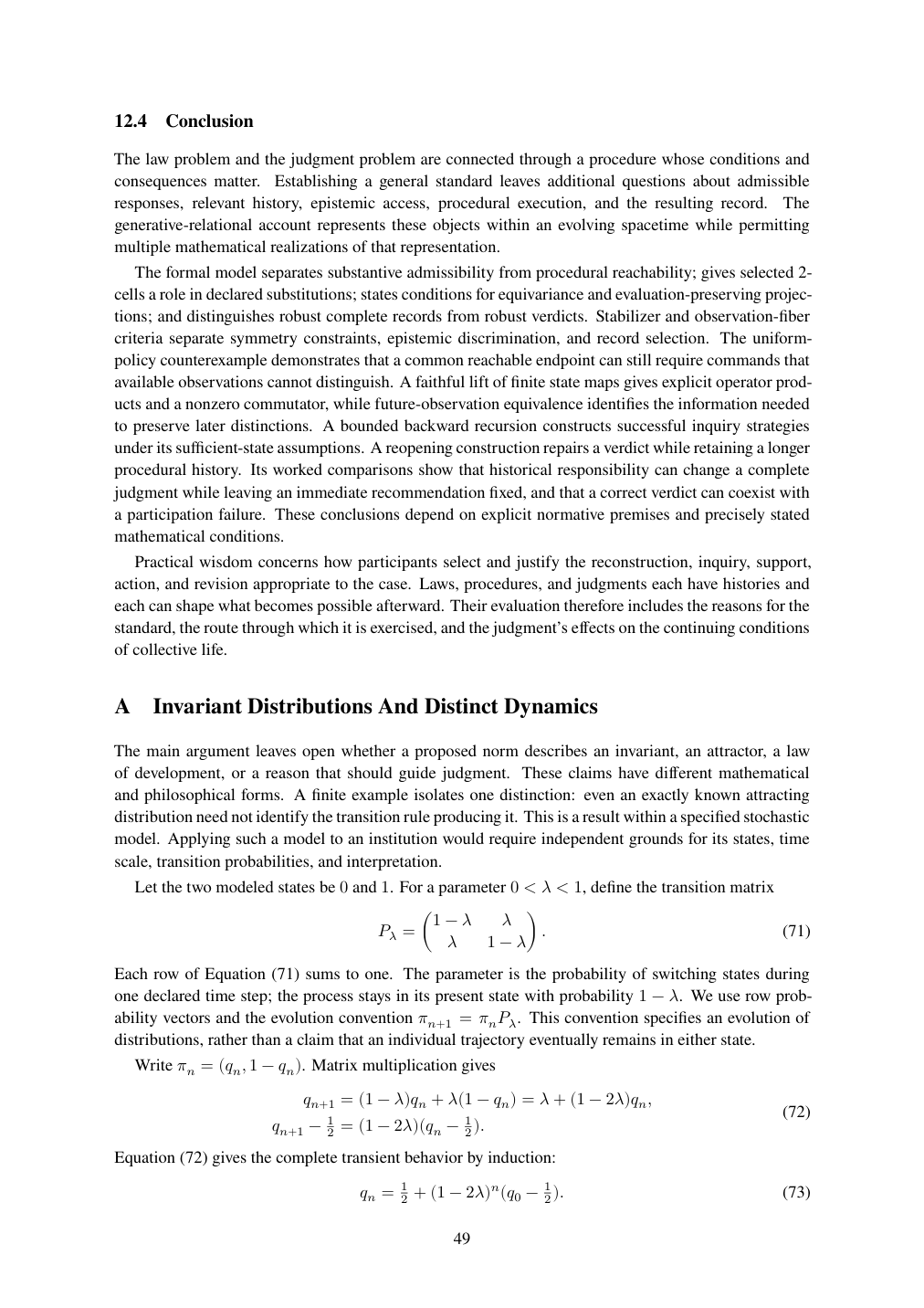
Readable text
The law problem and the judgment problem are connected through a procedure whose conditions and Establishing a general standard leaves additional questions about admissible responses, relevant history, epistemic access, procedural execution, and the resulting record. generative-relational account represents these objects within an evolving spacetime while permitting multiple mathematical realizations of that representation.
The formal model separates substantive admissibility from procedural reachability; gives selected 2- cells a role in declared substitutions; states conditions for equivariance and evaluation-preserving projec- tions; and distinguishes robust complete records from robust verdicts. Stabilizer and observation-fiber criteria separate symmetry constraints, epistemic discrimination, and record selection. The uniform- policy counterexample demonstrates that a common reachable endpoint can still require commands that available observations cannot distinguish. A faithful lift of finite state maps gives explicit operator prod- ucts and a nonzero commutator, while future-observation equivalence identifies the information needed to preserve later distinctions. A bounded backward recursion constructs successful inquiry strategies under its sufficient-state assumptions. A reopening construction repairs a verdict while retaining a longer procedural history. Its worked comparisons show that historical responsibility can change a complete judgment while leaving an immediate recommendation fixed, and that a correct verdict can coexist with a participation failure. These conclusions depend on explicit normative premises and precisely stated
Practical wisdom concerns how participants select and justify the reconstruction, inquiry, support, action, and revision appropriate to the case. Laws, procedures, and judgments each have histories and each can shape what becomes possible afterward. Their evaluation therefore includes the reasons for the standard, the route through which it is exercised, and the judgment’s effects on the continuing conditions
The main argument leaves open whether a proposed norm describes an invariant, an attractor, a law of development, or a reason that should guide judgment. These claims have different mathematical and philosophical forms. A finite example isolates one distinction: even an exactly known attracting distribution need not identify the transition rule producing it. This is a result within a specified stochastic model. Applying such a model to an institution would require independent grounds for its states, time
scale, transition probabilities, and interpretation.
Each row of Equation (71) sums to one. The parameter is the probability of switching states during distributions, rather than a claim that an individual trajectory eventually remains in either state.
Equation (72) gives the complete transient behavior by induction:
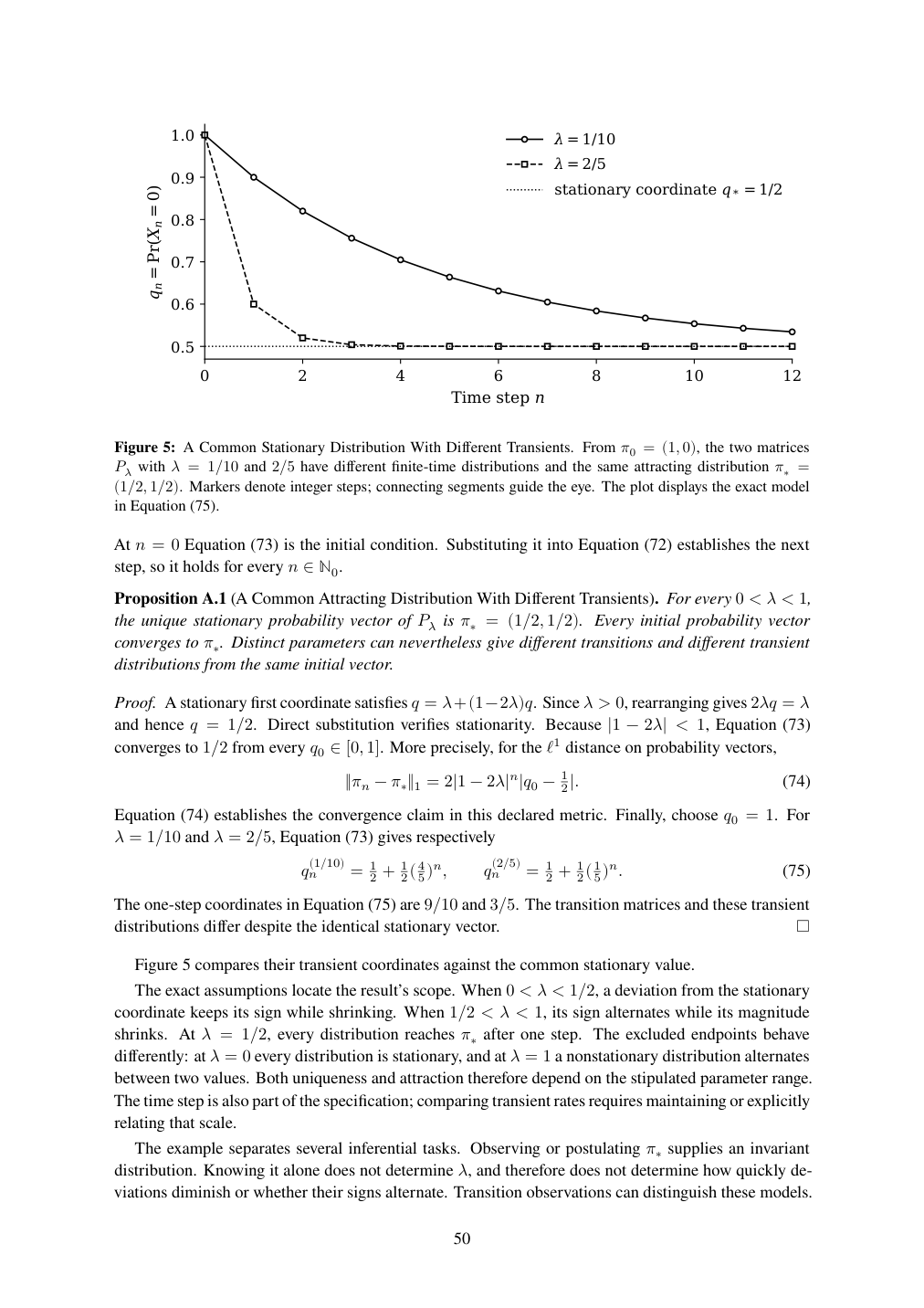
Readable text
distributions differ despite the identical stationary vector.
Figure 5 compares their transient coordinates against the common stationary value.
between two values. Both uniqueness and attraction therefore depend on the stipulated parameter range. The time step is also part of the specification; comparing transient rates requires maintaining or explicitly
viations diminish or whether their signs alternate. Transition observations can distinguish these models.
A declared mechanism, suitable interventions, or justified constraints on the model family can also supply additional identifying information. None of those resources is contained in the stationary distribution itself.

This distinction clarifies the place of invariance in a GR inquiry. A coarse historical comparison can preserve a distribution or selected observable while leaving its generating operations unidentified. A richer description can retain transition order, authority, resources, and the histories of those affected. The existence of an invariant at one resolution consequently supplies a question for further investigation: what processes support it, under which conditions, and with which consequences? It supplies no general reason to assume that a relational subject is Markovian or that its political and cultural history is exhausted by a two-state distribution.
The appendix therefore supports a limited claim needed by both papers. A shared invariant can coexist with different generators and histories, even under exact equality rather than approximation. The result does not establish that all historical mechanisms are unidentifiable, that no universal norm exists, or that lawful judgment is impossible. It identifies an inference that needs additional premises. The law–procedure–judgment analysis asks for those premises in the relevant domain: which law constrains the response, how the procedure obtains and uses information, what judgment it can reach, and which historical consequences survive an apparently equivalent result.
References
Addington v. Texas. 441 U.S. 418. Supreme Court of the United States, 1979. URL https://tile.loc.gov
/storage-services/service/ll/usrep/usrep441/usrep441418/usrep441418.pdf.
Thomas Aquinas. Summa theologiae, I–II, question 94, article 4, n.d. URL https://www.thomasintern
ational.org/projects/step/treatiseonlaw/delege094_4.htm. Translated by Alfred J. Freddoso.
Aristotle. Nicomachean ethics, book V. Translation by W. D. Ross; online reproduction, Internet Classics
Archive, Massachusetts Institute of Technology, 1925a. URL https://classics.mit.edu/Aristotle/nic omachaen.5.v.html. Especially chapter 10.
Aristotle. Nicomachean ethics, book VI. Translation by W. D. Ross; online reproduction, Internet
Classics Archive, Massachusetts Institute of Technology, 1925b. URL https://classics.mit.edu/Arist otle/nicomachaen.6.vi.html. Especially chapters 7–8.
John C. Baez. Spin foam models. Classical and Quantum Gravity, 15(7):1827–1858, 1998. URL
https://arxiv.org/pdf/gr-qc/9709052.
Kimberlé Crenshaw. Demarginalizing the intersection of race and sex: A black feminist critique of an-
tidiscrimination doctrine, feminist theory and antiracist politics. University of Chicago Legal Forum, 1989(1):139–167, 1989. URL https://scholarship.law.columbia.edu/faculty\_scholarship/3007/. Article 8.
Ronald Dworkin. Hard cases. In Taking Rights Seriously, pages 81–130. Harvard University Press,
Cambridge, MA, 1977. URL https://www.law.nyu.edu/sites/default/files/Ronald%20Dworkin%2 0-%20Hard%20Cases.pdf. Chapter 4; the original article appeared in 1975.
Ronald M. Dworkin. The model of rules. University of Chicago Law Review, 35(1):14–46, 1967. URL
https://chicagounbound.uchicago.edu/uclrev/vol35/iss1/3/.
Philippa Foot. The problem of abortion and the doctrine of the double effect. Oxford Review, (5):5–15,
1967. URL https://sites.pitt.edu/~mthompso/readings/foot.pdf. Reprinted in Virtues and Vices (1978).
Lon L. Fuller. The Morality of Law. Yale University Press, New Haven, CT, revised edition, 1969. URL
https://yalebooks.yale.edu/book/9780300010701/the-morality-of-law/.
Lon L. Fuller. The forms and limits of adjudication. Harvard Law Review, 92(2):353–409, 1978. URL
https://cyber.harvard.edu/bridge/LegalProcess/fuller2.txt.htm.
Jürgen Habermas. Between Facts and Norms: Contributions to a Discourse Theory of Law and Democ-
racy. MIT Press, Cambridge, MA, 1996. URL https://mitpress.mit.edu/9780262581622/between-f acts-and-norms/. Translated by William Rehg; German original published 1992.
H. L. A. Hart. The Concept of Law. Oxford University Press, Oxford, 3rd edition, 2012. URL https:
//india.oup.com/product/the-concept-of-law-9780198729990. With an introduction by Leslie Green; first edition published 1961.
Allen Hatcher. Algebraic Topology. Cambridge University Press, Cambridge, 2002. URL https://pi.m
ath.cornell.edu/~hatcher/AT/AT.pdf.
Wesley Newcomb Hohfeld. Some fundamental legal conceptions as applied in judicial reasoning. Yale
Law Journal, 23(1):16–59, 1913. doi: 10.2307/785533. URL https://persweb.wabash.edu/facstaff/ helmang/phi213-1314S/phi213-txtbrwsr/Hohfeld/Hohfeld1913.html.
In re Winship. 397 U.S. 358. Supreme Court of the United States, 1970. URL https://tile.loc.gov/stora
ge-services/service/ll/usrep/usrep397/usrep397358/usrep397358.pdf. The discussion of quantitative imprecision at pp. 369–372 is in Justice Harlan’s concurrence.
Larry Laudan. Truth, Error, and Criminal Law: An Essay in Legal Epistemology. Cambridge University
Press, Cambridge, 2006. URL https://assets.cambridge.org/97805217/30358/excerpt/978052173035 8_excerpt.pdf.
Alejandro Perez. The spin-foam approach to quantum gravity. Living Reviews in Relativity, 16, 2013.
doi: 10.12942/lrr-2013-3. URL https://link.springer.com/article/10.12942/lrr-2013-3. Article 3.
Henry Prakken and Giovanni Sartor. Law and logic: A review from an argumentation perspective. Ar-
tificial Intelligence, 227:214–245, 2015. doi: 10.1016/j.artint.2015.06.005. URL https://pure.rug.nl/ ws/portalfiles/portal/98715514/Law_and_logic_a_review_from_an_argumentation_perspective.pdf.
John Rawls. A Theory of Justice. Belknap Press of Harvard University Press, Cambridge, MA, revised
edition, 1999. URL https://www.cita.or.id/wp-content/uploads/2016/06/John-Rawls-A-Theory-of-J ustice-Belknap-Press-1999.pdf.
J. B. Ruhl. Law’s complexity: A primer. Georgia State University Law Review, 24(4):885–911, 2008.
URL https://scholarship.law.vanderbilt.edu/faculty-publications/486/.
Judith Jarvis Thomson. The trolley problem. Yale Law Journal, 94(6):1395–1415, 1985. URL https:
//cps-vo.org/sites/cps-vo.org/files/cpsvo_file_nodes/Thomson_1985_The_Trolley_Problempdf.pdf.
United Nations. International covenant on civil and political rights. 999 UNTS 171, 1966. URL https:
//www.ohchr.org/sites/default/files/ccpr.pdf. Adopted 16 December 1966; entered into force 23 March 1976.
United Nations Human Rights Committee. General comment no. 32: Article 14—right to equality
before courts and tribunals and to a fair trial. CCPR/C/GC/32, 23 August 2007, 2007. URL https: //digitallibrary.un.org/record/606075.