Seeking Alternatives To Natural Language For Efficient Communication
Full text from the PDF
Seeking Alternatives To Natural Language For Efficient
Communication
Wanhong Huang huangwanhong@serendip.ngo
Abstract
Alternative expressive structures can change the effort required to externalize, preserve, and communicate a developing thought. Biosignals offer time-dependent, multidimensional carriers whose usefulness depends on the organization of a communication task. This paper develops a generative-relational framework for examining five requirements: persistence, syntactic organization, propagation of relevant historical relations, noise resistance, and recognizable semantics. It treats noise robustness and semantic matching as connected mathematical problems. Persistent homology and braid representations support conditional stability results for specified observations and perturbations. Group actions organize nuisance transformations, latent-coordinate ambiguity, and the residual symmetries left by calibration. Exact decoding criteria distinguish recovery of a single assessment from selection among acceptable interpretations; metric margins connect stable features with correct finite-code decoding. Worked constructions show both the value and the information cost of invariance. A winding-based alphabet has a bounded-noise guarantee and an explicit speed– duration constraint, while a reversal example preserves point-cloud topology and changes an oriented task meaning. The comparison with topological quantum computation concerns the role of invariant structures and separately identifies the physical assumptions of protected quantum operations. Primary brain–computer-interface research motivates a task-specific evaluation program with participant correction, historical provenance, and separate tests of reconstruction, dynamical identification, and capacity propagation. The result is a mathematical and practical research framework for efficient communication across heterogeneous interpreters.
Keywords: Expressive Media; Biosignal Communication; Topological Representation; Semantic Alignment; Generativity.
Discussion Paper Note
This philosophical discussion paper shares an evolving inquiry and invites dialogue, criticism, revision, and independent development. Its definitions, distinctions, and constructions remain open to refinement. Mathematical statements are assessed under their stated assumptions. Circulation across scholarly and practical communities is part of the purpose of releasing the manuscript.
The author treats the viewpoints, concepts, and lines of reasoning presented here as contributions to a shared field of inquiry. Similar or related ideas may have appeared in other intellectual, cultural, and disciplinary traditions. The manuscript identifies known antecedents and distinguishes inherited positions, interpretive proposals, and arguments developed here. Historical priority remains open to further investigation.
The arguments are provisional and historically situated. Readers are encouraged to question, test, revise, extend, reinterpret, or independently develop the ideas presented here. Where appropriate, acknowledgment of this paper as one point of encounter in the development of a related idea is appreciated. Such acknowledgment records an intellectual route; the ideas remain available for criticism, revision, and independent development.
Definitions introduced here are paper-local analytical stipulations. Attributed definitions follow the cited works. The terminology specifies the scope of the present argument, while its intellectual history remains open to further investigation. Generative-Relational inquiry is treated as an open research programme whose proposals receive critical examination alongside independent literature.
Responsible Use And Rights Reservation
This section records a request for responsible scholarly conduct and identifies the scope of retained rights. Legal permissions are governed by the licence reproduced on the following page.
The author encourages good-faith discussion, criticism, independent inquiry, and responsible use of the material. Separately from the licence’s terms, users are asked to consider foreseeable consequences when adapting the arguments, representations, examples, or proposed procedures. Relevant considerations include affected persons’ participation, represented interests, attribution, responsibilities, access to resources, and opportunities for correction. The responsibilities depend on the application and its circumstances. The ethical request leaves the licence’s permissions and obligations unchanged.
The author retains the rights preserved under CC BY-NC 4.0 and may pursue remedies to which the author is legally entitled for breach of the licence or violation of independently applicable rights. Reuse remains independent from authorial endorsement. Third-party rights require authorisation from their respective holders where applicable. Copyright exceptions and limitations, including applicable forms of fair use or fair dealing, remain available.
Readable text
This page consolidates the manuscript’s research status, licence, preparation disclosure, available mate- rials, research-programme relation, and suggested citation.
This philosophical discussion manuscript is prepared for the author’s substantive review and It investigates expressive alternatives to natural language through biosignal communication, topological robustness, braid structures, and semantic matching under sym- Primary studies retain their participant and task conditions. proposed protocols have their own assumptions and evaluation requirements. identify the access level and scope of the consulted works.
Except where otherwise indicated, copyright 2026 Wanhong Huang. This work is made avail- able under the Creative Commons Attribution–NonCommercial 4.0 International Licence (CC BY-NC 4.0). Subject to its terms, the licence permits sharing and adaptation for noncommercial purposes with appropriate attribution, a link to the licence, and an indication of changes. The licence governs reuse; the responsible-use request on the preceding page remains separate from its terms. The licence deed and legal code are available at https://creativecommons.org/licenses/by-nc/4.0/. The licence governs in case of conflict with this summary. Third-party material remains subject to its respective rights.
Statement On The Use Of Language Models. Preparation involved OpenAI’s ChatGPT and Codex. manuscript remains with the human author.
Language models supported exploratory dialogue, source discovery and checking, drafting, mathemat- ical and editorial consistency checks, LATEX typesetting, and supporting code and figures. Verification used the sources and access levels documented in the accompanying source-audit records. The author initiated the research questions and directed the research programme. Interpretation, acceptance of argu- ments, and publication decisions remain subject to the author’s review. Responsibility for the released
Editable figures, manuscript sources, bibliography, source-access records, and scripts checking the constructed examples accompany the paper. Numerical illustrations follow their stated assumptions and support analytical comparison. Referenced empirical materials remain governed by the conditions of the original studies.
The paper contributes to the author’s evolving Generative-Relational inquiry. Its definitions and constructions are local to the stated arguments and invite comparison with
Research-Programme Relation. independent approaches.
Huang, W. (2026). Seeking Alternatives To Natural Language For Efficient Com-
Suggested Citation. munication. Philosophical discussion paper.
1 Introduction
A developing thought can concern several relations, alternatives, and anticipated consequences together. Expressing it requires selecting what to make explicit, arranging an external structure, and enabling another participant to interpret that structure through different experience and resources. A concise expression can work well when the relevant background is available. The same expression can demand considerable reconstruction when that background is unfamiliar. Communication efficiency consequently concerns the relation among an expressive carrier, its organization, the task, and the participants who use it.
This paper investigates alternatives and complements to natural language for that purpose. Its motivation is the possibility that a spatial, temporal, physiological, or executable structure can make selected relations easier to express and manipulate. Larkin and Simon’s comparison of sentential and diagrammatic problem representations provides a useful precedent: informationally equivalent descriptions can support different search and inference operations (Larkin and Simon, 1987). Such comparisons invite a task-specific inquiry into production, interpretation, and use. A representation can be easy to capture for its author and costly to interpret for another person. Its efficiency depends on whose effort, which stage, and which standard of success the comparison retains.
Biosignals deserve particular attention because they provide graded, temporally structured observations of biological activity. A recording can retain simultaneous variations whose verbal description would require explicit selection and sequencing. The research problem is how to organize that richness into a controlled and interpretable communication process. A physiological observation, an intended message, and an expressive convention are separate objects. Their connection can be learned through calibration, examples, participant feedback, and shared activity. The relevant achievement is a demonstrated capacity to communicate selected distinctions through the resulting system.
Two problems organize the investigation. The first concerns noise resistance: which distinctions survive measurement variation, preprocessing, temporal deformation, and later reuse? The second concerns semantic matching: under what conditions can another participant identify the intended distinction from the retained representation? These problems interact. A transformation regarded as a nuisance can carry information that matters for a particular task. Removing it can make a feature stable while making the intended meaning inaccessible. Conversely, a very detailed representation can preserve many distinctions while remaining difficult to calibrate or use.
Topology offers several possible approaches to the first problem. Persistent homology studies features across scales; configuration spaces and braid groups describe selected patterns of noncolliding trajectories. Their mathematical value lies in stated invariance or stability properties. A robustness argument must identify the input, the perturbation, the feature, and the decision that the feature supports. A comparison with topological quantum computation can clarify this strategy of using structural invariants. Physical quantum protection additionally depends on a realized encoding and dynamics, including the assumptions under which local disturbances have limited effects. Each use of topology therefore needs its own protection claim.
Symmetry provides a complementary approach to semantic matching. Equivalent latent coordinates can describe the same selected process, while the same observed dynamics can be paired with different semantic assignments. Group actions make those ambiguities explicit. Calibration supplies anchors that can reduce the remaining transformations; the task determines whether the residual ambiguity still matters. The central issue is whether available evidence distinguishes interpretations relevant to the communication. An exact theorem can state the required relation among observations and target assessments, while empirical inquiry examines whether a particular implementation satisfies its premises.
The generative-relational, or GR, framework situates these constructions within a selected subject’s historical and prospective spacetime. Participants have acquired capacities, access conditions, purposes,
models of others, and expectations about possible futures. An expressive artifact enters those relations and can alter later opportunities for interpretation and production. Three achievements therefore remain distinct: reconstructing a relevant history, identifying a generating process, and developing the capacity to continue a practice. A stable recording can contribute to each achievement through different routes. Their evaluation requires different evidence.
The paper develops a connected sequence of arguments. It first states a representation contract and a task-specific account of expressive efficiency. It then examines biosignal evidence, topological stability, and braid constructions. Semantic decoding and symmetry reduction provide a separate account of interpretability. A joint margin result connects measurement stability with reliable selection, while worked counterexamples identify information lost through invariance. Finally, an evaluation program addresses calibration, correction, transfer, resource burdens, and historical continuation. The mathematical results establish conditional consequences of explicit assumptions. The practical proposal concerns how those assumptions can be made concrete and tested in a communication setting.
2 Expressive Structures And Relational Spacetime
2.1 Carriers, Syntax, And Interpretive Practice
An expressive medium combines a carrier with distinctions and operations that participants can use. Paper, digital storage, recorded sound, and sampled physiology supply different carriers. A syntax specifies how elements can be distinguished, combined, transformed, or recognized as a structured expression. An interpretive practice connects those structures with referents, purposes, commitments, and possible responses. Stability of the carrier and availability of the interpretive practice require separate attention.
For an inquiry at a declared resolution, write a medium specification as


A biosignal record can be rich without already having the compositional organization of a public language. A waveform may function as a continuous control signal; selected intervals may be classified into a finite command alphabet; an interactive interface may combine gesture, neural activity, and explicit correction. Each arrangement defines a different syntax and a different communication task. The model should state which operations a participant can deliberately exercise and which recorded variations are incidental to that exercise.
Two precedents locate the interpretive question. Harnad’s symbol-grounding problem concerns how symbolic representation acquires a relation to meaningful capacities (Harnad, 1990). Clark and Brennan examine grounding as a collaborative process in which participants update the common basis for their activity (Clark and Brennan, 1991). The present formal models stipulate a target for a declared inquiry; the grounding record concerns the practices and evidence that warrant that target’s use. Calibration can establish a usable correspondence while its interpretation, adequacy, and scope remain attributable to particular participants and procedures.
Natural language also has several physical and practical realizations. Its comparison with biosignals should specify the interface under investigation: typing a text, speaking, drawing an annotated diagram, or interacting through a multimodal environment can impose different demands. A faster output channel can relieve one difficulty while leaving another stage unchanged. The same principle applies to a proposed alternative: the relevant unit is the organized task under its actual conditions.
Readable text
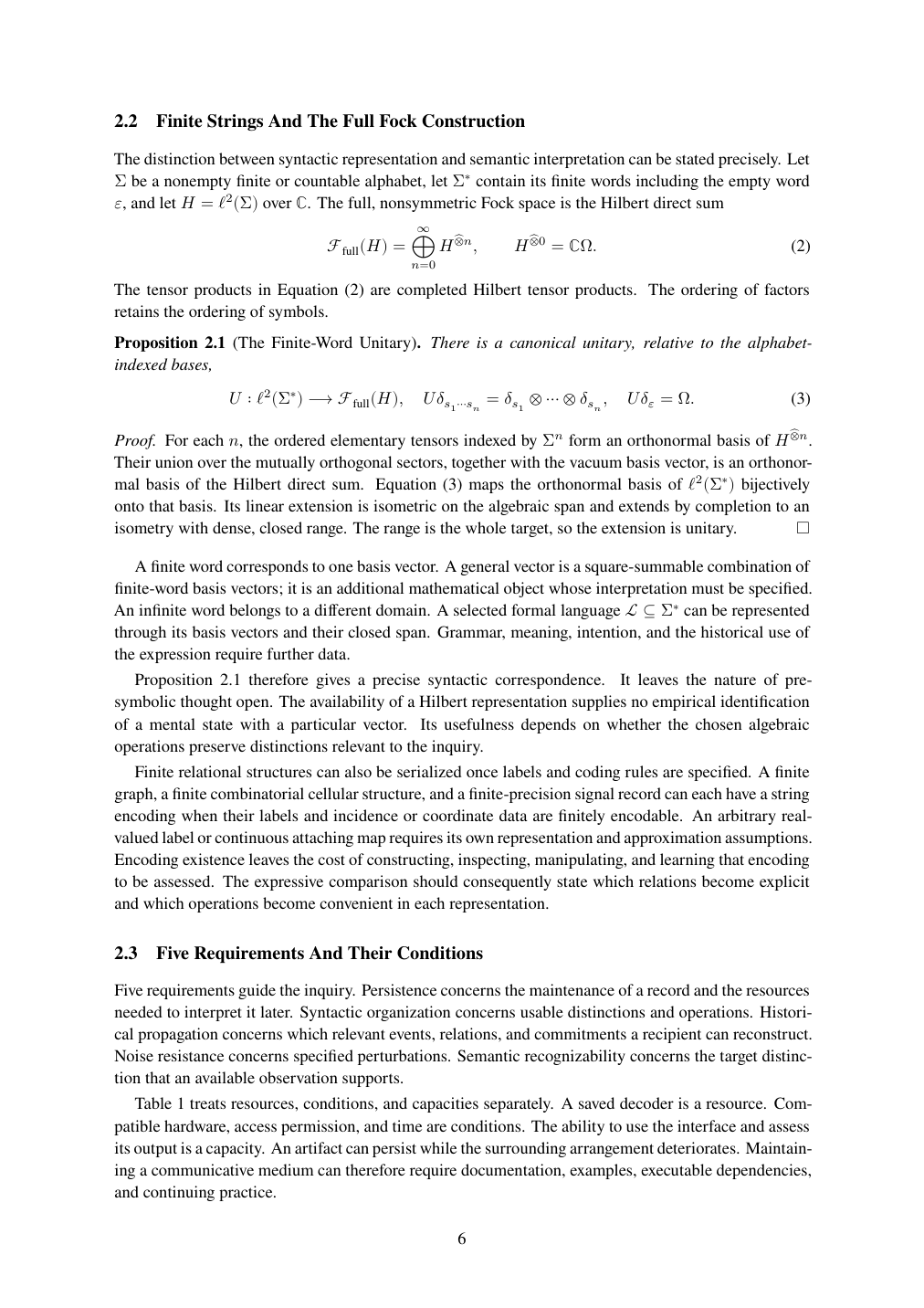
The distinction between syntactic representation and semantic interpretation can be stated precisely. Let
The tensor products in Equation (2) are completed Hilbert tensor products. The ordering of factors
Proposition 2.1 (The Finite-Word Unitary). There is a canonical unitary, relative to the alphabet-
Their union over the mutually orthogonal sectors, together with the vacuum basis vector, is an orthonor- onto that basis. Its linear extension is isometric on the algebraic span and extends by completion to an isometry with dense, closed range. The range is the whole target, so the extension is unitary.
A finite word corresponds to one basis vector. A general vector is a square-summable combination of finite-word basis vectors; it is an additional mathematical object whose interpretation must be specified. through its basis vectors and their closed span. Grammar, meaning, intention, and the historical use of
Proposition 2.1 therefore gives a precise syntactic correspondence. symbolic thought open. The availability of a Hilbert representation supplies no empirical identification of a mental state with a particular vector. Its usefulness depends on whether the chosen algebraic operations preserve distinctions relevant to the inquiry.
Finite relational structures can also be serialized once labels and coding rules are specified. A finite graph, a finite combinatorial cellular structure, and a finite-precision signal record can each have a string encoding when their labels and incidence or coordinate data are finitely encodable. An arbitrary real- valued label or continuous attaching map requires its own representation and approximation assumptions. Encoding existence leaves the cost of constructing, inspecting, manipulating, and learning that encoding to be assessed. The expressive comparison should consequently state which relations become explicit and which operations become convenient in each representation.
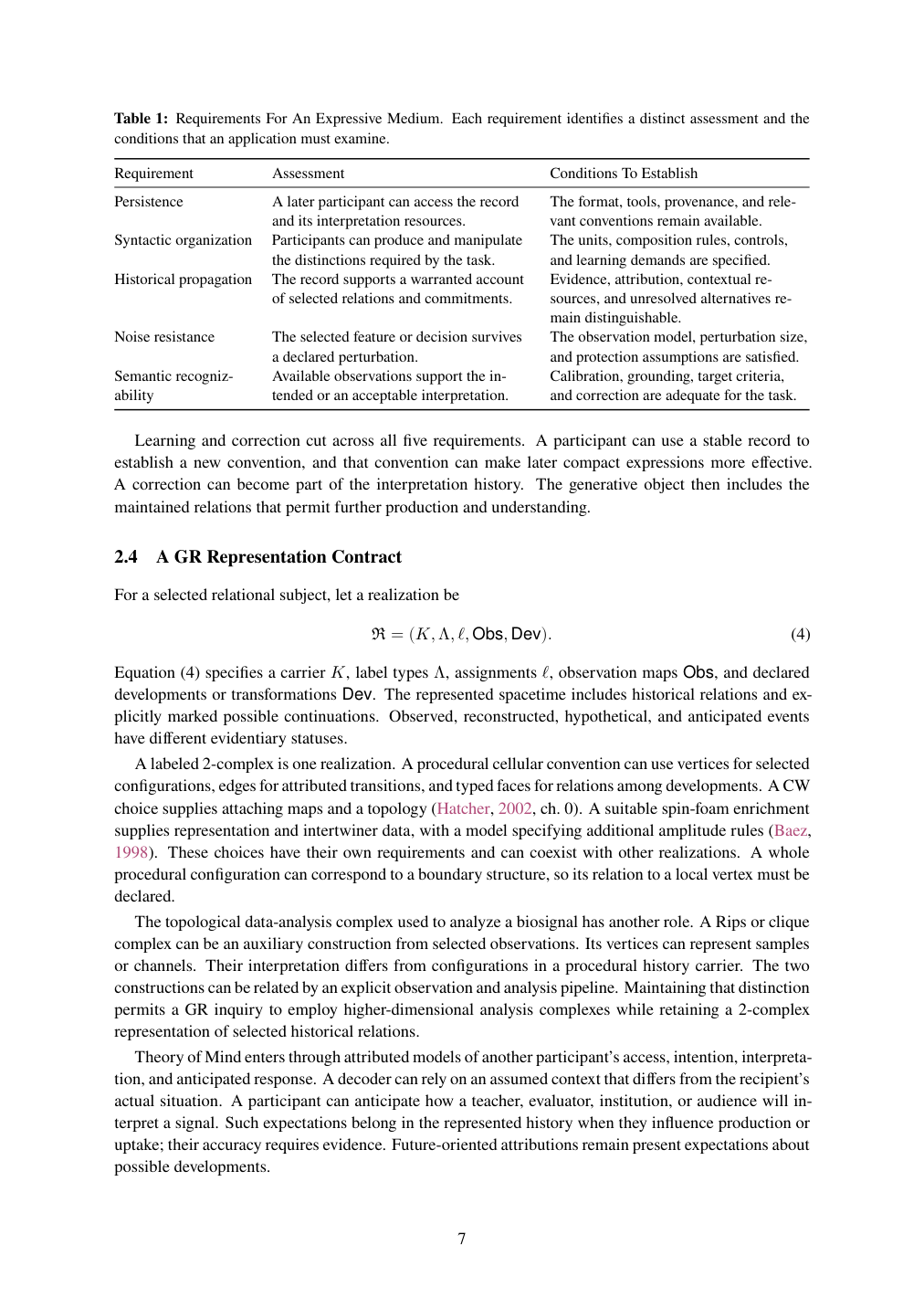
Five requirements guide the inquiry. Persistence concerns the maintenance of a record and the resources needed to interpret it later. Syntactic organization concerns usable distinctions and operations. Histori- cal propagation concerns which relevant events, relations, and commitments a recipient can reconstruct. Noise resistance concerns specified perturbations. Semantic recognizability concerns the target distinc-
Table 1 treats resources, conditions, and capacities separately. A saved decoder is a resource. Com- patible hardware, access permission, and time are conditions. The ability to use the interface and assess its output is a capacity. An artifact can persist while the surrounding arrangement deteriorates. Maintain- ing a communicative medium can therefore require documentation, examples, executable dependencies,
Readable text
Table 1: Requirements For An Expressive Medium. Each requirement identifies a distinct assessment and the
The format, tools, provenance, and rele- vant conventions remain available.
Participants can produce and manipulate the distinctions required by the task.
The units, composition rules, controls, and learning demands are specified.
The record supports a warranted account of selected relations and commitments.
Evidence, attribution, contextual re- sources, and unresolved alternatives re- main distinguishable.
The observation model, perturbation size, and protection assumptions are satisfied.
Available observations support the in- tended or an acceptable interpretation.
Calibration, grounding, target criteria, and correction are adequate for the task.
Learning and correction cut across all five requirements. A participant can use a stable record to establish a new convention, and that convention can make later compact expressions more effective. A correction can become part of the interpretation history. The generative object then includes the maintained relations that permit further production and understanding.
For a selected relational subject, let a realization be
developments or transformations Dev. The represented spacetime includes historical relations and ex- plicitly marked possible continuations. Observed, reconstructed, hypothetical, and anticipated events
A labeled 2-complex is one realization. A procedural cellular convention can use vertices for selected configurations, edges for attributed transitions, and typed faces for relations among developments. A CW choice supplies attaching maps and a topology (Hatcher, 2002, ch. 0). A suitable spin-foam enrichment supplies representation and intertwiner data, with a model specifying additional amplitude rules (Baez, 1998). These choices have their own requirements and can coexist with other realizations. A whole procedural configuration can correspond to a boundary structure, so its relation to a local vertex must be
The topological data-analysis complex used to analyze a biosignal has another role. A Rips or clique complex can be an auxiliary construction from selected observations. Its vertices can represent samples or channels. Their interpretation differs from configurations in a procedural history carrier. The two constructions can be related by an explicit observation and analysis pipeline. Maintaining that distinction permits a GR inquiry to employ higher-dimensional analysis complexes while retaining a 2-complex
Theory of Mind enters through attributed models of another participant’s access, intention, interpreta- tion, and anticipated response. A decoder can rely on an assumed context that differs from the recipient’s actual situation. A participant can anticipate how a teacher, evaluator, institution, or audience will in- terpret a signal. Such expectations belong in the represented history when they influence production or uptake; their accuracy requires evidence. Future-oriented attributions remain present expectations about
Readable text
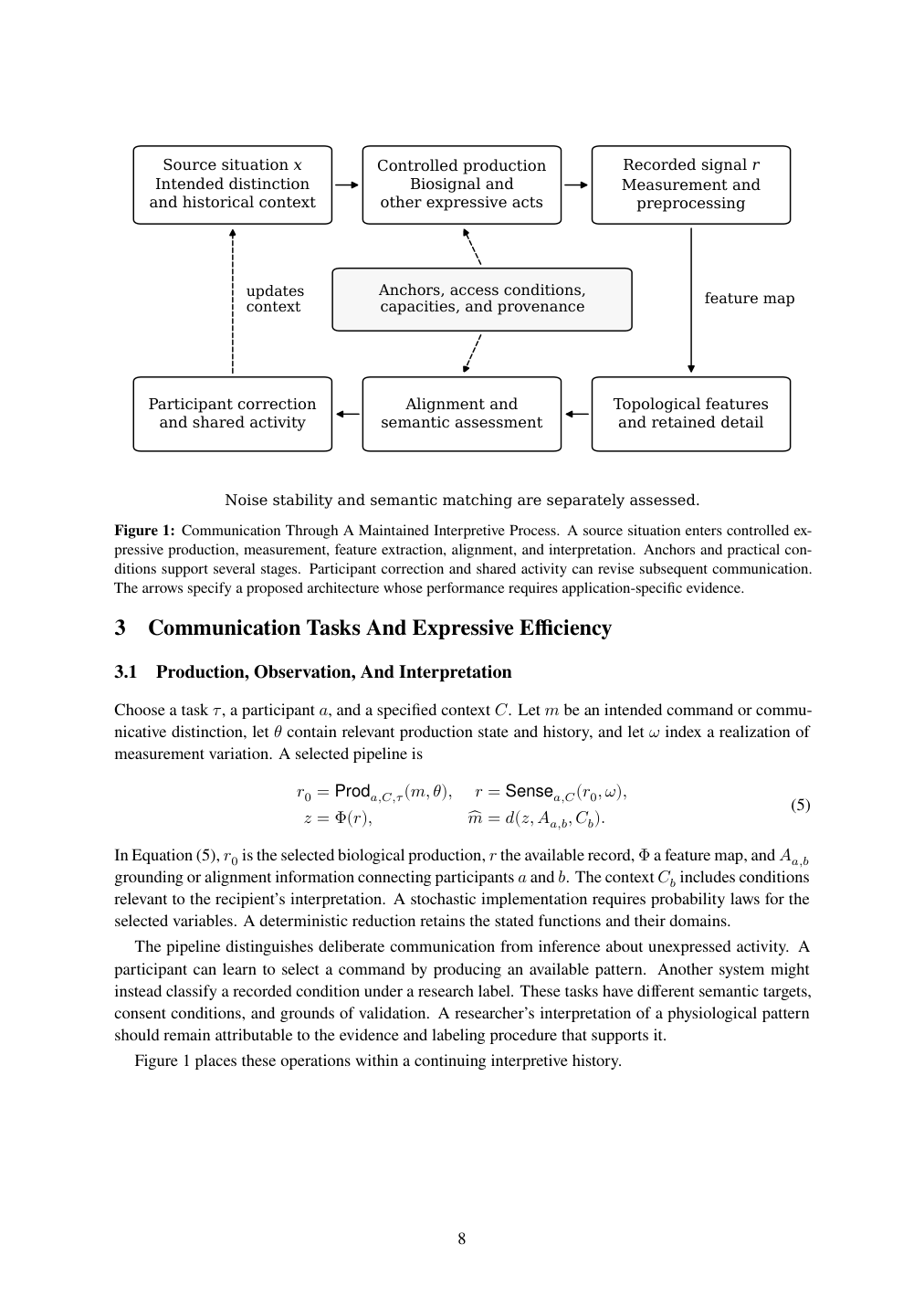
Source situation x Intended distinction and historical context
Noise stability and semantic matching are separately assessed.
Figure 1: Communication Through A Maintained Interpretive Process. A source situation enters controlled ex- pressive production, measurement, feature extraction, alignment, and interpretation. Anchors and practical con- ditions support several stages. Participant correction and shared activity can revise subsequent communication. The arrows specify a proposed architecture whose performance requires application-specific evidence.
relevant to the recipient’s interpretation. A stochastic implementation requires probability laws for the selected variables. A deterministic reduction retains the stated functions and their domains.
The pipeline distinguishes deliberate communication from inference about unexpressed activity. A participant can learn to select a command by producing an available pattern. Another system might instead classify a recorded condition under a research label. These tasks have different semantic targets, consent conditions, and grounds of validation. A researcher’s interpretation of a physiological pattern should remain attributable to the evidence and labeling procedure that supports it.
Figure 1 places these operations within a continuing interpretive history.
Readable text
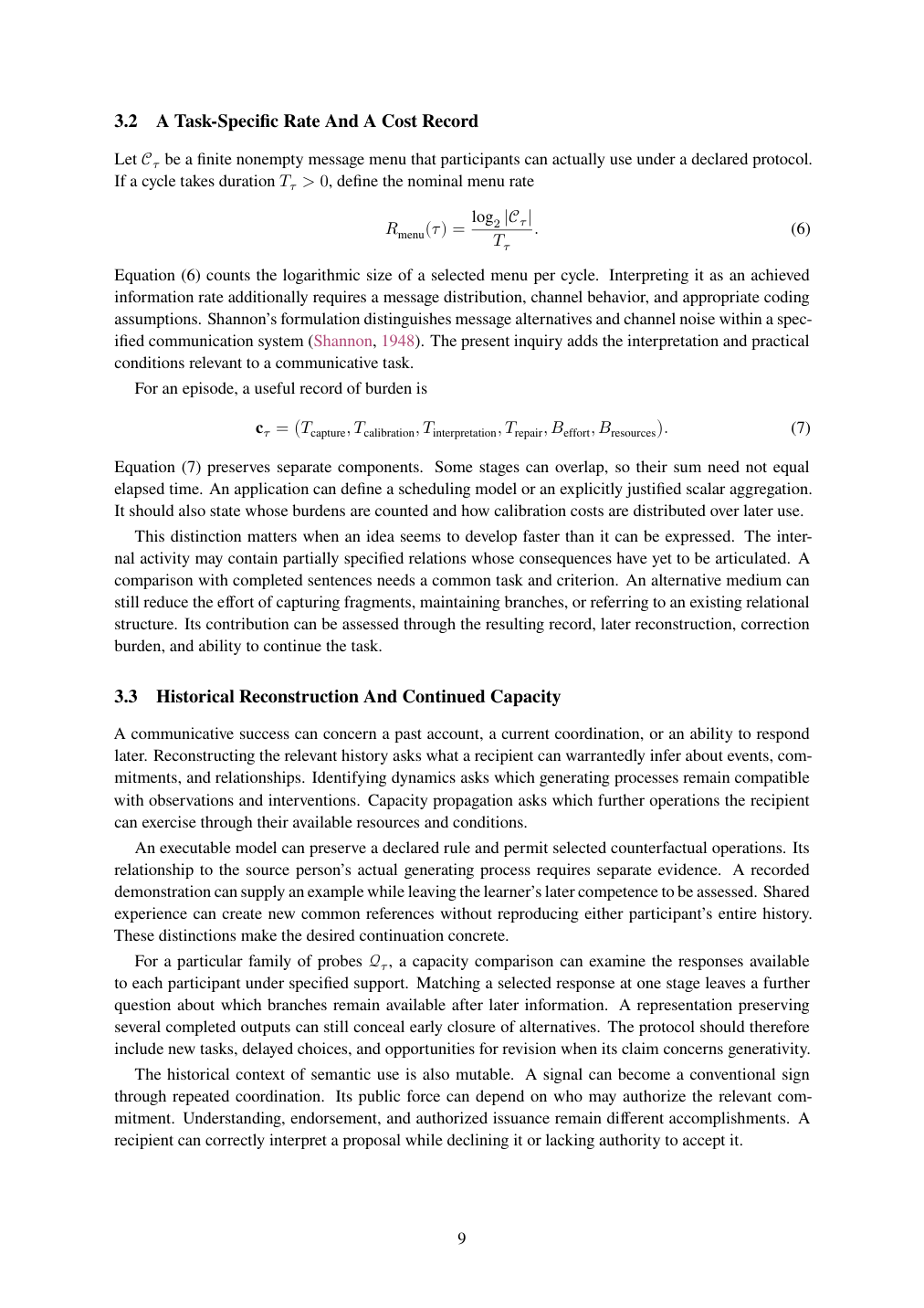
Equation (6) counts the logarithmic size of a selected menu per cycle. Interpreting it as an achieved information rate additionally requires a message distribution, channel behavior, and appropriate coding assumptions. Shannon’s formulation distinguishes message alternatives and channel noise within a spec- ified communication system (Shannon, 1948). The present inquiry adds the interpretation and practical
Equation (7) preserves separate components. Some stages can overlap, so their sum need not equal elapsed time. An application can define a scheduling model or an explicitly justified scalar aggregation. It should also state whose burdens are counted and how calibration costs are distributed over later use.
This distinction matters when an idea seems to develop faster than it can be expressed. The inter- nal activity may contain partially specified relations whose consequences have yet to be articulated. A comparison with completed sentences needs a common task and criterion. An alternative medium can still reduce the effort of capturing fragments, maintaining branches, or referring to an existing relational structure. Its contribution can be assessed through the resulting record, later reconstruction, correction
A communicative success can concern a past account, a current coordination, or an ability to respond later. Reconstructing the relevant history asks what a recipient can warrantedly infer about events, com- mitments, and relationships. Identifying dynamics asks which generating processes remain compatible with observations and interventions. Capacity propagation asks which further operations the recipient can exercise through their available resources and conditions.
An executable model can preserve a declared rule and permit selected counterfactual operations. Its relationship to the source person’s actual generating process requires separate evidence. A recorded demonstration can supply an example while leaving the learner’s later competence to be assessed. Shared experience can create new common references without reproducing either participant’s entire history. These distinctions make the desired continuation concrete.
to each participant under specified support. Matching a selected response at one stage leaves a further question about which branches remain available after later information. A representation preserving several completed outputs can still conceal early closure of alternatives. The protocol should therefore include new tasks, delayed choices, and opportunities for revision when its claim concerns generativity.
The historical context of semantic use is also mutable. A signal can become a conventional sign through repeated coordination. Its public force can depend on who may authorize the relevant com- mitment. Understanding, endorsement, and authorized issuance remain different accomplishments. A recipient can correctly interpret a proposal while declining it or lacking authority to accept it.
Readable text
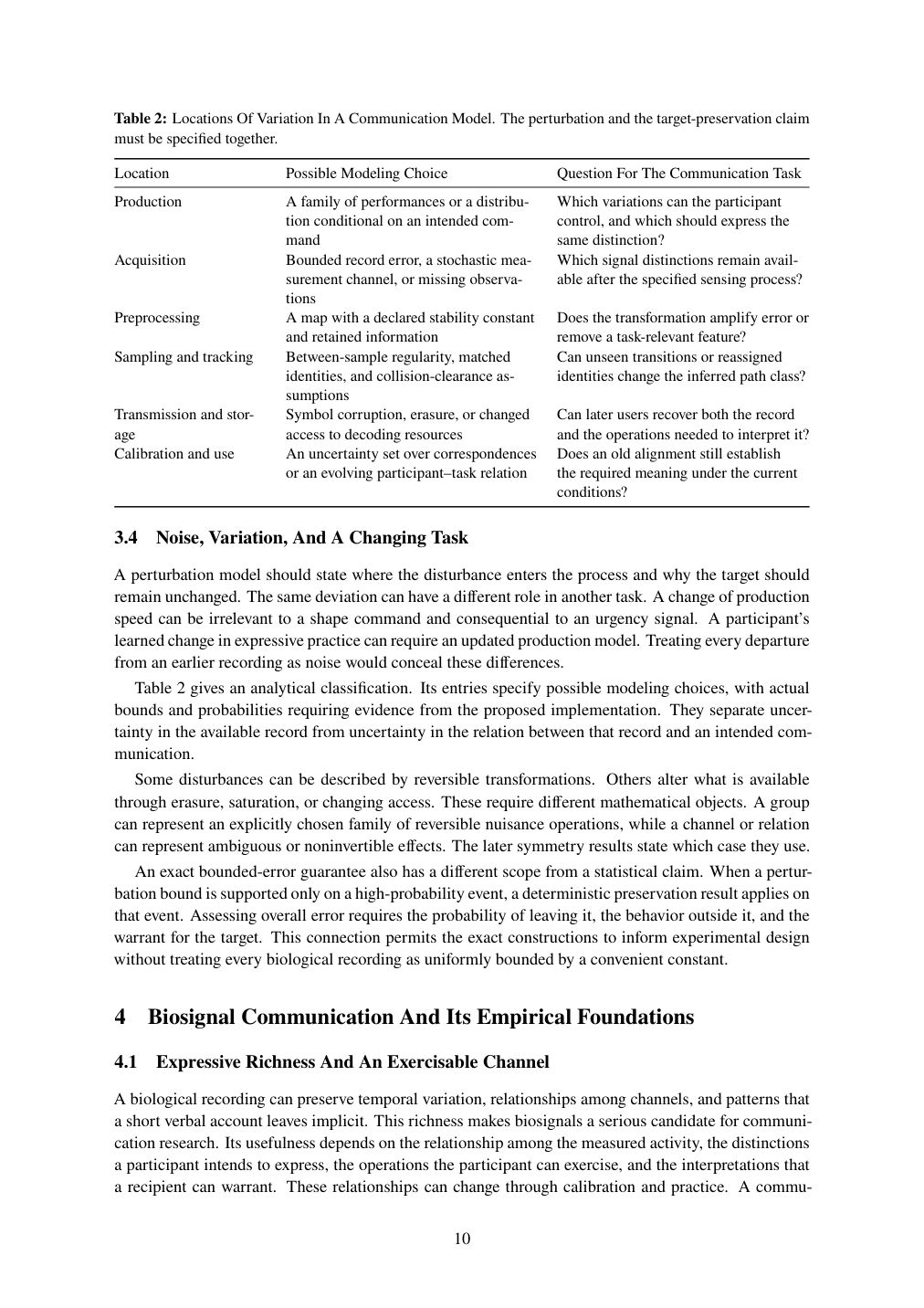
Table 2: Locations Of Variation In A Communication Model. The perturbation and the target-preservation claim
A family of performances or a distribu- tion conditional on an intended com-
Which variations can the participant control, and which should express the same distinction?
Which signal distinctions remain avail- able after the specified sensing process?
Bounded record error, a stochastic mea- surement channel, or missing observa-
Does the transformation amplify error or remove a task-relevant feature?
Between-sample regularity, matched identities, and collision-clearance as-
Can unseen transitions or reassigned identities change the inferred path class?
Can later users recover both the record and the operations needed to interpret it?
An uncertainty set over correspondences or an evolving participant–task relation
Does an old alignment still establish the required meaning under the current conditions?
A perturbation model should state where the disturbance enters the process and why the target should remain unchanged. The same deviation can have a different role in another task. A change of production speed can be irrelevant to a shape command and consequential to an urgency signal. A participant’s learned change in expressive practice can require an updated production model. Treating every departure from an earlier recording as noise would conceal these differences.
Table 2 gives an analytical classification. Its entries specify possible modeling choices, with actual bounds and probabilities requiring evidence from the proposed implementation. They separate uncer- tainty in the available record from uncertainty in the relation between that record and an intended com-
Some disturbances can be described by reversible transformations. Others alter what is available through erasure, saturation, or changing access. These require different mathematical objects. A group can represent an explicitly chosen family of reversible nuisance operations, while a channel or relation can represent ambiguous or noninvertible effects. The later symmetry results state which case they use.
An exact bounded-error guarantee also has a different scope from a statistical claim. When a pertur- bation bound is supported only on a high-probability event, a deterministic preservation result applies on that event. Assessing overall error requires the probability of leaving it, the behavior outside it, and the warrant for the target. This connection permits the exact constructions to inform experimental design without treating every biological recording as uniformly bounded by a convenient constant.
Biosignal Communication And Its Empirical Foundations
A biological recording can preserve temporal variation, relationships among channels, and patterns that a short verbal account leaves implicit. This richness makes biosignals a serious candidate for communi- cation research. Its usefulness depends on the relationship among the measured activity, the distinctions a participant intends to express, the operations the participant can exercise, and the interpretations that a recipient can warrant. These relationships can change through calibration and practice. A commu-
nication system therefore includes its participants, recording apparatus, learned transformations, and opportunities to inspect and correct the result.
Three sources of variation deserve separate records. Measurement variation concerns the recording of an underlying process. Physiological variation concerns changes in that process, including changes related to a task or a participant’s circumstances. Interpretive variation concerns the significance assigned to a measured development. A fluctuation can be measurement interference for one inquiry and a relevant physiological feature for another. The selection of a nuisance class must consequently be relative to a declared target. An invariant that removes a participant’s intended distinction can be stable while answering the wrong communicative question.
Syntactic richness also has several meanings. A continuous signal can contain many distinguishable shapes at a chosen resolution. A learned interface can make a smaller collection of those shapes available as reproducible commands. A richer repertoire can support combinations and transformations that participants learn to recognize. These are different claims. The number of measured channels or numerical samples establishes a storage dimension; evidence about controlled production, confusion, latency, and learning establishes an exercisable communicative repertoire. The proposal that biosignals offer an expressive carrier can be developed while examining the additional conditions under which that carrier becomes efficient communication.
A comparison should therefore specify the activity and its participants. An interface that restores communication to someone who cannot speak addresses a different baseline from an interface proposed to augment an already available form of writing. A record for later personal reflection differs from a message that another participant must interpret immediately. The relevant alternative can also combine biological signals with speech, gesture, spatial notation, or an executable artifact. Biosignal use then contributes selected distinctions within a larger arrangement.
4.2 Demonstrated Communication Through Neural Recordings
Willett et al. (2021) developed an intracortical interface translating attempted handwriting movements into text. Their participant, whose hand was paralyzed after spinal cord injury, achieved 90 characters per minute with 94.1% raw online accuracy; offline processing with a general-purpose autocorrect exceeded 99% accuracy. The contrast between raw online and corrected offline results belongs in the specification of the evidence. The study demonstrates an acquired neural route to a written output under its tested conditions. The declared output alphabet and attempted movement provide grounding for the interpretation.
Willett et al. (2023) demonstrated attempted-speech decoding in a participant with amyotrophic lateral sclerosis. Their reported pace was 62 words per minute, with word error rates of 9.1% for a 50-word vocabulary and 23.8% for a 125,000-word vocabulary. These are different vocabulary conditions within a particular clinical study. The comparison shows why a rate requires its error measure and task alongside it. It also shows how biological recordings can support rapid production of an established linguistic structure. The intended speech task and decoder training supply interpretive constraints whose contribution should remain visible.
More recent work extends the output beyond text. Wairagkar et al. (2025) studied a brain-to-voice system in a participant with amyotrophic lateral sclerosis and severe dysarthria. Their framework provided causal voice synthesis with auditory feedback and demonstrated task-specific modulation of question intonation, emphasis, and pitch. Some expressive control used additional decoders and prescribed acoustic modifications. The operational achievement concerns those trained tasks and the resulting voice control. The relation between a measured distinction, a decoded instruction, and an acoustic transformation is therefore part of the communicative mechanism.
Readable text
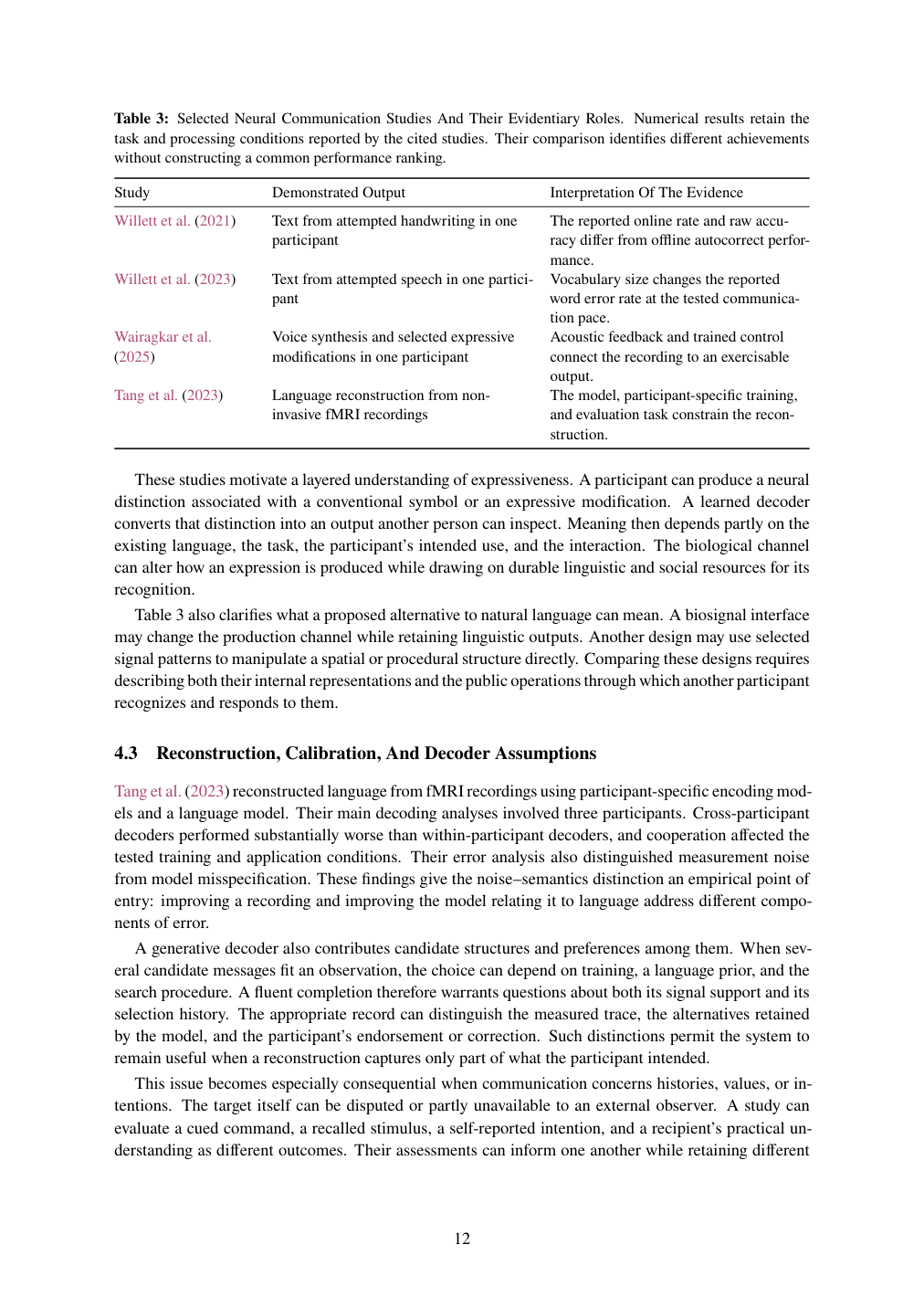
Table 3: Selected Neural Communication Studies And Their Evidentiary Roles. Numerical results retain the task and processing conditions reported by the cited studies. Their comparison identifies different achievements
The reported online rate and raw accu- racy differ from offline autocorrect perfor- mance.
Vocabulary size changes the reported word error rate at the tested communica- tion pace.
Acoustic feedback and trained control connect the recording to an exercisable output.
The model, participant-specific training, and evaluation task constrain the recon- struction.
These studies motivate a layered understanding of expressiveness. A participant can produce a neural distinction associated with a conventional symbol or an expressive modification. A learned decoder converts that distinction into an output another person can inspect. Meaning then depends partly on the existing language, the task, the participant’s intended use, and the interaction. The biological channel can alter how an expression is produced while drawing on durable linguistic and social resources for its
Table 3 also clarifies what a proposed alternative to natural language can mean. A biosignal interface may change the production channel while retaining linguistic outputs. Another design may use selected signal patterns to manipulate a spatial or procedural structure directly. Comparing these designs requires describing both their internal representations and the public operations through which another participant
Reconstruction, Calibration, And Decoder Assumptions
Tang et al. (2023) reconstructed language from fMRI recordings using participant-specific encoding mod- els and a language model. Their main decoding analyses involved three participants. Cross-participant decoders performed substantially worse than within-participant decoders, and cooperation affected the tested training and application conditions. Their error analysis also distinguished measurement noise from model misspecification. These findings give the noise–semantics distinction an empirical point of entry: improving a recording and improving the model relating it to language address different compo-
A generative decoder also contributes candidate structures and preferences among them. When sev- eral candidate messages fit an observation, the choice can depend on training, a language prior, and the search procedure. A fluent completion therefore warrants questions about both its signal support and its selection history. The appropriate record can distinguish the measured trace, the alternatives retained by the model, and the participant’s endorsement or correction. Such distinctions permit the system to remain useful when a reconstruction captures only part of what the participant intended.
This issue becomes especially consequential when communication concerns histories, values, or in- tentions. The target itself can be disputed or partly unavailable to an external observer. A study can evaluate a cued command, a recalled stimulus, a self-reported intention, and a recipient’s practical un- derstanding as different outcomes. Their assessments can inform one another while retaining different
evidentiary grounds. The GR account records those grounds through the history of production, interpretation, and subsequent response.
Calibration belongs within that history. An association acquired through repeated pairing of a signal and an action may become a resource for later communication. A recipient may learn an unfamiliar pattern through jointly observed consequences. These developments can improve task-relevant recognition without recovering the source participant’s whole experience. They can also depend on continuing conditions: an available device, a maintained decoder, familiar examples, usable feedback, or another person’s assistance. Capacity continuation then concerns the persistence of that arrangement as well as the recorded signal.
4.4 Topological And Cross-Participant Evidence
Cross-participant neural alignment supplies a related, task-specific precedent. Safaie et al. (2023) analyzed neural population recordings in monkeys and mice performing selected motor tasks. After alignment, latent dynamics supported decoding of planned or ongoing movement across individuals under the studied conditions. Their controls and modeled task distinctions connected the comparison to behavior. The relevant inference concerns those represented activities and alignment procedures. Extending it to another task, an interpreted intention, or a historical commitment requires an additional account of the retained distinctions and their grounding.
For EEG-based interfaces, the published abstract of Xu et al. (2025) reports a benchmark on three public datasets: two motor-imagery datasets and one mental-workload dataset. The evaluated topological methods performed worse in within-participant classification, while between-participant results were comparable and sometimes higher. The authors also report a relationship between persistence and spectral power. This pattern supports evaluating topological features against task-appropriate alternatives and examining which information a feature actually retains. The present discussion relies on the abstract-level report; the source audit records that access limit.
These examples connect the formal results to an experimental responsibility. A topological stability theorem concerns a declared representation and perturbation. A decoder study concerns measured data, a learned procedure, and particular evaluation conditions. A communication claim concerns what participants can express, recognize, and undertake through that procedure. An application should trace the links among these three claims. Doing so permits topology to contribute a specific robustness mechanism while preserving the need to evaluate task discrimination, interpretation, and continuing usability.
5 Topological Representations And Controlled Perturbations
A biosignal is recorded through a physical and computational chain. Electrode placement, sensor noise, background activity, preprocessing, discretization, and learned representation each affect the resulting object. A topological construction can make a selected feature stable under a stated perturbation, or invariant under a declared transformation. These achievements become useful for communication when the retained distinctions support the communicative task. This section develops precise versions of that possibility and specifies the additional conditions needed to carry a mathematical stability statement back to an acquisition process.
There are three connected objects to distinguish. The first is the measured activity and its recording. The second is an analytic representation, such as a filtered complex or a path in a configuration space. The third is the expression or response recognized through that representation. Stability of the second object can support reliability of the third when a decoder has a suitable separation margin. Establishing those margins and their relevance requires observations and semantic grounding appropriate to the participants and task.
Readable text
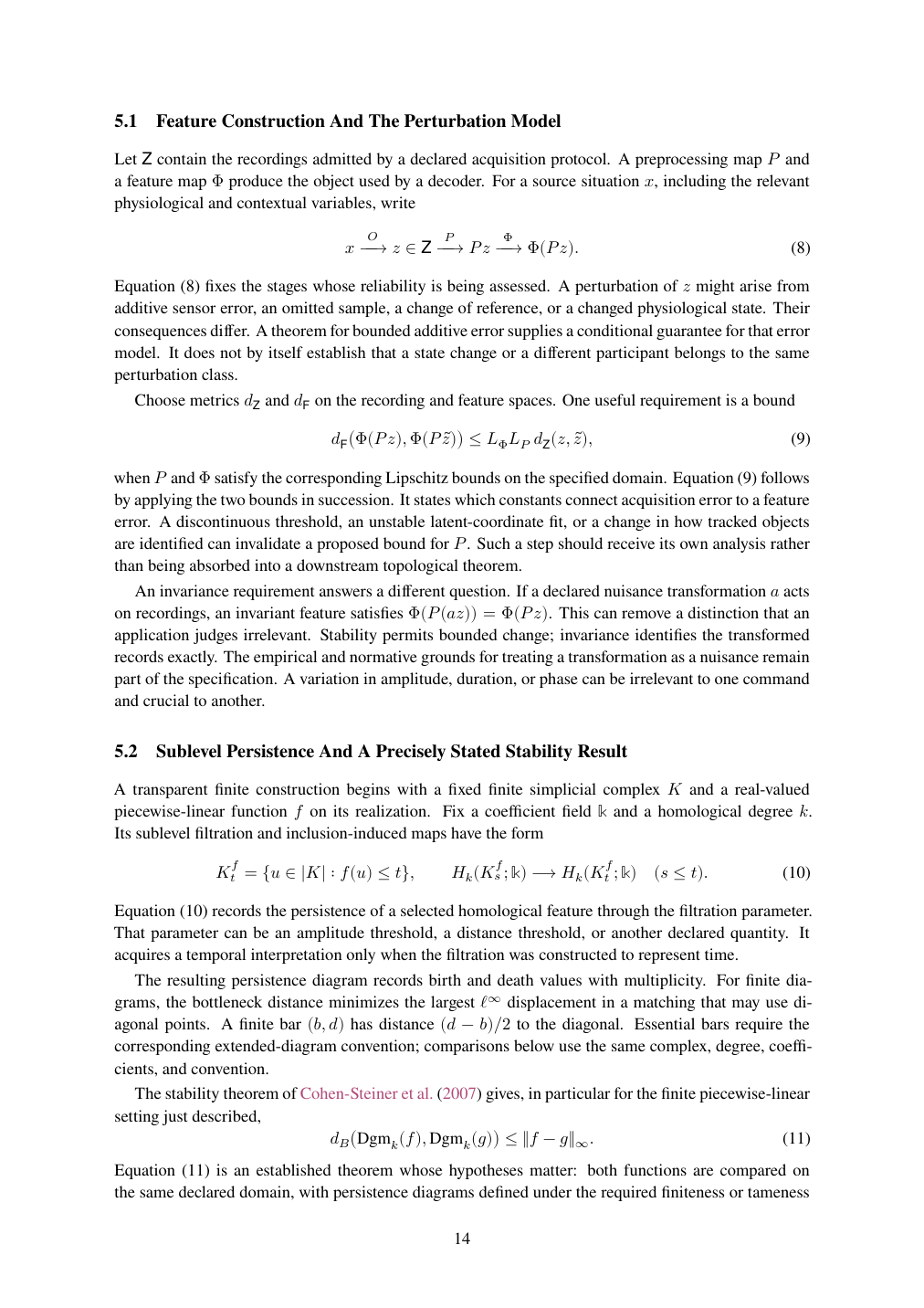
additive sensor error, an omitted sample, a change of reference, or a changed physiological state. Their consequences differ. A theorem for bounded additive error supplies a conditional guarantee for that error model. It does not by itself establish that a state change or a different participant belongs to the same
by applying the two bounds in succession. It states which constants connect acquisition error to a feature error. A discontinuous threshold, an unstable latent-coordinate fit, or a change in how tracked objects than being absorbed into a downstream topological theorem.
application judges irrelevant. Stability permits bounded change; invariance identifies the transformed records exactly. The empirical and normative grounds for treating a transformation as a nuisance remain part of the specification. A variation in amplitude, duration, or phase can be irrelevant to one command
Sublevel Persistence And A Precisely Stated Stability Result
Its sublevel filtration and inclusion-induced maps have the form
Equation (10) records the persistence of a selected homological feature through the filtration parameter. That parameter can be an amplitude threshold, a distance threshold, or another declared quantity. It acquires a temporal interpretation only when the filtration was constructed to represent time.
The resulting persistence diagram records birth and death values with multiplicity. For finite dia- corresponding extended-diagram convention; comparisons below use the same complex, degree, coeffi-
The stability theorem of Cohen-Steiner et al. (2007) gives, in particular for the finite piecewise-linear
Equation (11) is an established theorem whose hypotheses matter: both functions are compared on the same declared domain, with persistence diagrams defined under the required finiteness or tameness
Readable text
conditions. The result concerns the selected persistence representation. A communicative interpretation requires a further link between diagram distinctions and the expression under consideration.
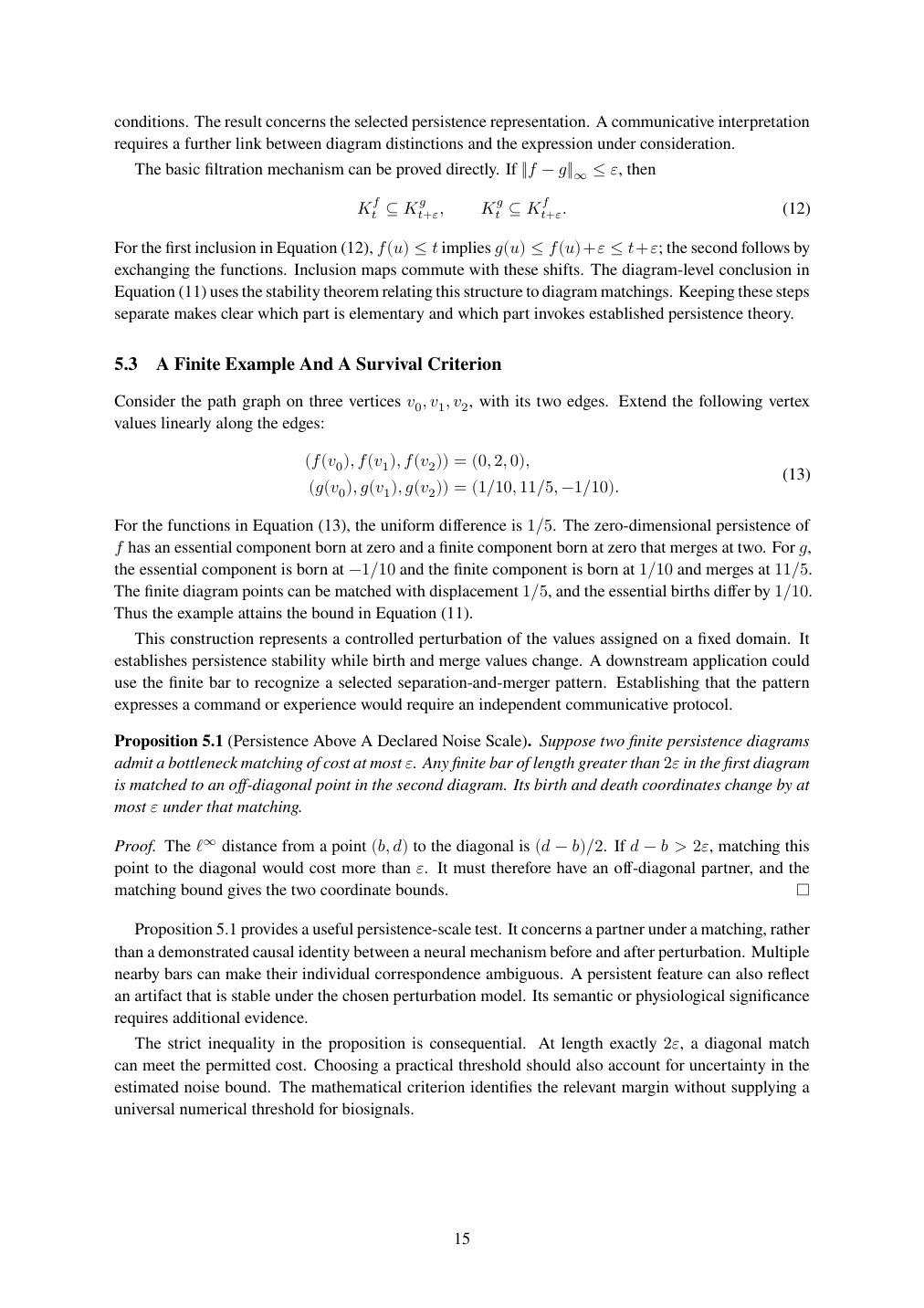
exchanging the functions. Inclusion maps commute with these shifts. The diagram-level conclusion in Equation (11) uses the stability theorem relating this structure to diagram matchings. Keeping these steps separate makes clear which part is elementary and which part invokes established persistence theory.
This construction represents a controlled perturbation of the values assigned on a fixed domain. It establishes persistence stability while birth and merge values change. A downstream application could use the finite bar to recognize a selected separation-and-merger pattern. Establishing that the pattern expresses a command or experience would require an independent communicative protocol.
Proposition 5.1 (Persistence Above A Declared Noise Scale). Suppose two finite persistence diagrams is matched to an off-diagonal point in the second diagram. Its birth and death coordinates change by at
Proposition 5.1 provides a useful persistence-scale test. It concerns a partner under a matching, rather than a demonstrated causal identity between a neural mechanism before and after perturbation. Multiple nearby bars can make their individual correspondence ambiguous. A persistent feature can also reflect an artifact that is stable under the chosen perturbation model. Its semantic or physiological significance
can meet the permitted cost. Choosing a practical threshold should also account for uncertainty in the estimated noise bound. The mathematical criterion identifies the relevant margin without supplying a
Readable text
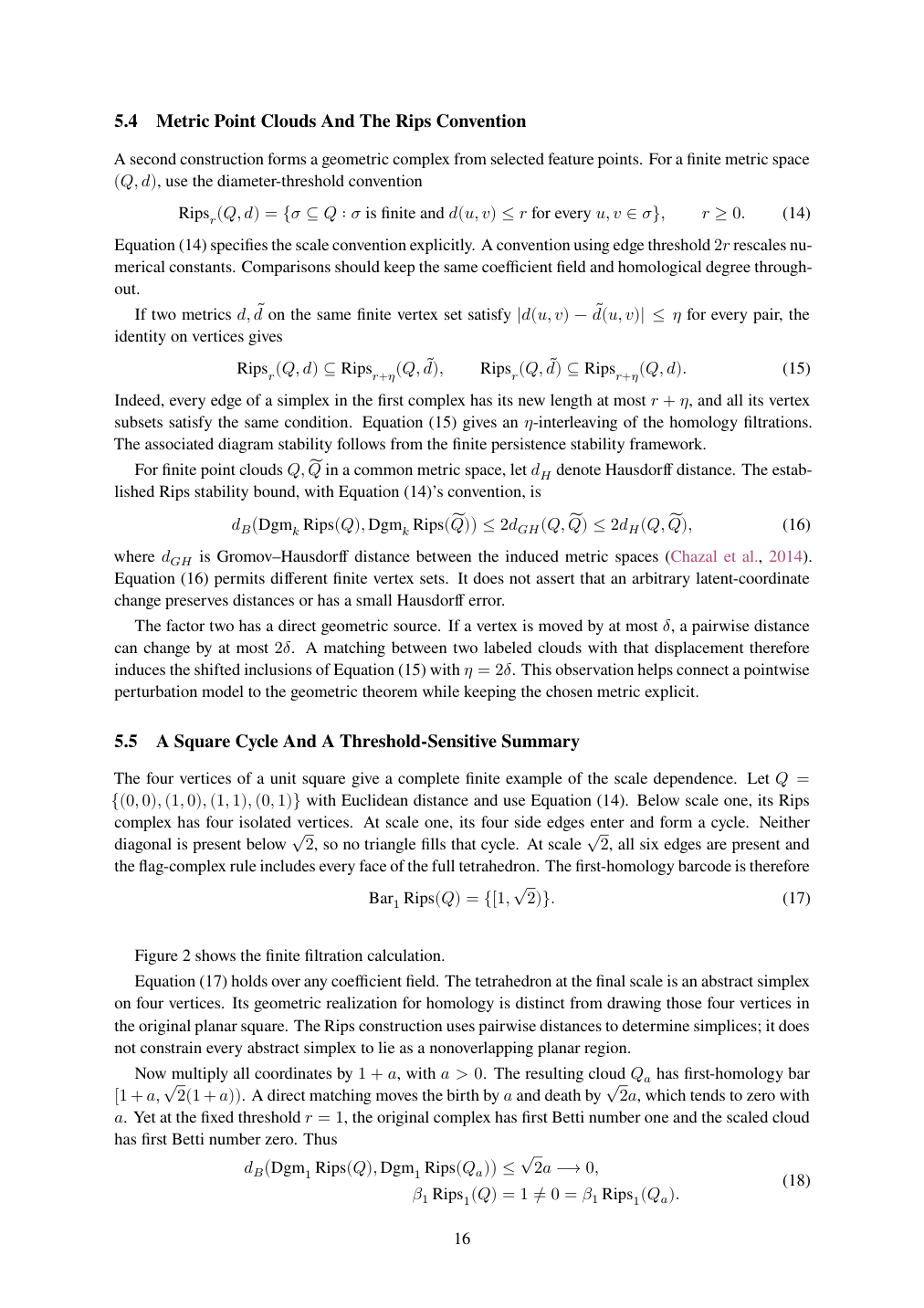
A second construction forms a geometric complex from selected feature points. For a finite metric space
merical constants. Comparisons should keep the same coefficient field and homological degree through-
The associated diagram stability follows from the finite persistence stability framework.
lished Rips stability bound, with Equation (14)’s convention, is
Equation (16) permits different finite vertex sets. It does not assert that an arbitrary latent-coordinate change preserves distances or has a small Hausdorff error.
perturbation model to the geometric theorem while keeping the chosen metric explicit.
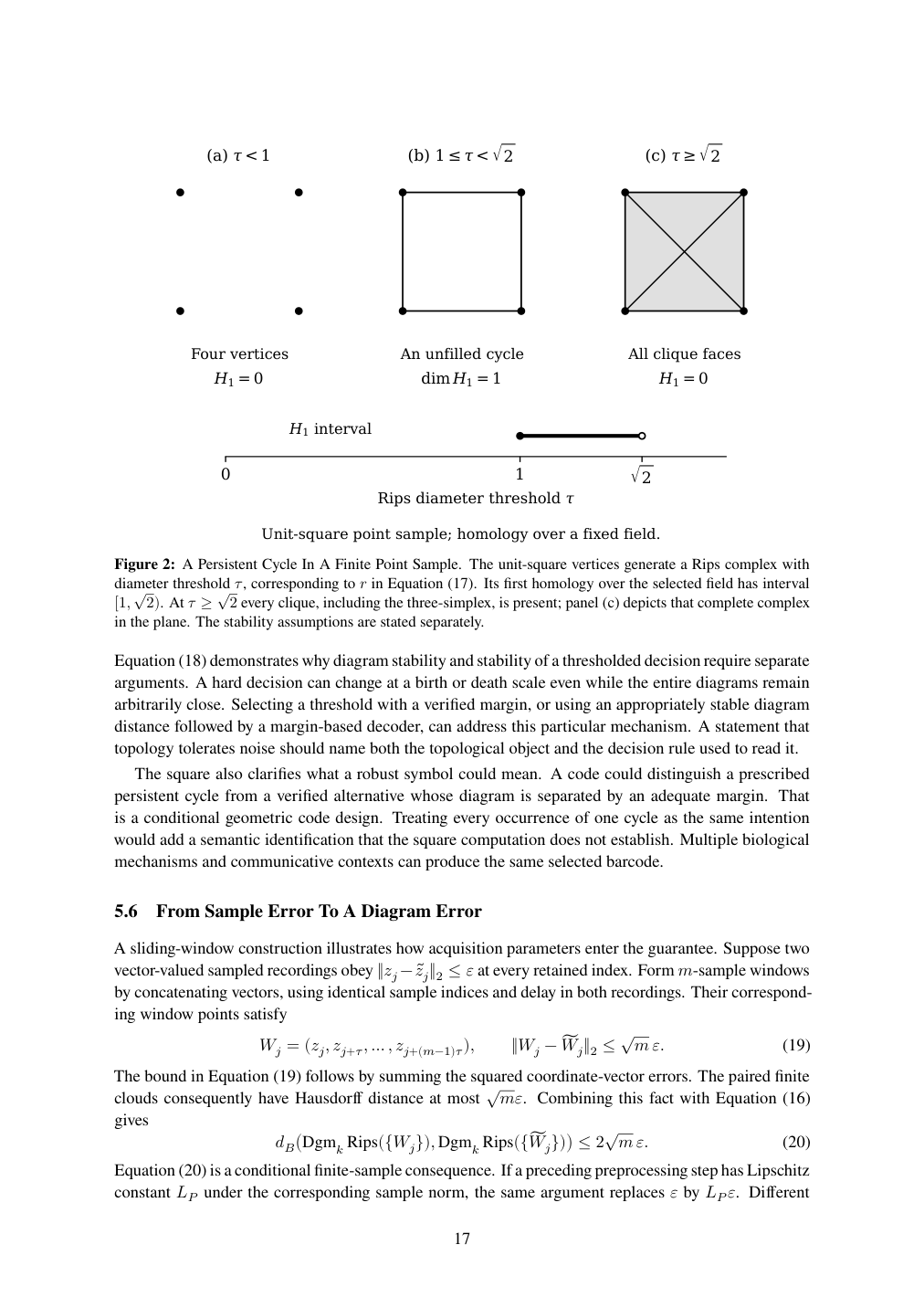
complex has four isolated vertices. At scale one, its four side edges enter and form a cycle. Neither
the flag-complex rule includes every face of the full tetrahedron. The first-homology barcode is therefore
Equation (17) holds over any coefficient field. The tetrahedron at the final scale is an abstract simplex on four vertices. Its geometric realization for homology is distinct from drawing those four vertices in the original planar square. The Rips construction uses pairwise distances to determine simplices; it does not constrain every abstract simplex to lie as a nonoverlapping planar region.
Readable text
Figure 2: A Persistent Cycle In A Finite Point Sample. The unit-square vertices generate a Rips complex with
in the plane. The stability assumptions are stated separately.
Equation (18) demonstrates why diagram stability and stability of a thresholded decision require separate arguments. A hard decision can change at a birth or death scale even while the entire diagrams remain arbitrarily close. Selecting a threshold with a verified margin, or using an appropriately stable diagram distance followed by a margin-based decoder, can address this particular mechanism. A statement that topology tolerates noise should name both the topological object and the decision rule used to read it.
The square also clarifies what a robust symbol could mean. A code could distinguish a prescribed persistent cycle from a verified alternative whose diagram is separated by an adequate margin. That is a conditional geometric code design. Treating every occurrence of one cycle as the same intention would add a semantic identification that the square computation does not establish. Multiple biological mechanisms and communicative contexts can produce the same selected barcode.
A sliding-window construction illustrates how acquisition parameters enter the guarantee. Suppose two by concatenating vectors, using identical sample indices and delay in both recordings. Their correspond-
The bound in Equation (19) follows by summing the squared coordinate-vector errors. The paired finite
Equation (20) is a conditional finite-sample consequence. If a preceding preprocessing step has Lipschitz
Readable text
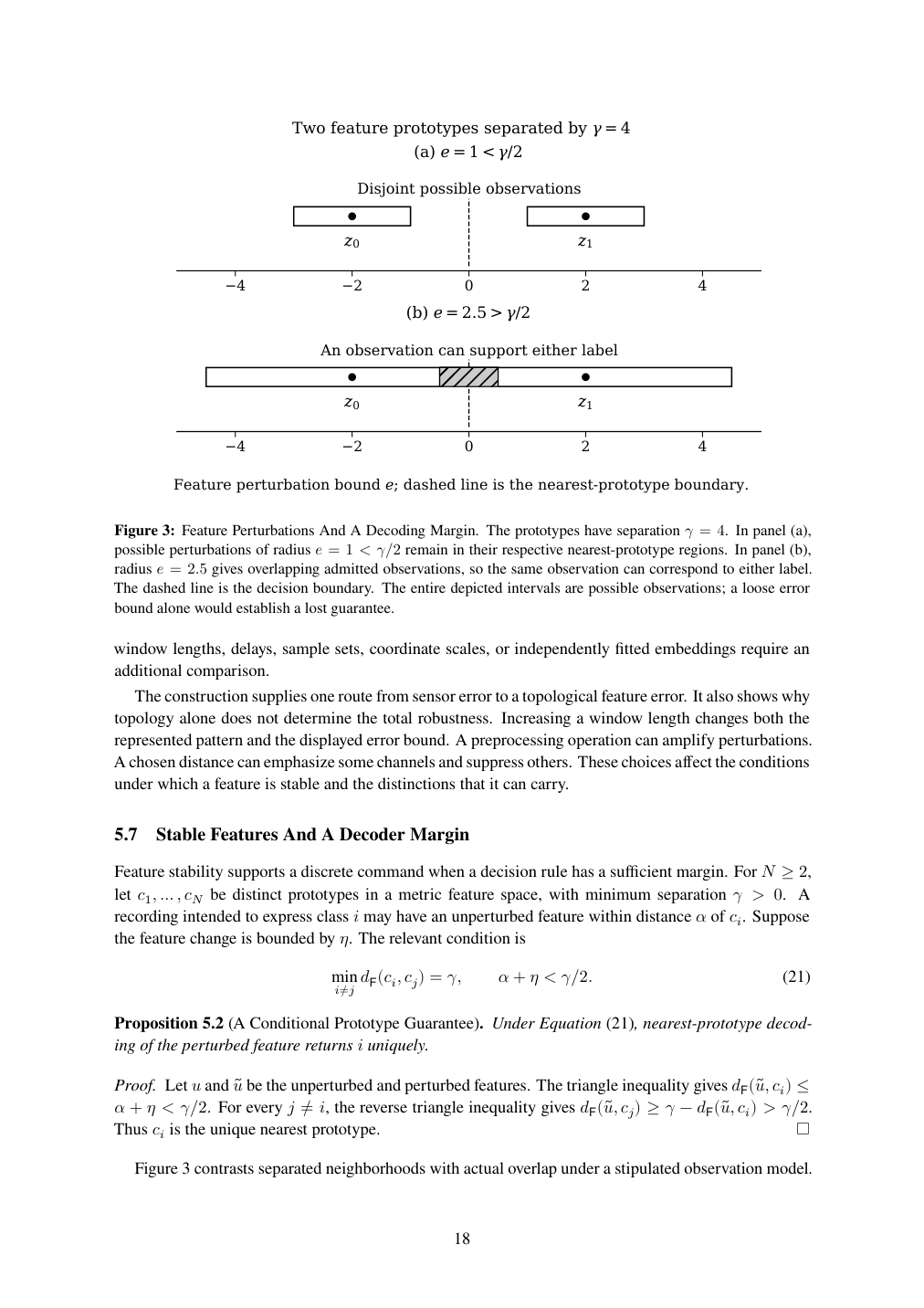
Feature perturbation bound e; dashed line is the nearest-prototype boundary.
The dashed line is the decision boundary. The entire depicted intervals are possible observations; a loose error
window lengths, delays, sample sets, coordinate scales, or independently fitted embeddings require an
The construction supplies one route from sensor error to a topological feature error. It also shows why topology alone does not determine the total robustness. Increasing a window length changes both the represented pattern and the displayed error bound. A preprocessing operation can amplify perturbations. A chosen distance can emphasize some channels and suppress others. These choices affect the conditions under which a feature is stable and the distinctions that it can carry.
Proposition 5.2 (A Conditional Prototype Guarantee). Under Equation (21), nearest-prototype decod-
Figure 3 contrasts separated neighborhoods with actual overlap under a stipulated observation model.
Readable text
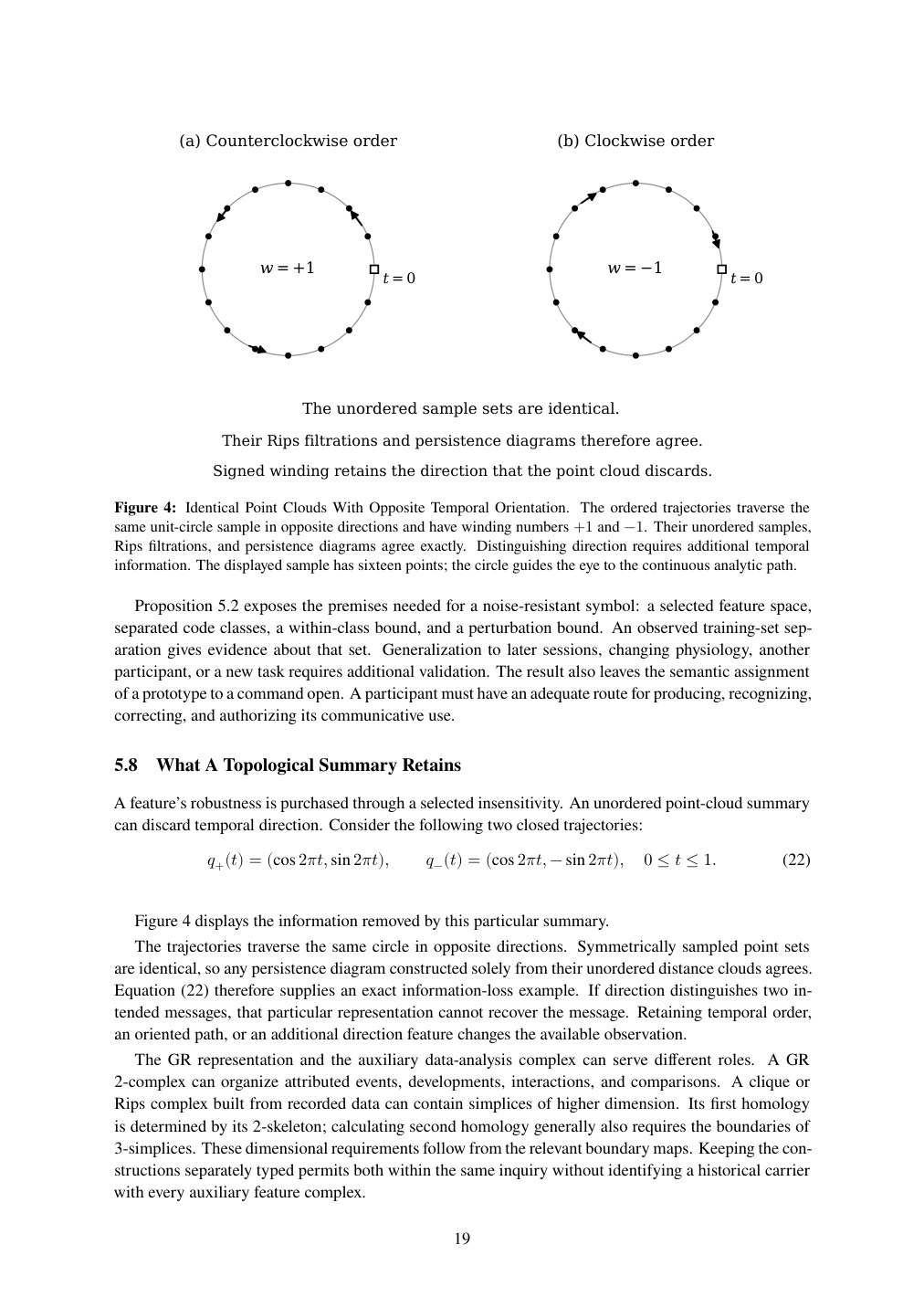
Their Rips filtrations and persistence diagrams therefore agree.
Signed winding retains the direction that the point cloud discards.
Figure 4: Identical Point Clouds With Opposite Temporal Orientation. The ordered trajectories traverse the Rips filtrations, and persistence diagrams agree exactly. Distinguishing direction requires additional temporal information. The displayed sample has sixteen points; the circle guides the eye to the continuous analytic path.
Proposition 5.2 exposes the premises needed for a noise-resistant symbol: a selected feature space, separated code classes, a within-class bound, and a perturbation bound. An observed training-set sep- aration gives evidence about that set. Generalization to later sessions, changing physiology, another participant, or a new task requires additional validation. The result also leaves the semantic assignment of a prototype to a command open. A participant must have an adequate route for producing, recognizing,
A feature’s robustness is purchased through a selected insensitivity. An unordered point-cloud summary can discard temporal direction. Consider the following two closed trajectories:
Figure 4 displays the information removed by this particular summary.
The trajectories traverse the same circle in opposite directions. Symmetrically sampled point sets are identical, so any persistence diagram constructed solely from their unordered distance clouds agrees. Equation (22) therefore supplies an exact information-loss example. If direction distinguishes two in- tended messages, that particular representation cannot recover the message. Retaining temporal order, an oriented path, or an additional direction feature changes the available observation.
The GR representation and the auxiliary data-analysis complex can serve different roles. A GR 2-complex can organize attributed events, developments, interactions, and comparisons. A clique or Rips complex built from recorded data can contain simplices of higher dimension. Its first homology is determined by its 2-skeleton; calculating second homology generally also requires the boundaries of 3-simplices. These dimensional requirements follow from the relevant boundary maps. Keeping the con- structions separately typed permits both within the same inquiry without identifying a historical carrier
Readable text
There are specific neural precedents for investigating topology. Giusti et al. (2015) used rank-based clique topology to investigate geometric organization in neural correlation data. Their invariance con- cerns the ordering of matrix entries under the specified monotone transformations; arbitrary pertur- bations can change that ordering. Gardner et al. (2022) investigated toroidal organization in popula- tion recordings from grid-cell modules. That result concerns a particular neural system and analysis. Together these works motivate testing structural features of activity while leaving the communicative meaning of a new biosignal code to be established through its own task and evidence.
Persistent homology can summarize multiscale structure, whereas a braid construction can retain se- lected ordering among tracked developments. Its potential for communication concerns the preservation of a path class when the detailed trajectories vary. A rigorous application begins by specifying what the strands are, how their identities persist, which configuration space they occupy, and which perturbations
Equation (24) distinguishes the pure braid group from the full braid group. An unordered loop can return the point set to its initial position while permuting the individual points. An ordered loop returns each identified point to its own starting position. The configuration-space interpretation and the classical algebraic development are established parts of braid theory (Fox and Neuwirth, 1962; Artin, 1947).
A biosignal application must construct the points in Equation (23). They could be tracked features in a selected two-dimensional state reduction. Their identities and the reduction would need empirical support. Drawing several scalar EEG traces against time does not by itself supply the required noncol- liding planar points: crossings of scalar traces may be equality events in the chosen scalar coordinate, while an arbitrary over/under convention adds unmeasured structure. A meaningful braid representation needs a declared observation map into a configuration space, together with an account of what its strand
The dimension matters. The classical braid groups in Equation (24) concern motion in a plane. Changing the ambient space changes its configuration topology. A projection of high-dimensional neu- ral activity into two dimensions can create apparent encounters or remove distinctions. Its selection must therefore be justified for the task rather than inferred from the visual appeal of a braid diagram.
A general recording window gives a path between configurations; it need not return to a base configu- ration. The natural object is then its endpoint-fixed homotopy class in the fundamental groupoid. Two such path classes compose when the target configuration of the first equals the source of the next. A based loop gives a group element as the special case with equal endpoints.
Readable text
This typing has practical consequences. Comparing two windows with different endpoint configura- tions requires a specified identification or connector. Closing every observed path by an arbitrary return route can change its braid class. Changing the basepoint of an already closed loop by a declared path induces the usual conjugation relation. These are different operations. An application should preserve the chosen connectors and their provenance if they affect the resulting symbol.
The path description can coexist with a GR history. A represented event can produce a feature con- figuration, and a subsequent episode can generate a path from it. A selected 2-cell can record a justified path comparison with matching boundaries. Whether that comparison is treated as equality under a de- coder, a proposed correction, or a divergence remains part of its semantic type. Topological homotopy supplies one explicit comparison relation when its domain and boundary conditions are satisfied.
The generators in Equation (25) describe elementary exchanges under a fixed geometric convention. A word records a composition; the relations identify words representing the same braid. Word length or a raw count of plotted intersections is consequently a property of a chosen description, unless an invariant
Equation (28) proves the asserted nonidentity. The example shows that net signed exchange count can discard order information retained by the braid class. Such information could matter when a proposed
signal expresses a sequence of relational operations.
The matrix representation also compresses. Direct multiplication gives
The braid in Equation (29) is nonidentity because its exponent sum differs from zero, yet its matrix image is the identity. Thus this particular matrix summary is useful as a nonidentity witness and re- mains nonfaithful globally. Any practical finite codebook should verify that its selected classes remain distinguishable under the actual feature map used by the decoder.
Readable text
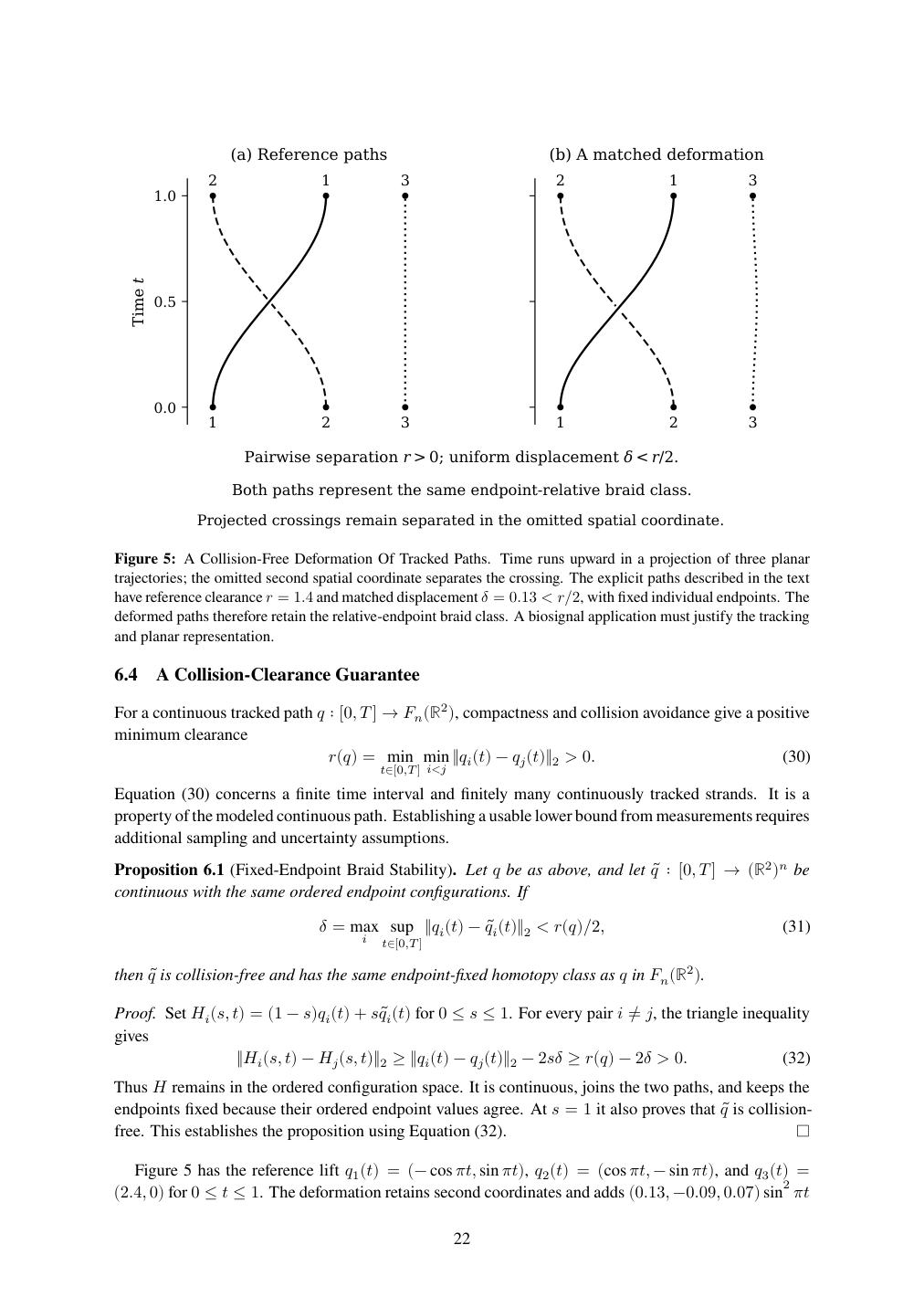
Both paths represent the same endpoint-relative braid class.
Projected crossings remain separated in the omitted spatial coordinate.
Figure 5: A Collision-Free Deformation Of Tracked Paths. Time runs upward in a projection of three planar trajectories; the omitted second spatial coordinate separates the crossing. The explicit paths described in the text deformed paths therefore retain the relative-endpoint braid class. A biosignal application must justify the tracking
Equation (30) concerns a finite time interval and finitely many continuously tracked strands. It is a property of the modeled continuous path. Establishing a usable lower bound from measurements requires
continuous with the same ordered endpoint configurations. If
free. This establishes the proposition using Equation (32).
Readable text
strand retains the reference strand’s endpoints. The reference ordered endpoints differ by a permutation,
Projection of this homotopy to the unordered configuration space preserves the corresponding path class there. For ordered loops it preserves the pure braid element, and for projected loops it preserves the full braid element. Proposition 6.1 therefore gives a precise version of topological noise resistance
The guarantee is conditional on tracking, endpoints, and the uniform bound. A relabeling error can change which reconstructed strand corresponds to which original strand. A collision or near-collision can make the permitted perturbation radius small. An amplitude error bound before an unstable two- dimensional embedding may fail to imply Equation (31). These are concrete failure modes to measure
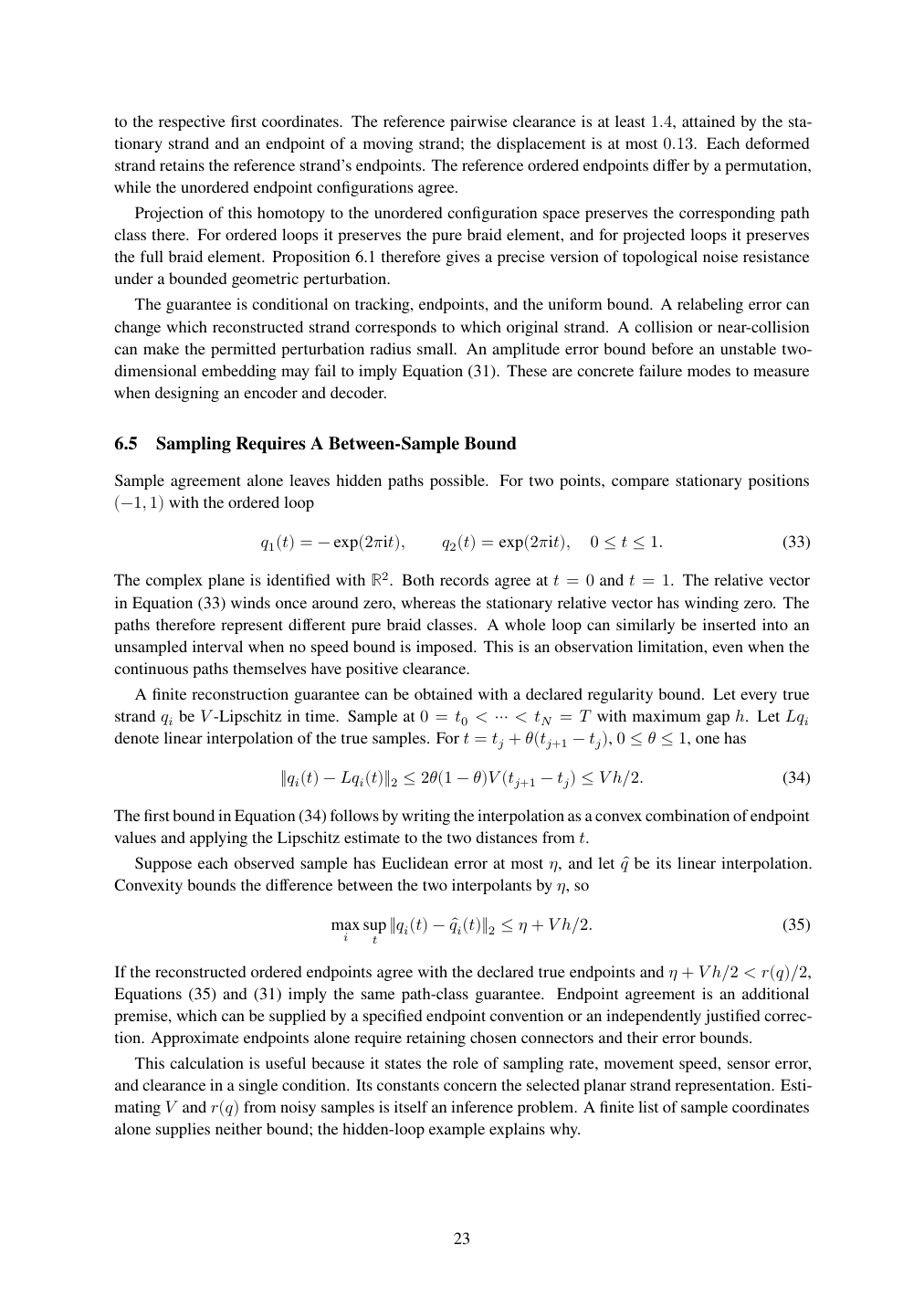
Sample agreement alone leaves hidden paths possible. For two points, compare stationary positions
in Equation (33) winds once around zero, whereas the stationary relative vector has winding zero. The paths therefore represent different pure braid classes. A whole loop can similarly be inserted into an unsampled interval when no speed bound is imposed. This is an observation limitation, even when the
continuous paths themselves have positive clearance.
A finite reconstruction guarantee can be obtained with a declared regularity bound. Let every true
The first bound in Equation (34) follows by writing the interpolation as a convex combination of endpoint
Equations (35) and (31) imply the same path-class guarantee. Endpoint agreement is an additional premise, which can be supplied by a specified endpoint convention or an independently justified correc- tion. Approximate endpoints alone require retaining chosen connectors and their error bounds.
This calculation is useful because it states the role of sampling rate, movement speed, sensor error, and clearance in a single condition. Its constants concern the selected planar strand representation. Esti- alone supplies neither bound; the hidden-loop example explains why.
6.6 Temporal Reparametrization And Temporal Meaning



Separate clock changes for different strands require a different analysis: they can alter their relative timing and can produce collisions in the derived representation. Reversing a based loop gives the inverse group element. Declaring reversal or independent timing variation irrelevant would therefore impose additional identifications, potentially removing a communicatively important distinction. The desired invariance must follow the task’s meaning rather than the convenience of its computation.
A practical braid code could assign a finite set of verified distinct classes to selected expressions, with participant-specific production and decoding support. The clearance argument would secure class preservation under its stated geometric perturbations. A symbol assignment, a reliable method of voluntary production, and a procedure for confirming intended meaning would complete different parts of the communication system. The representation’s algebraic richness supplies possible distinctions; efficiency depends on how readily participants can use them.
7 The Analogy With Topological Quantum Computation
Topological quantum computation offers a substantial mathematical inspiration for this proposal. In suitable physical models, encoded information is associated with a protected quantum subspace, while operations can depend on classes of quasiparticle exchanges. Kitaev (2003) provides a foundational construction of fault-tolerant computation using anyons. Nayak et al. (2008) develops the relation between separated non-Abelian quasiparticles, protected state spaces, braiding operations, and relevant error mechanisms. The biological proposal here borrows a design question from this work: which perturbations can change detailed realizations while preserving the operative encoded object?
7.1 Three Different Sources Of Reliability
The comparison requires identifying the level at which protection occurs. A classical persistence feature has a bound relating input and output perturbations. A geometric braid class is unchanged under a permitted endpoint-fixed homotopy. A topological quantum device relies on a particular physical realization whose low-energy encoded states and controlled operations have specified responses to local disturbances. These mechanisms have different hypotheses and different failure modes.
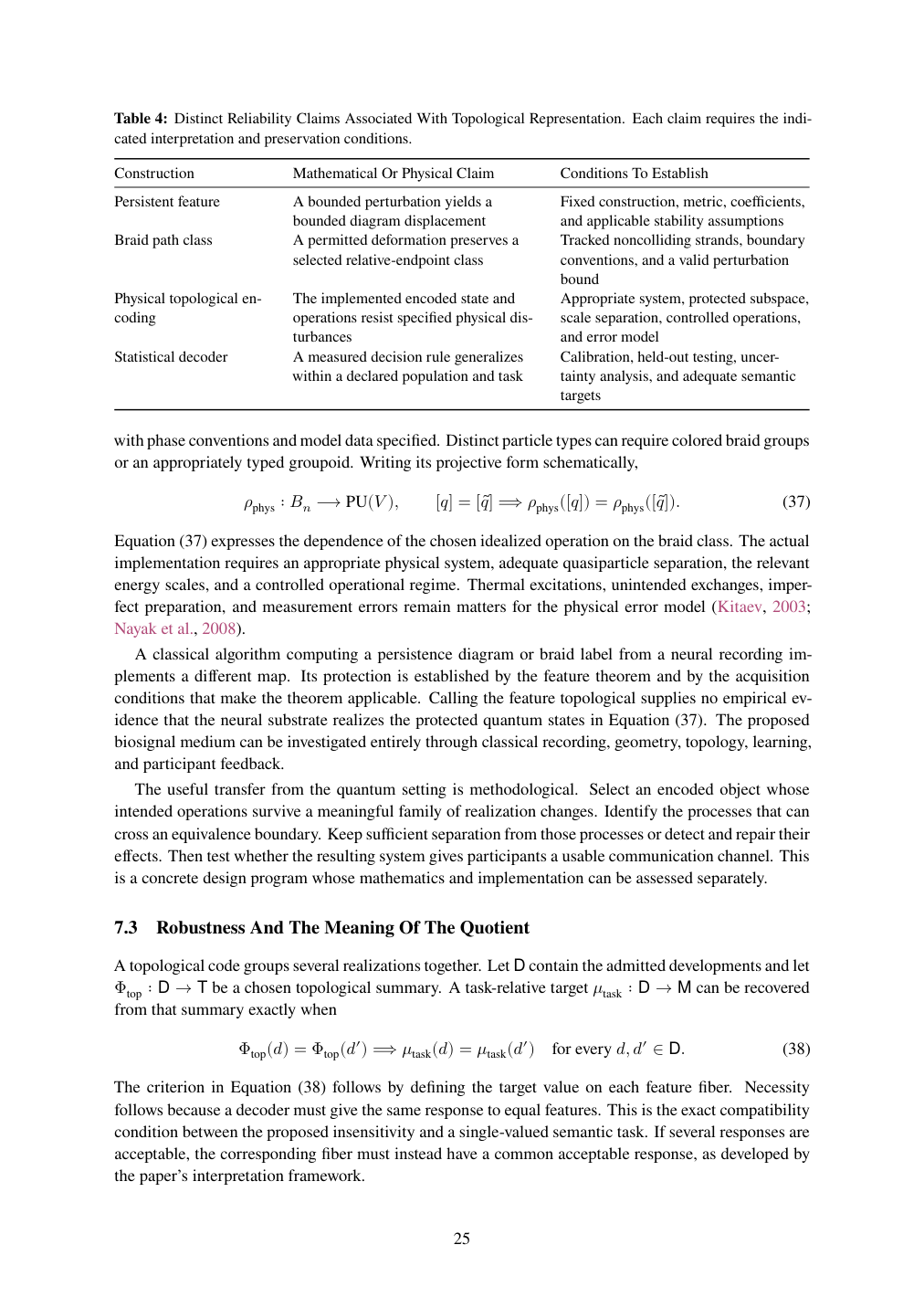
Table 4 separates structural stability from statistical success. A stable map can preserve the wrong feature for a task. A highly accurate classifier on a familiar distribution can use fragile distinctions. A geometric topological code can lose its protection when the physical or computational process creates collisions, tracking errors, or unobserved transitions. Combining the advantages requires evidence at each stage.
7.2 What The Physical Analogy Requires

Readable text
Table 4: Distinct Reliability Claims Associated With Topological Representation. Each claim requires the indi-
A bounded perturbation yields a bounded diagram displacement
Fixed construction, metric, coefficients, and applicable stability assumptions
A permitted deformation preserves a selected relative-endpoint class
Tracked noncolliding strands, boundary conventions, and a valid perturbation bound
The implemented encoded state and operations resist specified physical dis-
Appropriate system, protected subspace, scale separation, controlled operations, and error model
A measured decision rule generalizes within a declared population and task
Calibration, held-out testing, uncer- tainty analysis, and adequate semantic targets
with phase conventions and model data specified. Distinct particle types can require colored braid groups or an appropriately typed groupoid. Writing its projective form schematically,
Equation (37) expresses the dependence of the chosen idealized operation on the braid class. The actual implementation requires an appropriate physical system, adequate quasiparticle separation, the relevant energy scales, and a controlled operational regime. Thermal excitations, unintended exchanges, imper- fect preparation, and measurement errors remain matters for the physical error model (Kitaev, 2003;
A classical algorithm computing a persistence diagram or braid label from a neural recording im- plements a different map. Its protection is established by the feature theorem and by the acquisition conditions that make the theorem applicable. Calling the feature topological supplies no empirical ev- idence that the neural substrate realizes the protected quantum states in Equation (37). The proposed biosignal medium can be investigated entirely through classical recording, geometry, topology, learning,
The useful transfer from the quantum setting is methodological. Select an encoded object whose intended operations survive a meaningful family of realization changes. Identify the processes that can cross an equivalence boundary. Keep sufficient separation from those processes or detect and repair their effects. Then test whether the resulting system gives participants a usable communication channel. This is a concrete design program whose mathematics and implementation can be assessed separately.
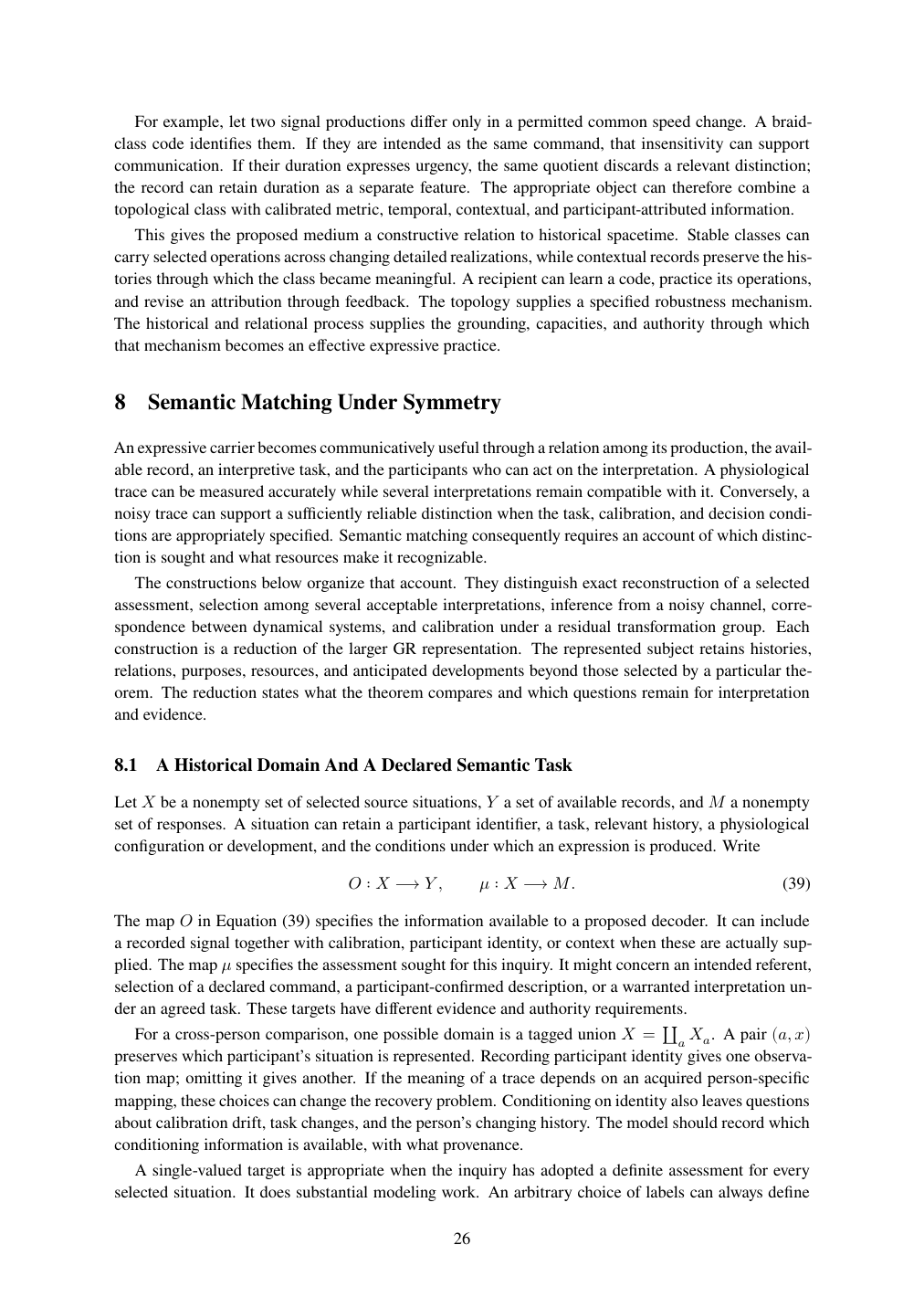
A topological code groups several realizations together. Let D contain the admitted developments and let
The criterion in Equation (38) follows by defining the target value on each feature fiber. Necessity follows because a decoder must give the same response to equal features. This is the exact compatibility condition between the proposed insensitivity and a single-valued semantic task. If several responses are acceptable, the corresponding fiber must instead have a common acceptable response, as developed by
Readable text
For example, let two signal productions differ only in a permitted common speed change. A braid- class code identifies them. If they are intended as the same command, that insensitivity can support communication. If their duration expresses urgency, the same quotient discards a relevant distinction; the record can retain duration as a separate feature. The appropriate object can therefore combine a topological class with calibrated metric, temporal, contextual, and participant-attributed information.
This gives the proposed medium a constructive relation to historical spacetime. Stable classes can carry selected operations across changing detailed realizations, while contextual records preserve the his- tories through which the class became meaningful. A recipient can learn a code, practice its operations, and revise an attribution through feedback. The topology supplies a specified robustness mechanism. The historical and relational process supplies the grounding, capacities, and authority through which that mechanism becomes an effective expressive practice.
An expressive carrier becomes communicatively useful through a relation among its production, the avail- able record, an interpretive task, and the participants who can act on the interpretation. A physiological trace can be measured accurately while several interpretations remain compatible with it. Conversely, a noisy trace can support a sufficiently reliable distinction when the task, calibration, and decision condi- tions are appropriately specified. Semantic matching consequently requires an account of which distinc- tion is sought and what resources make it recognizable.
The constructions below organize that account. They distinguish exact reconstruction of a selected assessment, selection among several acceptable interpretations, inference from a noisy channel, corre- spondence between dynamical systems, and calibration under a residual transformation group. Each construction is a reduction of the larger GR representation. The represented subject retains histories, relations, purposes, resources, and anticipated developments beyond those selected by a particular the- orem. The reduction states what the theorem compares and which questions remain for interpretation
set of responses. A situation can retain a participant identifier, a task, relevant history, a physiological configuration or development, and the conditions under which an expression is produced. Write
a recorded signal together with calibration, participant identity, or context when these are actually sup- selection of a declared command, a participant-confirmed description, or a warranted interpretation un- der an agreed task. These targets have different evidence and authority requirements.
preserves which participant’s situation is represented. Recording participant identity gives one observa- tion map; omitting it gives another. If the meaning of a trace depends on an acquired person-specific mapping, these choices can change the recovery problem. Conditioning on identity also leaves questions about calibration drift, task changes, and the person’s changing history. The model should record which conditioning information is available, with what provenance.
A single-valued target is appropriate when the inquiry has adopted a definite assessment for every selected situation. It does substantial modeling work. An arbitrary choice of labels can always define
a function, whereas a claim that those labels describe intention, experience, or justified interpretation needs independent support. The mathematical criterion therefore concerns recovery of a stipulated target. It supplies a way to test a representation once the semantic question and its warrant have been established.
An expressive biosignal also has a production status. A deliberately learned control pattern, an involuntary response, an inferred affective state, and a response to an externally presented stimulus are different objects. Evidence that a model predicts one of them establishes a corresponding bounded claim. Treating the output as an endorsed communication additionally requires a communicative practice and an appropriate confirmation relation. GR retains this difference through attributed events and roles in the history of production and use.
8.2 Exact Recovery And The Observation Fibers
The elementary factorization criterion identifies what an exact record must preserve. It applies to biosignals, words, diagrams, and combined artifacts alike.
Proposition 8.1 (Exact Task-Relative Recovery). For the functions in Equation (39), exact recovery is characterized by




The existence in Proposition 8.1 is set-theoretic. A decoder can exist without being effectively computable from a given description, learnable from the available examples, continuous, stable under perturbation, or usable within the participant’s resources. For finite explicitly supplied tables, one can construct it by inspecting fibers. Establishing those tables from a real encounter requires observations and interpretation. These are separate steps in an implementation argument.

8.3 Several Acceptable Interpretations

Readable text
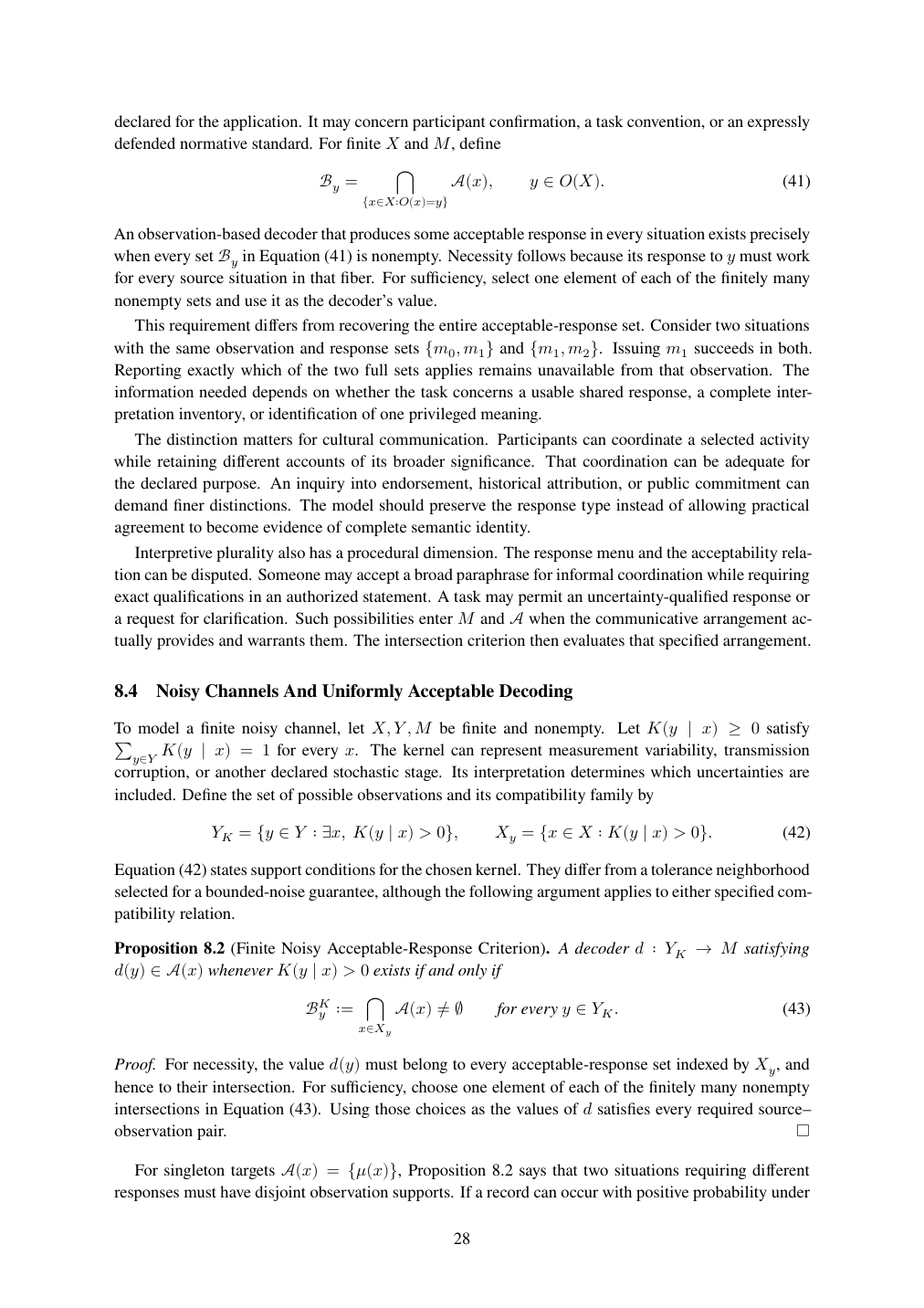
declared for the application. It may concern participant confirmation, a task convention, or an expressly
An observation-based decoder that produces some acceptable response in every situation exists precisely for every source situation in that fiber. For sufficiency, select one element of each of the finitely many
This requirement differs from recovering the entire acceptable-response set. Consider two situations Reporting exactly which of the two full sets applies remains unavailable from that observation. The information needed depends on whether the task concerns a usable shared response, a complete inter- pretation inventory, or identification of one privileged meaning.
The distinction matters for cultural communication. Participants can coordinate a selected activity while retaining different accounts of its broader significance. That coordination can be adequate for the declared purpose. An inquiry into endorsement, historical attribution, or public commitment can demand finer distinctions. The model should preserve the response type instead of allowing practical agreement to become evidence of complete semantic identity.
Interpretive plurality also has a procedural dimension. The response menu and the acceptability rela- tion can be disputed. Someone may accept a broad paraphrase for informal coordination while requiring exact qualifications in an authorized statement. A task may permit an uncertainty-qualified response or tually provides and warrants them. The intersection criterion then evaluates that specified arrangement.
corruption, or another declared stochastic stage. Its interpretation determines which uncertainties are included. Define the set of possible observations and its compatibility family by
Equation (42) states support conditions for the chosen kernel. They differ from a tolerance neighborhood selected for a bounded-noise guarantee, although the following argument applies to either specified com-
hence to their intersection. For sufficiency, choose one element of each of the finitely many nonempty
responses must have disjoint observation supports. If a record can occur with positive probability under
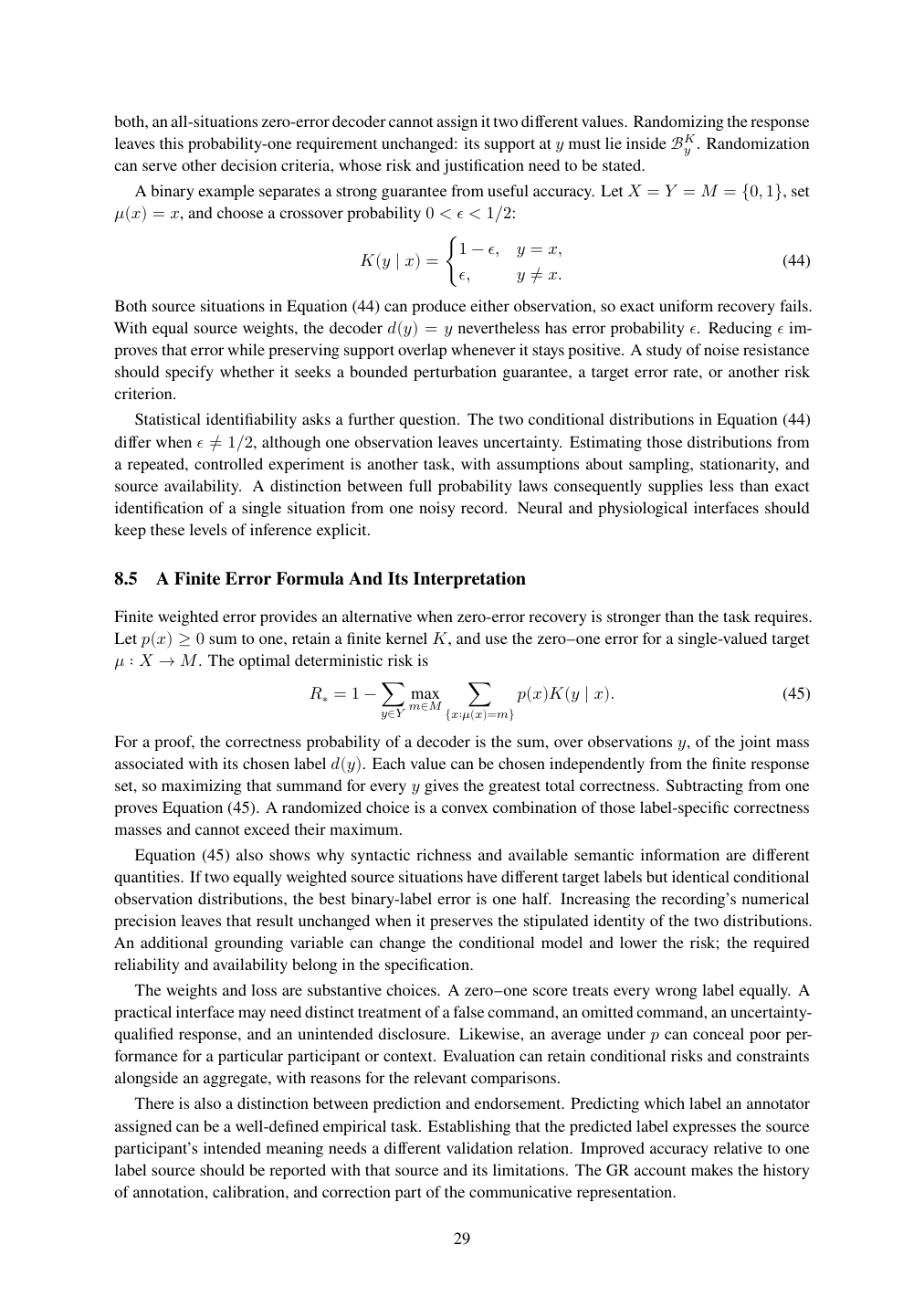
Readable text
both, an all-situations zero-error decoder cannot assign it two different values. Randomizing the response
can serve other decision criteria, whose risk and justification need to be stated.
Both source situations in Equation (44) can produce either observation, so exact uniform recovery fails.
proves that error while preserving support overlap whenever it stays positive. A study of noise resistance should specify whether it seeks a bounded perturbation guarantee, a target error rate, or another risk
Statistical identifiability asks a further question. The two conditional distributions in Equation (44) a repeated, controlled experiment is another task, with assumptions about sampling, stationarity, and source availability. A distinction between full probability laws consequently supplies less than exact identification of a single situation from one noisy record. Neural and physiological interfaces should
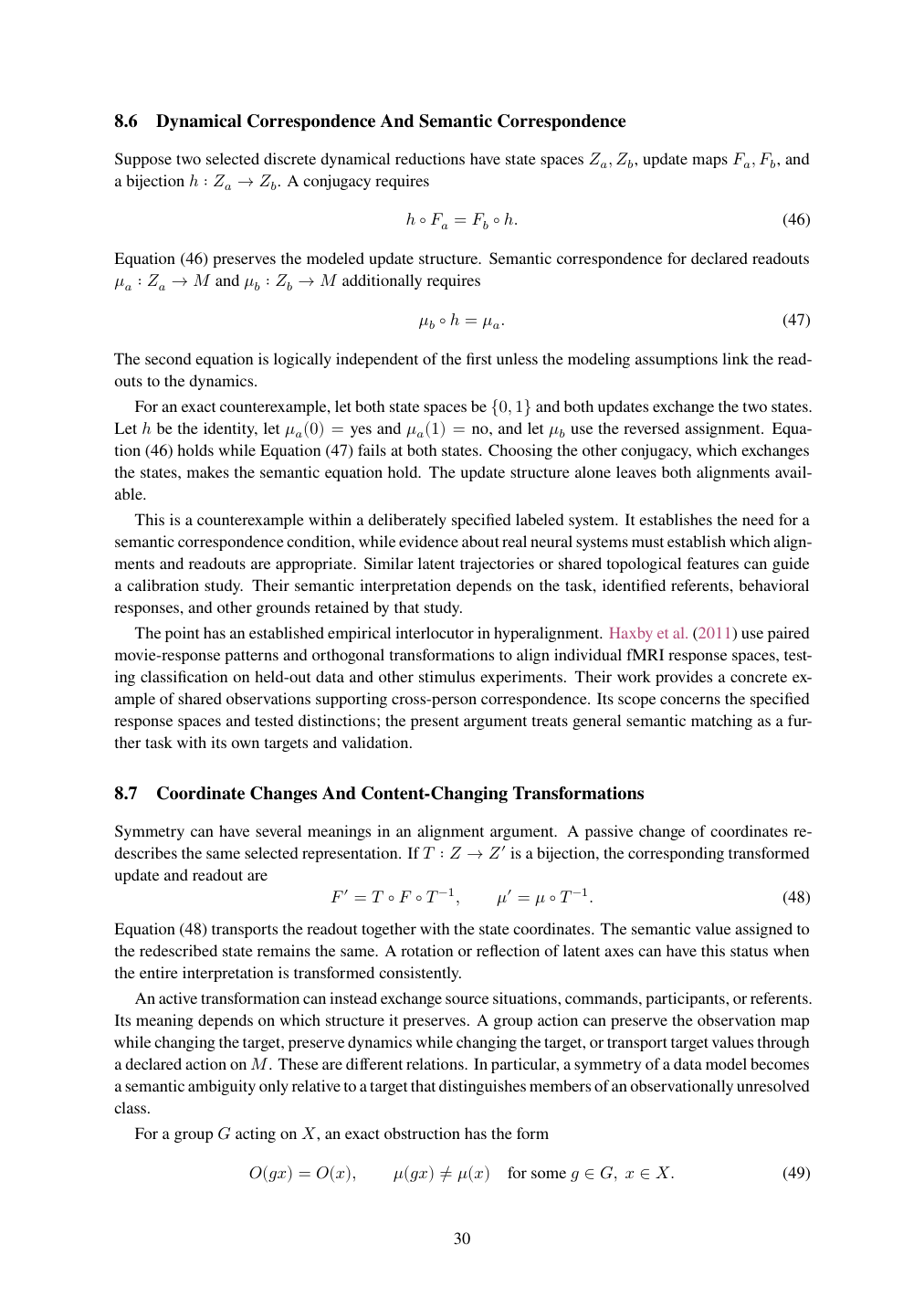
Finite weighted error provides an alternative when zero-error recovery is stronger than the task requires.
proves Equation (45). A randomized choice is a convex combination of those label-specific correctness
Equation (45) also shows why syntactic richness and available semantic information are different quantities. If two equally weighted source situations have different target labels but identical conditional observation distributions, the best binary-label error is one half. Increasing the recording’s numerical precision leaves that result unchanged when it preserves the stipulated identity of the two distributions. An additional grounding variable can change the conditional model and lower the risk; the required
reliability and availability belong in the specification.
The weights and loss are substantive choices. A zero–one score treats every wrong label equally. A practical interface may need distinct treatment of a false command, an omitted command, an uncertainty- formance for a particular participant or context. Evaluation can retain conditional risks and constraints alongside an aggregate, with reasons for the relevant comparisons.
There is also a distinction between prediction and endorsement. Predicting which label an annotator assigned can be a well-defined empirical task. Establishing that the predicted label expresses the source participant’s intended meaning needs a different validation relation. Improved accuracy relative to one label source should be reported with that source and its limitations. The GR account makes the history of annotation, calibration, and correction part of the communicative representation.
Readable text
Dynamical Correspondence And Semantic Correspondence
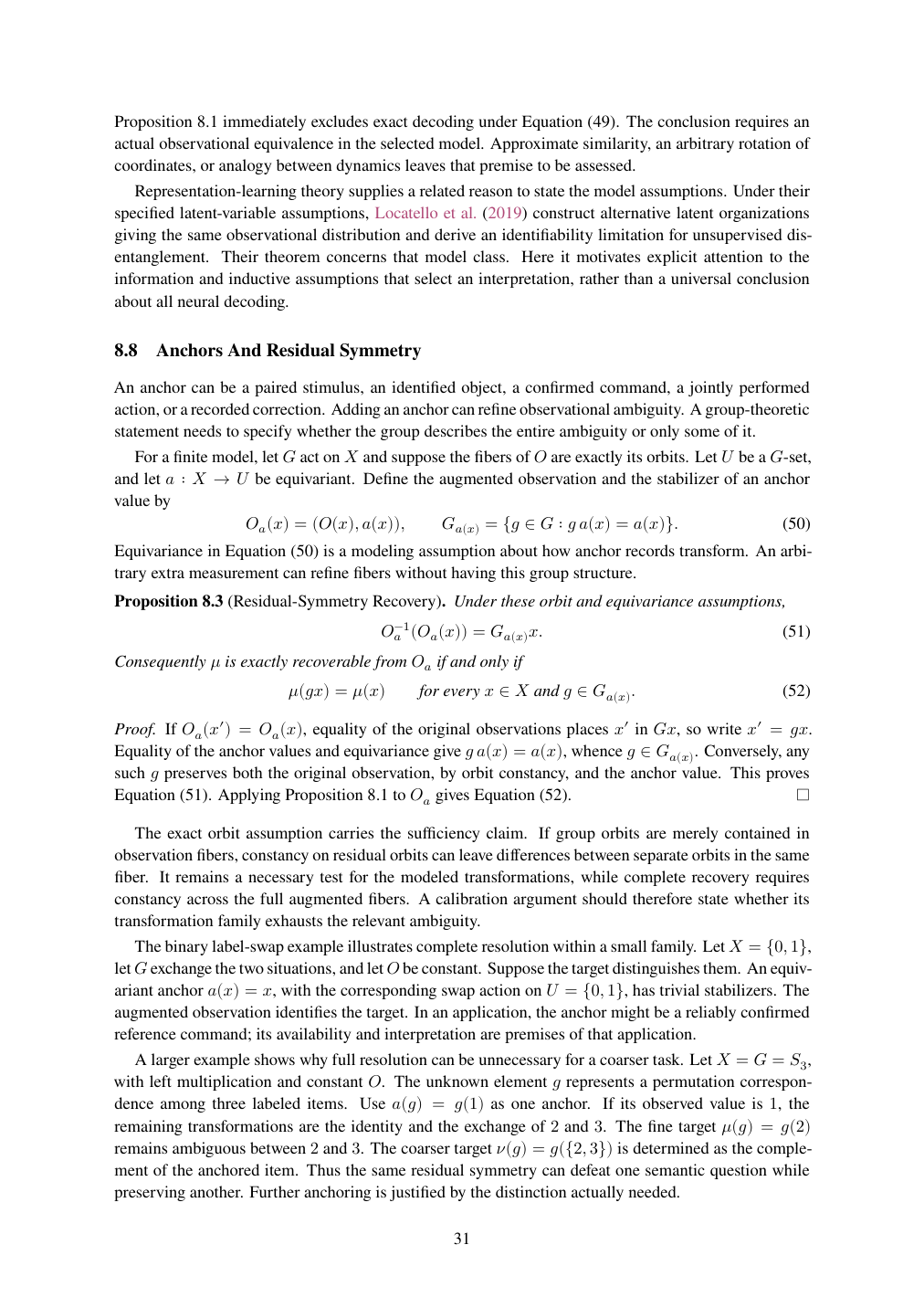
Equation (46) preserves the modeled update structure. Semantic correspondence for declared readouts
The second equation is logically independent of the first unless the modeling assumptions link the read-
tion (46) holds while Equation (47) fails at both states. Choosing the other conjugacy, which exchanges the states, makes the semantic equation hold. The update structure alone leaves both alignments avail-
This is a counterexample within a deliberately specified labeled system. It establishes the need for a semantic correspondence condition, while evidence about real neural systems must establish which align- ments and readouts are appropriate. Similar latent trajectories or shared topological features can guide a calibration study. Their semantic interpretation depends on the task, identified referents, behavioral
The point has an established empirical interlocutor in hyperalignment. Haxby et al. (2011) use paired movie-response patterns and orthogonal transformations to align individual fMRI response spaces, test- ing classification on held-out data and other stimulus experiments. Their work provides a concrete ex- ample of shared observations supporting cross-person correspondence. Its scope concerns the specified response spaces and tested distinctions; the present argument treats general semantic matching as a fur-
Coordinate Changes And Content-Changing Transformations
Symmetry can have several meanings in an alignment argument. A passive change of coordinates re-
Equation (48) transports the readout together with the state coordinates. The semantic value assigned to the redescribed state remains the same. A rotation or reflection of latent axes can have this status when
the entire interpretation is transformed consistently.
An active transformation can instead exchange source situations, commands, participants, or referents. Its meaning depends on which structure it preserves. A group action can preserve the observation map while changing the target, preserve dynamics while changing the target, or transport target values through a semantic ambiguity only relative to a target that distinguishes members of an observationally unresolved
Readable text
Proposition 8.1 immediately excludes exact decoding under Equation (49). The conclusion requires an actual observational equivalence in the selected model. Approximate similarity, an arbitrary rotation of coordinates, or analogy between dynamics leaves that premise to be assessed.
Representation-learning theory supplies a related reason to state the model assumptions. Under their specified latent-variable assumptions, Locatello et al. (2019) construct alternative latent organizations giving the same observational distribution and derive an identifiability limitation for unsupervised dis- entanglement. Their theorem concerns that model class. Here it motivates explicit attention to the information and inductive assumptions that select an interpretation, rather than a universal conclusion
An anchor can be a paired stimulus, an identified object, a confirmed command, a jointly performed action, or a recorded correction. Adding an anchor can refine observational ambiguity. A group-theoretic statement needs to specify whether the group describes the entire ambiguity or only some of it.
Equivariance in Equation (50) is a modeling assumption about how anchor records transform. An arbi- trary extra measurement can refine fibers without having this group structure.
Proposition 8.3 (Residual-Symmetry Recovery). Under these orbit and equivariance assumptions,
The exact orbit assumption carries the sufficiency claim. If group orbits are merely contained in observation fibers, constancy on residual orbits can leave differences between separate orbits in the same fiber. It remains a necessary test for the modeled transformations, while complete recovery requires constancy across the full augmented fibers. A calibration argument should therefore state whether its transformation family exhausts the relevant ambiguity.
augmented observation identifies the target. In an application, the anchor might be a reliably confirmed reference command; its availability and interpretation are premises of that application.
ment of the anchored item. Thus the same residual symmetry can defeat one semantic question while preserving another. Further anchoring is justified by the distinction actually needed.
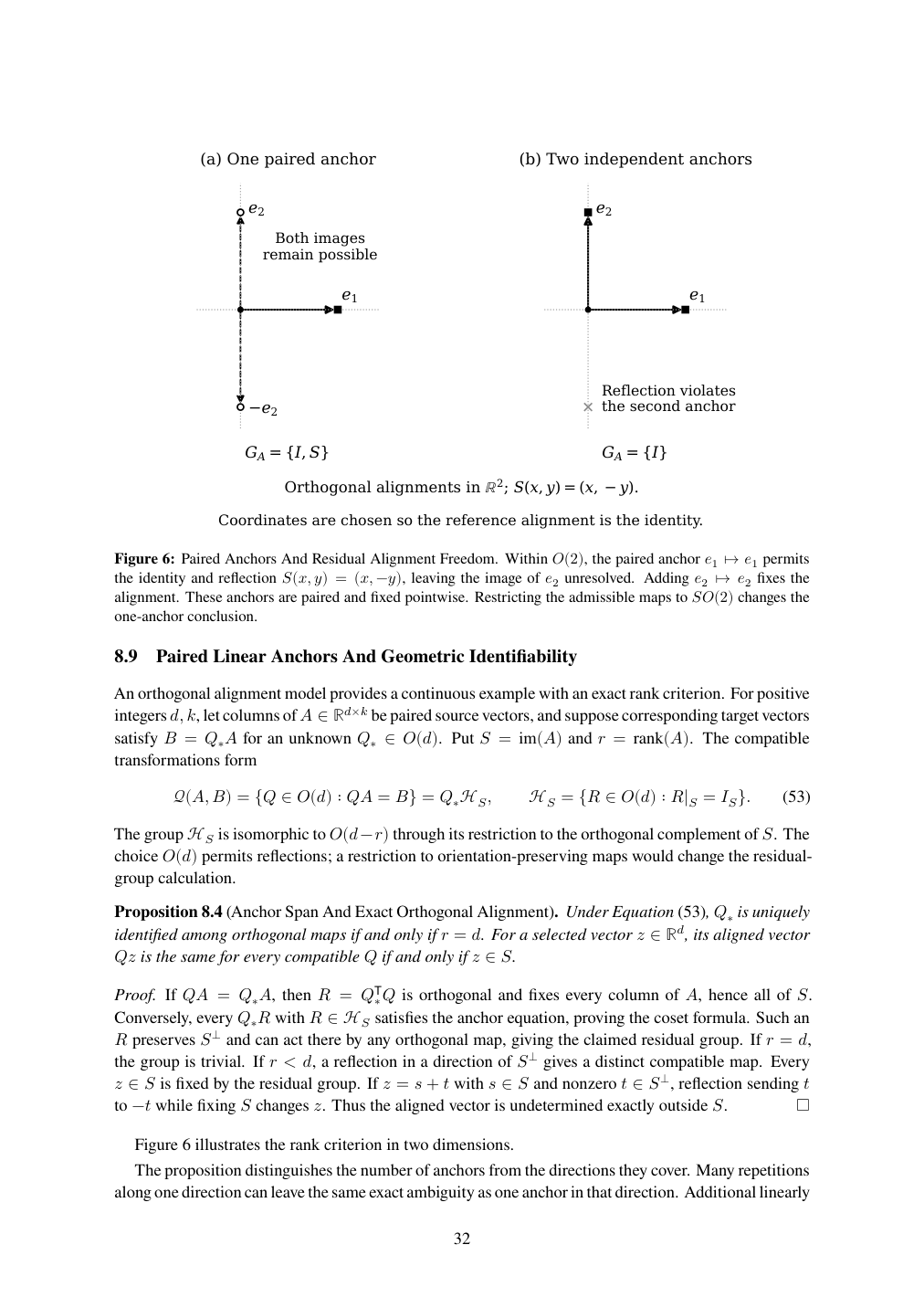
Readable text
Coordinates are chosen so the reference alignment is the identity.
Paired Linear Anchors And Geometric Identifiability
An orthogonal alignment model provides a continuous example with an exact rank criterion. For positive
Figure 6 illustrates the rank criterion in two dimensions.
The proposition distinguishes the number of anchors from the directions they cover. Many repetitions along one direction can leave the same exact ambiguity as one anchor in that direction. Additional linearly

Readable text
independent directions can reduce it. This is a result within the assumed orthogonal family; choosing that family requires an account of which geometric properties should be preserved.
The orthogonal Procrustes problem studies the corresponding least-squares alignment, with a classi- cal solution due to Schönemann (1966). The present rank argument concerns the exact set of compatible orthogonal maps. A least-squares optimum and its numerical uniqueness answer a fitting question; the fitted correspondence’s semantic adequacy requires the paired vectors and their interpretation to be war-
unchanged by every orthogonal transformation, while a signed coordinate can change under a residual reflection. Whether either quantity is semantically relevant depends on the declared task. Geometric identifiability and semantic importance remain separately assessed properties.
Proposition 8.5 (Full-Rank Anchor Perturbation Bound). Every minimizer in Equation (54) satisfies
The bound separates anchor perturbation, geometric conditioning, new-record perturbation, readout sensitivity, and readout discrepancy. A small singular value weakens the guarantee even when the anchor matrix has full rank. Repeated nearly dependent anchors can therefore leave a poorly conditioned cali- bration. Each quantity requires estimation appropriate to a proposed interface; the bound alone supplies
this argument with Equation (55) gives a sufficient condition for preservation of the reference decision.
Correctness of that reference decision remains a validation question concerning the chosen semantic task.
Approximate geometric alignment thus supports an explicitly conditional semantic estimate. Recovering the same geometry, obtaining the same classifier output, and establishing the participant’s intended meaning are related claims whose premises should be retained. Calibration should also be tested after relevant changes in task, context, or use, because its fixed correspondence assumptions concern a specified domain and horizon.
8.11 Calibration As A Recorded Communicative Procedure
A hypothetical three-command interface makes the distinctions operational. Suppose a participant seeks to communicate left, right, and pause through a learned physiological production practice. The commands name a stipulated control task; the example assumes no universal physiological signature of those words. Its first record concerns the intended command menu, the conditions under which a command counts as issued, and the participant’s means of correcting an interpretation. A request for clarification can be included as an additional response when the procedure permits it.
The next record concerns paired calibration episodes. A displayed cue can specify the requested command while the participant attempts its learned production and confirms or qualifies the attempt. The cue, observed activity, production status, and confirmation are different entries. A participant can misunderstand a cue, produce an unintended pattern, or recognize a decoder error. Assigning every episode the displayed label without retaining these distinctions would train a correspondence whose target differs from confirmed intention.
The finite permutation model identifies one possible ambiguity in these data. If the analyst assumes a one-to-one correspondence among three distinguishable signal classes and three commands, confirming one pair leaves the remaining two labels exchangeable. A second distinct confirmed pair resolves that permutation ambiguity, with the third pair then fixed by the assumed bijection. The conclusion depends on the complete three-class permutation model. Overlapping signal distributions, several patterns for one command, contextual meanings, or a changing production practice require a richer candidate family. The number of confirmed pairs alone does not establish the adequacy of that family.
A geometric reduction can supply a complementary question. Paired vectors may support an orthogonal correspondence on the anchor span while leaving other directions unresolved, as Proposition 8.4 shows. Adding repetitions can improve estimation of a supported direction. Adding independent anchor directions can reduce the exact residual symmetry. Their distinct roles suggest recording both coverage and uncertainty. The signal source and task should justify the vector space, preprocessing, paired events, and transformation family before the rank criterion receives an application.
With noisy anchor pairs, a tolerance-defined collection of transformations need not be a subgroup. For example, transformations each approximately fixing an anchor can compose into one with a larger discrepancy. Such a collection should be called a candidate set, retaining its actual definition and tolerance. An exact pointwise stabilizer has closure and inverses under its group action; an approximate fit set generally has different algebraic properties. Statistical confidence sets likewise require their sampling interpretation instead of inheriting group properties from the ambient transformation space.
Evaluation then asks whether a calibrated decoder continues to distinguish the commands in new episodes under the relevant conditions. Testing should retain the difference between data used to choose the correspondence and data used to assess it. A time-dependent artifact, an easy cue feature, or a repeated environmental condition can support prediction within one collection while leaving the intended production relation unresolved. Changes in setting and source practice deserve task-appropriate tests. The proposition’s declared domain and the empirical domain on which its premises are supported should be recorded together.
A conventional command can also carry a richer purpose. The label pause might request interruption of a moving device, time to consider a proposal, or cessation of an interaction. Their control effects and social implications differ. A protocol can deliberately fix one immediate interpretation for a bounded activity. Broader communication can require another question or a shared account of the circumstance. Efficient recognition of the fixed command then supplies a component within a larger interpretive process, whose historical and prospective context remains available for clarification.
Feature selection connects calibration to noise resistance. Suppose a topological or geometric descriptor identifies recordings that differ by a selected nuisance variation. If their required meanings agree, that identification can reduce irrelevant distinctions while preserving the target. If they require different meanings, Proposition 8.1 excludes exact recovery from the descriptor alone. An implementation can preserve additional features or an appropriately authorized raw record when future reinterpretation requires them. The correct choice depends on the communicative purpose and the grounds for retaining or discarding each distinction.
Finally, calibration can itself develop the source practice. Feedback can help a participant learn a more reproducible production pattern, while the decoder learns how to interpret it. The resulting correspondence has a history of co-adaptation. It should be described as a maintained communicative achievement, with its conditions and opportunities for revision, rather than assumed to reveal an unchanged private code. A richer expressive medium can build such a practice deliberately: it supplies stable records, usable feedback, and supported operations through which future communication becomes possible.
8.12 Shared Activity, Correction, And Interpretive Authority
The anchor analysis suggests a practical sequence. Participants identify the semantic distinctions needed for the activity, establish paired references through observation or action, examine which ambiguities remain, and test the resulting interpretation under relevant variation. Questions and corrections can then refine the record. A shared experience can supply a new common referent while leaving substantial differences in history, expectation, and evaluation. Its contribution concerns the particular distinctions it makes accessible.
The choice of anchors is itself consequential. Repeatedly pairing a signal with one externally chosen label can establish a control convention. It can also impose an interpretation that the participant would qualify or reject. A successful prediction of that training label supplies evidence about the trained relation. Attributing an intention requires an appropriate confirmation process, with attention to the participant’s resources, conditions, and ability to correct the account.
ToM enters because the source participant and interpreter anticipate one another’s purposes and likely responses. A participant may produce a conventional pattern because it communicates effectively, because another pattern remains difficult, or because an evaluator is expected to reward it. Those possibilities can generate similar outputs while supporting different historical explanations. Their identification requires further evidence. The interface should therefore record the status of an interpretation as observed, inferred, participant-confirmed, contested, or prospective, as appropriate to its purpose.
Interpretive authority also concerns who can define the response universe, maintain the calibration, revise a model, or authorize a consequential use. These powers can enable assistance and reliable coordination. Their exercise can also concentrate the ability to decide what another person’s signal is taken to mean. A GR analysis represents those relations and evaluates them through defended commitments concerning agency, competence, accountability, access, and correction. Group theory identifies an ambiguity structure; normative reasons govern how participants should resolve or preserve particular alternatives.
Finally, semantic matching and generative continuation answer different questions. Recognizing a current command can be enough for one immediate task. Learning a practice may require preserving
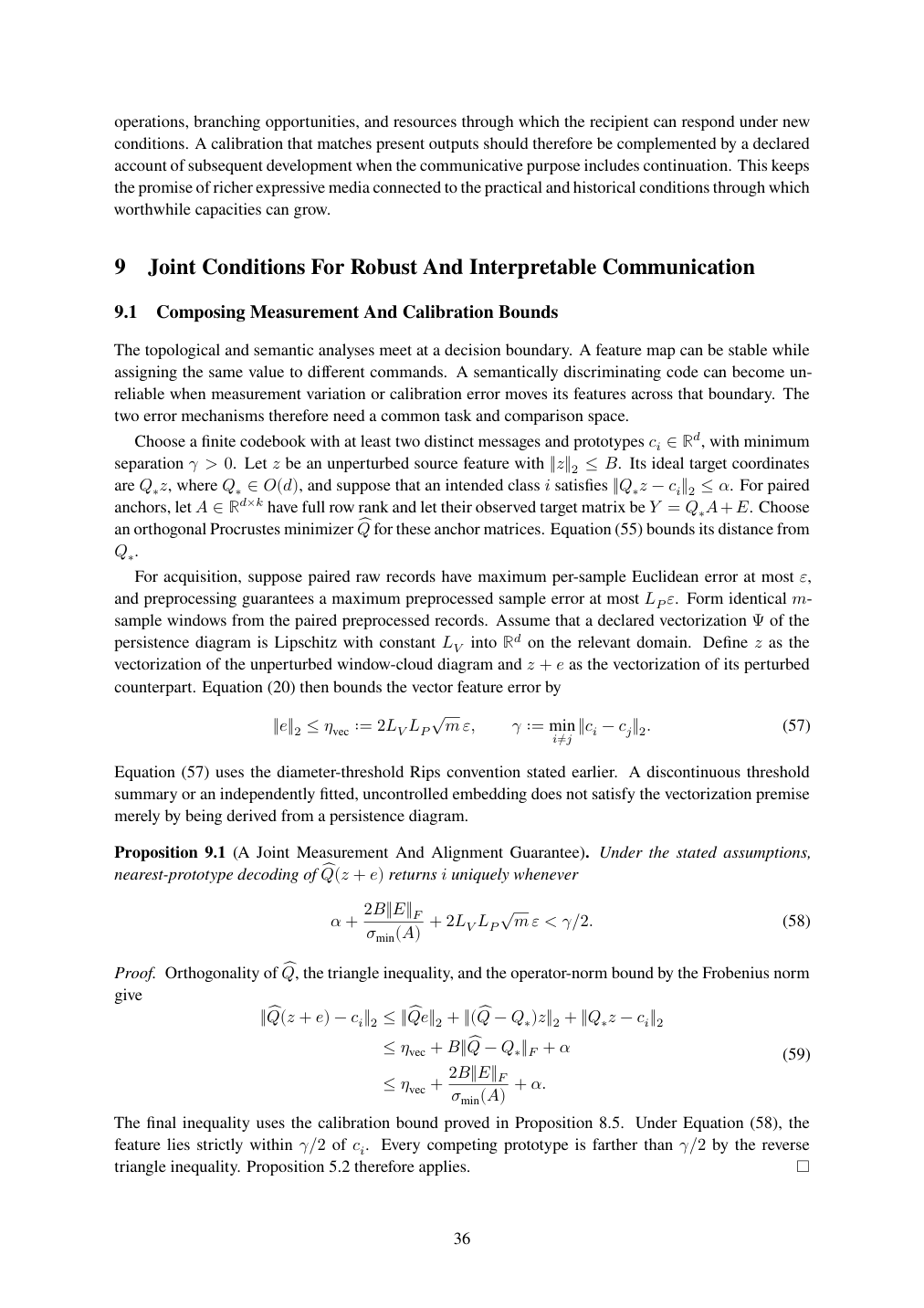
Readable text
operations, branching opportunities, and resources through which the recipient can respond under new conditions. A calibration that matches present outputs should therefore be complemented by a declared account of subsequent development when the communicative purpose includes continuation. This keeps the promise of richer expressive media connected to the practical and historical conditions through which
Joint Conditions For Robust And Interpretable Communication
The topological and semantic analyses meet at a decision boundary. A feature map can be stable while assigning the same value to different commands. A semantically discriminating code can become un- reliable when measurement variation or calibration error moves its features across that boundary. The two error mechanisms therefore need a common task and comparison space.
counterpart. Equation (20) then bounds the vector feature error by
Equation (57) uses the diameter-threshold Rips convention stated earlier. A discontinuous threshold summary or an independently fitted, uncontrolled embedding does not satisfy the vectorization premise
Proposition 9.1 (A Joint Measurement And Alignment Guarantee). Under the stated assumptions,
The final inequality uses the calibration bound proved in Proposition 8.5. Under Equation (58), the
triangle inequality. Proposition 5.2 therefore applies.
Equation (59) separates within-class variation, measurement stability, and anchor conditioning in Proposition 9.1. A small singular value can make a nominally full-rank anchor set weak for noise control. Large within-class variation can consume the available margin even with accurate sensors. Increasing the number of retained samples changes the analysis and its bound. These quantities organize distinct experimental questions.
The strict inequality matters. At equality a feature can tie between prototypes. If the intended messages share a feature prototype, the separation is zero and the proposed code requires another distinction. The theorem also assumes a biologically exercisable codebook and a warranted semantic assignment. A fluent or geometrically aligned output needs evidence connecting it to the participant’s intended or acceptable communication.

9.2 A Stable Invariant Can Remove A Relevant Distinction
The oppositely oriented loops in Equation (22) provide an exact comparison. Their uniform sample sets agree after permutation, so a feature computed solely from the unordered metric clouds agrees. If two commands are assigned by oriented winding, their task meanings differ. The point-cloud feature has discarded the order that distinguishes them, whereas an oriented path retains it. Figure 4 displays the comparison.
This is a counterexample to inferring semantic sufficiency from topological stability alone. It leaves the usefulness of persistent homology for a different task open. If the target concerns the presence of a circular state organization regardless of direction, discarding direction may be appropriate. The choice of invariance is consequently relative to the feature’s purpose.
The same issue occurs with amplitude, timing, and channel identity. An orientation-invariant representation can help when orientation is a coordinate convention. It can remove a command distinction when orientation is intentionally controlled. A time-reparameterization invariant can help with variable execution speed while removing duration when duration carries urgency. These interpretations should be established through task design and interventions. An analyst’s designation of nuisance variation is itself a modeling judgment.
9.3 Nuisance Quotients And Semantic Compatibility



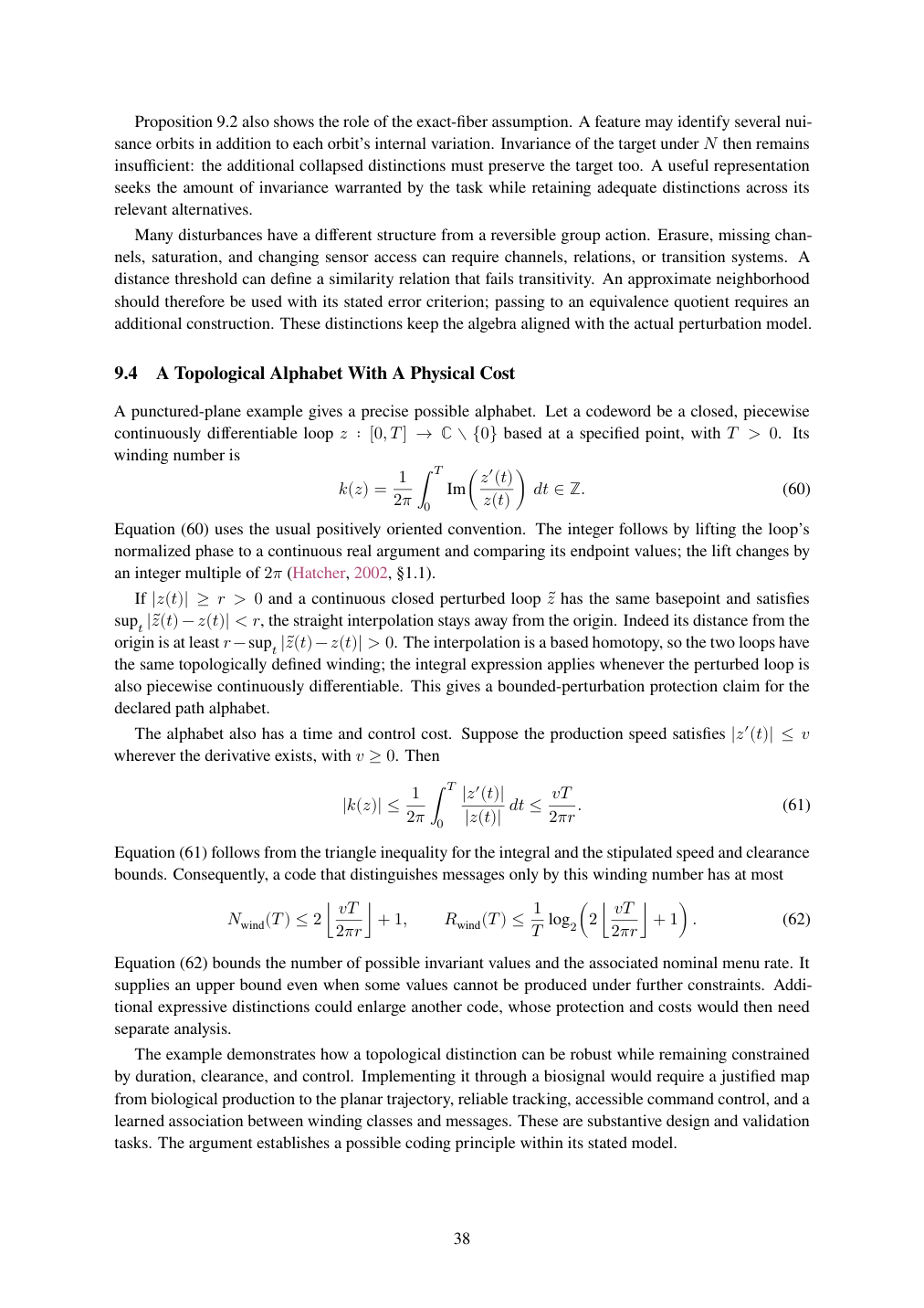
Readable text
Proposition 9.2 also shows the role of the exact-fiber assumption. A feature may identify several nui- insufficient: the additional collapsed distinctions must preserve the target too. A useful representation seeks the amount of invariance warranted by the task while retaining adequate distinctions across its
Many disturbances have a different structure from a reversible group action. Erasure, missing chan- nels, saturation, and changing sensor access can require channels, relations, or transition systems. A distance threshold can define a similarity relation that fails transitivity. An approximate neighborhood should therefore be used with its stated error criterion; passing to an equivalence quotient requires an additional construction. These distinctions keep the algebra aligned with the actual perturbation model.
A punctured-plane example gives a precise possible alphabet. Let a codeword be a closed, piecewise
Equation (60) uses the usual positively oriented convention. The integer follows by lifting the loop’s normalized phase to a continuous real argument and comparing its endpoint values; the lift changes by
the same topologically defined winding; the integral expression applies whenever the perturbed loop is also piecewise continuously differentiable. This gives a bounded-perturbation protection claim for the
Equation (61) follows from the triangle inequality for the integral and the stipulated speed and clearance bounds. Consequently, a code that distinguishes messages only by this winding number has at most
Equation (62) bounds the number of possible invariant values and the associated nominal menu rate. It supplies an upper bound even when some values cannot be produced under further constraints. Addi- tional expressive distinctions could enlarge another code, whose protection and costs would then need
The example demonstrates how a topological distinction can be robust while remaining constrained by duration, clearance, and control. Implementing it through a biosignal would require a justified map from biological production to the planar trajectory, reliable tracking, accessible command control, and a learned association between winding classes and messages. These are substantive design and validation tasks. The argument establishes a possible coding principle within its stated model.
10 A Practical Protocol For Grounded Biosignal Communication
10.1 A Declared Communicative Task
The formal constructions support a practical research protocol organized around a declared task. The initial record identifies who seeks to express which distinction, who is expected to interpret it, what response is at issue, and which outcomes count as adequate. It also identifies resources, access conditions, relevant capacities, and opportunities for correction. A task can concern a direct command, the selection of a relation in a spatial artifact, the explanation of a history, or the development of a new structure. Its assessment should follow that choice.
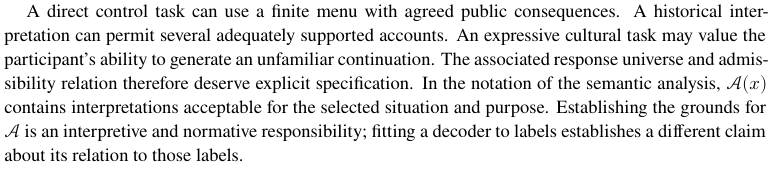
The source of a label should remain recoverable. A training label can come from an instruction, a participant’s report, an observed action, or an external annotator’s assessment. These sources provide different evidence. An instruction records what a participant was asked to do. A later endorsement records a particular act of recognition or authorization. A measured consequence records what occurred under the represented conditions. Keeping these histories distinct helps identify which uncertainty a proposed intervention can reduce.
The participant’s role also requires specification. In a self-directed communication task, the participant can examine and correct the output before it becomes a public assertion. In an observational study, a physiological classification can be an analyst’s hypothesis whose warrant depends on the study. A cooperative task can make a jointly negotiated convention available for later use. Each arrangement allocates a different authority over what the recorded activity is taken to mean.
10.2 Persistent Records And Revisable Interpretation
A persistent record should preserve more than an isolated numerical vector. A reproducible analysis requires recording the acquisition conditions, channel and timing conventions, preprocessing, feature construction, decoder version, available anchors, and relevant uncertainty. Reproduction of an analysis can still differ from a recipient’s understanding of what its output was intended to communicate. Supporting that understanding can require examples, explanations, task histories, and a route for addressing questions.
These resources can be organized through an expressive artifact. A participant might select actors in a relational map, indicate a possible transition, and associate a short account or demonstration with it. A biological control signal could perform one of those operations. The artifact would retain the resulting structure and the route of its development. Its labels should distinguish a recorded event, an inference, a hypothetical configuration, and a presently anticipated future. A later participant can then inspect what was preserved without treating every depicted continuation as an event that already occurred.
The representation can also retain a versioned interpretation. When a decoder changes, the original observation remains attributable to the original acquisition, while later transformations acquire their own records. A correction can improve a subsequent expression and provide evidence about an earlier misunderstanding. The corrected output and the history of the correction answer different questions. This makes the artifact suitable for examining both present coordination and the process through which an interpretation became available.
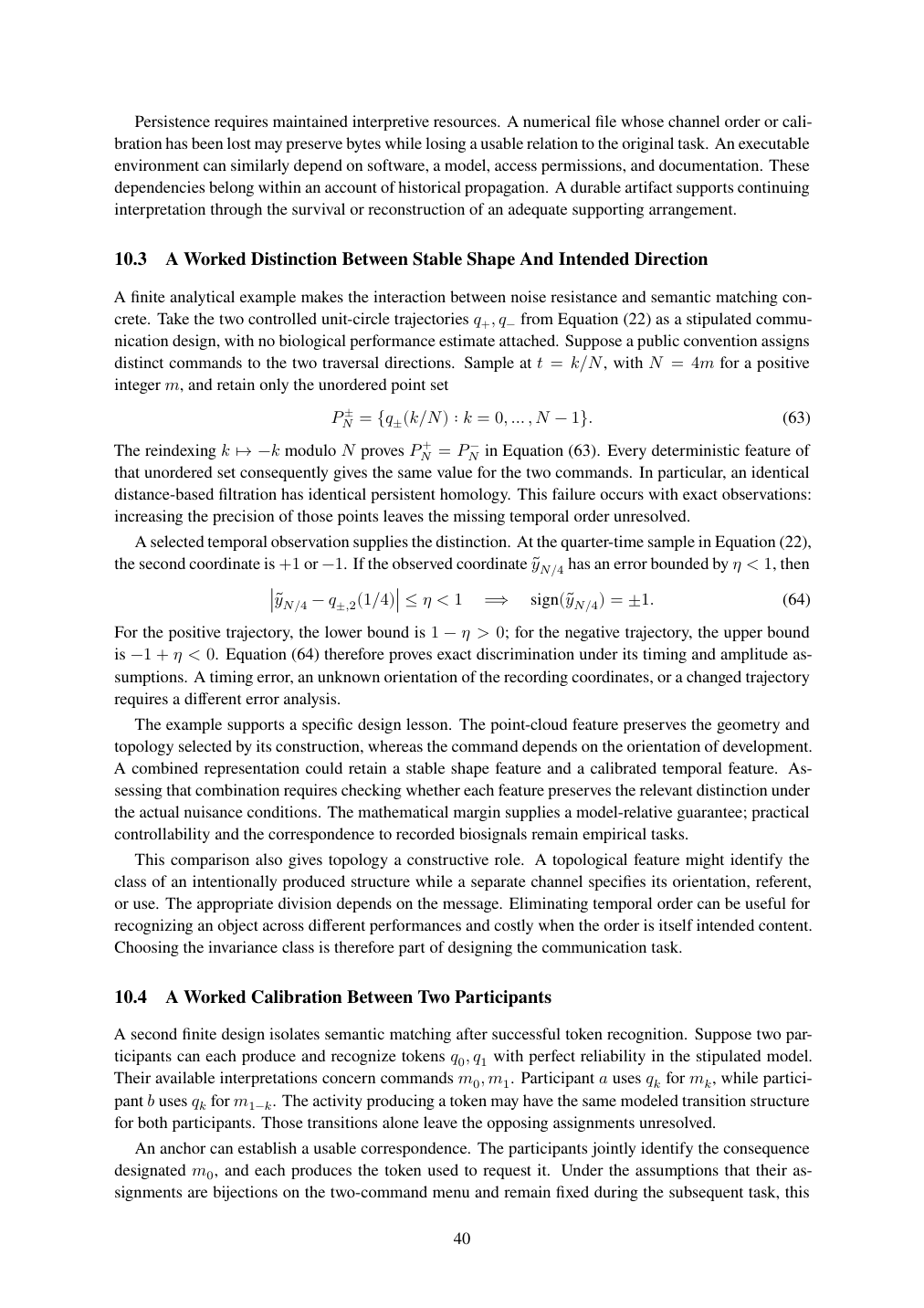
Readable text
Persistence requires maintained interpretive resources. A numerical file whose channel order or cali- bration has been lost may preserve bytes while losing a usable relation to the original task. An executable environment can similarly depend on software, a model, access permissions, and documentation. These dependencies belong within an account of historical propagation. A durable artifact supports continuing interpretation through the survival or reconstruction of an adequate supporting arrangement.
A Worked Distinction Between Stable Shape And Intended Direction
A finite analytical example makes the interaction between noise resistance and semantic matching con- nication design, with no biological performance estimate attached. Suppose a public convention assigns
that unordered set consequently gives the same value for the two commands. In particular, an identical distance-based filtration has identical persistent homology. This failure occurs with exact observations: increasing the precision of those points leaves the missing temporal order unresolved.
A selected temporal observation supplies the distinction. At the quarter-time sample in Equation (22),
sumptions. A timing error, an unknown orientation of the recording coordinates, or a changed trajectory
The example supports a specific design lesson. The point-cloud feature preserves the geometry and topology selected by its construction, whereas the command depends on the orientation of development. A combined representation could retain a stable shape feature and a calibrated temporal feature. As- sessing that combination requires checking whether each feature preserves the relevant distinction under the actual nuisance conditions. The mathematical margin supplies a model-relative guarantee; practical controllability and the correspondence to recorded biosignals remain empirical tasks.
This comparison also gives topology a constructive role. A topological feature might identify the class of an intentionally produced structure while a separate channel specifies its orientation, referent, or use. The appropriate division depends on the message. Eliminating temporal order can be useful for recognizing an object across different performances and costly when the order is itself intended content. Choosing the invariance class is therefore part of designing the communication task.
A second finite design isolates semantic matching after successful token recognition. Suppose two par- for both participants. Those transitions alone leave the opposing assignments unresolved.
An anchor can establish a usable correspondence. The participants jointly identify the consequence signments are bijections on the two-command menu and remain fixed during the subsequent task, this

The anchoring encounter creates a new shared history. It can support later communication without reconstructing why either participant originally acquired the convention. This is one concrete form of generativity propagation: the encounter supplies a relation that participants can subsequently exercise. Its continuation depends on memory, access to the artifact, maintained conventions, and opportunities to repair disagreement. An extension to a new task asks whether those resources still establish the relevant correspondence.
Power can affect this process even when token recognition is accurate. One participant may define the consequences that are offered as anchors or decide which interpretation enters the official record. Another may understand the proposed assignment while lacking authority to accept it. A person may also decline to disclose a private association. Such acts should enter the account through their appropriate interpretations. Agreement about a token’s use, endorsement of a proposed value, and authorization of a public commitment are different relations.
10.5 Feedback, Guidance, And Practical Wisdom
A useful protocol allows participants to inspect an output, identify a consequential difference, and choose a proportionate next step. That step might repeat an acquisition, clarify a task, provide an example, revise a model, or change the response language. The choice depends on which uncertainty is material. Additional measurements can help when the problem concerns unreliable acquisition; an explicit paired example can help when the problem concerns an unknown assignment. Some uncertainty concerns the purpose or adequacy standard itself and calls for discussion of that standard.
Guidance can enable communication. A demonstration may make a controlled signal distinguishable; a device adjustment may make feedback accessible; a collaborator may explain how an unfamiliar representation can be used. The scope and consequences of that guidance remain assessable. A protocol should record which developments the participant can choose, how a disagreement can alter the representation, and which support is needed for subsequent independent activity. Effective agency can include a maintained cooperative arrangement rather than solitary operation.
Theory of Mind enters through assumptions about what another participant knows, intends, or is likely to recognize. A facilitator might predict that a participant will understand a signal after one example. A participant might instead anticipate that only a conventional response will be accepted. The protocol can test selected consequences of those attributions through questions and practical trials. An observed response supports an attribution within the tested conditions; its interpretation also depends on incentives, access, and the participant’s ability to correct the record.
Practical wisdom concerns the relation between these opportunities and a particular purpose. Urgency can make a small validated menu appropriate while leaving a fuller historical explanation for another encounter. A learning activity can justify a slower exploration of alternatives. A cultural exchange can value the development of a new expressive form whose success resists reduction to reproducing a source label. The formal results identify requirements for particular comparisons; their selection and normative significance belong to the practical argument.
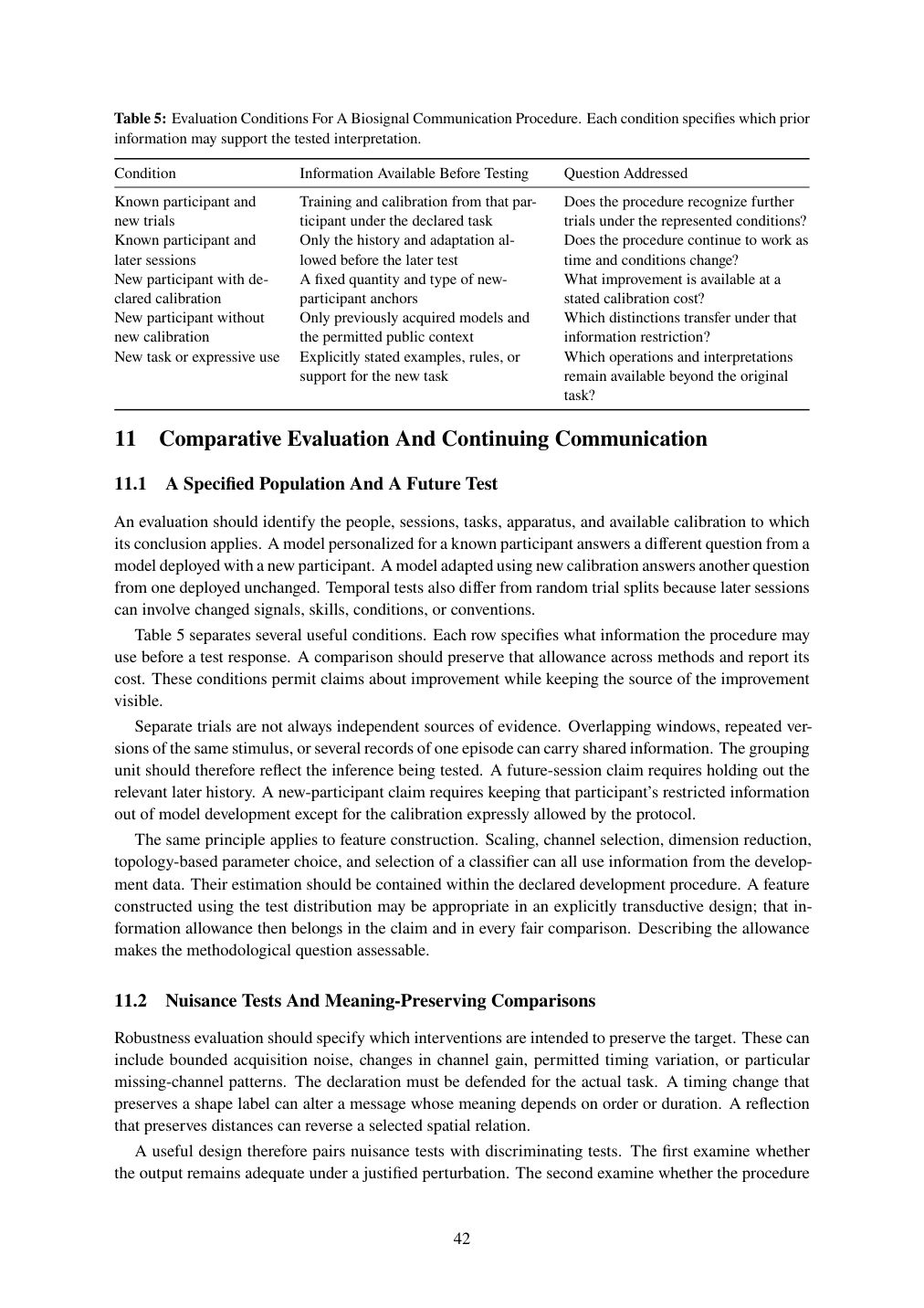
Readable text
Table 5: Evaluation Conditions For A Biosignal Communication Procedure. Each condition specifies which prior
Training and calibration from that par- ticipant under the declared task
Does the procedure recognize further trials under the represented conditions?
Does the procedure continue to work as time and conditions change?
What improvement is available at a stated calibration cost?
Which distinctions transfer under that information restriction?
Which operations and interpretations remain available beyond the original task?
Comparative Evaluation And Continuing Communication
An evaluation should identify the people, sessions, tasks, apparatus, and available calibration to which its conclusion applies. A model personalized for a known participant answers a different question from a model deployed with a new participant. A model adapted using new calibration answers another question from one deployed unchanged. Temporal tests also differ from random trial splits because later sessions can involve changed signals, skills, conditions, or conventions.
Table 5 separates several useful conditions. Each row specifies what information the procedure may use before a test response. A comparison should preserve that allowance across methods and report its cost. These conditions permit claims about improvement while keeping the source of the improvement
Separate trials are not always independent sources of evidence. Overlapping windows, repeated ver- sions of the same stimulus, or several records of one episode can carry shared information. The grouping unit should therefore reflect the inference being tested. A future-session claim requires holding out the relevant later history. A new-participant claim requires keeping that participant’s restricted information out of model development except for the calibration expressly allowed by the protocol.
The same principle applies to feature construction. Scaling, channel selection, dimension reduction, topology-based parameter choice, and selection of a classifier can all use information from the develop- ment data. Their estimation should be contained within the declared development procedure. A feature constructed using the test distribution may be appropriate in an explicitly transductive design; that in- formation allowance then belongs in the claim and in every fair comparison. Describing the allowance
Robustness evaluation should specify which interventions are intended to preserve the target. These can include bounded acquisition noise, changes in channel gain, permitted timing variation, or particular missing-channel patterns. The declaration must be defended for the actual task. A timing change that preserves a shape label can alter a message whose meaning depends on order or duration. A reflection that preserves distances can reverse a selected spatial relation.
A useful design therefore pairs nuisance tests with discriminating tests. The first examine whether the output remains adequate under a justified perturbation. The second examine whether the procedure
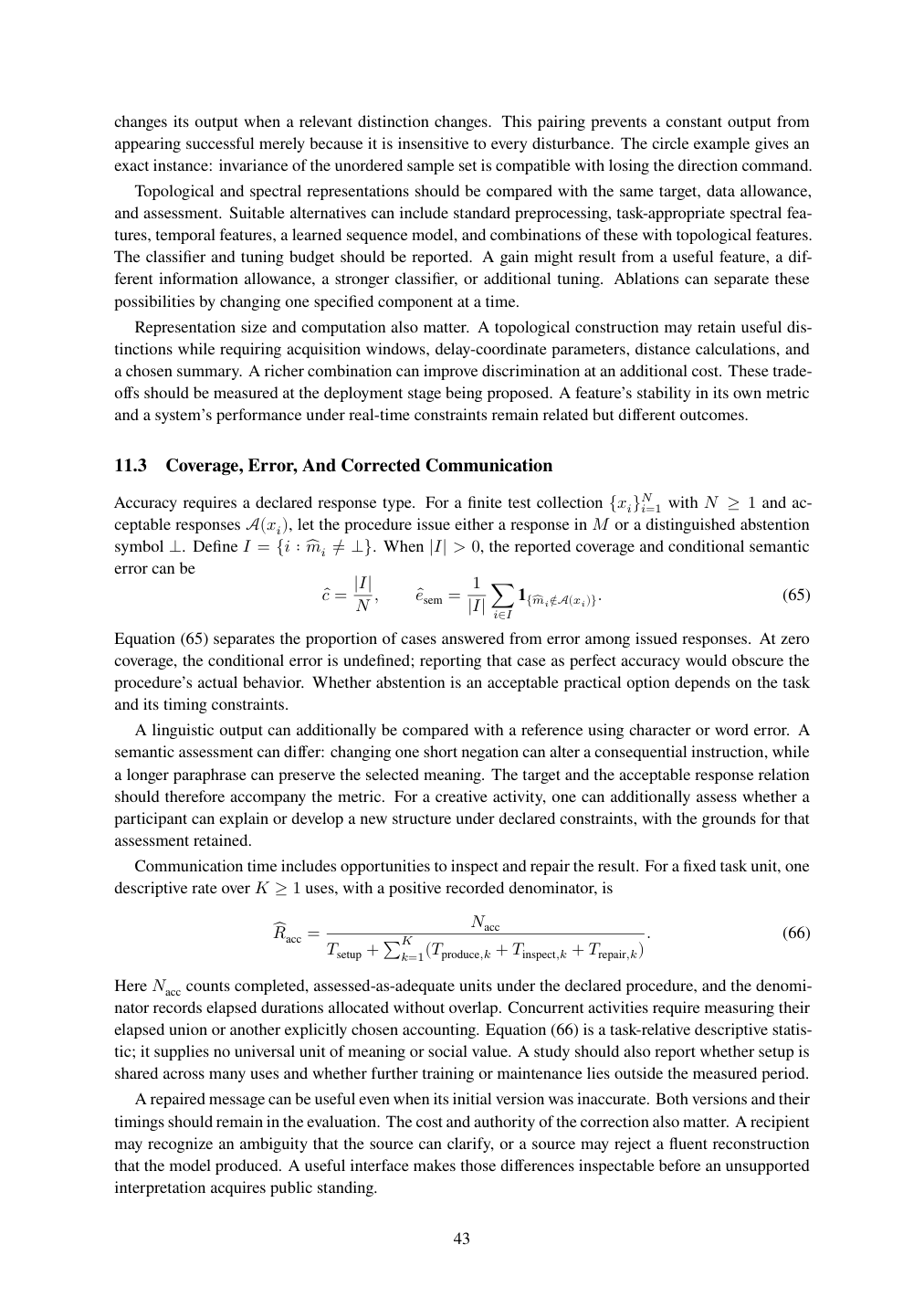
Readable text
changes its output when a relevant distinction changes. This pairing prevents a constant output from appearing successful merely because it is insensitive to every disturbance. The circle example gives an exact instance: invariance of the unordered sample set is compatible with losing the direction command.
Topological and spectral representations should be compared with the same target, data allowance, and assessment. Suitable alternatives can include standard preprocessing, task-appropriate spectral fea- tures, temporal features, a learned sequence model, and combinations of these with topological features. The classifier and tuning budget should be reported. A gain might result from a useful feature, a dif- ferent information allowance, a stronger classifier, or additional tuning. Ablations can separate these possibilities by changing one specified component at a time.
Representation size and computation also matter. A topological construction may retain useful dis- tinctions while requiring acquisition windows, delay-coordinate parameters, distance calculations, and a chosen summary. A richer combination can improve discrimination at an additional cost. These trade- offs should be measured at the deployment stage being proposed. A feature’s stability in its own metric and a system’s performance under real-time constraints remain related but different outcomes.
Equation (65) separates the proportion of cases answered from error among issued responses. At zero coverage, the conditional error is undefined; reporting that case as perfect accuracy would obscure the procedure’s actual behavior. Whether abstention is an acceptable practical option depends on the task
A linguistic output can additionally be compared with a reference using character or word error. A semantic assessment can differ: changing one short negation can alter a consequential instruction, while a longer paraphrase can preserve the selected meaning. The target and the acceptable response relation should therefore accompany the metric. For a creative activity, one can additionally assess whether a participant can explain or develop a new structure under declared constraints, with the grounds for that
Communication time includes opportunities to inspect and repair the result. For a fixed task unit, one
nator records elapsed durations allocated without overlap. Concurrent activities require measuring their elapsed union or another explicitly chosen accounting. Equation (66) is a task-relative descriptive statis- tic; it supplies no universal unit of meaning or social value. A study should also report whether setup is shared across many uses and whether further training or maintenance lies outside the measured period.
A repaired message can be useful even when its initial version was inaccurate. Both versions and their timings should remain in the evaluation. The cost and authority of the correction also matter. A recipient may recognize an ambiguity that the source can clarify, or a source may reject a fluent reconstruction that the model produced. A useful interface makes those differences inspectable before an unsupported
11.4 Drift, Missingness, And The Scope Of Continuation
A future communication episode can differ in acquisition quality, physiology, learned behavior, context, or vocabulary. These differences need separate hypotheses. A changed recording can justify recalibration; a new expressive purpose can justify revising the target language. An uncertainty detector can make some changes visible, but its own detection performance requires evaluation. The protocol should identify what support remains available when a previously adequate interpretation becomes uncertain.
Missingness also has a history. A randomly removed channel in an analysis can test one specified perturbation; a device failure or inaccessible resource can remove an entire class of observations or opportunities. The resulting situations can differ from the simulated disturbance. An evaluation can report performance under each declared missingness mechanism and state which affected conditions remain outside the evidence. This permits a proportionate account of robustness.
Historical propagation, dynamics identification, and capacity continuation then receive distinct tests. A persistent record can preserve an attributed episode. An intervention can discriminate among candidate mechanisms. A recipient’s performance on a new, relevant task can support a claim about an available operation. Each claim requires the corresponding evidence and resources. Continued communication can include adaptation or meaningful divergence rather than exact reproduction of the source participant’s history.
The proposed biosignal environment can therefore be evaluated through a continuing sequence: establish a task and its grounds; acquire and preserve an attributed record; choose features that retain relevant distinctions; calibrate interpretive correspondences; permit inspection and correction; and examine subsequent use under declared changes. Topology and symmetry contribute specific tools within that sequence. Their practical value is assessed through the communications and worthwhile continuations that the resulting arrangement supports.
12 Practical Wisdom And The Continuing Expressive Medium
12.1 Choosing The Distinctions That Should Survive
A communicative medium develops through decisions about what to preserve and what to treat as variation. The formal results make those decisions explicit. A diagram can preserve an organizing loop while discarding its orientation. A braid invariant can preserve a class under deformation while a coarser algebraic summary identifies distinct classes. An orthogonal alignment can resolve coordinate differences while its anchors leave some directions uncalibrated. Their suitability depends on the distinctions the communicative task requires.
Table 6 also explains why a single universal robustness score would conceal consequential choices. The same perturbation can be harmless for one command and meaningful for another. The record should state the target, the transformation, the grounds for treating it as immaterial, and the evidence that the remaining feature supports the task. A participant’s correction can reveal that the adopted criterion omitted a distinction. Practical wisdom includes recognizing when that response calls for a different representation.
This task is especially important for culturally and historically significant communication. A system might distinguish positive and negative responses while leaving the difference between an aspiration, a promise, and an authorized commitment unresolved. Each can require a separate response type and grounding procedure. A physiological reconstruction can contribute evidence about a selected response; its public force depends on the communicative relation through which it is issued and recognized.
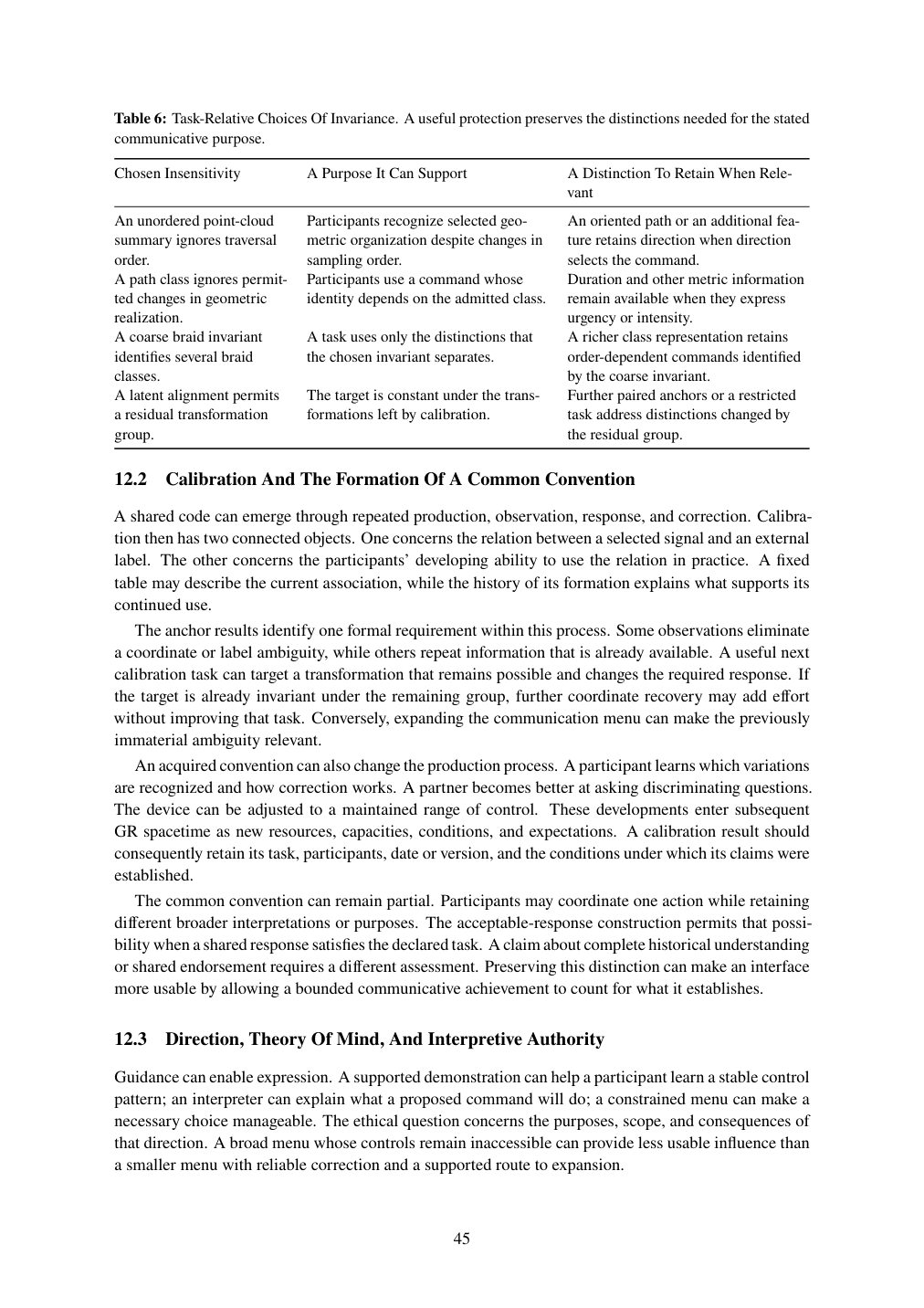
Readable text
Table 6: Task-Relative Choices Of Invariance. A useful protection preserves the distinctions needed for the stated
Participants recognize selected geo- metric organization despite changes in
An unordered point-cloud summary ignores traversal order.
An oriented path or an additional fea- ture retains direction when direction selects the command.
Participants use a command whose identity depends on the admitted class.
A path class ignores permit- ted changes in geometric realization.
Duration and other metric information remain available when they express urgency or intensity.
A task uses only the distinctions that the chosen invariant separates.
A coarse braid invariant identifies several braid classes.
A richer class representation retains order-dependent commands identified by the coarse invariant.
The target is constant under the trans- formations left by calibration.
A latent alignment permits a residual transformation group.
Further paired anchors or a restricted task address distinctions changed by the residual group.
Calibration And The Formation Of A Common Convention
A shared code can emerge through repeated production, observation, response, and correction. Calibra- tion then has two connected objects. One concerns the relation between a selected signal and an external label. The other concerns the participants’ developing ability to use the relation in practice. A fixed table may describe the current association, while the history of its formation explains what supports its
The anchor results identify one formal requirement within this process. Some observations eliminate a coordinate or label ambiguity, while others repeat information that is already available. A useful next calibration task can target a transformation that remains possible and changes the required response. If the target is already invariant under the remaining group, further coordinate recovery may add effort without improving that task. Conversely, expanding the communication menu can make the previously
An acquired convention can also change the production process. A participant learns which variations are recognized and how correction works. A partner becomes better at asking discriminating questions. The device can be adjusted to a maintained range of control. These developments enter subsequent GR spacetime as new resources, capacities, conditions, and expectations. A calibration result should consequently retain its task, participants, date or version, and the conditions under which its claims were
The common convention can remain partial. Participants may coordinate one action while retaining different broader interpretations or purposes. The acceptable-response construction permits that possi- bility when a shared response satisfies the declared task. A claim about complete historical understanding or shared endorsement requires a different assessment. Preserving this distinction can make an interface more usable by allowing a bounded communicative achievement to count for what it establishes.
Direction, Theory Of Mind, And Interpretive Authority
Guidance can enable expression. A supported demonstration can help a participant learn a stable control pattern; an interpreter can explain what a proposed command will do; a constrained menu can make a necessary choice manageable. The ethical question concerns the purposes, scope, and consequences of that direction. A broad menu whose controls remain inaccessible can provide less usable influence than a smaller menu with reliable correction and a supported route to expansion.
Theory of Mind enters through expectations on both sides. The sender can anticipate what a partner or decoder will recognize and alter their expression accordingly. A recipient can infer an intention from the production context and a history of earlier responses. Wider audiences can influence which expressions seem acceptable or likely to receive recognition. Those attributions can be useful and fallible. Their role in an episode and the evidence supporting their accuracy should remain distinguishable.
Interpretive authority is distributed across the process. Someone chooses the labels, defines the error measure, selects the invariant, maintains the software, and decides whether an output counts as an endorsed communication. Those responsibilities can be organized to support the participant’s ability to challenge a mistaken attribution. A correction should be able to change the operative record and subsequent calibration when the task warrants that change. Preserving a raw trace, a model reconstruction, and an endorsed expression as separate record types helps make those revisions intelligible.
The same analysis applies to an AI-assisted expressive environment. A model can propose an elaboration of a sparse signal or sketch. The proposal acquires its status through the task and the participant’s relation to it. An editable candidate, an endorsed statement, and an externally inferred description carry different commitments. Making those statuses explicit can support efficient assistance while preserving the source’s influence over what is communicated.
12.4 Persistence And The Burdens Of Continued Use
Stable recording is an achievement of a maintained arrangement. A saved biosignal can remain readable while an associated model, calibration record, or software environment becomes inaccessible. Conversely, documentation and examples can permit later reconstruction of a selected convention even after particular hardware changes. The medium’s persistence should therefore be assessed through both stored material and the interpretive operations that later users can exercise.
The burdens of maintenance can be unevenly distributed. A participant may depend on a specialist, an institution, or a particular device. Another may need language support, accessible controls, or time for calibration. These are part of the actual conditions of expression. Evaluating efficiency includes whether the arrangement preserves usable access and an appropriate route for correction as conditions change.
The GR account also makes a distinction between the author’s future self and another recipient. A compact personal record can rely on substantial remembered context. A later encounter can reveal that part of that context has changed or become unavailable. An expressive environment can support initial fragments and later elaboration through linked examples, histories, and operations. Its effectiveness can be measured at both stages: the effort of capture and the effort of warranted reconstruction and continuation.
12.5 Several Routes For Prolonging Generativity
The propagation of generativity can occur through retained resources, learned operations, maintained collaboration, or newly created shared experience. A book, a demonstration, an executable model, and a jointly practiced code preserve different things. Their contribution should be assessed through what a recipient becomes able to recognize or undertake under actual conditions.
For biosignal communication, learning a code can establish the ability to select a command. A richer goal can concern manipulating a relational model, comparing possible futures, or developing a new question together. A representation preserving temporal order and branching can support those operations when participants possess the necessary resources and capacities. Its value then includes the continuation made possible after the initial interpretation.
Similarity has a task-specific place in that evaluation. Reproducing a precise command can be necessary for safe coordination under an adopted protocol. Developing a different interpretation or creative continuation can be valuable in a cultural exchange. The framework records the purpose and the grounds for judging a particular divergence. Formal invariance or greater generative capacity alone supplies no general moral ranking of the possible developments.
12.6 The Contribution And Its Evidentiary Horizon
The paper connects several established mathematical tools to an explicit communication problem. The finite-word unitary locates one syntactic representation. Persistence and braid results identify preservation under declared perturbations. Fiber and support criteria locate the information required for a target interpretation. Residual symmetry and anchor conditioning describe calibration limits. Their integration makes the relationship among robustness, discrimination, semantic grounding, and exercisable capacity assessable within one framework.
The winding code and the composed measurement–alignment bound provide worked consequences of that integration. The former states both a protected distinction and a constraint on the number of invariant values available within a duration. The latter shows how within-class variation, sensor perturbation, vectorization, and anchor quality can jointly consume a decision margin. Both constructions have explicit mathematical scope. The empirical studies and evaluation protocol identify the further observations needed to connect that scope to a working biological interface.
The research horizon remains open in several productive directions. One concerns adaptive codes whose task distinctions and calibration develop together. Another concerns retained context that can be communicated with low burden while supporting later correction. A third concerns representations of branching development beyond a fixed finite menu. Each direction can preserve the same discipline: state the expressive object, the available operations, the semantic task, the resource conditions, and the evidence supporting the proposed continuation.
13 Conclusion
Seeking alternatives to natural language requires a comparison of organized communicative practices. Biosignals provide rich time-dependent carriers. Their transformation into an efficient expressive medium depends on controllable production, persistent recording, interpretable structure, adequate grounding, and the capacities through which participants use and revise the system.
Topology can contribute a precise noise-resistance mechanism. Persistent diagrams have stability bounds under specified constructions. Braid and winding classes preserve selected distinctions through admitted deformations with appropriate clearance and sampling conditions. A comparison with topological quantum computation clarifies the strategy of protecting an encoded object, with the physical realization supplying its own additional assumptions.
Semantic matching has a complementary mathematical structure. Exact recovery depends on the target being constant on the available observation fibers; plural interpretation depends on common acceptable responses. Symmetry identifies ambiguities, and calibration anchors can reduce them. Dynamical correspondence, coordinate alignment, and semantic agreement remain distinct relations. The relevant question is which residual transformations still alter the task’s required response.
The combined analysis connects these conditions through a decision margin and identifies the cost of excessive invariance. A representation can protect a structural feature while discarding a meaningful direction, duration, or ordering. A useful medium preserves the distinctions needed for its task while making relevant operations easier to exercise. Historical provenance, participant correction, and continuing support give that formal design a practical organization.
Readable text
The resulting proposal is an evolving expressive environment in which symbols, spatial structures, recorded activity, and executable operations can be combined. Its evaluation concerns efficient expres- sion and interpretation together with worthwhile capacities for further development. GR spacetime supplies the organizing representation of those histories and possibilities; the particular mathematical and empirical models state what each comparison establishes.
URL https://webhomes.maths.ed.ac.uk/~v1ranick/papers/artinbraids.pdf.
Frédéric Chazal, Vin de Silva, and Steve Oudot. Persistence stability for geometric complexes. Ge-
doi: 10.1007/s10711-013-9937-z. //geometrica.saclay.inria.fr/team/Fred.Chazal/papers/cdo-psgc-12/sdo-psgc-13-gd.pdf.
Herbert H. Clark and Susan E. Brennan. Grounding in communication. In Lauren B. Resnick, John M.
Levine, and Stephanie D. Teasley, editors, Perspectives on Socially Shared Cognition, pages 127– 149. American Psychological Association, Washington, DC, 1991. doi: 10.1037/10096-006. URL https://web.stanford.edu/~clark/1990s/Clark%2C%20H.H.%20\_%20Brennan%2C%20S.E.%20\_Gr
David Cohen-Steiner, Herbert Edelsbrunner, and John Harer. Stability of persistence diagrams. Discrete
Ralph H. Fox and Lee Neuwirth. The braid groups. Mathematica Scandinavica, 10:119–126, 1962. doi:
10.7146/math.scand.a-10518. URL https://journals.msp.org/mscand/article/view/2675.
Richard J. Gardner, Erik Hermansen, Marius Pachitariu, Yoram Burak, Nils A. Baas, Benjamin A. Dunn,
May-Britt Moser, and Edvard I. Moser. Toroidal topology of population activity in grid cells. Nature, 602:123–128, 2022. doi: 10.1038/s41586-021-04268-7. URL https://pmc.ncbi.nlm.nih.gov/article
Chad Giusti, Eva Pastalkova, Carina Curto, and Vladimir Itskov. Clique topology reveals intrinsic ge-
ometric structure in neural correlations. Proceedings of the National Academy of Sciences, 112(44): 13455–13460, 2015. doi: 10.1073/pnas.1506407112. URL https://pmc.ncbi.nlm.nih.gov/articles/
Stevan Harnad. The symbol grounding problem. Physica D: Nonlinear Phenomena, 42(1–3):335–346,
Allen Hatcher. Algebraic Topology. Cambridge University Press, Cambridge, 2002. URL https://pi.m
James V. Haxby, J. Swaroop Guntupalli, Andrew C. Connolly, Yaroslav O. Halchenko, Bryan R. Conroy,
M. Ida Gobbini, Michael Hanke, and Peter J. Ramadge. A common, high-dimensional model of the representational space in human ventral temporal cortex. Neuron, 72(2):404–416, 2011. doi: 10.1016/j.neuron.2011.08.026. URL https://bpb-us-e1.wpmucdn.com/sites.dartmouth.edu/dist/f/2 588/files/2024/09/Haxby_Neuron_withSupplMat_2011.pdf.
A. Yu. Kitaev. Fault-tolerant quantum computation by anyons. Annals of Physics, 303(1):2–30, 2003.
doi: 10.1016/S0003-4916(02)00018-0. URL https://arxiv.org/abs/quant-ph/9707021.
Jill H. Larkin and Herbert A. Simon. Why a diagram is (sometimes) worth ten thousand words. Cognitive
Science, 11(1):65–100, 1987. doi: 10.1111/j.1551-6708.1987.tb00863.x. URL https://iiif.library.c mu.edu/file/Simon_box00068_fld05250_bdl0001_doc0001/Simon_box00068_fld05250_bdl0001_ doc0001.pdf.
Francesco Locatello, Stefan Bauer, Mario Lucic, Gunnar Rätsch, Sylvain Gelly, Bernhard Schölkopf,
and Olivier Bachem. Challenging common assumptions in the unsupervised learning of disentangled representations. In Proceedings of the 36th International Conference on Machine Learning, volume 97 of Proceedings of Machine Learning Research, pages 4114–4124, 2019. URL https://proceedings.ml r.press/v97/locatello19a.html.
Chetan Nayak, Steven H. Simon, Ady Stern, Michael Freedman, and Sankar Das Sarma. Non-abelian
anyons and topological quantum computation. Reviews of Modern Physics, 80(3):1083–1159, 2008. doi: 10.1103/RevModPhys.80.1083. URL https://arxiv.org/abs/0707.1889.
Mostafa Safaie, Joanna C. Chang, Junchol Park, Lee E. Miller, Joshua T. Dudman, Matthew G. Perich,
and Juan A. Gallego. Preserved neural dynamics across animals performing similar behaviour. Nature, 623:765–771, 2023. doi: 10.1038/s41586-023-06714-0. URL https://joannachang.com/assets/pdf/S afaie%26Chang_et_al.pdf.
Peter H. Schönemann. A generalized solution of the orthogonal procrustes problem. Psychometrika, 31
(1):1–10, 1966. doi: 10.1007/BF02289451. URL https://web.stanford.edu/class/cs273/refs/procrust es.pdf.
Claude E. Shannon. A mathematical theory of communication. Bell System Technical Journal, 27:379–
423, 623–656, 1948. doi: 10.1002/j.1538-7305.1948.tb01338.x. URL https://people.math.harvard. edu/~ctm/home/text/others/shannon/entropy/entropy.pdf.
Jerry Tang, Amanda LeBel, Shailee Jain, and Alexander G. Huth. Semantic reconstruction of continuous
language from non-invasive brain recordings. Nature Neuroscience, 26:858–866, 2023. doi: 10.103 8/s41593-023-01304-9. URL https://pmc.ncbi.nlm.nih.gov/articles/PMC11304553/.
Maitreyee Wairagkar, Nicholas S. Card, Tyler Singer-Clark, Xianda Hou, Carrina Iacobacci, Lee M.
Miller, Leigh R. Hochberg, David M. Brandman, and Sergey D. Stavisky. An instantaneous voicesynthesis neuroprosthesis. Nature, 644:145–152, 2025. doi: 10.1038/s41586-025-09127-3. URL https://pmc.ncbi.nlm.nih.gov/articles/PMC12369848/.
Francis R. Willett, Donald T. Avansino, Leigh R. Hochberg, Jaimie M. Henderson, and Krishna V.
Shenoy. High-performance brain-to-text communication via handwriting. Nature, 593:249–254, 2021. doi: 10.1038/s41586-021-03506-2. URL https://pmc.ncbi.nlm.nih.gov/articles/PMC8 163299/.
Francis R. Willett, Erin M. Kunz, Chaofei Fan, et al. A high-performance speech neuroprosthesis. Na-
ture, 620:1031–1036, 2023. doi: 10.1038/s41586-023-06377-x. URL https://pmc.ncbi.nlm.nih.gov /articles/PMC10468393/.
Xiaoqi Xu, Nicolas Drougard, and Raphaëlle N. Roy. Does topological data analysis work for EEG-
based brain–computer interfaces? Journal of Neural Engineering, 22(3), 2025. doi: 10.1088/1741-2 552/add8bd. URL https://pubmed.ncbi.nlm.nih.gov/40367953/.