A Taxonomy Of Behaviors On Human-AI Communities Foundation Design
Full text from the PDF
Working Paper 27 November 2026 A Taxonomy Of Behaviors On Human-AI Communities Foundation Design
Abstract
In communities where humans and AI agents share work, the record of a decision may identify who approved a result while saying little about who investigated it, who could see it or how other participants used it. This paper proposes five levels of behavioral description. They distinguish epistemic activity, occurring conduct, manifestation, social attribution and normative qualification. An episode can support several descriptions, each with its own evidential requirements. Manifestation merits a distinct level because the same act can leave different evidence for its operator, its intended recipient and a later reviewer. An audit of five deterministic Koinonia simulations finds 21 requests for release. A count based on admitted acts recovers 12 and omits nine documented attempts. Two hypothetical cases extend the analysis to a negotiation over a shared archive and a shift handoff at a food cooperative. The latter distinguishes assigning a volunteer to call a member from reaching the member in time to collect a parcel. The resulting design links descriptions to episodes, identifies the audience or rule behind an attribution and makes disclosure of epistemic work subject to agreement. The simulations establish the consequences of a counting choice within one archive. The value of the taxonomy for live communities remains an empirical question.
Keywords human–AI communities, epistemic action, social ontology, community governance, provenance
License This paper is licensed under the Creative Commons Attribution 4.0 International License (CC BY 4.0).
AI Statement OpenAI Codex assisted with drafting, archival analysis, typesetting and verification.
1 Introduction
In a human–AI community, a record of who acted matters whenever members allocate work, give credit, grant access or challenge a decision. Consider a research group in which a member asks an AI assistant to circulate a correction. The assistant may prepare the text, a coordinator may approve it and a service may deliver it to an archive. The people using the original finding may still have access only to the earlier version. A committee can have grounds for marking the correction filed while a colleague has good grounds for saying that the team never saw it. An entry reading corrected gives a later reviewer little basis for deciding whether to notify the team again or to investigate the circulation procedure.
A community archive must sometimes answer a question its designers did not anticipate. A grant committee might ask who authorized the correction. A collaborator trying to reproduce the work might ask which version a particular analyst could read on a given day. An inquiry into credit might ask which participant noticed the error and how that contribution became known. Theories of action explain how a reason can rationalize conduct under a particular description. Institutional analysis identifies rules, norms and shared strategies that organize conduct. Provenance models associate agents with activities and distinguish attribution from delegation [1, 2, 3]. Using these resources together raises a design question about which distinctions a shared record needs to preserve for later inquiry.
The proposed taxonomy distinguishes the work of inquiry, the conduct that occurs, the evidence available to particular observers, the meaning a constituency gives the conduct and the standing
a rule confers on it. Its unit is an episode under description. One act of filing may qualify as a contribution under a project charter and as a discourtesy among collaborators who expected advance notice. Conversely, a single project such as correcting a public dataset can comprise many episodes. Each claim identifies its subject, its source and the circumstances under which it could be revised. The same questions can be asked of a person, a software participant or a group acting through several participants. Claims about an agent’s comparison or revision can be assessed from evidence of those operations, while a claim about someone’s private purpose calls for a different warrant.
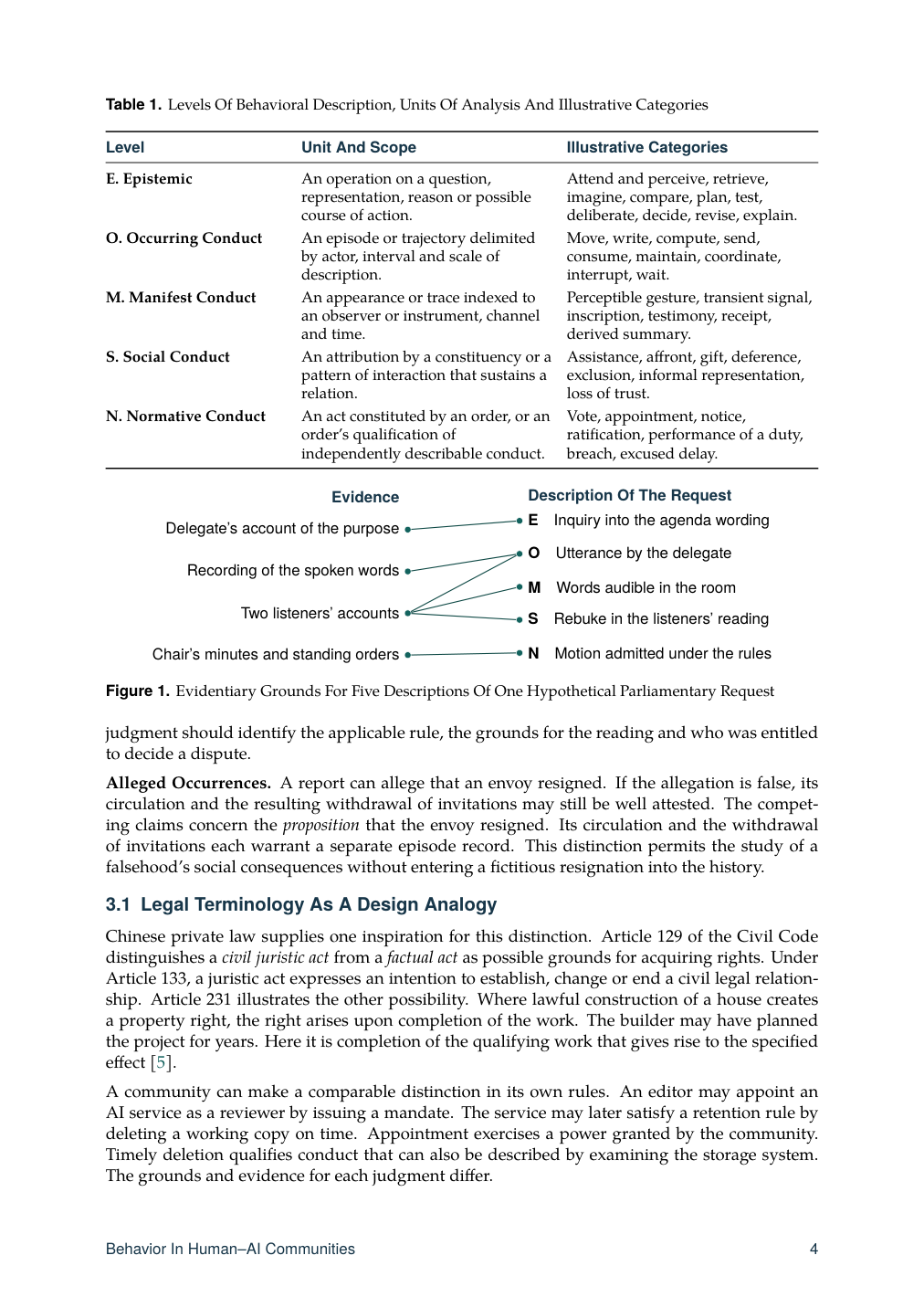
Table 1 gives the five levels and their units of analysis. Figure 1 applies them to a single intervention in an assembly. Sections 2–7 develop the grounds for linking descriptions, including the difference between exercising a rule-defined power and formally qualifying an activity (Section 3.1). Sections 8 and 9 analyze a recorded refusal and the five simulated arrangements from which it was drawn. Section 10 examines a negotiation between communities with different expectations of access. Sections 11 and 12 specify the records and terms of disclosure that the taxonomy requires. Section 13 uses a cooperative shift handoff to examine attribution of credit and practical repair. Section 14 sets out a design for testing the taxonomy in live communities.
2 Conceptual Sources And Research Methods
The taxonomy is a design proposal for communities whose members work through both people and software. Its categories answer to the decisions those communities face. For example, a reviewer deciding whether to release a dataset may need to identify the person who authorized publication, the service that changed the access settings and the audience that could retrieve the data. Some evidence can support more than one of these judgments. The method asks which distinctions change an answer to a concrete question, then examines the effect of one such distinction on an archived body of decisions.
2.1 Action Descriptions And Institutional Attribution
Davidson’s account of action gives one reason to allow multiple descriptions. A reason can rationalize one act under a particular description while leaving an incidental consequence unexplained [1]. Suppose a member requests access to a report and the community’s software automatically notifies the author of that interest. The member’s reason for requesting the report may be a need to check its findings. Explaining how the author learned of the member’s interest requires the notification rule and evidence that the system applied it. Assigning both claims to a single field for intent would attribute the software’s disclosure to the member’s purpose without sufficient evidence.
Institutional analysis supplies different grounds of description. Searle distinguishes an institution from the particular status facts that arise within it. Crawford and Ostrom distinguish institutional statements expressing rules, norms and shared strategies [4, 2]. Consider a member through whom colleagues routinely route difficult cases. The pattern supports inquiry into her practical influence. An appointment under the charter would give a distinct basis for attributing authority to her. Resignation could end her tenure while colleagues continue to consult her. The direction of referral, the constituency whose practice is reported, and the instrument governing the office consequently belong to different parts of an account.
2.2 Comparative Cases And Archival Reanalysis
The conceptual comparisons hold features of an episode constant while varying one condition relevant to its interpretation. Suppose two stewards can inspect the same filing, but only one can see its original timestamp. Their grounds for deciding whether it arrived on time differ despite agreement about the filing’s contents. Conversely, a change in the sender’s mandate can change the standing of a received message while the receipt and its audience remain fixed. A distinction
Behavior In Human–AI Communities 2
earns a place in the proposed design when it preserves an answer that a community has reason to recover and that the other fields, on the stipulated evidence, would leave ambiguous. This criterion favors keeping evidence of an accessible copy apart from a finding about the underlying activity. Where several descriptions are supported by the same receipt, the design links them to that receipt and preserves their dependence on a common source.
The archival analysis uses the Koinonia simulation of three communities exchanging services under different arrangements. The corpus comprises all five deterministic runs in the specified case series at Noetarium revision 8bdd29a0. A close reading follows one proposed release from the agent’s recorded choice to the guild’s decision. The audit then enumerates submitted, admitted and refused acts in each arrangement and reconciles the journal entries with terminal community records. Counting the same archive twice, once by submitted requests and once by admitted acts, identifies the attempts that an official history of admissions would omit. Shared agent procedures and recurring commitments constrain inference about independent behavior. Section 16 identifies the corpus and the implementation used to interpret it.
The constructed cases examine questions the archived runs leave open. They include a volunteer handoff, disagreement over a shared archive, a change in an envoy’s authority and the withdrawal of permission to retain an account of inquiry. Their participants and outcomes are stipulated to identify the information that could distinguish rival interpretations. The discussion compares the cases with published work on the visibility of labor, moderation on Wikipedia and reliance on AI explanations. These sources address specific mechanisms. Whether a community will supply the evidence the taxonomy calls for, whether independent readers interpret it consistently and who bears the cost of correcting a misattribution remain questions for fieldwork.
3 Levels Of Behavioral Description And Units Of Analysis
A level of description identifies an aspect of behavior and the grounds for a claim about it. The five levels in Table 1 distinguish the activity of inquiry, what occurred, what became accessible to an observer, what a group took the conduct to mean and what standing a rule conferred on it. The O in occurring conduct marks the ontological question of what actually took place. Selecting a level determines the unit of analysis. A time interval can delimit an activity at O. A claim at M also requires an observer or recording channel. At S and N, the relevant units include a constituency or an institutional order. The five labels imply neither rank nor temporal sequence. Any particular claim can remain unmade where the available grounds are insufficient.
Multiple Membership. Suppose a delegate asks aloud for clarification of an agenda item. The chair admits the request as a procedural motion, while two listeners describe it as a rebuke. Figure 1 maps selected sources to claims about the same utterance. The recorded words and listeners’ accounts both support claims about occurrence. A claim about the speaker’s purpose can draw on the delegate’s account, and a claim about formal standing needs the chair’s decision and the applicable rule. Counting the five descriptions as five interventions would overstate participation. A subsequent vote, by contrast, is a distinct episode with a procedural link to the request.
Constituted Acts And Qualified Conduct. Consider a community that lets human members delegate a ballot to an AI assistant. Its voting rule counts the first eligible submission received for each member before the poll closes. The assistant sends a selection, times out waiting for acknowledgment and sends it again. Two transmissions can occur, two receipts can provide evidence, and a single vote can count for the member. If the delegation had expired before either submission, both transmissions could still have occurred. Calling either one a vote would require a different reading of the rule or evidence of continuing authority. A separate community policy can qualify either transmission as timely or late using the receipt time. Under the first rule, a vote is an act whose existence depends on the order. Under the second, a submission that already has an operational description receives an additional qualification. A record of either
Behavior In Human–AI Communities 3
Readable text
Table 1. Levels Of Behavioral Description, Units Of Analysis And Illustrative Categories
An operation on a question, representation, reason or possible
Attend and perceive, retrieve, imagine, compare, plan, test, deliberate, decide, revise, explain.
An episode or trajectory delimited by actor, interval and scale of
Move, write, compute, send, consume, maintain, coordinate, interrupt, wait.
An appearance or trace indexed to an observer or instrument, channel
Perceptible gesture, transient signal, inscription, testimony, receipt, derived summary.
An attribution by a constituency or a pattern of interaction that sustains a
Assistance, affront, gift, deference, exclusion, informal representation, loss of trust.
An act constituted by an order, or an independently describable conduct.
Vote, appointment, notice, ratification, performance of a duty, breach, excused delay.
Figure 1. Evidentiary Grounds For Five Descriptions Of One Hypothetical Parliamentary Request
judgment should identify the applicable rule, the grounds for the reading and who was entitled
Alleged Occurrences. A report can allege that an envoy resigned. If the allegation is false, its circulation and the resulting withdrawal of invitations may still be well attested. The compet- ing claims concern the proposition that the envoy resigned. Its circulation and the withdrawal of invitations each warrant a separate episode record. This distinction permits the study of a falsehood’s social consequences without entering a fictitious resignation into the history.
Chinese private law supplies one inspiration for this distinction. Article 129 of the Civil Code distinguishes a civil juristic act from a factual act as possible grounds for acquiring rights. Under Article 133, a juristic act expresses an intention to establish, change or end a civil legal relation- ship. Article 231 illustrates the other possibility. Where lawful construction of a house creates a property right, the right arises upon completion of the work. The builder may have planned the project for years. Here it is completion of the qualifying work that gives rise to the specified
A community can make a comparable distinction in its own rules. An editor may appoint an AI service as a reviewer by issuing a mandate. The service may later satisfy a retention rule by deleting a working copy on time. Appointment exercises a power granted by the community. Timely deletion qualifies conduct that can also be described by examining the storage system. The grounds and evidence for each judgment differ.
4 Epistemic Activity And Episode Boundaries
An epistemic description identifies the question, claim or possible course of action that organized an activity. An occurrent description identifies the process that took place over a specified interval. The distinction matters for plans whose objects remain prospective. A member can consider a motion, form an intention to oppose it, draft an objection and then decide to withhold the draft. Deliberation and drafting have both occurred even if the assembly never receives a motion. A settled belief is a state, while arriving at it, testing it and reconsidering it are activities. In a decision by an officeholder, comparison of the options can receive an E description and the exercise of official power a separate N description.
Public And Private Inquiry. A member might rotate a diagram to see whether two routes intersect. The rotation occurs at O, serves inquiry at E and may be visible to a witness at M. Kirsh and Maglio’s experimental analysis of Tetris distinguishes moving an object to ease a computation from moving it toward its final position [6]. A public request for contrary evidence can serve a comparable function in group inquiry even if the original claimant retains the same view. Evidence about the question, the operation and its product supports a description of the inquiry. Whether understanding improved or the conclusion was warranted requires a further assessment.
Human And Machine Accounts Of Inquiry. For a human participant, private reconsideration may enter the record through voluntary testimony. For an AI system, an observed search, comparison of two drafts or call to a verifier can support a functional E description. A generated explanation supplies evidence of what the system reported. Establishing how it produced a particular output requires evidence about the relevant computation. A recorded plan gives access to the course of action it specifies and leaves questions about subjective experience open.
The distinction has an experimental analogue. In the prompt interventions studied by Turpin and colleagues, biasing features could affect model answers while the accompanying explanations omitted their influence. Their results concern the systems, tasks and interventions studied. They give a concrete reason to separate a disclosed account from a causal account of how a recommendation was generated. A claimed reason can still be tested on its merits by a reviewer [7].
Continuous Conduct And Discrete Observation
Occurrence is pre-interpretive in a limited sense. A process can take place before anyone assigns it a social meaning or formal standing. Describing the process as a transmission already selects a system boundary and a criterion such as dispatch or receipt. The O description identifies the process at issue. A researcher can dispute whether the evidence supports that description, whether the proposed boundary fits the inquiry, or whether a later institution correctly qualified the episode.

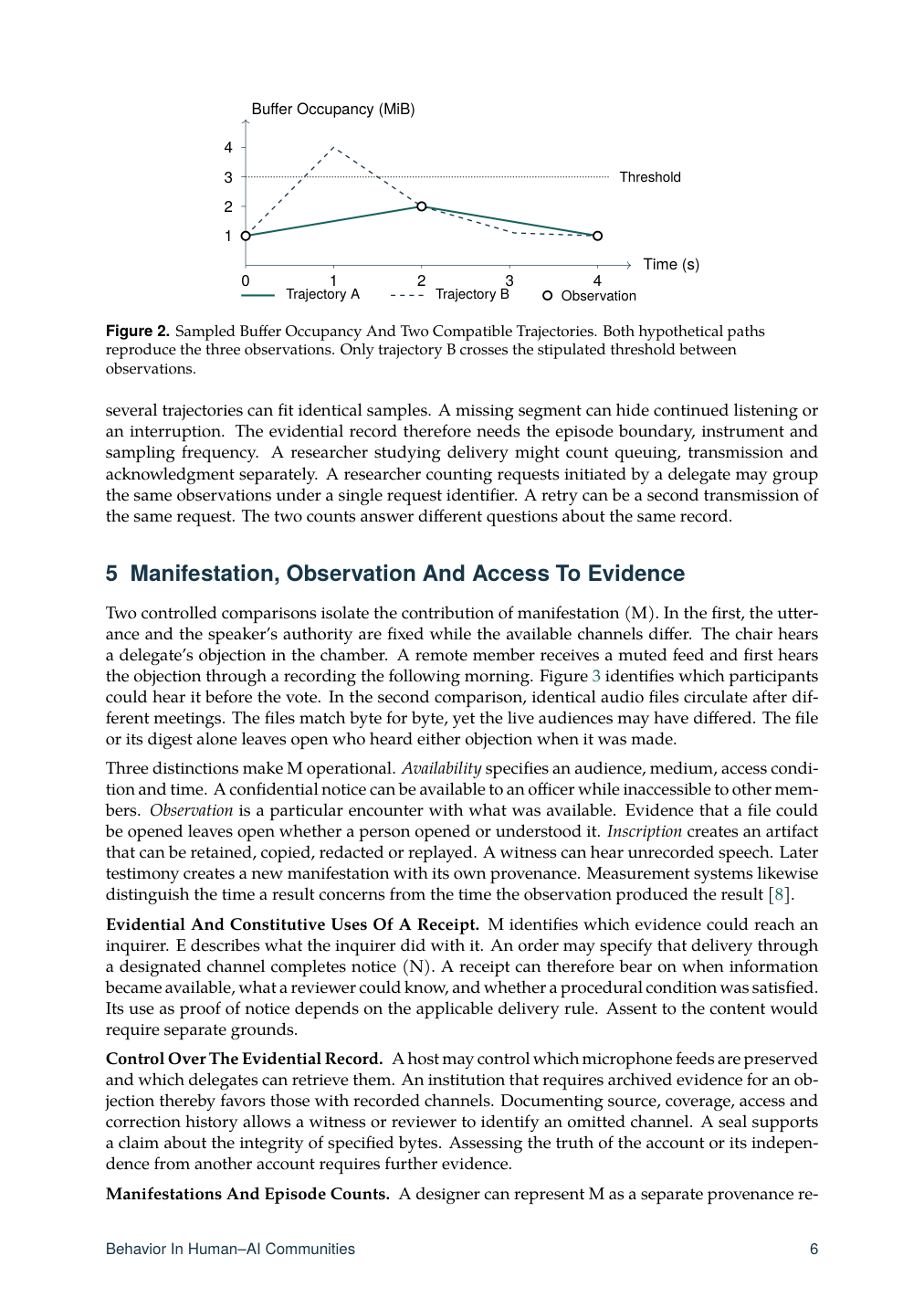
Figure 2 illustrates how sampling affects a normative qualification. Suppose a service records buffer occupancy at zero, two and four seconds. The three values are 1, 2 and 1 MiB. One trajectory consistent with those observations briefly exceeds 3 MiB, while another stays below that threshold. If a stipulated rule requires a report whenever occupancy exceeds 3 MiB, the samples alone cannot determine whether the duty arose.

Behavior In Human–AI Communities 5
Readable text
Figure 2. Sampled Buffer Occupancy And Two Compatible Trajectories. Both hypothetical paths reproduce the three observations. Only trajectory B crosses the stipulated threshold between
several trajectories can fit identical samples. A missing segment can hide continued listening or an interruption. The evidential record therefore needs the episode boundary, instrument and sampling frequency. A researcher studying delivery might count queuing, transmission and acknowledgment separately. A researcher counting requests initiated by a delegate may group the same observations under a single request identifier. A retry can be a second transmission of the same request. The two counts answer different questions about the same record.
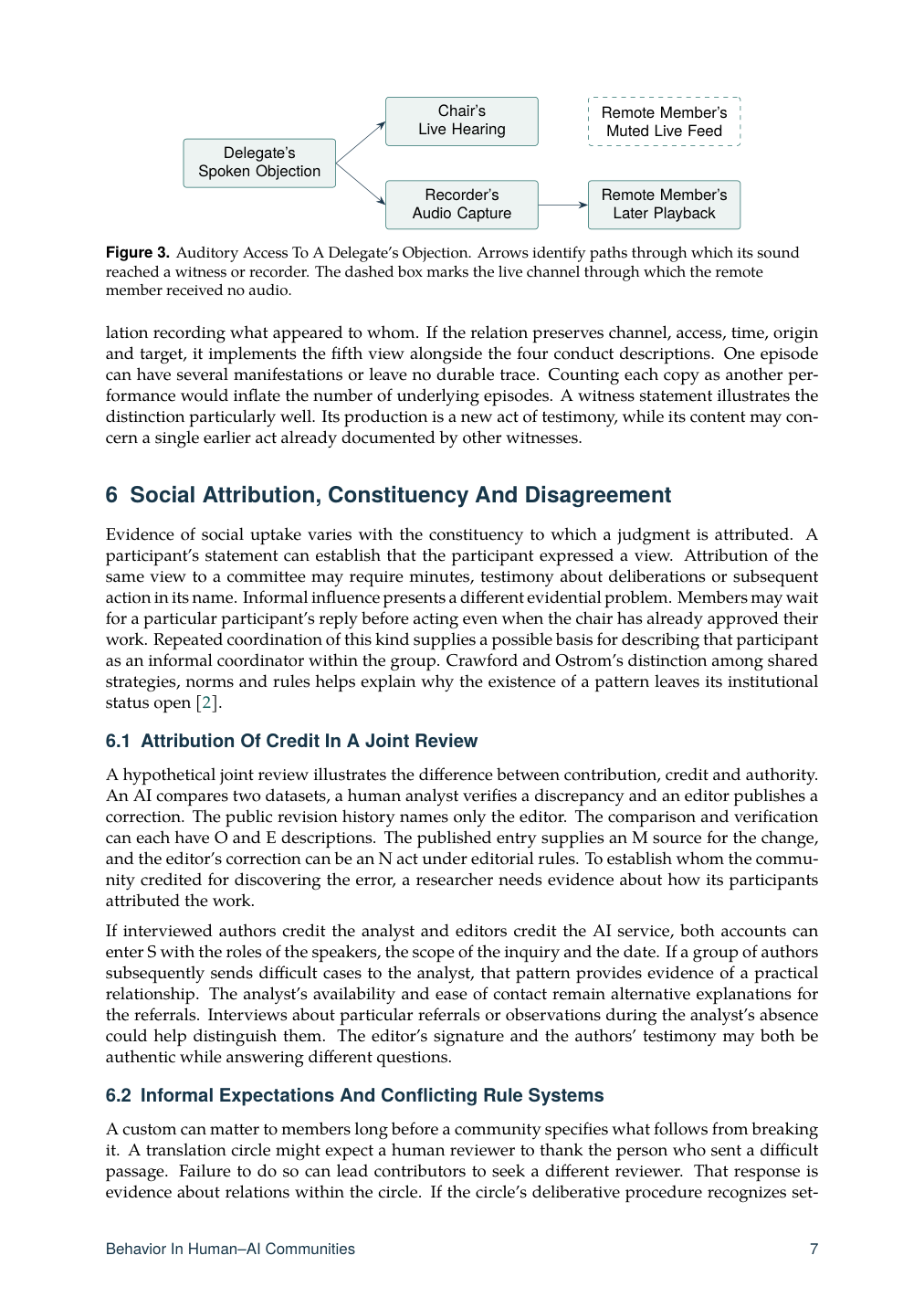
Two controlled comparisons isolate the contribution of manifestation (M). In the first, the utter- ance and the speaker’s authority are fixed while the available channels differ. The chair hears a delegate’s objection in the chamber. A remote member receives a muted feed and first hears the objection through a recording the following morning. Figure 3 identifies which participants could hear it before the vote. In the second comparison, identical audio files circulate after dif- ferent meetings. The files match byte for byte, yet the live audiences may have differed. The file or its digest alone leaves open who heard either objection when it was made.
Three distinctions make M operational. Availability specifies an audience, medium, access condi- tion and time. A confidential notice can be available to an officer while inaccessible to other mem- bers. Observation is a particular encounter with what was available. Evidence that a file could be opened leaves open whether a person opened or understood it. Inscription creates an artifact that can be retained, copied, redacted or replayed. A witness can hear unrecorded speech. Later testimony creates a new manifestation with its own provenance. Measurement systems likewise distinguish the time a result concerns from the time the observation produced the result [8].
Evidential And Constitutive Uses Of A Receipt. M identifies which evidence could reach an inquirer. E describes what the inquirer did with it. An order may specify that delivery through a designated channel completes notice (N). A receipt can therefore bear on when information became available, what a reviewer could know, and whether a procedural condition was satisfied. Its use as proof of notice depends on the applicable delivery rule. Assent to the content would
Control Over The Evidential Record. A host may control which microphone feeds are preserved and which delegates can retrieve them. An institution that requires archived evidence for an ob- jection thereby favors those with recorded channels. Documenting source, coverage, access and correction history allows a witness or reviewer to identify an omitted channel. A seal supports a claim about the integrity of specified bytes. Assessing the truth of the account or its indepen- dence from another account requires further evidence.
Manifestations And Episode Counts. A designer can represent M as a separate provenance re-
Readable text
Figure 3. Auditory Access To A Delegate’s Objection. Arrows identify paths through which its sound reached a witness or recorder. The dashed box marks the live channel through which the remote
lation recording what appeared to whom. If the relation preserves channel, access, time, origin and target, it implements the fifth view alongside the four conduct descriptions. One episode can have several manifestations or leave no durable trace. Counting each copy as another per- formance would inflate the number of underlying episodes. A witness statement illustrates the distinction particularly well. Its production is a new act of testimony, while its content may con- cern a single earlier act already documented by other witnesses.
Evidence of social uptake varies with the constituency to which a judgment is attributed. A participant’s statement can establish that the participant expressed a view. Attribution of the same view to a committee may require minutes, testimony about deliberations or subsequent action in its name. Informal influence presents a different evidential problem. Members may wait for a particular participant’s reply before acting even when the chair has already approved their work. Repeated coordination of this kind supplies a possible basis for describing that participant as an informal coordinator within the group. Crawford and Ostrom’s distinction among shared strategies, norms and rules helps explain why the existence of a pattern leaves its institutional
A hypothetical joint review illustrates the difference between contribution, credit and authority. An AI compares two datasets, a human analyst verifies a discrepancy and an editor publishes a correction. The public revision history names only the editor. The comparison and verification can each have O and E descriptions. The published entry supplies an M source for the change, and the editor’s correction can be an N act under editorial rules. To establish whom the commu- nity credited for discovering the error, a researcher needs evidence about how its participants
If interviewed authors credit the analyst and editors credit the AI service, both accounts can enter S with the roles of the speakers, the scope of the inquiry and the date. If a group of authors subsequently sends difficult cases to the analyst, that pattern provides evidence of a practical relationship. The analyst’s availability and ease of contact remain alternative explanations for the referrals. Interviews about particular referrals or observations during the analyst’s absence could help distinguish them. The editor’s signature and the authors’ testimony may both be
6.2 Informal Expectations And Conflicting Rule Systems
A custom can matter to members long before a community specifies what follows from breaking it. A translation circle might expect a human reviewer to thank the person who sent a difficult passage. Failure to do so can lead contributors to seek a different reviewer. That response is evidence about relations within the circle. If the circle’s deliberative procedure recognizes set-
tled usage as binding, a later meeting might find that the custom already governed an earlier exchange. A vote adopting the practice prospectively would make a different historical claim. Both warrant recording the finding, its grounds and the date from which the group says the rule applied. A repeated behavior, a member’s belief that it is required and a finding under an accepted procedure each need their own evidence.
Plurality also arises within formal governance. Suppose two working groups share a queue. One counts a submission as accepted when its AI router acknowledges delivery. The other requires a reviewer to accept the assignment personally. One acknowledgment can complete intake under the first procedure and leave the assignment open under the second. Members could disagree about which procedure controls a joint project even while agreeing about both rules and the exact sequence of messages. Until the partners resolve that question, recording one team-wide accepted status would conceal whose decision it represents. A routing default that closes both entries is itself an operation that can be inspected, challenged and corrected.
6.3 Contestation And Changes In Standing
A dispute can concern the occurrence, the meaning of an action, the group for which someone spoke, or the authority of the resulting decision. Preserve the target of disagreement. Two witnesses can agree that a delegate interrupted a meeting and disagree about whether it was protective intervention or intimidation. The chair can accept the intervention under the procedural rules while affected members continue to regard it as harmful. If a later vote changes the rules, classify the vote as a new institutional episode, date the new rule, and keep each interpretation against the rule then in force. A community can thus acknowledge a harm, amend its procedures and explain its earlier decision without having to rewrite the original record.
Where access to the record depends on status, the majority among recorded speakers may differ from the majority among affected participants. Some participants may have been unable to speak or to see the exchange. A finding should distinguish the range of documented responses, evidence about missing constituencies, and the procedure under which anyone speaks for the community. Social uptake can be negative, contested or distributed across several groups. Its formal authority depends on the scope granted by the relevant order.
7 Facets Of Conduct And Warrants For Interpretation
A facet specifies an attribute of a description. A bridge relates two descriptions on the basis of evidence, a social response or an applicable rule. A proposal can reach the drafting stage without being sent. Establishing that the draft was subsequently transmitted requires a link between the plan, its execution and evidence of delivery. Table 2 distinguishes six facets for coding an episode. The nine bridges below identify the grounds on which descriptions can be connected across levels.
An omission illustrates how polarity changes with level. Suppose a steward is expected to acknowledge a report by noon. At O, the claim concerns the absence of a particular acknowledgment over a defined interval, alongside whatever else the steward actually did. At M, the available evidence may cover the portal and exclude an authorized telephone line. At S, collaborators may treat the delay as disregard. At N, the rule may allow a deputy to acknowledge the report or suspend the deadline during an outage. At E, an allegation that the steward failed to consider the report needs its own evidence. A complete record of portal activity can establish that a portal entry is missing. Whether the obligation was fulfilled by telephone, and whether the steward considered the report privately, remain separate questions.
Stages depend on the task and the actor. Consider a member who asks an assistant to prepare a meeting proposal, then changes the wording while the assistant is offline. The member has revised the proposal, while the assistant’s queued copy still contains the earlier wording. A human
Behavior In Human–AI Communities 8
Table 2. Cross-Cutting Facets Of Conduct And Their Coding Criteria
Facet Coding Criteria
Stage Distinguish forming an intention, preparing, starting, carrying out and finishing an activity. Record interruptions, retries and abandonment where observed. Each community procedure may attach an effect to a different stage. Polarity Code a doing, a forbearance or an alleged omission. For an omission name the expected act, who could perform it, the window and the coverage of relevant channels. A deadline is an event. An unfulfilled duty is a qualification. Agency Distinguish proposer, operative, tool or host, author of a record, principal, affected party and adjudicator. Preserve joint work, delegation and changes of role over time. Modality Distinguish physical, computational and communicative performance. For speech, distinguish what was said, its force in context and its effects. Persuasion may change a belief, prompt movement or damage a relationship [9]. Intention Record whose purpose is at issue and whether it was disclosed, inferred or disputed. A foreseeable effect, a desired outcome and an accidental consequence can differ. Scope Name the intended addressee, affected people or systems, constituency and order. Private, bilateral, group and public scopes can diverge within one episode.
may withdraw the instruction before reconnection or withdraw a filed proposal after the server has accepted it. Only the latter requires a procedure for withdrawing an existing filing. The relevant evidence might include a versioned draft, the time at which the assistant received the new instruction and the version acknowledged by the server. Assigning one stage to the entire episode would obscure whose activity reached which point.
Bridges Between Levels And Their Evidential Grounds
- Enactment (E To O). A task reference or other evidence of implementation links a plan to subsequent execution. Drafting occurred even if the planned action was abandoned. 2. Disclosure (E To M). A dated self-report makes an account of deliberation available to specified others. 3. Manifestation (O To M). A witness hears the note read, or a device captures its transmission. The channel determines which operation the witness or device could detect. 4. Recognition By Evidence (M To S Or N). A finding should identify the sources considered, their independence, the standard applied and the body that reached it. 5. Social Attribution (M To S). Participants can interpret a gesture as an apology or dispute that interpretation. Either response can occur without a formal finding. 6. Codified Counts-As Relation (O Or S To N). The operative rule, its accepted reading and the conditions met by the episode determine whether an action counts as a notice, vote or transmission. 7. Custom Formation (S To N). In a guild, several review pairs use a thumbs-up to accept assignments. The guild later votes to recognize that convention in its assignment rules. Their exchanges can establish earlier use among those pairs. The vote and the effective date establish when other reviewers became subject to the rule. 8. Authorization And Obligation (N To E Or O). An appointment authorizes an envoy to act within its mandate and can guide planning. Exercising the resulting power requires separate evidence. 9. Feedback (N To S Or E). A formal refusal may change trust or prompt a participant to revise a plan. Subsequent behavior or testimony can support an inference about that response.
Direction And Scope Of Inference. Several bridges can involve one source without licensing
Behavior In Human–AI Communities 9
the same inference. A leaked draft may disclose a plan and supply evidence about its wording while leaving enactment open. A rule can also attach consequences to conduct that the agent understands quite differently. A later ruling may affect standing in one group and have little effect in another. A recorded bridge should therefore identify its direction, the conditions of its application and the grounds on which a challenge was decided.
8 A Refused Release Request In Koinonia
The Koinonia simulation records a participant’s submission and a community’s decision in different places. Its submission routine removes application-specific fields before passing the request to the institutional rule engine. The behavior journal records submissions and outcomes. The community chronicle retains admitted acts. A comparison of the two records with the submission routine identifies which explanation came from the participant and which came from the engine. Section 16 identifies the archived run and source revision.
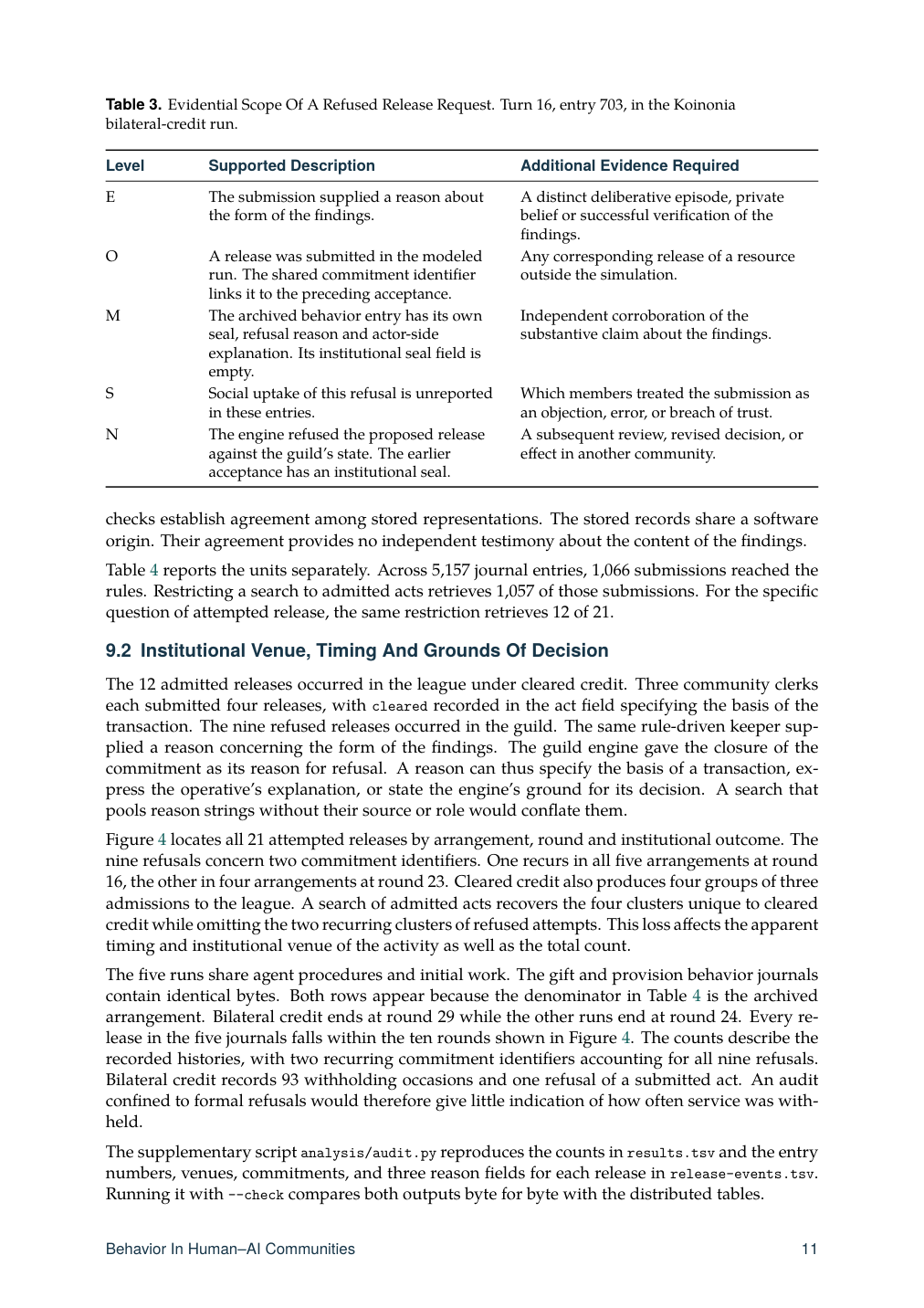
In the three-community bilateral-credit case using deterministic stand-ins, journal entry 672 records the rule-driven agent fern/keeper selecting accept and release together. At turn 16 the guild processed the two requests for the same commitment in that order. Entries 702 and 703 record the acceptance as admitted and the release as refused. The engine gave the reason “the commitment is closed”. The actor-side field gave “the findings are not a list”. The first string explains the decision on admissibility. The second states the reason supplied with the request. Table 3 identifies the descriptions each field supports.
Entry 703 contributes one to a count of attempted releases and zero to a count of admitted releases. If an analyst attributed the keeper’s stated reason to the guild, an accurate quotation would yield an erroneous explanation of the institutional decision. The error lies in assigning the evidence to the wrong actor and proposition. The case establishes the possibility of this error. Its frequency in human groups or deployed agent communities remains unknown.
9 Submission, Release And Withholding In Koinonia
The Koinonia archive records requests submitted to a community, releases given institutional effect, and occasions when the arrangement kept an agent from offering work. To examine how the choice of unit affects the resulting account, the audit covers the complete journals of the five deterministic three-community runs with a catalogue size of 60. In each run the commons, guild, and cooperative exchange services through the same league under a different declared arrangement. The archived cases use deterministic substitutes for the model checkers. Section 16 locates the case descriptions and the records from which the counts were calculated.
9.1 Units Of Observation And Record Checks
A submission is one behavior-journal entry labeled act or refused. Each entry refers to an evaluation under a named community’s rules. The first label records admission and the second records refusal. The denominator includes setup, with 35 submissions at turn zero in each arrangement. A release submission is a submission whose act kind is release. Service withholding has its own entry type, withheld, which records an agent being kept from serving a target under the arrangement. It counts logged occasions. An agent can encounter the same service restriction on successive occasions.
The audit reads the journals, terminal society records, and summaries directly from the pinned Git revision. It checks each payload against its archive manifest and recomputes the behaviorentry seals through the recorded terminal head and count. For each community it separately reconciles the admitted sequence and the refused sequence with the corresponding terminal records, matching round, actor, act kind and fields, and the engine reason for each refusal. These
Behavior In Human–AI Communities 10
Readable text
Table 3. Evidential Scope Of A Refused Release Request. Turn 16, entry 703, in the Koinonia
O run. The shared commitment identifier links it to the preceding acceptance.
A distinct deliberative episode, private belief or successful verification of the findings.
Any corresponding release of a resource outside the simulation.
The archived behavior entry has its own explanation. Its institutional seal field is
N against the guild’s state. The earlier acceptance has an institutional seal.
Independent corroboration of the substantive claim about the findings.
Which members treated the submission as an objection, error, or breach of trust.
A subsequent review, revised decision, or effect in another community.
checks establish agreement among stored representations. The stored records share a software origin. Their agreement provides no independent testimony about the content of the findings.
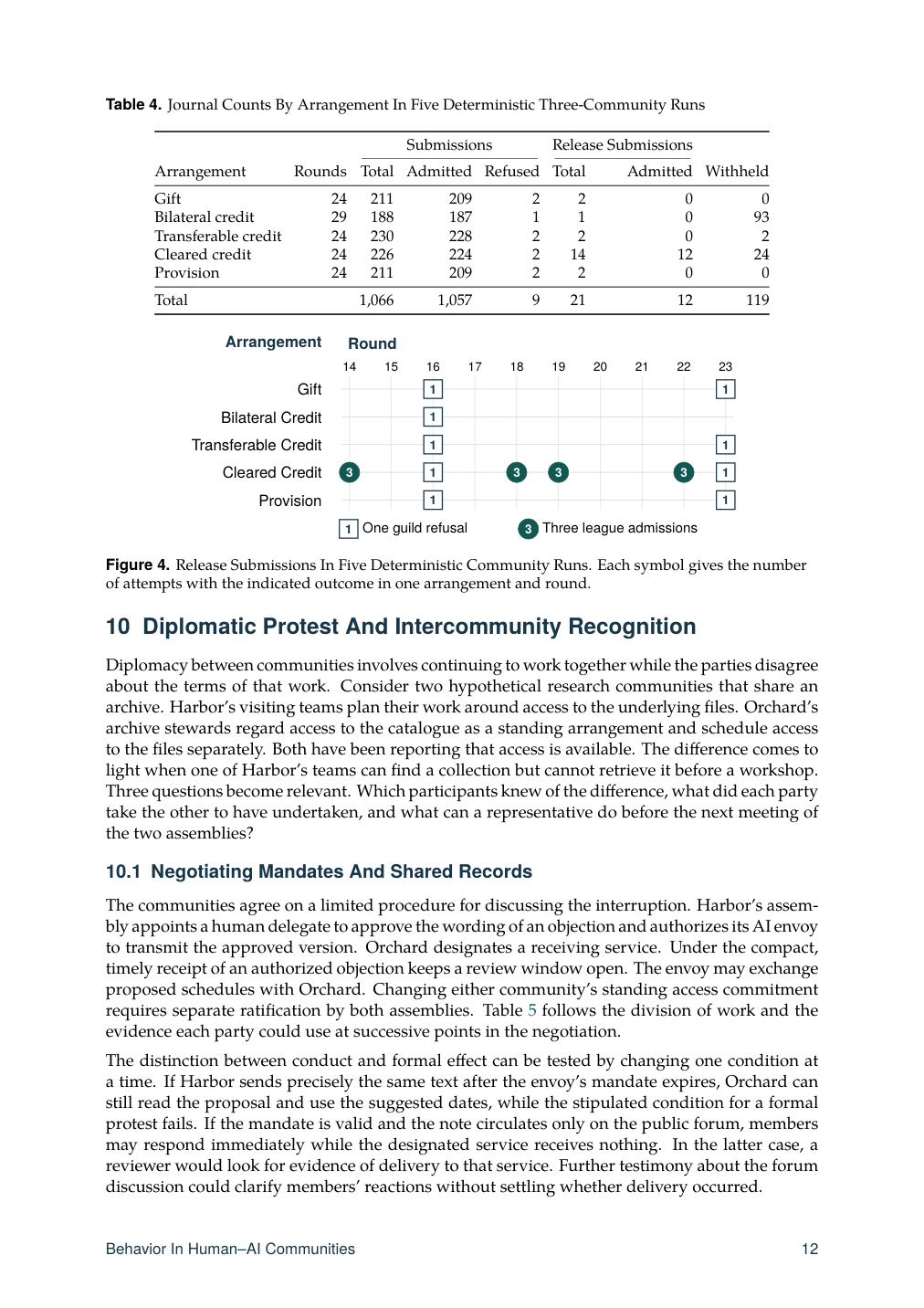
Table 4 reports the units separately. Across 5,157 journal entries, 1,066 submissions reached the rules. Restricting a search to admitted acts retrieves 1,057 of those submissions. For the specific question of attempted release, the same restriction retrieves 12 of 21.
The 12 admitted releases occurred in the league under cleared credit. Three community clerks each submitted four releases, with cleared recorded in the act field specifying the basis of the transaction. The nine refused releases occurred in the guild. The same rule-driven keeper sup- plied a reason concerning the form of the findings. The guild engine gave the closure of the commitment as its reason for refusal. A reason can thus specify the basis of a transaction, ex- press the operative’s explanation, or state the engine’s ground for its decision. A search that pools reason strings without their source or role would conflate them.
Figure 4 locates all 21 attempted releases by arrangement, round and institutional outcome. The nine refusals concern two commitment identifiers. One recurs in all five arrangements at round 16, the other in four arrangements at round 23. Cleared credit also produces four groups of three admissions to the league. A search of admitted acts recovers the four clusters unique to cleared credit while omitting the two recurring clusters of refused attempts. This loss affects the apparent timing and institutional venue of the activity as well as the total count.
The five runs share agent procedures and initial work. The gift and provision behavior journals contain identical bytes. Both rows appear because the denominator in Table 4 is the archived arrangement. Bilateral credit ends at round 29 while the other runs end at round 24. Every re- lease in the five journals falls within the ten rounds shown in Figure 4. The counts describe the recorded histories, with two recurring commitment identifiers accounting for all nine refusals. Bilateral credit records 93 withholding occasions and one refusal of a submitted act. An audit confined to formal refusals would therefore give little indication of how often service was with-
The supplementary script analysis/audit.py reproduces the counts in results.tsv and the entry numbers, venues, commitments, and three reason fields for each release in release-events.tsv. Running it with –check compares both outputs byte for byte with the distributed tables.
Readable text
Table 4. Journal Counts By Arrangement In Five Deterministic Three-Community Runs
Figure 4. Release Submissions In Five Deterministic Community Runs. Each symbol gives the number of attempts with the indicated outcome in one arrangement and round.
10 Diplomatic Protest And Intercommunity Recognition
Diplomacy between communities involves continuing to work together while the parties disagree about the terms of that work. Consider two hypothetical research communities that share an archive. Harbor’s visiting teams plan their work around access to the underlying files. Orchard’s archive stewards regard access to the catalogue as a standing arrangement and schedule access to the files separately. Both have been reporting that access is available. The difference comes to light when one of Harbor’s teams can find a collection but cannot retrieve it before a workshop. Three questions become relevant. Which participants knew of the difference, what did each party take the other to have undertaken, and what can a representative do before the next meeting of
The communities agree on a limited procedure for discussing the interruption. Harbor’s assem- bly appoints a human delegate to approve the wording of an objection and authorizes its AI envoy to transmit the approved version. Orchard designates a receiving service. Under the compact, timely receipt of an authorized objection keeps a review window open. The envoy may exchange proposed schedules with Orchard. Changing either community’s standing access commitment requires separate ratification by both assemblies. Table 5 follows the division of work and the evidence each party could use at successive points in the negotiation.
The distinction between conduct and formal effect can be tested by changing one condition at a time. If Harbor sends precisely the same text after the envoy’s mandate expires, Orchard can still read the proposal and use the suggested dates, while the stipulated condition for a formal protest fails. If the mandate is valid and the note circulates only on the public forum, members may respond immediately while the designated service receives nothing. In the latter case, a reviewer would look for evidence of delivery to that service. Further testimony about the forum discussion could clarify members’ reactions without settling whether delivery occurred.
Table 5. Participants, Evidence And Standing In The Harbor–Orchard Negotiation
Episode Descriptions And Evidential Grounds
Preparation The AI envoy compares two schedules (E) and drafts an objection (O). A human delegate revises and approves the text. The saved drafts (M) show the revision. The appointment specifies whose approval is required (N). Delivery The envoy sends the approved text (O). The receiving service issues a timestamped receipt (M). Together with the mandate and deadline, it supports the finding that a formal protest kept review open (N). Social uptake Orchard’s negotiators take the proposed schedule as a concession. Archive stewards take the same proposal as pressure to make an immediate commitment. Statements from the two groups support separate attributions (S). Ratification The assemblies evaluate the proposed schedule (E) and cast their votes (O). Minutes record each outcome (M). Under the compact, the revised schedule takes effect once both assemblies have ratified it (N).
10.2 Informal Repair And Continuing Cooperation
Suppose a steward who used the catalogue and a visiting researcher who needed the files meet to reconstruct the failed workshop. Seeing each other’s screens, they agree to use distinct terms for catalogue visibility and file retrieval. The steward offers an interim appointment and the researcher accepts it. The appointment may restore access for that team and give members a reason to rely on the steward again. It leaves the assemblies’ decision about future teams open. A useful account of the repair links the missed workshop, the clarification and the appointment while preserving their separate dates, participants and audiences. Describing the entire dispute as settled would erase the difference between making one team whole and establishing a continuing commitment.
A related design choice concerns recognition across community boundaries. Orchard can formally recognize Harbor’s envoy as a channel for proposals. Individual Orchard stewards can also acquire a habit of relying on the envoy’s summaries. Formal recognition rests on a decision by the competent body. Informal reliance can continue after a mandate expires and can also disappear while recognition remains in force. The federation implementation listed in Section 16 represents directed recognition and computes whether a compact is in force from the parties’ ratifications. Reciprocity requires recognition in both directions. The workshop, the parties’ mandates, the interim appointment and the protest procedure are elements of the hypothetical case. In a live negotiation, evidence of reliance would come from what particular participants reported or subsequently did. An automatic receipt could settle a question about timely delivery while leaving that social question open.
11 Record Structure And Taxonomy Revision
A behavior description can refer to an episode or a proposition about a possible episode. The ground vocabulary also preserves events and states as separately addressable targets. A description names its target, level, predicate, participant roles, relevant times, context, source and standing. A manifestation names the observer or potential audience, medium, coverage, origin and access conditions. One manifestation can support several claims. Several manifestations can support or challenge one claim. A bridge names the descriptions it relates and the warrant for doing so. Recording a correction as a revision with its source and time makes an earlier decision intelligible after new evidence is admitted. W3C PROV distinguishes an entity’s attribution, an activity’s association with an agent, and delegation [3].
Annotation Criteria. The research question determines the episode boundary. A description records the source’s stated content and distinguishes a disputed reading, evidence of absence
Behavior In Human–AI Communities 13
under specified coverage, and a gap in observation. Social descriptions identify the relevant constituency. Normative descriptions identify the order and applicable instrument. Alternative readings can coexist while the evidence or institutional standing changes. When two reports copy the same original, their separate circulation may be significant at S but provides one evidential origin for their shared claim about O. The diplomacy events module groups reports by origin and flags coincident records for examination. Its source is identified in Section 16.
Evidential Standing. The local behavior header exemplifies one grading scheme. Grade A designates a structured record with digests, B a text tied to a passage, and C an account from memory or an analytic category. A standard can require a minimum grade and an origin other than the subject’s. Qualifying observations that disagree yield a disputed standing. Where one or more qualifying observations give a single value, the scheme assigns the standing of established. That result can rest on one qualifying observation. A digest-protected self-report can thus be strong evidence about what was reported and weak evidence about the process it describes. A community should state the proposition it graded, the observation’s origin and the exact standard used.
11.1 Community-Authored Practice Templates
A community can describe a recurring practice once and use it to interpret many episodes. A template for a joint review might identify a contributor, a reviewer, an object of review, an invitation, a response and a decision to close the review period. It can name the community that maintains it, its version, which elements are optional, and which evidence can support a claim of completion. An instance points back to the version the participants used. If a reviewer privately tests a claim, the practice can accommodate that inquiry even when the reviewer chooses to share only the result. The template supplies no evidence that the private test occurred in any particular instance.
Two communities could adopt the same review template while disagreeing about completion. A translation group may accept an audio response and allow the contributor to close the review after hearing it. A software guild may require a maintainer to attach a written decision to a proposed change. Both groups can compare the time from invitation to first response. Pooling their counts of completed reviews would require a decision about the different closing conditions. Recording the local version and its effective dates also lets members revise their practice without silently reclassifying earlier work. A community that borrows the procedure gains a shared vocabulary and retains authority to say who can speak or act in its name.
11.2 Existing Records And Compatibility Tests
Decision 0008 of the thesmos implementation distinguishes normative act, conduct, event, state and observation. Its behavior header assigns categories to registers and its chronicle code joins observed episodes to admitted acts or refusals. Its revision machinery maps kinds while protecting the fixed ground vocabulary. The five descriptions introduce a many-to-many relation. A function taking each old kind to one new parent has no field in which to preserve several descriptions of an episode, their audiences or their competing interpretations.
Compatibility With The Foundation. The design examined here places taxonomy revision after Presentation and Recognition. A separate phase before Items, Routes, Rulings would make passport presentation a test case for distinguishing the institutional act, the evidence presented and any social uptake. Under the proposed migration, conduct receives an O reference, an observation an M description, and an admitted act an N description indexed to its order. Events and states remain separately addressable, so a deadline or a vacant office retains its type. E or S descriptions require additional evidence. A checked functor verifies the mappings its source and target schemas can express. The richer description relation and its access rules require separate specification and checks.
Behavior In Human–AI Communities 14
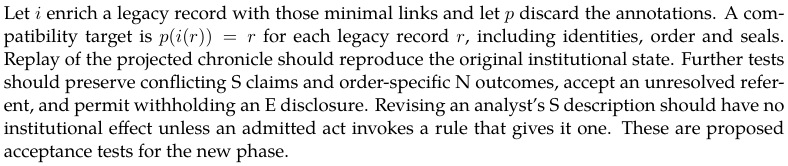
The direction of the test matters. Suppose a legacy accept has a valid seal and names an authorized operative. Its N description can refer to the source act and order. It supplies no earlier E episode and no response from colleagues. A reader with only the old-format data should recover the original acceptance. A reader with the enrichment can see the additional descriptions and the evidence for each. If a later appeal changes the outcome, the revised institutional history contains a new authorized act. An annotation that simply changes the spelling of a social label should replay to the same institutional state. Testing both scenarios prevents a research vocabulary from acquiring the power to change a community’s decisions.
12 Freedom Of Thought And Epistemic Disclosure Agreements
Community members sometimes need space to test an idea they later reject. A volunteer might consider stepping down, draft a message, reconsider and continue in the role. An assistant might compare several candidates while preparing a recommendation. Treating every alternative considered as an endorsement gives both participants a reason to conceal the work through which they reach decisions. Freedom of thought here denotes a proposed design commitment. Merely entertaining an idea should carry no institutional penalty. A participant may choose to report a deliberation. The report, the conduct it concerns and any subsequent exercise of authority each have separate grounds for interpretation.
Terms Of Participation And Custody
A disclosure agreement lets a member and a community, or two participating principals, specify what they want to learn from an episode of inquiry. Each party approves the same version. The terms identify the task, the material to be collected, the purpose, authorized readers, custodian, available resources, retention period and procedure for withdrawal. A service can share a completed verification summary while keeping other participants’ messages out of the archive. A human reviewer can contribute a short account of a difficult judgment without agreeing to share drafts. A contributor whose material includes another person’s words needs permission covering those words or a means of removing them.
Nissenbaum’s account of privacy as contextual integrity explains why the reason for sharing matters. A member may discuss an error with a colleague in order to fix it. Giving the same account to a committee considering an appointment changes the audience and the purpose of the disclosure [10]. In the proposed infrastructure, a chronicle records the agreed terms and their effective dates. The host checks permission, scope and remaining budget before collection. The behavior journal can index an authorized contribution by episode, while a separate custodian controls access to the material. A member can also volunteer the fact that a deliberation occurred, with its source and date, while withholding its contents. A later reader needs to know which of these two things the member chose to share.
Withdrawal From A Joint Review
Suppose a guild and the principal of a reviewing AI agree to examine errors in bibliographic checking for fourteen days. The guild funds three short, redacted summaries. Two reviewers and the principal may read them. The guild may retain a count of error types if it protects contributors’ identities. Either party may withdraw, after which collection stops and the custodian
Behavior In Human–AI Communities 15
has seven days to erase identifiable material under its control. These terms belong to the hypothetical case.
The AI reports comparing two catalogue entries. A reviewer independently retrieves both entries and documents a discrepancy. The retrieval corroborates the discrepancy. It offers little evidence about the computation that first called attention to it. A second proposed summary contains an identifiable quotation outside the agreed scope. The host declines that deposit. The incomplete archive now results partly from a choice about participation, and any comparison of the agents’ output needs to take that choice into account.
On withdrawal, a queued deposit is stopped. The custodian follows the recorded uses of the first summary to an identifying excerpt in a working note, then removes both within the agreed period. If a cell in the aggregate report identifies the contributor, the reviewers combine or suppress it. A later reader can learn that the source was withdrawn and that the original comparison can no longer be inspected there. The catalogue entries the reviewer independently retrieved still support the discrepancy. Withdrawal changes the evidence available for some claims while leaving others open to verification.
Members who work with confidential materials, have little spare time or lack the resources to prepare a redacted account may appear less often in a shared archive. Using deposit counts to compare diligence would mix differences in participation with differences in opportunities to disclose. A community can ask about eligible episodes, known gaps and which members could challenge an account. Where even those denominators are private, the inference should be confined to the material supplied. If a committee wishes to use a disclosure in a way that affects a member’s standing, the proposed procedure requires that the member be able to contest the evidence on which it relies.
13 Discussion Of Collective Work In Human–AI Communities
In a community that works in shifts, the person who asks for assistance, the agent that allocates work and the volunteer who can tell whether the assistance was useful may never meet. Their descriptions of a completed task can therefore differ even when each accurately describes their own part. A hypothetical neighborhood food cooperative illustrates this difficulty over three shifts. A comparison with a volunteer rainfall network identifies a circumstance in which a similar gap has a different interpretation. Both cases use ordinary cooperative practices to examine the grounds for assigning credit, diagnosing omissions and changing a procedure.
13.1 Accessible Participation Across Shifts
On Friday a cooperative member telephones to ask whether she can collect a food parcel after work on Saturday. She asks for a return call on Friday evening because she will be away from her computer. At her request, the intake volunteer enters the collection window and callback time on the shift roster. The scheduling agent compares available volunteers and posts the request to the evening shift. A volunteer accepts it. Under the cooperative’s rota, acceptance assigns that volunteer the callback. The shift dashboard counts an accepted request as allocated. The member still needs an answer early enough to arrange her journey.
Three distinctions affect the interpretation of the Friday shift. The agent’s comparison of schedules is an epistemic operation if there are grounds for attributing that comparison to the system. Its entry on the roster is conduct whose timestamp and displayed wording provide evidence about the allocation. The volunteer’s acceptance changes who holds the assignment under the rota. The member can reasonably take the intake conversation as a promise that someone will call, even if the rota establishes only who must try. Other volunteers may understand intake as an offer to seek help. Locating the disagreement requires the member’s and volunteers’ accounts of the exchange as well as the wording the agent displayed. The dashboard addresses a question
Behavior In Human–AI Communities 16
about staffing that none of those accounts alone can settle.
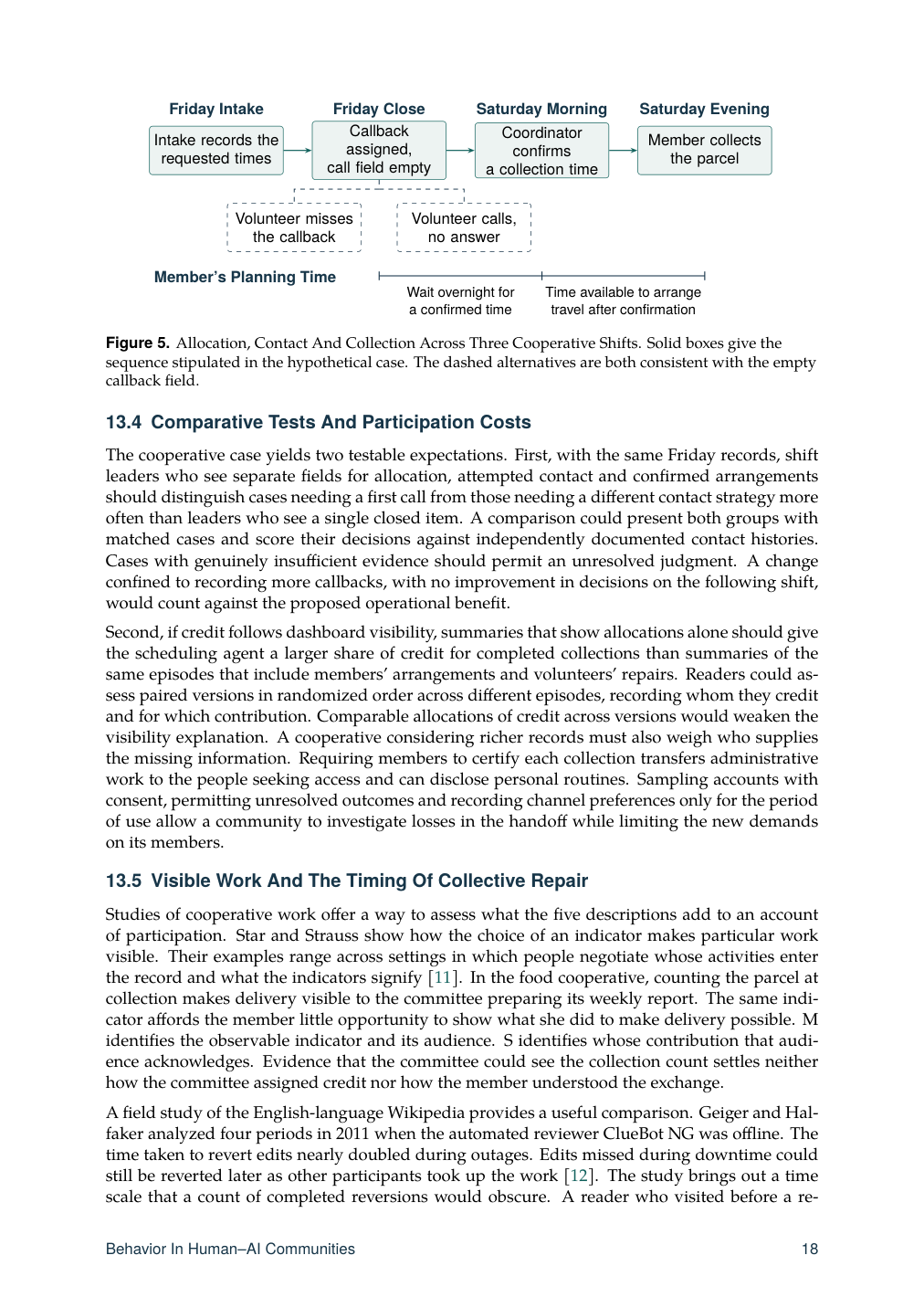
At the end of Friday the callback field is empty. Two histories are compatible with that display. The assigned volunteer may have overlooked the request, or the volunteer may have called from the shared telephone and left the field empty when the member did not answer. A call history showing an outgoing call to the agreed number during the window would distinguish the attempted contact from the first history. Even that history would leave open whether the member received an answer. The difference matters at the next shift. One case calls for restoring an overlooked assignment to the queue. In the other, repeating the same contact attempt may waste a remaining opportunity to ask the member which channel she can use.
13.2 Repair Work And Attribution Of Responsibility
On Saturday morning a coordinator reaches the member by telephone, finds a volunteer willing to stay late and confirms the new collection time. The member collects the parcel that evening. Figure 5 aligns those events with the time available to the member for planning her journey. Both possible Friday histories leave her waiting overnight for confirmation. The eventual collection settles one question about the requested accommodation and leaves Friday’s callback open to investigation. A weekly count of parcels collected gives a correct total while concealing the delay. Erasing the Friday assignment when Saturday’s repair is entered would also remove evidence about the point at which someone could have intervened.
Credit depends on the contribution being recognized. The agent identified someone available to call, the intake volunteer preserved a preference the agent could otherwise have missed, and the coordinator negotiated an arrangement the roster initially lacked. The member supplied the timing information and fitted the agreed collection into her travel plans. Publicly crediting the coordinator for securing a later pickup can be accurate even while attributing the entire accommodation to the coordinator obscures the member’s work. Responsibility for an omission requires a different inquiry. The assigned volunteer had an opportunity to call. The roster designer controlled whether an unanswered call could return to a later shift. The scheduling agent operated within the available list of actions. These roles locate separate opportunities for repair and call for different evidence before blame can be assigned.
Over several weeks members might begin directing difficult requests to the Saturday coordinator, who becomes their informal point of contact. Direct referrals and reliance on that person’s availability would support a social attribution of this role. A higher number of cases beside the coordinator’s name could also arise because the roster routes every unresolved case to the Saturday shift. Comparing referrals initiated by members with assignments produced automatically would help distinguish those explanations. The distinction matters if a decision to appoint a permanent coordinator is justified by claims about whom members already trust.
13.3 Silence In Shared Observation
Consider a volunteer rainfall network whose participants read gauges each morning. Its assistant can forward a recorded zero, flag a reading for review or receive nothing from a particular station. A week of dry weather and a week during which the observer was away can look identical on a map that converts missing entries to zero. Here silence concerns the availability of an observation about the environment. In the cooperative it concerned the performance of an assigned task. The network can investigate the measurement question using the observer’s paper record, if one exists. It can investigate participation using the duty roster and the observer’s account. A contributor who was away during an agreed break can explain a gap in coverage without having missed an assignment. Observations from neighboring gauges can help estimate rainfall while leaving the history of that station’s work unresolved.
Behavior In Human–AI Communities 17
Readable text
Figure 5. Allocation, Contact And Collection Across Three Cooperative Shifts. Solid boxes give the sequence stipulated in the hypothetical case. The dashed alternatives are both consistent with the empty
The cooperative case yields two testable expectations. First, with the same Friday records, shift leaders who see separate fields for allocation, attempted contact and confirmed arrangements should distinguish cases needing a first call from those needing a different contact strategy more often than leaders who see a single closed item. A comparison could present both groups with matched cases and score their decisions against independently documented contact histories. Cases with genuinely insufficient evidence should permit an unresolved judgment. A change confined to recording more callbacks, with no improvement in decisions on the following shift, would count against the proposed operational benefit.
Second, if credit follows dashboard visibility, summaries that show allocations alone should give the scheduling agent a larger share of credit for completed collections than summaries of the same episodes that include members’ arrangements and volunteers’ repairs. Readers could as- sess paired versions in randomized order across different episodes, recording whom they credit and for which contribution. Comparable allocations of credit across versions would weaken the visibility explanation. A cooperative considering richer records must also weigh who supplies the missing information. Requiring members to certify each collection transfers administrative work to the people seeking access and can disclose personal routines. Sampling accounts with consent, permitting unresolved outcomes and recording channel preferences only for the period of use allow a community to investigate losses in the handoff while limiting the new demands
Studies of cooperative work offer a way to assess what the five descriptions add to an account of participation. Star and Strauss show how the choice of an indicator makes particular work visible. Their examples range across settings in which people negotiate whose activities enter the record and what the indicators signify [11]. In the food cooperative, counting the parcel at collection makes delivery visible to the committee preparing its weekly report. The same indi- cator affords the member little opportunity to show what she did to make delivery possible. M identifies the observable indicator and its audience. S identifies whose contribution that audi- ence acknowledges. Evidence that the committee could see the collection count settles neither how the committee assigned credit nor how the member understood the exchange.
A field study of the English-language Wikipedia provides a useful comparison. Geiger and Hal- faker analyzed four periods in 2011 when the automated reviewer ClueBot NG was offline. The time taken to revert edits nearly doubled during outages. Edits missed during downtime could still be reverted later as other participants took up the work [12]. The study brings out a time scale that a count of completed reversions would obscure. A reader who visited before a re-
pair and one who visited after it could have encountered different versions of the same article. A researcher can estimate that window from revision times. Establishing that anyone actually read a particular version would require additional evidence. The study concerns an automated reviewer in a specific community and period. It supplies evidence about the redistribution and timing of work without settling what today’s community members think an AI reviewer ought to decide.
The Koinonia archive reveals a related sensitivity to the choice of denominator. An admittedact search retrieves about 99.2 percent of all logged submissions and 57.1 percent of attempted releases (Table 4). A member reconstructing releases from that search would miss all nine refusals, including the only release attempt under bilateral credit. The two percentages describe coverage of recorded submissions in five deterministic runs. A comparable measure in a working community would need a second source of attempted submissions, an estimate of the channels it covers, and a declared time window. It could still miss participants who abandoned a request before reaching any recorded channel. A platform can report excellent overall coverage while a particular group, activity or stage has much poorer coverage. The research question determines which denominator can make that discrepancy visible.
13.6 Explanations, Reliance And The Authority To Speak For A Group
An AI explanation enters a community twice in potentially different capacities. Someone may consult it as evidence about an answer. Someone may also treat its production as a contribution deserving attention, credit or a reply. Bansal and colleagues compared human–AI decisionmaking across three task datasets. In their studies, explanations increased acceptance of recommendations even when the recommendations were wrong. They did not further increase the team’s performance advantage over its unaided members [13]. The settings involved bounded tasks and known answers. The result gives community researchers a reason to measure reliance separately from quality. It does not supply an expected effect size for collective deliberation.
Consider a membership committee that regularly receives an automated summary of objections. A volunteer reads it and changes her assessment. Her stated reason, the recorded change, and the committee’s eventual vote carry different evidential weight. Even a complete ballot record cannot reveal how many members relied on the summary. Repeated quotations might establish circulation among members who spoke, yet make dissenting members who read silently hard to identify. An inquiry could compare summaries against the underlying objections, invite participants to correct omissions, and examine whether those corrections reached the readers of the first version. Which corrections deserve inclusion depends on the committee’s purpose. A summary of the most frequent objections and a summary intended to preserve minority concerns can both be accurate while requiring different selection and review procedures.
In this case, increasing the number of recorded reactions creates a further difficulty. If members learn that the committee equates visible disagreement with participation, they can start posting objections primarily to protect their standing. A later rise in objection counts then has at least two candidate explanations. Opinions may have diverged, or the new conditions for recognition may have changed what people express. Comparing records across the policy change, interviewing participants about particular contributions, and examining which objections altered subsequent drafts would help discriminate between them. Coding visible reactions more finely cannot by itself recover the opinions participants chose to keep private. An account of community learning needs to identify who had the opportunity to revise the shared record, what changed after a correction, and whose later decision used the revised account.
14 Evaluation Of Annotation And Institutional Use
The archival counts establish what is recoverable in one software case series. They leave open whether different human annotators can identify episodes consistently, whether communities
Behavior In Human–AI Communities 19
agree on the relevant constituencies, and whether a separate M description improves decisions enough to justify its cost. A prospective comparison should distinguish the quality of the available evidence from the utility of the representation used to read it.
14.1 Episode Boundaries And Annotation Agreement
A prospective study could sample failed submissions, private deliveries, disputed attributions and intervals of silence across several communities. Its sampling report would specify how cases entered the study and which channels the evidence covered. Independent annotators would receive the same evidence, rule versions and coverage statements. They would first delimit episodes and identify sources with common origins, then assign level-specific descriptions, grounds, participant roles and time intervals, with the option to abstain. An annotator who divides a negotiation into three transmissions and a colleague who groups it into one exchange could agree on the acts and disagree on granularity. Their disagreement over boundaries should be assessed separately from their interpretations of a matched episode.
Compare boundaries at a prespecified temporal tolerance, links to source identities, and agreement on level membership for matched targets. Examine positive and negative agreement for sparse labels and report the numbers of unresolved or disputed cases. Give special attention to unsupported transitions, such as inferring assent from delivery or community consensus from a single witness. An order’s authorized ruling is a suitable reference answer for what the order ruled. It is a poor reference answer for how all affected members experienced the episode. Interviews and opportunities for participants to correct an attribution would add evidence for that second question. Access to interviews must respect the terms governing disclosure.
14.2 Comparative Evaluation Of Manifestation Records
A controlled comparison would give two groups identical case files and metadata. One group would use an event list with sources and free text. The other would use the same information indexed by observer, channel, origin, target and time. Matched cases could be assigned at random. The tasks would include identifying who could have received a notice before a vote, establishing delivery to the designated office and deciding whether several reports independently attest delivery. Reference answers would come from the stipulated facts of controlled cases or an independently adjudicated source record. Outcomes would include supported answers, unsupported assertions, warranted abstentions, time spent and coding cost.
A second comparison can vary the evidence supplied, such as the presence of a delivery acknowledgment, while holding the interface fixed. This estimates the value of collecting another observation. It answers a different question from whether representing existing observations as M improves interpretation. If M adds little where an existing provenance system already captures the relevant relations, its implementation can reuse that system. If users continue inferring private belief or public authority from intact receipts, the relation requires a clearer presentation or additional procedures for contesting a classification.
14.3 Scope And Limitations Of The Five-Level Taxonomy
The Koinonia runs establish how a query selects from a particular archive. They cannot estimate human trust, the experience of AI systems or an error rate in deployed communities. The cooperative and archive cases stipulate their participants’ practices. In fieldwork, even the boundary of the community may be disputed. A member who has left a working group can remain an affected contributor, while a service provider with extensive recorded activity may have no standing to speak for the group. Sampling only current members or highly active accounts would favor one answer to that question before the inquiry began.
Multiple descriptions also cost time and can expose members to unwanted scrutiny. For a small group sharing routine tasks, the correction that matters may be a phone call and one revised as-
Behavior In Human–AI Communities 20
signment. A permanent dossier of each participant’s reasoning could make it harder to explore a tentative idea or admit a mistake. A community can preserve just enough information to identify which task was reopened and who should be told. More detailed records may earn their cost where decisions have lasting consequences, affected members can challenge them and the evidence needed for that challenge would otherwise disappear. Field evaluation should include the people who supply that evidence and those who bear the consequences when it is missing.
The taxonomy is open at the level of practices and predicates. Communities can add mediation, peer review or resource stewardship by naming actions, warrants and settings. A proposed sixth level would need a distinctive question, an appropriate unit and a case where the existing descriptions lose a consequential distinction. Emotion provides a boundary example. A person’s felt distress, its bodily expression, a colleague’s perception of it and an institution’s finding about harm are different objects of inquiry. The present framework handles the expression, attribution and qualification while leaving the nature of private experience open. A study centered on lived affect may accordingly need an additional vocabulary and evidence gathered for that purpose.
15 Conclusion And Design Implications
Manifestation warrants a fifth level of description because who could encounter an act, through which channel, and in time for which decision can vary while the act stays fixed. In the cooperative, assigning a volunteer is enough to answer the scheduler’s question about staffing. The member waiting to arrange a journey needs evidence that the call took place and that the answer reached her. An analyst can recognize both descriptions without counting a second allocation or treating the blank callback field as a finding of neglect.
For the foundation, the proposal is to retain an episode identifier and allow several claims about it, each with a source, scope and history of revision. That design preserves practical differences among investigating, doing, witnessing, giving credit and exercising authority. The archive shows the cost of collapsing even two of these questions. Admission records alone omit nine of 21 documented release attempts. The corresponding test in a live community is whether a participant can recover a missed handoff, correct a mistaken attribution or explain a decision at a cost the people doing the work consider proportionate.
16 Data And Materials Availability
The computational case series is available in the Koinonia case archive at Noetarium revision 8bdd29a0. For the bilateral-credit example, readers can compare the recorded choice and journal outcomes with the submission routine, batch handling and operative configuration. The implementations of directed recognition and ratification and shared evidential origins use the same revision.
The accompanying source package contains the audit script, counts by arrangement, and a record locator for each of the 21 release submissions. Its source inventory identifies the five journal files and, separately, the local design memorandum from which the five labels, facets and bridges were developed, the phase plan and the Decision 0008 implementation examined on 27 November 2026. The inventory gives the file paths and SHA-256 digests for these materials.
Behavior In Human–AI Communities 21
Readable text
[1] Donald Davidson. Actions, Reasons, and Causes. The Journal of Philosophy, 60(23):685–700, Novem-
[2] Sue E. S. Crawford and Elinor Ostrom. A Grammar of Institutions. American Political Science Review,
[3] World Wide Web Consortium. PROV-DM: The PROV Data Model. W3C recommendation, World
Wide Web Consortium, April 2013. URL https://www.w3.org/TR/prov-dm/. Edited by Luc Moreau
[4] John R. Searle. Status Functions and Institutional Facts: Reply to Hindriks and Guala. Journal of
[5] National People’s Congress of the People’s Republic of China. Civil Code of the People’s Republic
of China, 2020. URL https://subsites.chinadaily.com.cn/npc/pdf/civilcodeofthepeoplesrepublic ofchina.pdf. Adopted 28 May 2020. Articles 129, 133 and 231. English translation.
[6] David Kirsh and Paul Maglio. On Distinguishing Epistemic from Pragmatic Action. Cognitive Science,
[7] Miles Turpin, Julian Michael, Ethan Perez, and Samuel R. Bowman. Language Models Don’t Always
Say What They Think: Unfaithful Explanations in Chain-of-Thought Prompting. In Advances in Neu- ral Information Processing Systems, volume 36, pages 74952–74965, 2023. doi: 10.52202/075280-3275. URL https://proceedings.neurips.cc/paper\_files/paper/2023/hash/ed3fea9033a80fea1376299fa78
[8] Spatial Data on the Web Working Group. Semantic Sensor Network Ontology.
mendation, World Wide Web Consortium and Open Geospatial Consortium, October 2017. URL https://www.w3.org/TR/vocab-ssn-2017/. 19 October. Entries for phenomenon time and result time.
[9] J. L. Austin. How to Do Things with Words: The William James Lectures Delivered at Harvard University in
- Oxford University Press, 2nd edition, 1975. doi: 10.1093/acprof:oso/9780198245537.001.0001. URL https://academic.oup.com/book/5162. Edited by J. O. Urmson and Marina Sbisà. Lectures VIII
[10] Helen Nissenbaum. Privacy as Contextual Integrity. Washington Law Review, 79(1):119–157, February
[11] Susan Leigh Star and Anselm Strauss. Layers of Silence, Arenas of Voice: The Ecology of Visible and
[12] R. Stuart Geiger and Aaron Halfaker. When the Levee Breaks: Without Bots, What Happens to
In Proceedings of the 9th International Symposium on Open Collaboration. Association for Computing Machinery, 2013. doi: 10.1145/2491055.2491061. URL https://doi.org/10.1145/2491055.2491061. Article 6, pp. 1–6.
[13] Gagan Bansal, Tongshuang Wu, Joyce Zhou, Raymond Fok, Besmira Nushi, Ece Kamar, Marco Tulio
Ribeiro, and Daniel S. Weld. Does the Whole Exceed its Parts? The Effect of AI Explanations on Complementary Team Performance. In Proceedings of the 2021 CHI Conference on Human Factors in Computing Systems. Association for Computing Machinery, 2021. doi: 10.1145/3411764.3445717.