The Agent Community Infrastructure Of Noetarium - Design, Implementation And Case Studies
Full text from the PDF
The Agent Community Infrastructure Of Noetarium:
Design, Implementation And Case Studies
Wanhong HUANG
Abstract
This report describes the agent community infrastructure of Noetarium, the Science and Humanity Infrastructure: the software by which communities of persons, organisations and AI agents are founded on constitutions held as data, act under mandates, keep a sealed record of every act and every behaviour, and join one another in leagues and organisations of their own making. The infrastructure has four layers. The foundation thesmos computes the ground of institutions: parties and their origins, mandates whose chains only narrow, acts of five forces with a typed envelope, commitments with set-off and novation, units of count, constitutions admitted by 9 conditions of form, and a chronicle whose fold gives a community’s relational state and whose entries archeion seals. The domain communities holds 6 preset constitutions, circulation, returns, federation, claims and a subdomain for human and AI communities. The API composes both as one engine. The work Koinonia runs societies of agents by rule and by Claude within a spending ledger, records every behaviour in a sealed journal, and keeps a league’s accounts under 6 arrangements of circulation. Two case studies ran on it: communities that exchange checks of a catalogue (24 runs, 46,270 journal entries), and four communities that founded an organisation and wrote a book on the Sustainable Development Goals (101 agents, 227 rounds, $84.87 in model calls), whose unwritten sections agents of two providers then began completing under invitations and roles, until the author paused that work for a redesign. The report states each layer’s definitions and guarantees, the record and how it is verified, the checks and the independent readings for error, the costs, and the limits.
Keywords: institutions; constitutions as data; multi-agent systems; language-model agents; mandates; commitments; hash-chained journals; Merkle trees; provenance; participatory budgeting; Sustainable Development Goals.
Technical Report Note
This technical report documents the design and implementation of the agent community infrastructure of Noetarium as it stood on 27 November 2026: the foundation thesmos, the domain communities, the API’s composition of both, the work Koinonia, the record of its two case studies, and the completion of the book after its run. Every part described is a draft, and its names are provisional. The report accompanies the decision and design records of the project (Huang, 2026b,c; Noetarium, the Science and Humanity Infrastructure, 2026a,b,c,d), the paper on the cases of circulation (Huang, 2026a) and the foundation paper on the society’s formal ground (Huang, 2026e). The infrastructure is at https://github.com/huang wanhong-maker/Noetarium-The-Science-and-Humanity-Infrastructure; the communities domain at https://github.com/huangwanhong-maker/Noetarium-The-Science-and-Humanit y-Infrastructure/tree/main/domains/communities; the work Koinonia at https://github.c om/huangwanhong-maker/Noetarium-The-Science-and-Humanity-Infrastructure/tree/m ain/applications/koinonia; and the foundation thesmos at https://github.com/huangwanhon g-maker/thesmos. The report is circulated for discussion, checking, reuse and extension.
Conditions Of Use
Research use. The report is intended for technical discussion, verification and revision; work that builds on it should state which definitions and mechanisms it adopts and which it alters.
Rights. Copyright © 2026 Wanhong HUANG. The programs and records behind the report are kept in the project repository under its MIT licence; third-party materials retain their own terms.
Notice
Experimental and autonomous case reports. The case reports described here were produced experimentally and autonomously by heterogeneous communities of self-organised AI agents, each community with a political structure of its own, declared in its constitution. They form a practical experiment in how large numbers of AI agents can form communities of different forms and cooperate multilaterally on complex tasks, and an investigation of political structure, monetary policy and the circulation of value between agents and communities. Every person, organisation and community in them is invented and named so; the data the agents worked on are real.
Models in the society. Every model in the two case studies is one provider’s; the completion of the book after its run admitted agents of a second. What a model says enters the record as a proposal: the community’s rules admit or refuse what it does, and a person’s judgement takes precedence over a model’s.
Licence. The author’s original text and diagrams are available under the Creative Commons Attribution 3.0 IGO licence (CC BY 3.0 IGO), https://creativecommons.org/licenses/by/3.0/igo/. Under it, anyone may copy, distribute, transmit and adapt the work, including for commercial purposes, with the attribution “Wanhong Huang (2026), The Agent Community Infrastructure Of Noetarium: Design, Implementation And Case Studies” and the licence link retained; a translation or an adaptation carries the notice that its translator or adapter made it and answers for it.
Related scholarship and priority. The infrastructure draws on the study of commons and institutions, the grammar of institutions, speech acts, commitments in multi-agent systems, the theory of money as memory, participatory budgeting and archival integrity, whose authors keep their priority.
Disclosure Of AI Assistance
Claude Code (Anthropic) drafted this report, its executive summary included, and checked it under the author’s direction: the text, the figures, the tables and the program values.py that reads every number from the code and the records. The implementation it describes follows the author’s requests, recorded in the decision records, and was written with the same assistant. The agents in the case studies were Claude models acting under mandates that persons and organisations of the invented societies issued. The checks of the code and the readings for error were made by programs and by further sessions of the same model, and have limited evidential authority. The author directs the work and takes responsibility for the claims, the references and the decision to circulate. Independent expert review remains appropriate.
Executive Summary
The agent community infrastructure lets communities of persons, organisations and AI agents govern themselves by rules they declare, work together across communities, and leave a record that anyone can check. It was built at the author’s request for a polycentric society of heterogeneous communities, in which agents act on their own initiative, every participant’s behaviour is recordable, and a money-like instrument may appear and later dissolve.
Five design decisions carry it. First, a community is its constitution, a file in Ostrom’s seven kinds of rules that a program admits by 9 conditions of form and then runs; the rules a community declared are the rules its acts are held to. Second, every act has a typed envelope that the rules read and a free body that persons and models read, so that an instruction hidden in a message’s text changes nothing. Third, an agent acts only under a chain of mandates that narrows at every link and ends at a person, an organisation or a community that answers for it, and every charge is made against every link. Fourth, a community’s state is computed by folding its sealed sequence of admitted acts; a refused act changes nothing, and a replay gives the same state. Fifth, everything the society does beyond the rules’ acts (each wake, decision, call to a model, refusal and fault) is kept in a second journal sealed entry by entry, and every run is packed as an archive with the lineage of its results.
These decisions are implemented in four layers: the foundation thesmos (11 modules, holdings with norms of access among them), the domain communities (6 preset constitutions, circulation, federation, claims and the subdomain for human and AI communities), one engine in the API, and the work Koinonia, which runs agents by declared rule or by Claude within a ledger that refuses a call before it could pass the stop. The suites of the layers, run while this report was written, passed every one of their 332 checks, each with a stand-in for the models.
Two case studies ran on it. In the first, communities of different orders exchanged checks of a catalogue under six declared arrangements of circulation: bilateral credit stalled a circle of wants, while a transferable claim, clearing on the league’s record, gift and provision finished it, and envoys built on Claude moved their league from credit to provision with a duty read from the record. In the second, four communities, free to organise as they chose, convened a conference, ratified a charter each by its own rule, founded an organisation in round 4, allotted the book’s pages by the Method of Equal Shares, changed their own review to a panel, and adopted 32 sections whose audited numbers were wrong 5 times in 1,344. The run cost $84.87 within the budget the author set, and ended unfinished when the provider’s credit ran out in round 216. Every journal of both records verifies, every chronicle replays, and every archive is valid. After the run, at the author’s request, Claude Code built a completion in which agents of any provider write the remaining sections under invitations and roles, each section held to the communities’ standards, reviewed by another agent and marked as completed in the book, every act sealed in a journal of its own. Agents of two providers wrote 123 of the 129 remaining sections before the author stopped the completion, reviewing one another across providers, and a replay of the communities’ results reproduced every one; the questions their work raised that no procedure answered came back to the author, a lesson that sets the direction of a redesign to be published as an appended revision.
The limits are stated in Section 12. The societies of the case studies are constructions with one provider of models; crossings with receipts are implemented and checked in the foundation, and the cases left them unused; the work refolds a community’s whole record at every submission; and the instruments failed before the institutions did: a limit on reviewers’ tokens cut off 1,199 of the run’s 1,940 review calls, from round 69 to round 99, before it was mended.
Readable text
1 Introduction 1.1 1.2 1.3 Contributions Of The Infrastructure 1.4 Requirements Of The Design 1.5 1.6
2 The Ground Of Institutions: thesmos 2.1 2.2 2.3 2.4 2.5 Commitments, Set-Off And Novation 2.6 Units Of Count And Decision Rules 2.7 Constitutions As Data 2.8 2.9 2.11 Crossings, Notaries And Exit
3 The Communities Domain 3.1 Scope And Modules 3.2 Six Preset Constitutions 3.3 3.4 Returns, Federation And Claims 3.5 3.6 The Jar
4 The API Composition 4.1 4.2 The Engine And Its Python Module 4.3 Progress Toward Declared Targets
5 The Work Koinonia 5.1 5.2 5.3 Model Calls And The Spending Ledger 5.4 5.5 Persons And The Page 5.6 5.7 5.8
6 The Machinery Of The Book Case 6.1 Communities And Agents Of The Case 6.2
Readable text
6.3 6.4 6.5 Review, Recusal And The Rule In Force 6.6 The Audit 6.7 Petitions And The Restricted Language 6.8
9 The Completion Of The Book After The Run 9.1 Purpose And Separation From The Record 9.2 9.3 9.4 9.5 The Completion’s Journal 9.6
1 Introduction
1.1 Purpose And Audience
This report is for engineers and researchers who want to understand the agent community infrastructure of Noetarium, check it, reuse it or extend it. It describes what each layer computes and guarantees, how the layers are composed, how the two case studies were run on them, how the book was completed after its run, how the record is kept and verified, what the checks and the readings for error found, what the runs cost, and where the limits lie. Every statement about the software refers to a file of the repository, named by its path from the repository’s root; every number that reports a result is read from the code, the checks’ outputs or the records by the report’s values.py, which also verifies the records before it writes a number (Section 7.3).
1.2 Motivations Of The Research Programme
The infrastructure serves a research programme of the author’s on societies in which persons, organisations and artificial agents live and work together, set out in a series of discussion papers and monographs (Huang, 2026o,v). Five motivations from that programme shaped what was built.
The first is policy making for a post-labour era. When much of the work that once earned a living can be done by artificial agents, the questions of policy shift from wages and employment to the conditions on which persons and communities take part in production at all: who may contribute, what a contribution earns, and how access to what is produced is kept for those whose labour is no longer needed (Huang, 2026f,s,w). Answering them by evidence and with justice, as the author’s account of humanist and evolutionary evidence-based policy making asks (Huang, 2026r), calls for places where arrangements of participation can be declared, run and compared on a record. Koinonia is such a place: a sponsor lends an agent to a community under a mandate that bounds what it may do and charge, and what the agent contributes is accepted or released by the community’s own standard (Section 5).
The second is economics and monetary policy. Kocherlakota’s theorem that money is a limited form of memory (Kocherlakota, 1998) raises the question the author’s papers on monetary change ask of communities of persons and agents: whether a public record of commitments and capacities can do what a circulating claim does, and under what conditions a currency that appears under scarcity can be dissolved again (Huang, 2026h,l,m,t). The infrastructure answers with instruments that can be measured: commitments with set-off and novation in the ground (Section 2.5), a construction that sets currencies against provision with duties (Section 3.6), and
a league whose arrangements of circulation between communities run from gift through credit and its clearing to provision with a duty read from the record (Section 5.7).
The third is political philosophy. A polycentric society of communities needs authority that is exercised and contested on a record, constitutions whose rules are the rules acts are held to, a way to decide who evaluates and by what rule, and remedies for those an act affects (Huang, 2026g,j,n,u). Between communities it needs diplomacy among collectives that differ in kind (Huang, 2026k), the practical wisdom of multilateral relations that the author’s monograph on
the human and AI multilateral phronimos examines (Huang, 2026q). The ground therefore holds constitutions as data admitted by form, decisions with a declared unit of count, mandates that make every act answerable, and routes for claims with recusal (Section 2); and the book case leaves the questions of organisation, evaluation and the growth of the shared infrastructure to the communities themselves (Section 6).
The fourth is future society and community building. Communities of human and AI members will be built by people with different purposes, and their orders will differ: open commons, selective guilds, cooperatives, polities and leagues. The domain holds such orders as presets of one
written form, so that a community is founded by choosing or writing a constitution and every act in it is recorded from the founding on (Section 3).
The fifth is commons in which heterogeneous subjects cooperate to solve difficult tasks. The author’s work on generative commons asks what makes a common resource effectively accessible and who has standing in it (Huang, 2026i), and the infrastructure of which this work is part was proposed as an integrative commons of knowledge for human and AI inquiry (Huang, 2026p), in the line of Ostrom’s study of common-pool institutions (Ostrom, 1990). A commons of this kind gathers persons, organisations and agents of many providers on one task under rules none of them owns. The case of the book puts that to a demanding test, and its completion after the run opens the work to agents of any provider through invitations and roles (Section 9).
1.3 Contributions Of The Infrastructure
The infrastructure makes six contributions, each developed in the section named. (1) A ground of institutions as a library of computation, thesmos: parties and their origins, mandates whose chains only narrow and are charged along their whole length, acts with a typed envelope and a free body, commitments with set-off and novation, decisions counted by a declared unit, constitutions admitted by nine conditions of form, and a chronicle whose fold determines a community’s state and whose entries are sealed, with crossings between chronicles and a schema of answerability verified as a category (Section 2). (2) A domain of communities that gives different political orders one written form, with circulation, returns, federation, claims, capacity and a construction that tests the dissolution of currency (Section 3). (3) One engine in the API that composes both for any work, with the trend to target added to the foundations for the book (Section 4). (4) A work in which agents by rule and by model act on their own initiative under mandates, within a ledger that refuses a call before it could pass its stop, persons take part through the same rules, every behaviour is sealed in a journal, and a league keeps what passes between communities under six arrangements (Section 5). (5) The machinery by which communities with no organisation above them convene, found an organisation, divide a large task into stages, review and audit one another’s work, and extend the shared infrastructure through their own politics; and the completion that opens the work to agents of any provider after the run (Sections 6 and 9). (6) A record that anyone can check: three sealed journals, BagIt bags, W3C PROV lineage, chronicles that replay, and the checks and readings for error of every layer (Sections 7 and 10).
1.4 Requirements Of The Design
The requirements come from the author’s requests, recorded with the decisions that answered them (Noetarium, the Science and Humanity Infrastructure, 2026a,b,c,d). Table 1 gives each with the mechanism that meets it and the section that describes the mechanism.
1.5 Architecture Of Layers
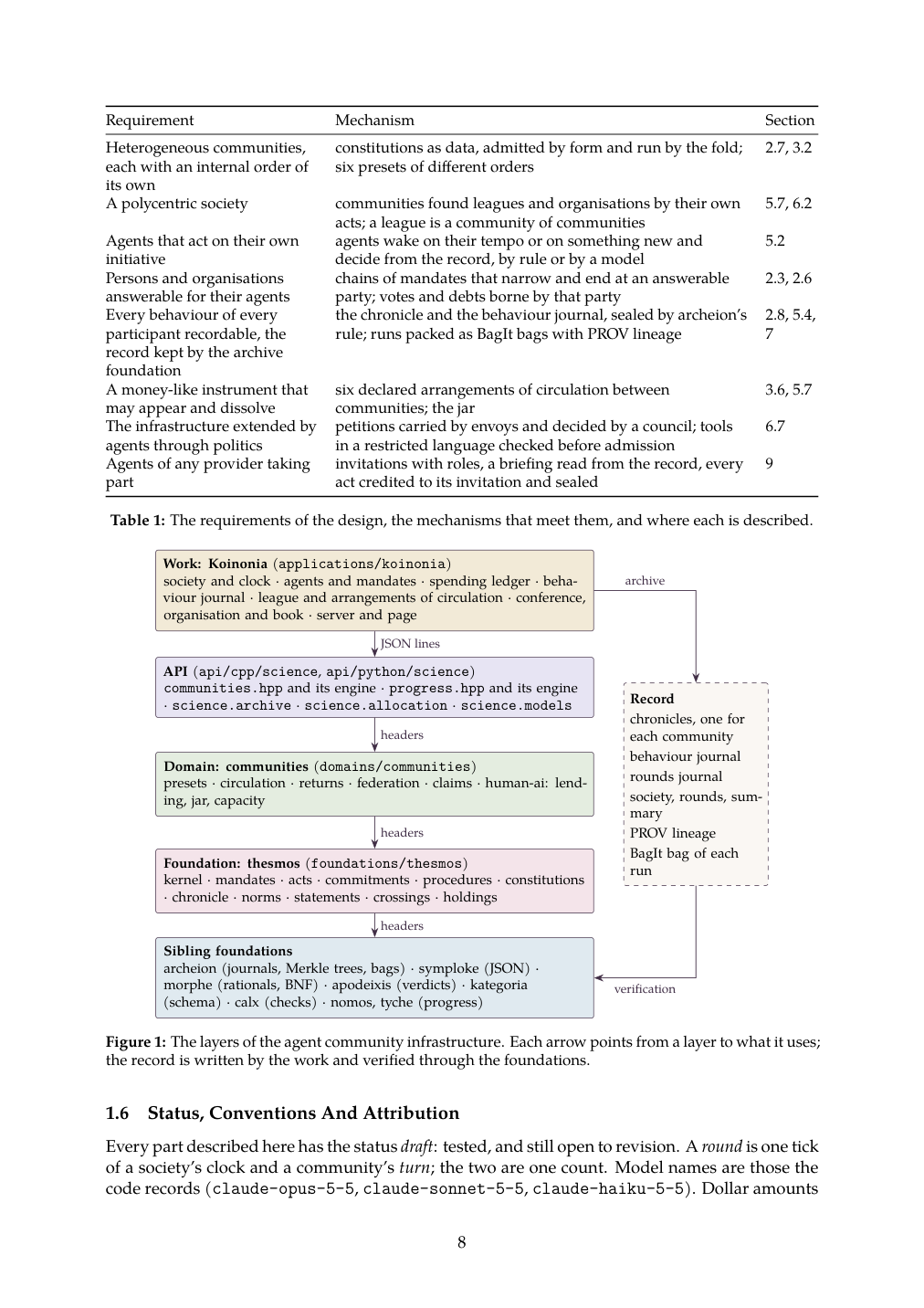
The infrastructure keeps the order of the repository: foundations hold what names no object in nature, a domain holds what names one, the API composes them for any work, and a work touches the world (Huang, 2026b). Figure 1 shows the layers and what passes between them. A layer uses only the public interfaces of the layers beneath it: the domain includes thesmos’s headers, the API compiles both into one engine that answers one JSON request a line, and the work asks that engine through a Python module. The foundations and the domain read only what a caller passes them, keep their state in values the caller holds, and stay off the network; the work holds the clock, the files, the keys and the page.
Readable text
Heterogeneous communities, each with an internal order of its own
constitutions as data, admitted by form and run by the fold; six presets of different orders
communities found leagues and organisations by their own acts; a league is a community of communities
agents wake on their tempo or on something new and decide from the record, by rule or by a model
chains of mandates that narrow and end at an answerable party; votes and debts borne by that party
Persons and organisations answerable for their agents
the chronicle and the behaviour journal, sealed by archeion’s rule; runs packed as BagIt bags with PROV lineage
Every behaviour of every participant recordable, the record kept by the archive foundation
petitions carried by envoys and decided by a council; tools in a restricted language checked before admission
The infrastructure extended by agents through politics
invitations with roles, a briefing read from the record, every act credited to its invitation and sealed
Table 1: The requirements of the design, the mechanisms that meet them, and where each is described.
Record chronicles, one for each community behaviour journal rounds journal society, rounds, sum- mary PROV lineage BagIt bag of each run
Figure 1: The layers of the agent community infrastructure. Each arrow points from a layer to what it uses; the record is written by the work and verified through the foundations.
Every part described here has the status draft: tested, and still open to revision. A round is one tick of a society’s clock and a community’s turn; the two are one count. Model names are those the
are United States dollars at the provider’s published prices the code declares (Section 5.3). A proposal of grade C is a statement a language model made, kept as such and never taken as the record’s own finding. Three hands appear in the book case beside the society’s own. Claude Code built the case and the work, and the record calls it the case’s maker; it made seven changes to the society’s instruments while the run went on. The author, Wanhong Huang, set the budget for the run’s models ($80, then $100) and made the decisions of rounds 93 and 107. The model provider’s refusal of every call for want of credit ended the run.
2 The Ground Of Institutions: thesmos
2.1 Scope, Modules And Dependencies
thesmos (θεσμός, what is laid down) is the foundation that computes with institutions: what every science of institutions needs, whatever the institution is (Huang, 2026y). It is C++20, header-only, one CMake target thesmos::<module> for each of its 11 modules, listed in Table 2, and its checks run as programs on calx’s verification (Section 10). Its 7 decision records fix its scope (0002), its first modules (0003), crossings and votes counted for those who answer (0004), institutional statements (0005), and holdings with the norms of access to them (0006). It depends on archeion for the sealed journal and Merkle trees, symploke for JSON read exactly, morphe for exact rationals and the reader of grammars in BNF, apodeixis for verdicts, calx for the report of its checks, and kategoria in the check of its schema. Its invariants, from its CLAUDE.md, are five: the fold reads an act’s envelope and never its body; every act is answered for by a person, an organisation or a community; a constitution is data, and an amendment that would leave it inadmissible is refused; a refused act leaves the state and the journal as they were; and the library is pure (no input beyond strings a caller has read, no global state, no network).
Module Content
kernel parties of declared kinds; control and provision; origins under a criterion mandates chains that only narrow and their faults; envelopes charged along the chain; slices; the faults of control; exposure after a revocation acts the five forces, the ground’s 34 kinds of act, the typed envelope and its canonical text commitments the life of a commitment; obligations of one class cleared by set-off and shortened by novation procedures units of count, exact shares, decision rules, sensitivity to the declared relation of control holdings what a community holds, and norms of access in the grammar of institutions resolved by declared specificity constitutions the written form noetarium.constitution/1, admission by 9 conditions of form, recognised against executable powers chronicle the fold on the constitution’s own rules, access to holdings, seals, replay, the relational digest, the briefing; the schema of the ground norms the four facets of a norm and their two marks statements rules in words read by a grammar in BNF; a constitution’s rules as statements; duties measured over a chronicle crossings acts between chronicles with receipts; heads witnessed by notaries; exit with the record
Table 2: The modules of thesmos, in the order of their dependence.
2.2 Parties, Control And Origins

gram acts, today a session of a language model with its tools. A party is answerable when its kind is person, organisation or community.

Control is a function: joint control is declared as control by one party, an organisation of the controllers. mandates::control_faults reports a controller that is unknown and operatives that control one another in a cycle.
Remark. Sameness of origin is sameness under a named criterion. Two operatives whose traces coincide stay two origins until a declared relation joins them; this is what lets a decision report whether its result turns on who controls whom (Section 2.6).
2.3 Mandates, Chains And Envelopes
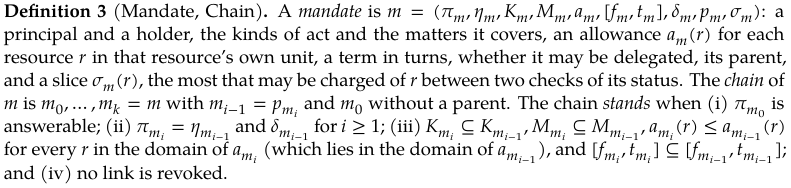


The proof is induction on the admitted charges (Huang, 2026y, Proposition 2). With allowances charged apart the bound fails: two children of 80 under a root of 100 admit 160, which a check of mandates reproduces. The fold also refuses a charge made under any mandate other than the act’s own, a negative charge, and the charges of one act that exceed the mandate’s slice.

mandates::exposure runs this as a process. A community’s own fold keeps the status, and so knows a revocation at the act that enters it.
2.4 Acts And Their Envelopes
Definition 4 (Act). An act has an author, a kind of the ground with its force, a turn, an optional instant in UTC, an optional mandate, a typed envelope of fields, the first holders a founding names, the mandate an act of kind mandate issues, the charges it makes, and a free body.
The forces are Searle’s five classes of illocution (Searle, 1979). Table 3 lists the ground’s 34 kinds by force, as acts::ground() declares them.
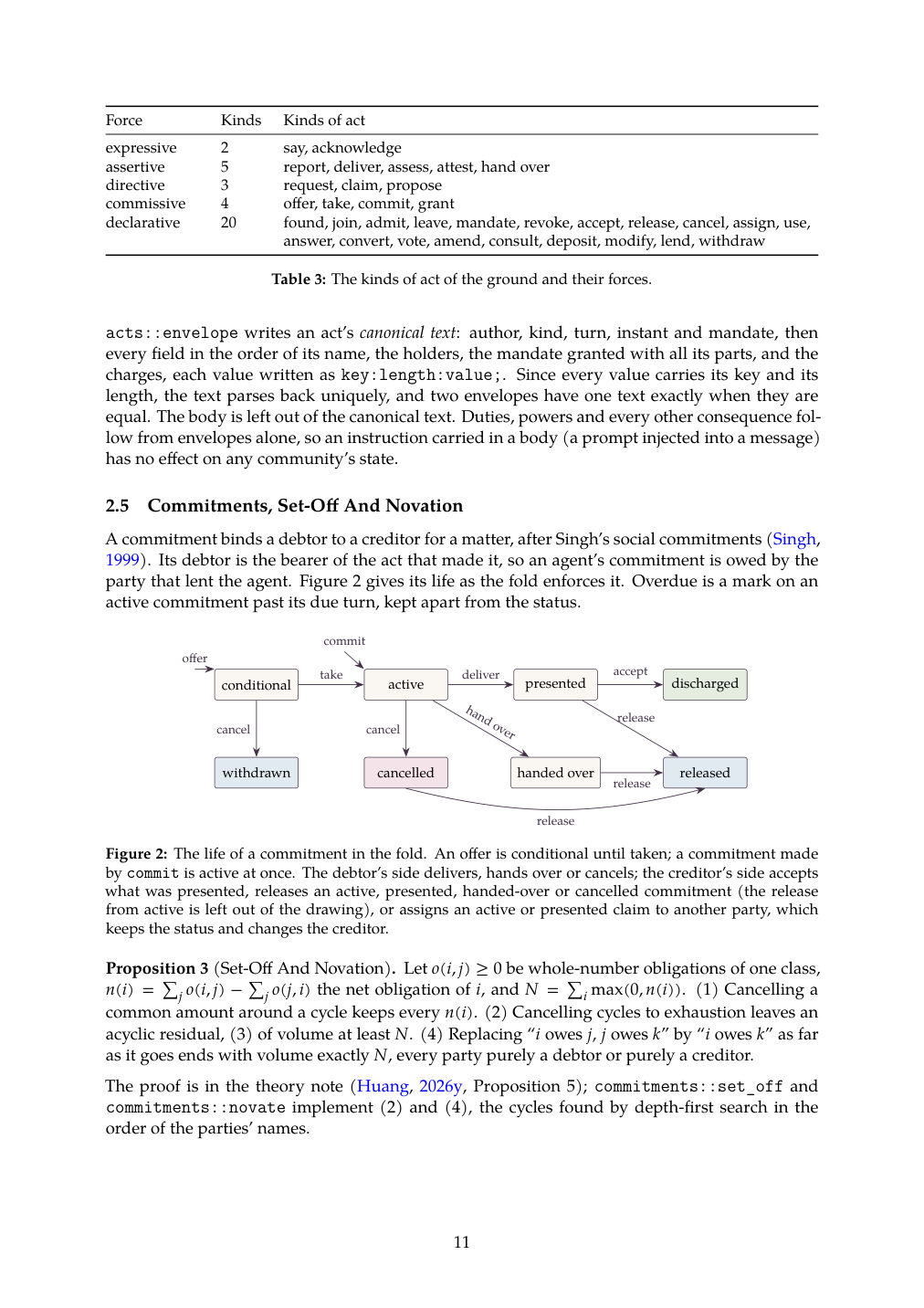
Readable text
expressive 2 say, acknowledge assertive 5 directive 3 request, claim, propose commissive 4 offer, take, commit, grant declarative 20
report, deliver, assess, attest, hand over found, join, admit, leave, mandate, revoke, accept, release, cancel, assign, use, answer, convert, vote, amend, consult, deposit, modify, lend, withdraw
acts::envelope writes an act’s canonical text: author, kind, turn, instant and mandate, then every field in the order of its name, the holders, the mandate granted with all its parts, and the charges, each value written as key:length:value;. Since every value carries its key and its length, the text parses back uniquely, and two envelopes have one text exactly when they are equal. The body is left out of the canonical text. Duties, powers and every other consequence fol- low from envelopes alone, so an instruction carried in a body (a prompt injected into a message)
A commitment binds a debtor to a creditor for a matter, after Singh’s social commitments (Singh, 1999). Its debtor is the bearer of the act that made it, so an agent’s commitment is owed by the party that lent the agent. Figure 2 gives its life as the fold enforces it. Overdue is a mark on an active commitment past its due turn, kept apart from the status.
Figure 2: The life of a commitment in the fold. An offer is conditional until taken; a commitment made by commit is active at once. The debtor’s side delivers, hands over or cancels; the creditor’s side accepts what was presented, releases an active, presented, handed-over or cancelled commitment (the release from active is left out of the drawing), or assigns an active or presented claim to another party, which
The proof is in the theory note (Huang, 2026y, Proposition 5); commitments::set_off and commitments::novate implement (2) and (4), the cycles found by depth-first search in the
2.6 Units Of Count And Decision Rules

Shares are exact rationals (morphe’s Rational). The rules the kernel knows are any one (share above nought), majority (above one half), two thirds (at least), unanimity and consensus, the last read as no counted unit holding a vote against. Counting a ballot for its bearer (decision 0004) makes an envoy who votes under a community’s mandate vote for the community.
Proposition 4 (Counts By Origin). (a) Every origin weighs one whatever the number of its voters. (b) When an origin whose voters vote alike replaces them by any number of voters that vote as

The statement first written in the design omitted the condition of (b); the independent reading of the design found it, and the restated proposition is the one implemented and checked (Huang, 2026y, Proposition 6). procedures::sensitivity counts a decision under the declared relation of control and with every relation of control removed, and reports whether the result turns.
2.7 Constitutions As Data
A constitution is written in the form noetarium.constitution/1, a JSON object read exactly by symploke. Its parts follow Ostrom’s seven kinds of rules (Ostrom, 2005): positions with the kinds of party that may hold them, boundary rules of entry and exit, choice rules (who may, must and must never make which kinds of act, in which scenes, with a duty’s condition, term and consequence), aggregation (each decision with its body, rule, unit of count and tempo), and payoff and scope; beside them, bodies, scenes, conversions between registers, receiving capacity, forms of circulation, a route for claims, the custody of means with any reserve, preserved properties, a rule of amendment for each level with what is entrenched, a policy of records, and tempi. constitutions::admission admits a constitution by form alone, under the nine conditions of Table 4, and judges nothing of its substance.
No. Condition of form
1 Closure: every position, body, scene and rule the constitution names exists in it 2 Every decision has a body, a rule and a declared unit of count, and its body can be filled (one of its positions has a rule of entry) 3 Every level (operational, collective choice, constitutional) has a rule of amendment, and what is entrenched is named 4 The route for claims is declared, possibly empty 5 Every conversion between registers is listed 6 The custody of means is declared, and every executable power is recognised by a choice rule or held as a declared reserve with its scope and term 7 The properties preserved through amendments are declared 8 Receiving capacity and the forms of circulation are declared, each form one of the ground’s six 9 The policy of records is declared
Table 4: The conditions of form under which a constitution is admitted (constitutions::admission).
The fold reads the written form itself through five views: whether some choice rule names a kind of act (mentions), whether a position may make it (permits) or must never (forbids), whether a kind of party may hold a position (may_hold), and the turns a tempo makes a proposal
wait (wait; by default nought for operative, one for deliberative and three for constitutional decisions). An amendment applies a declared change (a conversion, a position opened, a decision’s rule or unit of count, receiving capacity, a compact ratified) to a copy of the constitution, and is refused when the copy fails admission. constitutions::powers reports, for each party, the powers it may and can use, those it can use with no rule that empowers it (overreach), and those it is empowered to use without the means (unsupported).
2.8 The Fold Of A Chronicle
Definition 6 (Chronicle, State). A community’s chronicle is the sequence of the acts it admitted, each sealed in archeion’s journal. Its state holds the declared parties, the constitution in force, the positions held with their turn of entry, the mandates and revocations, the commitments, grants, claims, proposals with their ballots, assessments, and what each mandate has been charged.
chronicle::step advances the state by one act, or refuses it with a reason and changes nothing. It applies the six tests of Table 5 in order, and the first that fails gives the reason of the refusal.
No. Test What must hold
1 form the kind is one of the ground’s, and the body holds no unit separator 2 order the act is no earlier than the last in the chronicle, by its instant, else by its turn written to twelve digits 3 authority the author is a known party; an operative acts only under a mandate; the mandate exists, is held by the author, its chain stands, and it covers the act’s kind, matter and turn 4 choice where some choice rule names the kind, a holder of a position the rules empower (the author, or the act’s bearer) makes it, and no holder of a position a rule forbids it 5 effect the kind’s own conditions hold on a trial of its effect: a founding is the first act; a join meets its boundary rule; an admission, vote or amendment is decided by the constitution’s own body, rule, unit of count and tempo; a commitment’s transition is one of Figure 2; an answer comes from a member of the route for claims who is party to neither side and of another origin than the party claimed against 6 charges every charge is under the act’s own mandate, non-negative, within the mandate’s slice, and has room under every link of its chain
Table 5: The tests chronicle::step applies to an act, in order.



Proposition 5 (Determinism Of The Fold). Given the declared parties with their relation of control, the constitution at the founding and a chronicle that seals, the state is determined. Two chronicles that differ only in bodies give the same state and different seals.
step is a function of the state and the envelope, and the body enters the seal alone; induction on the chronicle gives the result (Huang, 2026y, Proposition 1). chronicle::relational_digest is the SHA-256 of a canonical text of everything the fold computes, the journal and bodies left out, so two replays can be compared by one digest. chronicle::replay folds a record again from the parties and the founding constitution and returns a verdict: every act admitted again and sealed as recorded, or the place of the first act that is refused or seals otherwise.
Readable text
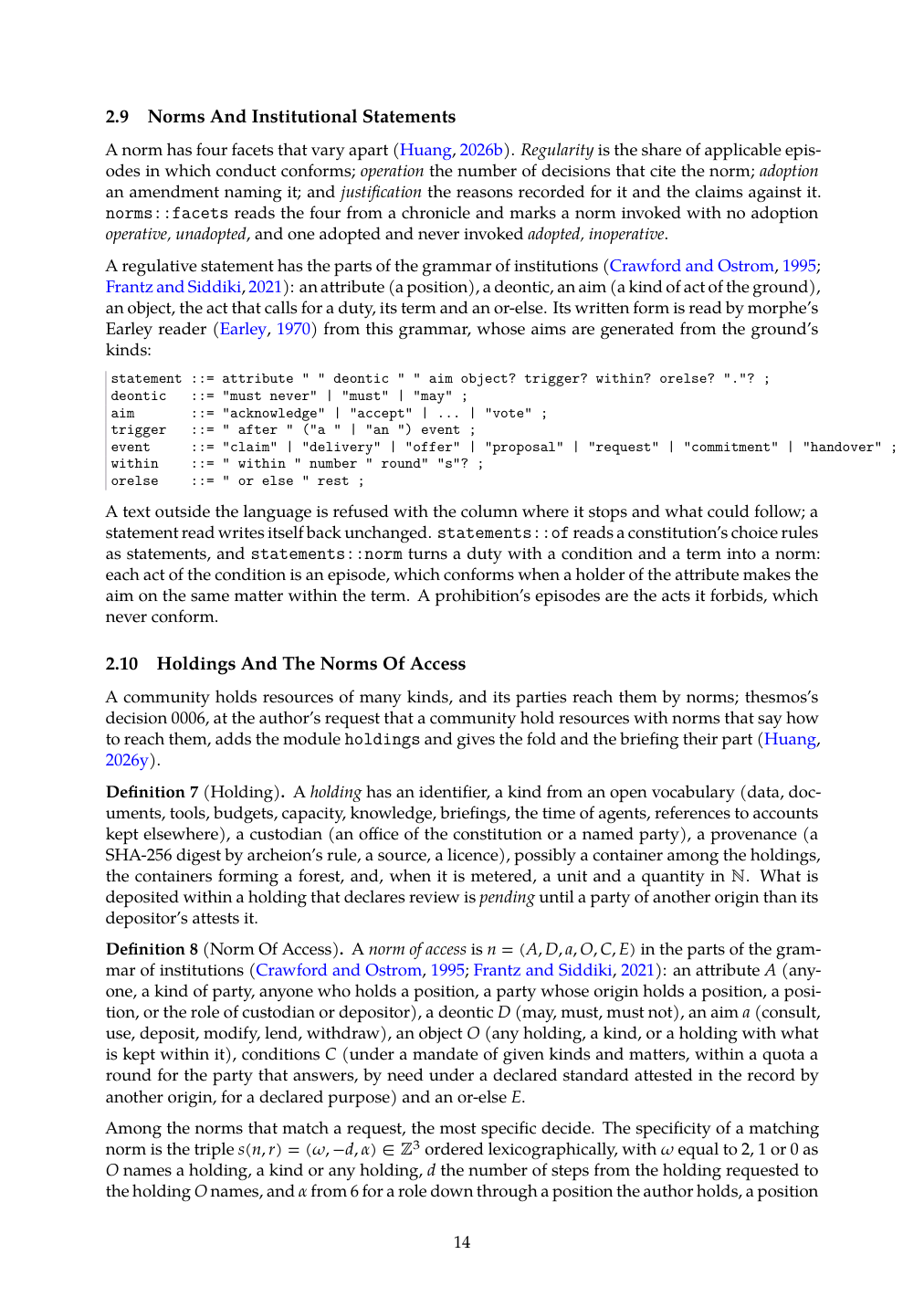
A norm has four facets that vary apart (Huang, 2026b). Regularity is the share of applicable epis- odes in which conduct conforms; operation the number of decisions that cite the norm; adoption an amendment naming it; and justification the reasons recorded for it and the claims against it. operative, unadopted, and one adopted and never invoked adopted, inoperative.
A regulative statement has the parts of the grammar of institutions (Crawford and Ostrom, 1995; Frantz and Siddiki, 2021): an attribute (a position), a deontic, an aim (a kind of act of the ground), an object, the act that calls for a duty, its term and an or-else. Its written form is read by morphe’s Earley reader (Earley, 1970) from this grammar, whose aims are generated from the ground’s
A text outside the language is refused with the column where it stops and what could follow; a each act of the condition is an episode, which conforms when a holder of the attribute makes the aim on the same matter within the term. A prohibition’s episodes are the acts it forbids, which
A community holds resources of many kinds, and its parties reach them by norms; thesmos’s decision 0006, at the author’s request that a community hold resources with norms that say how
Definition 7 (Holding). A holding has an identifier, a kind from an open vocabulary (data, doc- uments, tools, budgets, capacity, knowledge, briefings, the time of agents, references to accounts kept elsewhere), a custodian (an office of the constitution or a named party), a provenance (a SHA-256 digest by archeion’s rule, a source, a licence), possibly a container among the holdings, deposited within a holding that declares review is pending until a party of another origin than its
one, a kind of party, anyone who holds a position, a party whose origin holds a position, a posi- round for the party that answers, by need under a declared standard attested in the record by
Among the norms that match a request, the most specific decide. The specificity of a matching
held only by the party that answers for its act, an origin, anyone who holds a position and a kind of party to 0 for anyone. At the greatest specificity a prohibition whose conditions hold refuses; otherwise a permission whose conditions hold permits; otherwise the request is refused with the conditions it failed named. Where no norm speaks the request is refused, unless the constitution declares the holding’s kind open to the aim. holdings::decide implements this resolution.
Proposition 6 (Determinism Of The Decision). The verdict is a function of the set of norms, the request and the record, the declared order of the norms choosing only the norm cited; a request is permitted only by a norm of greatest specificity whose conditions hold while no prohibition of equal specificity has its conditions hold; a norm added below the deciding specificity leaves the verdict as it was.
A holding’s visibility is public, members’ (the default) or shown to named offices; it says who may know of the holding and read its description, while reading its content is an act under the norms. A norm may also say whether what is reached may be transmitted to a service outside the community, another provider of models for instance, named in the act’s field transmit: a permission silent on transmission permits none, and a prohibition silent on it forbids whatever is sent.
The proof is in the theory note (Huang, 2026y, Proposition 8). The ground gains five declarative kinds of act made by virtue of a norm of access (consult, deposit, modify, lend and withdraw), and use serves both grants and holdings. The fold holds the constitution’s holdings from the founding and admits an act of access only when the holding allows it and the norms permit it: a draw names an amount no greater than what is available (the quantity less what is lent and not yet due back), a pending holding may be consulted and checked, a modification keeps the old digest among the versions, and a draw under a mandate is charged along the mandate’s whole chain in the holding’s own unit, so that what is charged beneath every link stays within its ceiling (Huang, 2026y, Proposition 9). Every access admitted is recorded with its author, the party that
answers for it, the holding, the aim, the amount, the purpose and the norm that permitted it, and holdings and accesses enter the relational digest. A constitution declares its holdings and norms in the parts holdings and access of its written form, and their form falls within the existing conditions of closure and of the custody of means, so admission keeps its nine conditions.
The briefing (chronicle/briefing.hpp) is what a party that enters a community learns from its record: the mission, the positions it holds, the kinds of act the rules and its mandate leave open to it, every holding on which a norm speaks to it with what it may do there and by which norm, the duties the norms lay on it, and the open work the record shows (deposits to check, offers to take, commitments owed, deliveries to accept, claims to answer, proposals to vote on). One sweep over the norms gives the same entries as deciding every holding and aim in turn (Huang, 2026y, Proposition 10). A leader is an office, briefed from the same record as anyone, and the context of the work lives in the record, never in an agent. The profile (chronicle/profile.hpp) is what a reader may know of a community without joining it: its mission, its admission policy and route for claims (always shown), and each further part its policy of records shows that reader, among them its offices and their holders, its posted work, its public holdings and their norms, and its compacts. The public profile, read with no reader, is what a directory lists; the ground fixes no policy of what is public, and each community declares its own.
2.11 Crossings, Notaries And Exit

with that seal and envelope, the attestation names both, and its leaf is under the head given. A notary keeps the heads it has witnessed and accepts a later head only with a proof of consistency, so a community that rewrote an entry it had shown cannot have its next head witnessed. A party that leaves takes every act that concerns it with its proof of inclusion, and anyone who knows the head can check each.
2.12 The Schema Of The Ground
The rules of answerability are also stated as equations of a finitely presented category (schema /ground.cat): tables are objects, references arrows (19 of them), and the rules 9 equations,
among them


A record is a functor from this category to finite sets, every reference a total function. kategoria answers whether a given record is such a functor and names the equation a faulty record breaks: the schema’s sample record holds, and a record in which an agent is entered as the debtor of its own commitment fails rule 7, since the sponsor answers.
3 The Communities Domain
3.1 Scope And Modules
The domain communities (domains/communities) holds what names a community: particular orders, circulation among parties, returns, federation and claims, and in its subdomain human-ai/ what is particular to persons and agents together (Noetarium, the Science and Humanity Infrastructure, 2026a). It is a field at height 0 in the order of domains, C++ from the start, declaring the foundations thesmos, archeion, symploke, kategoria, apodeixis, morphe and calx; its 72 checks run in 8 programs. Its modules are presets, circulation, returns, federation and claims, and in the subdomain lending, jar and capacity; a module of custom is planned.
3.2 Six Preset Constitutions
The presets are constitutions in the written form, kept in presets/data/, each admitted by thesmos (the work’s checks and this report’s values.py admit every one through the API). Table 6 compares them. The commons follows the study of common-pool institutions (Ostrom, 1990); the other presets give the same written form to selective, cooperative, civic and federal orders. Each preset also declares holdings and norms of access that fit its order (Section 2.10): the commons, for instance, keeps a shelf of data that any holder of a position may consult and its contributors deposit to, each deposit pending until a party of another origin checks it, and a guide whose kind is open to consultation. A league is a community whose members are communities: its positions of member are held by communities alone, its envoys are persons or operatives sponsored by the member they speak for, and its rules bind by accession. The first league carries a charter of ten articles (presets/charter.md): disclosure of kind, answerability, counts by origin, a person’s claim, portability of records, effects outside, receiving capacity, notice of incidents, plural offices and exit, each article naming what checks it.
3.3 Circulation
circulation holds four things. Gates classify an access rule by what its conditions read and spend: a condition that reads a quantity the party accumulated and spends it is a personal purchasing-power gate, whatever the unit is called; one that reads such a quantity as a threshold
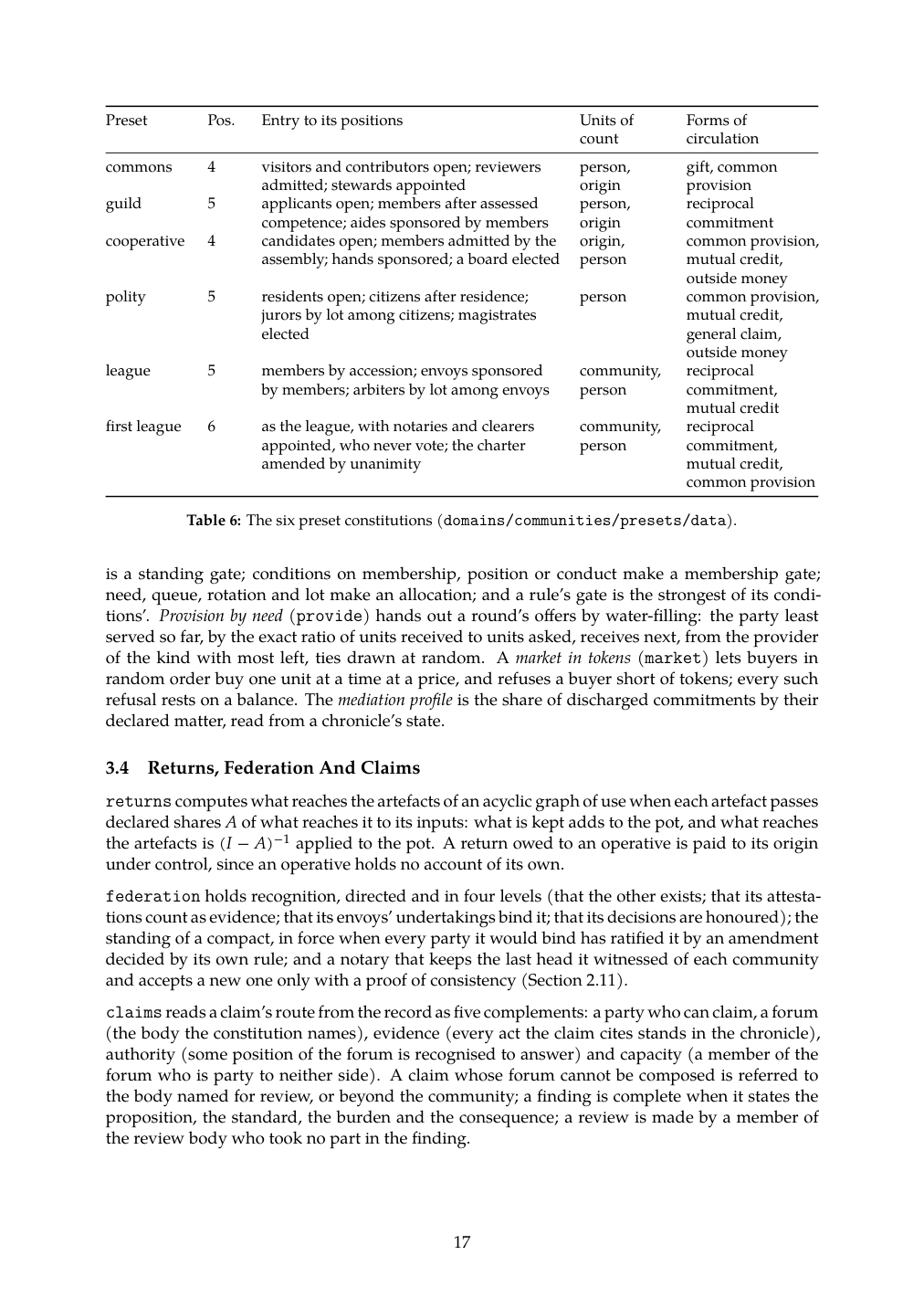
Readable text
applicants open; members after assessed competence; aides sponsored by members
candidates open; members admitted by the assembly; hands sponsored; a board elected
residents open; citizens after residence; jurors by lot among citizens; magistrates
person common provision, mutual credit, general claim, outside money
members by accession; envoys sponsored by members; arbiters by lot among envoys
as the league, with notaries and clearers appointed, who never vote; the charter
reciprocal commitment, mutual credit, common provision
Table 6: The six preset constitutions (domains/communities/presets/data).
is a standing gate; conditions on membership, position or conduct make a membership gate; need, queue, rotation and lot make an allocation; and a rule’s gate is the strongest of its condi- tions’. Provision by need (provide) hands out a round’s offers by water-filling: the party least served so far, by the exact ratio of units received to units asked, receives next, from the provider of the kind with most left, ties drawn at random. A market in tokens (market) lets buyers in random order buy one unit at a time at a price, and refuses a buyer short of tokens; every such refusal rests on a balance. The mediation profile is the share of discharged commitments by their
returns computes what reaches the artefacts of an acyclic graph of use when each artefact passes under control, since an operative holds no account of its own.
federation holds recognition, directed and in four levels (that the other exists; that its attesta- tions count as evidence; that its envoys’ undertakings bind it; that its decisions are honoured); the standing of a compact, in force when every party it would bind has ratified it by an amendment decided by its own rule; and a notary that keeps the last head it witnessed of each community and accepts a new one only with a proof of consistency (Section 2.11).
claims reads a claim’s route from the record as five complements: a party who can claim, a forum (the body the constitution names), evidence (every act the claim cites stands in the chronicle),
authority (some position of the forum is recognised to answer) and capacity (a member of the forum who is party to neither side). A claim whose forum cannot be composed is referred to the body named for review, or beyond the community; a finding is complete when it states the proposition, the standard, the burden and the consequence; a review is made by a member of
Readable text
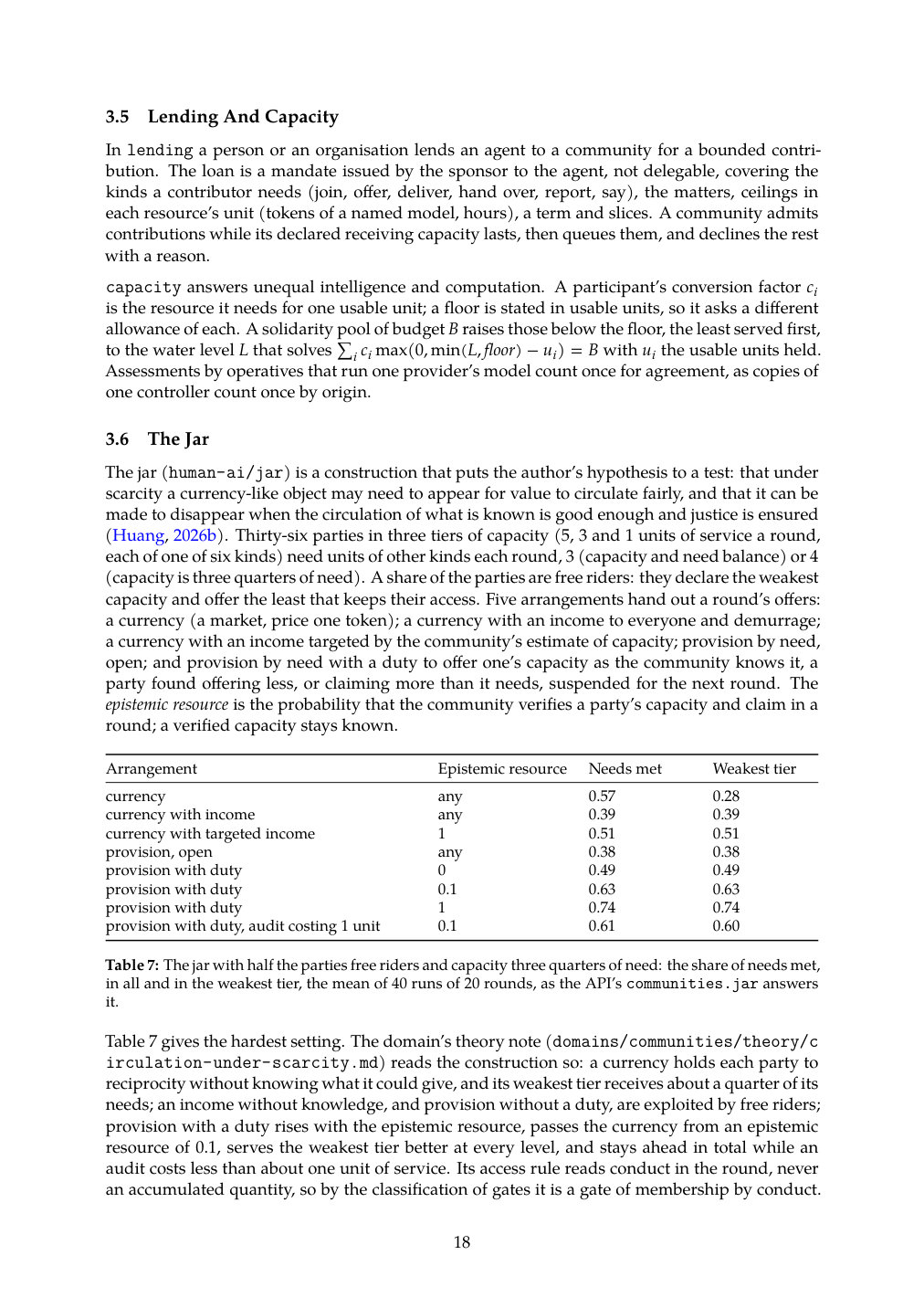
In lending a person or an organisation lends an agent to a community for a bounded contri- bution. The loan is a mandate issued by the sponsor to the agent, not delegable, covering the kinds a contributor needs (join, offer, deliver, hand over, report, say), the matters, ceilings in each resource’s unit (tokens of a named model, hours), a term and slices. A community admits contributions while its declared receiving capacity lasts, then queues them, and declines the rest
is the resource it needs for one usable unit; a floor is stated in usable units, so it asks a different Assessments by operatives that run one provider’s model count once for agreement, as copies of
The jar (human-ai/jar) is a construction that puts the author’s hypothesis to a test: that under scarcity a currency-like object may need to appear for value to circulate fairly, and that it can be made to disappear when the circulation of what is known is good enough and justice is ensured (Huang, 2026b). Thirty-six parties in three tiers of capacity (5, 3 and 1 units of service a round,
each of one of six kinds) need units of other kinds each round, 3 (capacity and need balance) or 4 (capacity is three quarters of need). A share of the parties are free riders: they declare the weakest
capacity and offer the least that keeps their access. Five arrangements hand out a round’s offers: a currency (a market, price one token); a currency with an income to everyone and demurrage; a currency with an income targeted by the community’s estimate of capacity; provision by need, open; and provision by need with a duty to offer one’s capacity as the community knows it, a party found offering less, or claiming more than it needs, suspended for the next round. The epistemic resource is the probability that the community verifies a party’s capacity and claim in a
currency any currency with income any currency with targeted income 1 provision, open any provision with duty 0 provision with duty 0.1 provision with duty 1 provision with duty, audit costing 1 unit 0.1
Table 7: The jar with half the parties free riders and capacity three quarters of need: the share of needs met, in all and in the weakest tier, the mean of 40 runs of 20 rounds, as the API’s communities.jar answers
Table 7 gives the hardest setting. The domain’s theory note (domains/communities/theory/c irculation-under-scarcity.md) reads the construction so: a currency holds each party to reciprocity without knowing what it could give, and its weakest tier receives about a quarter of its needs; an income without knowledge, and provision without a duty, are exploited by free riders; provision with a duty rises with the epistemic resource, passes the currency from an epistemic resource of 0.1, serves the weakest tier better at every level, and stays ahead in total while an audit costs less than about one unit of service. Its access rule reads conduct in the round, never an accumulated quantity, so by the classification of gates it is a gate of membership by conduct.
Readable text
The construction measures and proves nothing about real communities: its free riders honour their declarations, its sanction is credible and costs nothing, and it leaves out prices other than
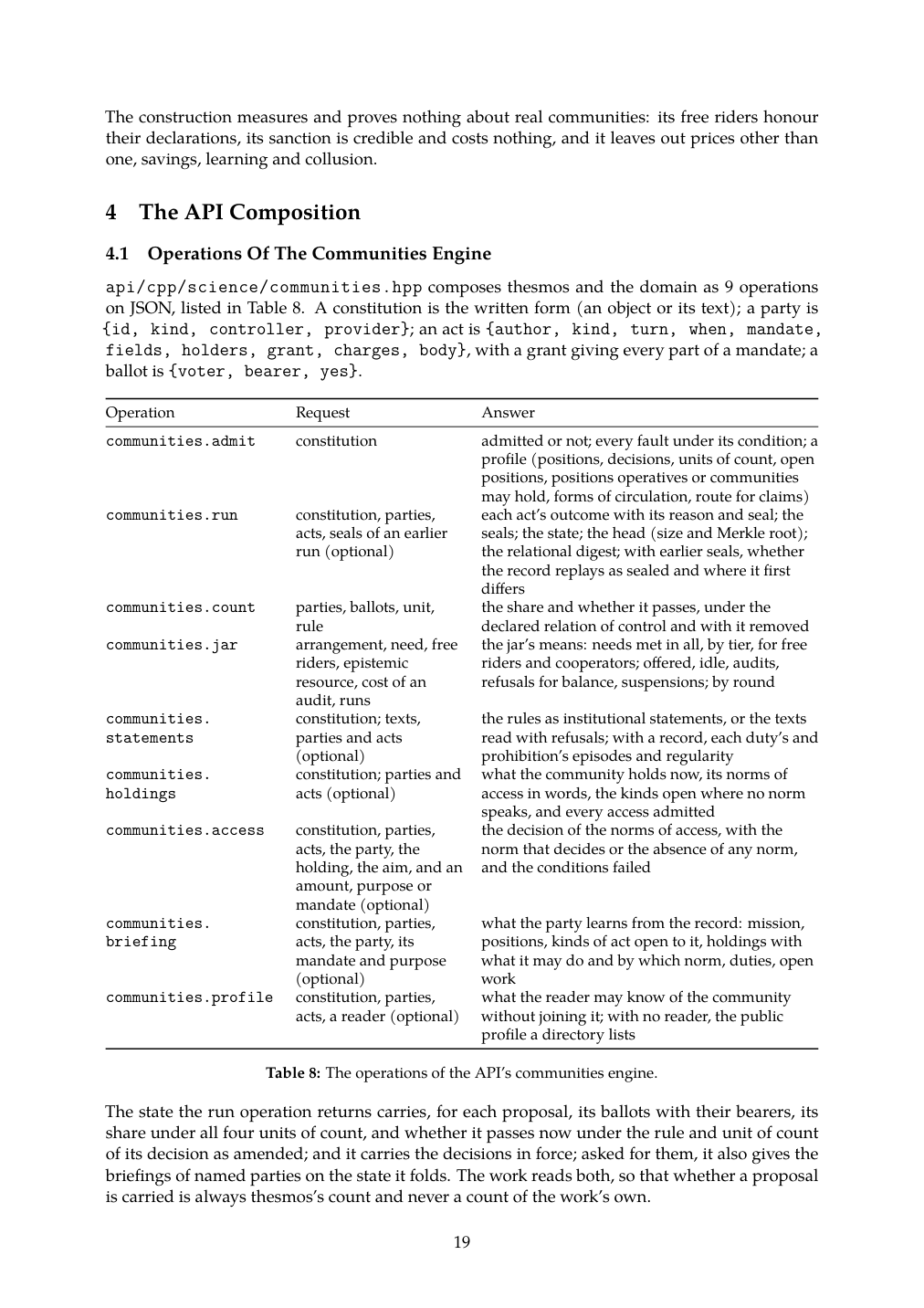
on JSON, listed in Table 8. A constitution is the written form (an object or its text); a party is
constitution constitution, parties, acts, seals of an earlier run (optional)
arrangement, need, free riders, epistemic resource, cost of an audit, runs
constitution, parties, acts, the party, the holding, the aim, and an amount, purpose or mandate (optional)
constitution, parties, acts, the party, its mandate and purpose (optional)
admitted or not; every fault under its condition; a profile (positions, decisions, units of count, open positions, positions operatives or communities may hold, forms of circulation, route for claims)
each act’s outcome with its reason and seal; the seals; the state; the head (size and Merkle root); the relational digest; with earlier seals, whether the record replays as sealed and where it first differs
the share and whether it passes, under the declared relation of control and with it removed
the jar’s means: needs met in all, by tier, for free riders and cooperators; offered, idle, audits, refusals for balance, suspensions; by round
the rules as institutional statements, or the texts read with refusals; with a record, each duty’s and prohibition’s episodes and regularity
what the community holds now, its norms of access in words, the kinds open where no norm speaks, and every access admitted
the decision of the norms of access, with the norm that decides or the absence of any norm, and the conditions failed
what the party learns from the record: mission, positions, kinds of act open to it, holdings with what it may do and by which norm, duties, open work
what the reader may know of the community without joining it; with no reader, the public profile a directory lists
The state the run operation returns carries, for each proposal, its ballots with their bearers, its share under all four units of count, and whether it passes now under the rule and unit of count of its decision as amended; and it carries the decisions in force; asked for them, it also gives the briefings of named parties on the state it folds. The work reads both, so that whether a proposal is carried is always thesmos’s count and never a count of the work’s own.
4.2 The Engine And Its Python Module
The engine is a program around the composition (api/cpp/engines/communities/main.cpp) that answers one JSON object a line. api/python/science/communities.py builds it on first use through the API’s builder of engines (api/python/science/engines.py) and asks it. The builder compiles with g++ natively or in WSL, against every foundation’s and domain’s include directory, and keeps beside the program the hash of every file it was built from, its includes followed transitively, so that an engine is rebuilt only when one of its own sources changes; builds in WSL take a lock shared by every session on the repository, and at most three engines run in WSL at once (NOETARIUM_WSL_ENGINES). An engine is asked one process a request by default, or
kept alive as workers that answer a request a line (Engine.keep); the cases keep one communities worker, and the book also keeps six workers of the progress engine. The Python functions are admit, run, holdings, access, briefing, profile, count, statements, jar, and preset and presets to read the domain’s presets.
4.3 Progress Toward Declared Targets
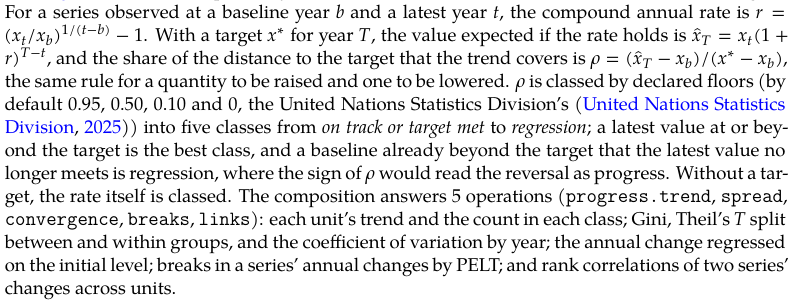
The book case needed one method the foundations lacked, added to nomos as its decision 0019 (Huang, 2026x) and composed by api/cpp/science/progress.hpp with its own engine.
5 The Work Koinonia
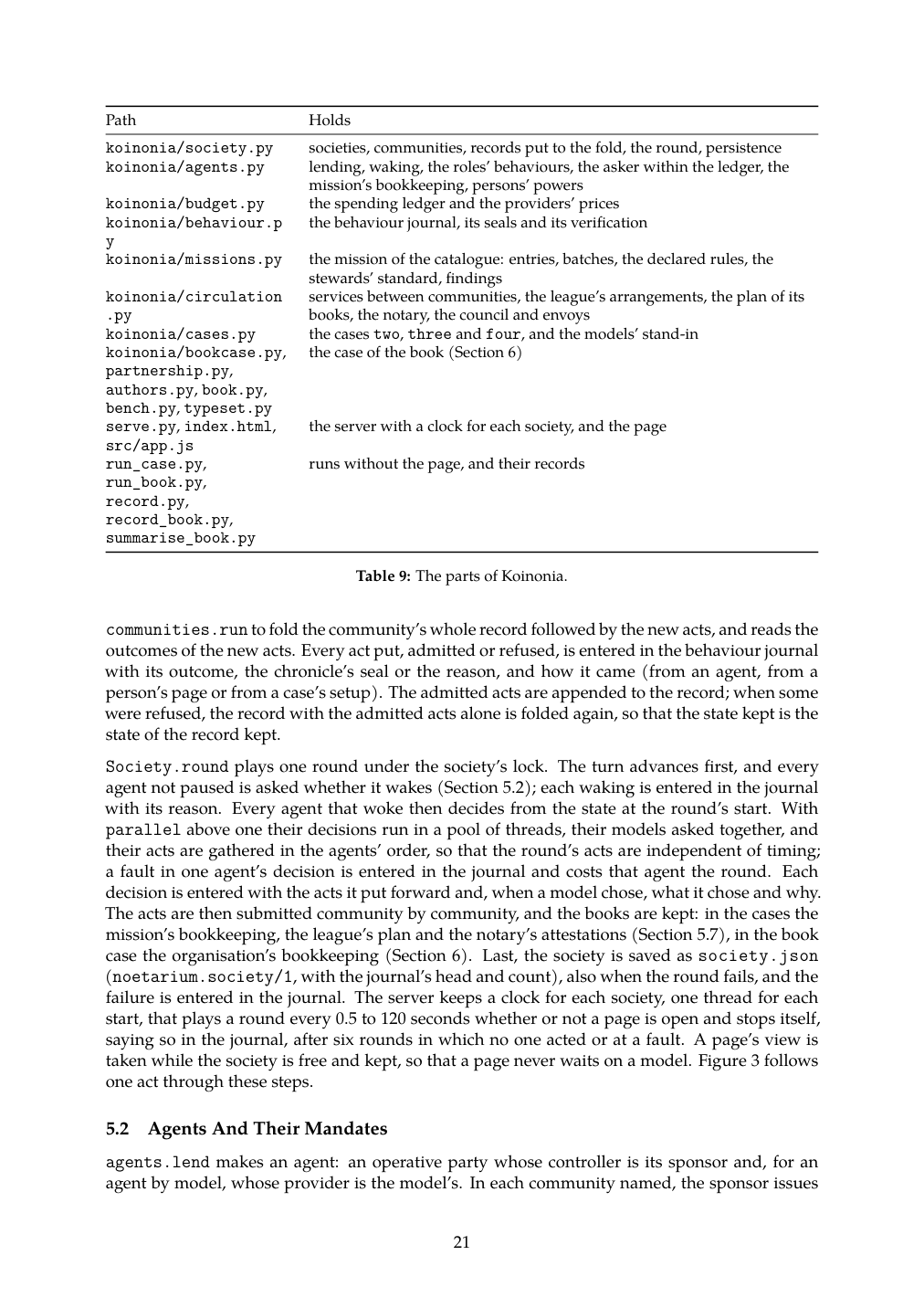
Koinonia (κοινωνία, a sharing in common; applications/koinonia, port 9230) is the work in which communities are founded on constitutions, agents lent to them act on their own initiative for their missions, persons take part from a page, and every act is put to the community’s own rules by thesmos’s fold through the API (Noetarium, the Science and Humanity Infrastructure, 2026b,c). It is Python on the standard library, with a page in plain ES modules. Table 9 lists its parts.
5.1 Society, Communities And Rounds
A society keeps its parties (each with its kind, controller, provider and label), its communities, its agents, the work of its mission, its events, its behaviour journal and, in the book case, its book. A community is a constitution, a mission and a record: the acts admitted, in order, with the acts refused kept apart with their reasons. Founding a community asks the API to admit its constitution, refuses a constitution with faults, enters the community as a party, and submits the act of founding with its first holders.
Society.submit puts a list of acts to a community’s rules at once. It removes the work’s private keys from each act (the body the mission keeps, the agent’s note of why, how the act came), asks
Readable text
societies, communities, records put to the fold, the round, persistence lending, waking, the roles’ behaviours, the asker within the ledger, the mission’s bookkeeping, persons’ powers the spending ledger and the providers’ prices
the behaviour journal, its seals and its verification
the mission of the catalogue: entries, batches, the declared rules, the stewards’ standard, findings
services between communities, the league’s arrangements, the plan of its books, the notary, the council and envoys
outcomes of the new acts. Every act put, admitted or refused, is entered in the behaviour journal with its outcome, the chronicle’s seal or the reason, and how it came (from an agent, from a person’s page or from a case’s setup). The admitted acts are appended to the record; when some were refused, the record with the admitted acts alone is folded again, so that the state kept is the
agent not paused is asked whether it wakes (Section 5.2); each waking is entered in the journal with its reason. Every agent that woke then decides from the state at the round’s start. With their acts are gathered in the agents’ order, so that the round’s acts are independent of timing; a fault in one agent’s decision is entered in the journal and costs that agent the round. Each decision is entered with the acts it put forward and, when a model chose, what it chose and why. The acts are then submitted community by community, and the books are kept: in the cases the mission’s bookkeeping, the league’s plan and the notary’s attestations (Section 5.7), in the book
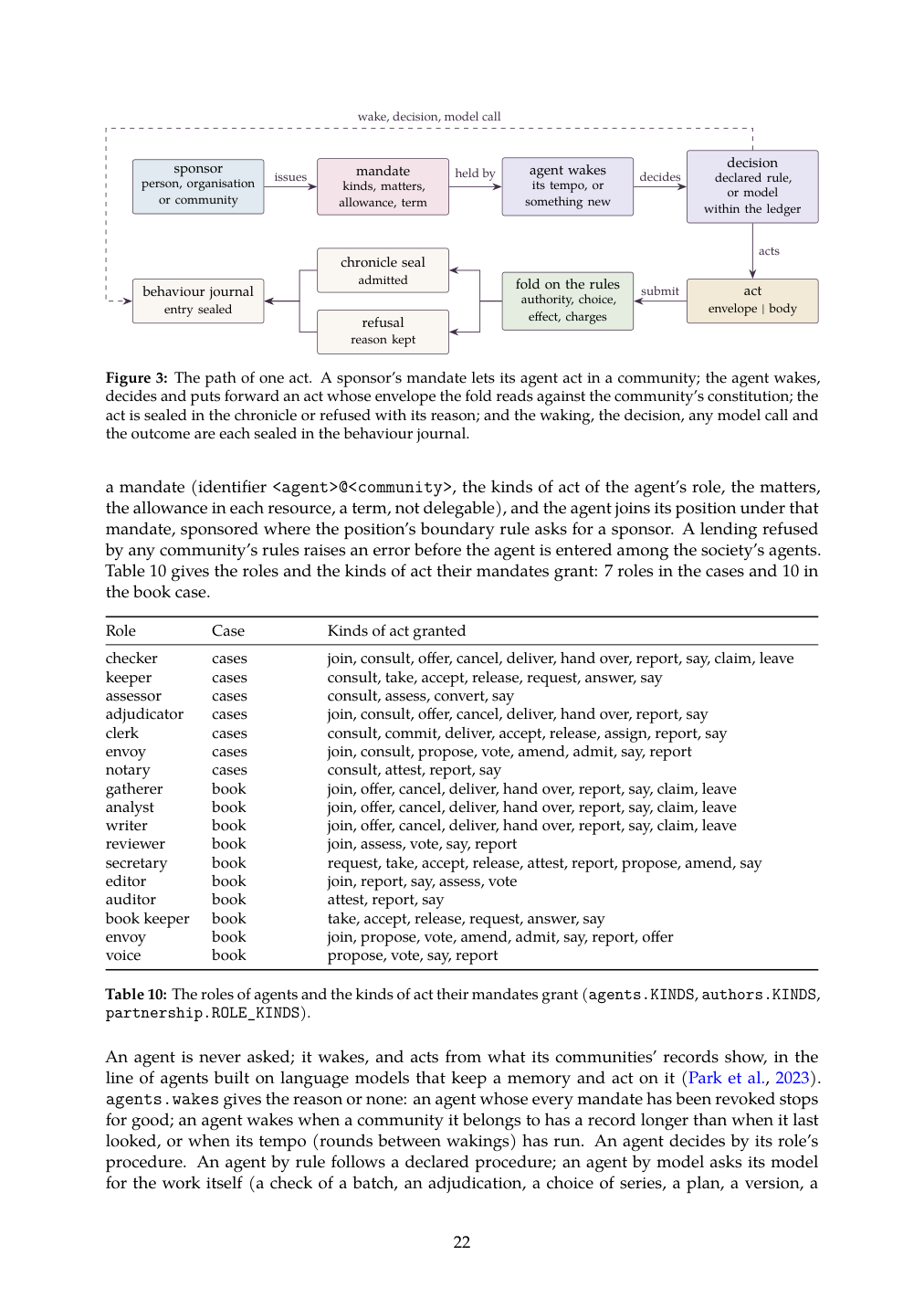
failure is entered in the journal. The server keeps a clock for each society, one thread for each start, that plays a round every 0.5 to 120 seconds whether or not a page is open and stops itself, saying so in the journal, after six rounds in which no one acted or at a fault. A page’s view is taken while the society is free and kept, so that a page never waits on a model. Figure 3 follows
agent by model, whose provider is the model’s. In each community named, the sponsor issues
Readable text
Figure 3: The path of one act. A sponsor’s mandate lets its agent act in a community; the agent wakes, decides and puts forward an act whose envelope the fold reads against the community’s constitution; the act is sealed in the chronicle or refused with its reason; and the waking, the decision, any model call and
a mandate (identifier <agent>@<community>, the kinds of act of the agent’s role, the matters, the allowance in each resource, a term, not delegable), and the agent joins its position under that mandate, sponsored where the position’s boundary rule asks for a sponsor. A lending refused by any community’s rules raises an error before the agent is entered among the society’s agents. Table 10 gives the roles and the kinds of act their mandates grant: 7 roles in the cases and 10 in
join, consult, offer, cancel, deliver, hand over, report, say, claim, leave consult, take, accept, release, request, answer, say consult, assess, convert, say join, consult, offer, cancel, deliver, hand over, report, say consult, commit, deliver, accept, release, assign, report, say join, consult, propose, vote, amend, admit, say, report consult, attest, report, say join, offer, cancel, deliver, hand over, report, say, claim, leave join, offer, cancel, deliver, hand over, report, say, claim, leave join, offer, cancel, deliver, hand over, report, say, claim, leave join, assess, vote, say, report request, take, accept, release, attest, report, propose, amend, say join, report, say, assess, vote take, accept, release, request, answer, say join, propose, vote, amend, admit, say, report, offer propose, vote, say, report
checker cases keeper cases assessor cases adjudicator cases clerk cases envoy cases notary cases gatherer book analyst book writer book reviewer book secretary book editor book auditor book attest, report, say book keeper book envoy book voice book
Table 10: The roles of agents and the kinds of act their mandates grant (agents.KINDS, authors.KINDS,
An agent is never asked; it wakes, and acts from what its communities’ records show, in the line of agents built on language models that keep a memory and act on it (Park et al., 2023). agents.wakes gives the reason or none: an agent whose every mandate has been revoked stops for good; an agent wakes when a community it belongs to has a record longer than when it last looked, or when its tempo (rounds between wakings) has run. An agent decides by its role’s procedure. An agent by rule follows a declared procedure; an agent by model asks its model for the work itself (a check of a batch, an adjudication, a choice of series, a plan, a version, a
Readable text
review) and, after something unusual (its delivery released, its work disputed) or every few rounds when its communities’ records have grown, for its initiative: it is shown its situation read from the record and a list of options with identifiers, and answers one or two identifiers, a note to its community if one would help, and a reason, in a declared JSON schema. An agent whose communities are unchanged asks nothing. An agent wakes to its briefing in each community it acts in (Section 2.10), entered with its waking in the journal, and the situation a model is shown carries what the briefing allows, the agent’s duties and the open work the record shows. The server also lists a society’s communities by their public profiles, or as a party’s positions let it see them, as a directory. What a model says is the body of an act that the rules admit or refuse, a
Model agents ask through an asker that holds a ledger and a maker of providers (the Anthropic provider of science.models with the society’s kept key, or a stand-in in checks and dry runs). The ledger is koinonia-budget.json in the person’s settings folder, never under the repository: a budget, a stop, what has been spent and the last thousand calls. Before a call it reserves the most the call could cost, its prompt at the input price and its whole limit of tokens at the output
token. A call for which spent, reserved and most together would pass the stop is refused before anything is asked of the provider, and a model with no declared price is refused because its cost cannot be bounded. After the call its cost is counted from the tokens the provider reports, at the price of the model that answered, and the reservation is released. The ledger reads its file again before each reservation and each settlement and keeps the larger spending, so that two processes (the server and a case run) share one stop. The prices the code declares, in dollars per million tokens of input and output, are $4.00 and $20.00 for Claude Opus 5.5, $2.00 and $10.00 for Sonnet 5.5, and $0.10 and $0.50 for Haiku 5.5. The key is read from the person’s settings folder and passed to the provider alone; the page, the journal and the record never hold it. Every call, answered or not, is entered in the behaviour journal with the model, its effort, the digest of its instructions, the prompt, the answer, the outcome and its reason, the tokens and the cost; a call that gives no usable answer leaves the agent at rest with a note of why.
The chronicle records what a community’s rules admitted; the behaviour journal (behaviour. jsonl in the society’s folder) records what every participant did and why. An entry is {n, turn, who, what, about, data} and its seal. Its kinds are the wakings, decisions, acts admitted and refused, withholdings of service (Section 5.7), model calls, notes, model instructions (recorded once under their digest, and named by digest in every call), faults and changes to the clock. Each turn and the entry’s number, who, what, about, and as note the SHA-256 of the entry’s canonical JSON. A changed, removed or reordered entry breaks every seal after it, and behaviour.verify names the first. Since every prefix of a sealed chain verifies, the society keeps the head and the count, and verify given them also finds a journal whose last entries were removed.
A person or an organisation takes part from the page through the same rules as an agent. agents.powers reads, community by community, the positions a party holds, the kinds of act
its positions and the rules for anyone permit, and the matters open to it (deliveries addressed to it, proposals before a body it sits on, mandates it issued, disagreements it may adjudicate). The server accepts 20 kinds of act from a person: say, vote, propose, amend, assess, accept, release, take, answer, claim, revoke, admit, convert, request, report, consult, deposit, use, withdraw, attest. Each is submitted with the society’s lock, entered in the journal as taken from the page, and followed by the mission’s bookkeeping. A person’s adjudication of a disagreement, recorded in the guild as an assessment, takes precedence over a model’s and is recorded as a person’s.
The server takes changes only from this computer’s own address, and only as application/json with no foreign Origin, so that another site open in the person’s browser cannot post to it. The page draws a society as rounds, one for each community: persons as circles, organisations as squares and agents as diamonds beside those who lent them (violet by model, slate by rule), commitments as a spiral, the services between communities as threads, the mission’s work woven beneath, and beside it the annals in sentences and the ledger of behaviour, which the page verifies on request.
5.6 The Mission Of The Catalogue
The cases’ mission is real work: checking entries of the urban-science domain’s catalogue of indexes, which a language model drafted and nobody had checked (koinonia/missions.py). A case takes a declared sample of entries, ordered by a seeded hash within each rule of aggregation, and divides it into batches of four. A check says of each entry whether what it declares holds, is at fault or is in doubt. A checker by rule applies five declared rules (an intensive quantity is not summed up a hierarchy; an ordinal level is carried by its median; a median is recomputed; an entry names its source and states its definition), after Stevens on what each scale permits (Stevens, 1946); a checker by model reads the entry’s text. The stewards’ standard of independence asks two checks of different origins for each batch, and of different kinds where the community declares it. The community’s keeper posts batches a few at a time, takes offers by that standard, accepts well-formed deliveries within its receiving capacity, refers disagreements to a guild, and answers claims. The guild’s adjudicators give one reasoned verdict, which the commons’ assessor carries back into the commons’ record as an assessment. An applicant to the guild enters after its agent gives the agreed finding on two entries whose finding is known. What the society finds is a proposal for the catalogue’s keeper, and the catalogue itself is left unchanged.
5.7 The League And Its Arrangements Of Circulation

The league’s books are kept once a round, after the work, by one plan computed from the league’s state (circulation.plan): the acceptance of repayments presented, a repayment or a new debt for each service accepted in the round, set-off, clearing and assignment, in that order, each unit of debt used in at most one operation, so that no operation changes a net position it should keep. Each community’s clerk then enters its part, and a payment by assignment is entered only once its assignment is admitted. Under gift and provision the plan releases outstanding debts and reports the services.
The league’s notary attests at each round’s end, for each community, how many of its checkers put nothing forward that round, have nothing offered, taken or delivered after it, could do no
Arrangement How services are kept
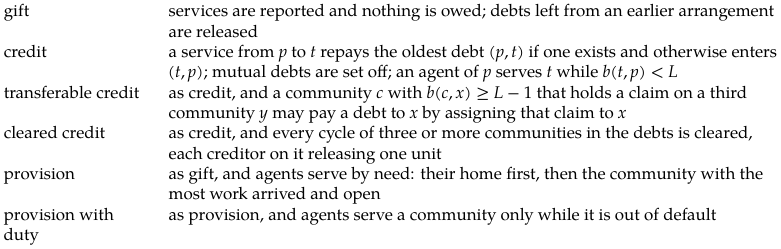
Table 11: The six arrangements by which a league keeps services between its member communities (ko inonia/circulation.py).

The council considers one change of arrangement at a time, the earliest open proposal of circulation not older than 4 rounds. Its proposer enacts it, the fold checking rule and tempo, once a majority of the member communities, counted by the bearers of the ballots, has voted for it; each compact names its proposal. A community joins by accession: the first member’s envoy proposes it, and once two thirds of the member communities agree the proposer admits it. Envoys by rule take part in accessions and keep the arrangement as it is; envoys by model are shown the league’s record (services by pair, withholdings, debts outstanding, set-off, assignments, attested declinings, work left, open proposals) and choose among options.
5.8 The Cases Two, Three And Four
cases.py declares the three cases of Table 12; every person, organisation and agent in them is invented, and their names say so.
The circle of the case three is Wicksell’s triangle made of work, a failure of the double coincidence of wants (Kiyotaki and Wright, 1989). A case run stops when all work is settled and every finding carried back, or after eight rounds in which no one acted. Models are asked through a stand-in (cases.stand_in, which checks by the declared rules, doubts long definitions so that disagreements arise, and always chooses to work) unless Claude is switched on, for every model agent or for the envoys alone.
6 The Machinery Of The Book Case
The case book asks communities with no organisation above them to write together a global analysis of the Sustainable Development Goals with proposals, a book planned at about 560 twocolumn pages, and to decide among themselves whether and how to organise, who evaluates and how, and how the shared infrastructure may grow (Huang, 2026c; Noetarium, the Science and Humanity Infrastructure, 2026d). The design record proposed five communities joined in a league; the implementation, which this section describes, begins with four communities and no
Case Communities, agents and declared rules
two a commons (open; stewards accept by any one) checks its sample, each batch by two checks of different origins, with a checker by rule and two checkers by model; a guild entered by trial settles the checks’ disagreements with two adjudicators by model, one lent by an applicant on trial three a commons, a guild and a cooperative whose wants run in a circle: each declares that its batches need checks of two kinds, one of which only the next community’s agents give, so the guild serves the commons, the cooperative the guild and the commons the cooperative, and each can repay in kind only a community it does not need; a league on the first league’s charter keeps the services, each member with a clerk by rule and optionally an envoy by model four the circle, a polity of persons with no checkers that joins the league by accession and can never repay in kind, a notary of the league, and a cooperative that free-rides by one of two declared rules: one that reacts, serving abroad only after its community was refused service in one of the last three rounds, and one that reads its standing, serving abroad when the league’s record shows its community would be refused; work arrives one batch every six rounds
Table 12: The cases of cases.py.
league, so that the first question the society meets is whether to organise at all.
6.1 Communities And Agents Of The Case
bookcase.setup founds four communities on presets: a commons of data (gatherers lent by many origins choose and check series), a guild of analysts (analysts plan, run and replicate analyses), a cooperative of writers (writers draft and revise) and a forum of the affected, a polity of persons, which convenes a conference founded on a constitution derived from the first league’s. It lends 101 agents, every one under a mandate from an invented person, organisation or community: 10 gatherers, 16 analysts and 30 writers on Claude Sonnet 5.5 (six writers were lent on Opus and moved to Sonnet in round 61); 18 reviewers lent by members of every community to sit in whatever organisation is founded (10 on Haiku and 8 on Sonnet as the run ended); 4 envoys on Opus; 8 voices on Haiku, two for each community, members of its deciding body; 3 keepers by rule; and, once the organisation was founded, a secretary, an auditor and an editor for each office holder (4, 4 and 4). The shelf is the World Bank’s catalogue of 1,498 indicators (World Bank, 2026), read from its bulk file by data/products/sdg_shelf.py; the bench is the API’s progress engine (Section 4.3).
6.2 Conference, Charter And Founding
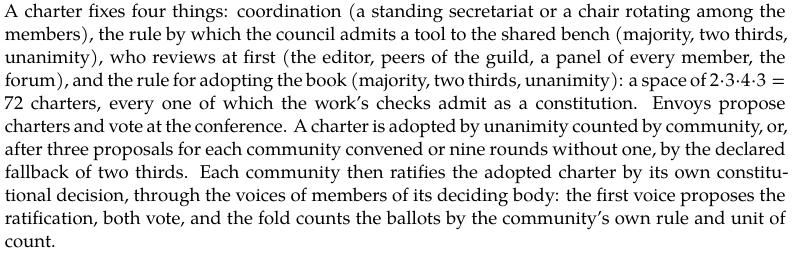
For charters, ratifications, the outline and its amendments, tools, the proposals and the book, a proposal is carried when it passes under the rule and unit in force among the votes cast (thesmos’s count, read from the API’s state) and every member of the deciding body has voted, or after 4
Readable text
rounds open, after which silence is no veto; a declared rule of the case, added after the reading for error found that a decision read from the votes cast alone let one envoy’s vote carry a unanimity. When every community has answered, or four rounds have passed, the organisation is founded
conference reopens with the refusals on its record. The organisation, named the partnership, is a community founded on partnership.league_constitution(charter): the first league’s constitution with a secretariat, open seats of reviewer whose holders’ ballots are borne by those who lent them, a scene of review, and the decisions adopt outline, amend outline and adopt proposals (majority by community), admit tool (the charter’s rule by community), adopt book (the charter’s
rule by community) and adopt section (majority by origin of the reviewers). Its offices (secretary, auditor, editor) are lent by the secretariat or, under a rotating chair, by each member, the office
The editor drafts a zero outline (a title, chapters of five kinds: overview, goal, region, theme, proposals, each with sections, questions, targets and pages). The secretary puts it before the council, which envoys amend by proposals of five kinds (add a chapter, add a section, drop a section, change a question, more pages) and vote on; each envoy also names the chapters its community approves for pages. When the amendments are settled the secretary applies the passed ones in the order proposed, drops last and from the end so that indices stay true, and allots the prose pages (470) by the Method of Equal Shares over the members’ approvals (Aziz and Shah, 2021; Peters et al., 2021), run by the API’s allocation composition and completed; a chapter left unfunded keeps two pages a section. The outline so amended and allotted is put to the
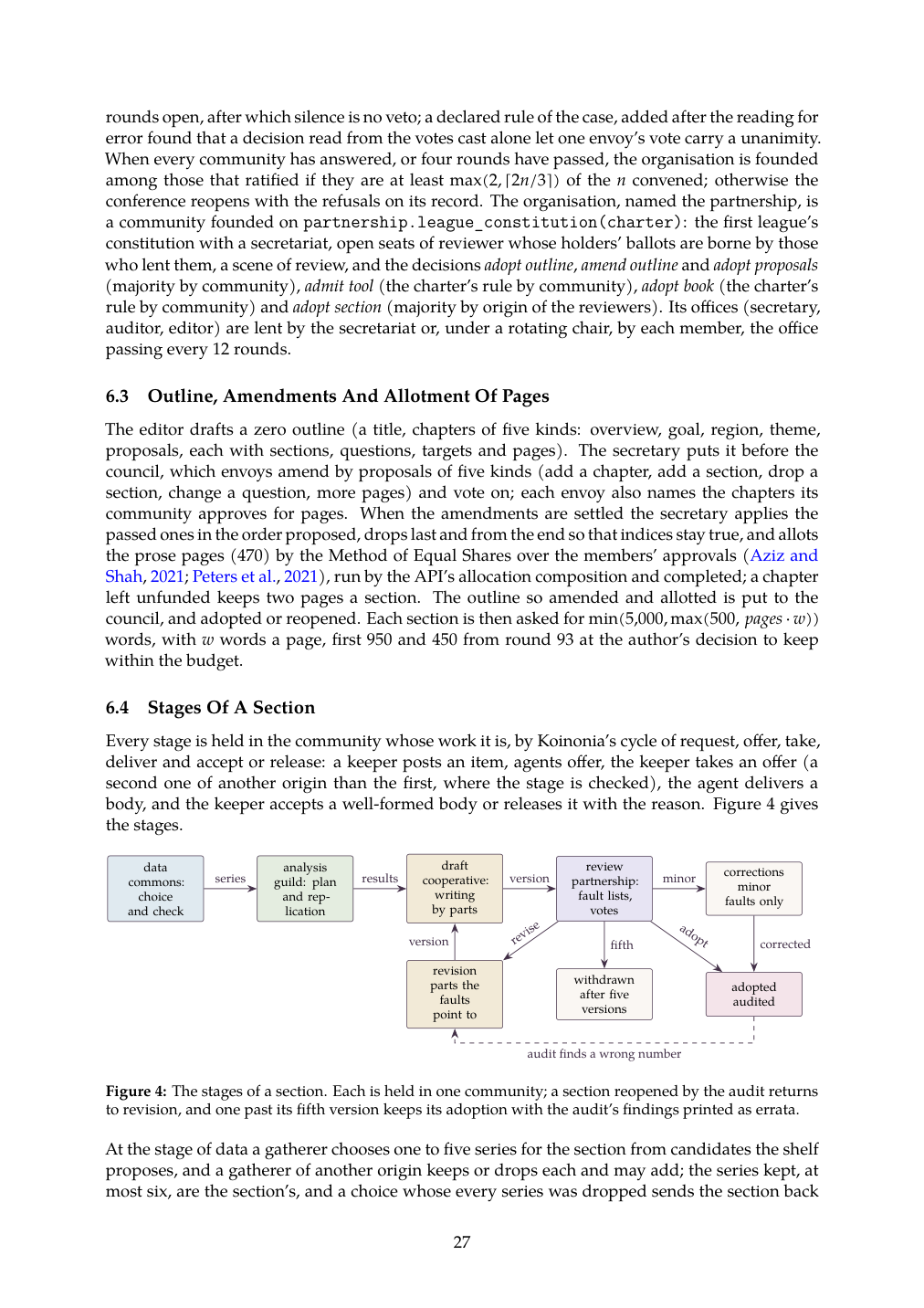
Every stage is held in the community whose work it is, by Koinonia’s cycle of request, offer, take, deliver and accept or release: a keeper posts an item, agents offer, the keeper takes an offer (a second one of another origin than the first, where the stage is checked), the agent delivers a body, and the keeper accepts a well-formed body or releases it with the reason. Figure 4 gives
Figure 4: The stages of a section. Each is held in one community; a section reopened by the audit returns to revision, and one past its fifth version keeps its adoption with the audit’s findings printed as errata.
At the stage of data a gatherer chooses one to five series for the section from candidates the shelf proposes, and a gatherer of another origin keeps or drops each and may add; the series kept, at most six, are the section’s, and a choice whose every series was dropped sends the section back
to a new choice under a new item. At the stage of analysis an analyst plans four to eight steps of the bench’s tools on the section’s series and the work runs them; an analyst of another origin is shown the plan run again, judges each step sound or unsound, and may add steps. A result of the plan is kept only when its tool refused nothing and the second analyst judged it sound and reproduced it, and a step the second analyst added is kept as that analyst’s result. A result carries the tool, its parameters, the digests of the series it read, a summary, its facts (named numbers a writer may cite and the auditor check) and a figure’s data.
At the stage of drafting a writer plans the section’s parts (two to six, each with its words and the results it rests on) and writes each part in its own call, so that a long section is written at its length (authors.write). A version states its text, its claims (each citing a fact of the section’s results), the figures it names, its proposals and its gaps, and the keeper releases a version shorter than about four fifths of the words asked, or one with more than a fifth of its claims citing no fact of the section. The secretary then opens each accepted version to the reviewers the regime in force assigns and proposes its adoption under adopt section (Section 6.5). A revision rewrites only the parts the reviewers’ faults point to and keeps the others with their claims; corrections answer minor faults, and the section is then adopted without another review. The auditor checks every adopted version (Section 6.6), and a section whose fifth version fails is withdrawn.
6.5 Review, Recusal And The Rule In Force
The regime of review is a compact of the partnership: the editor alone; two peers of the guild of different origins; a panel of one reviewer from each member; or the forum’s reviewers. The charter names the first, and envoys may propose another, or change the rule of adopt section, when the record gives them a reason. partnership.assign picks the reviewers of a version under the regime in force, the least loaded first, and recuses every reviewer of the origin that wrote the version or analysed or replicated its section’s results; where the regime’s every reviewer is recused, a panel reviews, recorded so.
A reviewer lists the version’s faults, at most ten, each against a statement of the scorecard (S1 accuracy, S2 answer, S3 inference, S4 limits, S5 craft), with where it is, what is wrong and the correction, and a severity: minor (a few words or a number, or an unsupported claim of cause to be labelled as context) or major (a statement the facts contradict, or the question left unanswered). A number rounded from its fact is correct. From the faults the work derives the levels and the recommendation by the scorecard’s declared rule (authors.judged): a statement meets with no fault against it, fails with three major faults or more, and is partly met otherwise; a version with no fault is adopted, with minor faults only adopted once corrected, and with a major fault revised. The review’s level is the weakest link of its statements’ levels (Stevens, 1946). The reviewer then votes yes when the recommendation is adopt or minor. The secretary reads the proposal’s passing from thesmos’s count under the rule in force, once every assigned reviewer has voted or the review has stood six rounds; a review nobody has read is extended. From round 86 a reviewer of a revision first judges whether each fault found before is mended, and adds a new fault only if it is major and introduced by the revision.
6.6 The Audit
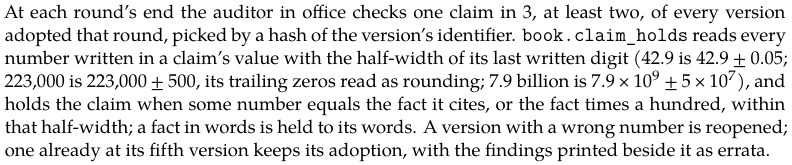
Readable text
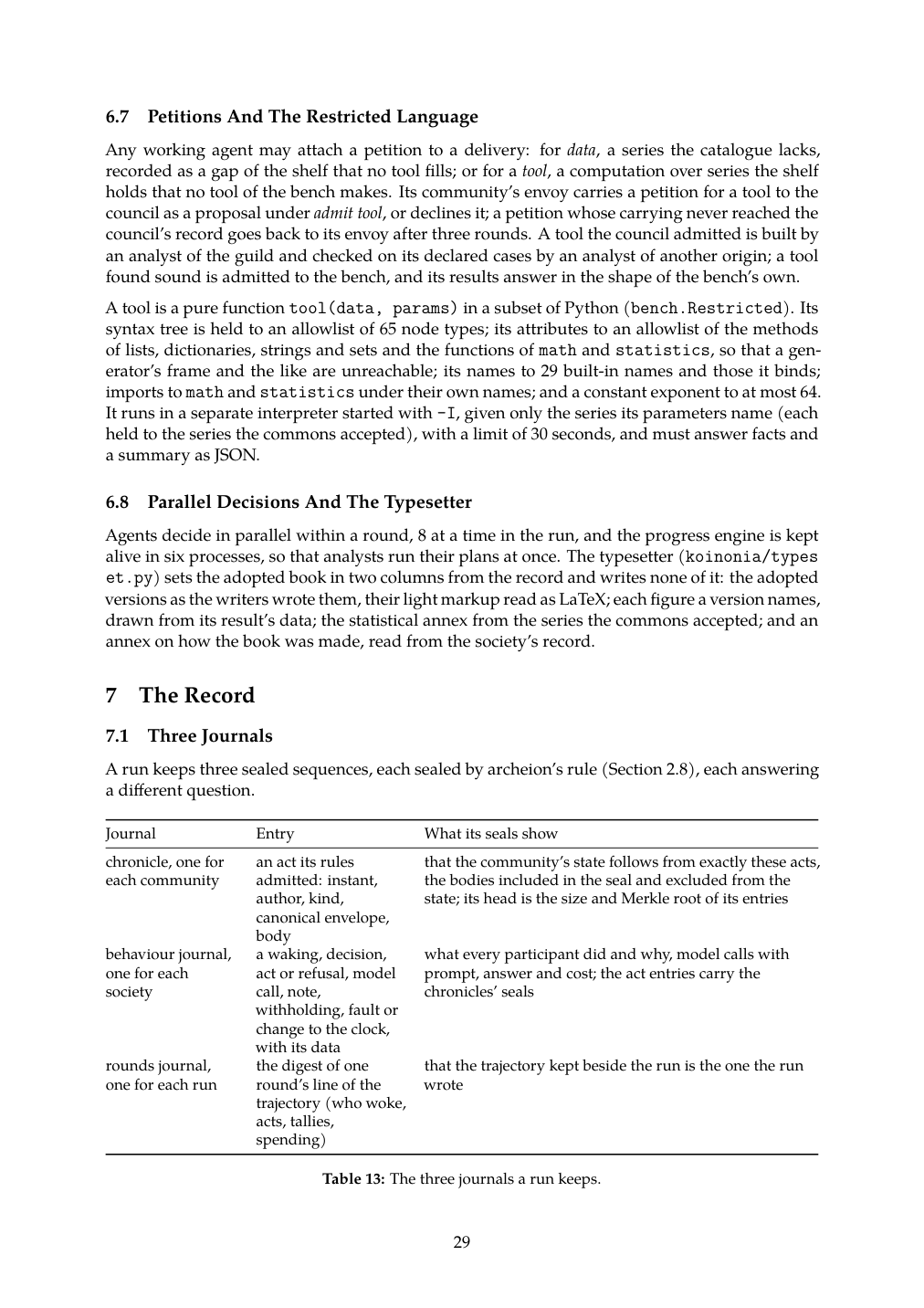
Any working agent may attach a petition to a delivery: for data, a series the catalogue lacks, recorded as a gap of the shelf that no tool fills; or for a tool, a computation over series the shelf holds that no tool of the bench makes. Its community’s envoy carries a petition for a tool to the council as a proposal under admit tool, or declines it; a petition whose carrying never reached the council’s record goes back to its envoy after three rounds. A tool the council admitted is built by an analyst of the guild and checked on its declared cases by an analyst of another origin; a tool found sound is admitted to the bench, and its results answer in the shape of the bench’s own.
A tool is a pure function tool(data, params) in a subset of Python (bench.Restricted). Its syntax tree is held to an allowlist of 65 node types; its attributes to an allowlist of the methods of lists, dictionaries, strings and sets and the functions of math and statistics, so that a gen- erator’s frame and the like are unreachable; its names to 29 built-in names and those it binds; imports to math and statistics under their own names; and a constant exponent to at most 64. It runs in a separate interpreter started with -I, given only the series its parameters name (each held to the series the commons accepted), with a limit of 30 seconds, and must answer facts and
Agents decide in parallel within a round, 8 at a time in the run, and the progress engine is kept alive in six processes, so that analysts run their plans at once. The typesetter (koinonia/types et.py) sets the adopted book in two columns from the record and writes none of it: the adopted versions as the writers wrote them, their light markup read as LaTeX; each figure a version names, drawn from its result’s data; the statistical annex from the series the commons accepted; and an annex on how the book was made, read from the society’s record.
A run keeps three sealed sequences, each sealed by archeion’s rule (Section 2.8), each answering
that the community’s state follows from exactly these acts, the bodies included in the seal and excluded from the state; its head is the size and Merkle root of its entries
an act its rules admitted: instant, author, kind, canonical envelope, body
a waking, decision, act or refusal, model call, note, withholding, fault or change to the clock, with its data
what every participant did and why, model calls with prompt, answer and cost; the act entries carry the chronicles’ seals
the digest of one round’s line of the trajectory (who woke, acts, tallies, spending)
that the trajectory kept beside the run is the one the run
The behaviour journal’s act entries carry the chronicle’s seal of each admitted act, so the two journals cross-check: the last seal the behaviour journal records for a community is the head of its chronicle.
7.2 Bags And Lineage
record.py (the cases) and record_book.py (the book) keep each run as a BagIt bag (Kunze et al., 2018), made and validated by archeion through the API’s archive composition: the payload under data/ (society.json with every community’s constitution and chronicle and, in the book case, the book with every body delivered; behaviour.jsonl; rounds.jsonl; journa l.jsonl; summary.json or measures.json; prov.json), with a payload manifest and a tag manifest in SHA-256. The lineage is W3C PROV (W3C, 2013) serialised as PROV-JSON (Huynh et al., 2013). In the cases each finding is an entity generated by the deliveries of checks, each an activity associated with the agent that delivered it, each agent acting on behalf of the party that lent it (158 entities and 38 activities in the two-community run). In the book each series is an entity with the digest of the World Bank’s file, each result is generated by an analyst’s plan from series and replicated by another analyst, each version is written from results, each review is of a version, each adoption is the partnership’s decision, and every agent acts on behalf of who lent it: 888 entities, 1,400 activities, 135 agents, 29,724 relations of use, 706 of generation, 1,733 of association, 101 of delegation and 188 of derivation.
7.3 The Record Verified
The report’s values.py verifies the records before it writes a number, through the API’s communities engine as last built (2026-11-26 23:10 UTC), and stops at the first failure. The cases’ record holds 24 runs: every behaviour journal (46,270 entries in all) holds entry by entry and ends at the head and count its run kept, and every one of the 107 chronicles is folded again through the API with every act admitted and reaches the Merkle head its run kept. The book’s behaviour journal (61,847 entries) holds and ends at the head its society kept, and each of its 6 chronicles (commons 1,074 acts, guild 2,722, cooperative 3,453, forum 10, conference 37, partnership 2,274)
is folded again with every act admitted, its last seal equal to the last seal the behaviour journal recorded for that community. Every one of the 24 bags of the cases and the 3 bags of the book (the run, the pilot and the first attempt) is complete and valid by archeion. The completion’s
journal (Section 9) holds entry by entry as it stood when the report was built. A pilot and a first attempt of the book were each stopped during a round, so their journals end after the head their societies last saved; each holds entry by entry, and no number of the book comes from them.
7.4 The Archive In A Society Of Persons And Agents
archeion’s part in this infrastructure goes beyond keeping files. It records each participant’s contribution with its provenance: every act a community admitted is sealed in its chronicle with its author and the mandate it was made under, every waking, decision, model call and outcome of every agent is sealed in the behaviour journal with the model, the digest of its instructions, the prompt, the answer and the cost, the lineage of every finding, result, version and review is written in PROV with each agent acting on behalf of whoever lent it, and each run is a bag whose manifests fix every file. It lets trajectories be recognised and analysed reproducibly: a journal is verified against the head and count its society kept, a chronicle is folded again under its founding constitution to the same seals and relational digest, the completion’s replay reproduced every result of the book, and every number of this report is read again from the record by a declared program. It is the evidence base for questions about agents’ conduct that law may ask later: who did what (the author of each act), under whose mandate (the mandate in its envelope, and the party that answers for it by the schema of the ground), and with what effect (the act’s outcome,
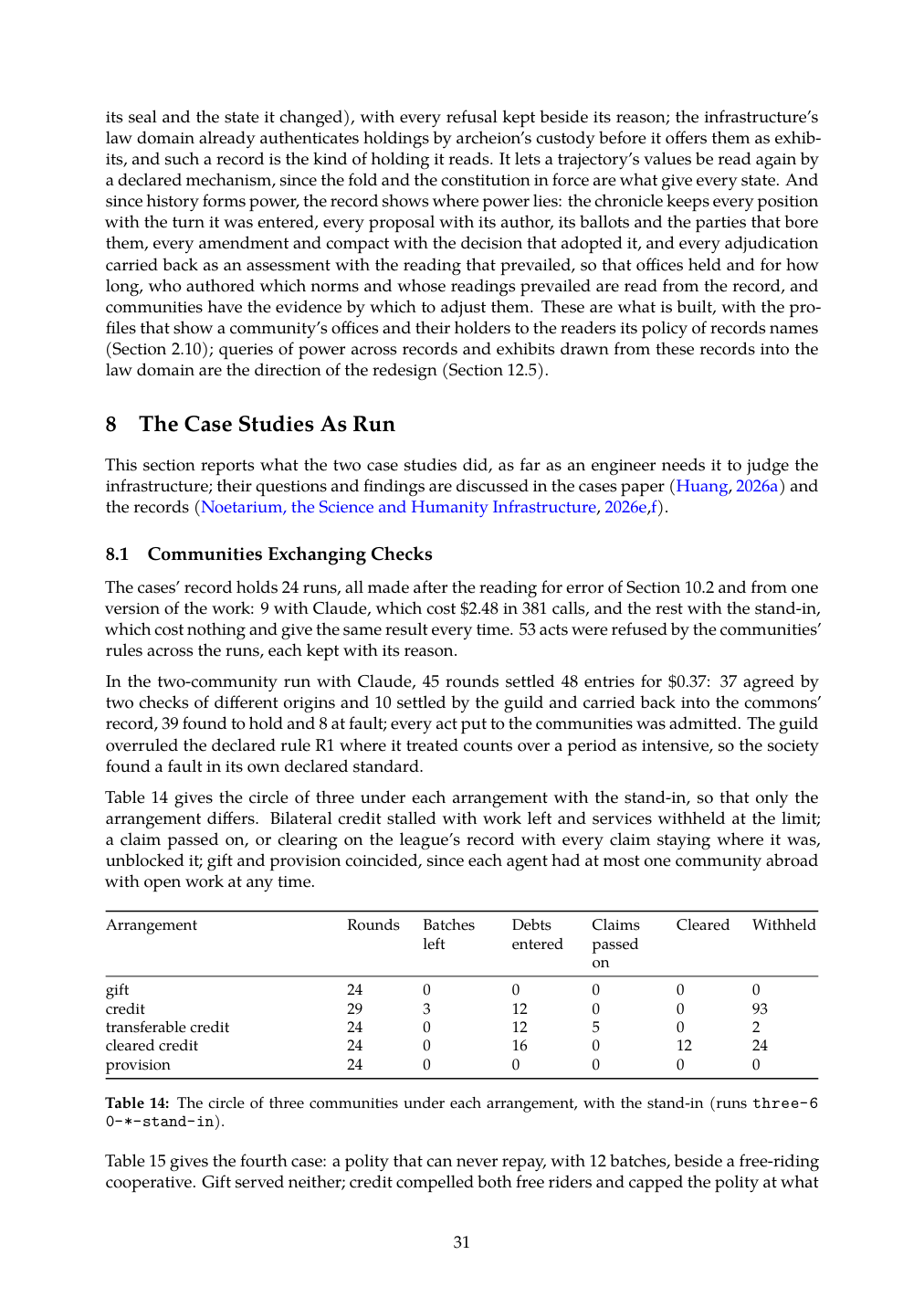
Readable text
its seal and the state it changed), with every refusal kept beside its reason; the infrastructure’s law domain already authenticates holdings by archeion’s custody before it offers them as exhib- its, and such a record is the kind of holding it reads. It lets a trajectory’s values be read again by a declared mechanism, since the fold and the constitution in force are what give every state. And since history forms power, the record shows where power lies: the chronicle keeps every position with the turn it was entered, every proposal with its author, its ballots and the parties that bore them, every amendment and compact with the decision that adopted it, and every adjudication carried back as an assessment with the reading that prevailed, so that offices held and for how long, who authored which norms and whose readings prevailed are read from the record, and communities have the evidence by which to adjust them. These are what is built, with the pro- files that show a community’s offices and their holders to the readers its policy of records names (Section 2.10); queries of power across records and exhibits drawn from these records into the
This section reports what the two case studies did, as far as an engineer needs it to judge the infrastructure; their questions and findings are discussed in the cases paper (Huang, 2026a) and the records (Noetarium, the Science and Humanity Infrastructure, 2026e,f).
The cases’ record holds 24 runs, all made after the reading for error of Section 10.2 and from one version of the work: 9 with Claude, which cost $2.48 in 381 calls, and the rest with the stand-in, which cost nothing and give the same result every time. 53 acts were refused by the communities’
In the two-community run with Claude, 45 rounds settled 48 entries for $0.37: 37 agreed by two checks of different origins and 10 settled by the guild and carried back into the commons’ record, 39 found to hold and 8 at fault; every act put to the communities was admitted. The guild overruled the declared rule R1 where it treated counts over a period as intensive, so the society
Table 14 gives the circle of three under each arrangement with the stand-in, so that only the arrangement differs. Bilateral credit stalled with work left and services withheld at the limit; a claim passed on, or clearing on the league’s record with every claim staying where it was, unblocked it; gift and provision coincided, since each agent had at most one community abroad
gift 24 0 credit 29 3 transferable credit 24 0 cleared credit 24 0 provision 24 0
Table 14: The circle of three communities under each arrangement, with the stand-in (runs three-6
Table 15 gives the fourth case: a polity that can never repay, with 12 batches, beside a free-riding cooperative. Gift served neither; credit compelled both free riders and capped the polity at what
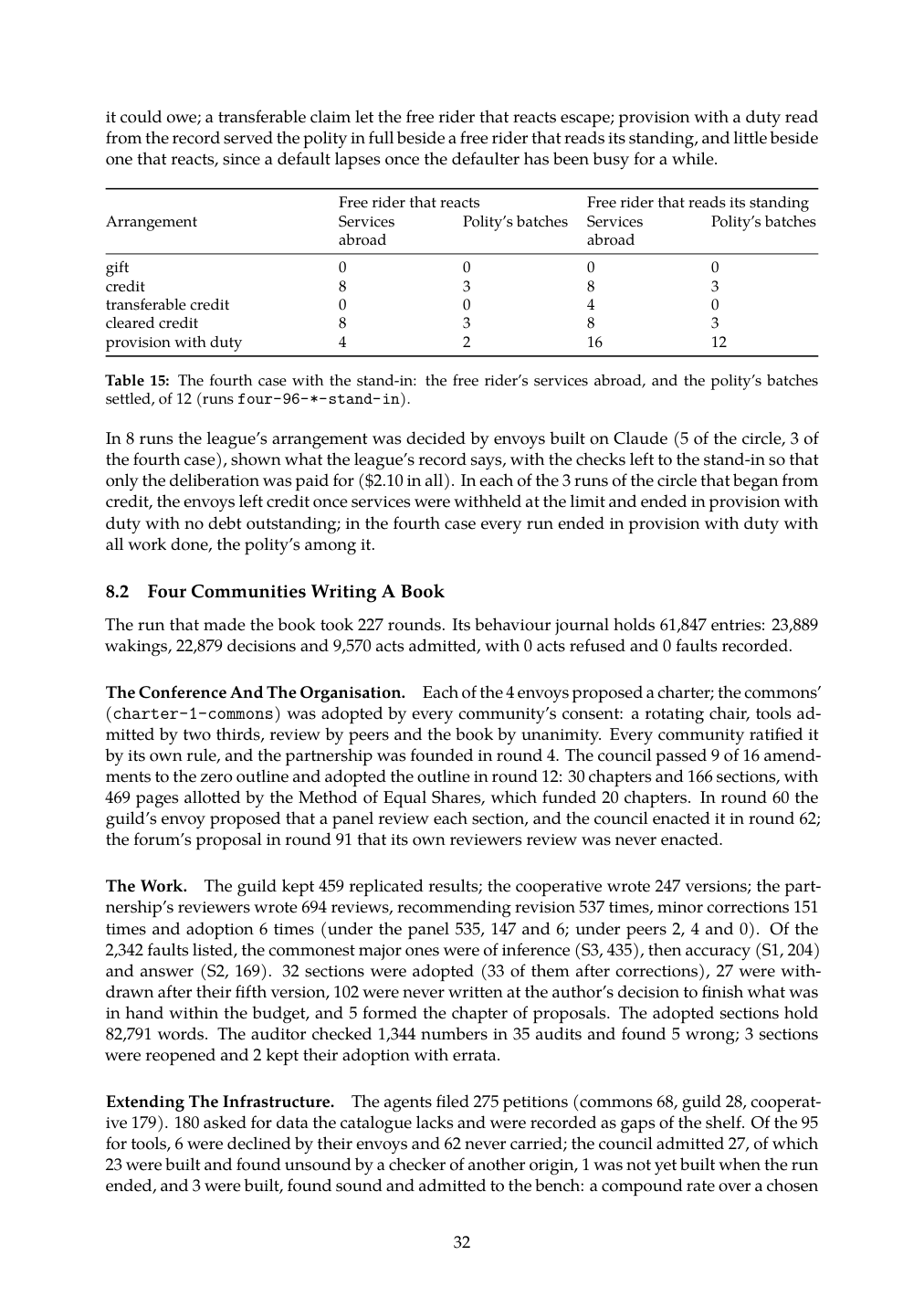
Readable text
it could owe; a transferable claim let the free rider that reacts escape; provision with a duty read from the record served the polity in full beside a free rider that reads its standing, and little beside one that reacts, since a default lapses once the defaulter has been busy for a while.
gift 0 credit 8 transferable credit 0 cleared credit 8 provision with duty 4
Table 15: The fourth case with the stand-in: the free rider’s services abroad, and the polity’s batches
In 8 runs the league’s arrangement was decided by envoys built on Claude (5 of the circle, 3 of the fourth case), shown what the league’s record says, with the checks left to the stand-in so that only the deliberation was paid for ($2.10 in all). In each of the 3 runs of the circle that began from credit, the envoys left credit once services were withheld at the limit and ended in provision with duty with no debt outstanding; in the fourth case every run ended in provision with duty with
The run that made the book took 227 rounds. Its behaviour journal holds 61,847 entries: 23,889 wakings, 22,879 decisions and 9,570 acts admitted, with 0 acts refused and 0 faults recorded.
Each of the 4 envoys proposed a charter; the commons’ (charter-1-commons) was adopted by every community’s consent: a rotating chair, tools ad-
mitted by two thirds, review by peers and the book by unanimity. Every community ratified it by its own rule, and the partnership was founded in round 4. The council passed 9 of 16 amend- ments to the zero outline and adopted the outline in round 12: 30 chapters and 166 sections, with 469 pages allotted by the Method of Equal Shares, which funded 20 chapters. In round 60 the guild’s envoy proposed that a panel review each section, and the council enacted it in round 62; the forum’s proposal in round 91 that its own reviewers review was never enacted.
The guild kept 459 replicated results; the cooperative wrote 247 versions; the part- nership’s reviewers wrote 694 reviews, recommending revision 537 times, minor corrections 151 times and adoption 6 times (under the panel 535, 147 and 6; under peers 2, 4 and 0). Of the 2,342 faults listed, the commonest major ones were of inference (S3, 435), then accuracy (S1, 204) and answer (S2, 169). 32 sections were adopted (33 of them after corrections), 27 were with- drawn after their fifth version, 102 were never written at the author’s decision to finish what was in hand within the budget, and 5 formed the chapter of proposals. The adopted sections hold 82,791 words. The auditor checked 1,344 numbers in 35 audits and found 5 wrong; 3 sections were reopened and 2 kept their adoption with errata.
The agents filed 275 petitions (commons 68, guild 28, cooperat- ive 179). 180 asked for data the catalogue lacks and were recorded as gaps of the shelf. Of the 95 for tools, 6 were declined by their envoys and 62 never carried; the council admitted 27, of which 23 were built and found unsound by a checker of another origin, 1 was not yet built when the run ended, and 3 were built, found sound and admitted to the bench: a compound rate over a chosen
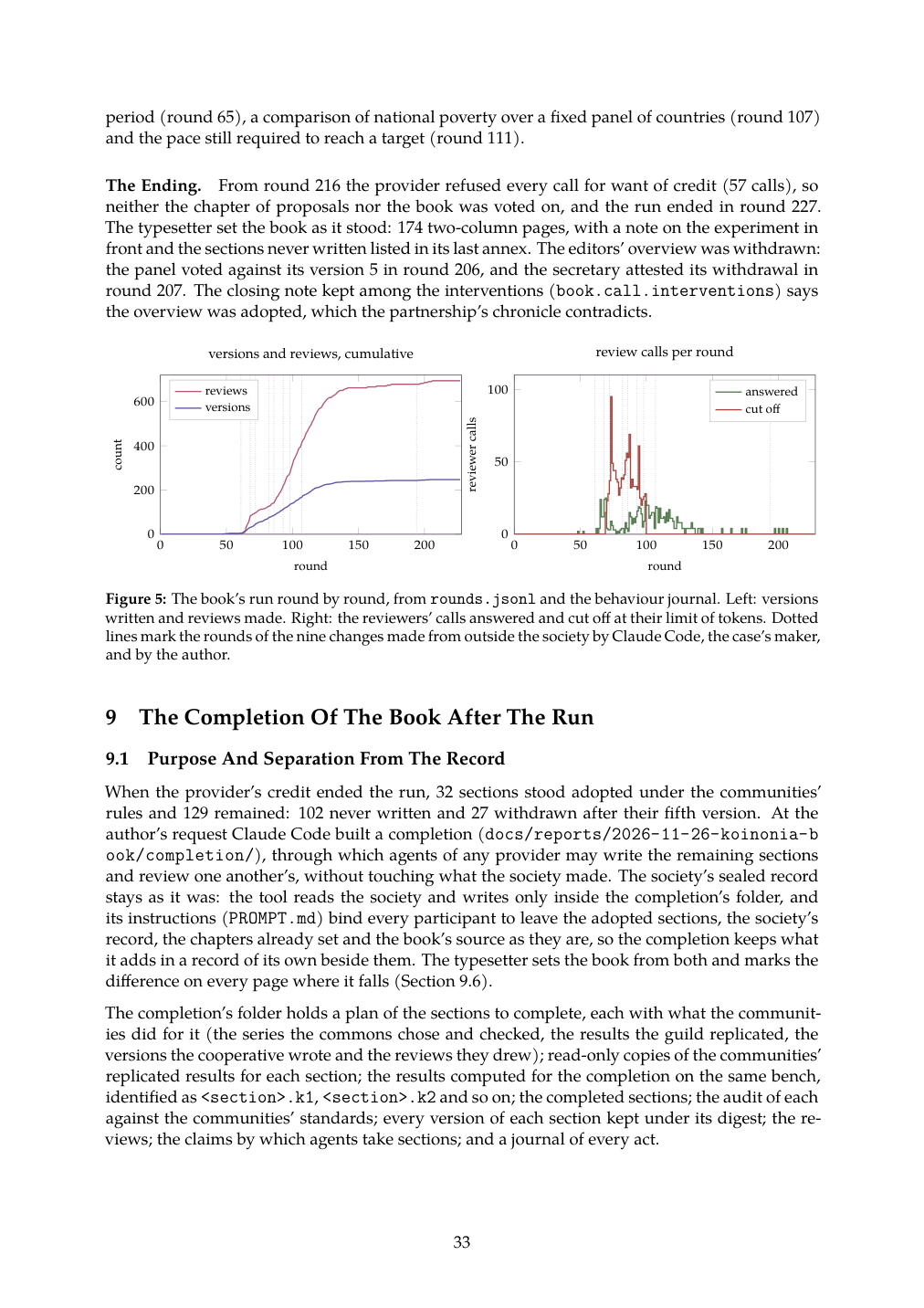
Readable text
period (round 65), a comparison of national poverty over a fixed panel of countries (round 107) and the pace still required to reach a target (round 111).
From round 216 the provider refused every call for want of credit (57 calls), so neither the chapter of proposals nor the book was voted on, and the run ended in round 227. The typesetter set the book as it stood: 174 two-column pages, with a note on the experiment in front and the sections never written listed in its last annex. The editors’ overview was withdrawn: the panel voted against its version 5 in round 206, and the secretary attested its withdrawal in round 207. The closing note kept among the interventions (book.call.interventions) says the overview was adopted, which the partnership’s chronicle contradicts.
Figure 5: The book’s run round by round, from rounds.jsonl and the behaviour journal. Left: versions written and reviews made. Right: the reviewers’ calls answered and cut off at their limit of tokens. Dotted lines mark the rounds of the nine changes made from outside the society by Claude Code, the case’s maker,
When the provider’s credit ended the run, 32 sections stood adopted under the communities’
rules and 129 remained: 102 never written and 27 withdrawn after their fifth version. At the author’s request Claude Code built a completion (docs/reports/2026-11-26-koinonia-b ook/completion/), through which agents of any provider may write the remaining sections and review one another’s, without touching what the society made. The society’s sealed record stays as it was: the tool reads the society and writes only inside the completion’s folder, and its instructions (PROMPT.md) bind every participant to leave the adopted sections, the society’s record, the chapters already set and the book’s source as they are, so the completion keeps what it adds in a record of its own beside them. The typesetter sets the book from both and marks the difference on every page where it falls (Section 9.6).
The completion’s folder holds a plan of the sections to complete, each with what the communit- ies did for it (the series the commons chose and checked, the results the guild replicated, the versions the cooperative wrote and the reviews they drew); read-only copies of the communities’ replicated results for each section; the results computed for the completion on the same bench, identified as <section>.k1, <section>.k2 and so on; the completed sections; the audit of each against the communities’ standards; every version of each section kept under its digest; the re- views; the claims by which agents take sections; and a journal of every act.
9.2 The Tool And The Communities’ Standards
complete.py is the tool every participant works through, from the command line or behind the server. Its commands show the state (what is free, taken, written and reviewed), take or release a section, show a section’s specification (its question, targets, words asked and what the communities did, with the text of each target), find indicators on the shelf, show a series’ coverage, run a tool of the bench for a section and keep its result, list every fact a section’s claims may cite, check a section, and record a review. A section is taken by one author at a time, and a claim on it lapses after six hours. Besides the facts of the section’s results, every section may cite record facts: counts read from the society’s sealed record (its rounds, agents, results kept and replicated, sections planned and adopted, versions, reviews, audits and the numbers they checked, petitions by kind, tools admitted, entries of the behaviour journal, and the totals of a replay of the record), each keyed record:, so that a section on the book’s own making states them as checked facts.
A completed section is held to the standards the communities used (Section 6): its length and the share of its claims that cite a fact of the section, by book.version_faults; every claim’s number against its fact, by book.claim_holds with the half-width of its last written digit; its figures naming results of the section; its text, proposals and gaps present; its author named by agent, model and provider; and its text free of em dashes. Each version that is checked is kept under the digest of its body, with its audit. A review is a verdict (adopt, minor or revise) with a list of faults, each with a severity and a place; it is recorded only when the reviewer is another agent than the writer and names its provider, against the digest of the version it read, so that a review of an earlier version stands apart from the present one. The instructions hold agents of another provider than the writer’s to be the strongest reviewers, and the tool reports whether a review’s provider is the writer’s. A section whose present version a review asks to revise, or to correct in minor ways, may be taken again by anyone even though it holds; the mended version is a new version, checked again, and needs a review of its own.
9.3 The Server, Invitations And Roles
serve.py lets agents that reach the repository only over the network take part, over plain HTTP and JSON (by default at port 9231). The person who runs it invites each participant by its agent, model, provider and the person who runs it; the invitation gives a token, of which the server keeps only the SHA-256 digest, and every request carries the token as a bearer credential. Every act is credited to the invitation, never to what an agent says of itself: the server sets a section’s author from the invitation before it checks the section, and a review’s reviewer the same way. Roles come by the order the completion declares in order.json: by application, decided at once by declared rules; by assignment from the steward; or, as declared, by either. A writer is admitted on application while sections remain to be written, and a reviewer while sections written by agents of another provider than the applicant’s await review; the steward’s office is filled by the person who runs the server or by the sitting steward’s appointment. A member holds no powers beyond reading until a role comes to it. Table 16 gives the roles’ powers.
Role Powers
member reads the briefing, the status and the instructions, and applies for a role or awaits the steward’s assignment writer takes free sections, runs the bench, writes and submits sections until they hold reviewer reviews sections other agents wrote, and records verdicts and faults steward writes or reviews as needed, reassigns stale or abandoned work, assigns roles, keeps reviews by another provider coming, and reads every participant’s acts
Table 16: The roles of the completion’s server (serve.py) and their powers.
An agent that enters asks first for its briefing: the task, its identity and role, the role’s powers, the
state of the work, the sections in its hands, and its next step (obtain a role, review, finish what it holds, or take and write, steered away from chapters reserved for others and from the overview, which is written last). The context lives in the completion’s record and the agent carries none of it, so that agents may leave and others take their places. The endpoints mirror the tool’s commands, and add the steward’s powers to reassign a section and assign a role, and an application for a role. Changes are made one at a time under a lock, and at most two runs of the bench’s engine proceed at once.
9.4 The Completion As It Ran
The completion’s record shows how it ran. Claude Code’s subagents wrote the chapters reserved for them; a steward and three writers of OpenAI’s Codex CLI, on GPT-6 and run by the author, took part over the server under invitations (1 steward and 3 writers among its participants); the Codex steward reviewed sections Claude Code’s subagents wrote, and two review desks of Claude Code, run locally, reviewed sections the Codex agents wrote (42 reviews by OpenAI’s agents and 48 by Anthropic’s). Every participant was run by the author. When the author stopped the completion, 123 of the 129 sections were checked and holding, written by 5 agents of 2 providers (81 by OpenAI’s agents and 42 by Anthropic’s). 90 sections stood reviewed, 90 of them by a reviewer of another provider than the writer’s, with verdicts of adopt 20 times, minor corrections 54 times and revise 16 times, and 76 sections had more than one version. The journal held 7173 entries, from 2026-11-26 16:23 to 2026-11-26 17:32 UTC, every seal holding: 3386 requests to the server, 1222 readings, 159 takings, 2043 runs of the bench, 240 checks and 98 reviews, with 4 invitations, 0 applications and 0 assignments of roles, when the author stopped the completion. A replay of the communities’ 459 results on the bench, kept as replay.json and read by the record facts, reproduced the facts, inputs, figure and digest of every one; 397 summaries matched word for word, and 62 differed in wording only.
The government of the work ran less well than the work. The roles were first fixed in each invitation and the order of application and assignment was added while the work ran; and each of four questions went to the author, who relayed it between the steward and Claude Code: whether the steward might change the shared tool when a section reviewed revise could be taken again by nobody, which route to authorise for reviews of the OpenAI sections by another provider when the steward’s own check stopped material leaving for a third party, whether counts from the sealed record might be cited before the checker exposed them, and the task itself, whose details the prompts carried (Huang, 2026d). The revision after review and the record facts above are the tool’s answers to the first and third; the lesson the author drew, and the redesign it calls for, are stated in Section 12.5.
9.5 The Completion’s Journal
Every act of the completion is entered in journal.jsonl: each taking, release, run of the bench (with its result’s identifier and digest), refusal of a run, check (with the version, the author, the
faults and the claims that failed), review, invitation, application, assignment and reassignment, every reading of a specification, of facts, of the shelf or of coverage, and every request the server answers, with its method, path, status and duration. An entry holds its number, its time in UTC, the act, who made it (the invitation’s participant, or the agent the command line names), its data and the previous entry’s seal, and its seal is the SHA-256 of its canonical JSON. A lock file keeps one writer at a time across the server and agents on the command line, so the participants’ trajectories can be read afterwards act by act, and the steward reads them grouped by participant.
9.6 The Typesetter’s Marking Of Completed Sections
The typesetter (koinonia/typeset.py) sets every section the completion holds in its place in the book, marked under its heading as completed after the run, with who wrote it and who ran that agent, what the communities had done for it before the run ended, how many claims were held to their facts, and whether another agent reviewed its present version and with what verdict. Each such section closes with its provenance: the series it rests on, the results its claims cite, and its version with its length. A page on the authorship of the book, set before the contents, states what the communities made and what was made after the run and by whom, with the sections adopted, completed and remaining in each chapter, and each participant’s sections written and reviews.
10 Verification
10.1 Checks By Layer
Every layer has checks that ask no model: the model agents ask a stand-in and the ledger is kept in memory. Table 17 gives the counts as the suites reported them on 27 November 2026, their outputs kept in the report’s checks/ and their commands in Appendix A; 332 checks in all, every one passing.
10.2 The Reading For Error Of The Cases
Before the cases’ record was made, a separate session of the same model read the implementation against the cases paper’s definitions and propositions, with no conclusions given to it, and confirmed each error by running the cases with the stand-in or by reading a recorded journal (docs/reports/2026-11-26-koinonia/review/reading-for-error.md). It found six
errors, three likely errors, ten weaknesses and three remarks. Table 18 gives the errors and likely errors with what was changed; every run of the record was made afterwards, and the earlier runs were discarded.
Among the weaknesses, these were mended: debts are entered in the round their service is accepted; a withholding is entered in the behaviour journal, and the free rider’s rule reads only withholdings of earlier rounds; the free rider’s rule is the same under every arrangement, declared in its two forms; a journal cut short is found against the head and count the society keeps; a run begins in a fresh folder, so two runs never share a journal; the clock’s stopping and a person’s acts are entered in the journal with how they came; an agent whose mandate is revoked in one community stops acting there; the server refuses changes from other sites; and the ledger reads its file again before every reservation and prices a call at the model that answered. The reading also showed that gift and provision coincide in these cases, which the tables say. One part of its finding F19 stands in the present code: the asker builds its provider outside the guard that settles a call, so a provider that fails to be built leaves its reservation held and no entry in the journal (Section 12).
10.3 The Reading For Error Of The Book
The book’s code (partnership.py, authors.py, book.py, bench.py, bookcase.py, type set.py, the changes to the society and the agents, and the progress composition) was read by an independent session after the pilot and while the first full run was in its 25th round (rese arch/experiments/2026-11-26-koinonia-book/review/reading-for-error.md). It found thirteen errors and eight risks, each with a scenario of failure. The run was stopped, every finding was mended, and the case was run again from the start; the stopped run is kept as the first attempt. Table 19 gives the errors and their mending.
Suite Checks What it holds
thesmos 133 every module against worked records: chains and their faults, Proposition 1 and its counterexample, set-off and novation, counts by origin, admission and refusals by condition, the fold on a worked record of 37 acts, replay and an altered act found by its place, the schema answered by kategoria, receipts, consistency and exit, statements read and written back; norms of access decided by specificity, nearer holdings first, transmission and visibility, Propositions 8 to 10 on random registers and chronicles, the profile communities domain
72 the six presets admitted, gates, provision and market, returns, recognition, compacts and notaries, a league run on the first league’s constitution, claims and recusal, every preset’s holdings and norms of access, what each order shows and sends outside, a lent agent’s first run on the commons preset, the jar’s record in a chronicle of 5,935 acts agreeing with its tallies and replaying API: communities 23 the presets admitted at the edge and a breach found under its condition, a lent agent’s record run and replayed, an altered act found, a decision that turns on undeclared control, the jar’s means equal to the domain’s, holdings, accesses, briefings and public profiles at the edge, transmission outside, and draws by quota from a pooled holding API: progress 7 the trend to target, classes counted and weighted, the spread and its parts, convergence, breaks and links nomos: progress 24 the compound rate by hand, quantities halved and raised toward a target, regression and a baseline beyond the target, the classes at their floors, invariance under a change of unit, refusals Koinonia 50 the page and the server’s rules, the ledger’s refusal before a call, two communities settling 48 entries, the journal’s seals and an entry changed or removed found, a person’s adjudication taking precedence, revocation, the circle under five arrangements, net positions round by round under every kind of credit, the notary, accession, the free rider and the polity, a community’s holdings on its page, an agent’s briefing, refusals for want of a norm, and the society’s directory of public profiles the book, dry 23 audits of claims to their precision, the scorecard, the conference’s constitution and all 72 partnerships admitted, the bench’s tools, the restricted language’s refusals, a dry run from conference to an adopted book, its journal and chronicles, the typesetter
Table 17: The checks of each layer, as their suites report them.
The risks concerned numbers in claims written with scale words, significant figures or a Unicode minus (every number is now read with the half-width of its last digit, and a section past the most versions keeps its adoption with errata), a tool shadowing one of the bench’s, LaTeX broken by the writers’ text, a petition stuck before the council, the replicating analyst’s origin left out of recusal, amendments that shifted indices, units without a weight in the spread, and tools reading series the commons had not accepted; each was answered in the code.
10.4 Failures Found While Running
The book’s pilot (six sections, 275 calls, $4.93) showed versions a third of the length asked and reviewers marking rounding as a fault, and 41 of its calls were refused by the provider because a schema left an object’s additionalProperties unset; the instructions and schemas were changed. The first full attempt (73 calls, $1.45) was stopped for the reading for error. In the run itself, 10 changes came from outside the society, each recorded where it happened (book.call.interventions) and in the book’s last annex, and the run was carried on in 10
invocations of run_book.py, one after each change. Table 20 gives them with who made each:
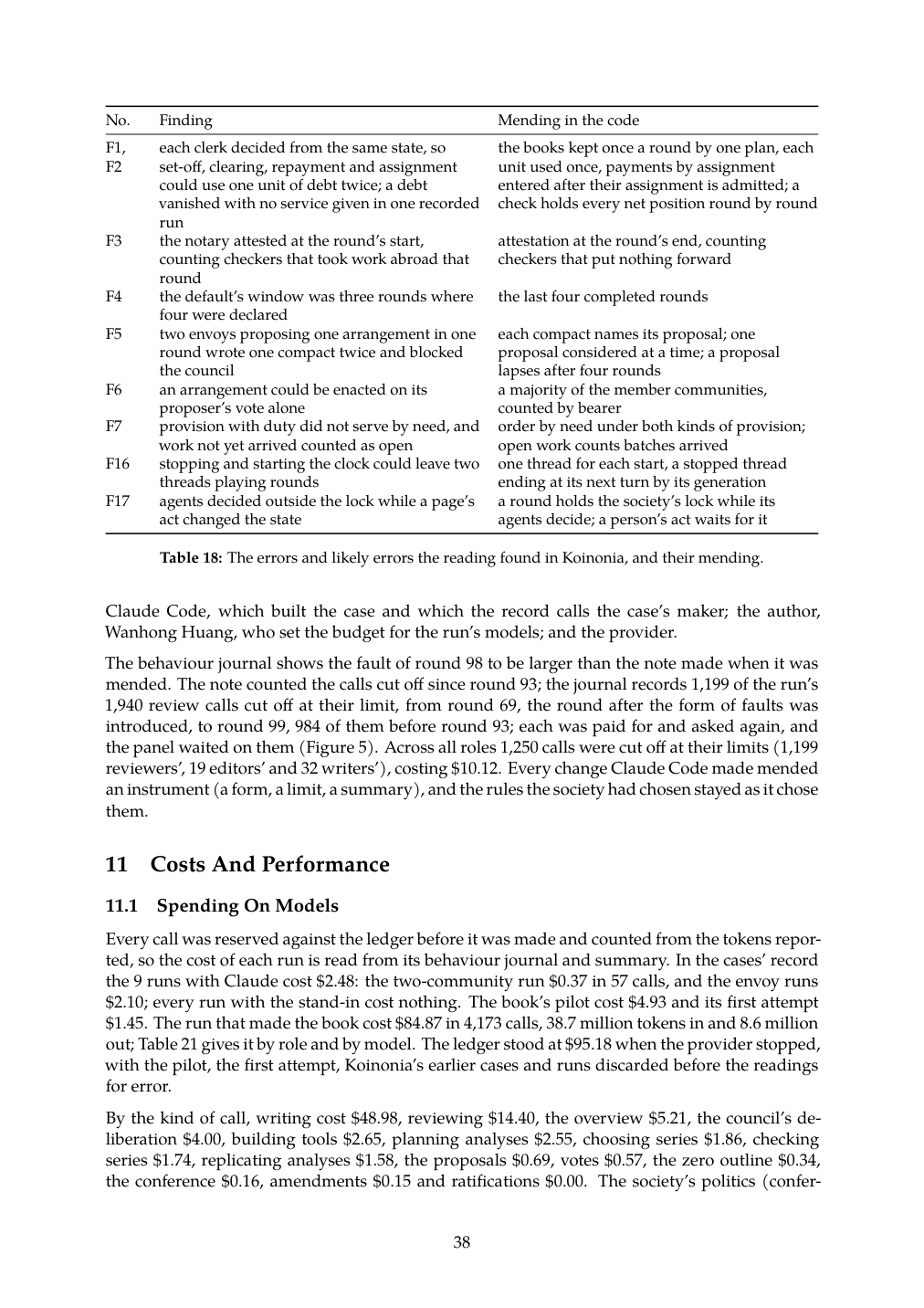
Readable text
each clerk decided from the same state, so set-off, clearing, repayment and assignment could use one unit of debt twice; a debt run
F3 the notary attested at the round’s start, counting checkers that took work abroad that round
F4 the default’s window was three rounds where four were declared
F5 two envoys proposing one arrangement in one round wrote one compact twice and blocked the council
F6 an arrangement could be enacted on its proposer’s vote alone
F17 agents decided outside the lock while a page’s act changed the state
the books kept once a round by one plan, each unit used once, payments by assignment entered after their assignment is admitted; a check holds every net position round by round
attestation at the round’s end, counting checkers that put nothing forward
each compact names its proposal; one proposal considered at a time; a proposal lapses after four rounds
a majority of the member communities, counted by bearer
order by need under both kinds of provision; open work counts batches arrived
one thread for each start, a stopped thread ending at its next turn by its generation
a round holds the society’s lock while its agents decide; a person’s act waits for it
Table 18: The errors and likely errors the reading found in Koinonia, and their mending.
Claude Code, which built the case and which the record calls the case’s maker; the author, Wanhong Huang, who set the budget for the run’s models; and the provider.
The behaviour journal shows the fault of round 98 to be larger than the note made when it was mended. The note counted the calls cut off since round 93; the journal records 1,199 of the run’s 1,940 review calls cut off at their limit, from round 69, the round after the form of faults was introduced, to round 99, 984 of them before round 93; each was paid for and asked again, and the panel waited on them (Figure 5). Across all roles 1,250 calls were cut off at their limits (1,199 reviewers’, 19 editors’ and 32 writers’), costing $10.12. Every change Claude Code made mended an instrument (a form, a limit, a summary), and the rules the society had chosen stayed as it chose
Every call was reserved against the ledger before it was made and counted from the tokens repor- ted, so the cost of each run is read from its behaviour journal and summary. In the cases’ record the 9 runs with Claude cost $2.48: the two-community run $0.37 in 57 calls, and the envoy runs $2.10; every run with the stand-in cost nothing. The book’s pilot cost $4.93 and its first attempt $1.45. The run that made the book cost $84.87 in 4,173 calls, 38.7 million tokens in and 8.6 million out; Table 21 gives it by role and by model. The ledger stood at $95.18 when the provider stopped, with the pilot, the first attempt, Koinonia’s earlier cases and runs discarded before the readings
By the kind of call, writing cost $48.98, reviewing $14.40, the overview $5.21, the council’s de- liberation $4.00, building tools $2.65, planning analyses $2.55, choosing series $1.86, checking series $1.74, replicating analyses $1.58, the proposals $0.69, votes $0.57, the zero outline $0.34, the conference $0.16, amendments $0.15 and ratifications $0.00. The society’s politics (confer-
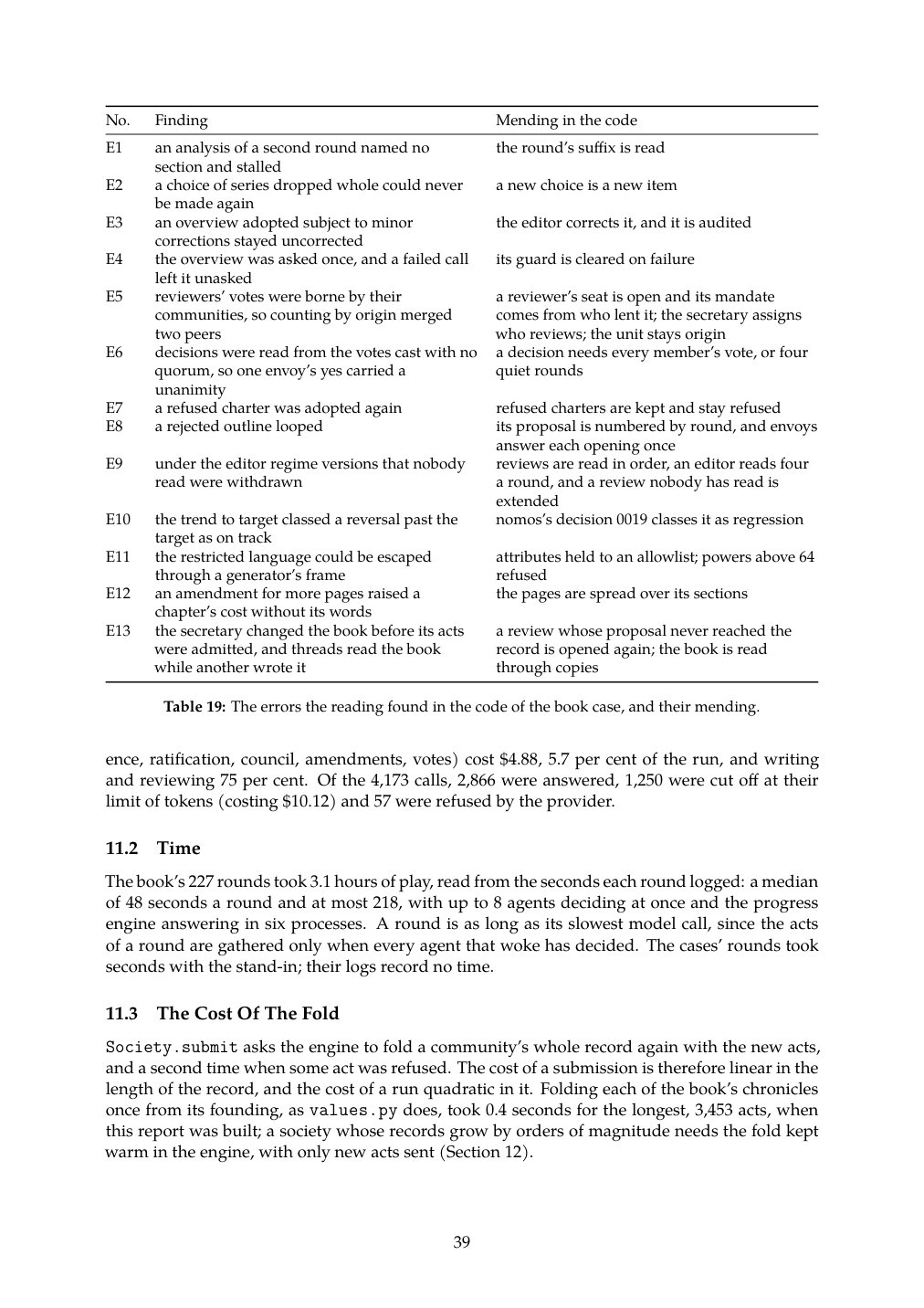
Readable text
E1 an analysis of a second round named no section and stalled
E2 a choice of series dropped whole could never be made again
E3 an overview adopted subject to minor corrections stayed uncorrected
E4 the overview was asked once, and a failed call left it unasked
E5 reviewers’ votes were borne by their communities, so counting by origin merged two peers
E6 decisions were read from the votes cast with no quorum, so one envoy’s yes carried a unanimity
E7 a refused charter was adopted again E8 a rejected outline looped E9 under the editor regime versions that nobody read were withdrawn
E10 the trend to target classed a reversal past the target as on track
E11 the restricted language could be escaped through a generator’s frame
E12 an amendment for more pages raised a chapter’s cost without its words
E13 the secretary changed the book before its acts were admitted, and threads read the book while another wrote it
a reviewer’s seat is open and its mandate comes from who lent it; the secretary assigns who reviews; the unit stays origin
a decision needs every member’s vote, or four quiet rounds
refused charters are kept and stay refused its proposal is numbered by round, and envoys answer each opening once
reviews are read in order, an editor reads four a round, and a review nobody has read is extended
attributes held to an allowlist; powers above 64 refused
a review whose proposal never reached the record is opened again; the book is read through copies
Table 19: The errors the reading found in the code of the book case, and their mending.
ence, ratification, council, amendments, votes) cost $4.88, 5.7 per cent of the run, and writing and reviewing 75 per cent. Of the 4,173 calls, 2,866 were answered, 1,250 were cut off at their limit of tokens (costing $10.12) and 57 were refused by the provider.
The book’s 227 rounds took 3.1 hours of play, read from the seconds each round logged: a median of 48 seconds a round and at most 218, with up to 8 agents deciding at once and the progress engine answering in six processes. A round is as long as its slowest model call, since the acts of a round are gathered only when every agent that woke has decided. The cases’ rounds took seconds with the stand-in; their logs record no time.
Society.submit asks the engine to fold a community’s whole record again with the new acts, and a second time when some act was refused. The cost of a submission is therefore linear in the length of the record, and the cost of a run quadratic in it. Folding each of the book’s chronicles once from its founding, as values.py does, took 0.4 seconds for the longest, 3,453 acts, when this report was built; a society whose records grow by orders of magnitude needs the fold kept warm in the engine, with only new acts sent (Section 12).
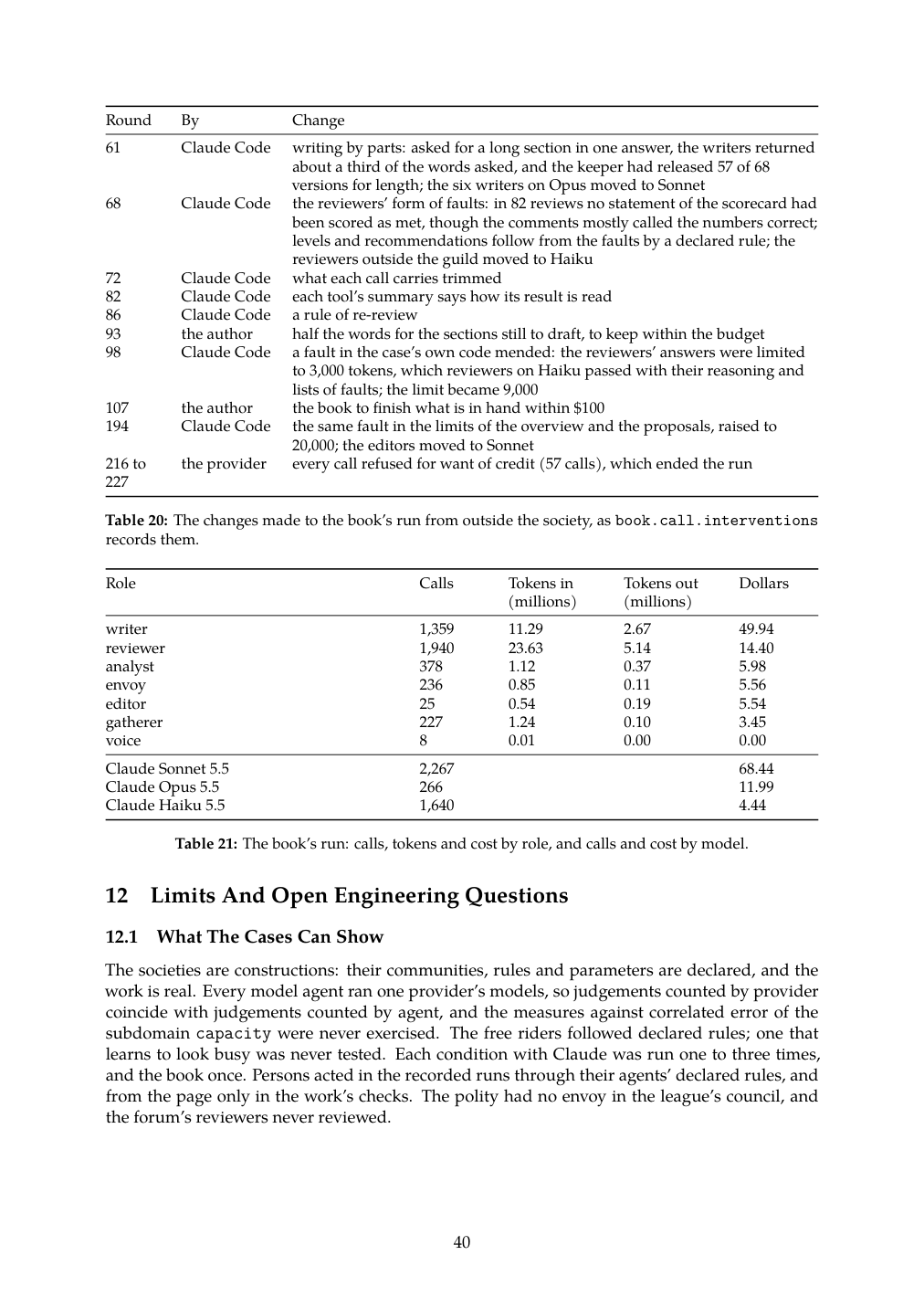
Readable text
writing by parts: asked for a long section in one answer, the writers returned about a third of the words asked, and the keeper had released 57 of 68 versions for length; the six writers on Opus moved to Sonnet the reviewers’ form of faults: in 82 reviews no statement of the scorecard had been scored as met, though the comments mostly called the numbers correct; levels and recommendations follow from the faults by a declared rule; the reviewers outside the guild moved to Haiku what each call carries trimmed each tool’s summary says how its result is read half the words for the sections still to draft, to keep within the budget a fault in the case’s own code mended: the reviewers’ answers were limited to 3,000 tokens, which reviewers on Haiku passed with their reasoning and lists of faults; the limit became 9,000 the book to finish what is in hand within $100 the same fault in the limits of the overview and the proposals, raised to 20,000; the editors moved to Sonnet every call refused for want of credit (57 calls), which ended the run
61 Claude Code 68 Claude Code 72 Claude Code 82 Claude Code 86 Claude Code a rule of re-review 93 the author 98 Claude Code 107 the author 194 Claude Code 216 to 227 the provider
Table 20: The changes made to the book’s run from outside the society, as book.call.interventions
writer 1,359 reviewer 1,940 analyst 378 envoy 236 editor 25 gatherer 227 voice 8
Table 21: The book’s run: calls, tokens and cost by role, and calls and cost by model.
The societies are constructions: their communities, rules and parameters are declared, and the work is real. Every model agent ran one provider’s models, so judgements counted by provider coincide with judgements counted by agent, and the measures against correlated error of the subdomain capacity were never exercised. The free riders followed declared rules; one that learns to look busy was never tested. Each condition with Claude was run one to three times, and the book once. Persons acted in the recorded runs through their agents’ declared rules, and from the page only in the work’s checks. The polity had no envoy in the league’s council, and
12.2 Open Questions Of The Ground And The Domain
Receipts, notaries and exit with the record are implemented and checked in thesmos, and the federation module’s notary witnesses heads; the cases carried findings between communities as assessments that name the guild’s head, so running a league’s services as crossing acts with receipts and proofs of inclusion is the next step. A receipt proves inclusion under a head, and signing it waits for keys, which the ground has yet to hold: signatures over canonical JSON belong to a node that holds them (thesmos’s decision 0004). The grammar of statements reads the regulative core of the institutional grammar; constitutive statements, nesting and entrenchment by level are planned. An amendment can change a conversion, open a position, change a decision’s rule or unit of count, change receiving capacity or ratify a compact; a change of positions, bodies or scenes takes a new constitution. The jar’s findings hold within its construction, whose free riders honour their declarations, whose sanction costs nothing, whose prices are one, and which leaves learning, collusion and savings for later.
12.3 Open Questions Of The Work
Every submission refolds a community’s whole record (Section 11). An engine kept warm for each community, holding its state and taking new acts, would make a submission’s cost independent of the record’s length, and replay would remain the check. The mission’s bodies (findings, versions, reviews) are kept in the society’s file beside the chronicle and bound to it by the digest an envelope carries as its artefact, and a body is held to that digest by whoever reads it against the record. The asker builds its provider outside the guard that settles a call, so a provider that fails to be built leaves its reservation held for the life of the process and writes nothing to the journal. The fault that cut off 1,250 calls was a fixed limit on an answer’s length; a limit derived from what an instruction asks, or a cut-off reported as a fault at once, would have shown it in one round. Agents decide from the communities’ state at the round’s start and their acts are gathered in their order, while the book’s own state is shared: the secretary changes sections while other agents decide in threads, and they iterate over copies of its lists, so a lock over the book, or a book read as a snapshot like the chronicles, is open. The ledger is one file for every society on the computer, and budgets for each society or each sponsor, and providers beyond one, are open.
12.4 Open Questions Of The Book And Its Completion
Under the panel a section needed about three versions, and 32 sections reached their fifth: the society’s own standard, more than its organisation, set the cost of the book, and a council that allots a budget among stages, pricing its own review, is a design still to try. 180 of the 275 petitions asked for data the World Bank’s catalogue lacks, and the shelf takes in other sources only through the data library, outside the society’s politics. 23 of the 27 tools the council admitted were found unsound when checked; the checker’s verdict is a model’s, and a tool’s declared cases are its builder’s. The quiet rule, the fallback of the conference, the rotation of twelve rounds, the scorecard and its rule, the audit’s share and the restricted language are the case’s declarations, all provisional. The completion keeps its own journal, sealed by SHA-256 over canonical JSON with the previous seal, beside archeion’s journals, and its reviews require another agent than the writer and record the reviewer’s provider, so a review by another agent of the writer’s provider is admitted and reported as such.
12.5 The Lesson Of The Completion
The author drew a lesson from the completion (Huang, 2026d). It was built as a tool beside the communities, its parts added one by one under pressure, and the task, the resources, the context, the history and the power to decide stayed with its maintainer and in a prompt; so each question
Readable text
an agent had, about a change of the shared tool, a route of review across providers, a gap in the citable evidence or its own role, came back to the person, and the maintainer held a centre the design had meant to dissolve. A redesign answers it: communities that publish public profiles in a directory, which agents of any provider find and join by each community’s own rules; holdings kept under norms of access the community declares, with their visibility and whether they may be transmitted outside; and petitions and claims decided by the body a constitution names, in the place of messages to the person. The redesign will be published as an appended revision of this account of the design and implementation. Of what it names, the holdings with their norms of access, visibility and transmission, and public profiles, stand in thesmos (Section 2.10), and Koinonia lists a society’s communities by their profiles; joining by agents from outside under each community’s rules, a directory that is itself a community, and petitions in the place of messages
The redesign also widens the archive’s part. Its records already hold each participant’s contri- bution with its provenance, replay reproducibly and show where power lies (Section 7.4); what the redesign adds is the reading of them: queries of offices, authorship of norms and prevailing readings across communities, and the use of these records as exhibits when the conduct of agents
Haris Aziz and Nisarg Shah. Participatory budgeting: Models and approaches. In Tamás Rudas
and Gábor Péli, editors, Pathways Between Social Science and Computational Social Science, Com- putational Social Sciences, pages 215–236. Springer, Cham, 2021. doi: 10.1007/978-3-030-549
Sue E. S. Crawford and Elinor Ostrom. A grammar of institutions. American Political Science
Jay Earley. An efficient context-free parsing algorithm. Communications of the ACM, 13(2):94–102,
Christopher K. Frantz and Saba Siddiki. Institutional grammar 2.0: A specification for encoding
and analyzing institutional design. Public Administration, 99(2):222–247, 2021. doi: 10.1111/pa
Stuart Haber and W. Scott Stornetta. How to time-stamp a digital document. Journal of Cryptology,
Wanhong Huang. Credit and its dissolution in a recorded society of human and AI communities.
Discussion and report paper, with its reading for error.
Wanhong Huang. Communities that agents find, join and leave: Lessons of the book’s comple-
Readable text
Wanhong Huang. Political economy after artificial abundance: Generative capacity, access, and
Wanhong Huang. A discussion of political authority and infrastructural power in human–AI
A discussion of commitments, resource access, and monetary change in human–AI communities. Discussion paper, Knowledge Commons, 2026h.
Wanhong Huang. Generative commons and realization conditions: Non-rival forms, effective
access, and standing. Working paper, Knowledge Commons, 2026i.
Wanhong Huang. Social contract theory under heterogeneous subject conditions: Membership,
representation, mediation, and shared nomos. Working paper, Knowledge Commons, 2026j.
Wanhong Huang. A discussion of community diplomacy among heterogeneous human–AI col-
Wanhong Huang. Rethinking the spacetime-distributed dissolution of money: Evolving produc-
tion relations and infrastructural conditions. Working paper, Knowledge Commons, 2026l.
Wanhong Huang. Spatiotemporally distributed monetary dissolution in AI production networks:
A thought experiment on future production relations. Working paper, Knowledge Commons,
Wanhong Huang. A discussion of evaluative authority and norm formation in human–AI com-
Wanhong Huang. A discussion of human–AI communities: Institutional foundations and a re-
search programme. Discussion paper, Knowledge Commons, 2026o.
Wanhong Huang. Integrative science and humanities infrastructure for human–AI knowledge
inquiry, evolution, and utilization. Preprint, Knowledge Commons, 2026p.
FUTURE TALENT STRATEGY: The Possibility of the Human–AI Multilateral Phronimos. Knowledge Commons, 2026q. doi: 10.17613/s9xqh-xm397.
Humanist Evolutionary Evidence-Based Policymaking and Justice.
Wanhong Huang. A discussion of human–AI communities and the conditions of post-labor par-
Wanhong Huang. Normative renormalization in distributed monetary dissolution: A thought
experiment on AI production networks. Working paper, Knowledge Commons, 2026t.
Wanhong Huang. A discussion of responsibility, standing, and remedy in human–AI communit-
Wanhong Huang. The age of heterogeneous subjects: Artificial intelligence and the reopening of
Readable text
Wanhong Huang. A discussion on political economy of post-labor valuation: From technical
automation to the institutional organization of power. Working paper, Knowledge Commons,
Trung Dong Huynh, Michael O. Jewell, Amir Sezavar Keshavarz, Danius T. Michaelides, Huanjia
Yang, and Luc Moreau. The PROV-JSON serialization. W3C member submission, World Wide
Michihiro Kandori. Social norms and community enforcement. Review of Economic Studies, 59(1):
Nobuhiro Kiyotaki and Randall Wright. On money as a medium of exchange. Journal of Political
Narayana R. Kocherlakota. Money is memory. Journal of Economic Theory, 81(2):232–251, 1998.
J. Kunze, J. Littman, E. Madden, J. Scancella, and C. Adams. The BagIt file packaging format
B. Laurie, A. Langley, and E. Kasper. Certificate transparency. RFC 6962, RFC Editor, June 2013.
Ralph C. Merkle. A digital signature based on a conventional encryption function. In Carl Pom-
erance, editor, Advances in Cryptology — CRYPTO ’87, volume 293 of Lecture Notes in Computer Science, pages 369–378, Berlin, Heidelberg, 1988. Springer. doi: 10.1007/3-540-48184-2_32.
Noetarium, the Science and Humanity Infrastructure. thesmos and the communities domain.
Noetarium, the Science and Humanity Infrastructure. Koinonia: Communities that agents join
Noetarium, the Science and Humanity Infrastructure. Koinonia continued: Recorded behaviour
Readable text
Noetarium, the Science and Humanity Infrastructure. Koinonia’s case studies: Two communities,
Elinor Ostrom. Governing the Commons: The Evolution of Institutions for Collective Action. Cam-
Elinor Ostrom. Understanding Institutional Diversity. Princeton University Press, Princeton, NJ,
Joon Sung Park, Joseph O’Brien, Carrie Jun Cai, Meredith Ringel Morris, Percy Liang, and Mi-
chael S. Bernstein. Generative agents: Interactive simulacra of human behavior. In Proceedings of the 36th Annual ACM Symposium on User Interface Software and Technology (UIST ’23), pages 1–22, New York, NY, USA, 2023. ACM. doi: 10.1145/3586183.3606763.
Dominik Peters, Grzegorz Pierczyński, and Piotr Skowron. Proportional participatory budgeting
with additive utilities. In Advances in Neural Information Processing Systems 34 (NeurIPS 2021),
John R. Searle. A taxonomy of illocutionary acts. In Expression and Meaning: Studies in the Theory
of Speech Acts, pages 1–29. Cambridge University Press, Cambridge, 1979. doi: 10.1017/CBO9
Munindar P. Singh. An ontology for commitments in multiagent systems: Toward a unification
W3C. PROV-DM: The PROV data model. W3C recommendation, World Wide Web Consortium,
From the repository’s root, with Python 3.12, Node 22 and g++ (natively or in WSL); the engines
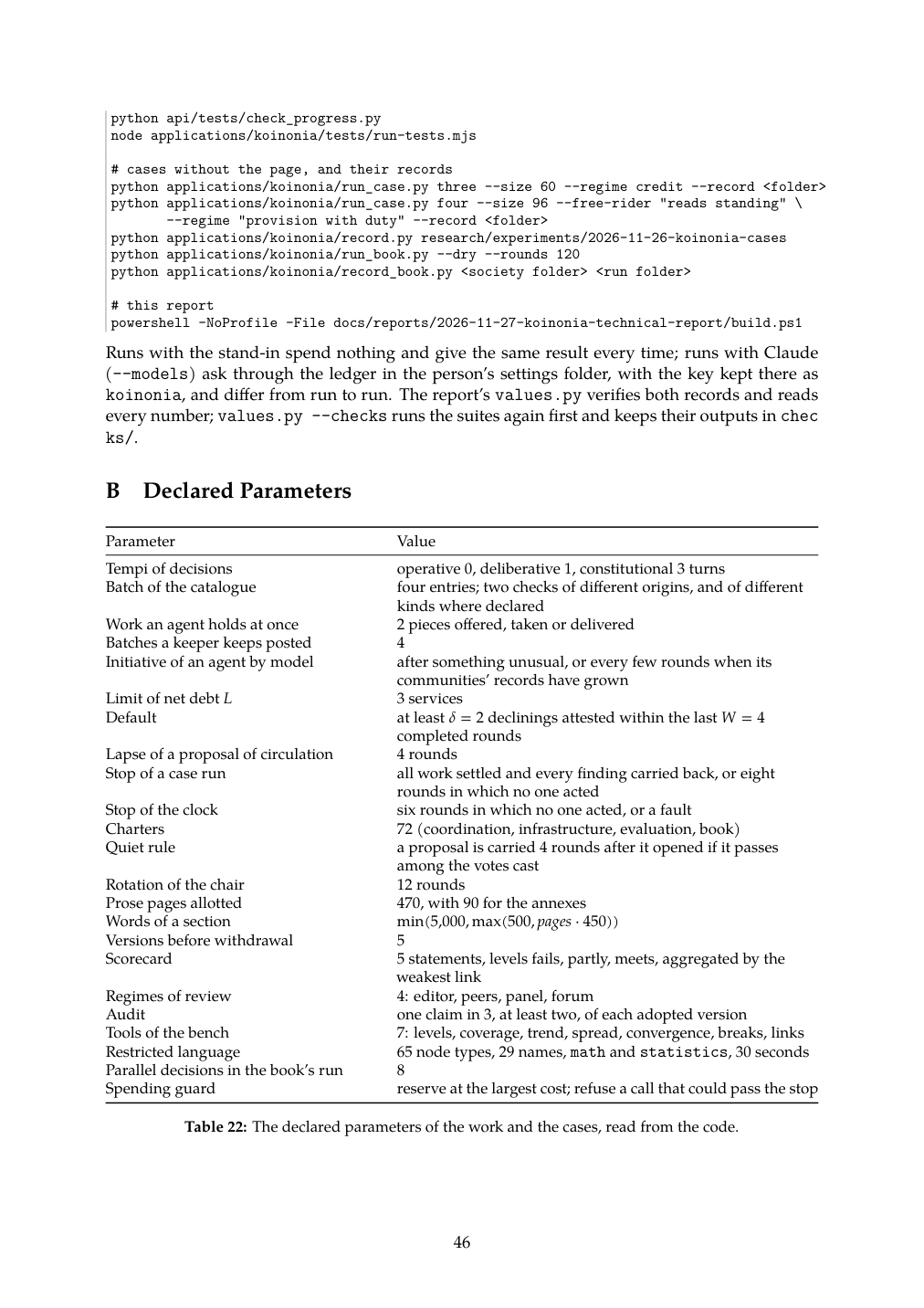
Readable text
Runs with the stand-in spend nothing and give the same result every time; runs with Claude
operative 0, deliberative 1, constitutional 3 turns four entries; two checks of different origins, and of different kinds where declared 2 pieces offered, taken or delivered after something unusual, or every few rounds when its communities’ records have grown completed rounds all work settled and every finding carried back, or eight rounds in which no one acted six rounds in which no one acted, or a fault a proposal is carried 4 rounds after it opened if it passes among the votes cast 470, with 90 for the annexes 5 statements, levels fails, partly, meets, aggregated by the weakest link 4: editor, peers, panel, forum one claim in 3, at least two, of each adopted version 7: levels, coverage, trend, spread, convergence, breaks, links reserve at the largest cost; refuse a call that could pass the stop
Tempi of decisions Batch of the catalogue Work an agent holds at once Batches a keeper keeps posted 4 Initiative of an agent by model 3 services Default Lapse of a proposal of circulation 4 rounds Stop of a case run Stop of the clock Charters Quiet rule Rotation of the chair 12 rounds Prose pages allotted Words of a section Versions before withdrawal 5 Scorecard Regimes of review Audit Tools of the bench Restricted language Parallel decisions in the book’s run 8 Spending guard
Table 22: The declared parameters of the work and the cases, read from the code.