The Structure of Exploitation on Heterogeneous-Value Loops - Gauge Symmetry, Holonomy, and the Loop Deficit
Abstract
A charge of exploitation is made in some description of an economy, and the party charged answers in another. Where the two descriptions differ only in bookkeeping, a charge whose truth changes between them can be defeated without any transfer being altered. This paper takes that observation as a principle and follows it. Admissible charges are the ones constant under the symmetry group of re-descriptions, so the group fixes which charges can be made at all. For value of a single kind the group is abelian and leaves one invariant on each closed circuit, the loop deficit, which registers whether circulation returns. For value of several kinds the group is larger, and the invariant becomes the conjugacy class of a matrix holonomy. Two mechanisms of extraction appear there with no counterpart in the single-kind theory. The first is spectral: a circuit whose holonomy has determinant one closes on every aggregate measure while one kind of value compounds without limit and another is extinguished, so aggregate closure criteria are unable to register kind-wise divergence. The second is sequential: two orders of the same exchanges, with identical rates and identical aggregates, leave a contributor in different positions, so an arrangement can redistribute value by sequencing alone. Conditions of exploitation are then restated on the enlarged group, with kind capture and spectral drift added to the absorption, schema power and blocked return of the single-kind case. The contribution is threefold. The first is a criterion of admissibility for exploitation claims, namely invariance under re-description. The second identifies the spectrum, rather than the determinant, as the object that carries kind-wise information around a circuit. The third is the treatment of the order of exchange as an independent locus of extraction, detectable by comparing two sequences of the same exchanges without observation of a whole circuit.
Keywords: exploitation; gauge symmetry; holonomy; loop deficit; heterogeneous value; circulation; generative relational economics.
Notices
Licence. This work is made available under a Creative Commons Attribution-NonCommercial 4.0 International Licence, CC BY-NC 4.0.
Statement on the use of language models. Drafting, literature search and argumentative criticism for this paper were conducted in dialogue with large language models, specifically Claude (Anthropic) and ChatGPT (OpenAI). The claims, the structure, the selection of material and the position taken are the author’s. References cited have been checked; any that remain unverified are marked in the text.
Companion paper. This paper extends The Geometry of Value: Loop Deficits as Invariant Measures of Structural Exploitation, which develops the single-kind case: the abelian group of re-descriptions, the loop deficit as its invariant, and the separation of that deficit from exploitation in both directions. The present paper enlarges the group. Results of the companion are cited where used, and §15 records where the extension weakens them.
Suggested citation. Huang, W. The Structure of Exploitation on Heterogeneous-Value Loops: Gauge Symmetry, Holonomy, and the Loop Deficit. Working draft.
Discussion Paper Note
This paper is a preliminary discussion paper intended to share an evolving idea and invite further dialogue, criticism, revision, and independent development.
The author does not claim exclusive epistemic ownership over the viewpoints, concepts, or lines of reasoning presented here, nor does the author claim priority as their first originator. Similar or related ideas may have appeared previously in other intellectual, cultural, or disciplinary traditions. Any legal rights retained in this work are intended to support attribution, responsible use, and protection against exploitative or harmful appropriation, and not to restrict independent inquiry, criticism, revision, or further development.
The arguments in this paper should therefore be understood as provisional and historically situated rather than definitive. Readers are encouraged to question, revise, extend, reinterpret, or independently develop the ideas presented here. Where appropriate, acknowledgment of this paper as one point of encounter in the development of related ideas is appreciated, but such acknowledgment should not be understood as granting the author epistemic ownership over the ideas themselves.
Responsible Use and Rights Reservation
The author encourages good-faith discussion, criticism, independent development, and responsible use of the knowledge presented in this work. The author does not claim exclusive epistemic ownership over the ideas or viewpoints discussed herein, nor claim priority as their first originator.
However, the author expressly reserves all rights and remedies available under applicable law with respect to uses of this work or related materials that involve unlawful conduct, harmful or abusive exploitation, improper commercial appropriation, infringement of applicable intellectual property or other legal rights, or conduct contrary to applicable national, regional, or international law.
This reservation is intended to preserve the ability to respond to misuse and harmful appropriation. It should not be interpreted as restricting legitimate academic inquiry, criticism, independent reasoning, or the further development of related ideas.
1. Introduction
A contributor to an open repository supplies review, correction and maintenance, and receives standing in a community. A carer supplies attention, and receives a wage. A supplier of components supplies goods, and receives payment on terms set by the party that assembles them. In each case a charge of exploitation can be made, and in each case the party charged has an answer, delivered in an accounting of its own: the standing is compensation, the wage is the market rate, the terms reflect the risk borne downstream. Neither party is lying. They are describing one arrangement in two registries, and the charge sits in one registry while the answer sits in the other.
This paper takes the situation as its starting point rather than its difficulty. Where two registries describe the same transfers and differ in bookkeeping alone, a charge whose truth changes between them can be defeated by re-description, with no transfer altered and no fact about the world in dispute. A charge that survives every such change of registry has a different standing: the party charged can answer it only by disputing the transfers themselves. The distinction between the two kinds of charge is sharp, it is decidable once the group of admissible re-descriptions is fixed, and it organises everything below. Section 8 states it as a proposition and derives its consequence, which is that admissible charges of exploitation factor through the orbits of the group.
The companion paper carried out this programme for value of a single kind. There a registry assigns one magnitude to each bundle, a re-description rescales one position’s registry, and the group of such rescalings is abelian. The invariants are the return ratios of closed circuits, and the loop deficit, the logarithm of that ratio, is the single quantity each circuit contributes. That paper also established the limits of the quantity: a deficit can exist with no wrong, since consumption opens every circuit it touches, and a wrong can exist at zero deficit, since a circuit that closes exactly may still concentrate capacity at one position.
Value is of several kinds. A contributor’s work is epistemic, the standing returned is relational, the wage is financial, and the care that sustains the wage-earner is neither. Once a position holds a vector of kinds rather than a magnitude, a leg converts kinds as well as amounts, and the group of admissible re-descriptions grows accordingly, from rescalings of a number to changes of basis of a space. The paper’s substantive results follow from that enlargement.
The first result is spectral. A circuit whose matrix holonomy has determinant one closes on every aggregate measure, and the single-kind deficit of that circuit is zero. Its eigenvalues need not be one. Section 10 exhibits a circuit of two kinds in which a bundle circulated ten times becomes five hundred and twenty-nine units of one kind and three thousandths of a unit of the other, with the determinant equal to one at every step. The aggregate closes, and inside the closure one kind compounds while the other is extinguished. Aggregate criteria of circulation, including the companion paper’s, are unable to register this.
The second result concerns order. Matrices do not commute, and the economic content of that arithmetic is that the same exchanges, at the same rates, performed in different sequences, leave a contributor holding different bundles. Section 11 exhibits two sequences with identical rates, identical determinants and identical aggregates, whose outcomes differ. An arrangement that controls sequencing therefore holds an instrument of redistribution that leaves every rate and every total untouched, and no single-kind analysis has a place to record it.
Section 13 restates the conditions of exploitation on the enlarged group, adding kind capture, in which a contributor’s kind is mapped into another and nothing returns to it, and spectral drift, in the sense of §10, to the three conditions inherited from the companion paper. Section 14 takes up measurement, where the enlarged setting turns out to help: traces of holonomies are invariant under change of basis, so a party may learn frame-independent content from a trace without holding the record of a whole circuit. Section 15 states the limits, of which the sharpest is that the decomposition of value into kinds is stipulated by the analyst, and stipulating it is an exercise of exactly the power §8 warns about.
The contributions are three. The first is the admissibility criterion of §8, which applies to any proposed account of exploitation and is independent of the rest of the paper. The second is the identification of the spectrum, in place of the determinant, as the carrier of kind-wise information around a circuit. The third is the treatment of sequencing as a locus of extraction, together with the observation that it is detectable by comparing two orders of the same exchanges, which is a lighter evidential burden than the observation of a whole circuit.
2. Scope, prior formulations, and the discipline on borrowed apparatus
2.1 Scope
The object of the paper is the circulation of value of several kinds among positions of an economy of transfers, with open knowledge platforms and care economies as the motivating cases. Five restrictions bound the claims.
The paper makes no physical claim. No constant, scale, dynamics or mechanism of a physical theory is applied to an economy, and the borrowed vocabulary carries the economic definitions given here and nothing further.
The paper takes no position on whether kinds of value are commensurable. A transport records the conversion an arrangement performs between kinds, at the rate it performs it, and recording a conversion endorses neither its rate nor its propriety. An arrangement that converts care into wages at some rate is described by a transport carrying that rate, and the description is compatible with holding the conversion unjust.
The paper supplies no criterion of justice. Section 13 states conditions under which a charge of exploitation is well founded, and the conditions are jointly necessary rather than sufficient for any verdict about an arrangement as a whole.
The paper proposes no quantity for maximisation. The companion paper showed that a maximand would be a potential and that the object of study is the obstruction to one; the present enlargement makes the obstruction non-abelian and leaves that conclusion intact.
The paper derives no numerical result about an actual economy or platform. The economies exhibited below are constructed to establish possibility and impossibility claims, and they describe no existing arrangement.
2.2 Prior formulations
Four bodies of work own parts of the apparatus, and each is conceded before anything is claimed.
Multi-commodity systems and their spectra. Sraffa(Sraffa, Piero, mph Production of Commodi, n.d.) analyses production as a system of several commodities that reproduces its own inputs, and constructs the standard commodity, a composite in terms of which the system’s rate of surplus can be stated as a single number. That construction is an eigenvector construction, and the associated eigenvalue is the growth factor of the system. Leontief(Leontief, Wassily, mph The Structure of , n.d.) supplies the input-output matrix; Bródy(Br ody, Andr as, mph Proportions, Prices, n.d.), Morishima(Morishima, Michio, mph Marx’s Economics:, n.d.) and Pasinetti(Pasinetti, Luigi L., mph Lectures on the, n.d.) develop the spectral analysis, and the Perron-Frobenius theorem is their principal instrument. The eigenvector that renders a multi-kind system scalar is therefore a century-old object, and the present paper claims no priority in it. The differentiation is one of question rather than of technique: those systems are stated in one accounting throughout, and the question of which of their quantities survive a change of accounting does not arise there. The present paper’s spectral result is a statement about invariants of a group action, and the group is absent from that literature because the accounting is fixed by assumption.
Gauge formulations in economics. Malaney(Malaney, Pia, mph The Index Number Probl, n.d.) identifies the index-number problem as a gauge problem. Ilinski(Ilinski, Kirill, mph Physics of Finance:, n.d.) constructs a gauge theory of financial markets in which curvature is arbitrage. Young(Young, n.d.) formulates the foreign-exchange market as a lattice gauge theory on a graph of currencies, with triangular arbitrage as holonomy. For all three the gauge freedom is a choice of numéraire, basket or currency within an agreed description of what is economic; here the freedom is the valuation frame itself, the registry under which activity counts as economic at all, so a deficit in the present sense survives arbitrage-free pricing.
Representation spaces. The classification of §9 is the space of representations of a free group modulo conjugation, studied as the character variety of a graph or surface group. Atiyah and Bott(Atiyah, Michael F., and Raoul Bott, “Th, n.d.) and Goldman(Goldman, William M., “The symplectic na, n.d.) are the standard references, and Wilson(Wilson, Kenneth G., “Confinement of qua, n.d.) is the source of the trace observable used in §14. The economic reading of these objects is the present paper’s, and their mathematics is not.
Circulation and its kinds. Eglash(Eglash, Ron, “An Introduction to Genera, n.d.) states the circulation criterion adopted here without amendment: generated value is to return to the communities that generated it, and generators are to retain control over the conditions of their production. Work on social reproduction, from Federici(Federici, Silvia, mph Revolution at Poin, n.d.) onward, supplies the substantive case that motivates §10, namely a kind of value that production consumes continuously and returns to only through conversion into another kind. Marx’s(Marx, Karl, mph Capital, Volume II: The , n.d.) circuits of capital supply the loop as an economic unit.
2.3 The discipline on borrowed apparatus
Four rules govern the use of the gauge and representation vocabulary. Each borrowed term receives an economic definition before use. The construction is required to pass an admission test rather than a metaphor test, so the transports of §9 are required to compose along paths and to invert, and the scope is restricted to legs for which they do. Where a concept of the source theory has no economic counterpart, the absence is recorded rather than left implicit; the correspondence table of §9 carries those rows. Where the source theory is unsettled, the paper declines to lean on it.
3. Preliminaries
This section defines the apparatus used below, with one worked instance each: vectors and matrices, the general linear group, eigenvalues and the determinant, invariant subspaces, conjugation and orbits, and the fundamental group of a graph. Each object is used only in the form defined here. The graph vocabulary is unchanged from the companion paper, and is restated in §6.1 so that this paper stands alone.
3.1 Graphs, walks, circuits, spanning trees
A directed multigraph $\Gamma=(V,E)$ consists of a finite vertex set $V$ and a finite edge set $E$, each edge $e$ having a tail $u$ and a head $v$, written $e=(u,v)$. A walk is an alternating sequence of vertices and edges in which each edge joins the vertex before it to the vertex after it, traversed forward from tail to head or backward from head to tail, with repetition permitted. A walk is closed when it ends where it began, and a closed walk is called a circuit here. A spanning tree $T$ is a cycle-free set of edges connecting every vertex; it has $|V|-1$ edges, and between any two vertices there is one walk using tree edges alone. An edge outside $T$ is a chord. Adjoining a chord $e$ to $T$ creates one circuit, the fundamental circuit $\gamma_e$, obtained by following the tree from a fixed root $r$ to the tail of $e$, crossing $e$, and returning along the tree. The number of chords is
$$\rho ;=; |E|-|V|+1 .$$
A triangle on three vertices with three edges has $\rho=1$ by Equation 1, and carries one independent circuit.
3.2 Vectors, matrices, and the general linear group
A bundle of value held at a position is written as a column vector $x\in\mathbb{R}^{n}$, whose $i$-th entry is the amount of the $i$-th kind. A linear conversion of bundles is written as an $n\times n$ matrix $A$, acting by $x\mapsto Ax$, whose entry $A_{ij}$ is the amount of kind $i$ produced per unit of kind $j$ consumed. Composition of conversions is matrix multiplication, and the order of composition is the order of performance: applying $B$ and then $A$ gives $AB$. Matrix multiplication is associative and, in general, order-dependent, so that $AB$ and $BA$ may differ; the difference
$$[A,B] ;=; AB-BA$$
is called the commutator, and $A$ and $B$ commute when Equation 2 vanishes. A matrix is invertible when some $A^{-1}$ satisfies $AA^{-1}=A^{-1}A=I$, where $I$ is the identity matrix; the invertible $n\times n$ matrices form a group under multiplication, written $\GL(n)$, which for $n=1$ is the multiplicative group of non-zero reals used in the companion paper.
As an instance, with two kinds and
$$A=\begin{pmatrix}1&0\ \tfrac12&1\end{pmatrix},\qquad
B=\begin{pmatrix}\tfrac45&0\ 0&\tfrac54\end{pmatrix},$$
$A$ converts half of the first kind into the second while leaving the first intact, and $B$ deducts a fifth of the first kind and adds a quarter to the second. Their commutator is non-zero, as §11 computes.
3.3 Determinant, eigenvalues, invariant subspaces
The determinant $\det A$ scales volumes by its own value, and is multiplicative: $\det(AB)=\det A,\det B$. A non-zero vector $w$ with $Aw=\mu w$ for a scalar $\mu$ is an eigenvector with eigenvalue $\mu$; the eigenvalues of an $n\times n$ matrix are the $n$ roots of $\det(A-\mu I)=0$, and their product is $\det A$. A subspace $S$ is invariant under $A$ when $Ax\in S$ for every $x\in S$; the span of an eigenvector is invariant, and a matrix with a proper invariant subspace can be written in block-triangular form. The trace $\operatorname{tr}A$ is the sum of the diagonal entries, and equals the sum of the eigenvalues.
As an instance, the matrix used throughout §10,
$$\hol=\begin{pmatrix} 1.8 & 0.6\ 0 & 1/1.8 \end{pmatrix},$$
is triangular, so its eigenvalues are its diagonal entries $1.8$ and $1/1.8$, their product is $\det \hol=1$, and the span of the first coordinate is invariant.
3.4 Conjugation, group actions, orbits
A group $G$ acts on a set $X$ when each $g\in G$ gives a map $x\mapsto g\cdot x$ with $e\cdot x=x$ and $g\cdot(h\cdot x)=(gh)\cdot x$. The orbit of $x$ is the set of all $g\cdot x$, and the orbits partition $X$. A function $f$ on $X$ is invariant when it is constant on each orbit, and invariant functions are exactly the functions of the orbit, in the sense that $f$ factors through the map sending each point to its orbit. Conjugation is the action of $\GL(n)$ on itself by $A\mapsto gAg^{-1}$; two matrices in one conjugation orbit represent one conversion written in two bases. The determinant, the trace and the eigenvalues are invariant under conjugation, since $\det(gAg^{-1})=\det A$, $\operatorname{tr}(gAg^{-1})=\operatorname{tr}A$, and $gAg^{-1}$ has the same characteristic polynomial as $A$. Individual entries of a matrix are not invariant, which is the fact that §8 turns into a criterion.
3.5 The fundamental group of a graph
Fix a root $r$. Circuits based at $r$ may be composed by traversing one and then the other, and a circuit followed by its own reverse is treated as the trivial circuit. The resulting group is the fundamental group $\pi_1(\Gamma,r)$, and for a connected graph it is the free group on the $\rho$ fundamental circuits of any spanning tree, with $\rho$ as in Equation 1. Free means that no relation holds among those generators beyond the cancellation of a circuit with its reverse; in particular two generators need not commute. Abelianising the group, which is to say imposing commutativity, yields the first homology $H_1(\Gamma;\mathbb{Z})\cong\mathbb{Z}^{\rho}$, the object that governs the single-kind theory. The distinction between the two is where the present paper’s second result lives.
4. The symmetry group of an accounting
This section fixes the objects on which everything below is defined. The single-kind case of the companion paper is recovered throughout by setting the number of kinds to one.
A transfer network is a finite, connected, directed multigraph $\Gamma=(V,E)$ in the sense of §6.1. A vertex is a position: a party or role at which value is registered. An edge $e=(u,v)$ is a leg: a recurring transfer from $u$ to $v$, such as delivered work, a payment, a provided service, or a contribution to a commons. Recurrence means that the same transfer is performed period after period, so the network describes a standing structure.
Each position $v$ carries a value space $\mathbb{R}^{n_v}$ together with a registry: a choice of basis of that space, in which a bundle held at $v$ is recorded as a column vector. The coordinates of the registry are the kinds of value that $v$ distinguishes, and the entries of a vector are the amounts of each kind. The registry encodes which activity counts as economic at $v$, under which headings, and at what rate.
Each leg $e=(u,v)$ carries a transport $U_e$, a linear map from the value space at $u$ to the value space at $v$, recorded as a matrix in the registries at both ends. Its entry $(U_e)_{ij}$ is the amount of kind $i$ registered at $v$ as received, per unit of kind $j$ registered at $u$ as surrendered.
Three comments fix the reading of Definition ?. The diagonal entries record conversion within a kind, so a payment leg that returns four fifths of what it receives carries $0.8$ on its financial diagonal. The off-diagonal entries record conversion between kinds, so a leg returning standing in a community for epistemic work carries a positive entry from the epistemic column into the relational row. A zero row records a kind that the leg returns nothing to, which is the formal shape of the complaint taken up in §13. Figure 1 sets these objects beside an ordinary circulation and previews the three mechanisms the later sections establish.
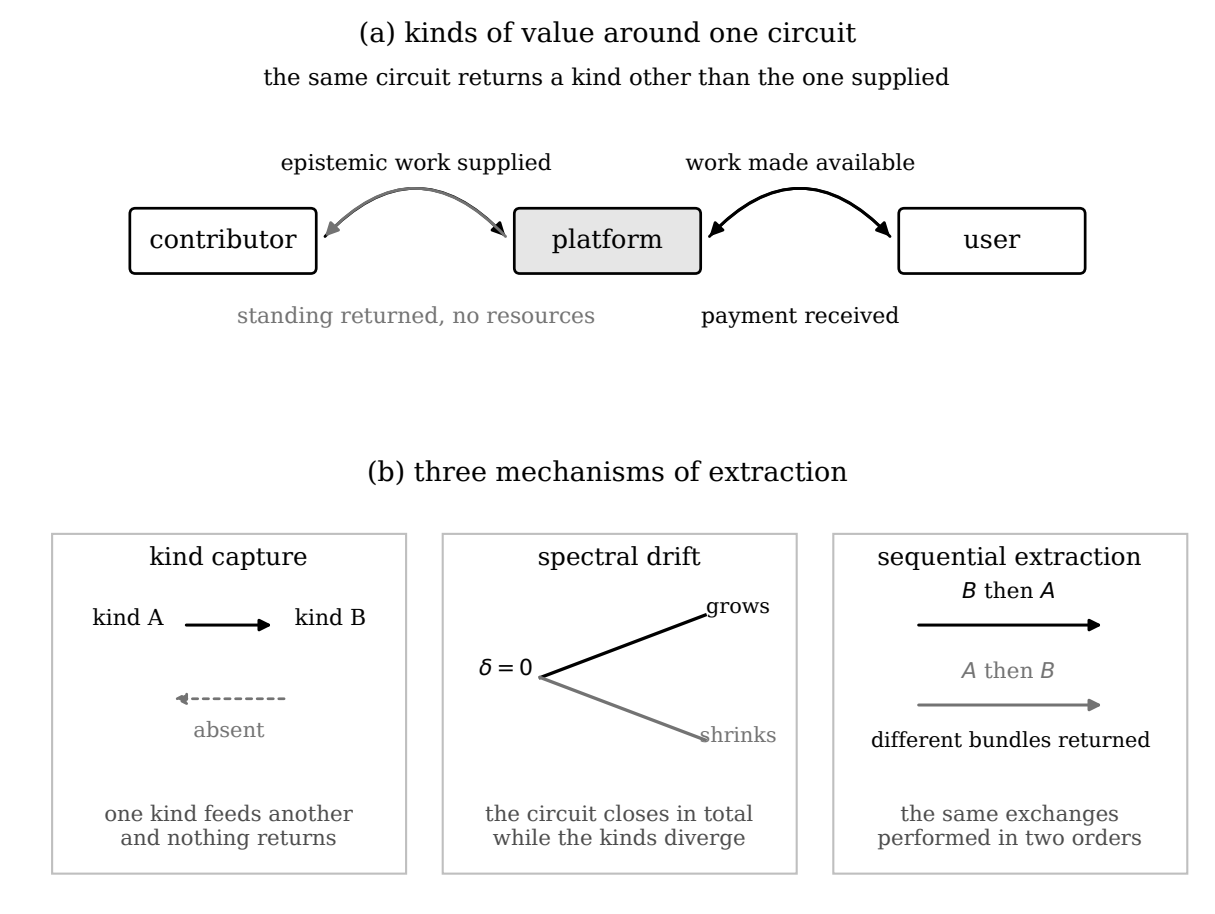
Figure 1. The objects of the paper on an ordinary circulation. Panel (a) shows a circuit in which a contributor supplies work of one kind and receives standing of another, so that the circuit returns a kind other than the one supplied; Definition ? records that pattern as a transport with a non-zero off-diagonal entry and a zero row. Panel (b) sets out the three mechanisms established below. Kind capture is the block-triangular structure of Proposition ?(ii), taken up at Condition ?. Spectral drift is Counterexample ?, where the total deficit vanishes while the spectral deficits carry opposite signs, taken up at Condition ?. Sequential extraction is Counterexample ?, where two orders of the same exchanges return different bundles, taken up at Condition ?.
Each leg converts at fixed rates regardless of the amounts transferred, so the transport acts by $x\mapsto U_e x$; and each transport is invertible, so $U_e\in\GL(n)$ with $n_u=n_v=n$ for every leg.
Assumption ? is an idealisation in three respects, each recorded again among the limits at §15. Linearity excludes thresholds and volume-dependent terms. Invertibility excludes legs whose conversion cannot be run backwards even in principle, and several economically important legs are of that kind. Equality of dimensions excludes positions that distinguish different numbers of kinds, which would give rectangular transports and no group.
Under Assumption ?, transports compose along walks. For a walk $p$ traversing legs $e_1,\dots,e_m$ with $\varepsilon_i=+1$ for forward traversal and $\varepsilon_i=-1$ for backward traversal, one bundle sent along $p$ arrives as $U_p x$, where
$$U_p ;=; U_{e_m}^{\varepsilon_m}\cdots U_{e_1}^{\varepsilon_1}.$$
The order of the factors in Equation 5 is the order of traversal, read from right to left, and carries significance here that it lacked in the single-kind case, since the factors need not commute.
A re-description is a family $g=(g_v)_{v\in V}$ of invertible matrices, one at each position. Position $v$ replaces its registry by the one in which a bundle formerly recorded as $x$ is recorded as $g_v x$. A re-description is local, in that it is performed at a position, requires the cooperation of no other position, and asserts nothing about the world beyond the bookkeeping at $v$. The set of re-descriptions forms a group $\mathcal{G}$ under position-wise multiplication, the symmetry group of the accounting.
A change of registry in the sense of Definition ? covers relabelling a heading, splitting one heading into two, merging two into one, and restating amounts in different units. It leaves untouched which bundles are transferred and to whom.
The action of $\mathcal{G}$ on the transports is derived rather than posited. Let $e=(u,v)$ and let a transfer surrender a bundle recorded as $x$ at $u$, so that by Assumption ? the bundle received at $v$ is recorded as $U_e x$. Under the new registries the surrendered bundle is recorded as $x’=g_u x$ and the received bundle as $g_v U_e x$. Expressing the received record in terms of the surrendered one gives $g_v U_e x = g_v U_e g_u^{-1} x’$, so the transport in the new registries is
$$U’_e ;=; g_v,U_e,g_u^{-1}.$$
Equation 6 is the transformation law of a lattice gauge field, obtained here from bookkeeping. For $n=1$ it reduces to the rule of the companion paper. Two descriptions of one economy are gauge-equivalent when they differ by some $g$ in the sense of Equation 6, and the orbits of $\mathcal{G}$ in the sense of §6.4 are the classes of descriptions that differ in bookkeeping alone.
One restriction on the identification is stated at once, since without it the construction would prove too much. If every difference of valuation counted as a re-description, valuation would make no difference to anything, which is false and which the companion papers argue against at length. The restriction is the one already fixed for interpretation in this series: two registries are gauge-related when the arrangements they induce license the same acts. Registries differing in vocabulary while licensing the same acts are redundant; registries licensing different acts are a degree of freedom of the arrangement rather than a choice of description. Everything below quantifies over the redundant differences alone, and the falsifiable direction is preserved, since a single act available under one registry and unavailable under the other establishes that the difference is substantive.
5. The invariance principle for charges of exploitation
A charge of exploitation is a claim about an arrangement, made on the basis of a description of it. Write $\mathcal{E}$ for the set of transfer networks with transports, and let a charge be a predicate $E$ on $\mathcal{E}$, so that $E(\Gamma,U)$ holds when the charge is well founded of the arrangement as described by $(\Gamma,U)$.
Let $E$ be a charge that is not constant on the orbits of $\mathcal{G}$. Then there is an arrangement $(\Gamma,U)$ of which $E$ holds, and a re-description $g$, such that $E$ fails of $(\Gamma,U’)$ with $U’$ given by Equation 6. The party charged may therefore defeat the charge by adopting $g$, with no transfer altered, no rate renegotiated, and no fact about the world in dispute.
If $E$ is not constant on orbits, some orbit contains a point where $E$ holds and a point where $E$ fails, since a predicate constant on no orbit takes both values somewhere within one. Let $(\Gamma,U)$ be the first and $(\Gamma,U’’)$ the second; being in one orbit, they satisfy $U’’=g\cdot U$ for some $g\in\mathcal{G}$. By Definition ? the passage from $U$ to $U’’$ changes registries alone, so the transfers, their recipients and their amounts in kind are the same in both descriptions.
A charge that resists defeat by re-description is constant on the orbits of $\mathcal{G}$, and therefore factors through the orbit space $\mathcal{E}/\mathcal{G}$ by §6.4. Call such charges admissible. The symmetry group of the accounting fixes which charges of exploitation are admissible, and the content available to any account of exploitation on transfer networks is the content of $\mathcal{E}/\mathcal{G}$.
Three consequences of Corollary ? organise the rest of the paper.
The first is a diagnosis of a familiar impasse. Charges stated at the level of a single transaction, of the form that a contribution was underpaid or a fee was excessive, are ordinarily inadmissible, since the value assigned to a single leg moves freely under Equation 6. The companion paper proves this for one kind, where any leg’s value may be set to any positive number by rescaling one endpoint. The situation in several kinds is no better, and §9 records the corresponding statement. This explains why disputes conducted transaction by transaction tend not to terminate: the parties are exchanging descriptions within one orbit, and the charge under dispute has no orbit-level content to settle.
The second is a research instruction. To find the admissible charges, compute the orbit space. The single-kind case gives one real number per independent circuit, the loop deficit, and the companion paper is the working out of that case. The present paper computes the orbit space for the enlarged group, and the two mechanisms of §10 and §11 are read off it.
The third is a caution that applies to this paper as much as to others. Corollary ? is relative to $\mathcal{G}$, and $\mathcal{G}$ is fixed by a judgement about which differences of registry are redundant. A party able to enlarge $\mathcal{G}$ shrinks the class of admissible charges, since more descriptions become equivalent and fewer functions remain constant on orbits. Control over the boundary of $\mathcal{G}$ is accordingly a form of power over what can be charged at all, and §13 takes it up under the heading of schema power.
6. Enlarging the group: value of several kinds
For $n=1$ the group $\mathcal{G}$ is abelian and the classification is the companion paper’s: the invariants are the return ratios of circuits, one real number for each of the $\rho$ independent circuits of Equation 1. This section states what replaces that classification for $n>1$, and the differences are three.
For a circuit $\gamma$ based at a position $v_0$, traversing legs $e_1,\dots,e_m$ with signs $\varepsilon_i$, the holonomy is the composite transport of Equation 5,
$$\hol(\gamma);=;U_{e_m}^{\varepsilon_m}\cdots U_{e_1}^{\varepsilon_1},$$
a matrix carrying each bundle sent from $v_0$ around $\gamma$ to the bundle that returns.
Under a re-description $g$, the holonomy of a circuit based at $v_0$ transforms by conjugation at the basepoint:
$$\hol’(\gamma);=;g_{v_0},\hol(\gamma),g_{v_0}^{-1}.$$
Consequently the conjugacy class of $\hol(\gamma)$, and every conjugation-invariant function of it, is unchanged by every re-description.
By Equation 6 a forward-traversed leg contributes $g_{v_i}U_{e_i}g_{v_{i-1}}^{-1}$ and a backward-traversed leg contributes $\big(g_{v_{i-1}}U_{e_i}g_{v_i}^{-1}\big)^{-1}=g_{v_i}U_{e_i}^{-1}g_{v_{i-1}}^{-1}$, so in both cases the factor is $g_{v_i}U_{e_i}^{\varepsilon_i}g_{v_{i-1}}^{-1}$. Multiplying along the circuit in the order of Equation 7, each interior pair $g_{v_i}^{-1}g_{v_i}$ cancels, leaving $g_{v_m}\hol(\gamma)g_{v_0}^{-1}$; and $v_m=v_0$ gives Equation 8. The final claim is §6.4: the determinant, the trace and the eigenvalues are conjugation-invariant.
The first difference from the single-kind case is visible in Equation 8. For $n=1$ conjugation is trivial and the holonomy is itself invariant, a number attached to a circuit. For $n>1$ the holonomy is invariant only up to conjugation, so the invariant object is a class rather than a matrix, and the numbers extracted from it are the conjugation-invariant functions: the determinant, the trace, the characteristic polynomial, the eigenvalues.
Moving the basepoint of a circuit from $v_0$ to another position on it conjugates the holonomy by the transport between them, which is a change of the same form as Equation 8. The conjugacy class is therefore a property of the circuit, and the matrix is a property of the circuit together with a position on it. This distinction carries weight in §13: the class states what happens around the circuit, and the matrix at a position states what happens to the party who stands there.
The second difference concerns which circuits are independent. In the single-kind case the holonomy of a composite circuit is the product of the holonomies of its parts, in any order, so the circuits contribute independent coordinates and the relevant object is the abelianised loop group, the homology $H_1(\Gamma;\mathbb{Z})$ of §6.5. For $n>1$ composition of circuits is composition of matrices, which depends on order, so the assignment of holonomies is a homomorphism from the fundamental group $\pi_1(\Gamma,r)$, free of rank $\rho$, which does not descend to the homology. Two circuits through one position now interact: the composite carries information beyond the pair, and §11 shows that the information is economically substantive.
Fix a spanning tree $T$ of $\Gamma$ with root $r$. Then:
- There is a re-description under which $U’_e=I$ for every $e\in T$, unique once $g_r=I$ is fixed.
- In that description each chord carries the holonomy of its fundamental circuit based at $r$, and these $\rho$ matrices may be prescribed arbitrarily in $\GL(n)$.
- Two transport assignments are gauge-equivalent exactly when their holonomies at $r$ agree after a single simultaneous conjugation. The orbit space is accordingly $$\mathcal{E}/\mathcal{G};\cong;\mathrm{Hom}\big(\pi_1(\Gamma,r),\GL(n)\big)\big/\GL(n);=;\GL(n)^{\rho}\big/\GL(n),$$ the $\rho$-fold product of the group modulo simultaneous conjugation, and every admissible charge in the sense of Corollary ? is a function on the space of Equation 9.
(i) For each position $v$ let $P_v$ be the composite transport of Equation 5 along the tree path from $r$ to $v$, which is well defined since that path is unique, with $P_r=I$. Put $g_v=P_v^{-1}$. For a tree leg $e=(u,v)$ with the root on the tail side, the tree path to $v$ is the path to $u$ extended by $e$, so $P_v=U_eP_u$ and Equation 6 gives $U’_e=P_v^{-1}U_eP_u=I$; with the root on the head side, $P_u=U_e^{-1}P_v$ and the same computation applies. For uniqueness, let $g$ and $h$ both fix the root and trivialise the tree. Then $g_vU_eg_u^{-1}=h_vU_eh_u^{-1}=I$ across every tree leg, so $h_v^{-1}g_v$ and $h_u^{-1}g_u$ agree along every tree leg; the tree connects all positions and the two agree at $r$, so they agree everywhere.
(ii) For a chord $e=(u,v)$, Equation 6 gives $U’_e=P_v^{-1}U_eP_u$, which by Equation 5 is the composite along the walk from $r$ to $u$ by the tree, across $e$, and back from $v$ to $r$ by the tree; that walk is the fundamental circuit $\gamma_e$, so $U’_e=\hol(\gamma_e)$ by Equation 7. The chords carry no constraint among them, since the transports of distinct legs are chosen independently, so the $\rho$ matrices range over $\GL(n)^{\rho}$.
(iii) Suppose two assignments are gauge-equivalent. Their holonomies at $r$ then differ by conjugation by the single matrix $g_r$, by Equation 8. Conversely, suppose the holonomies at $r$ of $U$ and $\widetilde U$ satisfy $\widetilde{\hol}(\gamma)=c,\hol(\gamma),c^{-1}$ for one $c$ and every circuit. Place both in the tree gauge of (i). By (ii) each is then determined by its list of fundamental holonomies, and the two lists differ by conjugation by $c$; applying the constant re-description $g_v=c$ for all $v$, which preserves the tree gauge since $cIc^{-1}=I$, carries one list to the other. Hence the assignments are gauge-equivalent. Combining (i), (ii) and this equivalence gives Equation 9, and Corollary ? makes admissible charges functions on it.
The third difference is now visible. In the single-kind case Equation 9 reduces to $\Rpos^{\rho}$, the quotient by conjugation being trivial, and the coordinates are the loop deficits. For $n>1$ the quotient is by simultaneous conjugation of a tuple, which mixes the circuits: a function of one circuit’s holonomy alone is invariant only if it is conjugation-invariant, and functions of several circuits jointly, such as the trace of a product, carry content that the individual circuits do not.
For any leg $e$ with distinct endpoints and any invertible $M$, there is a re-description with $U’_e=M$. Hence no function of a single leg’s transport is admissible in the sense of Corollary ?.
Put $g_v=MU_e^{-1}$ and $g_w=I$ for every $w\neq v$; Equation 6 gives $U’_e=MU_e^{-1}U_e=M$.
Corollary ? extends to several kinds the result the companion paper established for one. The worth of a contribution, the share of a payment attributable to a service, the rate at which one kind was exchanged for another on a given leg: each of these can be set to any invertible matrix by a change of registry at one endpoint, so a charge resting on any of them is defeasible in the sense of Proposition ?. Table 1 records the correspondence between the apparatus and its source, including the concepts the borrowing excludes.
| @p5.4cmp8.6cm@
| Gauge theory | Economy of transfers with several kinds |
|---|---|
| base space | transfer network $\Gamma$ (Def. ?) |
| fibre over a point | value space and registry at a position (Def. ?) |
| structure group | admissible changes of registry, $\GL(n)$ (Def. ?) |
| gauge transformation | re-description of a position’s accounting (Eq. 6) |
| connection, parallel transport | terms of exchange on a leg (Def. ?, Eq. 5) |
| non-abelian structure group | conversion between kinds, order-dependent (Eq. 2) |
| gauge-dependent quantity | worth of a single leg or contribution (Cor. ?) |
| holonomy of a loop | composite conversion around a circuit (Def. ?) |
| conjugacy class of the holonomy | the circuit’s frame-independent content (Lem. ?) |
| Wilson loop, the trace | the measurable of §14 |
| moduli space of flat connections | the space of economies modulo description (Eq. 9) |
| gauge fixing by a maximal tree | an imposed standard accounting (Thm. ?(i)) |
| dynamics, action, Lagrangian | no counterpart taken |
| physical constants and scales | no counterpart taken |
| continuum limit and field equations | no counterpart taken |
| quantisation, amplitudes, interference | no counterpart taken |
Table. The correspondence. Rows above the lower rule are definitional within this paper; rows below it name the concepts of the source theory that the borrowing excludes.
Two rows of Table 1 require comment. The tree-gauge row gives the formal position of a standard accounting: a uniform registry can always be imposed, by Theorem ?(i), and doing so simplifies every book. The imposition is an act performed at a position rather than a discovery about the economy, and the content carried by the circuits is unchanged by it, so a party who knows which accounting was imposed can still compute every invariant. The row also settles a question a reader of the gauge literature will raise: obstructions of the kind that arise when a global gauge is sought on a continuum do not arise here, since a spanning tree exists in every connected graph and may be trivialised in any structure group.
The moduli row is where the paper’s results live. Equation 9 says that an economy, described up to bookkeeping, is a family of $\rho$ conversions read around circuits, considered together and up to one simultaneous change of basis. The next two sections extract from that space the two mechanisms of extraction with no single-kind counterpart.
7. Spectral extraction: closure in total, divergence by kind
The single-kind theory attaches one number to a circuit, the loop deficit, which is zero when the circuit returns what was sent. This section asks which number plays that role for several kinds, finds that the natural candidate is inadequate, and identifies the object that replaces it.
Let $\gamma$ be a circuit with holonomy $\hol(\gamma)$, and let $\mu_1,\dots,\mu_n$ be its eigenvalues, listed with multiplicity. The total deficit and the spectral deficits of $\gamma$ are
$$\delta(\gamma);=;-\ln\big|\det \hol(\gamma)\big|,
\qquad
\delta_i(\gamma);=;-\ln|\mu_i| \quad (i=1,\dots,n).$$
Both are defined on the conjugacy class alone, by §6.4, so both are admissible in the sense of Corollary ?. For $n=1$ the two coincide and reduce to the loop deficit of the companion paper.
$\delta(\gamma)=\sum_{i=1}^{n}\delta_i(\gamma)$.
The determinant is the product of the eigenvalues, so $|\det \hol|=\prod_i|\mu_i|$; taking $-\ln$ and using the product-to-sum property of the logarithm gives the claim.
Lemma ? is the source of the difficulty. A total deficit of zero constrains the spectral deficits to sum to zero, and leaves each of them free. The next counterexample makes the freedom concrete.
Let two kinds be distinguished at each position, and let a circuit carry the holonomy first written at Equation 4:
$$\hol=\begin{pmatrix}1.8 & 0.6\ 0 & 1/1.8\end{pmatrix},
\qquad \det \hol = 1 .$$
By Equation 11 and Definition ? the total deficit is $\delta=0$: the circuit closes on the aggregate measure, and a single-kind analysis of it, obtained by recording only totals, reports a circuit in perfect balance. The eigenvalues are $1.8$ and $1/1.8\approx 0.5556$, so the spectral deficits are $\delta_1\approx-0.588$ and $\delta_2\approx 0.588$, summing to zero as Lemma ? requires. A bundle $x_0=(1,1)$ circulated $t$ times becomes $\hol^{t}x_0$, and
$$\hol^{1}x_0=\begin{pmatrix}2.400\ 0.556\end{pmatrix},\quad
\hol^{3}x_0=\begin{pmatrix}8.561\ 0.171\end{pmatrix},\quad
\hol^{5}x_0=\begin{pmatrix}27.98\ 0.053\end{pmatrix},\quad
\hol^{10}x_0=\begin{pmatrix}529.2\ 0.0028\end{pmatrix}.$$
The first kind compounds without limit and the second is driven toward extinction, around a circuit whose aggregate closes exactly at every period. Figure 2 plots the trajectory of Equation 12 together with the two spectral deficits.
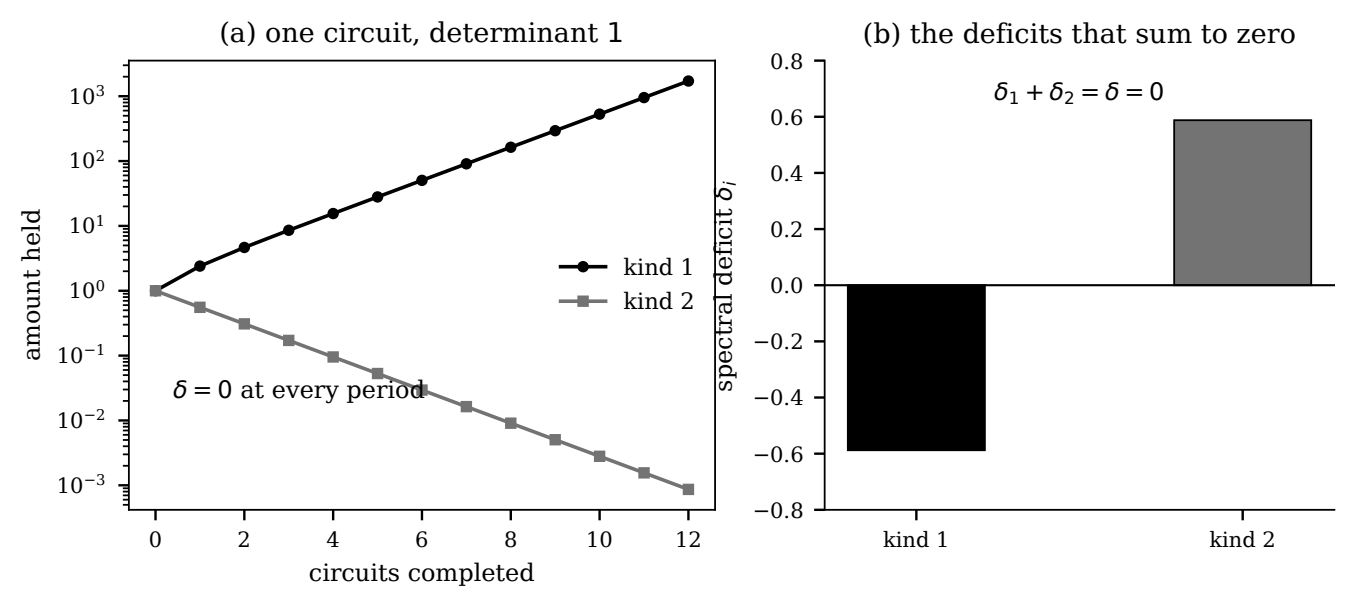
Figure 2. Aggregate closure with divergence by kind, from Counterexample ?. Panel (a) circulates the bundle $(1,1)$ around the circuit of Equation 11, whose holonomy has determinant $1$, so the total deficit is zero at every period and the circuit closes on every aggregate measure. On a logarithmic scale the first kind compounds and the second contracts, reaching $529.2$ and $0.0028$ after ten circuits. Panel (b) shows the two spectral deficits of Definition ?, which are equal in magnitude and opposite in sign, summing to the total deficit as Lemma ? requires.
No function of $\delta$ alone distinguishes a circuit that returns each kind as sent from a circuit that compounds one kind and extinguishes another. In particular, a criterion requiring circulation to close, applied to aggregates, is satisfied by the arrangement of Counterexample ?.
The circuit with $\hol=I$ has $\delta=0$ and returns every bundle unchanged; the circuit of Counterexample ? has $\delta=0$ and the trajectory of Equation 12. A function of $\delta$ takes one value on both.
Corollary ? stands in the same relation to the companion paper as that paper’s drift counterexample stood to circulation criteria stated on flows. There a circuit closed while stocks concentrated, and the wrong was invisible because the deficit is an observable of the legs while the concentration lived in the holdings. Here the concentration has moved into the legs themselves: the holonomy of Counterexample ? carries the divergence in its own spectrum, and a heterogeneous analysis registers internally what the single-kind analysis could reach only by adding a separate account of stocks. The spectral deficits are the objects that carry it.
The eigenvalues of a real matrix may occur in complex conjugate pairs, in which case $|\mu_i|$ remains defined and Equation 10 continues to make sense, while the interpretation of an individual $\delta_i$ as the deficit of a kind lapses, since no single kind is preserved by the circuit. What survives in general is the spectral radius $\max_i|\mu_i|$, which governs the growth of $|\hol^{t}x_0|$ for a generic bundle, and the associated deficit $-\ln\max_i|\mu_i|$, which is negative exactly when some direction of value compounds. Where the holonomy has non-negative entries, the Perron-Frobenius theorem supplies a real leading eigenvalue with a non-negative eigenvector, and the compounding direction is then a genuine composite of kinds. That composite is Sraffa’s standard commodity in the present notation, and the concession of §5.2 applies with full force: the construction is his, and the addition made here is the invariance of the eigenvalue under change of registry, which renders a charge resting on it admissible by Corollary ?.
The structure of a holonomy carries three further readings, each stated as a property of the matrix and each with an economic counterpart.
Let $\gamma$ be a circuit with holonomy $\hol$.
- A subspace $S$ invariant under $\hol$ is a composite of kinds that circulates on its own: bundles in $S$ return to $S$, and their circulation is described by the restriction of $\hol$ to $S$.
- If $\hol$ is block-triangular with respect to a decomposition into $S$ and a complement, with the off-diagonal block non-zero, then the circuit converts the complement into $S$ and returns nothing from $S$ to the complement.
- If $\hol$ has no invariant subspace other than the trivial ones, no composite of kinds is sustained by the circuit independently of the rest.
(i) is the definition of invariance in §6.3, together with the observation that the restriction of a linear map to an invariant subspace is a linear map of that subspace. For (ii), block-triangularity says that bundles in $S$ return to $S$ while bundles in the complement acquire a component in $S$; a non-zero off-diagonal block is exactly a non-zero such component, and the vanishing of the other off-diagonal block is the absence of a return. (iii) is the definition of irreducibility together with (i).
The holonomy of Counterexample ? is of type (ii): the first kind is invariant, and the second is converted into the first at the rate $0.6$ with nothing returned. In the case that motivates the paper, a contributor supplies work of one kind and receives standing of another, the standing does not reconvert, and the aggregate nevertheless balances. Proposition ?(ii) is the formal statement of that arrangement, and §13 states the conditions under which it grounds a charge.
8. Sequential extraction: the order of exchange
Matrices compose in an order, and the order matters. This section establishes what follows economically, and the result has an unusual shape: the mechanism is invisible to every invariant of a circuit taken by itself, and visible in the bundle a party actually receives.
Suppose the transports of $\Gamma$ commute pairwise and are simultaneously diagonalisable. Then there is a re-description after which every transport is diagonal, and the economy separates into $n$ single-kind economies on the same network, one for each diagonal entry. Every result of the companion paper applies to each separately, and the spectral deficits of Definition ? are the loop deficits of those $n$ economies.
Simultaneously diagonalisable transports share an eigenbasis; let $c$ be the matrix carrying the standard basis to it, and apply the constant re-description $g_v=c^{-1}$ for every $v$, which by Equation 6 replaces each $U_e$ by $c^{-1}U_ec$, a diagonal matrix. Diagonal matrices act coordinate-wise, so the $i$-th coordinate of a bundle is transported by the $i$-th diagonal entries alone and never mixes with the others. Each coordinate therefore carries a single-kind transfer network in the sense of the companion paper, and by Equation 7 the $i$-th diagonal entry of a holonomy is the product of the $i$-th entries around the circuit, which is that economy’s return ratio and, by Equation 10, has $-\ln$ of its modulus equal to $\delta_i$.
Proposition ? locates the paper’s subject precisely. Value of several kinds, by itself, adds nothing beyond bookkeeping if the conversions commute, since the arrangement is then $n$ separate economies written together. The content of heterogeneity is the failure of commutativity, and the following counterexample exhibits its economic form.
Let two kinds be distinguished, and let the two operations first written at Equation 3 be available:
$$A=\begin{pmatrix}1&0\ \tfrac12&1\end{pmatrix},
\qquad
B=\begin{pmatrix}\tfrac45&0\ 0&\tfrac54\end{pmatrix}.$$
In Equation 13, $A$ converts half of the first kind into the second and leaves the first intact, as when effort already supplied is also credited as relational standing. $B$ deducts a fifth of the first kind and adds a quarter to the second, as when a fee is levied and a credit issued. Performing $B$ and then $A$ gives $AB$; performing $A$ and then $B$ gives $BA$. The two agree on every conjugation invariant, since $BA=A^{-1}(AB)A$: the determinants are both $1$, the traces both $2.05$, and the eigenvalues both ${1.25,,0.8}$. They differ in what they do to a bundle. Starting from $x_0=(1,1)$,
$$AB,x_0=\begin{pmatrix}0.80\ 1.65\end{pmatrix},
\qquad
BA,x_0=\begin{pmatrix}0.80\ 1.875\end{pmatrix},
\qquad
[A,B],x_0=\begin{pmatrix}0\ -0.225\end{pmatrix}.$$
By Equation 14 the party holding $x_0$ ends with the same amount of the first kind under either order, and with $0.225$ less of the second when the fee is levied before the crediting rather than after; Figure 3 displays the comparison. No rate has changed, no aggregate has changed, and no invariant of the circuit has changed.
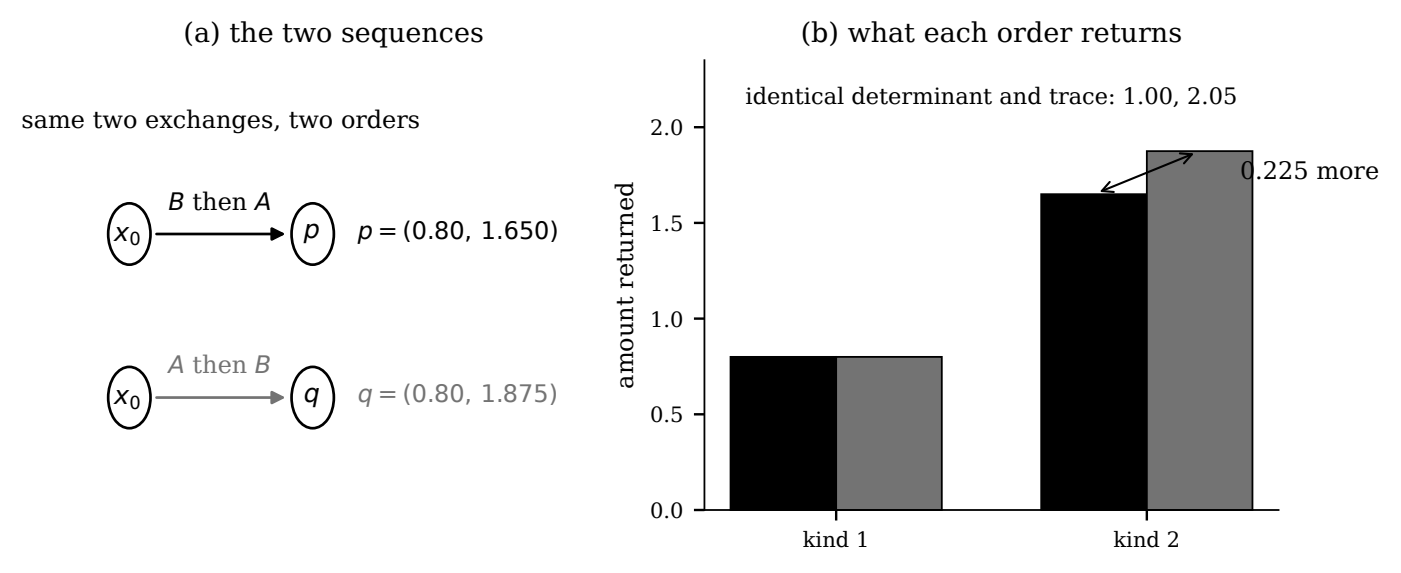
Figure 3. Two orders of the same exchanges, from Counterexample ?. Panel (a) applies the operations $A$ and $B$ of Equation 13 in the two possible orders to the same starting bundle. Panel (b) shows the bundles returned. The first kind is unaffected by the order, and the second differs by $0.225$. The two composites have the same determinant, $1.00$, the same trace, $2.05$, and the same eigenvalues, so every invariant of the circuit agrees while the party at the basepoint receives different bundles.
Let $A$ and $B$ be transports composable in either order around a circuit based at $v_0$.
- The products $AB$ and $BA$ are conjugate, so they lie in one conjugacy class and agree on every conjugation-invariant function, among them the total and spectral deficits of Definition ?.
- Under a re-description the commutator at $v_0$ transforms covariantly: $$[A,B];\longmapsto;g_{v_0},[A,B],g_{v_0}^{-1}.$$ Its vanishing is therefore invariant, and whether the two orders return the same bundle to the party at $v_0$ is a fact independent of every registry.
- The returned bundles themselves transform covariantly, $ABx_0\mapsto g_{v_0}(ABx_0)$, so a comparison between them made at $v_0$ is a comparison of two records in one registry and is unaffected by re-description.
(i) $BA=A^{-1}(AB)A$, so the two are conjugate by $A$; conjugation invariants agree by §6.4, and Definition ? depends on the determinant and the eigenvalues alone. (ii) Both $A$ and $B$ transform by Equation 8 with the same $g_{v_0}$, so each product transforms by conjugation and so does their difference, which is Equation 15; a matrix conjugated by an invertible matrix vanishes exactly when the original does. (iii) A bundle recorded as $x_0$ at $v_0$ is recorded as $g_{v_0}x_0$ after re-description, and the transported bundle likewise, by Definition ? and Equation 6.
Proposition ? gives the mechanism a precise standing. By clause (i), an analysis conducted at the level of a circuit’s invariants is blind to sequencing: the two orders are one point of the space in Equation 9. By clauses (ii) and (iii), the difference is nonetheless a fact about the party at the basepoint, stated in that party’s own registry and unchanged by any change of registry anywhere. The mechanism therefore belongs to the position-level content noted in Remark ?, where the class describes the circuit and the matrix at a position describes the party who stands there.
Three features of the mechanism bear on the cases the paper is written for. An arrangement can redistribute value by sequencing alone, without altering a rate, a price, or a total, so an audit that recomputes rates and totals will find nothing. The instances are ordinary: payment before or after delivery, credit extended before or after a conversion, recognition granted before or after a contribution has been used by others, and the settlement of a fee before or after the crediting it is deducted from. The evidential burden is comparatively light, since a commutator is exhibited by comparing two orders of the same exchanges, which is a comparison within one position’s records, where the deficits of §10 require the transports of a whole circuit.
Clause (iii) of Proposition ? supports comparisons between whole bundles. A claim about a particular kind, of the form that the party lost $0.225$ units of the second kind, additionally presupposes that the decomposition into kinds is part of the arrangement rather than a coordinate chosen by the analyst, since a change of registry mixes the kinds. Where the arrangement itself distinguishes the kinds, by paying in one and crediting in another, the decomposition is given and the claim stands. Where the analyst supplies the decomposition, the claim inherits the analyst’s choice, and §15 records this as a limit rather than resolving it.
9. Phase, and its proper place
A natural proposal for encoding kinds of value assigns each conversion a modulus and an angle, taking transports in the multiplicative group of non-zero complex numbers,
$$U_e;=;\rho_e,e^{\mathrm{i}\theta_e},
\qquad \rho_e>0,\quad \theta_e\in(-\pi,\pi],$$
with the modulus recording how much is converted and the angle recording into what. This section states what Equation 16 delivers and where it stops.
What it delivers is a second invariant on every circuit. The group of Equation 16 is abelian, so the holonomy of a circuit is invariant outright rather than up to conjugation, and Lemma ? specialises to the telescoping argument of the companion paper. Each circuit then carries a pair,
$$\delta(\gamma);=;-\sum_i \varepsilon_i\ln\rho_{e_i},
\qquad
\Theta(\gamma);=;\sum_i \varepsilon_i,\theta_{e_i}\ \ (\mathrm{mod}\ 2\pi),$$
and the second component registers a situation the single-kind theory has no room for. A circuit with $\delta(\gamma)=0$ and $\Theta(\gamma)\neq 0$ returns the full magnitude sent, in a kind other than the one sent: closure in quantity together with failure of closure in kind. That is the coarse form of the phenomenon §10 treats in detail, and Equation 17 states it with two numbers per circuit.
Where the proposal stops is fixed by the arithmetic of Equation 16. Composing two legs adds their angles, so the encoding presupposes an economic operation to which addition of kind-angles corresponds, and it further presupposes that the sum is meaningful modulo $2\pi$, which is to say that kinds compose cyclically: converting through a sequence of kinds and continuing far enough returns to the kind of departure. Some conversions have that character, as when a contribution is credited, the credit is spent, and the spending is again recorded as contribution. Many do not. Where the cycle is finite and known, a finite cyclic group is the candid choice, since it records the actual number of kinds rather than embedding them in a continuum. Where kinds neither cycle nor compose commutatively, Equation 16 supplies a coordinate without a referent.
The decisive limitation is structural rather than interpretive. The group in Equation 16 is the one-dimensional unitary group together with a scale, hence abelian, so by Proposition ? an economy described by it separates into single-kind economies and carries no order dependence whatever. Phase encodes which kind a quantity is in. It does not encode a conversion that fails to commute with another, and the mechanism of §11 lies outside its reach. The proper place of the phase encoding is accordingly as a special case: it is the abelian corner of the matrix model, useful where kinds are cyclic and conversions commute, and superseded by §9 elsewhere.
Two exclusions are recorded at the point of definition, as §5 requires. The angle of Equation 16 carries no connotation of amplitude, probability, superposition or interference, and no argument below draws on any. The paper likewise makes no claim that the kinds of value distinguished by an actual arrangement compose cyclically; where they do not, the phase reading lapses and the matrix model remains.
10. Conditions of exploitation on the enlarged group
The companion paper states three joint conditions under which a charge of exploitation is well founded in the single-kind case: a persistent deficit on a circuit, absorbed at an identifiable position; control of the accounting schema by that position; and the absence of any act by which the depleted party could close its own account. This section restates them for several kinds and adds the two mechanisms established above. Throughout, the conditions are stated per depleted position, and none of them aggregates across persons.
Two definitions are required first, since the terms carry weight.
Let a circuit $\gamma$ pass through position $v$, and let the arrangement operate in steady flow, so that in each period $v$ surrenders a bundle recorded as $x_v$ and receives a bundle recorded as $y_v$, both in $v$’s own registry. The retention at $v$ is the pair $(x_v,y_v)$, considered up to the simultaneous re-description $x_v\mapsto g_vx_v$, $y_v\mapsto g_vy_v$. Position $v$ is depleted in a direction when some linear functional $f$ with $f(x_v)>0$ satisfies $f(y_v)<f(x_v)$ in every period.
Definition ? is stated with a functional rather than a coordinate because a coordinate presupposes the kind decomposition, and Remark ? records why that presupposition is not free. Where the arrangement itself distinguishes kinds, by paying in one and crediting in another, the functionals picking out those kinds are given by the arrangement and the definition specialises to the coordinate form.
Let $\gamma$ carry $\delta(\gamma)>0$ in the sense of Definition ?. A position $b$ absorbs the deficit when there is a refinement of $\Gamma$, obtained by adjoining $b$ and rerouting one or more legs of $\gamma$ through it, under whose steady flow the retention of every original position on $\gamma$ is unchanged while the circuit through $b$ has total deficit zero. The value missing from the circuit as first described reappears as $b$’s registered net gain.
A circuit $\gamma$ carries $\delta(\gamma)>0$ in every period over which it recurs, and an identifiable position $b$ absorbs it in the sense of Definition ?.
The absorbing position fixes the registries in which legs are valued, or fixes which transfers are recorded as legs at all, or fixes the decomposition of value into kinds. By Corollary ? the boundary of the symmetry group determines which charges are admissible, so a position holding any of these powers determines in part which charges may be brought against it.
No act available to the depleted position establishes or re-opens a leg toward it whose inclusion would restore its retention, and the performance of such acts as are available places the absorbing position under no obligation to answer.
To these the enlargement adds two further conditions, each corresponding to a mechanism established above and each stated so that its presence or absence is settled by an admissible quantity.
There is a decomposition of the value space, given by the arrangement in the sense of Remark ?, and a circuit $\gamma$ through the depleted position whose holonomy is block-triangular with respect to it, in the sense of Proposition ?(ii), with the depleted position surrendering in the converted block and receiving in the invariant one. The kind supplied is converted into the kind returned, and the circuit returns nothing to the kind supplied.
A circuit through the depleted position has total deficit zero, or near zero, together with spectral deficits of both signs in the sense of Definition ?, and the depleted position’s retention lies in a direction whose spectral deficit is positive. The aggregate accounting of the circuit balances while the direction in which the position holds value contracts period by period.
Two orders of the same exchanges are available around a circuit through the depleted position; the commutator of the corresponding transports is non-zero at that position, by Equation 15; the order performed returns the smaller bundle to the depleted position under a functional given by the arrangement; and the choice of order lies with another position.
Three remarks fix how the conditions are meant to be used.
They are jointly necessary and severally insufficient, and each is stated so that its failure is as informative as its satisfaction. A circuit exhibiting Condition ? without Condition ? describes a party who is contracting in some direction and holds acts by which the contraction may be raised, which is an ordinary feature of arrangements that no one calls exploitative. The companion paper’s counterexamples survive the enlargement unchanged: final consumption opens a circuit without wronging anyone, and a circuit may close in every sense examined here while capacity concentrates in holdings that no transport describes.
They divide according to the level at which the evidence lives, which bears directly on who is able to bring a charge. Conditions ?, ? and ? are stated on the conjugacy class of a holonomy, so establishing them requires the transports around a whole circuit. Condition ? is stated at a position, by Proposition ?(ii) and (iii), so establishing it requires two orders of the same exchanges as recorded by the party who receives them. A depleted party ordinarily holds records of the second kind and lacks records of the first, which makes the sequential condition the one such a party is positioned to establish on its own.
They answer, in part, a question left open by the loop-observables paper of this series, which set a criterion defined on circuits against a criterion a person may invoke on his own behalf, and recorded the tension as unresolved. Remark ? supplies the missing distinction. A conjugacy class describes a circuit and belongs to no one on it; the matrix at a position, acting on that position’s own bundle, describes what the circuit does to the party standing there, and transforms covariantly with that party’s registry by Proposition ?(iii). The per-person quantity the earlier paper wanted is the action of the holonomy at the position of the person concerned. The resolution is partial, since Conditions ?, ? and ? continue to require circuit-level information that a single party seldom holds.
11. Observability
An account that identifies an invariant no party can compute has produced a result and no instrument. This section states what the enlarged setting requires of an observer, and where it improves on the single-kind case.
Three levels of information are distinguished. The circuit level is the sequence of transports around a closed circuit, from which the holonomy and its conjugacy class follow by Definition ?. The position level is the record of bundles surrendered and received at one position, together with the orders in which exchanges were performed. The trace level sits between them.
For every circuit $\gamma$, the quantities $\operatorname{tr}\hol(\gamma)^{k}$ for $k=1,2,\dots$ are invariant under every re-description, and for an $n\times n$ holonomy the first $n$ of them determine the characteristic polynomial, hence the eigenvalues, hence the total and spectral deficits of Definition ?.
Invariance is Lemma ? together with the conjugation-invariance of the trace recorded in §6.4. The power sums $p_k=\operatorname{tr}\hol^{k}$ are the power sums of the eigenvalues, and Newton’s identities express the elementary symmetric functions, which are the coefficients of the characteristic polynomial, in terms of $p_1,\dots,p_n$. The eigenvalues are the roots of that polynomial, and Equation 10 is a function of their moduli.
The economic content of Proposition ? is that a party who can observe how a standard bundle fares around a circuit, without observing the individual conversions, recovers the admissible circuit-level content in its entirety. Repeated circulation supplies the higher powers, since $\operatorname{tr}\hol^{k}$ concerns a bundle sent around $k$ times. What the trace does not supply is the position at which any part of the deficit is retained, which is the content of Definition ? and belongs to the position level.
The single-kind case admits a sharper statement of the difficulty, and the companion paper makes it: computing a loop deficit requires the transports of every leg on the circuit, and in a platform economy the only party holding the complete circuit record is ordinarily the intermediary. That difficulty persists here for Conditions ?, ? and ?. Two features of the enlarged setting soften it. First, by Proposition ?, aggregate observation of circulated bundles substitutes for leg-by-leg records, and such observation is available to a party who can send a bundle around and receive what returns. Second, by Proposition ?, the sequential condition is settled at a position, so a depleted party can establish Condition ? from its own records alone.
The disclosure consequence of the companion paper therefore narrows rather than disappears. Circuit-level disclosure remains the condition under which a party other than the intermediary can establish the class-level conditions. Where such disclosure is refused, the position-level conditions remain available, and an account of exploitation that rests on them is weaker in what it establishes and stronger in who is able to establish it.
12. Limits
Seven limits, in decreasing order of severity.
First, the decomposition of value into kinds is stipulated, and stipulating it is an exercise of the power described in Condition ?. Remark ? confines the damage by resting the position-level claims on functionals the arrangement itself supplies, and Conditions ? and ? are stated with the same restriction. The confinement is partial. An analyst who chooses the kinds chooses which block-triangular structures are visible, and the paper offers no procedure for fixing the kinds from the arrangement alone.
Second, Assumption ? fails for the legs of greatest interest. Invertibility excludes conversions that cannot be run backwards, and the conversion of care into labour power, or of attention into a completed work, is of that kind. Where transports fail to invert, the composite of Equation 5 remains defined and the group structure does not, so Theorem ? and everything resting on conjugacy classes lapses. Linearity likewise excludes thresholds and volume-dependent terms. The paper’s results hold for legs admitting invertible linear conversion, and several of the arrangements that motivate it contain legs that do not.
Third, equality of dimensions across positions is assumed. Positions that distinguish different numbers of kinds give rectangular transports, for which composition is defined and inversion is not, and the classification of §9 has no counterpart there. Since a difference in how many kinds a position distinguishes is itself an economically significant asymmetry, the assumption removes a phenomenon worth studying.
Fourth, Perron-Frobenius theory already covers a substantial part of §10 in the non-negative case, as §5.2 concedes, and the differentiation rests entirely on invariance under change of registry. A reader who holds that the accounting of an economy is fixed by its material structure, so that the group of §7 is trivial, will regard the spectral results as a restatement of the classical ones.
Fifth, the empirical burden is heavier than in the single-kind case. Establishing a conjugacy class requires transports as matrices, and an arrangement that records only totals supplies determinants at best. The trace observables of §14 reduce the burden without removing it.
Sixth, the magnitudes carry no interpretation. The paper distinguishes zero from non-zero deficits and positive from negative spectral deficits; it attaches no social meaning to any particular value, and Corollary ? blocks the reading of any threshold as a verdict.
Seventh, the invariance principle of §8 is relative to the symmetry group, and the group is fixed by a judgement about which differences of registry leave the available acts unchanged. That judgement is made in the same conditions the paper studies, by parties with unequal standing to make it. The principle is therefore an instrument for assessing charges once the group is agreed, and it supplies no method for settling disagreements about the group itself.
The paper’s established claims are these. Charges of exploitation that vary under re-description are defeasible by re-description, so admissible charges are functions on the space of Equation 9. For value of one kind that space carries one number per circuit. For value of several kinds it carries a conjugacy class per circuit, considered jointly and up to simultaneous change of basis, and two mechanisms of extraction live there with no single-kind counterpart: a circuit may close in aggregate while one kind compounds and another is extinguished, and two orders of the same exchanges may leave a party holding different bundles while every invariant of the circuit agrees.
References
Atiyah, Michael F., and Raoul Bott, “The Yang-Mills equations over Riemann surfaces,” Philosophical Transactions of the Royal Society A 308, 1983, 523–615.
Bródy, András, Proportions, Prices and Planning, North-Holland, 1970.
Eglash, Ron, “An Introduction to Generative Justice,” Teknokultura 13(2), 2016, 369–404.
Federici, Silvia, Revolution at Point Zero: Housework, Reproduction, and Feminist Struggle, PM Press, 2012.
Goldman, William M., “The symplectic nature of fundamental groups of surfaces,” Advances in Mathematics 54(2), 1984, 200–225.
Ilinski, Kirill, Physics of Finance: Gauge Modelling in Non-Equilibrium Pricing, Wiley, 2001.
Leontief, Wassily, The Structure of American Economy, 1919–1929, Harvard University Press, 1941.
Malaney, Pia, The Index Number Problem: A Differential Geometric Approach, PhD dissertation, Harvard University, 1996.
Marx, Karl, Capital, Volume II: The Process of Circulation of Capital, 1885.
Morishima, Michio, Marx’s Economics: A Dual Theory of Value and Growth, Cambridge University Press, 1973.
Pasinetti, Luigi L., Lectures on the Theory of Production, Columbia University Press, 1977.
Sraffa, Piero, Production of Commodities by Means of Commodities, Cambridge University Press, 1960.
Wilson, Kenneth G., “Confinement of quarks,” Physical Review D 10(8), 1974, 2445–2459.
Young, K., “Foreign exchange market as a lattice gauge theory,” American Journal of Physics 67(10), 1999, 862–868. thebibliography